A Better Monetary Policy Needs a Better Market
NRB's four-page monetary policy is a genuine reform. The problem is Nepal hasn't built the institutions that make it work.
Nepal Rastra Bank's twenty-fifth monetary policy runs to four pages, and the Governor's address announcing it lasted five minutes. This is a real reform, borrowed from central banks that do it well. Whether it works here depends on three conditions, and Nepal currently meets one of them.
One clarification about what this piece is not. It is not a complaint that NRB should have written more. Length is not a virtue and Nepali official documents have historically confused the two. A sixty-page policy that buries three consequential provisions in paragraph forty is worse in every respect than four pages that state them plainly, and anyone arguing otherwise is defending habit rather than transparency.
What actually happened on 8 July
Governor Dr Bishwanath Paudel released the monetary policy for fiscal year 2083/84. It was the twenty-fifth since the practice began in FY2059/60 under the Nepal Rastra Bank Act.
The main document ran to four pages. The Governor's formal address lasted five minutes, against the lengthy presentations of previous years. This was possible because the review of the current year's policy and the comprehensive macroeconomic report had already been published as separate documents, ahead of the announcement.
Domestic coverage called it a modernisation and a radical departure from established norms. Both descriptions are accurate.
For context on what changed: the twenty-four preceding policies were by the same coverage's account, accompanied by lengthy presentations in which the Governor walked through the economic assessment before arriving at the decisions. That ritual is what the five-minute address replaced. The decisions themselves were announced in both formats; what disappeared was the spoken reasoning that surrounded them.
We want to take the reform seriously rather than treat brevity as evasion because the case for it is genuinely strong and is not being made anywhere in Nepali commentary. So this piece runs in an unusual order: the argument in favour first, stated as forcefully as we can put it, and then the three conditions that argument depends on, tested one at a time against the country the policy is written for.
The case for a four-page policy
A monetary policy statement has two jobs that pull against each other. It must commit the central bank to specific actions, and it must explain the reasoning well enough that the commitment is credible. Bundling both into one long document does neither well: the commitments get buried in analysis, and the analysis gets compressed to fit around the commitments.
Mature central banks separate them. A short statement carries the decision. A longer report carries the evidence, the forecasts and the methodology. The Bank of England, the European Central Bank and the Reserve Bank of India all publish in roughly this shape.
The separation improves accountability rather than reducing it. Four pages of commitments can be checked line by line against outcomes twelve months later. Sixty pages of interleaved narrative and directive cannot, which is precisely why long policy documents are easier to write and harder to hold anyone to.
It also gets the incentives right internally. If the analysis is published separately and in advance, it has to stand on its own. It cannot be reverse-engineered to justify a decision already taken, because it went out first.
That last point deserves emphasis because it is the strongest version of the argument. NRB published the macroeconomic report and the implementation review before the announcement. A central bank that publishes its analysis in advance has made it harder for itself to fit the reasoning to the conclusion. That is a genuine accountability gain and it should be recognised as one.
So the reform is defensible on its own terms. The question is whether the conditions it presumes are present in Nepal.
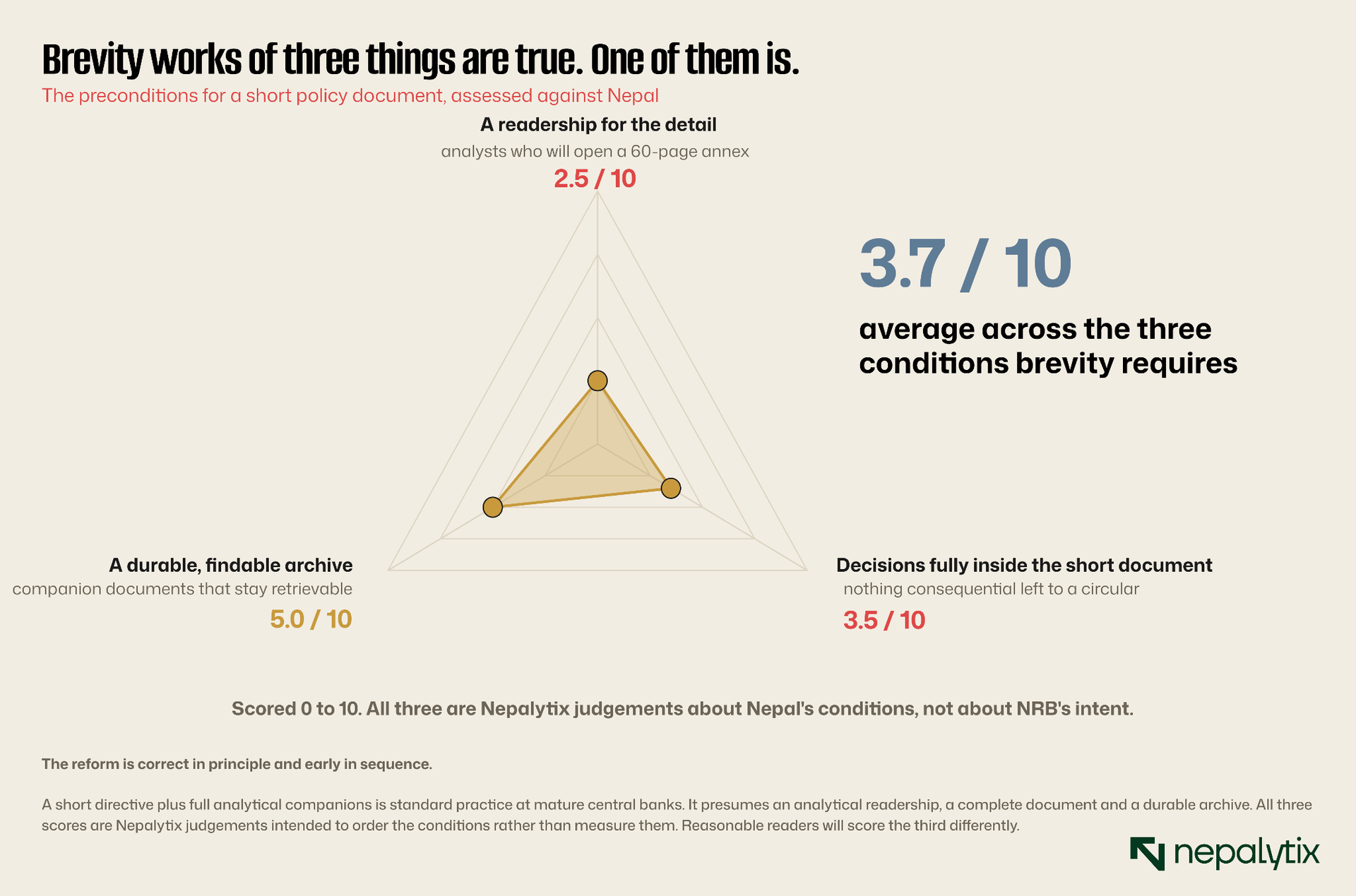
How the three conditions were chosen
A word on method, because the rest of this piece rests on it and the conditions are ours rather than anyone else's.
The question we are asking is not whether short documents are good. It is what a short document does that a long one does not and what has to be true for that difference to be an improvement.
A short policy statement does three things. It states commitments in a form that can be checked later. It relies on a companion literature to supply the reasoning and it enters an archive that future readers will consult.
Each of those has a precondition. The first requires that the statement actually contains the commitments otherwise checking it later checks the wrong thing. The second requires readers who will follow the reasoning into the companion. The third requires the companion to still be there.
These are not arbitrary. They are what the reform's own logic assumes, and each can be assessed against observable facts about Nepal rather than against a preference for one document length over another. That is the test we are running.
We are deliberately not asking whether four pages is enough space, which is unanswerable and would come down to taste. A four-page document that satisfies all three conditions is better than a sixty-page one that satisfies none.
1) There must be someone to read the long version
Separating the directive from the analysis assumes a readership that will follow the analysis into a second document. In practice that means a professional buy-side: analysts, fund managers and economists whose job is to read sixty pages and translate them for everyone else.
Nepal does not have one at scale. This week's Edition put weekly turnover at 0.60% of market capitalisation, a third of the level of two years ago. There are a handful of research houses, no institutional analyst community of size, and a market where the largest single institutional holders, the provident and pension funds covered in last Thursday's Long Read publish nothing about their own portfolios and employ no visible public research function.
In a market with a professional intermediary layer, a short statement plus a technical annex reaches investors indirectly but reliably. Somebody reads the annex, writes about it and the market absorbs it second-hand. In a market without that layer, a short statement plus a technical annex reaches investors as a short statement.
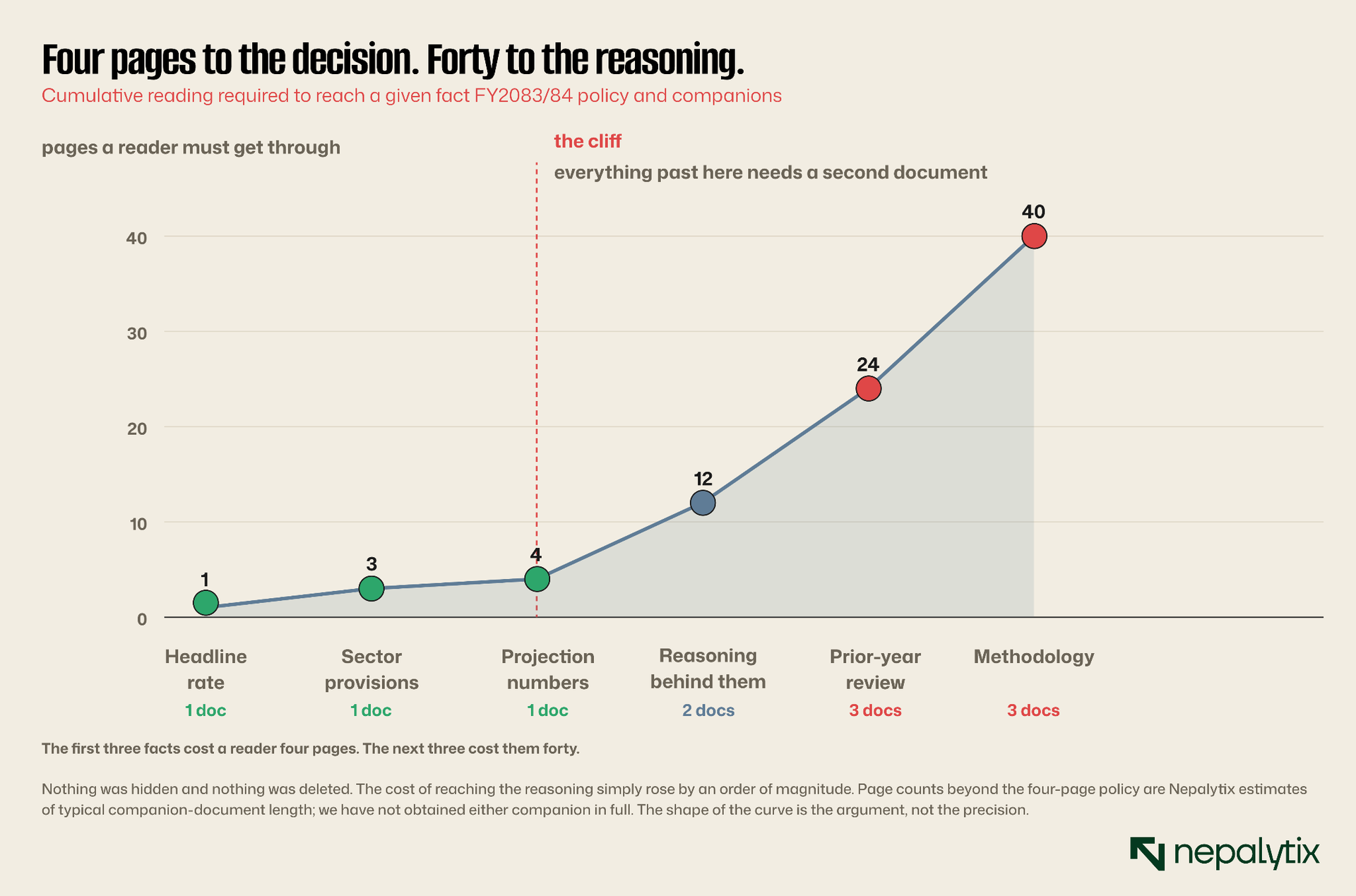
Look at where the curve breaks. The first three things a reader might want the headline rate, the sector provisions, the projection numbers are available inside four pages. Everything after that requires opening a second document and reading tens of pages more.
Nothing has been hidden. Nothing has been deleted. The cost of reaching the reasoning has simply risen by roughly an order of magnitude and it has risen in a market where very few people were paying that cost when it was low.
What the readership actually looks like
It is worth being concrete about who reads a Nepali monetary policy because "no professional readership" is an abstraction and the specifics matter.
There are the banks themselves, whose treasury and compliance functions read every word because they must implement it. That readership is real, competent and entirely internal, it produces no public analysis.
There are the broker research desks which produce short notes aimed at retail clients and are staffed thinly. There are perhaps a handful of independent research outlets, this one included.
There is the financial press, which is the main channel by which the policy reaches the public and which operates on announcement-day deadlines. And there is the retail investor, roughly a few hundred thousand demat accounts reading a summary.
Notice what is missing. There is no buy-side analyst community, because there are almost no active institutional funds. The three largest pools of institutional money in the country are the provident and pension funds and as last Thursday's Long Read established, none of them publishes an asset allocation, a gross return or a benchmark. An institution that does not disclose its own portfolio does not employ analysts to read central bank annexes.
The chain that carries technical analysis from a central bank annex to a market price in London or Mumbai has, in Nepal, no middle.
The distributional point
Who bears that cost matters. A bank treasury department with a research function will read the companions. A retail investor with a demat account and a day job will read a news summary of the four pages. The gap between those two readers was already wide in Nepal, and this change widens it.
That is not an argument for keeping documents long. Long documents excluded the retail reader just as effectively, by different means. It is an argument that the reform delivers its benefit to a readership Nepal has not built yet, while the cost falls on the readership it has.
The comparison that is usually made and why it does not hold
The reference point invoked when Nepali institutions shorten their disclosures is usually the Bank of England or the Reserve Bank of India. It is worth being precise about what those institutions have that Nepal does not.
The Bank of England publishes a short Monetary Policy Summary alongside a full Monetary Policy Report and the minutes of the committee that took the decision including how each member voted. Around that sits a professional readership numbering in the thousands: gilt desks, macro funds, bank economists, financial journalists with specialist beats and academic monetary economists who will read the technical annexes for their own purposes.
The Reserve Bank of India publishes a statement, a full report and minutes with attributed votes, into a market with hundreds of sell-side analysts covering banks alone.
The documents are the visible part. The readership is the part that makes the documents work, and it took decades to build in both cases. Nepal has adopted the document structure. The readership is a separate project and nobody is running it.
This is not an argument that Nepal should wait. It is an argument that the document reform and the readership problem are two halves of one thing, and only one half has been attempted.
2) The short document must contain the decisions
The second condition is more concrete and, we think, more damaging. A short policy statement works as a commitment device only if it contains the commitments. If consequential decisions arrive through other instruments, then shortening the policy has not concentrated the decisions, it has only shortened one of several channels.
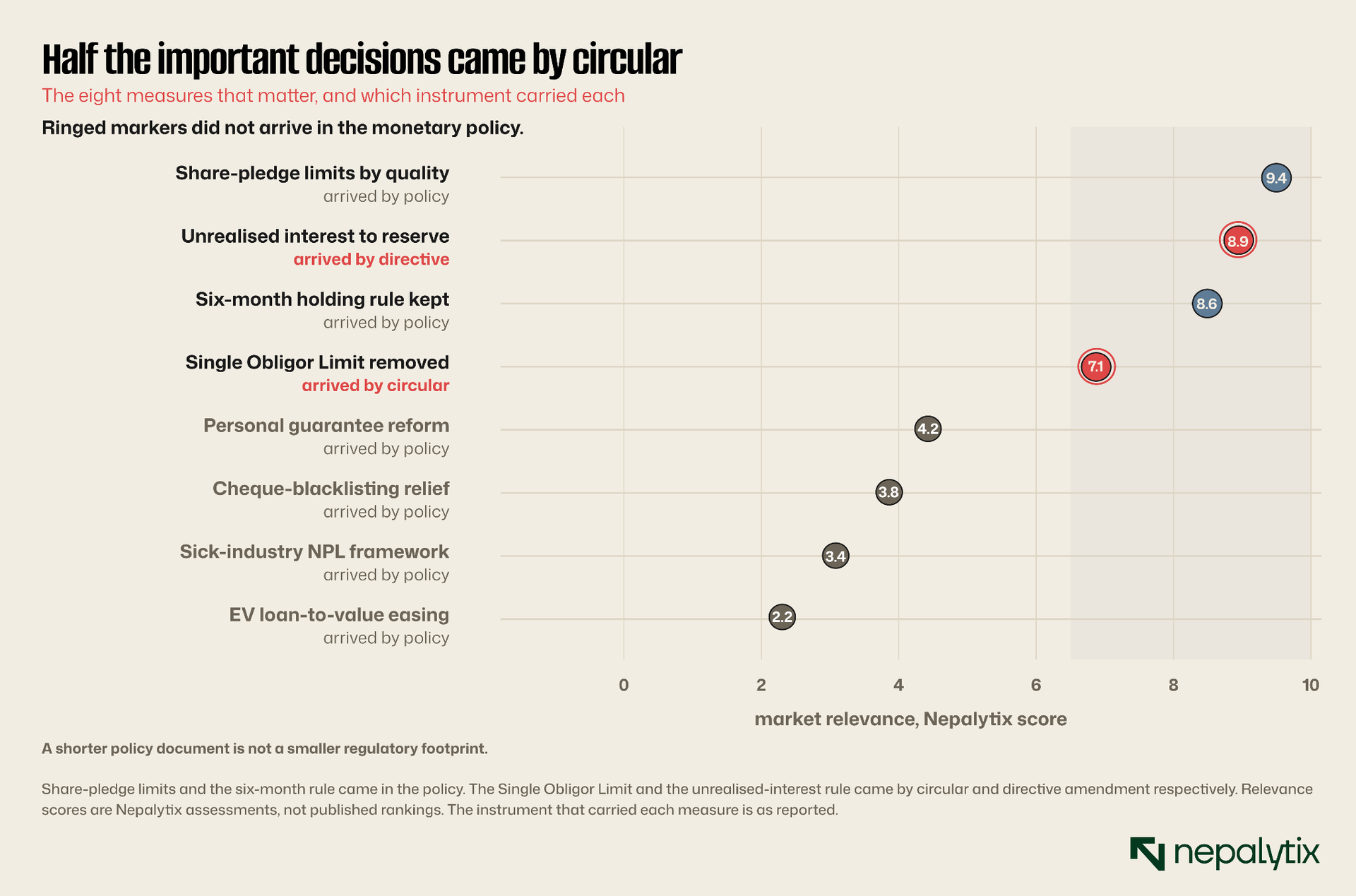
Two of the four most consequential regulatory changes affecting Nepali banks and Nepali share prices this year did not arrive in a monetary policy.
The Single Obligor Limit: the Rs 25 crore ceiling on exposure to a single borrower or related group was removed from the Unified Directives by circular in Ashoj 2082 months before the July announcement.
The requirement that interest recognised but not collected be transferred to the regulatory reserve which we covered in last Monday's Signal arrived through an amendment to the Unified Directives on 16 July 2026 ten days before the fiscal year closed and eight days after the monetary policy was announced. It reshapes what every commercial bank can distribute as dividend and it appeared in neither the policy nor its companions.
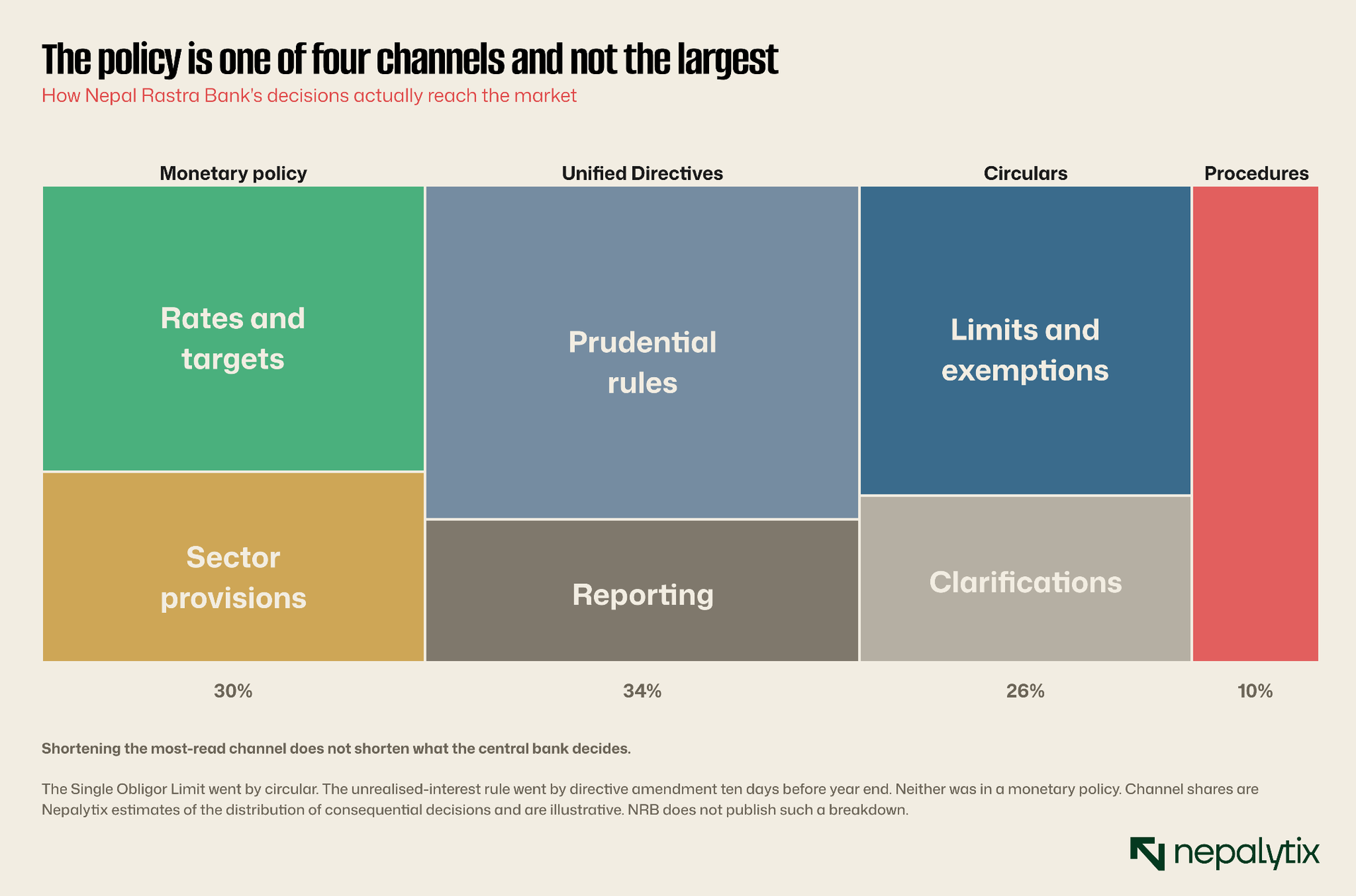
By our estimate the July policy carries something like thirty per cent of what NRB actually decides in a year. Unified Directives amendments, circulars and procedural frameworks carry the rest, and they arrive throughout the year with a fraction of the attention.
This is the condition Nepal fails most clearly, and it is worth being precise about why it matters. If the policy statement were the whole of monetary and prudential decision-making, four pages would be an act of discipline: everything that matters, stated briefly, checkable in twelve months. Because it is not, four pages is a shorter version of the most visible channel while the less visible channels carry on as before.
The reform reduces the length of the thing everybody reads without reducing the volume of what they need to know.
Why circulars are not a scandal
We should be fair about the circular channel because there are good reasons for it and criticising it wholesale would be lazy.
A central bank needs to act between annual policy statements. Conditions change, a class of institution comes under stress, a loophole appears. An instrument that can be issued in days rather than waiting for July is not an evasion of transparency; it is basic supervisory capability, and every central bank has one.
The unrealised-interest amendment is a good example of why. It closes a genuine gap between what accounting standards permit and what a regulator considers prudent and it should not have waited eleven months for the next policy window.
The problem is not that circulars exist. It is that the policy document's new brevity is being presented as a transparency reform while the channel carrying comparable weight has had no corresponding change. A reader who now finds the July document admirably concise still has to track directive amendments issued throughout the year with no consolidated index and no summary.
Shortening one channel while leaving the others unchanged does not simplify a reader's job. It relocates the complexity.
3) The archive must be durable and findable
The third condition is the one where we would give NRB most credit and the least certainty.
A monetary policy has twenty-five years of institutional precedent. It is published in a known place in a known format at a known time. Researchers, journalists and students know where to look, and the series is continuous back to FY2059/60.
The Macroeconomic Report and the Monetary Policy Implementation Review have no such precedent. They were published, and they were published on time. Whether they will be published every year, indexed alongside the policy, and retrievable in five years is not something anyone can currently know.
We score this condition at five out of ten, which is a way of saying we have no basis for confidence in either direction. It is the condition most easily fixed and the one least discussed.
Two of our twelve items appear in neither document. There is no published rationale for individual sector provisions why quality-linked share-pledge limits rather than a uniform cap why the six-month bank shareholding rule was retained and there is no record of alternatives considered or of internal disagreement.
The second of those is not a Nepali failing; most central banks outside a small group publish no minutes and no dissent. But it does bear on the accountability argument in the steelman above. A four-page document is only checkable against outcomes if the reasoning behind each line is retrievable somewhere. For two of our twelve items it is not retrievable anywhere.
The precedent problem in Nepali institutions
Scepticism about whether the companions persist is not a hunch. It reflects a specific pattern in Nepali institutional publishing that anyone who has tried to do research here will recognise.
Documents appear, are reported on, and become difficult to retrieve within a year or two. Series start and stop. Publication moves between departments. URLs change and archives are not maintained. Reports referenced in one year's document cannot be located when the next year's arrives.
This is not unique to NRB and it is not a criticism of any individual. It is a resourcing and convention problem across the Nepali public sector, and it is why the monetary policy series itself is so valuable: twenty-five years of a document published in the same place at the same time is genuinely rare here.
Moving the analytical content out of that series and into two new publications transfers it from the most reliable publishing tradition NRB has to one with no track record at all. That may be fine. It is a risk that a public commitment to the series would eliminate at no cost, and the absence of such a commitment is the reason we score this condition in the middle rather than at the top.
What a durable archive is worth
It is easy to underrate this condition because archives are boring. Consider what the twenty-five-year policy series makes possible.
A researcher can trace Nepal's policy rate across two decades. A journalist can check what NRB said it would do in FY2075/76 against what happened. A student can read the sequence and see the framework evolve. Every one of those uses depends on the documents being where they are expected to be, in a consistent format, indefinitely.
The reasoning behind FY2083/84's decisions now sits outside that series. If the companions are published annually and indexed alongside the policies, nothing is lost and the archive improves. If they are published this year, differently next year, and quietly discontinued the year after then the reasoning behind a whole period of Nepali monetary policy will be difficult to reconstruct.
We are not predicting the second outcome. We are noting that the first requires a commitment nobody has made publicly, and that the cost of making it is close to zero.
A note on the thirty per cent
The channel shares in Figure 4 are our estimate and we would not defend the precise numbers. NRB publishes no breakdown of where its consequential decisions arrive and constructing one requires judgement about what counts as consequential.
What we would defend is the ordering. The Unified Directives and the circular stream together carry more of what binds Nepali banks than the annual policy does, and any practitioner in the sector would say so. The directive amendment of 16 July arriving after the policy and changing what every bank can distribute is the proof rather than an exception.
The two items that live nowhere
The gaps in Figure 5 deserve more than a passing mention because they are the parts a longer document would not have fixed either.
Take the share-pledge decision. NRB will move from a uniform cap on margin lending to limits set by the financial quality of the pledged company. This is a significant structural intervention in how the Nepali equity market is financed, it will make strong companies cheaper to hold on borrowed money than weak ones by regulation rather than by market preference.
Why? What problem does it solve? Was concentration in weak-company collateral identified as a risk and on what evidence? Would a different instrument: higher haircuts, position limits, disclosure requirements have addressed it better? None of this is published.
The same applies to the six-month bank shareholding rule. Market participants lobbied for its removal and were refused. A refusal is a decision and it has reasoning behind it, and the reasoning is not available.
We stress that this is not a Nepal-specific failing. Most central banks outside a small group publish no rationale at the provision level. But the accountability case for a four-page document rests on the claim that short commitments are easier to check and a commitment whose purpose is unstated cannot be checked against its purpose. It can only be checked against outcomes which takes years and confounds everything.
The sequencing problem
There is one further observation and it cuts against the strongest point in the reform's favour.
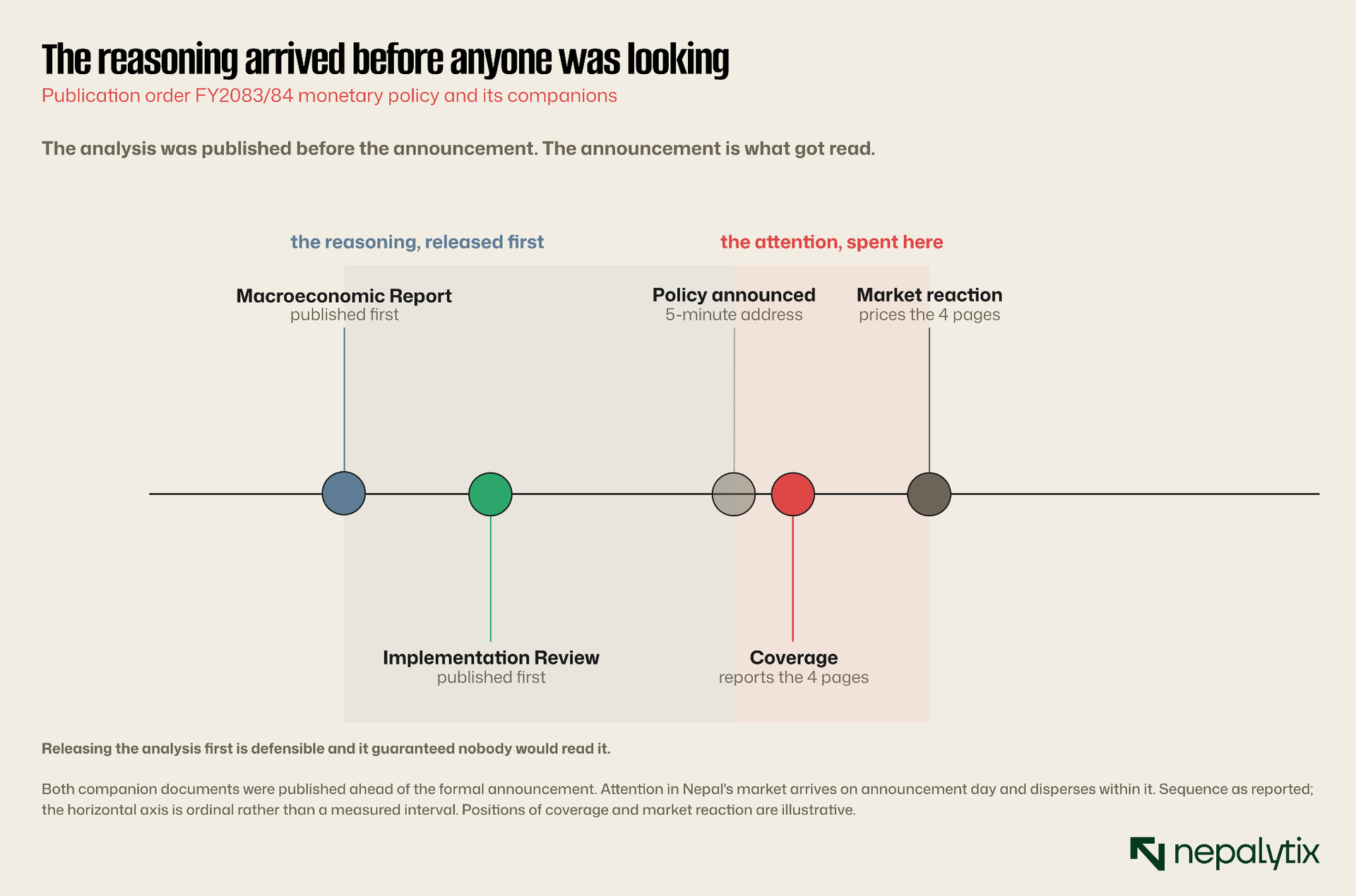
Publishing the analysis before the announcement is genuinely good practice, for the reason set out earlier: it stops the reasoning being fitted to the conclusion.
It also guarantees that the analysis is published into a vacuum. Attention in Nepal's financial market arrives on announcement day. It does not arrive three days earlier for a macroeconomic report and it disperses within a day or two of the announcement it did arrive for.
So the sequence that maximises internal discipline minimises external readership. Both effects are real and they run in opposite directions. We think NRB has chosen correctly, internal discipline is worth more than a day's coverage but the trade-off deserves stating because the coverage the companions did not get is the coverage that would have built the readership condition one requires.
A test the reform could pass
There is a straightforward empirical check available in about twelve months, and we intend to run it.
If the reform works as intended, then by July 2027 there should be visible evidence of the companions being used: research notes citing the Macroeconomic Report, press coverage referencing the Implementation Review's assessment of the previous year, questions to the Governor drawing on the forecast methodology. If the companions have entered the conversation, condition one is being met and our score of 2.5 was wrong.
If, twelve months on, coverage of the FY2084/85 policy consists of the same announcement-day summaries of a four-page document with no reference to either companion, then the analysis has been published into a void and the reform has delivered brevity without the accountability it was meant to buy.
We will report which it was. It is a rare case where an argument about institutional design has a clean test attached, and it would be a waste not to run it.
Scoring it honestly
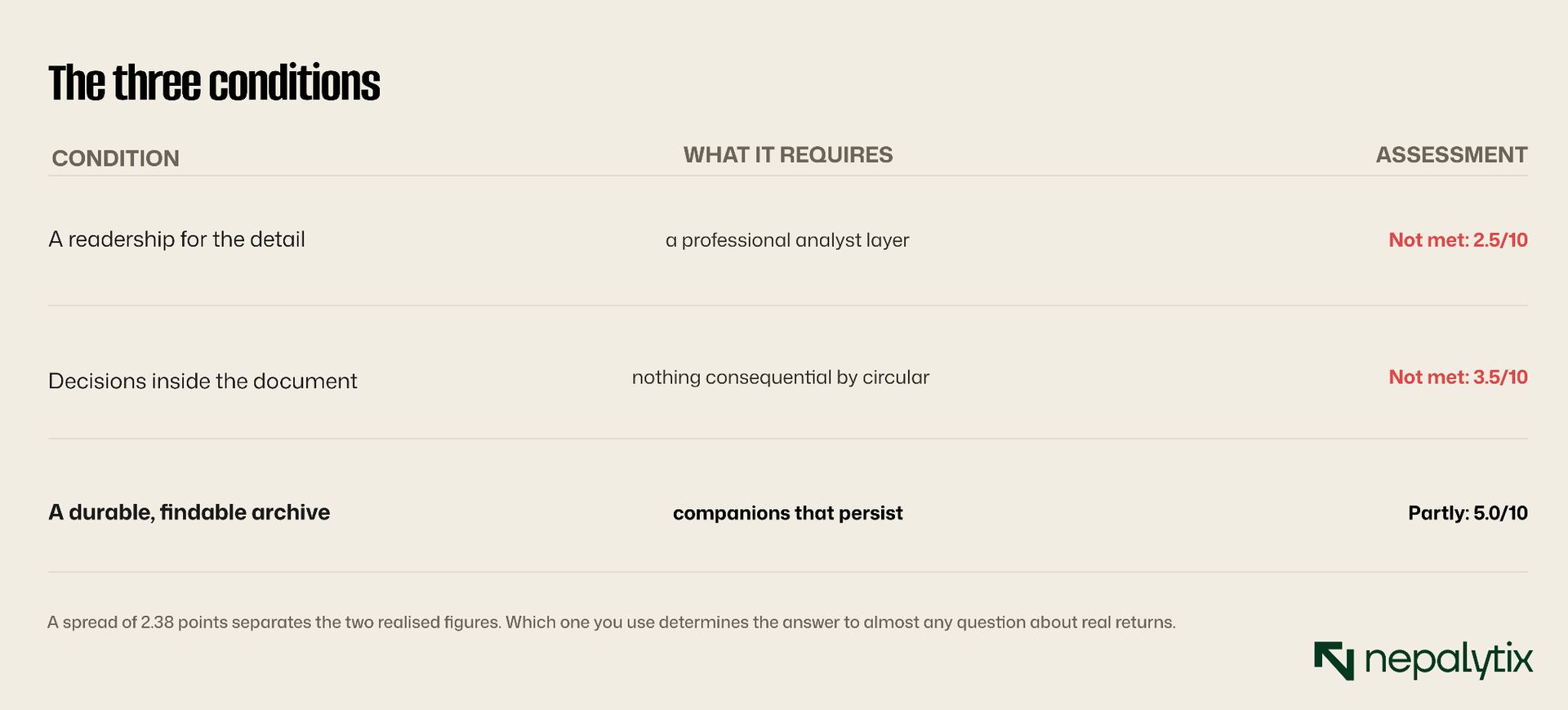
Our view is that this is the right reform introduced ahead of the conditions that make it work. That is a different criticism from the one we made last Wednesday about the cooperative regulator and we want to keep the two separate.
The cooperative failure was inaction: a state told about a problem in 2013 that acted in 2025. This is the opposite, an institution moving toward international practice faster than its market has developed the capacity to absorb it. One is negligence. The other is a sequencing error made in the right direction.
The counter-argument we take most seriously
Someone at NRB could reasonably answer all of this as follows.
The readership condition is not the central bank's problem to solve. A central bank's job is to publish accurate, timely, complete information. Whether a market has built an analyst layer capable of consuming it is a question for the market, the securities regulator and the education system. Withholding a reform until the audience matures is a recipe for never reforming, and institutions that wait for perfect conditions wait indefinitely.
Moreover, publishing in the mature format may itself help create the readership. A market given a technical annex has a reason to develop people who read technical annexes. A market never given one never does.
We find this persuasive and it is why our conclusion is that the sequencing is wrong rather than the reform. If NRB's view is that supply creates its own demand for analysis that is a defensible bet and we would rather they made it than not.
What it does not answer is condition two. The circular channel is entirely within NRB's control, and consolidating an annual index of directive amendments requires no readership at all, it requires a clerk and a decision.
The regional comparison worth making instead
If the Bank of England is the wrong benchmark, a better one is Sri Lanka or Bangladesh, South Asian central banks operating in markets of comparable depth with comparable analyst populations.
Both publish policy statements considerably longer than four pages and both interleave reasoning with directive in the way NRB has just moved away from. Neither publishes a separate implementation review on NRB's model.
On that comparison Nepal is ahead and it is worth saying so in a market where the reflex is to assume domestic institutions lag. NRB has adopted a communication structure that its immediate peers have not. Our argument is about the conditions surrounding the structure not about whether adopting it was forward-looking. It plainly was.
The right way to read this piece is therefore as a critique of an institution doing something better than its peers which is a different and more useful kind of criticism than one aimed at an institution doing something worse.
What would make it work
Four things, in order of how much difference each would make.
Publish a plain-language summary alongside the four pages. Two pages, in Nepali and English explaining what changed and why, aimed at the retail investor rather than the analyst. This costs almost nothing and addresses condition one directly, by not requiring an intermediary layer that does not exist. It is the single highest-return change available.
Consolidate the annual regulatory calendar. If the Single Obligor Limit and the unrealised-interest rule are as consequential as the policy's own provisions and they are then NRB should publish, once a year alongside the policy, a consolidated list of every directive amendment and circular issued in the preceding twelve months, with a one-line description of each. This addresses condition two without constraining NRB's ability to regulate through circulars when it needs to.
Commit to the companions as a series. Name them, number them, publish them on a fixed schedule and index them alongside the twenty-five monetary policies. This is administrative and it converts condition three from uncertain to met.
Time the companion release to the announcement, not before it. Same day, same press conference, same news cycle. This forfeits a little of the internal-discipline gain described earlier, because analysis released simultaneously can in principle be fitted to the conclusion. But it is the only change that puts the reasoning in front of the readership at the moment the readership is looking and on balance we think the trade is worth making until condition one improves.
Publish a rationale line per provision. Not a defence, not a consultation document. One or two sentences per sector measure explaining the problem it addresses. For the eight provisions in this year's policy that is perhaps half a page, and it would close the largest of the two gaps in Figure 5.
The first is the one we would do tomorrow. A two-page plain-language summary costs a fraction of a staff-week, requires no institutional change, and reaches the readership that actually exists rather than the one the reform assumes.
None of these lengthens the policy statement. Three of them are administrative decisions inside NRB's existing powers. All four preserve the reform while supplying what the reform assumes.
What we are not saying
Three things because the argument is easy to overstate and we would rather bound it ourselves.
We are not saying NRB is hiding anything. Every fact this piece relies on came from NRB's own publications or from reporting of them. An institution concealing information does not publish its analysis three days early.
We are not saying the previous format was better. Long documents in Nepal have historically mixed commitment and commentary in a way that made both harder to use, and nobody was reading those to the end either.
We are not saying the reform should be reversed. Reversing it would forfeit the accountability gain and return to a format with its own well-documented failings. The four remaining steps are additive, not corrective.
What we are saying is narrower. A reform whose benefit depends on three conditions has been introduced where one holds, and the two that do not hold are fixable by NRB alone within a year.
Where this leaves the reader
We began this piece intending to write a sharper criticism than the one we have ended up with, and it is worth saying so.
The four-page policy is not opacity with better manners. It is a real move toward how good central banks communicate made by a Governor who published his analysis before his conclusions and then spoke for five minutes rather than an hour. Those are the actions of an institution trying to be held to account not one avoiding it.
The problem is that the reform imports a structure from markets with a dense professional readership into a market that has none, and does so while roughly seventy per cent of NRB's consequential decisions continue to arrive through channels the reform does not touch. The result is that the most visible document got shorter while the total amount a reader needs to track stayed the same or grew.
For Nepalytix the practical consequence is a change in method, and we will state it plainly because it affects what we publish. From this year, covering NRB properly means reading three documents rather than one, and tracking the circular stream continuously rather than annually. Sunday's Paisa set out the reading order for the policy itself. The harder discipline is the one this piece points to: watching the instruments that never make the front page.
NRB has taken a step that most central banks in the region have not. It should take the next five and they are all small.
One closing thought about what the five-minute address actually signalled. A Governor who speaks for five minutes is telling an audience that the document says what it needs to say and does not require his interpretation. That is a confident and unusual thing for a Nepali institution to communicate and the confidence is mostly warranted.
The risk is that in a market where the audience has always relied on interpretation from the Governor from the press, from a broker's note withdrawing the interpretation removes something the audience was using without supplying the capability it was substituting for. Five minutes assumes the room can read. The room is learning.
Disclaimer
This report has been prepared by Nepalytix for informational and educational purposes only and does not constitute investment advice, an offer, or a solicitation to buy or sell any securities.
The information contained in this report is based on sources believed to be reliable; however, Nepalytix does not guarantee its accuracy, completeness, or timeliness. Opinions, estimates, and projections expressed herein are those of the authors as of the date of publication and are subject to change without notice.
Investing in securities involves risks, including the possible loss of principal. Past performance is not indicative of future results. Readers are advised to conduct their own independent research and consult with a qualified financial advisor before making any investment decisions.
Nepalytix and its contributors may hold positions in the securities discussed in this report at the time of publication or thereafter.
Neither Nepalytix nor any of its affiliates accept any liability for any loss arising from the use of this report or its contents.