Bank Profits Rose 46%. Take Out One Line and They Fell.
Nepal’s commercial banks reported a 46% profit jump to Rs 19.15 billion but net interest income grew just 1%. The real boost came from 45% lower impairment charges, despite rising bad loans. Remove that one factor and the earnings story changes completely.
The Signal
Commercial banks reported a 46% jump in first-quarter profit. Their lending income rose 1%. The difference is a Rs 9 billion drop in what they set aside for bad loans in a year when bad loans grew by about a fifth.
Hold provisioning where it was a year ago and profit fell 2.6%. Twelve of the twenty banks earned less before provisions. Five can't legally pay a dividend.
01. The Headline Is Real. It's Also One Line Of The Income Statement.
Every outlet ran the same story three weeks ago and they were all correct. The 20 commercial banks made Rs 19.15 billion in the first quarter of 2083/84, up from Rs 13.15 billion a year earlier. Seventeen banks earned more. Ten cleared a billion rupees. Citizens went from a loss to a profit. If you own bank shares and in Nepal that's most people who own shares, it read like the turn everyone had been waiting for.
So we did the boring thing and went line by line.
A bank's profit is basically three numbers stacked on top of each other. What it earns from lending after paying depositors. Minus what it costs to run the place. Minus what it sets aside for loans that might not come back. That last one is the impairment charge and it's the only one of the three that involves a judgment call.
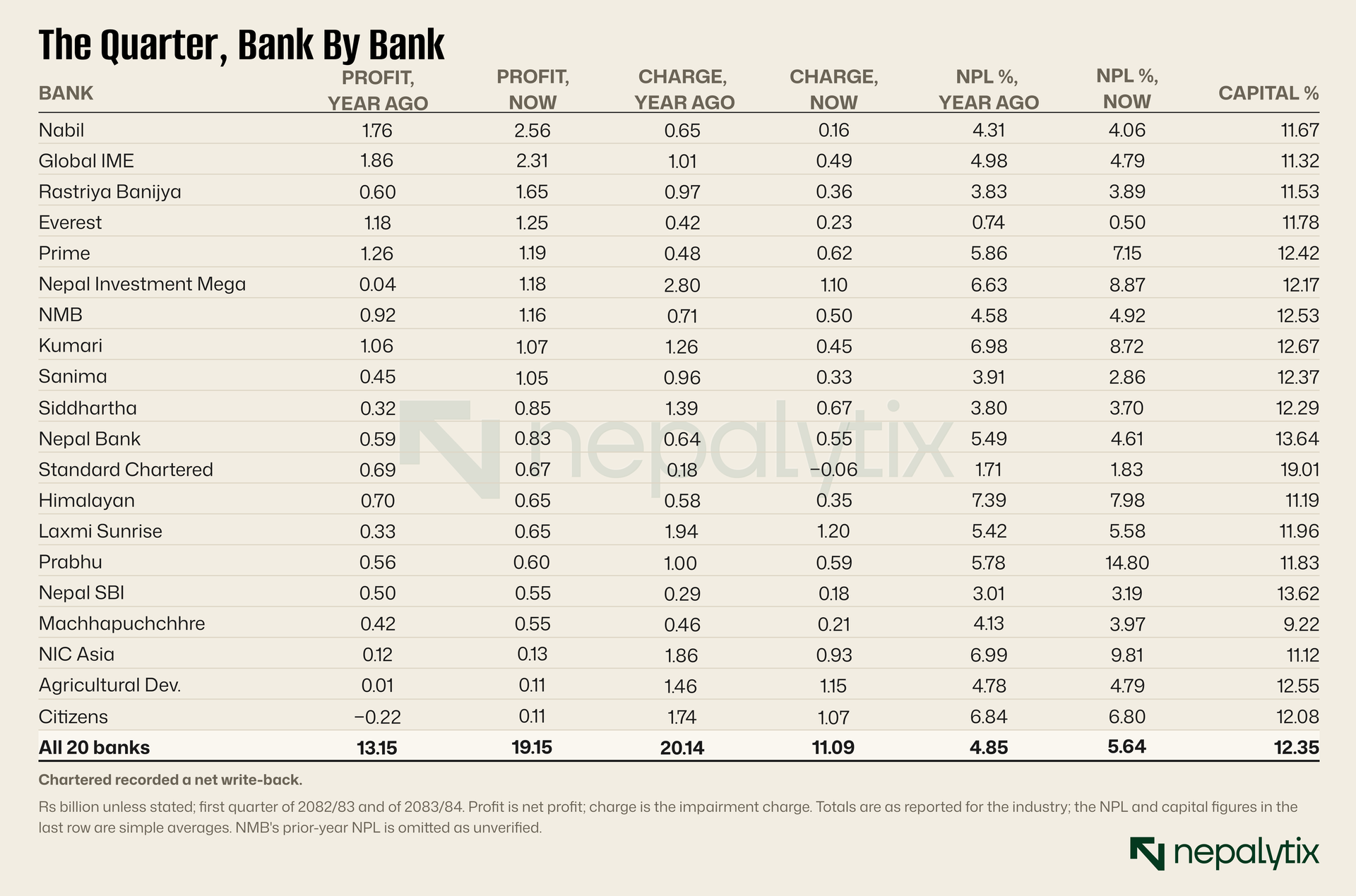
Here's what each did. Net interest income, the lending engine went from Rs 49.20 billion to Rs 49.67 billion. Up 1%. The impairment charge went from Rs 20.14 billion to Rs 11.09 billion. Down 45%.
That's a Rs 9.05 billion swing in one line. After tax at 30%, it's worth about Rs 6.3 billion of net profit. The entire rise in net profit was Rs 6.0 billion.
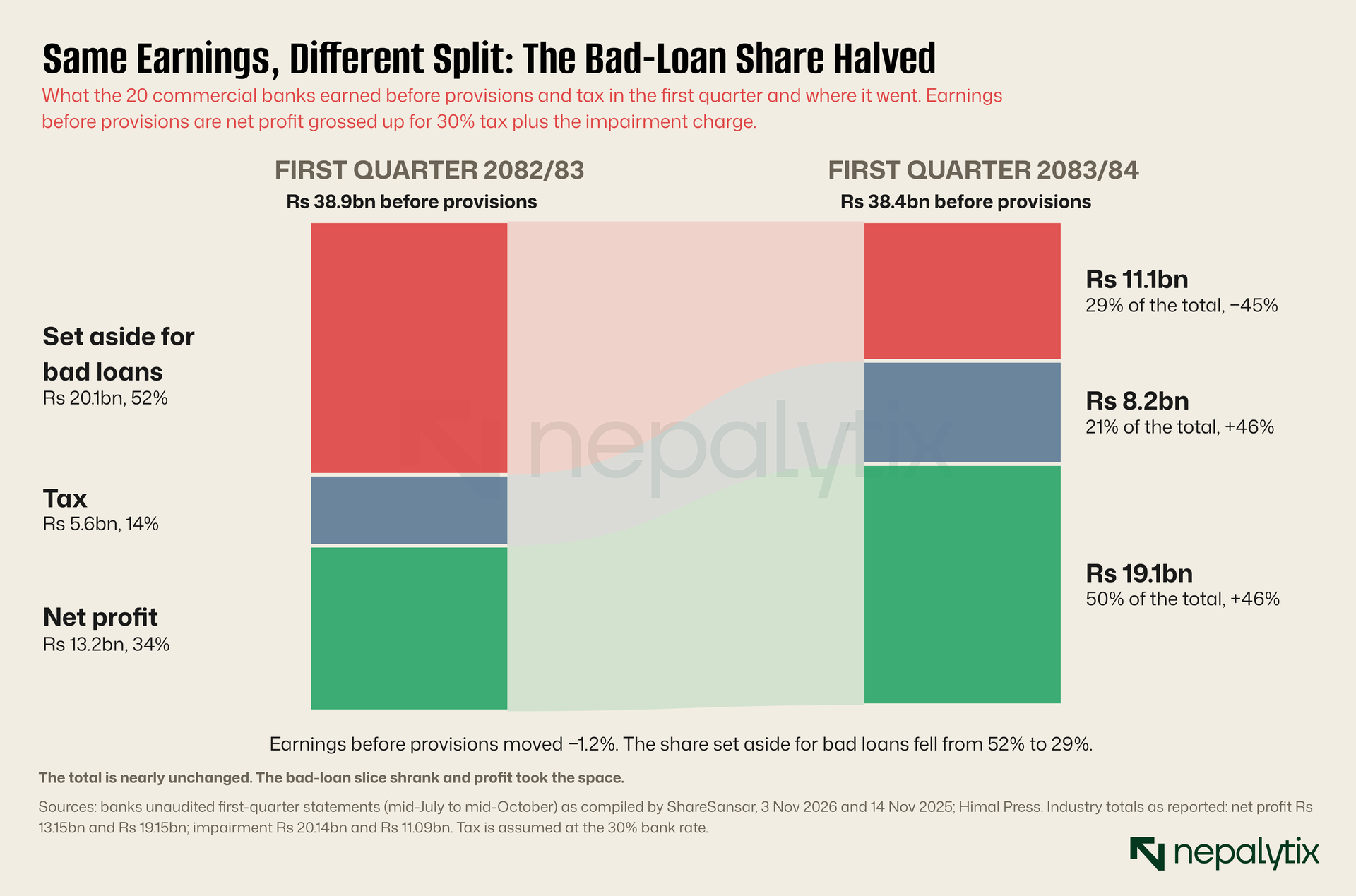
Put the two quarters side by side and they're almost the same size. Before provisions and tax, the banks earned roughly Rs 38.9 billion last year and Rs 38.4 billion this year, a dip of about 1%. What changed is the split. A year ago, 52 paisa of every rupee earned went into the bad-loan pot. This year it was 29. Hold provisioning at last year's level and first-quarter profit comes out near Rs 12.8 billion. That's 2.6% lower than a year ago, not 46% higher.
If the impairment charge is new to you, think of it this way. A bank lends Rs 100 to a hundred borrowers and expects a few not to pay. Each quarter it looks at who's late, guesses how much it will lose and takes that guess out of profit before anyone sees the profit. Guess high and this quarter looks bad and a later one looks good. Guess low and it's the other way round. The central bank sets minimums by how overdue a loan is so it isn't a free-for-all. But inside those rules there's room, and the charge moves around far more than the loans do.
(A caveat we'll repeat at the bottom: the banks summary tables don't break out operating costs, so "earnings before provisions" here is net profit grossed up for tax plus the impairment charge. It's an estimate and a decent one.)
02. Twelve Banks Earned Less And Reported More
Industry totals can hide a lot so here's the same test run on each bank. The grey bar is the profit a bank picked up purely from setting aside less. The dot is what actually happened to its profit. If the dot lands short of the end of the bar, the bank's underlying earnings went backwards and lower provisioning more than covered the gap.
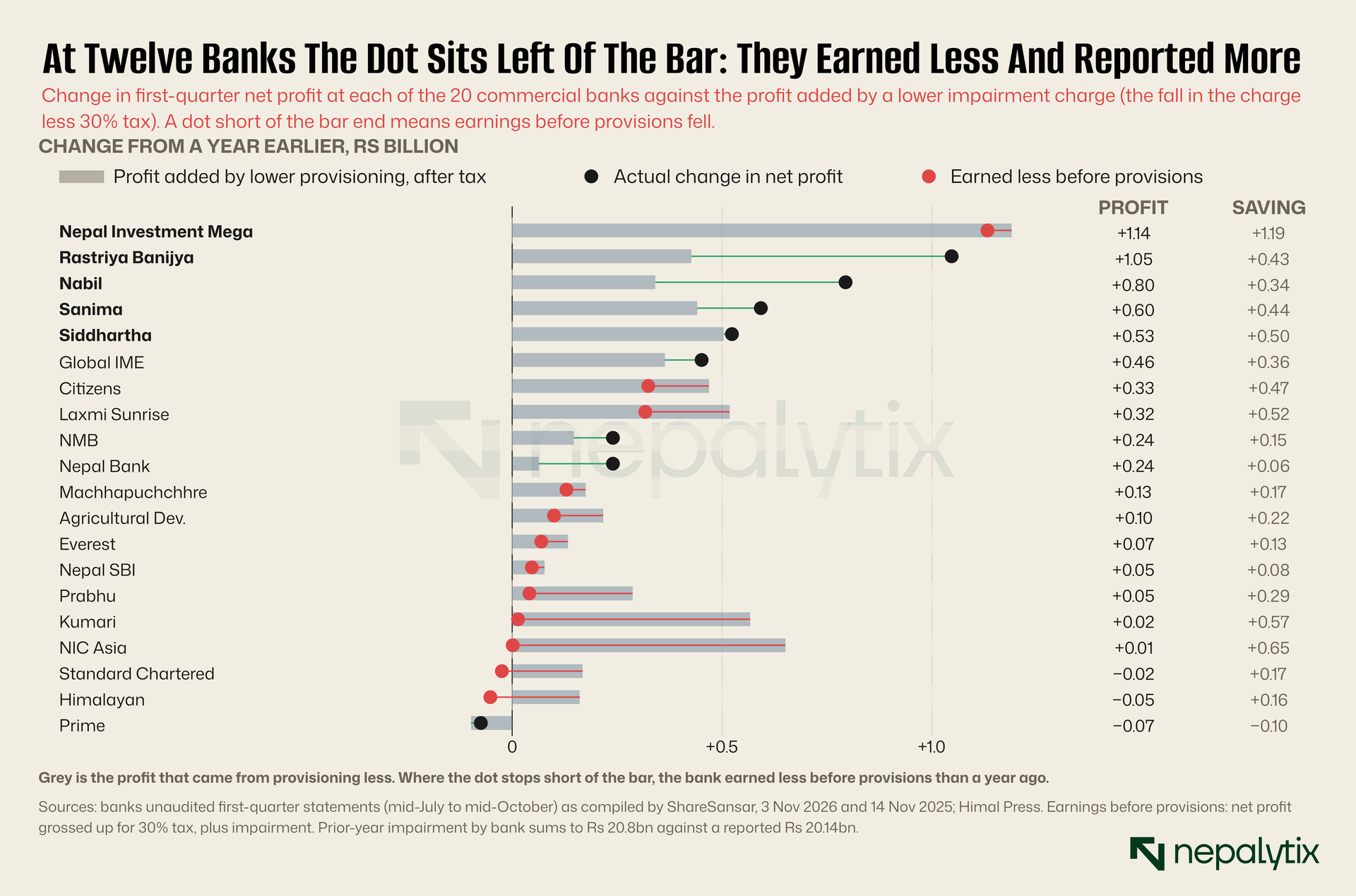
Twelve red dots. At twelve of the twenty banks, earnings before provisions fell. Ten of those twelve still reported higher profit.
Nineteen of twenty banks booked a smaller impairment charge than a year ago. The one that didn't is Prime and (not a coincidence) Prime is one of only three banks whose profit fell.
Look at the top of the chart. Nepal Investment Mega is the quarter's poster child: profit up from Rs 45 million to Rs 1.18 billion, a rise of more than 2,500%, and the number that led half the coverage. Its impairment charge fell by Rs 1.70 billion. After tax, that's Rs 1.19 billion. Its profit rose Rs 1.14 billion. You can do the subtraction.
Further down it gets starker. Kumari's charge fell Rs 810 million and its profit rose Rs 18 million. NIC Asia's charge halved, a Rs 930 million saving and its profit rose Rs 5 million. Those two banks lending income dropped 28% and 18%. The lower charge didn't lift their profit so much as hold it up.
There are two banks where the story really is about banking. Rastriya Banijya grew net interest income from Rs 2.92 billion to Rs 4.01 billion. Nabil grew it from Rs 3.90 billion to Rs 4.73 billion. Together that's Rs 1.92 billion of extra lending income. The whole industry's rose by Rs 0.47 billion. Which means the other eighteen banks, taken together, earned about Rs 1.45 billion less from lending than a year ago.
Half the industry, ten banks, had lower net interest income outright.
It helps to sort the twenty into three groups because they're having three different years.
The ones actually growing. Rastriya Banijya, Nabil, Nepal Bank, Sanima, NMB and Global IME with Siddhartha and Prime just on the right side of zero. Their dots sit at or beyond the end of the bar. Earnings before provisions rose and lower provisioning was a bonus on top. This is what a recovery looks like when it's real.
The ones standing still. Everest, Nepal SBI, Standard Chartered, Machhapuchchhre, Agricultural Development. Earnings before provisions slipped a little, the loan books are clean or cleanish and profit is roughly where it was. Nothing to celebrate, nothing to worry about.
The ones being carried. Nepal Investment Mega, Kumari, NIC Asia, Prabhu, Laxmi Sunrise, Citizens, Himalayan. Lending income flat or falling, bad loans high or rising and a reported profit that depends on this quarter's charge being much smaller than last year's. These seven hold just over a third of the industry's loans.
03. Fine, But Maybe The Loans Got Better?
That would be the innocent explanation, and it deserves a hearing. If borrowers are paying again, a bank should set aside less. That's how provisioning is supposed to work.
They aren't. The average non-performing loan ratio across the 20 banks rose from 4.85% to 5.64%. It went up at twelve of them.
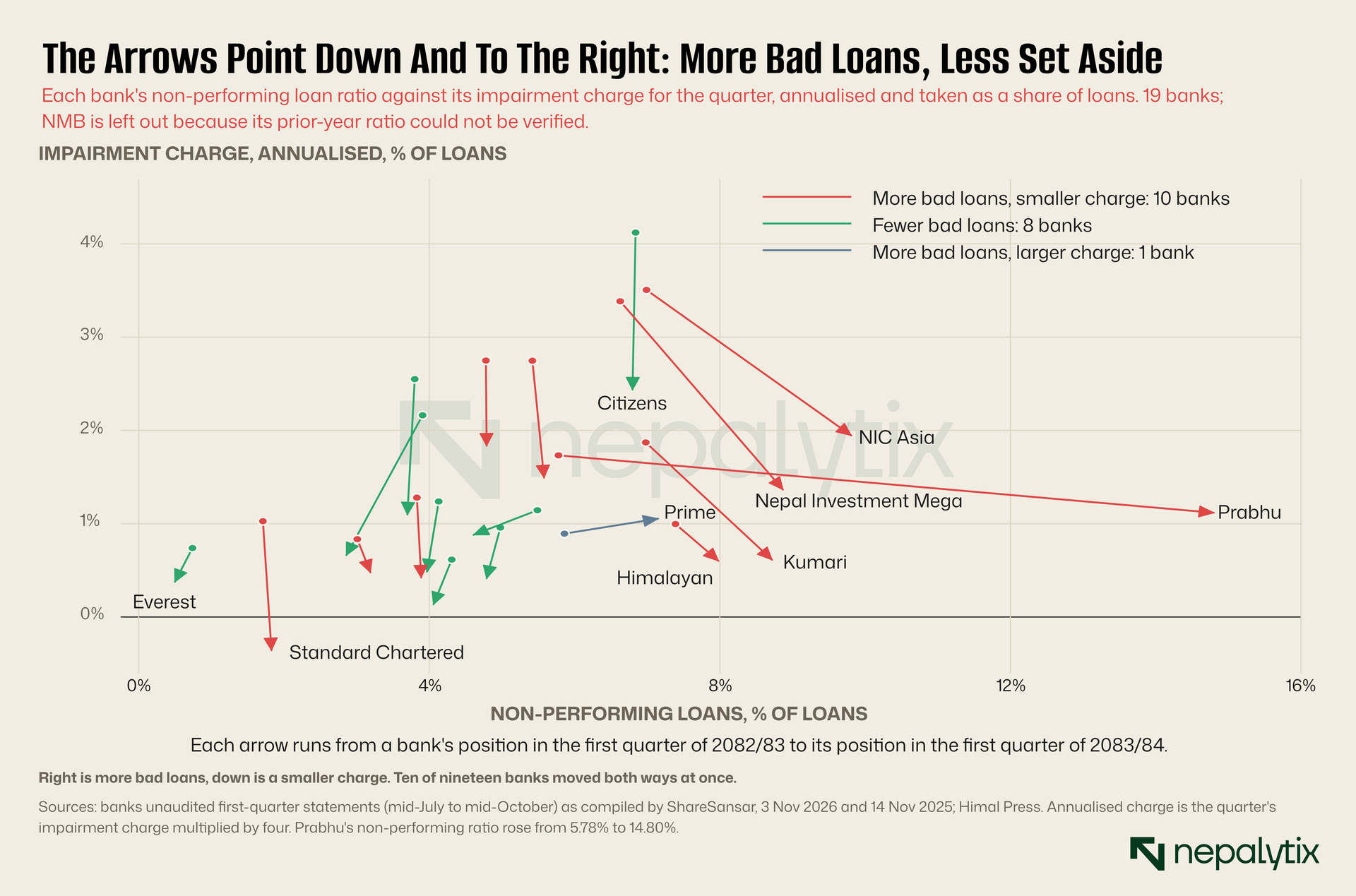
Each arrow is a bank, running from where it stood a year ago to where it stands now. Right means a bigger share of loans gone bad. Down means a smaller provisioning charge relative to the loan book. If asset quality were driving the lower charge, the arrows would point down and to the left. Eleven of the twenty point down and to the right.
The long one is Prabhu. Its non-performing ratio went from 5.78% to 14.80% in twelve months, the highest in the industry by a distance. Its impairment charge for the quarter fell from Rs 1.00 billion to Rs 0.59 billion.
In rupees, the twenty banks are carrying about Rs 290 billion of non-performing loans, up from Rs 238 billion. That's Rs 52 billion more in a year, a rise of 22%, during a quarter in which the charge against bad loans nearly halved. A year ago the banks set aside about 8.7 paisa in the quarter for every rupee of bad loans on the books. This year, 3.8 paisa.
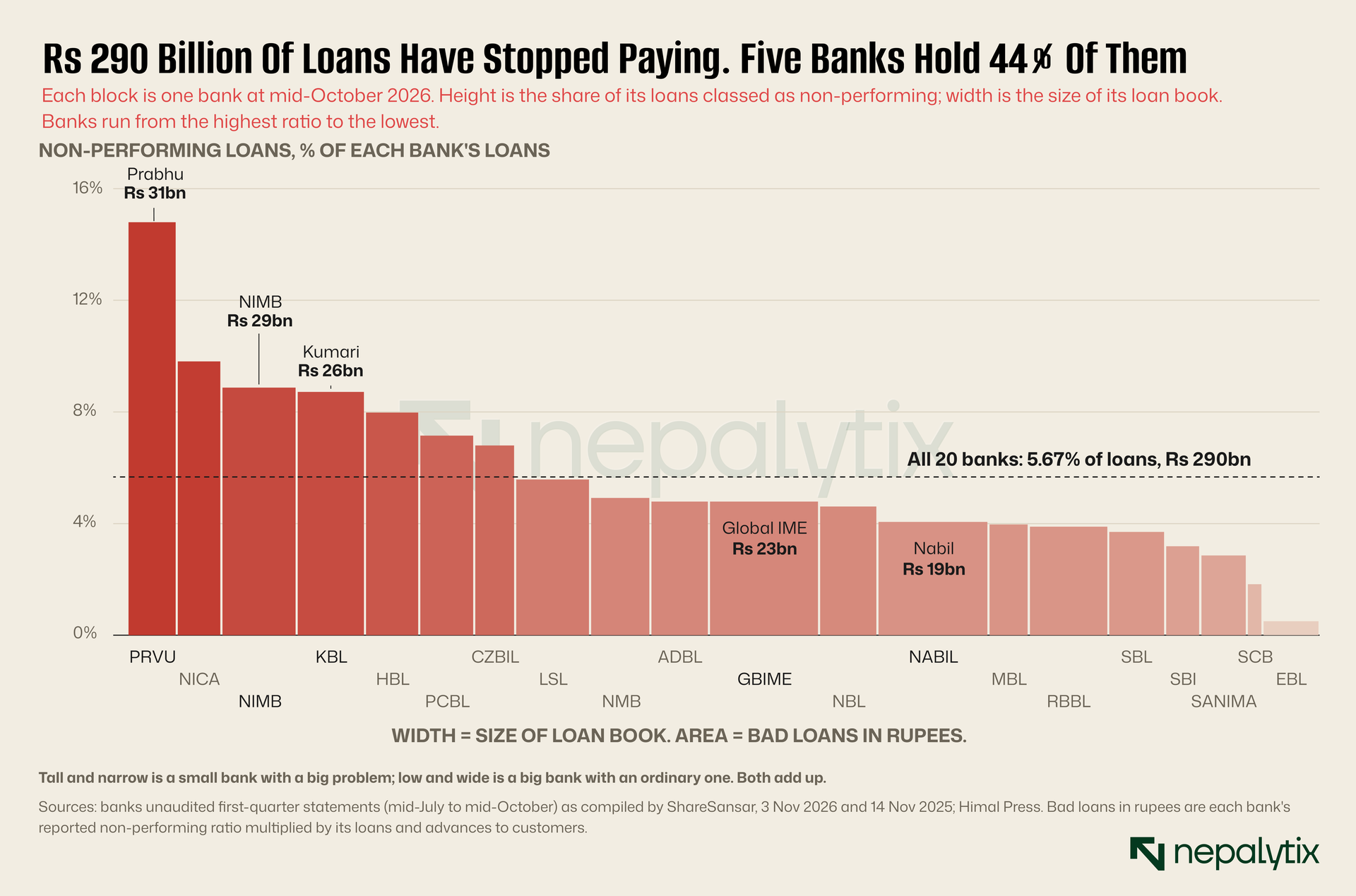
That Rs 290 billion isn't spread evenly. Prabhu, Nepal Investment Mega, Kumari, Global IME and Nabil hold 44% of it between them, though for very different reasons: the first three because their ratios are high, the last two because their loan books are enormous.
So how does the charge fall while the pile grows? There are respectable answers and we'd rather give them than imply something sinister. Banks recovered some loans they'd already provided for and a recovery is booked as a write-back that offsets new charges (Standard Chartered's net charge for the quarter was actually negative). A loan that was already heavily provisioned needs little extra when it slips a category. Banking Khabar has reported that regulatory relief on restructured construction-sector loans lowered the requirement and last year's first quarter was an ugly base: it took in the September 2025 unrest and the October floods, and banks provisioned hard into both.
All of that can be true. It doesn't change the arithmetic. This quarter's profit growth came from a number that has more bad loans underneath it than last year's and it's a number that only falls so far.
04. The Lending Engine Is Idling
If the bad-loan line flattered the quarter, the lending line explains why it needed flattering.
Deposits are pouring in. Loans aren't going out at anything like the same pace. Across the twenty banks, deposits rose by Rs 983 billion in a year and loans by Rs 369 billion.
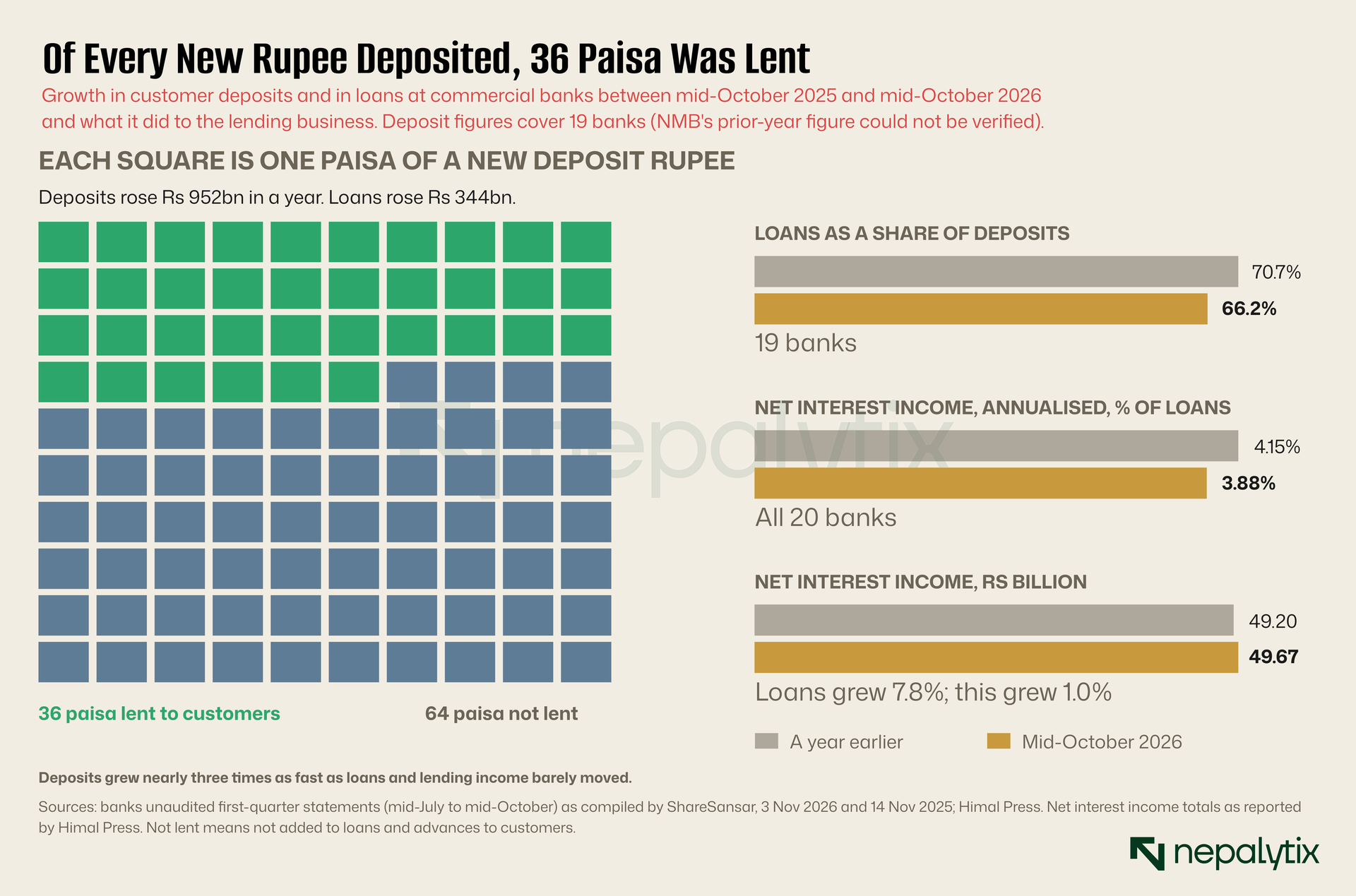
Thirty-eight paisa of every new deposit rupee was lent to a customer. Loans as a share of deposits fell from 71.2% to 66.8%. Five banks (Himalayan, NIC Asia, Nepal Investment Mega, Prabhu and Standard Chartered) have smaller loan books than they did a year ago. You'll notice some overlap with the bad-loan list.
The spread between banks is enormous. Nabil lent out 88 paisa of each new deposit rupee, Sanima 79 and Prime lent more than it took in. At the other end, NIC Asia's loan book shrank by Rs 21 billion and Prabhu's by nearly Rs 20 billion while their deposits edged up. Rastriya Banijya, the state-owned giant, is its own category: deposits jumped by Rs 187 billion in a year, a rise of 35% and loans by Rs 37 billion. Less than half of its deposits are now lent to customers. It still grew lending income faster than anyone which tells you how cheap that money was.
A bank pays interest on all of its deposits and earns a lending margin on only some of them. With the average best fixed-deposit rate down to 3.9% this month, deposits are cheap which helps. Lending rates have fallen too which doesn't. Net interest income as a share of loans slipped from 4.15% to 3.88% on an annualised basis. That's how a loan book that grew 7.8% produced lending income that grew 1%.
To be fair to the optimists, there's a version of the next year where this works out. Deposits this cheap are a gift if borrowers show up. A bank that's sitting on unlent money with fixed deposits costing under 4%, makes a lot very quickly once credit demand returns and there's nothing structural stopping that. Bad loans tend to peak a few quarters after the economy does. If that peak is behind us, today's lower charge will look like good judgment and not like a holiday.
We don't have evidence for that yet. We have a quarter in which bad loans rose by a fifth.
This is the part that matters for the next three quarters. A provisioning charge can fall from Rs 20 billion to Rs 11 billion once. It can't do it again. To grow profit from here the banks need the top line to move and right now it isn't.
05. What Shareholders Can Actually Be Paid
Net profit isn't the number a dividend comes out of. Distributable profit is: what's left after the regulator's required reserves and adjustments, including for interest that's been booked but not collected. For an investor it's the number that counts and it gets a fraction of the coverage.
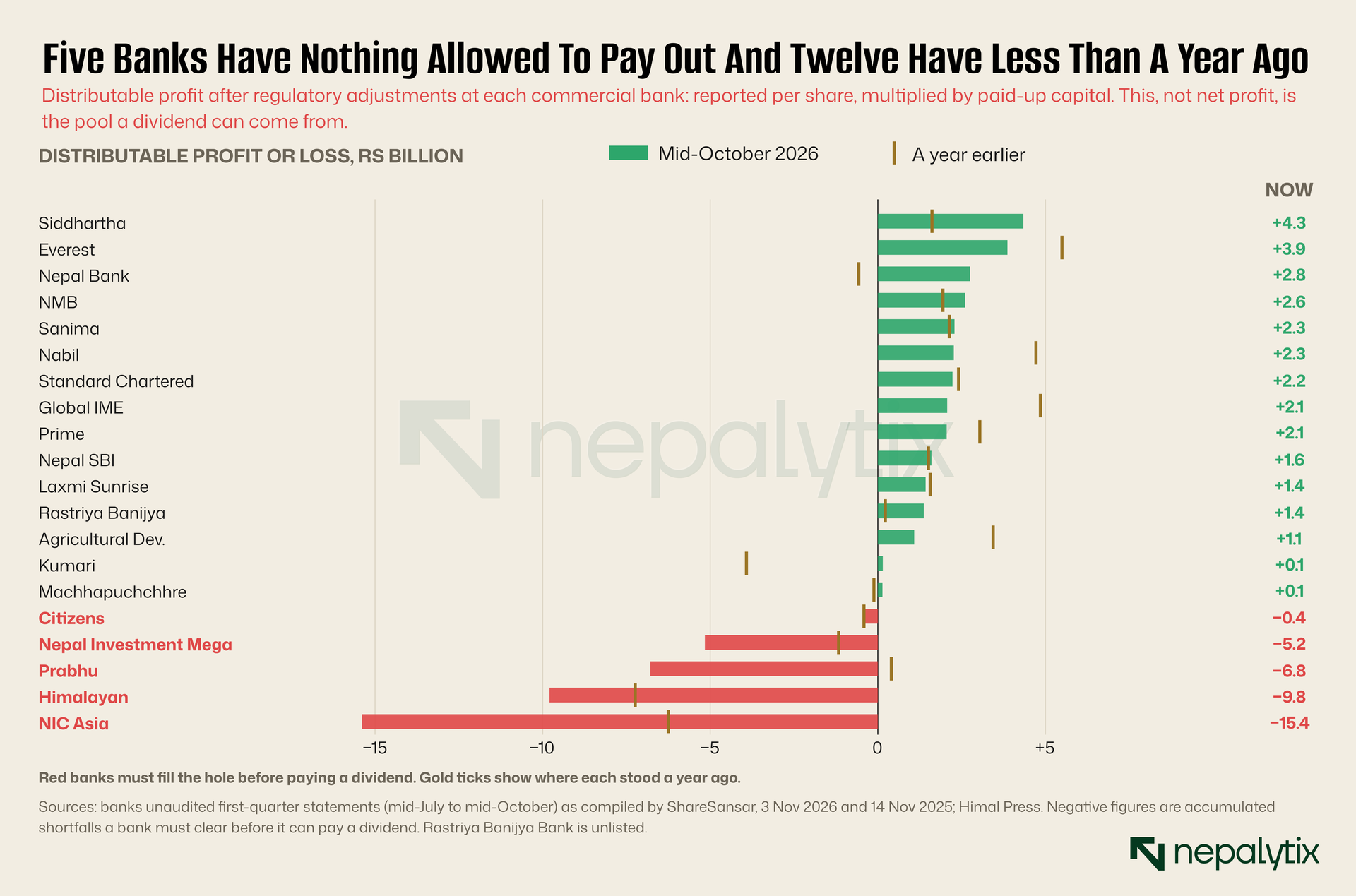
Five banks have a negative figure, meaning a hole to fill before any dividend is possible. NIC Asia's is about Rs 15.4 billion. Himalayan's is Rs 9.8 billion, Prabhu's Rs 6.8 billion, Nepal Investment Mega's Rs 5.2 billion. Yes, that's the same Nepal Investment Mega whose profit rose 2,500%.
How does a bank earn a billion rupees and have nothing to distribute? Mostly through two adjustments. Interest that a borrower owes but hasn't paid still counts as income under the accounting rules and the regulator makes the bank park it in a reserve until the cash arrives. And property a bank has seized from defaulters sits on the balance sheet at a value the regulator requires it to reserve against. Both grow when borrowers struggle so the banks with the most bad loans report profit that is to a large extent not yet money.
In a quarter when industry profit rose 46%, distributable profit is lower than a year ago at twelve of the twenty banks. Nabil, the most profitable bank in the country has Rs 2.3 billion distributable against Rs 4.7 billion a year earlier.
Capital tells the same story from the other side. The capital adequacy ratio is lower than a year ago at fourteen banks. The median fell from 12.88% to 12.12%. A year ago one bank sat below 12%. Now nine do against a regulatory floor of 11%. One figure in the compiled table, Machhapuchchhre at 9.22%, is below that floor as printed; we'd want to see it in the bank's own statement before reading anything into it.
06. So What Do You Do With This?
Stop ranking banks by profit growth. This quarter it mostly measures who cut provisioning the most. The two questions that sort the list properly are simpler. Did net interest income grow? And is the bad-loan ratio falling? Only a handful of banks can answer yes to both. Nabil, Global IME, Sanima, Siddhartha and Machhapuchchhre can. Rastriya Banijya nearly can.
Read the second quarter for one line. Results for the quarter to mid-January land in early February. If the impairment charge stays near Rs 11 billion while non-performing loans keep rising, the question becomes when the bill arrives not whether. If the charge climbs back, the 46% goes with it.
Check distributable profit before you price in a dividend. A bank can report a record profit and be barred from paying out a rupee of it. Five are in that position today.
Watch credit growth. It's the only route back to earnings that don't depend on an accounting line. Commercial banks added about Rs 149 billion of loans in the first four months of the fiscal year and both Prabhu and NIC Asia shrank. That's a slow start.
Do the ten-minute version yourself. Take any bank's quarterly statement. Find net profit, the impairment charge and net interest income, this year and last. Divide profit by 0.7 and add the impairment charge: that's earnings before provisions. If it fell while profit rose, you've found a bank from the third group. Then multiply the non-performing ratio by total loans, both years and see whether the pile in rupees grew. Four numbers, two years, one answer.
One last thing. None of this means the banks are hiding anything. Every figure in this piece comes from statements they published themselves. The trouble is what gets printed in bold. A bank's quarterly release leads with net profit and a growth percentage. It doesn't lead with earnings before provisions or with the rupee value of loans that have stopped paying or with what can be distributed. You can build all three from the same document in about ten minutes. Almost nobody does and so "profit up 46%" became the story of a quarter in which the banks earned slightly less than they did a year ago.
Disclaimer
This report has been prepared by Nepalytix for informational and educational purposes only and does not constitute investment advice, an offer, or a solicitation to buy or sell any securities.
The information contained in this report is based on sources believed to be reliable; however, Nepalytix does not guarantee its accuracy, completeness, or timeliness. Opinions, estimates, and projections expressed herein are those of the authors as of the date of publication and are subject to change without notice.
Investing in securities involves risks, including the possible loss of principal. Past performance is not indicative of future results. Readers are advised to conduct their own independent research and consult with a qualified financial advisor before making any investment decisions.
Nepalytix and its contributors may hold positions in the securities discussed in this report at the time of publication or thereafter.
Neither Nepalytix nor any of its affiliates accept any liability for any loss arising from the use of this report or its contents.