Bonus Shares Are Creating Fake Dividend Yield
Nepal’s most common small cash dividend is 0.53% often not a return to shareholders but a tax payment on bonus shares. The practice makes dividends look larger than they really are.
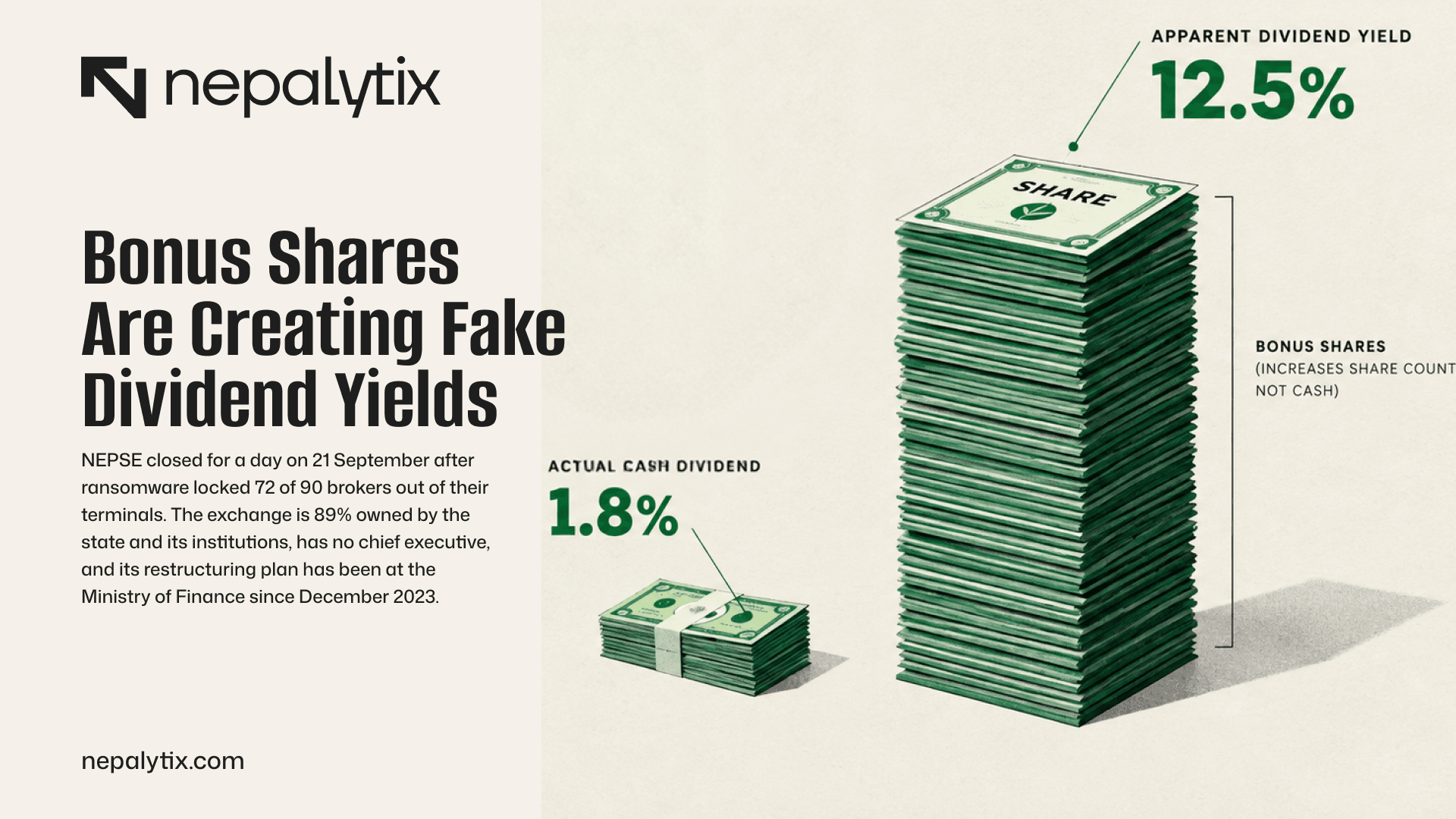
Nepal's commonest cash dividend is 0.53% of par exactly the tax on a 10% bonus share. Nearly three in five companies that issue bonus shares alongside cash pay out precisely that tax and nothing more. The ritual is a symptom. Bonus shares are not dividends. They should stop being taxed and announced as if they were.
The proposition
A bonus share moves a company's retained earnings into share capital and gives shareholders more paper for the same company. It is a share split with an accounting entry attached. Nepal taxes it at 5% as if it were income. Companies announce it alongside cash as one "dividend" percentage. They pay out a sliver of cash whose only purpose is to settle that tax. The tax should go, the headline should split and regulators should stop requiring the paid-up capital that the practice exists to manufacture.
Every autumn as Nepali companies close their books, the exchange's notice board fills with a familiar line. A board has proposed say a 10% bonus share and a 0.53% cash dividend "for tax purposes". The financial press adds the two and reports a 10.53% dividend. Shareholders who receive it find that their holding has grown by a tenth in share count that the share price has been cut on book-closure day by roughly the same tenth and that the cash credited to them has gone straight to the tax office. Nothing has entered their account. The headline said 10.53%.
This is not an occasional quirk. It is one of the most consistent patterns in the dividend records of Nepal's listed companies, and it is visible in the numbers alone. We assembled the dividend histories of every listed equity with a company page on merolagani.com 264 companies once mutual funds, debentures and promoter-share lines are excluded. Each history lists up to ten years of cash dividends. Each page also records the most recent bonus share issue. That is enough to see the pattern and enough to test it.
The commonest dividend is a tax payment
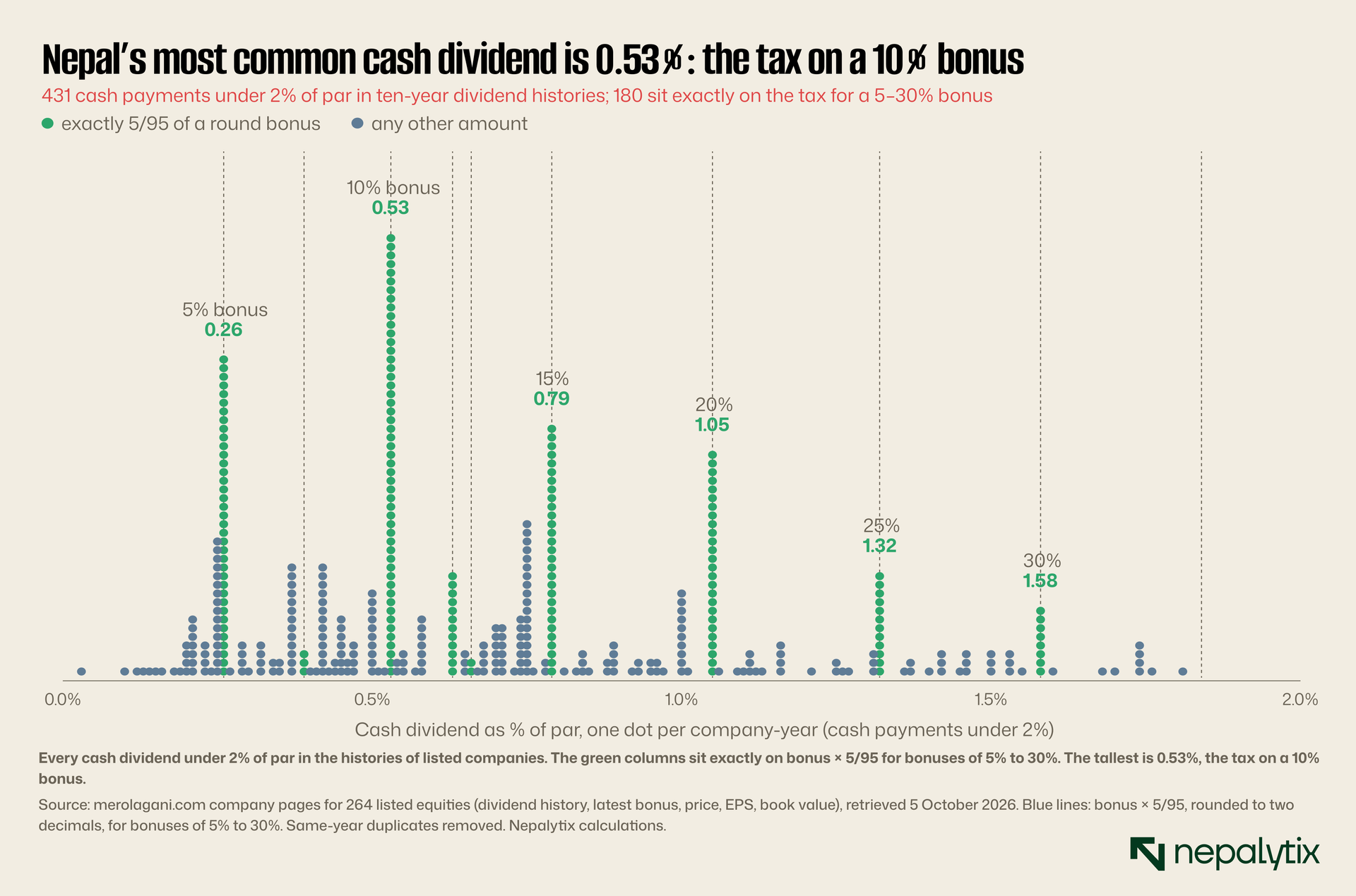
Across the 264 companies, we count 864 cash dividends, one per company per fiscal year. Half of them, 431, are under 2% of par value. Within that half, the distribution should be smooth if cash payouts were set by profits and policy. It is not. It has spikes at a handful of exact values, and almost nothing on either side of each spike.
The tallest spike is 0.53%. Fifty-one company-years paid exactly that amount. That is more than paid 5% (41 company-years) or 10% (40), the two round numbers one would expect to be most common. It is the single most frequent cash dividend in the dataset. Next to it, 0.52% appears once and 0.54% twice. The next spikes are 0.26% (37 company-years), 0.79% (29) and 1.05% (26). Their neighbours, one hundredth of a point either side are almost empty.
Those four numbers are not arbitrary. They are 5/95 of 5%, 10%, 15% and 20%. When a company issues a 10% bonus, the law treats the bonus as a dividend and requires 5% tax to be withheld on it. A company that wants its shareholders not to pay that tax out of pocket declares a cash dividend just large enough that 5% of the total distribution equals the cash. Cash of c on a bonus of b satisfies c = 5% × (b + c), so c = b × 5/95. For a 10% bonus, that is 0.526% rounded to 0.53%. The company sends the 0.53% to the tax office on the shareholders' behalf. The shareholders receive their new shares and no cash.
The arithmetic also explains why the spikes are so clean. The tax amount depends only on the bonus ratio and companies choose bonus ratios from a small menu of round numbers. Every company that declares a 10% bonus and covers the tax lands on 0.526% which rounds to 0.53%. No other consideration, not profit, not cash on hand, not the previous year's payout moves the number. A cash dividend set by a board weighing profits and needs would never cluster so tightly. One set by a formula always would.
Of the 431 small cash payments, 180 sit exactly on that grid for bonuses of 5% to 30%. A further cluster at 0.25% corresponds to a 4.75% bonus. Some microfinance companies use it to reach a round 5% headline as we explain below. The rest of the small payments are scattered across many values as one would expect from cash set by profit.
The press has long reported this practice in plain terms. Announcements describe cash as being "for tax purposes": a 33% bonus with 1.74% cash in 2015, a 10% bonus with 5% cash plus 0.79% "for tax purposes" in 2019. A review of FY2074/75 declarations noted that a company issuing bonus shares must either pay that tax cash or require investors to bring the tax money to its office before they could receive their shares. What the histogram adds is scale. This is not a handful of companies. It is the modal behaviour of the market.
Three in five bonus issuers pay the tax and nothing else
The dividend histories show cash amounts but not the bonus issues that went with them. To match the two directly we need a single year in which both are known. Each company page gives the latest bonus issue and its fiscal year and the latest cash dividend and its year. For 107 companies the most recent distribution included bonus shares. In 96 of those, the company also paid cash in the same fiscal year.
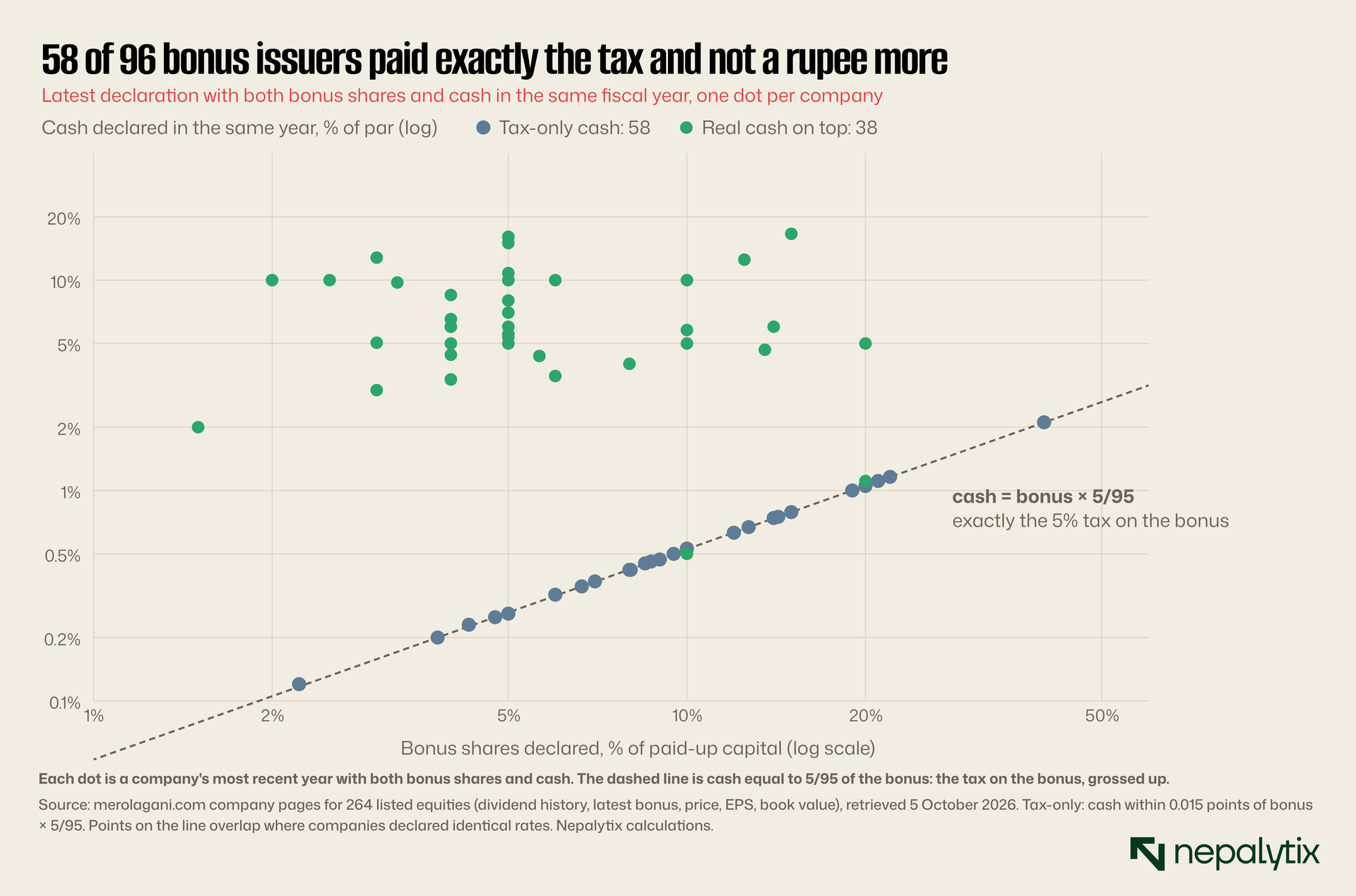
Fifty-eight of the 96 lie on the line. Their cash is within 0.015 points of the bonus multiplied by 5/95. Those companies paid exactly the tax on the bonus and not a rupee more. The other 38 paid real cash on top, mostly between 3% and 15% of par in addition to the tax element. Only one paid less than the line by a few hundredths of a point. Almost every company that paid any cash with a bonus paid at least enough to cover the tax.
The 58 cover every corner of the market. Twenty-five are hydropower companies, 15 are microfinance institutions and five are non-life insurers. The rest include commercial banks, development banks, hotels, manufacturers and investment companies. Size and sector make little difference to the habit.
Some companies go one step further and adjust the bonus so that the headline comes out round. A microfinance company that declares a 9.5% bonus with 0.5% cash or 14.25% with 0.75%, or 19% with 1% is declaring 10%, 15% or 20% in total. The cash is still exactly 5/95 of the bonus. The only purpose of the odd bonus figure is to make the sum look like a round dividend. Several microfinance institutions in our data have done exactly this.
What a bonus share actually is
The tax would be harmless, if irritating, if a bonus share were income. It is not and the market's own mechanics prove it.
When a company issues a 10% bonus, it moves an amount equal to 10% of its paid-up capital from retained earnings, or another reserve into share capital. No money leaves the company. Its assets, liabilities, profits and total equity are unchanged. The only change is that the same equity is now divided among 10% more shares. Book value per share falls by about a tenth and so does earnings per share.
The exchange recognises this. On the book-closure date, NEPSE adjusts the reference price by dividing it by one plus the bonus ratio. A share trading at Rs 550 before a 10% bonus opens at Rs 500 afterwards. A shareholder with 100 shares worth Rs 55,000 has 110 shares worth Rs 55,000. The value of the holding is the same but the shareholder has paid tax on Rs 1,000 of par value and either the company or the shareholder has paid it in cash.
The bonus share also breaks every per-share series that investors use. Earnings per share, book value per share, dividend per share and the share price all fall by the bonus ratio on the day, so comparisons across years require adjustment. Nepal's company pages and quarterly reports often present per-share figures unadjusted. A company whose EPS has been flat for five years while it issued 10% bonuses annually has in fact grown its profits by about 60%. One whose EPS has fallen by a tenth after a 10% bonus has stood still. Investors who read unadjusted series see decline where there is stability and stability where there is growth.
In economic terms this is a share split. In most markets, a split is a non-event for tax: no income is recognised and the shareholder's cost basis is spread over the larger number of shares. Some jurisdictions tax stock dividends in particular circumstances. The general principle is that a distribution which does not change the shareholder's proportional claim on the company is not income. Nepal's treatment inverts that. The tax is levied at the moment when nothing has happened and the "dividend" headline treats the shares as if they were money.
The tax is also not trivial in aggregate. The 107 companies whose latest distribution included bonus shares capitalised on the most recent declarations, something on the order of Rs 38.6 billion of par value. That is an upper bound, because some of the share counts we used already include the bonus. At 5%, the implied tax is close to Rs 1.9 billion. Each of those rupees was collected on a transaction that left every shareholder with exactly the same share of the same company.
Headlines that count shares as income
The second cost of the practice is to understanding. Nepal's financial press and many brokers report a company's "dividend" as the sum of the bonus percentage and the cash percentage. A company declaring a 15% bonus and 0.79% cash is reported as declaring a 15.79% dividend. A dividend yield calculated on that headline is roughly twenty times the cash yield and even that cash is withheld for tax.
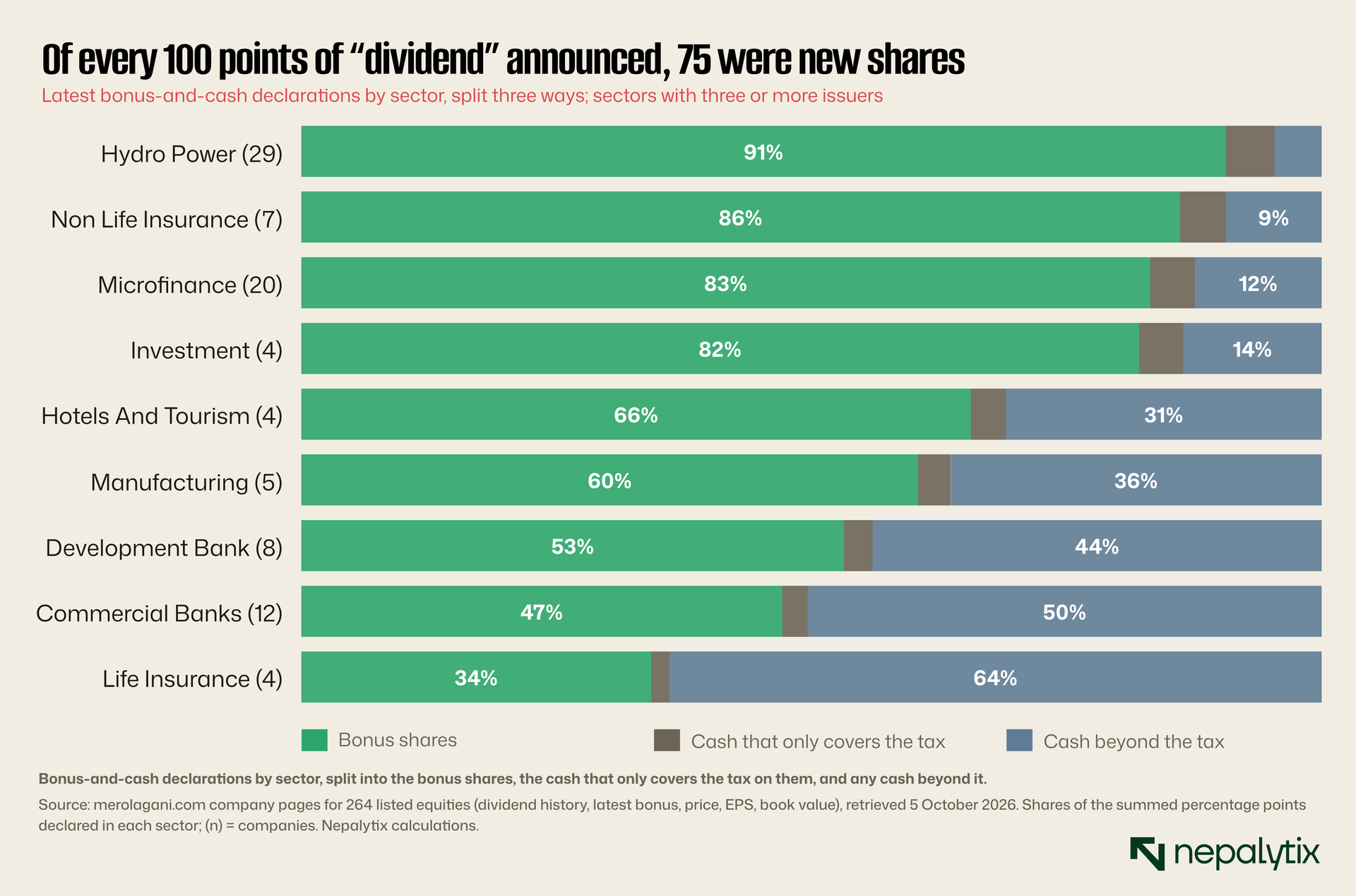
Add up the latest bonus-and-cash declarations of the 96 companies that made both. The total is 1,252 percentage points of "dividend". Of those, 942 points, 75% were bonus shares. A further 49.5 points, 4% were cash that went to the tax office. The remaining 260 points, 21% were cash that reached shareholders. On these declarations, a reader of the headline figures would overstate the cash going to shareholders by a factor of nearly five.
The proportions vary sharply by sector and the variation tells its own story. Life insurers and commercial banks which generate cash and are watched closely by their regulators put half or more of their declared dividend into real cash. Hydropower companies put 91% of theirs into bonus shares, microfinance companies 83% and non-life insurers 86%. Those are the sectors in which a capital requirement or an ambition to grow paid-up capital has been the main reason to declare anything at all.
The same distortion runs through every screen that ranks companies by dividend yield. A company that pays 0.53% cash with a 10% bonus will appear on such a screen with a yield calculated on 10.53%. A company that pays a steady 5% in cash with no bonus will appear with half that yield. The first returns nothing to its shareholders; the second returns real money. A retail investor sorting by yield will buy the wrong one.
The language matters because retail investors buy on it. A hydropower company announcing a "15.79% dividend" is, for most purposes, announcing that it will split its shares. The yield an investor can spend is zero. The disclosure framework, written originally for banks asks companies to announce a dividend rate. It does not ask them to separate shares from cash still less to show the tax element. That is the gap our coverage keeps finding: the rules require the number a bank would publish and every other kind of company fills it in as best it can.
A worked example
Take a shareholder with 100 shares in a company trading at Rs 550. The board proposes a 10% bonus and a 0.53% cash dividend "for tax purposes" and the annual general meeting approves it. Here is what happens to the shareholder.
The company capitalises Rs 10 of reserves for every share so the shareholder receives 10 new shares with a par value of Rs 1,000. It also declares cash of Rs 0.53 per share, Rs 53 in all. The law treats the whole distribution, shares and cash as a dividend and requires 5% to be withheld. Five per cent of Rs 1,053 is Rs 52.65. The company withholds the cash and remits it to the tax office. The shareholder's bank account receives nothing, or a few paisa of rounding.
On book-closure day, the exchange adjusts the reference price. Roughly, the new price is the old price, less the cash divided by 1.1. Rs 550 becomes about Rs 499.50. The shareholder now has 110 shares at Rs 499.50 worth Rs 54,945. Before, the holding was worth Rs 55,000. The Rs 55 difference is the cash dividend of Rs 53, which went to the tax office plus rounding. The shareholder owns exactly the same fraction of the same company as before. The holding is Rs 53 lighter than it would have been had the bonus been declared as a split because that is the tax.
Now compare what the headline said. A "10.53% dividend" on a Rs 100 par share implies Rs 10.53 per share of income. On a Rs 550 share that is a dividend yield of 1.9%. The real cash yield to the shareholder was zero and the real change in wealth was minus 0.01% after tax. The headline number has no relationship to anything the shareholder received.
If the company had instead declared a 1.1-for-1 share split, the shareholder would have ended the day with 110 shares at Rs 500 and Rs 55,000, no tax paid and no dividend headline. Economically, that is the same event. The only differences are the tax and the confusion.
The variants
The basic pattern has three common variants and each tells us something about why companies use it.
Bonus with no cash at all. Five companies in our census declared a bonus with no cash in the same year. In that case the tax still has to be paid. Under the practice described in contemporary reporting, shareholders must settle the 5% themselves before the new shares are credited to their accounts. For a retail shareholder that is an administrative burden. For the company it saves a small amount of cash. Few companies choose it.
Bonus with grossed-up "round" headlines. Microfinance institutions in particular tend to declare a bonus of 9.5%, 14.25% or 19% with cash of 0.5%, 0.75% or 1%. The totals are 10%, 15% and 20%. The cash is still exactly 5/95 of the bonus. The purpose of the odd bonus figure is to make the announced total come out round. The company is deliberately choosing a bonus ratio to produce a better-looking dividend headline.
Bonus with real cash on top. Thirty-eight of the 96 companies that paid both paid real cash in addition to the tax element. Commercial banks and development banks dominate this group. They often combine a bonus of 3% to 5% with cash of 5% to 10%. Their cash dividends are a real return to shareholders. The bonus element, alongside them, still carries its own tax, paid out of the cash.
A decade of the same habit
None of this is new. The tax-only payment runs through the histories of today's listed companies as far back as they go.
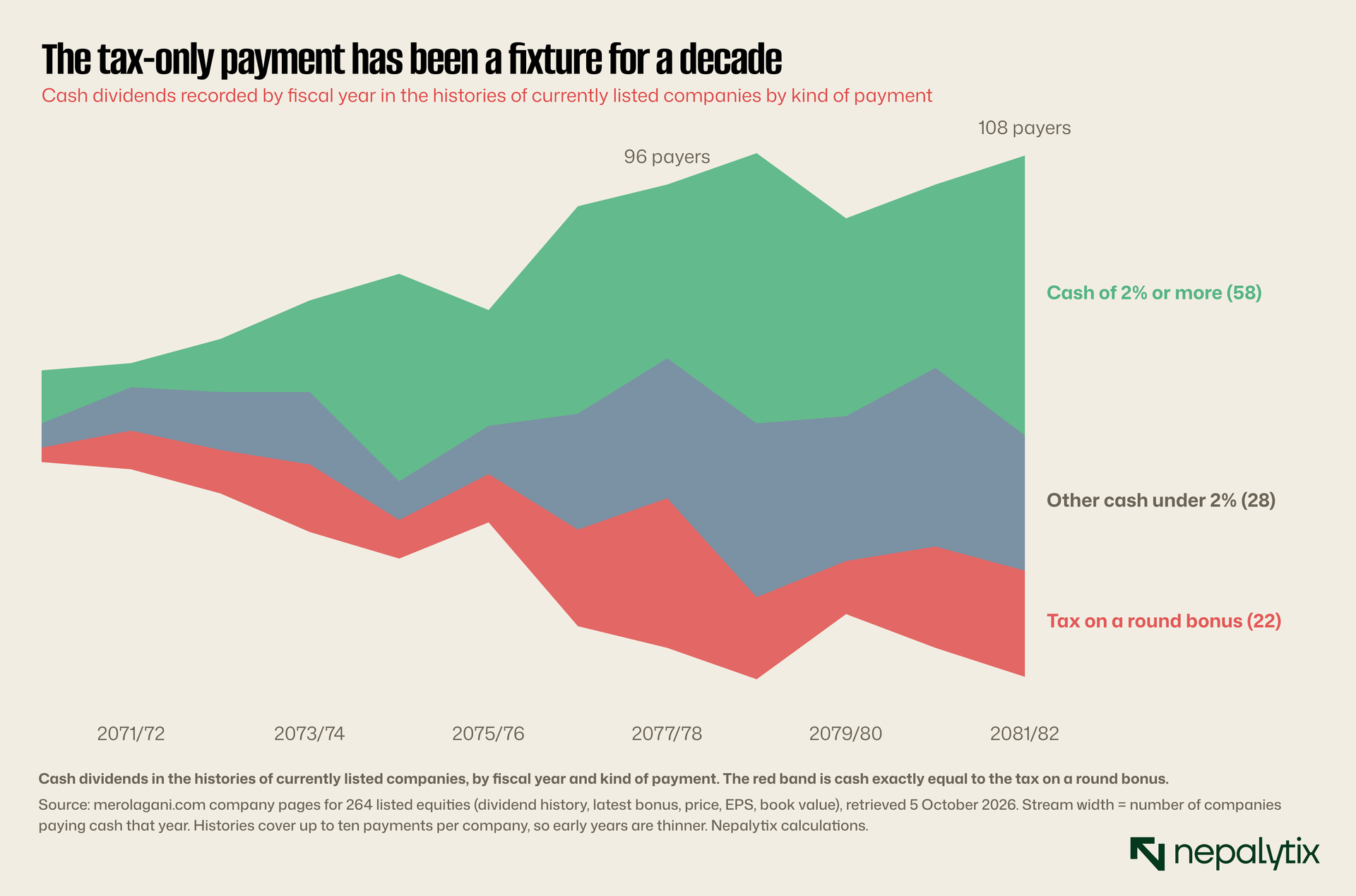
In FY2077/78, 96 of today's listed companies paid some cash dividend. For 31 of them, the cash was exactly the tax on a round bonus. In FY2081/82, the latest complete year in most histories, 108 companies paid cash. Fifty-eight paid 2% of par or more, 28 paid other small amounts, and 22 paid exactly the tax on a round bonus. The tax-only share has drifted down from its peak, as more companies have moved to paying real cash or nothing. The practice remains a fixture.
The histories have limits. They cover only companies listed today, so companies that merged or delisted are missing. Each company page shows at most ten cash payments, so early years are thinly populated. The direction is nonetheless clear. Through a period of mergers, a pandemic, a credit squeeze and a market boom and bust, the tax-only payment has stayed among the commonest cash dividends on the exchange.
Capitalising more than was earned
Because a bonus share is drawn from reserves, a company can issue more bonus in a year than it earned that year. Doing so is legal. It capitalises profits retained in earlier years or a share premium from an earlier offering. But it makes the dividend headline still less informative about the year it is supposed to describe.
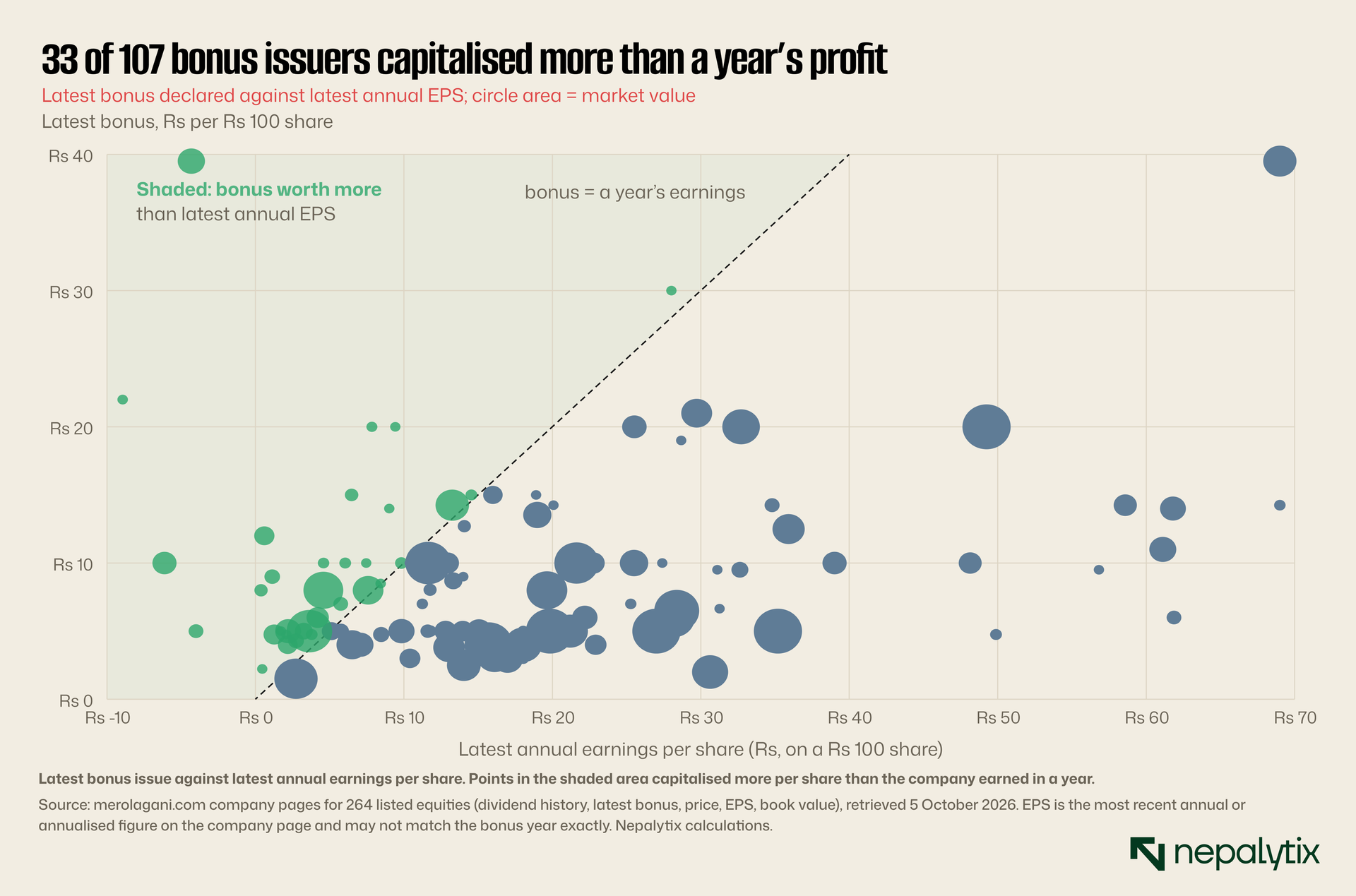
Of the 107 companies whose latest distribution included bonus shares, 33 issued a bonus worth more per share than their latest annual earnings per share. Four were reporting losses on their latest figures. The comparison is imperfect: the company page shows the latest EPS, which may belong to a later year than the bonus. Restricting the test to the 21 companies whose latest bonus and latest full-year EPS are both for FY2082/83, five capitalised more than they earned.
There is nothing improper in capitalising reserves built up in earlier years. A company that retained profits for a decade and then converts them into share capital is formalising a decision it took long ago. What is misleading is the presentation. A bonus share announced in a year of losses appears in the dividend tables as that year's dividend. A reader comparing companies on their latest "dividend" will rank a loss-making company that capitalised old reserves above a profitable one that kept its cash. The four loss-making issuers in our data are small but the principle applies to every company whose bonus exceeds its earnings.
The same point applies to the tax. Because the 5% is levied on the par value of the bonus, a company that capitalises past reserves in a bad year triggers a tax payment for its shareholders in exactly the year it has the least cash to cover it. That is when the tax-only cash dividend becomes hardest to fund and when shareholders are most likely to be asked to pay it themselves.
The government has already recognised one version of this problem. In the FY2080/81 budget, the finance minister announced that bonus shares distributed out of the share premium raised in further public offerings would be treated as taxable income of the company. Companies that had paid such bonuses up to FY2078/79 were given until Mangsir 2080 to file. The logic was that a premium raised from new investors and handed back to old ones as bonus shares should not escape tax. Whatever its merits, the rule confirms that the tax system treats bonus shares as a transfer of value. Economically, they are not.
Does the market care?
If bonus shares were a genuine signal of value, the market would pay more for companies that issue them. It does not at least not visibly.
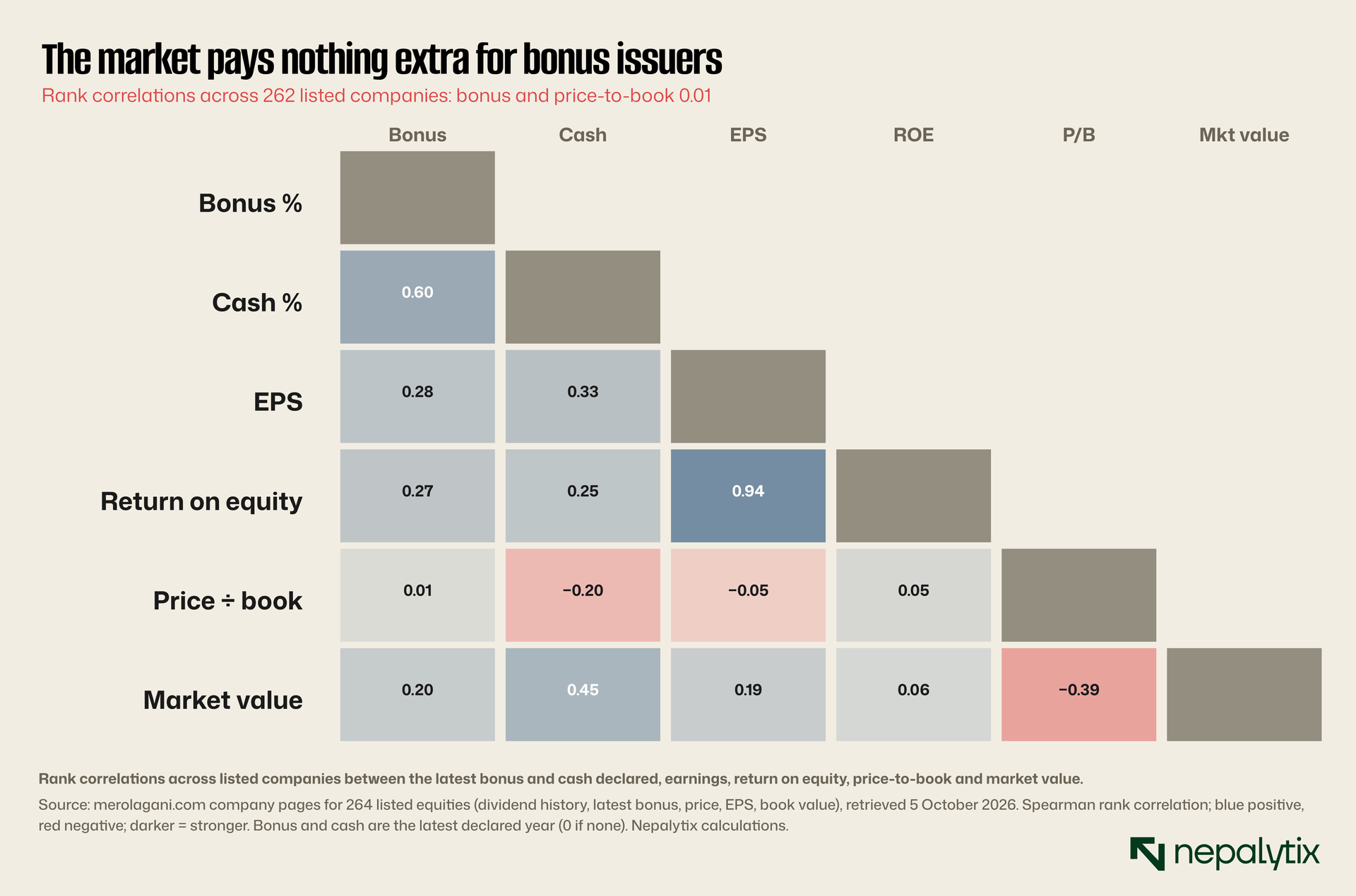
Across 262 companies with usable data, the rank correlation between the latest bonus percentage and the price-to-book ratio is 0.01, effectively zero. Bonus issuers are slightly more profitable: the correlation with return on equity is 0.27. The market does not pay a higher multiple for them. Cash dividends tell a different story. The cash percentage is strongly associated with company size (0.45) and modestly negatively with price-to-book (−0.20). Large, mature companies pay cash and the market does not pay up for them either.
A cross-section is not proof of anything and price-to-book is driven by many other things. But it is consistent with what the mechanics say. A bonus share carries no information that the market values. The market prices the company; the share count is a detail. The book-closure adjustment removes any mechanical gain on the day. Whatever enthusiasm bonus announcements generate before book closure, the data give no sign that it lasts.
The best case for the current system
Regulators require paid-up capital, and bonus shares are the cheapest way to raise it. Nepal Rastra Bank has repeatedly set minimum paid-up capital levels for banks, development banks, finance companies and microfinance institutions. Insurance regulators have done the same. A company that has retained profits can meet a paid-up capital target by capitalising them without asking shareholders for new money. Without bonus shares, many institutions would have had to issue rights shares or merge.
Retention is sensible for growing companies. A hydropower company repaying debt or a microfinance institution growing its loan book may be better off keeping its cash. A bonus share lets it reward shareholders without spending money.
Taxing at issue prevents deferral. If retained profits are never distributed, they are never taxed in the shareholders hands. Taxing bonus shares at capitalisation collects the tax at the point the profits are formally tied to share capital. Without it, the state might wait decades for the revenue.
Shareholders like bonus shares. More shares at a lower price can improve liquidity and access for small investors. Retail investors appear to value the announcement and the market's fondness for it is long-standing.
A bonus signals confidence. Managements that expect higher profits may issue bonus shares to show it, knowing that a larger share count will dilute per-share figures unless earnings grow. On this view the bonus is a credible promise.
The tax-purpose cash is a convenience. Without it, shareholders would have to pay the 5% themselves often in person before they could receive their new shares. The grossed-up cash spares them that trip.
Why the case does not hold
Each of these arguments describes a real constraint. None justifies the current arrangement.
Capital requirements. The case for minimum paid-up capital is that a bank needs loss-absorbing capital. Retained earnings absorb losses exactly as well as paid-up capital and international bank capital rules count them in common equity tier 1 on equal terms. A paid-up capital threshold that counts only share capital forces institutions to relabel reserves as capital and the tax system then charges for the relabelling. The fix is for regulators to set thresholds in terms of total equity or core capital not paid-up capital alone. Where a regulator wants a larger share count for its own reasons, it can require a split.
Retention. A company that wants to keep its cash can simply keep it. It does not need to issue new shares to do so. Retained earnings remain the shareholders property whether or not they are converted into share capital. The bonus share adds nothing to retention except a tax bill and a headline.
Deferral. Profits retained by a company are taxed at the company level when they are earned. What is deferred is the second layer of tax on distributions. Nepal already taxes gains on listed shares when they are sold. If retained profits raise the share price, the shareholder pays capital gains tax on the gain at sale. If the company later pays cash, the shareholder pays dividend tax then. Taxing the bonus at issue collects a tax on value that has not moved. It does not prevent deferral. It simply brings forward a tax on an event that changes nothing.
Liquidity. If a lower share price helps liquidity, a split achieves it directly with no tax and no pretence of a dividend. Nepal's market has a long history of high nominal share prices, partly because companies use bonus shares rather than splits. The two would have the same effect on liquidity and only one is taxed.
Signalling. If bonus shares carried information about future profits, the market would pay for it. On our cross-section it does not: the rank correlation between bonus and price-to-book is 0.01. A signal the market does not price is not much of a signal. And a company that wants to signal confidence can raise its cash dividend which costs it something and is therefore believable. A bonus share costs the company nothing but the tax which its shareholders pay.
Convenience. That companies pay cash so that shareholders need not visit an office to pay tax on shares they did not ask for is not a defence of the tax. It shows how far the system has adapted around a tax that should not exist. The regulators have not been consistent either. In 2019, the Insurance Board directed that insurers should not distribute cash for the purpose of tax on bonus shares and at least one insurer cancelled such a payment after its AGM had approved it. The convenience was withdrawn in one sector without removing the tax that made it necessary.
Who does it
Classifying every listed equity by its most recent distribution shows where the habit is concentrated.
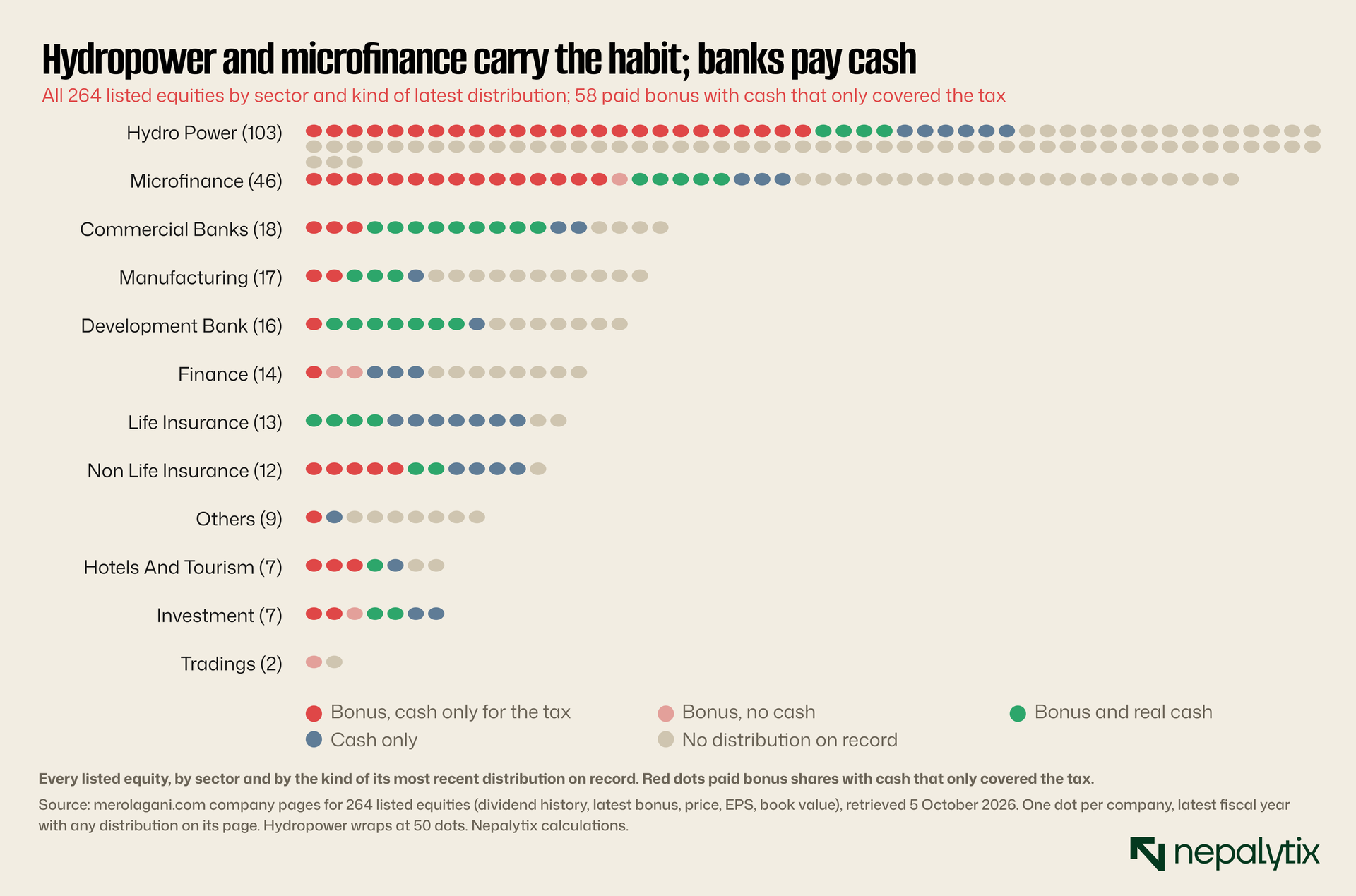
Of the 264 listed equities, 58 most recently paid bonus shares with cash that only covered the tax. Thirty-seven paid bonus shares with real cash. Thirty-one paid cash only, five paid bonus with no cash and 133 have no distribution recorded on their company pages at all. Most of the last group are hydropower companies that have never paid anything.
Hydropower accounts for 25 of the 58 tax-only payers. Microfinance accounts for 15 and non-life insurance for five. Commercial banks are the mirror image. Nine of the 18 most recently paid bonus with real cash, two paid cash only and three paid the tax only. Life insurers are the most cash-heavy: seven paid cash only and four paid bonus with real cash.
The pattern lines up with regulation and with cash generation. Microfinance institutions, development banks and finance companies have faced repeated paid-up capital requirements from Nepal Rastra Bank. Insurers have faced capital requirements from their regulator. Hydropower companies face no capital rule of that kind, but most have little free cash: their earnings are committed to debt repayment. For a hydropower company with retained profits and no cash, a bonus share is the only "dividend" it can declare. The tax-only cash is the only cash it can afford.
What should change
We would make four changes, in order of importance.
First, stop taxing bonus shares at issue. A bonus share should be treated as a capitalisation issue, not as a dividend. The shareholder's cost basis should be spread across the enlarged holding, and tax should fall on gains when shares are sold, as it does for other appreciation. If the government is concerned about companies capitalising share premium raised from new investors, it can address that directly in the company's tax, as the FY2080/81 budget tried to do without taxing ordinary capitalisations of retained profit.
Second, require separate disclosure. SEBON should require that any distribution announcement state the cash dividend per share and the bonus ratio separately. No combined "dividend percentage" should appear in exchange notices and any cash paid solely to settle tax on a bonus should be labelled as such. Brokers and the press will follow the format the exchange uses. Dividend yields should be calculated on cash only.
Third, reframe capital thresholds. Nepal Rastra Bank and the Insurance Authority should express minimum capital requirements in terms of core capital including retained earnings, rather than paid-up capital alone. Institutions that already hold the reserves would then have no reason to capitalise them for regulatory purposes and a large share of bonus issues would stop. Those that remained would be genuine choices about share count.
Fourth, if a tax must be collected, collect it from the company. If the government is unwilling to give up the revenue, it should levy the tax on the company at the moment of capitalisation and call it what it is: a tax on converting reserves into capital. It should not route the money through a fictional cash dividend that inflates the headline and confuses the yield.
Transition. These changes can be sequenced without disruption. Disclosure can change at once, by SEBON circular and costs nothing. The capital-threshold change requires Nepal Rastra Bank and the Insurance Authority to redefine terms in their directives. That could take effect for the next round of capital plans, with existing commitments honoured. The tax change needs an amendment to the Income Tax Act. It should set out how the cost basis of bonus shares is determined, so that capital gains tax on later sales captures any real gain. Bonus shares already issued could be left as they are. The aim is not to refund past tax but to stop collecting it on future capitalisations.
Revenue. The government would lose the tax now collected on bonus issues on the order of Rs 1.9 billion on the most recent round in our data, and less in leaner years. Some of that would return through capital gains tax as shares are sold and some through dividend tax if companies that stop issuing bonus shares pay more cash instead. The net cost is uncertain and probably modest relative to the distortion it removes. A tax that pushes every listed company towards issuing paper rather than cash and that makes the dividend statistics of an entire market unreadable has costs of its own.
None of these changes costs shareholders anything. The first costs the government some revenue: on the order of Rs 1.9 billion on the latest round of declarations, an upper-bound estimate and less in years when fewer bonuses are issued. That revenue is currently collected on transactions in which no shareholder gains anything. A tax system that prefers to collect on fictional income rather than real gains should be fixed whatever the cost.
What the evidence cannot show
This argument rests on a census assembled from public company pages and it has limits that matter.
The bonus histories are incomplete. Each company page shows only the latest bonus issue. We can match bonus to cash directly only for the most recent year which is why the matched sample is 96 companies. The ten-year pattern rests on the cash amounts alone, read against the grid of tax amounts. That inference is strong because the spikes are so sharp and their neighbours so empty. It is still an inference: a company that happened to declare 0.53% cash for another reason would be counted as a tax-only payer.
The census covers only companies listed today. Companies that have merged, an important group among banks and microfinance institutions are missing. Their histories would add to the counts rather than change the pattern. The EPS comparison uses the latest figure on each page, which may not match the year of the bonus and we have flagged the matched subset separately. The correlation analysis is a single cross-section and cannot show cause.
Finally, we have not examined price behaviour around book closure. Nepali investors often say that prices rise before a bonus book closure and fall after. That claim deserves a proper event study using the listing-date and book-closure data we are still building. Nothing in this argument depends on it. The case against taxing bonus shares as income stands whether or not the market misprices them in the short run.
The wider point
Nepal's listed companies publish the numbers their regulators ask for and the regulators ask for numbers designed for banks. A bank's paid-up capital, its dividend rate and its profit are for a bank, meaningful operating figures. For a hydropower company, a microfinance institution or an insurer, the same numbers are formal categories that the company fills in to satisfy a framework. The bonus share is the clearest case. A requirement written in terms of paid-up capital creates a reason to manufacture paid-up capital. A tax written in terms of dividends taxes the manufacture. A disclosure convention written in terms of a dividend rate reports the manufactured capital as if it were income. Each rule is reasonable in isolation. Together they produce a market in which the commonest cash dividend is a payment to the tax office on behalf of shareholders who received nothing.
Changing the rules would not make any company more profitable. It would make Nepal's dividend data mean what it says, remove a tax on an accounting entry and let shareholders and analysts see at a glance, how much cash a company actually returns. Those are modest goals. They are not met today.
Disclaimer
This report has been prepared by Nepalytix for informational and educational purposes only and does not constitute investment advice, an offer, or a solicitation to buy or sell any securities.
The information contained in this report is based on sources believed to be reliable; however, Nepalytix does not guarantee its accuracy, completeness, or timeliness. Opinions, estimates, and projections expressed herein are those of the authors as of the date of publication and are subject to change without notice.
Investing in securities involves risks, including the possible loss of principal. Past performance is not indicative of future results. Readers are advised to conduct their own independent research and consult with a qualified financial advisor before making any investment decisions.
Nepalytix and its contributors may hold positions in the securities discussed in this report at the time of publication or thereafter.
Neither Nepalytix nor any of its affiliates accept any liability for any loss arising from the use of this report or its contents.