Bonus Shares vs Rights Shares: What Nepali Investors Need to Know
Bonus shares don’t make you richer but ignoring a rights issue can cost you. Here’s how both affect your shares, wealth, returns and tax.
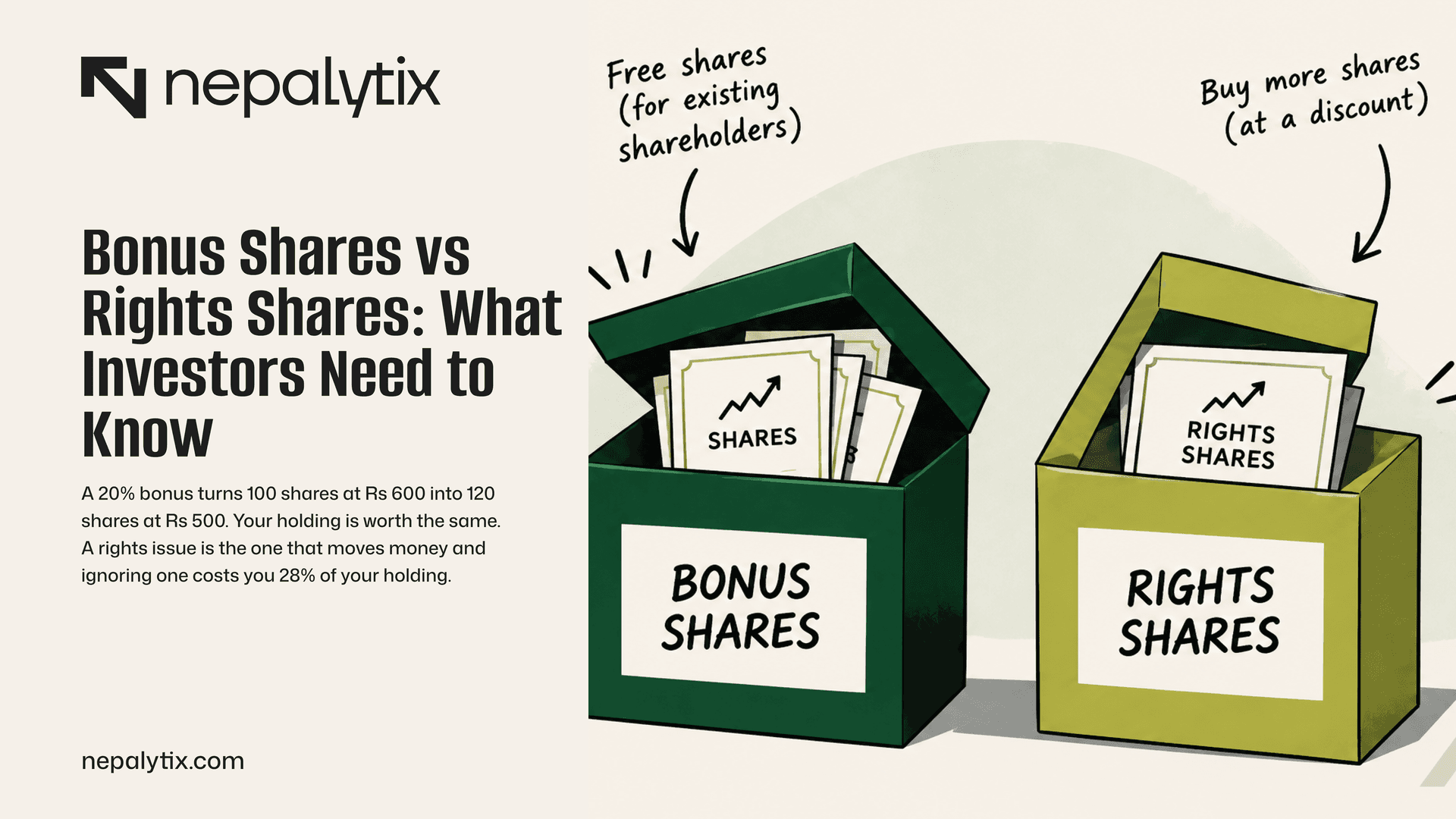
A 20% bonus turns 100 shares at Rs 600 into 120 shares at Rs 500. Your holding is worth the same. A rights issue is the one that moves money and ignoring one costs you 28% of your holding.
You own a hundred shares at Rs 600. The company announces a 20% bonus. Free shares and you get twenty of them.
The next morning your portfolio shows 120 shares at Rs 500. Your holding is worth Rs 60,000 which is what it was worth yesterday.
Nothing was given to you. Nothing was taken away. The company divided itself into more pieces and handed you the extra pieces, and a hundred shares of a sixth of a company is the same thing as a hundred and twenty shares of a sixth of a company.
Almost every Nepali investor knows this and almost none behaves as though they do. This piece sets out what a bonus issue actually does, what a rights issue does differently and the one consequence of bonus shares that is real and costs you money.
Why this is worth a whole piece
Because the consequences run further than the arithmetic and because this publication ran straight into them a fortnight ago.
The IPO screen published here measured what a company listed at Rs 100 is worth today. That calculation is only valid if the company has not issued bonus shares since listing because a holder of one share who has received three bonus issues does not hold one share any more. For a recent cohort it does not arise. For anything older it dominates the answer.
The same problem sits underneath every long-run comparison anyone makes in this market. Sector indices, five-year charts, a family's sense of whether a holding has done well: all of them are wrong by the cumulative bonus factor unless somebody has adjusted for it \and almost nobody has.
So this is not a piece about a technicality. It is about the reason most Nepali investors cannot answer a simple question about their own portfolio.
The rectangle
The clearest way to see it is to stop thinking about the price.
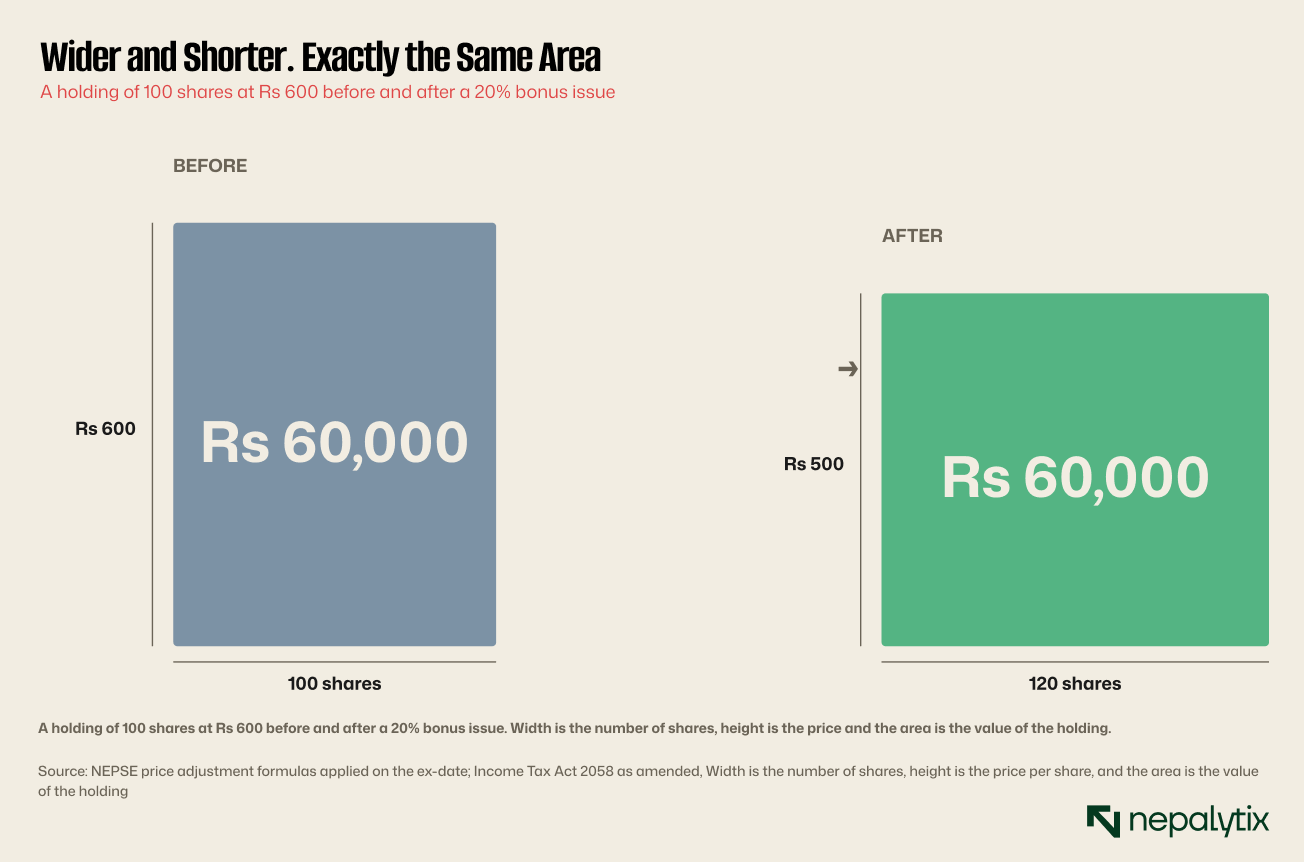
Your holding is a rectangle. The width is how many shares you have. The height is what each one is worth. The area is your money.
A bonus issue widens the rectangle and shortens it by exactly the amount required to leave the area alone. That is not a coincidence or an approximation. It is the formula NEPSE applies on the ex-date and the formula is built to produce that result.
The adjusted price is the old price multiplied by 100 and divided by 100 plus the bonus percentage. A 20% bonus on a Rs 600 share gives 600 × 100 ÷ 120, which is Rs 500. A 10% bonus gives Rs 545.45. A 50% bonus gives Rs 400.
In every case the number of shares rises by the same proportion the price falls. The rectangle changes shape and keeps its area.
It is worth sitting with the formula for a moment because the shape of it explains something people find counter-intuitive. The divisor is 100 plus the bonus percentage not 100 minus it. A 50% bonus does not cut the price in half. It divides by 1.5 which takes Rs 600 to Rs 400, a fall of 33%.
The reason is that a 50% bonus gives you one new share for every two you hold so your share count rises by half. To keep the area constant the price must fall to two thirds. People expecting a halving see the price at Rs 400, assume they have gained and have not.
The same trap runs the other way at small percentages. A 5% bonus moves the price to Rs 571.43, a fall of 4.76% rather than 5%. Close enough that nobody notices and wrong in the same direction.
The rectangle also explains why the announcement is worth nothing on the day it is made. A company declaring a bonus in Ashoj does not change anything until the book closes and when the book closes the exchange applies the formula. Between the two dates the share trades with the entitlement attached which is why it often drifts up: buyers are paying for the right to receive shares that will arrive with an offsetting price cut.
That drift is the closest thing to a real effect in the whole mechanism and it is not a benefit. It is people paying in advance for something worth nothing.
Where the shares come from
The question worth asking is where the extra shares came from because the answer explains why this is not generosity.
A company that earns a profit can do three things with it. Pay it out in cash. Keep it in the business as retained earnings. Or convert some of those retained earnings into share capital and hand the new shares to existing holders.
The third is a bonus issue. It moves money from one line of the balance sheet to another. The company's assets do not change, its earnings do not change and its total equity does not change. What changes is that the equity is now labelled share capital rather than reserves and is divided into more shares.
So the shares are not free. They are paid for out of profits the company already earned and already owned on your behalf. What a bonus issue does is convert a claim you already had into a certificate.
This matters for how to read a company's dividend. A firm declaring a 12% dividend made up of 8% bonus and 4% cash is giving you Rs 4 of money and Rs 8 of paperwork. Chilime Hydropower's FY2081/82 declaration was exactly that: on a paid-up capital of Rs 8.78 billion, Rs 702.4 million went out as bonus shares and Rs 351.2 million as cash. The bonus was twice the size of the cash and cost the company nothing it had not already retained.
There is a legitimate argument for bonus issues and it is worth stating, because the description above makes them sound pointless.
A company that keeps its profits and never converts them into share capital ends up with a large gap between its paid-up capital and its total equity. For a Nepali bank or insurer that matters because regulatory capital requirements are set against paid-up capital. Converting reserves into share capital raises the number the regulator looks at without anyone putting in new money.
Nepal Rastra Bank and the Insurance Authority have both used paid-up capital thresholds as policy instruments. The insurance consolidation examined here last week was driven by a Rs 2.5 billion floor. Companies approaching such a floor have a direct reason to issue bonus shares rather than pay cash, and many do.
There is a second reason, less respectable. A share priced at Rs 2,000 looks expensive to a retail investor in a way a share priced at Rs 500 does not even though the two say nothing about value. Bonus issues keep the quoted price in a range people are comfortable buying. That is cosmetic, and it works.
The one that does take money from you
Rights issues look similar on an announcement and work in the opposite direction.
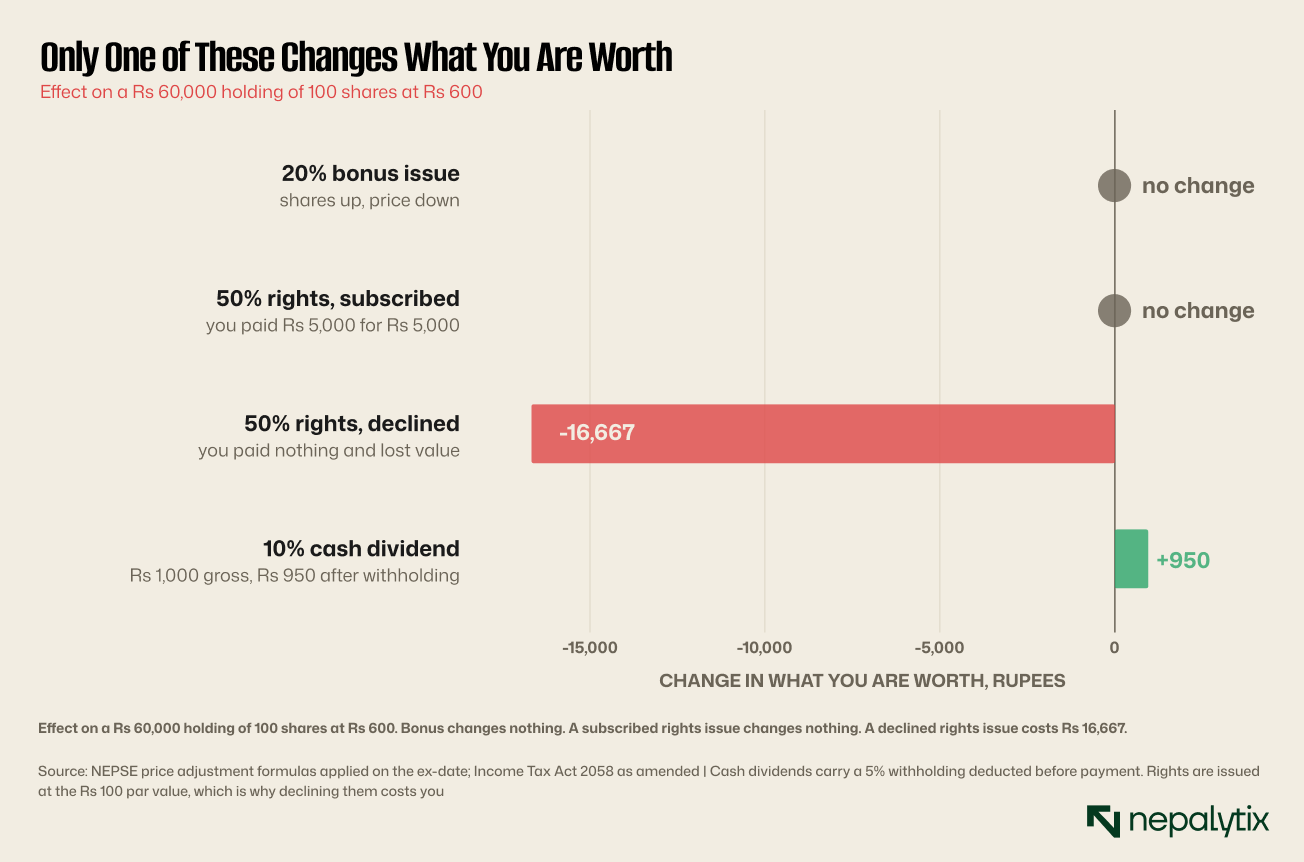
A rights issue offers you new shares at Rs 100, the par value. You have to pay for them. So the adjustment formula is different: the adjusted price is the old price plus the rights percentage times Rs 100, all divided by one plus the rights percentage.
On a 50% rights issue with the share at Rs 600, the adjusted price is Rs 433.33. If you subscribe, you pay Rs 5,000 for fifty new shares and end up with 150 shares at Rs 433.33 which is Rs 65,000. You paid Rs 5,000 and your holding rose by Rs 5,000. You are exactly level.
If you decline, you still hold 100 shares and the price has still adjusted to Rs 433.33. Your holding is now worth Rs 43,333. You have lost Rs 16,667 which is 28% of what you had and you did nothing at all to cause it.
That is the single most expensive misunderstanding available to a Nepali retail investor. Bonus issues require nothing from you. Rights issues require money and the penalty for ignoring the letter is immediate and large.
One practical note on the mechanics of the rights letter. The offer has a deadline and shares bought after the book-closure date do not carry the entitlement. If you buy a share the day after book closure you get the adjusted price and none of the rights which is fair but surprises people who bought on seeing the announcement.
You can also renounce rights to somebody else in some issues which converts the entitlement into something you can sell rather than something you lose. Whether that facility is available depends on the issue and the letter says so.
What you cannot do is nothing. The adjustment happens whether you act or not.
What the price chart does not tell you
Now extend the bonus arithmetic over time because this is where it stops being a curiosity and starts distorting what people believe about their own investments.
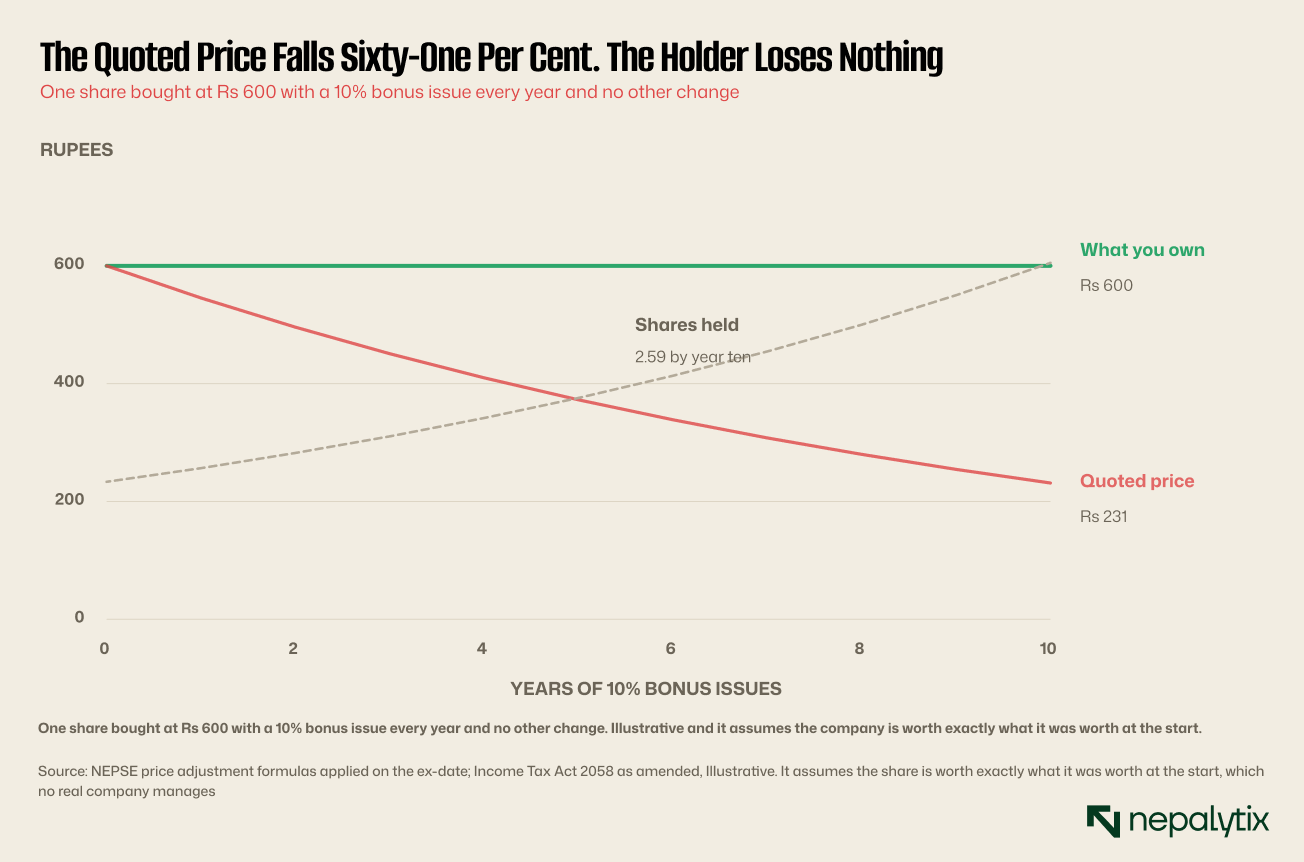
Take a company that issues a 10% bonus every year for ten years and is otherwise completely static. Same plant, same earnings, same everything.
After ten years the quoted price is Rs 231. That is a fall of 61%. Anyone pulling up a ten-year chart sees a share that has collapsed.
The original holder has 2.59 shares worth Rs 231 each which is Rs 600. They have not made or lost a rupee.
This is why unadjusted price history in Nepal is close to meaningless for any company with a dividend record. Chilime has paid dividends in nearly every fiscal year since 2060/61, a large share of them in bonus shares and its paid-up capital has grown accordingly. Its quoted price today says one thing. What a long-term holder actually experienced says another and the difference is every bonus issue in between.
If you want to know what a Nepali share has actually done, the price series has to be adjusted for every bonus and rights issue in the period. Most published charts are not.
The distortion has a second form that catches people comparing two companies rather than one company to itself.
Suppose two hydropower companies listed the same year at Rs 100. One has issued bonus shares every year since. The other has paid cash. Ten years later the first trades at Rs 300 and the second at Rs 700.
The obvious reading is that the second company performed far better. It may have performed worse. The first company's holders own several times as many shares as they started with and their total position could be worth more than the second company's holders hold.
Comparing quoted prices across companies with different dividend policies tells you almost nothing. What it tells you is which company chose to keep its share count low which is a decision about presentation rather than about performance.
The checklist
When a bonus is announced, nothing happens to your wealth. Do not celebrate and do not sell in anticipation.
On the ex-date, your price drops and your share count rises. If your broker statement shows a loss that morning, it is showing you the price adjustment before the new shares have been credited. Wait for the shares.
When a rights issue is announced, work out what it costs you to subscribe and subscribe unless you have a reason not to. Declining is a decision to lose money.
Before comparing a share to its own history, check whether it has issued bonuses in the period. If it has, the unadjusted chart understates your return, possibly severely.
Before selling, check your weighted average cost rather than what you remember paying. Bonus issues have pulled it down and the tax will be computed from the lower number.
When comparing two companies dividends, separate the cash from the bonus. A 12% dividend that is 10% bonus and 2% cash gives you Rs 2 per hundred of paid-up value. A 12% dividend that is all cash gives you Rs 12, less the 5% withholding.
The consequence that is real
Everything so far says a bonus issue does nothing. There is one place where it does something and it costs you.
Capital gains tax is charged on the difference between what you sell for and what you paid. What you paid is your weighted average cost and bonus shares enter that average at zero.
Buy at Rs 400 and receive a 10% bonus, and your average cost becomes Rs 363.64. Your holding is worth the same but your recorded cost is lower so the gain the tax authority sees is larger.
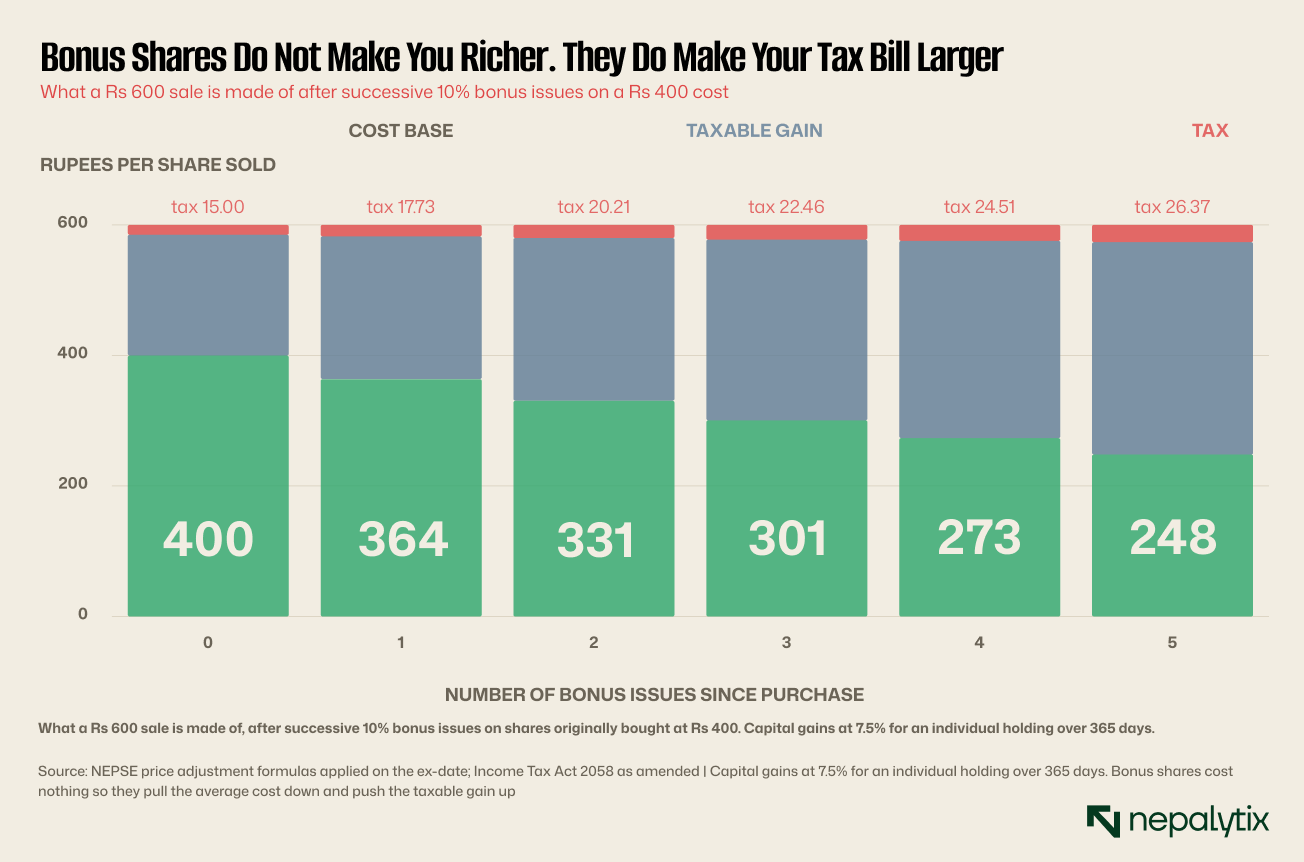
After five 10% bonus issues, a Rs 400 cost base has become Rs 248.37. Sell at Rs 600 and the taxable gain has gone from Rs 200 to Rs 351.63. The tax has gone from Rs 15.00 to Rs 26.37, a rise of 76%.
Nothing about your wealth changed across those five years. Your tax bill rose by three quarters.
This is not a loophole or an error. It is the correct arithmetic: you received shares at no cost and the gain on those shares is genuinely the full sale price. But it means the common belief that bonus shares are a costless benefit is wrong in one specific and measurable way, and the measure is in Figure 4.
One more asymmetry worth knowing because it affects when to act rather than what to think.
The price adjustment happens on the ex-date, automatically, applied by the exchange. The bonus shares arrive in your demat account later, once the company has completed the allotment and the depository has credited them. Those two events are not simultaneous and the gap can run to weeks.
In between, your portfolio looks smaller than it is. The price has fallen and the shares have not yet arrived. Every year a number of investors see that, conclude something has gone wrong and sell into it.
Nothing has gone wrong. The shares are coming. Selling during that window realises the price fall without receiving the shares that offset it which is the one way to turn a bonus issue into an actual loss.
What the company is telling you
There is information in the mix even though there is no money in the bonus and it is worth learning to read.
A company paying mostly cash is telling you it has more money than it needs. It has funded its investment, serviced its debt and has surplus to return. Chilime's early years, when it paid 10% and later 70% including a 40% bonus were the years its plant was generating and its obligations were manageable.
A company paying mostly bonus is telling you the opposite. It has earned a profit on paper and either needs the cash for something or does not have it in a form it can distribute. A hydropower company mid-construction earns accounting profit while every rupee goes into the next turbine. Bonus shares let it acknowledge the profit without parting with the cash.
Neither is good or bad on its own. But a company that shifts from cash to bonus is telling you something changed and the shift is visible in the declaration long before it shows up anywhere else. Chilime's payouts have moderated as bonus issuance expanded its capital base which is a sentence about the company as much as about the shares.
The one combination worth treating with care is a large bonus alongside a rights issue in the same year. The bonus gives you paper and the rights asks you for money and a company doing both is expanding its capital base twice while returning nothing.
The tax point has a corollary that matters for timing. Because a bonus issue lowers your average cost, it raises the gain on every share you subsequently sell including the ones you bought long before. There is no way to sell the bonus shares separately and keep the original cost on the rest. Nepal computes a single weighted average across the holding.
Which means the only lever you have is the holding period. Over 365 days the rate is 7.5% and at or under it is 10%. On a cost base that bonus issues have pushed down to Rs 248 and a sale at Rs 600, the difference between those two rates is Rs 8.79 a share. On a thousand shares it is close to Rs 9,000, available for waiting.
Working out your own number
Everything above is easier to accept than to apply so here is the procedure for one holding.
Start with what you paid and how many shares you bought. Multiply the two. That is the only number that matters and it never changes.
For each bonus issue since multiply your share count by one plus the bonus percentage. Three successive 10% bonuses on 100 shares give 133.1 shares, not 130 because each applies to the larger count.
For each rights issue you subscribed to, add the new shares and add what you paid to your total cost. For each you declined, add nothing and change nothing except the regret.
Your weighted average cost is total money in divided by total shares held. Your position today is shares held times the current price. The difference between those two, before charges and tax is what you have made.
Do that once for a holding you have owned for several years and the number will not match what you thought. In almost every case it will be better because the quoted price has been falling mechanically the whole time while your share count rose.
The number most people carry
There is a specific and common error worth naming because it runs the other way.
An investor who bought at Rs 800 five years ago, watched the price drift to Rs 400 and concludes they are down half. They check their demat and find they hold more shares than they bought and treat that as a small consolation.
If those extra shares came from bonus issues totalling 100%, they hold twice what they bought at half the price and they are exactly level. The loss they have been carrying in their head for five years never happened.
The reverse error is rarer but worse. An investor who sees the share at Rs 400, remembers buying at Rs 800 and decides to average down by buying more is making a decision from a comparison that is not valid.
What to do with all this
Three habits follow and none requires effort.
Keep a record of what you paid and when. Not the price on the screen, the money that left your account and the number of shares that arrived. Every bonus and rights issue since is an adjustment to that record and nothing else. A spreadsheet with four columns will outlive any broker statement.
Treat every rights letter as a bill. It is the only corporate action in Nepal that asks you for money and the only one where doing nothing has a price. Put the deadline in a calendar the day the announcement arrives.
Stop reading unadjusted price charts. For a company with a dividend history they describe the share count more than the value. If you want to know how a holding has done, compute it from your own record rather than from a chart drawn by somebody who does not know what you paid.
A closing observation about why this misunderstanding survives. Nothing in the system corrects it. Your broker shows you a price and a holding not a return. The exchange publishes an unadjusted chart. The company announces a percentage without explaining what it does. The financial press reports the declaration as news about a dividend.
At no point does anyone tell a shareholder that the 12% they just received was 8% of nothing and 4% of something. So the belief persists that bonus issues are a windfall and it persists because every institution the investor deals with describes it in language that supports the belief.
The point
A bonus issue is a company telling you how it accounted for money it already owed you. It changes the shape of your holding and not its size.
What it does change is the number on the screen, which falls, and your tax bill which rises. Both of those are real and neither is what people think they are watching.
Disclaimer
This report has been prepared by Nepalytix for informational and educational purposes only and does not constitute investment advice, an offer, or a solicitation to buy or sell any securities.
The information contained in this report is based on sources believed to be reliable; however, Nepalytix does not guarantee its accuracy, completeness, or timeliness. Opinions, estimates, and projections expressed herein are those of the authors as of the date of publication and are subject to change without notice.
Investing in securities involves risks, including the possible loss of principal. Past performance is not indicative of future results. Readers are advised to conduct their own independent research and consult with a qualified financial advisor before making any investment decisions.
Nepalytix and its contributors may hold positions in the securities discussed in this report at the time of publication or thereafter.
Neither Nepalytix nor any of its affiliates accept any liability for any loss arising from the use of this report or its contents.