Gold Moved Rs 13,300 In A Day. Here Is What Moved It.
Gold jumped Rs 13,300 per tola in a single morning but the rally started thousands of miles away. From global market movements and Nepal's doubled customs duty to a 23-year comparison with NEPSE, we break down what drives gold prices in Nepal and why the two assets have historically moved in opposite directions.
The Signal
Kathmandu's gold rate rose Rs 13,300 a tola on Thursday 5 November, the largest move of the festival season and gave back Rs 5,900 the next morning. Nothing changed in Nepal. The world price had jumped the day before, after the Kathmandu rate was already set and the federation's once-a-day fix delivered two sessions of rally in one morning enlarged by a customs duty that the budget doubled in May.
A sixth of every tola is now tax. And over 23 years, gold has risen in every year that NEPSE fell.
01. What happened
On Wednesday 4 November a tola of fine gold cost Rs 275,600 in Kathmandu. On Thursday morning the Federation of Nepal Gold and Silver Dealers Associations set the day's rate at Rs 288,900. That is Rs 13,300 more, a rise of 4.8% between one morning and the next, three days before Laxmi Puja.
It did not hold. Friday's rate was Rs 283,000, a fall of Rs 5,900. It was unchanged on Sunday, edged up to Rs 284,300 on Monday 9 November and stayed there on Tuesday.
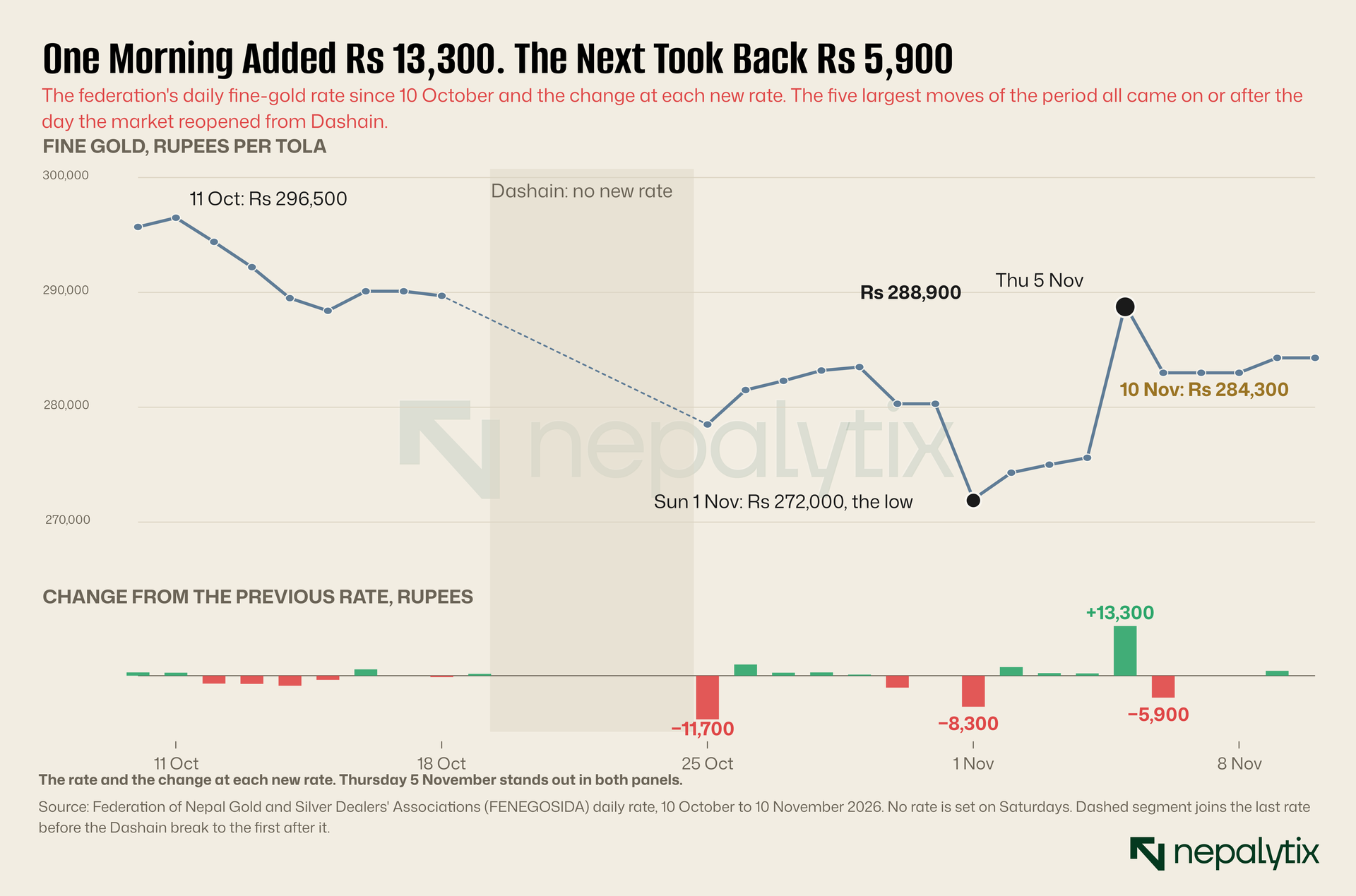
Thursday was the largest move of a month of large ones. The market came back from Dashain on 25 October Rs 11,700 lower than it had left. It lost another Rs 8,300 on Sunday 1 November which took the rate to Rs 272,000, the lowest of the period. In the fortnight after reopening the rate moved by more than Rs 5,000 on four mornings. In the week before Dashain the largest move was Rs 2,700.
02. Where the Rs 13,300 came from
None of it came from Nepal. The world price of gold had been sliding for nine months, from above $5,500 an ounce in late January to a one-year low of $3,869.85 on Friday 30 October. Then it turned. On Wednesday 4 November spot gold rose 3.4%, its sharpest one-day gain since 19 August. On Thursday it touched $4,146.63, the highest since 20 October.
The trigger was the United States, twice over. The midterm elections on Tuesday produced a strong Democratic result; the dollar weakened and Treasury yields fell. At the same time oil was falling, which eased the inflation worry that has had markets pricing another Federal Reserve rate rise in December. A weaker dollar and lower yields are the two things that most reliably lift gold and they arrived together.
It helps to remember how far gold had fallen first. The January peak came on distrust of American monetary policy and on geopolitical tension. Since then the ground has shifted under it: the Federal Reserve turned to raising rates which makes a metal that pays no interest more expensive to hold, and by last week oil was falling on talk of progress in negotiations with Iran over its nuclear programme and the reopening of the Strait of Hormuz. A market that had lost 30% in nine months was primed for a sharp bounce on the first piece of dollar-negative news. The midterms supplied it.
By our reading of the daily world price, gold was worth about Rs 222,700 a tola in rupees on Tuesday afternoon and about Rs 233,500 on Thursday afternoon, before any Nepali tax. That is Rs 10,800 a tola. Add the 20% customs duty on top of the increase and the landed cost rose by about Rs 12,900 in two days. The Kathmandu rate rose Rs 13,300.
03. Why Thursday and not Wednesday
The world moved on Wednesday. Kathmandu moved on Thursday. The gap is the whole reason the number looked so violent.
The federation sets one rate a day, in the morning, and it stands until the next morning. Wednesday's rate was fixed before the rally began: it rose Rs 600. By Wednesday afternoon in Kathmandu the world price was already Rs 7,000 a tola higher, and it kept climbing through the New York session and into Thursday's Asian trade. Thursday morning's rate had to absorb all of it at once.
Friday's fall of Rs 5,900 has the same explanation in reverse. Between Thursday afternoon and Friday afternoon the world price eased from about $4,118 to $4,064 an ounce and the rupee firmed from 151.2 to 150.3 to the dollar. Together those took about Rs 5,400 off the cost of landing a tola. Thursday's rate had been set near the top of a two-day spike; Friday's corrected for it.
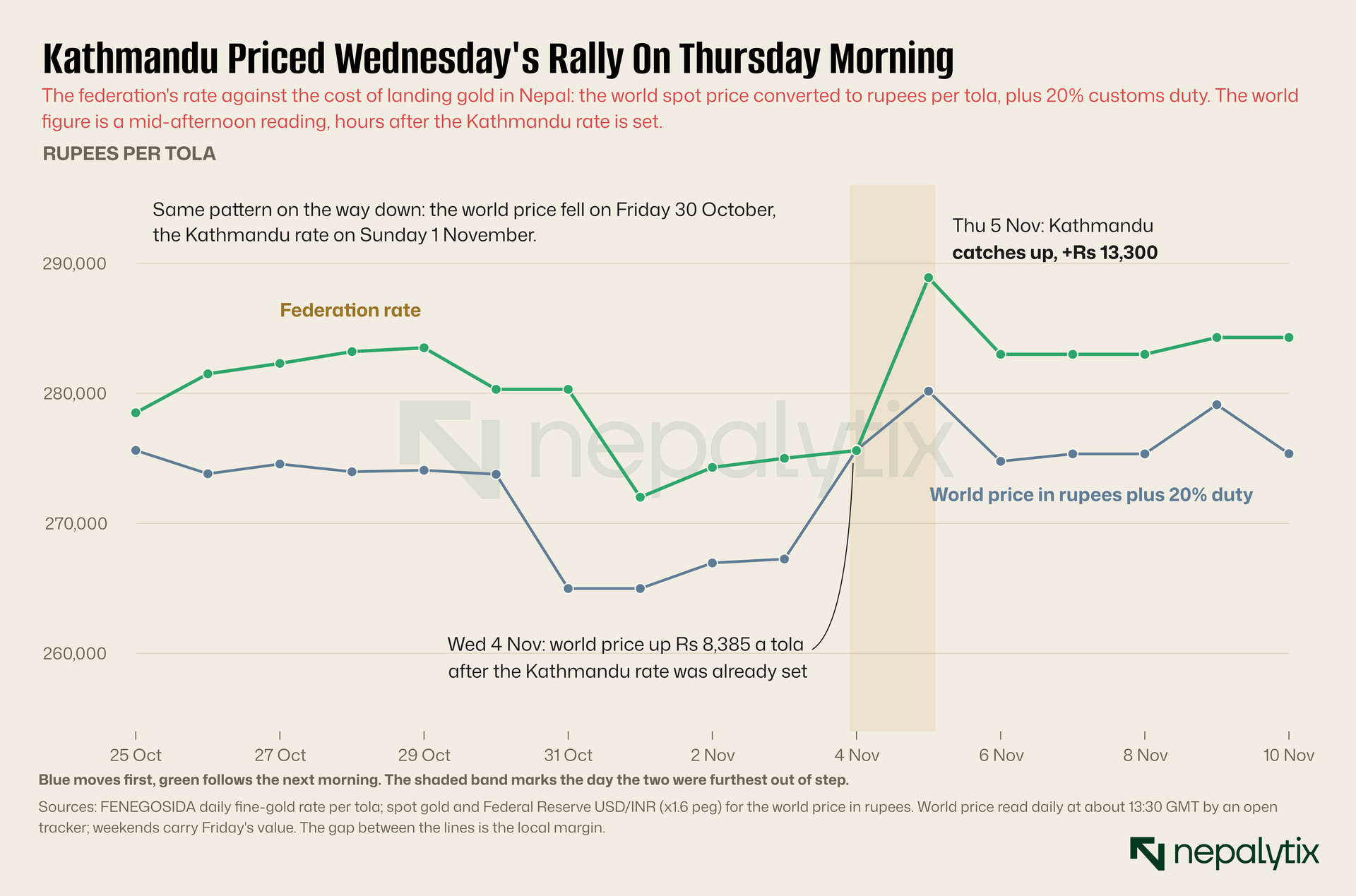
Chart 2 shows the same thing happening in the other direction four days earlier. The world price hit its low on Friday 30 October. Kathmandu's rate fell Rs 3,200 that morning was not set on Saturday, and dropped Rs 8,300 on Sunday. A market that reprices once a day will always turn a world move of two sessions into one local jump. With no rate on Saturdays, a Friday move in New York waits until Sunday.
For a buyer this has a practical edge. On a day when the world price has moved sharply after the morning fix, the next day's Kathmandu rate is largely knowable the evening before. Anyone who was going to buy for Tihar and looked at the world price on Wednesday night could see Thursday's jump coming.
04. What is in a tola
The federation publishes a price. It does not publish how the price is built. Working backwards from the world price, the exchange rate and the duty gets close enough to see the parts.
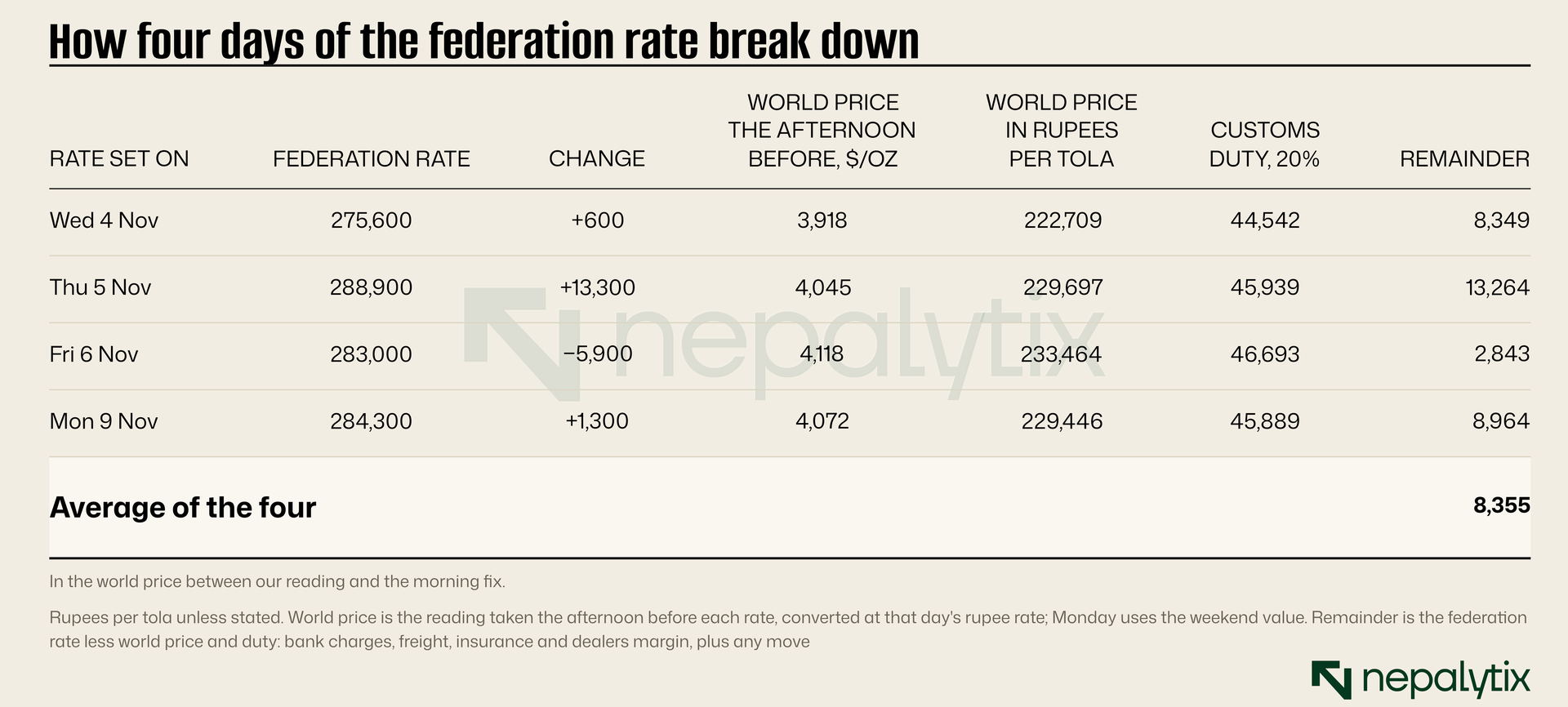
Three things make up the rate. The first is the world price in rupees, about Rs 229,000 of the Rs 284,300. The second is customs duty at 20% of that, about Rs 46,000. The third is everything else: bank charges on the import, freight and insurance, and the dealers' margin. Over the four rates in the table that remainder averaged Rs 8,400, about 3% of the price.
For scale, in December 2007 the whole tola cost about Rs 19,000 at the world price. The duty alone is now more than twice that. And the federation's rate is for fine gold in bar form. Tejabi gold, the slightly less refined local grade was quoted Rs 700 a tola lower in October and jewellery adds making charges and a 0.5% fee on the sale that the rate does not include.
The remainder jumps around in the table, from Rs 13,300 on Thursday to Rs 2,800 on Friday. That is the timing gap from the previous section, not a change in anyone's margin. Our world reading is taken the afternoon before each rate and on both days the world price moved several thousand rupees a tola between that reading and the federation's morning. Average across the swing and the remainder is where it was the week before.
So nothing local changed on Thursday. The import quota did not move, the duty did not move, and the margin did not move. The rupee was steady at about 151 to the dollar. The Rs 13,300 was the world price, multiplied by 1.2.
05. The part the budget added
That multiplier is the piece of this story that was decided in Kathmandu. Until the budget of 29 May this year, customs duty on gold was 10%. The budget doubled it to 20%, removed a 2% luxury tax and added a 0.5% fee on sales. The rate jumped Rs 20,500 the next trading day, to Rs 311,100. That was a bigger morning than Thursday's and it had nothing to do with the world price.
The finance minister said the increase was meant to raise revenue and restrain spending on luxury goods. A dealer quoted at the time put the duty at around Rs 52,000 a tola at the prices then prevailing. The move reversed a cut made only eighteen months earlier: in November 2024 the duty had been halved from 20% to 10%, and the rate fell Rs 15,900 in a day. So in the space of two years a buyer has seen the tax on gold halved and doubled, with a five-figure move in the rate each time.
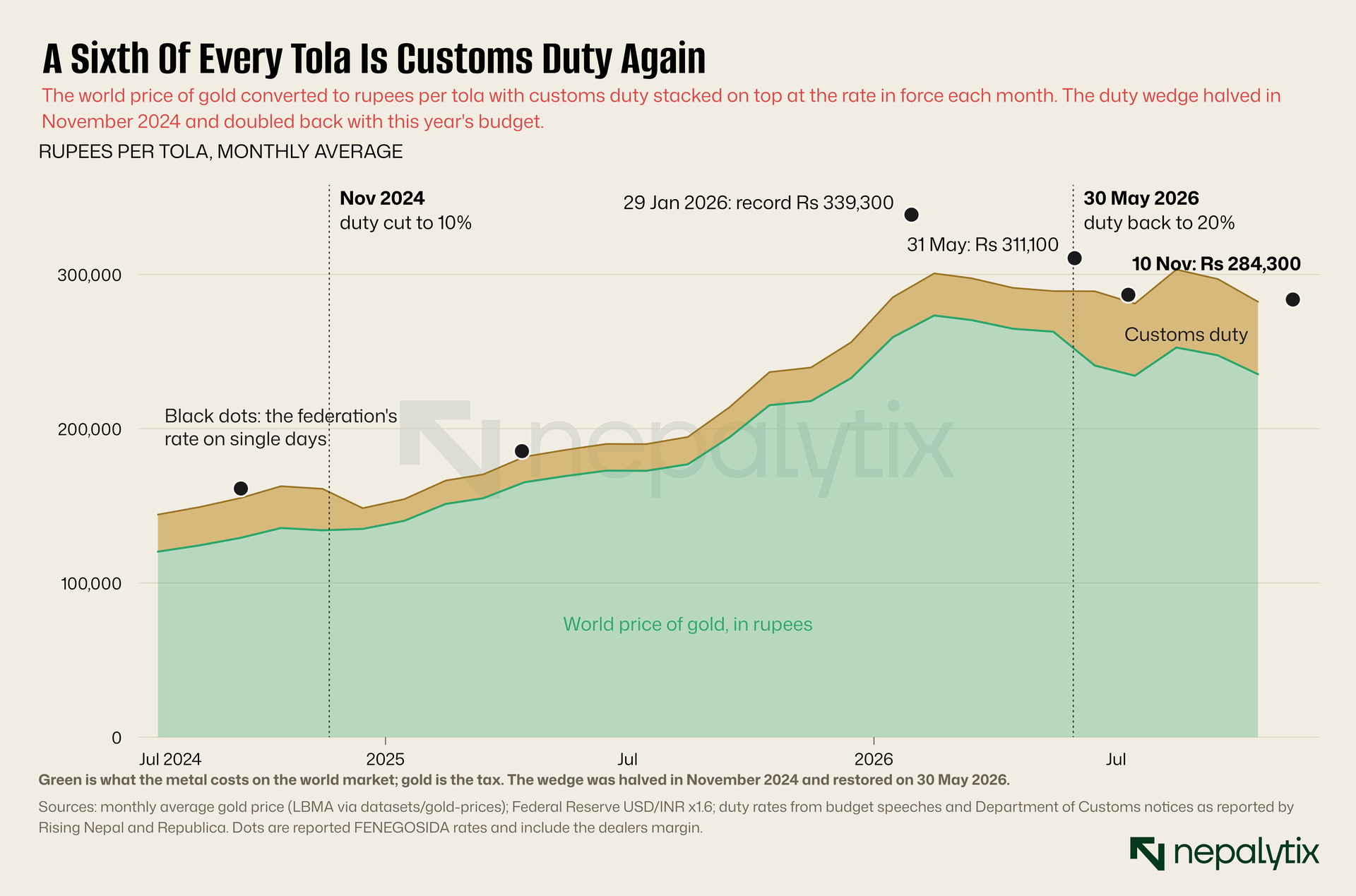
At today's world price and margin, a tola would cost about Rs 261,000 at the old 10% rate, Rs 23,000 less than it does. Roughly a sixth of what a buyer pays is duty.
The duty also explains why gold in Nepal has fallen less than gold elsewhere. From late January to the end of October the dollar price fell by about 30%. Over the same months the federation's rate fell from its record of Rs 339,300 to Rs 272,000, a drop of 20%. Two things cushioned it: the rupee weakened from about 145 to the dollar to about 152, and the duty doubled on the way down. A Nepali who bought at the January record has lost less than a buyer in Dubai. A Nepali buying today is paying a higher tax for the same metal.
The size of that tax matters beyond the jeweller's counter. In July, one published comparison put fine gold in Kathmandu about Rs 48,000 a tola above the same metal in Dubai at market exchange rates, most of it duty. A gap of that size across an open border and through one international airport is a standing incentive for gold to arrive by routes that pay no duty at all.
A higher duty has one more effect that Thursday showed clearly. Every world move now arrives in Kathmandu a fifth larger instead of a tenth larger. The same rally under last year's duty would have been about Rs 1,100 smaller.
06. What nobody publishes
Nepalytix keeps finding the same gap in different markets: one headline number is published and the working behind it is collected by somebody and required of nobody. Gold has its own version. The federation's rate prices a market that almost every household is in and its components are not disclosed. The central bank allots the daily import quota, 25 kilograms since October 2025, and banks are the only importers. How much of the quota is used, what banks charge on it and what margin sits between the landed cost and the published rate are all known to the people involved. A buyer sees one number at eleven in the morning.
Our reconstruction puts the undisclosed part at around Rs 6,000 to Rs 9,000 a tola. It may be entirely reasonable. It would take the federation one line a day to show it.
07. Gold against shares, the long view
This is a capital markets publication so the question a gold move raises here is what it says about shares. Start with the long record.
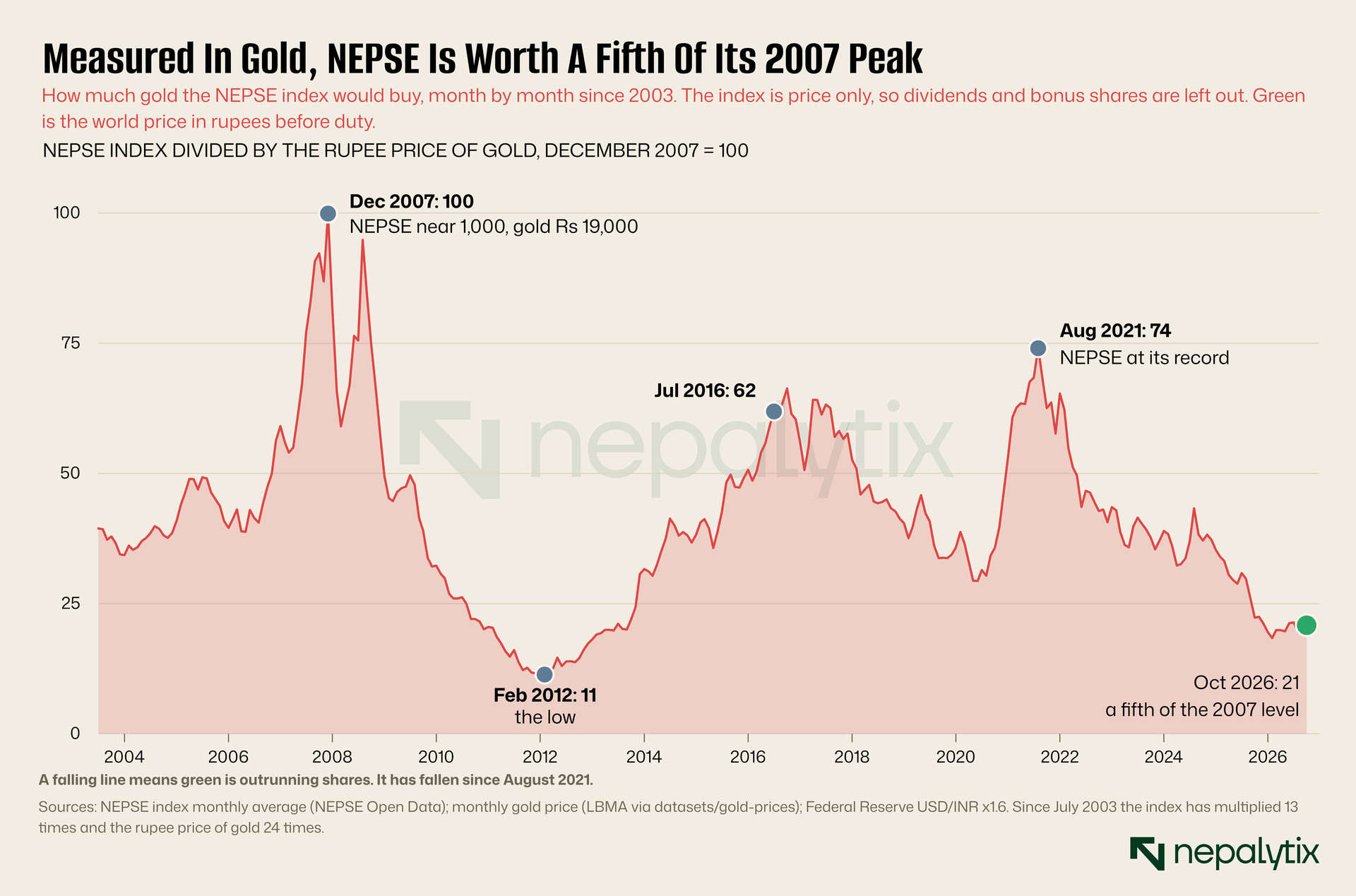
Divide the NEPSE index by the rupee price of gold and you get a measure of how much gold the index would buy. Set the peak, December 2007, to 100. The measure fell to 11 by February 2012, recovered to 62 in the 2016 bull market and to 74 when the index hit its record in August 2021. In October 2026 it stood at 21.
In plain numbers: in December 2007 the index averaged about 1,006 and gold cost about Rs 19,000 a tola at the world price. Last month the index averaged about 2,615 and gold about Rs 235,000. The index has multiplied 2.6 times in nineteen years. Gold has multiplied twelve times.
Since that 2021 record the index is down 16% and the world price of gold in rupees has almost tripled. Since July 2003, the start of our series, the index has multiplied 13 times and gold 24 times. The index leaves out dividends and bonus shares which matter a great deal over twenty years so this is not a fair race and should not be read as one. It is a fair description of the last five years in which the gap is far too wide for dividends to close.
08. Year by year
The more useful fact for someone who owns both is how the two behave together.
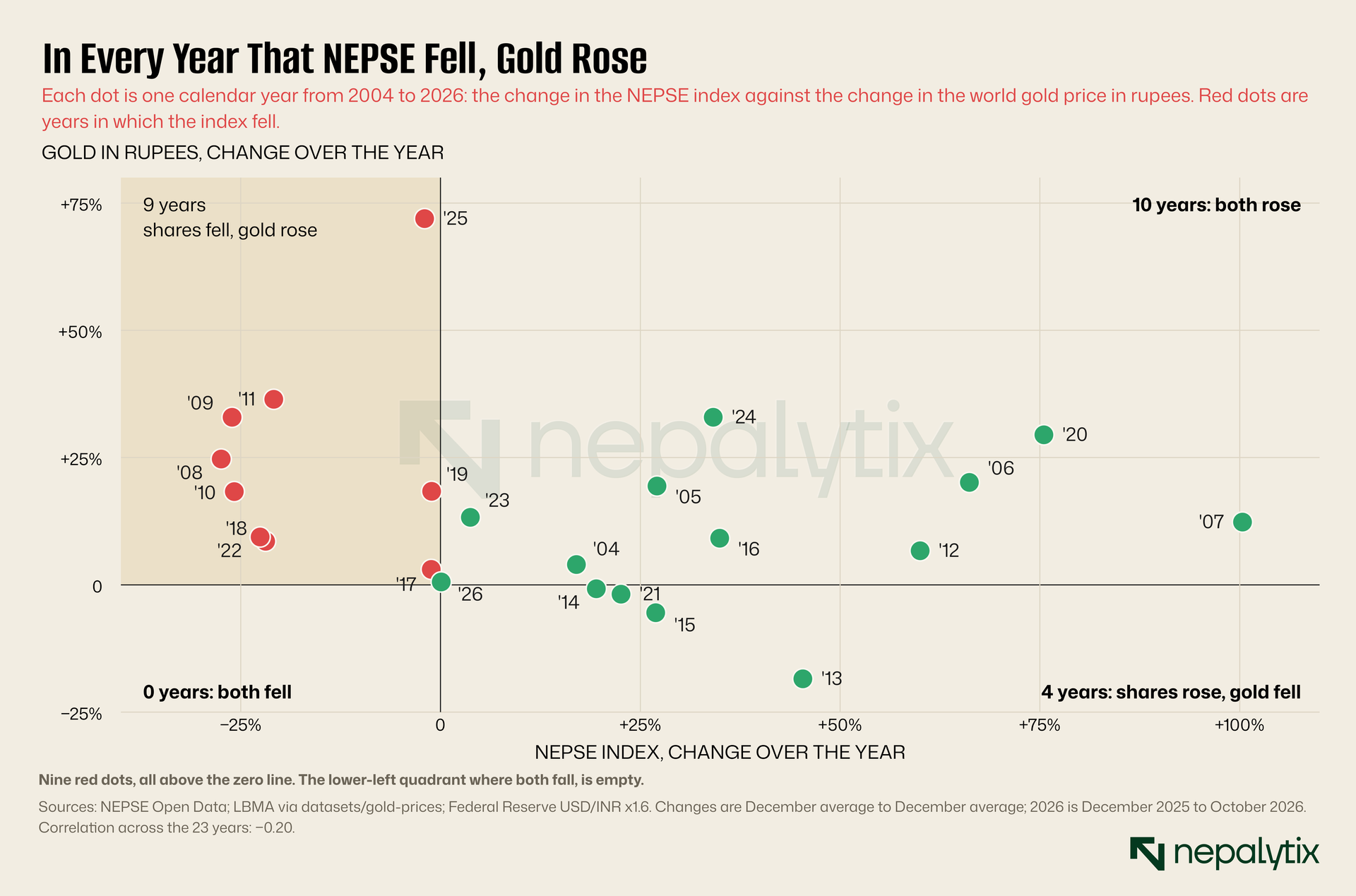
Take each calendar year from 2004. The index fell in nine of the 23. Gold in rupees rose in all nine. There has not been a single year in which both lost value. Gold rose in 19 years of the 23 and the index in 14.
That is not because gold reacts to NEPSE. Month to month the two are unrelated: the correlation of their monthly changes is −0.04. It is because they answer to different things. Gold in rupees follows the dollar price and the exchange rate and NEPSE follows domestic liquidity, interest rates and sentiment. Over a year, the bad stretches have simply not coincided. Last year was the extreme case: gold rose 72% while the index slipped 2%.
Twenty-three years is a short record. It does not prove gold will rise the next time shares fall. It does say that a household holding both has so far never had a year in which everything it owned went down.
09. This season
The festival weeks ran to the same pattern in miniature, the other way round.
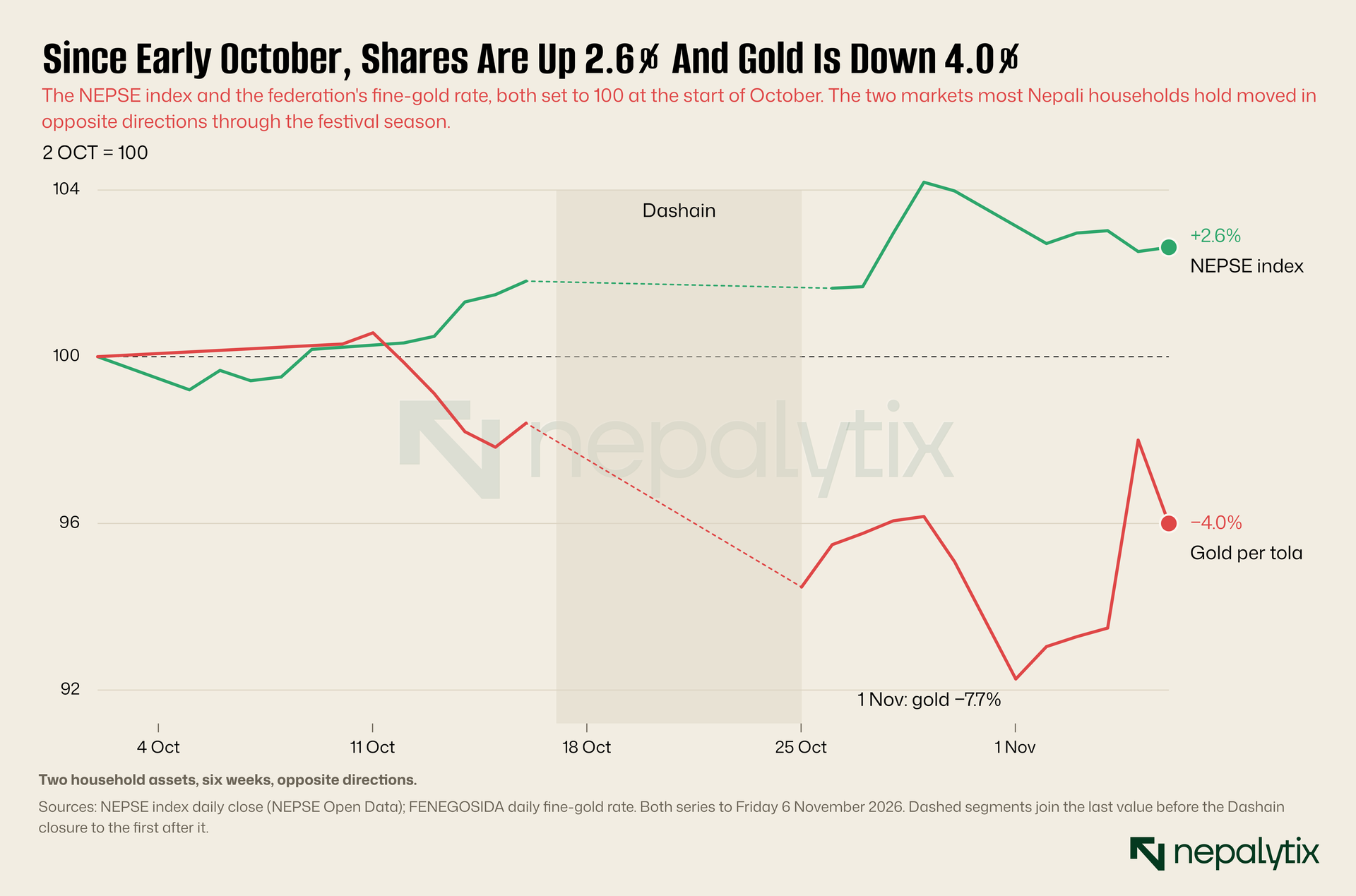
From the start of October to Friday 6 November the index rose 2.6%, helped by a rally when trading resumed after Dashain. Gold fell 4.0% over the same weeks, and at its low on 1 November it was down 7.7%. Shares up, gold down and neither move had anything to do with the other. NEPSE was responding to first-quarter results and the dividend season. Gold was responding to the Federal Reserve.
That is worth saying plainly because the two are often discussed as rivals for the same rupee as though money leaving one must be entering the other. On the evidence of this month and of 23 years, they are better understood as two separate bets that a household can hold side by side.
10. What to watch
The $4,000 line. Gold has rebounded about $250 from its low and markets are treating $4,000 as the floor. At the current exchange rate and duty, every $100 an ounce is roughly Rs 6,800 on the Kathmandu rate.
The Fed in December. Traders put the chance of a rate rise at around 80% last week. A rise that is already expected should do little; a surprise in either direction would move gold by more than Thursday did. United States inflation and jobs figures are the dates to mark.
The rupee. The peg to the Indian rupee means the dollar rate is set in Mumbai. It strengthened from about 152 to about 150 over the past fortnight, which took roughly Rs 3,000 off a tola and partly offset the rally.
The Sunday effect. Watch Friday's close in New York. With no rate on Saturday, it is the best guide available to Sunday's price in Kathmandu.
The quota. Banks may bring in 25 kilograms a day between them. The wedding season that follows Tihar is when demand tests that ceiling, and a binding quota shows up as a wider gap between the federation's rate and the landed cost. Our estimate of that gap, Rs 6,000 to Rs 9,000 a tola, is the number to compare against.
The duty. It has been halved and doubled again inside two years, each time moving the rate by Rs 15,000 to Rs 20,000 overnight. It is the largest single risk to anyone timing a purchase, and it is announced without warning in a budget speech.
11. The reading
A jump of Rs 13,300 looks like a market in disorder. It was the opposite: a mechanical price doing exactly what its formula says, one day late and one-fifth larger. The world price rose about 5% across two sessions, the rupee held and Kathmandu's rate rose 4.8%.
The lessons are narrow and usable. The rate you see each morning is yesterday's world price plus tax so the evening before tells you most of what the morning will bring. A sixth of the price is duty, set by the government and liable to change. And gold's place next to shares in a household's savings rests on a record in which the two have not yet fallen together which is a better reason to hold it than any single morning's move.
Disclaimer
This report has been prepared by Nepalytix for informational and educational purposes only and does not constitute investment advice, an offer, or a solicitation to buy or sell any securities.
The information contained in this report is based on sources believed to be reliable; however, Nepalytix does not guarantee its accuracy, completeness, or timeliness. Opinions, estimates, and projections expressed herein are those of the authors as of the date of publication and are subject to change without notice.
Investing in securities involves risks, including the possible loss of principal. Past performance is not indicative of future results. Readers are advised to conduct their own independent research and consult with a qualified financial advisor before making any investment decisions.
Nepalytix and its contributors may hold positions in the securities discussed in this report at the time of publication or thereafter.
Neither Nepalytix nor any of its affiliates accept any liability for any loss arising from the use of this report or its contents.