How Nepal Turned Export Policy Into Corporate Welfare
Nepal's export cash incentive scheme boosted the profits of a handful of listed exporters.
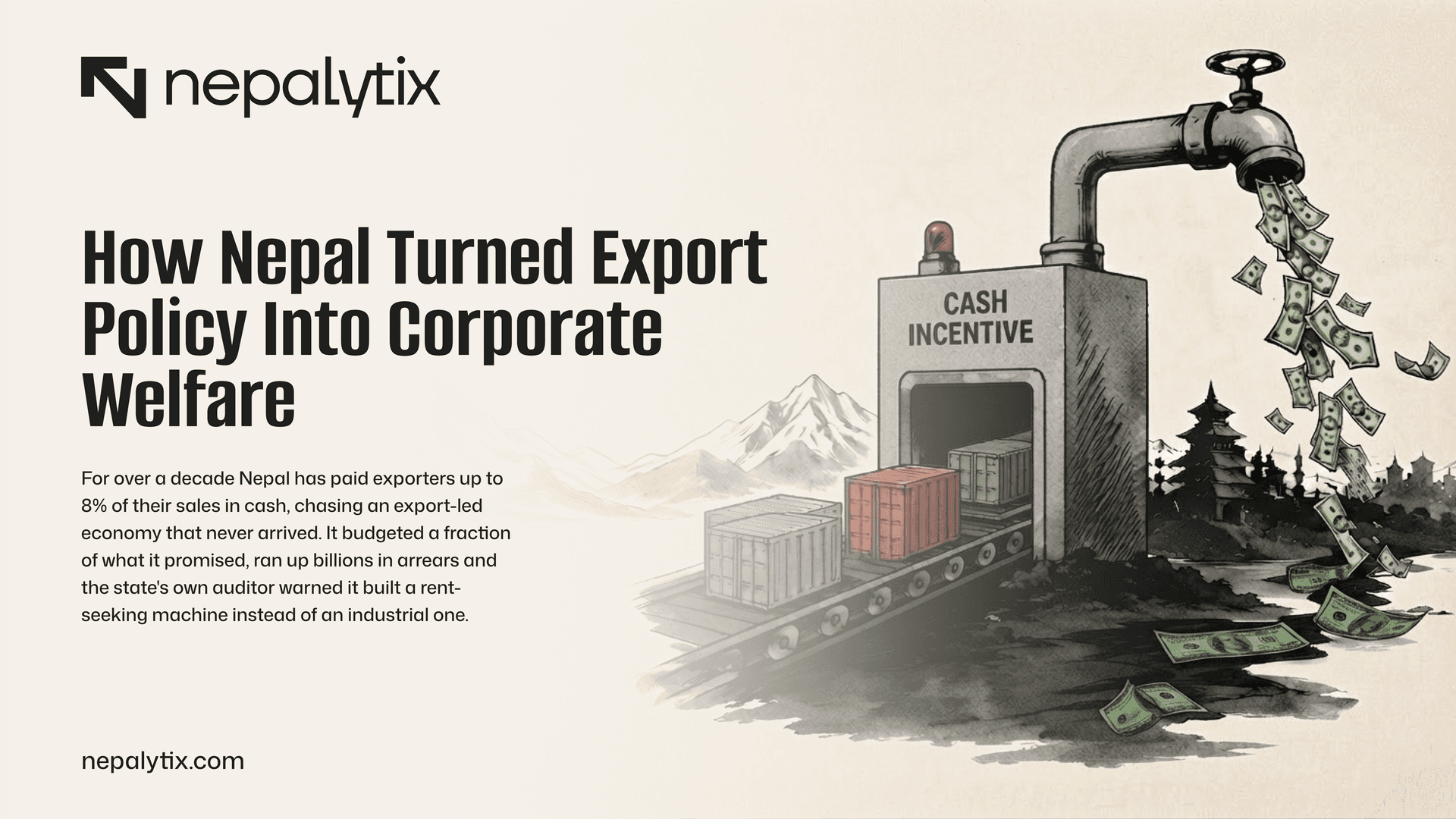
For over a decade Nepal has paid exporters up to 8% of their sales in cash, chasing an export-led economy that never arrived. It budgeted a fraction of what it promised, ran up billions in arrears and the state's own auditor warned it built a rent-seeking machine instead of an industrial one. On the income statements of a handful of large exporters though the scheme worked perfectly. This is where the money went and what it did.
In Summary
→ Nepal's Cash Incentive Scheme for Exports has, since 2012, paid a cash subsidy now 4 to 8 percent of export value on roughly three dozen products. In October 2022 the top rate doubled to 8% and heavy industry (cement, clinker, steel, yarn) was brought in, turning a modest promotion grant into a multi-billion-rupee liability.
→ The state budgets a fraction of what it owes. In FY2023/24 it allocated Rs 900m against roughly Rs 5.1bn actually earned under the scheme a 5.7× gap. The difference becomes an arrear: the Nepal Export Council puts withheld subsidy near Rs 5bn across two fiscal years.
→ The money concentrates at the top. The 8% band rewards scale so the largest rupee claims flow to a small set of big listed exporters. For some Reliance Spinning Mills is the clearest case, the subsidy is larger than the entire pre-tax profit.
→ It did not build an export economy. After a decade, exports remain about 13% of trade, the deficit is at a record Rs 1.6 trillion, and recent export "growth" is largely low-value oil re-export to India. The government has now frozen applications, cut the programme and proposes shifting to production-based support just as LDC graduation makes export subsidies harder to keep.
The contradiction, nationalised
Start with a number that appeared in this publication on Tuesday. Reliance Spinning Mills, Nepal's largest yarn exporter, reported a record year and its entire pre-tax profit turned out to be smaller than the export cash incentive the government had handed it. Strip the subsidy out and the mill lost money before tax. That is not an accounting curiosity peculiar to one company. It is the clearest visible symptom of a policy that has quietly reshaped the economics of Nepali export manufacturing: a cash subsidy paid by a government that cannot afford it, on which a growing share of listed-company profit now depends.
The Cash Incentive Scheme for Exports is one of the least-examined large transfers in Nepal's public finances. It is discussed, when at all, as a technical line in trade policy or a grievance aired by exporters waiting to be paid. It deserves more scrutiny than that, because it sits at the intersection of three things that matter to anyone investing in Nepal: the quality of listed manufacturers earnings, the health of the government's budget and the question of whether Nepal is building an export economy or only the appearance of one. This piece follows the money how much, from whom, to whom and to what end.
What the scheme actually is
The mechanics are simple enough. An exporter of an eligible product receives a cash payment worth a percentage of the export value, provided the goods carry enough domestic value addition. The rate depends on the product and the processing. Lightly-processed goods sit at 4%; higher value-addition products earn 5%; there is a further 1% bonus for very high domestic content. And then there is the headline band, a top rate of 8%, added in the 2022 overhaul available to large industrial exporters whose export value exceeds Rs 500m a year with at least 30% domestic value addition.
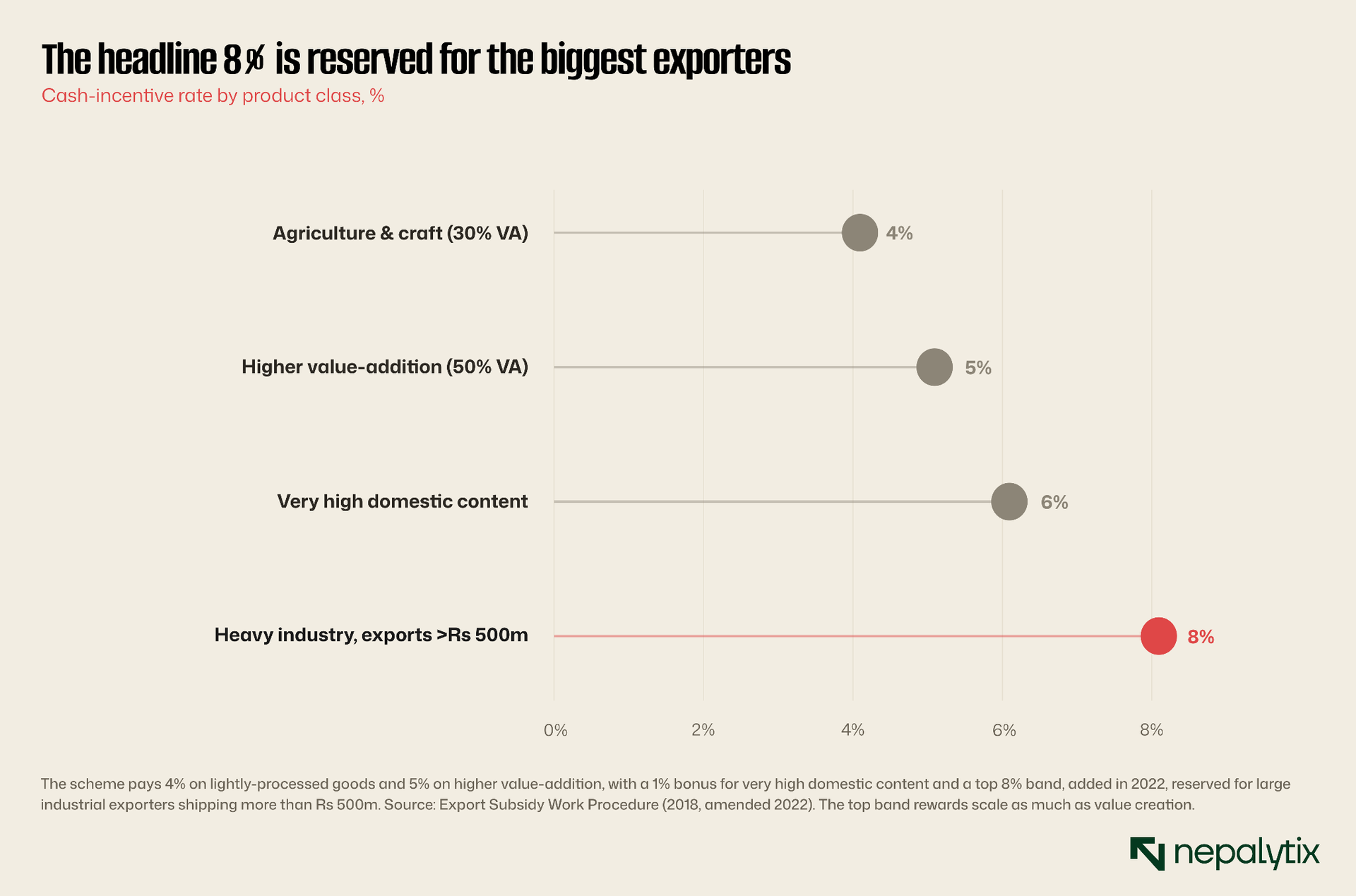
The eligible list runs to around three dozen products and reading it is instructive, because it describes two very different economies pretending to be one. One column is rural and small: processed tea and coffee, large cardamom, ginger, honey, herbs and essential oils, allo, turmeric, vegetables. A second is craft and textile: Chyangra pashmina, woollen carpets, readymade garments, handicrafts, jute goods, semi-processed leather, handmade paper. The third and newest is heavy industry: cotton, polyester, viscose and acrylic yarn; cement; clinker; steel; plywood; catechu; rosin and turpentine. The scheme reads like a rural development programme. In rupee terms, the money flows like industrial policy because a single yarn or cement exporter claiming 8% on billions of rupees of shipments dwarfs an entire district's tea receipts claimed at 5%.
The value-addition loophole
The scheme's defenders describe it as a reward for domestic value creation, and the rules appear to enforce that: to qualify at all, a product must carry at least 30% domestic value addition, and the higher rates demand more. In practice, the value-addition test is where much of the scheme's discretion and its vulnerability to gaming lives. Value addition is calculated as the export price minus the value of foreign-originated materials, divided by the export price. The exporter self-declares the inputs, obtains a value-addition certificate at the start of the fiscal year and claims accordingly. The Department of Industry verifies but with limited capacity across thousands of transactions and dozens of products.
The problem is structural. A firm has every incentive to understate the foreign content of its inputs and overstate domestic value addition, because a few percentage points of declared value addition can move it into a higher subsidy band worth real money. For a genuinely integrated manufacturer, a spinner with captive processing, a cement maker with captive clinker, the value addition is real. For a re-exporter buying refined-adjacent inputs and doing light processing, the same paperwork can produce a similar-looking certificate. This is precisely the gap through which the soybean-oil arbitrage drives: crude imported, lightly processed, and presented as a value-added Nepali export. The Auditor General's transparency concern is not abstract. It is the observation that a self-declared, thinly-verified value-addition test, attached to a cash payment is an invitation to the exact misreporting the numbers suggest is happening.
It also explains why the scheme resists clean targeting. In theory, an incentive tied to value addition should channel money toward the exporters creating the most domestic economic activity. In practice, the ones best equipped to document and where the rules allow, to optimise their value-addition claims are large, well-advised firms with in-house compliance functions, not the small tea processor or handicraft cooperative the scheme's public framing evokes. The design rewards administrative sophistication as much as economic substance.
From token gesture to structural bill
It did not start large. Introduced in the FY2010/11 budget and effective from 2012, the scheme in its first year paid about $1.6m to 28 firms, a rounding error in a national budget, a genuine promotion tool for a handful of exporters. By FY2016/17 the allocation was around $3m. For a decade it stayed the kind of programme nobody needed to worry about, precisely because it was small.
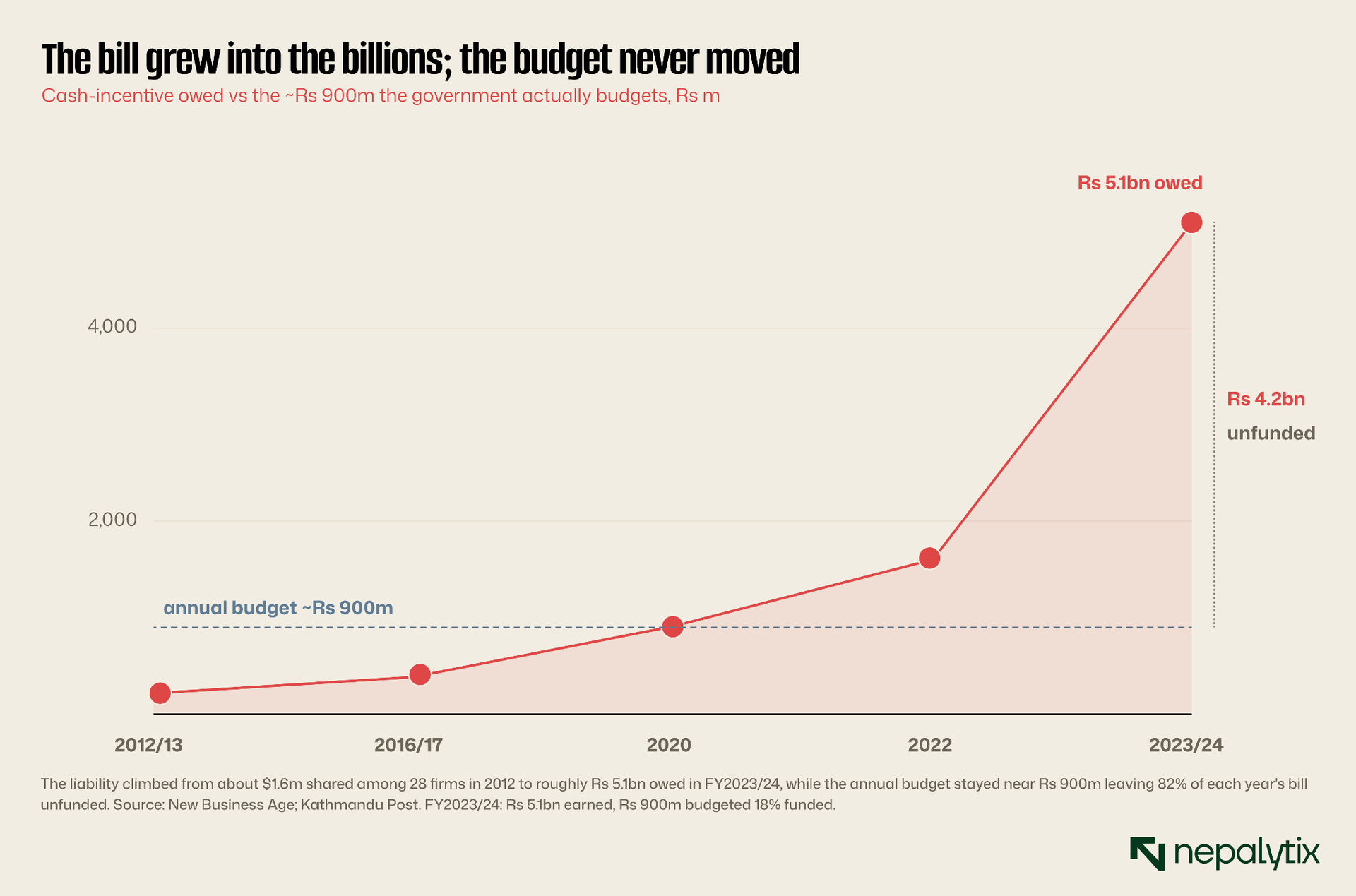
The 2022 amendment changed its nature. Doubling the range to 4–8% and crucially extending the top band to high-volume industrial goods transformed a modest grant into a claim large enough to matter to the budget. This is the moment the scheme stopped being about nurturing infant exporters and started being about subsidising the output of established, capital-intensive manufacturers who ship at scale. It is not a coincidence that this is also the moment the arrears began to pile up. When you promise 8% of billions, you have promised more than a Rs 900m line item can pay.
The gap the budget hides
Which brings us to the defining feature of the scheme: the government budgets a fraction of what it owes and treats the difference as a problem for next year. In FY2023/24 the allocation was Rs 900m. The amount actually earned by exporters under the scheme's own rules was around Rs 5.1bn. That is not a small miscalculation. It is a 5.7-fold gap between what was promised and what was funded and it recurs.
The consequence is arithmetic. An exporter completes a qualifying shipment, files the paperwork, and books the incentive as income it has legally earned. The government, having budgeted a fifth of the total bill, pays some and defers the rest. The deferred portion does not vanish, it becomes a receivable on the exporter's balance sheet and a liability the state has not formally acknowledged in its accounts. Multiply that across every large exporter, every year and the scheme quietly manufactures a stock of government debt that never appears in the headline deficit. The budget looks disciplined precisely because it under-provisions.
The arrears and the queue they join
By late 2025 the withheld amount was substantial. The Nepal Export Council put the subsidy owed across two fiscal years at around Rs 5bn; other estimates ran lower, above Rs 2bn. The precise figure is itself a symptom a well-run transfer would not leave its own recipients guessing how much they are owed. What is clear is that the subsidy joined a long queue of state IOUs. The government separately owes something like Rs 50bn to the construction industry and billions more elsewhere. An export incentive booked as profit is, in cash terms, an unsecured claim on a government that is already paying its bills late across the board.
For an equity investor this is the crux and it generalises Tuesday's lesson about reading the cash flow statement. Subsidy income recognised on accrual is not the same as cash in the bank. When a listed exporter reports a profit materially composed of export incentive, the quality of that profit depends entirely on whether and when a fiscally-stretched government actually pays. The market, pricing some of these companies at high multiples of subsidy-inflated earnings, has largely ignored this. The accounts have not: the receivable is right there in the notes, for anyone who reads that far.
The worked example: when the subsidy is the profit
Reliance Spinning Mills makes the abstraction concrete. In FY2081/82 the company recognised Rs 614m of export incentive more than its entire Rs 594m pre-tax profit. The subsidy did not augment the profit; it was the profit and then some. Remove it and the core spinning business lost money before tax. Meanwhile, Note 41 of the audited accounts disclosed Rs 977m of incentive income for two earlier years still unsettled by Nepal Rastra Bank more than two years of net profit recognised as income sitting unpaid.
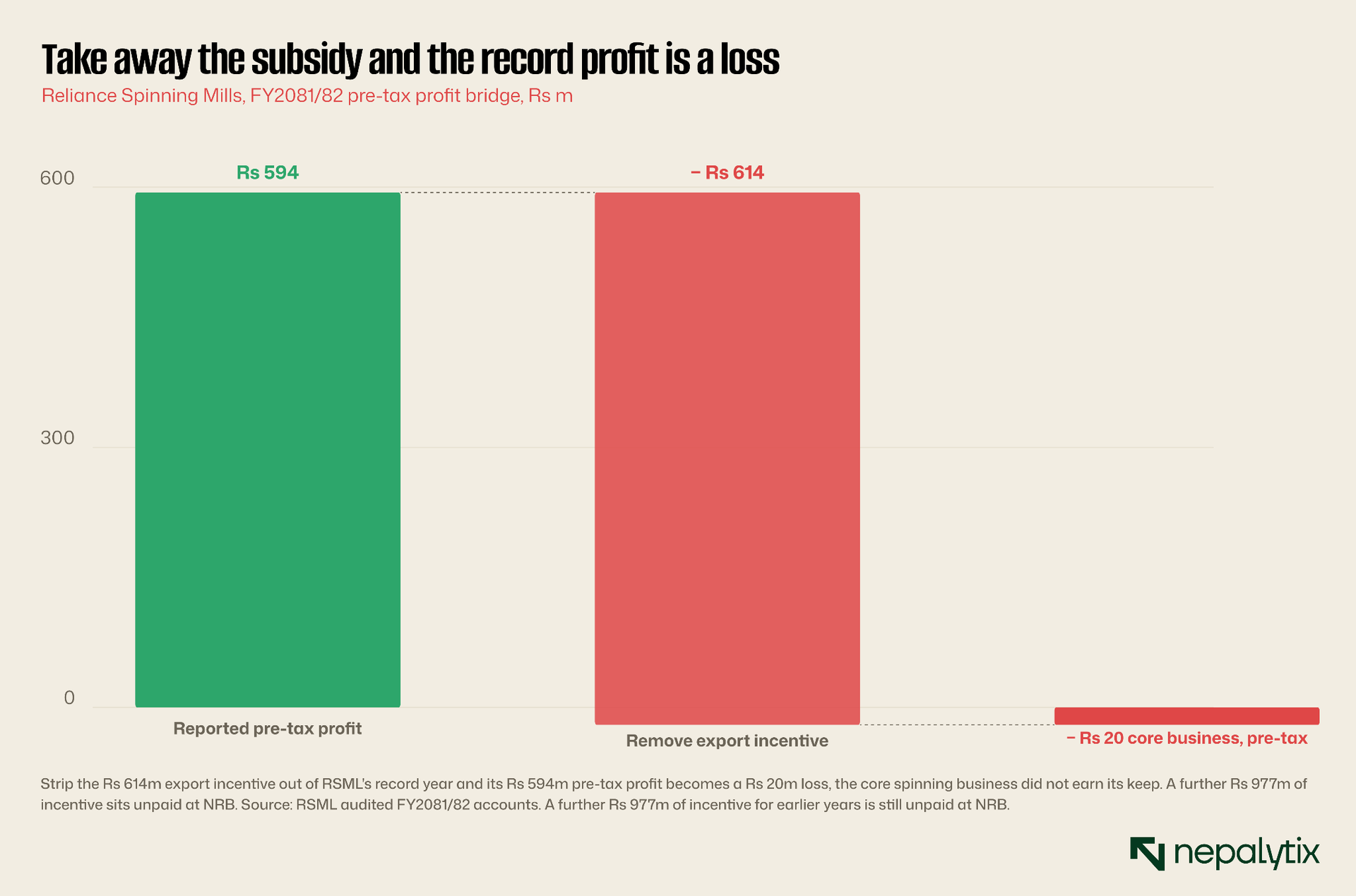
RSML is not doing anything improper; it is accounting for a subsidy it is legally entitled to exactly as the rules require. That is the point. The scheme is designed such that a well-run genuinely competitive exporter can post a record year in which the government's cheque exceeds everything the underlying business earned. When FNCCI campaigned to save the scheme in 2025, it used RSML "exports yarn worth Rs 7bn annually" as its poster child. It was the right example for the wrong reason: RSML shows not how well the subsidy builds exporters but how completely some exporters reported profitability has come to rest on it.
Which listed names carry the risk
For a NEPSE investor the abstraction becomes a screening exercise, because the withdrawal of the subsidy is a direct hit to the reported earnings of any listed company whose profit leaned on it. Reliance Spinning Mills is the extreme case, the subsidy larger than the entire pre-tax profit but it is not the only one and the pattern is identifiable from the accounts. The tell is a line in the income statement usually within other operating income or disclosed in the notes, labelled export incentive or export cash subsidy. Where that line is large relative to pre-tax profit, the company's headline profitability is, to that extent, a government transfer rather than an operating result.
The exposure clusters in the products that dominate the 8% band. Yarn is the clearest: RSML and its peers ship billions of rupees of cotton, polyester, viscose and acrylic yarn, overwhelmingly to India and the incentive on that volume is material to their margins. Cement and clinker are the next frontier as domestic overcapacity pushes producers to export, the same 8% that flatters yarn margins is being written into cement income statements which matters for the listed cement names now leaning on export volumes to absorb idle capacity. Steel is similar. Each of these is a capital-intensive, thin-margin, cyclical business in which a few percentage points of subsidy can be the difference between a reported profit and a reported loss, exactly the businesses where earnings quality is hardest to read from the headline.
The screening questions follow directly from the week's earlier pieces. First, how large is the export-incentive line relative to pre-tax profit? Is the subsidy a garnish or the main course? Second, how much of the accrued incentive has actually been received in cash and how much sits as a receivable at Nepal Rastra Bank, exposed to the government's payment delays? Third, and most important, what does the business earn with the subsidy stripped out entirely? Is core operating profit positive, does it cover interest, does it clear the cost of capital? For a genuinely competitive exporter the answers will be reassuring; the subsidy is upside, not oxygen. For others, as the RSML note showed, removing the subsidy removes the profit. In a market that has priced several of these names at high multiples of subsidy-inflated earnings, the difference is the whole investment case and it is about to be tested by the scheme's withdrawal.
Who actually captures the money
The scheme's defenders describe it as support for Nepali industry against the headwinds of a landlocked, high-cost economy. Its design, though, determines who benefits and the top 8% band gated on export value above Rs 500m steers the largest payments to the largest firms. This matters because the same rupee of subsidy does completely different things depending on who receives it.
The most rigorous evidence on this comes from outside Nepal. A landmark study of subsidised export finance in Pakistan found that large, listed and business-group firms, the ones with easy access to capital made no meaningful change to their operations when handed subsidised credit; the money simply raised their profits. Credit-constrained smaller firms which might have used the support to actually expand, were crowded out. Nearly half the subsidy went to firms that did not need it, a substantial misallocation. Nepal's scheme, dominated at the top by large listed exporters, fits the template. A subsidy that flows to the financially unconstrained is not an investment in future exports; it is a transfer to present shareholders. For the small tea processor or handicraft exporter the scheme was ostensibly built for, the 4–5% cash-back is real and useful when it is paid. The problem is that the rupees are concentrated where the need is least.
A decade of subsidy and the deficit only widened
Set the firm-level story aside and ask the national question the scheme was meant to answer: did it grow Nepal's exports? The macro data are unkind. Across the whole life of the scheme, exports have hovered around 12–13% of total trade while imports climbed relentlessly. In the first eleven months of FY2025/26 the merchandise trade deficit reached a record Rs 1.6 trillion; for every rupee Nepal earns abroad, it spends close to seven. A decade of cash incentives did not bend that curve.
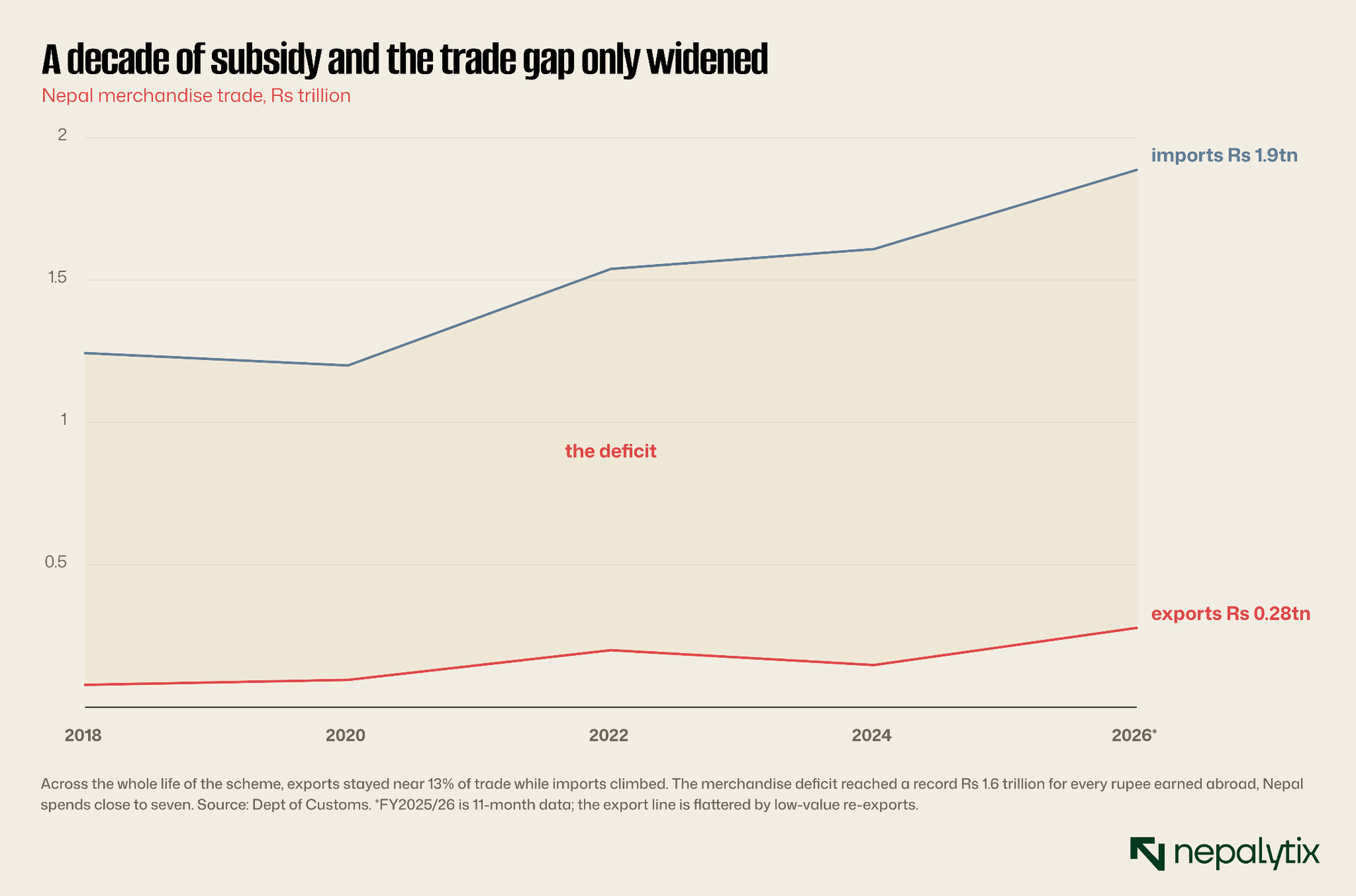
Defenders will object that exports did grow in absolute terms, and that without the subsidy they would have grown less. Perhaps. Early academic work on the scheme's first years found it did lift exports of targeted products mostly by encouraging firms to add new products and new markets. But the honest reading of the aggregate is that whatever the subsidy achieved at the margin, it did not alter Nepal's fundamental trade position. The country remains an import-dependent, remittance-financed economy in which manufacturing exports are a rounding error against the import bill. If the scheme's purpose was to change that, it failed at the level that counts.
The arbitrage mirage
Worse, the recent export growth that might seem to vindicate the policy is largely an illusion. FY2025/26's headline surge exports up around 32% to India in parts of the year was driven overwhelmingly by refined soybean and palm oil: crude oil imported from third countries lightly processed in Nepal and re-exported to India to exploit a tariff preference under the South Asian Free Trade Area. The domestic value added is negligible. This is not Nepali industry winning foreign markets; it is a tariff arbitrage that happens to be physically routed through Nepal.
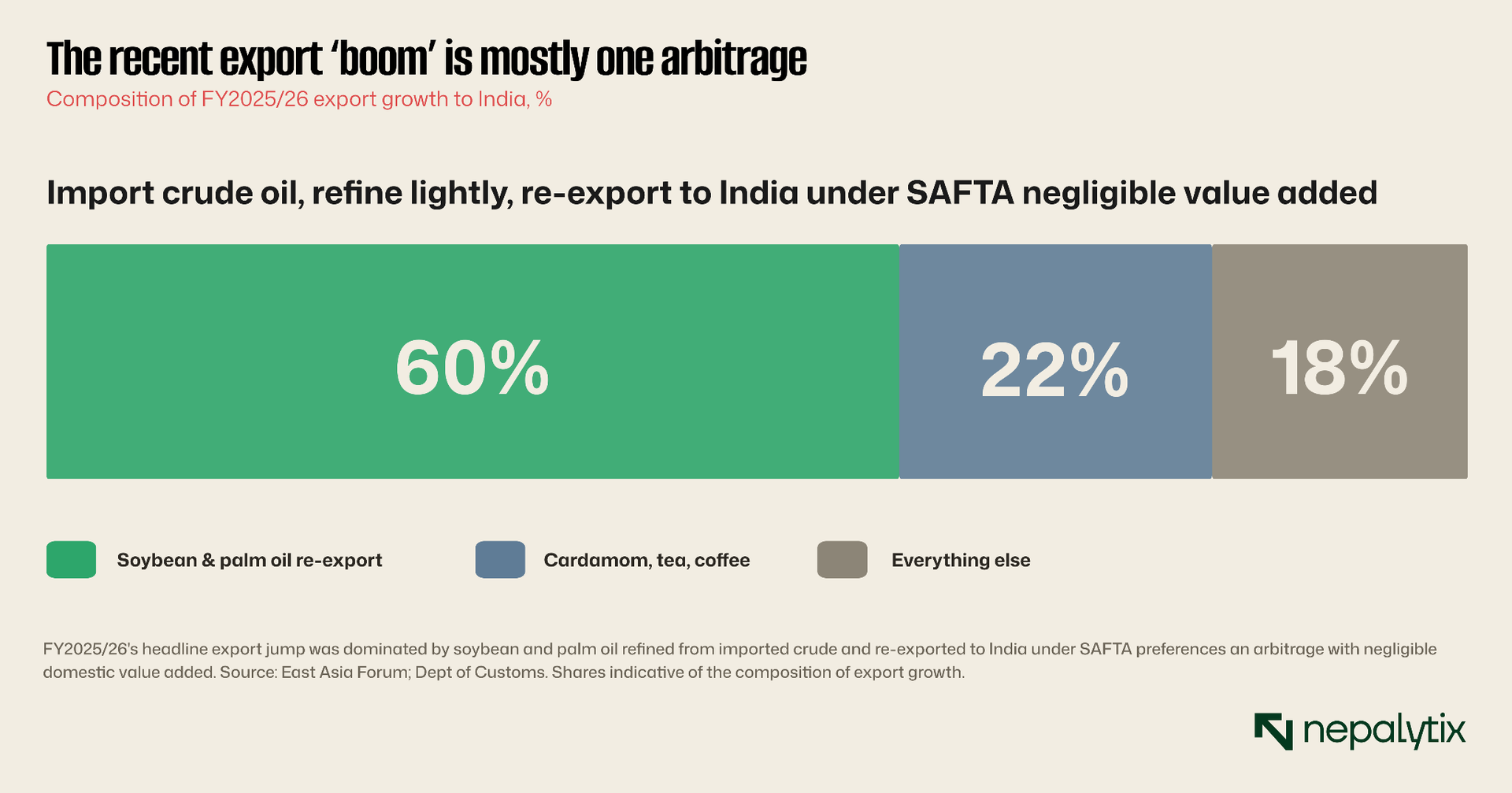
The arbitrage mirage matters for how we judge the subsidy because it means the export statistics flatter the underlying reality. A policymaker looking at rising export numbers might conclude the incentive is working. An investor or analyst looking through to value addition and durability sees something far weaker: a headline number propped up by a re-export trade that adds little to the economy and could vanish with a change in either country's tariff schedule. Strip out the oil arbitrage and Nepal's "real" export base, the yarn, the pashmina, the carpets, the cardamom is smaller and more fragile than the aggregate suggests.
The state's own auditor calls it rent-seeking
None of this is a heterodox reading. The most damning assessment of the scheme comes from within the government itself. The Office of the Auditor General has flagged the cash-incentive programme for a set of structural failures: it runs on administrative procedures rather than legislation, leaving it on weak and changeable legal footing; it is poorly targeted, rewarding scale and relationships over genuine value creation; its disbursements are inadequately accounted for and lack transparency; and in the auditor's framing, it risks becoming a vehicle for rent-seeking rather than a catalyst for exports. The verdict "unsustainable giveaways, not catalysts" is the state auditing its own policy and finding it wanting.
When the auditor and the academic literature agree that a scheme is poorly designed, the arrears and the misallocation stop looking like unfortunate accidents and start looking like the predictable output of the design. A programme with vague procedures, unchecked payouts and no legislative anchor is, structurally, prone to capture. That it ended up concentrating rupees in a handful of large exporters while running up billions in unpaid claims is not a bug in an otherwise sound policy. It is what this policy, built this way, was always going to do.
The wind-down
The government appears to have reached the same conclusion and is quietly dismantling the scheme. In October 2025 the Department of Industry stopped accepting applications for FY2024/25, citing the risk of creating new liabilities it could not fund. The FY2025/26 budget cut the programme. The finance ministry has signalled it will pay the old dues eventually while proposing to replace export-based incentives with production-based support. Applications frozen, budget cut, arrears deferred, mechanism to be redesigned: this is a policy being wound down under fiscal pressure, not one being reformed from a position of strength.
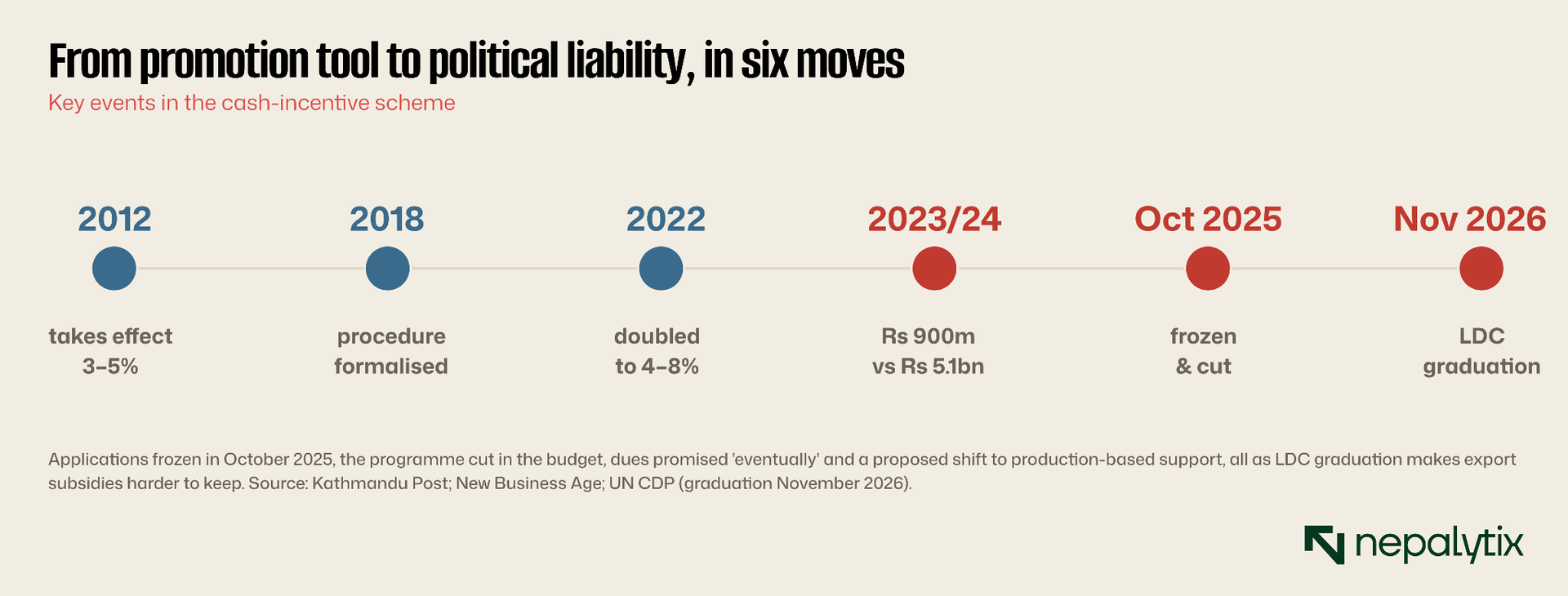
The proposed shift from export-based to production-based incentives is worth watching, because it is the one genuinely interesting idea in the wreckage. An export-based subsidy pays for shipments regardless of where the value was created, which is how you end up subsidising oil re-export and rewarding firms for sales they would have made anyway. A production-based incentive, in principle, pays for domestic manufacturing activity which is harder to game with arbitrage and better aligned with building an industrial base. Whether Nepal can design and fund such a scheme any better than it funded this one is an open question. The track record does not inspire confidence.
The graduation deadline
There is also a clock running. Nepal is scheduled to graduate from least-developed-country status in November 2026 and graduation changes the rules of the game. LDCs enjoy latitude under WTO rules to subsidise exports directly; developing countries do not. A cash payment tied explicitly to export value is exactly the kind of measure that becomes harder to defend once the LDC exemptions fall away. So even setting aside the fiscal strain and the auditor's criticism, the export cash incentive in its current form has a limited legal shelf life.
Graduation cuts the other way too which is why the private sector is fighting so hard to preserve support in some form. Studies project that losing LDC trade preferences could reduce Nepal's exports by somewhere between 2.5% and 4.3% with the pain concentrated in apparel, textiles and processed goods precisely the sectors the cash incentive targets. The exporters argument is that withdrawing the subsidy at the same moment external preferences disappear is a double blow to an already fragile export base. That argument has real force. It does not, however, rescue a scheme this poorly designed; it argues for building a better one, quickly before both supports are gone at once.
The politics of a subsidy that cannot quite be killed
If the scheme is so poorly designed why has it survived and why is the government dismantling it so hesitantly rather than cleanly? The answer is politics and it is instructive about how industrial support ossifies. The scheme created a constituency. Every large exporter that built its margins around the incentive now has a direct financial interest in its continuation, and those exporters are organised, articulate and represented by the country's most powerful business body. When the Department of Industry froze applications in October 2025, the Federation of Nepalese Chambers of Commerce and Industry did not treat it as the removal of a flawed transfer; it treated it as an attack on investment, jobs and competitiveness, and it mobilised accordingly.
The exporters argument is not frivolous which is what makes the politics hard. Nepal is a high-cost, landlocked economy graduating from LDC status just as its trade preferences erode. Withdrawing domestic export support at the same moment external preferences disappear is from an exporter's chair, a double blow to an already fragile base and studies putting the graduation-related export loss at 2.5 to 4.3% give that fear a number. The government, for its part cannot afford the scheme as designed, has already accrued billions it has not paid, and has been told by its own auditor that the programme is structurally unsound. It is caught between a fiscal position that will not fund the subsidy and a political economy that will not let it die.
The compromise on offer to pay the old dues eventually cut the current programme, and promised a redesigned production-based scheme later is the characteristic outcome of that bind. It satisfies no one fully. Exporters get neither their arrears promptly nor certainty about future support. The treasury gets neither a clean saving nor a defensible policy. And the redesign, when it comes, will be negotiated with the same constituency that shaped the current scheme, which is not obviously a recipe for better targeting. The lesson for anyone watching Nepal's industrial policy is that a subsidy, once it becomes load-bearing for powerful balance sheets, is extraordinarily difficult to remove even when the state cannot pay it and its own auditor says it should not.
What a working scheme would look like
It is worth being clear that the problem is not export support as such, it is this design. Countries that have used export incentives well share a few features Nepal's scheme conspicuously lacks. The first is that payment is tied to verified value creation rather than to gross shipment value, which is what stops the money leaking into pure arbitrage like the soybean-oil re-export trade. A subsidy that pays on domestic value added would have paid Nepali spinners and pashmina weavers and paid almost nothing on refined imported oil, the opposite of what the current scheme does.
The second feature is fiscal honesty: the support is budgeted at something close to its real cost so that recipients are paid on time and the programme does not silently accumulate off-book liabilities. A scheme funded at a fifth of its bill is not a promotion policy; it is a deferral mechanism that damages the very exporters it claims to help because a receivable stuck at Nepal Rastra Bank for two years is worth far less than cash today. The third is targeting: the best-evidenced use of scarce subsidy rupees is to relieve genuine constraints working capital for small and new exporters, market-entry costs, quality certification rather than to hand cash to large listed firms that would have exported regardless. Duty drawback schemes, which simply refund taxes paid on inputs to exports, achieve much of the benefit without the rent-seeking, because they are mechanical and hard to game.
Measured against that standard, the proposed pivot to production-based incentives is directionally right. It moves the reward toward domestic activity and away from gross shipments but the design details and, above all, the funding will determine whether it repeats the same failure in a new costume. A production subsidy budgeted at a fifth of its cost and administered through the same discretionary procedures would simply relocate the arrears from the customs line to the factory floor. The lesson of the cash-incentive decade is not that Nepal should stop supporting exporters. It is that a support scheme the state cannot afford, cannot target, and cannot administer transparently will end up subsidising profits rather than production no matter what the payment is nominally tied to.
What it actually built
So tally the ledger. The scheme was sold as a tool of export-led growth. Exports remain about 13% of trade and the deficit is at a record. It was meant to reward domestic value addition; its recent "success" is low-value oil re-export. It was framed as support for Nepali industry; the largest payments flowed to the largest, least-constrained firms. On every stated objective, the honest verdict is failure or something close to it.
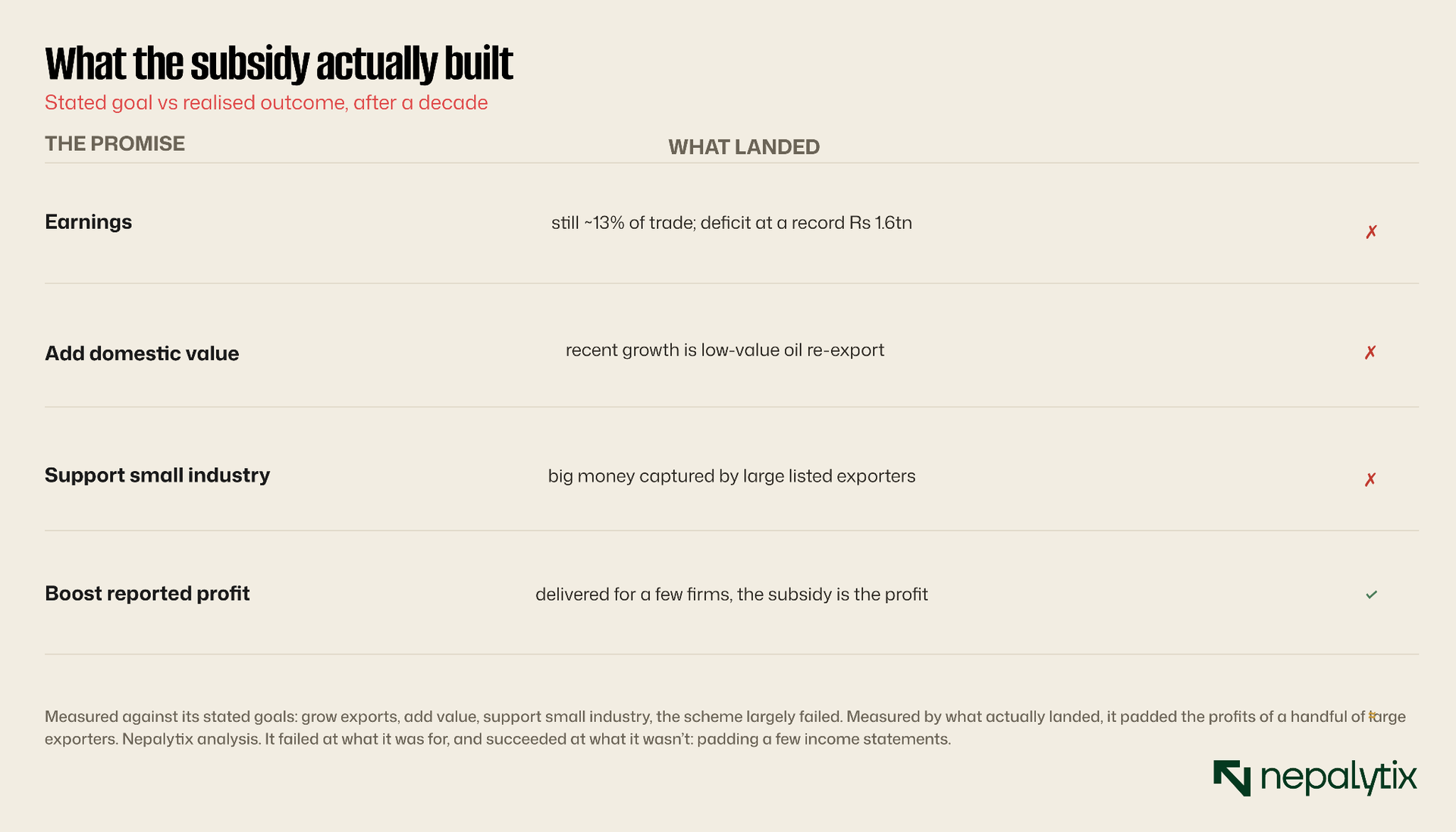
But there is one column where the scheme worked flawlessly, and it is the column that should concern investors most: it inflated reported profits for a specific set of large, listed exporters. For those firms the subsidy was not a marginal boost it was, in the starkest cases, the difference between a profit and a loss. That is a real and durable effect and it is the scheme's clearest legacy. Not a wave of new exporters, not a narrowing trade gap, not an industrial base but a handful of income statements that look considerably healthier than the businesses beneath them, dependent on a cheque from a government that has now decided to stop writing it.
The reckoning for investors
The wind-down is where the two stories, the fiscal one and the equity one collide. For years, a slice of listed manufacturing profit in Nepal has been, in effect, a government transfer. As the scheme is cut that slice goes away. Companies whose margins were flattered by 8% cash-back on exports will see those margins compress precisely as they lose the subsidy and, potentially, LDC trade preferences at the same time. The earnings that looked like the reward for competitive manufacturing will be revealed, in some cases, as the reward for a policy that no longer exists.
The investor's task, then, is the one this week's pieces keep returning to: separate the business from the subsidy. For every export-heavy manufacturer on NEPSE, the questions are the same. How much of the reported profit is export incentive? How much of that incentive has actually been collected in cash, and how much sits as a receivable at Nepal Rastra Bank? And what does the business earn, what is its core operating profit, its interest cover, its return with the subsidy stripped out entirely? For some companies the answers will be reassuring. For others, as Tuesday's note showed, the entire pre-tax profit disappears. The subsidy economy is ending. The reckoning for the income statements built on it has only started.
Nepal spent a decade paying exporters to build an export economy. It got billions in arrears, a rent-seeking scheme its own auditor disowned, a record trade deficit and a handful of listed companies whose profits were, quietly, the state's cheque all along. That cheque is being cancelled. The question now is which businesses can stand without it.
Disclaimer
This report has been prepared by Nepalytix for informational and educational purposes only and does not constitute investment advice, an offer, or a solicitation to buy or sell any securities.
The information contained in this report is based on sources believed to be reliable; however, Nepalytix does not guarantee its accuracy, completeness, or timeliness. Opinions, estimates, and projections expressed herein are those of the authors as of the date of publication and are subject to change without notice.
Investing in securities involves risks, including the possible loss of principal. Past performance is not indicative of future results. Readers are advised to conduct their own independent research and consult with a qualified financial advisor before making any investment decisions.
Nepalytix and its contributors may hold positions in the securities discussed in this report at the time of publication or thereafter.
Neither Nepalytix nor any of its affiliates accept any liability for any loss arising from the use of this report or its contents.