How to Invest in Debentures in Nepal: A Complete Guide
A debenture's coupon rate is not the return you actually earn. Learn how to calculate yield to maturity, understand market prices, compare returns with bank deposits and evaluate the risks before investing in Nepal's debenture market.
A debenture is the simplest security on NEPSE. It pays a fixed coupon and returns Rs 1,000 at the end. It is also the one most often misread: the coupon in the name is not what a buyer earns and today 69 of the 70 listed debentures cost more than Rs 1,000. Here is how to read one, how to work out its real yield and why it moves the way it does.
Rastriya Banijya Bank opened its 6% RBBL Debenture 2089 to the public on Thursday on the eve of NEPSE's nine-day Dashain closure. It is selling three million units at Rs 1,000 each and 1.2 million of them are set aside for the general public. The application window runs to 27 October. Anyone who applies gets a security whose name contains three of the four numbers they need: the coupon, the issuer and the maturity year. The fourth number, the price is set by the market once the debenture lists. That number decides what the buyer actually earns.
This piece explains how to read all four. It uses the full ShareSansar register of public debenture issues, 85 of them since 2014, and ShareSansar's register of listed debentures which gives the exact coupon, tenor and maturity date of each. We matched these to the daily price history of every listed debenture. We also used Nepal Rastra Bank's monthly series of the deposit rate commercial banks pay which turns out to explain most of what debenture prices do.
The short version is this. A debenture's coupon was set the day it was issued and never changes. Its price changes every day it trades and moves against interest rates. Right now interest rates are low so most debentures trade well above their Rs 1,000 face value. A buyer at today's prices earns roughly 6% a year to maturity not the 9% or 10% printed in the name.
The four numbers in the name
Take a debenture that trades often: the 8.5% Sanima Debenture 2087, symbol SBD87. Its name gives three facts.
The coupon, 8.5%. This is the interest the bank pays each year as a percentage of face value. Face value on every Nepali bank debenture is Rs 1,000. So one unit of SBD87 pays Rs 85 a year whatever the unit costs in the market. The coupon is fixed for the life of the debenture. It does not rise when interest rates rise and it does not fall when they fall. That is the whole point of a fixed-income security and it is also the source of every price movement described below.
The issuer, Sanima Bank. A debenture is a loan to the bank not a share in it. The holder gets the coupon and the face value back, and nothing else: no dividend, no bonus shares, no vote. If the bank does very well, the holder gets exactly what was promised. If it does badly, the holder still gets what was promised unless it does so badly that it cannot pay. Most listed Nepali debentures are subordinated: they are issued partly to count towards the bank's regulatory capital and in a failure they rank behind depositors. They are also not deposits so deposit insurance does not cover them. A debenture is only as safe as the bank that issued it.
The maturity, 2087. This is the Bikram Sambat year in which the bank repays the Rs 1,000. It is not the exact date and the difference can be large: BS 2087 runs from April 2030 to April 2031. ShareSansar's debenture register gives SBD87's exact maturity as 11 January 2031 which is in BS 2087. Some names give a fiscal year instead such as NMBD89/90 for the 10.75% NMB Debenture 2089/90 which matures on 12 April 2033. Always look up the exact date. Everything about the yield depends on it.
The price. This is the fourth number and it is not in the name. SBD87 last traded on 15 October at Rs 1,105.70. That is 10.6% above face value. Most readers first instinct is that a debenture should trade near Rs 1,000 because that is what the bank pays back. It does at issue and at maturity. In between, it can trade almost anywhere.
Price, coupon and yield are three different numbers
A buyer of SBD87 at Rs 1,105.70 gets a simple stream of cash. They pay Rs 1,105.70 now. They then receive five coupons of Rs 85 and Rs 1,000 back when the last coupon is paid in January 2031.
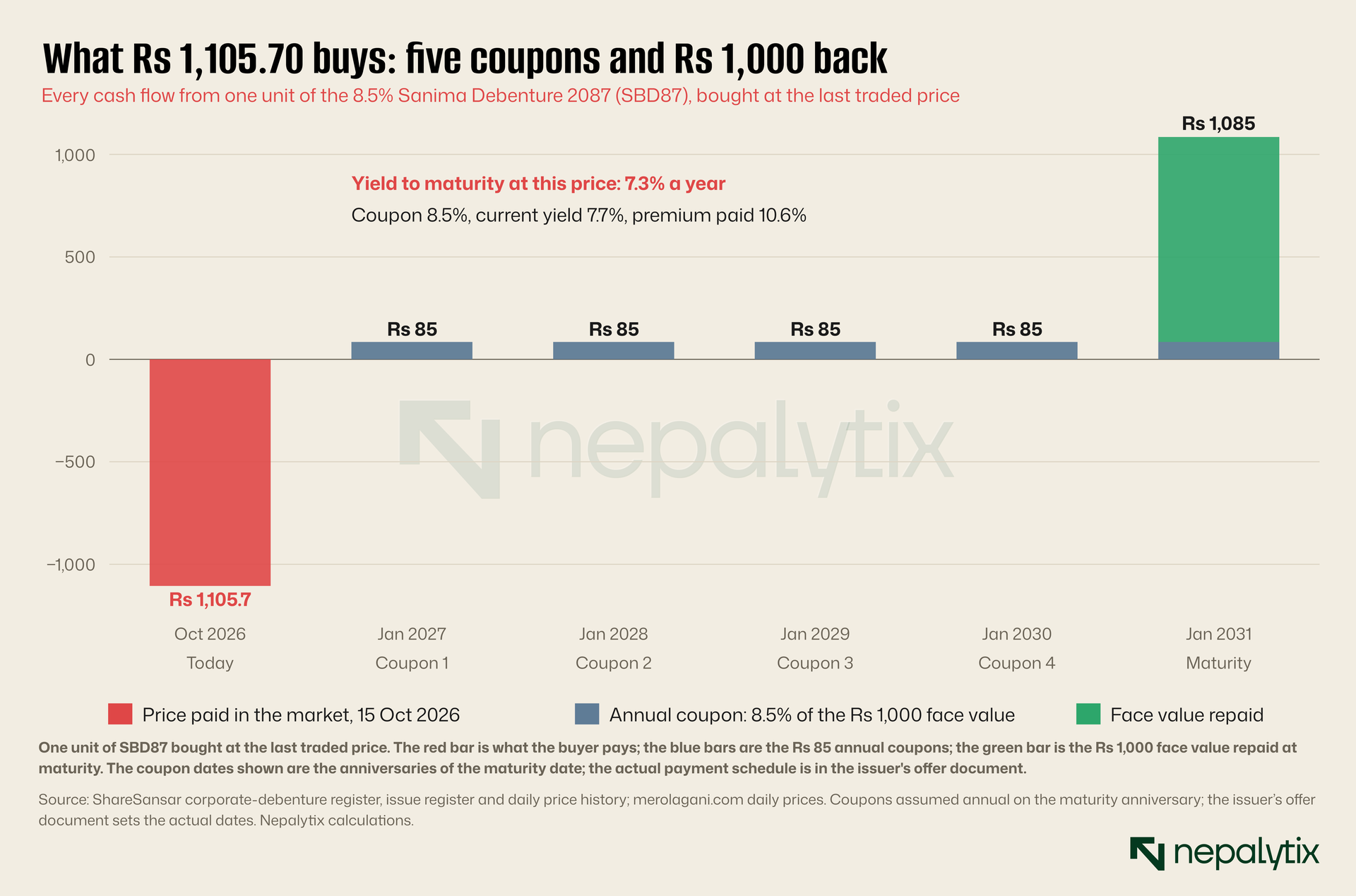
Add it up. The buyer pays Rs 1,105.70 and receives Rs 85 × 5 + Rs 1,000 = Rs 1,425 over a little more than four years. Three different percentages describe that deal and they answer different questions.
The coupon rate, 8.5%, answers: how much does the bank pay on face value? It says nothing about what this buyer earns because this buyer did not pay face value.
The current yield, 7.7%, answers: how much income does the buyer get each year for the price paid? It is the annual coupon divided by the price, Rs 85 ÷ Rs 1,105.70. It is a useful quick check but it ignores the fact that the buyer paid Rs 105.70 more than they will get back at maturity. That loss is certain and comes out of the return.
The yield to maturity, 7.3%, answers the question that matters: if the buyer holds to the end and the bank pays everything it owes, what annual return does the deal produce? It is the single interest rate at which the stream of coupons and principal, discounted back to today is worth exactly the price paid. There is no shortcut formula. You find it by trial: guess a rate, discount each payment, add them up, compare with the price and adjust. A spreadsheet's YIELD or IRR function does it in a second. For SBD87 at Rs 1,105.70, the answer is 7.3% a year.
The gap between the three numbers is the premium. When a debenture trades above face value, the coupon rate is highest, the current yield is lower and the yield to maturity is lowest. When it trades below face value the order reverses. Only at exactly Rs 1,000 and only on a coupon date, are all three the same.
Two practical points affect the arithmetic. The first is the coupon schedule. Some Nepali debentures pay interest twice a year, some once and the dates are set in the offer document rather than the name. In Nepal the coupon goes to whoever holds the debenture on the book-closure date so the price a buyer pays includes the right to the next full coupon, however close it is. A buyer a month before book closure pays for a coupon that is almost due. That is why debenture prices rise into the payment date and drop after it and why yields calculated from a price just before or just after book closure can look odd. The yields in this piece treat the traded price as all-in and assume one coupon a year on the maturity anniversary. For debentures with more than 18 months to run, a different schedule moves the answer by a fraction of a point.
The second point is tax. Interest paid to individuals on debentures is taxed at source. The withholding section of the Income Tax Act as currently published sets the rate at 6% of the interest paid. So an Rs 85 coupon arrives as about Rs 79.90. For SBD87 at Rs 1,105.70 that brings the yield to maturity from 7.3% to about 6.7%. Gains on selling are a separate question. The Cabinet approved new capital gains rates on listed securities in September: 3.5% for natural persons on holdings of more than a year and 5% on shorter holdings. The reports we have seen do not say how debentures are treated so check with your broker before relying on a figure.
Why banks issue debentures and how they set the coupon
Banks borrow mostly from depositors, and most deposits can be withdrawn at short notice or within a year or three. Loans run for five to ten years. A debenture is money the bank cannot be asked to repay early at a fixed cost for seven or ten years. Most also count towards regulatory capital. That is why commercial banks plus a few development banks and finance companies are almost the only issuers on NEPSE.
The register shows when they needed it. There were three issues in 2018 then 13 in 2019, 11 in 2020, 20 in 2021, 13 in 2022 and 10 in 2023. That is 67 issues in five years, with a combined face value of about Rs 172 billion. Then issuance almost stopped: one issue in 2024. It picked up again with nine in 2025, and three so far in 2026. The recent issues are the ones with the low coupons in their names: 7% Nabil Debenture 2089, 7% NIC Asia Debenture 2091, 6.25% Prime Bank Debenture 2093 and the 6% RBBL issue open now.
How does a bank decide on 6% rather than 10%? The chart answers that more cleanly than any explanation.
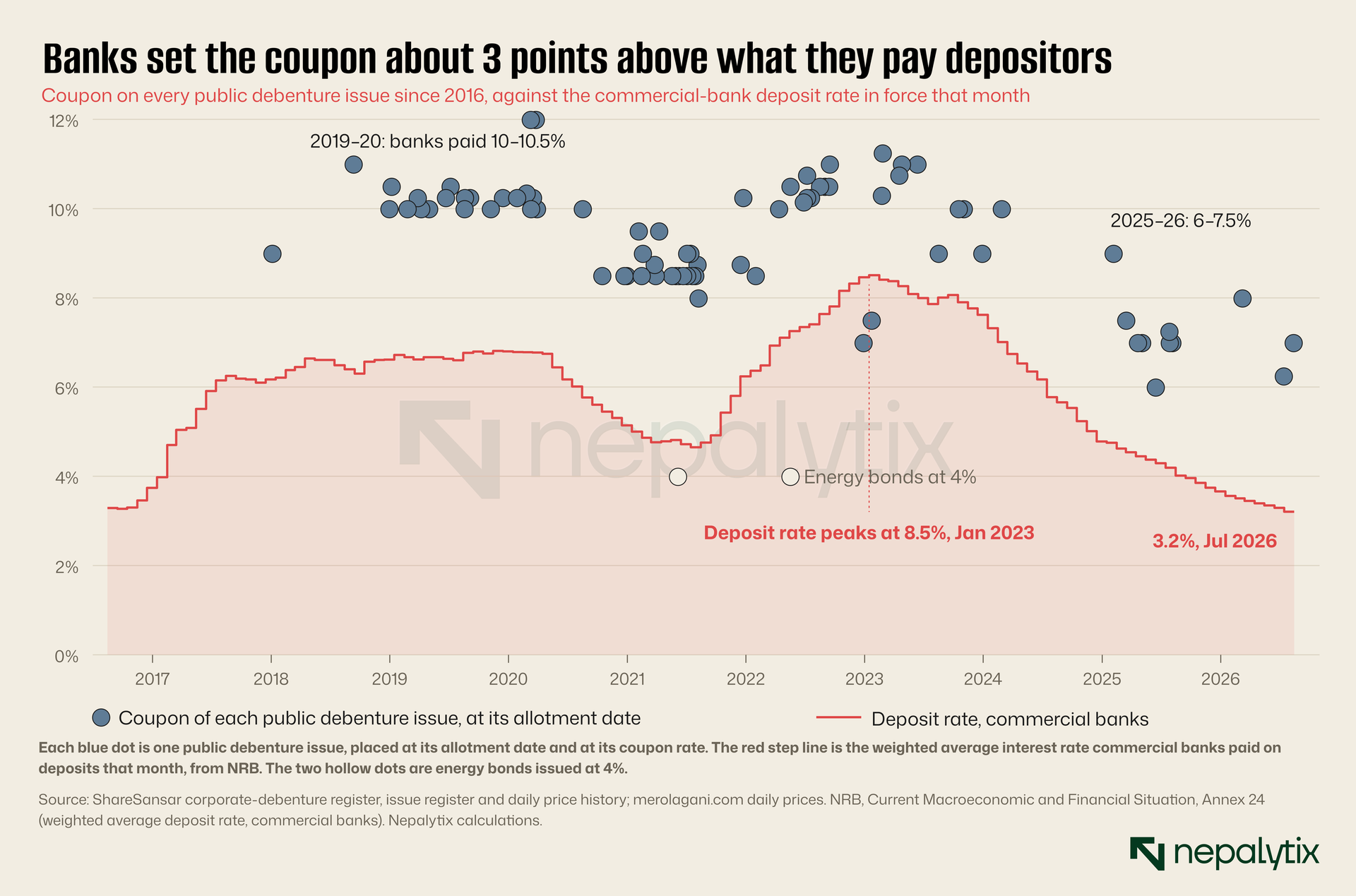
Banks price debentures off their own deposit rate. Across the 80 issues since August 2016 for which we have the deposit rate that month, leaving out the two 4% energy bonds, the coupon was a median 3.3 percentage points above the rate banks were paying depositors. The spread moves a little, between about 2.2 and 3.9 points depending on the year but the coupon follows the deposit rate up and down.
In 2019 and early 2020, deposits cost banks about 6.8% and debenture coupons clustered at 10–10.5%. In 2021, deposit rates fell below 5% and coupons dropped to 8.5%. Then rates climbed again and the weighted average deposit rate peaked at 8.5% in January 2023. Coupons went back to 10–11.25%. Since then deposit rates have fallen steadily to 3.2% by mid-July 2026 and the coupons on new issues have followed them to 6–7.5%.
The 3.3-point gap is the premium a debenture buyer gets for three things a depositor does not give up. They lend for seven to ten years rather than one. They rank behind depositors if the bank fails. And they cannot simply walk into a branch and ask for their money back; they have to find a buyer on NEPSE. As the section on liquidity shows, that last point is worth more than it sounds.
The chart also explains why debentures issued at different times carry such different coupons. A 2022 debenture pays 10.25% and a 2025 debenture from the same bank pays 7%. The bank is no riskier or safer. Interest rates were simply different when each was issued.
The see-saw: why prices move against rates
Here is the key idea. Suppose a bank issued a 10% debenture when deposit rates were 6.8%. Rates then fall and new debentures come out at 7%. An investor can buy a new 7% debenture at Rs 1,000 or an old 10% debenture. The old one pays Rs 100 a year against the new one's Rs 70 so nobody will sell it at Rs 1,000. Its price rises until the extra coupon is roughly cancelled out by the premium the buyer pays and loses at maturity. Then its yield to maturity is in line with the new issues.
The same logic runs in reverse. When rates rise and new debentures pay 11%, nobody wants an old 8.5% at Rs 1,000 and its price falls below face value until its yield matches. A debenture's price is the market's way of bringing an old coupon up or down to today's rate.
Nepal has just run that experiment in both directions.
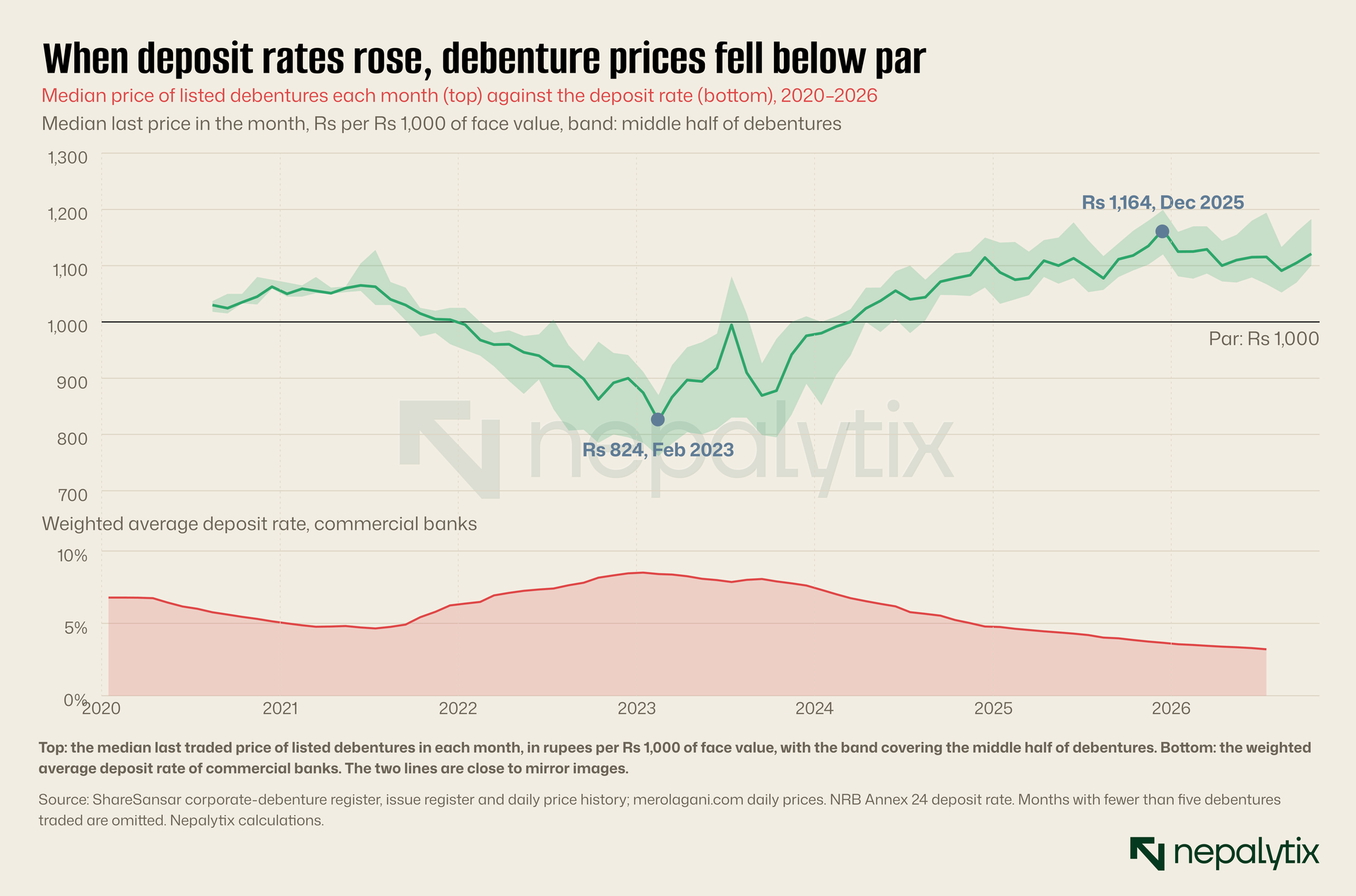
From late 2020 to mid-2021 with deposit rates near 5%, the median listed debenture traded at about Rs 1,025 to Rs 1,065. As deposit rates climbed through 2022, prices fell below Rs 1,000 and kept falling. The median reached Rs 824 in February 2023, a month after deposit rates peaked. At that point an investor could buy a typical bank debenture for about 18% less than the bank would repay. As rates came down from 2024, prices recovered, crossed back to Rs 1,000 in March 2024 and kept rising. The median peaked at Rs 1,164 in December 2025. In October 2026 it is Rs 1,121.
Over the 72 months with enough trades to measure, the correlation between the monthly median debenture price and the deposit rate is −0.95. A correlation of −1 would mean the two move in perfect opposition. In practice, if you know what deposit rates are doing, you know most of what debenture prices are doing.
How far does the price move? It depends on how long the debenture has left to run. A debenture with ten years to go has ten years of coupons that are above or below the market rate, so its price has to move a long way to compensate. One with a year to go has only one coupon left so its price barely moves. Take SBD87 again. At today's price it yields 7.3%. If market yields for debentures like it rose by one point to 8.3%, its price would fall to about Rs 1,070. If they rose by two points, it would fall to about Rs 1,036. If they fell by one point, it would rise to about Rs 1,143 and by two points to about Rs 1,182. A debenture with nine years left, such as the 10% NIMB Debenture 2090 would move about 1.8 times as much: around 5.7% of its price for each point.
This is the main risk in a debenture for someone who might need to sell before maturity. The bank's promise is fixed. The price at which someone else will take that promise off your hands is not.
Pull to par: the price always comes home
There is one date on which the price of a debenture is certain: the day it matures. On that day the bank pays Rs 1,000 plus the last coupon and the debenture is delisted. Whatever it traded at along the way, it ends at par. Bond traders call this the pull to par.
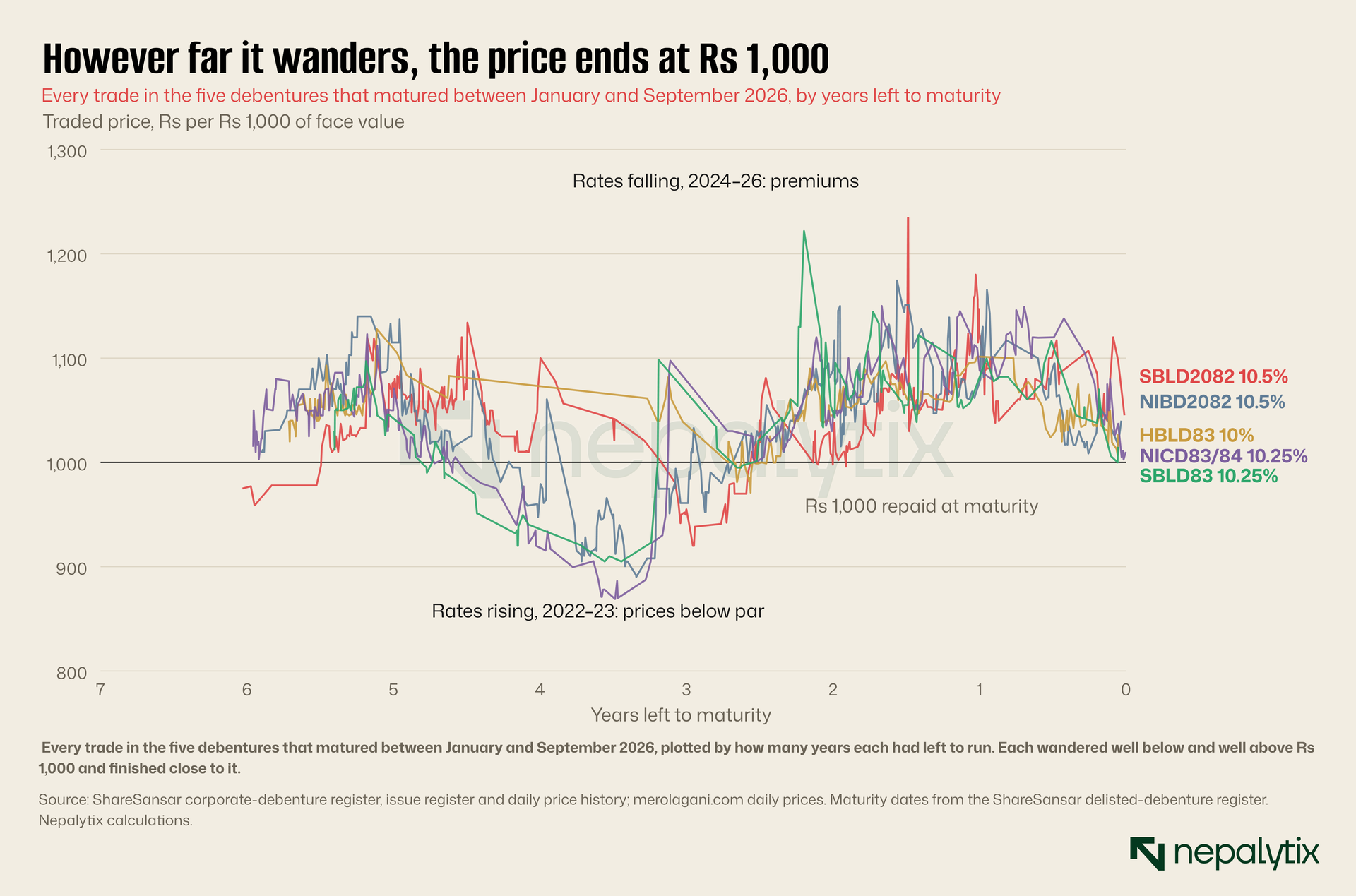
The five debentures that matured in 2026 show it clearly. All five were issued in 2019 with coupons of 10% to 10.5%, close to the market rate of the time. They traded a little above par in 2021. Then the rate rise of 2022 pushed every one of them below par. NIC Asia's 10.25% debenture traded as low as Rs 869 in February 2023, Nepal Investment Bank's 10.5% at Rs 890 and Siddhartha Bank's two issues at Rs 905 and Rs 920. By 2024, with rates falling, four of the five traded as high as Rs 1,150 to Rs 1,234. Then as maturity approached, each slid back towards Rs 1,000. Their last trades were between Rs 1,010 and Rs 1,045 slightly above par because the buyer still collected the final coupon.
The lesson is that a holder who keeps the debenture to the end does not care about any of that. Someone who bought SBLD2082 at Rs 1,000 in 2019 received every 10.5% coupon and their Rs 1,000 back in January 2026 whether the price in between was Rs 920 or Rs 1,234. Price risk is a risk only for the holder who has to sell or who bought at a premium and treats the premium as permanent. The premium always disappears by maturity. A buyer at Rs 1,105.70 today will get Rs 1,000 back, not Rs 1,105.70 and the yield to maturity already accounts for that loss.
What the market is paying now
We counted every listed debenture that has not matured and has traded in the past 90 days. There are 70 with a combined face value of about Rs 170 billion. Their median coupon is 9%. Their median last price is Rs 1,120.55, a premium of 12.1%. Only one of the 70 trades below par: the 4% NMB Urja Rinpatra, an energy bond issued in 2022 with a coupon far below anything else on the list at Rs 955. The other 69 all trade above Rs 1,000.
The premiums are largest on the debentures issued at the top of the last rate cycle. KBL Debenture 2090 with a 10% coupon, last traded at Rs 1,460. SBL Debenture 2089, at 10.75%, last traded at Rs 1,455. NMB Debenture 2089/90, at 10.75%, last traded at Rs 1,420. These were issued in 2022 and 2023 at coupons set against deposit rates near their peak. They have six to seven years left to run. They are exactly what the see-saw predicts: long, high-coupon debentures in a falling-rate market.
The coupons and premiums vary a lot. The yields to maturity which net them against each other, vary much less.
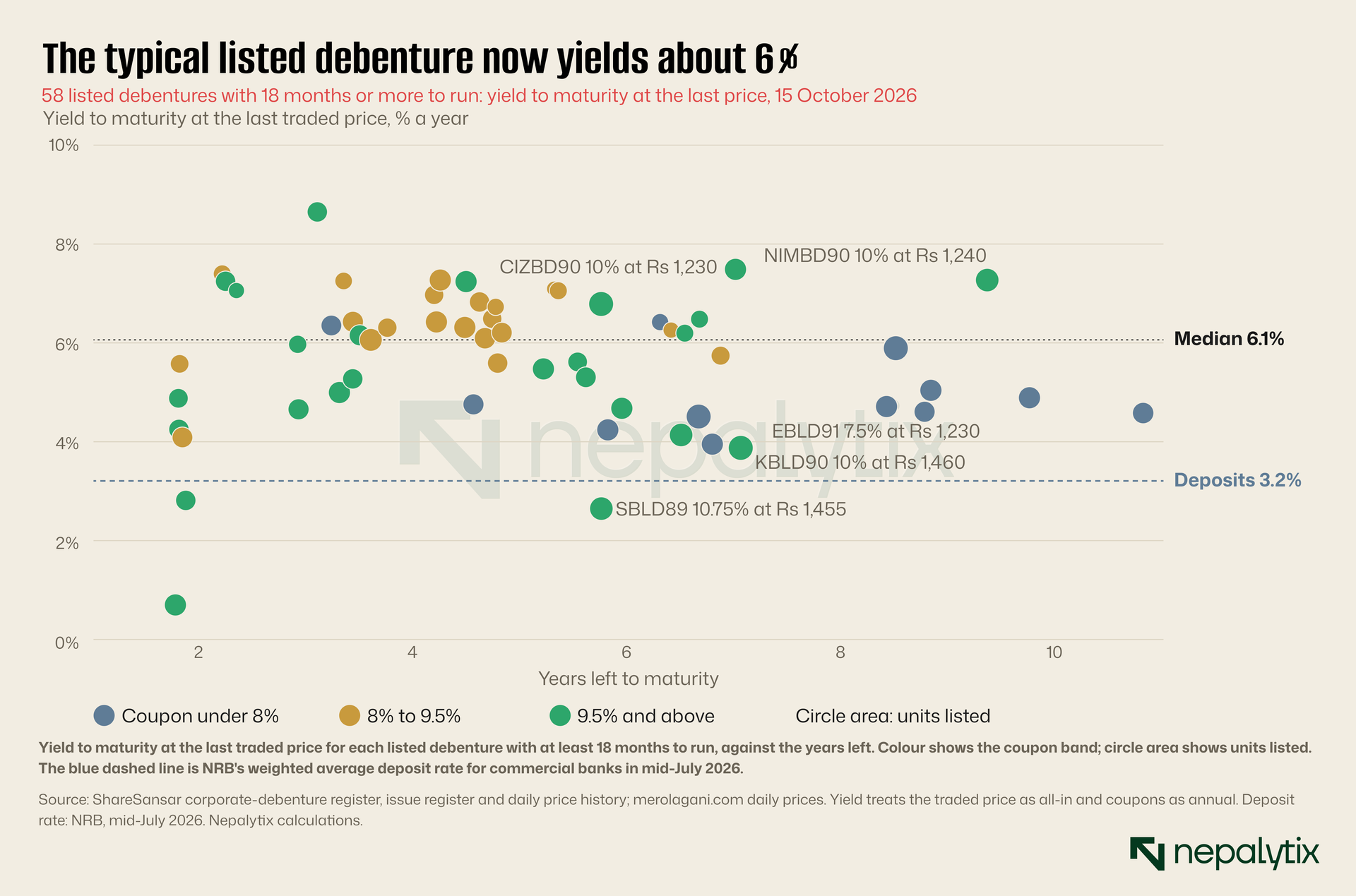
For the 58 debentures with at least 18 months to run, the median yield to maturity is 6.1%. Half of them yield between 4.8% and 6.5%. The coupons on the same debentures run from 4% to 11% but once the price is taken into account, most of them offer a buyer today something close to 6%.
That is the number to compare with alternatives. In mid-July 2026, NRB's weighted average deposit rate for commercial banks was 3.2%, and the 91-day Treasury bill yielded 2.3%. A debenture at 6% pays nearly three points more than an average deposit. That is close to the 3.3-point gap at which banks price new issues so the secondary market and the primary market agree with each other. The spread is not free money. It is the price of lending for years, ranking behind depositors and holding something that may be hard to sell.
The chart also shows where the market is not efficient. SBL Debenture 2089 and Citizens Bank Debenture 2090 are both high-coupon commercial-bank debentures issued in 2022 and 2023 maturing about fifteen months apart. SBLD89 last traded at Rs 1,455, a yield of 2.6%. CIZBD90 last traded at Rs 1,230, a yield of 7.5%. Unless one bank is far riskier than the other, those two prices cannot both be right. Someone who paid Rs 1,455 for SBLD89 has locked in less than a bank deposit pays for six years with more risk. Gaps like that persist because the market is thin and because many buyers look at the coupon in the name rather than the yield at the price.
The 6% RBBL debenture now open fits this picture. It is a seven-year issue at par. The 18 listed debentures maturing between 2032 and 2034 have a median yield to maturity of 5.7%. An investor who applies gets 6% on a seven-year state-bank debenture, slightly more than the secondary market is paying for comparable maturities. It is not a bargain and it is not a bad deal either. It is about where the market is.
Hard to buy, hard to sell
One reason gaps persist is that debentures rarely trade. We counted the sessions on which each of the 70 listed debentures traded in the year to 15 October. NEPSE held 232 sessions in that period.
The median debenture traded on 71 of the 232 sessions, under a third. Seventeen traded on 50 sessions or fewer. Only 15 traded on half the sessions or more and the most active, Everest Bank's 7.5% debenture maturing in 2035, traded on 203. In value, the median debenture saw trading equal to 12.5% of its listed face value over the whole year. Even the busiest turned over less than 70% of its face value.
Debentures can have a busy day. On 14 July, as the fiscal year closed and holders positioned for annual interest payments, debentures made up more than half of NEPSE's Rs 8.41 billion turnover and nine of the ten most-traded securities, Himal Press reported. KBL Debenture 2089 closed that day at Rs 1,290. Over the past year, listed debentures traded a combined Rs 31.7 billion. But that activity is concentrated in a few issues and a few weeks.
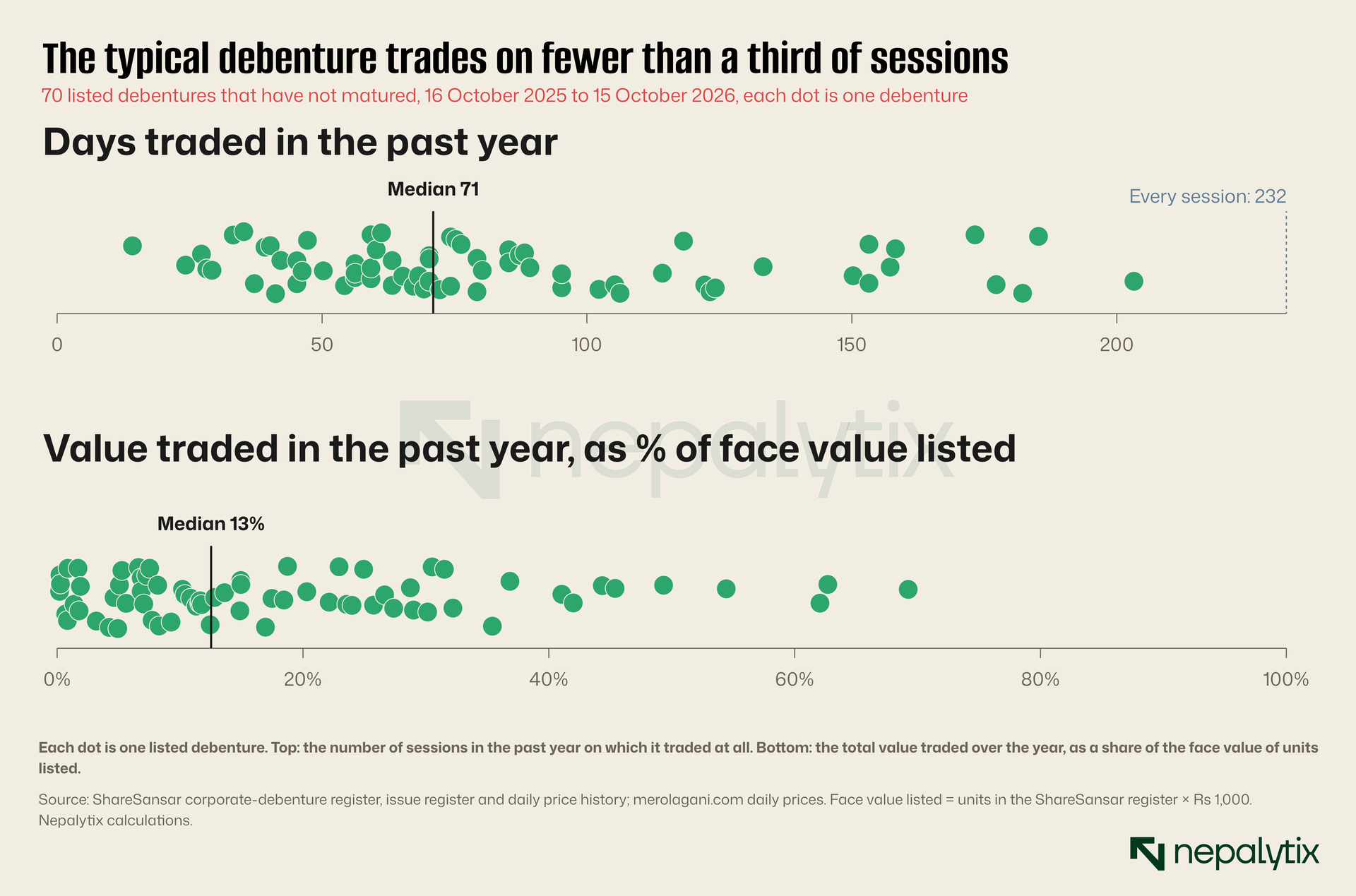
For a small investor this has two consequences. The last traded price may be days or weeks old and may reflect one trade of a few dozen units. Some debentures in our list last traded in August or September. Their yields in the chart are calculated from prices that may no longer be available. And anyone who needs to sell quickly may have to accept a lower price than the last trade suggests. The 3.3-point spread over deposits pays partly for this. A depositor can withdraw at a known value; a debenture holder can only sell to whoever is bidding that day.
A checklist for any debenture
Everything above comes down to six questions. They take a few minutes with a spreadsheet.
What is the exact maturity date? The year in the name is a Bikram Sambat year or a fiscal year. Look up the date. Two debentures named 2089 can mature seven months apart.
What is the coupon and when is it paid? The rate is in the name. The schedule, once or twice a year and the book-closure dates are in the offer document. A price just before book closure includes the next coupon.
What is the price and how old is it? Check the date of the last trade and the quantity. A price from one trade of 25 units three weeks ago is a weak guide to what you would pay today.
What is the yield to maturity at that price? Put the price, the coupon and the dates into a spreadsheet's YIELD or IRR function. Compare the result not the coupon with other debentures and with deposit rates. Today the median is 6.1%.
What does tax do to it? Interest is taxed at source, at 6% for individuals under the current text of the Income Tax Act. Reduce the coupon accordingly. Check how gains on sale are treated before you count on them.
Who is the issuer and do you trust them for the whole term? The debenture ranks behind deposits and is not insured. A seven-year debenture is a seven-year loan to that bank. The higher yield is a payment for that risk not a gift.
Two mistakes cover most of the losses in this market. The first is buying for the coupon: paying Rs 1,455 for a 10.75% debenture because 10.75% looks generous when the price has already turned it into a 2.6% investment. The second is treating the premium as value that will last. Every premium in the market today will be zero on maturity day. Read the yield not the name and the debenture becomes what it was designed to be: the most predictable security on the exchange.
Disclaimer
This report has been prepared by Nepalytix for informational and educational purposes only and does not constitute investment advice, an offer, or a solicitation to buy or sell any securities.
The information contained in this report is based on sources believed to be reliable; however, Nepalytix does not guarantee its accuracy, completeness, or timeliness. Opinions, estimates, and projections expressed herein are those of the authors as of the date of publication and are subject to change without notice.
Investing in securities involves risks, including the possible loss of principal. Past performance is not indicative of future results. Readers are advised to conduct their own independent research and consult with a qualified financial advisor before making any investment decisions.
Nepalytix and its contributors may hold positions in the securities discussed in this report at the time of publication or thereafter.
Neither Nepalytix nor any of its affiliates accept any liability for any loss arising from the use of this report or its contents.