How to read a cash flow statement
Profit can be manipulated. Cash is harder to fake. Learn how to use the cash flow statement to spot weak earnings, hidden risks, and accounting red flags in Nepal's listed companies.
The income statement is where a company tells its story. The cash flow statement is where it slips up. Once you learn to read the second against the first you can spot the profit that isn't really there in a bank, a hydropower plant, an insurer, a microfinance lender or a spinning mill in about five minutes.
Two months ago, Nepal's financial press announced that Reliance Spinning Mills had earned a record profit of Rs 1.48 billion. The number ran everywhere, unchanged for days. It was wrong that the gross profit and the money that actually reached shareholders was Rs 476 million less than a third of it. But even Rs 476 million overstates what the mill's year was really worth and to see why you have to leave the income statement behind and turn to the one page most retail investors in Nepal never read: the cash flow statement.
Here is the single idea this guide is built on. Profit is an opinion. Cash is a fact. A company's reported profit depends on dozens of accounting choices when to recognise a sale, how fast to depreciate a machine or whether to book a government subsidy that has not yet been paid. Cash is harder to fake: either the money is in the bank or it isn't. The cash flow statement is where those two versions of reality are forced to meet and the gap between them is one of the most reliable warning signs available to an ordinary investor. You do not need a model or a finance degree to use it. You need to know what the statement is, what each part means and which line to distrust in which sector.
What the statement actually is
Every listed company publishes three financial statements each quarter. The balance sheet is a snapshot of what the company owns and owes in one day. The income statement (or profit and loss account) is a story of a period of revenue earned, costs incurred, profit left over. The cash flow statement is the third and it answers a question the other two dodge: over this period, did money actually come in and where did it go?
It is split into three sections and understanding the split is most of the battle.
Cash from operating activities is the important one. It is the cash the core business generates selling yarn, lending money, underwriting policies after paying for the day-to-day costs of doing so. This is the number you will compare against reported profit and the number that tells you whether the profit is real. A healthy business generates operating cash that, over a full year, is at least as large as its net profit.
Cash from investing activities is money spent on or received from long-term assets building a new plant, buying machinery, purchasing shares of another company. For a growing company this is usually negative because it is spending to expand. That is not a bad sign in itself; a hydropower company mid-construction should be pouring cash into investing.
Cash from financing activities is money raised from or returned to lenders and shareholders taking a loan, repaying one, issuing shares, paying a dividend. This section tells you how the company is funding itself and it holds one of the sharpest tells of all which we will come to.
Add the three together and you get the change in the company's cash balance over the period. Simple arithmetic. The insight is in the composition specifically in the first section and in how it relates to the profit the company trumpeted on its income statement.
From profit to cash: the reconciliation
Nepali companies present operating cash flow using what is called the indirect method and it is a gift to the careful reader because it lays out line by line exactly how reported profit is converted into cash. It starts at net profit and adjusts. Learn to read this reconciliation and you can see precisely where a company's earnings turn into money or fail to (Figure 1).
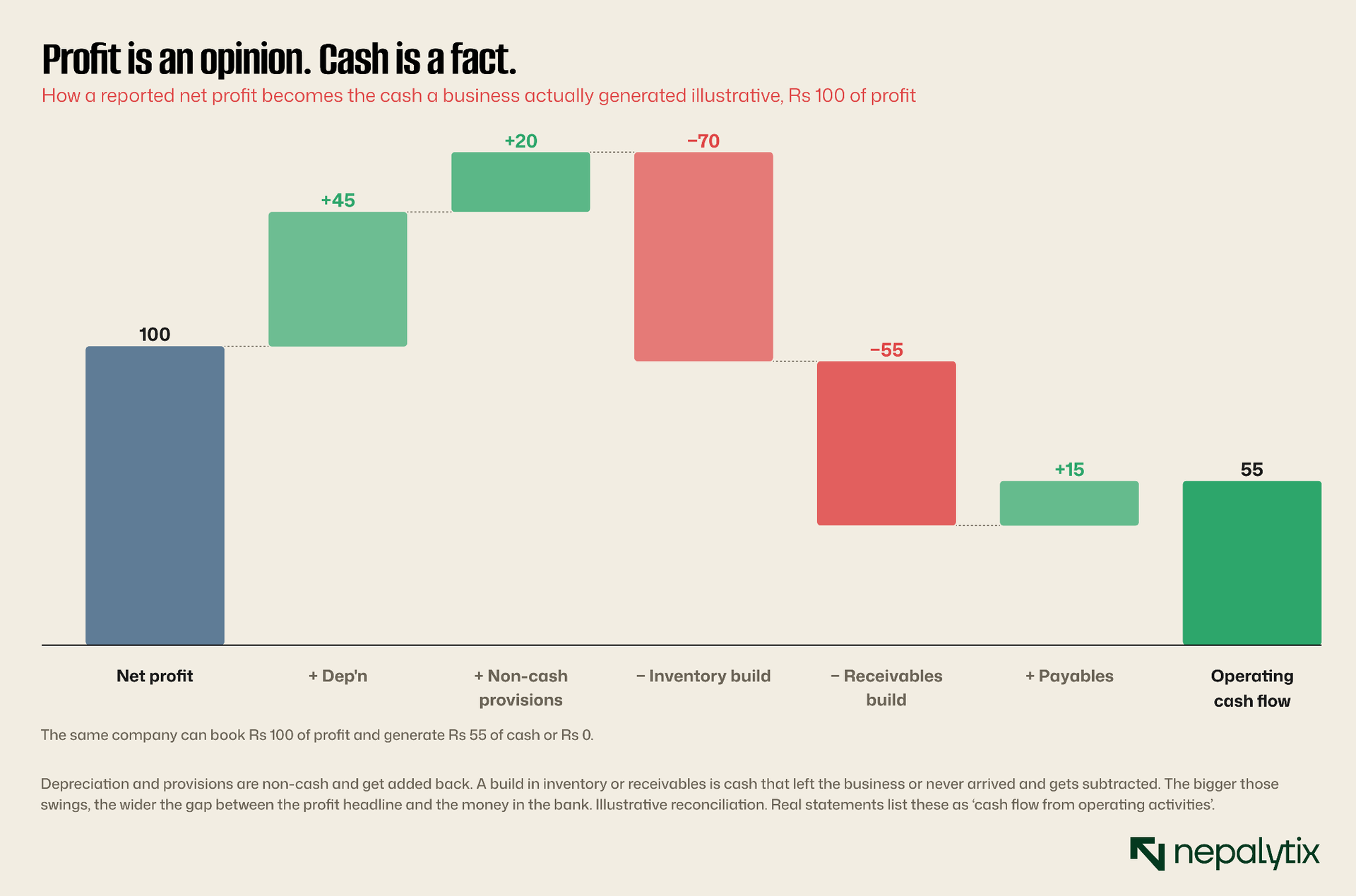
The first adjustments add cash back. Depreciation and amortisation are the biggest: when a company writes down the value of a machine by Rs 100m this year that Rs 100m was subtracted as a cost on the income statement but no cash left the building the money was spent years ago when the machine was bought. So it gets added back. The same goes for other non-cash charges: provisions for bad loans a bank has not yet written off, revaluation losses, unpaid accrued expenses. These make profit look smaller than the cash reality.
The next adjustments do the opposite: they reveal cash that profit hid. These are the working-capital movements and they are where most of the action is in Nepal. If a company's inventory rose over the period, it spent cash building up stock that has not yet been sold cash out, no profit impact yet. If its receivables rose, it made sales and booked the profit but has not been paid profit recognised, cash not received. Both are subtracted from profit to get to cash. Conversely, if the company stretched its payables took longer to pay its own suppliers it held on to cash which was added.
Put plainly: a business whose inventory and unpaid bills are ballooning can report a healthy profit and generate almost no cash. That is not necessarily fraud or even mismanagement; a fast-growing company naturally ties up cash in working capital. But it is something you must see because a company that never converts its profit into cash is either growing recklessly, selling to customers who don't pay or flattering its earnings. The cash flow statement is the only place that shows you which.
The one comparison that matters
If you remember nothing else, remember this: put net profit and operating cash flow side by side, across three or four years. In a sound business they move together. Profit of Rs 500m should give or take the timing of a good or bad quarter, come with operating cash of roughly Rs 500m or more over a full year. When the two diverge when profit marches up while operating cash stays flat or turns negative the income statement is telling a more flattering story than the cash flow statement and the cash flow statement is almost always the more honest of the two.
A single year of divergence can be innocent: a big order delivered in the last week of the year, booked as a receivable, collected in the first week of the next. Timing. But a pattern of three years running of profit comfortably above cash is a structural signal. It means the business does not convert what it earns into money it can spend and eventually that catches up with the dividend, the debt repayments or the share price.
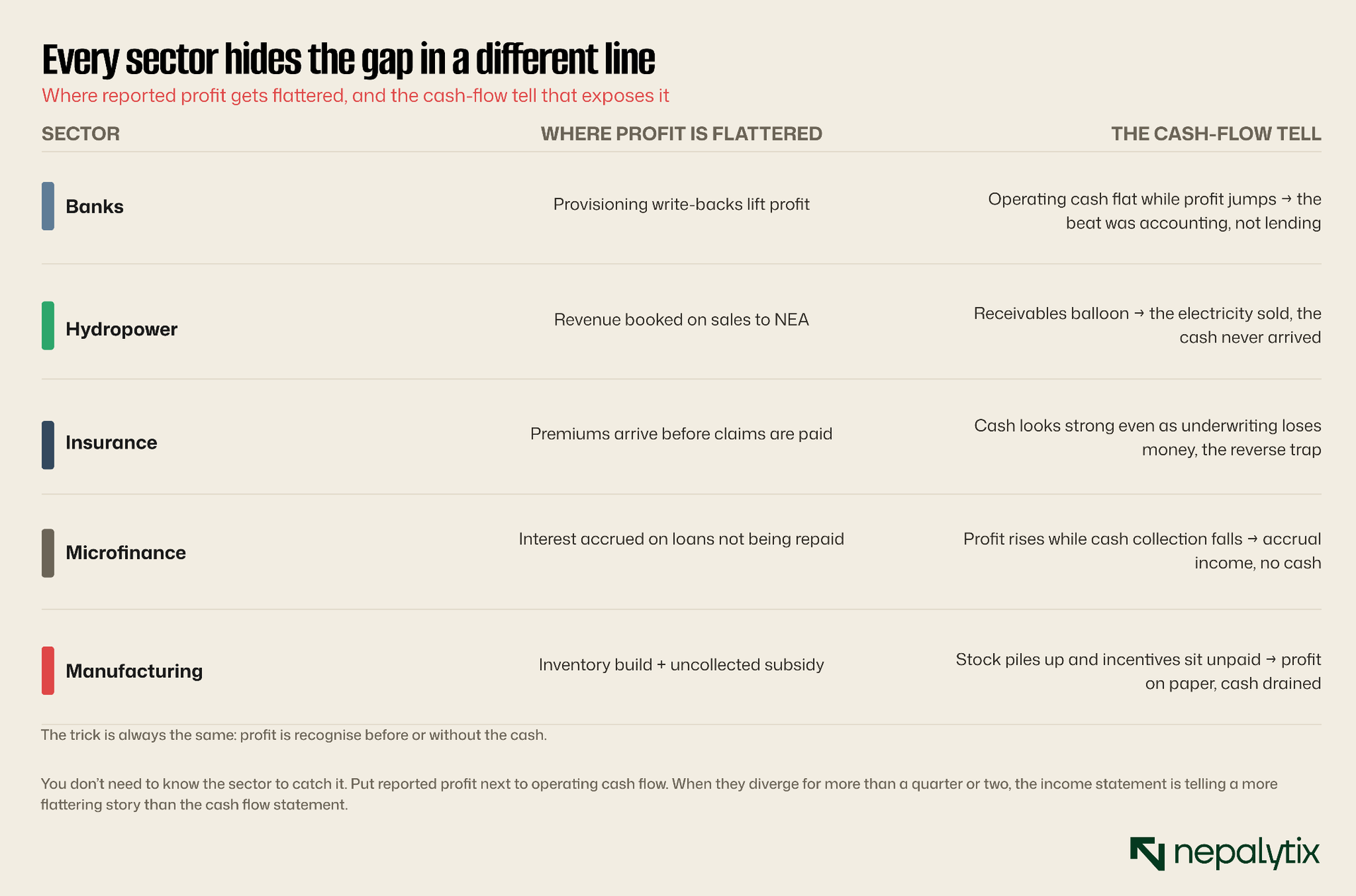
What makes this genuinely useful in Nepal is that the divergence shows up differently in every sector so the same five-minute check works whether you are looking at a bank, a hydro, an insurer, a microfinance lender or a manufacturer. Each hides the gap in a different line (Figure 2). Once you know which line you know where to look.
Banks: the provisioning mirage
Nepal's commercial banks are the heaviest weight on NEPSE and their profits are the easiest to misread. A bank's reported profit is heavily shaped by one line entirely within management's discretion: loan-loss provisions. When a bank expects some borrowers to default, it sets aside a provision which reduces profit. When conditions look better or when the regulator relaxes the rules it can write those provisions back which increases profit without a single extra rupee of lending.
This is not hypothetical. In the third quarter of the last fiscal year, Nepal's commercial banks reported profits up more than 19% while their core operating income grew barely 2%. The gap was provisioning relief not a lending boom. On the income statement, it looks like a great year. On the cash flow statement, operating cash from actual banking barely moved. An investor reading only the profit headline would conclude the sector was thriving; an investor comparing profit to operating cash would see that most of the improvement was an accounting entry that can reverse the moment the credit cycle turns.
For banks, then, the check is slightly adapted: look past net profit to net interest income and operating profit before provisions. If profit is rising because provisions are falling rather than because the bank is earning more from lending, treat the improvement as borrowed, not earned.
Hydropower: the electricity you sold but weren't paid for
Hydropower is the story stock of Nepal's market and its cash-flow trap is the cleanest of all. A hydropower company sells almost all its electricity to one buyer the Nepal Electricity Authority under a long-term agreement and books that electricity as revenue the moment it is delivered to the grid. The problem is that NEA itself under chronic financial strain does not always pay on time.
The result is a company that can report record revenue and rising profit while its bank balance goes nowhere because the cash is trapped in a swelling receivable from NEA (Figure 4). The power was generated, the sale was booked, the profit was recognised but the money has not arrived. On the income statement, a triumph. On the cash flow statement, operating cash lagging further behind profit every year as the receivable grows.
So when you look at a hydropower company, do not stop at profit or even at revenue. Find trade receivables on the balance sheet and track them over several years. If they are growing faster than revenue, the company is increasingly a lender to NEA rather than a seller of electricity and its reported earnings are a claim on a counterparty with well-known payment problems. That is a very different investment from the one the profit line advertises.
Insurance: the trap that runs in reverse
Insurance is the one sector where the cash flow statement can flatter rather than expose and knowing this keeps you from the opposite mistake. An insurer collects premiums up front and pays claims later, sometimes years later. That timing means cash pours in before the corresponding cost goes out so an insurer's operating cash flow can look wonderful even while the underlying business is unprofitable.
This front-loaded cash is called the float and it is genuinely valuable, the insurer invests it and earns a return while it waits to pay claims. But it also means you cannot judge an insurer by operating cash alone because strong cash inflow can coexist with underwriting that loses money on every policy written. Here the income statement lines matter more: the claims ratio (claims paid as a share of premiums earned), the expense ratio and their sum, the combined ratio. A combined ratio above 100% means the insurer is paying out more in claims and costs than it takes in premiums and is relying entirely on investment income from the float to make money.
The lesson generalises: the profit-versus-cash comparison is the right instinct but you must know which direction the distortion runs. In banks, hydros, microfinance and manufacturing, cash tends to lag profit and the cash flow statement is skeptical. In insurance, cash tends to lead to profit and the income statement's underwriting ratios are skeptical instead.
Microfinance: interest you booked but never collected
Microfinance lenders earn interest on the loans they extend and they book that interest as income as it accrues whether or not the borrower actually pays. In good times this is unremarkable. But Nepal's microfinance sector has been through a genuine repayment crisis with non-performing loans across the sector climbing into double digits. When borrowers stop paying, a lender that continues to accrue interest income on those loans reports profit that has no cash behind it at all.
The tell is the same shape as hydropower's in a different costume: accrued interest receivable rising, operating cash falling short of reported profit and the sharpest signal profit holding up even as loan collections deteriorate. For a microfinance company, read the non-performing loan ratio and the movement in accrued interest alongside the profit. If profit is steady while asset quality is visibly worsening, the earnings are being manufactured by an accounting convention not by cash coming through the door.
Manufacturing: back to Reliance Spinning Mills
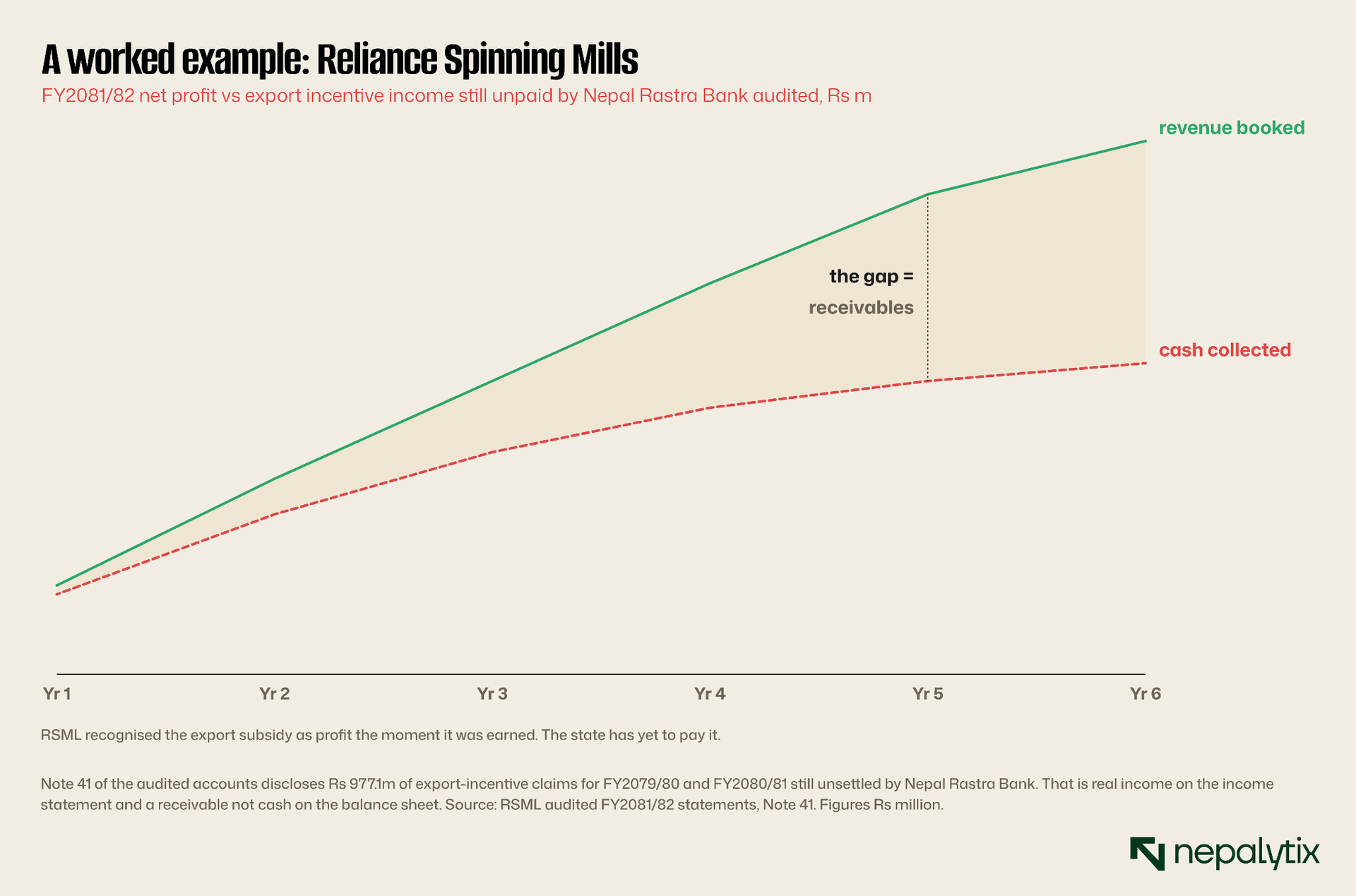
Which returns us to where we began. A manufacturer's cash gets trapped in two classic places: inventory and receivables. Reliance Spinning Mills shows both and it shows a third that is specific to Nepal's export champions the government subsidy booked as income before the state has paid it.
RSML earns an export cash incentive of up to 8% on what it ships abroad and it recognises that incentive as revenue when earned. In its record year, that incentive was Rs 614m larger than the company's entire pre-tax profit. But recognising it and receiving it are two different things. Note 41 of the audited accounts discloses that Rs 977m of incentive income for two earlier years remained unpaid by Nepal Rastra Bank at the audit date (Figure 3). That is more than two full years of net profit sitting on the balance sheet as a receivable rather than in the bank as cash.
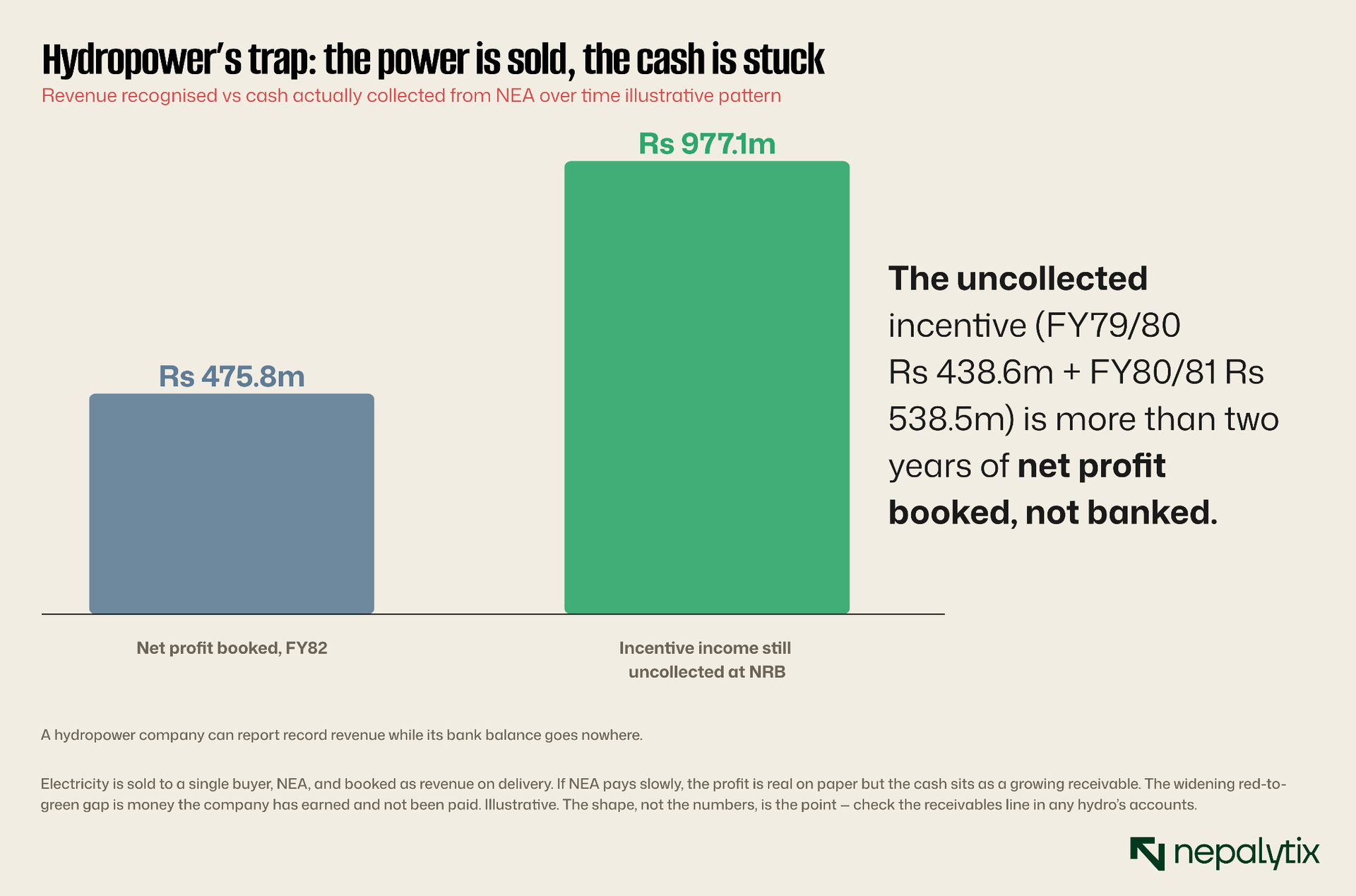
Layer on top of that the ordinary working-capital drag of a spinning mill cotton bought and held as inventory, yarn shipped to customers on credit and you get a company whose reported profit is a poor guide to the cash it generated. This is not an argument that RSML is a bad business; it is a well-run mill and a real exporter. There is an argument that its Rs 476m of profit, itself already a third of the headline everyone quoted, should be read against the cash it actually collected before you decide what the earnings are worth. The income statement said one thing. The cash flow statement, and Note 41, said another.
The dividend tell
One more check tucked in the financing section catches problems the operating section can miss. Look at what funds the dividend. A company paying its dividend out of operating cash flow is returning money it earned. A company paying its dividend while operating cash is weak, funding it instead by drawing new loans or running down reserves is returning money it borrowed and dressing up a warning sign as a reward.
In a market like Nepal's, where dividends drive a great deal of retail buying, this matters enormously. A high, consistent dividend is attractive precisely because it looks like proof of health. But a dividend is only proof of health if the cash flow statement shows it was paid from cash the business generated. When you see a generous payout sitting above thin or negative operating cash and rising borrowings, the payout is a liability being deferred, not a strength being shared.
Five checks, five minutes
None of this requires expertise. It requires the discipline to turn one page past the profit headline and read what the cash flow statement is quietly saying. Five checks will take you most of the way (Figure 5).
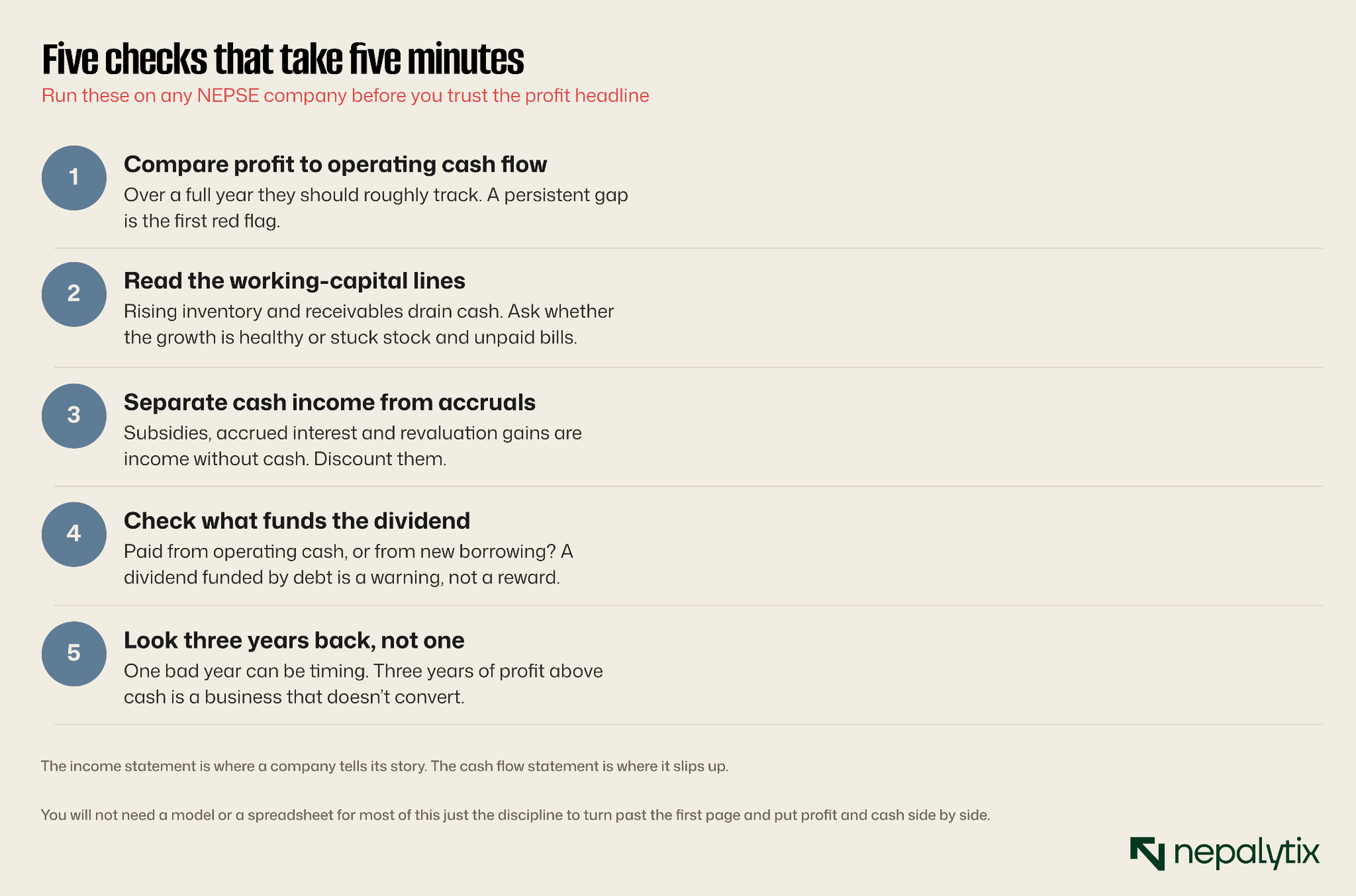
Compare profit to operating cash flow over a full year, and be suspicious of a persistent gap. Read the working-capital lines and ask whether rising inventory and receivables reflect healthy growth or stuck stock and unpaid bills. Strip out income that carries no cash subsidies, accrued interest, revaluation gains and discount it. Check what funds the dividend. And look three years back rather than one, because a single year can be timing while a pattern is character.
Do this and you will be reading Nepal's listed companies the way their auditors and their lenders do as businesses that must eventually produce cash, not just print profit. The headline number is where a company gets to tell you its story. The cash flow statement is where the story has to be true. In a market still learning to tell the difference, the investors who read the second page will keep finding what the ones who stop at the first keep missing.
Disclaimer
This report has been prepared by Nepalytix for informational and educational purposes only and does not constitute investment advice, an offer, or a solicitation to buy or sell any securities.
The information contained in this report is based on sources believed to be reliable; however, Nepalytix does not guarantee its accuracy, completeness, or timeliness. Opinions, estimates, and projections expressed herein are those of the authors as of the date of publication and are subject to change without notice.
Investing in securities involves risks, including the possible loss of principal. Past performance is not indicative of future results. Readers are advised to conduct their own independent research and consult with a qualified financial advisor before making any investment decisions.
Nepalytix and its contributors may hold positions in the securities discussed in this report at the time of publication or thereafter.
Neither Nepalytix nor any of its affiliates accept any liability for any loss arising from the use of this report or its contents.