How to read a hydropower company's accounts
A practical guide to reading hydropower accounts, from PPAs and generation to debt, depreciation and why P/E can mislead.
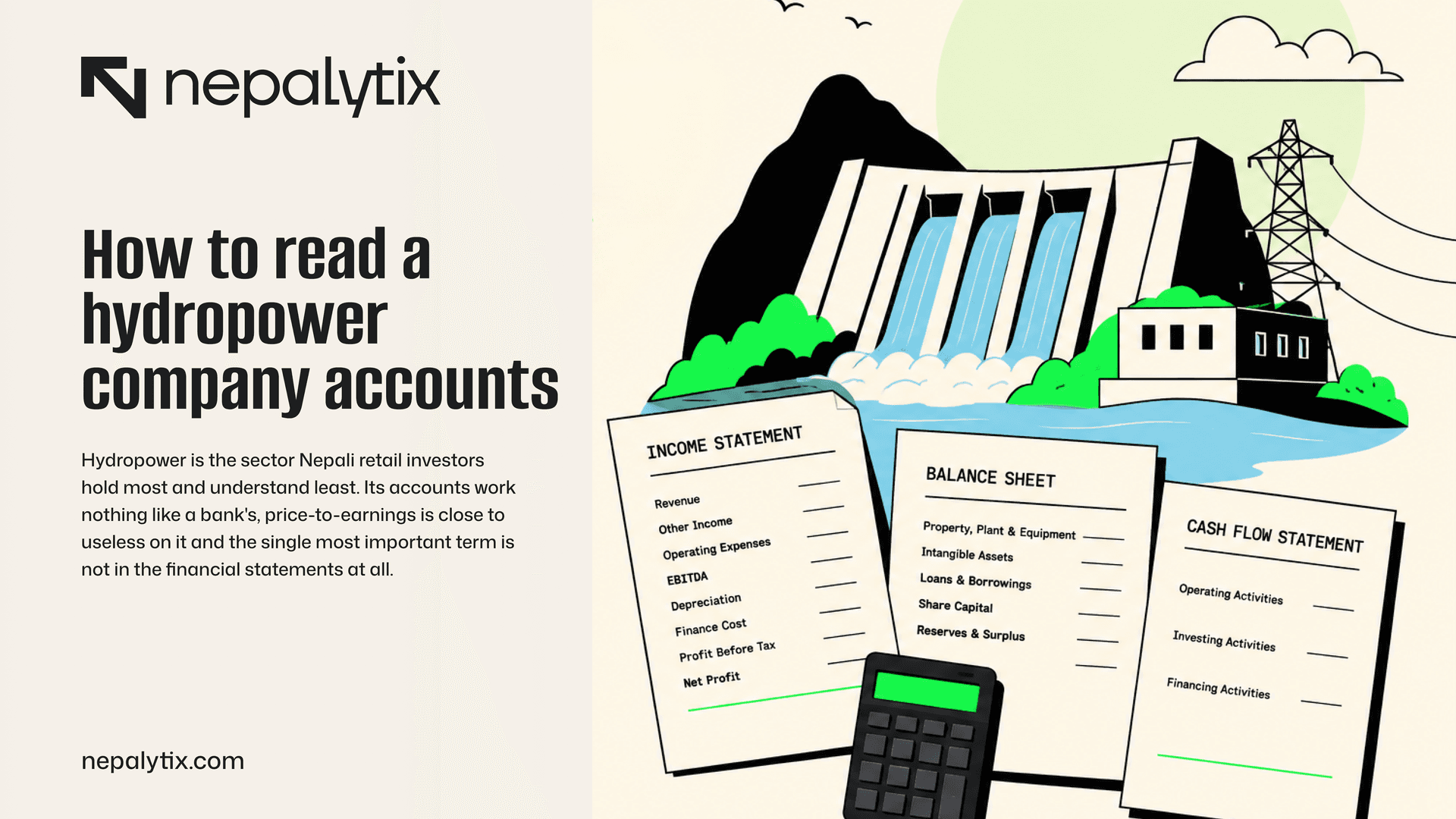
Hydropower is the sector Nepali retail investors hold most and understand least. Its accounts work nothing like a bank's, price-to-earnings is close to useless on it and the single most important term is not in the financial statements at all.
The most important document is not the annual report
Open the accounts of a Nepali commercial bank and you can work out what it does. It takes deposits at one rate, lends at another and the gap is the business. Judgement enters through provisioning and asset quality but the shape is legible.
Open the accounts of a hydropower company and the shape is misleading. Revenue looks like an achievement. Profit looks small. Depreciation looks alarming. None of those readings is correct and the reason is that the document determining almost everything is not the annual report. It is the power purchase agreement.
A Nepali hydropower company sells its entire output to one buyer, the Nepal Electricity Authority(NEA) at a rate fixed in a contract signed years before the plant was built. There is no pricing decision. There is no market share. There is no sales function in any meaningful sense. Water arrives, turbines turn and NEA pays a rate somebody agreed to a decade ago.
Which means that if you have read the PPA terms, you have read the revenue line for the next thirty years. That is an unusual degree of visibility and it is the sector's genuine attraction. It is also why so much published commentary on hydropower earnings misses the point: the interesting variable is never price and it is almost never management.
The terms as they currently stand
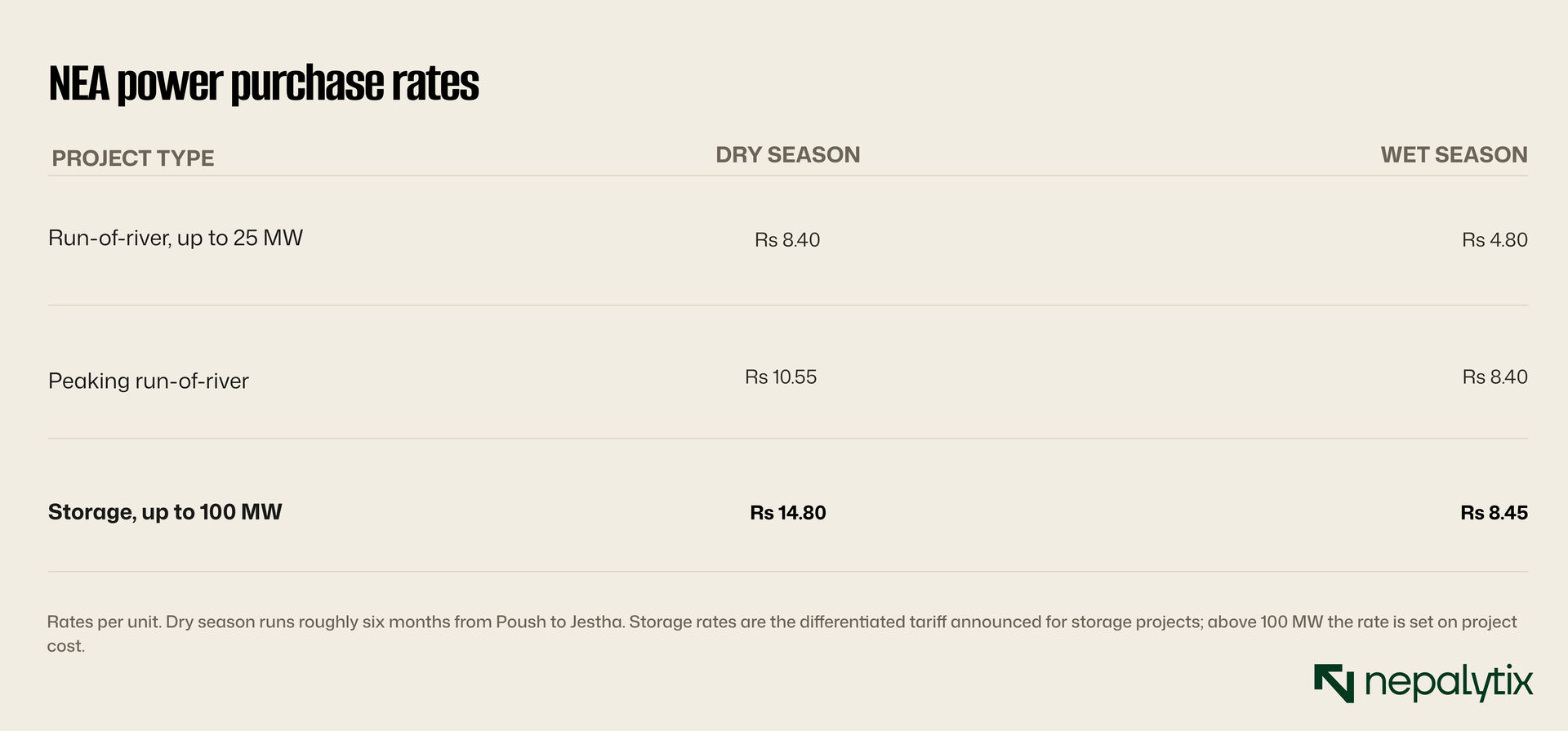
Three further terms matter as much as the rates.
The escalation. Three per cent a year, for the first six to eight years depending on the vintage of the agreement and then nothing.
The duration. Thirty years from the date of commercial operation.
The purchase obligation. This one changed in June 2025 and we come to it in section four because it is the most consequential development in Nepali hydropower economics in a decade and almost nobody has written about what it does to a company's accounts.
Those three terms are worth writing down for any company you look at because together they determine the entire revenue stream and none of them will change during the contract's life.
The base rates of Rs 4.80 and Rs 8.40 were set in 2011. They have been unchanged for roughly fourteen years, and the government is now moving toward a competitive bidding model that the Independent Power Producers' Association is resisting.
Why one buyer changes everything
It is worth pausing on the monopsony because it shapes risks that do not appear anywhere in the financial statements.
A company with many customers can lose one. A company with one customer cannot. Every listed Nepali hydropower company depends entirely on NEA's willingness and ability to pay on a contract NEA itself negotiated and which the government can alter through policy.
That dependency is currently benign. NEA has been paying, Nepal's power deficit has narrowed, and export to India has grown. But the counterparty risk is undiversified and permanent and it should be priced. A thirty-year fixed contract is only as good as the party on the other side of it for thirty years.
It also means that policy changes reach these companies directly rather than through markets. The move to take-and-pay in June 2025 was not a market development. It was a decision and it altered the economics of every project signing afterwards.
Before moving on, it is worth naming the structural feature that sits behind all of this: a Nepali hydropower company has exactly one customer.
In an ordinary business, a customer who stops paying is a bad debt and you find another. Here there is no other. NEA's financial position is therefore an input to every hydropower company's accounts, and it does not appear in any of them.
This cuts both ways and the favourable side is real. A single state-linked offtaker on a thirty-year contract is why these projects can be financed at 70% debt in the first place. No Nepali bank would lend Rs 3.5 billion against a merchant power plant selling into a spot market. The PPA is the collateral in everything but name.
The unfavourable side is concentration. If NEA delays payment, every listed hydropower company feels it simultaneously, and the equity market has no way to distinguish a well-run plant from a poorly-run one on that measure. It is a sector-wide risk that sits outside the sector's own control.
The water and the money arrive at different times
Here is the first thing that catches people out, and it catches out professionals as well as retail.
A run-of-river plant which is most of what is listed on NEPSE has no reservoir. It generates from whatever the river is carrying at that moment. In Nepal, that means it generates enormously during the monsoon and comparatively little through the winter and spring.
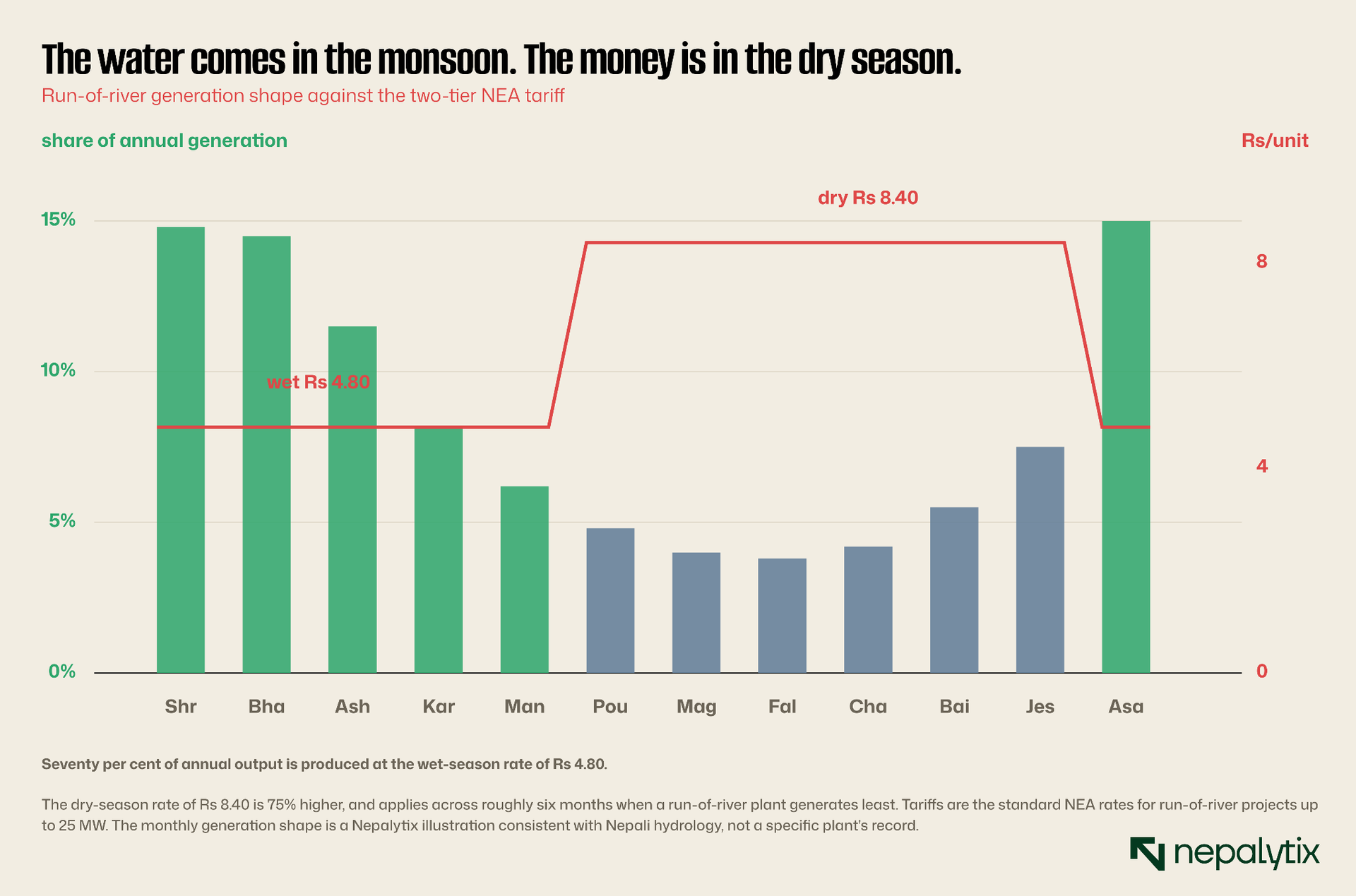
Now look at what the tariff does. The high rate of Rs 8.40 applies during the dry season when the plant produces least. The low rate of Rs 4.80 applies during the wet season, when it produces most.
On our illustrative shape roughly 70% of annual generation occurs at the wet-season rate. That output earns 57% of annual revenue. The dry-season months produce 30% of the units and 43% of the money.
The tariff structure is deliberate: NEA needs power in winter when demand peaks and rivers are low so it pays more for it. A run-of-river plant simply cannot deliver much then because it has no reservoir to hold monsoon water back for the dry months. That is precisely what a storage project does and it is why storage tariffs are set so much higher.
Most of the water arrives when the price is lowest. That is the central economic fact of Nepali run-of-river hydropower.
What this means for reading a quarterly report
Never compare a hydropower company's quarter against the quarter immediately before it. A Shrawan-to-Ashwin quarter and a Magh-to-Chaitra quarter are different businesses and the comparison will tell you nothing except which months you happened to pick.
Compare year on year, same quarter, always. And when a company reports a strong first quarter of a fiscal year, remember that Shrawan and Bhadra are the peak months. That is not momentum; that is the monsoon.
The tariff escalates for eight years and then stops
The three per cent escalation is often described as inflation protection. It is not and understanding why changes how you value one of these companies.
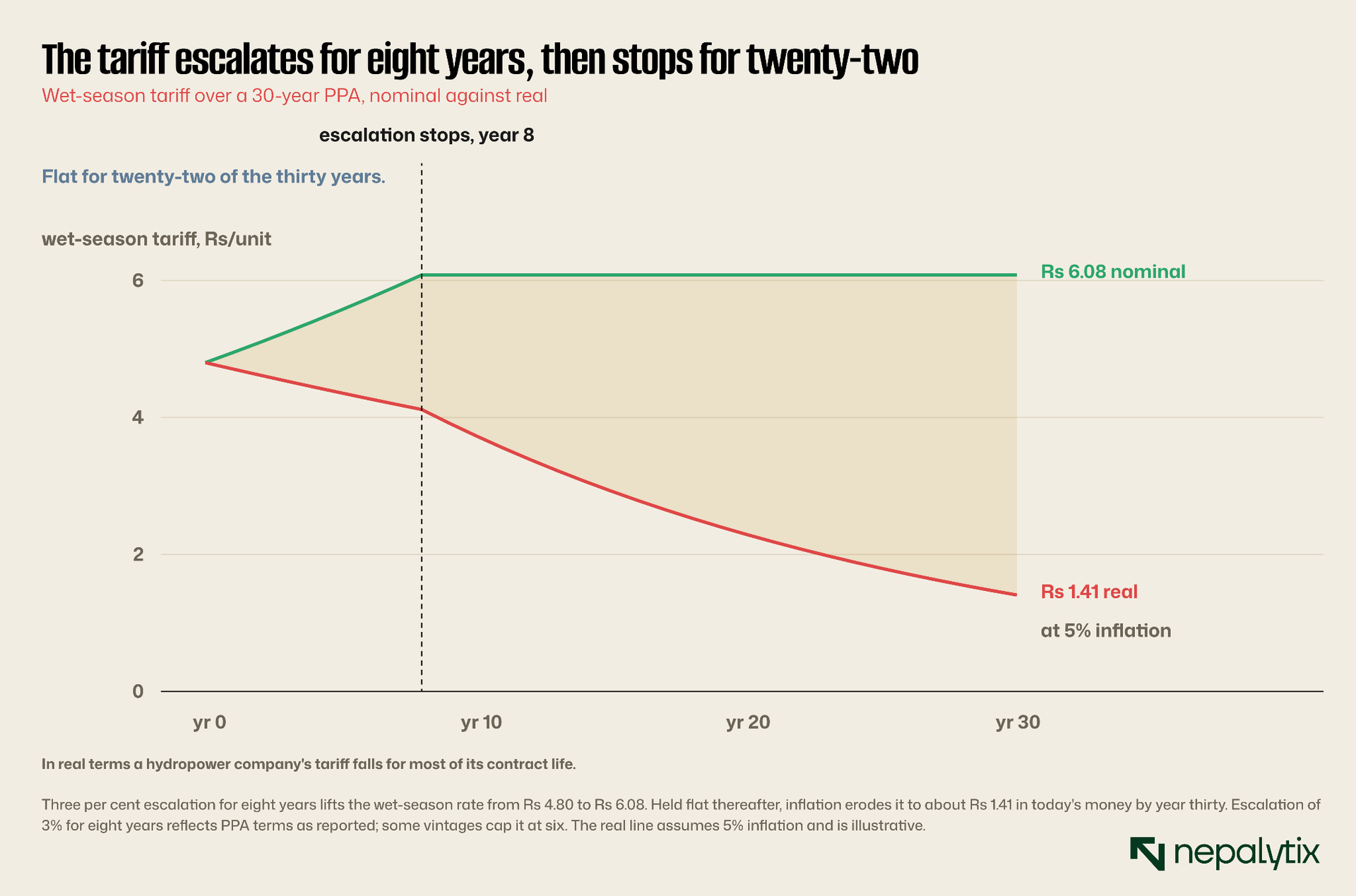
Escalation lifts the wet-season rate from Rs 4.80 to roughly Rs 6.08 over eight years. Then it stops. For the remaining twenty-two years of a thirty-year agreement, the tariff is flat in nominal terms.
Flat in nominal terms means falling in real terms, every year, for more than two decades. On a 5% inflation assumption that Rs 6.08 is worth about Rs 1.41 in today's money by year thirty.
So a hydropower PPA is not an inflation-linked annuity. It is a fixed nominal stream with a brief escalating phase at the start and its real value declines for most of its life. Any valuation that treats the revenue line as growing indefinitely is wrong on the contract's own terms.
This also explains something about the sector's behaviour. A developer's incentive is to commission as early as possible because the escalation clock starts at commercial operation and every year of construction delay costs a step of escalation permanently. A rating report on one project under construction warned precisely this: delay would mean the loss of two stages of escalation, a shorter earning period and penalties payable to NEA.
What the plant load factor actually tells you
One number does most of the work in a hydropower model and it is rarely explained: the plant load factor.
It is the ratio of what a plant actually generated to what it would have generated running at full capacity every hour of the year. A 25 MW plant running flat out for a year would produce about 219 gigawatt hours. At a 55% load factor it produces about 120.
For a run-of-river plant that number is set by the river not by management. It reflects how much water the catchment delivers and how evenly it delivers it across the year. NEA has historically signed PPAs with projects able to run at full capacity roughly 40% of the time so the design assumption is built into the contract.
When you see two hydropower companies of the same installed capacity reporting very different revenues, the load factor is usually the explanation, and it is a permanent characteristic of the site rather than something that improves with better management.
The plant load factor and why it is not what it sounds like
One term appears in every hydropower prospectus and is routinely misread: the plant load factor.
It is the ratio of what a plant actually generated to what it would have generated running flat out for the whole year. A 25 MW plant running continuously would produce about 219 GWh a year. At a 55% plant load factor it produces about 120 GWh.
A low plant load factor is not a sign of a badly run plant. For run-of-river it is a statement about the river. The turbines are sized for monsoon flow, and for much of the year the water simply is not there to fill them. A 55% figure is normal; a plant claiming 80% is either a storage project or is describing something other than annual output.
What matters is comparing the achieved factor against the one assumed in the project's own feasibility study. A plant designed around 55% that delivers 48% is generating 13% less revenue than the model that justified its debt, and the debt schedule does not adjust.
This is the single most useful number to track year on year and most companies disclose enough to compute it.
In June 2025 the risk moved
This is the section to read if you read only one.
Historically, Nepali PPAs were take-or-pay. NEA committed to pay for the contracted energy whether or not it could actually take it. If the grid could not absorb monsoon output and Nepal has surplus wet-season power, NEA still paid. The spillage risk sat with the buyer.
From June 2025, new agreements moved to take-and-pay. NEA pays only for the energy it actually takes. Projects up to 10 MW and export-oriented projects remain on the old basis.
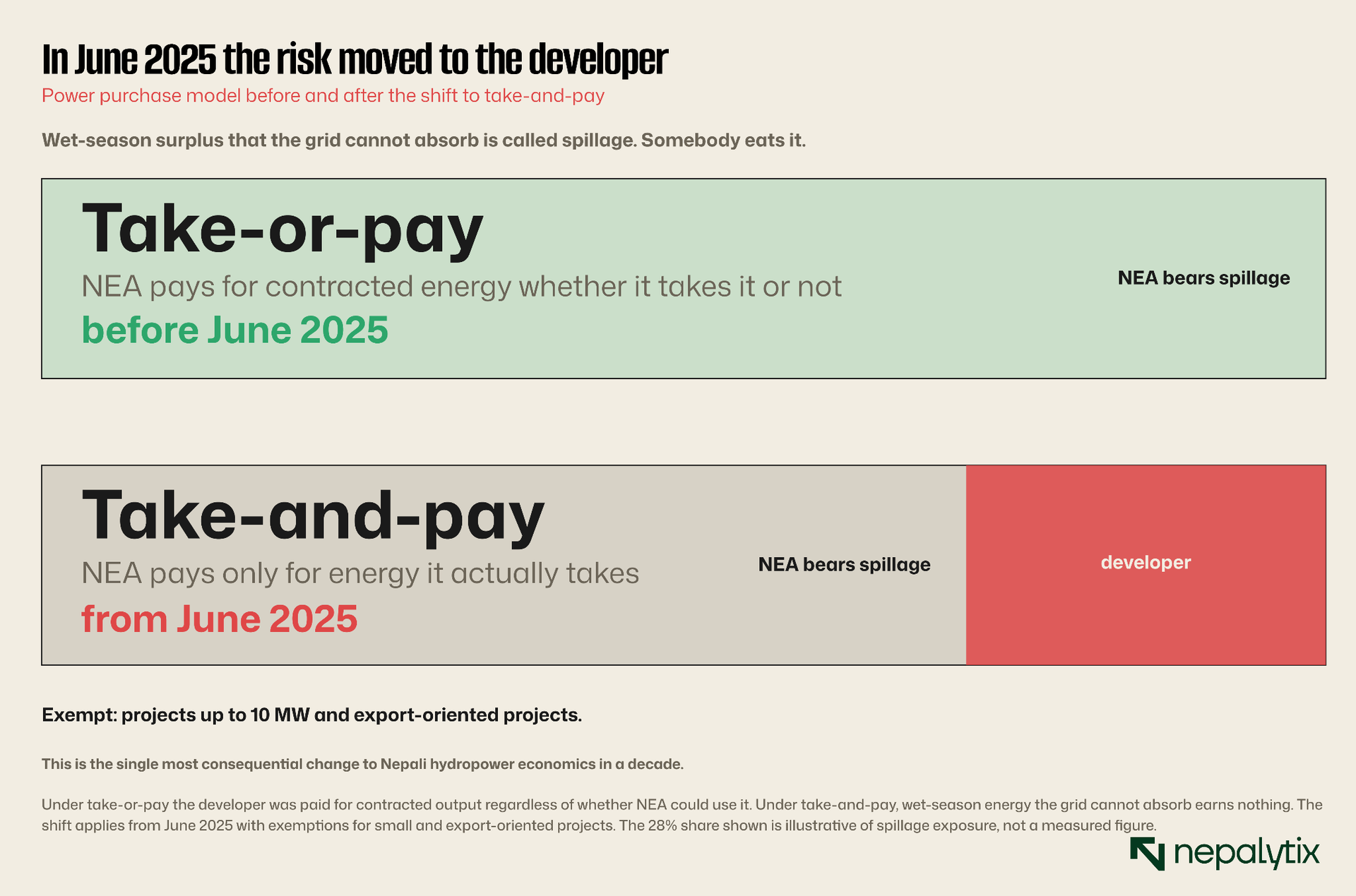
Consider what that does to the company we have been describing. It generates 70% of its output in the wet season. Nepal has surplus power in the wet season. Under take-or-pay that surplus was NEA's problem. Under take-and-pay, it is the developer's, and it is uncompensated.
The revenue line of a run-of-river project is now exposed to grid absorption in exactly the months when the grid is least able to absorb. That is a structural change to the asset class, not a detail.
What to check in any hydropower company you look at
Find out which basis its PPA is on. A project that signed before June 2025 and commissioned under take-or-pay is a materially different asset from one signing today, even at identical tariffs and identical capacity.
This is not usually stated in the quarterly report. It is in the PPA, in the prospectus for a recent IPO, and often in the credit rating report if the project has one.
The year of commissioning breaks the comparison
Now to the accounts themselves, and the item that produces the most confused commentary.
While a hydropower plant is under construction, the interest on its construction loans is not charged against profit. It is capitalised, added to the value of the asset being built. The logic is sound: the borrowing produced the asset so the cost belongs in the asset.
On the day the plant commences commercial operation, that stops. Interest starts hitting the income statement. So does depreciation because there is now an asset to depreciate.
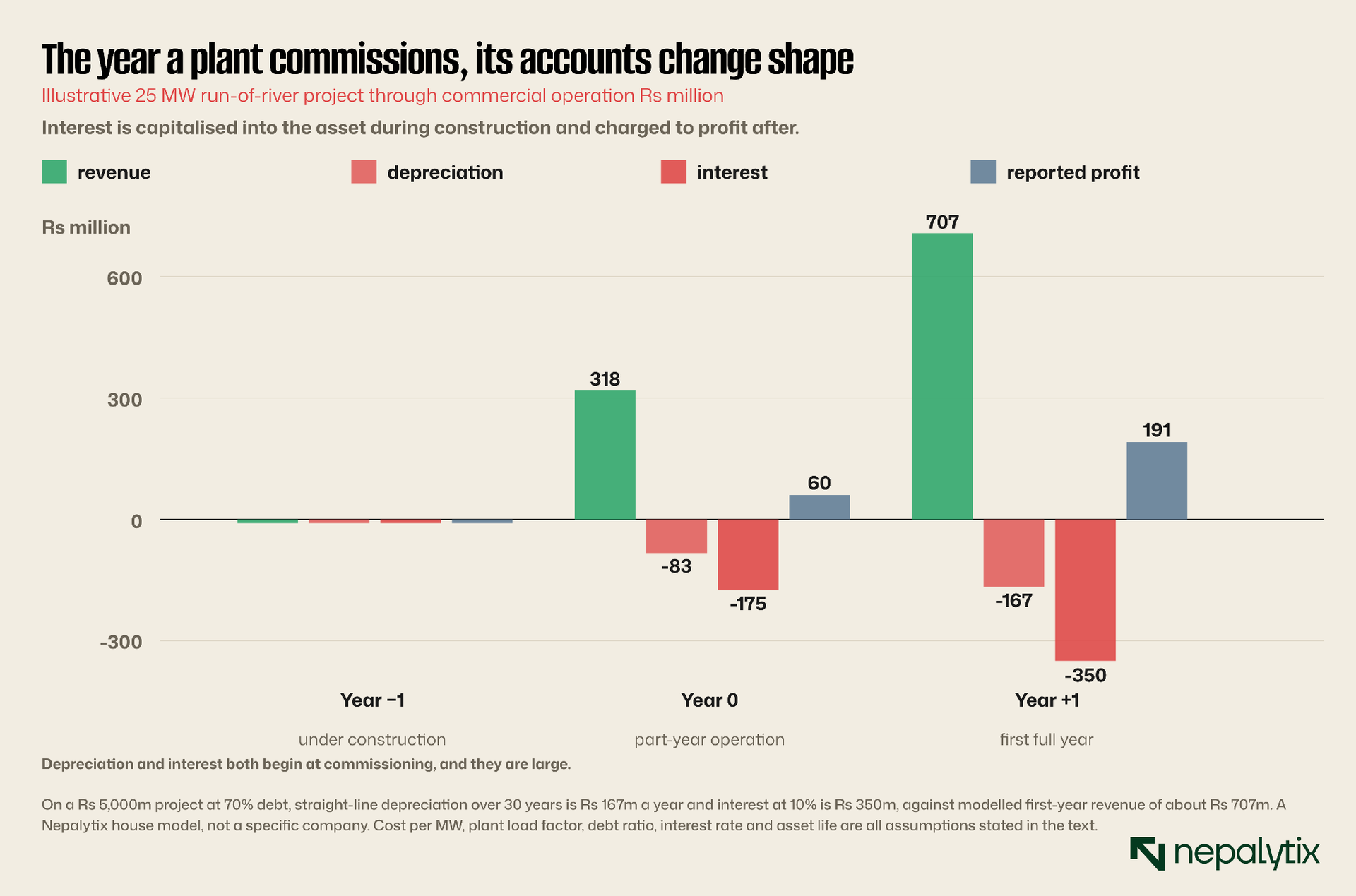
Our model assumes a 25 MW plant costing Rs 5,000 million, financed 70% by debt at 10%, with a 55% plant load factor and thirty-year straight-line depreciation. Every one of those is an assumption and none is reported by any company.
On those assumptions, first full-year revenue is about Rs 707 million. Depreciation is Rs 167 million a year and interest is Rs 350 million. Reported profit is roughly Rs 191 million.
The important observation is what happens to the year-on-year comparison. In the year before commissioning, the company had no revenue, no depreciation and no interest charge. In the first full year it has all three. Any percentage change calculated across that boundary is meaningless, and a great deal of published commentary calculates exactly that.
The other things that start at commissioning
Depreciation and interest are the two large ones but three smaller changes arrive at the same moment and each distorts a year-on-year comparison.
Royalty payments to the government begin, calculated on capacity and on energy generated and they rise after the first fifteen years of the licence.
Operations and maintenance costs appear for the first time along with the staff to perform them.
Tax treatment changes. Nepal grants income tax holidays to hydropower projects and the terms depend on when the project commissioned and under which policy. A company enjoying a full exemption reports very different net profit from an otherwise identical company whose holiday has expired and neither figure tells you anything about the underlying asset.
The practical instruction is the same as before: find out when the plant commissioned, and treat any comparison that spans that date as unusable.
What a delay actually costs
The commissioning date is a valuation input in a way that is unusual even among infrastructure assets, and it is worth working through why.
A delay does three things at once. It pushes back the start of the thirty-year PPA so the revenue stream begins later. It extends the construction period, during which interest accrues and is capitalised so the asset carries a larger cost and therefore a larger annual depreciation charge for its whole life. And where the PPA specifies a required commercial operation date, it can trigger penalties payable to NEA.
The rating report on Dudhkoshi-2 states the risk explicitly: delay in achieving the required commercial operation date would mean losing two stages of tariff escalation, a shorter energy-selling period and penalty exposure.
Losing two escalation stages is permanent. Those steps are not deferred; they are gone and the tariff is lower for the entire remaining life of the agreement.
So when a hydropower company announces a delay, the correct response is not to adjust one year's forecast. It is to recognise that the contracted revenue stream has been permanently reduced.
Why price-to-earnings tells you almost nothing here
Depreciation on a Rs 5,000 million asset is enormous, and it is not a payment. Nobody writes a cheque for it. It is an accounting recognition that the plant is one year closer to the end of its life.
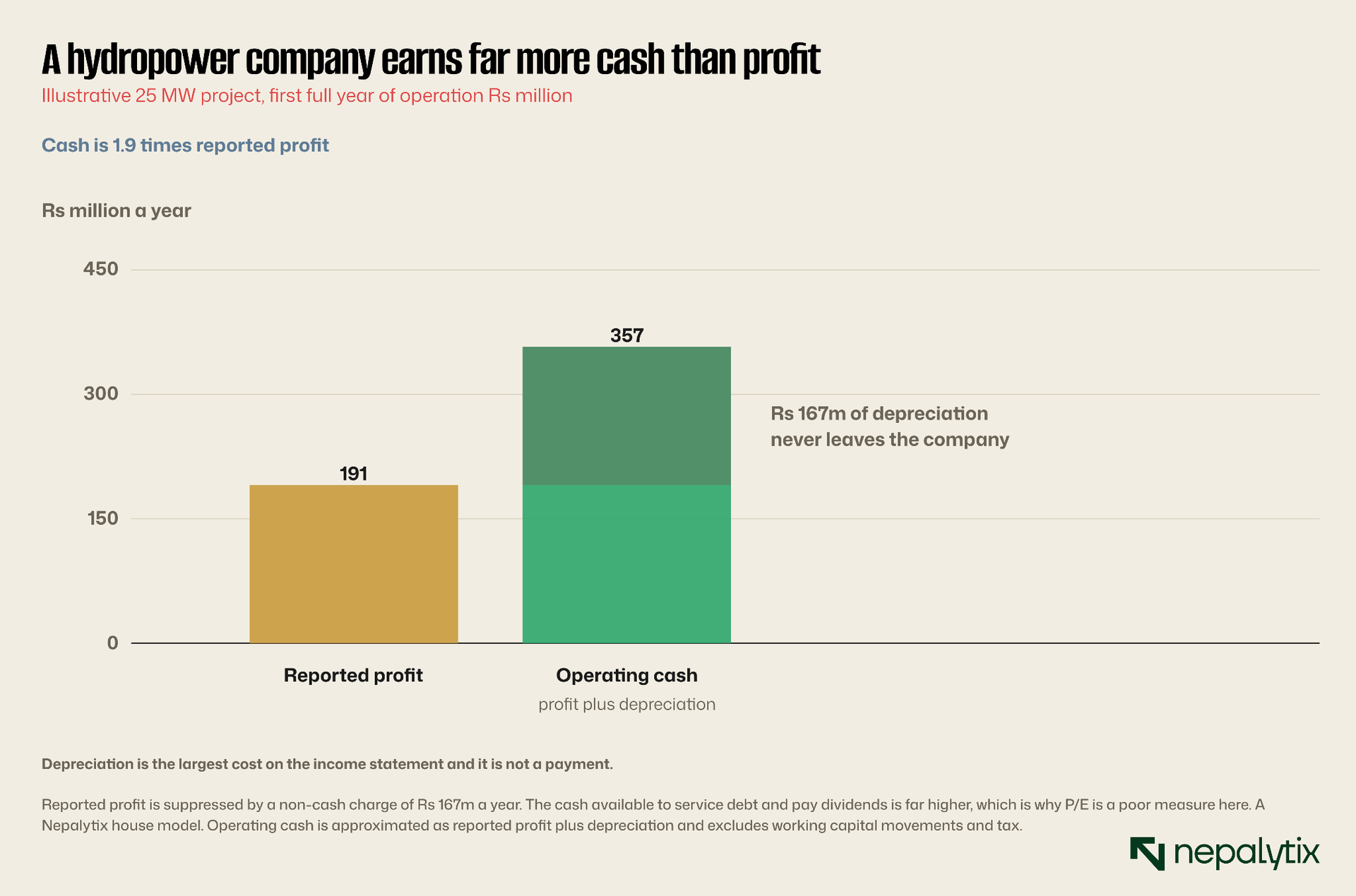
On our model, reported profit is Rs 191 million and the cash the business actually generates is around Rs 357 million roughly 1.9 times the profit figure. The difference is the depreciation that never left the company.
This is why applying a price-to-earnings multiple to a hydropower company misleads. The earnings figure is suppressed by a large non-cash charge so the multiple looks high on a business that may be generating substantial cash.
What to use instead:
Cash generation against debt service. The company has a large loan to repay from a contracted revenue stream. Whether the cash covers the principal and interest schedule is the question that determines survival.
Generation in units, year on year. Revenue is price times volume, and price is fixed by contract. So the only variable the company controls is how many units it produced and the only thing that moves that is hydrology and plant availability.
Progress through the escalation window. A plant in year two of its PPA has six more escalation steps ahead. A plant in year twelve has none. Two identical plants at identical tariffs are worth different amounts depending purely on where they sit in that window.
Where the debt actually sits
Hydropower in Nepal is built with domestic bank debt, and the sums are large relative to the companies raising them.
The Jagadulla project in Dolpa has secured over Rs 16 arba from domestic financial institutions. Dudhkoshi-2, a 70 MW project carries a bank facility rating covering roughly Rs 10.8 billion. These are typical rather than exceptional.
Two consequences follow, and both connect to material this publication has covered recently.
For the hydropower investor, leverage of this order against a contractually fixed revenue stream means the equity is a residual claim on a highly geared asset. Small variations in generation or in commissioning dates produce large swings in equity value. That is why hydropower share prices move far more than the underlying business does.
For the banking analyst, this is where a meaningful share of Nepali bank credit has gone. Transport, communication and utilities was one of the faster-growing credit categories to mid-April 2026 at 10.1%, and electricity has been among the better-performing sectors on asset quality. Bank exposure to hydropower is exposure to hydrology and to NEA's ability to pay.
A note on the sector's valuations
Hydropower is among the most retail-held sectors on NEPSE and among the most consistently described as expensive. Both things can be true at once and the reason connects to everything above.
If a market values these companies on price-to-earnings, it is applying a multiple to a figure suppressed by depreciation. That produces optically high ratios on companies generating real cash, and it produces equally misleading comparisons between a plant in year two of its escalation window and one in year twenty.
None of which means the sector is cheap. It means the ratio most commonly quoted is not measuring what people think it measures, and that a company-by-company reading of generation, escalation position, gearing and PPA basis will separate these assets far better than any sector-level multiple.
Reading the balance sheet
Two balance sheet items on a hydropower company behave differently from anything in a bank's accounts.
Capital work in progress. For a company still building, this is essentially the whole business. It accumulates construction spending plus capitalised interest and on the day of commissioning it transfers to property, plant and equipment. A large and growing figure here means the company is spending; a stalled figure means construction has slowed which is worth asking about.
Deferred tax. Nepali hydropower projects receive income tax exemptions for a defined period after commissioning. During the holiday, reported tax is minimal and profit looks better than it will later. When the exemption ends, the tax line appears and profit falls for reasons unrelated to operations.
Both are visible in the accounts and both are routinely ignored in commentary that compares one year's profit to the next as though the tax basis were constant.
The order to read it in
Q4 filings are arriving now. Swet-Ganga Hydropower reported net profit of Rs 177.34 million and Mathillo Mailun Khola Rs 111.28 million, both on 7 August. More land daily.
Here is the sequence that will get you further than most published analysis, in about twenty minutes per company.
Reading a hydropower company
Find the PPA terms before opening the accounts.Tariff, escalation rate, escalation duration, PPA length, and whether it is take-or-pay or take-and-pay. Prospectus, rating report, or company disclosures. This is the revenue line.
Establish where the plant is in its escalation window.Years since commercial operation against the six-to-eight-year escalation cap. This determines whether revenue can still grow.
Read generation in units, not revenue in rupees.Price is fixed. Units are the only thing management influences, and hydrology is the only thing that moves them much.
Compare same quarter year on year, never sequentially.A monsoon quarter against a winter quarter compares two different businesses.
Check whether the plant commissioned during the comparison period.Capitalised interest stops and depreciation starts. Any growth rate spanning that boundary is meaningless.
Add depreciation back to profit.That is roughly the cash. Then measure it against the debt service schedule, which is the number that determines whether the equity survives.
Find the debt and its cost.These are highly geared assets funded by domestic banks. Leverage against a fixed revenue stream is the whole risk.
Ignore the price-to-earnings ratio.It is depressed by a large non-cash charge and it will mislead you in both directions.
A hydropower company is one of the simplest businesses on NEPSE once you accept what it is: a fixed-price contract, a river and a large loan. The accounts are only confusing because they are being read with instincts developed for businesses that set their own prices.
None of them do.
One closing note on where this sits in the market. Seventy-five companies are waiting in Nepal's IPO pipeline, and hydropower is the largest single sector in it at roughly Rs 16.26 billion of the Rs 52.15 billion total. Most of those prospectuses will contain a PPA, an escalation clause, a load factor and a debt schedule. Everything in this piece applies to reading them, and the prospectus is where those terms are stated most plainly usually more plainly than in any annual report the company will publish afterwards.
Disclaimer
This report has been prepared by Nepalytix for informational and educational purposes only and does not constitute investment advice, an offer, or a solicitation to buy or sell any securities.
The information contained in this report is based on sources believed to be reliable; however, Nepalytix does not guarantee its accuracy, completeness, or timeliness. Opinions, estimates, and projections expressed herein are those of the authors as of the date of publication and are subject to change without notice.
Investing in securities involves risks, including the possible loss of principal. Past performance is not indicative of future results. Readers are advised to conduct their own independent research and consult with a qualified financial advisor before making any investment decisions.
Nepalytix and its contributors may hold positions in the securities discussed in this report at the time of publication or thereafter.
Neither Nepalytix nor any of its affiliates accept any liability for any loss arising from the use of this report or its contents.