How to Read a Lock-in Expiry
A lock-in expiry does not mean shares are entering the market. Here’s how to identify what is actually unlocking which clock applies, and whether the float will really change.

Twenty million Hathway Investment shares leave lock-in after Ashoj 2. Every portal has run the number and asked which shares can now be traded. The answer is almost none of them and the reason is a distinction that Nepali market coverage collapses almost every time.
Two things that are not the same
A lock-in expiry and a share becoming tradeable are different events. They can be years apart. Coverage of Nepali unlocks treats them as one thing which is why an expiry notice reliably produces a headline about supply hitting the market and reliably fails to produce the supply.
The distinction is simple once stated.
Lock-in expiry means CDS and Clearing Limited lifts a restriction code on the shares. Before expiry, the depository blocks any transfer, sale, gift, pledge, anything. After expiry, it does not.
Conversion to ordinary means the share changes class from promoter stock to public stock, and becomes tradeable in the ordinary market at the ordinary price. That requires an AGM resolution, SEBON approval, NEPSE approval and an application to CDSC.
The first is automatic and happens on a date. The second is a process with four consents and no deadline. A company can sit at step one indefinitely, and many do, the promoter block stays unlocked, unsold and unconverted because no shareholder has a reason to force the question.
So when 20,533,500 Hathway shares leave lock-in, what changes is that their holders may now sell them to other promoters, in the promoter market, at the promoter price. What does not change is the ordinary float.
The rest of this piece is about how to work out which of those two things a given notice is announcing and what it does to a company you own.
Seven regimes, three clocks
There is no single lock-in period in Nepal. There are seven and they run from three different starting points.
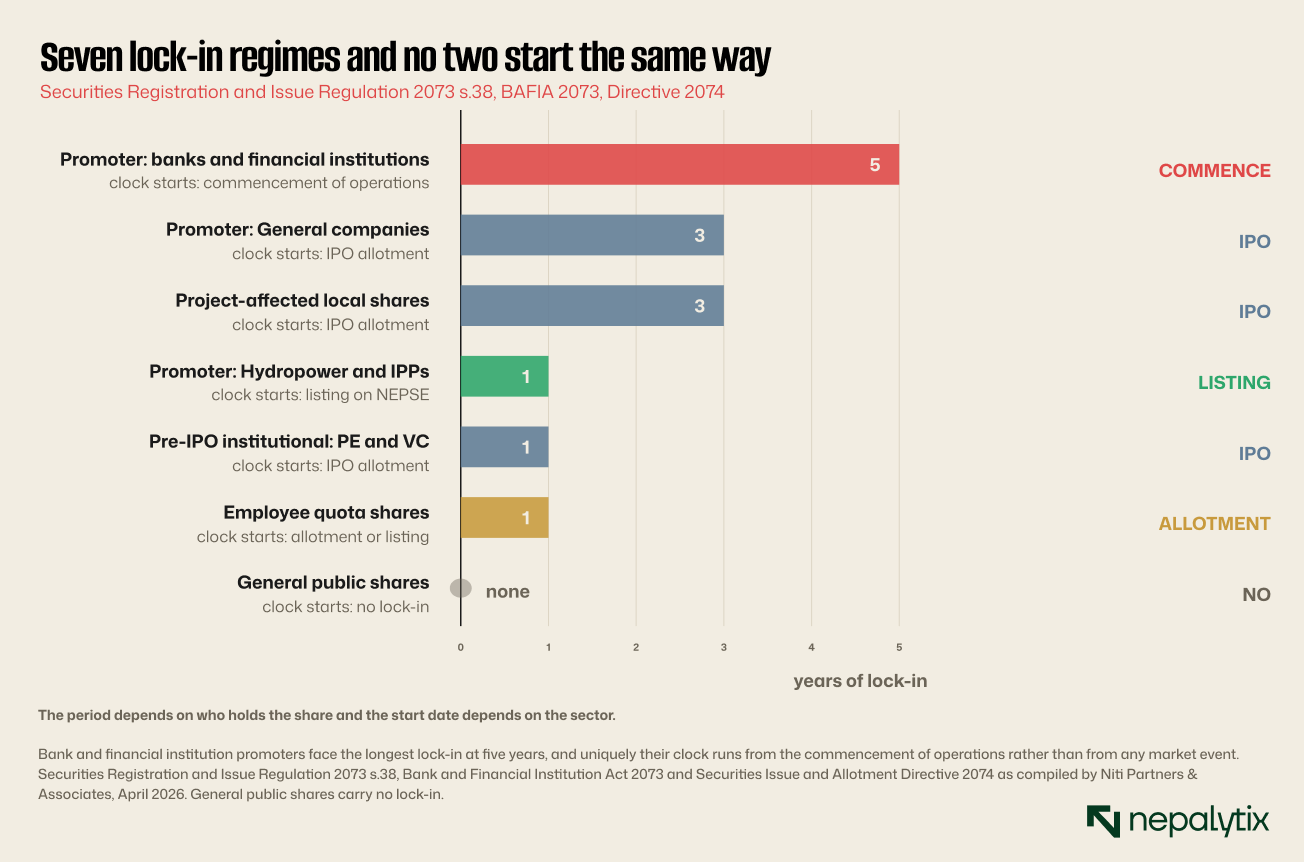
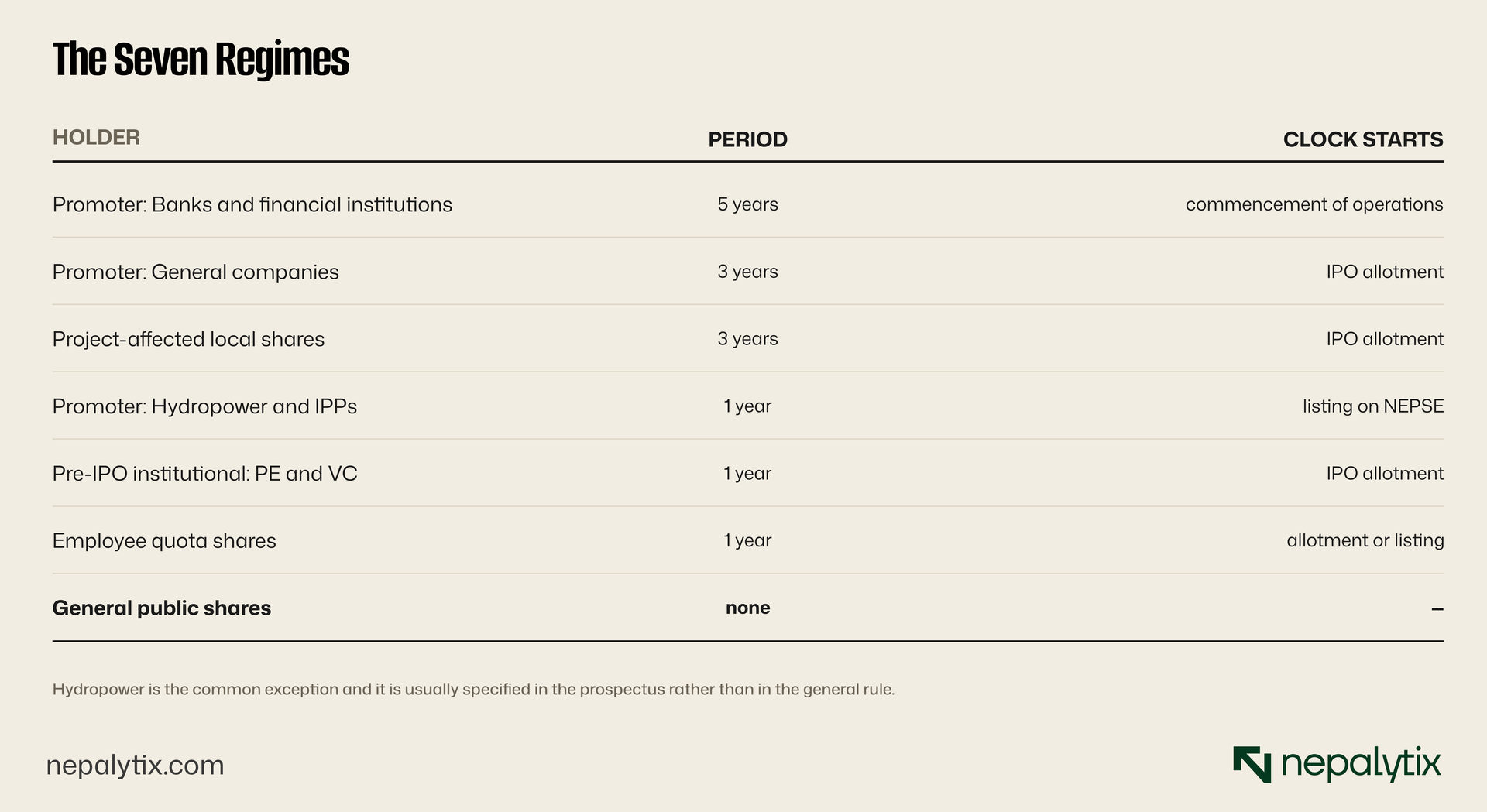
Two things follow from that table and both matter in practice.
First, the prospectus overrides the general rule. Where a company's SEBON-approved offer document specifies a start point, that governs. Hydropower issues routinely run their clock from listing, which is why the general three-year rule does not describe them.
Second, a company can have several tranches unlocking on different dates. Promoter shares, employee quota shares and project-affected local shares are three separate categories with three separate clocks, and a company that issued all three has three expiries to track.
The restriction most people miss
Directors, chief executives, auditors and company secretaries are prohibited from trading their company's shares throughout their tenure and for one year after leaving office.
That is a separate restriction from the general lock-in, it survives the lock-in expiry, and it applies regardless of how long the person has held the shares. A promoter who is also a director does not become free to sell when the promoter lock-in lapses.
Why the periods differ
The variation is not arbitrary. Each period is calibrated to a different risk.
Banks get five years because they hold public deposits. The regulator's concern is not the share price but the institution: a promoter who can exit at year two has limited incentive to build a bank that survives to year ten. The clock runs from commencement of operations for the same reason, the relevant milestone is when the institution started taking deposits, not when its shares happened to list.
Hydropower gets one year because the risk it addresses is different. A hydropower promoter's commitment is demonstrated by having built a plant. By listing, the capital expenditure is sunk and the asset exists. A long lock-in adds little and hydropower needs equity capital badly enough that the regulator has chosen liquidity over restraint.
Project-affected locals get three years for a reason that has nothing to do with the promoter. Those shares are allocated at par to communities near a project as compensation and participation. The lock-in protects the recipients from selling immediately at a discount to buyers who understand the value better than they do.
Pre-IPO institutional investors get one year because they are professionals. A private equity fund that invested before listing knows what it holds, and the regulator's interest is in ensuring it does not dump into the IPO's aftermath rather than in keeping it invested for years.
Reading the period tells you what the regulator was worried about, which is often more informative than the period itself.
Finding the right start date
The most common error in reading an expiry is using the listing date. It is the date everyone knows, it is published and for most companies it is wrong.
Hathway makes the point precisely because the two dates are three weeks apart and only one of them governed.
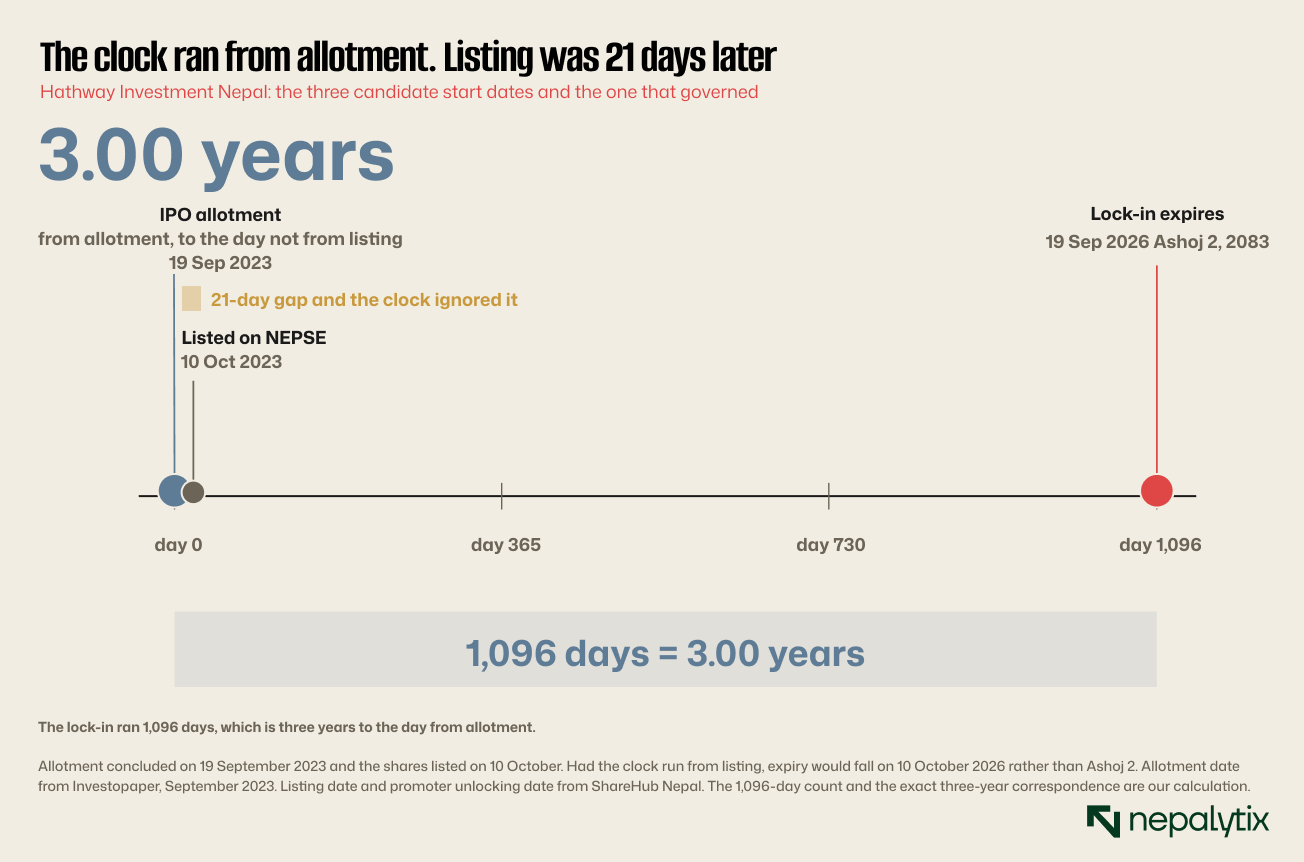
Twenty-one days separate the two candidate dates. That is a small gap and it is enough to get the answer wrong.
Three years from 19 September 2023 is 19 September 2026. The published unlocking date is 19 September 2026. The correspondence is exact which tells you two things without needing to read the prospectus: this is a general-company promoter lock-in under Regulation 38, and the clock ran from allotment.
That is the check to run on any expiry notice. Take the stated unlock date, subtract the period you think applies, and see which candidate start date it lands on. If it lands on allotment, Regulation 38 governs. If it lands on listing, the prospectus specified something else. If it lands on neither, you have the wrong period.
Working out what is actually unlocking
An expiry notice gives you one number. To make it mean anything you need three more: total listed shares, the current public float, and the promoter holding.
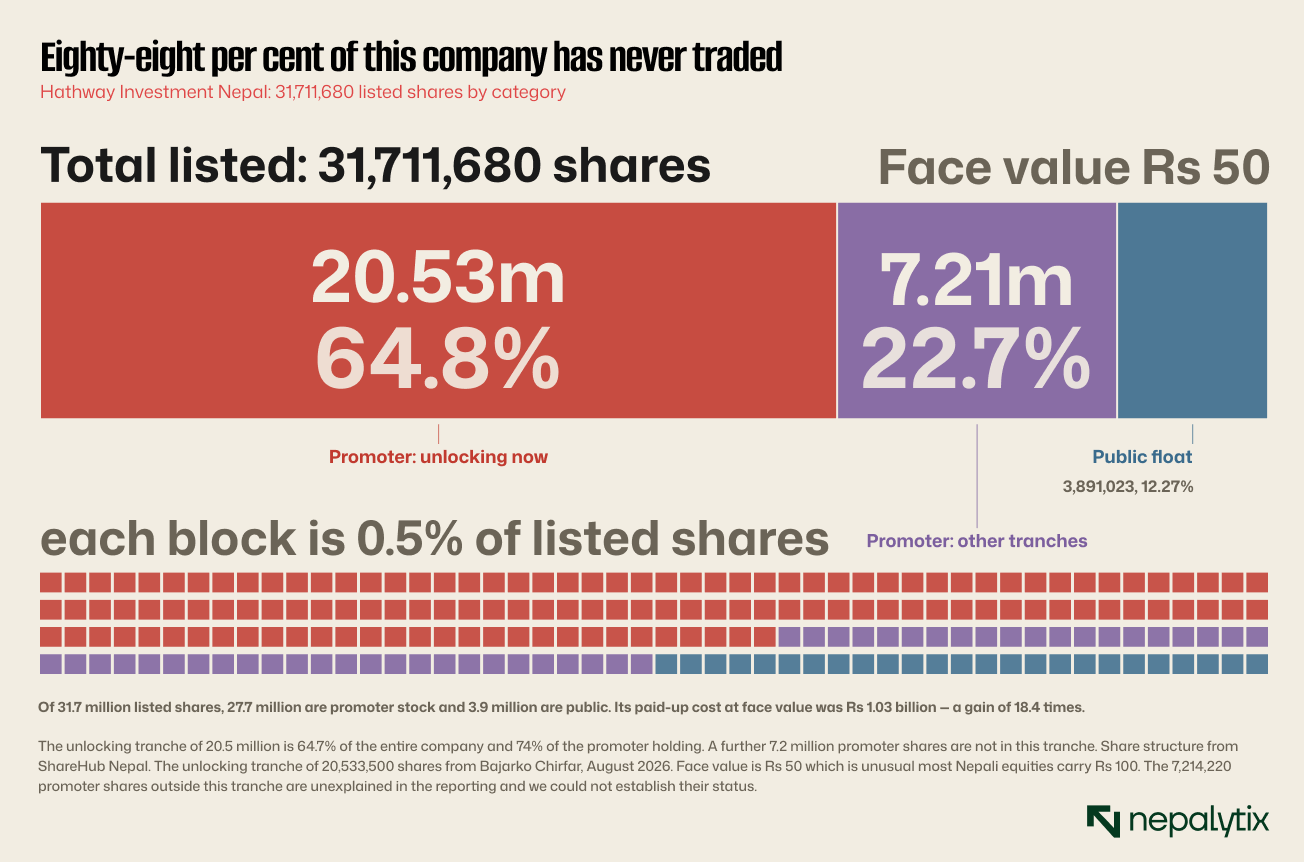
Note also the face value: Rs 50, where almost every Nepali equity carries Rs 100. That matters when you compute anything per share against par, and it is easy to miss because the convention is so nearly universal.
Hathway's public float is 12.27% of the company. That is close to the statutory minimum, and it is the number that makes the unlock look alarming: the tranche leaving lock-in is more than five times the entire tradeable float.
Which brings us to the arithmetic everyone does, and the correction almost nobody makes.
Where to find the numbers
Three of the four figures you need are published and one is not always.
Total listed shares and the promoter split appear on any of the major portals and on NEPSE's own company page. They are also in the company's quarterly filing under share capital.
The public float is usually stated as a percentage and sometimes as a count. Where only the percentage is given, multiply. Watch for the case where promoter plus public does not reach 100%, the remainder is typically employee or locally allocated stock with its own lock-in.
The tranche size comes from the company's own notice which is what the portals are reporting when they run an expiry story.
The tranche's composition is the one that is frequently missing. A notice saying twenty million shares are unlocking does not always say whether they are promoter, employee, or local stock, and that determines where they go. Where the notice does not specify, the promoter percentage is the best guide: if the tranche is smaller than the promoter holding and the company is past its promoter expiry date, it is almost certainly promoter stock.
The five-times number and why it is wrong
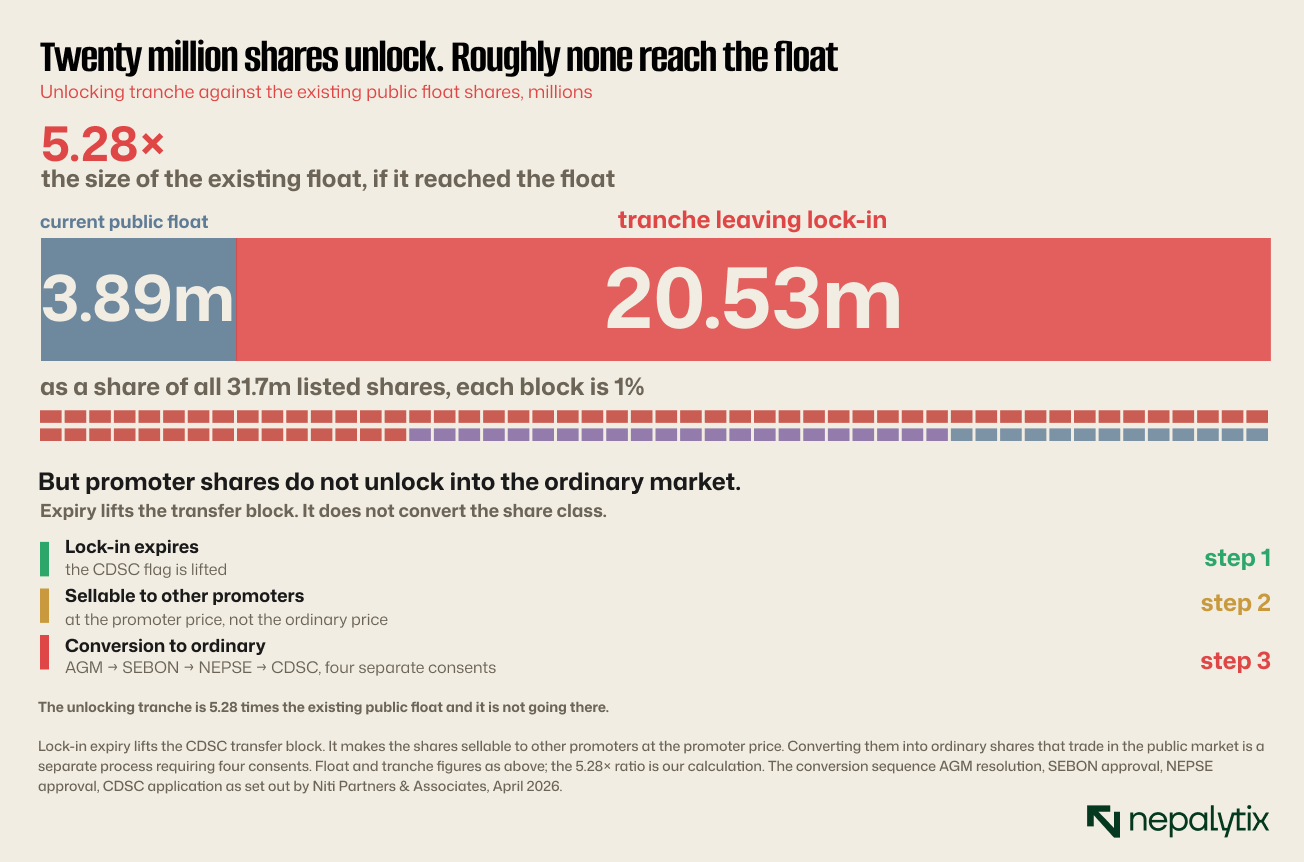
If those 20.5 million shares entered the ordinary market, the float would go from 3.9 million to 24.4 million and the price would have to absorb a sixfold increase in supply. That is the story implied by the coverage.
It is not what happens. After expiry the shares remain promoter shares. They can be transferred to other promoters. They trade where they trade at all, in the promoter market, which in Nepal prices at a persistent discount to the ordinary market for reasons of liquidity and eligible buyers rather than of value.
For those shares to reach the public float, the company must take a resolution to its AGM, obtain SEBON's approval, obtain NEPSE's approval and apply to CDSC. Each is a separate consent. None has a statutory deadline.
What the expiry does change
It is not nothing. Three things become possible on expiry that were impossible before.
Promoters can exit to other promoters. A founder who wants out can now sell to an incoming promoter. Ownership can change even though the float does not.
Shares can be pledged. Locked shares cannot be used as collateral. Unlocked promoter stock can, which matters for margin lending and for promoters who want liquidity without selling.
The conversion clock can start. Expiry is the precondition. A company that wants to widen its float cannot begin the process before it.
Why the holders care so much
To understand why an expiry is a significant corporate event even when no shares reach the market, look at what the locked shareholders are holding.
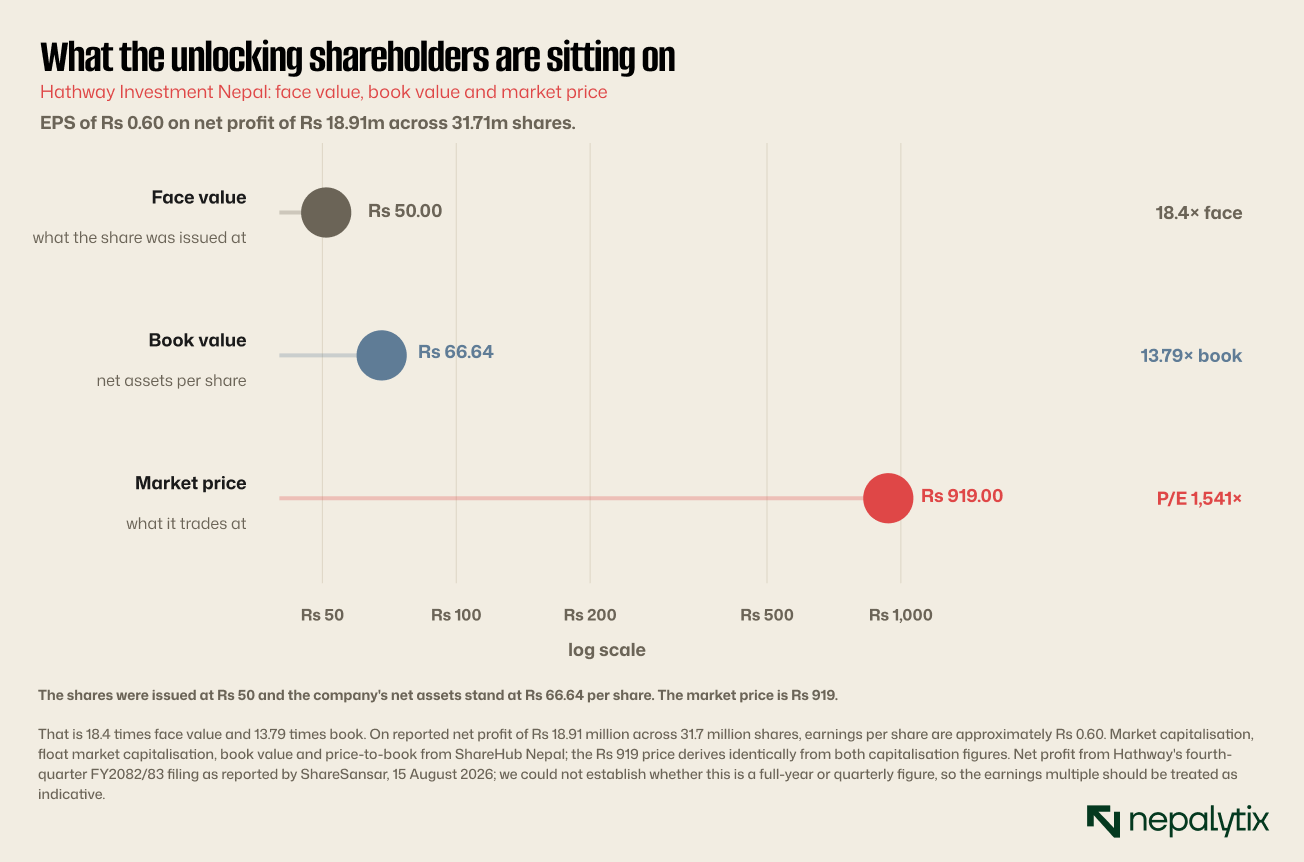
A promoter holding 20.5 million shares acquired at Rs 50 is sitting on stock the market values at Rs 919. The tranche is worth roughly Rs 18.87 billion against a paid-up cost of about Rs 1.03 billion.
That gap is why expiry matters. It is not that supply arrives. It is that a very large unrealised gain becomes, for the first time, capable of being realised by sale to another promoter or by pledge or eventually by conversion.
It is also why the market reacts to expiry notices even when the mechanics say it should not. The reaction is not irrational so much as imprecise: it is pricing the possibility of eventual conversion, at an unknown date, discounted by an unknown probability. Nobody can compute that, so the market substitutes the tranche size which is the one number the notice actually supplies.
What actually moves a float
If lock-in expiry is not the event that increases tradeable supply, what is?
A promoter-to-ordinary conversion resolution. This is the real one. When a company puts conversion on its AGM agenda, the float is genuinely about to change, and the resolution will state how many shares. Note that NRB caps any single conversion at a tenth of founder holdings for banks and financial institutions, so even an approved conversion arrives in instalments.
A rights issue or FPO. New shares issued to the public go straight into the float with no lock-in. This is the most direct route and the one most likely to move a price.
Bonus shares. Issued pro rata, so they enlarge the float and the promoter holding in the same proportion. The float percentage does not change but the absolute number of tradeable shares does.
Employee and local tranches expiring. Unlike promoter shares, these are ordinary shares that were flagged. When their lock-in lapses they are tradeable immediately, with no conversion process. A twenty-million-share employee tranche would be real supply in a way that a twenty-million-share promoter tranche is not.
That last distinction is the single most useful thing in this piece. Same notice, same number, entirely different consequence and the difference is one word in the announcement.
The distribution that created the situation
One more number because it explains why Nepali floats are so thin in the first place.
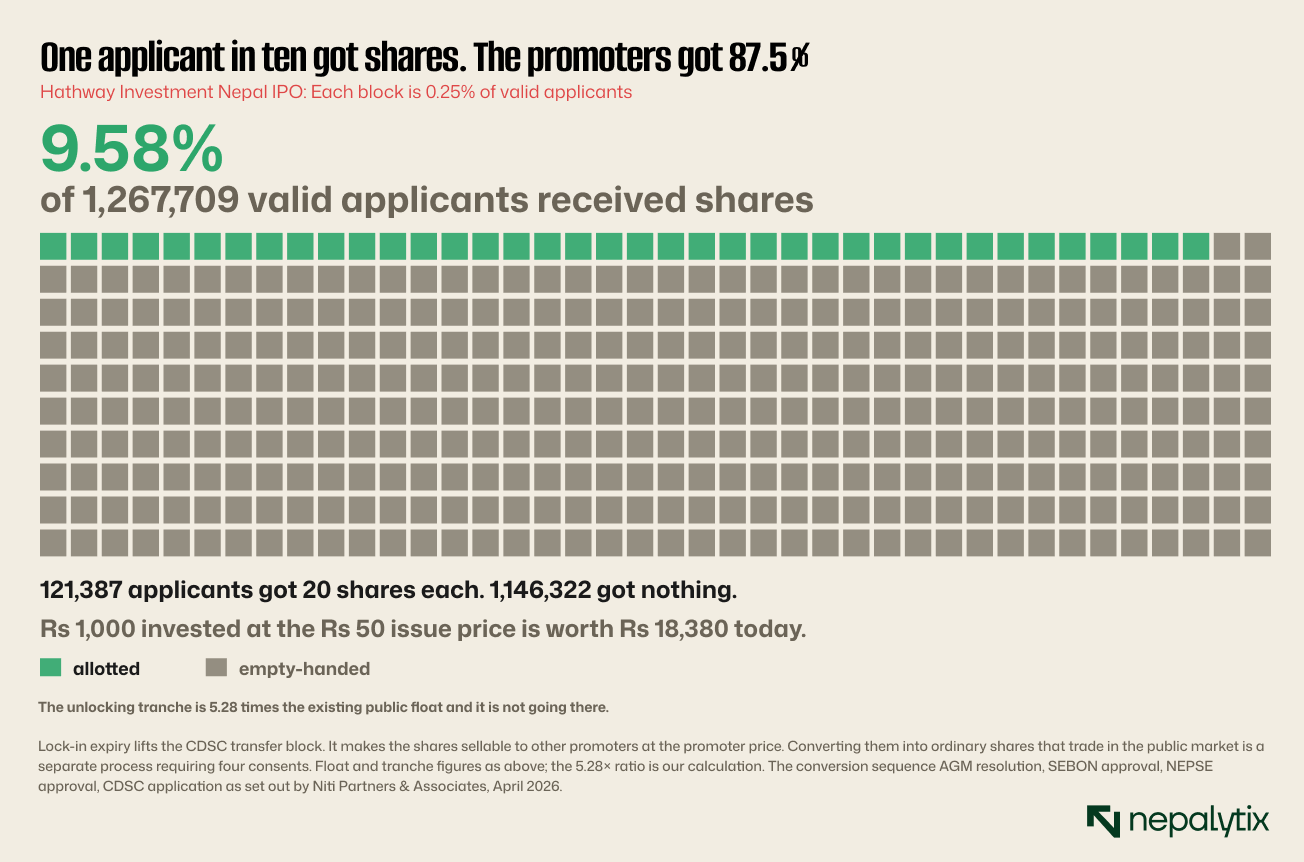
Someone who received the minimum allotment paid Rs 1,000. Those 20 shares are worth about Rs 18,380 today.
But note the structure this produces. The public got 12.5% of the company, distributed in twenty-share lots across 121,387 holders. The promoters got 87.5% in concentrated blocks. The float is thin because it was designed to be thin and the lock-in regime then removed the larger block from circulation for three years.
An expiry does not undo that. It removes one constraint from a structure that has several, a 12.27% float, a 87.5% promoter block and a conversion process that has not begun.
The reform that would change all of this
One development worth tracking, because it would make most of this piece unnecessary.
Nepal currently runs a single ISIN for most companies, promoter and public shares share one identifier, and locked stock is distinguished only by a flag in CDSC's records that investors cannot see. The draft Securities Dematerialisation Operating Guidelines 2025 propose separating them into two ISINs.
Under a dual-ISIN system, promoter and public shares would be structurally distinct rather than distinguished by an invisible database field. Locked stock could not be blended with public stock, enforcement would be mechanical rather than dependent on a flag being set correctly, and conversion would require an explicit act rather than happening by reclassification.
The guidelines are awaiting SEBON approval. Until they arrive, the flag is the only thing separating a locked promoter share from a tradeable public one and the flag is not visible to anyone outside the depository.
That invisibility is why expiry notices carry more weight than they should. In a market where you cannot see which shares are restricted, an announcement that some are becoming unrestricted feels like news even when the mechanics say little has changed.
Reading the next one
Expiry notices arrive constantly. Here is the sequence that will get you a real answer in about ten minutes.
Reading a lock-in expiry
Identify the category first.Promoter, employee quota, project-affected local, or pre-IPO institutional. The period and the clock both depend on it, and a company can have several running at once.
Check the sector.Banks and financial institutions run five years from commencement of operations. Hydropower usually runs one year from listing. Everything else is three years from allotment.
Verify the start date by subtraction.Take the stated expiry, subtract the period, and see which candidate date it lands on. If it lands on neither allotment nor listing, you have the wrong period.
Read the prospectus where it matters.The offer document overrides the general rule. For any company where the subtraction does not resolve cleanly, the prospectus is the only authority.
Get the three context number.Total listed shares, current public float, promoter percentage. The tranche size means nothing without them.
Ask where the shares go, not just that they unlock.Promoter stock unlocks into the promoter market. Employee and public tranches unlock into the ordinary float. Only the second is supply.
Check for the officer restriction.Directors, CEOs, auditors and company secretaries cannot trade during tenure or for a year afterwards, whatever the lock-in says.
Look for a conversion resolution, not an expiry date.If the company has put promoter conversion on an AGM agenda, that is the event that changes the float. The expiry is only the precondition.
The general rule holds across almost every Nepali expiry you will read about: the notice describes a restriction being lifted not shares arriving. The two get conflated because the numbers are large and the mechanism is dull.
The mechanism is where the answer is. A twenty-million-share promoter tranche and a twenty-million-share employee tranche produce identical headlines and opposite outcomes and nothing in the headline tells you which one you are reading. Only the category does.
Disclaimer
This report has been prepared by Nepalytix for informational and educational purposes only and does not constitute investment advice, an offer, or a solicitation to buy or sell any securities.
The information contained in this report is based on sources believed to be reliable; however, Nepalytix does not guarantee its accuracy, completeness, or timeliness. Opinions, estimates, and projections expressed herein are those of the authors as of the date of publication and are subject to change without notice.
Investing in securities involves risks, including the possible loss of principal. Past performance is not indicative of future results. Readers are advised to conduct their own independent research and consult with a qualified financial advisor before making any investment decisions.
Nepalytix and its contributors may hold positions in the securities discussed in this report at the time of publication or thereafter.
Neither Nepalytix nor any of its affiliates accept any liability for any loss arising from the use of this report or its contents.