How to read Nepal's monetary policy
Nepal's monetary policy is one of the country's most important financial documents, yet most readers focus on the wrong sections. Here's a practical guide to understanding what actually matters, from the currency peg and liquidity corridor to sector-specific provisions that can move bank earnings and stock prices.
Nepal Rastra Bank published its twenty-fifth monetary policy on 8 July. It is four pages long, its headline rate is not the rate anything actually costs, and the two provisions that will move share prices are in the second half where most readers stop.
Start with the thing that makes Nepal different, because almost every explanation of monetary policy you will read was written about a country that does not work like this one.
In most economies the central bank sets an interest rate, that rate moves the cost of money, and the cost of money moves the economy. The policy rate is the lever. Read the policy rate, and you have read the policy.
Nepal does not have that lever, and it gave it up on purpose. The Nepali rupee is pegged to the Indian rupee at a fixed rate, and that peg is not one policy among many, it is the anchor of the entire system. NRB's own framework names the fixed exchange rate as the intermediate target of monetary policy.
Once a country pegs its currency, its interest rates cannot drift far from those of the country it is pegged to without capital moving to exploit the gap. The peg does the work that a policy rate does elsewhere. That is not a criticism, a small, import-dependent, remittance-funded economy with a much larger neighbour has good reasons to buy stability this way. But it means the first question you should ask of a Nepali monetary policy is not "what did they do with rates?" It is "what did they do inside the space the peg leaves them?"
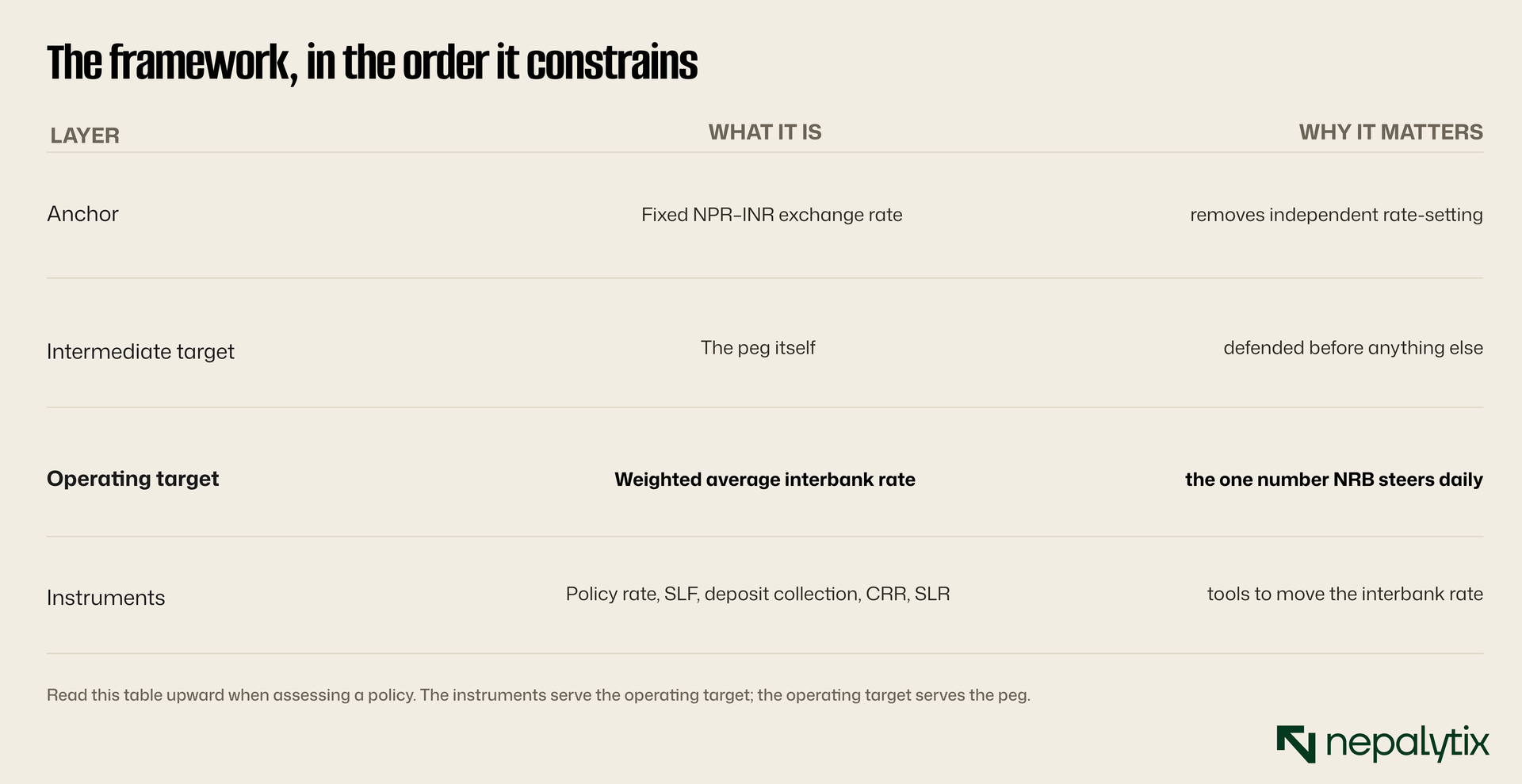
The row that matters is the third. The weighted average interbank rate is the operating target — the number NRB is actually trying to steer, week to week. Everything in the instrument row exists to push that number around. If you want to know whether a Nepali monetary policy is working, watch the interbank rate, not the policy rate.
One consequence worth naming before moving on. Because the peg is the anchor, Nepal effectively imports a large part of its monetary conditions from India. When the Reserve Bank of India tightens, capital in Nepal faces a wider differential and NRB's room narrows. When India loosens, NRB gains space it did not create. This is why NRB's own inflation projections cite Indian inflation as an upside risk: prices in Nepal are substantially a function of prices across an open border with a fixed exchange rate.
It also explains something readers often find puzzling — why NRB rarely makes dramatic moves. A central bank whose primary obligation is defending a peg has a strong institutional preference for continuity. The phrase used in the FY2083/84 document is "cautiously accommodative," and it is the same stance as the year before. Continuity is not indecision here. It is the job.
Read the floor, not the headline
Nepal operates an interest rate corridor: a ceiling, a middle, and a floor. The names are unhelpfully technical so here is what each one does.
The standing liquidity facility at 5.75% is the ceiling. A bank short of cash can always borrow from NRB at this rate, so no bank will ever pay more than 5.75% to borrow overnight from another bank.
The deposit collection rate at 2.75% is the floor. A bank with surplus cash can always park it at NRB and earn this, so no bank will ever lend to another bank for less.
The policy rate at 4.25% sits in the middle and is the number that appears in every headline.
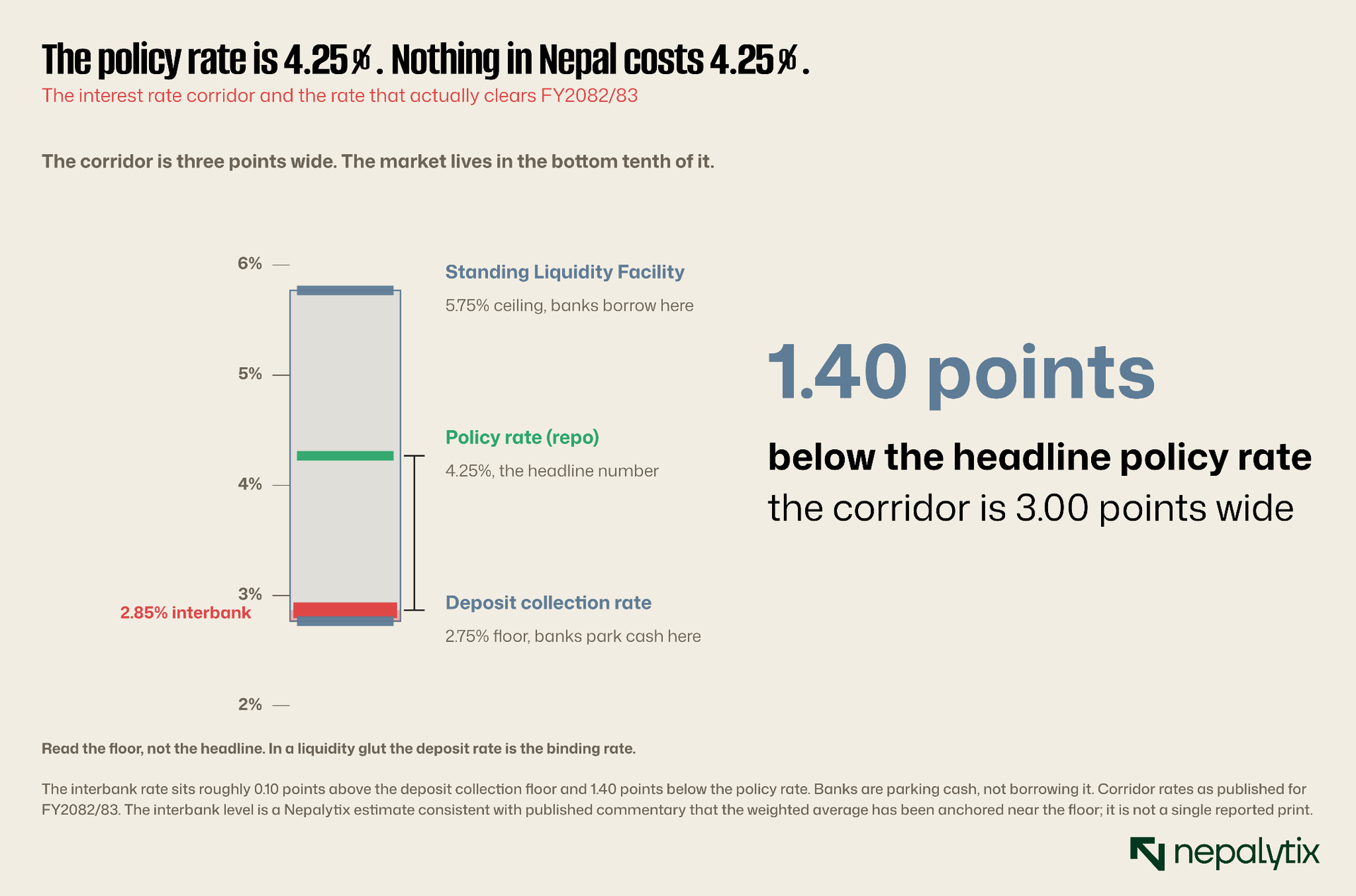
Now look at where the interbank rate sits. Not at 4.25%. It sits near the bottom of the tube, roughly a tenth of a point above the floor and about 1.40 points below the headline policy rate.
This is the single most useful thing to understand about reading Nepali monetary policy, so it is worth stating plainly. When banks have more cash than they can lend, they do not need to borrow from each other. The interbank market goes quiet, and the rate falls to the floor because the only alternative use for surplus cash is parking it at NRB. In that state the deposit collection rate becomes the binding rate, and the policy rate is decorative.
In a liquidity glut, the floor is the policy rate. The number in the middle is a press release.
Nepal has been in that state for a sustained period. The credit-to-deposit ratio sits at 74.32% against a 90% ceiling, which is another way of saying banks have roughly sixteen points of lending capacity they are not using. The 91-day treasury bill yields 2.25%, below the floor, which tells you the government can borrow more cheaply than banks can park.
What to do with this
When a monetary policy announces a cut to the policy rate, ask first where the interbank rate is sitting. If it is pinned near the floor, a cut to the middle of the corridor changes nothing at all, because nothing was priced off the middle.
The measure that would actually bite in a glut is a cut to the floor, the deposit collection rate because that is what makes parking cash less attractive than lending it. Watch that line.
What the CRR and SLR actually do
Two instruments appear in every policy and are almost never explained. The cash reserve ratio is the proportion of deposits a bank must hold as cash with NRB. The statutory liquidity ratio is the proportion it must hold in specified liquid assets, mostly government securities. Neither earns the bank much.
Raising either withdraws lending capacity from the system; lowering either releases it. They are blunt and immediate, which makes them useful when the problem is quantity rather than price. In a year when banks already hold more capacity than they are using, a change to CRR or SLR would do very little you cannot release capacity into a system that is not using the capacity it has. That is worth remembering when a policy leaves both unchanged: it may be inaction or it may be a recognition that the instrument does not fit the problem.
The rate you read is not the rate you pay
Suppose the policy rate did bite. It still would not reach a borrower directly. It reaches a chain, and every link in that chain adds a spread and a delay.
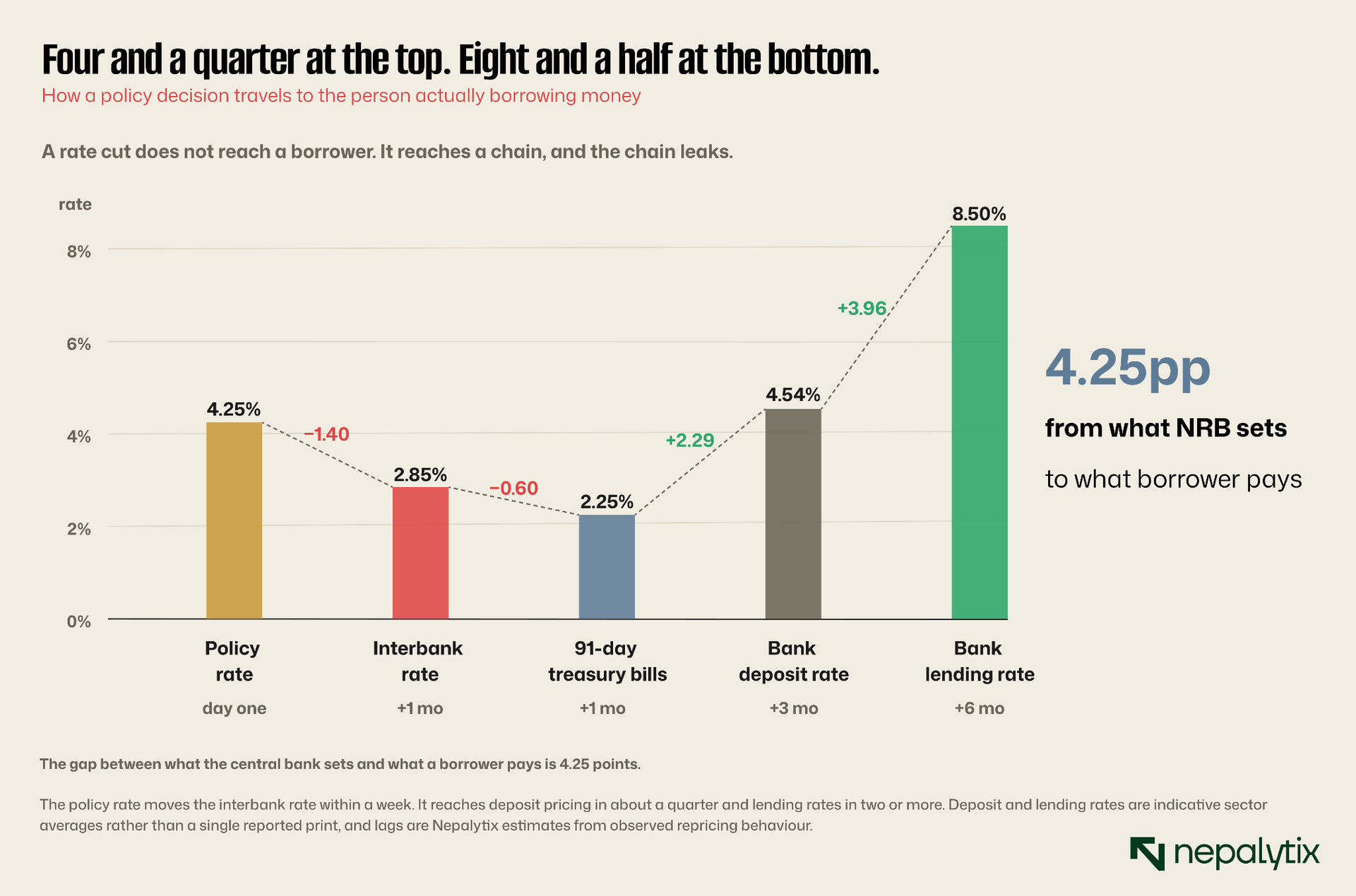
Policy rate 4.25%. Interbank 2.85%, within a week. Treasury bill 2.25%, within weeks. Bank deposit rates around 4.54%, taking roughly a quarter to reprice. Bank lending rates around 8.50%, two quarters or more.
Note the shape. It is not a smooth decline. The rate falls from policy to interbank to treasury bill then rises sharply through deposits to lending. Between what NRB sets and what a borrower pays sits a gap of 4.25 percentage points.
Most of that gap is legitimate. Banks pay depositors, absorb credit losses, hold capital against risk and cover operating costs. A spread of about four points between deposit and lending rates is not evidence of anything improper.
But it does explain why monetary policy in Nepal is a blunt instrument, and why announcements about the policy rate produce so little in the real economy. A borrower in Nepalgunj does not experience a policy rate. They experience a lending rate that was reset two quarters ago by a bank branch manager applying a base rate plus a premium.
The timing question
There is a second reason the policy arrives with less force than it appears to.
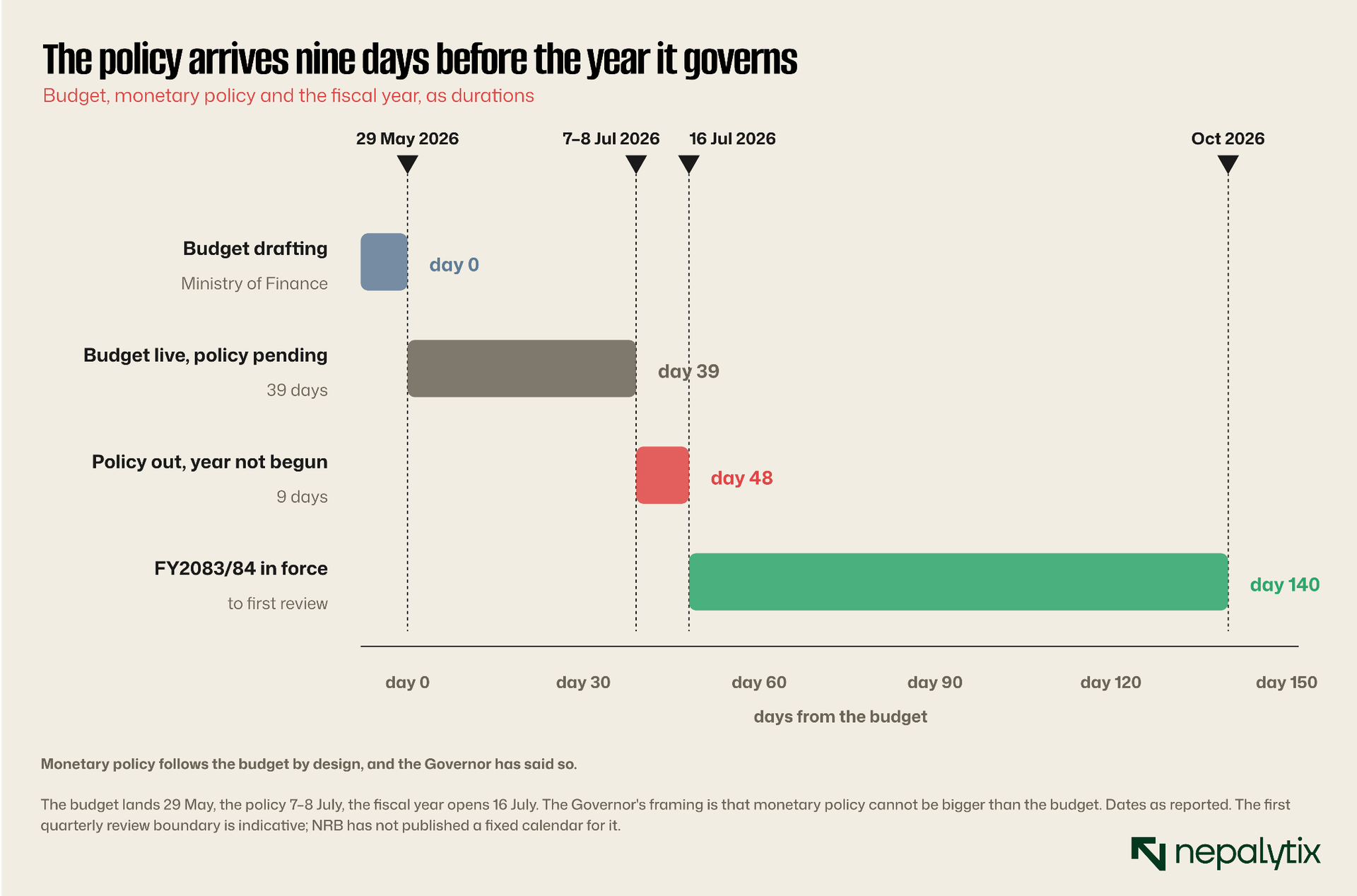
The budget for FY2083/84 was presented on 29 May 2026. The monetary policy followed on 7–8 July, thirty-nine days later. The fiscal year began on 16 July, nine days after that.
The sequence is deliberate and the Governor has said so publicly, his framing is that monetary policy cannot be bigger than the budget, and that this year's policy was written to fit the government's fiscal programme rather than to lead it.
That is a defensible position for a central bank in a small open economy with a pegged currency. It is also a limit on what a monetary policy can be. If the fiscal stance is set in May and the monetary policy is written in July to accommodate it, the monetary policy is a supporting document. Read it as one.
This year the document got shorter
Something changed with the twenty-fifth policy that has had almost no attention, and it changes how you should read the document.
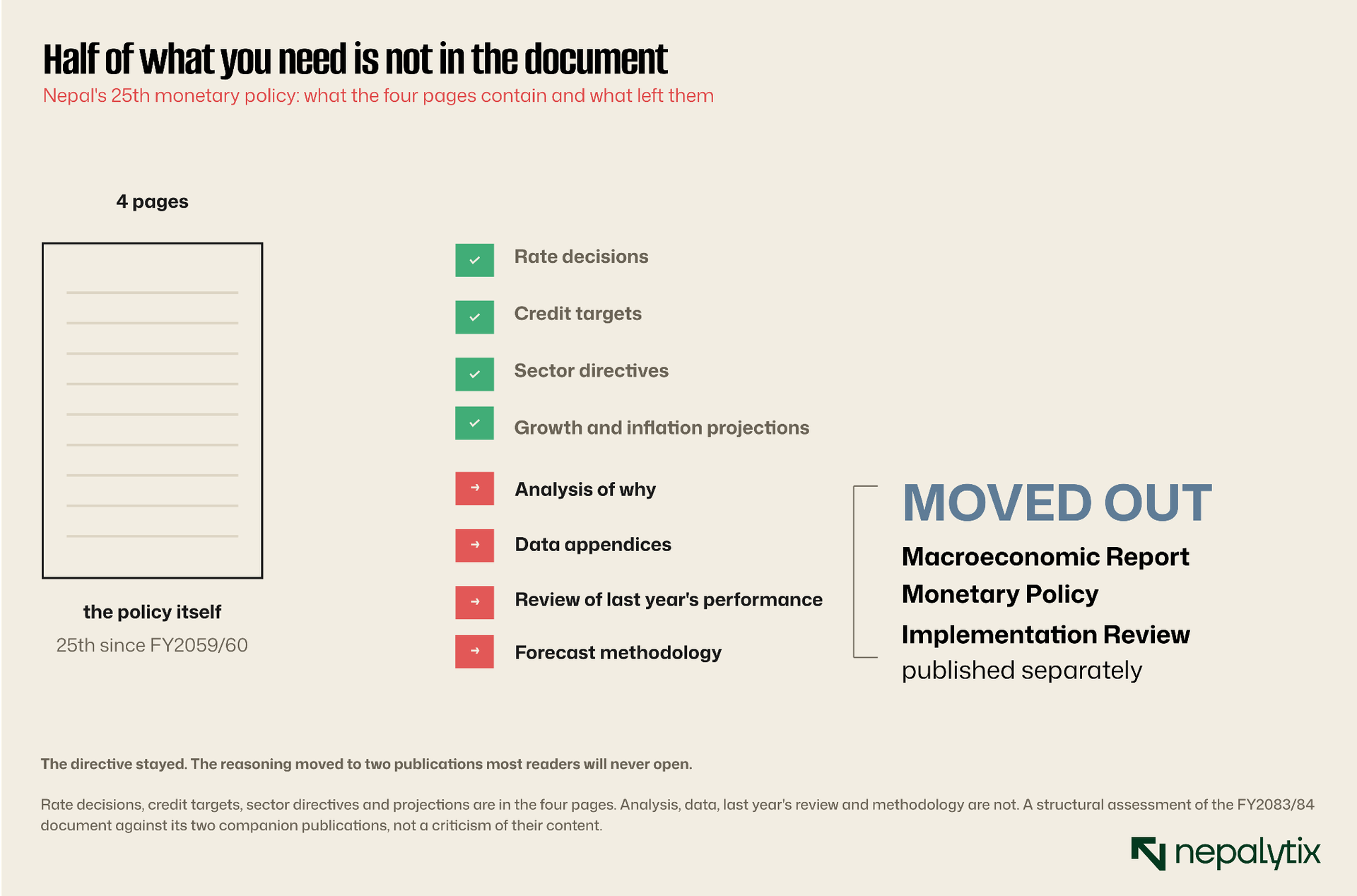
The main policy document for FY2083/84 is four pages. All of the economic analysis, the reasoning, the data, the review of the previous year's performance, the forecast methodology has been moved into two separate publications: a Macroeconomic Report and a Monetary Policy Implementation Review.
What remains in the four pages is the directive. Rate decisions. Credit targets. Sector provisions. Growth and inflation projections. What left is everything that would let you evaluate them.
The practical consequence for a reader is straightforward and slightly uncomfortable. The document everyone reads no longer contains the evidence for what it says. If you want to know why NRB projects 5.5% inflation, or how it assessed last year's performance, or what its credit-growth assumption rests on, the four pages will not tell you. You need the companions.
We will argue on Wednesday about whether this is good practice. For today's purposes it is simply a reading instruction: the policy is now three documents, and reading one of them is reading a third of it.
The credit target and what it assumes
The FY2083/84 policy targets private-sector credit growth of about 11%. On an existing loan book of roughly Rs 6,000 billion, that implies Rs 652 billion of new lending across the year.
Check that against capacity, which is the first test any credit target should face. At a credit-to-deposit ratio of 74.32% against a 90% ceiling, the banking system has something like sixteen percentage points of unused room. Capacity is plainly not the binding constraint.
Then check it against demand, and the document does something unusual: it concedes the difficulty. The policy acknowledges that domestic credit demand remains weak and that some institutions face capital adequacy pressure. A target of 11% growth alongside an admission that borrowers are scarce is a statement of intent, not a forecast.
We will take that contradiction apart properly tomorrow. For today the reading lesson is narrower: a credit target is a claim about demand, not supply, and should be read against whatever the same document says about demand. Very often, as here, the document argues with itself, and the argument is more informative than either side of it.
The news is in the sector paragraphs
Here is the part that matters most to anyone holding Nepali shares, and it is the part most consistently missed.
Coverage of a monetary policy concentrates on the rate line and the growth target. In Nepal, neither of those moves securities prices, because the policy rate is not binding and the growth target is aspirational. What moves prices sits further down, in the sector provisions.
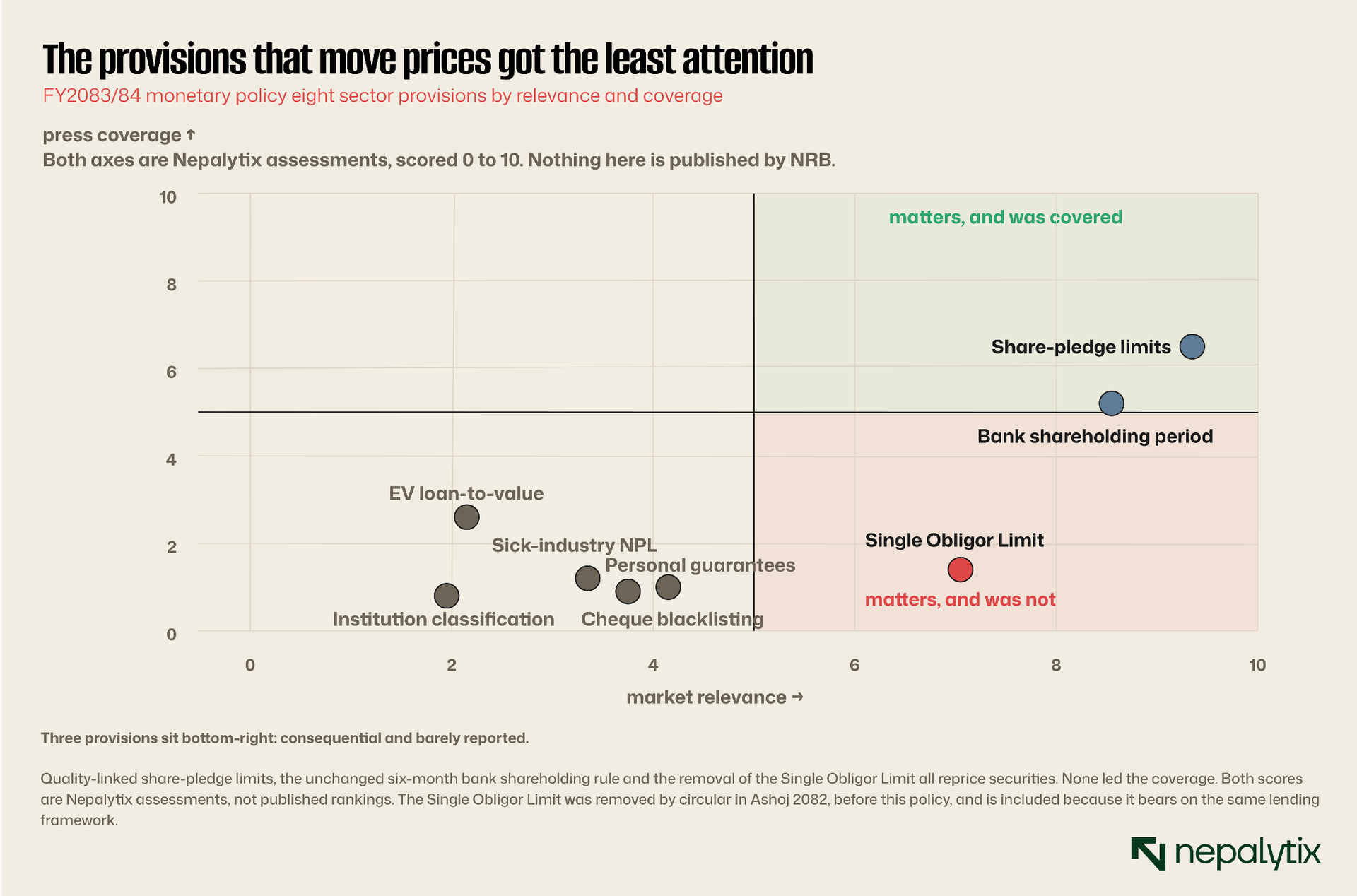
Three provisions sit in the bottom-right quadrant, consequential and barely reported.
Share-pledge loans become quality-linked
This is the most important sentence in the FY2083/84 policy and it appears well past the headline. NRB intends to move away from a single uniform cap on share-backed lending toward limits set by the financial strength and quality of the company whose shares are pledged. Stronger companies would support higher loan limits; weaker ones lower.
Think about what that does. Margin lending in Nepal has historically treated all listed shares as broadly similar collateral. Under a quality-linked regime, the financing cost of holding a strong company's shares falls relative to a weak one's. That is a structural change in relative demand across the market, applied by a regulator rather than by investors, and it favours exactly the large-cap names that already trade at premium multiples.
The rule has not been written yet. When it is, the definition of "quality" will be worth more attention than any rate decision in the document.
The six-month rule survived
Banks must still hold shares they purchase for at least six months before selling. Market participants lobbied for removal, arguing it keeps banks out of the market as active buyers, and lost.
This is a non-event that is genuinely newsworthy, because the expectation of change was priced. Reading a policy well includes noticing what did not happen where something was expected to.
And one that arrived outside the policy
The Single Obligor Limit, the Rs 25 crore ceiling on exposure to a single borrower or related group was removed from the Unified Directives by circular in Ashoj 2082, before this policy was written.
The Single Obligor Limit existed to prevent concentration risk, the danger of a bank lending so much to one borrower or group that the borrower's failure becomes the bank's. Removing it liberalises lending, which is consistent with a policy trying to push credit out of the door. It also removes a guardrail at precisely the moment the system NPL ratio is the worst in a decade, and that tension has gone almost entirely unremarked.
It is included in Figure 5 as a warning. Not everything that matters arrives in the monetary policy. A great deal of Nepal's actual financial regulation moves through NRB circulars and amendments to the Unified Directives, issued throughout the year with far less coverage. The July document is the most visible instrument, not the only one.
Two numbers this year that do not agree
One last habit and it applies to any policy document.
The FY2083/84 policy projects inflation of around 5.5%. It also reports that average inflation across the first ten months of FY2082/83 was 2.66%, and that the point-to-point print for Baishakh 2083 was 5.04%.
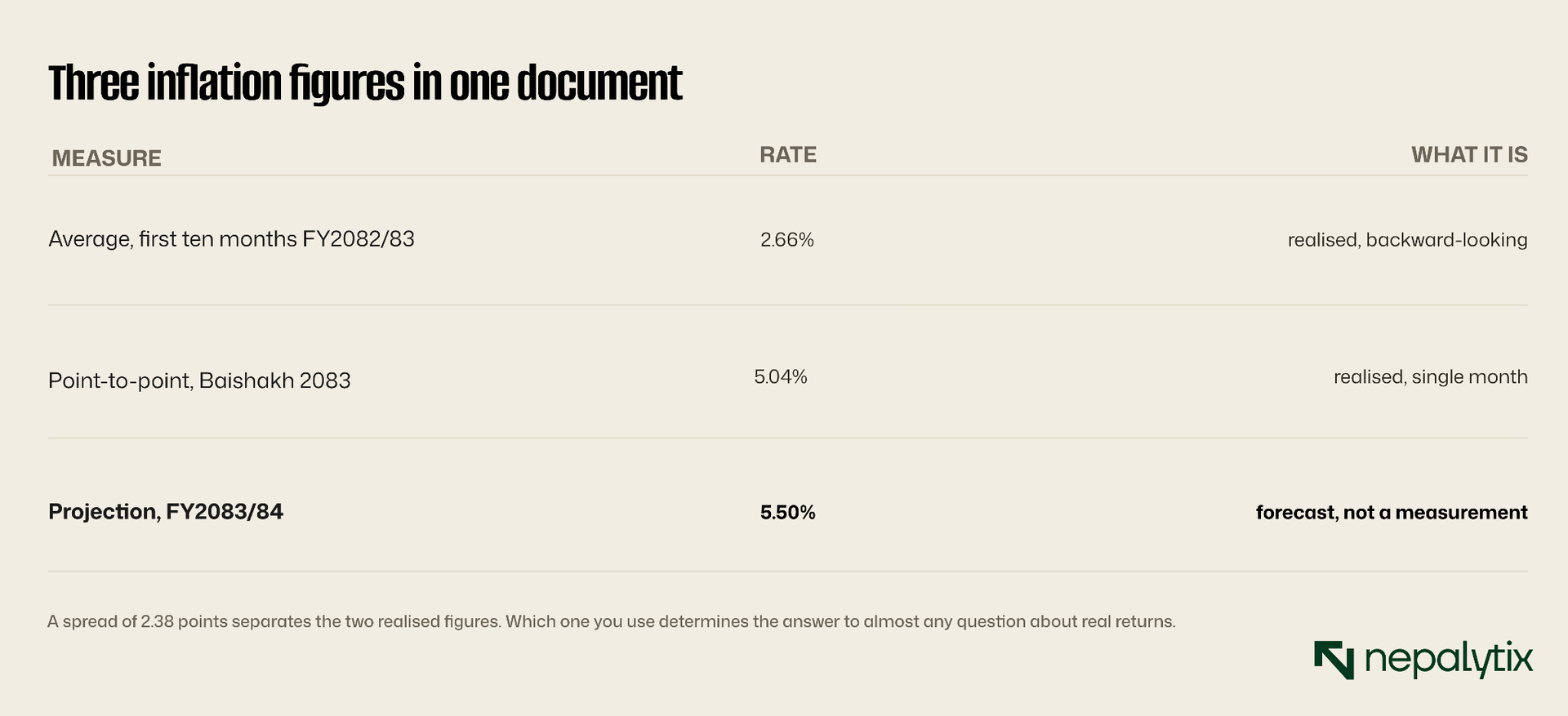
None of these is wrong and none contradicts the others, they measure different things. An average over ten months smooths; a point-to-point print catches a single month's spike; a projection is a forecast.
But they produce very different conclusions. Ask whether a bank deposit paying 4.5% earns a real return, and the answer is comfortably yes on the ten-month average, marginally no on the point-to-point print, and no on the projection.
We make this point with some embarrassment. Our own Long Read on Thursday used the 5.5% projection to conclude that a provident fund crediting 5.25% delivers a negative real return. Against the realised prints in this same policy document it delivers a positive one, of between 0.2 and 2.6 points. We corrected the piece. The lesson is the one this section is for: when a document gives you three versions of a number, say which one you used and why.
The order to read it in
Everything above, as a sequence. Fifteen minutes, once a year, and you will understand the document better than most people quoting it.
Reading a Nepali monetary policy
Check the peg first.If the fixed NPR–INR rate is continued, the space for independent rate policy is narrow and everything else is bounded by that.
Find the operating target, not the policy rate.The weighted average interbank rate is what NRB actually steers. The policy rate is one instrument aimed at it.
Locate the interbank rate inside the corridor.Near the floor means a liquidity glut and a non-binding policy rate. Near the ceiling means scarcity. This one fact reframes the whole document.
Read the credit target against the CD ratio.A credit growth target is only meaningful if banks have both capacity and demand. At 74.32% against a 90% ceiling, capacity is not the constraint.
Skip to the sector provisions.This is where securities get repriced. Share-pledge rules, bank shareholding rules, margin lending, provisioning. The rate line rarely matters; these always do.
Note what did not change.A rule left in place against expectation is news. The six-month bank shareholding rule is this year's example.
Check which inflation number you are being given.Realised average, point-to-point, or projection. State which you used in anything you write.
Then read the two companion documents.Since FY2083/84 the analysis lives outside the policy. The four pages tell you what; the Macroeconomic Report and Implementation Review tell you why.
And keep watching the circulars.The Single Obligor Limit was abolished by circular. The Unified Directives amendment on unrealised interest arrived ten days before year-end. The July policy is the loudest instrument, not the only one.
One closing note on why this is worth the fifteen minutes. Every quarterly bank result you read for the next twelve months will have been shaped by the provisions in this document, the provisioning rules, the credit targets, the share-pledge framework. Last Sunday we covered how to read a Q4 unaudited report. This is the document that decides what those reports will contain.
The monetary policy is the most widely read financial document Nepal produces and the least carefully read. It is not difficult. It is just organised in an order that does not match where the information is, and this year half of it moved somewhere else.
Disclaimer
This report has been prepared by Nepalytix for informational and educational purposes only and does not constitute investment advice, an offer, or a solicitation to buy or sell any securities.
The information contained in this report is based on sources believed to be reliable; however, Nepalytix does not guarantee its accuracy, completeness, or timeliness. Opinions, estimates, and projections expressed herein are those of the authors as of the date of publication and are subject to change without notice.
Investing in securities involves risks, including the possible loss of principal. Past performance is not indicative of future results. Readers are advised to conduct their own independent research and consult with a qualified financial advisor before making any investment decisions.
Nepalytix and its contributors may hold positions in the securities discussed in this report at the time of publication or thereafter.
Neither Nepalytix nor any of its affiliates accept any liability for any loss arising from the use of this report or its contents.