Hydropower's 50% Rule Protects The Rs 100 Buyer. The Losses Are At Rs 363.
Nepal's proposed 50% hydropower IPO rule aims to protect investors. But an analysis of 108 NEPSE listings reveals that Rs 100 IPO allottees largely avoided losses, while those buying at 3–4 times the price bore the risk. The bigger threats may be inflated listing prices and promoter lock-in expiries.
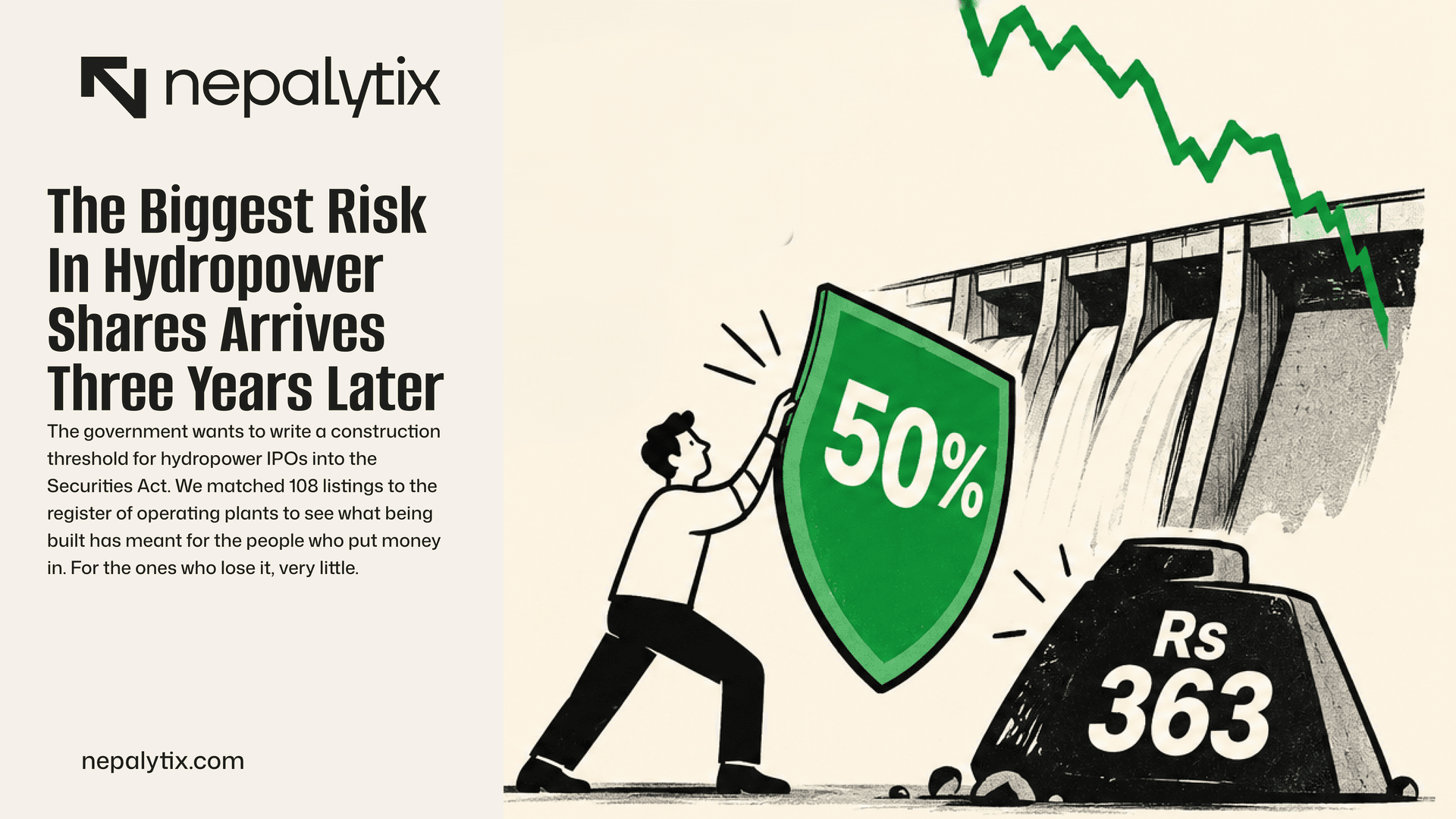
Ten days ago the government circulated a draft ordinance that would write one number into the Securities Act. A hydropower company whose plant isn't running yet could sell shares to the public once the project is at least 50% physically complete and the regulator couldn't turn the application down just because the turbines haven't turned.
The number has been argued over ever since, mostly by people who think it's in the wrong place. One camp says 50% is far too early: no shares until there's power. Another says it's too late because a developer needs the money while the tunnel is being dug not after. A third says one line for a 5 megawatt plant and a 100 megawatt plant is silly whatever the number is.
We don't have a view on where the line should go. We think it's the wrong line.
That's a claim about evidence so here's the evidence. Since 2014, 108 hydropower companies have listed on the Nepal Stock Exchange. In 40 of them, nothing was generating on the first day of trading. In the other 68, at least one plant was already selling power. Nobody designed that as an experiment but it is one and it has been running for twelve years.
So we matched every listed company to the government's register of operating plants, pulled every day of prices and asked a simple question. Did it matter to anyone who put money in whether the thing was built?
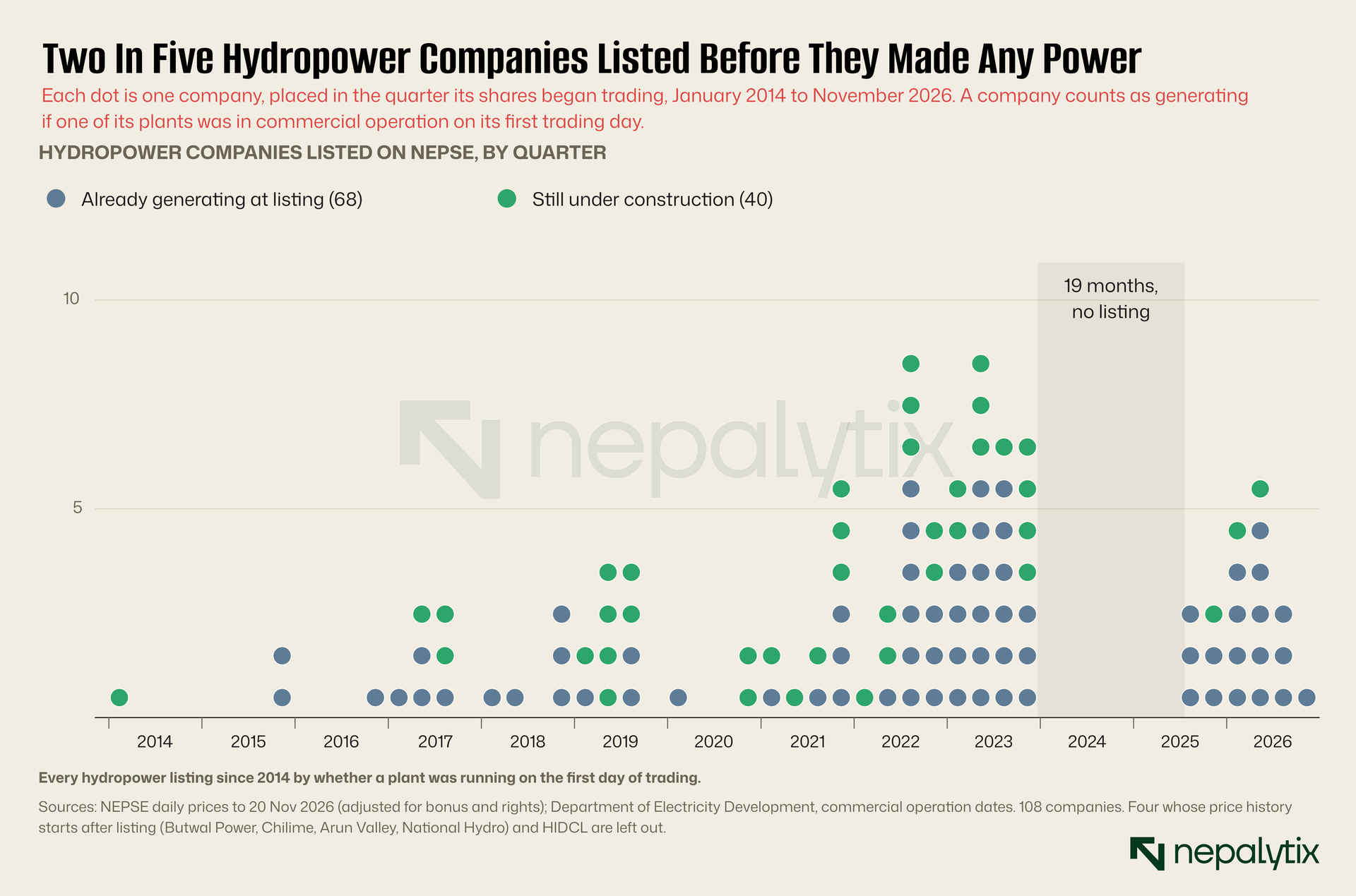
The short version: it mattered to almost nobody's returns. What mattered was the price you paid and the month you paid it. And the worst stretch for a hydropower shareholder turns out to be one the draft doesn't mention at all.
What Is Actually On The Table
It's worth being precise about the proposal because half the coverage called it a tightening and the other half called it a loosening. Both are right.
The 50% threshold isn't new. The Electricity Regulatory Commission has had it in a directive since 2021/22: a company with a project under construction needs the Commission's nod before a public issue and the Commission won't give it below 50% physical progress. What the draft does is lift that rule out of an energy regulator's directive and put it in the securities law where only Parliament can move it.
That's the tightening. The loosening is the second half of the sentence. In September the Securities Board published draft eligibility guidelines that would require a record of continuous business before any company could issue shares which for a power company means a plant that's running. A commission chaired by former finance minister Rameshore Khanal had recommended the same thing. Developers hated it. The ordinance draft overrules it: get to 50% and "not generating yet" stops being a reason to say no.
The draft also attaches conditions, and they're the best part of it. Progress has to be certified by an independent technical evaluator. The prospectus has to state total cost, work remaining, money still needed and where it's coming from, the expected completion date and the risk of delay and overrun. Proceeds can only be spent on the project.
Then on Tuesday Kantipur reported that the Securities Board has a directive of its own in draft: seven stages from survey to operation, eligibility from the stage where financing is secured and the Commission's minimum progress is verified, a scorecard on which a company needs 70% and a video from the issue manager explaining the company's finances. (We are curious about the video.) It also confirmed it won't approve any company with a net worth below Rs 90 a share, a floor that comes from a parliamentary committee and appears in no law.
So there are now at least five places people want to draw the line.
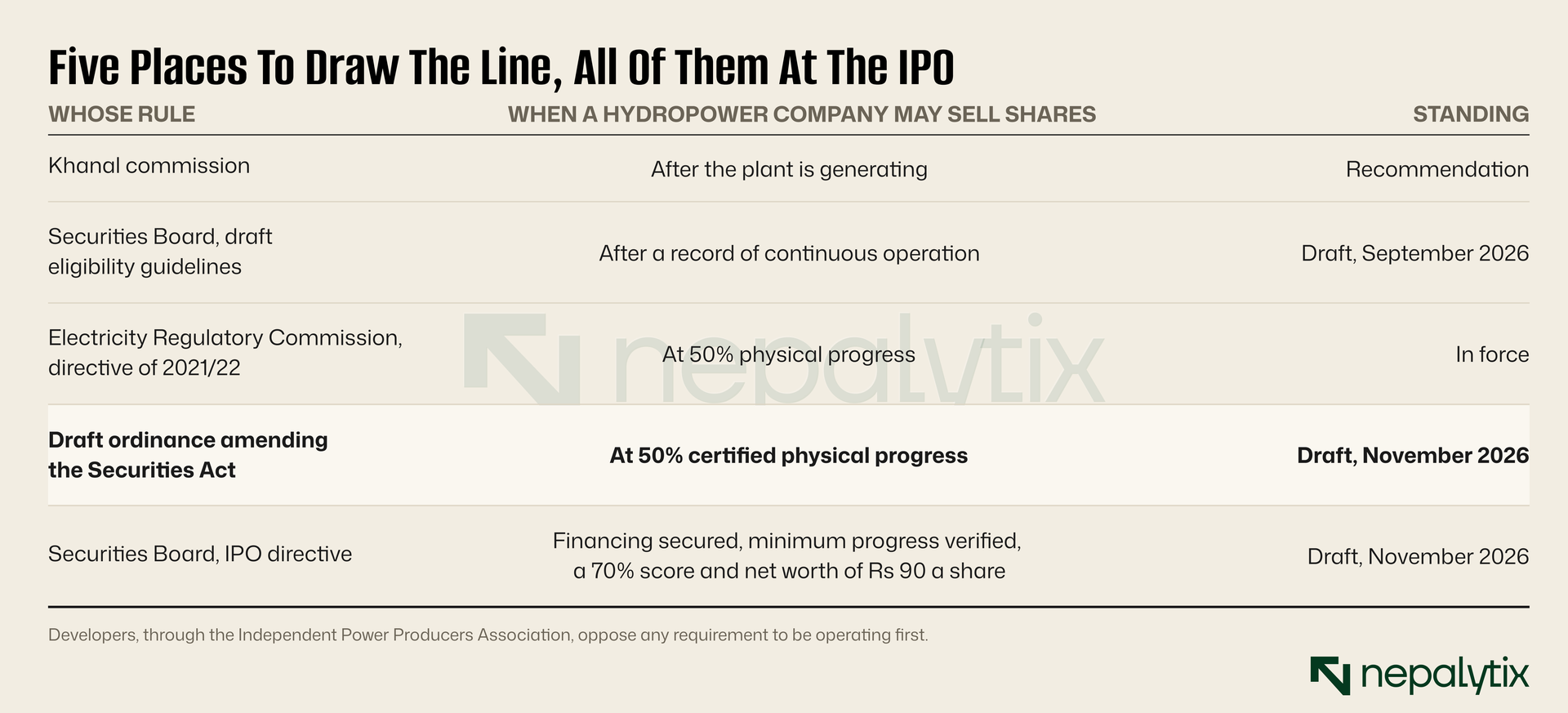
Notice what every row has in common. Each one is a test applied to the company, once, on the day it asks to sell shares at Rs 100. All five are about the IPO.
Keep that in mind, because the losses aren't.
Why The IPO Gets All The Attention
It isn't hard to see why regulation piles up at that one moment.
An IPO approval is the only point at which the Securities Board signs something. If a company it approved goes wrong, there's a letter with a date on it. If a share halves in its third year because 86% of the company came unlocked, nobody approved that. It just happened.
The IPO is also where the crowd is. Two and a half million people applied for Super Khudi. That's one application for every twelve people in the country and every one of those applicants thinks of the IPO as the investment. A rule about it sounds like a rule about them.
So the argument narrows to a single question, built or not built and everything on either side of the listing day drops out of view. Our complaint isn't that the question is stupid. It's that it's the only one being asked and when we checked, it wasn't the one that decided who lost money.
We Have Already Run This Experiment
Start with the investor the rule is written for: the person who applies for an IPO.
In Nepal that person doesn't choose how much to buy. Hydropower IPOs are oversubscribed many times over so shares go out by lottery, ten to a winner. When Super Khudi Hydropower sold shares in February, 2.58 million people applied and 128,650 of them got ten shares each. That's a one in twenty chance of being allowed to invest Rs 1,000.
Super Khudi is a useful example because it's exactly the kind of company the debate is about. Its 26 megawatt plant in Lamjung wasn't generating when the IPO opened. Construction was reported at 95.3% complete and the completion date had already been pushed back three times. As of last week it still isn't in the Department of Electricity Development's list of operating plants.
Here's what happened to the Rs 1,000. The shares started trading on 25 March at Rs 330. Three weeks later they closed at Rs 1,251. They've since fallen by almost half to Rs 665 and the lottery winner's Rs 1,000 is worth Rs 6,650.
Now look at the sums. The 128,650 winners put up Rs 129 million between them. In Super Khudi's first twenty sessions, Rs 679 million of its shares changed hands at an average price of Rs 1,208. The people who paid that are down 45%. They are not the people the ordinance has in mind.
That isn't a one-off. It's the rule.
Here is every hydropower company listed since the start of 2021, 79 of them with its price traced for three years from the first day of trading. Green lines were generating at listing. Red lines weren't.
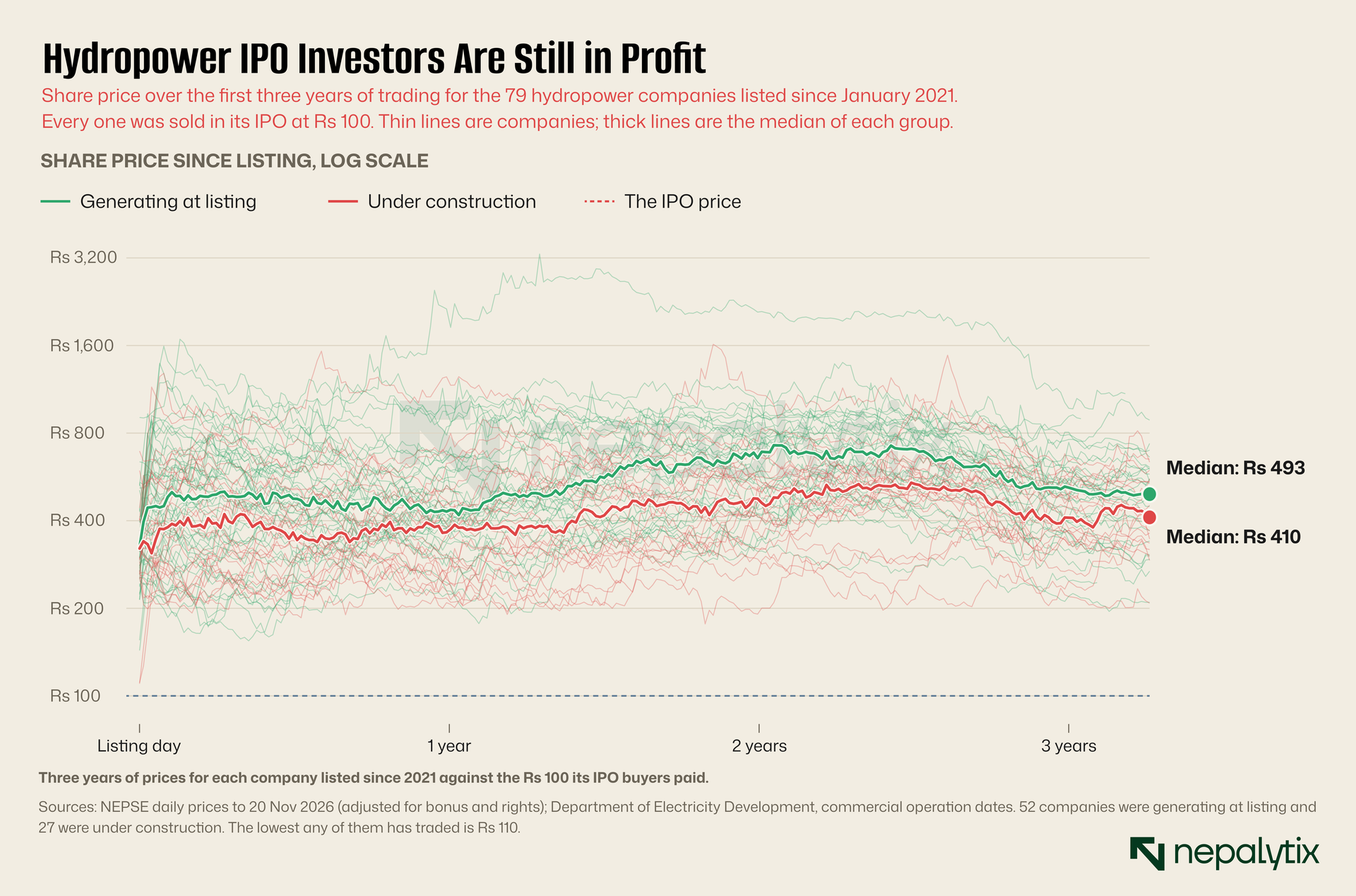
Look for a line that crosses the red one. There isn't one.
In 79 listings over six years, including 27 that were still construction sites, not one share has traded below its IPO price for a single day. The closest call was Madhya Bhotekoshi which opened at Rs 110. Three years in, the median allottee in a company that was generating holds shares worth Rs 493 for every Rs 100 paid. The median allottee in a company that wasn't holds Rs 410.
We should be honest about the years before that, because they're the best argument the other side has on this point. Allottees have lost money. Of the 25 companies that listed between 2017 and 2020, 17 traded below Rs 100 at some point, some for more than a year. That was a bear market: the exchange spent much of 2018 and 2019 falling and new hydropower shares fell with it.
But look at who fell. Of the 18 companies in our whole sample that ever traded below their IPO price, 13 had a plant running when they listed. Being built didn't save them. Being listed in 2019 sank them.
And even that group came through. Every one of the 108 companies trades above Rs 100 today. Adjusting for bonus and rights shares, the median allottee is holding 4.8 times what they paid, and the worst off in Rasuwagadhi is still up 65%.
So the first finding is this. The person buying at Rs 100 has had construction risk for free. In good markets they made four or five times their money either way. In the one bad market they lost either way. A 50% rule changes neither.
The Buyer Who Does Lose
There is a second investor and nobody in this debate is talking about them.
It's whoever buys from the lottery winners.
That's not a small group. The 99 hydropower companies for which the Securities Board publishes issue amounts raised Rs 40 billion at their IPOs. In their first year of trading, Rs 211 billion of their shares changed hands. For every rupee paid at Rs 100, five were paid at the market price.
And the market price is nowhere near Rs 100. Across all 108 listings, the average rupee spent in a share's first twenty sessions bought it at 3.6 times the IPO price. We use that as our measure of what a market buyer pays, because the first day's closing price is a fiction. (On Super Khudi's first day, shares worth Rs 28,810 traded. Not Rs 28,810 a share. In total.)
How did those buyers do? A year later, 41 of 90 were under water. That's 46%. Three years later it was 20 of 75. Today, in 38 of the 108 companies, the first-month buyer is sitting on a loss.
The ones who didn't lose didn't do anything special either. The median first-month buyer made 25% over three years. Over the same three years the NEPSE index did two points better with a great deal less drama: a quarter of these buyers lost at least 3%, a quarter made more than 70% and 37 of 75 beat the index which is what a coin would have managed.
So buying a newly listed hydropower share has been a bet with the market's return and several times its spread. Fine, if you know that's what you're buying. Most of the commentary around listing day suggests people think they're buying something else.
These are the people a hydropower rule ought to worry about. They put in most of the money, they pay the high price and close to half of them are down after a year.
So does construction progress protect them? This is the test the 50% rule has to pass. If half-built companies are the dangerous ones, then people who bought half-built companies in the market should have done worse.
Here are the three-year returns for both groups, lined up from worst to best.
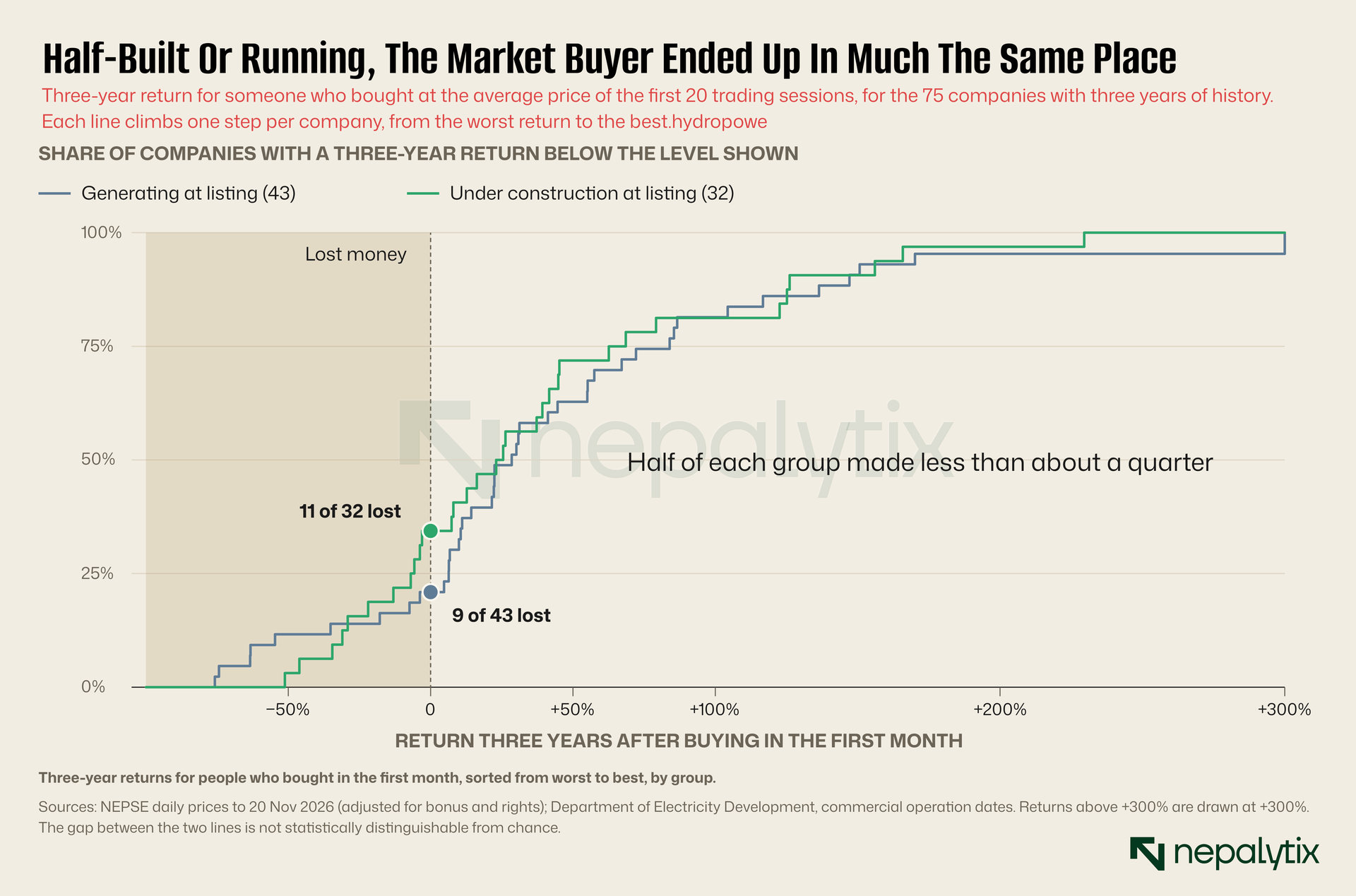
The two lines are tangled together from end to end.
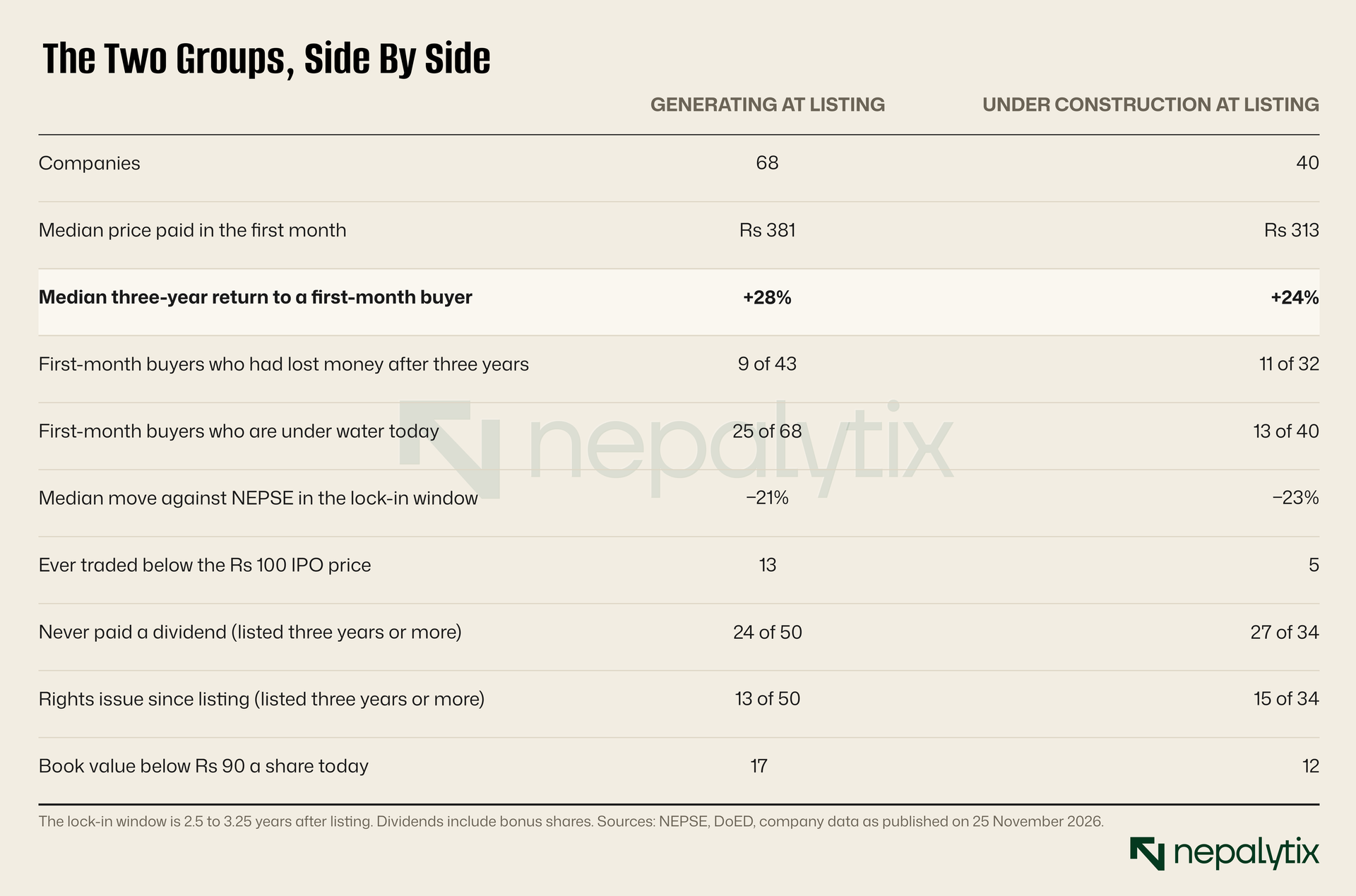
The typical market buyer of a company that was already generating made 28% over three years. The typical buyer of a company still under construction made 24%. Nine of 43 lost money in the first group and 11 of 32 in the second and with numbers that small the gap is well inside what chance produces. Run it at one year or to today and you get the same answer: no difference you could act on.
We didn't expect that. We expected the half-built companies to look worse and to spend this piece arguing about how much worse. They don't.
Why The Rule Is Redundant
There's a reason and it isn't that construction risk is imaginary. It's that the market already charges for it.
Market buyers typically paid Rs 381 in the first month for a company with a running plant. For a company without one they paid Rs 313. That's an 18% discount for not being finished, set by people with their own money at stake with no directive telling them to.
You can see the same thing in the totals. Shares in companies with a running plant were sold at Rs 100 and valued by the market, a month later, at 4.7 times that. Shares in companies without one were valued at 3.3 times. Nobody had to be told which was riskier.
The discount did its job. Half-built companies were cheaper so the people who bought them ended up in about the same place as the people who paid up for a finished one.
This is the awkward thing about regulating a risk that's printed on the first page of the prospectus. Everyone can see whether there's a powerhouse. It's the least hidden fact about a hydropower company. A rule that screens for it is screening for the one thing buyers were already screening for.
What they weren't screening for is how much they were paying.
Same 75 companies, same three-year returns. This time we've put the first-month price along the bottom.
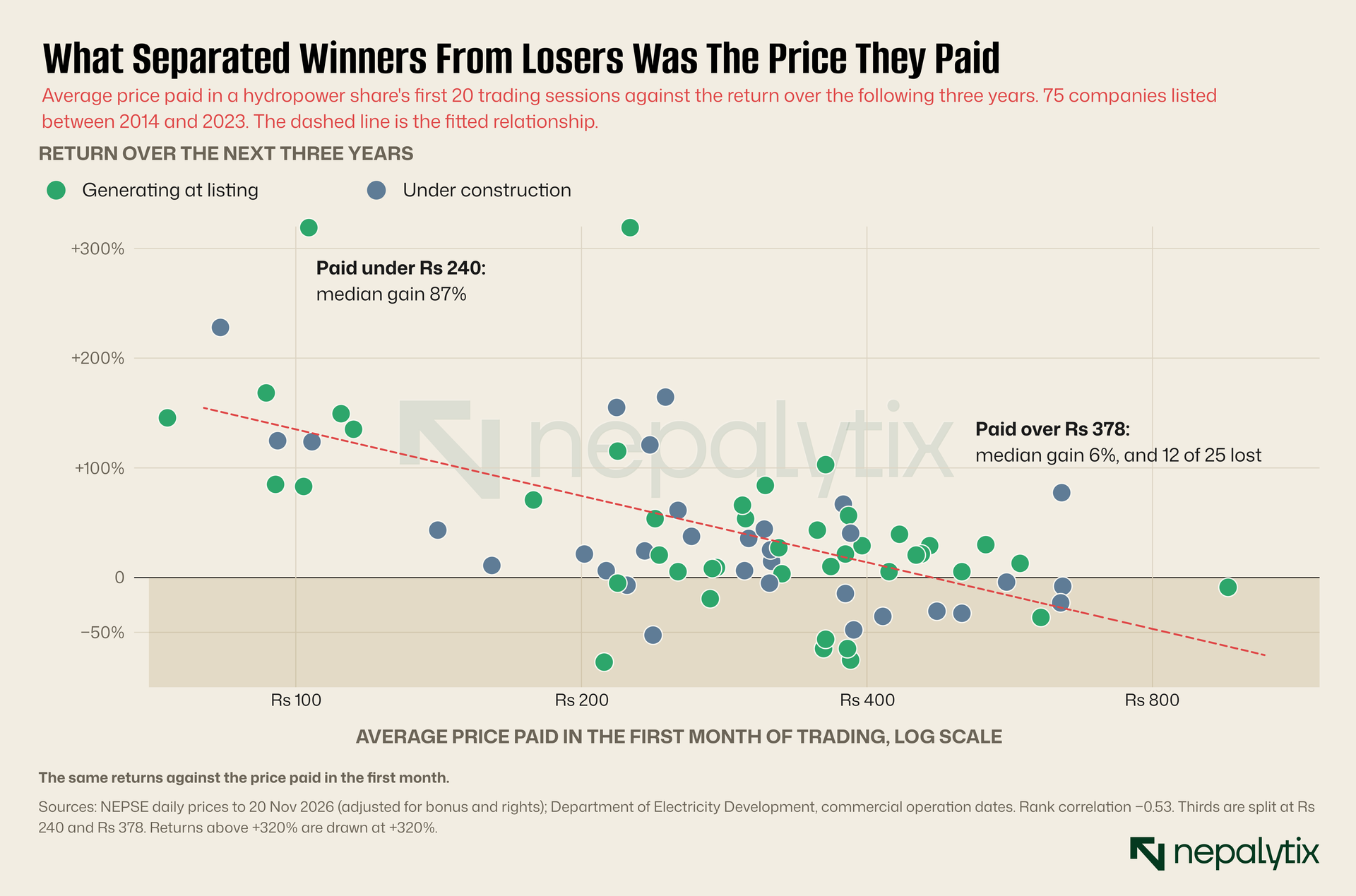
That's a relationship.
Split the companies into thirds by what the first-month buyer paid. In the cheapest third, bought below about Rs 240, the median buyer made 87% in three years and 4 of 25 lost money. In the dearest third, bought above about Rs 380, the median buyer made 6% and 12 of 25 lost.
The blue and gold dots are scattered all the way along the line. Whether there was a plant tells you nothing about where a company sits. The price tells you most of it.
None of this should be a surprise to anyone who has bought anything. But it has a consequence for the rule. The danger to the market buyer is a number, the price and the ordinance regulates a different number.
A Percentage Is Not A Date
There's a practical problem with the threshold too, and it's worth a minute.
"Fifty per cent physical progress" sounds like a measurement. It's closer to an opinion. Civil works, the tunnel, the electromechanical equipment and the transmission line all move at different speeds and somebody has to decide how to weight them. The draft says an independent technical evaluator will certify the figure. It doesn't say who picks the evaluator.
More to the point, progress isn't what shareholders are waiting for. They're waiting for a date. Super Khudi was reported 95.3% complete in February. Nine months on it isn't in the operating register. The last few per cent of a hydropower project is where the transmission line isn't ready or the monsoon takes the access road or the testing finds something.
A company at 95% can be a year from power. A company at 55% with its line built and its equipment on site can be closer. The number in the ordinance can't tell those two apart, and the thing that can, a completion date with the developer's name next to it is in the draft only as a line in the prospectus.
And Then Year Three Arrives
The price paid is half of what hurts market buyers. The other half is a date.
When a hydropower company lists, most of its shares can't be sold. Promoters, project-area locals and employees are locked in for three years from the day the IPO is allotted. Typically about a fifth of the company trades and the rest sits still.
The locals are worth a thought here. They're the one group of outside shareholders who are made to hold through construction since their tenth of the company is locked for the same three years as the promoters. If anybody carries the risk the ordinance is worried about, it's them and their shares come free on the same morning as everyone else's.
Then, three years on, all of it can move.
Take Super Madi. In early November 2025 its shares were at Rs 879. The lock-in on 19.9 million of them, 86% of the company, was due to end on 4 February. By New Year the price was Rs 560. By March it was Rs 461. The NEPSE index over those four months went from 2,631 to 2,674.
We wanted to know if that was typical so we lined every company up by the number of years since it listed and divided each price by the index to take the market's own ups and downs out.
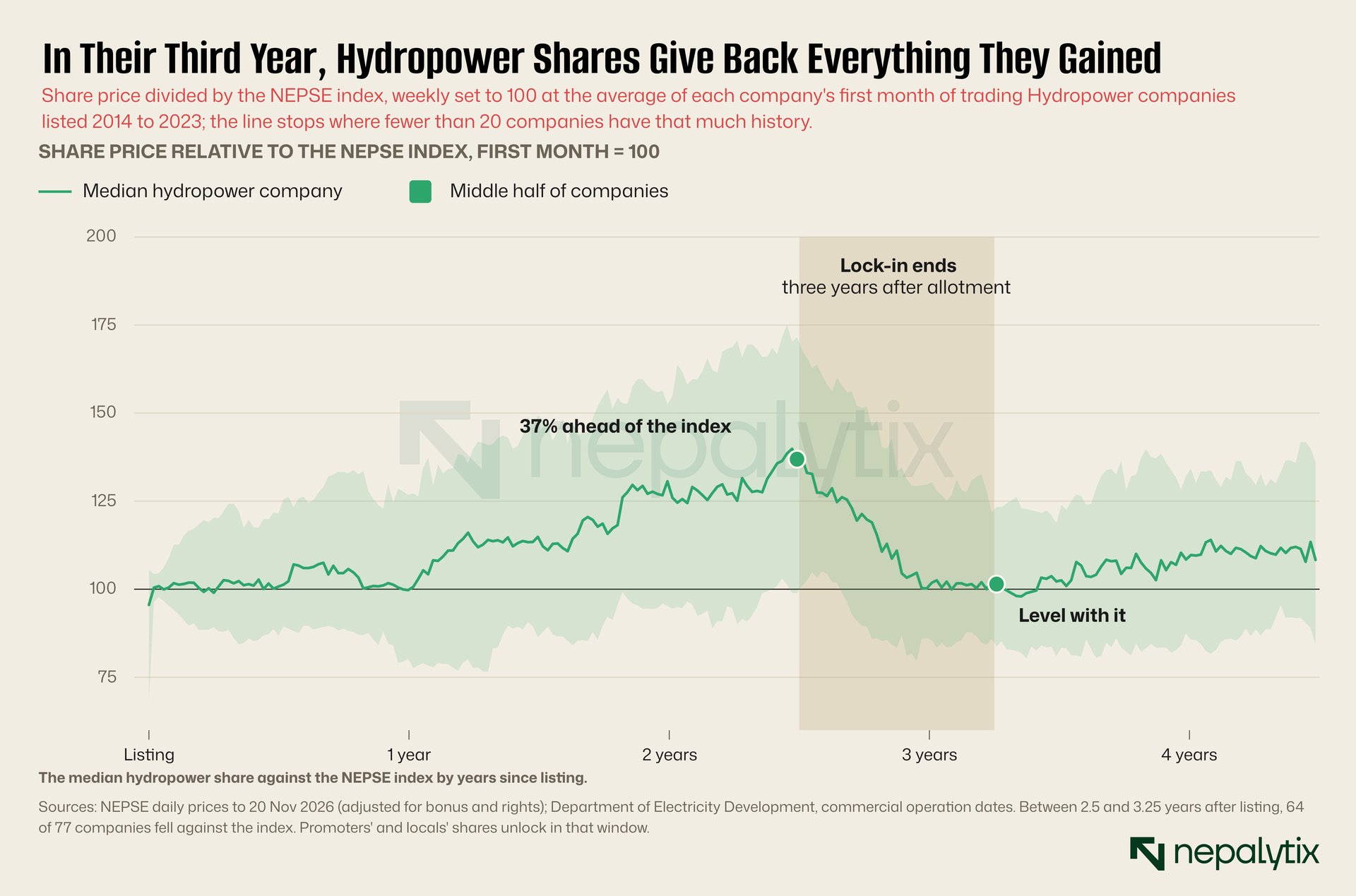
It's typical.
For two and a half years the median hydropower share does well. It keeps pace with the market for a year, then pulls ahead and at the thirty-month mark it's 37% in front. Then it gives all of it back in nine months.
Between two and a half and three and a quarter years after listing, 64 of 77 companies fell against the index. The median fell 21%. In the nine months before that window the median slipped 2%, and in the nine months after it rose 5%. Whatever this is, it happens on a schedule.
It also happens across market conditions. The companies that listed in 2019 hit their third year in 2022. Those from 2021 hit it in 2024, those from 2022 in 2025 and those from 2023 this year. Different markets every time. In those four cohorts, 55 of 58 companies fell against the index in the window.
There are two things we should say against our own chart. The first is that the pattern is missing from the twelve companies that listed in 2017 and 2018. Their third year landed in the boom of 2020 and 2021, when hydropower shares rose faster than the market as a whole and most of them gained on the index. So a strong enough market can swamp it.
The second is that new shares often fade against the market as the excitement wears off with or without a lock-in. If that were all this was, though, the slide would be spread across the first three years. It isn't. The first two and a half years are fine. The loss is packed into nine months and those nine months sit on top of the unlock.
And, once again, it doesn't care about construction. Companies that were generating at listing fell a median 21% in the window. Companies that weren't fell 23%.
We can't see who sold. The exchange doesn't publish that. But the Securities Board's own study committee, the one led by Phanindra Gautam whose report is now being cited for the 50% threshold, found the pattern from the other side: promoters in about a quarter of the hydropower companies it examined had exited after the lock-in ended and it named them. In June the Post reported directors resigning their posts ahead of the date so that the extra one-year hold on insiders would run out sooner.
Here is the strange thing about the politics of that report. It made two findings. One was about when companies should be let in. The other was about what happens when promoters are let out. The first is on its way into the Securities Act. The second which is where the price chart says the damage is is nowhere in the draft.
The strongest case against us
The best version of the other side goes like this and parts of it are right.
Returns aren't the only thing that matters. A share is a claim on a business and businesses that list half-built have treated shareholders worse on every measure except the share price.
We checked. Among companies listed for at least three years, 27 of the 34 that were under construction at listing have never paid a dividend of any kind, cash or bonus shares. That's 79%. Among those that were generating, it's 24 of 50 or 48%. The gap survives if we only compare companies that have had at least three years of generation so it isn't just that the half-built ones started later. They've also come back to shareholders for more money more often: 15 of 34 have done a rights issue since listing against 13 of 50.
And "under construction" covers a lot of ground. Here's how long shareholders in those 40 companies waited for the plant.
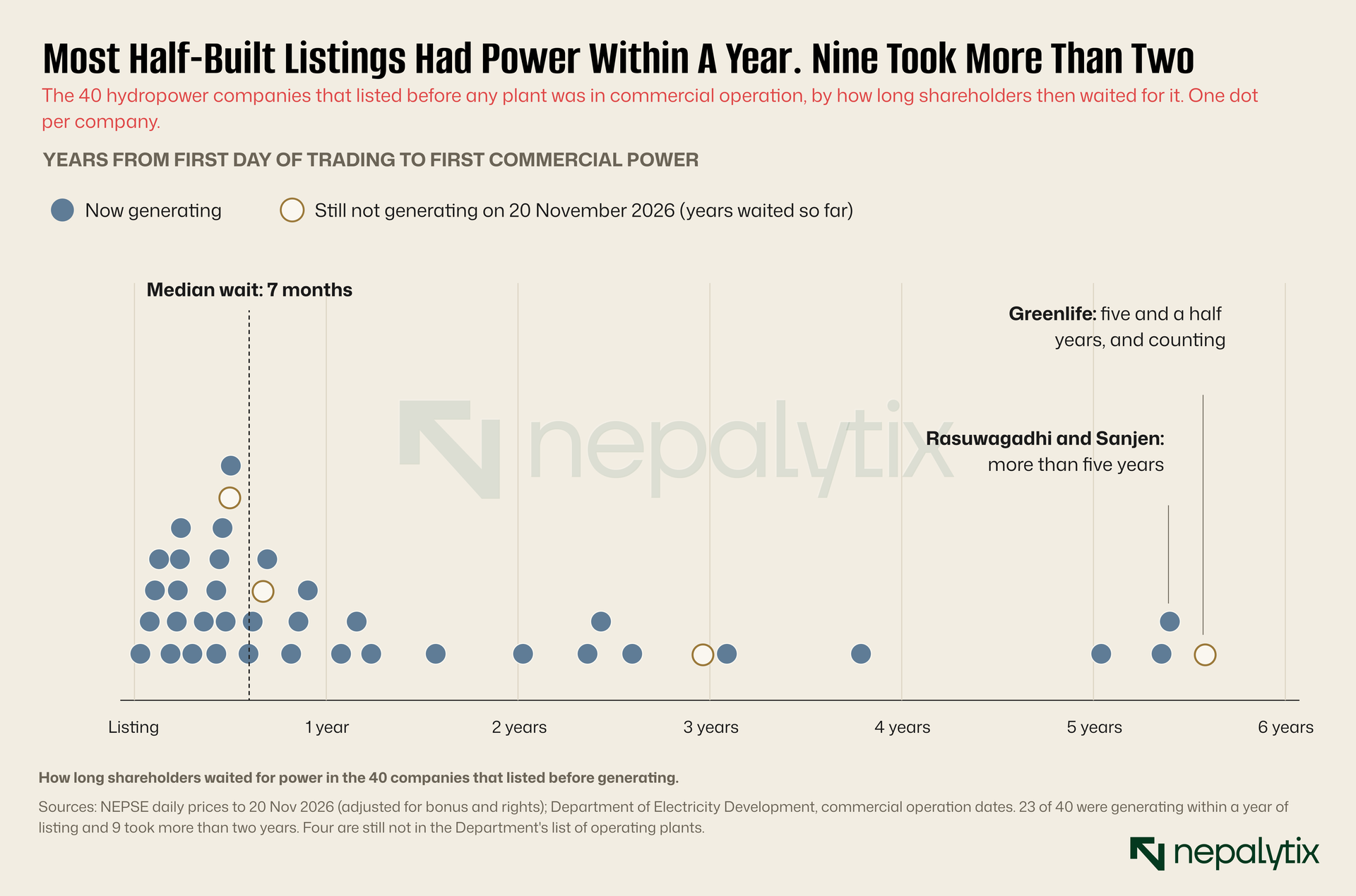
Most of them were nearly done. Seventeen were generating within six months and 23 within a year which means a 50% rule wouldn't have stopped them anyway.
But nine took more than two years. Rasuwagadhi and Sanjen, both subsidiaries of the state-backed Chilime, listed in August 2019 and switched on in December 2024. Greenlife listed in April 2021 and isn't in the operating register yet. Of the 17 companies that were more than a year from power, 13 have three years of history and their market buyers made a median 8%, against 26% for the ones that were close. Thirteen companies is too few to hang a law on, but the direction is the one the rule's supporters would predict.
So there is something real here. A company that lists early in construction ties up shareholders money for years, pays nothing while it does, and often asks for more. A minimum progress test speaks to that.
Our answer is that it speaks to it weakly and in the wrong place. It's weak because of who the long waits were. Five of the eleven longest belong to the state utility's own family: Upper Tamakoshi, Trishuli and Chilime's three subsidiaries which sold shares to provident-fund members and locals years before completion. We doubt a progress test written for private developers would have been the thing that stopped those. It's in the wrong place because a test applied once at the IPO does nothing about delay that shows up afterwards. The disclosure conditions in the draft would do more: certified progress, cost to complete, a date. But the draft asks for them once in the prospectus. Rasuwagadhi's problem wasn't its prospectus. It was the five years after it.
The Test That Expires
That last row of the table deserves a word because it's the same problem in a different rule.
The Securities Board won't approve an IPO for a company whose net worth is below Rs 90 a share. On today's sheet, 25 hydropower applicants have filed a figure. Every one passes. The lowest is Rs 94.76.
Now run the same test on the companies that are already listed. Twenty-nine of the 108 have a book value below Rs 90 as of their latest quarterly accounts. One is negative. Seventeen of the 29 had a plant running the day they listed so this isn't a construction story either. They passed whatever was asked of them at the door and then the business happened.
We made this point about the Board's issuance guidelines in October and it applies here without changing a word: the test is given at the moment it's easiest to pass. A company arranging an IPO has every reason, and every means, to look its best on the day. A threshold for net worth or for physical progress, measures the company once. Shareholders own it for years.
That doesn't make entry tests worthless. It makes them the smaller half of the job.
Where The Money Went
There's one more party to a hydropower IPO and it's the one the industry says it's worried about: the company.
The developers case against a generation-first rule is that projects need equity during construction. That's true and it's the reason the ordinance draft exists. A project that's 60% built and short of cash either raises money or stops.
It matters more than the headcount suggests, because the companies that list half-built are the big ones. Their median project is 24 megawatts. For companies that listed with a plant running, it's 7. So although only 36 of the 99 IPOs we can put a figure on were construction-stage, they raised Rs 23.4 billion of the Rs 40.3 billion. Cut them off and you cut off most of the money.
So how much do these IPOs raise? Less than they could, by a distance that we found hard to believe until we'd checked it three ways.
Every hydropower IPO for which the Securities Board records a price was sold at Rs 100. Not most of them. All of them. The rules keep premium pricing for companies with a record of profits which a company that needs construction money by definition doesn't have. (Of the 41 in today's queue, one is asking for a premium. Its plant has been running since 2022.)
Here's what that costs. The gold line adds up what companies received for the shares they sold. The green line values those same shares at what the market paid a month later.
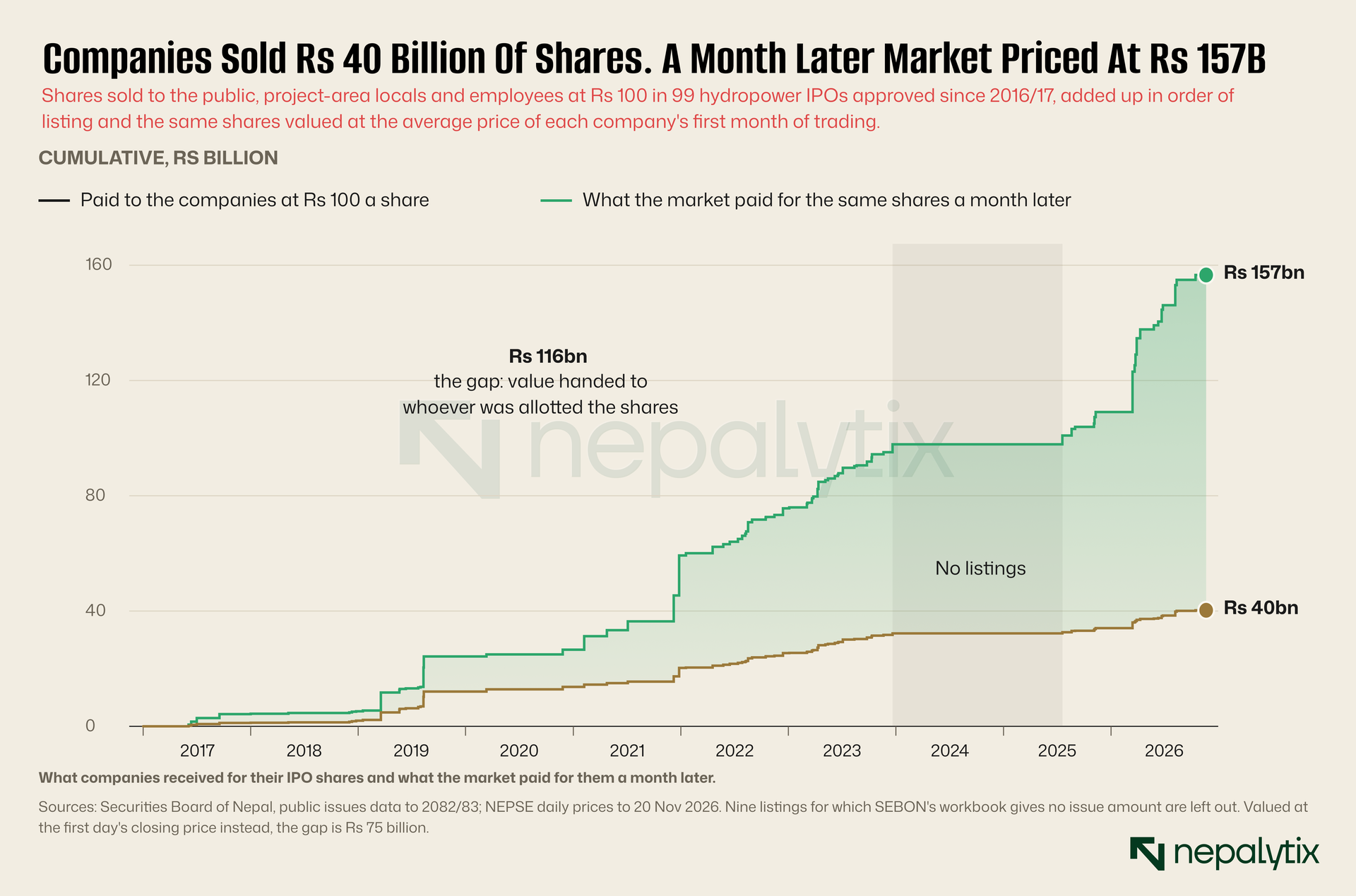
Hydropower companies sold shares for Rs 40 billion that the market valued, within weeks, at Rs 157 billion. The Rs 116 billion in between didn't go into tunnels or turbines. It went to whoever's name came up in the lottery. (If you'd rather use the first day's closing price, which understates it for the reason we gave earlier, the gap is still Rs 75 billion.)
We're not saying a company could have sold every share at the first-month price. It couldn't; part of that price exists because so few shares trade. But the gap is nearly three times the money raised. Close a quarter of it and the average hydropower IPO raises 70% more than it did.
Put that next to the debate about timing. The developers say: let us sell earlier, we need the money. The reformers say: sell later, when it's safer. Neither is asking why a project that's short of capital is required to sell its shares at a third of what buyers will pay for them the following month.
An IPO at a fair price would do two things at once. The company would raise more from the same dilution, so fewer projects would stall for want of equity. And there'd be less of a gift attached to each lottery ticket so less of a scramble on listing day, so a lower price for the market buyer. Which, as the scatter above showed, is the one thing that reliably protects them.
The Freeze Made It Worse
We can test that last point because Nepal has just run that experiment too.
Go back to the first chart and the grey band. From December 2023 to July 2025 not a single hydropower company listed. The Securities Board had stopped approving them while it argued with Parliament's committees about net worth and with everyone about generation. Nineteen months, no supply.
Then the gate reopened and here's what the first month of trading looked like.
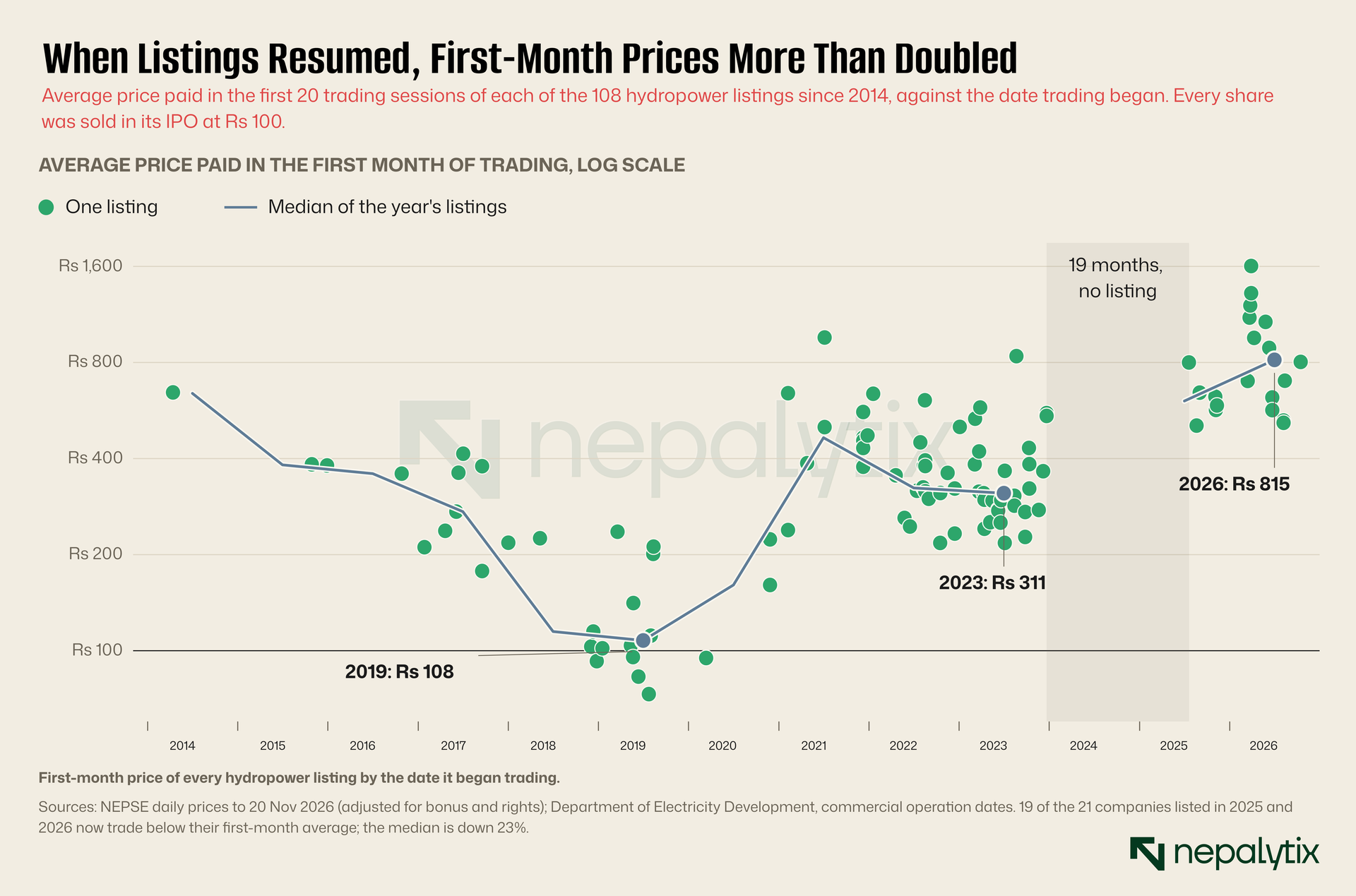
In 2023, the last year before the freeze, the typical new hydropower share cost Rs 311 in its first month. In 2025 it was Rs 606. In 2026 it's Rs 815.
The market explains a little of that. The index was roughly 40% higher when this year's companies listed than when 2023's did. First-month prices are 160% higher. The companies are the same sort of company, sold at the same Rs 100. What changed is that applicants had waited a year and a half for a lottery ticket.
The result is the worst cohort in the sample. Of the 21 companies listed since trading resumed, 19 now sit below their first-month average. The median first-month buyer is down 23%, most of them within months. The five that listed in the three weeks from 22 March are each down between 45% and 55%.
A pause that was meant to protect investors produced the most expensive entry prices in twelve years and then the usual thing happened to people who paid them.
That's the risk in any rule whose main effect is to make listings rarer. And it's worth looking at who is actually in the queue.
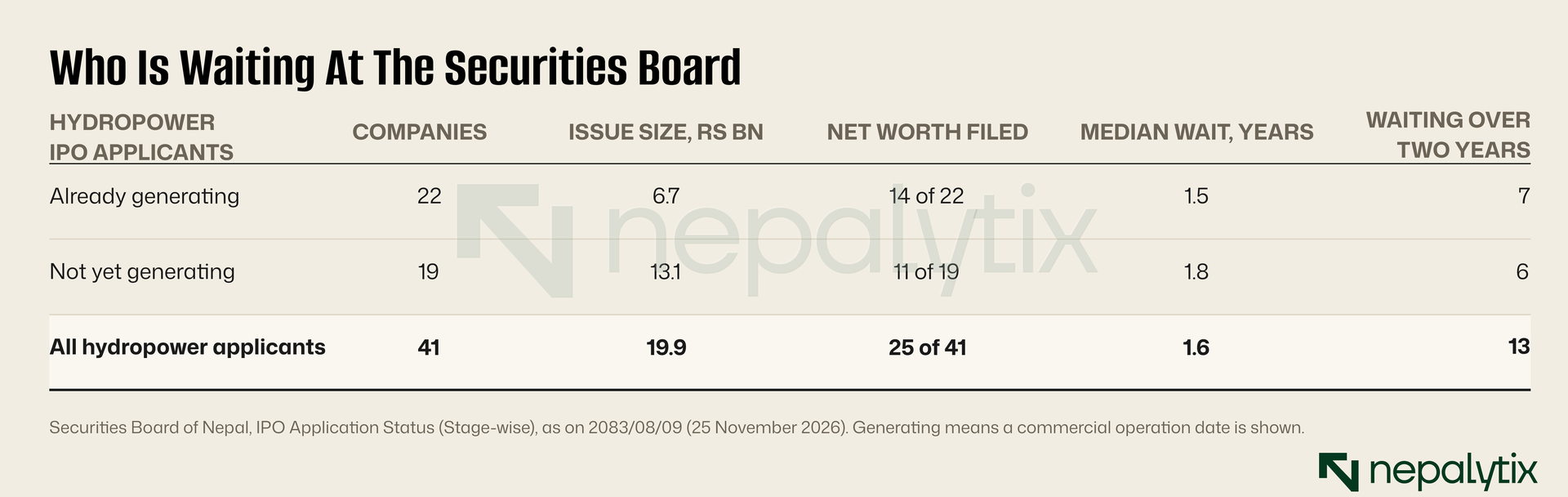
On the Board's sheet dated today, 41 hydropower companies have IPO applications in, for Rs 19.9 billion in all. The median applicant has been waiting 1.6 years. Thirteen have waited more than two.
Twenty-two of the 41 are already generating. A construction threshold has nothing to say to them. One, Sanima Hydropower has been selling electricity since March 2005, reports a net worth of Rs 264 a share and applied in May 2023. It's still waiting.
The other 19, worth Rs 13.1 billion are the ones the 50% rule is about. So the rule matters for who gets in. Just not, on twelve years of evidence, for what happens to the people who buy.
One smaller thing in that table is a familiar one. The Board's pipeline sheet now asks each hydropower applicant for two numbers: net worth per share and commercial operation date. Neither tells you whether a plant is any good. The number that does is how much energy it delivers against what it contracted to deliver, month by month. Every company has that figure, because it's how it gets paid. No rule asks for it. We keep finding the same gap in sector after sector: the regulator collects the accounting number and not the operating one.
So Why Not Just Wait For Power?
The cleanest alternative is the Khanal commission's: no shares until the plant runs. Plenty of investors want it, and it has the appeal of being easy to check.
We can say what it would have done. Of the 40 companies that listed half-built, 36 are generating now. A generation-first rule would have delayed 23 of them by less than a year and nine by more than two. It would have kept Greenlife and the others still waiting off the board altogether.
What it wouldn't have done is change the outcome for buyers. That's the whole point of the comparison in this piece: the 68 companies that did wait for power are the control group, and their market buyers lost money just as often, paid more to get in and fell just as far in year three.
Meanwhile the cost lands on the project. Equity that arrives two years later is two more years of borrowing at construction-stage rates, on the largest projects in the pipeline. And if the freeze is any guide, fewer listings a year means a higher price for each one which is the opposite of protection for the person buying in the market.
We'd take generation-first over nothing. We just can't find the investor it would have saved.
What A Rule For The Right Investor Would Say
If we were drafting, we wouldn't start with the IPO.
We'd start with year three. A cliff where four fifths of a company's shares unlock on one morning is a design choice, and the Board's own committee has already said what it leads to. Release promoter shares in stages: a slice a year, say, over four or five years. And start the clock when the plant runs, not when the IPO is allotted so that nobody can sell out of a project they haven't finished.
Promoters will object that they need a way out, and they do. A developer who can never sell can't recycle capital into the next project. But there's a lot of room between never and all at once and the Post's reporting suggests people in the market have been asking for a gradual release for a while. It costs the Treasury nothing. It's aimed squarely at the nine months in which the median shareholder loses a fifth against the market.
Second, we'd let construction-stage companies price their shares. Not freely, since nobody would trust that yet. But Nepal already has a book-building directive, and institutions that can read a cost-to-complete schedule. Let them set a range, sell part of the issue to them at that price, and run the lottery at a discount to it. Selling at Rs 100 what trades at Rs 363 a month later isn't investor protection. It's a subsidy to lottery winners, paid for by the project.
The honest objection is that a higher issue price takes away the allottee's cushion. It does. In 2019 that cushion was the difference between a small loss and a large one. But the cushion isn't free: it's Rs 116 billion that projects didn't get and it's the reason two and a half million people queue for a single issue.
Third, we'd keep every disclosure condition in the draft and make it permanent. Certified progress, cost to complete and the expected date of first power, every quarter until the plant runs. After that, energy delivered against contract, every month. The companies that kept shareholders waiting five years weren't hiding at the IPO. They went quiet after it.
None of these needs an ordinance. The lock-in is in the Board's regulations. Pricing is in its guidelines. Disclosure is a listing condition. That's rather the point: the tools for protecting the market buyer are already on the regulator's desk, and the one piece of primary legislation on offer is being spent on the entrance.
What would change our mind? Two things. If the next few years of listings show half-built companies doing clearly worse for market buyers, the case for a threshold gets stronger and we've published the method so anyone can rerun it. And if someone can show that the year-three slide is something other than the unlock, say a tax date or an accounting event we've missed, the lock-in argument weakens. We looked and didn't find one. The slide shows up in companies that listed in four different years, and it shows up on time.
And the 50% line? Keep it if you like. It's been in the Commission's directive for five years and the sky hasn't fallen. It'll stop the occasional company from listing on a licence and a dream. But it shouldn't be sold as the thing that makes hydropower shares safe and it shouldn't use up the one slot in an ordinance that could have fixed something.
The person it protects pays Rs 100, by lottery and hasn't lost money on a hydropower listing since 2021. The person who needs protecting pays Rs 363 a month later and nobody has written a rule for them yet.
Disclaimer
This report has been prepared by Nepalytix for informational and educational purposes only and does not constitute investment advice, an offer, or a solicitation to buy or sell any securities.
The information contained in this report is based on sources believed to be reliable; however, Nepalytix does not guarantee its accuracy, completeness, or timeliness. Opinions, estimates, and projections expressed herein are those of the authors as of the date of publication and are subject to change without notice.
Investing in securities involves risks, including the possible loss of principal. Past performance is not indicative of future results. Readers are advised to conduct their own independent research and consult with a qualified financial advisor before making any investment decisions.
Nepalytix and its contributors may hold positions in the securities discussed in this report at the time of publication or thereafter.
Neither Nepalytix nor any of its affiliates accept any liability for any loss arising from the use of this report or its contents.