Nepal waited 12 years to regulate its cooperative sector. The bill grew 36×.
Nepal's cooperative crisis was not caused by a lack of warnings-it was the result of more than a decade of regulatory inaction.

In 2013 a government commission reported that 162 cooperatives were in trouble and 22,170 depositors were owed Rs 7.61 billion. The regulator opened for business on 27 January 2025. In the twelve years between, the bill grew thirty-six times.
The National Cooperative Regulatory Authority came into operation on 27 January 2025 created by ordinance the previous December. Two weeks ago the government enacted the Cooperative (First Amendment) Act, 2083 which gives the authority real powers: savings and credit cooperatives must now hold an operating licence and renew it annually and the state has committed to compensating depositors where a failed cooperative's assets fall short.
These are good measures. We support them. They are also on the evidence below arriving after the money is gone and the honest way to write about them is to say both things at once.
This piece is an argument not a report. The argument is that Nepal's cooperative failure was not a failure of information, the information was excellent and early but a failure of political will, and that the institution now being built is being asked to do a job that has already been made almost impossible by the delay.
One clarification before the evidence because the word "cooperative" carries a lot of freight in Nepal and the argument is not against cooperatives. The sector genuinely reaches people commercial banking does not. Seven and a half million members is a quarter of the country. Agricultural cooperatives, dairy cooperatives, women's savings groups in districts with no bank branch, these institutions do work no NEPSE-listed bank has ever shown interest in doing and the constitutional decision to name them a pillar of the economy was defensible.
The argument is narrower and it is this: an institution that takes deposits from the public and lends them out is a bank, whatever its legal form and however admirable its founding purpose. Nepal allowed several thousand such institutions to operate at scale with no prudential supervisor for three decades. The cooperative principle is not what failed. The absence of a supervisor is.
They were told in 2013
In 2013 the government formed a probe commission to investigate mismanagement in the cooperative sector. It reported findings that read, thirteen years later, like a prophecy written in the past tense.
The commission found that cooperative operators were taking loans from their own institutions and not repaying them for years. It found books of accounts that were not transparent, annual general meetings that had not been held for years, cooperatives that had failed to settle dues to banks, and cooperatives blacklisted by the Credit Information Bureau. It counted 22,170 depositors who had not received Rs 7.61 billion of savings before interest. It identified 162 cooperatives as problematic and recommended their proper management.
Every structural feature of the crisis that would consume the sector over the following decade is in that list. Insider lending. Governance failure. No audit trail. No enforcement.
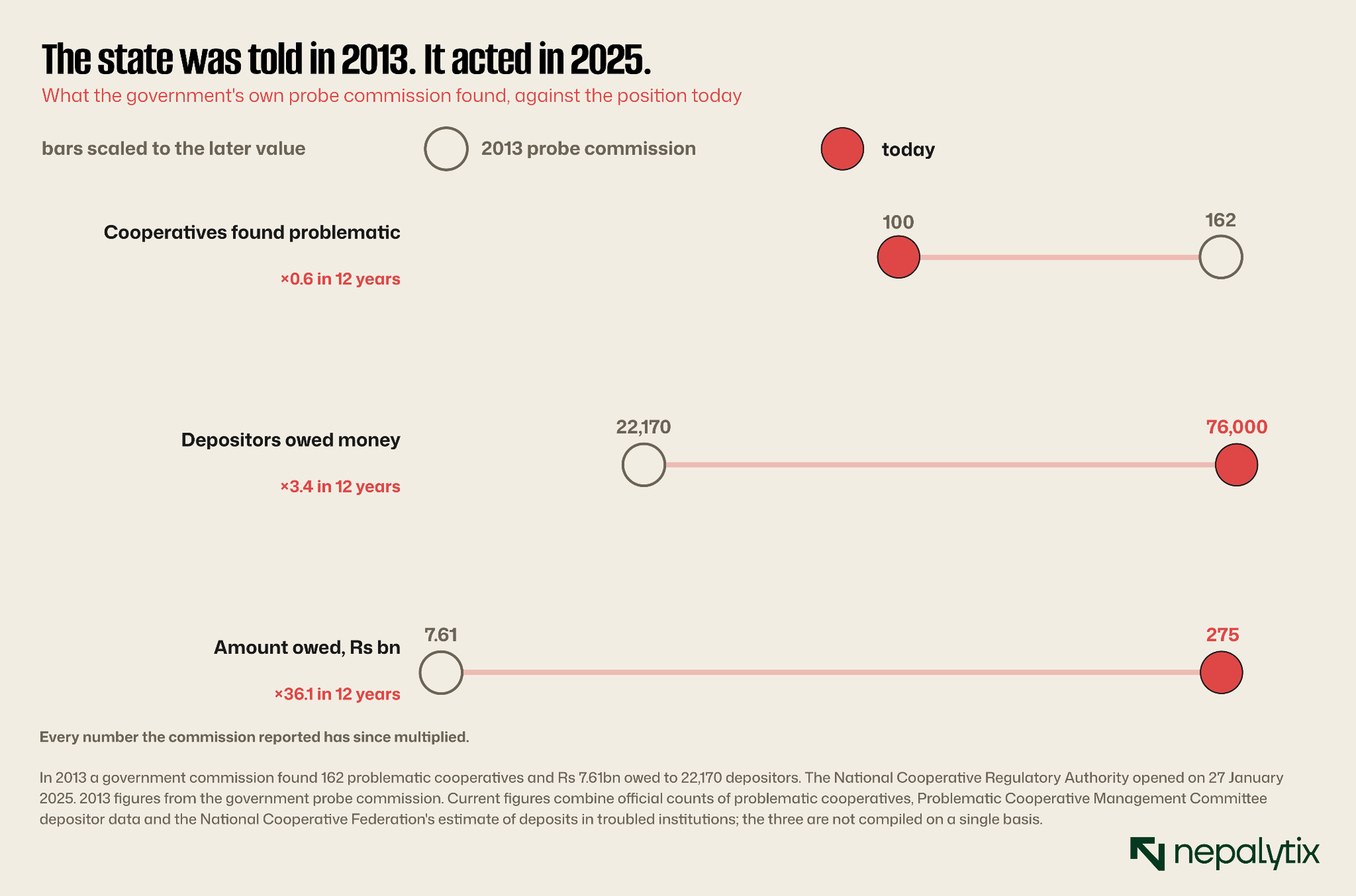
Note the middle row, because it is the one that indicates. Depositors owed money went from 22,170 to roughly 76,000 a tripling. But the amount owed went from Rs 7.61 billion to Rs 275 billion, a multiple of thirty-six. The number of victims grew; the money each of them lost grew far faster. That is what an unsupervised deposit-taking sector does when it is left to compound: the institutions that were already insolvent in 2013 kept taking deposits and used the new money to pay the old.
The commission's report was not ignored because it was wrong. It was ignored because acting on it would have required somebody powerful to lose.
Consider what the state did instead. In 2015 the new Constitution named cooperatives one of the three pillars of the national economy, alongside the public and private sectors, a statement of ambition with no supervisory content. In 2017 Parliament passed a new Cooperative Act, the obvious vehicle for creating a prudential regulator four years after the commission reported. It did not create one.
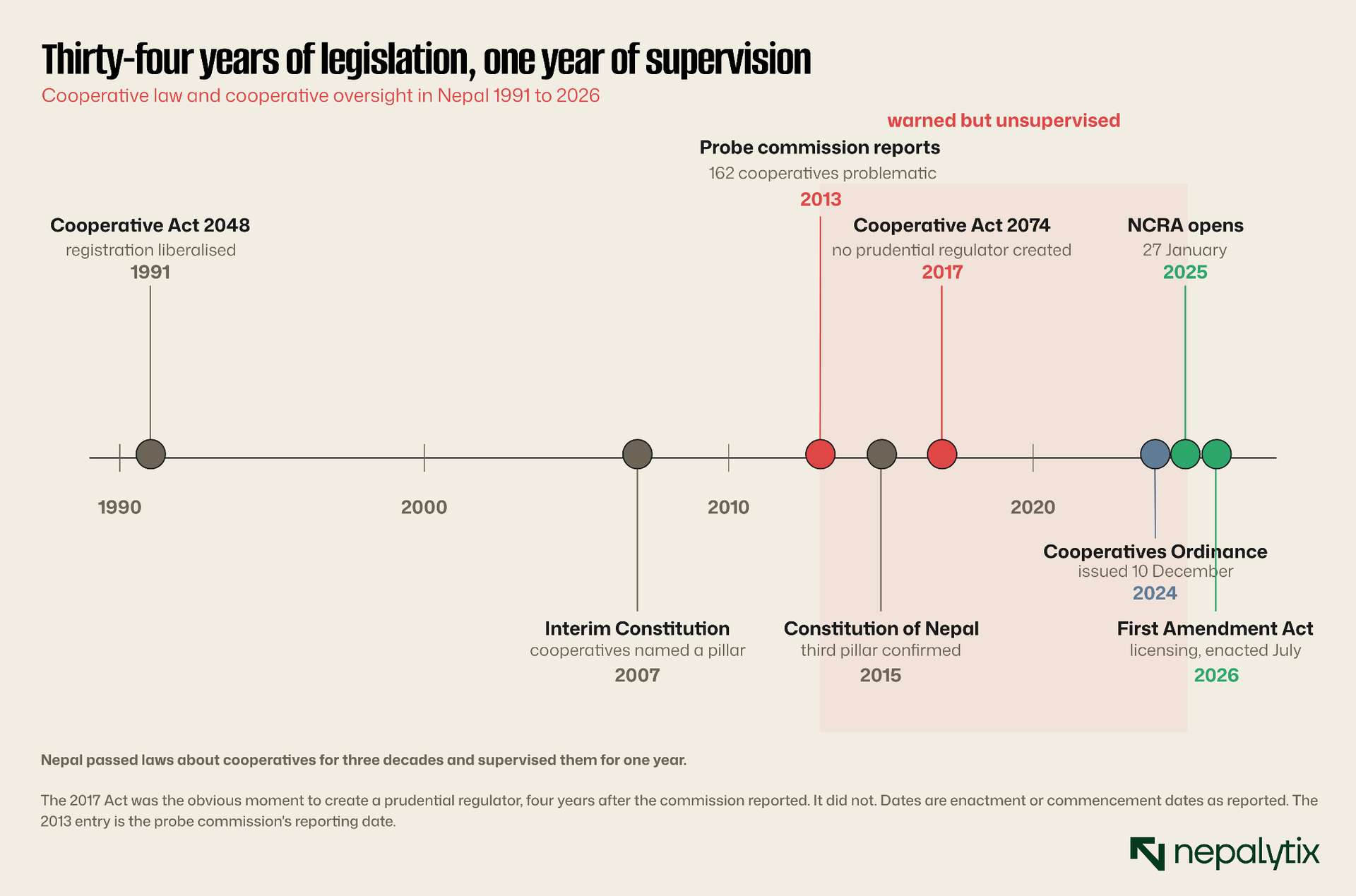
Thirty-four years of legislating about cooperatives. Eighteen months of supervising them. The chart is not a rhetorical device; it is the actual record.
It is worth being precise about what the state had in its hands, because the standard defence is that nobody understood cooperative risk in 2013. That is not what the record shows. The commission did not report a vague sense of unease. It reported a specific, recognisable pattern of financial institution failure: related-party lending to directors, non-performing loans left unclassified, accounts that could not be audited, meetings not held and institutions already blacklisted by the country's own credit bureau. Any bank supervisor reading that list would have known exactly what it meant.
It meant the institutions were insolvent and still open. A cooperative that has lent to its own directors and cannot recover is not illiquid; it is broke. Leaving it open means it must keep taking deposits to pay withdrawals which is the definition of the structure that turns a Rs 7.61 billion problem into a Rs 275 billion one. Every month of inaction after 2013 was a month in which a savings clerk somewhere accepted a farmer's money into an institution the state already knew could not return it.
What twelve years of silence cost
The sector Nepal left unsupervised was not small and this is the part that makes the omission difficult to defend on grounds of proportionality.
By March 2024 Nepal had 31,450 cooperatives with 7,383,528 members roughly a quarter of the population holding Rs 478.11 billion of deposits against Rs 453 billion of credit, employing 94,000 people. Around 15,000 of those cooperatives were registered to collect deposits.
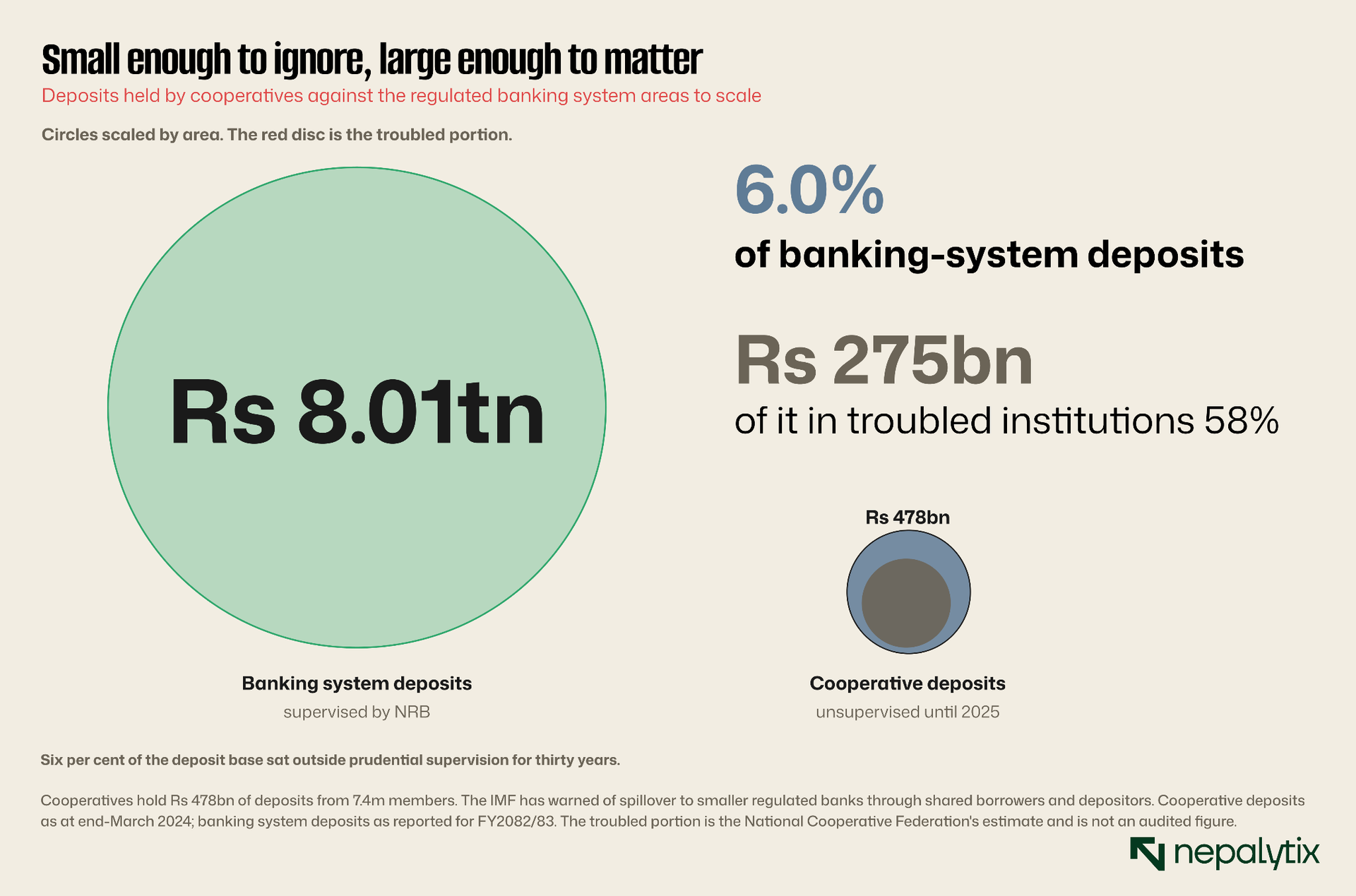
Six per cent of the national deposit base. Small enough that a finance ministry could look past it; large enough that a quarter of the country had money in it. The IMF has warned of spillover risk to smaller regulated banks through shared borrowers and shared depositors which is the precise mechanism by which a shadow deposit sector stops being somebody else's problem.
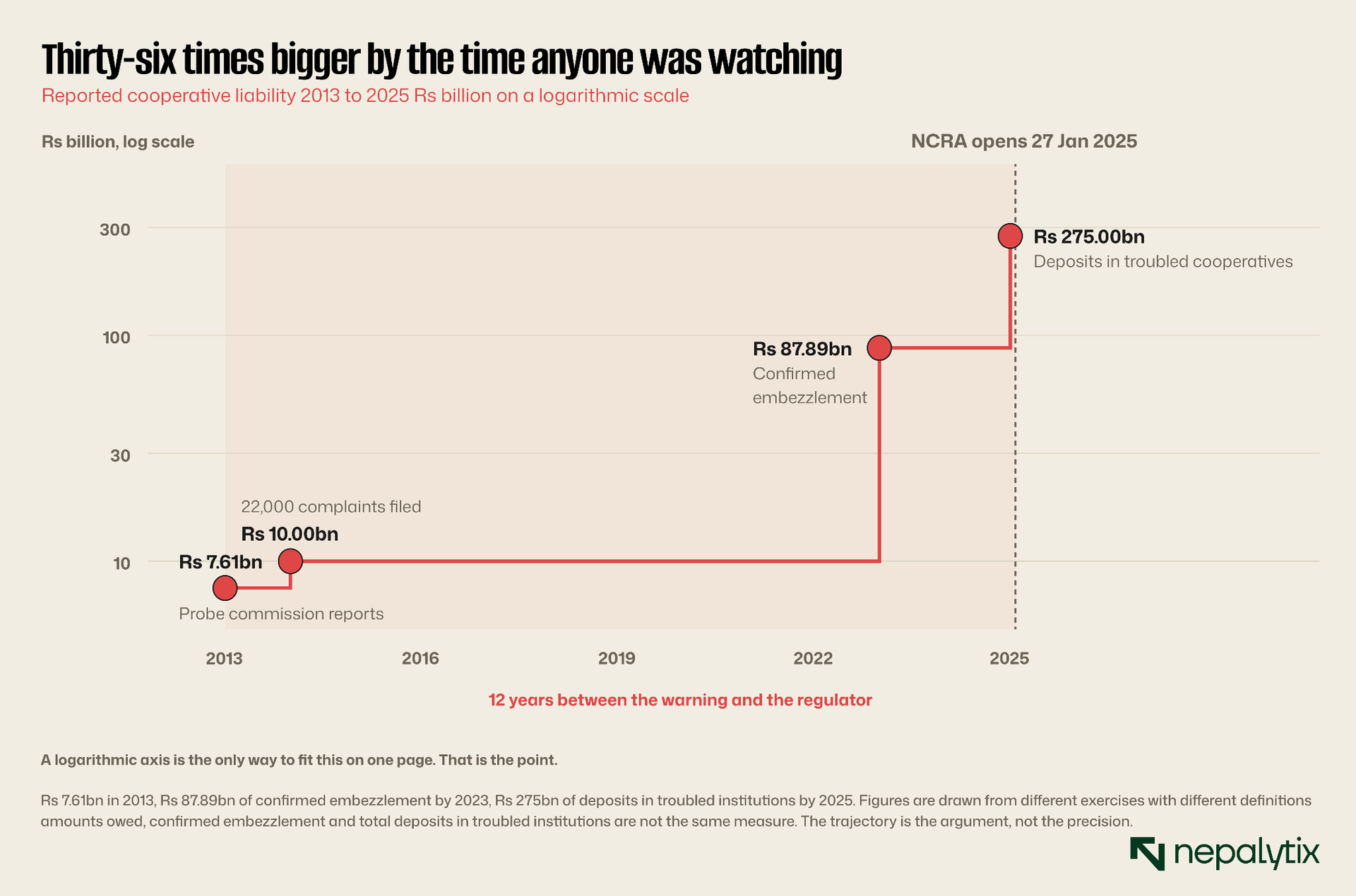
A logarithmic axis is the only way to fit thirteen years of this on one page and that fact is itself the finding.
The geographic concentration is worth naming too, because it disposes of another defence that the problem was diffuse and therefore hard to see. It was not diffuse. Bagmati province holds 2,716 cooperatives, close to a third of the country's active total. Within Bagmati, Kathmandu alone has 866, of which 96 have been implicated in mismanaging depositors funds. Forty Bagmati cooperatives are formally labelled problematic and a further 205 are recorded as facing difficulties.
So the epicentre of a national financial scandal sat in the capital city, in institutions registered with authorities a short drive from the ministry responsible for them at a concentration an inspector could have walked between. This was not a supervision problem of remote geography and poor communications. The institutions that failed were the ones closest to the state.
Nobody can say how big the hole is
Here is a detail that deserves more attention than it gets. Ask how much money is missing from Nepal's cooperatives and you will get three answers and they differ by a factor of six.
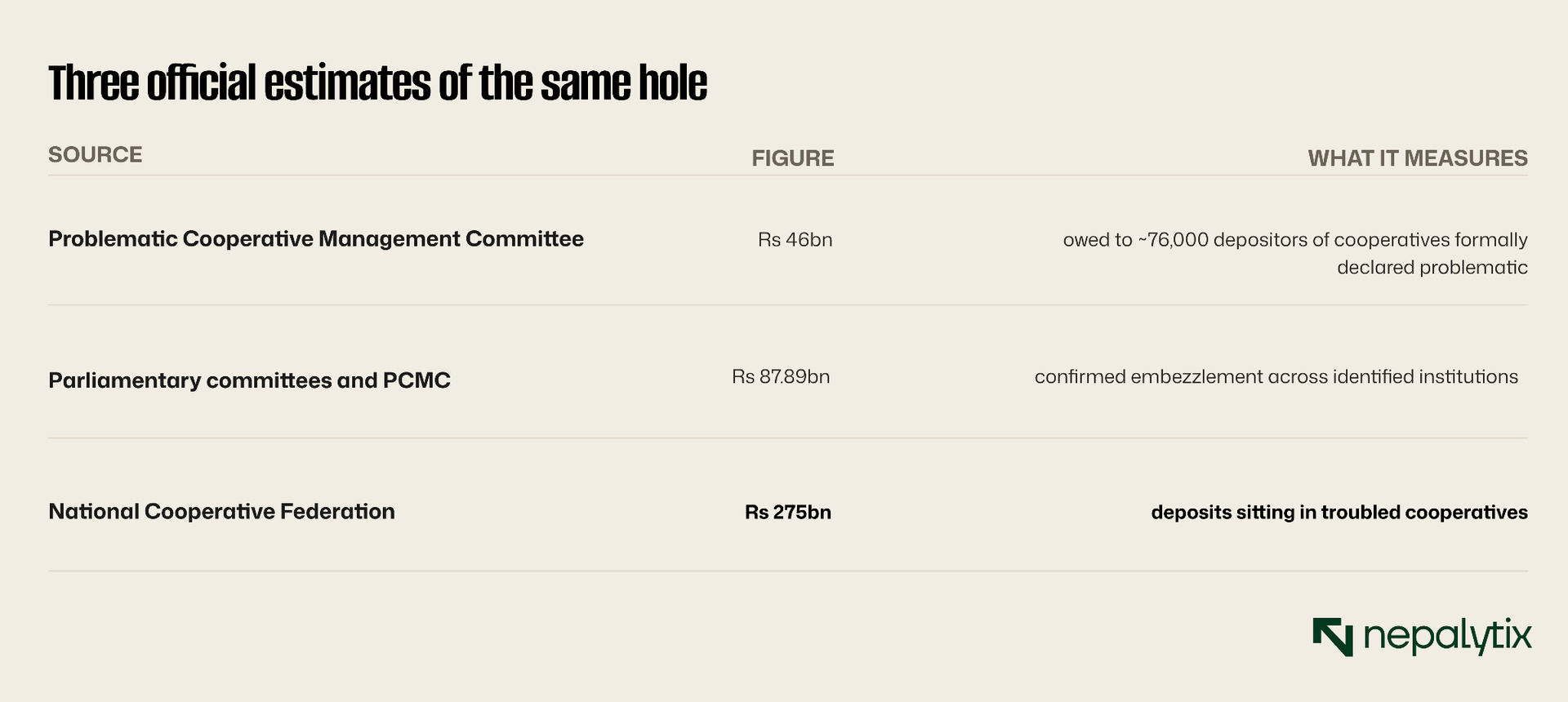
Thirteen years after the first commission and eighteen months after the regulator opened, the Nepali state cannot tell its citizens the size of the loss to within a factor of six. That is not a data problem. It is the direct, predictable consequence of having no supervisor: nobody was collecting returns so nobody has a denominator.
There is a further consequence of the missing denominator that deserves stating because it will shape the next several years. Without a reconciled figure, the government cannot size the fiscal commitment it has just made. The July 2026 Act commits the state to compensating depositors where a failed cooperative's assets fall short. That is a contingent liability on the public balance sheet and its magnitude is somewhere between Rs 46 billion and Rs 275 billion depending on which official estimate you believe.
A government that legislates a guarantee without knowing its size has done something genuinely risky. Rs 46 billion is manageable. Rs 275 billion is roughly a fifth of annual revenue. The difference between those two numbers is not an accounting nicety; it is the difference between a policy and a fiscal event and the state currently cannot say which one it has enacted.
The regulator arrived without a staff
Give the NCRA its due first. In eighteen months it has drafted inspection protocols, prepared regulations and begun recommending further institutions for problematic designation sixteen more in Kathmandu alone in recent months. Those are the right first moves.
Now the arithmetic of what it has been asked to do.
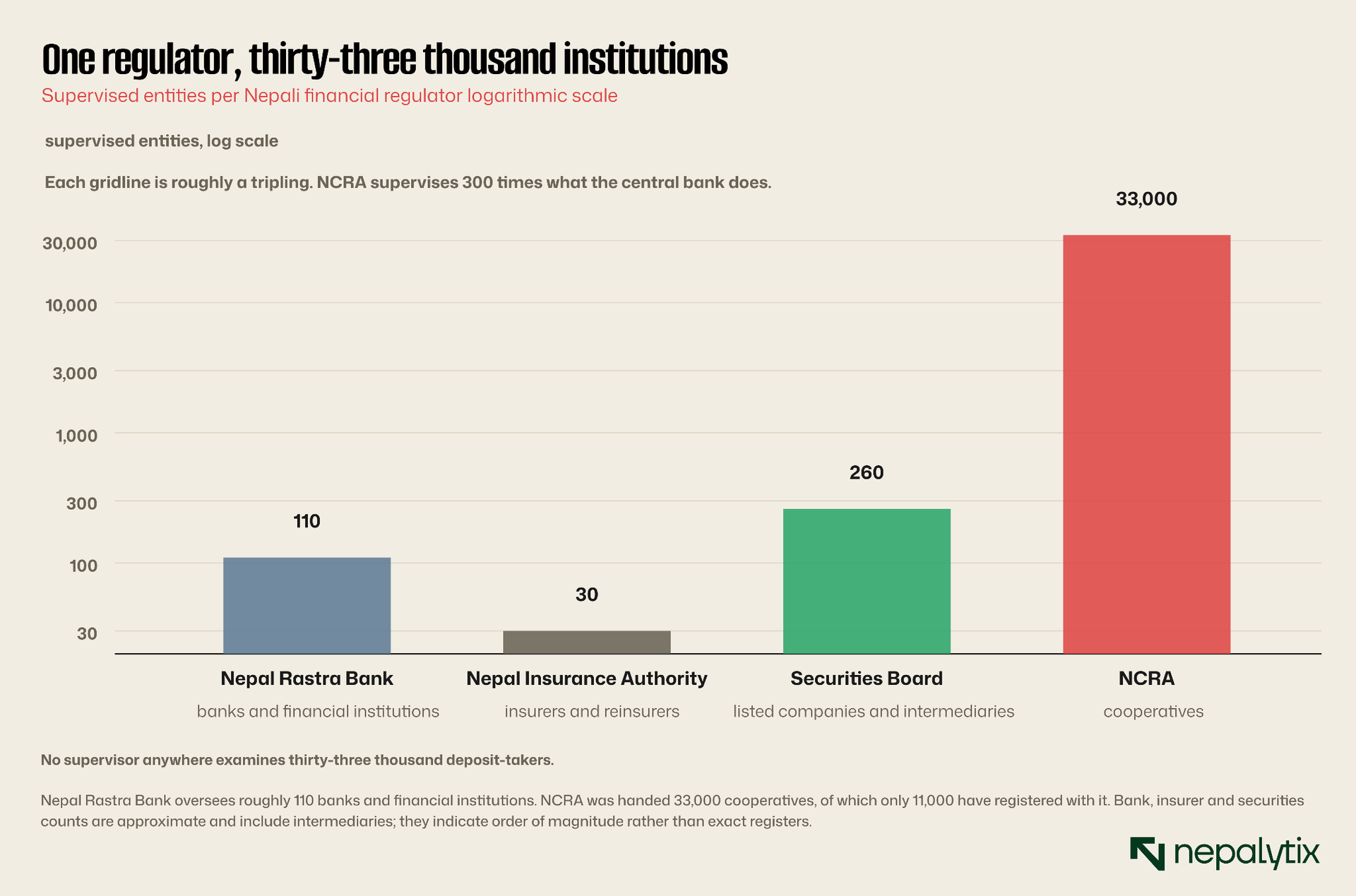
Nepal Rastra Bank supervises roughly 110 banks and financial institutions and is stretched doing it. The Nepal Insurance Authority has around 30 insurers. The Securities Board oversees a few hundred listed companies and intermediaries.
The NCRA was handed 33,000 institutions.
That is not a hard job. It is a different category of job and no supervisor anywhere in the world conducts prudential examinations of thirty-three thousand deposit-takers. The comparison is roughly three hundred to one against the central bank.
The practical position confirms it. Only about 11,000 of the 33,000 cooperatives have registered with the authority, a third. No full organisation and management survey has been completed. Permanent staffing is incomplete. An authority that cannot yet count its own supervised population cannot examine it.
The design flaw
A regulator created to solve a crisis in roughly one hundred large institutions was given a mandate over thirty-three thousand, most of which are small, rural, solvent and entirely beside the point.
That is not caution. It is the most reliable way to ensure the hundred that matter are never examined properly because the authority's scarce inspection capacity is spread across a register two orders of magnitude too large.
It is also worth asking what the delay did to the honest majority of the sector because they are the second set of victims and they get almost no attention. A dairy cooperative in Ilam that has never missed an audit now operates under a licensing regime, savings caps, lending restrictions and quarterly reporting obligations designed to catch fraud it never committed. Its compliance cost has risen because a hundred urban savings institutions in Kathmandu were allowed to steal for a decade.
That is the ordinary tax that regulatory failure levies on the compliant, and it is why the tiering argument later in this piece matters so much. Every year the state fails to distinguish between a Rs 5 billion urban savings and credit institution and a village agricultural cooperative, it applies the same rulebook to both and makes the second one poorer for the sins of the first.
The refund arithmetic is an insult
The clearest test of whether an institution is working is not what it says but what reaches the person it was built to protect.
In the two months to 29 June 2026, the Problematic Cooperative Management Committee returned Rs 26.39 million to 1,754 depositors drawn from ten of the twenty-three cooperatives the federal government has declared problematic. Against Rs 46 billion owed to roughly 76,000 people.
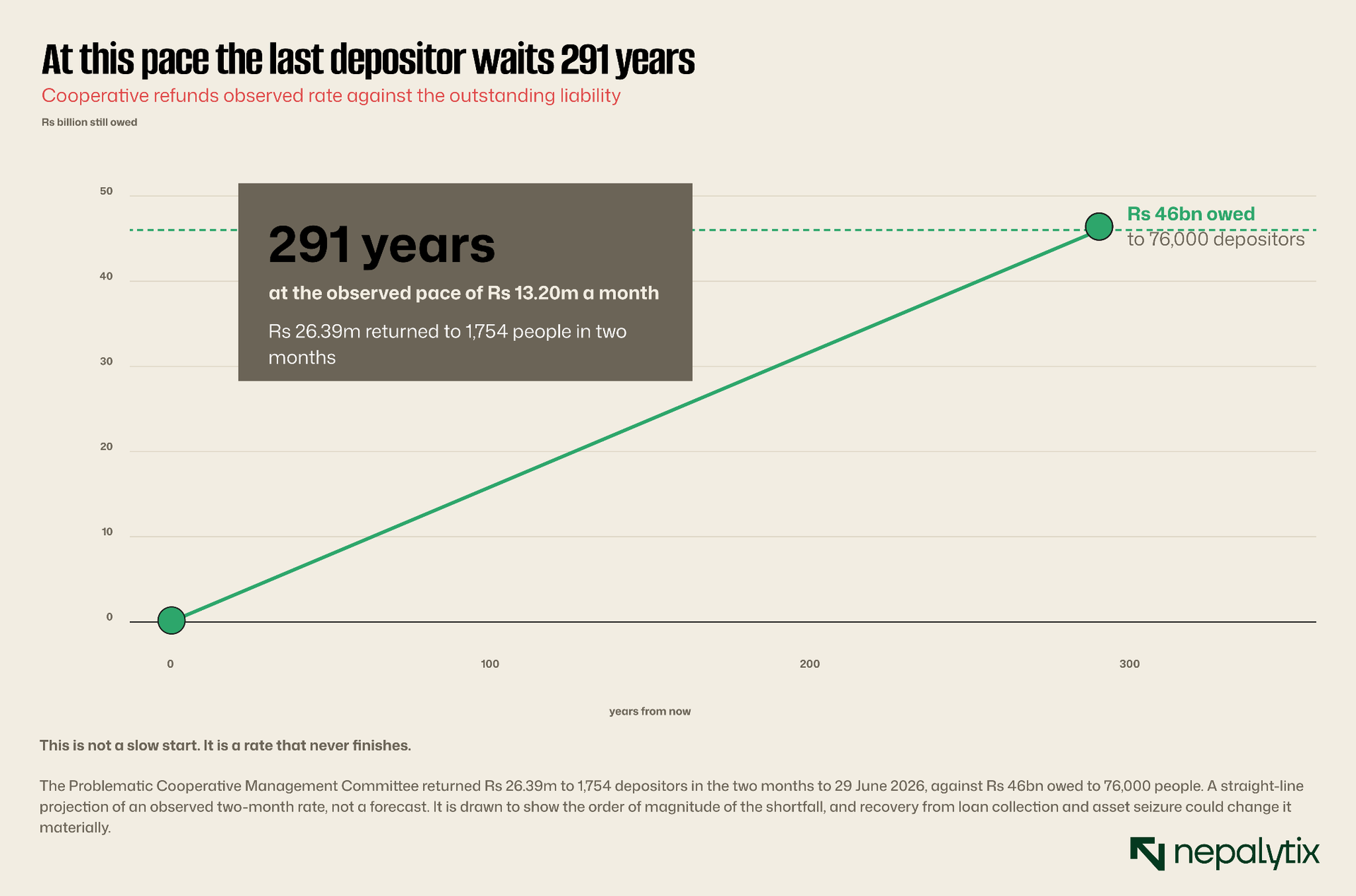
At that pace it takes 291 years. The 1,754 depositors repaid are 2.3% of the queue. The Rs 26.39 million is 0.057% of the money.
We are not suggesting the committee is idle, and the projection is deliberately crude. Asset seizure and loan recovery are lumpy and could change the slope sharply. The government's Good Governance Roadmap 2026 promises to fast-track refunds for depositors with savings under Rs 100,000 through the Deposit and Credit Guarantee Fund with disbursement beginning within a hundred days and if that lands, the picture improves.
But a rate is a fact and this rate is a fact. In Bagmati, the province holding nearly a third of the country's active cooperatives, the provincial committee marked the launch of its own refund process by returning Rs 1.7 million to 42 depositors with plans to reach 1,766. Those are real people getting real money and we do not sneer at it. It is also, set against 76,000 claimants, a rounding error presented as a milestone.
One more structural point about the mandate. Deposit-taking is not the only thing cooperatives do and the register does not distinguish well between the two categories. Roughly 15,000 of the 33,000 are registered for deposit collection, and of the savings and credit institutions specifically, around 14,000 exist on paper with only about 10,000 active, some 4,000 dormant. A supervisor whose register contains four thousand institutions that no longer trade is spending scarce inspection capacity confirming that empty buildings are still empty.
Cleaning the register is unglamorous and it is the highest-return administrative act available to the authority. Every dormant entity struck off is a marginal inspector-hour redirected to an institution that actually holds somebody's savings. It requires no new legislation and no constitutional negotiation with provinces. It requires a decision.
A note on where the money went because the diversion pattern explains why recovery is so slow. Cooperative funds were not simply stolen and spirited abroad. They were invested arbitrarily and by directors acting for themselves in houses, land, shares, hydropower and in several documented cases, television stations. When those ventures failed or simply became illiquid, the institutions could not return depositors savings.
That matters for the refund arithmetic in two ways. It means there are assets which is why asset seizure and auction feature so heavily in the government's roadmap and why the recovery curve could steepen. It also means those assets are land, buildings and equity stakes in a market where the land price has been flat and NEPSE has spent a year going sideways. Recovering Rs 46 billion by liquidating illiquid assets into a soft market is a slower and lower-yielding exercise than the headline pledge suggests.
And almost nobody is being caught
Recovery is one half of deterrence. Consequence is the other.
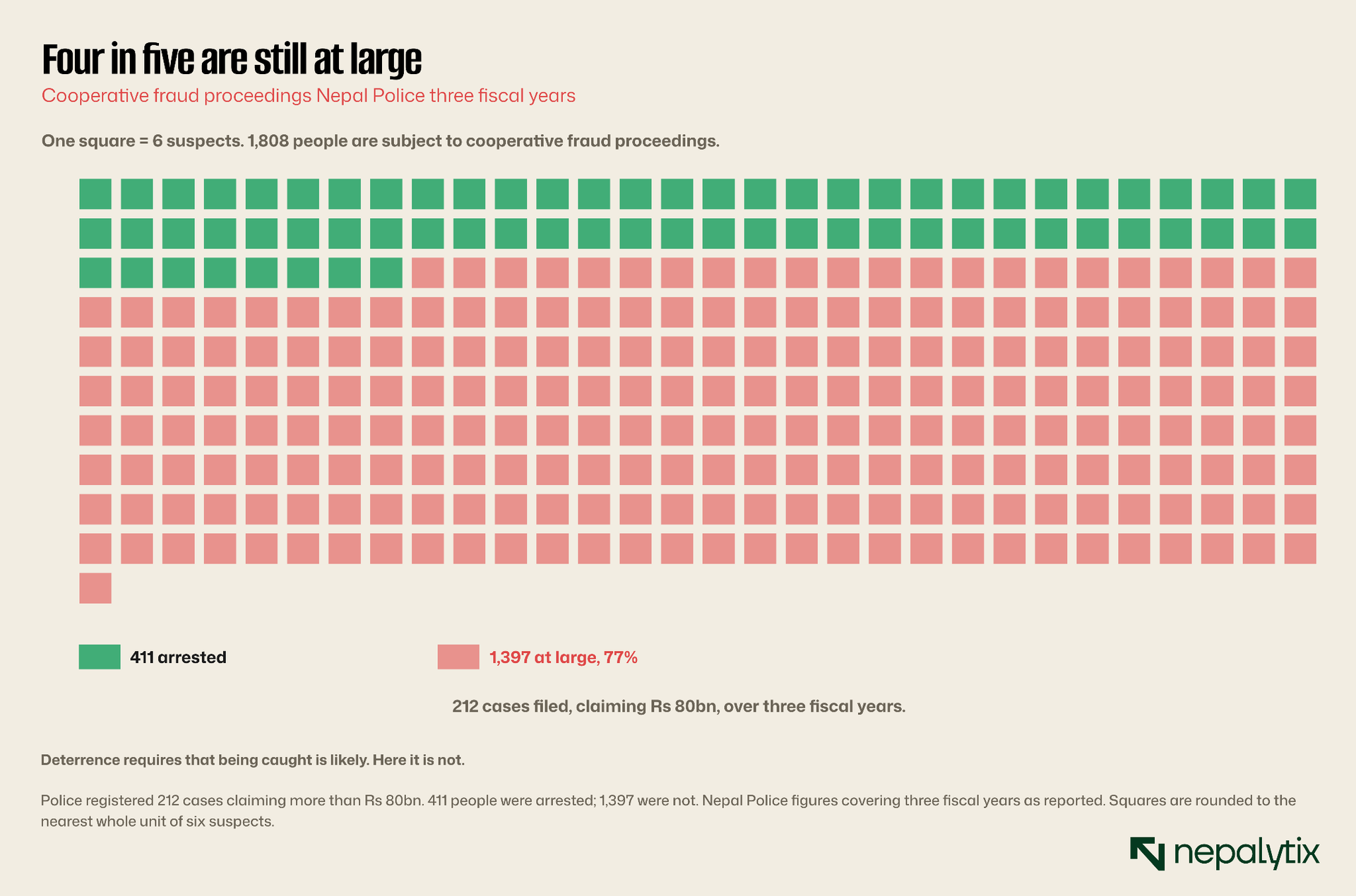
Nepal Police registered 212 cooperative fraud cases claiming more than Rs 80 billion over three fiscal years. They arrested 411 people. A further 1,397 are at large 77% of those subject to proceedings.
The cases that have concluded show what was possible. Dev Kumar Nepali, former mayor of Dhorpatan Municipality was accused of embezzling over Rs 2.25 billion through the Image Savings and Credit Cooperative he founded and chaired. He evaded authorities for months, was arrested in New Delhi in September 2024, and extradited. Lawmakers, local representatives, media entrepreneurs and ministers have been arrested in cooperative cases.
That last sentence is the political economy of the whole affair in one line. The cooperative sector was not unsupervised by oversight. It was unsupervised because the people who would have had to build the supervision were in a meaningful number of cases, the people it would have caught.
There is a further reason the enforcement numbers matter beyond justice for the people already robbed. Prudential supervision only works if the people running institutions believe that stealing carries a cost. That belief is formed by observation. What a cooperative director in Nepal has been able to observe over the last decade is that roughly four in five people accused of cooperative fraud are not in custody, that cases take years and that some of those charged held public office throughout.
No licensing regime survives that. The July 2026 Act can require annual renewal, and the NCRA can write inspection protocols, but a director who calculates that the expected cost of diversion is low will divert. Enforcement is not a separate workstream from supervision; it is the thing that makes supervision credible, and it is currently the weakest link in the chain.
The comparison that should embarrass everyone involved is with the banking sector's own recent history. When Nepal's banks came under asset-quality pressure, Nepal Rastra Bank responded within a single fiscal year: it tightened interest-income recognition, forced unrealised interest into regulatory reserves, required prior approval of financial statements before publication and restricted dividend distribution at institutions that failed the tests. Whatever one thinks of those measures, the machinery existed and it moved.
The cooperative sector, holding six per cent of the same deposit base and reaching a quarter of the population, had none of that machinery at all. Not weaker versions of it. None. There was no capital adequacy requirement, no provisioning standard, no prior-approval regime, no restriction on distributing profit that had not been earned, and no supervisor with the authority to demand a return. A depositor at a commercial bank and a depositor at a savings and credit cooperative in the same town were exposed to institutions regulated on entirely different planets, and almost none of them knew it.
The case for the defence
We should put the strongest version of the other side, because parts of it are genuinely persuasive and a Take that only prosecutes is propaganda.
What a fair-minded official would say
Federalism made this constitutionally hard. Nepal's 2015 Constitution distributes cooperative jurisdiction across federal, provincial and local governments. Cooperatives are registered at the local level. Building a federal prudential regulator over locally-registered entities is not a matter of political will alone; it required resolving a genuine constitutional allocation, and the 2024 ordinance did exactly that by establishing regulation "under the ownership of all three levels of government."
The sector is overwhelmingly sound. Around 100 cooperatives of 33,000 are officially considered problematic 0.3%. Building a heavy prudential apparatus over 33,000 mostly small rural institutions to catch a hundred bad ones imposes compliance costs on the 32,900 that are working. Those institutions provide financial access in places no commercial bank will go.
Capacity is real, not an excuse. Nepal Rastra Bank took decades to build supervisory capability over a hundred banks. Standing up an equivalent function over a register three hundred times larger, from nothing, in eighteen months, was never going to be quick. Criticising the NCRA for incomplete staffing in its second year is criticising it for not being older.
Something is finally being done. The ordinance imposed savings and lending limits of Rs 1 million within a district, Rs 2.5 million within a province and Rs 5 million nationally. It set director term limits, banned membership of multiple cooperatives of the same type, and required quarterly defaulter reporting to the Credit Information Bureau. NRB has required large cooperatives to place at least half their loan book in productive sectors by mid-July 2026. The July 2026 Act adds annual licensing. This is a coherent package.
The first argument is the serious one and we concede a great deal of it. Federal structure genuinely complicated the design and anyone who has watched Nepali institution-building knows that jurisdiction disputes can consume years without any bad faith at all.
But it does not survive the dates. The commission reported in 2013 two years before the federal Constitution existed. The 2017 Cooperative Act was passed by a Parliament that had the commission's findings, the constitutional framework and a clear mandate to legislate. It chose not to create a supervisor. Federalism explains why a solution would have been complicated. It does not explain why nobody attempted one.
The second argument that only 0.3% are problematic is true and beside the point. Deposit-taking failures are not evenly distributed and never have been. The hundred problematic institutions are the large savings and credit cooperatives, and they hold a share of sector deposits vastly out of proportion to their number. A regulator that congratulates itself on 99.7% soundness while the concentrated part fails has measured the wrong thing.
The third argument on capacity we accept almost entirely and it is the reason this piece criticises the mandate rather than the staff. An authority asked to do an impossible job will fail at it, and the failure belongs to whoever wrote the mandate. Our quarrel is with a design that guarantees the institution cannot succeed not with the people inside it.
The fourth argument that the package is coherent, is the one we find least persuasive. The measures are individually sensible and collectively unsequenced. Savings limits of Rs 1 million, Rs 2.5 million and Rs 5 million by tier of operation are reasonable rules for a functioning sector. They do nothing for a depositor whose money went missing in 2019. Requiring large cooperatives to place half their loan book in productive sectors is sound development policy and has no bearing on recovering diverted funds. Term limits for directors prevent the next entrenchment and reverse none of the last one.
The package is a prevention regime being applied to a resolution problem. Nepal needs both. It has legislated mostly the first.
We should also concede the timing point in the government's favour. The administration that inherited this file took office after the March 2026 elections, placed cooperative reform at the centre of its Good Governance Roadmap within weeks, moved an ordinance through Cabinet in April and enacted the amending legislation in July. Whatever the merits of the design, that is a faster four months than the previous twelve years produced in total, and pretending otherwise would be dishonest.
What would actually work
Criticism without prescription is just noise, so here is what we would do, in order.
Tier the register and stop pretending. The single most useful reform available is to formally divide the 33,000 into a supervised tier and a registered tier. Direct prudential examination should apply to the several hundred to a thousand institutions that hold the overwhelming majority of deposits, the ones capable of causing systemic damage. Everything below a size threshold should face registration, standardised reporting and audit requirements but not examination. The ordinance's three-level categorisation gestures at this. It needs to become an explicit supervisory allocation of scarce inspectors.
Separate promotion from supervision, permanently. The Good Governance Roadmap commits to abolishing the Department of Cooperatives. It should be done and it should be irreversible. A body that exists to promote cooperative formation cannot credibly police cooperative failure and the last three decades are the proof.
Deposit insurance with risk-based premiums. The Deposit and Credit Guarantee Fund is already being used for emergency refunds. Turn it into a standing scheme for licensed savings and credit cooperatives funded by premiums that rise with the institution's risk profile. This does two things at once: it protects small savers and it creates a second party, the insurer with a financial interest in monitoring which is exactly what has been missing.
Give the authority a recovery tribunal. The parliamentary special committee recommended a Debt Recovery Tribunal and a Credit Information Centre. The credit information piece is in the ordinance. The tribunal is not and without it the refund arithmetic in Figure 6 does not change because recovery depends on a court system that takes years per case while 1,397 suspects remain at large.
Publish one number, quarterly. The state should publish a single reconciled estimate of the total cooperative liability, with methodology, every quarter. Not three numbers from three bodies differing sixfold. Until the government can say how much is missing, no assessment of whether it is being recovered is possible including this one.
Set a deadline for the register. The authority has 11,000 of 33,000 registered after eighteen months. Registration should carry a hard date after which an unregistered savings and credit cooperative cannot legally accept a deposit. This is the one lever that converts a voluntary compliance rate into a mandatory one and it costs nothing.
None of these five requires a constitutional amendment, a new ordinance, or a negotiation with seven provinces. Four of them are administrative decisions inside the authority's existing powers. The tribunal needs legislation, and it was recommended by Parliament's own special committee years ago.
Publish the inspection record. The authority should name, quarterly, how many on-site examinations it conducted, at which institutions and what it found. Supervisory transparency is the cheapest discipline available: a director who knows an examination result will be published behaves differently from one who does not. Nepal Rastra Bank publishes far more about the banks it supervises than the NCRA currently publishes about cooperatives and there is no principled reason for the asymmetry given that cooperative depositors have demonstrably less protection.
Taken together these six measures share a common logic. They accept that the authority cannot examine 33,000 institutions and stop pretending it will. They concentrate scarce supervisory attention where the deposits actually are. They create parties other than the state, an insurer, a tribunal, a reading public with an interest in monitoring. And they make the compliant majority of the sector cheaper to run rather than more expensive, which is the only way a licensing regime survives contact with a village dairy cooperative.
The verdict
Nepal is building the right institution. The National Cooperative Regulatory Authority should exist, the July 2026 licensing regime is correct and the officials staffing it are attempting a genuinely difficult task with inadequate resources.
None of that changes the central fact. A government commission described this crisis accurately in 2013 when the bill was Rs 7.61 billion and 22,170 people were owed money. Nepal passed a new Cooperative Act in 2017 and declined to create a regulator. It created one in 2025, by which time the number under discussion was Rs 275 billion roughly 76,000 people were in the queue, and 1,397 of the people responsible had left.
The authority now exists to supervise a sector whose worst institutions have already failed, whose depositors have already lost and whose perpetrators have largely already gone. It has a register three hundred times larger than the central bank's, a third of which has bothered to register and a refund mechanism moving at a rate that clears the queue in the twenty-fourth century.
A regulator built after the loss is not a regulator. It is a receiver.
The distinction is not semantic. A supervisor's job is to examine solvent institutions and intervene before depositors are harmed. A receiver's job is to divide what is left among people who have already been harmed. Nepal has built the second and called it the first, and the difference will be visible in every performance metric the authority publishes for the next five years, because it will be judged on recovery rates it cannot control rather than on failures it prevented.
There is one more thing worth saying about how this ends because the comparison with banking is instructive rather than rhetorical. Nepal Rastra Bank's supervisory capability was not created in a good year. It was built through successive banking problems each of which produced a directive, a reporting requirement or an examination practice that had not existed before. Regulators in frontier markets are almost always built out of the wreckage of the thing they failed to prevent.
That is the charitable reading of where the NCRA stands: it is at the beginning of the process that produced a functioning bank supervisor and it will take a similar length of time. The uncharitable reading is that the banking sector's problems were resolved because the institutions were few, identifiable and systemically important enough that the state had to act. Cooperatives are numerous, dispersed and politically entangled, and the incentive to finish the job weakens every year that passes after the headlines fade.
Which reading proves correct depends almost entirely on decisions taken in the next twelve months while there is still political attention on the file.
The useful question is no longer whether Nepal should have acted sooner. It is whether the institution being built now is being designed to prevent the next cooperative crisis or merely to administer the last one. On the current mandate 33,000 institutions, incomplete staffing, no tribunal, no reconciled loss figure, it is being designed to administer.
That can still be changed. The tiering decision, the tribunal and the deposit insurance scheme are all live policy choices available to this government right now, and it has shown more appetite for cooperative reform than any of its predecessors. We would rather write the piece in 2028 that says the design was fixed than the one that says the second crisis arrived on schedule.
Disclaimer
This report has been prepared by Nepalytix for informational and educational purposes only and does not constitute investment advice, an offer, or a solicitation to buy or sell any securities.
The information contained in this report is based on sources believed to be reliable; however, Nepalytix does not guarantee its accuracy, completeness, or timeliness. Opinions, estimates, and projections expressed herein are those of the authors as of the date of publication and are subject to change without notice.
Investing in securities involves risks, including the possible loss of principal. Past performance is not indicative of future results. Readers are advised to conduct their own independent research and consult with a qualified financial advisor before making any investment decisions.
Nepalytix and its contributors may hold positions in the securities discussed in this report at the time of publication or thereafter.
Neither Nepalytix nor any of its affiliates accept any liability for any loss arising from the use of this report or its contents.