Nepali bank profits increasingly cannot become dividends.
Nepali banks are about to report respectable FY2082/83 profits, but shareholders may be disappointed by lower dividends.
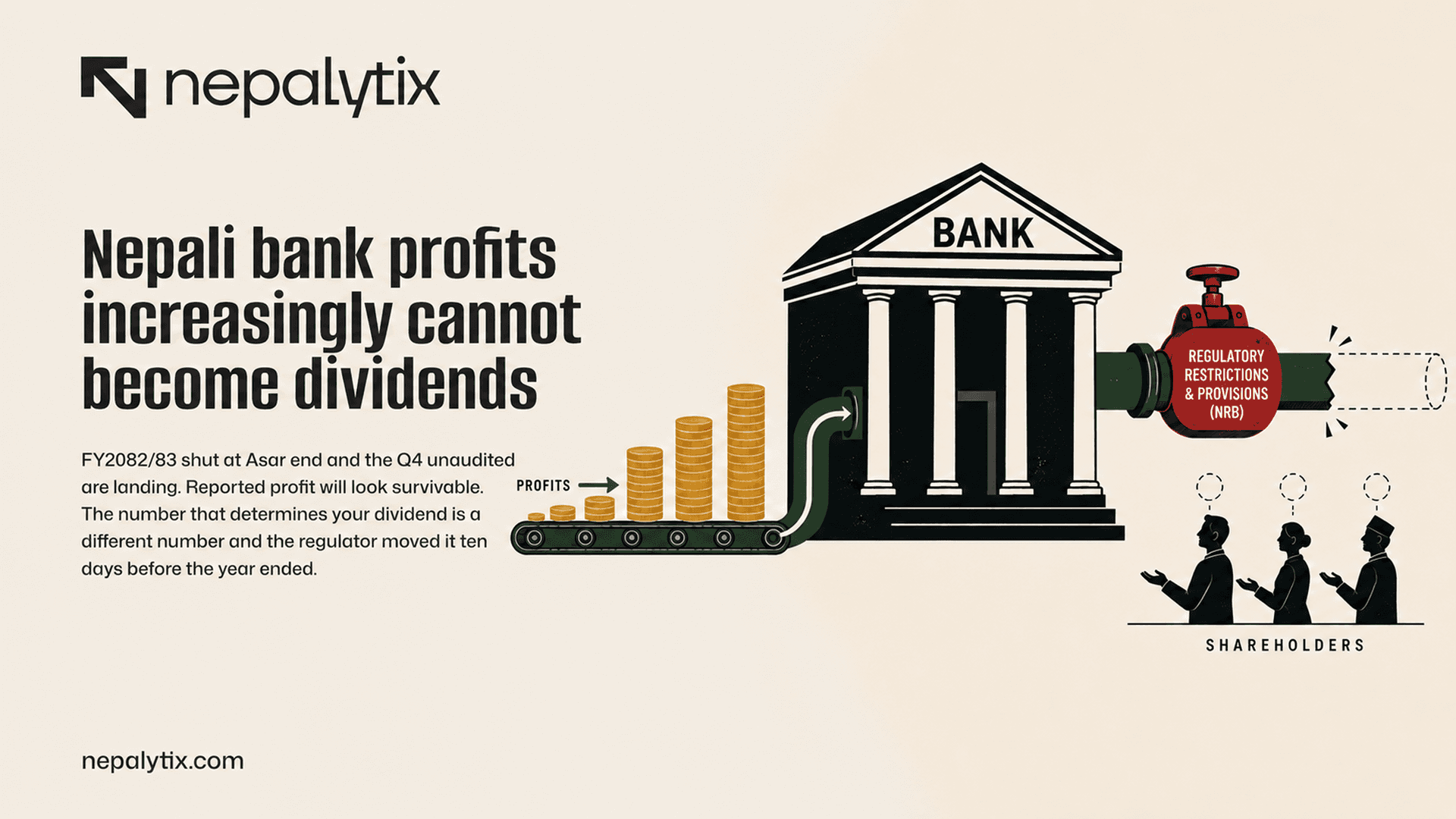
FY2082/83 shut at Asar end and the Q4 unaudited are landing. Reported profit will look survivable. The number that determines your dividend is a different number and the regulator moved it ten days before the year ended.
The Signal
Nepal's banks are about to report a year that looks acceptable and pays badly. The gap between what a bank reports and what it may legally hand over has been widening for three years and on 16 July 2026 Nepal Rastra Bank widened it again by ruling that interest accrued but not collected must sit in the regulatory reserve rather than the distributable pool.
That amendment landed ten days before FY2082/83 closed. It applies to a loan book already carrying the worst asset quality in a decade. The dividend season now beginning will be the tightest since the framework was written and the constraint is not profitability, it is collectability.
The rule changed ten days before the year closed
On 16 July 2026 Nepal Rastra Bank amended its Unified Directives, 2082. The headline coverage focused on the National Identity Card requirement for customer records. The consequential change was the other one.
Banks in Nepal report interest income on an accrual basis, as accounting standards require. If a borrower owes interest and has not paid it, the bank still books it as income. Under the amendment, interest recognised but not actually collected must now be transferred to the regulatory reserve disclosed as income, unavailable as dividend. Banks may deduct income tax, employee bonus and mandatory statutory allocations before making the transfer but the residual is ring-fenced.
The effect is to sever reported profitability from payable profitability more sharply than before. A bank whose borrowers are servicing their loans is unaffected. A bank whose borrowers are not will report the same profit as before and be able to distribute considerably less of it.
It is worth being precise about why this rule exists rather than treating it as regulatory fussiness. A bank that lends to a borrower who stops paying still books the interest as revenue under accrual accounting and can go on booking it while the loan sits unrecovered. Profit rises. Cash does not. If that profit is then distributed, the bank has paid out money it never received, funded from deposits. The regulatory reserve exists to stop that and the 16 July amendment closes the gap between what the accounting standard permits and what the regulator considers real.
Timing matters here. FY2082/83 ran to Asar end, days after the amendment. This is the first dividend season under the tighter rule, applied to a full year of lending that was underwritten before anyone knew the rule was coming.
Reported profit and payable profit have been separating for three years
Start with the aggregate, because it is stark and almost nobody quotes it.
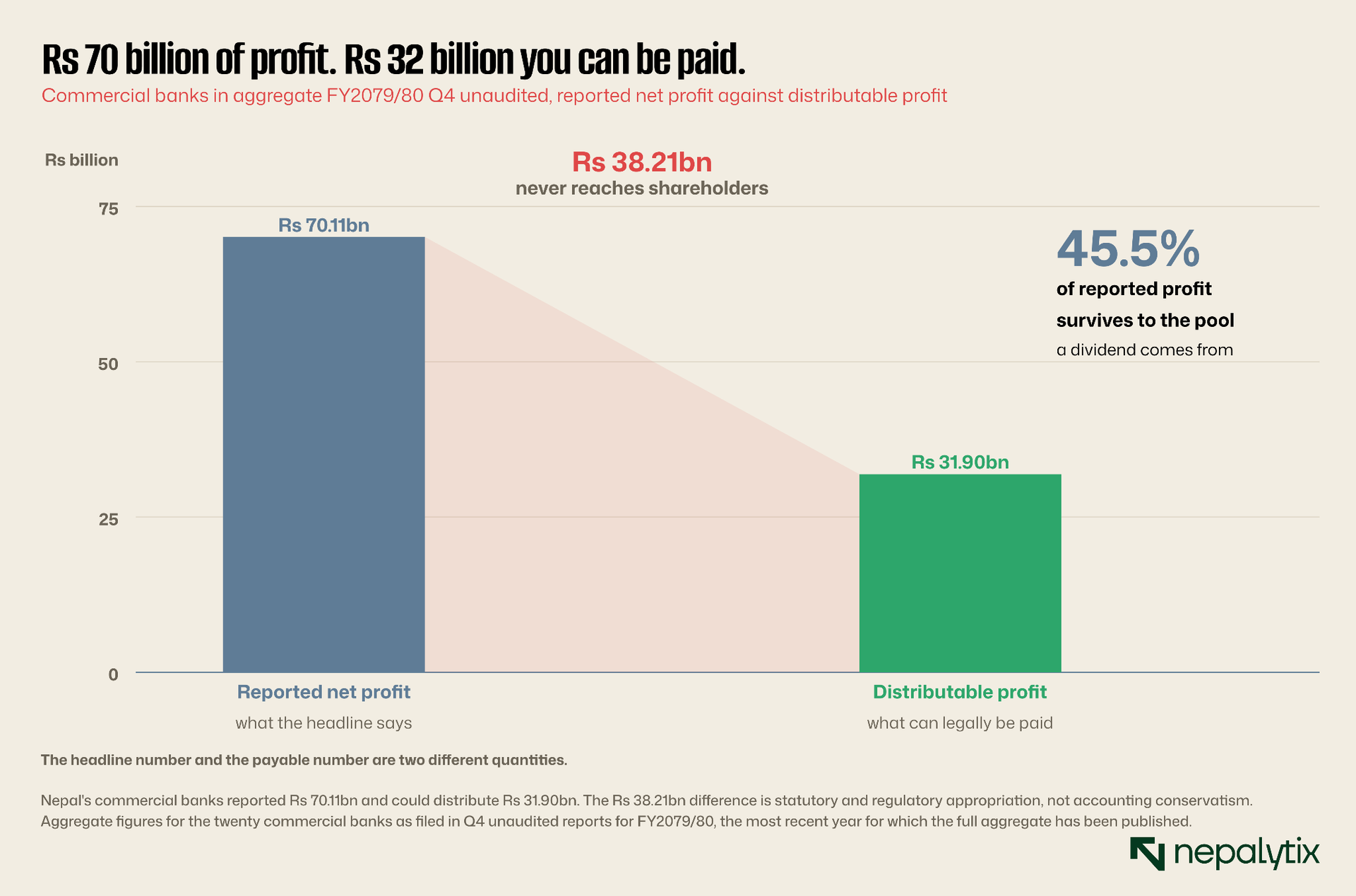
Nepal's commercial banks reported Rs 70.11 billion of net profit and could distribute Rs 31.90 billion of it. Less than half. That is not a rounding adjustment or an accounting quirk, it is Rs 38.21 billion of reported earnings that shareholders were never entitled to see.
Distributable profit that year fell 26% while reported profit did not and the average dividend ratio dropped from 14.65% of paid-up capital to 11.77%. The mechanism was regulatory adjustment, not trading.
A bank's profit tells you how it traded. Its distributable profit tells you what it collected.
The direction of that ratio is the important part and it points one way at both the institutional and the industry level
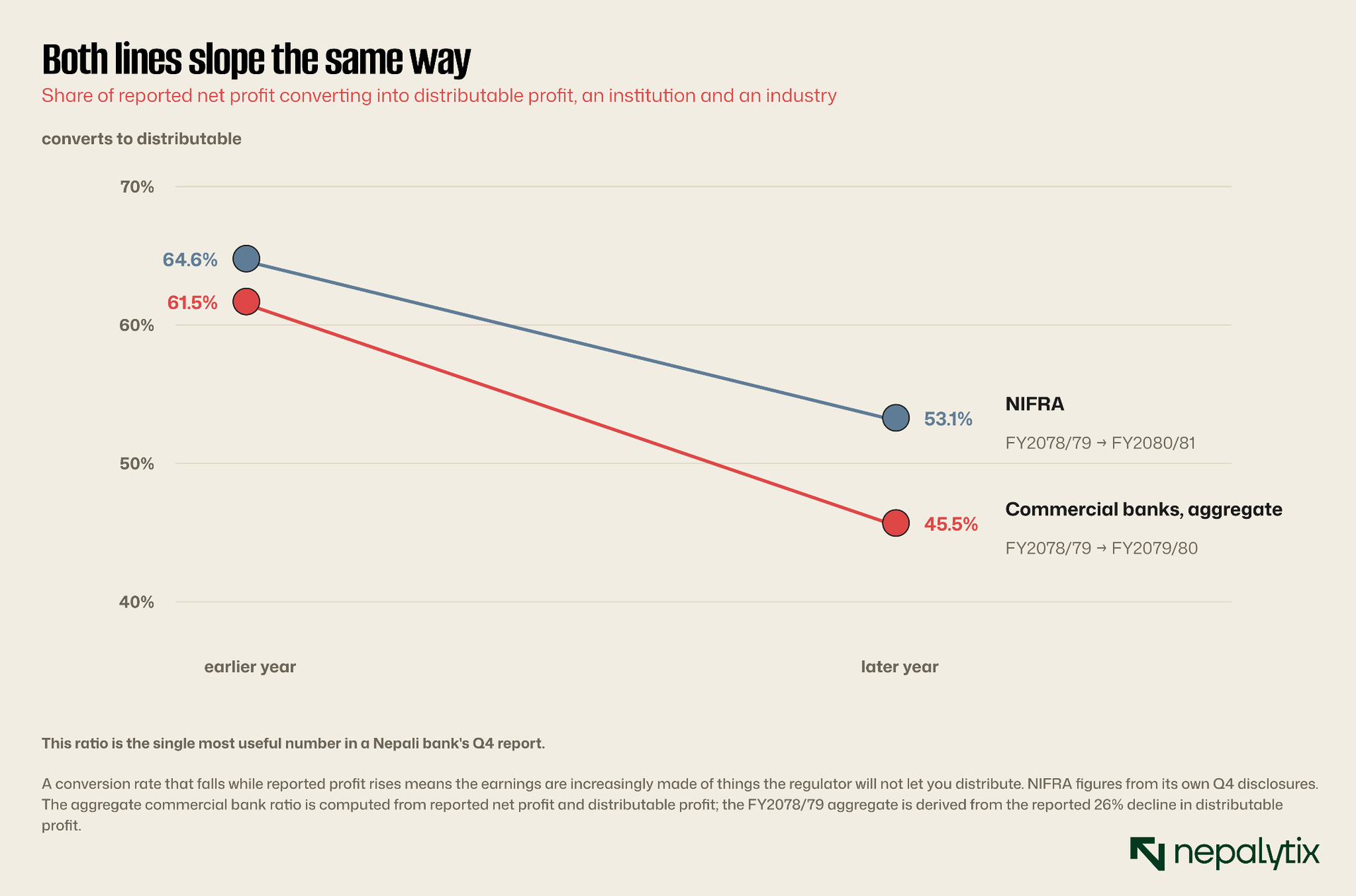
Two entirely different subjects, one specialist infrastructure bank and the twenty commercial banks taken together sloping the same way over overlapping periods. When a conversion ratio falls while reported profit holds up, the earnings are increasingly composed of things the regulator will not let you distribute.
The one ratio to compute this season
Take distributable profit, divide by net profit, and track it across three or four years for the same institution. That single percentage compresses asset quality, tax position and collection performance into one comparable number.
It is disclosed in every Q4 report. It is quoted almost nowhere. A bank whose ratio is stable and high has clean earnings; a bank whose ratio is falling while profit rises is telling you something the profit line is not.
One caution on the aggregate figures. FY2079/80 is the most recent year for which the full twenty-bank aggregate has been published in comparable form so the absolute level is three years stale. What is not stale is the direction which the institution-level data in 3 and 6 confirms through FY2081/82 and the regulatory trajectory, which has tightened at every step since.
The count of banks that legally cannot pay has tripled
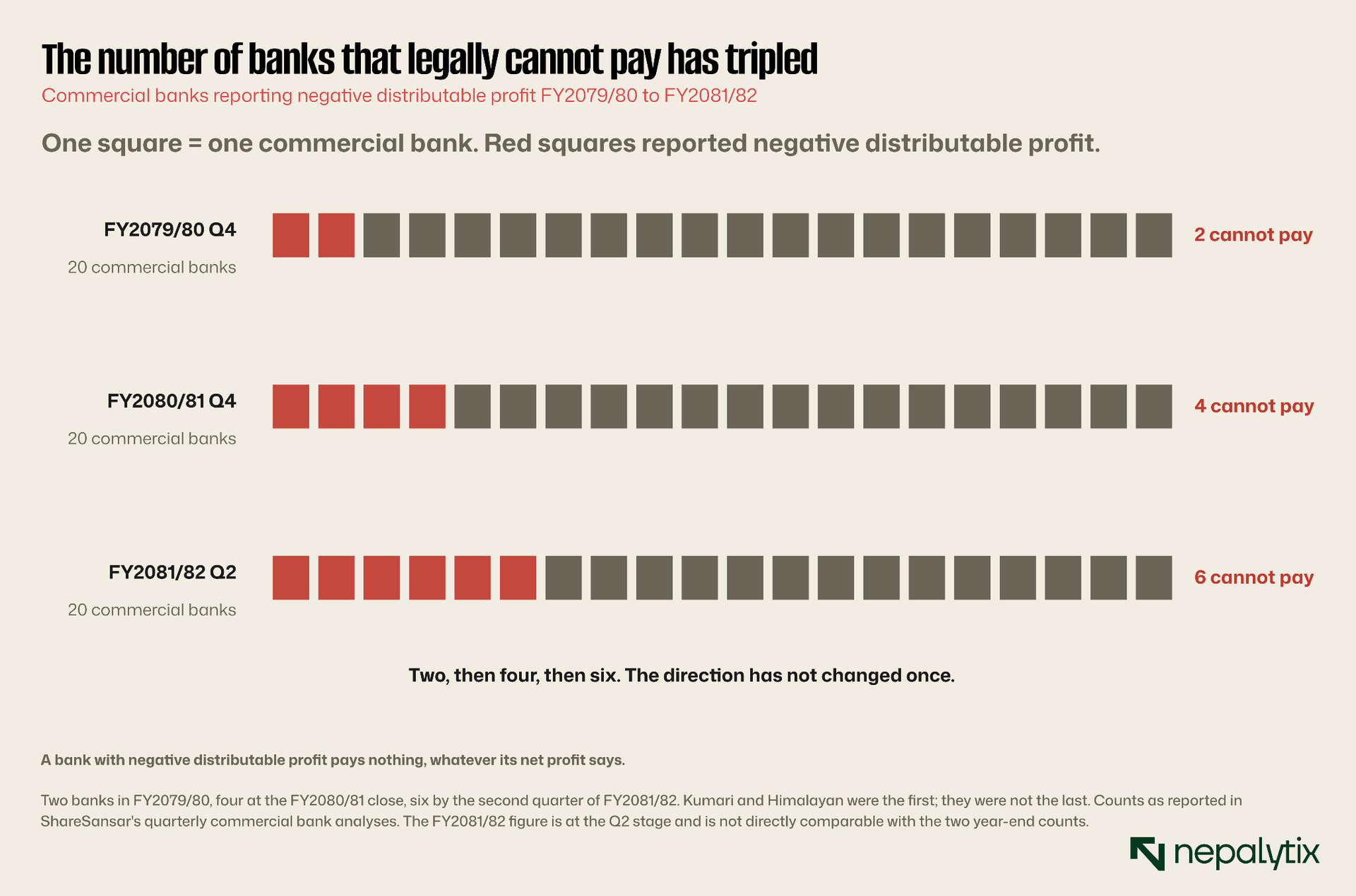
Negative distributable profit is an absolute bar. It does not reduce the dividend, it eliminates it. A bank in that position pays nothing to anyone, however healthy its net profit line looks and however much its board would like to.
Kumari Bank and Himalayan Bank were the first, at the FY2079/80 close, with distributable profit per share of Rs −3.23 and Rs −3.28. By the FY2080/81 close four commercial banks were in the same position. By the second quarter of FY2081/82 the count was six.
Nepal Investment Mega Bank is the case worth studying, because it shows the two lines moving in opposite directions inside one institution. In Q4 FY2080/81 it reported net profit up 39.71% to Rs 5.19 billion and negative distributable profit, alongside rising NPLs. A 40% profit increase and nothing to hand over.
Only a third of the missing money is the reserve everyone knows about
Most investors who know about this constraint know about the general reserve: 20% of net profit, statutory, non-negotiable. It is the easy part and it is the smaller part.
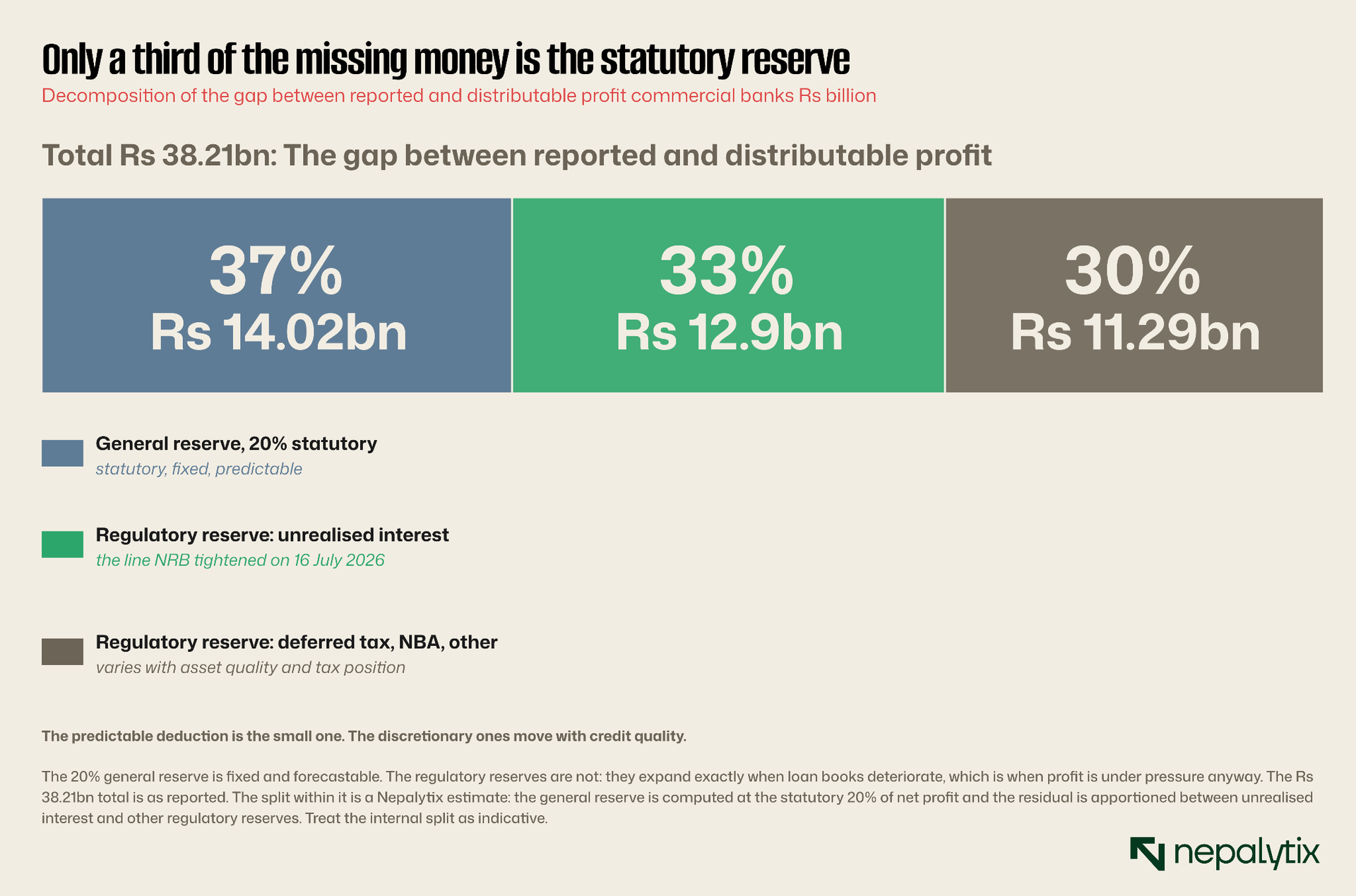
Rs 14.02 billion of the gap is the general reserve fixed, forecastable, and something any model can handle. The remaining Rs 24.19 billion is regulatory reserve and it behaves completely differently. It expands when accrued interest goes uncollected, when deferred tax assets build when a bank takes property in settlement of a bad loan.
Every one of those triggers correlates with credit stress. Which means the discretionary two-thirds of the deduction grows precisely when profit is already under pressure and shrinks when it is not. The constraint is procyclical and it is the part NRB has just tightened.
The pattern across those three observations is worth naming precisely, because it is easy to misread as a story about weak banks. It is not. The count rose while the sector's reported profitability held up. What changed was the composition of that profit: more of it accrued, less of it collected and the regulatory machinery converted the difference into a distribution bar. A bank can be profitable, adequately capitalised and still barred from paying and that combination is becoming ordinary rather than exceptional.
The board does not decide the dividend, NRB does
There is a second document worth knowing about. NRB's Procedure for Approval of Financial Statement Publication and Dividend Distribution, 2082 replaced the 2077 procedure and applies to commercial banks, development banks, finance companies and microfinance institutions.
Under it, banks must submit annual accounts to NRB's supervision department for preliminary review before board approval and signature. The department may require corrections. Permission to publish financial statements is granted only after the final audit report. And where the loan loss provision computed under NFRS falls short of what NRB's directive requires, the shortfall must be transferred to the regulatory reserve.
Read that last clause carefully. It means the accounting standard sets the floor and the regulator sets the answer. A bank cannot provision its way to a bigger dividend by taking a favourable view under NFRS; the directive difference is captured and ring-fenced.
The practical consequence for a shareholder is a sequencing point. When a board announces a proposed dividend, it is a proposal against numbers the regulator has not finished with. Between proposal and payment sit the supervision review, the audit and the approval. Every one of those can move the figure down.
Bad loans quadrupled and the payout has only started to follow
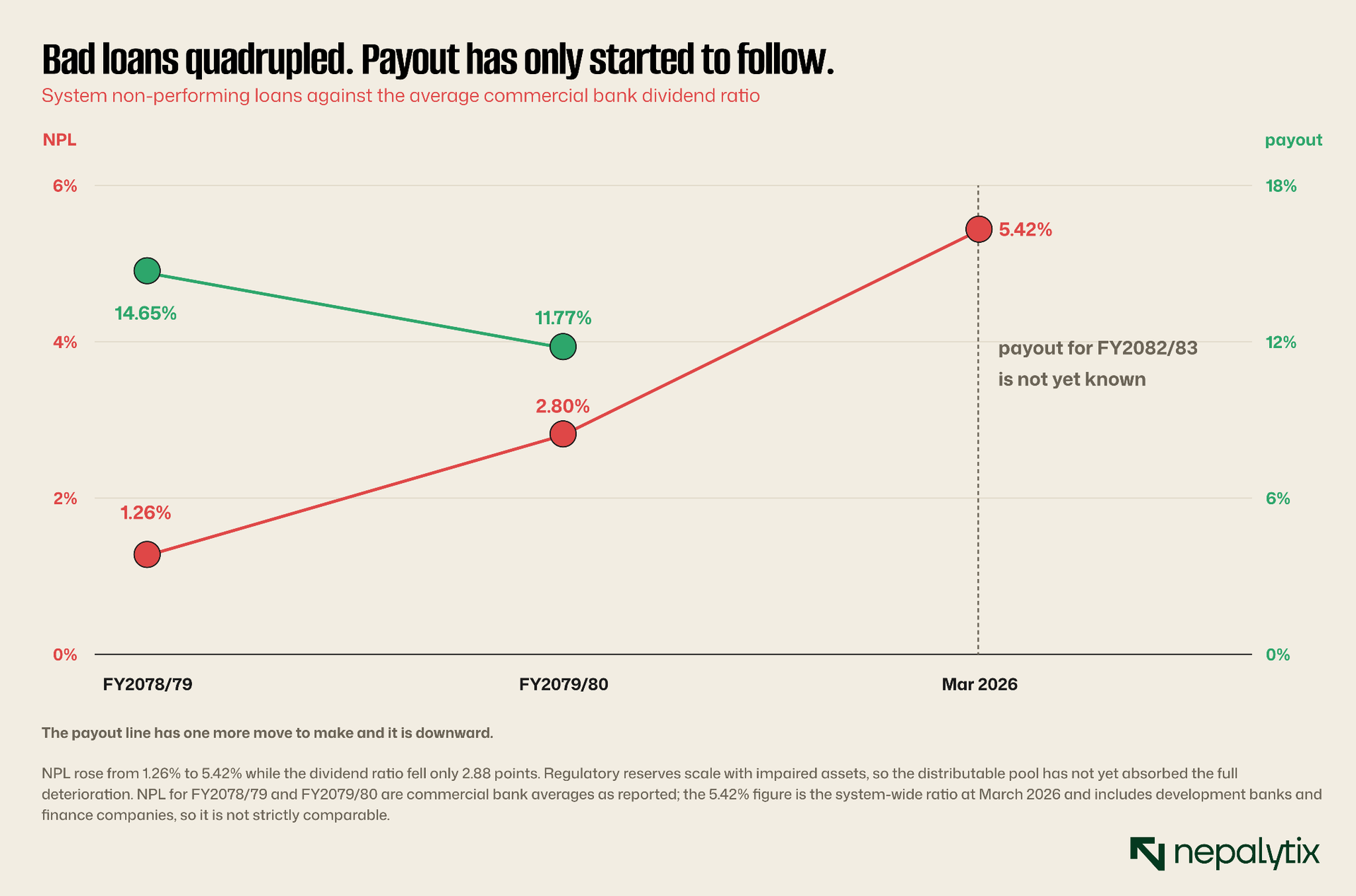
NPL went from 1.26% to 2.80% between FY2078/79 and FY2079/80 a 122% increase and the dividend ratio fell 2.88 percentage points. Since then the system-wide ratio has reached 5.42%.
The two lines have not moved proportionally and that is the point of this chart. Regulatory reserves scale with impaired assets. If NPL has roughly doubled again since FY2079/80 and the distributable pool has not yet absorbed it, the adjustment is still ahead rather than behind.
The dispersion inside that system figure matters as much as the level. Commercial banks average around 3.6%. Finance companies exceed 10%. The constraint therefore falls very unevenly, which is why the sector-level conclusion is much less useful than the institution-level one.
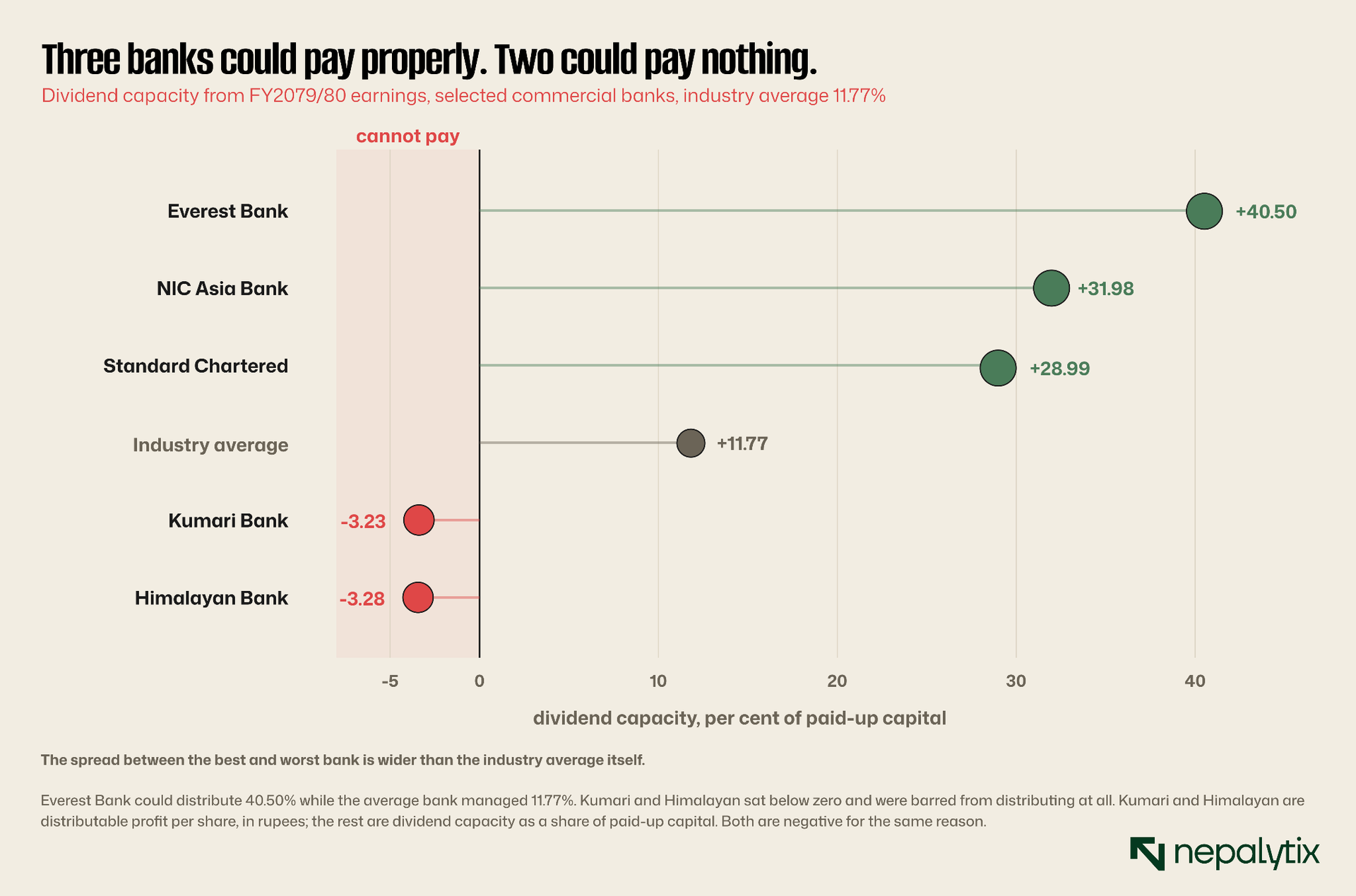
Everest Bank could distribute 40.50%. NIC Asia 31.98%. Standard Chartered 28.99%. The industry average was 11.77%, and two banks were below zero. The spread between the best and the worst is wider than the average itself.
This is the practical argument against sector allocation in Nepali banking. Buying "the banks" for yield buys the average, and the average is composed of institutions whose dividend capacity differs by a factor of four before you reach the ones that cannot pay at all.
What we are watching in the filings
Q4 FY2082/83 reports are arriving now. Nepal Infrastructure Bank filed on 23 July at Rs 987.39 million, down 19.98%. Miteri Development Bank filed the same day at Rs 141.21 million, up 8.98%. The commercial banks follow over the next fortnight.
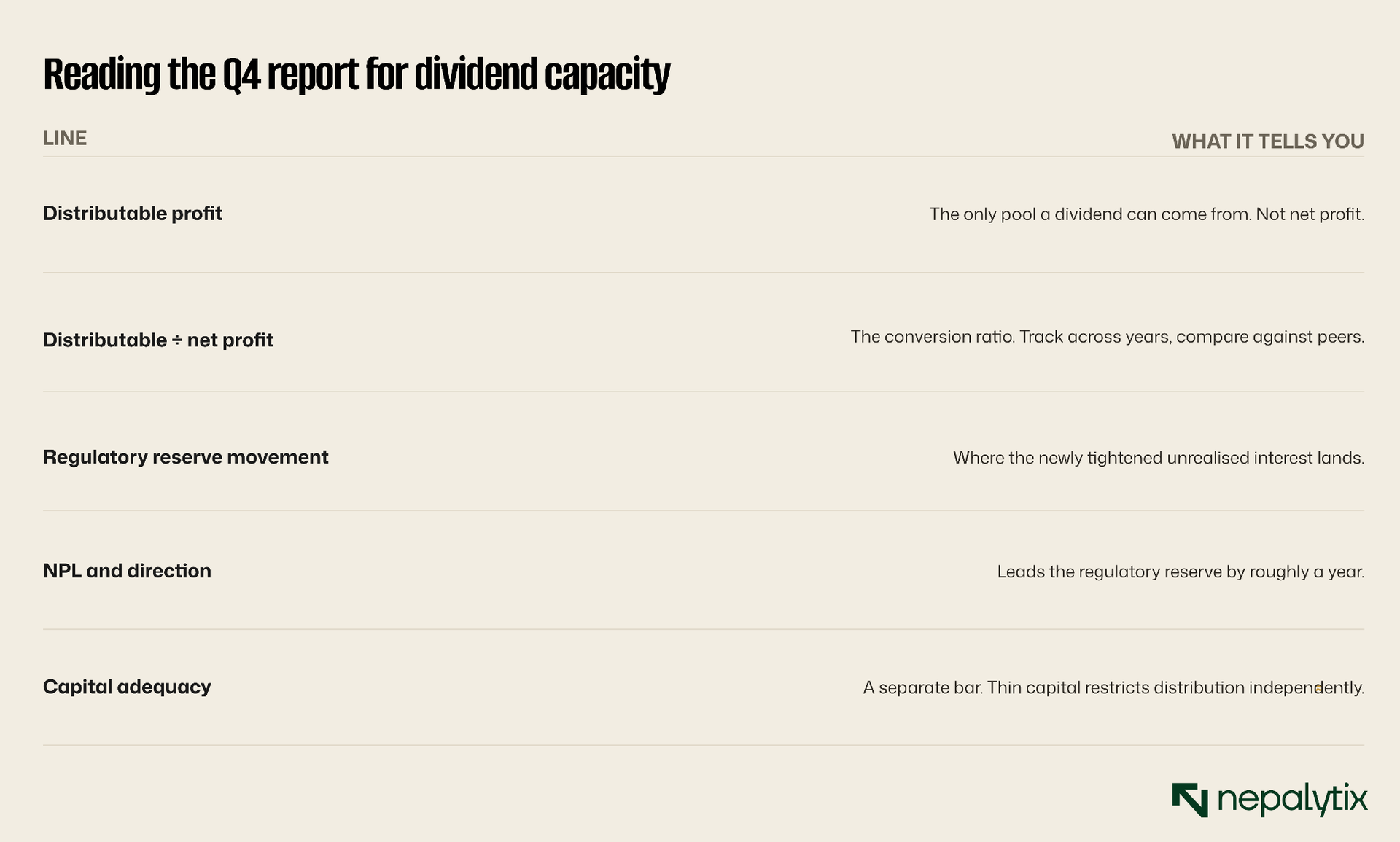
The four things that will decide this season
How much unrealised interest moves. The 16 July amendment is untested at year end. The first commercial bank filings will reveal the scale and the number to watch is the movement in regulatory reserve, not net profit.
Whether the count of negative-distributable banks rises above six. Two, four, six is a trend, not a series of accidents. A seventh or eighth would confirm the constraint is structural rather than idiosyncratic.
Whether the conversion ratio breaks below 45%. The aggregate has fallen from roughly 61.5% to 45.5%. Another leg down puts the average commercial bank dividend near single digits as a share of paid-up capital.
What NRB does at the approval stage. Boards will propose. The supervision review, the audit and the approval come after. The gap between proposed and approved is where this season will actually be decided.
One further point for holders of development banks, finance companies and microfinance institutions rather than commercial banks. The same procedure covers all four classes, but the underlying asset quality does not. Finance companies carry NPL above 10% against roughly 3.6% at commercial banks and the regulatory reserve scales with exactly that. The classes with the weakest books face the tightest distribution constraint, which inverts the yield logic that draws retail money toward them in the first place.
The uncomfortable summary is that Nepali bank earnings and Nepali bank dividends have been telling different stories for three years and the regulator has just widened the distance between them. Reported profit for FY2082/83 will be reported soon and will be quoted everywhere. It is the wrong number.
Disclaimer
This report has been prepared by Nepalytix for informational and educational purposes only and does not constitute investment advice, an offer, or a solicitation to buy or sell any securities.
The information contained in this report is based on sources believed to be reliable; however, Nepalytix does not guarantee its accuracy, completeness, or timeliness. Opinions, estimates, and projections expressed herein are those of the authors as of the date of publication and are subject to change without notice.
Investing in securities involves risks, including the possible loss of principal. Past performance is not indicative of future results. Readers are advised to conduct their own independent research and consult with a qualified financial advisor before making any investment decisions.
Nepalytix and its contributors may hold positions in the securities discussed in this report at the time of publication or thereafter.
Neither Nepalytix nor any of its affiliates accept any liability for any loss arising from the use of this report or its contents.