Nepal’s Dividend Season Has a Hidden Problem: Not Every Dividend Pays Cash
Six of 22 dividend declarations over the past two seasons paid no cash at all, the “cash dividend” only covered tax on bonus shares showing how misleading headline dividend percentages can be.
Seven boards have reported FY2082/83 dividends with a published split. Super Madi Hydropower declared 15.78947% and United Idi-Mardi 5.2632%. In both, the cash is exactly the tax on the bonus. Neither pays a rupee.
THE SIGNAL
Super Madi Hydropower declared a dividend of 15.78947% for FY2082/83. United Idi-Mardi and R.B. Hydropower declared 5.2632%. Neither will pay its shareholders a single rupee.
In both cases the cash component is exactly the tax owed on the bonus shares, computed to the fifth decimal. It is declared, withheld and handed to the revenue authority.
Pull last season's declarations alongside this one and the pattern is not two companies having an unusual year. Across twenty-two declarations with a published split, six pay nothing and they sit in hydropower, manufacturing, investment and microfinance.
Six on the line
NEPSE closed last week at 2,542.77, down 14.54 points on the week. Six boards met in Bhadra and cleared the dividend question in nineteen days: Super Madi on the 8th, Global IME Bank on the 17th, Global IME Capital on the 22nd, Nabil on the 24th, Machhapuchchhre on the 26th, Everest Bank on the 27th.
Bonus shares attract a 5% tax. The cash that funds it is itself taxed at 5% so the amount a company must declare is the bonus divided by nineteen. Plot every declaration against that line and the companies sitting on it have paid the tax and nothing else.
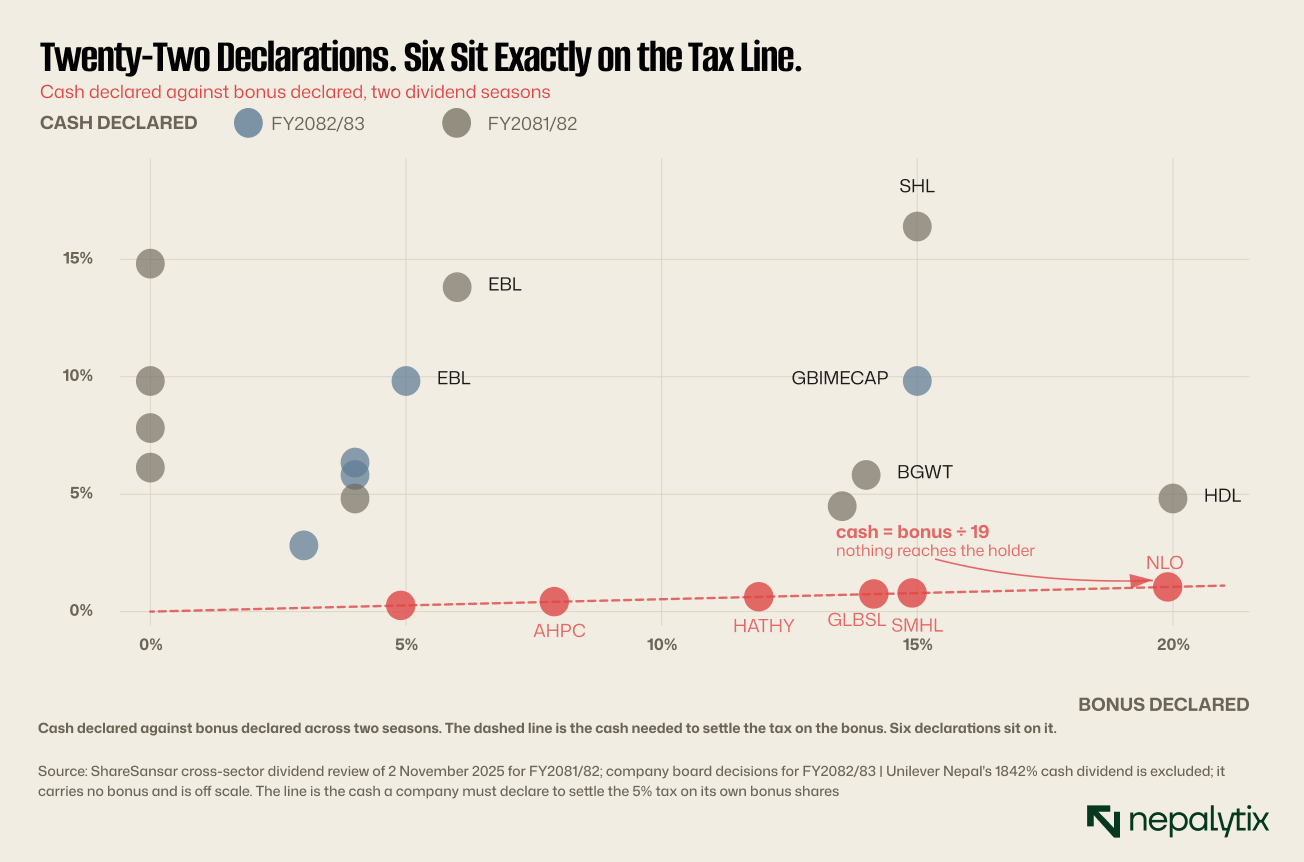
Super Madi declared 15% bonus and 0.78947% cash; fifteen over nineteen is 0.78947. United Idi-Mardi declared 5% and 0.2632%. Last season Arun Valley Hydropower declared 8% and 0.421%, Hathway Investment 12% and 0.632%, Nepal Lube Oil 20% and 1.05264%, Gurans Laghubitta 14.25% and 0.75%.
Every one of those cash figures is the bonus divided by nineteen, carried to the decimal place the liability requires.
The precision is the tell. A company rounding a cash dividend for presentation would declare 0.8% or 0.75%. These declare 0.78947% and 1.05264% because the liability they are settling is exact and any shortfall would have to come from somewhere else.
Nepal Lube Oil's is the most striking of the six. A 20% bonus with 1.05264% cash attached from a profitable lubricants business with no construction programme and no obvious cash constraint. Announced as a 21.05264% dividend, it delivers nothing.
How the cash leaves
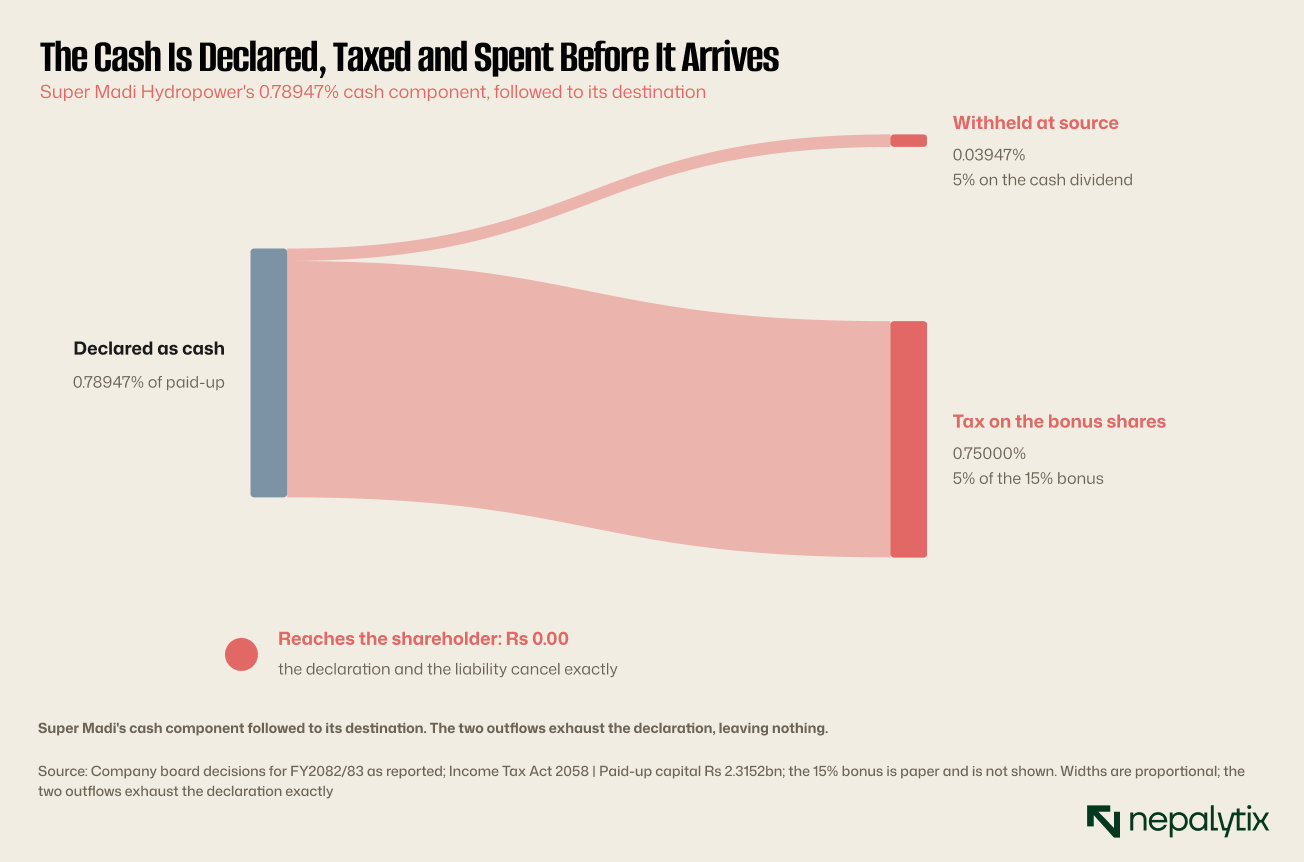
Super Madi's cash leaves the company, loses 0.03947 points to withholding at source and the remaining 0.75000 points settle the tax on a 15% bonus. Shareholders end with more shares worth proportionally less each and no money.
Neither company is concealing this. Super Madi's announcement states the cash is for the tax on the bonus and United Idi-Mardi's does the same. The information is in the disclosure and absent from the headline that carries it.
Super Madi's board set the bonus at Rs 34.73 crore of paid-up capital and called the seventeenth annual general meeting for Ashoj 1. Like every hydropower declaration this season it also needs Electricity Regulatory Commission approval, a second gate the banks do not face.
Machhapuchchhre's 564th board meeting on Bhadra 26 set 3% cash on ordinary shares, Rs 362.59 million and 8.25% on preference shares, Rs 74.59 million with the preference payment prorated from each holder's allotment date rather than applied across the full year. Several banks have issued preference shares recently and how they treat a first partial year will vary.
Nabil moved on Bhadra 24 with 15.80% on ordinary shares and a separate 8.00% for preference holders worth Rs 23.34 crore. Global IME Bank is the largest in the set by capital base at Rs 38.11 billion paid-up and its 10% is the most modest headline among the commercial banks.
What the twenty-two contain
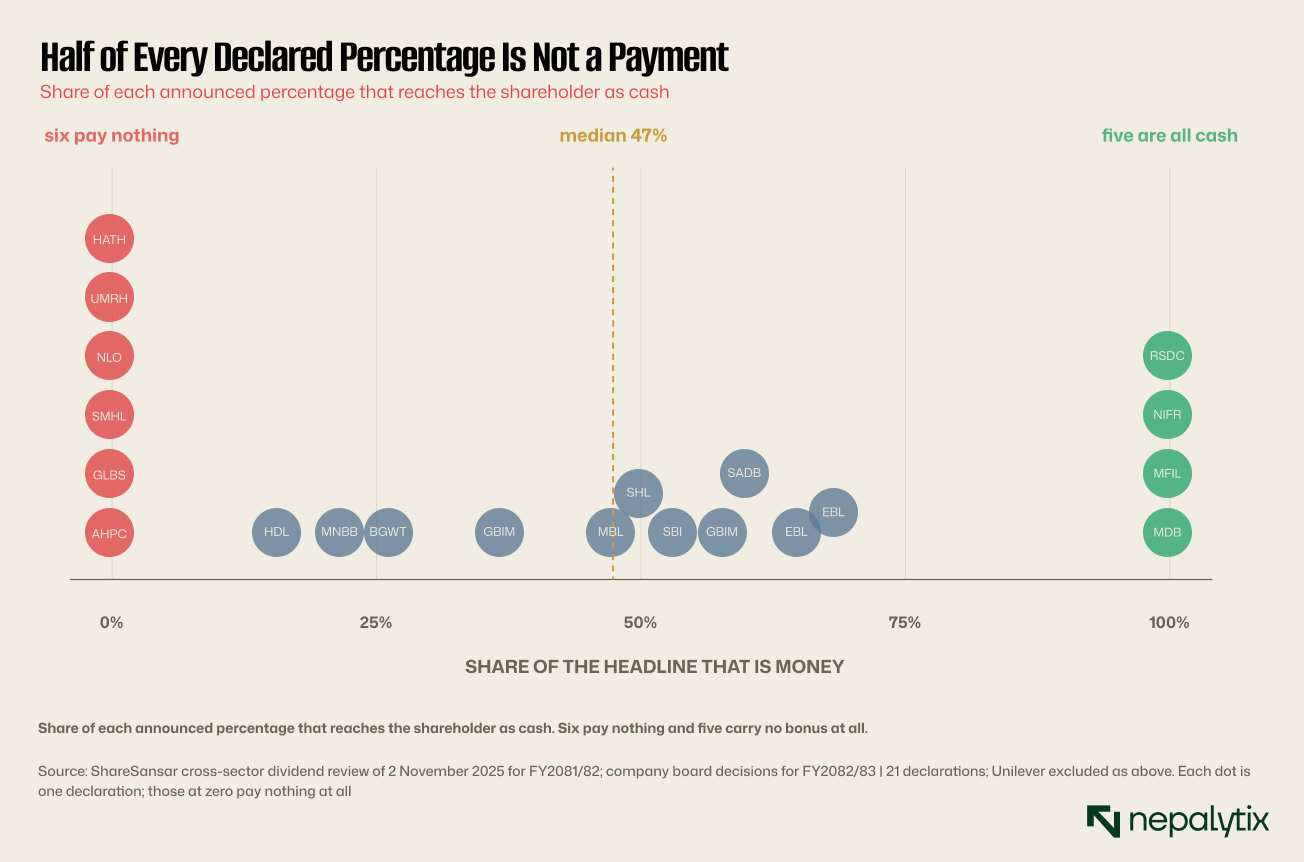
The median declaration across both seasons is 47% money. Six are at zero. Five are at a hundred: Miteri Development Bank, Manjushree Finance, Nepal Infrastructure Bank, RSDC Laghubitta and Unilever Nepal all declared cash with no bonus attached.
Unilever's 1842% is the largest dividend on the Nepali market by a wide margin and it is entirely cash. It is excluded from the charts because it is off every scale and it is worth naming because it sits at the opposite pole from Super Madi: all money, no paper.
Between those poles sit the rest. Everest Bank's 20% last season was 6% bonus and 14% cash. Soaltee Hotel's 31.5789% was 15% and 16.5789%. Himalayan Distillery's 25% was 20% and 5% which puts four fifths of the largest manufacturing declaration into paper.
The distribution has a shape worth noting. It is not a smooth spread between nothing and everything. It clusters at three points: a group at zero, a group at one hundred and a body between forty and sixty-five per cent.
The group at one hundred are companies that declared no bonus at all. The group at zero are companies that declared nothing but bonus. The middle is everyone pairing the two, and their cash lands in a fairly narrow band once the tax component is stripped out.
Soaltee Hotel's 31.5789% last season is the largest genuine payment in the dataset. Fifteen points of bonus, 16.5789 of cash of which 0.78947 covers the tax and 15.79 points are money. The only hotel declaration in either season and the most cash-generous of the twenty-two after Unilever.
Bhagawati Hydropower's 20% is the counterpoint within its own sector. Fourteen points of bonus and six of cash of which 5.26 points are money. So hydropower produced both the largest paying declaration outside banking and three of the six that pay nothing in the same two seasons.
Not one sector
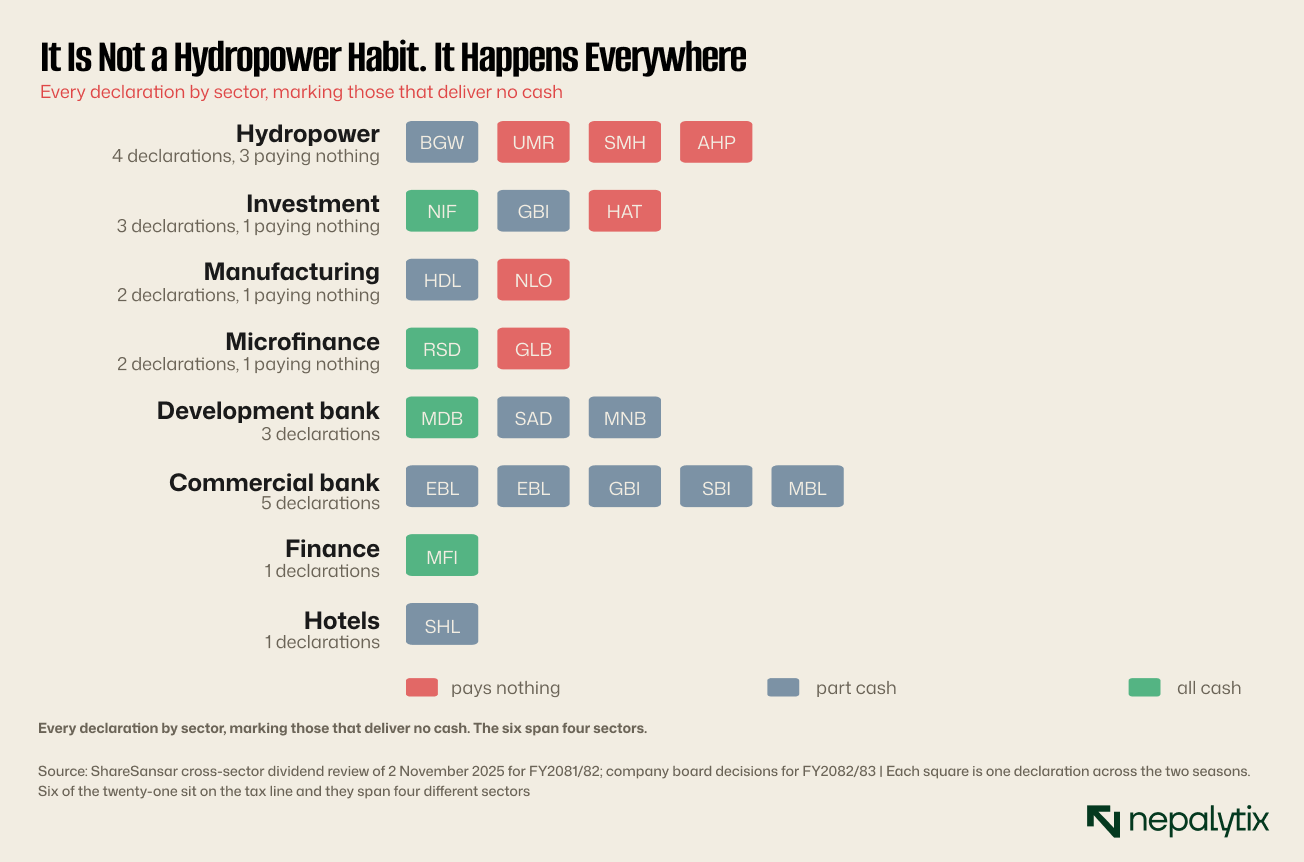
The obvious explanation for a company paying no cash is that it has none. A hydropower company mid-build earns accounting profit while the money goes into construction and three of the six are hydropower.
The other three are not. Hathway Investment, Nepal Lube Oil and Gurans Laghubitta sit in investment, manufacturing and microfinance. Nepal Lube Oil is a profitable lubricants business with no construction programme. Whatever is producing this, it is not confined to companies that are short of cash.
The commercial banks are the cleanest counter-case. Seven declarations across the two seasons and not one on the line. Global IME declared 4% bonus and 6% cash, Everest 5% and 10%, Machhapuchchhre 3% and 3%, Nepal SBI 4% and 5%. Every one pairs a modest bonus with cash well clear of the threshold, which is what a bank holding deposits it cannot lend looks like when it declares.
There is a regulatory reading that would explain some of this and it does not survive the data. A bonus issue converts retained earnings into paid-up capital which is the figure Nepal Rastra Bank and the Insurance Authority measure against. A company approaching a capital threshold has a supervisory reason to issue paper rather than pay cash.
That would predict the line-sitters clustering among regulated financial institutions approaching thresholds. They do not. Four of the six are outside banking entirely, and the seven commercial bank declarations across both seasons are the group furthest from the line.
The sector view also shows how thin participation is. Ninety-four hydropower companies were listed under the index last season and five declared anything. Nineteen commercial banks, seven declared. Sixteen development banks, four. Life insurance, non-life insurance, trading and the others sector declared nothing at all.
So the dividend season in Nepal is a minority event. Most listed companies pay nothing in any form and the argument in this piece concerns the smaller group that pays something and how much of that something is real.
The aggregate
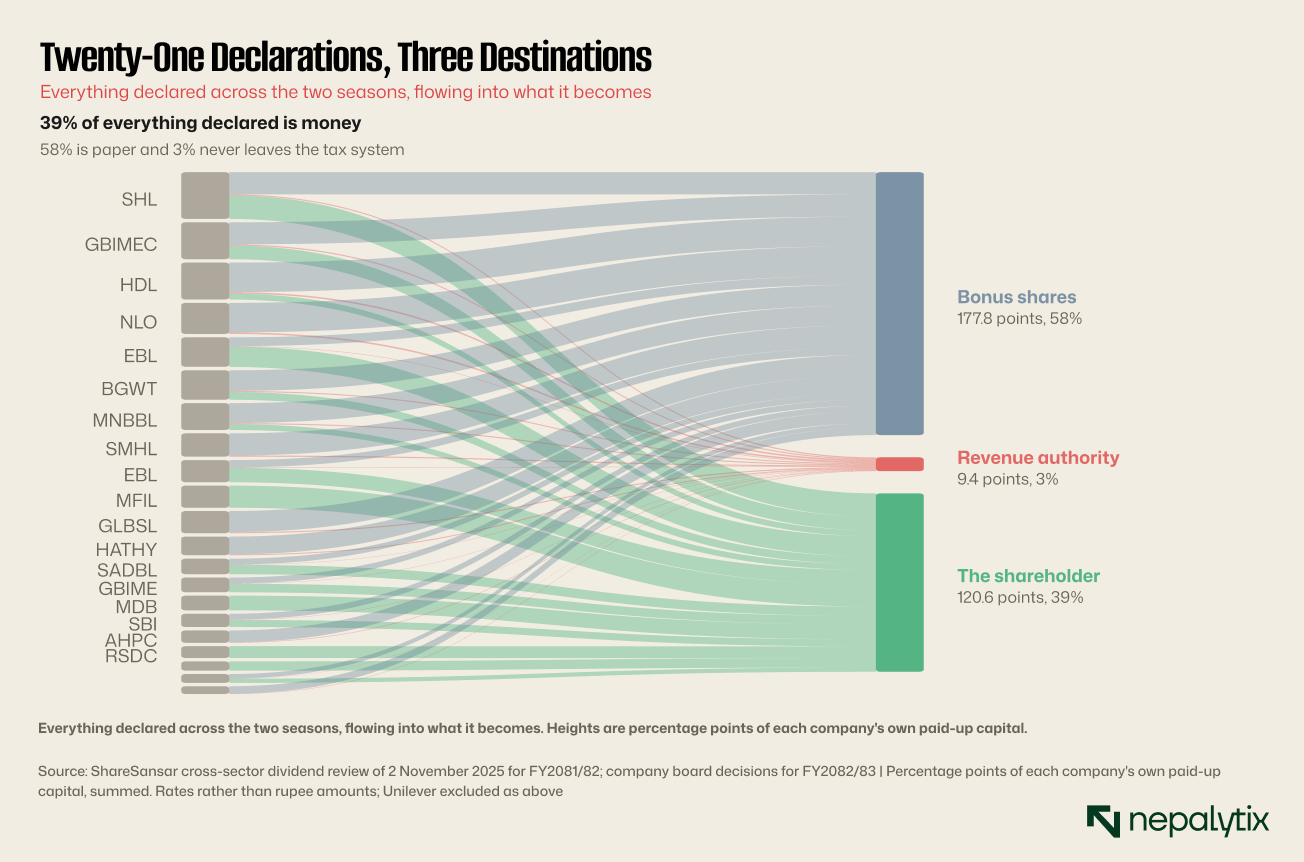
Across the twenty-one declarations that fit on a chart, 58% of everything announced is bonus shares, 3% is tax that never leaves the tax system and 39% is money.
That ratio is specific to these companies and these two years. It is not a rule. It is a better starting assumption than treating a declared percentage as income which is what every published dividend yield in this market currently does.
Shangrila Development Bank's 10.5263% sits outside this season's Bhadra cluster. It was declared earlier and is still awaiting Nepal Rastra Bank approval with no annual general meeting called. On the decomposition it carries 6.32 points of money on a paid-up capital of Rs 3.73 billion, the third largest payment among this season's seven.
What is still missing
Three of this season's ten declarations published a total and no split: Nabil at 15.80%, Kalinchowk Darshan at 8.9474%, Mandhu Hydropower at 12%. Nabil is the consequential omission. It is among the largest banks in the country and its 15.80% is the second largest headline of the season. Whether that contains nine points of money or half a point is the difference between a substantial payment and a paper exercise.
Neither NEPSE nor SEBON publishes declarations as a table with bonus and cash broken out. The twenty-two here were matched across ShareSansar, ShareHub, ICT Frame and Bajarko Chirfar. A market that runs a dividend season every year has no consolidated record of what the season paid.
Last season's coverage shows how thin the season is to begin with. Seven of nineteen commercial banks declared. Four of sixteen development banks. Five of ninety-four hydropower companies. Life insurance, non-life insurance, trading and the others sector declared nothing at all.
One thing the two seasons together still cannot answer. Nothing here measures whether these are good dividends in the sense that matters which is whether the company could afford what it paid and what it gave up to pay it. A bank distributing ten points of cash out of surplus deposits sits differently from one distributing the same to hold a share price.
That needs the fourth-quarter accounts read alongside the declaration, company by company. For most of the twenty-two those accounts have been filed and not analysed. It is a piece for after the annual general meetings rather than during them.
Ashoj
Annual general meetings run through Ashoj and the declarations accelerate with them. Global IME Bank meets on Ashoj 16, Global IME Capital on Ashoj 14, Super Madi on Ashoj 1. Everest Bank's book closes on Ashoj 1 with eligibility set by Bhadra 31.
Three things to watch as the count builds. Whether Nabil, Kalinchowk and Mandhu publish splits. Whether the six-in-twenty-two rate holds as more declarations land. And whether any company declares a bonus without the accompanying tax cash which would mean funding the liability from somewhere else and would be the first departure from a pattern that has now held across two seasons and four sectors.
The pattern has now held across two fiscal years, ten sectors and twenty-two declarations without a single exception. Every company issuing a bonus declared cash of at least bonus over nineteen, and six declared exactly that and no more. Not one declared a bonus with less cash than the tax required, which would have meant funding the liability from reserves instead.
That consistency is itself the finding. It means the tax component is not a matter of company policy or cash position; it is a mechanical requirement every board satisfies. What varies is only whether anything is added on top.
The order changes
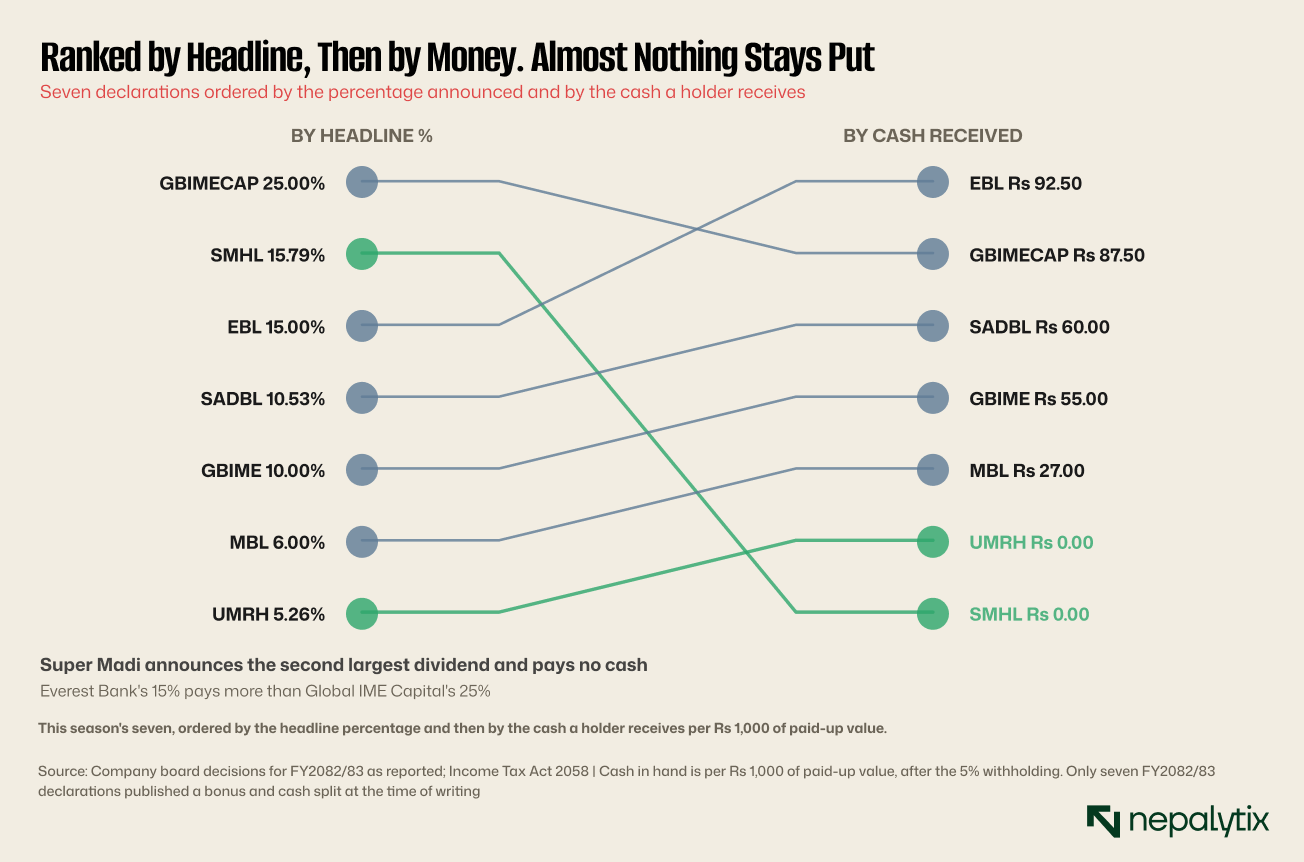
Ranked by announcement this season: Global IME Capital at 25%, Super Madi at 15.79%, Everest Bank at 15%, Shangrila at 10.53%, Global IME Bank at 10%, Machhapuchchhre at 6%, United Idi-Mardi at 5.26%.
Ranked by payment: Everest Bank at Rs 92.50 per Rs 1,000 of paid-up value, Global IME Capital at Rs 87.50, Shangrila at Rs 60.00, Global IME Bank at Rs 55.00, Machhapuchchhre at Rs 27.00 then the two at nothing.
Super Madi falls from second to last. Everest Bank rises from third to first. Any yield screen built on the announced percentage has these backwards, and for Super Madi and United Idi-Mardi it reports income that does not exist.
Machhapuchchhre is worth a second look. Its 6% is the smallest headline among the payers, and on a paid-up capital of Rs 12.09 billion its 3% cash is Rs 362.59 million. Global IME Capital's 25%, the largest headline of the season is Rs 49.39 million on a base of Rs 494 million. The smallest percentage among the payers is writing a cheque seven times larger than the largest.
Everest Bank has now appeared in both seasons and moved in the same direction twice. Last year it declared 20%, of which 6% was bonus and 13.68 points were money after the tax component. This year it declared 15% of which 5% was bonus and 9.74 points were money. The headline fell five points and the payment fell four which is a rare case of the two moving together.
Muktinath Bikas Bank's 18.20% from last season is the most finely split declaration in the dataset: 13.53% bonus and 4.67% cash. The tax component on a 13.53 bonus is 0.712 leaving 3.958 points of money so a headline in the top quarter of the range delivers a payment in the middle of it.
Miteri Development Bank sits directly opposite. Ten per cent, all cash, no bonus, the lowest headline among development banks last season and a payment larger than Muktinath's in percentage terms after the decomposition.
What a reader can do with it
The arithmetic does not require the dataset. Take any declaration, divide the bonus by nineteen and compare the result to the cash. If they match, the announcement pays nothing. If the cash is larger, the difference times 0.95 is what arrives.
On a 12% dividend made of 10% bonus and 2% cash, the tax component is 0.526 and the money is 1.474 points. On a 12% dividend made of 2% bonus and 10% cash, the money is 9.895 points. The two announcements are identical in a headline and differ by a factor of nearly seven in a bank account.
That calculation takes ten seconds and no Nepali broker, portal or news outlet performs it before publishing a yield.
Disclaimer
This report has been prepared by Nepalytix for informational and educational purposes only and does not constitute investment advice, an offer, or a solicitation to buy or sell any securities.
The information contained in this report is based on sources believed to be reliable; however, Nepalytix does not guarantee its accuracy, completeness, or timeliness. Opinions, estimates, and projections expressed herein are those of the authors as of the date of publication and are subject to change without notice.
Investing in securities involves risks, including the possible loss of principal. Past performance is not indicative of future results. Readers are advised to conduct their own independent research and consult with a qualified financial advisor before making any investment decisions.
Nepalytix and its contributors may hold positions in the securities discussed in this report at the time of publication or thereafter.
Neither Nepalytix nor any of its affiliates accept any liability for any loss arising from the use of this report or its contents.