Nepal’s Dividend Season Starts With Cash Not Bonus Shares
Thirteen FY2082/83 distributions have been declared so far but only one carries a bonus. With twelve declarations paying cash and Shangrila Development Bank cutting its bonus to 4% despite a 47% rise in profit, the opening weeks of Nepal’s dividend season are challenging expectations of widespread share dilution.

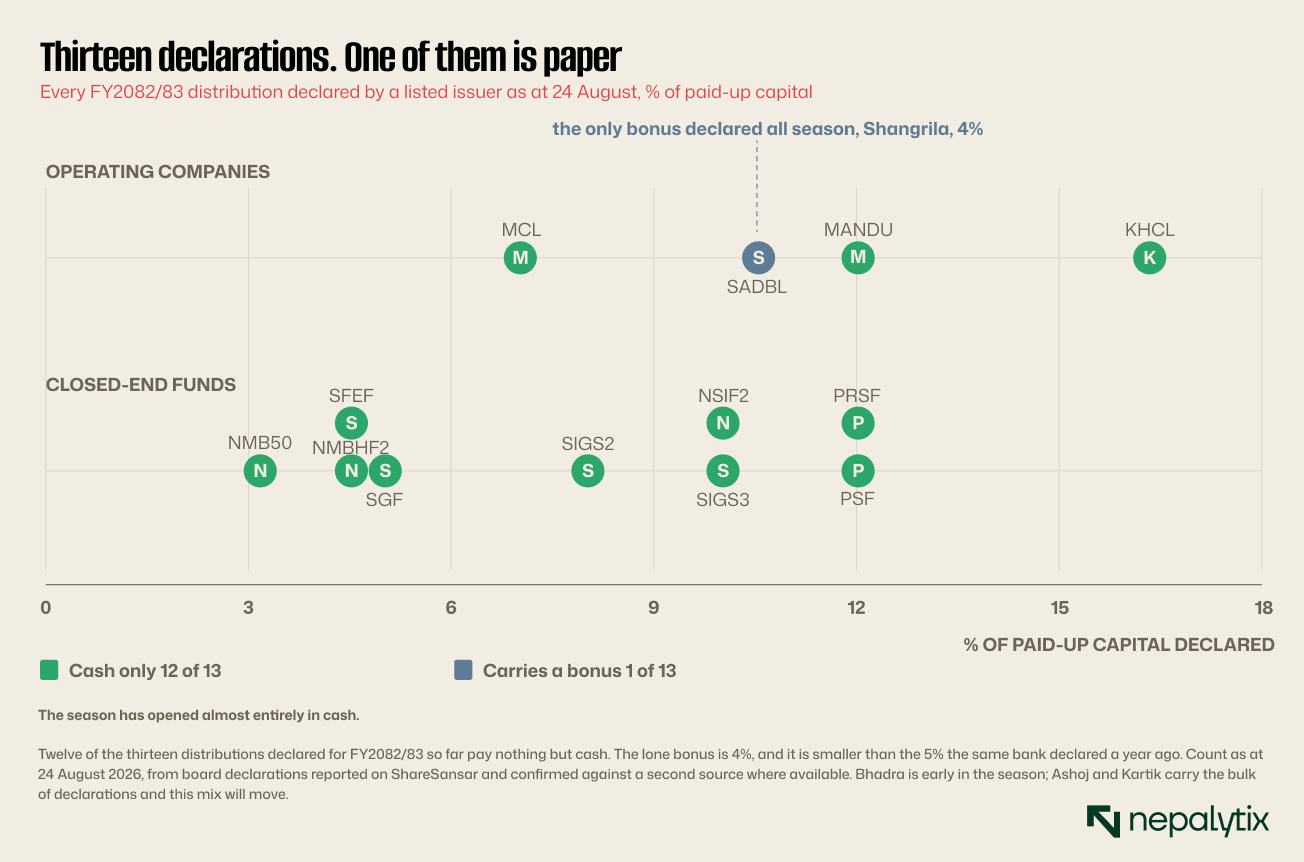
Thirteen distributions are on the board for FY2082/83. Twelve of them are money. The one bonus is smaller than last year's declared by a bank whose profit rose 47% and the dilution everyone is braced for has not shown up yet.
Thirteen listed issuers have put a FY2082/83 distribution to their boards. Twelve of them pay cash and nothing else. The thirteenth, Shangrila Development Bank, pairs a 4% bonus with 6.5263% in cash.
That ratio is the story and it runs against what the market has spent the summer expecting. The standing assumption into AGM season is that Nepali boards capitalise: they declare paper, the share count swells and every shareholder's claim on next year's earnings is divided into more pieces. The arithmetic of that is real and this publication has made the argument before. But it is an argument about a season that has not yet behaved that way.
Two caveats belong at the top rather than buried. Thirteen is a small number and Bhadra is early, the bulk of Nepali AGMs fall between Ashoj and Poush and the mix will move as they land. And nine of the thirteen are closed-end mutual funds which are structurally obliged to distribute cash and cannot issue bonus units at all. Strip them out and the operating-company sample is four, of which one declared paper.
The backdrop matters to how the mix should be read. NEPSE closed the fiscal year at 2,597.80 on the last session of Ashadh and has traded at 2,712.54 in recent sessions, a recovery of roughly 4% from the year-end mark, achieved on thin turnover. This is not a market starved of confidence but nor is it one where boards are being rewarded for hoarding equity. When a bank can borrow cheaply, lend little and see its cost of funds fall by 147 basis points in a year, the case for capitalising reserves into permanent share capital weakens considerably.
So this is a reading of an opening not a verdict on a season. It is worth taking anyway because the direction of the first declarations usually survives contact with the rest.
It is also worth being precise about what a bonus does and does not do because the looseness of the language around it drives most of the confusion. A bonus share is not a transfer of value from the company to the shareholder. It is a bookkeeping entry that moves an amount out of reserves and into paid-up share capital and issues each holder new shares in exact proportion to what they already own. Nobody's percentage of the company changes. The company's assets do not change. What changes is that there are more shares, each representing a proportionately smaller slice and NEPSE mechanically restates the quoted price to reflect it at book closure.
Cash is different in kind, not in degree. It leaves the balance sheet permanently and arrives in a bank account. That is why the mix between the two is the single most informative thing in any declaration and why a season that opens cash-heavy tells you something a season that opens paper-heavy would not.
A headline percentage tells you almost nothing
Every rate above is gross. Nepal withholds 5% on distributions as a final tax under section 88(2)(a) of the Income Tax Act 2058, and it falls on the whole distribution, the bonus included. A shareholder never receives the number in the notice.
This is why Nepali dividend lines carry those repeating decimals. Shangrila's 10.5263% is 10 divided by 0.95. Kabeli's 16.3158% is 15.50 divided by 0.95. The decimal is the gross-up, and its presence tells you the board was working backwards from a round net figure. A round headline Mandu's 12%, Machhapuchchhre Capital's 7% tells you nobody did and the shareholder receives 11.40% and 6.65% respectively.
The split matters more than the total. Shangrila's declaration nets to exactly 10.00%: 4% in paper, 6% in money. Compare that with the same company's FY2081/82 declaration of 10.3583% which was 5% bonus and 5.3583% cash. Near-identical headlines, materially different instruments.
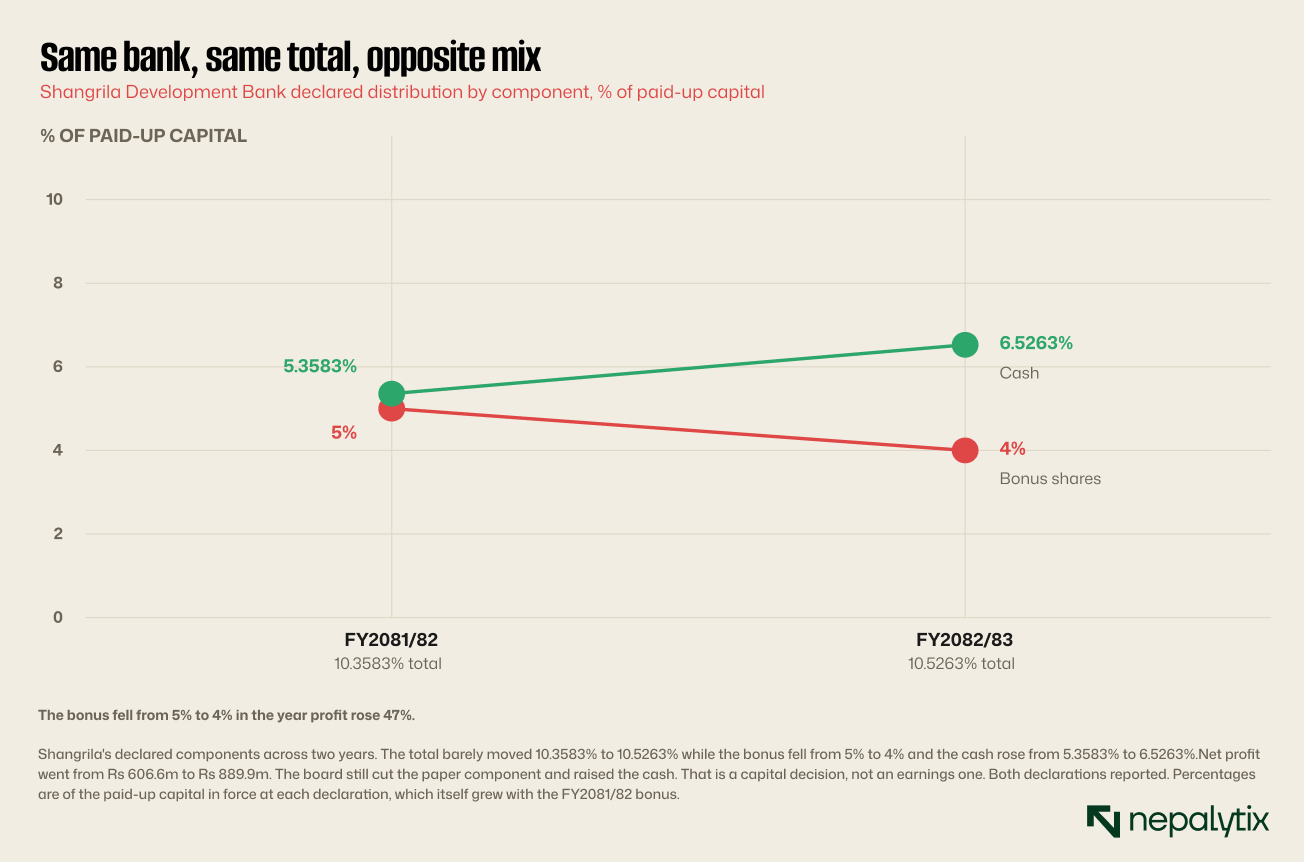
A board that cuts its bonus in a year profit rises by nearly half is not managing earnings. It is managing capital. Bonus shares capitalise reserves: the money stays inside the bank and becomes permanent equity. Cash leaves. Choosing cash over paper in a year of strong profit is a statement that the bank does not currently need the equity which with loan growth subdued across the system is a coherent position rather than a careless one.
Two of the four operating declarations deserve a second look for reasons unrelated to their rates.
Mandu Hydropower is holding a joint fourteenth and fifteenth annual general meeting on Bhadra 17, putting two fiscal years to shareholders in a single sitting. For FY2081/82 it declared 10.5263% but structured as 10% bonus and 0.5263% cash where the cash exists purely to settle the withholding on the paper. A shareholder in that year received additional shares and precisely nothing in the bank. For FY2082/83, the same company declared 12% in pure cash. The same issuer, one year apart, moved from an all-paper distribution to an all-money one. If a single company can swing that far, a thirteen-name sample should be held loosely.
Kabeli Hydropower's 16.3158% is the highest rate declared this season and it is being paid by a company preparing an initial public offering. That is worth stating plainly: the cash is leaving before the public is invited in, and it accrues to the existing shareholders who hold the register today. There is nothing improper in it, a pre-IPO distribution of accumulated profit is ordinary practice and the offer documents will reflect the reduced reserves. But anyone assessing the eventual issue should read the 16.3158% as a transfer that has already happened rather than as evidence of a distribution policy the incoming public shareholder will inherit.
The question that follows is where the money came from and the answer is not lending.
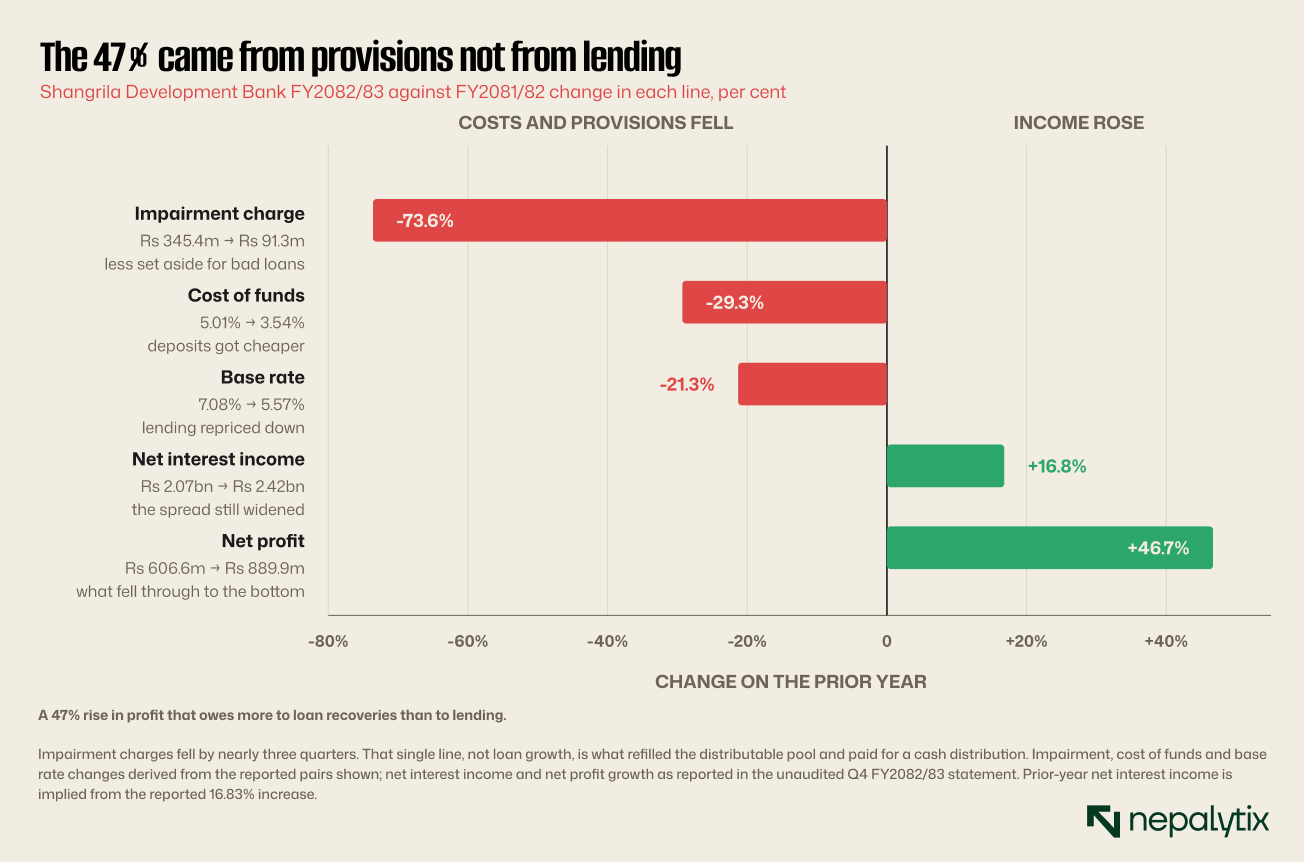
A bank that refills its distributable pool by releasing provisions rather than by writing new loans has cash it does not need as capital. Recoveries are cash; they arrive without consuming risk-weighted assets and without requiring the equity base to grow to support them. That is the cleanest explanation on the table for why the board rotated toward money and away from paper and it is a mechanism that will repeat across the sector if provisioning normalises broadly.
It is also, worth saying, a lower-quality source of profit growth than lending would be. Provision reversals are finite. A 47% increase built on them does not annualise which makes the 4% hurdle in the next section rather less trivial than it first appears.
The one bonus and the hurdle it just set
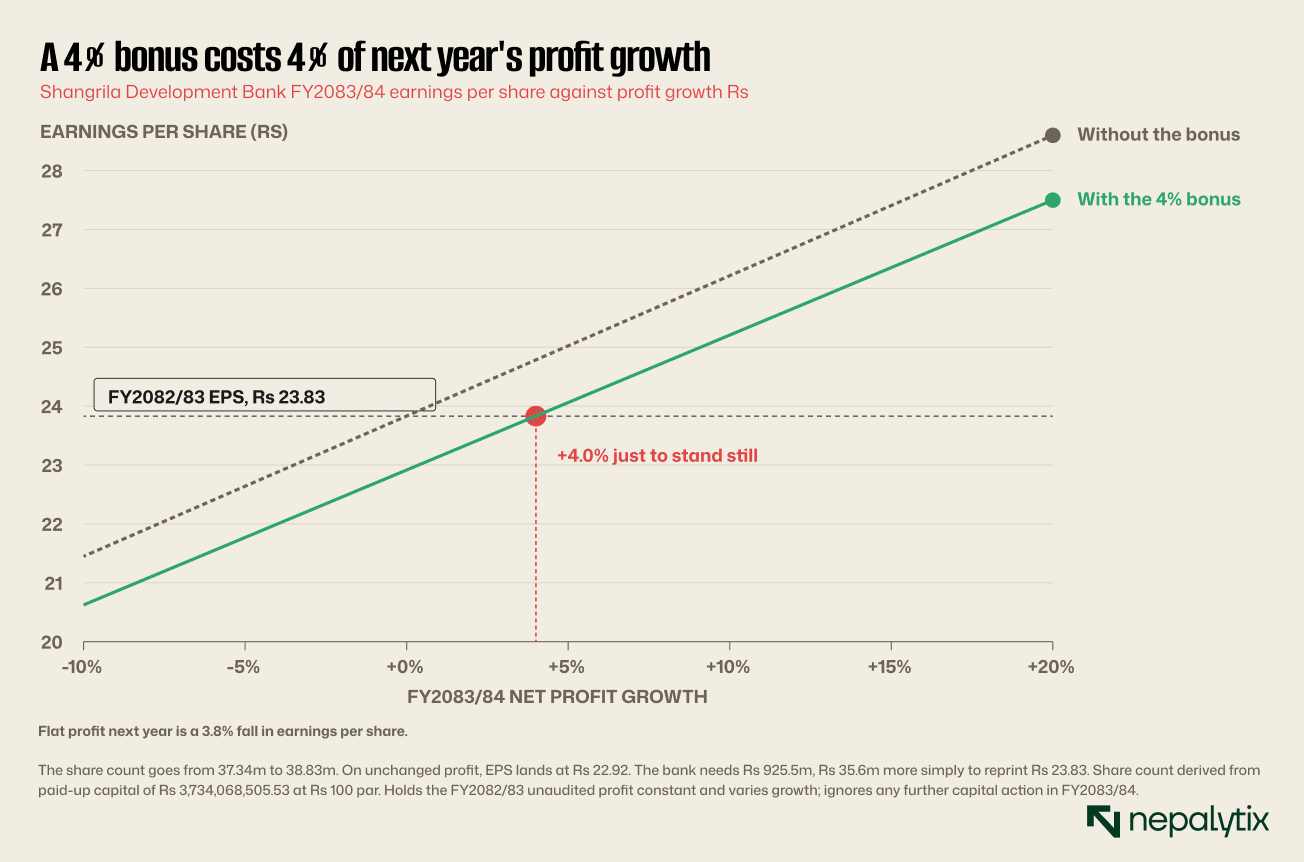
A 4% bonus takes Shangrila's share count from 37,340,685 to 38,834,312. Nothing about the business changes. The claim each existing shareholder holds is unchanged because everyone is diluted equally. What changes is the denominator under next year's earnings.
FY2082/83 EPS was Rs 23.83 on unaudited figures. Hold profit flat at Rs 889.9m and next year's EPS lands at Rs 22.92, a 3.8% fall produced entirely by arithmetic. To reprint Rs 23.83, the bank must earn Rs 925.5m which is Rs 35.6m more than it just made.
Four per cent is a modest hurdle for a bank that grew profit 46.7%. That is the point of citing it: this is what a small bonus commits a company to. A 20% bonus, common enough in Nepali AGM seasons requires 20% profit growth before a shareholder sees a single rupee of EPS improvement. When the declarations arrive in volume through Ashoj, this is the test to apply to each one.
The funds are paying less than the companies they hold
Nine closed-end funds have declared from NMB 50's 3.15% to Prabhu's two schemes at 12% each. Ranked against the four operating declarations they sit lower: the median company declared 11.26%, the median fund 8.00%, and only two of nine funds clear the operating median. Figure 1 shows the separation, the operating lane is weighted to the right of the fund lane at almost every point of the distribution.
This is structural rather than damning. A closed-end fund distributes realised gains and dividend income. It spent FY2082/83 holding a market that fell for a good part of the year, and it cannot distribute an unrealised position. An operating company distributes out of profit and profit for the banks and hydropower issuers that have reported did not fall. The gap reflects two different machines, not two different levels of competence.
The dispersion inside the fund cohort is wider than the gap to the companies. Prabhu's two schemes declared 12% each; NMB 50 declared 3.15%. That is close to a fourfold spread across instruments that broadly hold the same Nepali equities, and it is a function of when each fund was launched, what it bought and how much of its book it chose to realise this year rather than of manager skill in any single twelve-month window. A fund that sold into strength crystallised gains it can distribute; one that held did not.
One technical note that trips up comparison: a fund's declared percentage is of Rs 100 par unit value, not of net asset value or of market price. It is not a yield and should not be read against one.
Profit is not the constraint. The distributable pool is
Shangrila is the only declaration in the sample with enough disclosure to take apart, and what it shows is worth generalising.
The bank earned Rs 889.9m, Rs 23.83 a share. Its distributable profit was Rs 492.3m or Rs 13.19 a share. The gap of Rs 10.64 a share is not available to anyone: it is absorbed by statutory and regulatory reserve requirements before the board sees a rupee of it. Reported earnings, in other words overstate distributable capacity by roughly 80% at this bank.
Against that Rs 13.19, the board declared Rs 10.5263, 79.8% of what it was permitted to distribute and 44.2% of what it earned. Rs 2.66 a share of headroom was left unused and Rs 99.2m stays in the bank.
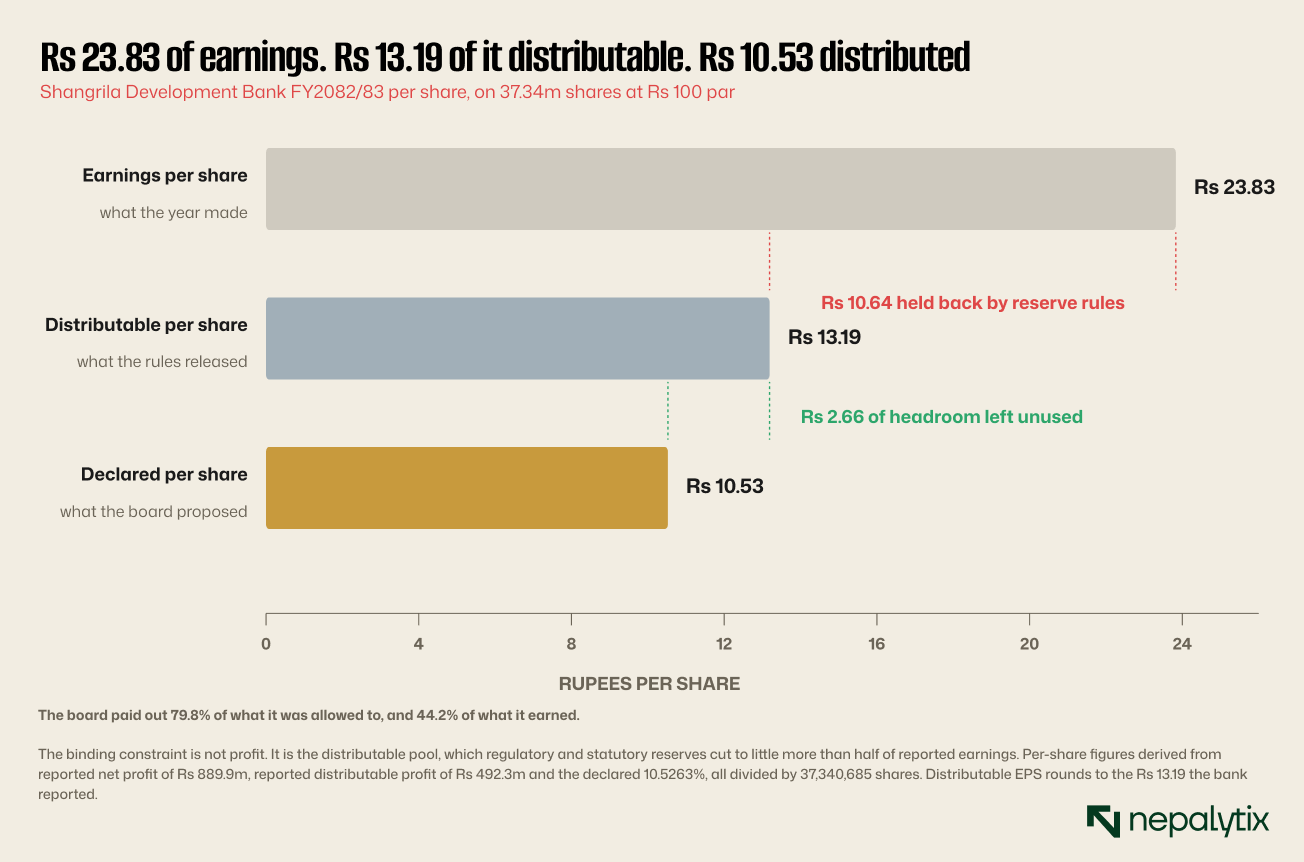
Two mechanisms drive that gap for a bank. The first is the general reserve: a fixed proportion of each year's profit must be appropriated before anything becomes distributable. The second is the regulatory reserve, which quarantines income that has been recognised in the accounts but not received in cash, accrued interest, deferred tax, certain revaluation effects. Neither is discretionary and neither appears in the earnings-per-share figure that headlines the quarterly coverage.
The practical consequence is that any attempt to forecast a dividend from an EPS number will be wrong usually by a wide margin. The line to watch in a quarterly report is distributable profit, and for banks it moves with provisioning and regulatory reserve adjustments rather than with the headline result. Shangrila's distributable profit was helped enormously this year by impairment charges falling from Rs 345.4m to Rs 91.3m.
There is a further asymmetry between the two instruments that rarely gets stated. Cash dividends are irreversible for the company and immediately taxable for the holder. Bonus shares are equally taxable, the 5% falls on them just the same but the holder must fund that tax from somewhere, which is why Nepali boards habitually attach a small cash component sized to cover it. When that component is sized to cover the tax and no more, as Mandu's 0.5263% was, the shareholder receives a tax bill settled on their behalf and no income. The declaration is real, the percentage is real and the cash received is zero.
For an investor holding for income, the distinction is the whole question. For one holding for compounding, a bonus is at worst neutral and at best a signal that the company intends to keep the capital working. The mistake is treating the two as interchangeable because they are quoted in the same units against the same base.
The approval gate that has not opened
Only one bank has declared anything, and that declaration is not final. Shangrila's proposal is explicitly conditional on Nepal Rastra Bank clearing it, and the bank has said that if the central bank directs changes those will be folded in before the proposal reaches the AGM.
That gate is the reason banking declarations lag the rest of the market every year. A bank's board can propose in Bhadra, but the audited accounts must clear the regulator before a notice can carry a dividend line. Until then there is no notice, no book closure date and no tradeable event. For the twenty commercial banks that have now published fourth-quarter figures, the proposals will follow the approvals, not the results.
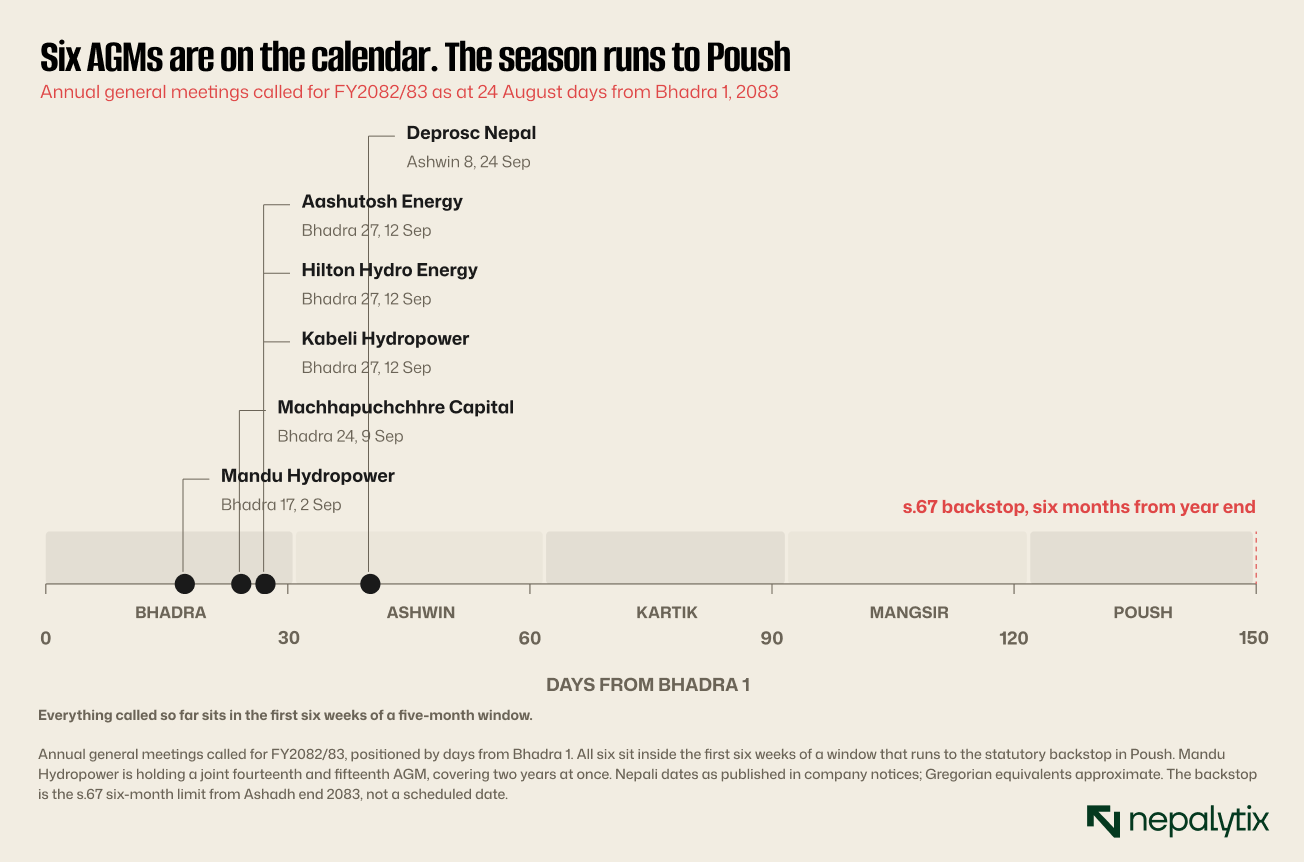
Six AGMs have been called so far. Three of them fall on Bhadra 27 alone.
What to check as Ashoj fills the calendar
Four tests, in order of how much they tell you.
The split, not the total. Read past the headline percentage to the bonus and cash components. A 10.5263% that is 10% bonus plus 0.5263% cash the structure Mandu used for FY2081/82 puts precisely zero rupees in a shareholder's account, because the cash component exists only to settle the tax on the paper. A 10.5263% that is 4% bonus plus 6.5263% cash pays 6.00% in real money.
The bonus against the profit growth just delivered. A bonus of x% requires x% profit growth next year for EPS to stand still. Set each declaration against the fourth-quarter result the same company just filed. Where the bonus exceeds the growth, the board has committed to an acceleration it has not yet demonstrated.
Distributable profit, not net profit. The dividend line is capped by the distributable pool. For banks that pool is roughly half of reported earnings and moves with provisioning.
The rupee amount, where it is given. Eleven of the thirteen declarations in this sample disclosed a percentage and no absolute figure. A percentage of paid-up capital is only meaningful once you know the capital it applies to and paid-up capital moves every time a company issues bonus shares or rights. Two declarations of the same percentage by companies of different size are not comparable events and a company that declares the same percentage two years running after issuing a bonus in between has quietly increased the absolute sum it is paying out.
Whether the declaration is approved or merely proposed. A board decision, a regulator's clearance and an AGM resolution are three different states. Only the last one makes a dividend an entitlement and only a published notice fixes the book closure that determines who receives it.
There is a fifth test that applies only to banks and it is the one most likely to catch people out this season. A proposal conditioned on Nepal Rastra Bank approval can be reduced. The regulator has form in trimming declarations where it judges capital or provisioning inadequate and the version that reaches the AGM is not always the version the board announced. Between a board's Bhadra announcement and a Poush book closure there are two authorities who can move the number and the shareholder learns the outcome only when the notice is published.
If the pattern in these first thirteen holds through Ashoj, cash-heavy, paper-light then the supply pressure on the market this season comes from the issuance pipeline rather than from inside existing companies. That is a different problem with a different remedy and it is the one this week returns to on Thursday.
Disclaimer
This report has been prepared by Nepalytix for informational and educational purposes only and does not constitute investment advice, an offer, or a solicitation to buy or sell any securities.
The information contained in this report is based on sources believed to be reliable; however, Nepalytix does not guarantee its accuracy, completeness, or timeliness. Opinions, estimates, and projections expressed herein are those of the authors as of the date of publication and are subject to change without notice.
Investing in securities involves risks, including the possible loss of principal. Past performance is not indicative of future results. Readers are advised to conduct their own independent research and consult with a qualified financial advisor before making any investment decisions.
Nepalytix and its contributors may hold positions in the securities discussed in this report at the time of publication or thereafter.
Neither Nepalytix nor any of its affiliates accept any liability for any loss arising from the use of this report or its contents.