Nepal’s Microfinance Profits Rose 43%. Bad Loans Tell a Different Story.
Microfinance profits rose 43%, but bad loans surged 64%. Falling loan-loss provisions explain much of the profit growth, raising questions about its sustainability.
The fourth-quarter numbers say the sector had its most profitable year in the regulator's four-year series. The regulator's numbers say its bad loans grew six times as fast as its lending. The gap between them is provisioning and last year's audit shows what happens to that gap.
The signal
The 43% rise in microfinance profit is mostly provisioning that was not done. Across 26 companies whose statements show both years in full, impairment charges fell by Rs 4.1 billion against a Rs 1.6 billion rise in net interest income while the sector's bad loans rose by nearly two-thirds and provision cover fell from 84% to 69%. Last year's unaudited fourth-quarter profit for the same 26 companies was cut by two-thirds when it was restated. This year's is also unaudited. Price the profit accordingly so far the market has.
01. The headline, and the other headline
The fourth-quarter season for microfinance ended in August and the summary that circulated was uniform: profits up about 43%, 40 companies up, 10 down. Our count of the 49 listed microfinance companies with a fourth-quarter filing on sharesansar.com agrees. Their combined net profit for FY2082/83 was Rs 12.03 billion against Rs 8.40 billion for FY2081/82 as those companies first published it a year ago, a rise of 43.2%. Thirty-nine reported higher profit and ten lower.
In late September the Nepal Rastra Bank's offsite supervision report on microfinance put a different set of numbers beside those. For the 48 retail microfinance institutions, non-performing loans rose from Rs 31.02 billion to Rs 50.82 billion in the year to mid-July up 63.8%. Loans grew 10.1% to Rs 487.7 billion. The non-performing ratio went from 7.0% to 10.4%. Net profit, on the regulator's count rose 48% from Rs 7.28 billion to Rs 10.78 billion. Two institutions made losses; eight reported capital adequacy below the 8% minimum in unaudited returns; ten are under the central bank's prompt corrective action framework.
A lender whose bad loans grow six times as fast as its loan book does not usually report its best profit growth in years. The explanation is in one line of the income statement.
02. The market did not believe it
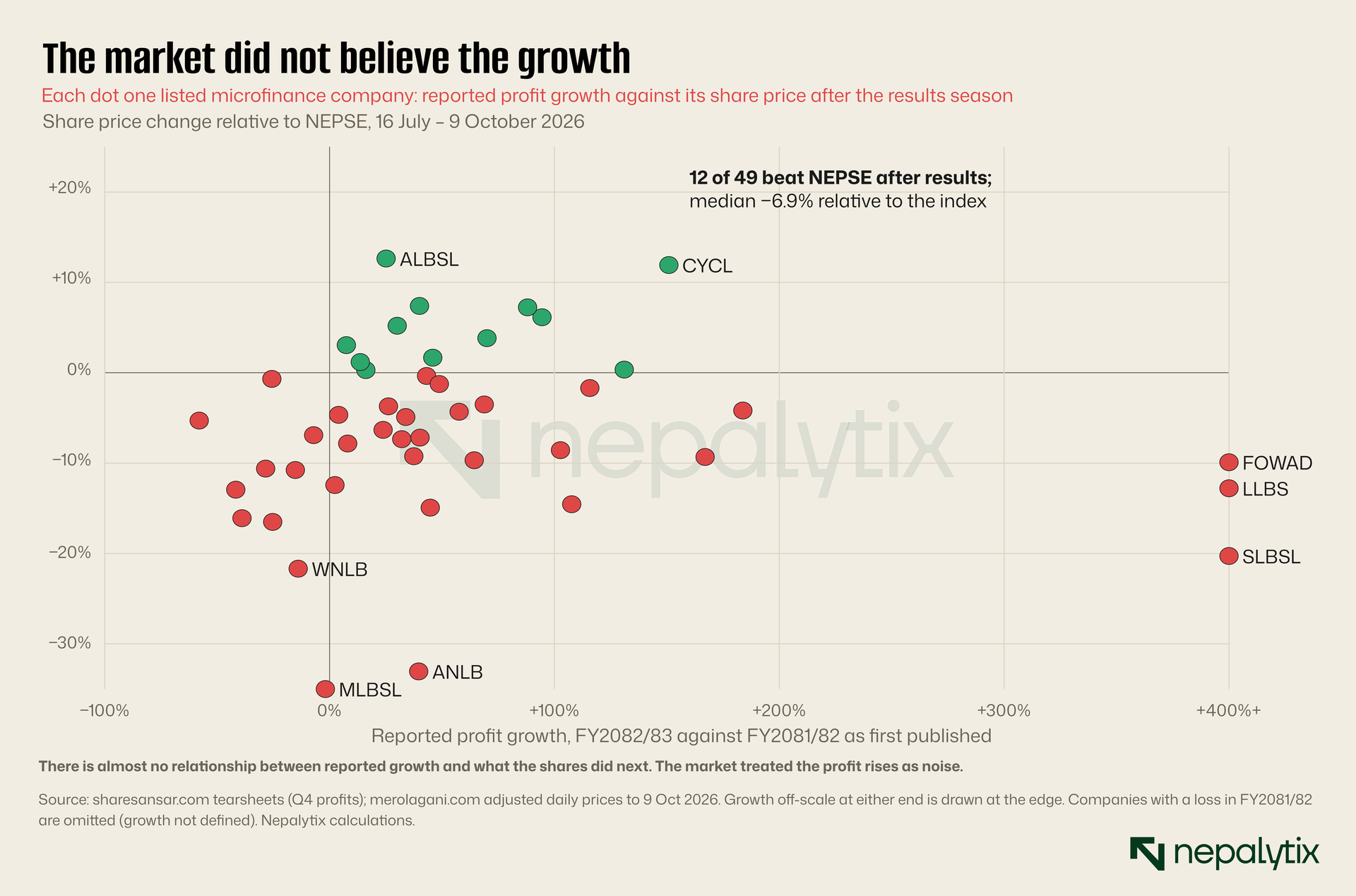
Investors read the numbers the same way. From 16 July, the end of the fiscal year to 9 October, the NEPSE microfinance sub-index fell 3.8% while NEPSE fell 0.2%. Of the 49 listed companies, 12 beat NEPSE over that period; the median trailed it by 6.9%. The companies that reported the biggest growth were not rewarded for it: Forward Microfinance, Laxmi Laghubitta and Samudayik Laghubitta all reported profit growth of more than 300% and all fell by 10% to 20% relative to the index.
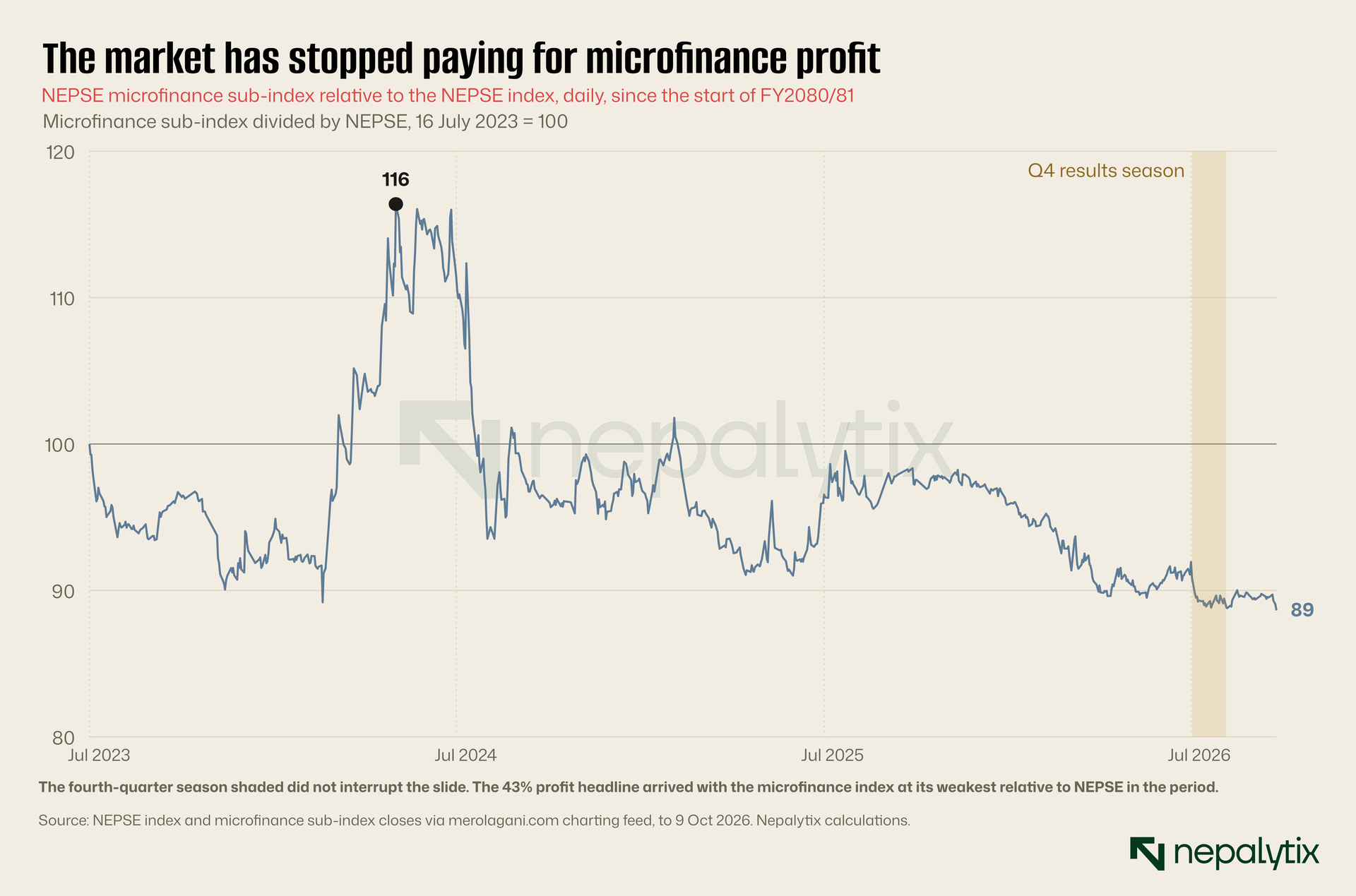
The longer record is clearer still. Relative to NEPSE, the microfinance sub-index peaked in the first half of 2024, 16% above where it started FY2080/81 and has since fallen to 11% below. The sector still trades at a median price-to-earnings ratio of 32 and a median of five times book value, rich for lenders whose bad loans just rose by two-thirds but the direction of travel for two years has been down.
03. Provisions did not keep up with bad loans
Start with how bad 10.4% is. On the central bank's own monthly statistics for mid-July 2026, the non-performing ratio was 5.56% at commercial banks, 5.77% at development banks and 9.89% at finance companies. Microfinance is now the worst class of licensed lender in the country by this measure and it got there in a single year from 7.0%. It is also the class whose borrowers have the least collateral and the least capacity to absorb a shock which is why the regulator caps collateral-backed lending at a third of a retail microfinance portfolio.
A microfinance company sets aside a provision against loans it does not expect to recover. The charge for that provision is an expense; when it goes up, profit goes down. If bad loans rise 64% and provisions rise in step, profit falls. If provisions rise more slowly than bad loans, profit can rise.
That is what happened. The regulator's report puts total loan loss provisions at Rs 35.24 billion up 34.9%, about half the rate of increase in bad loans. Provision cover, total provisions as a share of non-performing loans fell from 84% to 69%. Had the sector held cover at last year's 84%, it would have needed Rs 42.8 billion of provisions, Rs 7.6 billion more than it holds. That shortfall is equal to 70% of the sector's reported net profit for the year.
The regulator's report also gives provisions held specifically against non-performing loans: Rs 29.42 billion, up 84%. Specific cover went from 52% to 58%. So the institutions did provide more against loans already classified as bad. What fell was everything else. Provisions not tied to a specific bad loan dropped from about Rs 10.1 billion to Rs 5.8 billion: the general provisions on loans still classed as good which under NFRS expected-credit-loss accounting is where a lender recognises that tomorrow's bad loans are forming today.
04. Inside the profit: 26 companies, line by line
The aggregate tells you the direction. The company statements tell you the size. We parsed the fourth-quarter statements of the microfinance companies published and kept the 26 whose year-to-date profit matched the company's reported figure so that we knew we were reading the right columns. Together they reported Rs 4.86 billion of profit, 40% of the listed sector's total and they include Sana Kisan, Nirdhan Utthan, Nerude Mirmire, Global IME and Matribhumi. The largest profit-makers, Chhimek, Jeevan Bikas, Deprosc and National are not in the sample, because their statements were not available in the same form.
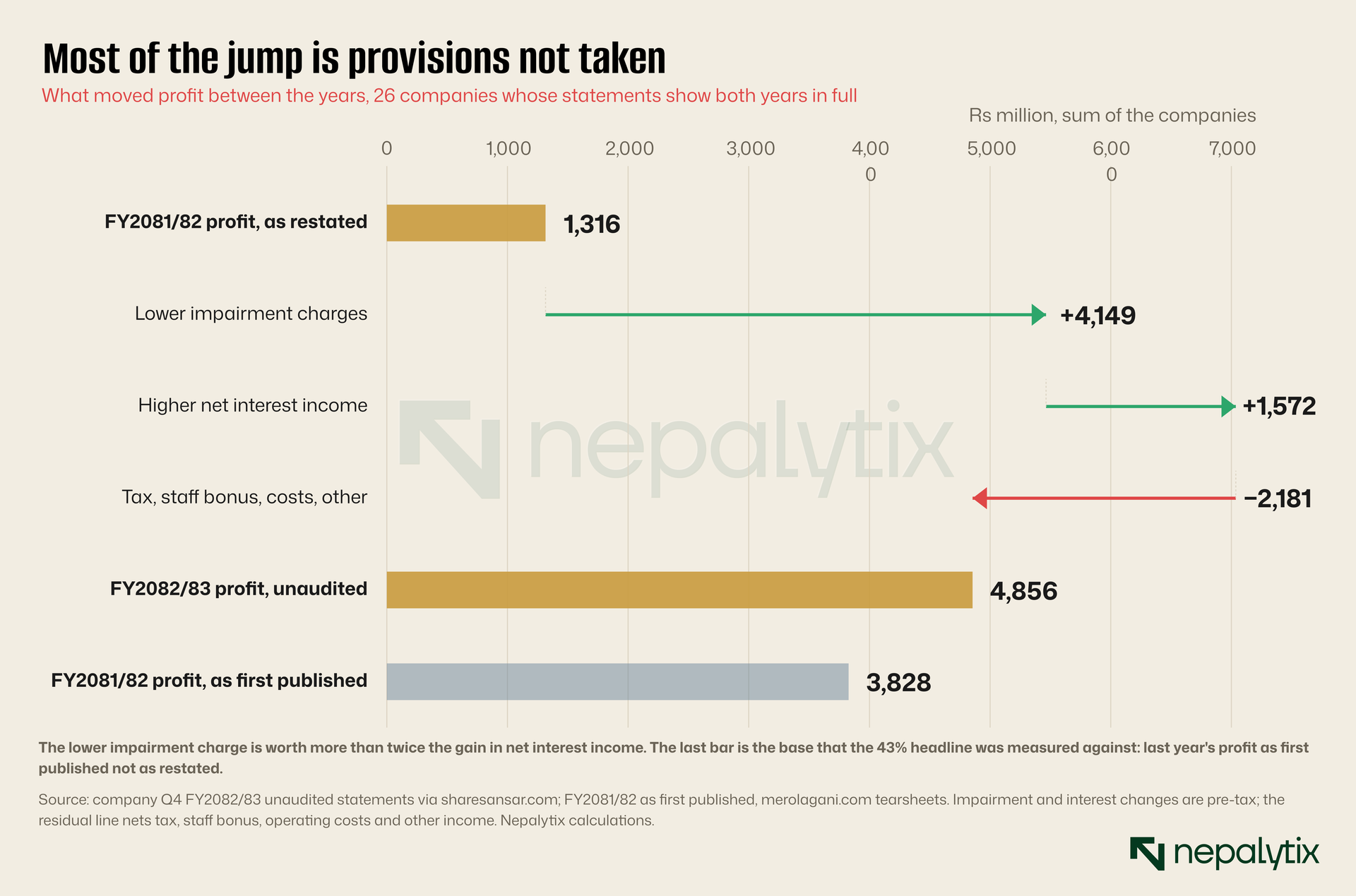
Their combined impairment charge for loans fell from Rs 6.36 billion in FY2081/82 to Rs 2.21 billion in FY2082/83, a cut of Rs 4.15 billion or 65%. Their net interest income rose by Rs 1.57 billion. Everything else, tax, staff bonus, operating costs and other income took Rs 2.18 billion back. After tax at 30%, the impairment saving is worth about Rs 2.90 billion or 82% of the Rs 3.54 billion rise in their combined profit.
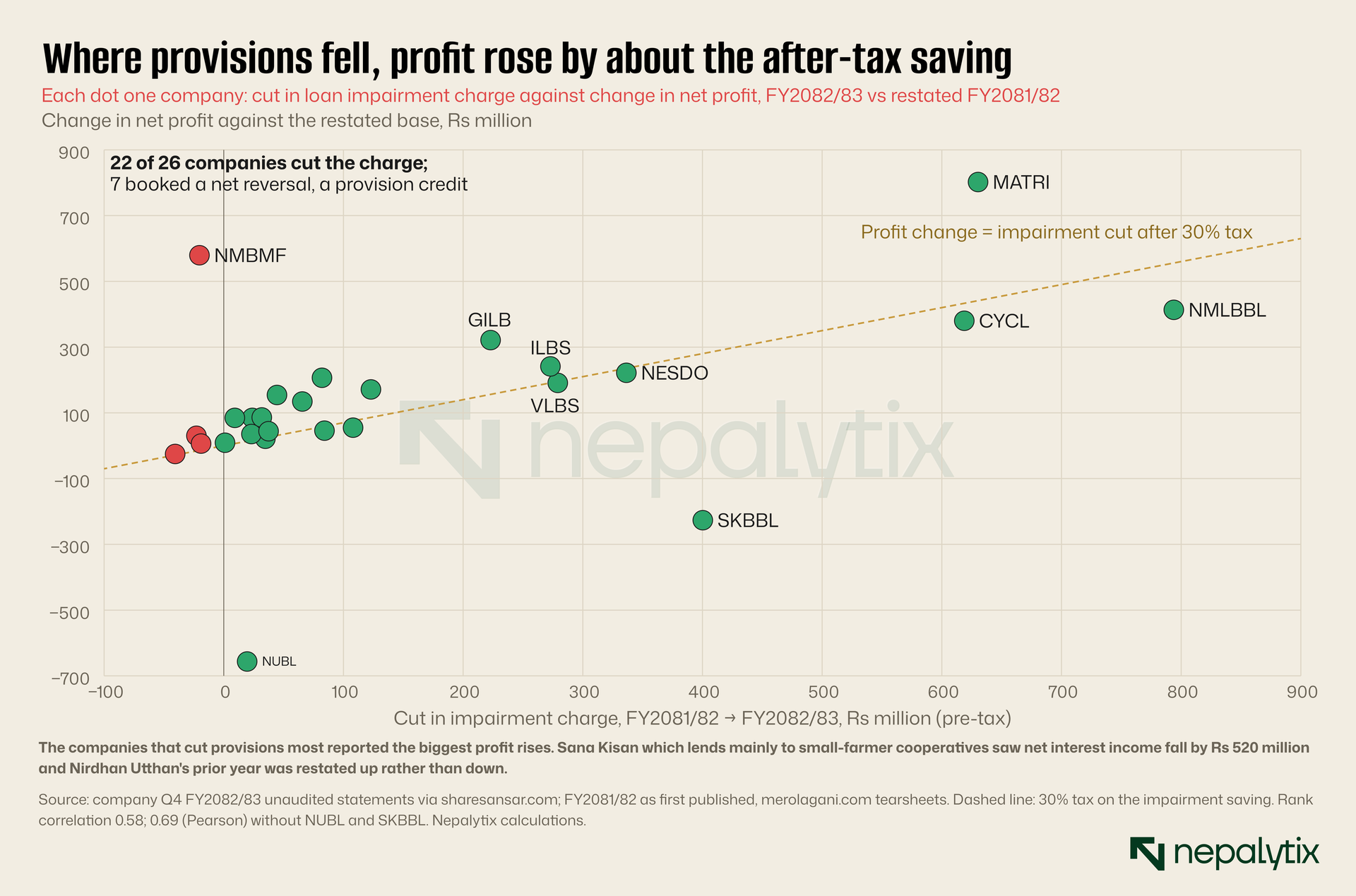
The pattern holds company by company. Twenty-two of the 26 cut their impairment charge. Seven booked a net reversal, a provision credit that adds to profit including Matribhumi which went from a Rs 531 million charge to a Rs 100 million credit, and CYC Nepal from Rs 360 million to a Rs 259 million credit. The rank correlation between the size of the impairment cut and the size of the profit rise is 0.58 leaving out Sana Kisan and Nirdhan Utthan whose profits fell for reasons of their own, the straight correlation is 0.69 and the slope is close to the after-tax value of the saving.
05. The base was moved
There is a second reason the growth looks the way it does. Each fourth-quarter statement shows last year's figures beside this year's. For 23 of the 26 companies, last year's profit in this year's statement is lower than the profit those companies published a year ago, sometimes far lower.
Taken together, the 26 first published FY2081/82 profit of Rs 3.83 billion. In this year's statements, the same year is shown at Rs 1.32 billion, a cut of 66%. NMB Laghubitta first reported a profit of Rs 64 million restated it was a loss of Rs 437 million. Matribhumi went from a loss of Rs 58 million to a loss of Rs 523 million. Global IME Laghubitta's profit went from Rs 236 million to Rs 75 million; Asha's from Rs 209 million to Rs 103 million.
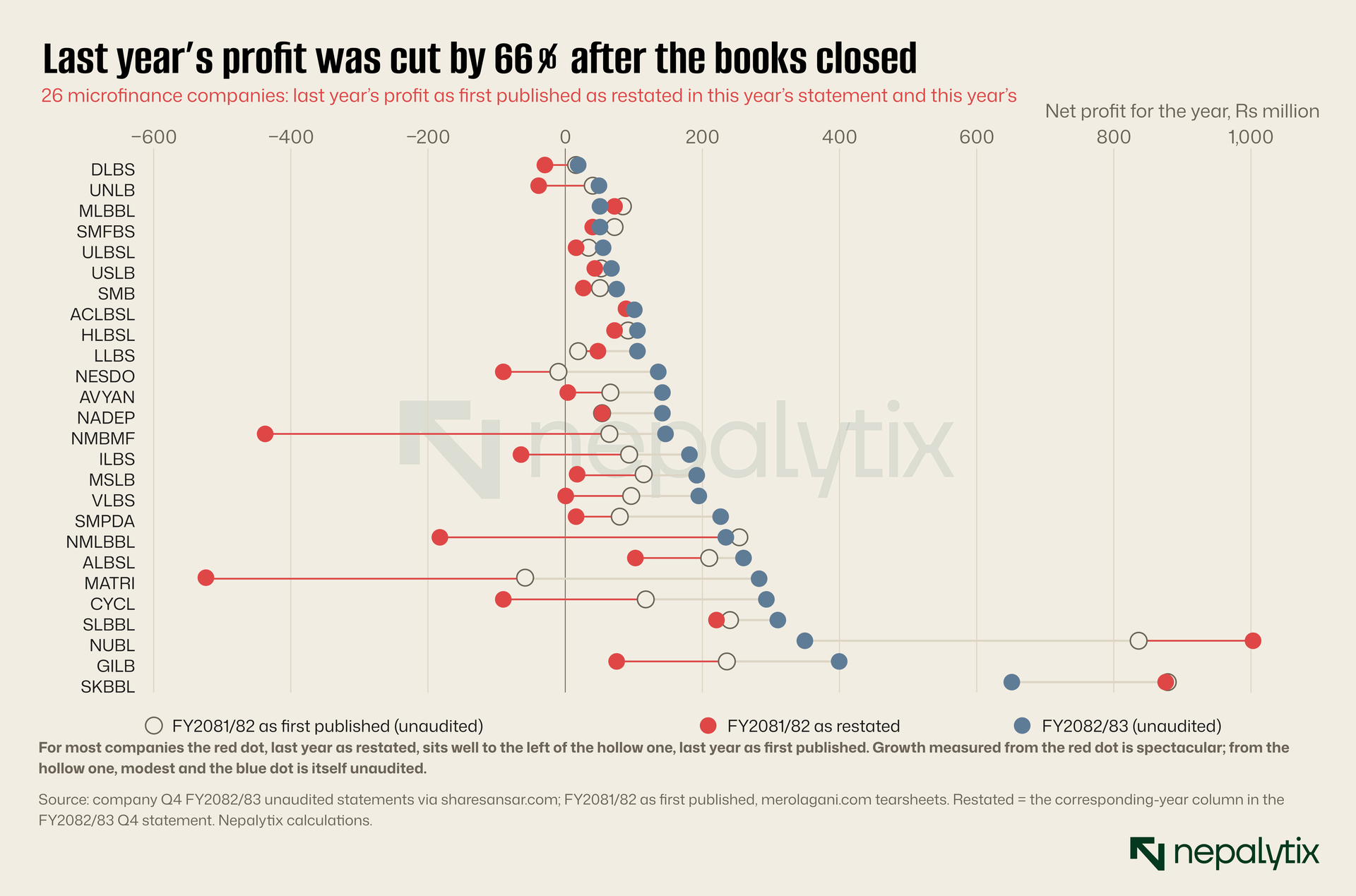
Two things probably drove those restatements. FY2081/82 was the first year microfinance institutions reported under NFRS, Nepal's version of international accounting standards with its expected-credit-loss model for impairment. And the restated column reflects the audit. Whatever the mix, the effect was the same: the unaudited fourth-quarter profit that companies published in August 2025 turned out for these 26 to be about three times what the audited books supported and almost all of the difference came through impairment.
That makes the comparison investors were shown awkward in both directions. Measured against last year as first published, the sample's profit rose 27%. Measured against last year as restated, it rose 269%. Neither is wrong but the second compares an unaudited number with an audited one and the first compares two unaudited numbers, one of which has already been cut by two-thirds.
06. Four moves, repeated
Set the 26 side by side and the same sequence recurs. Last year's profit restated down: 23 companies. This year's impairment charge cut: 22. Net interest income up: 21. Profit up against last year as first published: 21. In five companies, the after-tax impairment saving alone was larger than the entire rise in profit which means the underlying business, before the provision line, did worse than the year before.
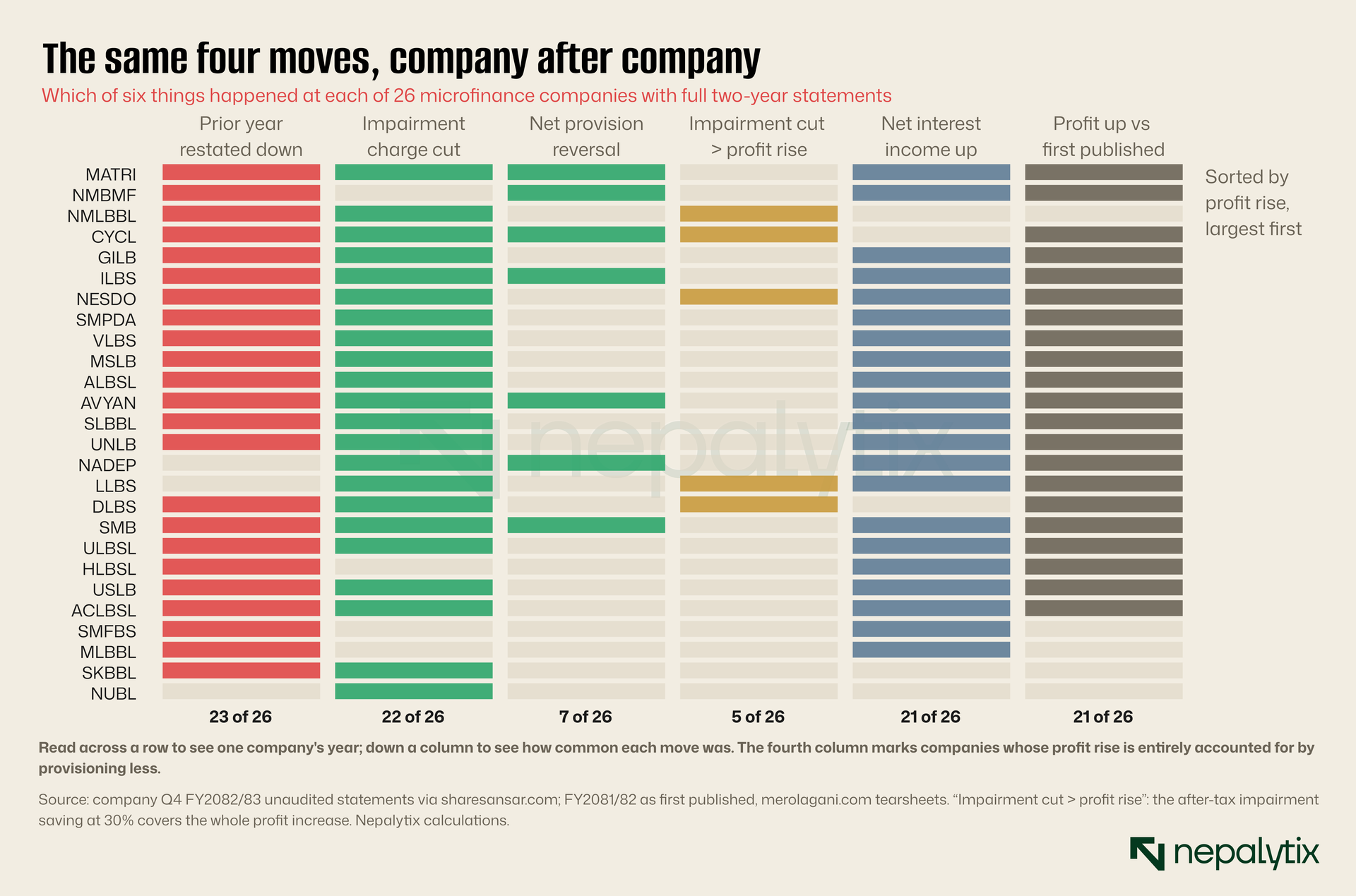
The companies where all four moves line up most sharply are worth naming because their next audited numbers carry the most risk of revision. Nerude Mirmire, Matribhumi and CYC Nepal each cut their impairment charge by more than Rs 600 million while their prior-year profit was restated down by more than Rs 200 million. NESDO Sambridha, Vijaya, Infinity and Global IME each cut it by more than Rs 200 million. At the other end, Sana Kisan and Nirdhan Utthan reported lower profit despite lower impairment charges, for reasons outside the provision line: Sana Kisan's net interest income fell by Rs 520 million and Nirdhan Utthan's prior year had been restated up. Himalayan, Mithila and Swabhimaan raised their charges.
This is not an accusation of wrongdoing. Provisions under expected-credit-loss accounting depend on assumptions about future recoveries and a company that believes its collections are improving is entitled to provide less. Some evidence supports that: net interest income which only counts interest actually recognised, rose at 21 of the 26. But the regulator's numbers point the other way and the regulator sees every institution's loan book.
07. What the regulator's returns show
The central bank's monthly statistics give a longer view of the sector, all 51 institutions including the wholesale lenders and the non-financial indicators are the ones least affected by the change in accounting standards.
Members rose 5% in the year to mid-July, to 6.53 million. Borrowers barely moved, up 0.2% to 2.71 million. Passive members, people still on the books but no longer transacting, rose 21% to 972,000 and passive groups by 57%, to 59,952. Overdue borrowers rose 5.5% to 659,343, nearly a quarter of all borrowers. Interest suspense, interest that has been accrued on loans but not received, rose 26% to Rs 17.1 billion. Branches fell for the third year running. Retained earnings across the sector fell from Rs 2.6 billion to Rs 0.5 billion, even as reported profit rose.
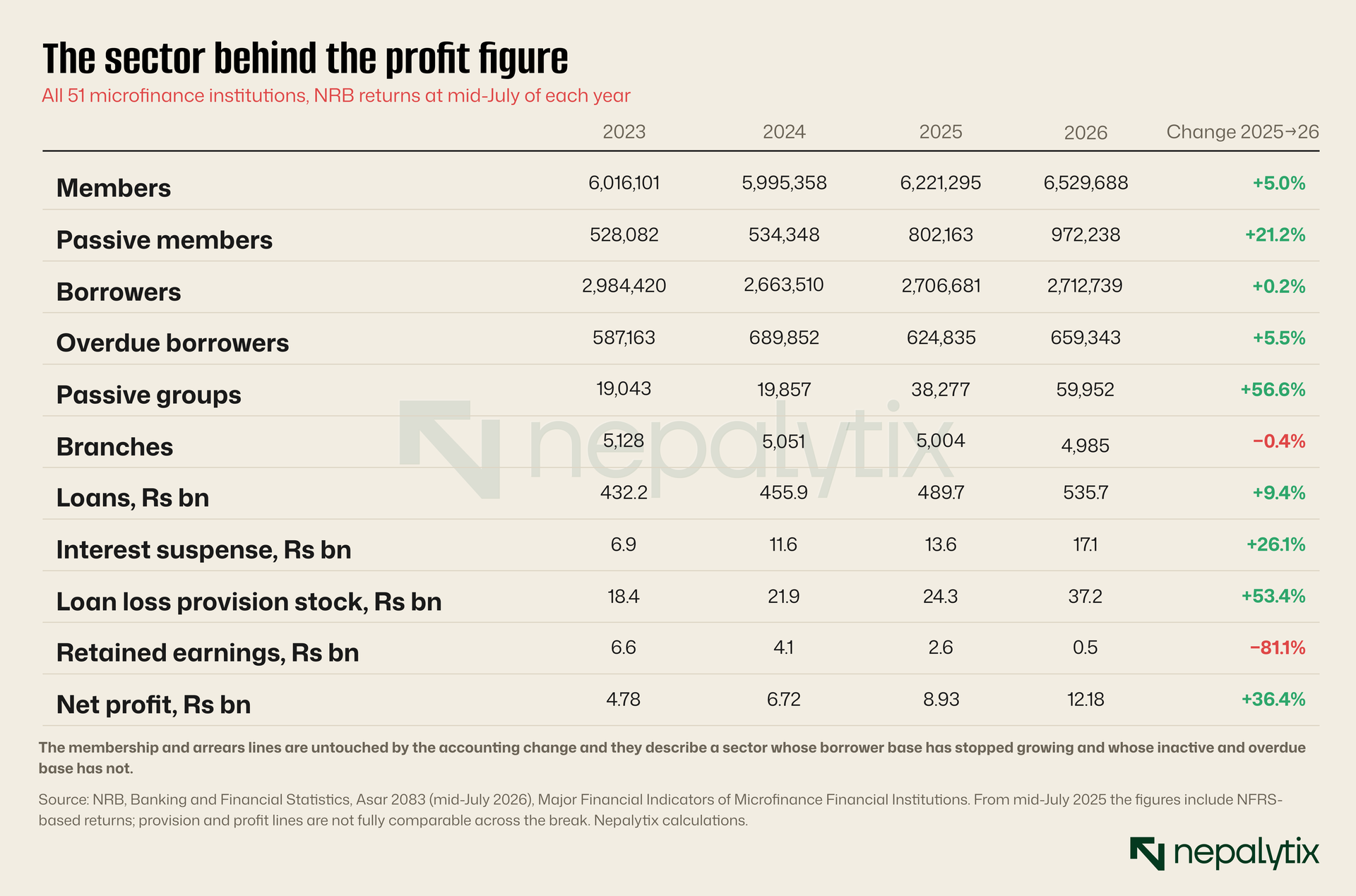
Interest suspense deserves a word. When a borrower stops paying, the lender keeps accruing interest on the loan but under the central bank's rules it cannot count that interest as income; it parks it in a suspense account until cash arrives. A rising suspense balance is uncollected income building up. At Rs 17.1 billion it is now larger than the sector's entire reported net profit for the year and it has grown faster than the loan book in each of the last three years.
None of those lines describes a recovery in repayment strong enough to justify cutting provisions by two-thirds. A borrower base that does not grow, an inactive base that grows by a fifth and uncollected interest that grows by a quarter describe a loan book that is ageing.
08. The best case for the companies
There is a reading of these numbers that is kinder to the companies and it should be put fairly.
First, FY2081/82 was the first year under NFRS, and the first year of an expected-credit-loss model usually over-provisions: models are calibrated cautiously, auditors push for more and every loan is assessed at once. Some of last year's restated charge may have been a one-off catch-up which would make this year's lower charge a return to normal rather than a cut. Second, the companies wrote off more. The central bank's returns show loans written off across the sector rising from Rs 41 million to Rs 495 million; a write-off uses up provisions already made so it can lower the stock of provisions without any change in judgement. Third, specific provisions against loans already classed as bad did rise by 84%, faster than the bad loans themselves.
Each point has a limit. If last year was over-provided, non-performing loans would not have risen 64% this year. The write-offs are small next to a Rs 19.8 billion rise in bad loans. And the specific provisions rose because the bad loans did; what fell was the provision for the loans that will go bad next. The kindest reading is that the companies are betting that the arrears cycle has turned. The membership, overdue and suspense figures say it has not turned yet.
09. What happens next
Three dates matter. The first quarter of FY2083/84 closes this Friday, 16 October, the last trading day before Dashain; those reports, due by mid-November will show whether the lower provisioning continued. The audits of FY2082/83 are under way, and annual general meetings will approve audited accounts in the coming months; last year, the same step cut the reported profit of these 26 companies by two-thirds. And the central bank's supervision report names 10 institutions under prompt corrective action and eight below minimum capital on unaudited figures which means some of the audited numbers will be written under supervisory pressure.
For a reader of microfinance results, the practical rule is short. Read the impairment line before the profit line. Compare this year's unaudited figure with last year's restated one and ask how far last year's moved. And look for the one number the companies do not put on the front page: non-performing loans and provision cover, institution by institution. The central bank collects both every month. The regulator publishes them for the sector; the companies publish them, in the ratios annex of their statements inconsistently and the summary tables most investors see do not carry them at all.
A short guide to reading the statement, for anyone who wants to check a single company. The income statement in the NRB interim format has four columns: this quarter, the year to date, the same quarter last year and the year to date last year. The fourth column is last year as restated not as first published; compare it with what the company reported a year ago. The line "impairment charge/(reversal) for loans and other losses" is the provision expense; a figure in brackets is a reversal and adds to profit. The ratios annex at the end should carry the non-performing ratio, provision cover and capital adequacy; if it shows dashes, the company has published without them and the question is why.
That is the recurring gap in Nepali disclosure, in its sharpest form. A microfinance company's profit is a provisioning decision. The figure that tests it is the bad-loan figure. The first is headlined; the second is not.
Disclaimer
This report has been prepared by Nepalytix for informational and educational purposes only and does not constitute investment advice, an offer, or a solicitation to buy or sell any securities.
The information contained in this report is based on sources believed to be reliable; however, Nepalytix does not guarantee its accuracy, completeness, or timeliness. Opinions, estimates, and projections expressed herein are those of the authors as of the date of publication and are subject to change without notice.
Investing in securities involves risks, including the possible loss of principal. Past performance is not indicative of future results. Readers are advised to conduct their own independent research and consult with a qualified financial advisor before making any investment decisions.
Nepalytix and its contributors may hold positions in the securities discussed in this report at the time of publication or thereafter.
Neither Nepalytix nor any of its affiliates accept any liability for any loss arising from the use of this report or its contents.