Nepal’s Share-Backed Loans Are Built on a Price That Often Isn’t Real
Nepal’s 80% margin lending rule relies on thinly traded share prices creating hidden valuation and liquidity risks for banks.

In July Nepal raised the ceiling on share-backed lending to 80%. The rule values the collateral at the last traded price. For a fifth of the market that price comes from twenty-five trades or fewer and for one company it came from a single transaction of ten units.
On 15 July Nepal Rastra Bank decided that banks could lend more against shares. The ceiling went from 70% of the collateral's value to 80%, available to any company that passes a test of its paid-up capital, listing history, profitability, dividends, credit rating, compliance record and whether it holds its annual meetings.
Six weeks later a flood came down the Bhote Koshi. Fourteen power projects were damaged, three official estimates of the loss ranged from 405 to 748 megawatts and five hydropower shares fell to their circuit limits and stopped. On that Wednesday, a bank holding those shares as collateral could not value them, could not sell them and watched the cover behind its loans erode without being able to do anything about it.
The two events are related by more than timing. The July decision rested on an assumption that the August session disproved: that a Nepali share has a price.
Start with why banks are doing this at all because the demand is genuine on both sides and the growth is not the story of a regulator asleep.
For the borrower, pledging shares solves a specific problem. You own equity. You need cash for a business, a property purchase, a family obligation. Selling means paying the round-trip costs this publication set out on Sunday, realising a capital gain and paying tax on it at 7.5% or 10% and giving up a position you still want. Borrowing against the shares avoids all three and takes days rather than weeks.
For the bank, the appeal is administrative. Nepali lenders are not short of things to lend against; they are short of borrowers. Deposits reached Rs 8,276.93 billion at mid-July, up Rs 1,013 billion over the year while private sector credit reached Rs 5,857.06 billion, up Rs 359 billion. Deposits grew nearly three times faster than lending, leaving roughly Rs 654 billion of new funding with no borrower attached to it. In that environment a loan that can be assessed and disbursed quickly, secured on collateral pledged electronically with no surveyor and no title search is exactly what a lending officer is looking for.
So the question is not whether banks should be doing this. It is whether the collateral behaves the way both sides assume and that turns entirely on one number in the directive.
The rule always picks the same number
Nepal's margin lending rule looks careful. A bank values pledged shares at the lower of two figures, the 180-day average closing price and the prevailing market price then lends a percentage of whichever is smaller. Taking the lower of two numbers is the reflex of a conservative lender. It stops a bank advancing against a spike.
Except that on any given day in Nepal the answer is known in advance.
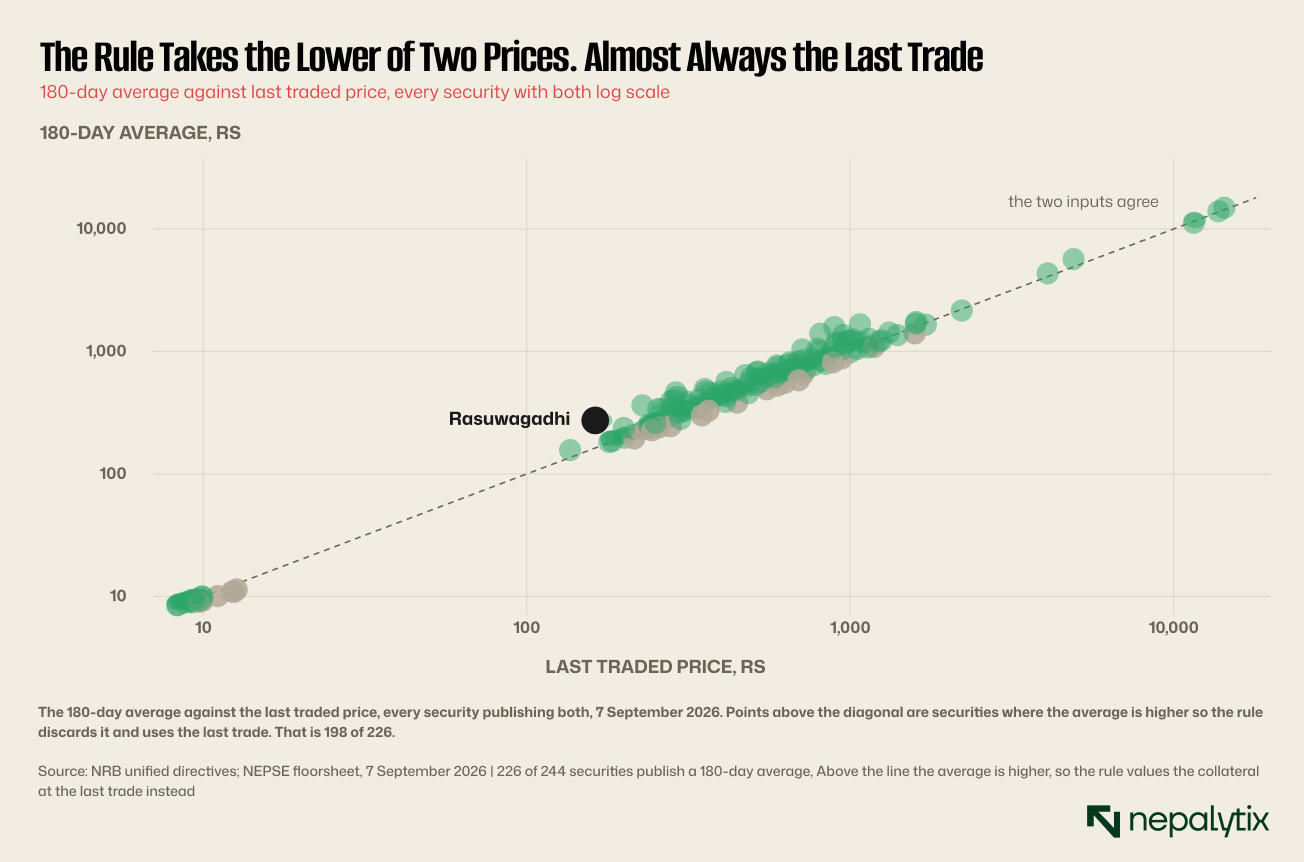
On 7 September, 198 of the 226 securities with both figures had a 180-day average above their last trade. Eighty-eight per cent. The market has been falling, NEPSE closed the fiscal year at 2,597.80 against 2,794.79 a year earlier and a trailing average in a falling market sits above the present by construction. So the test resolves to the market price, and it will keep resolving to the market price for as long as the market keeps drifting down.
The safeguard binds only when prices rise, which is when a lender needs it least. When prices fall which is the only condition under which collateral rules are tested, the rule quietly becomes a different rule: lend 80% of the last traded price.
The effect compounds over time in a way the drafting does not seem to anticipate. A 180-day average updates slowly by construction which is the point of it. But that means a security which has repriced sharply carries a stale average for months afterwards and during those months the rule keeps resolving to the market price while the average sits uselessly above it, neither constraining the lending nor reflecting the asset. The safeguard is not merely inactive. It is inactive for exactly as long as the repricing takes to wash through which is the period in which the loan is most at risk.
Rasuwagadhi is marked on the chart and it shows what that means at the extreme. Its last trade on 7 September was Rs 170.20. Its 180-day average was Rs 273.08, sixty per cent higher because the average still carries the months before a flood destroyed part of the company's business. A bank valuing on the average would be lending against a price that no longer exists. A bank valuing on the last trade is doing what the rule requires. Neither figure tells you what the shares would fetch if the bank tried to sell them.
It is worth being precise about why this is a design failure rather than bad luck. A trailing average sitting above the current price is not evidence that the rule is wrong. It is what a trailing average does in a falling market and any lender would want to know it. The failure is in what the rule does next. Having established that the average is higher, it discards the average completely and takes a single day's closing price. It does not blend the two. It does not weight by volume. It does not ask whether that closing price came from four hundred transactions or from one. The comparison happens and then the enquiry stops.
Compare that with what the same rule would produce in a rising market. There the average sits below the price, the rule takes the average and the bank lends against a number built from six months of trading. That is a genuinely robust valuation. So the rule delivers its best output in the conditions where a mistake costs least and its worst output in the conditions where a mistake costs most. A collateral test should behave the other way around.
And the number it picks is made of very little
If the rule reduces to the last traded price, the question is what a last traded price in Nepal actually contains.
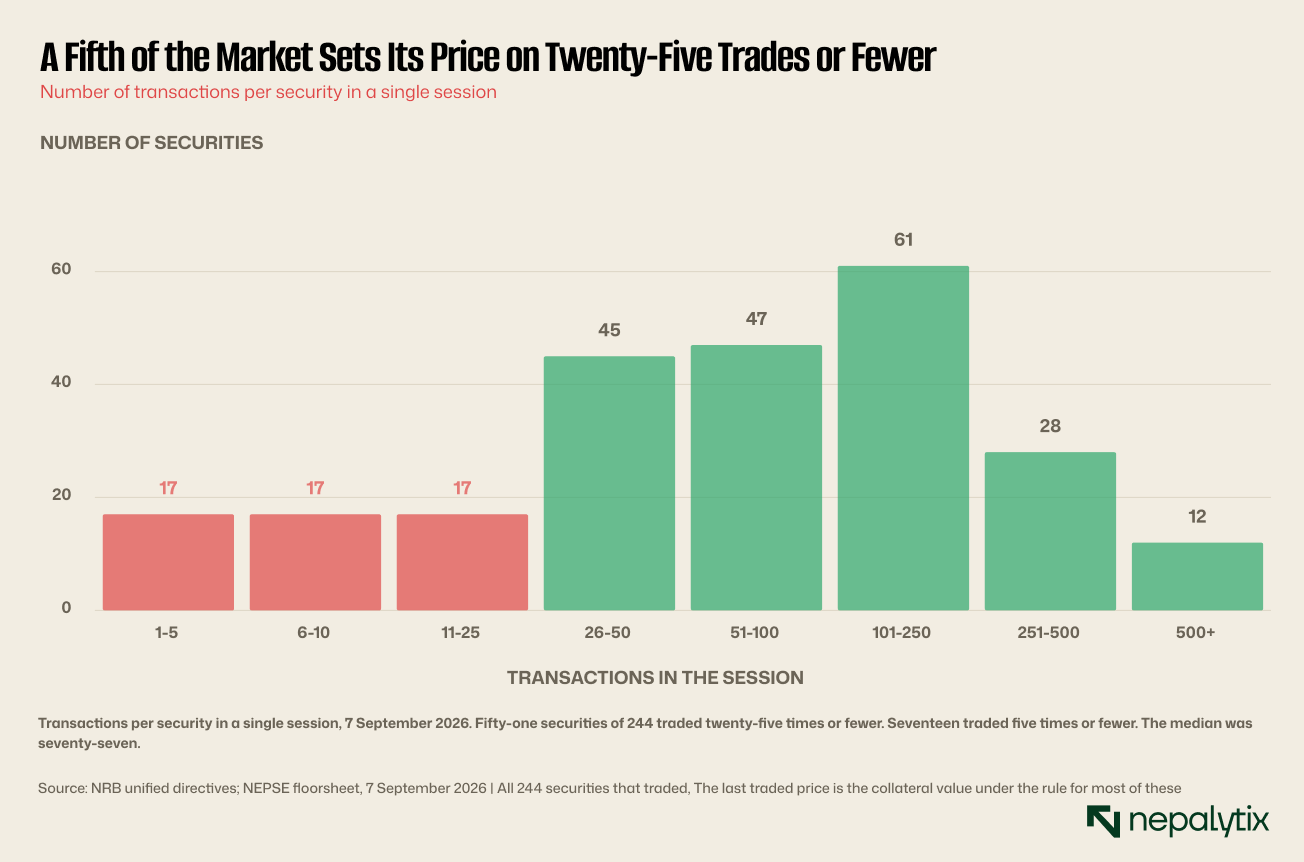
Fifty-one of 244 securities traded twenty-five times or fewer. Seventeen traded five times or fewer. At the other end Garima Bikas Bank went through 1,506 transactions, Mount Everest Power 942, Nabil 866. The same valuation method is applied to both ends of that distribution and it produces numbers of entirely different quality.
Rastriya Beema Company traded once. Ten units, at Rs 13,755.60. Under the rule that single transaction is the collateral value for every margin loan secured on the share until somebody trades it again. Bottlers Nepal also traded once, also ten units. Jyoti Bikas Bank's promoter line traded once. Nepal Investment Mega's promoter line traded twice.
What makes this hard to dismiss is that these are not distressed or dubious companies. Rastriya Beema is a large state-linked insurer. Bottlers Nepal is a profitable manufacturer with a household brand. Bishal Bazar, at eleven trades is a long-established property business. They trade thinly because their registers do not turn over not because anything is wrong with them. Any test that screens for company quality will pass all three and learn nothing about whether their prices mean anything.
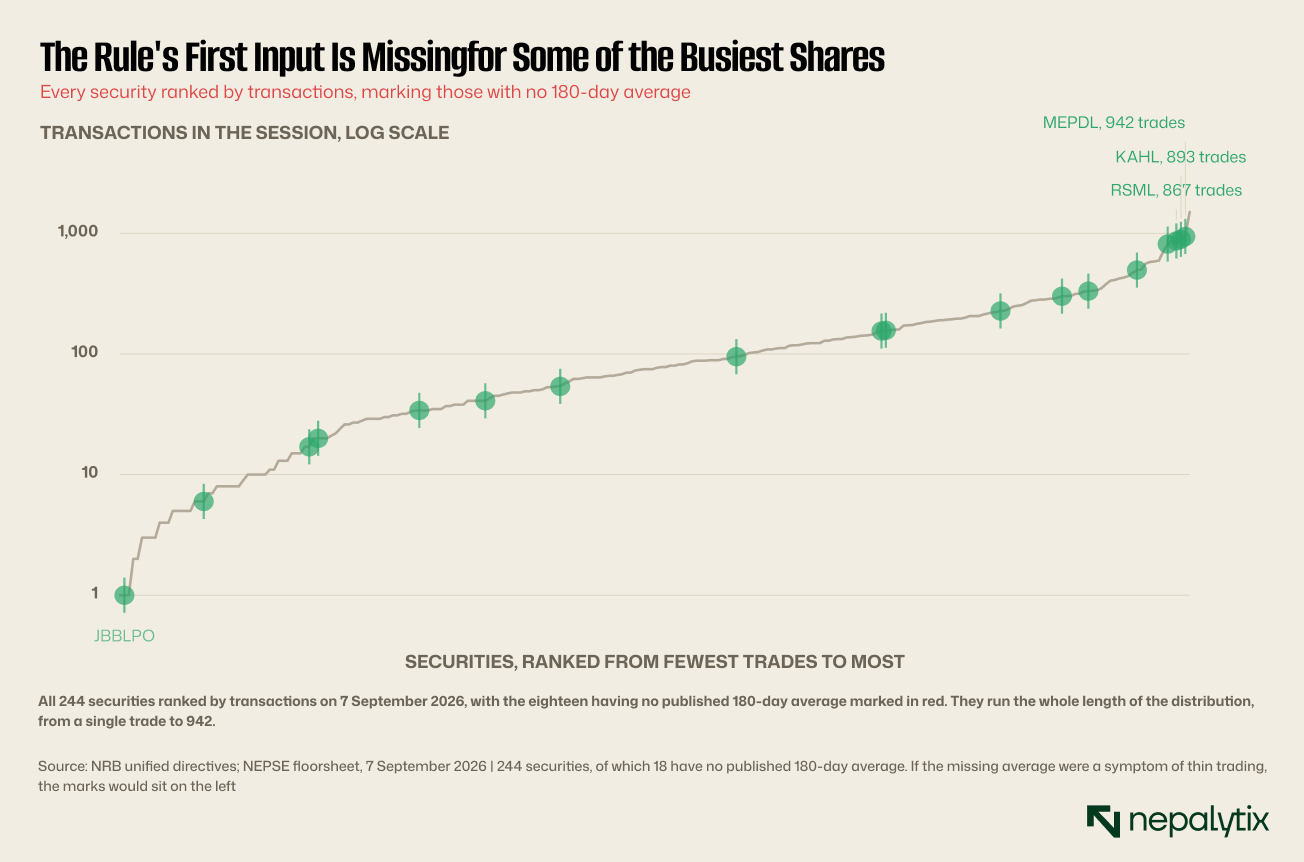
Underneath sits a smaller problem that is stranger still. Eighteen of the 244 securities have no published 180-day average at all, mostly recent listings that have not been trading long enough to have one. Several are heavily traded: Mount Everest Power at 942 transactions, Kalanga Hydro at 893, Reliance Spinning Mills at 867. For these the rule's first input does not exist so a bank cannot perform the comparison the directive requires and will fall back on the market price alone which is the outcome the two-number test was written to prevent. One of the eighteen is a promoter share whose entire price history that day consisted of a single trade.
There is a defence of the last traded price that deserves an answer, because it is the one a banker would give. A price is a price. Two parties agreed it, money changed hands and the alternative is for the bank to substitute its own judgement for the market's which regulators rightly discourage. If the last trade in Rastriya Beema was Rs 13,755.60 that is what somebody paid.
The answer is that a price carries information in proportion to how many decisions went into it. Four hundred transactions in Nabil aggregate hundreds of independent views about a company whose accounts are public and widely followed, and the resulting number is about as good an estimate of value as a market produces. Ten units of Rastriya Beema tell you that on one occasion one buyer and one seller agreed. That is a fact, and it is a much weaker fact. Treating the two identically is not deference to the market. It is a refusal to distinguish between a lot of information and almost none.
The distinction matters most precisely when a bank needs to act because the question then is not what somebody paid last time. It is what somebody will pay now for a quantity far larger than ten units in a hurry. A thickly traded price is a reasonable proxy for that. A single transaction is not a proxy for anything.
The eighteen securities with no average at all sharpen the point in a different way. Their absence is not a scandal; a company listed four months ago cannot have a 180-day average and nobody has done anything wrong. But it means a bank following the directive literally cannot perform the comparison the directive requires and must therefore do something the directive does not describe. In practice it will lend against the market price alone which is exactly the outcome the two-number test was written to prevent and it will do so without any explicit permission and with no stated haircut adjustment to compensate.
Several of the eighteen are among the most heavily traded securities on the exchange which means the missing average is not a proxy for thinness. Mount Everest Power went through 942 transactions that session. Kalanga Hydro 893. Reliance Spinning Mills 867. These are liquid names whose prices are well established by any reasonable standard and the rule has no way to say so. The test that is supposed to distinguish reliable valuations from unreliable ones cannot be run on them at all.
Then the market takes the exit away
A lender can live with an imprecise valuation if it can sell quickly because selling reveals the true number and caps the loss. Nepal removes that option at exactly the wrong moment.
Since 20 April a share may move 15% in a day and no further. When it reaches that limit, trading does not halt but no transaction below the limit price is permitted, so the book fills with sellers and empties of buyers since anyone who thinks the share is worth less simply waits for tomorrow when the limit will be 15% lower again. A bank enforcing security joins that queue with no priority. On a genuine repricing it sells nothing on day one and nothing on day two.
There is a second-order effect that makes the queue worse than it looks. The size of the unfilled sell side is visible to everyone. Anyone watching it knows tomorrow opens lower which removes the incentive to buy today which lengthens the queue further. The limit does not so much slow the fall as empty the order book and then let the fall happen anyway, one session at a time with the bank watching from inside it.
Now run the loan alongside it.
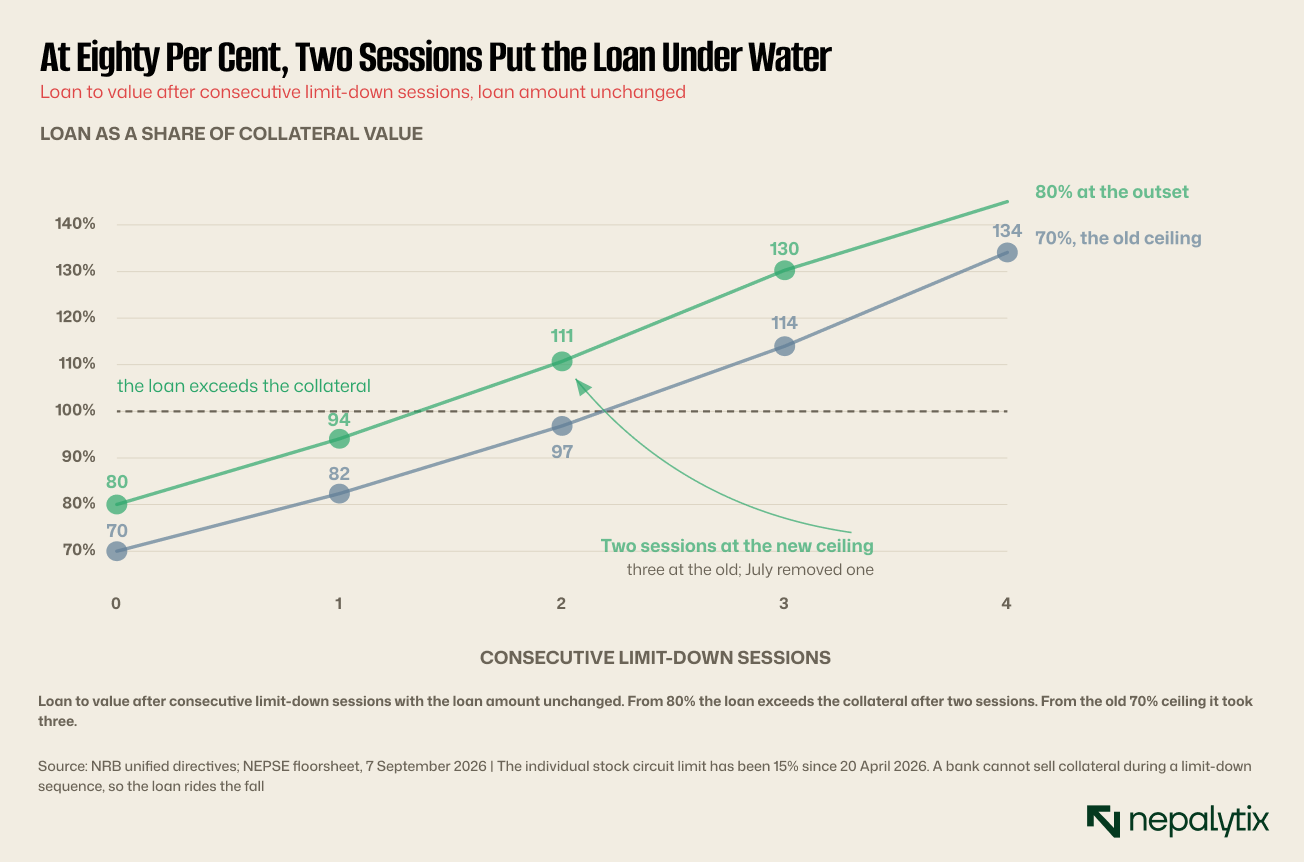
One limit-down session takes an 80% loan to 94%. Two takes it to 111%. After two trading days the loan is larger than the asset behind it, and through both of those days the bank could not sell. At the old 70% ceiling the same sequence took three sessions. The July decision removed a session of cushion from a mechanism that was already short of them.
Twenty points of haircut is being asked to absorb three separate things here: the price move between deciding to sell and being able to which is at minimum one session at 15%; the error in a valuation that may rest on a single trade and the market impact of the bank's own selling into a book that handles twenty-five transactions on a normal day. Twenty points is a reasonable haircut for a liquid share in a market with continuous trading and no daily cap. It is doing far more work than that here.
The 26 August session is the demonstration. Rasuwagadhi fell 15.00%, Molung Khola 14.99%, and three more hydropower names fell between 11% and 13%. The index fell 1.38%, well below the 5% level at which a market-wide halt fires so the exchange traded normally all day. From a lender's seat that is the worst available configuration: no pause to assess and no liquidity in the one security that needed it. Everything worked except the part that mattered.
Set that alongside how the same bank would treat other collateral and the inconsistency becomes hard to defend. To lend against land in Nepal, a bank commissions a valuation, checks title, visits the site and applies a haircut. The process takes weeks and everybody involved understands that the asset cannot be sold quickly afterwards. That understanding is priced in from the start.
To lend against shares, the bank reads a figure off a screen and applies a percentage. The whole process can run in days and the speed is justified by the assumption that the collateral can be liquidated in a morning. For Nabil or Global IME that assumption holds. For the fifth of the market that trades twenty-five times a session it does not and for those securities the bank has performed less diligence than it would on a plot of land while assuming better liquidity than the land offers.
Land has the compensating virtue of being honestly labelled. Nobody looks at a plot in Nawalparasi and imagines they can sell it by lunchtime. A thinly traded share is just as illiquid and arrives with a daily price that implies the opposite.
Work through the 26 August session from a lending desk and the sequence is instructive. Wednesday morning: a flood, fourteen damaged projects and three official capacity estimates that disagree by a factor of nearly two so nobody knows the size of the loss. Your collateral opens lower and closes at minus 15.00%. If you lent at 80%, you are now at 94%. You cannot sell because the share is at its limit and there is a queue. You can, per the directive inform the borrower and reassess the value so you do that. Thursday the share may fall another 15%, which would take you to 111%.
Ten sessions later, on 7 September, Rasuwagadhi's 180-day average was still Rs 273.08 against a market price of Rs 170.20. The valuation input the directive names first has not begun to catch up and will not for months. At no point in that sequence did the bank do anything wrong. It followed the rule at every step. The rule simply has nothing to say about the sequence.
The strength test screens the wrong thing
The obvious defence of the July increase is that the extra ten points are not automatic. A bank must publish a product paper assessing the company against seven criteria before lending at 80% and in principle only large, established, profitable, rated, compliant issuers qualify. Those, the argument runs are exactly the companies that trade often enough for a price to mean something.
It is the strongest defence available and it fails on inspection. Every one of the seven criteria describes the issuer: capital, listing history, profits, dividends, rating, compliance, meetings. Not one describes the market in the security. There is no test of turnover, of transaction count, of free float, of how often the share actually changes hands. A company can satisfy all seven and still be Rastriya Beema, trading once.
The test asks whether the borrower's collateral is a good company. The risk in a secured loan is whether the collateral can be valued and sold. Those are different questions and the rule only asks the first which is how a screen designed to add caution ends up adding leverage to precisely the securities it cannot assess.
Two further provisions deserve credit before the criticism goes further because they are well drafted. The single-borrower cap of Rs 150 million across all banks limits concentration. And the ban on upward revaluatio which prevents a borrower drawing more credit as the share rises, closes the spiral that has driven margin crises in other markets: prices rise, collateral is revalued, borrowers draw more, they buy more, prices rise further. Whoever wrote that understood the risk on the way up. The absence of any equivalent on the way down is therefore harder to explain, not easier. The directive says a bank should inform the borrower and reassess the value when the collateral falls. That is a communication requirement. There is no defined maintenance level, no margin call trigger, and no instruction covering collateral that is limit-down and unsellable.
The absence of a maintenance rule is worth dwelling on because it is the single largest hole and it is not difficult to fill. A functioning framework needs four things and none is exotic. A trigger: a stated loan-to-value at which the borrower must act. A cure period: how long they have to post cash or additional shares. A rule for collateral that cannot be sold which is the case the daily limit guarantees will arise. And a provisioning treatment so that a loan sitting above 100% of its collateral for a defined period is recognised as such rather than appearing in the accounts identical to a fully covered one.
The arithmetic of the first is instructive on its own. If the opening ceiling is 80% and the trigger sits at 90%, the borrower has ten points of warning. At a 15% daily limit those ten points are consumed in less than a single session. Which means that in Nepal, a maintenance trigger set at conventional levels would fire and expire on the same day and the only variable the regulator can actually control is the opening ceiling. Raising it from 70% to 80% moved in the wrong direction.
It is worth asking what twenty points of haircut is actually being asked to absorb here because the number sounds generous until it is decomposed. It has to cover the price move between the moment a bank decides to sell and the moment it can, which on a limit-down security is at minimum one session at 15% and possibly several. It has to cover the error in the valuation itself which for a security priced by a single transaction is not a small quantity. And it has to cover the market impact of the bank's own selling into a book that handles twenty-five transactions on an ordinary day, an effect nobody in Nepal has measured because the data to measure it is not published.
Twenty points is a sensible haircut for a liquid share in a market with continuous trading and no daily cap where a lender can be out of a position in an hour and the only question is how far the price moves in that hour. It is being asked to do considerably more than that here and the July decision reduced it from thirty.
Promoter shares, where the rule is right and still exposed
The regulator treats promoter shares separately and treats them cautiously and this cuts against the argument so it should be put plainly.
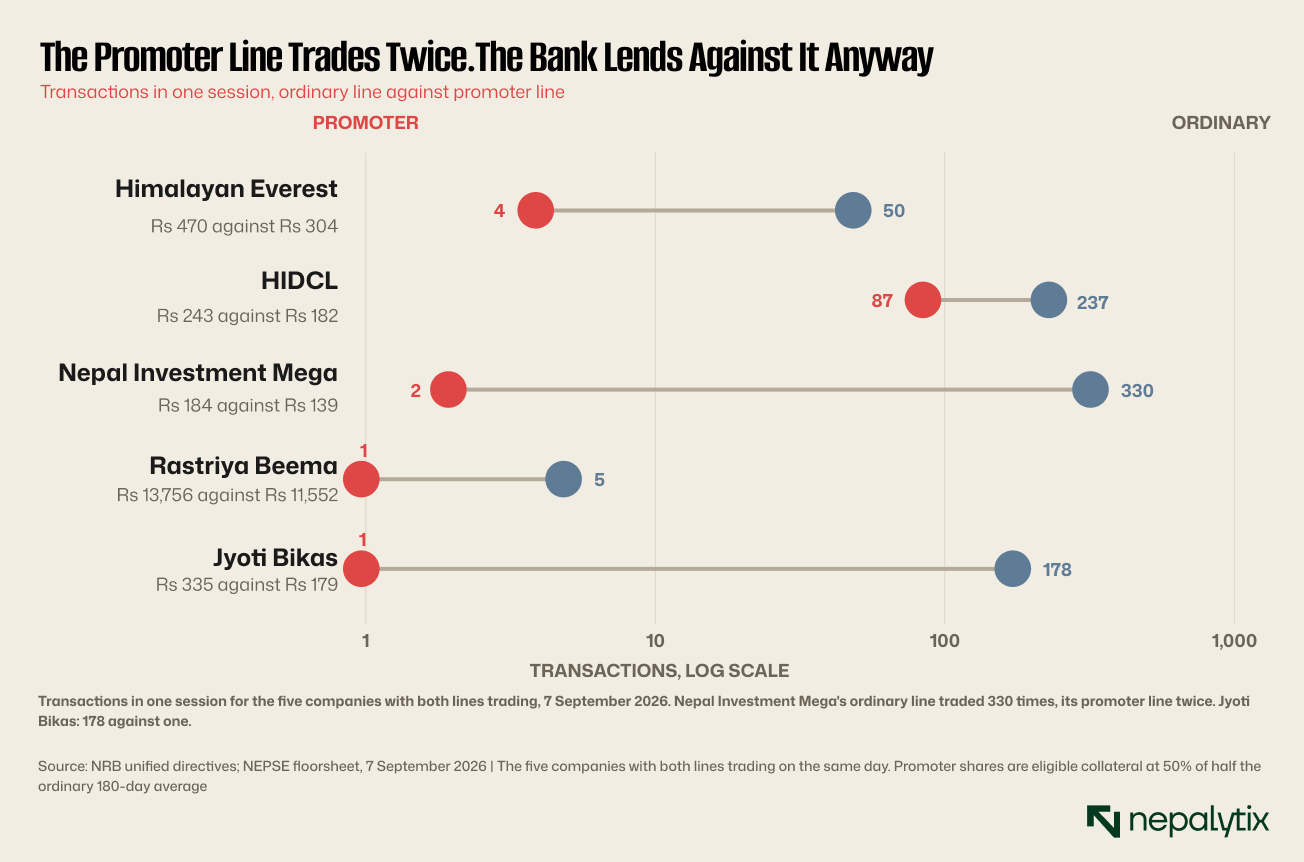
A bank may lend 50% of half the ordinary share's 180-day average. For Nepal Investment Mega that works out at about Rs 49 against a promoter share trading at Rs 139, so the advance is roughly 35% of market value where an ordinary share attracts up to 80%. The regulator has recognised that promoter shares are a different asset and priced that recognition into the rule. It also anchors to the ordinary share's average which is a far more reliable number than the promoter line's own price.
The exposure that remains is narrower. Nepal Investment Mega's ordinary shares traded 330 times that session and its promoter shares twice. Jyoti Bikas: 178 against one. Himalayan Everest: 50 against four. A conservative advance against an asset that changes hands once a session is still an advance against something the bank cannot liquidate at any speed and the haircut protects against the price being wrong rather than against there being no buyer.
There is a second exposure in the promoter rule that the advance rate does not address. The rule anchors the promoter valuation to the ordinary share's 180-day average which is sensible because the ordinary line trades and the promoter line barely does. But it means the collateral value of a promoter share is derived from the price of a different security, one the borrower does not own and cannot deliver. If the ordinary line falls, the promoter collateral is marked down whether or not anyone has traded the promoter share at all.
That is defensible as valuation. It is awkward as security because the bank ends up holding an asset whose recorded value tracks an instrument it has no claim on and whose realisable value depends on a market of a handful of eligible buyers. The haircut protects against the price being wrong. It does not protect against there being no buyer and those are different risks that the rule collapses into one number.
The Rs 150 million cap deserves one further note because concentration limits only work if somebody can see the concentration. The cap applies across all banks which means enforcing it requires a consolidated view of each borrower's share-backed borrowing. Nepal's credit information infrastructure can in principle deliver that. Whether it captures pledges accurately, in near enough to real time to matter during a fast decline, is not something the published material addresses.
And the exemption is broad. Institutions established to invest in shares are outside the cap entirely. That is defensible on the grounds that a fund is a different kind of borrower from an individual but it means the largest concentrations in the system sit precisely where the limit does not reach, and there is no published measure of how large they are.
The book is growing faster than almost anything else
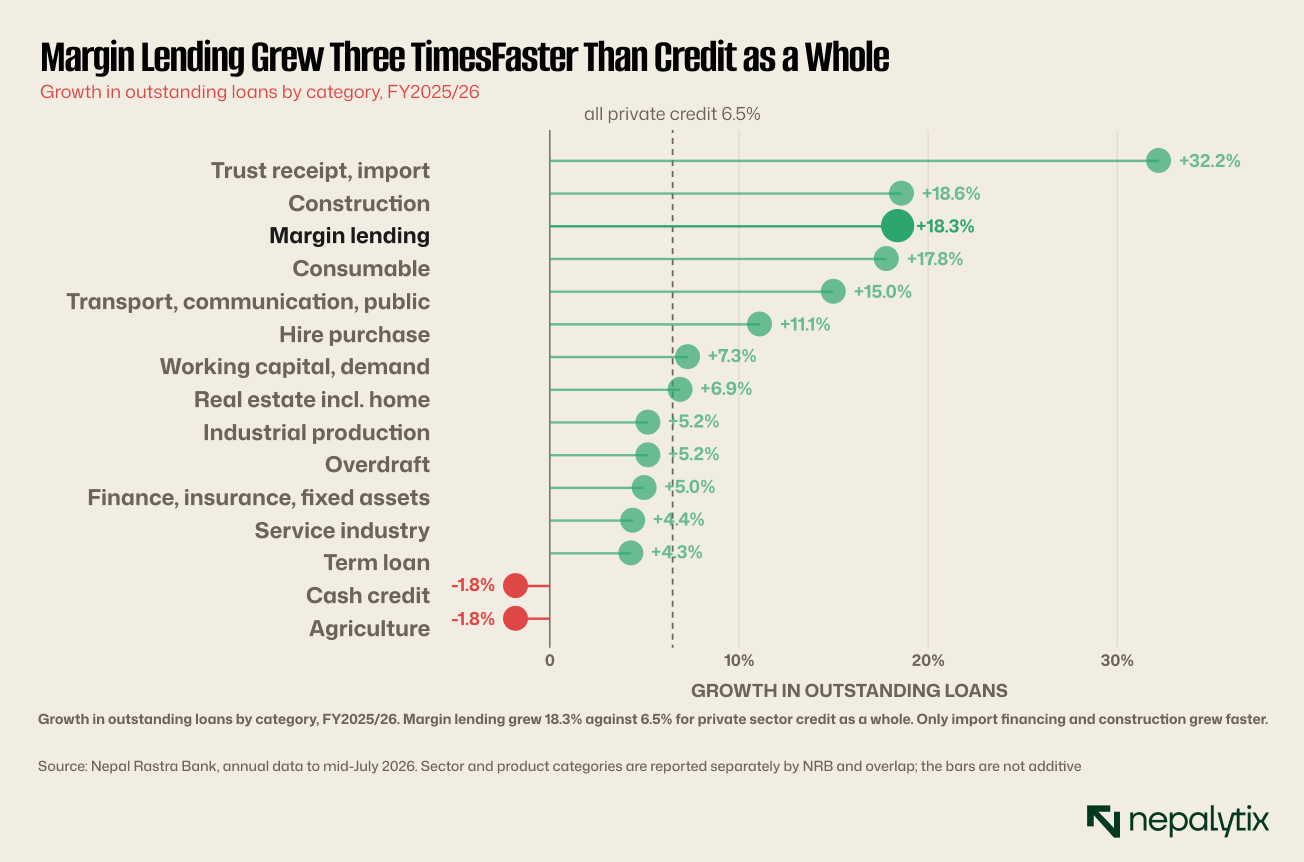
Margin lending grew 18.3% over the fiscal year against 6.5% for private sector credit overall. Only trust receipt lending which finances imports and construction grew faster. The three fastest-growing categories in Nepali banking finance imports, buildings and share purchases.
The growth is not banks reaching for risk so much as banks with nowhere else to go. Deposits grew Rs 1,013 billion over the year against Rs 359 billion of new credit leaving roughly Rs 654 billion of funding without a borrower. Meanwhile 62.9% of outstanding credit is secured on land and buildings which requires a valuation, a title search and a site visit. A share-backed loan requires a number off a screen and an electronic pledge, and can be disbursed in days. Global IME markets a digital product for it. Machhapuchchhre's runs from Rs 500,000.
Those product sheets point at something the rule does not seem to anticipate. The Rs 150 million cap implies the regulator has large borrowers in mind but a minimum ticket of Rs 500,000 describes retail. The typical Nepali margin borrower is not a speculator financing a position. They are someone who owned shares, needed cash for a business or a family obligation and found that pledging was faster than selling and avoided the capital gains tax. That borrower has no view on the share price and no plan for a limit-down sequence, and when the bank asks for more collateral they are being asked for cash they do not have against a fall in an asset they were never trading.
There is a loop here too and it runs through the prices the lending is secured on. Margin credit puts buying power into the market and supports prices; falling prices reduce collateral values, banks lend less, less borrowing means less buying, prices fall further. In a deep market that loop is damped by everyone else. In a market where a fifth of securities trade twenty-five times a session, the marginal buyer carries more weight and margin lending is part of who that buyer is. Nobody can size it because NRB publishes the growth rate and not the balance.
One more channel belongs in the picture because banks are not the only lenders. Under a SEBON directive, brokers with net assets above Rs 50 million may extend margin at up to 50% of the value of shares, on the same lower-of-two basis. The advance rate is more conservative which is appropriate for thinner institutions, but the valuation method is identical so every objection above applies to that book as well.
It also creates a gap nobody appears to have closed. A single security can carry margin credit from two regulated channels supervised by two different regulators, valued the same way, with no consolidated view of the total outstanding against it. The Rs 150 million cap counts borrowing across all banks. Whether it counts broker margin alongside it is not something the published rules make clear.
The circularity in this deserves naming because it connects the lending back to the prices it is secured on. Margin credit puts buying power into the market and that buying supports prices. Run it backwards and the same loop tightens: falling prices reduce collateral values, banks become less willing to lend against shares, less borrowing means less buying and prices fall further. In a deep market that loop is damped by everyone else who is trading for their own reasons. In a market where a fifth of securities change hands twenty-five times a session, the marginal buyer carries disproportionate weight, and margin lending is part of who that buyer is.
Which means the 18.3% growth rate is not only a credit statistic. It is also a statement about where some of the demand in Nepali equities has been coming from, and about what happens to that demand if the collateral rules tighten or the prices fall far enough that banks lose their appetite. Nobody can size the effect because the outstanding balance is not published but the direction is not in question.
What a rule that fitted this market would say
The fix is not to reverse the July decision. It is to make the collateral test describe the collateral.
Other markets in the region already do this. The standard instrument is an eligibility list built on liquidity rather than company quality, with minimum turnover, minimum trading days and minimum free float and securities that fail simply drop off. The second is graduated haircuts set from observed volatility and turnover so a blue chip and a thinly traded small cap attract different advance rates as a matter of data rather than of the lender's judgement. The third is a maintenance margin with a defined trigger, a cure period and a stated consequence.
Nepal has none of the three. It has one ceiling applied to every listed security, a company-quality screen bolted onto the top ten points and silence on what happens as the price falls. Adding a liquidity screen to the existing seven criteria would cost nothing and would catch exactly the securities this piece has been describing. Defining a maintenance level, a cure period and a treatment for collateral that is limit-down would cover the only scenario in which any of this matters. And a provisioning rule for loans sitting above 100% of collateral would stop a loan that is unsecured in substance from looking identical in the accounts to one that is fully covered.
One more thing would change the conversation entirely. NRB publishes that margin lending grew 18.3%. It does not publish the outstanding balance, the collateral mix, actual loan-to-value against the ceilings or borrower concentration. Every bank reports all of it. A book of Rs 20 billion concentrated in the twenty most traded securities is a different object from a book of Rs 200 billion spread across the tail and at present nobody outside the regulator can tell which Nepal has. That is why this piece has had to argue about a mechanism rather than measure an exposure.
A note on who actually borrows this way because the rule appears to have a different person in mind. Margin frameworks are usually written around a speculator: someone borrowing to buy more shares who can be sold out without much sympathy when the position turns against them. The Rs 150 million single-borrower cap implies the regulator is thinking about substantial investors.
The product sheets describe someone else. Machhapuchchhre's margin loan starts at Rs 500,000. Global IME markets a digital facility for personal and business needs. These are retail products sold on convenience and the typical borrower is a shopkeeper funding stock, a family paying fees abroad, a small business bridging a gap. They pledged shares because it was the fastest way to raise money against something they already owned.
That borrower has no view on the share price and no plan for a limit-down sequence. When the collateral falls and the bank asks for more, they are being asked to find cash they do not have, against a decline in an asset they were never trading. And their options are worse than a trader's: someone with a portfolio can sell something else while someone with one holding and a loan against it cannot.
None of the three instruments described above requires data Nepal does not already collect. Turnover and transaction counts are published daily by the exchange. Volatility can be computed from the same series. Free float sits in the depository. The eligibility list, the graduated haircut and the maintenance trigger are all constructible from information that exists and the reason they do not exist is not technical.
It is that each of them requires somebody to make a judgement and defend it. A single ceiling applied to every security requires no judgement at all, which is administratively comfortable and is presumably why three revisions of the circuit limits and one of the loan-to-value ceiling have all adjusted the number rather than the design.
The assumption underneath
Two things follow from all of this and neither is that margin lending should stop. A market this thin needs ways for holders to raise cash without selling and removing share-backed credit would push sales into an order book that cannot absorb them. Nor is the argument that a crisis is coming; the book may be small, actual advances may sit well below the ceilings and the collateral may be concentrated in the liquid names. A mechanism that could fail is not a mechanism that is failing.
The argument is narrower and it is about design. Nepali banks lend against land only after a valuation, a title search and a site visit because everyone accepts that land is illiquid and prices it accordingly. They lend against shares on a number read off a screen because everyone accepts that shares are liquid. For Nabil and Global IME that acceptance is correct. For a fifth of the market it is not and those securities carry a daily price that looks like liquidity while offering none of it. Property at least is honestly labelled.
And the cost of getting it wrong does not stay with the two parties who signed the contract. A bank liquidating a pledged position into a security that trades twenty-five times a day is not one participant among many. It is the market that afternoon and the price it makes belongs to everyone else holding the share.
The cost of getting this wrong does not stay with the two parties who signed the contract which is the last reason it is worth arguing about. If a margin loan sours, the bank takes a credit loss and the borrower loses their shares and both are adults who entered a bargain. But a bank liquidating a pledged position into a security that trades twenty-five times a day is not one participant among many. It is the market that afternoon. The price it makes becomes the reference for everyone else holding that share for every other margin loan secured on it and for the next valuation any lender performs. A forced sale in a thin book does not just realise a loss. It manufactures the number that everyone else is then marked against.
In July the central bank decided banks could lend more against Nepali equities. In August a river came down a gorge and showed what those equities are worth when somebody actually needs to sell them. The rule assumes a market price is a price. On a normal Monday that assumption fails for a fifth of the market. On a day like the twenty-sixth of August it failed for all of it.
Disclaimer
This report has been prepared by Nepalytix for informational and educational purposes only and does not constitute investment advice, an offer, or a solicitation to buy or sell any securities.
The information contained in this report is based on sources believed to be reliable; however, Nepalytix does not guarantee its accuracy, completeness, or timeliness. Opinions, estimates, and projections expressed herein are those of the authors as of the date of publication and are subject to change without notice.
Investing in securities involves risks, including the possible loss of principal. Past performance is not indicative of future results. Readers are advised to conduct their own independent research and consult with a qualified financial advisor before making any investment decisions.
Nepalytix and its contributors may hold positions in the securities discussed in this report at the time of publication or thereafter.
Neither Nepalytix nor any of its affiliates accept any liability for any loss arising from the use of this report or its contents.