NEPSE: Who Gets To Set The Price
NEPSE opened Reliance Spinning Mills at Rs 300 despite institutional investors pricing it at Rs 912 through book-building. The episode exposes a deeper problem with how Nepal’s exchange approaches price discovery.

In February, Nepal Stock Exchange changed how it sets the opening price of a newly listed share. Reliance Spinning Mills had sold stock to institutions at Rs 912 and to the public at Rs 820.80 through a book-built offering. NEPSE opened it at Rs 300. The company objected in writing, listed anyway, and asked investors to ignore the price its own exchange had set.
What this piece is about
Most market-structure writing in Nepal concerns things investors can act on: a rate decision, a results season, a policy that changes what a bank may lend. This one concerns a formula, which is a harder subject to make matter.
It matters for a specific reason. A stock exchange's central function is to let buyers and sellers discover what a security is worth. Everything else it does: settlement, listing standards, circuit breakers, indices, exists to support that. When an exchange sets a price itself, rather than hosting the process by which a price is set, it is doing something categorically different from its stated purpose.
In February, Nepal Stock Exchange did exactly that to a company that had already discovered its price through a regulated process. The episode lasted three weeks was reported as a dispute between an exchange and an issuer and then dropped out of view.
The rule that caused it remains in force and the next company that issues above par will meet it on its first morning of trading.
A number arrives from somewhere else
On 13 February 2026 two companies began trading on the Nepal Stock Exchange. Salapa Bikas Bank had allotted its initial public offering on 30 December. Reliance Spinning Mills had completed allotment on 2 January.
Both were given the same opening price band: Rs 100 to Rs 300. One was a development bank and the other a spinning mill and the exchange's formula did not distinguish between them in any respect.
For Salapa, a development bank issuing at par, that band was unremarkable. For Reliance Spinning Mills it was not because Reliance had not issued at par. It had run a book-built offering in which qualified institutional investors bid and were allotted at Rs 912 per share and the general public subscribed at Rs 820.80.
The minimum retail application was fifty shares. That is Rs 41,040 committed by an ordinary applicant, several weeks earlier, at a price arrived at through the mechanism Nepal's own securities framework prescribes for establishing fair value.
On the first morning of trading, the exchange capped the price at Rs 300.
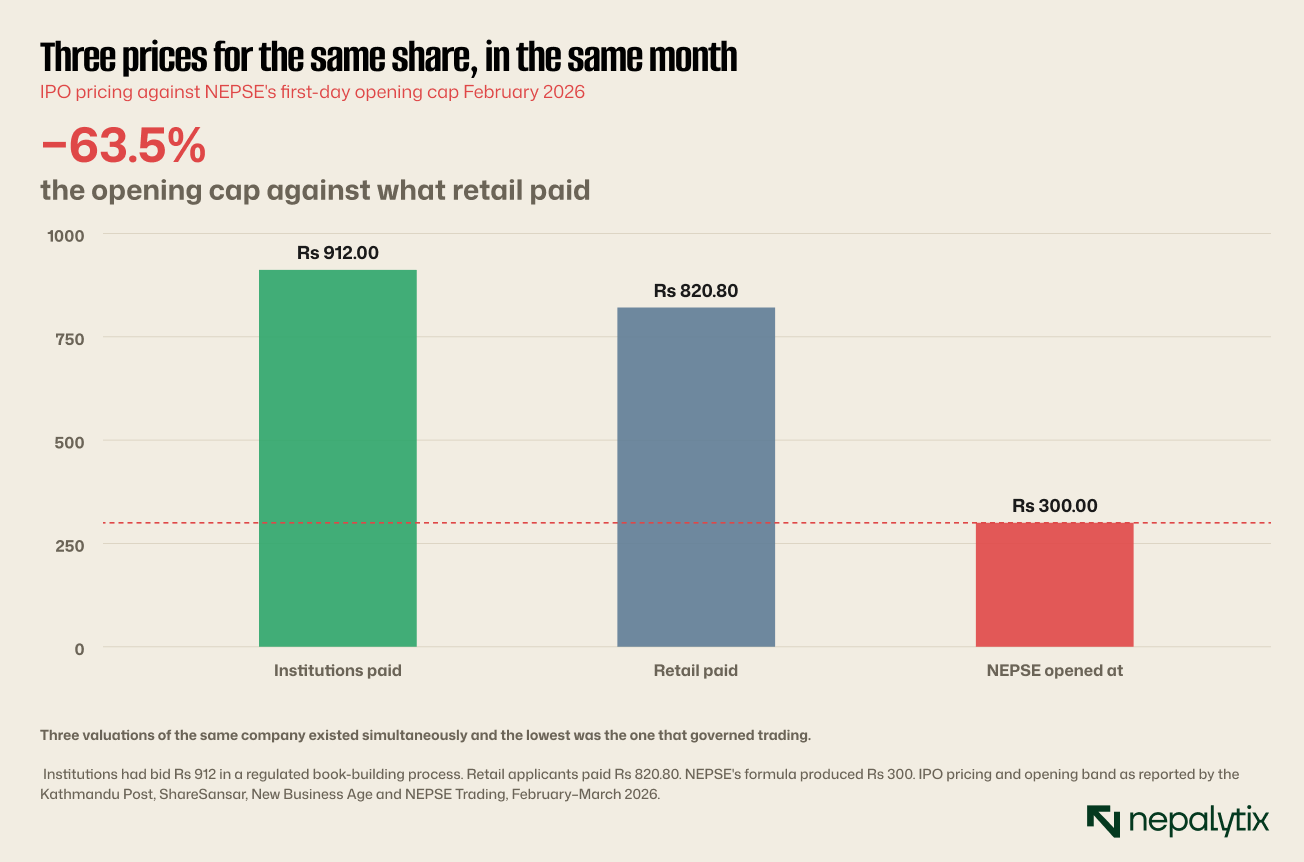
The gap is 63.5% against what retail paid and 67.1% against what institutions paid. Neither number reflects anything that happened to the business between allotment and listing. Nothing happened to the business. The company was the same company on 13 February as it had been on 2 January.
What changed was a rule: adopted by the exchange's board earlier that month, not published on its website at the time it was applied and described publicly only after two companies had already listed under it.
What book-building is and why Nepal adopted it
A brief detour, because the mechanism at the centre of this story is not widely understood and the argument depends on it.
In a conventional Nepali IPO, a company issues shares at par Rs 100 and the offering is almost always oversubscribed many times over. Allotment happens by lottery. the price was never in question because the price was fixed by convention rather than by any judgement about what the company is worth.
That works well enough for a development bank with a Rs 100 book value. It works badly for a manufacturer whose assets, order book and earnings might justify several times that. Issuing such a company at par transfers enormous value from the existing shareholders to whoever wins the lottery, which is a poor way to raise capital and a worse way to encourage companies to list.
Book-building solves this. Qualified institutional investors funds, banks, insurers with analytical capacity submit bids indicating what they will pay and for how much. Those bids establish a price band. The general public then subscribes at a small discount to the price institutions accepted.
The mechanism's whole purpose is to import valuation judgement into primary issuance from the participants best equipped to supply it. Nepal introduced it deliberately, over several years, as part of a broader effort to make listing attractive to companies that are worth more than par.
Reliance Spinning Mills used it. Institutions bid and were allotted at Rs 912. The public subscribed at Rs 820.80, a 10% discount to the institutional price.
Then the company listed and the exchange applied a formula built for the world book-building was designed to replace.
What the rule used to do
Until early February 2026, NEPSE set the opening band for a newly listed security at up to three times the company's net worth per share, taken from the prospectus filed at the time of the offering.
That method has an internal logic. Net worth per share is what the balance sheet says each share is backed by. Anchoring the first day's trading range to a multiple of it ties the opening price to something the company actually possesses and the three-times ceiling caps how far above book value the market can travel before ordinary price discovery takes over.
Ghorahi Cement, listed in August 2023 is a clean illustration. Its audited net worth per share was Rs 226.61 so NEPSE set its opening range at Rs 226.61 to Rs 679.83, one to three times book.
In February 2026 the board changed the basis. For companies with positive net worth, the opening range would no longer be computed from net worth. It would be computed from the face value of the share.
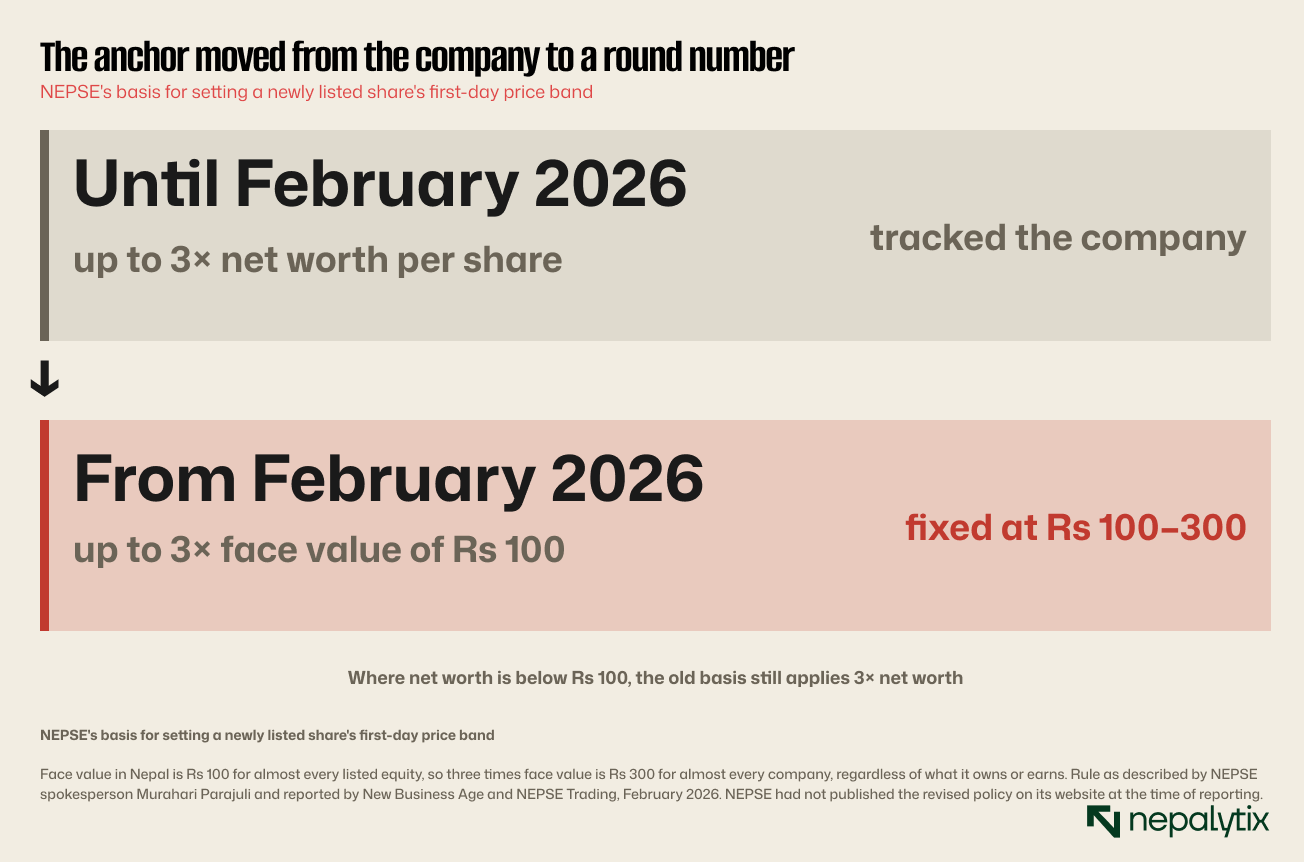
The exception is telling. Where a company's net worth per share falls below Rs 100, the old method survives, the band is set at up to three times net worth. So the rule reverts to a company-specific anchor precisely for the companies whose balance sheets are weakest and applies the fixed anchor to everyone else.
A company that has built book value above Rs 100 is treated identically to one that has just incorporated. The measure that distinguished them was removed.
NEPSE's stated justification is that the revision follows a decision originally taken in 2068 BS, 2011. A member of the exchange's own board disputed the relevance publicly, pointing out that the 2011 decision predates the normalisation of premium-priced and book-built offerings in Nepal. In 2011 essentially every IPO was issued at par, so a face-value anchor and a net-worth anchor produced similar answers. They no longer do.
Why face value is not a valuation
It is worth being precise about what Rs 100 actually represents, because the rule treats it as though it means something and it does not.
Face value, or par value, is an accounting convention. It is the nominal amount assigned to a share when a company's capital is structured, and it determines how paid-up capital is recorded on the balance sheet. In Nepal it is Rs 100 for almost every listed equity.
It carries no information about the company. Two companies with identical Rs 100 face values can differ by any factor in assets, earnings, reserves or prospects. The number is chosen, not measured.
Net worth per share, by contrast, is measured. It is total equity divided by shares outstanding what the balance sheet says is behind each share after every liability is settled. It changes as the company earns or loses money. It is an imperfect measure of value, as any accounting figure is but it is a measure.
The February change substituted the chosen number for the measured one.
The practical consequence is that NEPSE's opening band no longer contains any company-specific information for the three-quarters of the market with positive net worth above face. Rs 100 to Rs 300 is the answer for a hydropower company with Rs 400 of book value and for a newly incorporated development bank alike.
What it cost a retail applicant
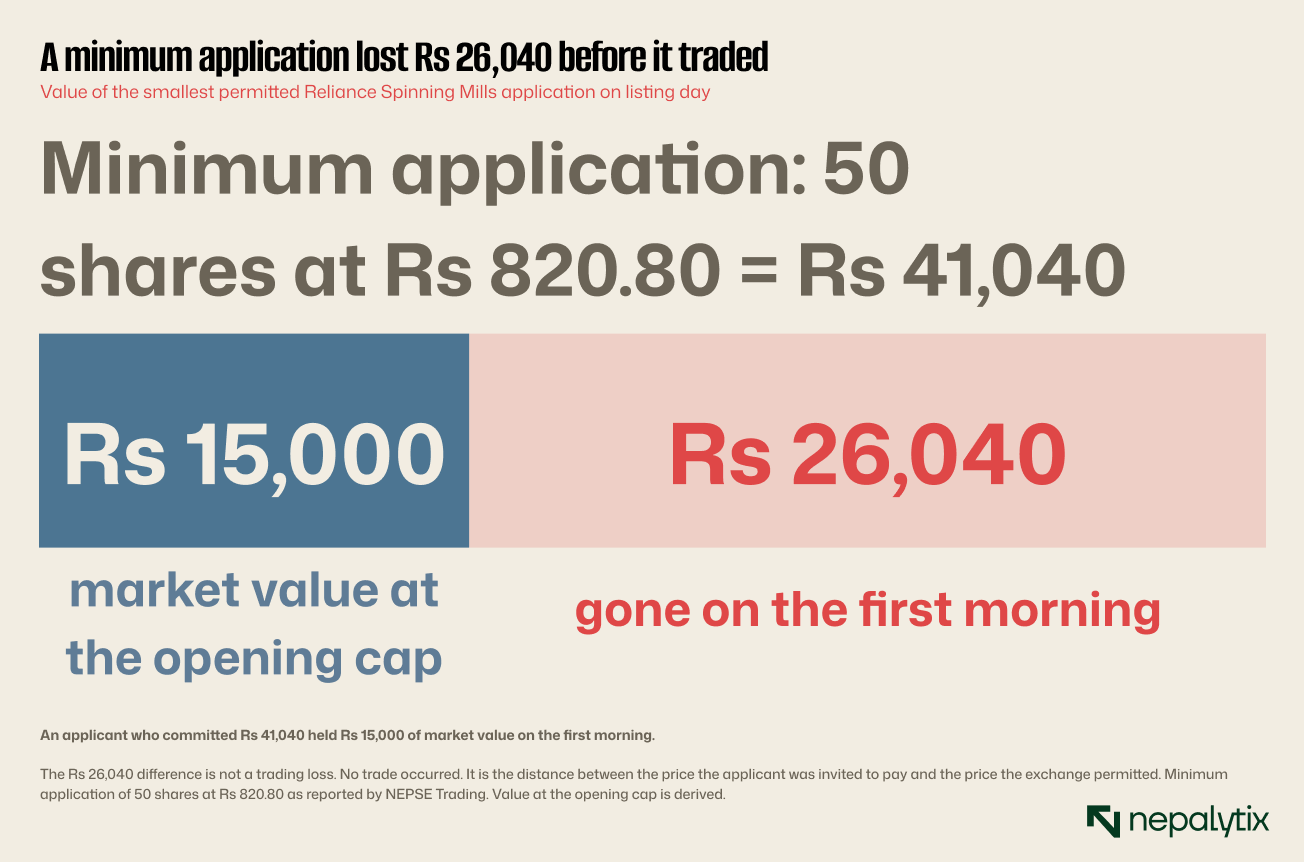
This is worth sitting with in concrete terms, because Nepali IPO applicants are not, in the main, professional investors. The Long Read of 30 July established that roughly four and a half million Nepalis hold financial assets through statutory funds without ever having chosen one. Alongside that sits a retail population whose entry point to the market is precisely this: an allotment, a listing and a first-day price.
An applicant in that position committed Rs 41,040 in early January. They did so at a price set by a process Nepal's regulator designed and approved. Six weeks later the exchange told them the price was Rs 300.
The recovery and what it required
What happened next is the part that turns an unfair rule into a structural problem.
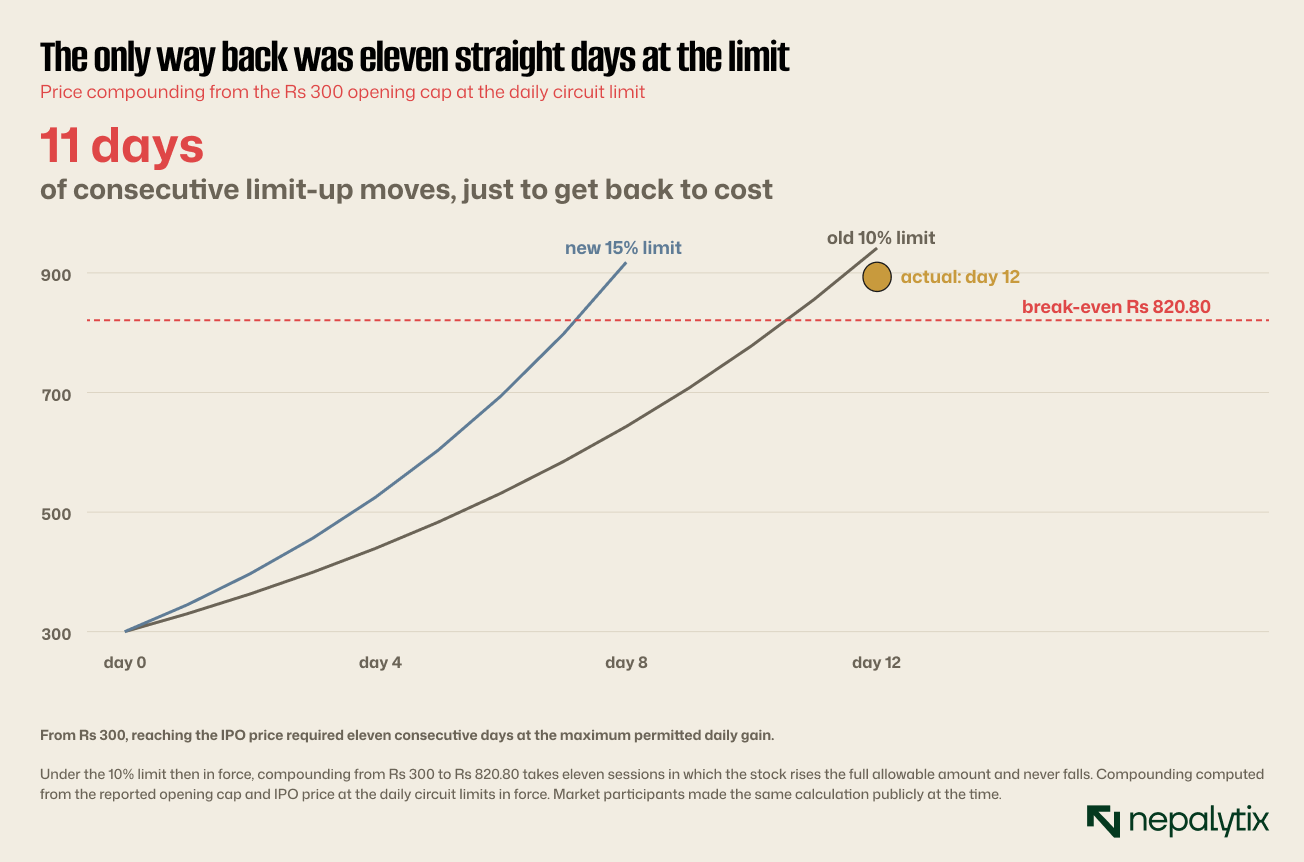
Market participants said this openly in February: the stock would need to hit the upper circuit for at least ten consecutive days to approach break-even. Our own arithmetic makes it eleven at the 10% limit.
It took twelve trading days and it very nearly went uninterrupted. The stock traded at or near its circuit level in every session but one.
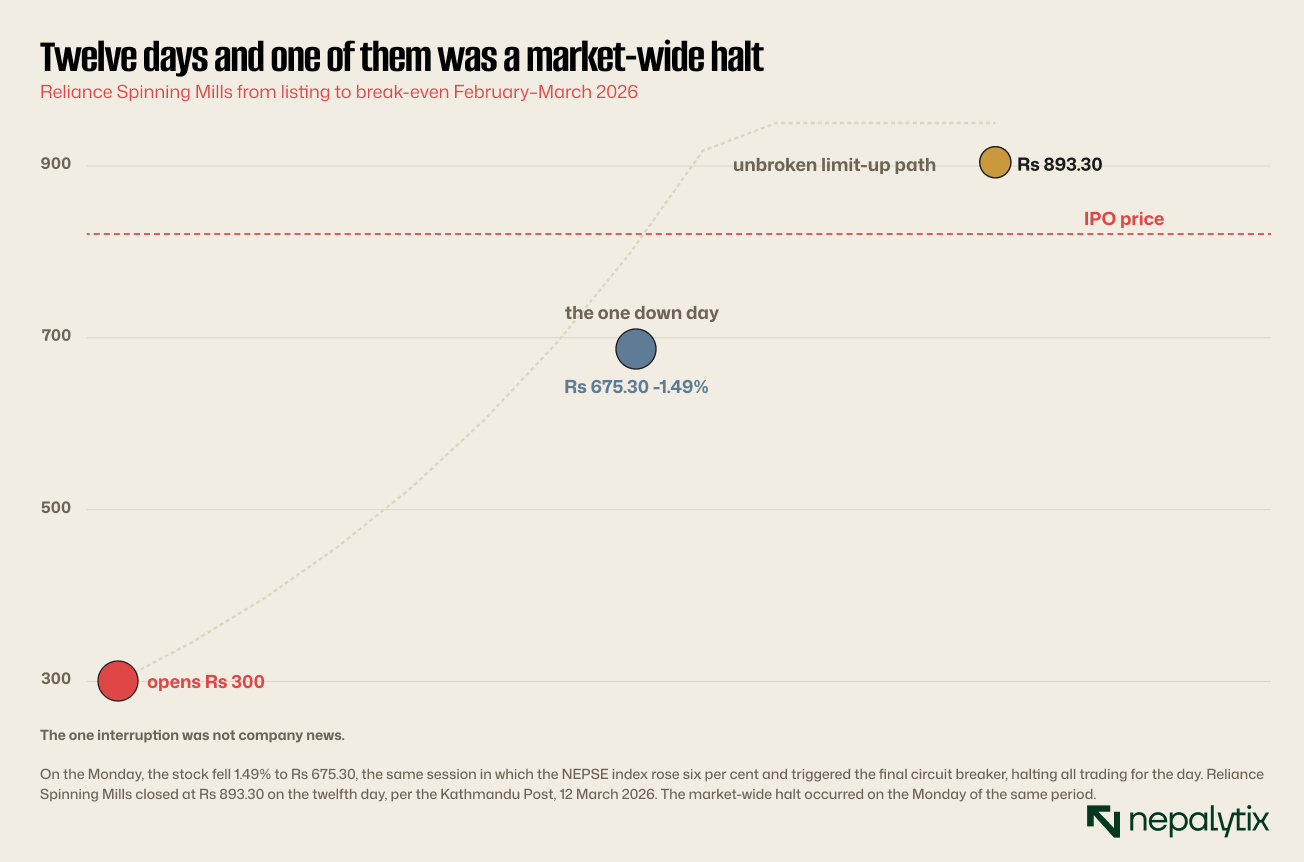
So the recovery ran essentially as the arithmetic demanded: the stock pinned to its upper limit almost every session until it reached the price it had been sold at.
The market did eventually price Reliance Spinning Mills near where the book-building process had. It simply took twelve sessions of mechanically constrained trading to get there during which the stock could not find a level because the level was determined by a daily percentage cap rather than by supply and demand.
Why a limit-up run is not price discovery
A stock at its upper circuit is not trading in any meaningful sense. There are buyers and no sellers at the permitted price so the order book clears at a ceiling rather than at a price. Nobody learns what the share is worth; they learn only that it is worth more than the cap allows today.
Twelve consecutive sessions of this tells you nothing about valuation. It tells you the opening price was wrong by roughly the amount the stock subsequently travelled, which everyone already knew on day one.
The twelve days session by session
The mechanics of that fortnight are worth setting out because they describe a market operating in a mode that is not really trading.
A share at its upper circuit has bids stacked at the limit price and effectively no offers. The exchange matches what it can and the rest of the demand carries to the following session. Volume is thin not because interest is thin but because holders will not sell into a price they know is capped below fair value.
So each morning the stock opened, moved immediately to the limit, and stopped. The closing price each day was a function of the previous close multiplied by 1.10, not of anything anyone learned about Reliance Spinning Mills.
An investor wanting to buy could not, in size. An investor wanting to sell had no reason to. The order book did not clear; it queued.
Twelve sessions of this, and then the stock closed at Rs 893.30 above the Rs 820.80 the public had paid and just under the Rs 912 institutions had bid. At which point the market finally had a price, and it was approximately the price book-building had produced seven weeks earlier.
What the recovery proves and does not prove
It proves the book-building process worked. Institutions bid Rs 912; the market, once free to move, settled near Rs 893. The valuation mechanism Nepal built produced approximately the right answer.
It does not prove the system corrected itself gracefully. Reaching that price required nearly three weeks in which the exchange's own circuit limits prevented the correction from happening, and during which any investor who needed to exit did so at a fraction of fair value.
The institutions lost more than the public
There is a second-order consequence that has gone almost entirely unremarked and it matters more for Nepal's market development than the retail loss does.
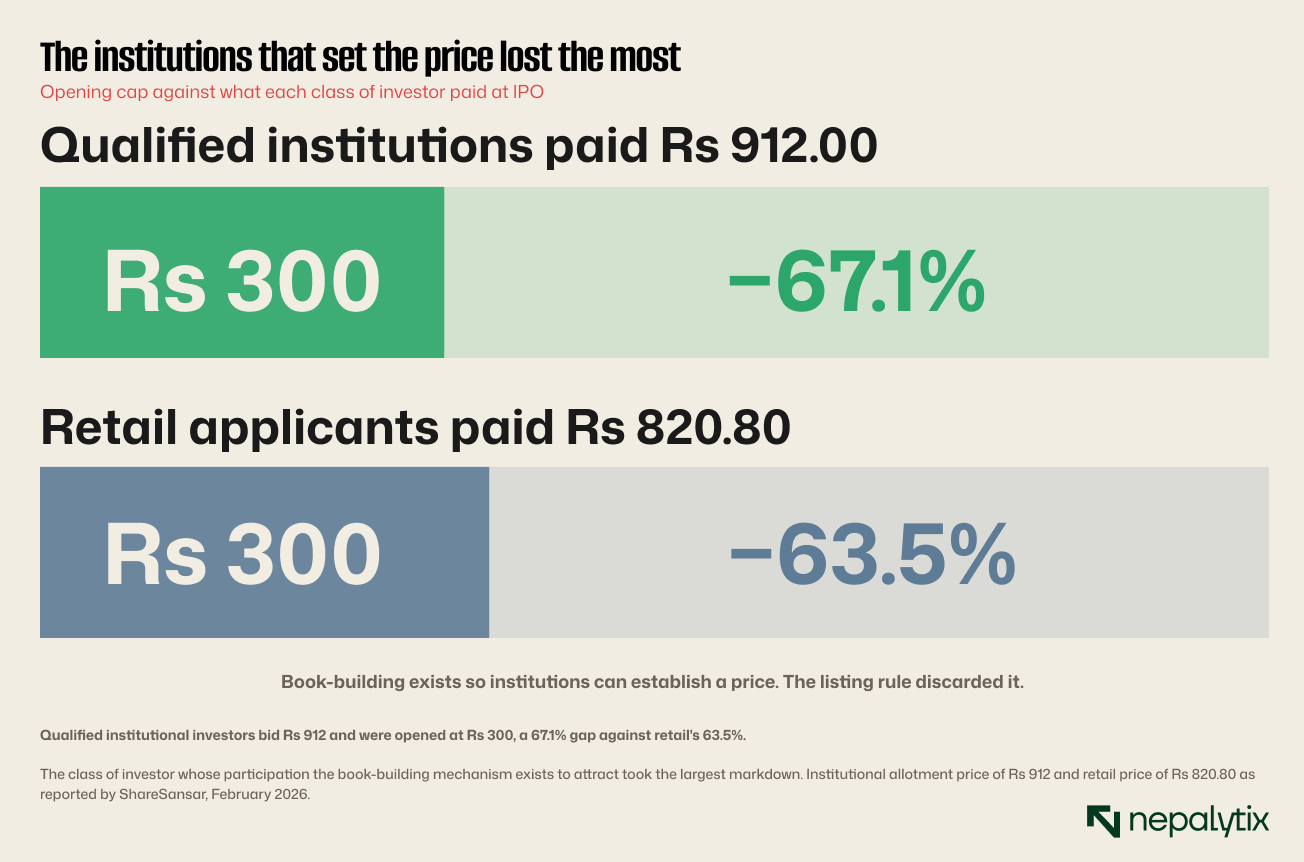
Book-building exists for a specific reason. In a market where retail investors cannot realistically value a manufacturing company, the mechanism invites institutions with analytical capacity to bid and uses their bids to establish a price the public can then subscribe at.
It is, in other words, an outsourcing of valuation to the participants best equipped to perform it, and it is the only mechanism in the Nepali market where a price is set by people who have studied the company and are risking their own capital on the answer. Nepal adopted it deliberately, and it is one of the more meaningful pieces of market infrastructure the country has built in the last decade.
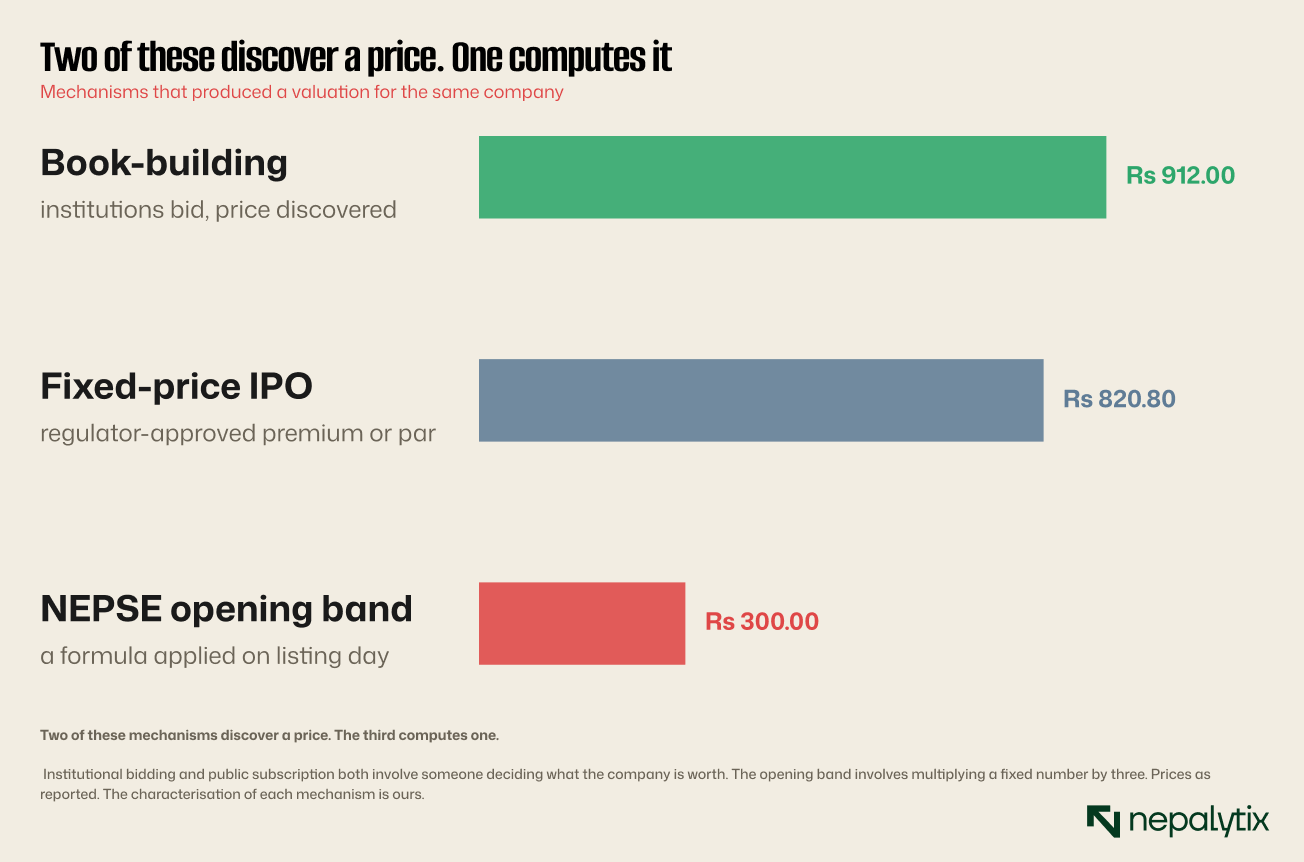
Reliance Spinning Mills said this in its own public statement, and it is worth quoting the substance: the company argued that book-building is designed to establish fair market value through institutional participation and that ignoring that benchmark at listing undermines the credibility of the pricing process.
The statement is unusual enough to be worth pausing on. Listed companies do not, as a rule, publicly criticise the exchange they have just joined.
Then it added a sentence that no listed company should ever have to write. It asked investors to trade its shares by reference to its actual financial performance rather than by reference to the exchange's rule.
A company was compelled to list at a price it disputed and then to publicly advise the market to disregard that price.
Consider what that does to the next book-built offering. An institution deciding whether to bid Rs 900 for a Nepali manufacturer now has to price in the possibility that the exchange will open the stock at Rs 300 regardless of what the bidding produces. The rational response is to bid lower, or not at all.
The rule therefore taxes precisely the behaviour Nepal's capital market most needs: informed institutional participation in primary issuance.
And it taxes it in the least visible way. No institution will announce that it bid lower because of a listing rule. It will simply bid lower, or pass, and the offering will price where it prices. The cost shows up as offerings that clear at weaker levels and companies that decide against listing, neither of which is attributable to anything in particular.
What the exception implies about intent
One reading of the carve-out is administrative: NEPSE needed some rule for companies whose net worth is below face value and reverting to the old basis was the simplest available.
Another reading is that the exchange retained the balance-sheet anchor exactly where it protects investors from overpaying, and dropped it where it protected issuers from being underpriced. Under that reading the rule is not arbitrary at all. It is asymmetric, cautious about opening a weak company too high, indifferent to opening a strong one too low.
We cannot distinguish between those readings from the public record and the revised policy had not been published when the change was reported so the drafting itself is not available to consult. But the asymmetry is real whichever explanation holds, and it is the single feature of the rule most worth putting to the exchange.
The signal sent to future issuers
Nepal has a listing problem that predates all of this. The exchange is dominated by financial institutions: banks, insurers, microfinance companies because regulation effectively requires them to list. Manufacturing, hotels, trading and services are thinly represented and the country's larger private companies have historically stayed private.
Book-building was one of the few instruments available to change that. A manufacturer worth Rs 900 a share had, for the first time, a route to market that did not require handing most of that value to IPO applicants at Rs 100.
Now consider the same manufacturer watching February. Reliance ran the process correctly, priced through institutional bidding at Rs 912 and was opened at Rs 300 by its own exchange. Its shareholders watched a 67% markdown appear on the screen for reasons unconnected to the business, and the company was reduced to issuing a statement asking the market to ignore the exchange.
A private company considering listing has just been shown what happens if it tries to issue above par.
The rule's cost is therefore not confined to the applicants who lost money in February. It falls on the pipeline of companies Nepal most needs to attract to its market and it arrives at a moment when the country is trying to broaden a market that is roughly 60% financial institutions by capitalisation.
The exception that reveals the logic
Return to the carve-out because it is the most analytically interesting part of the rule and nobody has examined it.
Where net worth per share is below Rs 100, the opening band is still set at up to three times net worth. So a company whose accumulated losses have eaten into its paid-up capital gets a company-specific anchor. A company that has built reserves above face value does not.
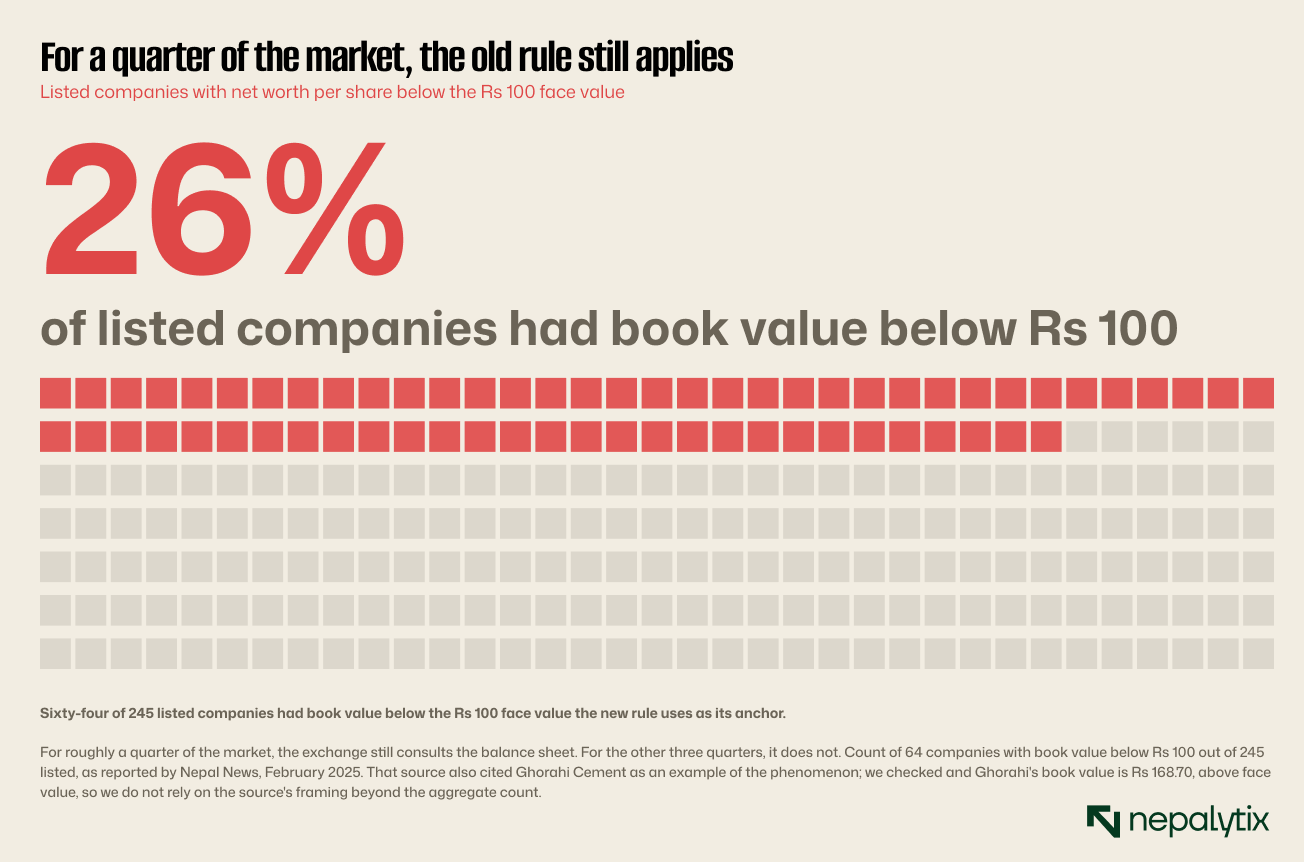
We should be careful with that figure. It comes from a single report and is dated February 2025, when 245 companies were listed against roughly 278 now. The same report contains at least two errors we could verify, it names Ghorahi Cement as an example of the problem when Ghorahi's book value is Rs 168.70, comfortably above face and it quotes market capitalisation figures an order of magnitude away from what the exchange reports. We use the aggregate count and nothing else from it, and readers should treat even that as approximate.
The principle, though, does not depend on the count. The rule as described applies a balance-sheet anchor to weak companies and a fixed anchor to strong ones which is the opposite of what a prudential instinct would produce.
How the exception interacts with the market it applies to
The carve-out has a second-order effect that is worth tracing.
A company with net worth below Rs 100 gets an opening band of up to three times that net worth. If net worth per share is Rs 60, the band tops out at Rs 180. If it is Rs 30, the band tops out at Rs 90 below face value and below what any IPO applicant paid.
So for the weakest listings the rule produces a band that can sit entirely underneath the issue price. That is arguably correct: a company whose accumulated losses have consumed 70% of its paid-up capital arguably should not open at par.
But it means the two anchors pull in opposite directions at the boundary. A company at Rs 101 of net worth opens in a Rs 100–300 band. A company at Rs 99 opens in a Rs 99–297 band. Those are nearly identical, so the boundary itself is smooth.
The discontinuity appears further up. A company at Rs 400 of net worth would have opened, under the old rule, in a band reaching Rs 1,200. Under the new one it opens in a band reaching Rs 300, a quarter of what its balance sheet supports. The stronger the company, the larger the distortion.
A rule whose error grows with the quality of the issuer is difficult to defend on any reading.
Reading the rule charitably
There is a defensible reading and it deserves stating properly.
A face-value anchor is simple, predictable and immune to manipulation of the prospectus. Net worth per share is a reported figure, and a company that wanted a high opening band had an incentive to present a high net worth in its offer document. Anchoring to Rs 100 removes that incentive entirely.
It also produces a uniform starting point. Every new listing enters the market in the same band, and where the share settles afterwards is a matter for buyers and sellers rather than for a formula applied to a number the company itself supplied.
Both points are real. Neither addresses the case of a company that has already discovered its price through a regulated process weeks before listing, which is what book-building is.
What Salapa shows
The second company listed that day is the control case, and it explains why the rule went largely unremarked outside the Reliance dispute.
Salapa Bikas Bank issued at par. Its shares were sold at Rs 100. NEPSE opened it in a band of Rs 100 to Rs 300 and for a company issuing at face value that band is entirely sensible. It permits the stock to trade up to three times its issue price on the first day and imposes no penalty on anyone.
Under the old rule, Salapa's band would have been computed from its net worth per share which for a newly capitalised development bank sits close to Rs 100 anyway. Old rule and new rule would have produced nearly the same answer.
So the change is invisible for the majority of Nepali listings, which are par-priced financial institutions. It bites only where a company has issued above par which is exactly the category Nepal has been trying to encourage.
A rule that is harmless in the common case and damaging in the strategic one is a rule that will not generate sustained pressure to change. That is the practical difficulty facing anyone who wants it revisited.
The counter-case, put fairly
An exchange official defending the rule would make three arguments and two of them are strong.
Net worth per share is a self-reported figure. It comes from the prospectus which the company prepares. Anchoring the opening band to it gives an issuer a direct incentive to present the highest defensible net worth, and the exchange has no independent means of auditing it at listing. A face-value anchor removes that incentive completely and cannot be gamed.
Uniformity has value. Every new listing entering in the same band means the exchange applies one rule to everyone, with no discretion and no case-by-case judgement about whether a particular company's net worth is credible. In a market where regulatory discretion attracts suspicion, a mechanical rule has real institutional advantages.
The market corrects it anyway. Reliance reached Rs 893 within twelve sessions. If the opening band is wrong, trading fixes it, and the fix took less than a month.
The first two we accept. The third we do not, and the reason is the one set out above: twelve sessions of limit-pinned trading is not a market correcting an error. It is a market prevented from correcting an error, slowly working through the constraint.
And the first two arguments have an answer that the exchange's own board member supplied. Where a price has been established by institutional bidding under SEBON's framework, the self-reporting objection falls away entirely, the price was not asserted by the company, it was bid by third parties with money at risk.
Two months later, the limits changed too
In April 2026, NEPSE amended the Securities Trading Operations Bylaws with SEBON's approval.
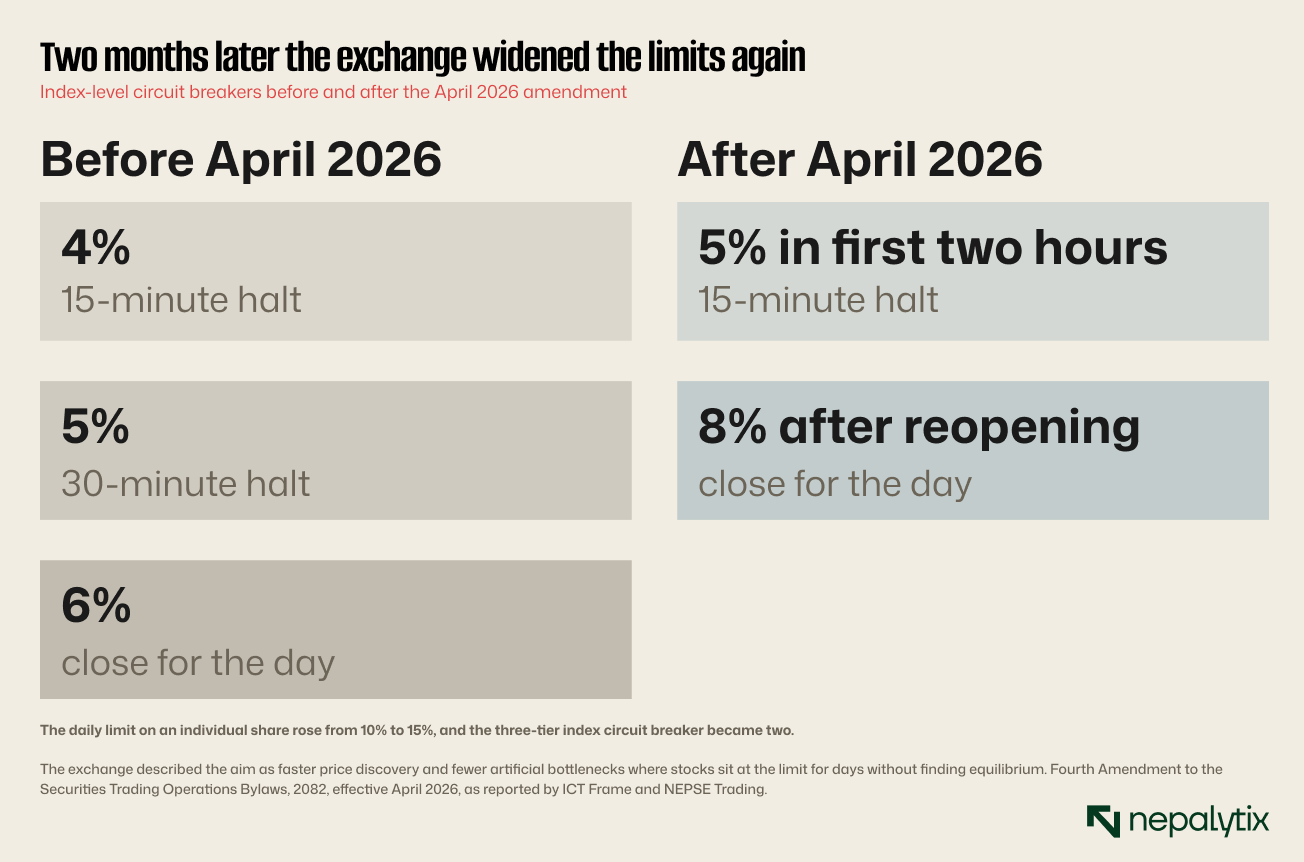
The stated rationale is worth reading against February. The exchange's own explanation for widening the limits is that stocks were getting stuck at the cap for days without reaching a market-clearing price.
Which is exactly what its opening price rule had produced eight weeks earlier.
We are not suggesting a causal link, and we have no evidence the amendment was a response to the Reliance listing. But an institution that identifies limit-pinning as a problem worth fixing, having recently introduced a rule that guarantees limit-pinning for any premium-priced listing, is holding two positions that are difficult to reconcile.
Under the 15% limit, a stock opened at Rs 300 against an Rs 820.80 issue price needs eight consecutive limit-up sessions rather than eleven. That is an improvement in the sense that the distortion clears faster. It is not a solution, because the distortion should not exist.
The regulator's position
SEBON approved the book-building framework, approved Reliance Spinning Mills offer document and approved the price band at which institutions bid. It also approves NEPSE trading bylaws, including the April amendment to circuit limits.
So both mechanisms in this story carry the regulator's authorisation and they contradict each other. One establishes that the company is worth roughly Rs 900 a share. The other opens it at Rs 300.
We could find no public statement from SEBON reconciling the two, and the reporting does not record one. That silence is itself part of the problem: where two approved processes produce incompatible answers, the party that approved both is the natural place for the question to land.
It is worth noting what SEBON did not do. It did not suspend the listing, did not require NEPSE to apply the previous basis and did not publicly comment while a company was issuing statements disputing its own exchange's pricing. Whether that reflects a considered view that the rule is within NEPSE's authority, or simply that the episode moved faster than a regulatory response, is not something the public record answers.
What this is really about
The Reliance episode reads as an administrative dispute. It is not. It is a question about who is permitted to set a price in Nepal's capital market and the answer the February rule gives is troubling.
Nepal has spent a decade building mechanisms for price formation. Book-building for premium issues. A securities regulator with approval authority over offer documents. A pre-open session. Circuit breakers calibrated and recalibrated. Wider daily limits to let stocks find equilibrium faster.
Every one of those is an attempt to let a market discover what things are worth.
Then, at the single moment when a security passes from the primary market into the secondary market, the moment when all that discovery should carry across, a formula overrides it.
The exchange's rule does not adjust the price. It replaces it.
This connects directly to the two-price problem covered yesterday. In that case, promoter and ordinary shares of the same company trade roughly 40% apart despite carrying identical rights, and NEPSE computes market capitalisation by applying the ordinary price to both. Here, an exchange rule sets a listing price 63% below what a regulated process established.
Both are cases of an administrative convention producing a number that the market itself does not believe, and both are cases where the convention has never been examined publicly because the number it produces looks official.
The comparison with the promoter-share problem
Yesterday's Take examined a related distortion and putting the two side by side sharpens what is common to them.
In that case, promoter shares and ordinary shares of the same company carry identical legal rights and trade roughly 40% apart, because promoter stock cannot be freely sold. NEPSE nonetheless computes market capitalisation by applying the ordinary price to every share, including the promoter stock the market values far lower. The published float figure, 35% of stated market capitalisation at the last date both were available shows how much of the market this affects.
The shared feature is an administrative convention that produces a number the market itself does not believe, applied because it is simple, and never revisited because the output looks authoritative.
In the promoter case the convention overstates. In the listing case it understates. Neither is a scandal in the sense of anyone profiting improperly. Both are cases of a formula standing in for a price, and of the formula's output being treated as fact by everyone downstream — index calculations, market-cap-to-GDP ratios, portfolio valuations, and in February, the opening screen of a company that had already discovered its price.
What would fix it
Exempt book-built issues from the face-value anchor. Where a price has been established through institutional bidding under SEBON's own framework, the opening band should be set with reference to that price. This is the change NEPSE's own board member argued for, and it addresses the entire problem in one clause.
Publish the rule. At the time the change was reported, the revised policy had not been published on the exchange's website. A pricing rule that binds every new listing and was applied to two companies in February should be a public document before it is applied, not after.
Say which rule governs which company. The current framework has two anchors: face value for positive net worth, net worth for companies below Rs 100. A prospective applicant should be able to determine before subscribing which one will apply to the company they are applying to and what band it will produce.
Follow international practice for premium issues. The board member quoted in February noted that international practice generally allows shares to open at the issued price, on the reasoning that investors have already agreed to buy at that level. For a book-built issue this is straightforwardly correct.
What the April amendment says about the exchange's own view
Read the April rationale carefully and it amounts to an argument against the February rule made by the same institution.
NEPSE's stated case for widening the daily limit from 10% to 15% was that the narrower band created artificial bottlenecks stocks getting stuck at the limit for days without being able to find equilibrium. The exchange described the aim as more realistic, market-driven price discovery with stocks reaching their true value faster on demand and supply.
Every word of that is a description of what its own opening price rule guarantees for premium-priced listings. A stock opened at Rs 300 against an Rs 820.80 issue price is by construction going to sit at the limit for days without finding equilibrium.
The exchange therefore holds two positions. Limit-pinning is a problem serious enough to justify amending the trading bylaws. And the opening price band should be set by a formula that produces limit-pinning whenever a company issues above par.
We would put it more usefully than that. The April amendment is evidence that NEPSE understands the cost of prices that cannot move. The February rule is evidence it has not connected that understanding to how it sets a listing price.
The pre-open session, briefly
One further mechanism deserves mention because it was also amended and it bears on the same question.
NEPSE runs a pre-open session from 10:45 to 11:00, in which orders are collected and an opening price is determined before continuous trading begins. The April amendment raised the permitted price movement in that session to 5%.
The pre-open session exists precisely to let a market establish an opening level from actual orders rather than from a prior close or a formula. It is the natural place for a newly listed security to find its first price, and a well-designed listing process would use it, collect orders, match them, let the price be whatever the book says.
Instead the opening band constrains where that session can land. The mechanism designed to discover an opening price operates inside limits set by a mechanism that has already decided it.
What we could not establish
Three things this piece wanted and could not obtain, stated because the gaps bear on how firmly its conclusions should be read.
We could not obtain NEPSE's published rule text. At the time the change was reported, the revised policy had not been posted to the exchange's website and the description here rests on the spokesperson's account as carried by three separate outlets. They agree with one another which is reassuring but none of them is the document.
We could not establish how many listings the rule has been applied to since February. Two are documented: Reliance Spinning Mills and Salapa Bikas Bank. Whether others have listed under it and whether any were premium-priced is not something we could determine from public reporting.
And we could not obtain a SEBON position. The regulator approved both the book-building framework and the trading bylaws and the public record contains no statement reconciling the two. That may mean no view has been taken or simply that none has been published.
The applicant's position
End where this started, with the person who applied for fifty shares.
They committed Rs 41,040 in the first week of January at a price arrived at by institutions bidding in a process the regulator designed. They waited six weeks. On the first morning of trading their holding was worth Rs 15,000, for reasons entirely unconnected to the company they had invested in.
Twelve sessions later, most of them at the daily limit, they were roughly whole again. Rs 893.30 against Rs 820.80 paid, a gain of 8.8% over roughly six weeks from application to break-even which for the risk taken is not much of a return.
That outcome is being read in some quarters as evidence the system worked the market corrected the exchange's number, the price found its level, nobody was ultimately harmed. We think that reading is wrong, for two reasons.
The first is that not every applicant held for twelve days. Anyone who sold into the opening band for any reason crystallised a 63% loss created by an administrative formula.
The second is that a market which requires twelve consecutive limit-up sessions to undo its own opening price has not demonstrated resilience. It has demonstrated that the opening price was wrong, expensively and that correcting it consumed nearly three weeks of trading during which no genuine price discovery occurred at all.
Nepal's exchange has spent two years widening limits, shortening circuit breakers and lengthening the pre-open session, all in the stated pursuit of letting prices find their level faster.
In February it introduced a rule guaranteeing that, for any company that dares to issue above par, they cannot.
The rule is still in force. No listing since has tested it in the way Reliance did, and the next one that does will produce the same three weeks.
Disclaimer
This report has been prepared by Nepalytix for informational and educational purposes only and does not constitute investment advice, an offer, or a solicitation to buy or sell any securities.
The information contained in this report is based on sources believed to be reliable; however, Nepalytix does not guarantee its accuracy, completeness, or timeliness. Opinions, estimates, and projections expressed herein are those of the authors as of the date of publication and are subject to change without notice.
Investing in securities involves risks, including the possible loss of principal. Past performance is not indicative of future results. Readers are advised to conduct their own independent research and consult with a qualified financial advisor before making any investment decisions.
Nepalytix and its contributors may hold positions in the securities discussed in this report at the time of publication or thereafter.
Neither Nepalytix nor any of its affiliates accept any liability for any loss arising from the use of this report or its contents.