NEPSE’s 15% Limit Failed the Flood Test
NEPSE widened its daily stock limit from 10% to 15% in April. Four months later, five hydropower stocks hit the new ceiling after the Bhote Koshi flood exposed the limits of fixed price bands.
On 26 August a flood took fourteen power projects off the Bhote Koshi. Five hydropower shares fell to their daily limit. Rasuwagadhi fell exactly 15.00% and stopped because that is where the exchange makes it stop.
NEPSE had widened that limit four months earlier, from 10% to 15%, to give the market more room. It was not enough. On the one day this year when real information hit real securities, the wider limit still bound.
A price limit is built for panic. What happened on 26 August was not panic. It was a market trying to price a fact nobody could size, and being told it had gone far enough.
What the rule actually is
Start with the rule because most people quoting it are quoting the old one.
Until April, a NEPSE-listed share could move 10% in either direction in a day. Past that it stopped trading. The index had three halt levels: 4% paused trading 20 minutes, 5% paused it 40 minutes and 6% closed the market for the day.
On 20 April 2026 all of that changed.
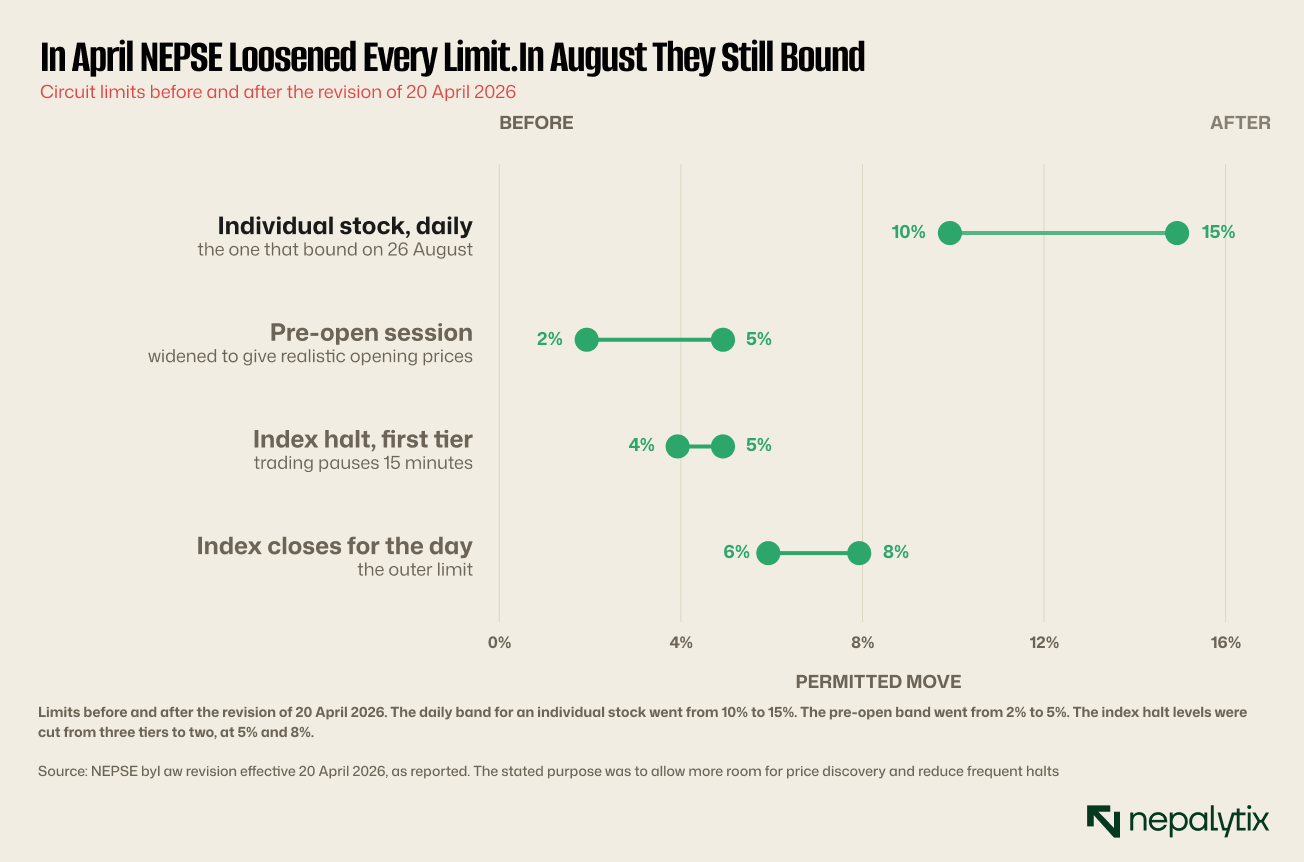
The stock limit went to 15%. The pre-open band went to 5%. The index breakers were simplified: a 5% move pauses trading for 15 minutes in the first two hours, an 8% move closes the day.
NEPSE said the point was to allow more room for price discovery and to cut down on halts. That is a reasonable thing to want. It is also an admission. You do not widen a limit unless you think it was binding too often.
It is worth knowing why the change happened, because the reasoning matters later.
Under the old rules a share could move 5% in the pre-open session. Then regular trading opened and the 10% band applied from the previous close. Traders complained that a stock which had already moved 5% before the open had only 5% left and that sell orders could not be filled because nobody would step in near the boundary. The band was doing its work too early in the day.
NEPSE agreed. It widened the pre-open band to 5% and the daily band to 15% which gave a stock room to move in the pre-open and still have most of its range left. It also cut the index tiers from three to two, on the view that frequent short halts were more disruptive than useful.
Nothing about that reasoning is wrong. The exchange identified a real friction and removed some of it. The point of this piece is that the friction it removed was not the binding one.
What happened on 26 August
The flood came down the Bhote Koshi that morning. The Ministry of Energy named fourteen damaged projects across Rasuwa and Nuwakot. The Nepal Electricity Authority put the affected capacity at about 748 megawatts. Two other official counts said 431 and 405. Nobody knew the number and nobody knows it now.
The market opened into that.
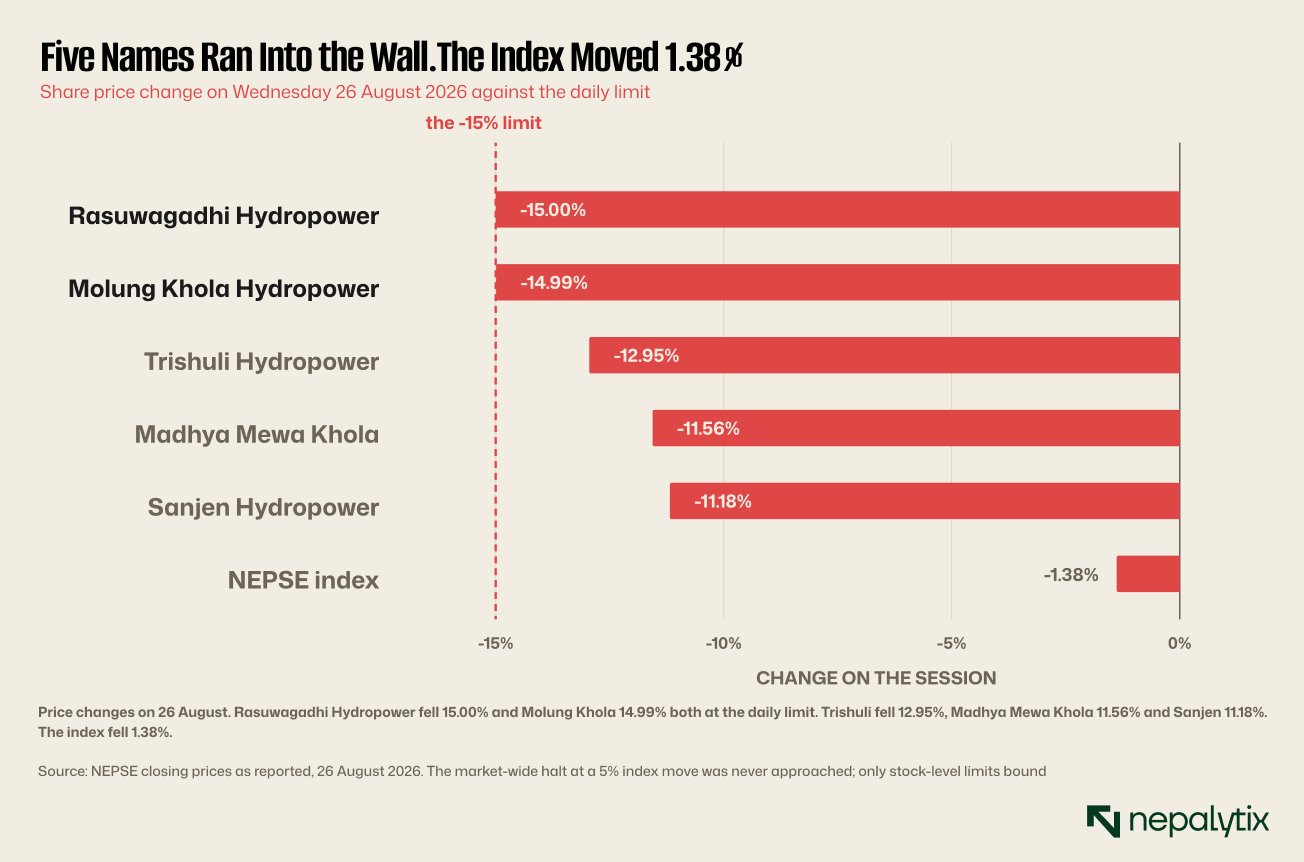
Rasuwagadhi fell 15.00%. Not 14.8%, not 15.2%. Exactly the limit. Molung Khola fell 14.99%. Both stopped where the rule says they stop.
Three more names got close. Trishuli fell 12.95%, Madhya Mewa 11.56%, Sanjen 11.18%.
The index fell 1.38%.
That last number matters more than it looks. The market-wide halt triggers at 5%. The day never came near it. No trading pause happened, no session was cut short and for most of the market it was an ordinary Wednesday. The only thing that stopped working was price discovery in the handful of securities where information had actually arrived.
What the market was actually trying to do
Put yourself in front of a screen that morning.
You know a flood came down the Bhote Koshi. You know it hit a corridor where a lot of Nepal's hydropower sits. You do not know which plants are damaged, how badly, whether the damage is to the powerhouse or the headworks or just the access road, how long repairs take or whether any of it is insured.
You own Rasuwagadhi. It is an 111 megawatt plant on that river. What is it worth?
The honest answer is a range. If the plant is out for two months, very little changes. If it is out for two years, a great deal does. If the headworks are gone, more still. Nothing available on 26 August let anyone pick a point in that range.
What a market does in that situation is find the price at which someone will hold the uncertainty. That price is discovered by people with different views trading against each other. It is not a number anyone knows in advance. It emerges.
The limit stopped that process at minus 15%. Not because minus 15% was the answer but because minus 15% is where the rule is.
Why the index number is the important one
Most coverage of 26 August led with the index falling 35.92 points. That was the wrong number to lead with.
The index fell 1.38%. NEPSE's first halt triggers at 5%. The day was nowhere near it. In market-wide terms, 26 August was unremarkable, a bad session in a run of bad sessions.
What made it unusual was concentration. A small set of securities moved a great deal while almost everything else moved a little. That is the signature of company-specific news rather than a market-wide shock and it is exactly the case a market-wide halt is not designed for.
The two mechanisms are answering different questions. The index breaker asks whether the whole market has lost its footing. The stock limit asks whether one security has moved too far. On 26 August the first answered correctly and did nothing. The second answered a question that was not being asked.
Worth stating plainly: the index breaker worked. This piece is a criticism of one mechanism, not of circuit breakers as a category.
What limit-down actually looks like
The mechanics matter and they are not widely understood.
When a stock reaches its lower limit, it does not stop existing. Orders can still be entered. What cannot happen is a trade below the limit price. So the order book fills with sellers at the limit and empties of buyers because a buyer who thinks the stock is worth less than the limit price simply waits.
The result is a queue. Sellers stack up and only those at the front get filled by whatever buying interest exists at that price. Everyone else carries the position into the next session.
This has two consequences. The first is that the reported closing price stops being informative. Minus 15% does not mean the market valued the stock 15% lower. It means the market wanted to go further and could not. The second is that the queue itself becomes information: anyone who can see a large unfilled sell queue knows tomorrow opens lower which discourages buying today.
The limit is supposed to give people time to think. In a thin market it can do the opposite. It tells everyone the direction of travel and removes their ability to act on it.
The limit did not prevent a fall. It scheduled one.
Here is the thing a price limit cannot do. It cannot decide whether a fall is justified.
If Rasuwagadhi was worth 15% less on 26 August, the limit cost its holders one day. If it was worth 30% less, the limit cost them two. The stock has to get where it is going. The rule only controls how long it takes.
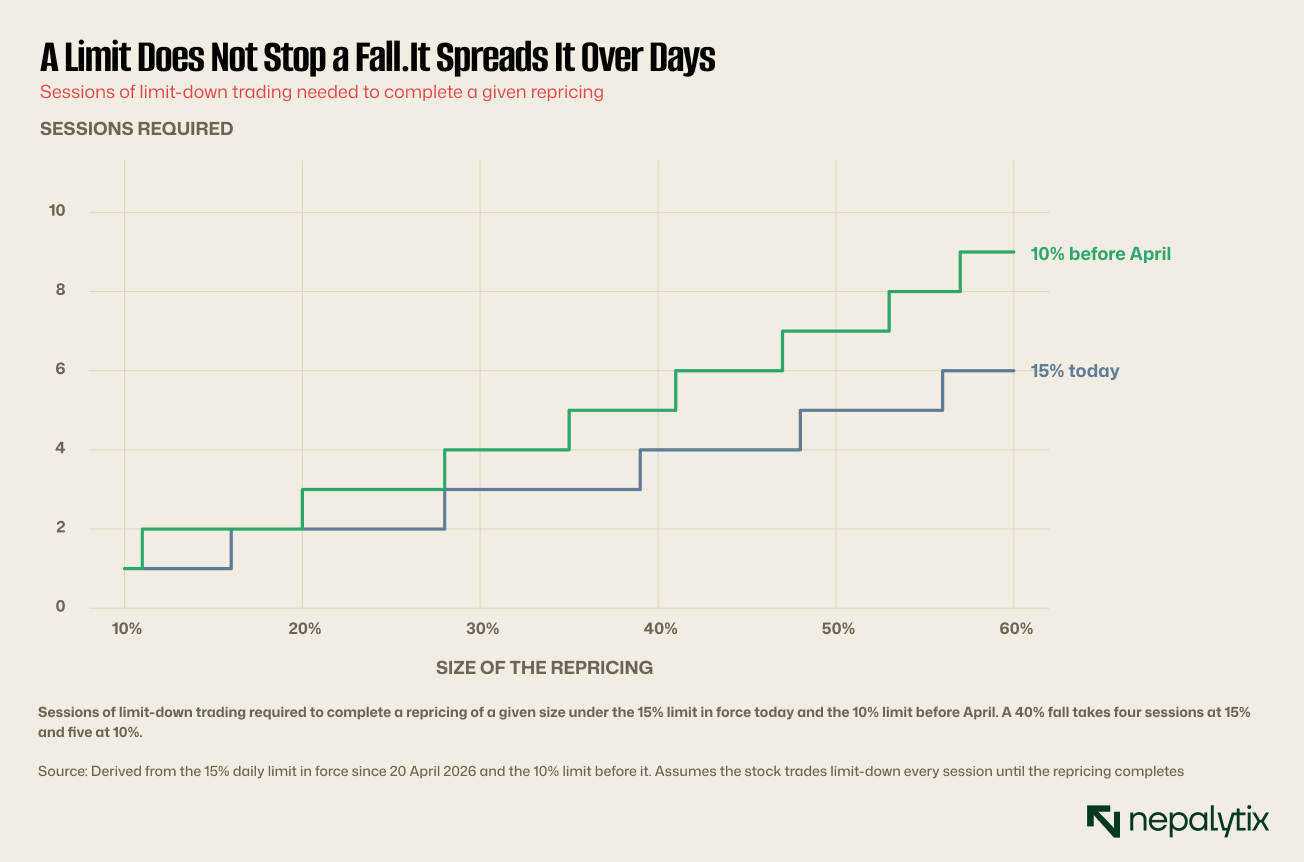
A 20% repricing takes two sessions. A 40% repricing takes four. A 60% repricing takes six. The April change helped, the same 40% move needed five sessions under the old rule but it did not change the shape of the problem.
And the cost is not spread evenly. A holder who wants to sell on day one cannot. A buyer who wants the shares cheap cannot get them either because nobody will sell at the limit price when they expect another limit-down tomorrow. Volume dries up at exactly the moment the market needs someone to set a price. The limit does not slow the fall. It empties the order book and then lets the fall happen anyway.
The seller nobody thinks about
Arguments about circuit limits usually feature two characters. The panicking retail investor who needs saving from himself and the predatory trader who needs stopping. Both exist. Neither is the person the rule hurts most.
That person is the forced seller. Someone with a loan payment due. Someone whose broker has called margin. An estate being liquidated. A fund facing redemptions. These people are not panicking and they are not speculating. They have to sell, on a schedule they do not control.
A limit does not protect them. It removes their only option. They watch a position fall for as many sessions as the repricing takes and they sell at the end of it rather than the beginning which is worse for them by exactly the amount the stock fell in between.
Margin lending grew 18.3% last year. Every one of those loans has a forced-seller clause in it somewhere. The more the market lends against shares, the larger this group gets and the more the limit costs them.
Volume tells you the limit bound
There is a way to test whether a limit day is a genuine stop or just a slow day and it is in the turnover.
Turnover on 26 August was Rs 4.77 billion, the highest of the week and up from Rs 3.23 billion on Monday. That is a market transacting heavily not one sitting on its hands.
Now hold that against the five securities pinned at their limits. Heavy overall volume and individual securities that cannot trade is the specific pattern that says the constraint is binding rather than the interest being absent. If nobody wanted to trade those shares, the limit would have been irrelevant. Volume elsewhere in the market says people wanted to trade plenty.
The one thing the limit did well
There is a version of 26 August without a limit that is worth imagining because it is the strongest defence of the rule.
Rasuwagadhi is not a heavily traded security. Nor are Molung Khola or Sanjen. In a stock with a handful of trades a session, the order book below the current price is thin. A wave of sell orders into that book does not find a price. It finds the last standing bid which might be 40% lower and prints there.
That print then becomes the reference for the next day, for margin calculations, for portfolio valuations across the market. A single trade of a few hundred units would have repriced the company for everyone.
The limit prevented that. That is a real benefit and it is not hypothetical, Nepal has seen exactly this in illiquid names before. Anyone arguing for abolition has to explain what replaces it.
This piece is not arguing for abolition.
Nepal has been here before
The last time Nepali limits bound at scale was March 2020. The market fell for consecutive sessions with large numbers of securities at their lower limits, and the exchange eventually suspended trading entirely for an extended period.
That episode is usually cited as evidence that limits are necessary, the market was in free fall and the mechanism contained it. It can equally be read the other way. Limits binding across a whole market on consecutive days is not a mechanism working. It is a mechanism failing to find a price, over and over until the exchange gives up and closes.
The difference with 26 August is scope. In 2020 the whole market was hitting limits and the index breakers were firing too. In 2026 five securities hit limits and the index did nothing. The first is a systemic event. The second is a company-specific one being handled by a systemic tool.
The week around it
It is worth seeing the session in context, because the market was already sliding.
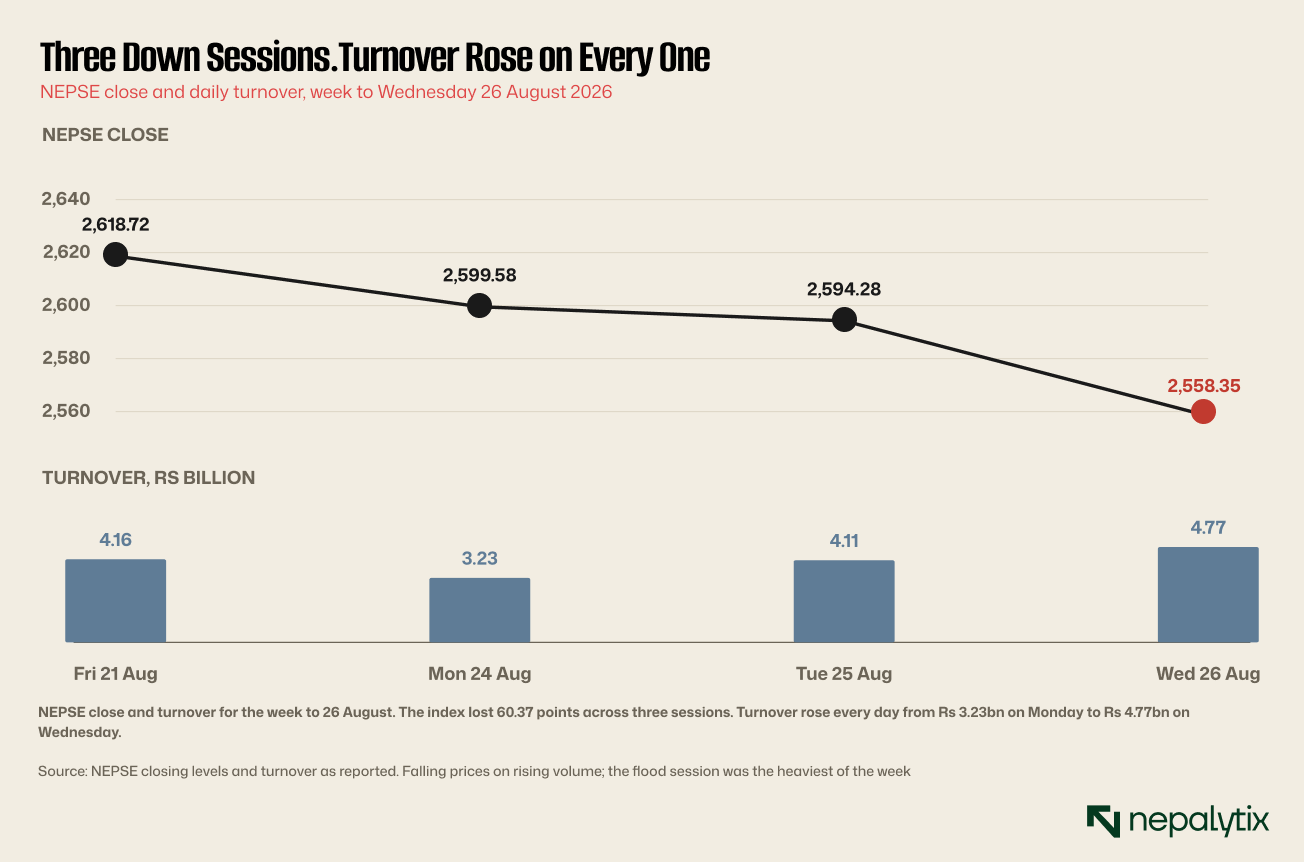
Monday down 19.13. Tuesday down 5.30. Wednesday down 35.92. Sixty points across the week.
Turnover went the other way. Rs 3.23bn on Monday, Rs 4.11bn on Tuesday, Rs 4.77bn on Wednesday. Prices falling on rising volume is people selling, not people losing interest.
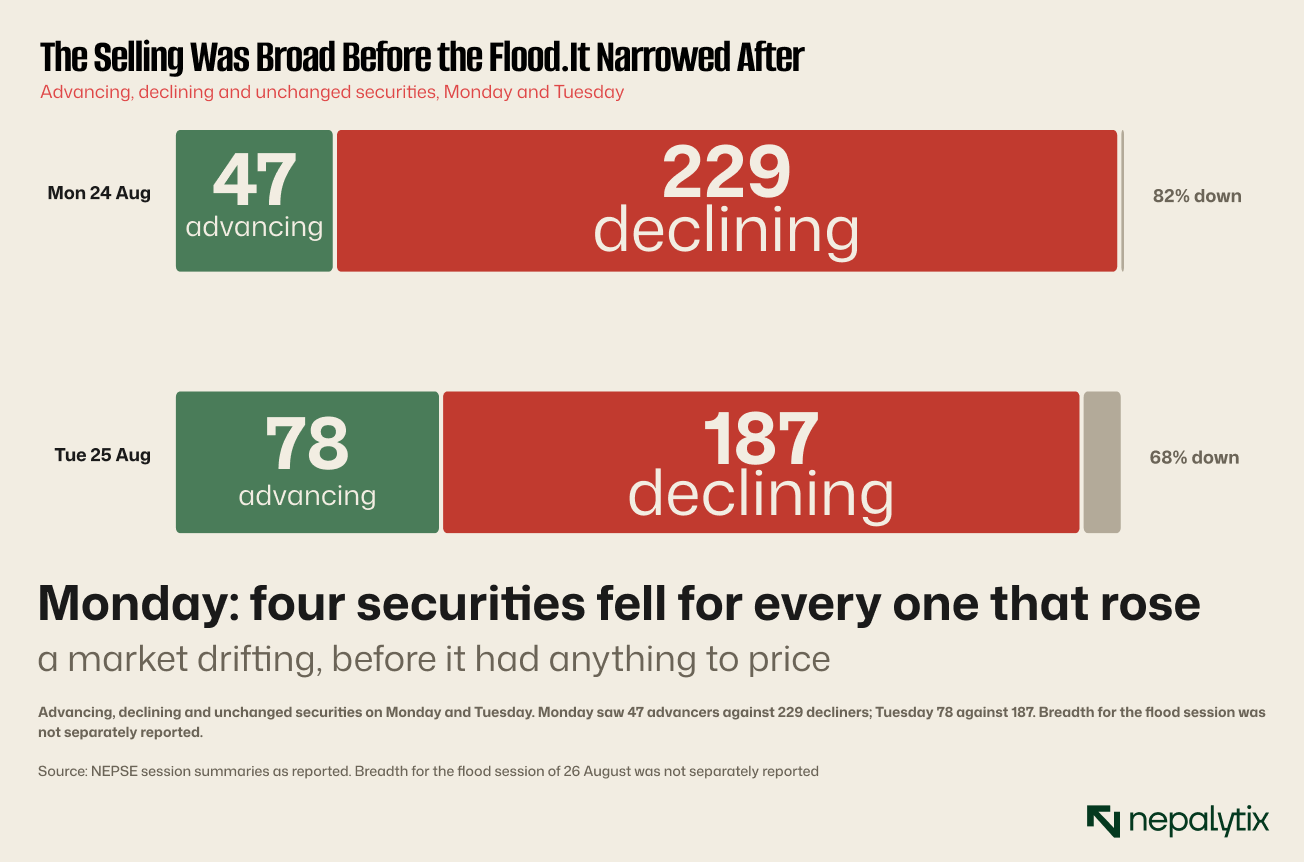
Monday was broad and dull. Four securities fell for every one that rose and all eleven sectoral indices closed lower. Nothing had happened. The market was just heavy.
Wednesday was different in kind. The index moved less than a typical bad day but a specific set of securities moved a lot. That is what a real event looks like in a price series, and it is the case where a blanket limit is least useful.
Three official numbers, none of them agreeing
The market's problem on 26 August was not that the news was bad. It was that the news had no size.
Three official figures came out for the same event, all on 27 August. The Nepal Electricity Authority said 14 projects and about 748 megawatts, split into nine operating plants at 354 megawatts and five under construction at 394. The Ministry of Energy said 431 megawatts. A third contemporaneous official count said 11 projects and 405 megawatts.
A 343 megawatt spread between official sources, published the same day. That is not a scandal: roads were gone, gauges were destroyed and teams could not reach the sites. Early damage assessment looks like this everywhere.
But it tells you what the market was working with. Anyone modelling the earnings impact on a listed hydropower company that Wednesday was working from a number that might be wrong by a factor of nearly two. In that situation the price should move a lot and it should move uncertainly and both of those are the market doing its job rather than failing at it.
What was on that river
The names that hit their limits were not random. They sit on the water that flooded.
The Ministry of Energy's list runs down the Trishuli and Bhote Koshi corridor. Upper Trishuli-1 at 216 megawatts, still under construction. Rasuwa Bhotekoshi at 120, also under construction. Rasuwagadhi at 111, operating. Sanjen Khola at 78. Upper Trishuli-3A at 60. Chilime at 22. Langtang Khola at 20. Trishuli at 24. Devighat at 14.1. Smaller units below that.
Roughly 341 megawatts of it was operating and generating revenue. About 414 megawatts was under construction: money already spent, nothing yet earned and now a repair bill before the first unit is sold.
The concentration is not an accident. Developers build where the gradient and the flat ground are which means they cluster. A single event on a single river took out about five per cent of Nepal's installed capacity and a much larger share of what was being built.
So the market had a genuine question to answer that morning, company by company: how much of this is mine. The limit prevented it from answering.
The case for the limit, put properly
The argument for price limits in Nepal is stronger than critics allow and it is worth stating before taking it apart.
Nepali equities are thin. Yesterday's piece on closed-end funds noted four listed schemes that did not trade at all. Nepal Investment Mega's promoter line traded four times in a session while its ordinary line traded 370. In a security that trades a handful of times a day, one motivated seller can move the price 40% against no information whatsoever. There is no institutional bid to absorb it.
The market is also overwhelmingly retail. There is little independent research and price moves get read as signals about other price moves. A 30% fall on Monday becomes a reason to sell on Tuesday, regardless of what caused Monday.
In that market, a limit does real work. It stops a single trade from repricing a company. It gives holders overnight to find out what happened before they act. Those are not small benefits, and any argument that ignores them is not serious.
The information the exchange already had
Here is the part that makes the flat rule hardest to defend.
NEPSE was not in the dark on 26 August. The Ministry of Energy issued a preliminary release naming the damaged projects that day. The Nepal Electricity Authority followed with its own count. Every affected company is a listed issuer with a continuous disclosure obligation.
The exchange therefore knew or could have known within an hour, that a specific and identifiable set of securities had material news. It applied the same 15% band to those securities as to a microfinance company in Jhapa with nothing happening at all.
That is not a technology problem. It is a design choice. The rule does not have a mechanism for saying "this security has news, widen its band today". Building one is not conceptually hard. India does it. It requires the exchange to make a judgement which is presumably why NEPSE prefers a number that requires none.
How other markets handle the same problem
Nepal is not the only market with thin securities and retail investors, and the mechanisms elsewhere are worth knowing.
India uses tiered bands: 5%, 10% or 20% depending on the security and moves stocks between tiers based on volatility. Crucially, it relaxes the band when there is a legitimate reason for a move. A stock with a corporate announcement is not held to the same limit as one moving on nothing.
Several markets use a volatility auction rather than a hard stop. When a price approaches its band, continuous trading pauses and a short call auction runs. Orders accumulate on both sides for a few minutes and the stock reopens at whatever clears. The cooling-off happens and price discovery still occurs.
The common thread is that the mechanism distinguishes between kinds of price move, or converts the stop into a matching event instead of a wall. Nepal does neither. Its limit is a flat percentage applied identically to every security every day with no reference to whether anything has happened.
What a limit assumes about people
Every price limit rests on a claim about investors: that left alone, they will do something they regret, and a pause will stop them.
That claim is sometimes true. Markets do overshoot. People do sell at the bottom. The research on this is not ambiguous.
But the claim has a hidden condition. The pause has to give people something they did not have before time to get information, or time to calm down. If the information does not exist, the pause supplies neither. Everyone comes back the next morning knowing exactly what they knew the previous afternoon which on 26 August was that a flood had damaged an unknown amount of plant.
A cooling-off period cools nothing when the temperature is not the problem.
There is a further assumption buried in the rule: that the exchange knows how far a price should be allowed to move. Fifteen per cent is not derived from anything. It is not a volatility estimate, not a function of the security, not tied to any measure of how much information has arrived. It was 10% for nineteen years and is now 15% because traders complained. That is a reasonable way to set an administrative convenience. It is a strange way to set the boundary of what a market is permitted to conclude.
Where the argument breaks
The limit is designed for one problem and applied to another.
The problem it solves is a price move without information. One seller, thin book, no news. The limit stops that cold and it should.
The problem on 26 August was the opposite. There was information: a flood, named projects, a damaged corridor and no way to size it. The market was not moving without a reason. It was moving because of a reason it could not measure. Stopping it did not add information. It just deferred the trade.
A limit cannot tell those two situations apart, because it only looks at the price. That is its whole design. It is a fixed number applied to every security on every day and it binds hardest on the days when the price is trying hardest to do its job.
Nepal has been slowly conceding this point for two decades.
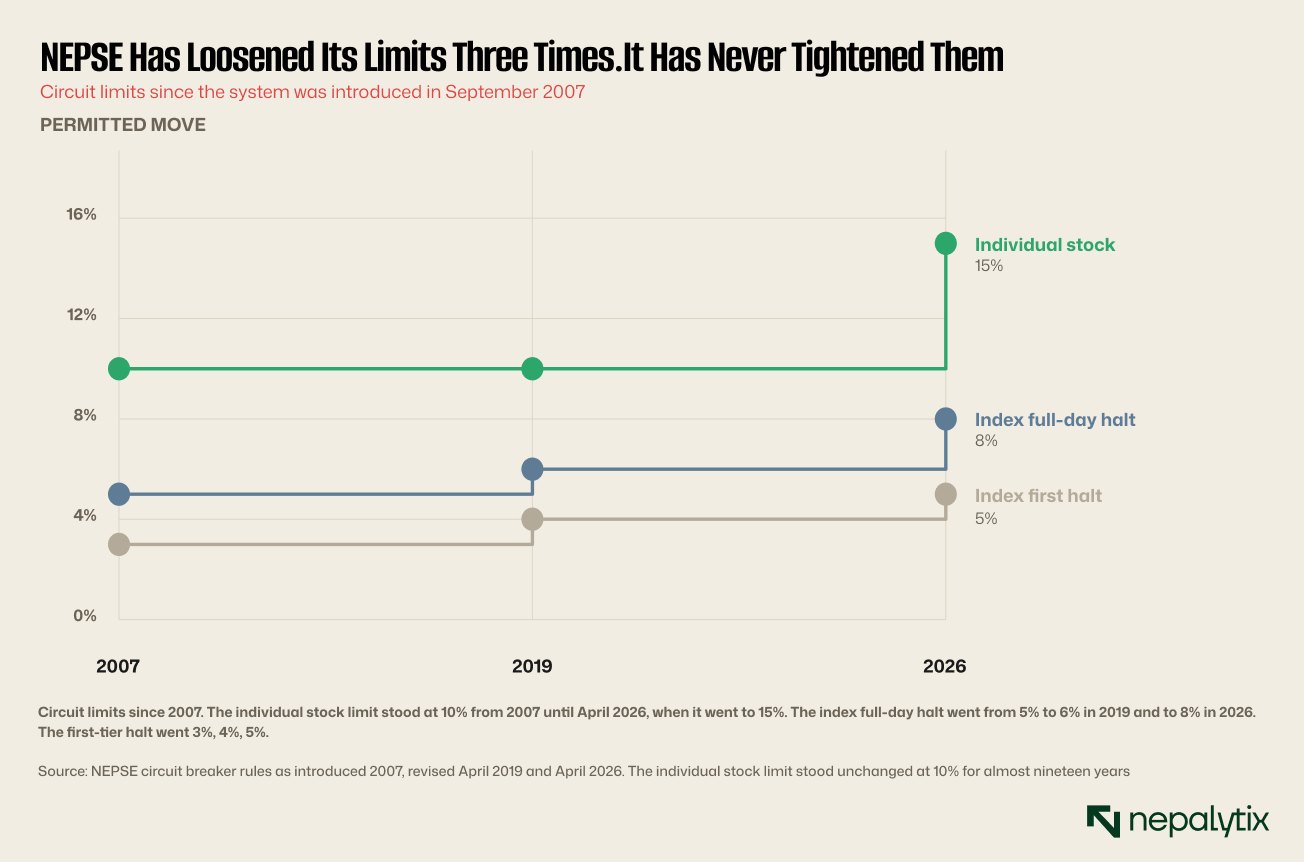
Every revision since 2007 has widened the band. The index closing threshold went from 5% to 6% to 8%. The first halt went from 3% to 4% to 5%. The stock limit sat at 10% for nineteen years and then went to 15%.
Not once has NEPSE tightened a limit. Each time the argument was the same: the constraint was binding too often and getting in the way. That argument was accepted three times. It is the same argument this piece is making about 26 August.
The collateral problem
One consequence of a limit sequence deserves its own section because it connects to something growing fast in the Nepali banking system.
Margin lending: loans against shares grew 18.3% last year faster than almost any other loan category and nearly three times the system average. Banks hold listed securities as collateral against those loans and they value that collateral at market prices.
Now consider a limit sequence. The stock is falling and the bank knows it is not finished falling, because the limit is binding. The collateral is worth less than the last print by an unknown amount. If the loan needs to be called, the bank cannot sell into a limit-down market. If it waits, the collateral falls further.
That is a risk banks carry and do not disclose. Nepali banks publish margin lending growth. They do not publish which securities they hold, at what loan-to-value or what happens to that book in a limit sequence. On 26 August that exposure was live for every lender holding hydropower shares.
The asymmetry in the rule
A detail worth noticing. The limit is symmetric 15% up, 15% down but its effects are not.
On the way up, a stock hitting its ceiling has willing sellers who cannot get the price they want. Annoying, not urgent. Nobody is forced to sell into a rally.
On the way down, a stock hitting its floor has holders who need out and cannot get out. The cost falls on people with obligations rather than on people with ambitions.
On 26 August Sarbottam Paints closed at its positive circuit while five hydropower names sat at or near their negative one. Same rule, same day, opposite consequences. The holder of Sarbottam who wanted to sell higher was inconvenienced. The holder of Rasuwagadhi who needed to sell at all was stuck.
Symmetric rules with asymmetric consequences are common and usually unexamined. This one has never been examined in Nepal at all.
Who actually pays
Work through who bears the cost of a limit day.
The holder who needs to sell. Someone with a margin call, a loan payment or a personal need cannot exit. They watch the position fall for as many sessions as it takes. The limit protects them from a bad price by denying them any price.
The buyer who thinks the fall is overdone. If you thought Rasuwagadhi was cheap at minus 15%, you could not buy much. Sellers step back when another limit-down looks likely. The people the limit is meant to attract are the ones it repels.
The company. Its cost of capital is being reset by a price the market was not allowed to finish setting. If it needs to raise money, it does so against a quote nobody believes.
The lender holding the shares as collateral. Margin lending grew 18.3% last year. A bank holding hydropower shares against a loan cannot value them properly during a limit sequence, and cannot sell them either.
Against that, the beneficiary is the holder who would have panicked and did not. That is a real person and a real benefit. It is just a smaller group than the four above.
The counterfactual nobody can settle
An honest problem with this whole argument: we cannot know what would have happened without the limit.
Maybe Rasuwagadhi falls 22% and stabilises, and the limit cost the market a day. Maybe it falls 45% on three trades and recovers to minus 20% over the following week in which case the limit prevented a bad print from becoming everyone's reference. Both are plausible. The data to distinguish them does not exist.
What can be said is narrower. The market spent the following sessions doing whatever price discovery the 26th prevented. The index has since recovered past its pre-flood level. The question of where those specific shares settled is not answerable from anything published because Nepal does not have accessible historical price series for individual securities in a form a reader can check.
That absence is worth noting on its own. An argument about whether a market mechanism works should be settleable with data. In Nepal it is not which is why this debate gets conducted in anecdotes and why the limit has been widened three times without anyone demonstrating what the old width cost.
What the pre-open change did
One piece of the April revision has gone almost unremarked and is arguably more consequential than the headline number.
The pre-open band went from 2% to 5%. That session sets the opening price, and it is where a stock with overnight news does most of its adjusting. Widening it from 2% to 5% more than doubled the room a stock has to open away from its previous close.
On 26 August that mattered. The news arrived before the market opened. A stock that could open 5% down rather than 2% down starts the session much closer to where it needs to be and has the remaining band to work with. Without that change the limits would have bound even harder.
So the April revision helped. It helped in the right place and it was not enough. Those two statements sit together and any fair reading of what NEPSE did has to hold both.
What the recovery does and does not prove
NEPSE closed at 2,558.35 on 26 August. It has since traded above 2,700. The market made back the flood session and more inside two weeks.
Two readings of that are available and people will pick whichever suits them.
The first: the fall was an overreaction, the limit did its job by slowing it and the recovery proves the market was wrong to sell. The second: the index recovering says nothing about the individual securities which is where the limits bound and a market-level number cannot settle a stock-level question.
The second is correct. The index is 300-odd securities and the flood touched a handful. Its recovery tells you about everything except the thing under discussion. Anyone citing the recovery as evidence the limit worked is answering a different question.
What a better rule looks like
The answer is not a wider fixed number. April already tried that and August showed the result.
Widen the band when there is news. Most exchanges distinguish between a price move with a disclosed cause and one without. If a company or a regulator has published material information, the limit should relax or lift for that security. NEPSE already knows when a disclosure has been filed. On 26 August the Ministry of Energy named the damaged projects before the session. The exchange had every reason to know these securities had something to price.
Use an auction instead of a wall. When a stock hits its limit, trading stops. A better mechanism holds a short call auction at the limit, lets buyers and sellers submit orders and reopens at whatever price clears. That converts a hard stop into a pause for matching. It preserves the cooling-off benefit and gives up much less price discovery.
Publish how often the limit binds. Nobody knows how many securities hit their limit in a typical month or how long a limit sequence usually runs. NEPSE has the data. Without it, every revision is argued on anecdote which is how the limit has been widened three times without anyone showing what the previous width cost.
Leave the index breakers alone. They did not fire on 26 August and they were right not to. A 1.38% index move is not a market-wide event. The market-level mechanism worked exactly as intended which is worth saying in a piece critical of the stock-level one.
What this says about the market underneath
Step back from the rule for a moment.
A price limit binds when the market wants to move further than the exchange permits. How often that happens is a function of two things: how wide the band is and how thin the market is. Nepal has been widening the band. It has done nothing about the thinness.
The evidence on thinness is everywhere in this publication's recent work. Four listed closed-end funds did not trade at all in a session. Nepal Investment Mega's promoter line traded four times against its ordinary line's 370. Promoter shares across the market trade a third or more below identical ordinary shares purely because they cannot be sold freely. Roughly a quarter of the closed-end fund universe cannot be priced against its own assets because nobody trades it.
A market that thin needs price limits. It also needs them more often and they cost more when they bind, because there is nothing else holding the price together.
Widening the band treats the symptom. The underlying condition is that Nepali securities do not have enough buyers and sellers at enough prices. Everything this publication has written about promoter lock-ins, face-value IPO pricing and the free float that nobody publishes comes back to the same place. The circuit limit is where that shortage becomes visible on a specific Wednesday.
What to watch next
Three things will tell you whether any of this gets addressed.
Whether NEPSE publishes limit statistics. How many securities hit their band in a month, and how long a limit sequence typically runs. The exchange has the data and has never released it. Publishing it would cost nothing and would settle most of the argument in this piece one way or the other.
Whether a news-based relaxation appears. The mechanism exists in other markets and is not technically demanding. Its absence is the single clearest gap in Nepal's rules.
Whether the band gets widened again. If the answer to August is another increase, 15% to 20% that will be the fourth widening in nineteen years and the fourth time the underlying design goes unexamined. It will also work in the narrow sense until the next event that needs more room than the new number allows.
The cost of getting it wrong in either direction
Set the two failure modes side by side, because policy is a choice between them.
A limit that is too tight defers price discovery, traps forced sellers, empties the order book and makes the closing price uninformative. Nepal saw this on 26 August.
A limit that is too loose lets one trade in a thin security reprice a company for everyone, sets a false reference for margin calculations and portfolio valuations across the market and can trigger selling that has nothing to do with the original news.
Both are real. The question is which one Nepal is closer to, and the answer has been assumed rather than measured for nineteen years. The exchange has widened the band three times on the basis of trader complaints. It has never published the data that would show what the previous band cost or whether the new one is closer to right.
That is the actual problem. Not the number.
The point
NEPSE spent April arguing that its limits were too tight and widened them 50%. In August a river came down a gorge, five hydropower shares ran into the new limit anyway and the market spent the rest of the week finding the price it was not allowed to find on Wednesday.
The lesson is not that limits are wrong. It is that a fixed percentage cannot tell the difference between a market that is frightened and a market that is informed. Nepal keeps raising the number and running into it again. The number is not the problem.
One last thing. Nothing here should be read as arguing that Nepali investors need less protection. The opposite. A market where a company can be repriced by three trades needs guardrails, and the people most exposed to a bad print are the small holders least able to absorb it.
The argument is that a flat percentage is a crude guardrail, that Nepal has now widened it three times without asking whether the design is right and that on 26 August the crudeness had a visible cost. A rule that treats a flood the same as a rumour is not protecting anyone. It is just simple to administer.
Disclaimer
This report has been prepared by Nepalytix for informational and educational purposes only and does not constitute investment advice, an offer, or a solicitation to buy or sell any securities.
The information contained in this report is based on sources believed to be reliable; however, Nepalytix does not guarantee its accuracy, completeness, or timeliness. Opinions, estimates, and projections expressed herein are those of the authors as of the date of publication and are subject to change without notice.
Investing in securities involves risks, including the possible loss of principal. Past performance is not indicative of future results. Readers are advised to conduct their own independent research and consult with a qualified financial advisor before making any investment decisions.
Nepalytix and its contributors may hold positions in the securities discussed in this report at the time of publication or thereafter.
Neither Nepalytix nor any of its affiliates accept any liability for any loss arising from the use of this report or its contents.