NEPSE’s Breakout Gets Sold as 2,550 Fails to Hold
NEPSE’s reform rally hit the 2,550 wall as the index fell 0.60% on heavy Rs 4.20 arab turnover with 192 stocks declining and selling pressure spreading across the market.

Markets Today
30-Seconds Read
NEPSE closed 2,545.40, down 15.43 (−0.60%), giving back 85% of Monday's reform-driven +18.07 in a single session. 2,550 failed as support the first time it was tested. That was the stated risk on Monday, in those words.
Breadth collapsed: A/D 0.39 (74 advancers, 192 decliners) from 2.47. The four-session above-parity streak, a coverage record is over. All thirteen sub-indices closed red, the first fully red board of the coverage.
Turnover was Rs 4.20 arab, the second-highest of the coverage, on 50,804 transactions. This was not a quiet drift lower. It was heavy selling on near-record volume which is materially worse than a low-volume fade.
RSML rose 1.80% to 2,993.00, a third consecutive gain with the largest block of the day for a third consecutive session. After fifteen failed rotations, this is the first thing in the entire coverage to hold a directional move three days. Four RSML blocks totalled Rs 9.84 crore, 87% of the top-five block value.
The flood's insurance math just got much worse. Insurers have paid Rs 7.62 billion against Rs 23.53 billion of Gen-Z movement claims — 32.4%. That is the precedent for the Rs 25.87 billion Bhotekoshi book. Non-Life fell 1.57% unwinding Monday's +2.05% rally.
The technical scan did not move: 23.71% bullish versus 23.70% on Monday, while breadth fell from 2.47 to 0.39. Another divergence, and this time the scan is the calm one.
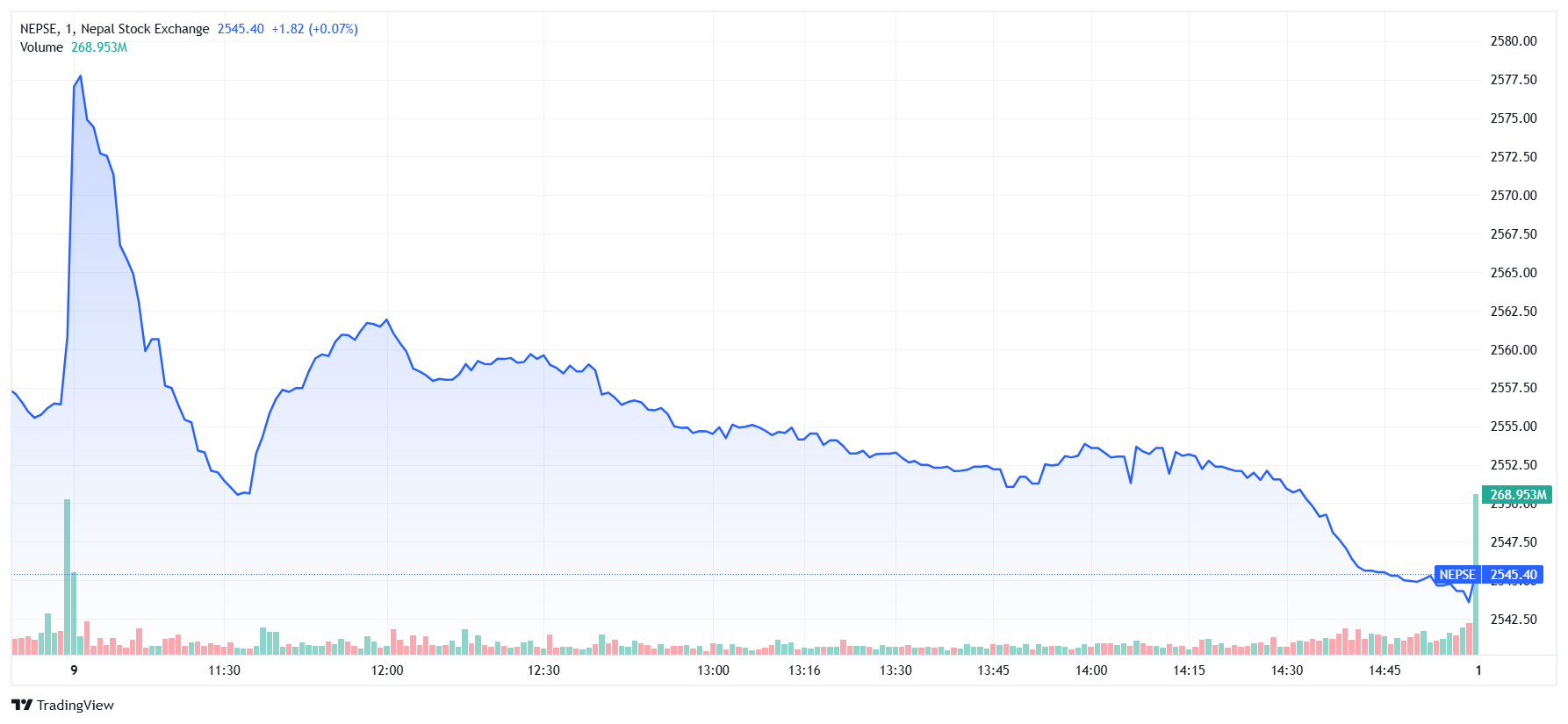
NEPSE closed 2,545.40. The reform trade lasted exactly one session.
The index fell 15.43 points (−0.60%) on Rs 4.20 arab turnover, 1.10 crore units and 50,804 transactions across 352 scrips. Advancers 74, decliners 192, unchanged 16 an A/D ratio of 0.39, down from 2.47.
That breadth swing is the third-largest in the dataset, and it ends the four-session above-parity run that had been the strongest evidence of a genuine turn. All thirteen sub-indices closed red, the first time the entire board has been negative in twenty-two sessions of coverage. Development Bank was worst at −2.37% then Non-Life Insurance −1.57% and Trading −1.56%.
The volume is what makes this serious. Rs 4.20 arab is the second-highest turnover of the coverage behind only 26 August's Rs 4.77 arab, and transactions of 50,804 essentially matched Monday's record 50,844. A rally that fades on thin volume is indecision. A 0.60% decline with 192 decliners on near-record turnover is distribution, people sold into strength, in size and found buyers only at lower prices.
Two things did not break and they matter.
First, large caps outperformed again. Sensitive fell 0.35% against NEPSE's 0.60%, and Banking was the best sector at −0.16%. Monday's quality rotation held through a down day, which is the harder test. When small caps lead a rally and then lead the selloff that is churn; when large caps outperform in both directions, money is genuinely sitting in them.
Second, RSML held. Up 1.80% to 2,993.00, its third consecutive gain, top of the turnover table for a third consecutive session and the source of the largest block for a third consecutive session. In twenty-two sessions and fifteen failed rotations, nothing has held three days. RSML just did on the day the rest of the market broke.
Underneath, the tails stayed violent. ENL, JFL and SINDU all closed limit-down at −14.99% for a second consecutive session, each now down roughly 27.7% across two days. KDL fell 14.28% on its own dividend announcement. ULBSL fell 12.04%. Against that, ULHC closed limit-up at +15.00% after falling 13.33% on Monday, a complete round trip in two sessions.
Tuesday 8 September was a public holiday for Gen Z Sahid Diwas and NEPSE did not trade. Today's change is measured against Monday's close. No session is missing.
Index Snapshot
Index | Close | % |
|---|---|---|
NEPSE | 2,545.40 | −0.60% |
Sensitive | 452.34 | −0.35% |
Float | 174.65 | −0.58% |
Turnover Rs 4.20 arab
Volume 1.10 crore units
Transactions 50,804
Scrips traded 352
Sensitive outperformed for a second consecutive session, −0.35% against the broad index's −0.60%. On Monday it led the rally at +0.99% versus +0.71%. Large caps up more and down less across two sessions is the first sustained quality signal of the coverage.
Sectoral Indices Performance
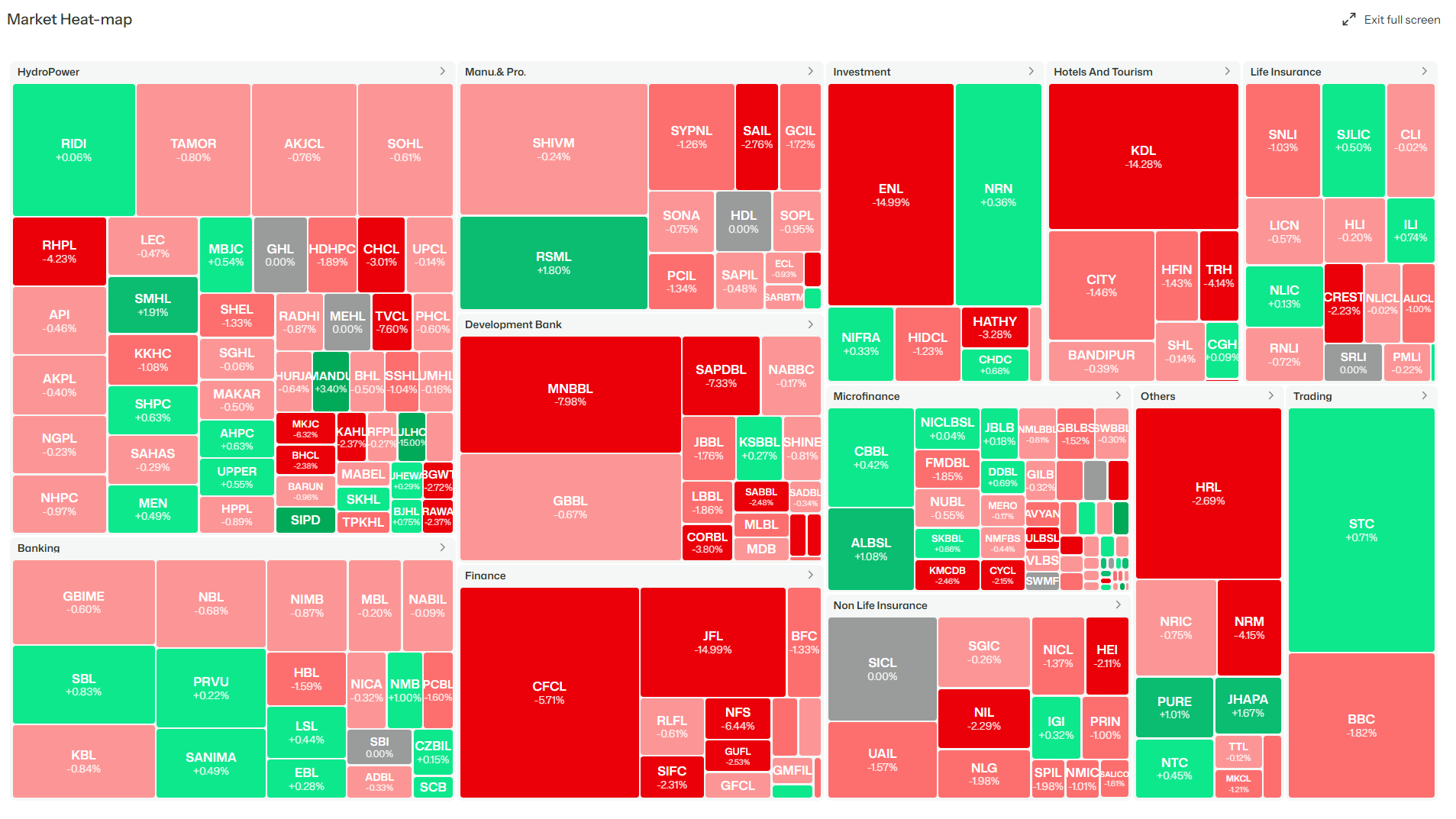
Twelve captured sub-indices, all red. Float (174.65, −0.58%) is a broad index, not a sub-index.
Development Bank's −2.37% is real, not a single-stock artefact. SINDU −14.99%, MNBBL −7.98%, SAPDBL −7.33%, JBBL −1.76%, GBBL −0.67%. Five constituents down materially — this is the one sector where the damage is genuinely broad.
Non-Life's −1.57% unwinds Monday's +2.05% almost exactly. NIL −2.29%, HEI −2.11%, NLG −1.98%, UAIL −1.57%, NICL −1.37%, with SICL flat at 0.00% after Monday's +5.24%. See the Gen-Z claims story below for why.
Hydropower's −0.49% conceals the widest dispersion on the board: eight of the ten top gainers are hydro (ULHC +15.00%, SPL +6.40%, BHPL +5.79%) while MKJC −6.32%, TVCL −7.60%, RHPL −4.23% and CHCL −3.01% sit at the other end. The sector print is meaningless today.
Market Breadth
Metric | Count |
|---|---|
Advancers | 74 |
Decliners | 192 |
Unchanged | 16 |
Live universe total | 282 |
A/D ratio | 0.39 |
Scrips traded (full tape) | 352 |
Running A/D series (7 Aug → 9 Sep): 0.32 → 0.51 → 0.99 → 0.70 → 1.66 → 0.67 → 0.35 → 0.32 → 0.79 → 1.01 → 0.36 → 0.21 → 0.42 → 0.09 → 1.24 → 0.08 → 2.15 → 2.57 → 1.18 → 2.47 → 0.39
The four-session above-parity streak ends. Note what it does not do: 0.39 is well above the 0.08 and 0.09 readings from the late-August capitulation. This is a bad day, not a panic. But the swing from 2.47 to 0.39 in one session is the second-largest single-session breadth reversal recorded here, behind only 30–31 August (1.24 → 0.08).
Technical scan
The Live Indicator Scan at 2:58 PM read 3,324 total signals: 788 bullish (23.71%) and 1,220 bearish (36.70%).
Running bullish %: 24.86 → 25.24 → 24.92 → 25.45 → 22.27 → 22.66 → 21.41 → 20.27 → 19.71 → 20.09 → 18.98 → 19.62 → 21.44 → 23.70 → 23.71
The scan did not move. 23.71% against 23.70% on Monday — a difference of one basis point while breadth collapsed from 2.47 to 0.39. Bearish signals rose only modestly, from 36.07% to 36.70%.
This is the fifth divergence of the coverage, and the scan is on the calm side. The pattern has been that the scan leads and breadth follows within a session, and it is now 4-for-5. On 3 September the scan improved while breadth fell to 1.18, and the index gained 18.07 points the next session. The identical setup is in place today.
The honest counterweight: the scan's one failure came on 2 September, when a record-low reading called a reversal that never happened. And a flat scan against a −0.60% index day with 192 decliners is a weaker signal than an improving scan against a rising one. Treat it as a reason not to extrapolate today's decline, not as a reason to expect a bounce.
Winners & Losers
Top Gainers
Stock | Sector | LTP | % |
|---|---|---|---|
ULHC | HydroPower | 299.00 | +15.00% |
SPL | HydroPower | 655.00 | +6.40% |
BHPL | HydroPower | 457.00 | +5.79% |
IHL | HydroPower | 302.90 | +3.66% |
SIPD | HydroPower | 611.80 | +3.50% |
MANDU | HydroPower | 700.00 | +3.40% |
TSHL | HydroPower | 342.00 | +2.70% |
SMFBS | Microfinance | 1,380.00 | +2.60% |
USHL | HydroPower | 512.00 | +2.20% |
GMFBS | Microfinance | 1,170.00 | +2.18% |
Eight of ten are hydropower and none appears in either activity table. These are thin prints in a sector index that closed −0.49%.
ULHC completed a two-session round trip: 300.00 on 3 September, limit-down to 260.00 on Monday, limit-up to 299.00 today. Net change over three sessions: −0.33%. Two circuit moves in opposite directions to end up where it started.
SPL and IHL both reversed Monday's declines SPL from −3.81% to +6.40%, IHL from −3.88% to +3.66%. IHL is plausibly Ingwa Hydropower which announced today that it has resumed full generation at its 9.7 MW Upper Ingwa Khola project after repairing flood damage. Treat the ticker mapping as inference.
Top Losers
Stock | Sector | LTP | % |
|---|---|---|---|
ENL | Investment | 587.90 | −14.99% |
JFL | Finance | 266.60 | −14.99% |
SINDU | Development Bank | 423.10 | −14.99% |
KDL | Hotels & Tourism | 623.20 | −14.28% |
ULBSL | Microfinance | 2,498.00 | −12.04% |
MNBBL | Development Bank | 318.40 | −7.98% |
TVCL | HydroPower | 293.10 | −7.60% |
SAPDBL | Development Bank | 632.00 | −7.33% |
NFS | Finance | 491.10 | −6.44% |
MKJC | HydroPower | 271.10 | −6.32% |
ENL, JFL and SINDU are limit-down for a second consecutive session. Each has lost roughly 27.7% across two days. Alongside RSML, these are the only names in the market currently holding a directional move and three of the four are falling at the circuit.
KDL fell 14.28% on the day it announced a dividend. See below; this breaks the dividend thread in an instructive way.
ULBSL's −12.04% closes the file on a name this report flagged twice. It ran +11.87% on 2 September and +4.87% on 7 September, and on both occasions the note said it appeared in neither activity table and should be treated as a thin print rather than a signal. From 2,926 on Monday to 2,498 today is −14.6%. The warning was correct.
TVCL is down a second consecutive session, −7.60% to 293.10. It has now fallen roughly 11.2% across two sessions since the tape finally began pricing the total loss of the 37 MW Upper Trishuli-3 'B'. The disclosure was made on 2 September; the market took three sessions to react and is now reacting hard.
Turnover & Volume Leaders
Most Active by Turnover
Stock | Sector | LTP | % |
|---|---|---|---|
RSML | Manu. & Pro. | 2,993.00 | +1.80% |
CFCL | Finance | 561.00 | −5.71% |
NRN | Investment | 1,405.00 | +0.36% |
SOHL | HydroPower | 650.00 | −0.61% |
SHIVM | Manu. & Pro. | 662.60 | −0.24% |
TAMOR | HydroPower | 493.10 | −0.80% |
ENL | Investment | 587.90 | −14.99% |
SYPNL | Manu. & Pro. | 1,327.00 | −1.26% |
RIDI | HydroPower | 347.90 | +0.06% |
GBBL | Development Bank | 444.00 | −0.67% |
Most Active by Volume
CFCL (561.00, −5.71%), RIDI (347.90, +0.06%), TAMOR (493.10, −0.80%), AKJCL (338.00, −0.76%), SOHL (650.00, −0.61%) , MNBBL (318.40, −7.98%), SHIVM (662.60, −0.24%), GBBL (444.00, −0.67%), ENL (587.90, −14.99%), RSML (2,993.00, +1.80%)
Only two of the twenty entries across both tables are green, and one of them is RSML. The most-traded names were almost uniformly sold.
ENL appears in both tables while locked limit-down. Heavy volume into a circuit means real supply meeting no bid, this is forced or urgent selling, not repositioning.
GBBL at −0.67% completes the fade of Monday's dividend pop. It was top by volume on Monday at +2.45% on a 20% dividend proposal; it has given back a quarter of that.
CFCL is the volume leader on a −5.71% day. Its arc across the coverage: 635.00 (+9.11%, 2 Sep) → 598.40 (−5.76%, 3 Sep) → 561.00 (−5.71%, today). Down 11.7% from the spike, on the heaviest volume in the market. This report called CFCL "backed by real volume" on 2 September and marked that wrong on 3 September; the subsequent path confirms the correction.
Metric | Value | Prior session |
|---|---|---|
Total transactions | 45,878 | 45,790 |
Total quantity | 1 crore | 84.13 lakh |
Total amount | Rs 3.83 arab | Rs 3.45 arab |
Average deal size | Rs 83,375 | Rs 75,399 |
Largest single transaction | Rs 5.88 crore (RSML, 10:46:00 AM) | Rs 5.87 crore (RSML) |
Top 5 by amount: RSML Rs 5.88 Cr (52.22%), RSML Rs 1.47 Cr (13.06%), NCCD86 Rs 1.42 Cr (12.60%), RSML Rs 1.30 Cr (11.53%), RSML Rs 1.19 Cr (10.59%). Combined Rs 11.26 crore.
Top 5 by quantity: GIBF1 2,50,000, PRSF 1,75,000, PRSF 1,00,000, GIBF1 1,00,000, RSY 1,00,000.
Four of the top five blocks are RSML, totalling Rs 9.84 crore — 87.4% of the top-five value. RSML has now produced the largest single block for three consecutive sessions: Rs 8.10 Cr, Rs 5.87 Cr, Rs 5.88 Cr. Across the three sessions the name has absorbed roughly Rs 25.5 crore of block flow while the price moved 2,830 → 2,940 → 2,993.
This is an accumulation campaign, not a series of unrelated placements, and it is the single most legible piece of institutional behaviour in the coverage. The price impact is decelerating — +5.01%, +3.89%, +1.80% — which is what you would expect from a buyer working an order rather than chasing.
Average deal size recovered to Rs 83,375, back above the Rs 80,000 continuity threshold after Monday's dip to Rs 75,399. Series: 53,605 → 59,442 → 74,087 → 85,606 → 75,399 → 83,375.
Exclusion note: NCCD86 is a debenture and one of the names explicitly listed as recurring non-signal instruments. Its Rs 1.42 crore print is a bond placement, not equity demand and it is stripped from the equity read.
Turnover integrity check: the RSML blocks total Rs 9.84 crore, or 2.3% of Rs 4.20 arab; the NCCD86 debenture adds 0.3%. Headline turnover stands as equity turnover. Rs 4.20 arab is real and it is the second-highest of the coverage. Mutual fund units (GIBF1, PRSF, RSY) again dominate the quantity list at 725,000 units inflating volume but not turnover.
Previous Session Recap
Monday, 7 September, NEPSE rose 18.07 points to 2,560.84, clearing 2,550 for the first time and posting the highest close since 28 August. Breadth was 2.47 with 195 advancers, a coverage record. Turnover was Rs 3.83 arab on a then-record 50,844 transactions. Sensitive outperformed at +0.99% with four banks in the activity tables. The driver was policy: Finance Minister Wagle directed NRB and SEBON to propose legal measures for capital market reform and SEBON's chairman outlined a full overhaul at the Nepal Capital Market Discourse. Non-Life led at +2.05% and GBBL topped the tape on a 20% dividend.
Tuesday 8 September: NEPSE closed for Gen Z Sahid Diwas.
Coverage index series (7 Aug → 9 Sep, 22 sessions): 2,650.08 → 2,641.06 → 2,641.85 → 2,642.40 → 2,651.21 → 2,643.83 → 2,641.82 → 2,622.48 → 2,622.22 → 2,629.40 → 2,618.72 → 2,599.58 → 2,594.27 → 2,558.35 → 2,557.31 → 2,513.42 → 2,522.66 → 2,538.11 → 2,542.77 → 2,560.84 → 2,545.40
Net across the coverage: −104.68 points, −3.95%. The market retains +31.98 points (+1.27%) off the 31 August low having recovered and then partly surrendered.
Signal Scorecard, what resolved today
Prior call | Status | What happened |
|---|---|---|
"A close back below 2,550 marks Monday as a one-day reform spike" | CONFIRMED — spike | Closed 2,545.40. 2,550 failed on its first test as support. The reform trade had a one-session half-life, exactly as the twenty-one-session base rate predicted. |
"RSML on day three — the cleanest test of whether anything can hold" | HELD | +1.80% to 2,993.00, third consecutive gain, third consecutive largest block. The first three-day directional hold of the coverage. Fifteen rotations failed before this. |
"A/D for a fifth consecutive above-parity session" | FAILED | 0.39. Streak ends at four. Second-largest single-session breadth reversal in the dataset. |
"Do large caps keep leading?" | YES | Sensitive −0.35% vs NEPSE −0.60%; Banking best sector at −0.16%. Outperformed up on Monday and down today. The quality rotation is the one thing that survived. |
"Average deal size back above Rs 80,000" | ACHIEVED | Rs 83,375 recovered from Rs 75,399. |
"Turnover must hold above Rs 3.00 arab" | HELD — but read it differently | Rs 4.20 arab, second-highest of the coverage. On a −0.60% day with 192 decliners, high turnover is distribution, not participation. The threshold was designed for up-days. |
"Reform follow-through, or the one-day half-life" | HALF-LIFE | No draft, no timeline, no bill. Sentiment faded on schedule. Policy record falls to 1 for 1 on impact, 0 for 1 on durability. |
"Dividends 3 for 3" | BROKEN, 3 for 4 | KDL proposed 8.9474% and fell 14.28%. But see below: the composition explains it. |
"The limit-move tails" | WORSE | ENL, JFL and SINDU limit-down for a second consecutive session, each −27.7% over two days. Plus KDL −14.28%, ULBSL −12.04%, and ULHC limit-up. |
"ULBSL is a thin print, not a signal" (flagged 2 Sep and 7 Sep) | CORRECT | −12.04% to 2,498.00, down 14.6% from Monday. |
"Watch for a TVCL rating action / the tape pricing the total loss" | PRICING NOW | Second consecutive decline, −7.60%, roughly −11.2% over two sessions. |
"NRB forbearance for flood-affected borrowers" | NO NEWS | Still the largest unpriced risk |
Top Stories in Nepal
1. Insurers paid 32% of the last disaster's claims. That is the Bhotekoshi precedent.
Insurance companies have paid Rs 7.62 billion against Rs 23.53 billion in claims filed for damage during the September 2025 Gen-Z movement. Large claims remain pending on assessment, documentation and disputes.
That is 32.4% settled, roughly a year on.
Now place it beside the current book. The Nepal Insurance Authority has 583 Bhotekoshi claims worth Rs 25.87 billion, a slightly larger book than Gen-Z. On 3 September the Ministry of Finance, the Authority and insurers agreed to make advance payments against verified claims, and the explicit precedent cited for that mechanism was the Gen-Z movement where advances of up to 50% were provided.
The precedent being invoked as reassurance is a precedent in which two-thirds of the money has not been paid a year later.
Why it matters and why Non-Life fell 1.57% today. On Monday the sector was the best performer at +2.05%, led by SICL +5.24%, a relief rally on the advance-payment agreement. Today that reversed almost exactly: NIL −2.29%, HEI −2.11%, NLG −1.98%, UAIL −1.57%, SICL flat. The relief was priced on the assumption that advance payments resolve the overhang. The Gen-Z data says settlement is slow, contested and incomplete.
Read alongside the damage arithmetic, the picture is consistent and unpleasant: Rs 180 billion of estimated Bhotekoshi damage Rs 25.87 billion of claims filed (14%) and a settlement precedent running at 32%. Applied naively, that implies roughly Rs 8.4 billion actually reaching claimants against Rs 180 billion of destroyed value. The residual sits with project sponsors and their lenders. This remains an equity and credit event with a small insurance component and today's insurance data made the component smaller.
2. SEBON: only 17 lakh of 80 lakh demat accounts are active
SEBON says around 17 lakh of Nepal's 80 lakh registered demat accounts are currently active — 21.3%. The regulator framed it as widespread inactivity requiring stronger financial literacy.
Why it matters: this is the number that explains this report's central observation. A market with 1.7 million active accounts, no institutional bid and no primary-market price discovery produces exactly what has been documented for twenty-two sessions: thin prints running 10–15% on a handful of trades, sector indices distorted by single stocks, headlines priced for one day and reverted, and fifteen consecutive failed rotations.
It also sharpens Monday's reform story. SEBON's stated fix is qualified institutional investors and a genuine price discovery mechanism. Today's disclosure is the regulator publishing its own evidence for why that is needed. The diagnosis and the prescription are consistent which is more than can be said for most policy announcements. What is still missing is a bill.
The counterpoint arrived the same day: Beni Hydropower's IPO was oversubscribed 15.80 times, with over 1.16 million applicants applying for 13.64 crore shares. 1.16 million applicants against 1.7 million active accounts means the primary market mobilises nearly the entire active base while the secondary market runs on far less. Demand exists; it is allocation-hungry, not price-discovering. It also means IPO application money is locked up during subscription, a plausible contributor to secondary-market liquidity conditions this week.
3. ICRA works through the hydro book, one name stays on negative watch
Three ratings today:
Sagarmatha Jalabidhyut — BBB- issuer rating reaffirmed, but "Watch with Negative Implication" retained.
Niko Energy — LB+ / A4 reaffirmed, with ICRA flagging construction delays and funding risks at the 9 MW Mathilo Bhurundi-A project.
Swastik Rolling Mills — LB+ / A4 assigned, citing strong operational advantages alongside high leverage and tight liquidity.
Why it matters: the credit chain template established with Myagdi Hydropower runs damage → force majeure → unquantified claim → debt servicing risk → downgrade. Sagarmatha Jalabidhyut sitting on negative watch and Niko Energy carrying flagged construction and funding risk are both consistent with that chain's early stages. ICRA remains the most active source of company-specific hard information in this market, and it is the mechanism by which flood damage becomes a rated credit event rather than a news item. TVCL which disclosed a total asset loss on 2 September, still has no rating action and its stock fell 7.60% today.
4. LPG at Rs 3,000 against a fixed price of Rs 2,165
Cooking gas in Kathmandu Valley is selling for as much as Rs 3,000 per cylinder against the government-fixed price of Rs 2,165 — 38.6% above the official rate.
This is the supply-chain thread arriving at the consumer. The chain is documented across this coverage: Rasuwagadhi closed roughly 40 km of the 56 km Bidur–Rasuwagadhi road destroyed, the Prithvi Highway blocked at Krishnabhir, Salt Trading filling STC cylinders at private plants with only ~2% of the NOC allocation and NOC halting commercial LPG supply through Valley depots.
Why it matters: an official price and a market price 38.6% apart is a rationing failure, not a price move. Watch Hotels & Tourism, which fell 1.38% today with KDL −14.28%, TRH −4.14%, CITY −1.46% and HFIN −1.43%, energy input costs into the peak festival quarter land there first. Consumer inflation also constrains NRB at a moment when it is simultaneously withdrawing Rs 85 billion from BFIs and has yet to address flood-affected loan classification.
5. Corporate calendar fills in
Global IME Bank has called its 20th AGM for Ashwin 16 to endorse the 10% dividend (4% bonus, 6% cash). Nabil Investment Banking has called its 17th AGM for Ashwin 20, with a 10% bonus and 11.05% cash proposal, the largest cash component announced in the coverage. Ingwa Hydropower has resumed full generation at its 9.7 MW Upper Ingwa Khola project after repairing flood and landslide damage, the first restoration confirmation from any flood-affected generator. Gham Power showcased Nepal's first soluble lead-flow battery using recycled lead-acid cells for solar and hydro storage.
Why the Ingwa item matters more than its size suggests: twelve projects went offline, exports fell from ~1,000 MW to ~650 MW and no restoration timeline has been published for RHPL, CHCL or the 220 kV Trishuli-3 'B' substation. A 9.7 MW project coming back is small, but it is the first datapoint that repair is possible and being completed. RHPL fell 4.23% today and still has no timeline.
Corporate Actions & Events
Company | Action | Detail | Status |
|---|---|---|---|
Kalinchowk Darshan (KDL) | Dividend | 8.9474% — 8.5% bonus + 0.4474% cash | Proposed; stock −14.28% |
Nabil Investment Banking | AGM + dividend | 10% bonus + 11.05% cash | AGM Ashwin 20 |
Global IME Bank (GBIME) | AGM + dividend | 10% — 4% bonus + 6% cash | AGM Ashwin 16 |
Garima Bikas Bank (GBBL) | Dividend | 20% proposed | Announced 7 Sep |
Everest Bank (EBL) | Book closure | 15% dividend | Set |
Himalayan Capital 80-20 | Cash dividend | 15%, Rs 15 crore | Declared 3 Sep |
ICFC Finance | Cash dividend | 10.5263%, Rs 124.58 mn | Proposed |
NIFRA / Kamana Sewa / Super Madi | Dividend | 5.2632% / 15% / 15.79% | Announced |
Beni Hydropower | IPO | Oversubscribed 15.80×; 1.16 mn applicants for 13.64 cr shares | Closed |
Sagarmatha Jalabidhyut | Rating | BBB- reaffirmed, Watch with Negative Implication retained | ICRA, 9 Sep |
Niko Energy | Rating | LB+ / A4 reaffirmed; construction delay and funding risk flagged | ICRA, 9 Sep |
Swastik Rolling Mills | Rating | LB+ / A4 assigned; high leverage, tight liquidity | ICRA, 9 Sep |
Ingwa Hydropower | Operations | Full generation resumed, 9.7 MW Upper Ingwa Khola | First restoration of the flood |
Himalayan Reinsurance (HRL) | Board | Chairman resigned effective Bhadra 10 | Chair still vacant |
Trishuli Jal Vidyut (TVCL) | Disclosure | UT-3 'B' (37 MW) completely damaged | −11.2% over two sessions |
Eastern Hydropower | Rights issue | 54 lakh shares, 1:0.871 | ERC approved |
Upper Hewakhola (UHEWA) | Promoter sale | 452,533 shares (~7.9%) over 3 months | Disclosed 1 Sep |
Shikhar Power Development | Lock-in expiry | 1.11 lakh units | Ashwin 2, 2083 |
Nilgiri Khola / Divine Healthcare | AGM / IPO | IPO on agenda / pre-filing | Pending |
What to Watch
1. 2,542.77 — 2.63 points below. Thursday's most important number. Hold it and the four-session structure from 2,538 to 2,561 remains a base; lose it and the next tested level is 2,522.66, then the 2,513.42 coverage low with nothing underneath. Reclaiming 2,550 would require +4.60 points and would put Monday's spike back in play.
2. RSML on day four. Three consecutive gains, three consecutive largest blocks, roughly Rs 25.5 crore of block flow absorbed, price impact decelerating from +5.01% to +1.80%. This is the only sustained institutional footprint in the coverage. A fourth session extends the first genuine trend; a reversal says the buyer finished and the campaign was distribution into retail. Watch whether the block appears again more than watch the price.
3. Does the scan or the breadth win? Bullish signals sat at 23.71% while A/D collapsed to 0.39. The scan has been right 4 times in 5 when it diverged, and it is diverging now on the calm side. A bounce Thursday makes it 5-for-6 and establishes it as the primary tool; a second heavy down-day breaks it and this report should stop leading with it.
4. The Gen-Z settlement rate as the Bhotekoshi template. Rs 7.62 bn paid of Rs 23.53 bn, 32.4%. Watch for any Insurance Authority figure on actual Bhotekoshi disbursement versus the Rs 25.87 bn filed. If advance payments run at the Gen-Z pace, the Non-Life relief rally of 7 September was mispriced and the sector has further to fall. UAIL, SGIC, SICL and SPIL carry the largest listed exposures.
5. Turnover on the next down day. Rs 4.20 arab on a −0.60% session is distribution. A second high-turnover decline confirms institutional selling into the reform headline; a low-turnover decline says supply is exhausted. The volume figure matters more than the index change here.
6. Cash dividends only. The refined rule is 3 for 3 on cash, 0 for 1 on bonus-dominant. Nabil Investment Banking's 11.05% cash at the Ashwin 20 AGM is the largest cash component announced in the coverage and is the cleanest forward test. GBIME's Ashwin 16 AGM confirms 6% cash.
7. Development Bank is the one genuinely broad breakdown. −2.37% with five constituents down materially and SINDU limit-down twice. This is not a single-stock artefact and it is not thin-print noise. If it continues, it is the first sector-level breakdown of the recovery attempt.
8. TVCL and the rating chain. Down 11.2% over two sessions with no ICRA action yet while Sagarmatha Jalabidhyut sits on negative watch and Niko Energy carries flagged funding risk. Myagdi took ten days from event to downgrade; TVCL disclosed on 2 September. A rating action is overdue on that timetable.
Disclaimer
This report has been prepared by Nepalytix for informational and educational purposes only and does not constitute investment advice, an offer, or a solicitation to buy or sell any securities.
The information contained in this report is based on sources believed to be reliable; however, Nepalytix does not guarantee its accuracy, completeness, or timeliness. Opinions, estimates, and projections expressed herein are those of the authors as of the date of publication and are subject to change without notice.
Investing in securities involves risks, including the possible loss of principal. Past performance is not indicative of future results. Readers are advised to conduct their own independent research and consult with a qualified financial advisor before making any investment decisions.
Nepalytix and its contributors may hold positions in the securities discussed in this report at the time of publication or thereafter.
Neither Nepalytix nor any of its affiliates accept any liability for any loss arising from the use of this report or its contents.