NEPSE's market capitalisation is wrong and the banks are about to prove it
NEPSE’s headline market capitalisation values restricted promoter shares at ordinary-share prices, potentially overstating the market by 20–24%.

Nepal Stock Exchange calculates the market capitalisation of a listed company by multiplying its total listed shares by the price of its ordinary share.
Total listed shares include promoter shares. Promoter shares trade at roughly 40% below ordinary shares, on the same exchange, on the same day with prices published.
So the number that anchors every valuation discussion in Nepal, the Rs 4.66 trillion quoted in every weekly market report, the market-cap-to-GDP ratio, the index weightings and the turnover velocity rests on valuing a large block of shares at a price the market visibly refuses to pay for them.
This is not a novel observation. A Kathmandu Post column made it in December 2019 and ShareSansar has described the same defect in explaining how the index family works. What is new is that a wave of promoter-to-ordinary conversions is now running through Nepali banks and insurers which will convert the theoretical problem into a visible one.
We should be clear about the standard of proof here, because the central claim is a criticism of a national exchange's published methodology and it should not rest on inference.
Four independent sources state that NEPSE multiplies total listed shares by the ordinary share price: ShareSansar's analysis of the index family, a Kathmandu Post column from December 2019, Aarthik News in July 2026 and a published methodology explainer. Two of them state it in the course of criticising it; two state it neutrally while explaining the calculation.
None of them is NEPSE itself and we did not obtain a methodology document from the exchange. If NEPSE publishes an adjusted series we have not found it, and the market does not quote one.
What is a promoter share, exactly?
How to spot one: On NEPSE the promoter line carries a "P" suffix on the ordinary ticker. NABIL becomes NABILP; NIC Asia becomes NICAP. An unfamiliar low price on a familiar bank is usually the promoter line rather than a bargain.
When a Nepali bank, financial institution or insurer is incorporated, its founders subscribe the initial capital. Those shares are designated promoter shares. Under BAFIA 2017, promoters may hold up to 70% of issued capital, and at least 30% must be reserved for the public.
The legal rights attaching to a promoter share are identical to those of an ordinary share. Same vote at the general meeting. Same dividend per share. Same entitlement in a winding-up. Even the capital gains tax treatment is the same, 5% for individuals holding over a year, 7.5% for a year or less, withheld at settlement.
The difference is entirely about who may buy one, and when. That single restriction is worth roughly 40% of the share's value, and everything in this piece follows from it.
Who can actually buy one
The eligible buyer pool for a promoter share is narrow by design. A promoter share may generally be transferred to an existing promoter of the same institution or to a person who meets the fit-and-proper criteria NRB applies to bank promoters which involves source-of-funds scrutiny, a background check and regulatory approval of the transfer itself.
For a retail investor, none of that is available. The shares appear on the same screen, quote a price, and cannot be bought. This is the source of a recurring confusion in Nepali retail investing: a familiar bank apparently trading at half price is not an opportunity, it is a different instrument.
The 70:30 rule and where it came from
The structure dates to Nepal's banking liberalisation. When private commercial banks were licensed, the concern was that founders would raise public money, extract value and leave. Locking promoters in for a defined period aligned their interests with depositors for long enough to establish whether the institution was sound.
That reasoning is coherent and most jurisdictions have some version of it. What is unusual about Nepal is that the locked shares are listed and traded rather than simply held off-market. Two classes of the same security quote on the same exchange and the exchange treats one price as authoritative for both.
In most markets, restricted founder stock is unlisted. It has no market price at all, so nobody is tempted to apply the wrong one. Nepal created a price for promoter shares and then declined to use it.
Why do two identical shares trade 40% apart?
Because one of them is close to unsaleable.
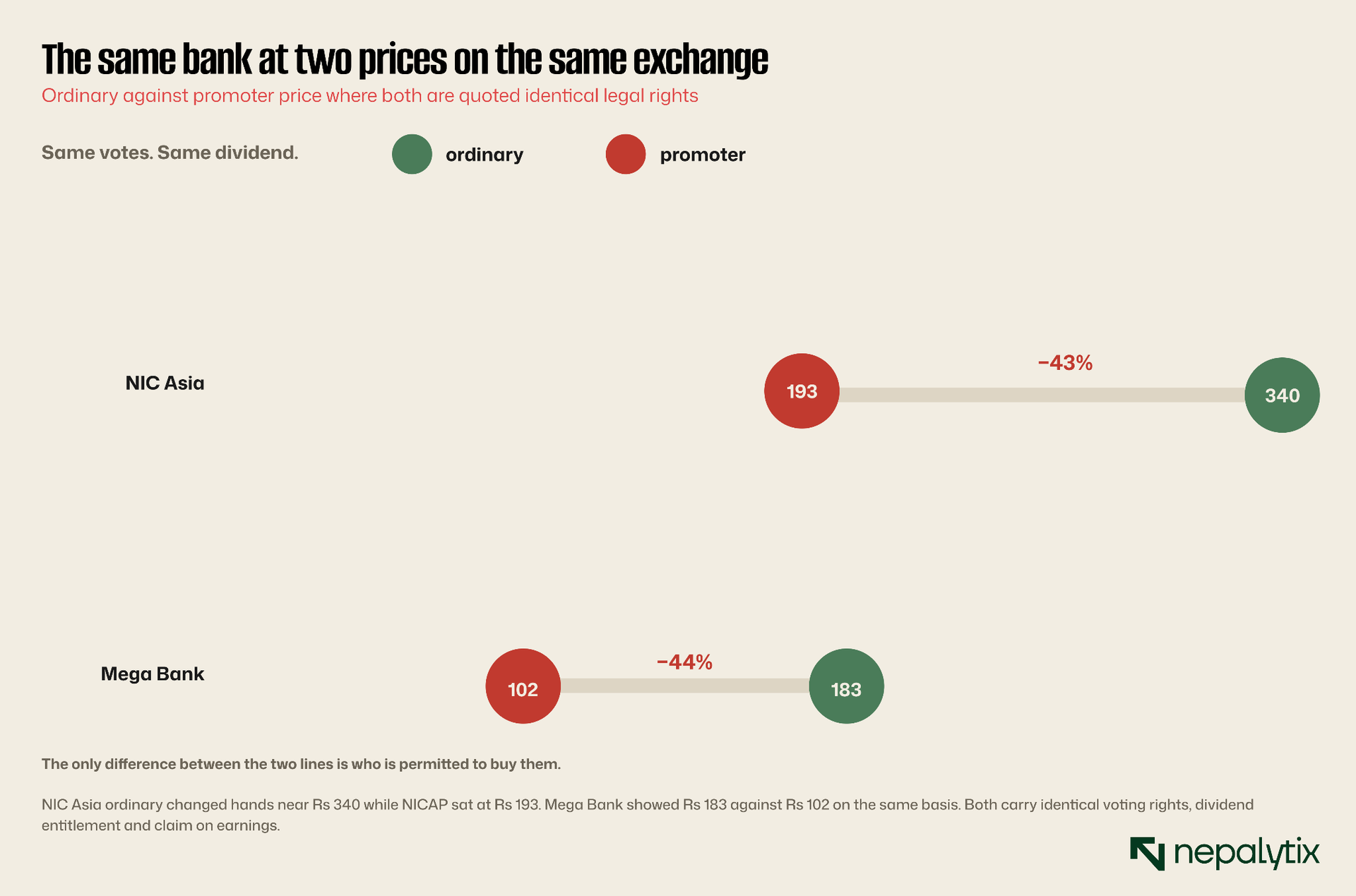
Nothing distinguishes the two lines except who is allowed to stand on the buy side. The discount is a liquidity price, not a value judgement and it is the market's own estimate of what the restriction costs.
A promoter share can only be sold to another qualified promoter, and only after the lock-in period has run. Retail investors cannot buy them. Institutions generally cannot either. The pool of eligible buyers for any given promoter block is small, known and often uninterested.
The discount is therefore a liquidity discount and it is real. It is also not a bargain available to anyone because a buyer who could acquire promoter shares at Rs 193 would inherit precisely the illiquidity that made them cost Rs 193.
Is the discount rational?
Largely, yes and it is worth defending before criticising what is done with it.
An asset you cannot sell for years, to a buyer pool of a few dozen qualified parties, in blocks that may take months to place is genuinely worth less than an identical asset you can sell this afternoon. Liquidity has a price everywhere.
Whether 40% is the right price is harder. In developed markets, discounts for lack of marketability on restricted stock typically run 15% to 30%, and Nepal's restrictions are tighter than most. A 40% discount on a ten-year lock with a 51% floor and a 10% conversion cap is not obviously excessive.
So the promoter price is not irrational and neither is the ordinary price. Both reflect what their respective buyers will pay. The error is in the aggregation.
How does that break the market capitalisation?
Mechanically. NEPSE takes the last traded price of the ordinary share and multiplies it by every share in issue, promoter shares included.
The clearest illustration on the exchange is not a bank.
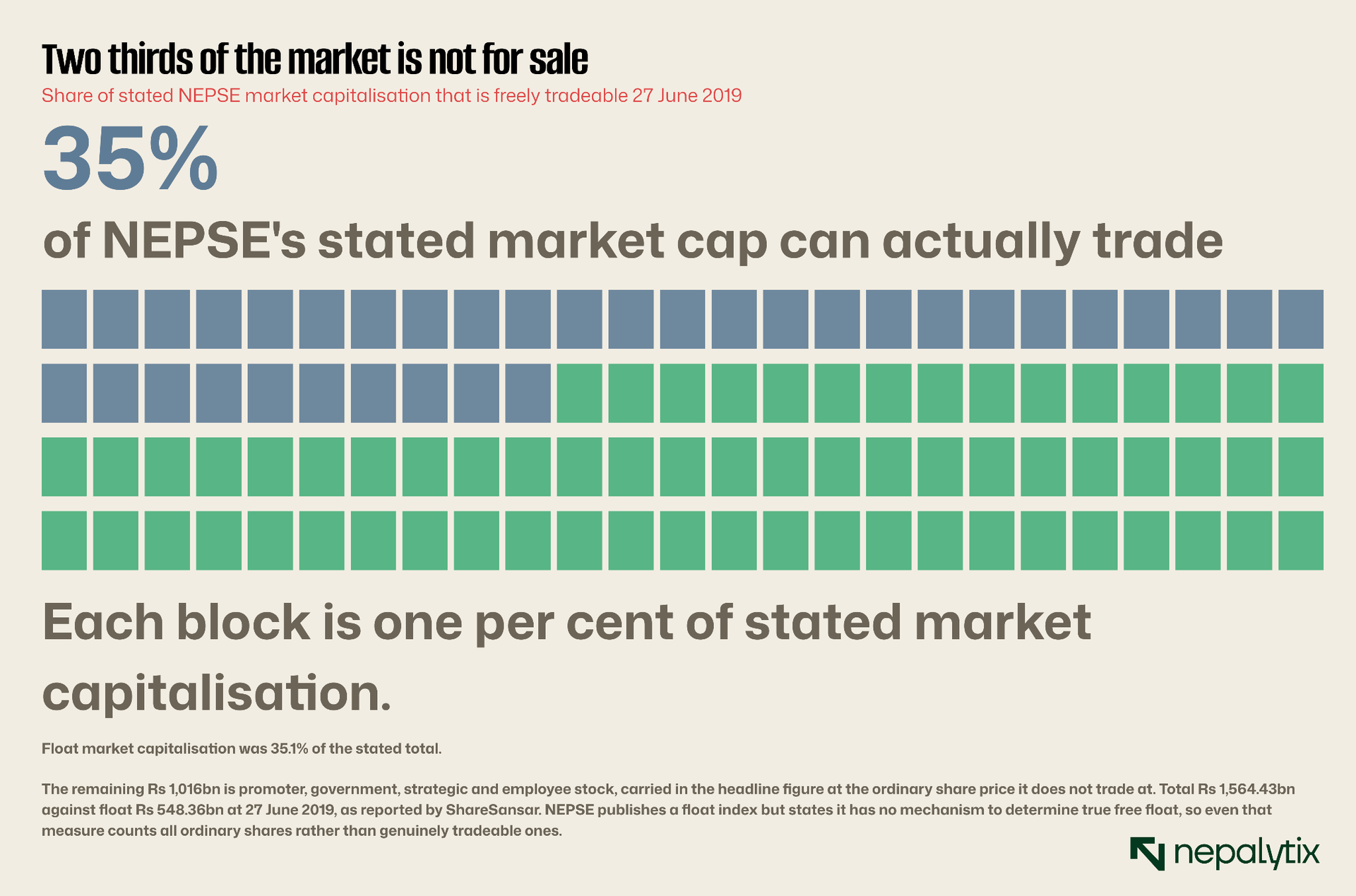
Bishal Bazar Company became the largest listed company on NEPSE in the last fiscal year, at a market capitalisation of Rs 222.88 billion. It achieved that by listing 39.6 million government-owned promoter shares taking the government's stake to 98.96%.
The public holds 1.04%.
Put in share terms: of 40.1 million shares, roughly 417,000 are available to the market. Those 417,000 shares determine the value assigned to the other 39.6 million.
Bishal Bazar's market capitalisation is 40.1 million shares multiplied by Rs 5,532, a price discovered by trading in roughly one share in a hundred. The other ninety-nine are government-held, will not trade and are valued at whatever that one does.
98.96% of Nepal's largest listed company is priced by a market it does not participate in.
Nepal Telecom shows the same shape at national scale. Roughly 91% of its shares are government-held promoter stock. The market capitalisation applies the ordinary price to all of it.
Working one bank through
Take a commercial bank at the statutory floor: 51% promoter, 49% public. Its ordinary share last traded at Rs 400. Its promoter line, at the observed discount is worth about Rs 228.
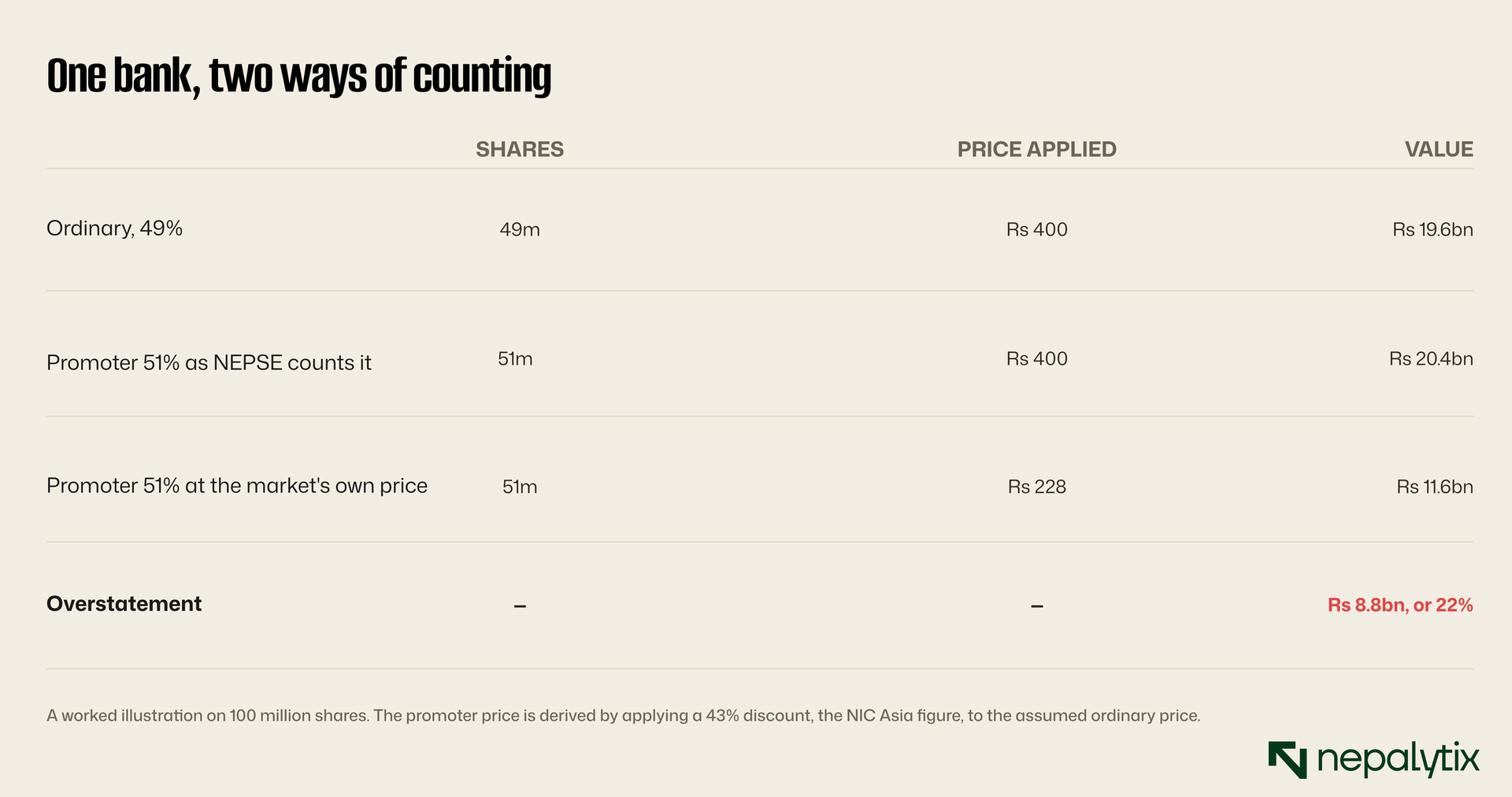
Twenty-two per cent, on a single bank at the legal minimum promoter holding. Banks above the floor and most are, since 51% is a floor rather than a target overstate by more.
Bishal Bazar is the limit case, not the exception
It is tempting to treat a 98.96% promoter company as a curiosity that says nothing about the market. It is the opposite: it is the same mechanism with the dial turned to its maximum which is what makes it useful.
Every listed company on NEPSE with promoter shares has some version of Bishal Bazar's problem. The government-owned trading company has 1.04% of its shares setting the price for 100%. A commercial bank at the floor has 49% setting the price for 100%. The arithmetic is identical; only the ratio differs.
And Bishal Bazar's ascent to largest listed company happened without the business changing at all. Listing existing government shares moved it to the top of the table. Nepal Reinsurance, in second at Rs 169.13 billion was overtaken by an administrative act.
How big is the distortion?
Here we have to be careful, and we are going to be explicit about where the estimate stops being a measurement.
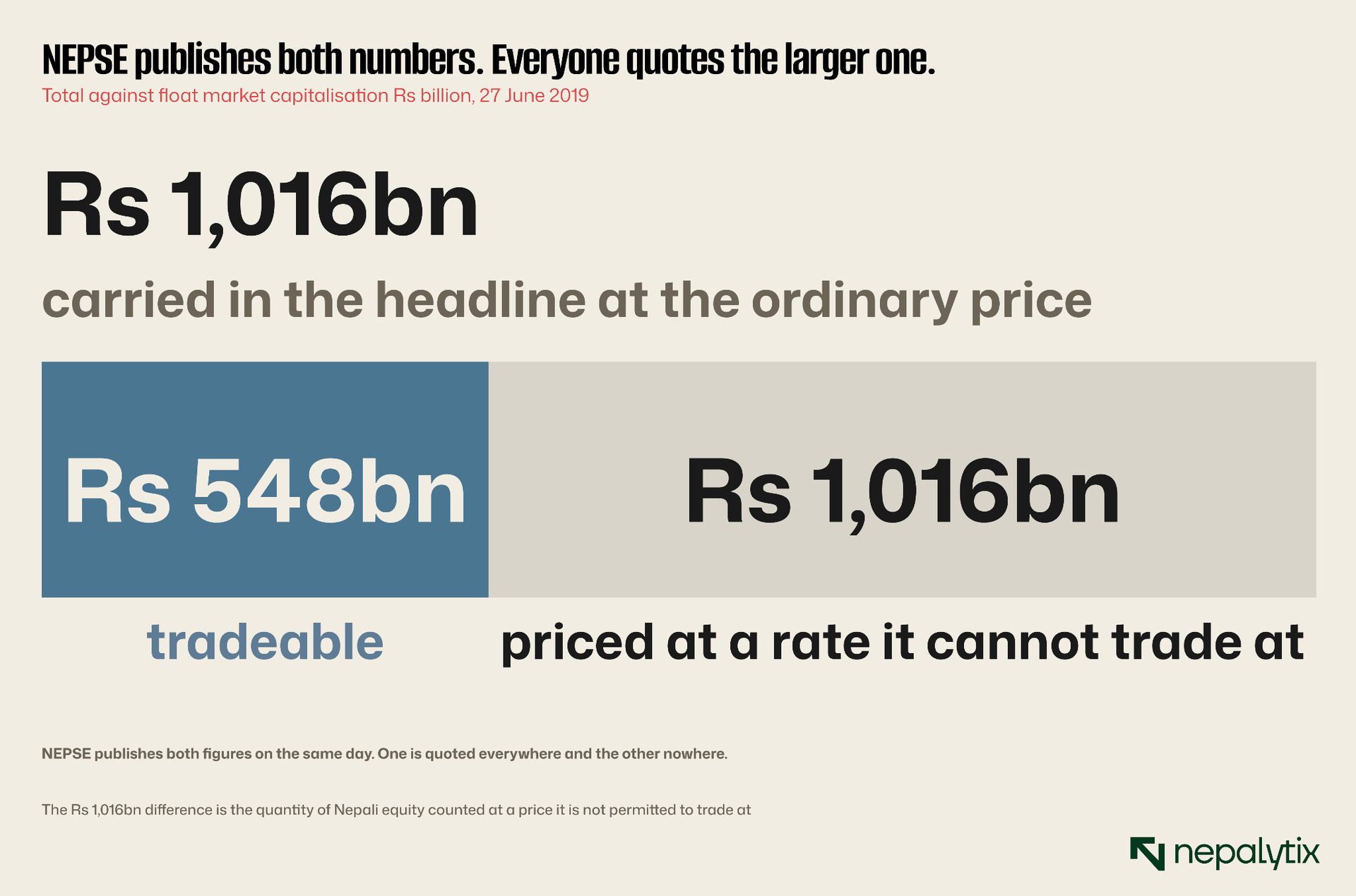
The two figures are published by the same exchange, on the same day. One is quoted in every market report; the other is quoted nowhere. The difference between them Rs 1,016 billion in 2019 is the quantity of Nepali equity counted at a price it is not permitted to trade at.
A bank at the 51% statutory floor with promoter shares at a 43% discount has a stated market capitalisation roughly 22% above what the market's own prices imply.
Apply that logic market-wide at two plausible promoter weightings and the stated Rs 4.66 trillion becomes something between Rs 3.54 trillion and Rs 3.71 trillion, a reduction of 20% to 24%.
We do not claim those are the right numbers. We claim the right number is materially below the stated one, and that nobody publishes it.
To put the scale in context: a 20% overstatement on Rs 4.66 trillion is roughly Rs 950 billion. That is more than twice the entire deposit base of Nepal's cooperative sector and about the size of the combined assets of the three statutory worker funds.
Why the number is a range and not a figure
Two unknowns sit between the worked example above and a market-wide restatement.
The first is the market's aggregate promoter weighting. Every company discloses its own split, but nobody publishes the total. Bishal Bazar is 98.96% promoter. Nepal Telecom is roughly 91%. A commercial bank at the floor is 51%. A company with no statutory requirement may be under 30%. The weighted average across the market is knowable and unknown.
The second is whether 40% is the right discount everywhere. It is the widely reported figure and it matches both pairs we verified but a promoter block in a heavily traded large-cap bank probably trades tighter than one in an illiquid development bank.
Figure 3 therefore brackets rather than measures. The direction is certain, the sign is certain, and the magnitude is an estimate we have labelled as one.
Why does it concentrate in financials?
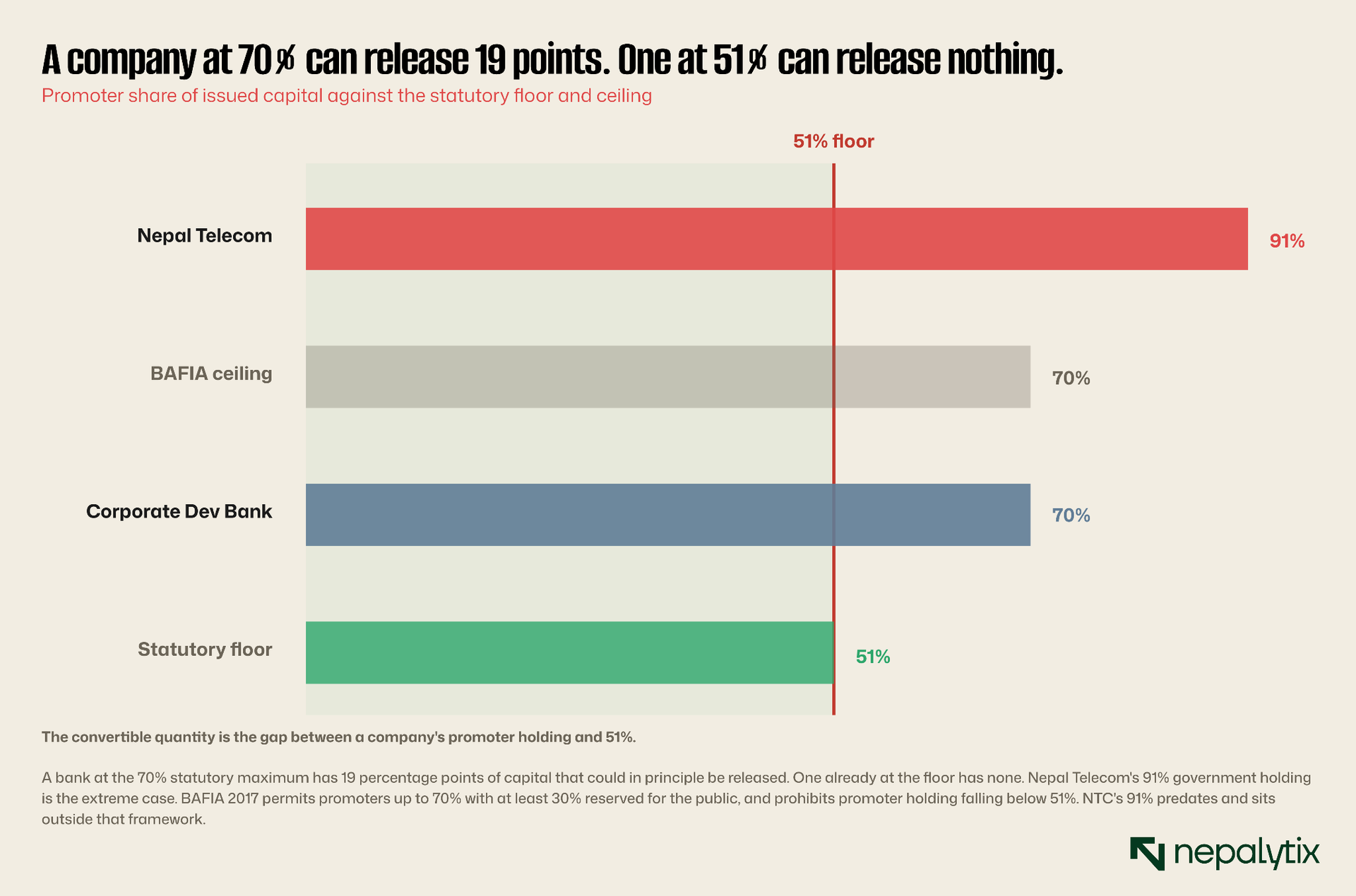
Because the promoter requirement is a banking and insurance rule. Nepal Rastra Bank's position is that promoter lock-in protects depositors by keeping founders committed to institutions entrusted with public money. The Insurance Authority applies a comparable logic.
The insurance sector operates under the Insurance Authority rather than NRB, with a five-year conversion window instead of ten, but the same two-class structure.
Manufacturing companies, hotels and trading companies carry no equivalent statutory promoter minimum. So the distortion is concentrated in exactly the sectors that account for over 60% of NEPSE's market capitalisation.
The counter-argument which is real
NEPSE's defence has been made publicly and deserves stating.
Some promoter shares do not trade for days, weeks or months. Using the last traded promoter price would mean valuing a large block on a stale quote that may be entirely disconnected from current conditions. A price from three months ago is not obviously better than a current ordinary price.
That is a genuine problem and it has no clean answer. But there are worse and better responses to it. Publishing only the ordinary-price figure is one response. Publishing both, with the staleness disclosed, is another. Publishing a float-based series that excludes promoter shares entirely is a third.
Nepal has the third in principle, the float index and does not use it as the headline measure. The market quotes the total capitalisation figure and so does everyone reporting on it.
What NEPSE would have to do
Very little, mechanically. Both price lines are already in the exchange's own trading system. Both share counts are in its own listing records. The adjusted figure is a different multiplication of numbers NEPSE holds.
The genuine work is deciding the convention for stale promoter prices: last traded, a rolling average or a haircut applied to the ordinary price where no recent trade exists. Any of the three is defensible if disclosed.
Why does this matter beyond arithmetic?
Because market capitalisation is a denominator and four widely used measures sit on top of it.
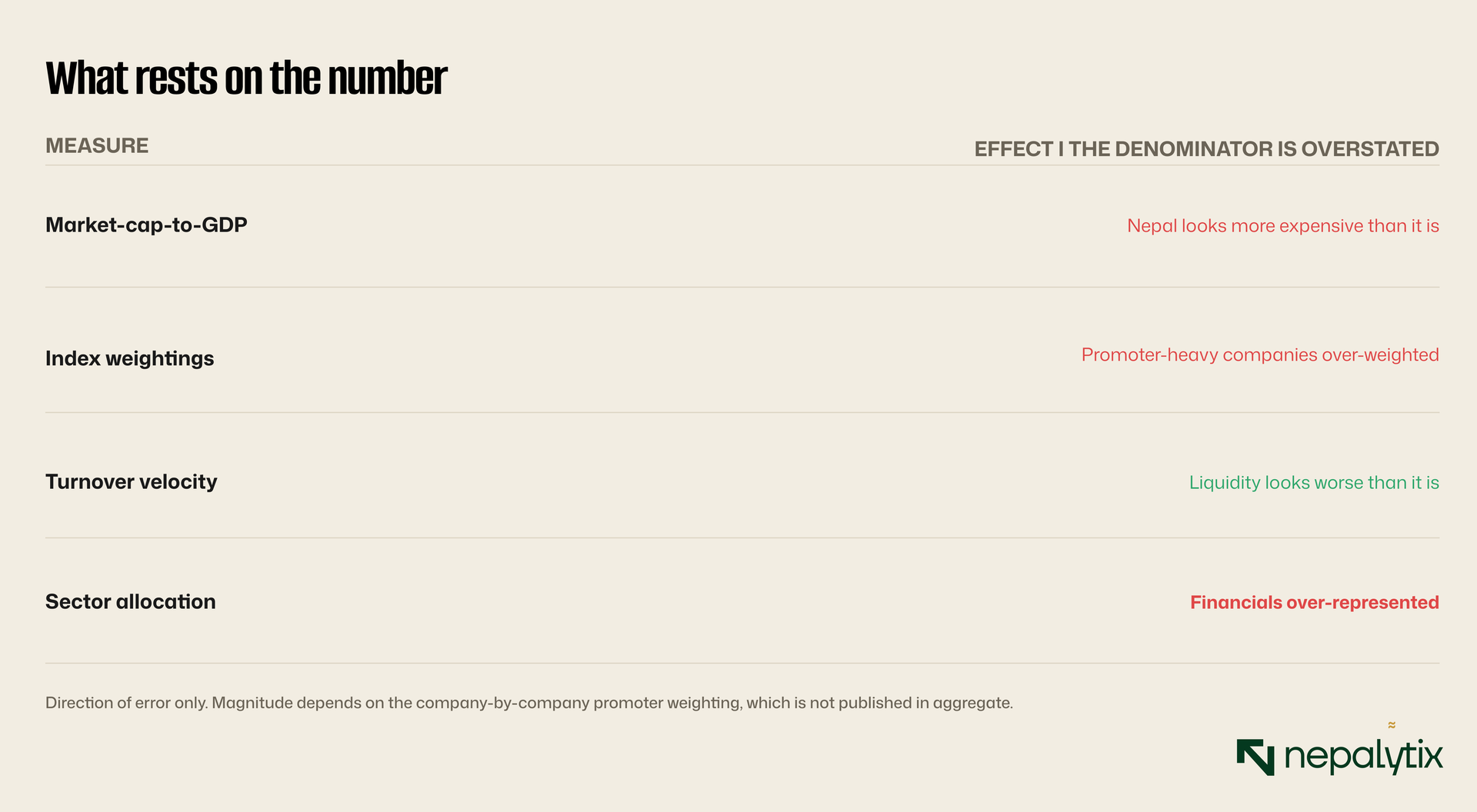
The index-weighting consequence
Of the four measures above, index weighting is the one with the most direct effect on money.
NEPSE's main index is market-capitalisation weighted so the largest companies by stated capitalisation carry the greatest weight. Published analysis has noted that a handful of names: Nepal Telecom, Nabil and Standard Chartered among them have historically accounted for around a third of the market by capitalisation and that commercial banks, development banks and finance companies together approach 70%.
Nepal Telecom is roughly 91% promoter-held. Its index weight is therefore built substantially on shares valued at a price they do not trade at.
Any fund tracking the index inherits that weighting. Any comparison of sector performance inherits it. And any statement that "financials are 60% of the market" is a statement about a measure that overstates financials specifically, because financials are where the promoter requirement applies.
What the float index does and does not fix
NEPSE introduced a float index on 15 September 2008 precisely to address this. It was a good idea and it is incompletely executed.
The float index excludes promoter holdings, government holdings, strategic holdings and locked-in employee shares and counts only what is available to the public. That solves the share-count half of the problem.
What it does not solve is the price half, and there is a second limitation. NEPSE has not established a mechanism to determine genuine free float within the public shares, so the float index takes the ordinary shares of all listed companies rather than the shares actually available to trade. A public share held by a long-term holder who never sells is counted as float.
So Nepal has one series that counts the wrong shares at the right price and another that counts a better set of shares, still at a price that ignores the promoter line entirely. Neither is a promoter-adjusted capitalisation and the market quotes neither as its headline.
A note on staleness since it cuts both ways
NEPSE's objection that promoter prices go stale is worth testing against the alternative rather than accepted as decisive.
A promoter share that last traded three months ago carries a price from three months ago. Applying it today misstates by whatever the market has done since.
But applying the ordinary price to that same share misstates by the entire liquidity discount, roughly 40%, every single day. The stale-price error is bounded by market movement over the gap. The ordinary-price error is structural and permanent.
Between an estimate that is occasionally wrong by a few per cent and one that is always wrong by forty, the case for the first is not close. And the objection disappears entirely for the float-adjusted approach which simply excludes the shares rather than pricing them.
What is actually happening right now?
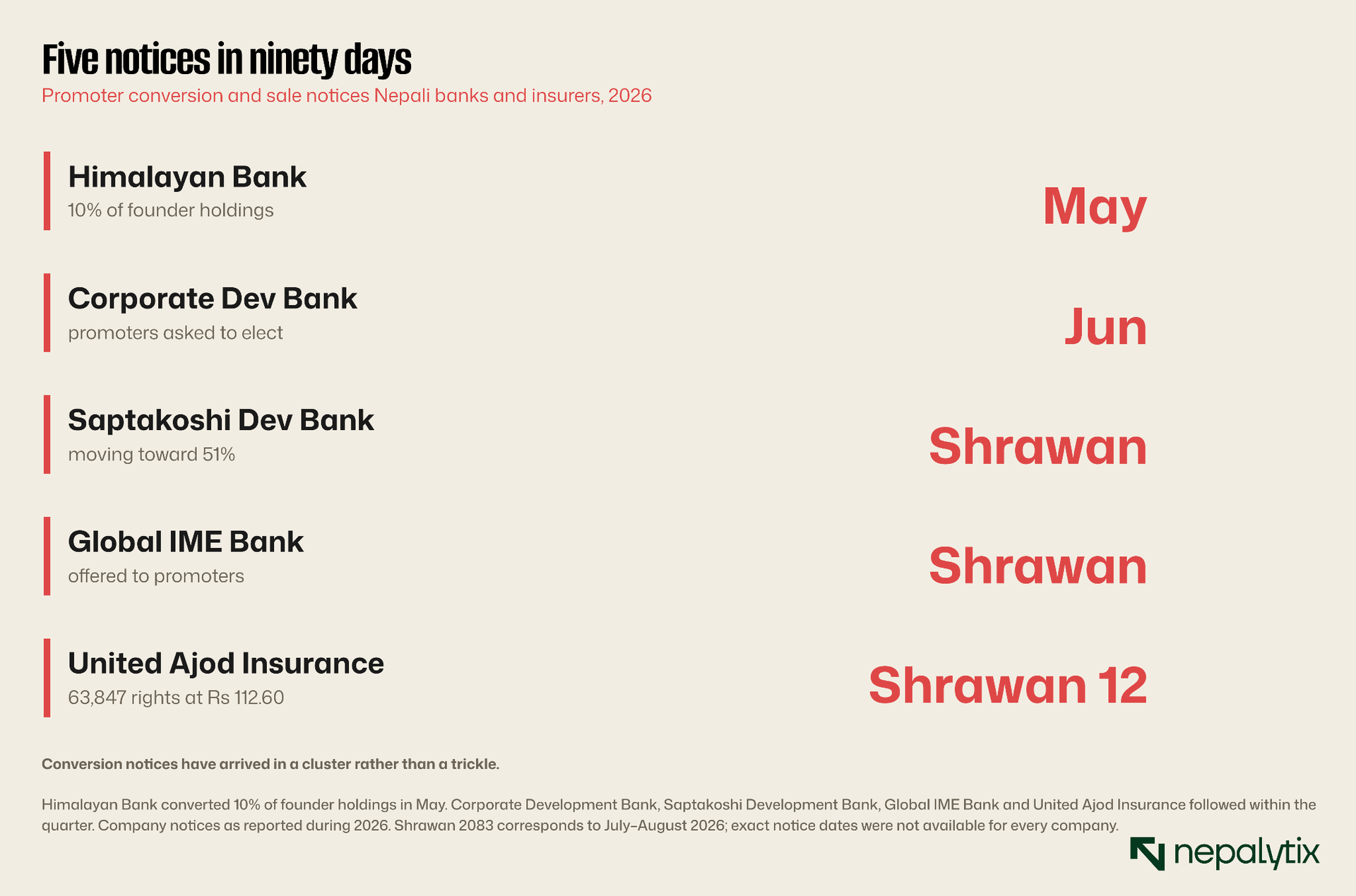
Five notices inside one quarter, across three commercial banks, a development bank and an insurer. Conversions have arrived in a cluster rather than a trickle which is what you would expect if the constraint were the ten-year clock rather than any company's individual circumstances.
Five conversion or promoter-sale notices in roughly ninety days, across a commercial bank, a development bank, an insurer and two others.
Himalayan Bank converted 10% of founder holdings in May. Corporate Development Bank, sitting at 70:30, asked promoters to elect in June. Saptakoshi is moving to the 51% floor, Global IME issued a promoter sale notice, and United Ajod distributed unsold promoter rights at Rs 112.60 all in Shrawan.
Each one moves shares from the illiquid class to the liquid class. Each one therefore adds float at a price the market currently discounts by around 40% and each one is a small live test of what happens when that discount has to be resolved.
What conversion does to a share price
The mechanics are worth following because they explain the pace.
When a promoter share converts, nothing about the company changes. No capital is raised, no assets move, earnings per share is unaffected. What changes is that a share which could previously be sold only to a qualified promoter can now be sold to anyone.
Two things follow. The converted share should re-rate upward toward the ordinary price, since its illiquidity discount no longer applies. And the ordinary line faces new supply, since there are now more shares that can reach the market.
For the converting promoter that is straightforwardly good: an asset worth Rs 228 becomes worth something closer to Rs 400. For existing ordinary shareholders it is dilutive in the liquidity sense, no new shares exist but more of the existing ones can now be sold to them.
Which is why the 10% cap exists, and why it will not be relaxed quickly. A bank converting its full promoter block at once would roughly double the tradeable float in a market whose weekly turnover is already running at a third of its 2024 velocity.
The insurance exception
Insurance companies may convert after five years rather than ten. The rationale is presumably that an insurer's failure mode is slower and better collateralised than a bank run, so the lock-in can be shorter.
Whatever the reasoning, it means the insurance sector will resolve its promoter overhang sooner than banking. United Ajod's distribution of 63,847 unsold promoter rights at Rs 112.60 in Shrawan is an early example, and insurers are worth watching as the leading indicator for what conversion does to a price.
Why is it only ten per cent at a time?
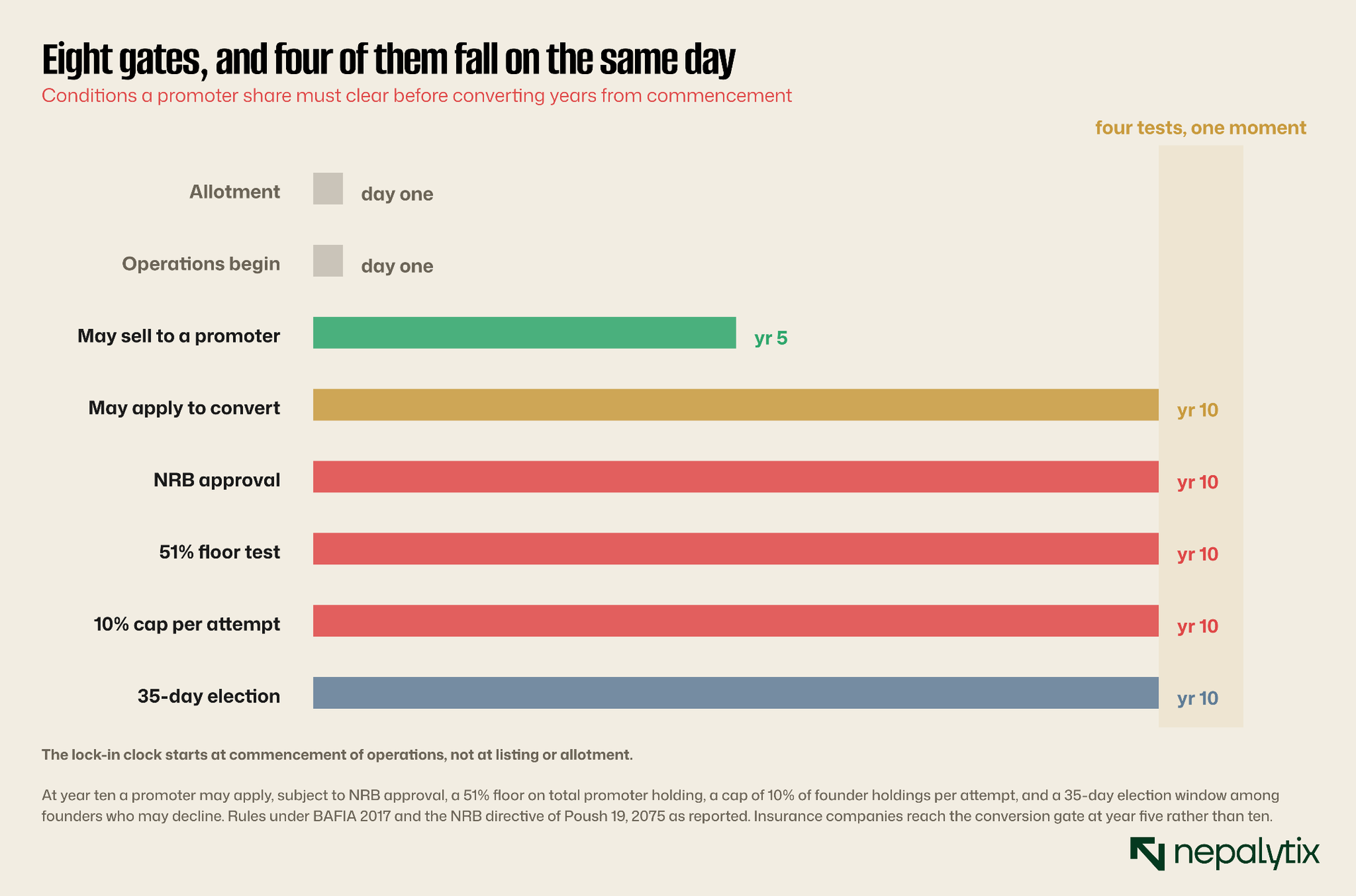
Four of the eight conditions bind at the same moment. A promoter who has waited a decade still needs NRB's approval, a company that stays above 51% afterwards, a conversion no larger than a tenth of founder holdings, and the outcome of a 35-day election among founders who may simply decline. The clock is the easy part.
Because the rules are designed to release supply slowly, and because releasing it quickly would move prices.
A promoter may sell to another qualified promoter after five years of operations. Conversion to ordinary requires ten years and NRB approval, five for insurance companies. Promoter holding may never fall below 51%. Any single conversion is capped at 10% of total founder holdings, and founders must be given a 35-day window to elect.
The unstated reason: Conversion adds tradeable supply. Supply pressures price. Doing it at 10% a time, with a 51% floor, is a managed release rather than a market event which is sensible, and is also why the discount will persist for years.
So the answer to "why not simply have one class of shares" is that the transition has a cost and the cost falls on the share price at exactly the moment it is released.
The conversion is not free money either
A promoter holding shares worth Rs 228 that could become worth Rs 400 on conversion is looking at a substantial gain, which raises the question of why conversions are not universal.
Several reasons. Conversion requires NRB approval which is not automatic. It is capped at 10% of holdings, so the gain is realised slowly. The 51% floor means a majority of the block can never convert while the institution remains under the promoter requirement. And converting means giving up the control position that promoter status confers.
For a founding family that regards the bank as a long-term holding, the illiquidity discount is not a cost they are paying, it is a price they never intend to realise. Conversion matters to promoters who want out and those are a subset.
Which is another reason the discount persists. The people who could close it mostly do not want to.
Should promoter shares exist at all?
The prudential argument is the one NRB makes: banks are entrusted with public deposits, and founders who cannot exit quickly have a reason to run them properly. That is a real argument and it is why nearly every banking system restricts founder stock in some way.
The counter-argument has three parts.
The lock-in has a fixed term so its protective value expires while the two-class structure does not. A bank twenty-five years into operations retains a promoter block that no longer serves the purpose the lock was written for.
The restriction applies to a class of share rather than to individuals. A promoter who sells to another promoter has exited entirely; the commitment the rule was meant to secure has transferred to someone who bought at a discount, not someone with founding skin in the game.
And Nepal already has stronger tools for the same objective. Fit-and-proper testing, capital adequacy, prompt corrective action, the framework applied to five microfinance institutions in June and NRB's supervisory powers all bear directly on whether an institution is soundly run. Those do the work the lock-in was invented to do, and they do it continuously rather than for a fixed decade.
On balance we think the case for a defined sunset is strong, and the case for abolishing the class immediately is not because the supply shock would fall on a market already short of liquidity.
Is this only a banking problem?
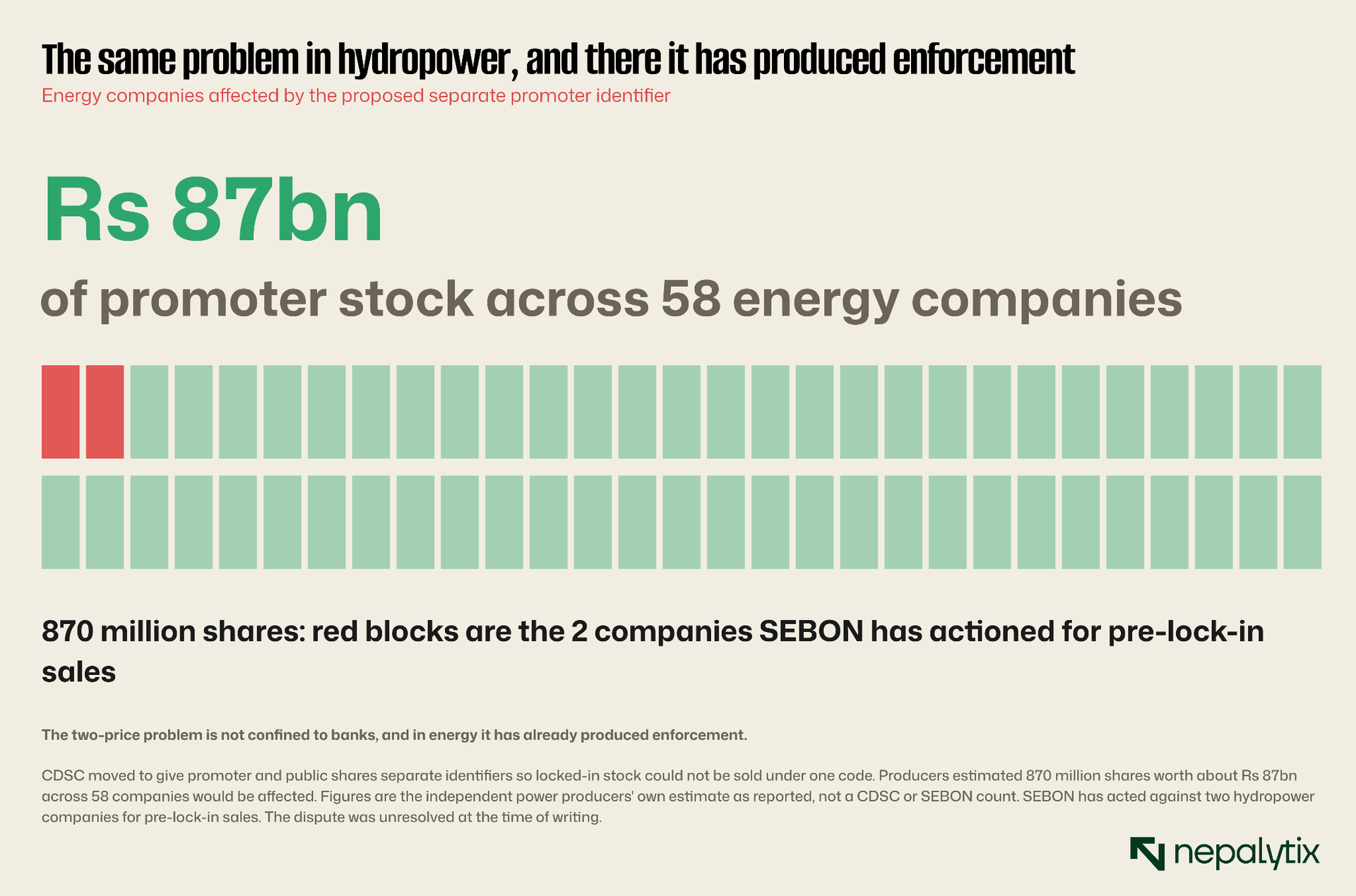
Two of those fifty-eight companies have already been actioned by SEBON for selling promoter stock before its lock-in expired. That is precisely what a single shared identifier permits, and it is the practical case for separating the codes.
No. In early 2026 the Central Depository System and Clearing moved to give promoter and public shares separate ISINs so that locked-in promoter stock could not be sold under a single identifier.
Independent power producers estimated the change would affect roughly 870 million shares worth about Rs 87 billion across 58 energy companies. SEBON has taken action against two hydropower companies for pre-lock-in sales.
That figure tells you how much value is parked in promoter shares waiting for a clean route out, in one sector alone.
It also reframes the problem. The dual-ISIN dispute is not about valuation at all, it is an enforcement measure, prompted by promoter stock being sold before its lock-in expired. Two hydropower companies have already been actioned.
So there are two independent reasons to separate the classes properly: the market capitalisation is wrong, and the single identifier makes the lock-in difficult to police. The second is the one that has produced regulatory action.
What a proper screen would show
The work this piece could not do is worth specifying because it is the obvious next step and somebody should do it.
Every dual-listed company on NEPSE has two price lines published daily. Every company discloses its promoter and public share split in its quarterly report. Combining the two gives, for each company, a stated market capitalisation and an adjusted one.
Aggregating that across the market produces the number this piece has had to approximate. It would also produce a ranking which companies are most overstated and that ranking would be genuinely useful because it identifies where index weightings are most distorted.
Our estimate is that the exercise requires a few hundred data points and a day of work. We flag it as an open item rather than pretend the illustration in Figure 3 substitutes for it.
What the wave is actually telling you
Five notices in ninety days is not a policy shift. Nobody has changed the rules. What changed is that a cohort of institutions crossed the ten-year threshold at roughly the same time because they were licensed at roughly the same time during Nepal's banking expansion.
That has a consequence worth sitting with. The wave is demographic rather than deliberate, which means it will continue as successive cohorts reach their thresholds and it will do so regardless of market conditions.
Conversion supply is therefore going to arrive in a market with turnover velocity at a third of its 2024 level, over the next several years because a licensing decision made a decade ago says so.
What should change?
Publish a promoter-adjusted market capitalisation. NEPSE already computes a float index, introduced on 15 September 2008. But that index uses the ordinary shares of all listed companies rather than genuine free float so it corrects the share count and not the price. A second series applying the last traded promoter price to promoter shares would take a day to build and would give Nepal an honest capitalisation figure for the first time.
Publish the promoter weighting by company. The reason this piece offers a range rather than a number is that no aggregate promoter weighting is published. It is knowable every company discloses its own split and nobody has assembled it.
Set a horizon for one class of shares. The prudential argument for promoter lock-in is strongest in year one and weakest in year twenty-five. A published timetable would let the market price the transition rather than guess at it.
How other markets handle it
The comparison worth making is not to sophisticated exchanges but to the general practice on restricted stock.
In most markets, founder or restricted shares are simply not listed until the restriction lapses. They exist on the register, they carry rights, and they have no quoted price. Index providers then use free-float-adjusted capitalisation as standard: MSCI, FTSE and S&P all weight by float rather than total shares, precisely because total shares include stock that cannot trade.
Nepal does something unusual in two ways: it lists the restricted class and it weights by total shares rather than float. Either alone would be manageable. Together they produce a headline number that is both prominent and wrong in a knowable direction.
The fix that most markets converged on float weighting already exists here as a secondary index. Making it the primary measure is not an innovation. It is catching up.
Where this leaves the Rs 4.66 trillion figure
It should still be published and it should be published alongside something else.
The stated capitalisation is not meaningless. It is a consistent series with a long history, computed the same way every day, and for measuring change over time that consistency matters more than the level. A series that is 20% high every day still shows you accurately when the market moves.
Where it fails is in cross-sectional and cross-country comparison. Nepal's market-cap-to-GDP against India's is comparing a total-share measure to a float-adjusted one. A sector weight computed on the Nepali basis is not comparable to the same sector's weight anywhere else.
So the recommendation is additive rather than corrective: keep the series, publish a promoter-adjusted companion, and use the companion for anything comparative.
What we could not establish
Three things, and they bound everything above.
We verified only two promoter-ordinary price pairs to a published source. The 40% figure is widely reported and consistent with both, but a proper screen across every dual-listed company on NEPSE would require pulling both price lines for each ticker and we did not have access to do that. Figure 1 is an illustration, not a census.
We could not obtain an aggregate promoter weighting for the market which is why Figure 3 offers two scenarios rather than a restated number.
And we could not establish whether NEPSE has any internal adjusted series it does not publish.
Three questions, answered plainly
Is NEPSE doing something wrong?
No. It is applying a consistent, disclosed method. The method has a known limitation that NEPSE itself has acknowledged in the past, some promoter shares do not trade for weeks so using a stale price has its own distortion. The criticism is that no adjusted series is published alongside.
Does this mean Nepali shares are overvalued?
Not individually. An ordinary share's price is discovered by people trading ordinary shares and that price is real. What is overstated is the aggregate and every ratio computed from it.
Should an investor do anything differently?
Treat market-cap-to-GDP and any aggregate valuation measure for Nepal as directionally useful and numerically unreliable. When comparing a company's market capitalisation to peers, check the promoter weighting first, a 98.96% promoter company and a 51% promoter company are not measured on the same basis.
Disclaimer
This report has been prepared by Nepalytix for informational and educational purposes only and does not constitute investment advice, an offer, or a solicitation to buy or sell any securities.
The information contained in this report is based on sources believed to be reliable; however, Nepalytix does not guarantee its accuracy, completeness, or timeliness. Opinions, estimates, and projections expressed herein are those of the authors as of the date of publication and are subject to change without notice.
Investing in securities involves risks, including the possible loss of principal. Past performance is not indicative of future results. Readers are advised to conduct their own independent research and consult with a qualified financial advisor before making any investment decisions.
Nepalytix and its contributors may hold positions in the securities discussed in this report at the time of publication or thereafter.
Neither Nepalytix nor any of its affiliates accept any liability for any loss arising from the use of this report or its contents.