NRB has put five microfinance companies on notice
NRB has placed five microfinance companies under prompt corrective action but its own data points to a wider problem: 17 institutions are at or near the capital threshold while sector NPLs have surged to 11.32%.
The announcement named five. The supervisory data behind it counts seventeen at or near the capital floor, and sector bad loans have risen more than four points in three quarters.
The Signal
Nepal's microfinance sector is running the mirror image of the problem in commercial banking, and it is the more urgent of the two.
Commercial banks hold Rs 1.56 trillion they cannot lend because nobody is borrowing. Microfinance institutions face borrower demand that NRB itself describes as significant, and cannot lend because their capital has fallen below the regulatory minimum.
Five institutions were named in June. By NRB's mid-April data, eight were already under prompt corrective action and seventeen were under action or close to the threshold. The cause is asset quality: retail microfinance non-performing loans reached 11.32%, up from 7.00% at the close of the prior fiscal year.
Capital adequacy ratios are as reported by NRB with as-at dates between mid-July and mid-October 2025. Sector NPL and the count of institutions at risk are for the quarter to mid-April 2026.
Five institutions, all below the floor
Nepal Rastra Bank's Microfinance Institution Supervision Department conducted inspections during the third quarter of the current fiscal year. Five institutions were placed under prompt corrective action under Regulation 3(a) of the Prompt Corrective Action Bylaws, 2017, for failing to maintain the minimum capital adequacy ratio.
NRB requires microfinance institutions to hold a minimum capital adequacy ratio of 8% and Tier 1 capital of at least 4%.
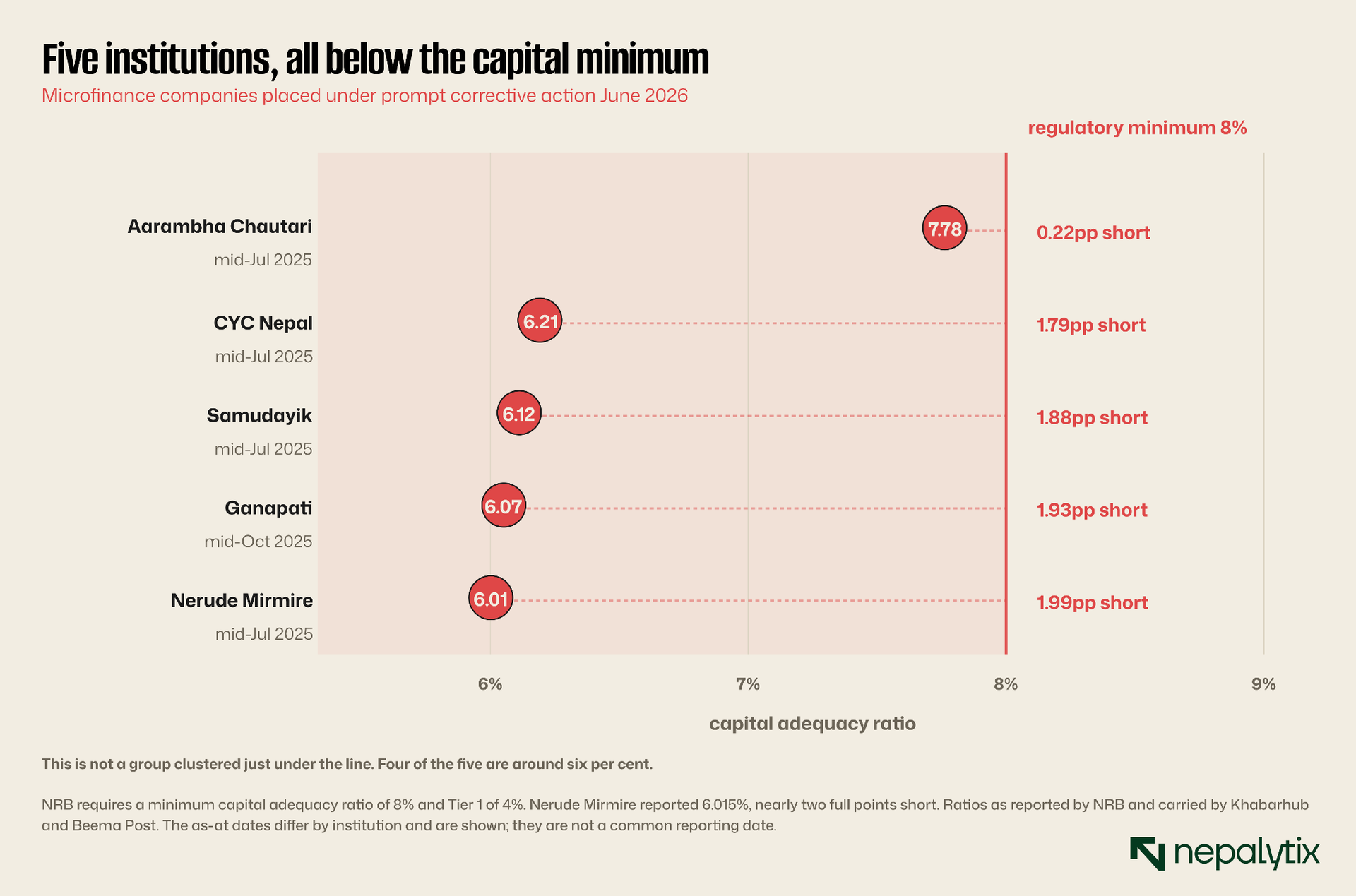
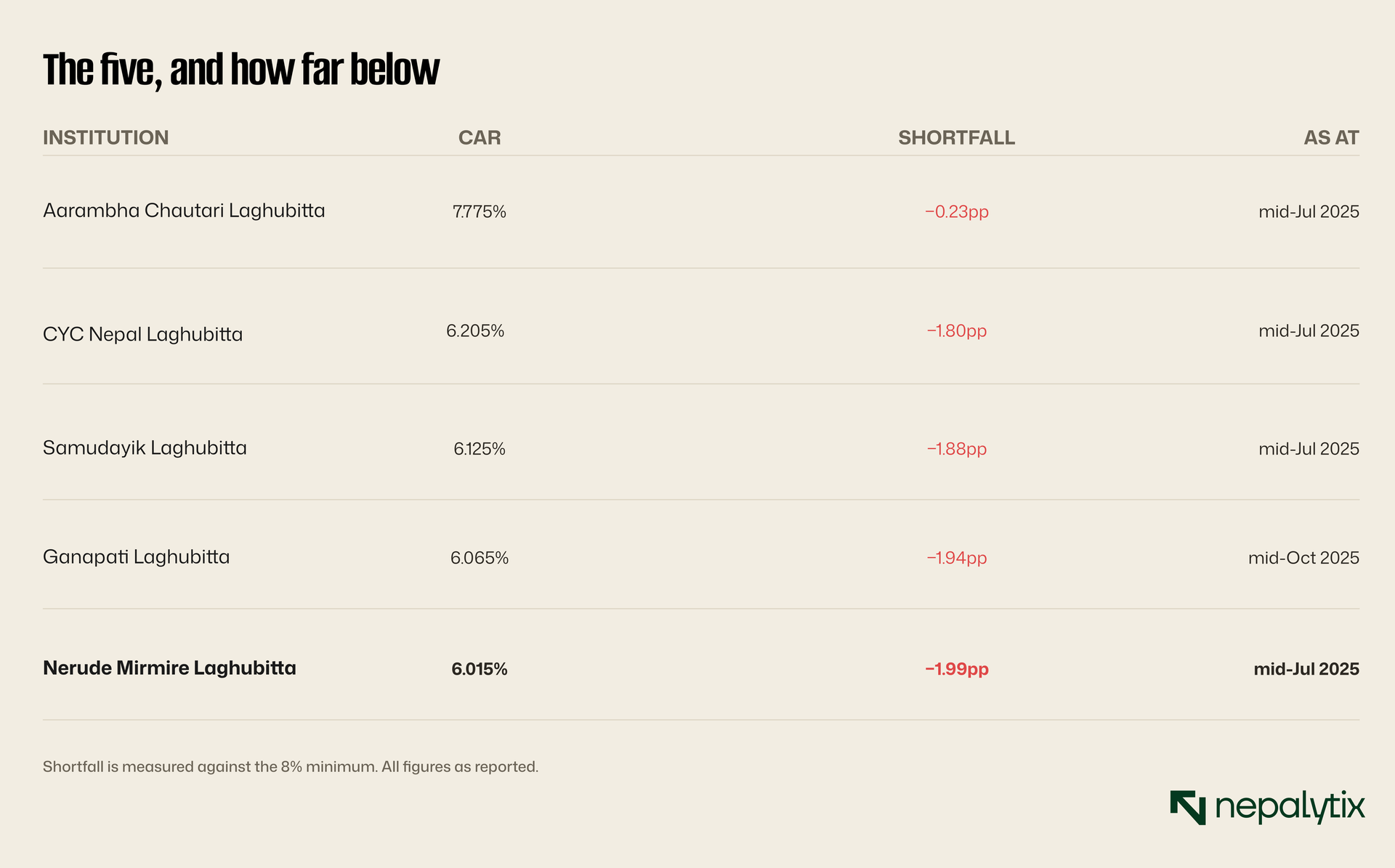
Aarambha Chautari at 7.775% is the closest to compliance, a little over two-tenths of a point short. The other four are between 1.80 and 1.99 points below.
The distribution matters. This is not a group clustered just under the line, where a single good quarter would resolve the position. Four of the five sit around six per cent, close to two full points below the minimum, and one of those readings dates from mid-October 2025.
Five was the announcement and seventeen are under action
The June action was reported as five institutions. NRB's own supervisory data for the quarter ending mid-April 2026 describes something wider.
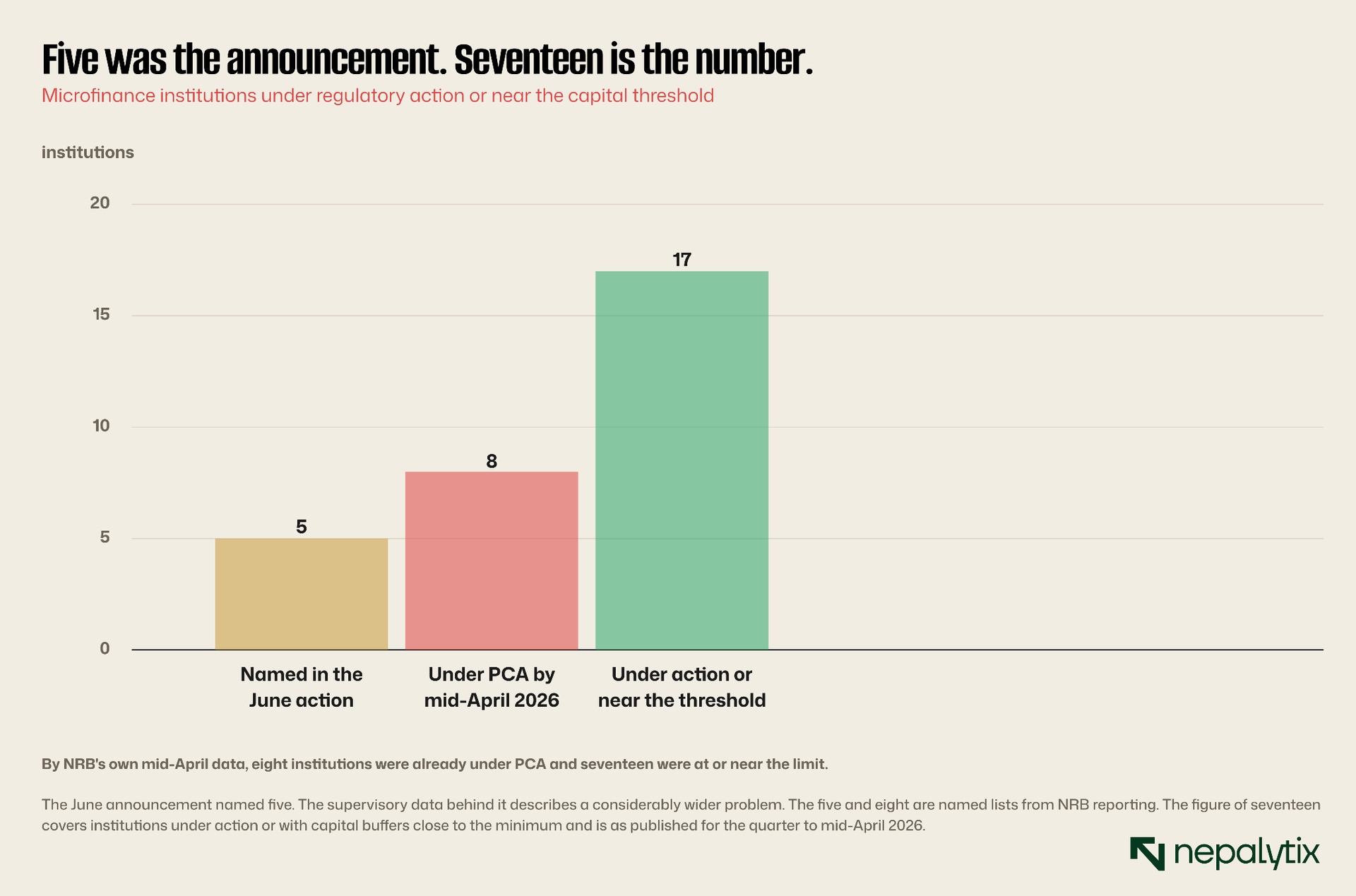
By that data, eight institutions had already been placed under the PCA framework: Nerude Mirmire, Forward, Samudayik, Nadep, Aarambha Chautari, Ganapati, CYC Nepal and Abhiyan.
And seventeen were either under regulatory action or operating with capital buffers close to the minimum threshold.
Three of the eight were not in the June announcement. Forward, Nadep and Abhiyan appear on the mid-April list and not in the June reporting, which means either that they were added separately or that the June announcement covered only the institutions caught in that particular inspection round.
Either reading points the same way. The five named were a subset, not the population, and the gap between what was announced and what the supervisory data shows is the reason this story has been under-read.
Why the reporting dates matter
One feature of this action deserves attention before moving on. The ratios that triggered it date from mid-July 2025 for four institutions and mid-October 2025 for the fifth. The action was taken in late June 2026.
That is a gap of eight to eleven months between the reported position and the regulatory response. Some of that is inspection cycle, NRB's supervision department works to a schedule and the findings emerged from third-quarter inspections. But it means the ratios in Figure 1 describe where these institutions stood roughly a year ago.
Given that sector NPL rose more than four points over broadly the same period, the current positions are unlikely to be better than the ones that triggered the action. Nobody outside the institutions and the regulator knows how much worse.
The cause is asset quality and it moved fast
Capital ratios do not fall on their own. They fall because losses eat capital or because risk-weighted assets grow faster than capital does. In this case it is the first.
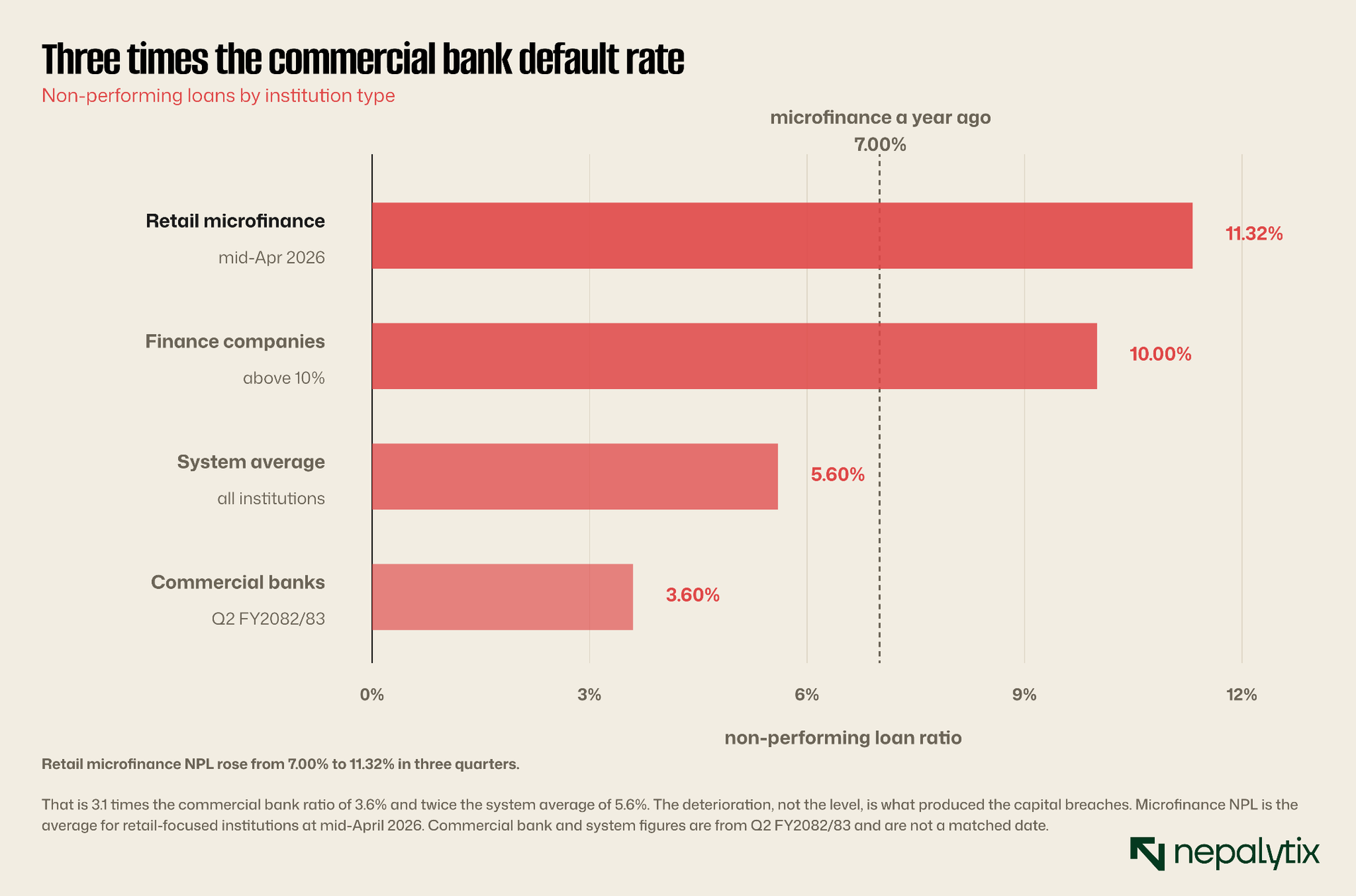
The average non-performing loan ratio among retail-focused microfinance institutions reached 11.32% by mid-April 2026, having risen 4.32 percentage points from the close of the previous fiscal year.
That is a move from roughly 7.00% to 11.32% in three quarters. For comparison, commercial banks sit at 3.6% and the system average at 5.6%.
Microfinance is therefore defaulting at roughly three times the commercial bank rate, and the deterioration is recent and rapid rather than a long-standing structural level.
A four-point rise in bad loans over three quarters is not a credit cycle. It is a break.
The speed is what produced the capital breaches. An institution operating at 9% capital adequacy with a 7% NPL ratio has a manageable position. The same institution at an 11.3% NPL ratio, after provisioning against the difference, does not.
What prompt corrective action actually does
PCA is frequently reported as a warning. It is considerably more than that.
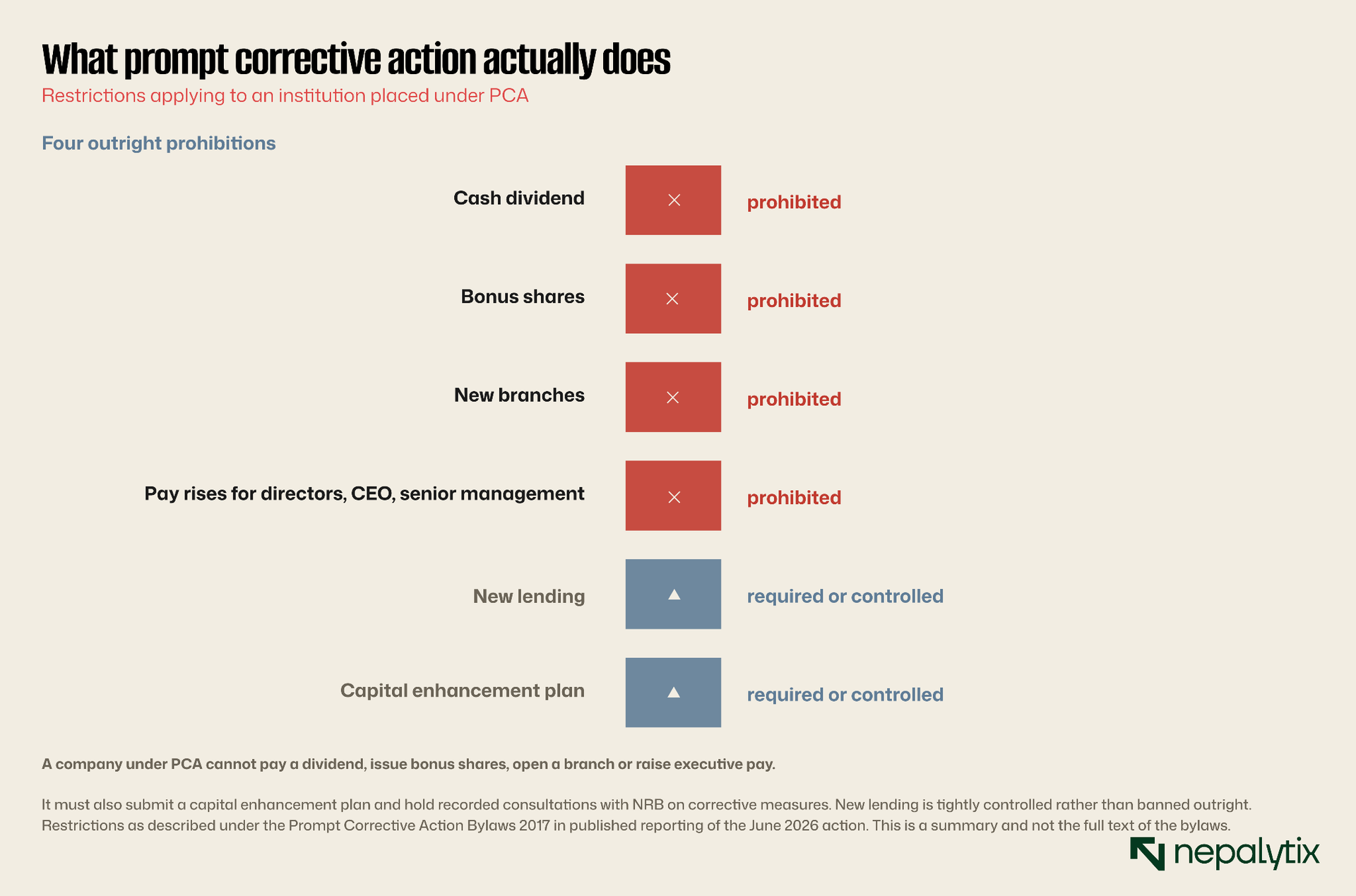
An institution placed under PCA may not declare a cash dividend. It may not issue bonus shares. It may not open new branches. It may not increase the salaries, allowances or other benefits of its directors, chief executive or senior management.
It must submit a capital enhancement plan, and NRB will hold recorded consultations with senior management on corrective measures.
For a listed microfinance company, the dividend prohibition is the immediate consequence. Nepali retail investors in this sector hold substantially for the bonus and cash dividend, and an institution under PCA cannot pay either until it restores its capital position.
Why the dividend ban compounds the problem
A microfinance institution below the capital floor needs to raise capital. The cheapest route is retained earnings, which the dividend ban helpfully preserves.
The alternative is a rights issue. But a company under PCA, prohibited from paying dividends, with an NPL ratio above 11% and a share price reflecting all of that, is asking existing shareholders for money on unattractive terms.
The restriction is correct prudentially and it narrows the routes out. That is the tension inside every PCA framework and it is why the escalation ladder exists.
What the borrower experiences
There is a consequence of all this that does not appear in any ratio, and it falls on people who have no idea any of it is happening.
A microfinance borrower in Nepal is typically a member of a group, often a woman, borrowing small sums for working capital in agriculture, livestock or petty trade. The relationship runs on repeat lending: repay this cycle, borrow the next, slightly larger.
An institution under PCA cannot open branches and faces tight controls on fresh lending. For its borrowers, that means the next cycle may not come and it will not come for reasons entirely unconnected to their own repayment record.
NRB's assessment describes credit demand in the sector as remaining significant. What has been curtailed is the ability to meet it. The seventeen institutions at or near the floor collectively serve a borrower base that has done nothing wrong and is about to find credit harder to obtain.
That is the real cost of the deterioration, and it is why the speed of the NPL rise matters more than the level.
Stage one of four
The five named in June are on the bottom rung of a structure that does not end there.
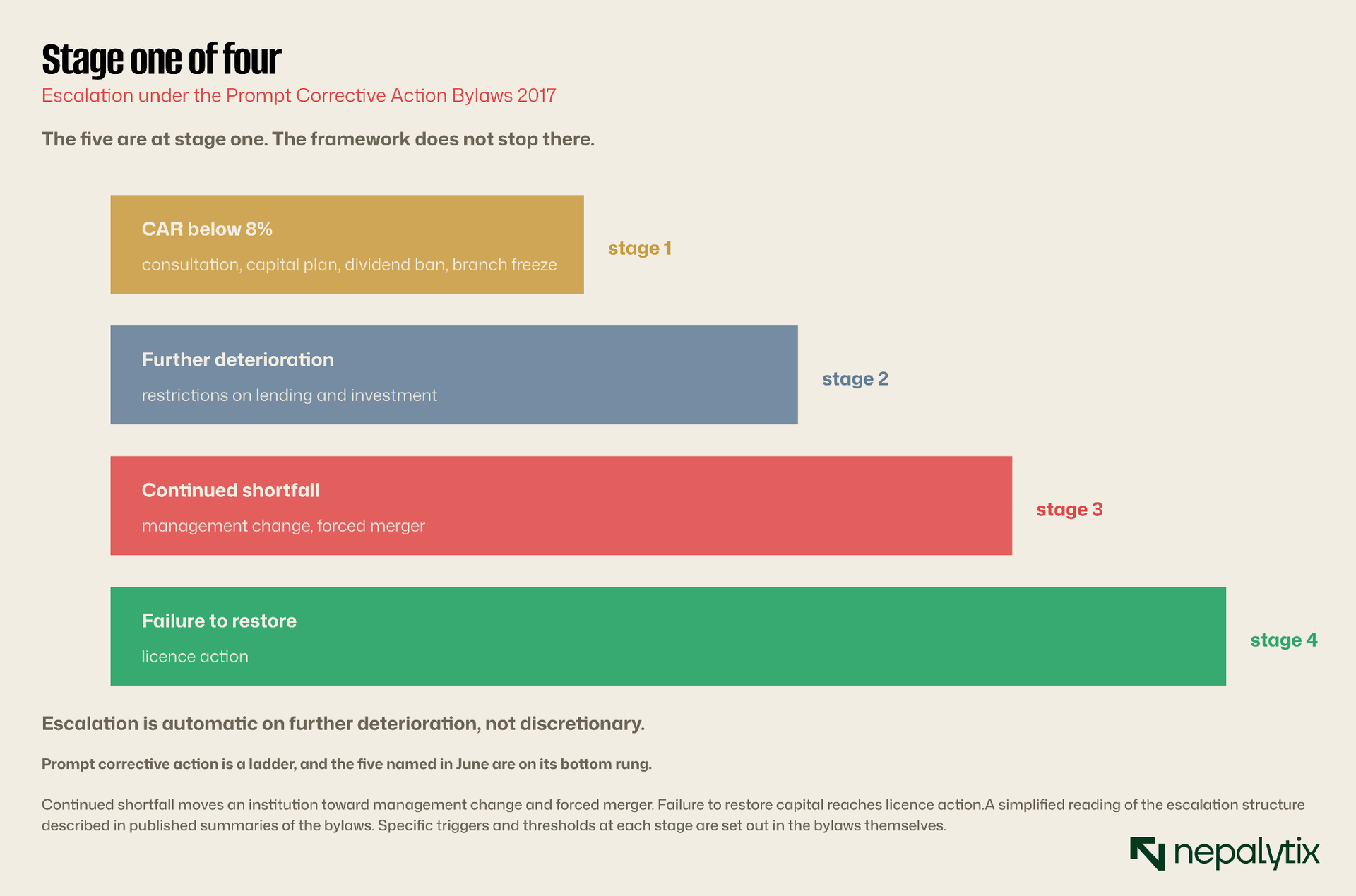
Continued deterioration brings restrictions on lending and investment. Persistent shortfall reaches management change and forced merger. Failure to restore capital reaches licence action.
NRB has pursued consolidation in microfinance for several years, and a forced merger is a realistic outcome for an institution that cannot raise capital. For a shareholder, a merger executed from a position of regulatory compulsion is not the same transaction as one negotiated from strength.
Governance actions, separately
Alongside the capital breaches, NRB took enforcement action on governance and financial discipline.
The boards of Dhaulagiri Laghubitta and CYC Nepal Laghubitta were issued formal warnings for regulatory violations. The chief executive of Nerude Mirmire Laghubitta was warned over an accounting practice the central bank found contrary to its directives, and instructed not to repeat it.
Bajarko Chirfar reported the specific finding against the Nerude Mirmire chief executive as an accounting practice the central bank considered contrary to its directives. NRB instructed that it not be repeated.
Two of those three institutions are also on the capital list. That overlap is the more informative fact: the same institutions failing the capital test are the ones drawing governance findings, which suggests the capital position is a symptom rather than the whole diagnosis.
The mirror image of the credit drought
Set this against what this publication reported last week and the shape of Nepal's financial system becomes clearer than either half is on its own.
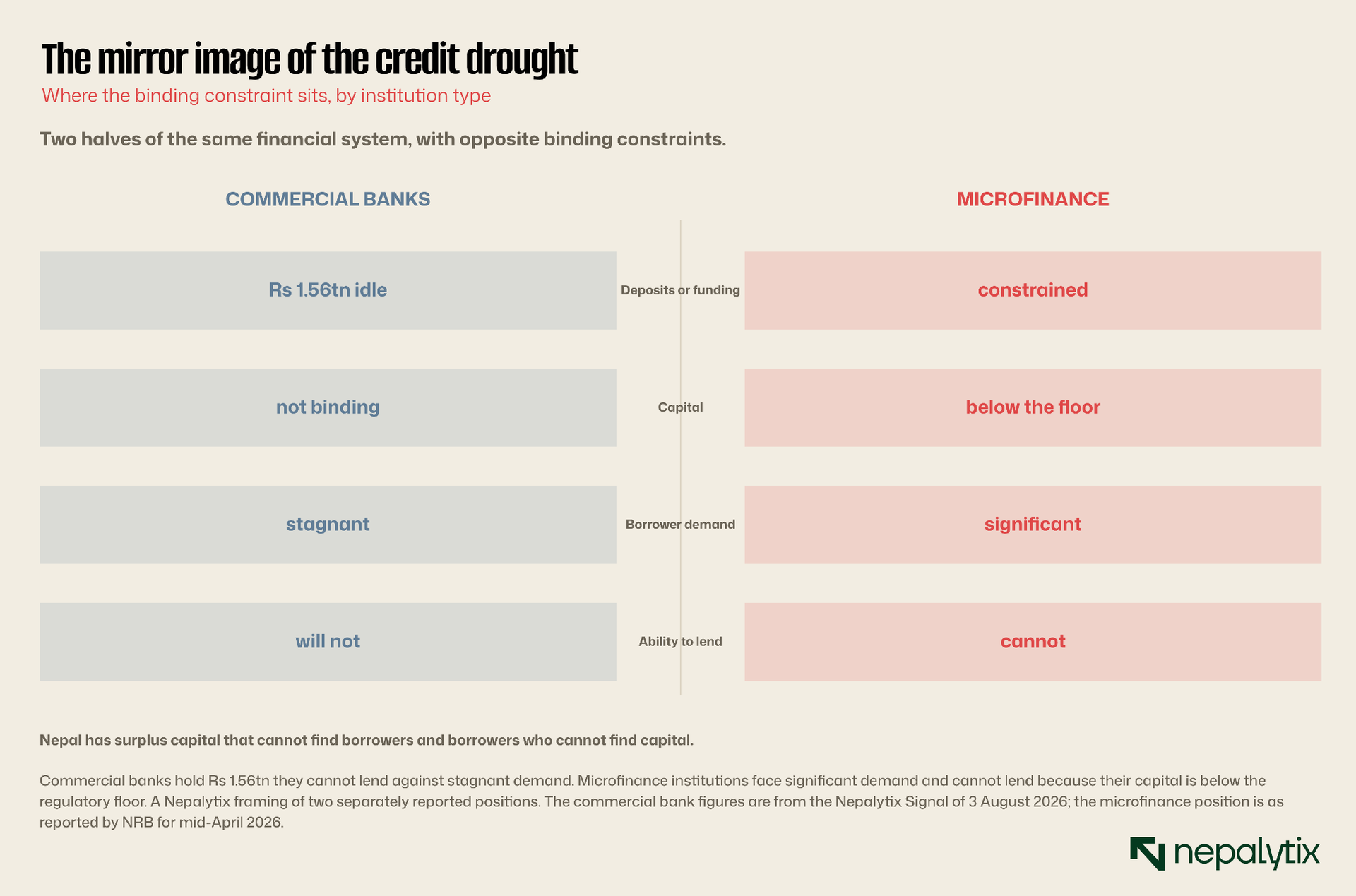
Commercial banks hold approximately Rs 1.56 trillion in excess lendable funds, a credit-to-deposit ratio of 71.29% against a 90% ceiling, and cannot find borrowers. Their constraint is demand.
Microfinance institutions serve borrowers who want credit NRB's own assessment describes demand as remaining significant and cannot lend because capital is below the floor. Their constraint is supply.
These are the two halves of one system, and the money is on the wrong side of it. The institutions with capital have no borrowers. The institutions with borrowers have no capital.
No instrument currently in use addresses that. A policy rate cut reaches neither. A credit growth target reaches neither. What would reach it is a mechanism moving capital from the surplus side to the constrained side: wholesale lending, capital guarantees, or the consolidation NRB has been pursuing and none of those is a monetary tool.
What we are watching
The PCA count at mid-July. It went from five named in June to eight on the mid-April data. The next quarterly supervisory release tells you whether seventeen at risk has become seventeen under action.
Microfinance NPL at the fiscal year close. A rise of 4.32 points in three quarters is the number that produced everything else here. If it continues at that rate, stage two of the escalation ladder becomes the base case for several institutions.
Any rights issue announcement. The only route out that preserves shareholders is fresh capital. Watch which institutions attempt one, at what discount, and whether it is subscribed.
Merger announcements. NRB has pushed consolidation for years and a capital-constrained institution is a willing target. A merger from compulsion prices differently from a merger from choice.
Q4 filings from the named five. The ratios cited date from mid-July and mid-October 2025. The full-year position is not yet public and is the first genuine update on whether any of them is recovering.
The June action was reported as a regulatory housekeeping story. It is not. It is the visible edge of a sector where bad loans have risen four points in three quarters, seventeen institutions are at or near their capital floor and the ones still able to lend are lending into the same deteriorating book.
Disclaimer
This report has been prepared by Nepalytix for informational and educational purposes only and does not constitute investment advice, an offer, or a solicitation to buy or sell any securities.
The information contained in this report is based on sources believed to be reliable; however, Nepalytix does not guarantee its accuracy, completeness, or timeliness. Opinions, estimates, and projections expressed herein are those of the authors as of the date of publication and are subject to change without notice.
Investing in securities involves risks, including the possible loss of principal. Past performance is not indicative of future results. Readers are advised to conduct their own independent research and consult with a qualified financial advisor before making any investment decisions.
Nepalytix and its contributors may hold positions in the securities discussed in this report at the time of publication or thereafter.
Neither Nepalytix nor any of its affiliates accept any liability for any loss arising from the use of this report or its contents.