NRB Share Loan Rule: The 80% Loan Has No Margin for Error
NRB 80% lending limit assumes financially strong shares make safer collateral. Fourteen years of NEPSE price history suggest the real risk lies elsewhere: the market conditions when a loan is made and how little protection remains when prices fall.
In July the central bank let banks lend 80% against shares they judge to be strong and left the judging to them. We tested fourteen years of prices to see whether strength makes a share loan safe. The limit is the problem and the label does not fix it.
The proposition
Nepal Rastra Bank should not leave each bank to decide which shares are strong enough to carry an 80% loan. It should write one test into the directive, base that test on the price of the share and not the standing of the company and let a bank call for collateral after a 10% fall on any loan above 70%. If it will not do those things, it should withdraw the tier.
In the middle of July, on the last day of the fiscal year, Nepal Rastra Bank amended one paragraph of its Unified Directive. Until then a bank could lend up to 70% of the value of listed shares pledged to it. From that day it may lend up to 80%, if the shares are those of a company the bank judges to be financially strong.
The central bank did not say which companies those are. It told each bank and financial institution to write a "product paper" setting out its own method of assessment to consider at least six things in doing so and to post the paper on its website. The six are the size of the company's paid-up capital, how long it has been listed, its record of profit and dividends, its credit rating, its compliance with regulators and whether it holds its general meetings on time. How much weight each carries, what counts as enough and where the line falls between strong and not strong are left to the lender.
The change drew little argument. One columnist objected that the central bank was looking at the collateral when it should be looking at the borrower. Otherwise the rule passed into the directive with less scrutiny than a ten-point change in the leverage available against the stock market deserves.
This piece gives it that scrutiny. It asks four questions of the rule. What does ten more points do to the arithmetic of a share loan? Is a loan against a strong share actually safer, on the record of the past fourteen years? Who should decide what strong means? And is there any test of strength, the central bank's or anyone else's, that would have told a safe share loan from a dangerous one on the day it was made? We ran each of them against the price of every ordinary share on the exchange. The answers lead to the proposition at the head of this page and one of them overturned a recommendation we had intended to make.
First, what the rule gets right
An argument against a rule should begin with the best thing that can be said for it and there is a good deal to say for this one.
A single loan limit for every listed share is crude. Under the old rule a bank could lend the same 70% against Nabil Bank which has been listed for decades and has paid a dividend in every year anyone can remember, as against a hydropower company that listed last spring and has yet to generate a unit of electricity. No lender anywhere thinks those two pieces of collateral are alike, and regulators in most markets do not pretend they are. Tiered limits, with more allowed against better collateral, are normal practice.
The directive also keeps the two features of the Nepali rule that do most to restrain it. Collateral is still valued at the lower of the latest price and the average closing price of the previous 180 trading days so a share that has just doubled is valued for lending purposes well below its market price. And the July amendment adds a new restraint: once a loan is made, the bank may not revalue the shares upward and lend more against the same pledge. A borrower cannot ride a rally by re-borrowing against paper gains. That closes the channel through which margin lending most often turns a rise into a bubble.
Finally, the sums involved are not, by themselves, a threat to the banking system. Loans against shares stood at Rs 167.85 billion in mid-September. That is a large number for the stock market and a small one for banks whose total lending is measured in trillions and each bank's share-loan book is capped at 40% of its core capital.
So the case here is not that risk-based limits are wrong, or that the banking system is in danger. It is narrower and we think harder to answer. The particular number chosen removes a buffer that the rest of the rulebook assumes is there. The evidence that strong shares make safer loans is much weaker than the rule supposes. And the decision about which shares qualify has been handed to the parties with the most to gain from a generous answer.
Then the arithmetic nobody mentioned
A share loan is safe for the bank for as long as the pledged shares are worth more than the loan. The gap between the two is the cushion. Two numbers in the directive govern it. One is the loan limit which sets how big the cushion is on the first day. The other is the margin call threshold which sets how far prices must fall before the bank is allowed to ask the borrower for more collateral.
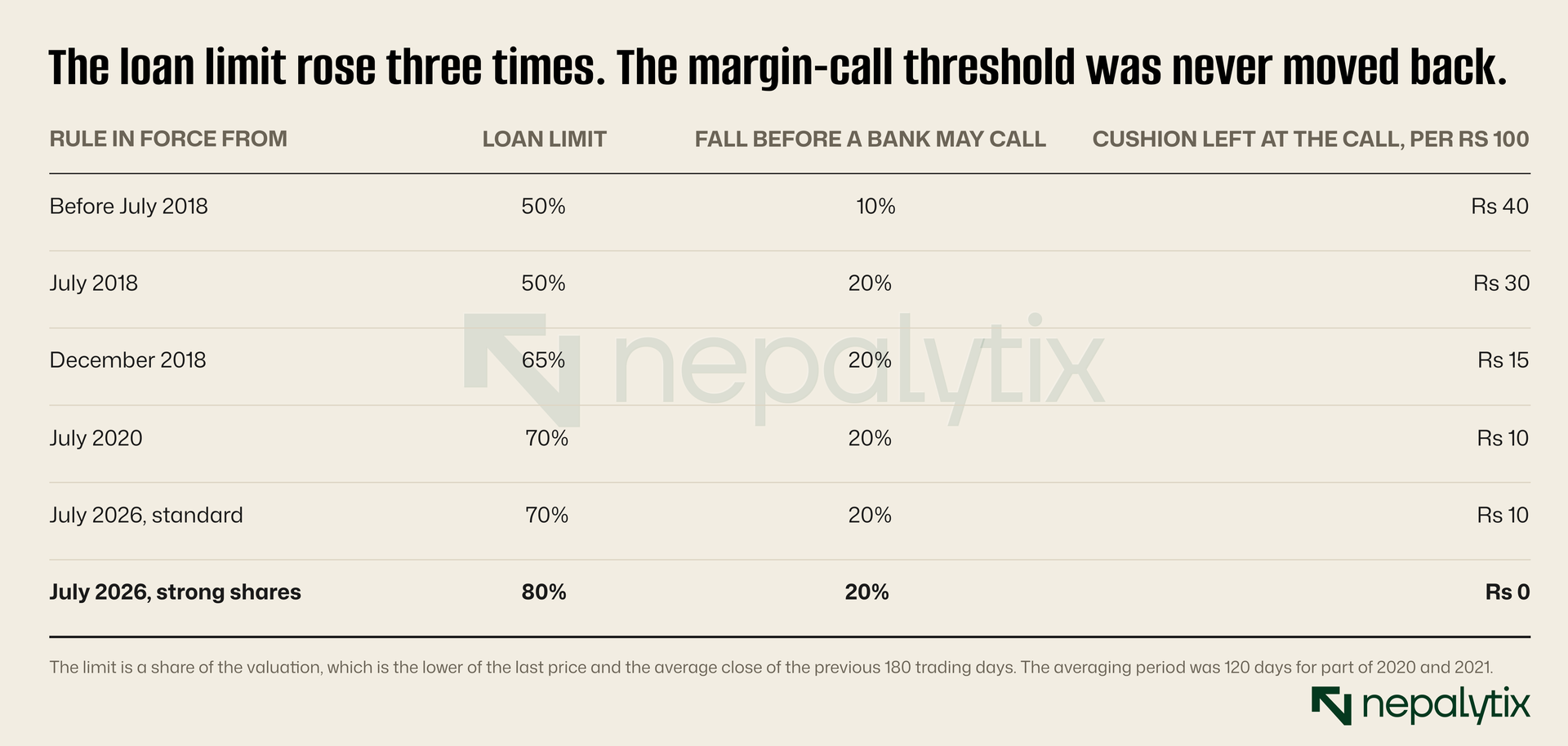
That second number has been 20% since July 2018. Before then a bank could call when the price had fallen 10%. The central bank doubled the threshold in that year's monetary policy, at a time when the market was falling and borrowers were complaining of repeated calls. It has not been changed since. A bank may not make a margin call until the value of the pledged shares has fallen by more than a fifth.
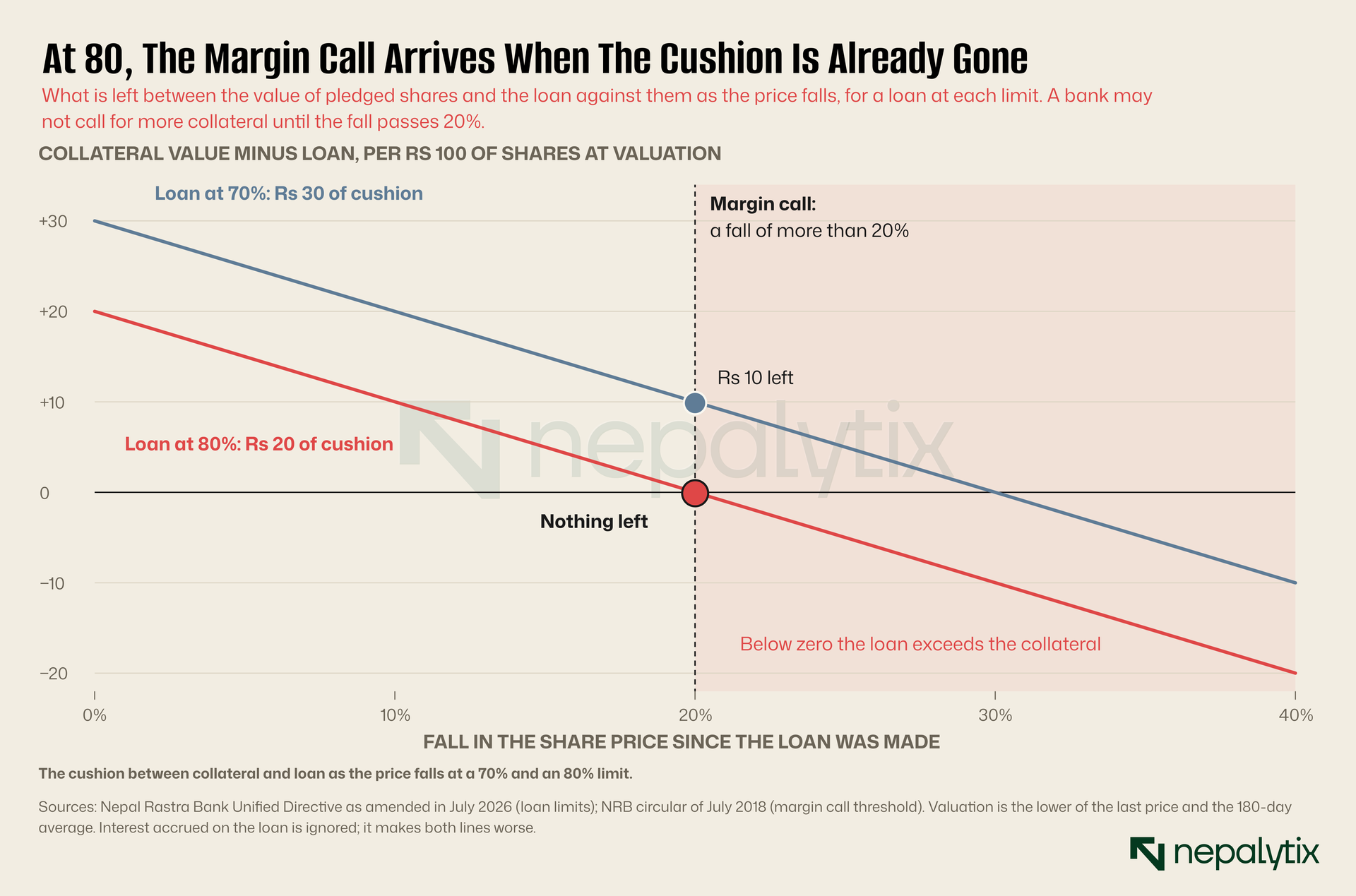
Put the two numbers together. At a 70% limit, Rs 100 of shares supports a loan of Rs 70 and the cushion is Rs 30. When the price has fallen 20% and the bank is first allowed to call, the shares are worth Rs 80 and Rs 10 of cushion remains. That is not much but it is something: time for the borrower to find more collateral or for the bank to sell before the loan is larger than what secures it.
At an 80% limit the loan is Rs 80. When the price has fallen 20% the shares are worth Rs 80. The margin call and the exhaustion of the cushion arrive at the same price. One rupee below it, the bank is holding collateral worth less than the loan and it has only just acquired the right to ask for more. Add a quarter's accrued interest and the loan is under water before the call can be made at all.
Nobody designed this. The 20% threshold was set when the limit was 50% and a 20% fall then left Rs 30 of cushion out of Rs 50. The limit was raised to 65% five months later and to 70% in 2020. Each increase ate into the space between the call and the loss and the threshold was never moved to compensate. At 80% the space is gone.
The rule therefore makes an assumption without stating it. It assumes that a strong share will not fall 20% below its valuation while it is pledged or will do so rarely enough that it does not matter. That is a claim about prices and prices can be checked.
So is a strong share a safe loan?
We ran the test on every ordinary share on NEPSE for which there is a price history from mid-2012 to the present. On each trading day, for each share, we valued the collateral exactly as the directive requires at the lower of that day's close and the 180-day average. We then followed the price for the next 250 sessions, about a year and recorded the lowest close. If that low was more than 20% below the valuation, a loan made on that day met a margin call. If it was more than 30% below, a 70% loan was under water at some point. That gives 294,895 simulated loans on 241 shares, the last of them made in October 2025 so that each has a full year to run. Loans made in a share's first 180 sessions or shortly after a suspension of trading, are left out.
We sorted them into three groups. The first is the 19 listed commercial banks which are the obvious candidates for "strong" on every one of the central bank's six criteria: the largest paid-up capital on the exchange, the longest listing histories, regular dividends, credit ratings, the closest regulation and annual meetings held under the regulator's eye. The second is every other share that had been listed for at least five years on the day of the loan. The third is everything listed more recently.
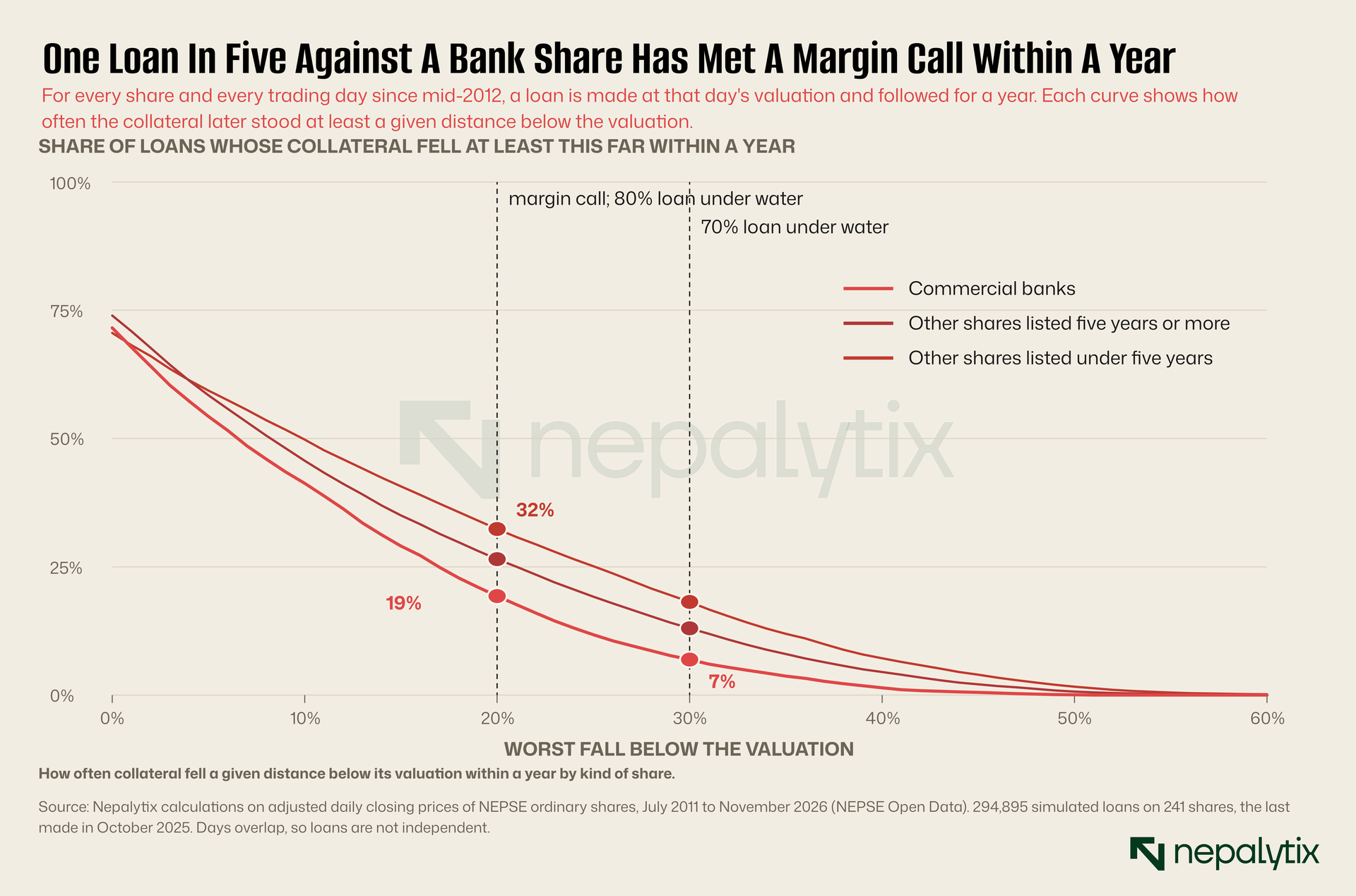
The light red line is the banks and it is the lowest of the three throughout. Loans against commercial bank shares met a margin call 19% of the time. For other seasoned shares the figure was 26% and for recent listings 32%. The median loan in every group was never in trouble: its collateral dipped 7% to 10% below the valuation at worst. The rule's premise is not baseless. Bank shares have been better collateral.
But look at what "better" amounts to. One loan in five against the strongest category of share on the exchange, valued conservatively, saw its collateral fall by more than a fifth within a year. That is not a tail event to be assumed away. It is roughly the chance of rolling a six.
Now apply the arithmetic of the previous section because at 80% a margin-call fall and an under-water loan are the same event.
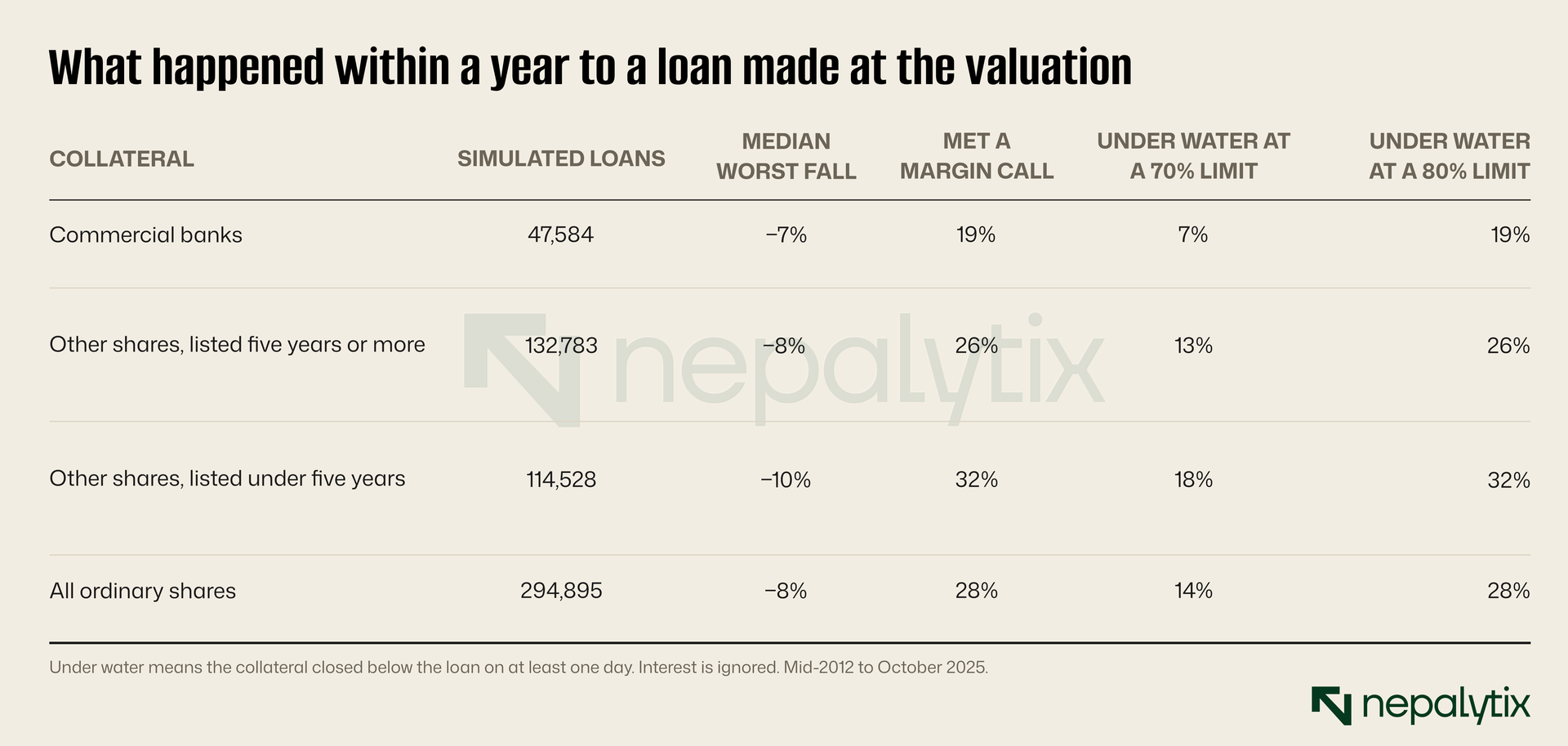
At the old 70% limit, a loan against a commercial bank share was under water at some point in the following year in 7% of cases. At the new 80% limit the figure is 19%. The ten points nearly triple the frequency with which the collateral fails to cover the loan.
The comparison that matters most is across the table and not down it. An 80% loan against a commercial bank share has been under water more often at 19%, than a 70% loan against the average share on the exchange at 14%. It has been under water more often than a 70% loan against a share listed less than five years ago at 18%. The premium tier, reserved for the strongest collateral is on this record a riskier loan than the standard tier applied to the weakest.
That is the central finding of this piece, and it does not depend on any view about which shares are strong. It follows from two facts: that the best shares fall 20% about a fifth of the time, and that 80 plus 20 is 100.
And these are not dips
There is an obvious reply to all this. A price that touches a level for a day and bounces has cost nobody anything. If the falls in the test are brief, a bank can sit them out and the arithmetic of the cushion is a curiosity. So we followed each loan that met a margin call to see how the fall arrived and how long it stayed.
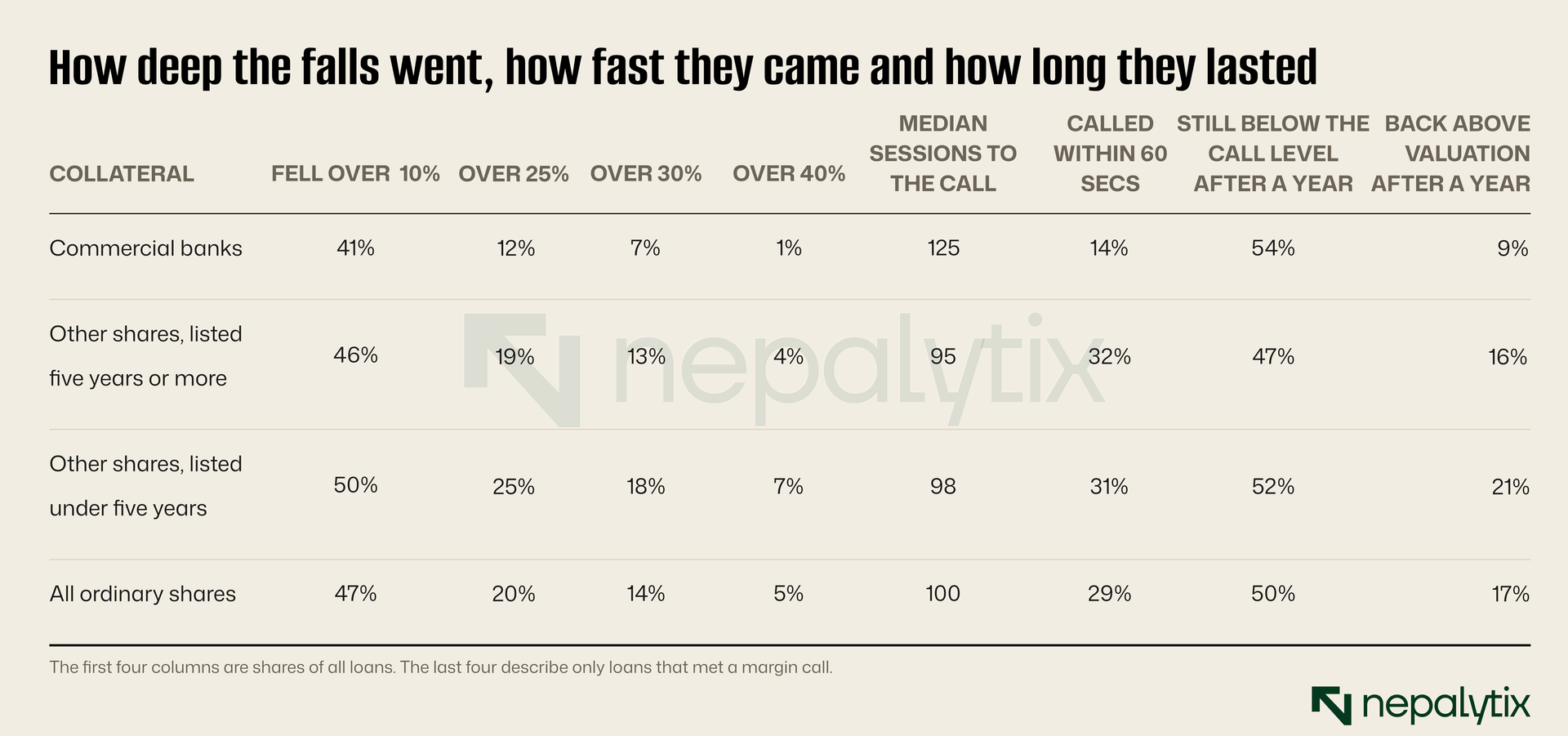
It arrived slowly. For a loan against a commercial bank share, the median time from the day of the loan to the first close more than 20% below the valuation was 125 trading sessions about six months. Only 14% of the calls came within the first 60 sessions. Other shares fell faster: the median was under 100 sessions and nearly a third of the calls came inside 60.
And it stayed. A bank share that crossed the line spent a median of 50 sessions beneath it before the year was out. At the end of the year, 54% of those loans still had collateral worth more than 20% less than the valuation and only 9% had collateral worth as much as it was on the day the loan was made. These are bear markets not bad afternoons. A bank that waits for the price to come back has on this record waited more than a year about half the time.
The depth is the last piece. In 12% of all loans against commercial bank shares, the collateral fell more than 25% below the valuation which at an 80% limit leaves the bank at least Rs 5 short on every Rs 100 of shares. In 7% it fell more than 30%. In the worst tenth of cases the shortfall was Rs 6.60 or more. For the average share on the exchange, one loan in five was at some point at least Rs 5 short and one in seven at least Rs 10.
The slow arrival cuts both ways and it matters for what follows. It means a bank has time to act. But the directive gives it nothing to act with until the 20% line is crossed and by then, at 80%, there is nothing left to protect. An earlier trigger would have given real notice. Had the threshold been 10%, the bank would have been entitled to call a median of 53 sessions before a bank share reached the 20% line, and in three cases out of four at least 28 sessions before.
It is the year, not the share
An average over fourteen years conceals how these episodes arrive. They do not come one loan in five, spread evenly. They come all at once.
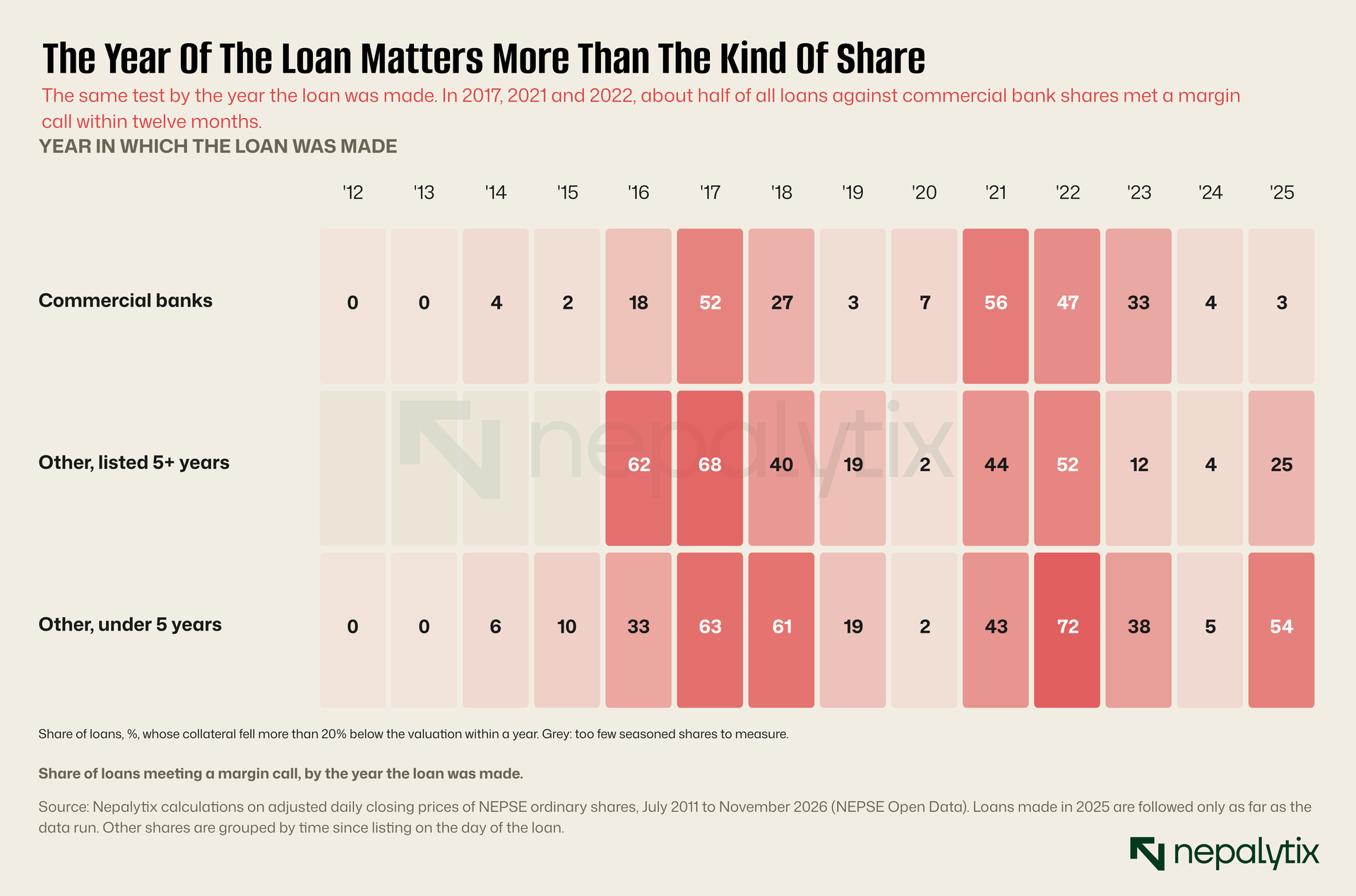
Of loans made against commercial bank shares in 2017, 52% met a margin call within a year. Of those made in 2021, 56%. In 2022, 47%. In the quiet years the figure was close to nothing: 3% in 2019, 4% in 2024.
A simple measure puts a number on it. Knowing only the month in which a loan was made accounts for 33% of the variation in whether it met a margin call. Knowing only which share was pledged accounts for 10%. Knowing only which of the three groups the share belonged to accounts for 1%.
Read across the rows in any of the bad years and the three groups look much alike. In 2021 bank shares did worse than the others. In 2017 and 2022 they did somewhat better and still half of them hit the threshold. What separates a safe share loan from a dangerous one in this grid is the column which is to say the state of the market when the loan was made. The row, which is the quality of the company is a second-order effect.
This matters for the rule in two ways. It means that when the 80% tier fails it will fail for a large part of every bank's premium book at the same moment because the banks will all have classed the same handful of large, liquid, dividend-paying companies as strong. And it means the test the directive sets is aimed at the wrong variable. A product paper that scores paid-up capital and dividend history is measuring the row. The risk is in the column.
The record since the start of 2021 makes the same point more bluntly. Over that period loans against commercial bank shares met a margin call 28.8% of the time. Loans against other shares listed five years or more met one 23.7% of the time. For the past five years the category that every product paper will place at the top has been worse collateral than the seasoned companies ranked beneath it.
And the label hides more than it shows
Grouping shares into "commercial banks" and "others" is itself a simplification, and it flatters the idea that strength is a property of a category.
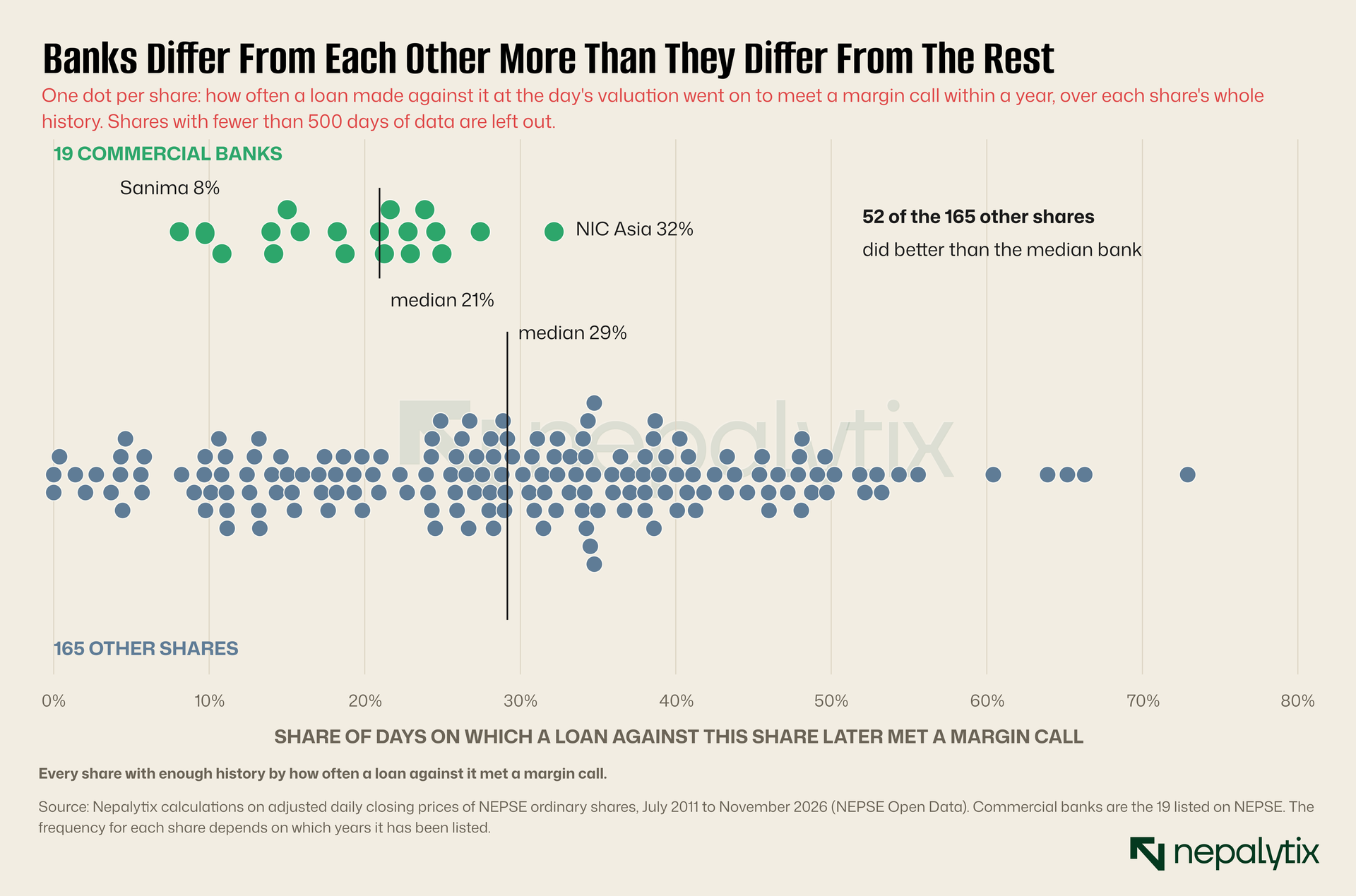
Each dot in Chart 4 is one share, placed according to how often a loan against it went on to meet a margin call. The 19 banks are in green along the top. They range from 8% to 32%. The best of them, Sanima was four times safer as collateral than the worst, NIC Asia. That spread of 24 points within one tightly regulated sector is three times the 8-point gap between the median bank and the median of everything else.
Below them are 165 other shares with enough history to measure. Their median is worse at 29% against 21%. But 52 of them, nearly a third had a better record than the median bank. They include hydropower companies, insurers, development banks and manufacturers. A product paper that awards the 80% tier by sector or by size of paid-up capital, will admit NIC Asia and exclude all 52.
The six criteria in the directive are mostly of that kind. Paid-up capital, years listed, a rating, compliance and timely meetings describe the institution. Only the profit and dividend record says anything about the business, and none says anything about the price. Yet it is the price that determines whether a share loan is covered. A company can be large, old, rated, compliant and punctual and its shares can still halve.
Meanwhile the brake is off
The strongest defence of the Nepali regime has always been the 180-day rule. Because collateral is valued at the lower of the last price and the six-month average, the loan available against a share shrinks, as a proportion of its market price, exactly when the price has run up. It is an automatic stabiliser, and a good one.
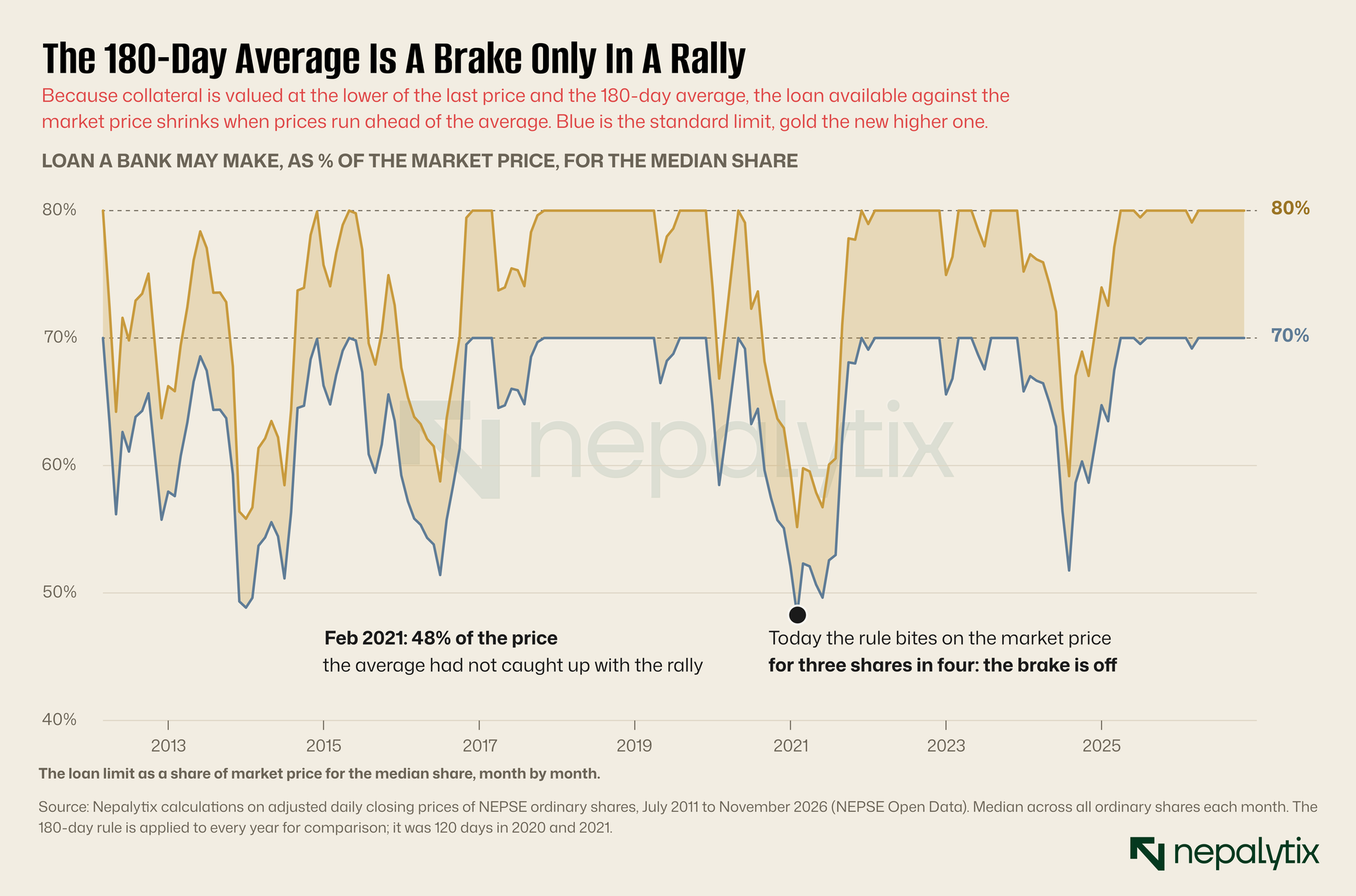
Chart 5 shows it working. In February 2021, eight months into a rally in which the NEPSE index doubled, the median share's 180-day average was so far below its price that a 70% loan against the valuation was a loan of 48% against the market price. Borrowers could not lever the rally at anything like the headline rate. In 41 of the past 176 months the effective limit for the median share has been below 60%.
But the rule only bites when prices are above their average. When they are below it, the lower of the two figures is the market price and the limit is the full headline rate. That is the position today. At the close on 6 November, 194 of 257 ordinary shares were trading below their 180-day average. For three shares in four, a bank can lend the whole 70% or the whole 80%, against today's price.
The banks themselves are the exception this month, and the exception is instructive. Eighteen of the 19 commercial banks closed above their averages, by a median of 7%. For them the stabiliser is on: an 80% loan against the valuation is a loan of 75% against the market price. That is five points of hidden cushion. It exists because bank shares have risen since the summer and it will last as long as they keep rising.
The record shows how much that state matters. Across the whole test, loans made on days when the share stood above its 180-day average met a margin call 18% of the time. Loans made when it stood below met one 39% of the time. For commercial bank shares the figures were 11% and 29%. A share trading below its average is, on this evidence, the more dangerous collateral and it is the collateral against which the rule allows the fullest loan.
So the new tier has arrived at a moment when the regime's main safeguard is not operating for most of the market. That is a feature of the design more than an accident of timing. The stabiliser restrains borrowing in a boom. It does nothing in a flat or falling market which is when a regulator is most likely to be asked to loosen and most likely to agree. The 20% margin-call threshold was a concession to a falling market in 2018. The removal of the per-borrower cap came in October 2025 and the 80% tier in July 2026 with the NEPSE index 19% below its 2021 peak on both occasions and the banking index more than 30% below its own. Each made sense as relief. Together they have built a structure with less protection in it than any single decision intended.
Which brings us to who decides
Suppose all of that is accepted and the central bank still wants a higher tier for better collateral. The question then is who draws up the list.
The directive's answer is every lender, separately. There are 20 commercial banks, of which 19 make share loans and beside them the development banks and finance companies. Each is to write its own method. The only discipline is publication.
Consider the position of the officer writing that paper. The bank's share-loan book is one of the few parts of its lending that grew last year: the system's total rose from Rs 140.7 billion in July 2025 to Rs 167.9 billion fourteen months later, a rise of 19%. The borrowers are large and few. Loans above Rs 10 million made up 72% of the total in June and loans below Rs 2.5 million made up 5%.
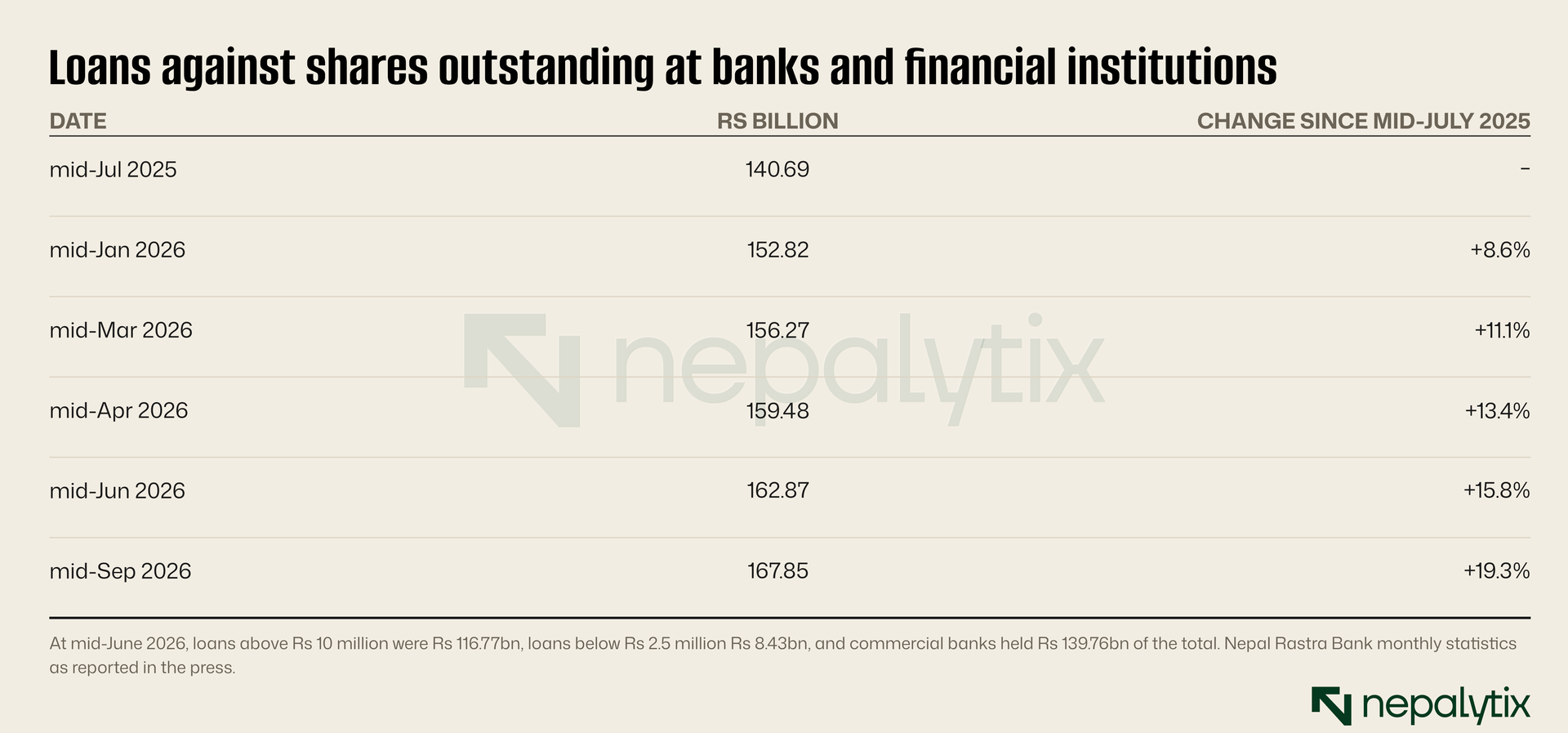
Those large borrowers are free since the cap was lifted to borrow as much as they like from as many banks as they like. They will take their pledges to whichever bank's paper gives them 80% on the shares they hold.
A bank that writes a strict paper loses that business to a bank that writes a loose one. No bank needs to behave badly for the result to follow. The papers will converge and they will converge on the list that the biggest borrowers want. A rule that was meant to reward the quality of the collateral will end by reflecting the bargaining power of the borrower.
Nor is there any natural stopping point because "strong" has no single meaning that the banks could be held to.
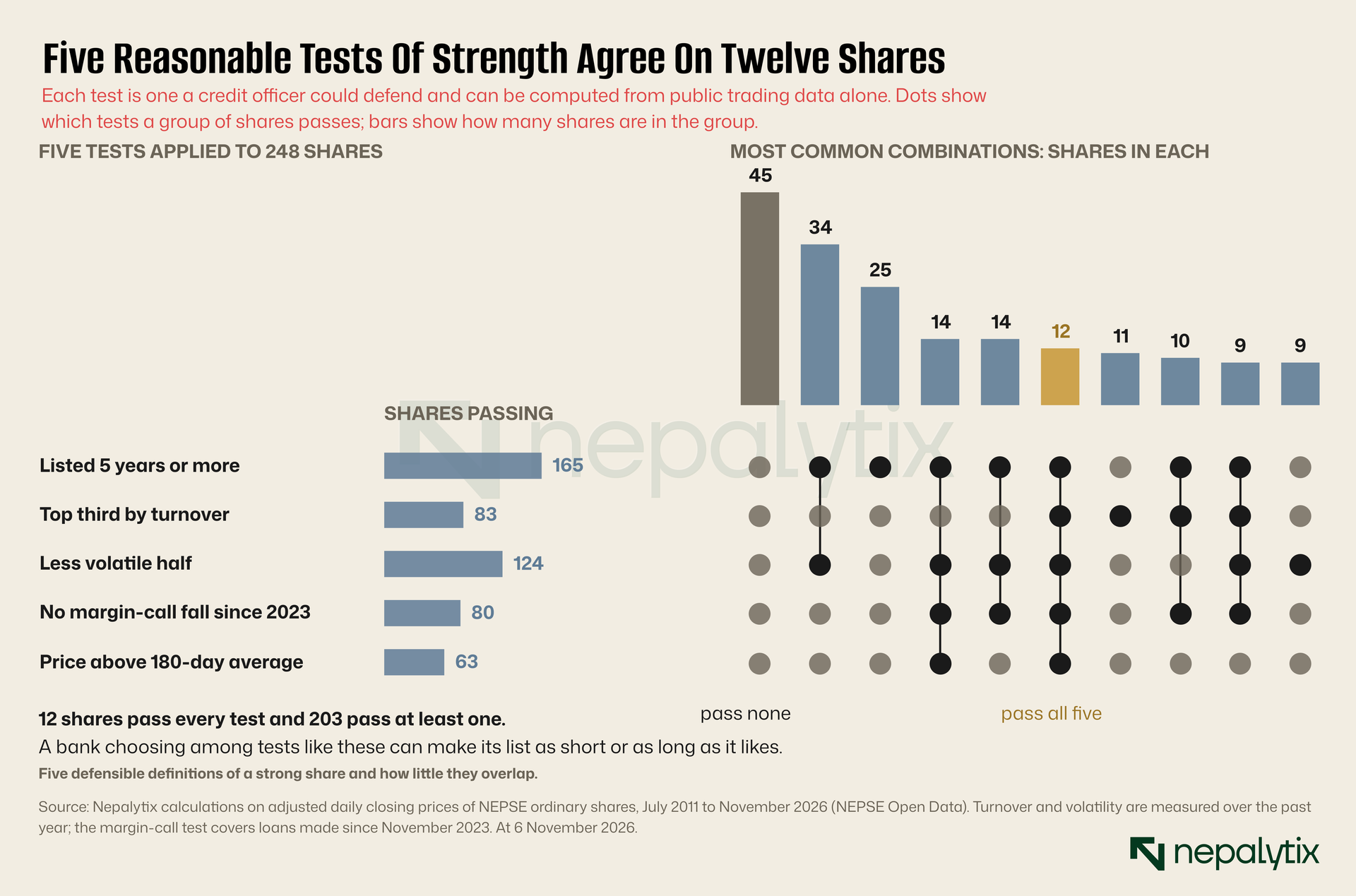
We wrote five tests that a credit committee could defend and that anyone can compute from public trading data. A share is strong if it has been listed five years or more; if it is in the top third by turnover; if it is in the less volatile half of the market; if no loan against it since late 2023 would have met a margin call; or if it trades above its 180-day average. Applied to 248 shares on 6 November, the tests pass 165, 83, 124, 80 and 63 of them.
Twelve shares pass all five. Two hundred and three pass at least one. Seven of the 19 commercial banks are among the twelve, and twelve are not. A bank that wants a short list can justify twelve names. A bank that wants a long one can justify four-fifths of the exchange, and both can publish a paper that satisfies the directive.
The regulator next door has shown that it does not have to be this way. When the Securities Board issued its directive on margin trading through brokers, it wrote the eligibility criteria into the directive itself. On one published reading, 128 companies qualify. An investor can know before walking into any broker whether a share is eligible and no broker can win business by bending the list. Nepal now has two leverage regimes for the same shares: one, for brokers, with a public list set by the regulator and one, for banks, with a private list set by each lender. The second is the larger by far.
The strongest case against us
Banks know credit and regulators should let them price it. A central bank that publishes a list of strong companies is in effect issuing investment advice and will be blamed when a listed name fails. Delegation with disclosure is the modern approach: set the principles, require the method to be public, supervise the outcome. If a bank's paper is reckless, its supervisor can say so and its own capital is at stake.
The buffer is still there in practice. A fall of 20% from the valuation is not a fall of 20% from the market price whenever the 180-day average is doing its work and a careful bank will call well before its legal right arises by agreeing tighter terms in the loan contract. Nothing in the directive stops a bank lending 75% or calling at 10%.
The test above is unfair to the rule. It treats a loan as under water the moment the collateral dips below it, on any one day in a year. Banks do not lose money on dips. They lose it when a borrower cannot or will not top up and the shares cannot be sold. The borrowers who will get 80% are, by the article's own figures, large and well known to their banks. Banks have come through three severe market falls without reporting heavy losses on share loans.
And the alternative is worse. A single list drawn up in Baluwatar would be lobbied over by every listed company, revised late and treated by the market as a seal of approval. The companies left off would see their shares fall. Twenty lists that disagree are less distorting than one that everyone must follow.
Why that case does not hold
Each of those points has force and none of them rescues the rule as written.
On delegation: it works when the party delegated to bears the cost of getting it wrong and when its choices can be compared against a standard. Neither holds here. A bank that writes a generous paper gains the loan today and bears the cost, if there is one, in a market fall that will hit every bank at once and will be met, on past form with regulatory forbearance. And there is no standard. The directive lists six considerations and no thresholds, so a supervisor who thinks a paper too loose has nothing in the rule to point to.
On the buffer in practice: a careful bank can indeed lend less and call sooner. The purpose of a prudential limit is to bind the bank that is not careful, in the year when competition for a growing product is fiercest. And the 180-day average is, as of this month, providing no buffer for three-quarters of the market.
On fairness: it is true that a day under water is not a loss. But the falls in the test were not days. Half of the bank-share loans that crossed the line were still beneath it a year after they were made. It is also true that we know of no bank that has reported heavy losses on share loans, though the central bank does not publish the figure. Those falls were met under limits of 50%, 65% and 70% each of which left something between the call and the collateral. The record says nothing about a limit that leaves nothing. As for knowing the borrower, the directive now ties the higher limit to the share and not to the person pledging it. If the argument for 80% is that the borrowers are strong, the rule should say so and test for it.
On the single list: the objection proves too much because one already exists for brokers and the market has absorbed it without drama. Eligibility for more leverage is not a recommendation to buy, any more than the central bank's list of securities acceptable as collateral for its own lending is one. The criteria can be mechanical, the list can be recomputed from published data and a company that falls off it loses ten points of loan value on its shares and nothing else. Which mechanical criteria would do the job is a question of evidence, and it is the one question the directive's defenders and its critics have both left alone.
So we tested the tests
If the list is to be written once, by rule, the rule ought to work. So before recommending one we tried six, including the one we had meant to recommend.
Each test was applied the way a lender would have to apply it: using only what was known on the day of the loan. A share's turnover and volatility were ranked against every other share's over the previous 250 sessions. Its record as collateral was judged on loans made between one and four years earlier, whose outcomes were by then known. We then compared how often loans against the shares that passed went on to meet a margin call with how often loans against the shares that failed did.
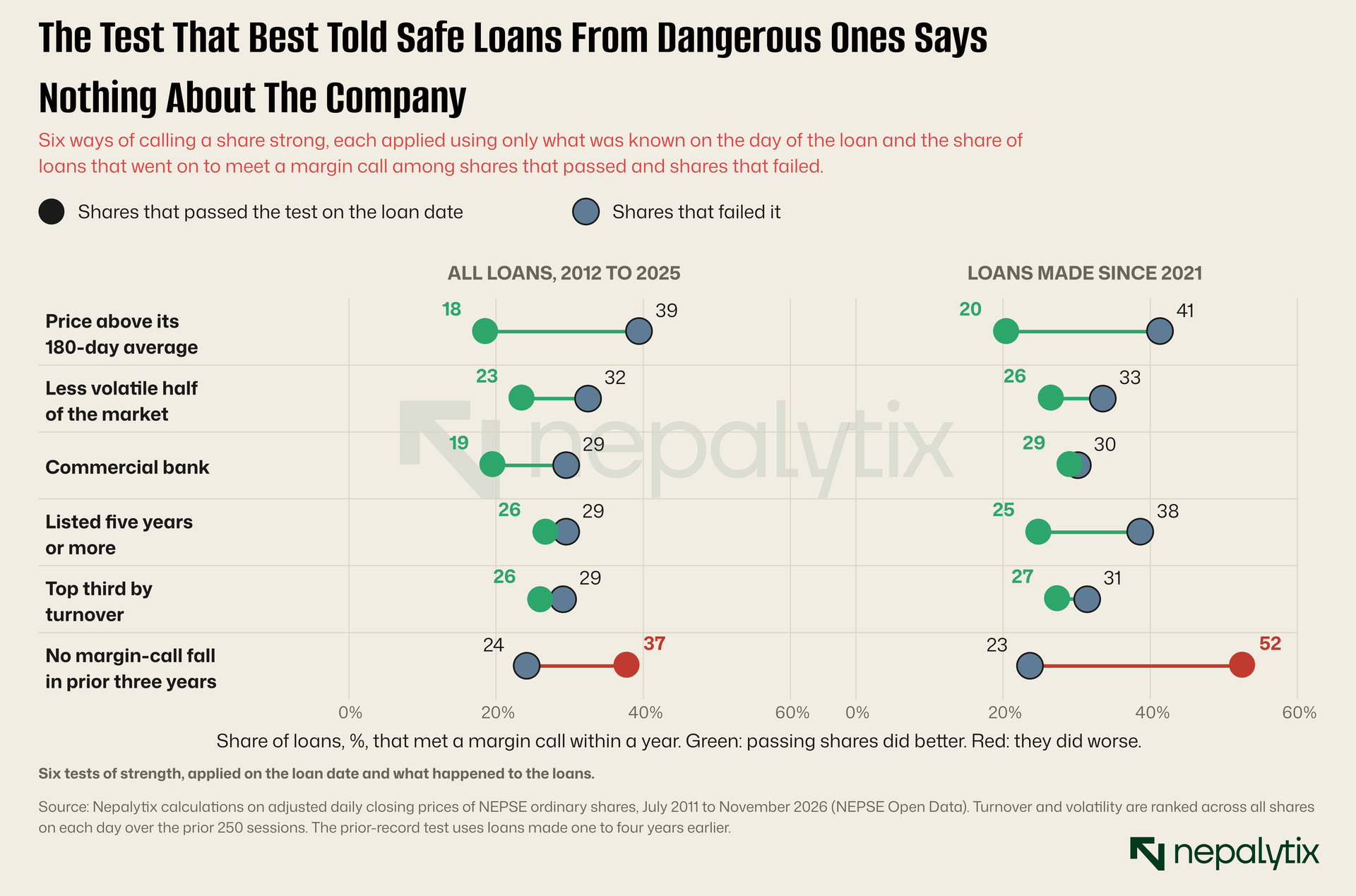
Start with the institutional tests which are the kind the directive asks for. Being a commercial bank looks useful over the whole period, 19% against 29%. Since 2021 it has been worth nothing: 29% against 30%. Being listed for five years or more is worth three points over the whole period and fourteen since 2021, so the two tests have swapped places. High turnover is worth three points and shares in the top third by turnover did better than the rest in only five loan-years of fourteen. None of these is a reliable sign of anything. Each works in some markets and fails in others and nobody knows in advance which market is coming.
The test we had intended to propose did worst. It seemed the natural one: a share is strong collateral if no loan against it in the previous three years would have met a margin call. It is the only test of the six that measures the thing a lender cares about. Loans against shares with that clean record went on to meet a margin call 37% of the time. Loans against shares without it met one 24% of the time. Since 2021 the gap is wider, 52% against 23%.
The reason is not hard to see once the numbers are on the page. A share that has not fallen 20% in three years is a share that has gone up for three years. Only one loan in nine passed the test and they were concentrated at the top of rallies. A clean record does not tell a lender that a share is safe. It says the market is late in its rise. Any rule that rewards recent good behaviour with more leverage will add it at the worst possible time and the profit and dividend record in the central bank's own criteria risks being a slower version of the same mistake.
Two tests did separate the loans. Low volatility was worth nine points, 23% against 32%, and held in ten loan-years of fourteen. And the share's position against its own 180-day average was worth more than twice as much again: 18% against 39% over the whole period, 20% against 41% since 2021.
That last result needs careful reading because it is not what it first appears. Shares trading above their average were not safer shares. Measured from the market price and not from the valuation, loans against bank shares that stood above their average fell more than 20% in 26% of cases. Measured from the valuation, the same loans met a call 11% of the time. They were safer loans because the valuation rule had already taken something off. The bank was lending against the average, the average was below the price and that gap was a second cushion which the 20% threshold did not consume. The stabiliser in the directive is doing the work. The company is doing none of it.
Nor did any test rescue a lender in a bad year. In the six loan-years when more than 30% of all loans met a margin call, the less volatile half of the market met one 41% of the time and shares above their average 46% of the time. The best available test moved the odds from worse than even to somewhat better than even. Nothing made an 80% loan a safe loan in 2017, 2021 or 2022.
So the evidence does not support a list of strong companies at all, whoever draws it up. It supports a rule about the state of the price on the day of the loan. That is cheaper to administer than a product paper, identical at every bank, impossible to lobby over and it is the only version of the higher tier that the past fourteen years can be made to justify.
What the central bank should do instead
There are four changes, in descending order of importance. Any one would improve the rule. The first two would repair it.
Restore the space between the call and the loss. If any loan may be made at 80%, the margin-call threshold for that loan should be 10% and not 20%. That returns the 80% tier to the position the 70% tier is in today, with Rs 10 of cushion left when the bank is first entitled to act. The cost is real and should be stated. On the record, 41% of loans against commercial bank shares would have met a 10% call within a year, against 19% that met a 20% call, and about half of those early calls would have been for falls that went no further. Borrowers will dislike that. It is what ten more points of leverage ought to cost and a borrower who does not want the earlier call can take the 70% loan.
Tie the tier to the price, in the directive and drop the product papers. The higher limit should be available against any share that has been listed long enough to have a 180-day average and is trading above it, and against no other. When the share is below its average the limit is 70%. On 6 November that test was met by 63 of 257 shares, 18 of them commercial banks, so the tier would be open today to all but one of the commercial banks. The difference is in what happens next. Under the directive as written, a bank share that falls below its average stays on every bank's strong list. Under a price test it drops out on the day, at every bank at once, for new loans. This is the opposite of how relief is usually granted, since it withdraws leverage in a falling market, and it is the right way round.
If there must be a list of companies, write one list. Should the central bank prefer institutional criteria all the same, it should set thresholds and not considerations, publish the resulting names, and align them with the Securities Board's so that the two regimes agree. On our evidence such a list adds little to safety. A single public one at least removes the competition between lenders to write the longest.
Publish what is pledged. The central bank reports total share loans each month, and splits them by size of loan and by class of lender. It does not report which companies shares are pledged, in what quantity, or at what loan-to-value. That is the gap Nepalytix has found in sector after sector: a headline figure is published and the operating detail which the institutions compile as a matter of course, is required of nobody. In this case the detail is the whole of the risk. If a large part of the free float of a bank's shares is pledged to other banks at 80%, the market should know before the price falls, and so should the banks holding the pledges.
None of this requires abandoning the principle that better collateral deserves a higher limit. It requires that the limit leave a margin for error, that "better" be measured by something which has in fact predicted the outcome, and that the public be able to see how much leverage sits behind which shares.
What will tell us who is right
The rule is four months old and the evidence on how it is being used is thin. Three things will settle the argument sooner than a market fall would.
The first is the product papers themselves. They are required to be public. When enough of them are, it will be possible to count how many companies each bank rates as strong and how far the lists overlap. If the lists are short and different, the delegation is working as its defenders hope. If they are long and alike, it is working as we expect.
The second is the monthly total. Ten more points on the entire book would be about Rs 24 billion of additional borrowing against the same shares. Nothing like that will happen quickly, because existing loans may not be topped up. But new lending is running at about Rs 2 billion a month, and the share of it made above 70% is a number the central bank has and could release.
The third is the split by size. Small share loans have been falling since brokers began to offer margin trading, and large ones rising. If the 80% tier is taken up almost entirely in loans above Rs 10 million, the rule will have given the investors who already had the most leverage a little more.
There is a fourth which nobody should wish for. Eighteen of the 19 commercial banks trade above their 180-day averages today. When they stop doing so, the hidden five points go, the full 80% becomes available against a falling price and the record says that is the condition under which three bank-share loans in ten have met a call. The time to move the threshold is before that, while moving it costs almost nothing.
Disclaimer
This report has been prepared by Nepalytix for informational and educational purposes only and does not constitute investment advice, an offer, or a solicitation to buy or sell any securities.
The information contained in this report is based on sources believed to be reliable; however, Nepalytix does not guarantee its accuracy, completeness, or timeliness. Opinions, estimates, and projections expressed herein are those of the authors as of the date of publication and are subject to change without notice.
Investing in securities involves risks, including the possible loss of principal. Past performance is not indicative of future results. Readers are advised to conduct their own independent research and consult with a qualified financial advisor before making any investment decisions.
Nepalytix and its contributors may hold positions in the securities discussed in this report at the time of publication or thereafter.
Neither Nepalytix nor any of its affiliates accept any liability for any loss arising from the use of this report or its contents.