NRB Wants Rs 652 Billion Lent. Nobody Is Borrowing.
NRB wants Rs 652 billion of new lending, but banks already have Rs 1.56 trillion sitting idle. Nepal's credit problem isn't liquidity, it's a lack of borrowers.
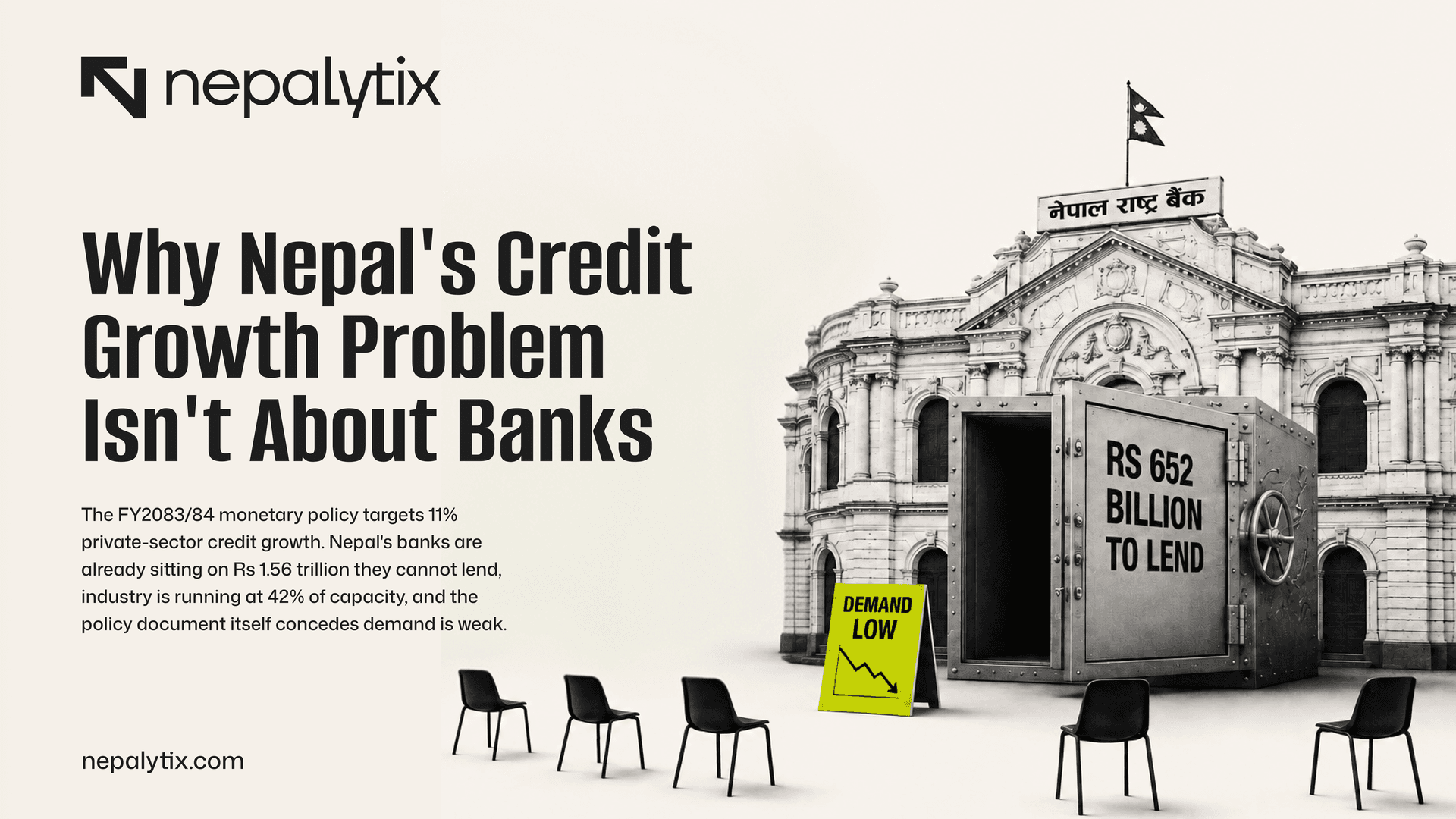
The FY2083/84 monetary policy targets 11% private-sector credit growth. Nepal's banks are already sitting on Rs 1.56 trillion they cannot lend, industry is running at 42% of capacity, and the policy document itself concedes demand is weak.
The Signal
Nepal's monetary transmission is not broken at the supply end. It is broken at the demand end, and no instrument in a monetary policy reaches that.
Banks hold Rs 1.56 trillion of excess lendable funds. The credit-to-deposit ratio is 71.29% against a 90% ceiling. Lending rates have fallen to generational lows. Every condition a central bank can create has been created, and credit growth has fallen in each of the last five years, from 27.1% to 5.4%.
The FY2083/84 target of 11% asks for roughly double the current rate. Of the eight sector measures in the policy, two address demand and both of those are targets rather than instruments.
The target is 42% of money the banks already cannot lend
Start with the arithmetic, because it settles the argument before any interpretation is needed.
NRB targets private-sector credit growth of about 11% for FY2083/84. On an outstanding loan book of Rs 5.94 trillion that implies roughly Rs 652 billion of new lending across twelve months.
As of 10 July 2026, Nepal's banks and financial institutions held approximately Rs 1.56 trillion in excess lendable funds. Even after adjusting for the roughly 20% of deposits that must be held in cash and liquid assets, Rs 1.47 trillion remained.
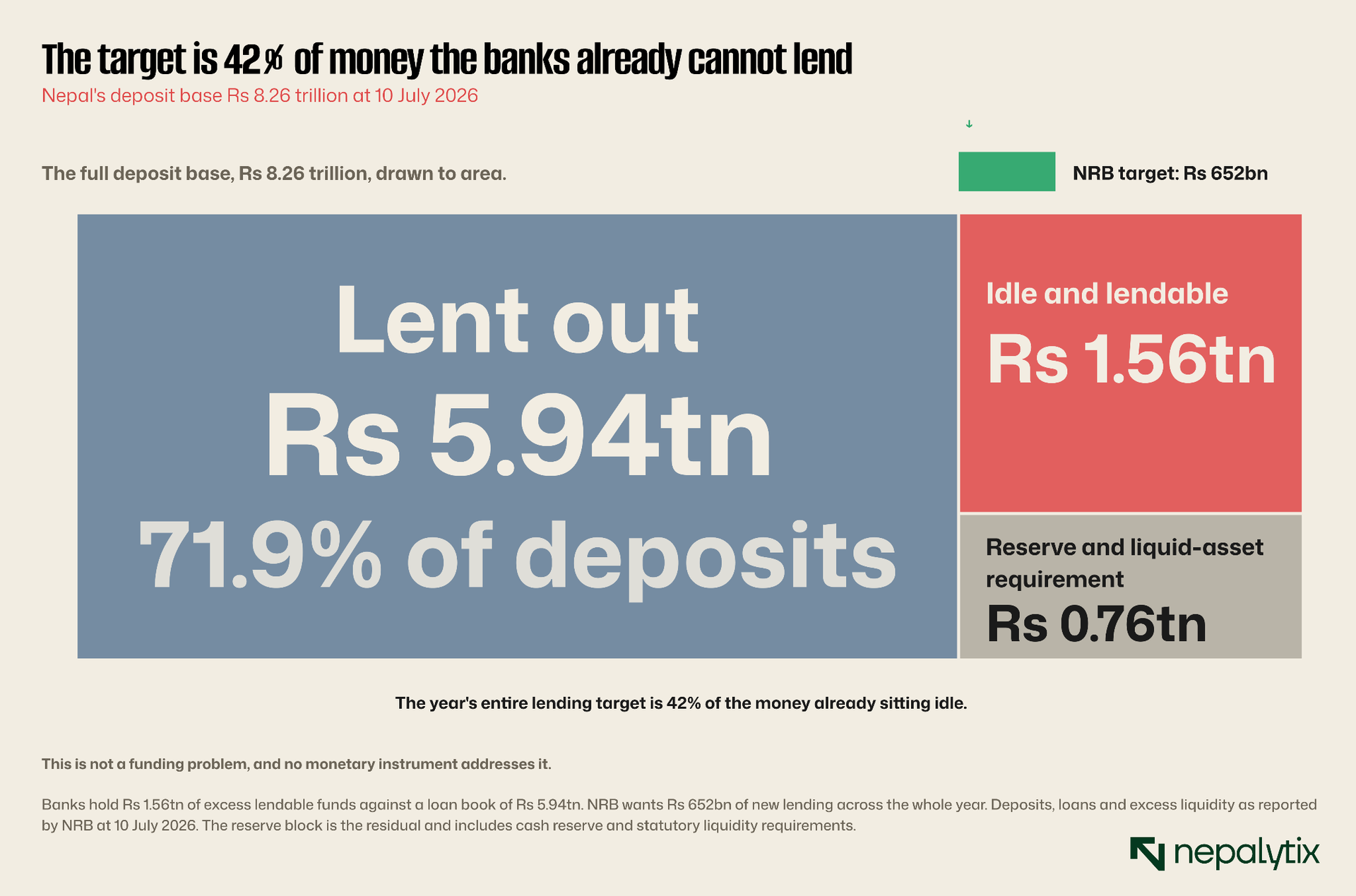
The gold bar is the entire year's lending ambition. The red block is money the banking system is already holding and cannot deploy. The target is 41.8% of the idle pile.
Put another way: if every rupee NRB wants lent this year were lent tomorrow morning, banks would still be sitting on Rs 908 billion they could not place.
You cannot solve a demand problem by supplying more of what is already unused.
Five straight years down, and the target doubles it
The 11% figure needs context, because on its own it sounds like a modest ambition. Against the trend it is not.
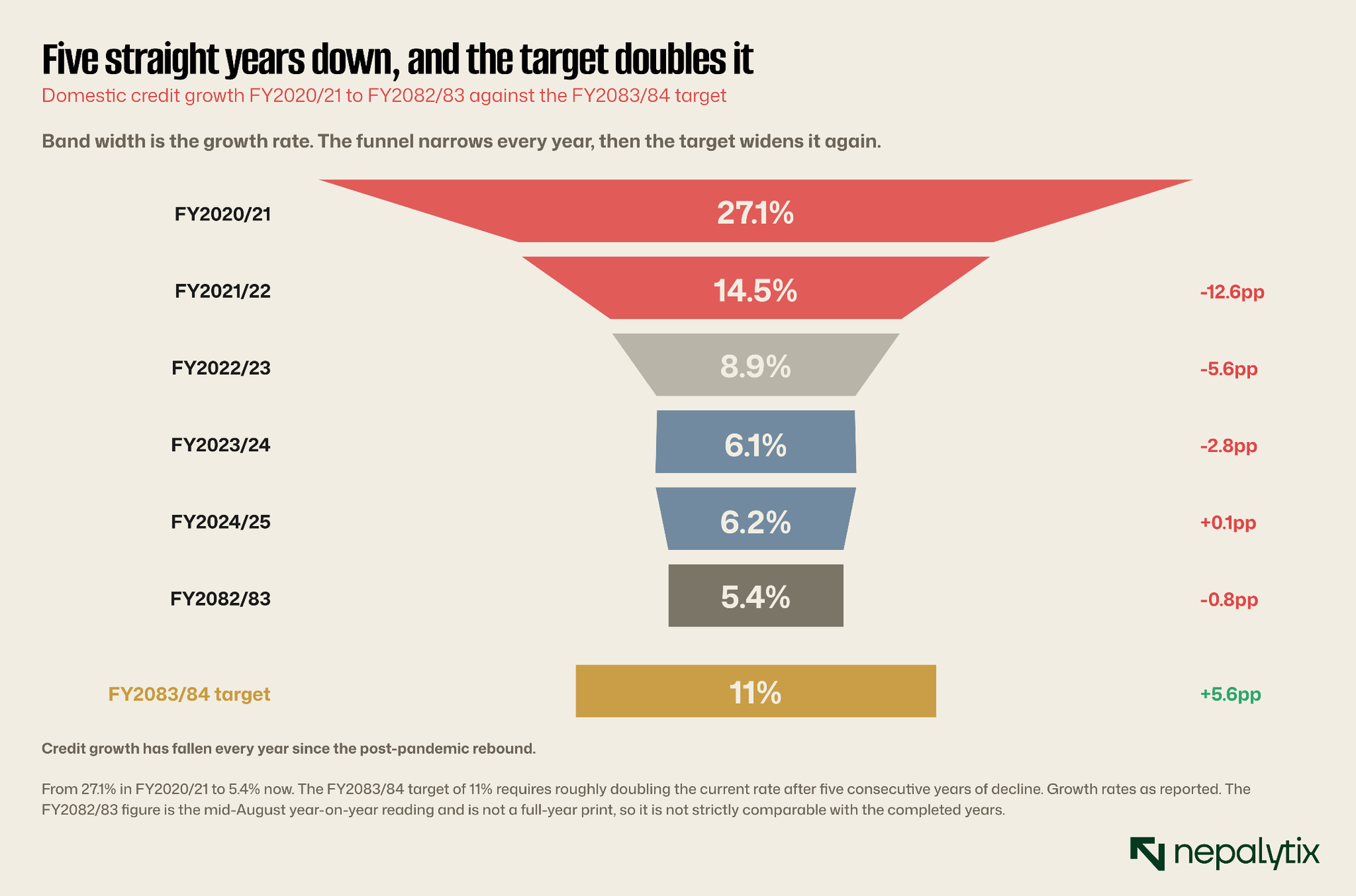
Credit growth was 27.1% in FY2020/21, in the post-pandemic rebound. Then 14.5%. Then 8.9%. Then 6.1%. Then 6.2%. Now 5.4%.
Five consecutive years of deceleration, and the target asks for 11% roughly double the current rate, and a level the system has not seen since FY2021/22.
What would have to change for that to happen? Not rates: they are already at generational lows. Not capacity: banks have Rs 1.56 trillion spare. Not regulation: the credit-to-deposit ceiling is nowhere near binding. It would require borrowers to appear, in numbers that have been shrinking for half a decade.
No class of lender is anywhere near its ceiling
One response to the above is that the aggregate hides tightness somewhere that some institutions are constrained even if the system is not. The class-level data does not support it.
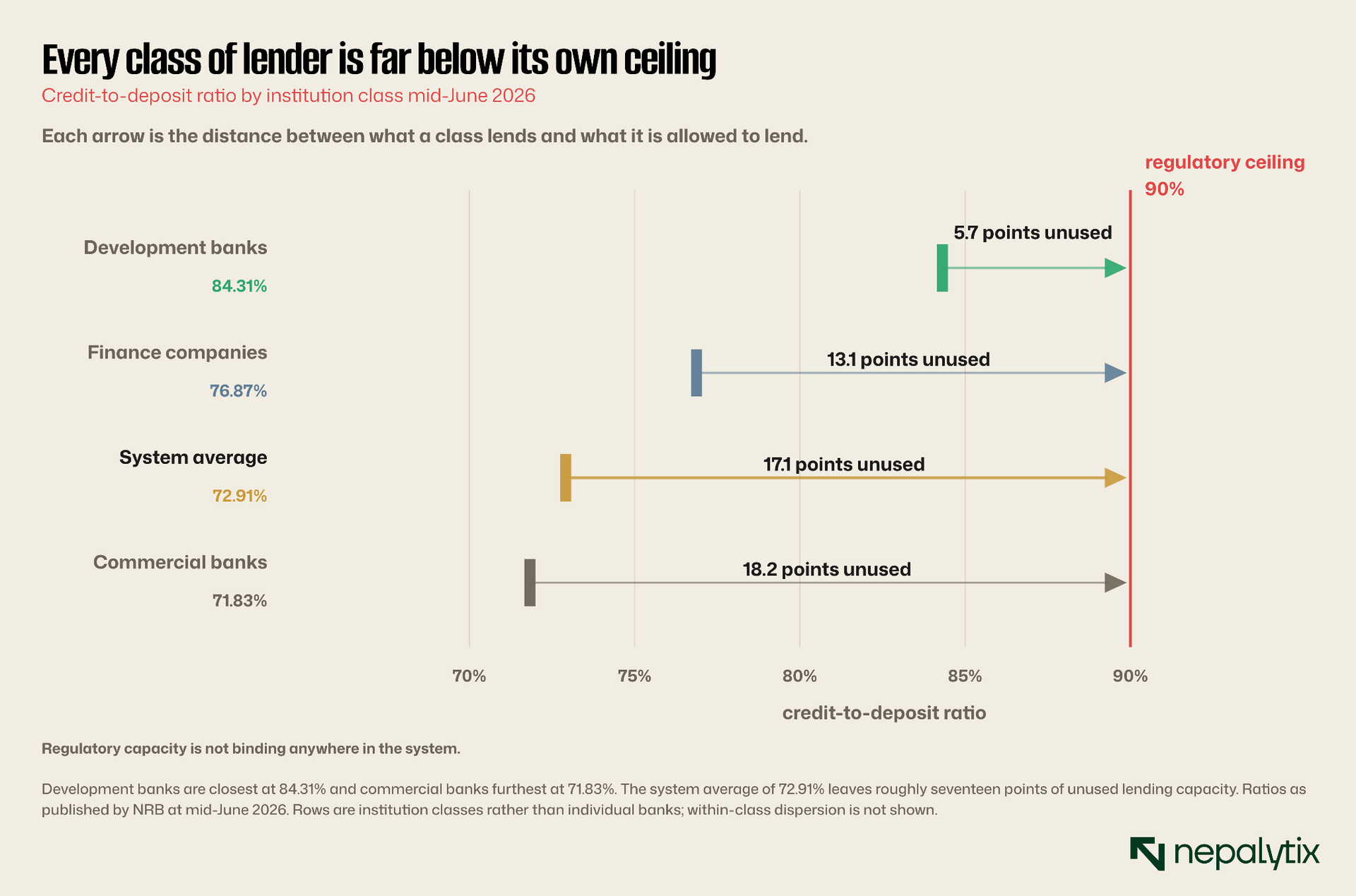
Development banks are closest to the limit at 84.31%, and even they have nearly six points of room. Finance companies sit at 76.87%. Commercial banks which hold the overwhelming majority of the system's assets — are at 71.83%, more than eighteen points below the ceiling.
The system average of 72.91% translates to roughly Rs 1.4 trillion of lending the rules permit and the banks are not doing.
What the CD ratio actually tells you
The credit-to-deposit ratio is the share of deposits a bank has lent out. NRB caps it at 90%, and the cap exists to stop banks lending so aggressively that they cannot meet withdrawals.
A high ratio near the cap means a bank is constrained, it wants to lend more and cannot. A low ratio means the opposite: it can lend and is not. When every class in the system sits well below the cap, the regulation is not doing anything, and any policy measure aimed at loosening capacity is aimed at a constraint that does not exist.
One qualification. Class averages conceal individual banks, and independent analysis of Q2 FY2082/83 results found some commercial banks running much closer to the limit, Everest at 80.19% and Nabil at 78.12% on that data. So a handful of institutions genuinely are constrained. But a system in which the tightest large bank sits ten points below the cap while the average sits eighteen points below is not a system where regulation is throttling credit.
One target requires borrowers to appear, the other requires nothing
It is worth seeing the two headline numbers side by side, because they are not the same kind of thing at all.
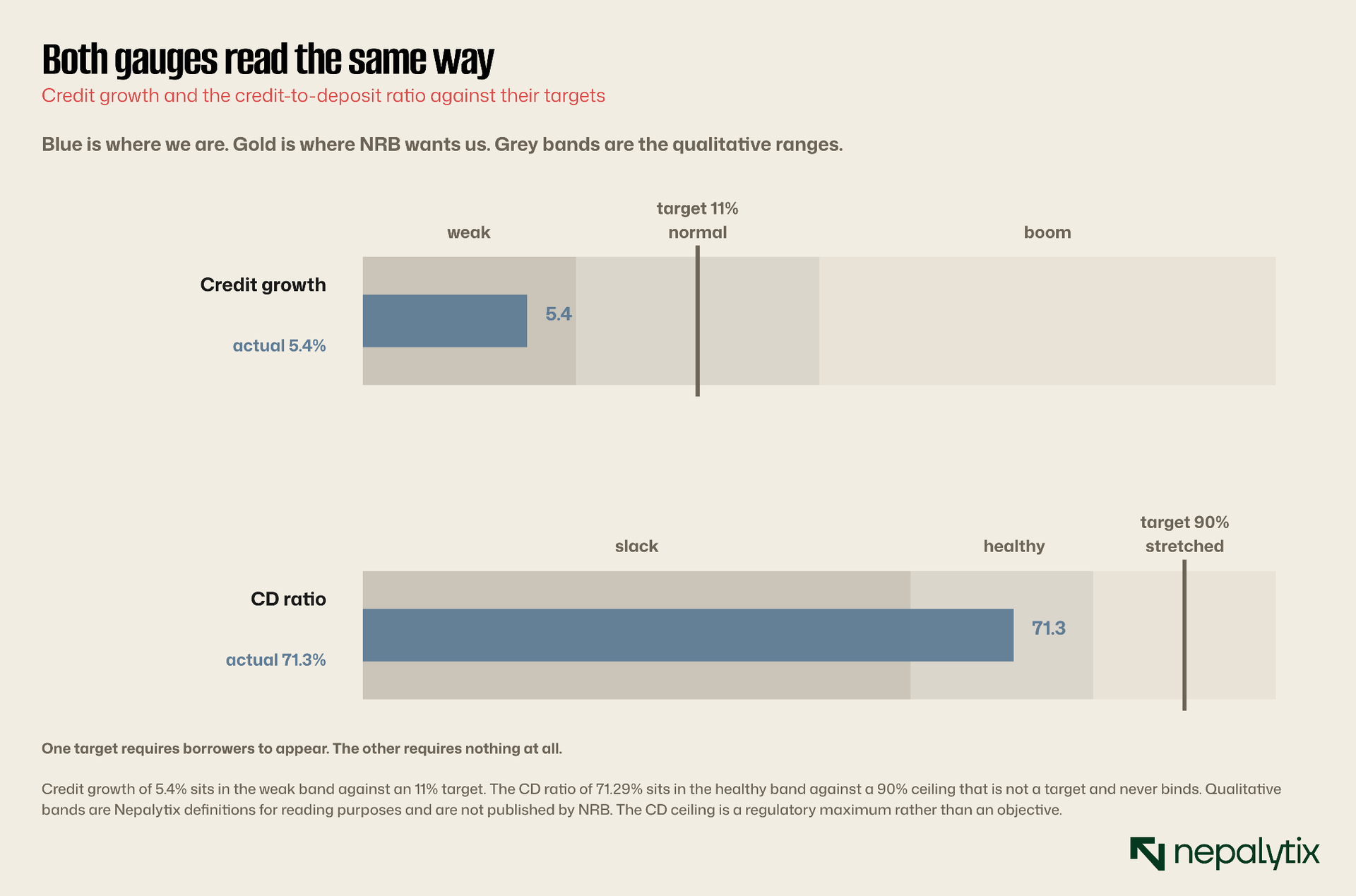
Credit growth at 5.4% sits in the weak band, well short of an 11% target that would require a genuine change in borrower behaviour.
The CD ratio at 71.29% sits comfortably inside the healthy band, and the 90% figure above it is not a target at all, it is a ceiling nobody is approaching. A bank that never reaches it has not failed at anything.
Reading a policy well includes noticing when two numbers presented with equal weight carry entirely different obligations. One is a demand forecast dressed as a target. The other is a regulatory maximum that binds nobody.
Industry is running at 42% of capacity, that is the whole story
If capacity, rates and regulation are not the constraint, what is? The Nepal Bankers Association has said so directly and the number is the most important one in this note.
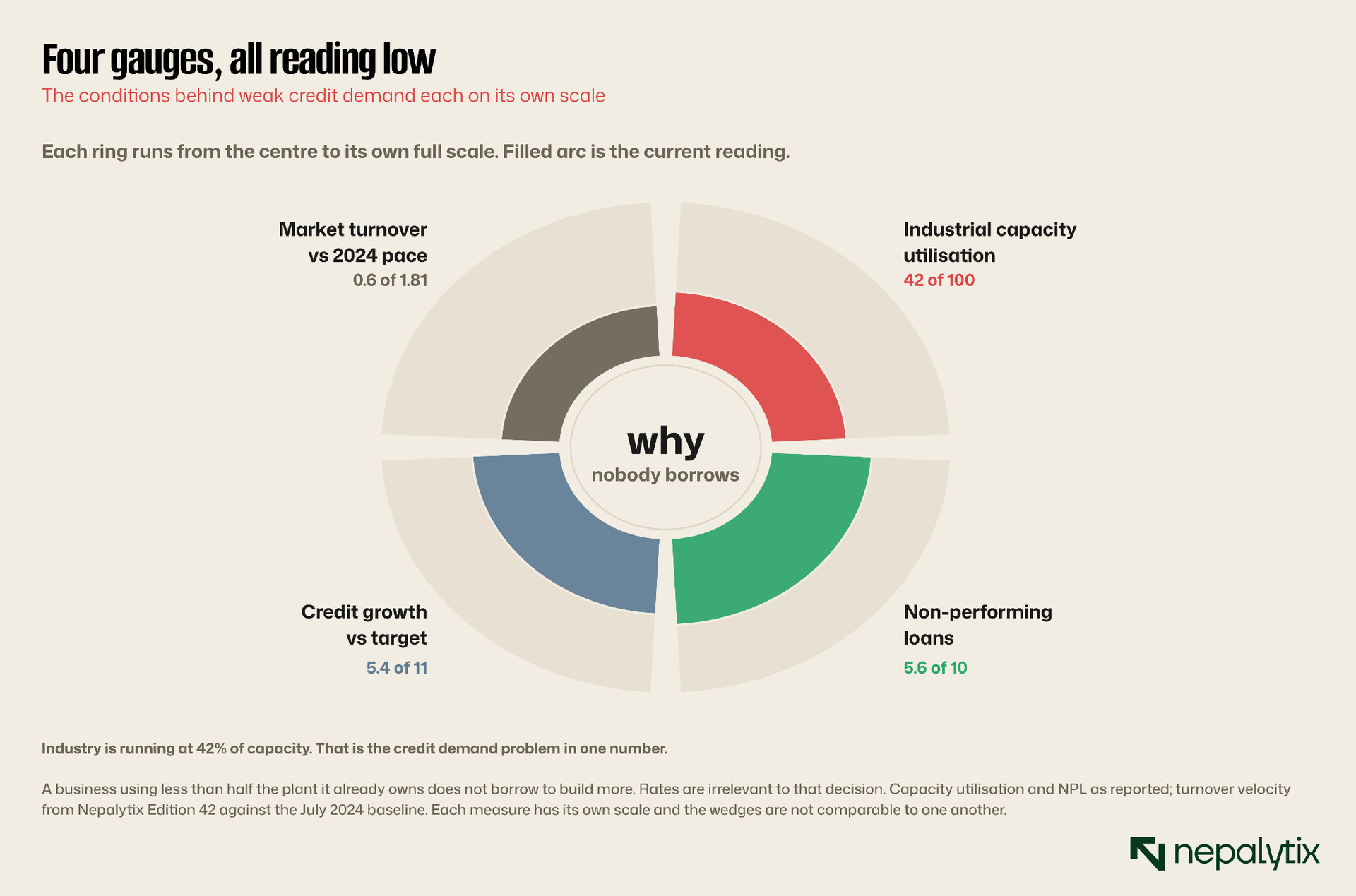
Nepali industry is operating at roughly 42% of capacity. Association President Santosh Koirala has been explicit: banks are willing to lend and cannot because industries are running at less than half their capacity and very few new businesses are being established.
Think about what that means for a lending decision. A manufacturer using 42% of the plant they already own has no reason to borrow to build more. The marginal return on new capacity is negative when existing capacity is idle and no interest rate makes that arithmetic work. A rate cut changes the cost of borrowing; it does not create a reason to borrow.
The other three gauges compound it. Non-performing loans at 5.6% and rising make banks more selective at exactly the moment they most want volume. Stock market turnover at a third of its 2024 velocity removes the wealth effect that supports consumer borrowing. And new business formation is, per the same source, negligible.
Nepal does not have a shortage of funds. It has a shortage of quality credit demand, and that is not a monetary condition.
There is a second-order effect worth naming. Excess liquidity does not sit still, it goes somewhere, and where it goes is government paper and deposits at the central bank. NRB issued Rs 200 billion of bonds in the month of Poush alone to absorb surplus funds, which is roughly 13% of the current excess pile removed in a single month, and pressure on rates still did not fully ease.
That is a central bank simultaneously trying to absorb liquidity and expand credit. Both are defensible in isolation. Together they describe an institution managing a problem it cannot solve with the tools it has.
The policy is aimed at constraints that are not binding
Set each of the eight sector measures against the constraint it relieves, and the pattern is uncomfortable.
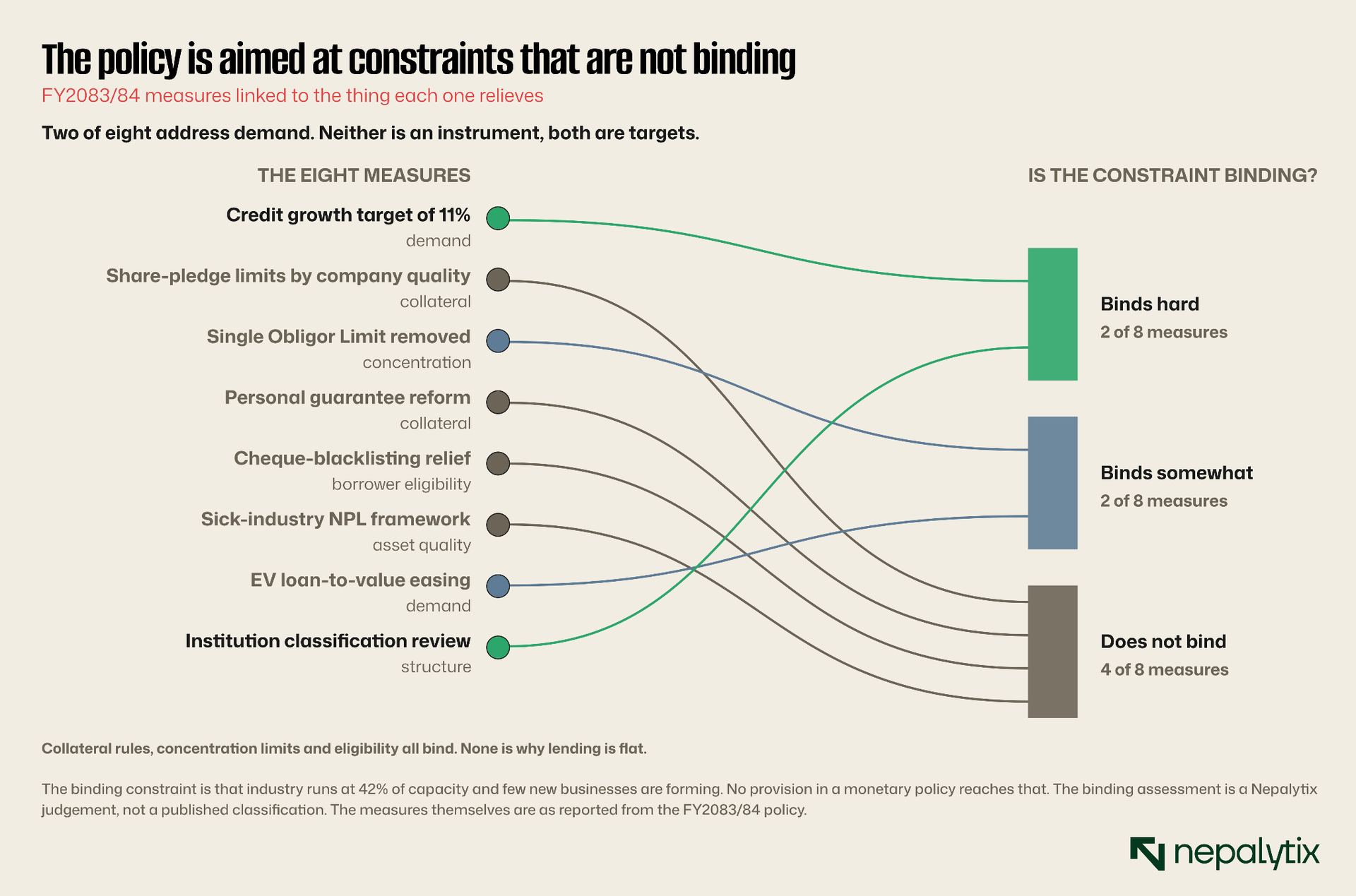
Quality-linked share-pledge limits address collateral. Removing the Single Obligor Limit addresses concentration. Personal-guarantee reform and cheque-blacklisting relief address borrower eligibility. The sick-industry framework addresses asset quality. Institution reclassification addresses structure.
All of these are sensible measures. Several are overdue. Not one of them addresses the fact that a factory running at 42% of capacity has nothing to borrow for.
Two measures touch demand at all, the credit growth target itself, and the easing of loan-to-value requirements on large electric public-transport vehicles. The first is a target rather than an instrument. The second is genuinely demand-creating and is confined to one narrow category of asset.
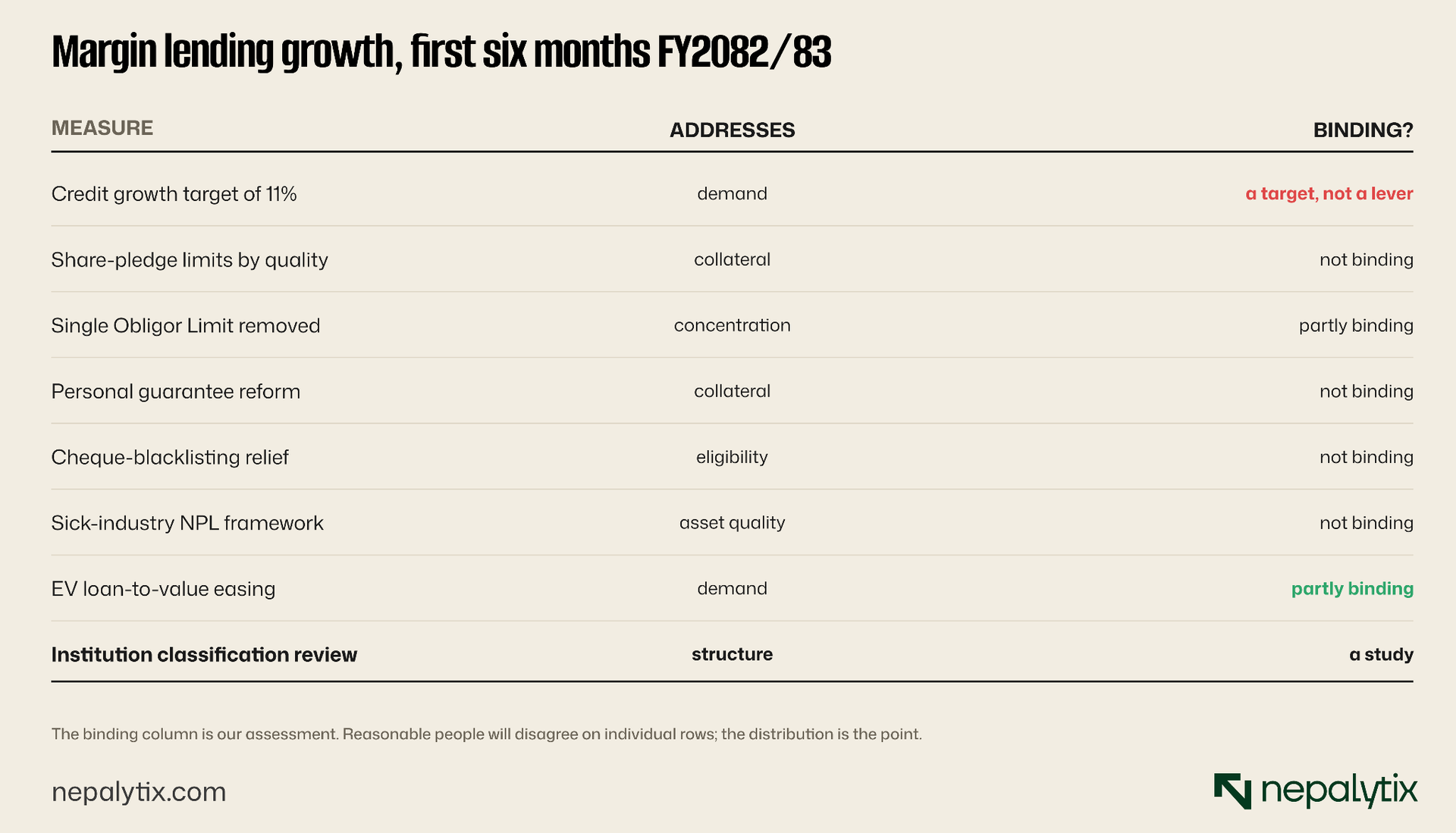
Where the credit actually went instead
One part of the loan book did grow and it says something about where confidence sits.
In the first six months of FY2082/83, margin lending loans against shares grew fastest in the mid-sized brackets. Loans between Rs 5 million and Rs 10 million rose 12.8%. Between Rs 2.5 million and Rs 5 million, 10.3%. Below Rs 2.5 million, 7.9%.
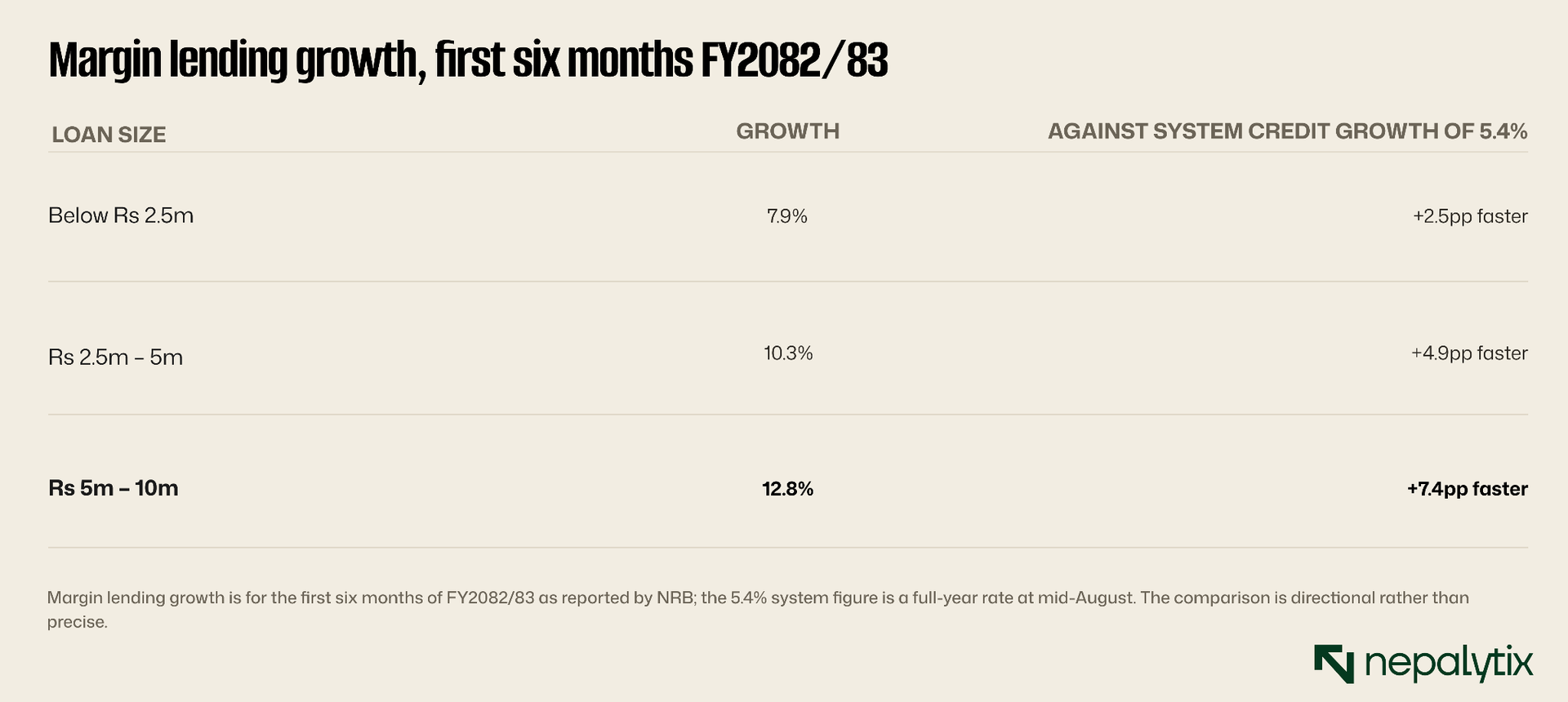
Every bracket is growing faster than the loan book as a whole, and the largest bracket at more than twice the system rate.
That is worth sitting with. In an economy where industry cannot find a reason to borrow, the credit that is growing is money borrowed to buy shares. Not to build capacity, hire staff or expand a business but to take a position in a secondary market that itself trades at a third of its 2024 velocity.
This is not a scandal: margin lending is legal, regulated and useful. But it does mean that the marginal borrower in Nepal right now is more likely to be an investor than a manufacturer and that the quality-linked share-pledge reform in the same policy will land in the one part of the loan book that is already growing.
What we are watching
The excess liquidity number. Rs 1.56 trillion at 10 July is the highest of a three-year run. If it keeps rising through the first quarter of FY2083/84, the credit target is already lost and NRB will be absorbing rather than expanding.
Capacity utilisation. The 42% figure is the binding constraint in this note. Any improvement is a leading indicator for credit demand; deterioration means the target is unreachable regardless of policy.
Q4 and Q1 bank filings. Watch loan growth by sector, not headline profit. If margin lending continues to outpace the book, the composition of Nepali credit is changing in a way nobody has decided on.
The share-pledge rule when it is written. The definition of "company quality" will determine which securities are cheapest to finance. In a market where margin lending is the fastest-growing credit category, that definition is a market structure decision.
NRB's absorption operations. Rs 200 billion of bonds in Poush alone tells you the central bank is fighting its own liquidity. If absorption continues at that scale alongside an expansionary credit target, the policy is arguing with itself in public.
The FY2083/84 policy is not a bad document. Its measures are mostly sensible and several are overdue. But it is a supply-side response to a demand-side problem published by an institution that says so in its own text and the gap between the Rs 652 billion it wants lent and the Rs 1.56 trillion already sitting idle is the clearest statement of that mismatch available.
Disclaimer
This report has been prepared by Nepalytix for informational and educational purposes only and does not constitute investment advice, an offer, or a solicitation to buy or sell any securities.
The information contained in this report is based on sources believed to be reliable; however, Nepalytix does not guarantee its accuracy, completeness, or timeliness. Opinions, estimates, and projections expressed herein are those of the authors as of the date of publication and are subject to change without notice.
Investing in securities involves risks, including the possible loss of principal. Past performance is not indicative of future results. Readers are advised to conduct their own independent research and consult with a qualified financial advisor before making any investment decisions.
Nepalytix and its contributors may hold positions in the securities discussed in this report at the time of publication or thereafter.
Neither Nepalytix nor any of its affiliates accept any liability for any loss arising from the use of this report or its contents.