Reliance Spinning Mills: A subsidised profit and a fantasy price
Reliance Spinning Mills is Nepal's leading textile exporter, but its lofty valuation rests on government subsidies.
RSML is the best textile asset in Nepal and one of its more troubling stocks. The record profit everyone celebrates is mostly a government cheque; the balance sheet carries a bill larger than a year's earnings; and at 107× earnings the price has come loose from anything the mill actually does.
In August 2025, Reliance Spinning Mills released its FY 2081/82 accounts and the Nepali financial press reported, more or less in unison, that the company had earned a record profit of Rs 1.48 billion. Fiscal Nepal, ShareSansar, NepseTrading, Lagani News all ran the same number. It was repeated so often it became fact.
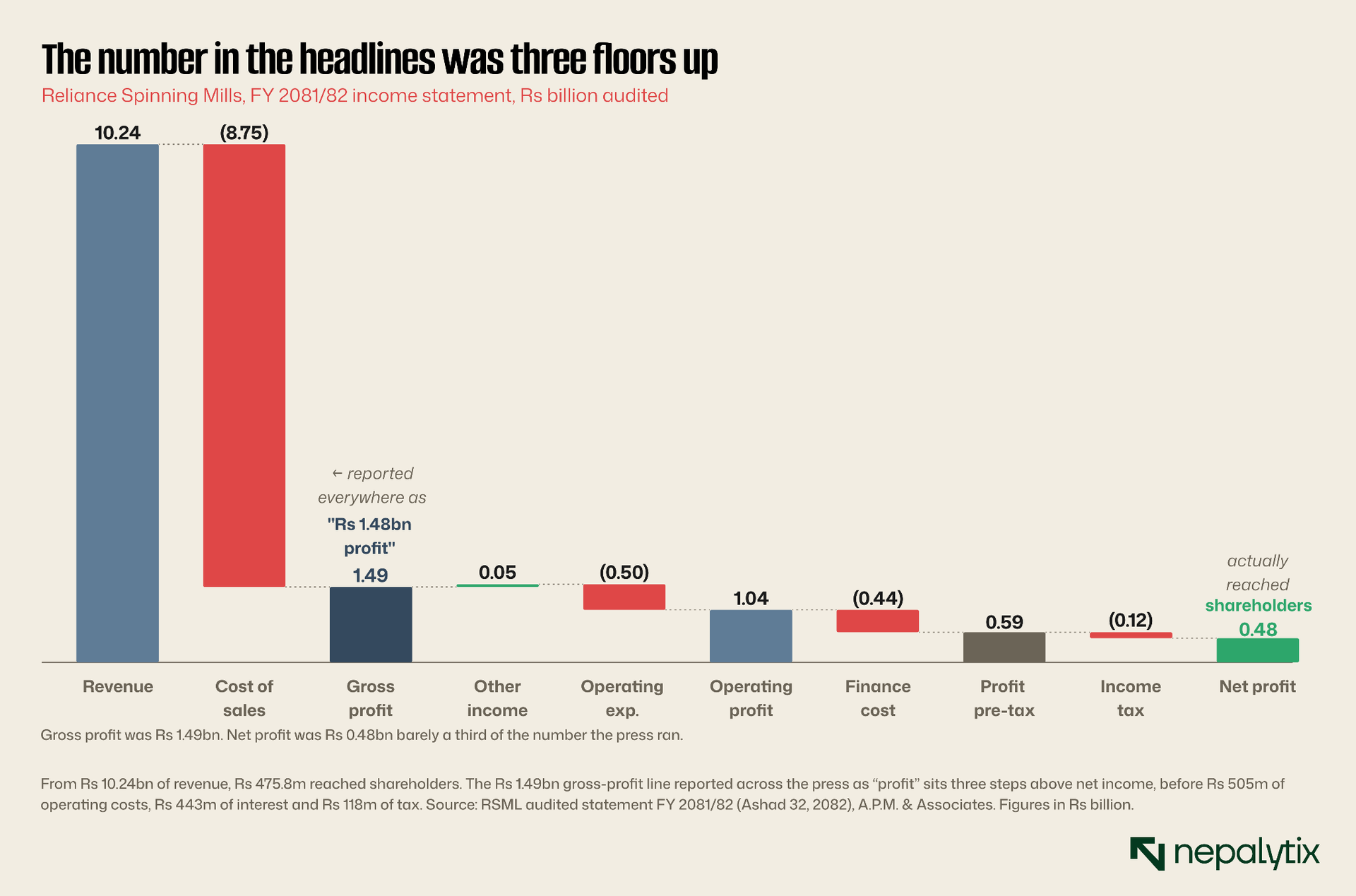
It is not for profit. Rs 1.489 billion is the company's gross profit revenue minus the cost of goods sold, and nothing else. The number that actually belonged to shareholders after selling costs, administration, interest and tax was Rs 475.8 million. Not Rs 1.48 billion. Less than a third of it.
This is not a rounding quibble. It is the difference between a company earning a 14.5% net return on sales and one earning 4.6%. The audited statement is unambiguous from Rs 10.24bn of revenue, Rs 8.75bn is cost of sales leaving the celebrated Rs 1.49bn of gross profit. Then Rs 505m of operating expenses, Rs 443m of interest and Rs 118m of tax carve it down to Rs 476m. The headline writers stopped reading at the first subtotal.
We open here because it sets the tone for the whole file. RSML is a genuinely good industrial business wrapped in a set of financial disclosures that reward careful reading and punish lazy ones. The gap between what the mill is and what the market thinks it is runs through every section that follows.
What the company actually is
Strip away the noise and Reliance Spinning Mills is the real thing: Nepal's largest yarn spinner incorporated in 2051 BS (1994 with two plants at Khanar and Duhabi in Sunsari district running an installed base that has grown from 9,000 spindles at inception to north of 100,000 today. It makes cotton, polyester, viscose, acrylic and textured yarn, employs around 4,000 people and crucially exports roughly three-quarters of what it produces earning about USD 50m a year from customers in India, Turkey, Vietnam and the United Kingdom. In a country whose listed “manufacturers” are mostly cement and beverages sold to Nepalis, RSML is a rare thing: an exporter that competes on world markets and wins.
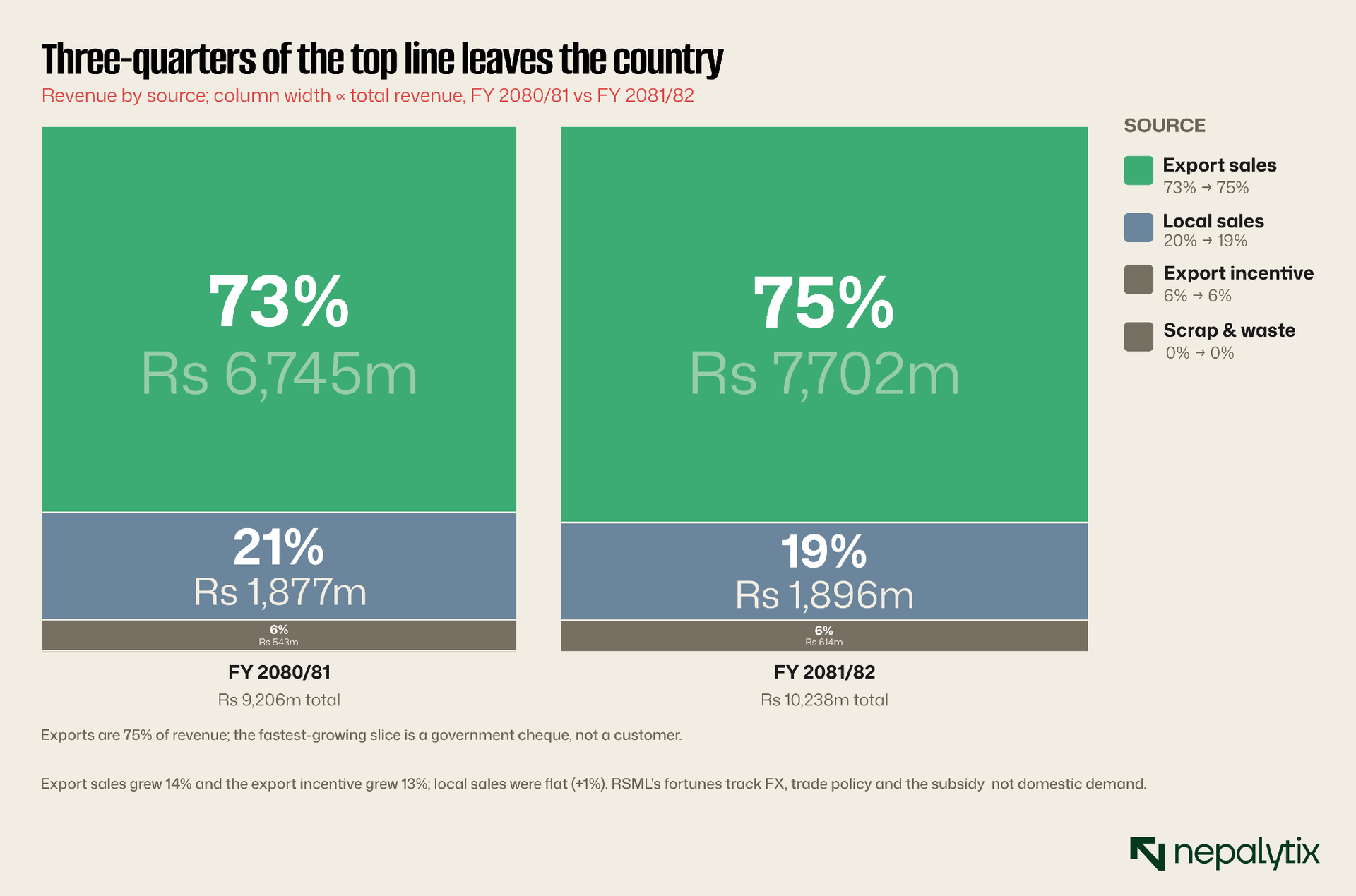
The revenue mix makes the export tilt concrete. Of FY82's Rs 10.24bn top line, export sales are Rs 7.70bn 75% while local sales are a flat Rs 1.90bn (19%). The fastest-growing slice is neither: it is the Rs 614m export cash incentive of which more shortly. What this composition tells you is that RSML's fortunes are driven by the rupee by Indian and Turkish demand and by trade policy in Kathmandu not by domestic consumption. That is a genuine diversifier in a NEPSE dominated by banks and hydropower. It is also a specific bundle of risks that most retail buyers of the stock have not priced.
The industrial track record deserves respect. Thirty years of continuous operation, no shutdown for labour unrest, a management team under managing director Akshay Golyan that the government saw fit to name a Commercially Important Person and a CARE-NP A− issuer rating that signals adequate if not fortress credit quality. None of this is in dispute. The question this note asks is narrower and harder: what are you paying for it and what is the quality of the earnings you are paying for?
The subsidy is the profit
Here is the fact that reframes everything. In FY82 the company recognised Rs 614.2m of export incentive as operating income, a cash subsidy of up to 8% that Nepal pays exporters who ship more than Rs 50 crore in a year. Reported profit before tax was Rs 593.8m. In other words, the incentive was larger than the entire pre-tax profit. Take it away and RSML made a pre-tax loss of Rs 20m on everything else it did. The prior year is starker still: a Rs 100m reported pre-tax profit conceals a Rs 443m loss once the Rs 543m subsidy is removed
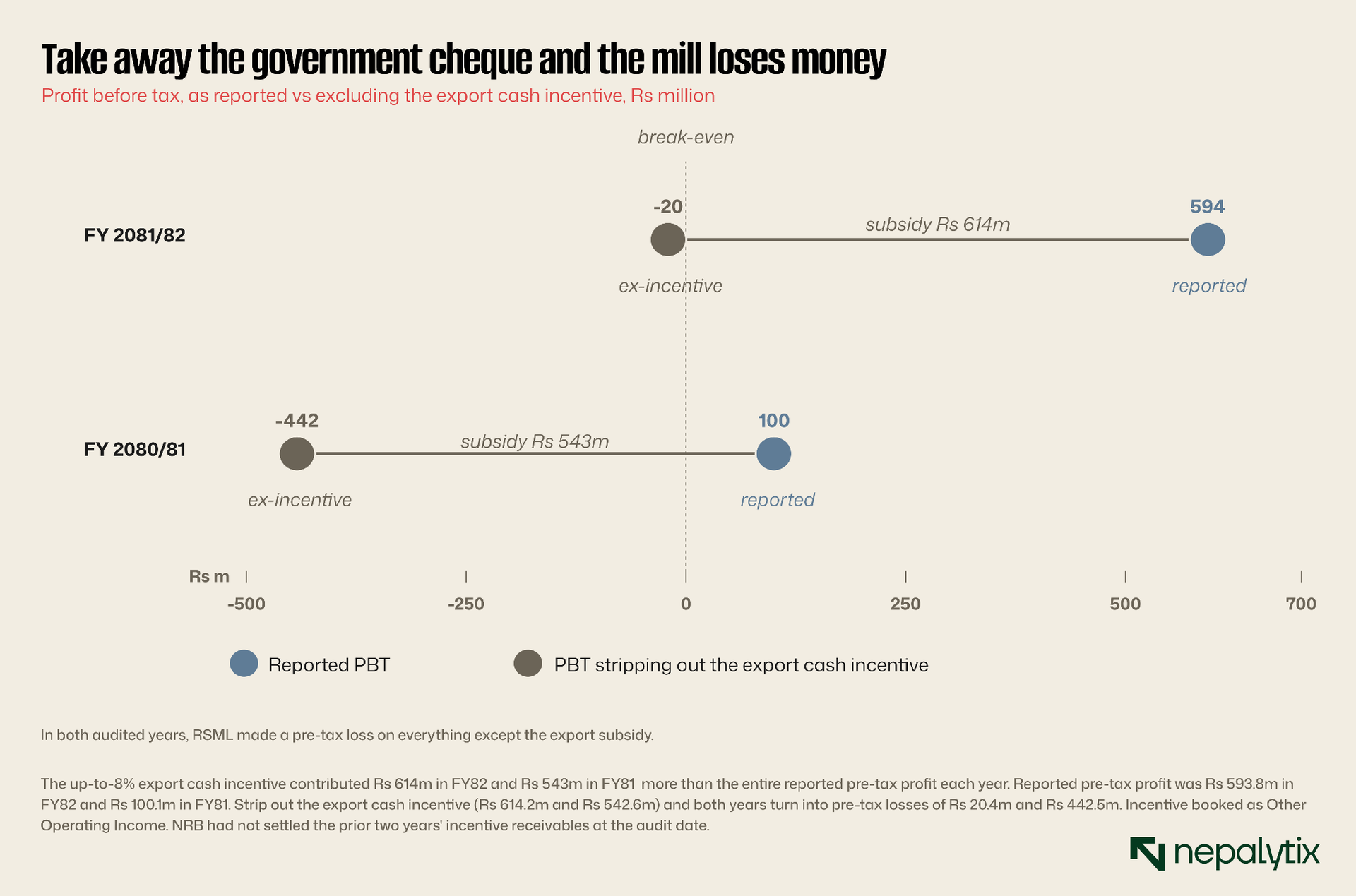
Two audited years, two years in which the mill lost money on a pre-tax basis before the government's export cheque. That is not a footnote. That is the business model.
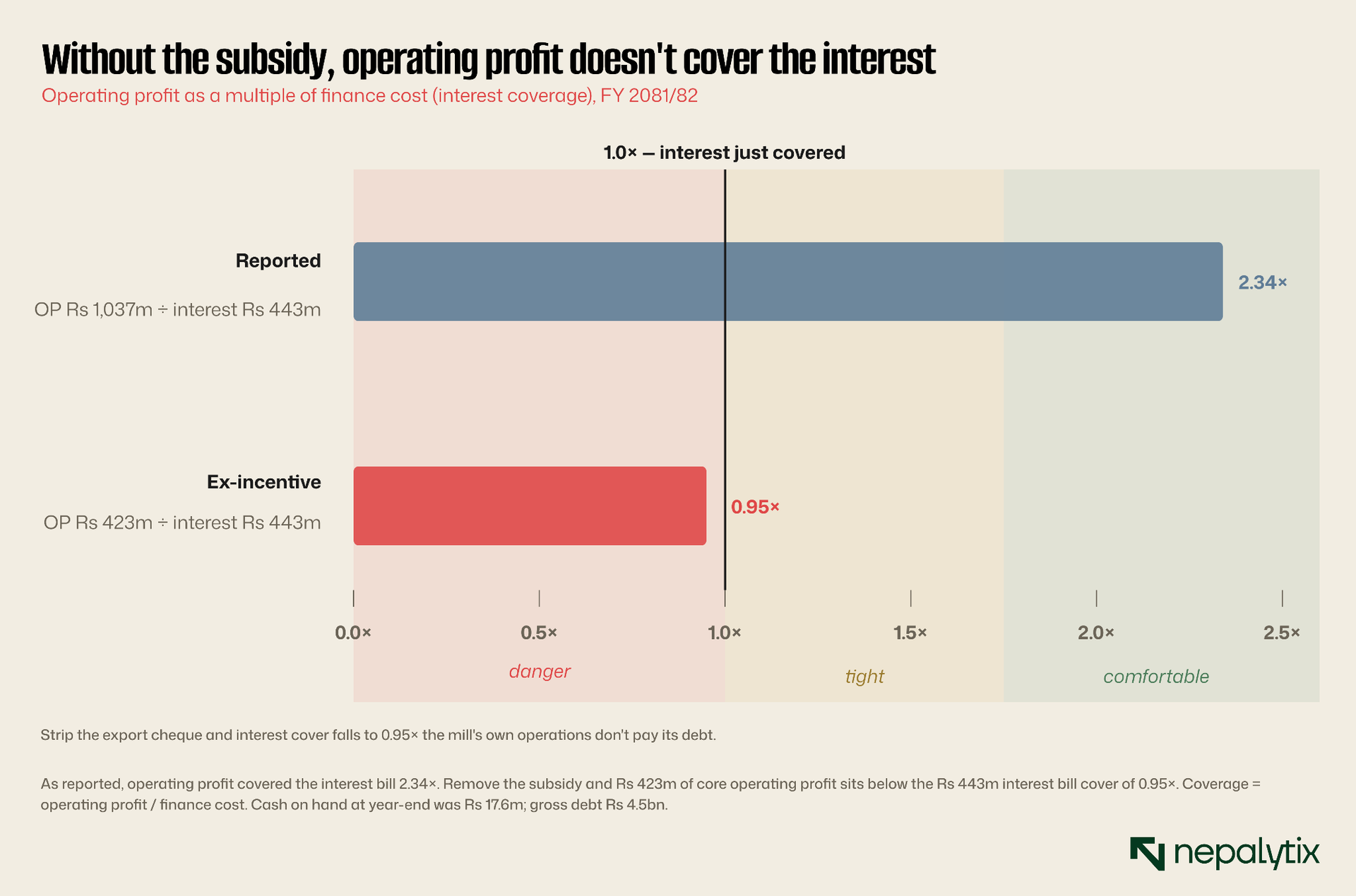
It gets sharper. Look at what the subsidy does to the ability to service debt. As reported, operating profit of Rs 1,037m covers the Rs 443m interest bill a comfortable 2.34 times. But Rs 614m of that operating profit is the incentive. Core operating profit, the profit from spinning and selling yarn is Rs 423m which does not cover the interest bill at all. Coverage ex-subsidy is 0.95×. The mill's own operations, in a record year, did not generate enough to pay their own interest.
And there is a collection problem sitting behind the accounting. The incentive is booked on accrual recognised as revenue when earned but Note 41 discloses that Nepal Rastra Bank had not settled the incentive claims for FY 2079/80 (Rs 438.6m) or FY 2080/81 (Rs 538.5m) as of the audit date. So more than a billion rupees of “profit” recognised across recent years is an uncollected government receivable, dependent on the fiscal room and political will of the state to actually pay. A prudent investor treats these earnings as lower quality than cash from a customer. The market, pricing the stock at 107× those earnings, is doing the opposite.
The export engine runs on two levers Kathmandu controls
An export champion sounds like a company insulated from Nepal's domestic troubles. RSML is the opposite: it is unusually exposed to two things that Kathmandu, not the mill, decides. The first is the export incentive already discussed, a policy subsidy that can be trimmed, capped or delayed at the stroke of a budget and on which the entire reported profit depends. The second is the exchange rate, and here the conventional wisdom about exporters is wrong in RSML's specific case.
The instinct is that a weak rupee is pure upside for an exporter, because dollars convert to more rupees. But RSML both imports its principal raw material cotton and man-made fibre are bought abroad, priced in hard currency and carries dollar debt. Note 45 shows USD 4.7m of foreign-currency borrowings and USD 9.8m of other foreign payables against just USD 0.66m of dollar receivables. The company has structurally short dollars on its balance sheet. So while a soft rupee flatters the top-line export receipts, it simultaneously raises the cost of imported cotton and the rupee cost of servicing dollar liabilities. The net foreign-exchange line was a Rs 50.2m expense in FY82, up from Rs 28.1m currency moved against the company not for it in the record year.
The takeaway is not that RSML is FX-doomed; it manages the exposure and keeps foreign receivables short-dated. The takeaway is that the simple “weak rupee = happy exporter” thesis that props up a lot of retail enthusiasm for this stock does not survive contact with the notes. RSML's margin is a tug-of-war between export prices, imported-input costs and a policy subsidy of three moving parts, at least two of them outside management's control.
Where the nine-fold jump came from
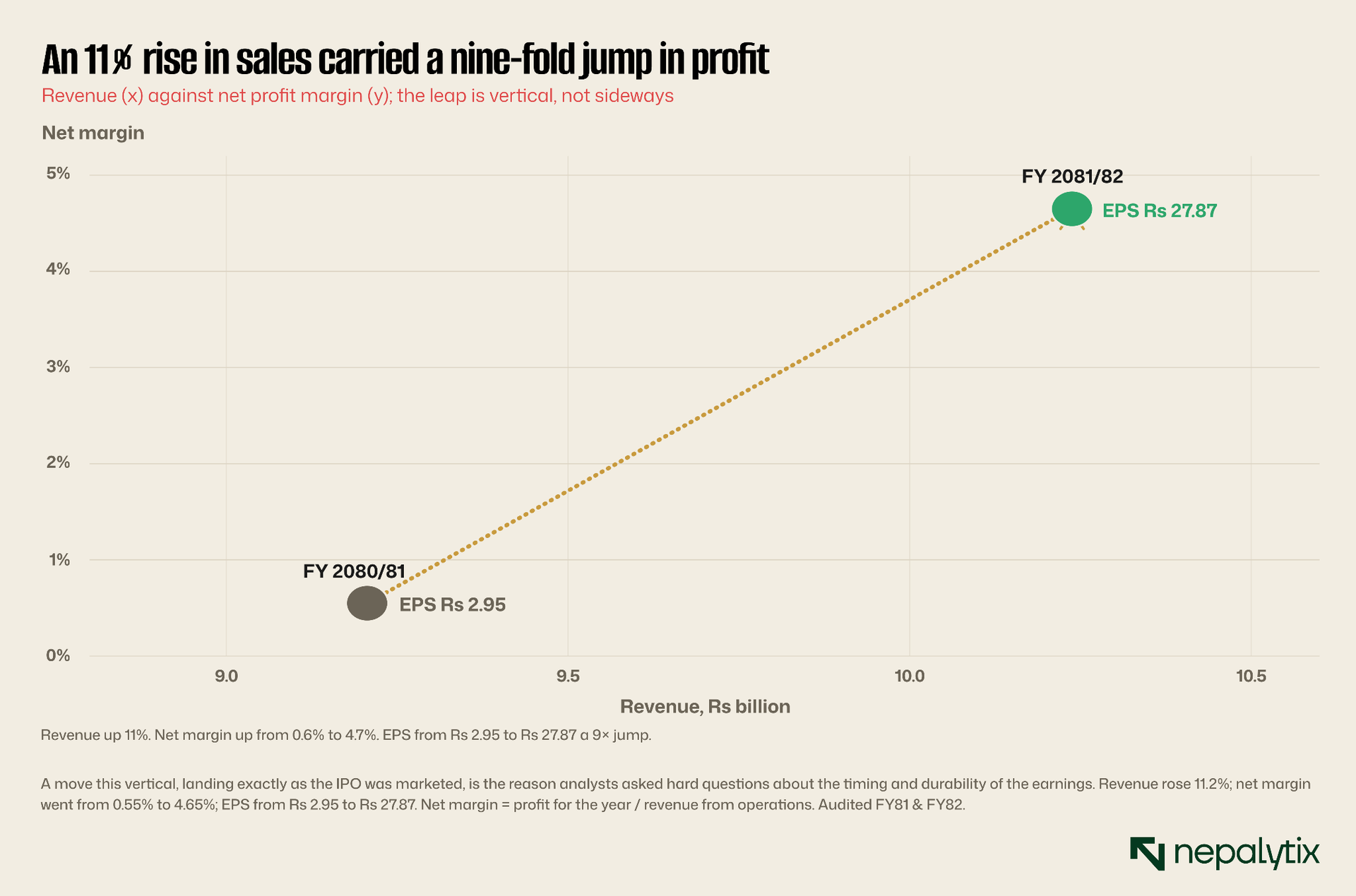
Net profit went from Rs 50.4m to Rs 475.8m in a single year, a 9× jump, EPS from Rs 2.95 to Rs 27.87 and it landed precisely as the company was marketing its IPO. That timing alone earned the numbers a hard look from local analysts and they were right to look. The move is almost entirely a margin story, not a sales story: revenue rose only 11% but net margin went from 0.6% to 4.7%.
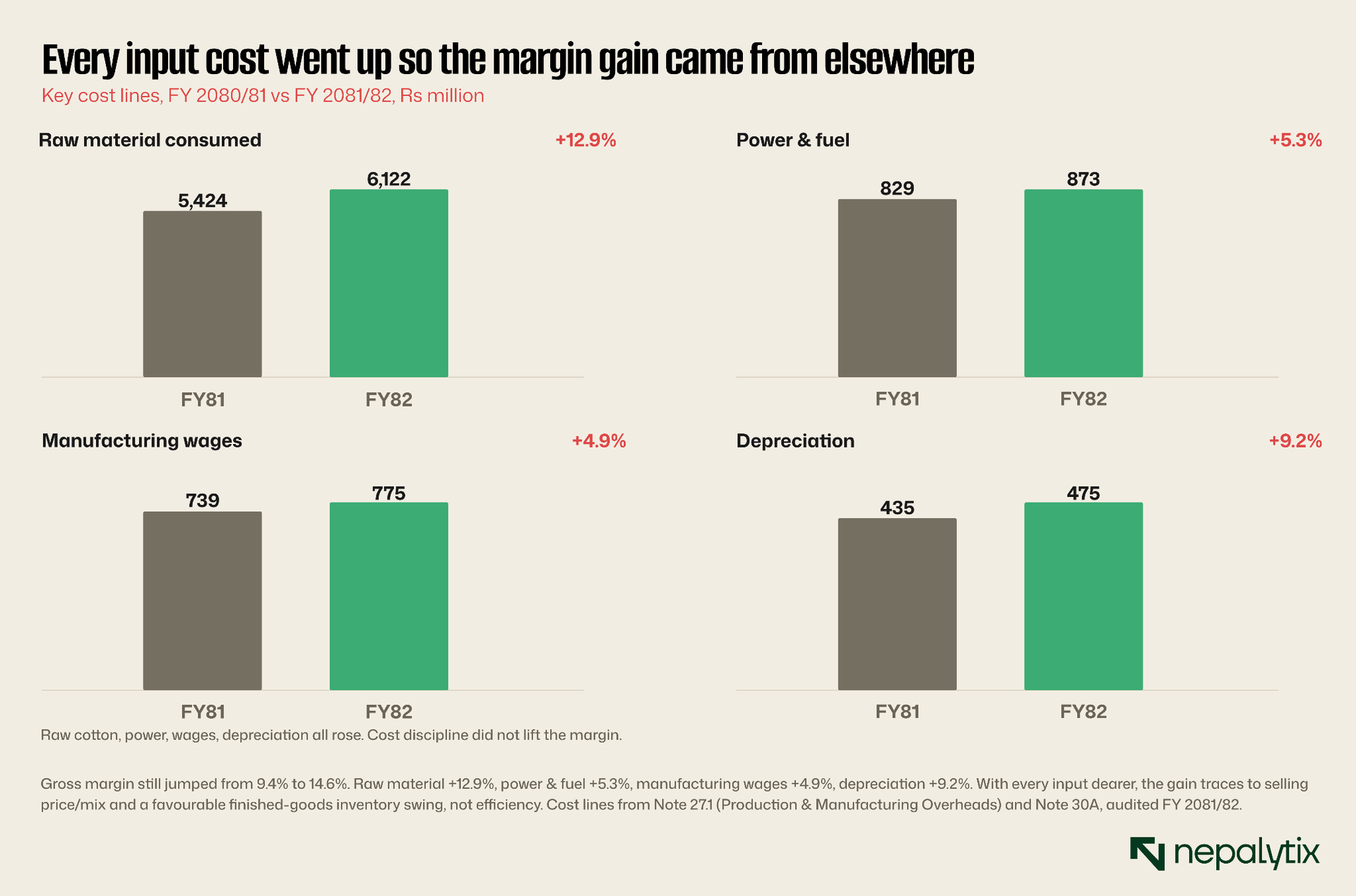
So what lifted the margin? Not cost control. Every major input line rose: raw cotton and fibre consumption up 12.9%, power and fuel up 5.3%, factory wages up 4.9%, depreciation up 9.2%. When all your costs go up and your gross margin still expands by five points, the explanation lies in price, mix and accounting not efficiency.
Two mechanisms did most of the work. First, selling prices and product mix improved, plausibly helped by a weaker rupee flattering export receipts. Second and less flattering a swing in finished-goods inventory. In FY81 the company drew down finished goods, which added Rs 445m to cost of sales; in FY82 it built finished goods, which subtracted Rs 101m. That Rs 546m swing in the inventory-change line is a real accounting effect that lowered reported cost of sales in the good year and raised it in the weak one exaggerating the year-on-year margin improvement. It is legitimate under NFRS. It is also the kind of thing that makes a one-year earnings leap look more durable than it is. The separate observation by some analysts that finance costs behaved oddly relative to rising debt is worth flagging but overstated: audited finance cost actually fell modestly from Rs 472.7m to Rs 443.4m as some borrowing costs were capitalised against expansion. The real earnings-quality question is the subsidy and the inventory swing not the interest line.
The balance sheet and the cloud over it
RSML carries Rs 4.5bn of gross debt, a Rs 3.45bn term loan from a consortium led by Rastriya Banijya Bank, plus Rs 1.05bn of working-capital lines against Rs 7.5bn of equity. Net gearing of roughly 0.5× is not alarming for a capital-intensive spinner. What is alarming is the thinness of the liquidity underneath it: cash at year-end was Rs 17.6m. Seventeen million rupees, for a company turning over ten billion. There are Rs 703m of fixed deposits behind that so total liquid resources are Rs 721m but the operating cash cushion is wafer-thin and the entire model leans on continuously rolled bank lines secured against fixed assets and personal guarantees from the promoters.
Then there is the NEA problem. Nepal Electricity Authority, following the Girish Chandra Lal commission's report on disputed dedicated- and trunk-line tariffs, has issued RSML a demand for Rs 753.7m of back electricity charges. The company disputes it, has filed for administrative review, deposited a token Rs 27.5m and taken the matter to the High Court and it has provisioned nothing. That single contingent claim is larger than the entire FY82 net profit. Stack it with Rs 752m of performance guarantees and Rs 406m of unexpired letters of credit and you have Rs 1.9bn of off-balance-sheet exposure sitting above Rs 0.7bn of liquid assets.
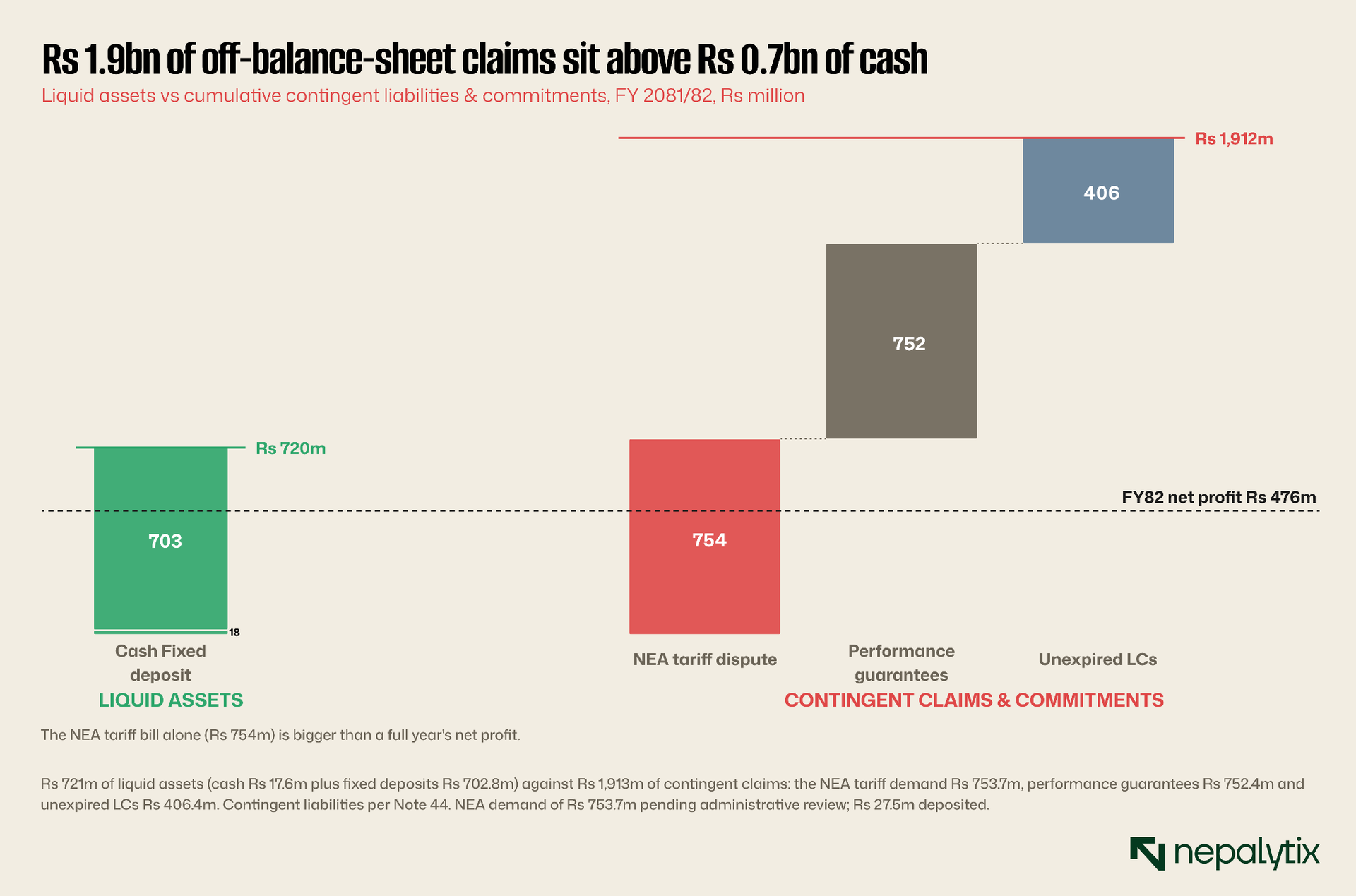
We are not predicting the NEA bill crystallises, the company's legal position on load-shedding-adjusted supply is arguable, and the post-GenZ government has signalled an instalment route. But an investor paying a triple-digit multiple should know that a single adverse ruling could erase more than a year's earnings and that the company has chosen to reflect that possibility nowhere in its reported numbers.
The IPO nobody could agree on
The way RSML reached the market matters because it colours how much trust to place in the numbers and the people behind them. SEBON approved the prospectus on Ashad 12, 2081 (26 June 2024). Two weeks later, on Ashad 26, following a letter from Parliament's Public Accounts Committee, SEBON abruptly suspended the issue a day before the first tranche was due to open for Nepalis abroad. The company sued the government, and in September 2025 the court annulled the suspension and ordered the regulator to let the issue proceed. Along the way, local commentators noted that two different versions of the prospectus had circulated, and that the profit surge conveniently arrived just as the book was being marketed.
None of this is proof of wrongdoing and the court sided with the company. But the sequence, a parliamentary committee intervening, a regulator reversing itself, duelling prospectuses, and a 9× earnings jump timed to the roadshow is exactly the kind of governance texture a careful investor files away. It tells you the disclosure environment around this company is contested rather than pristine and that the promoters are willing to litigate the state to get their way. Read alongside the accounting choices already discussed, the inventory swing, the unprovisioned NEA claim, the accrued-but-uncollected subsidy, the picture is not of fraud but of a company that consistently presents itself in the most favourable light the rules allow. Pay the multiple accordingly.
One governance point cuts the other way and deserves credit: the promoters have their own capital and names on the line. The Rs 3.45bn term loan is secured not just on the mill's fixed assets but on personal guarantees from Pawan Golyan, Shashi Kant Agrawal and Akshay Golyan. And the company took no dividend in FY82 after a Rs 341m interim payout the year before conserving cash for the expansion. Owners who guarantee the debt and forgo the dividend are at least, aligned with the durability of the business rather than a quick extraction.
A price detached from the mill
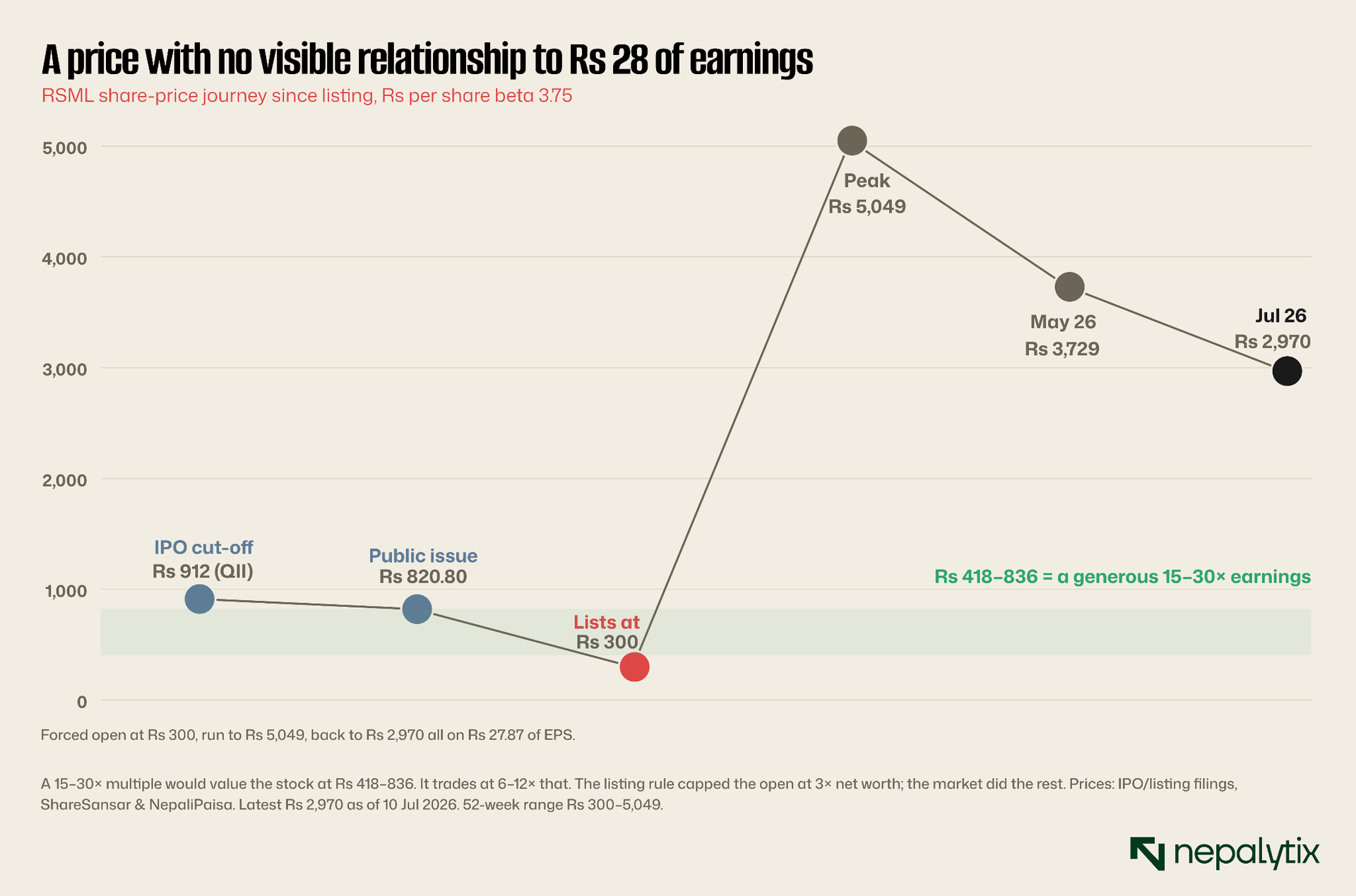
RSML's time as a listed stock has been brief and violent. It came to market through Nepal's second-ever book-built IPO (after Sarbottam Cement), with a QII cut-off of Rs 912 and a public price of Rs 820.80. Then two things collided. SEBON suspended the issue on a letter from the Parliamentary Accounts Committee, a suspension the company fought in court and had annulled in September 2025 and NEPSE's revised listing rule capped the opening price at three times net worth per share. Net worth was Rs 250.80, so the stock was forced to open at Rs 300, far below the Rs 820.80 the public had paid.
What followed had nothing to do with spinning yarn. The shares ran to Rs 5,049, a 16-fold gain off the listing floor, then subsided to Rs 3,729 by May and Rs 2,970 by July. Beta is 3.75 the stock moves nearly four times as hard as the index. On FY82 EPS of Rs 27.87, even a generous 15–30× multiple the kind Nepal awards its blue-chip manufacturers implies a value of Rs 418–836. The stock trades at six to twelve times that.
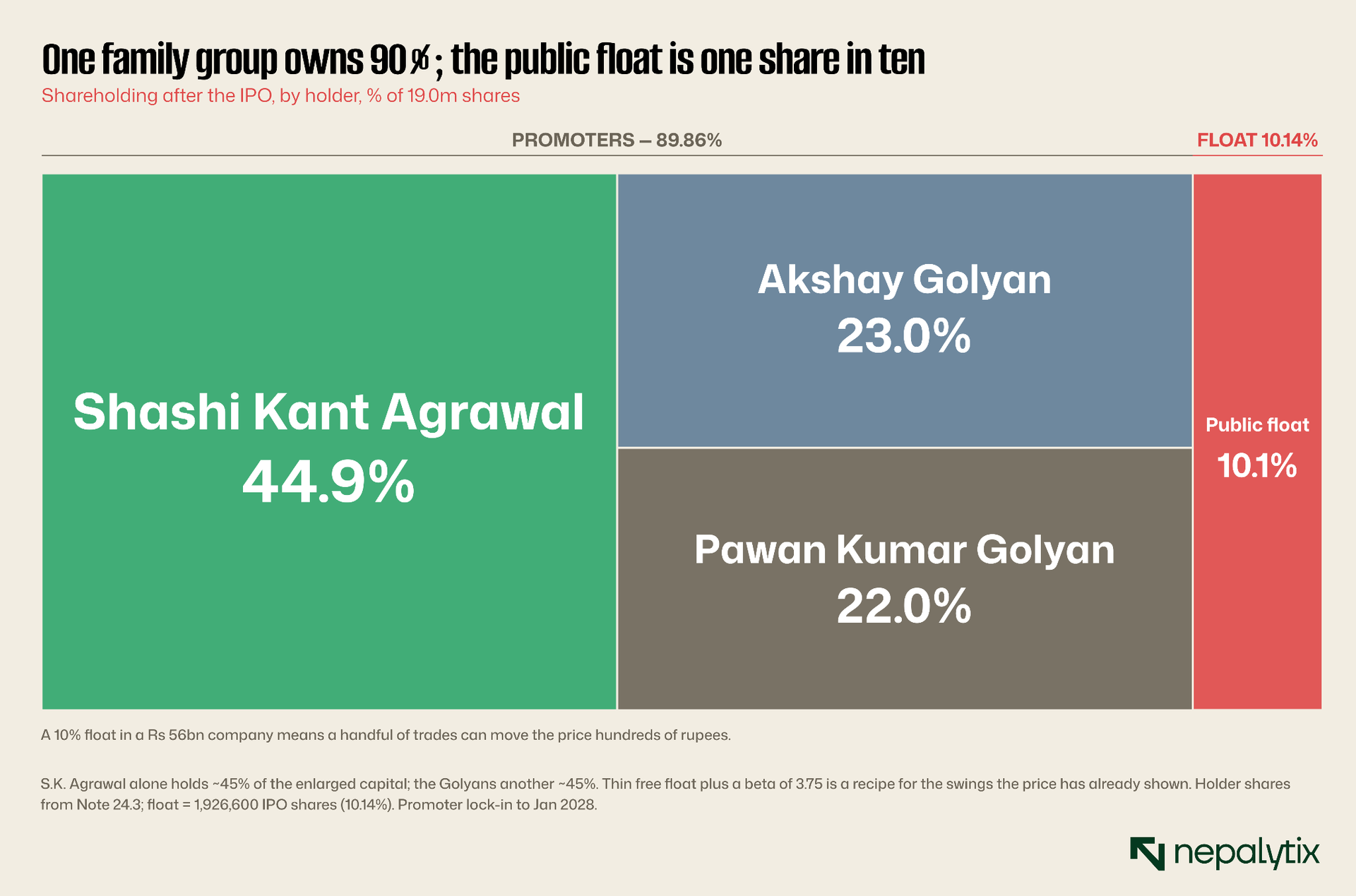
The float explains much of the violence. Only 10.14% of the company is in public hands; S.K. Agrawal holds roughly 45% of the enlarged capital and the Golyan family another 45%, all locked up until January 2028. A Rs 56bn company whose entire tradable supply is a sliver will move hundreds of rupees on a few thousand shares. Thin float plus a 3.75 beta is not an investment characteristic; it is a warning label.
What the mill is worth
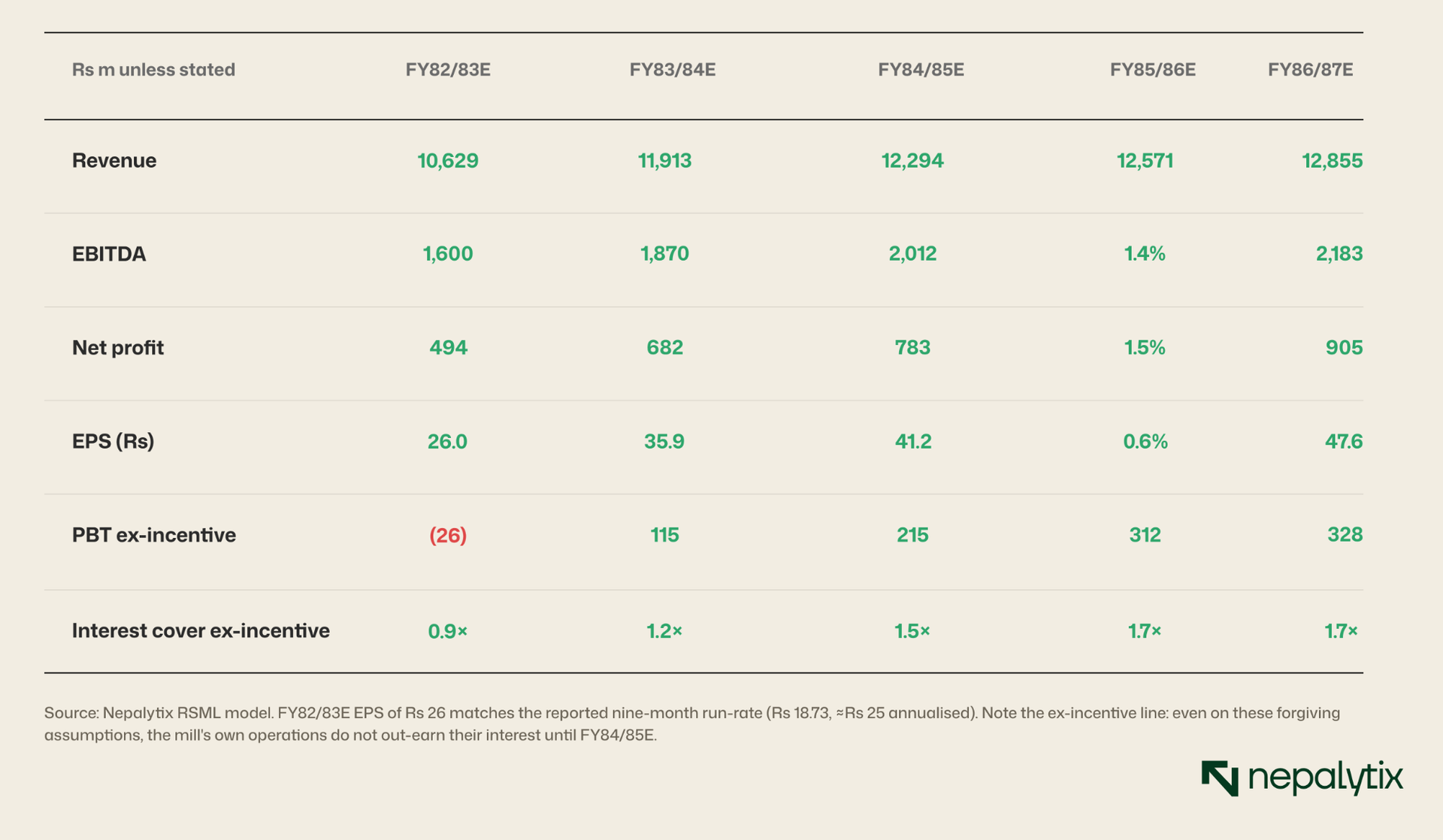
Diagnosis is only half of research; the other half is putting a number on it. So we built a full model, the operating build (spindles, utilisation, realised price and mix), a three-statement projection to FY2086/87 and a discounted-cash-flow valuation cross-checked against the metrics that actually govern a commodity spinner. The model ties the audited accounts to the rupee: it reproduces FY82's Rs 423m of core operating profit, its 0.95× ex-subsidy interest cover and its Rs 27.87 of EPS. That is the anchor. Everything forward flows from explicit, visible assumptions rather than a wish.
Start with the forward numbers because they are more generous to the mill than the bear case requires. We give RSML its Unit C cotton-yarn expansion (capacity rising from 102,824 to 120,824 spindles), a soft rupee and the export incentive held at the statutory 8%. Even so, the shape of the business is unchanged: earnings grind higher on volume not transformation and the core still cannot cover its interest bill without the government cheque.
Now value it. For a capital-intensive, cyclical commodity producer, a headline P/E is the wrong lens depreciation and leverage dominate, and the earnings are subsidy-inflated. So we triangulate four ways and sanity-check with a fifth (Figure 9). A discounted cash flow, at a 13.5% WACC (a 7% Nepali risk-free rate, a frontier equity risk premium, and a fundamental beta near 1.1 not the 3.75 trading artefact) and 3.5% terminal growth, and crediting the subsidy in full, values the equity at Rs 437 a share. On a global spinner's 4–7× EV/EBITDA, Rs 138–390 (midpoint Rs 222). On a normalised 12× earnings, Rs 312. On a 1.3× tangible book stripping out the Rs 3.02bn revaluation reserve that is a valuer's opinion, not earned capital Rs 407. And the asset floor: at an industry-typical replacement cost of roughly USD 1,000 a spindle, the plant would cost about Rs 13.7bn to rebuild worth Rs 521 a share after debt.
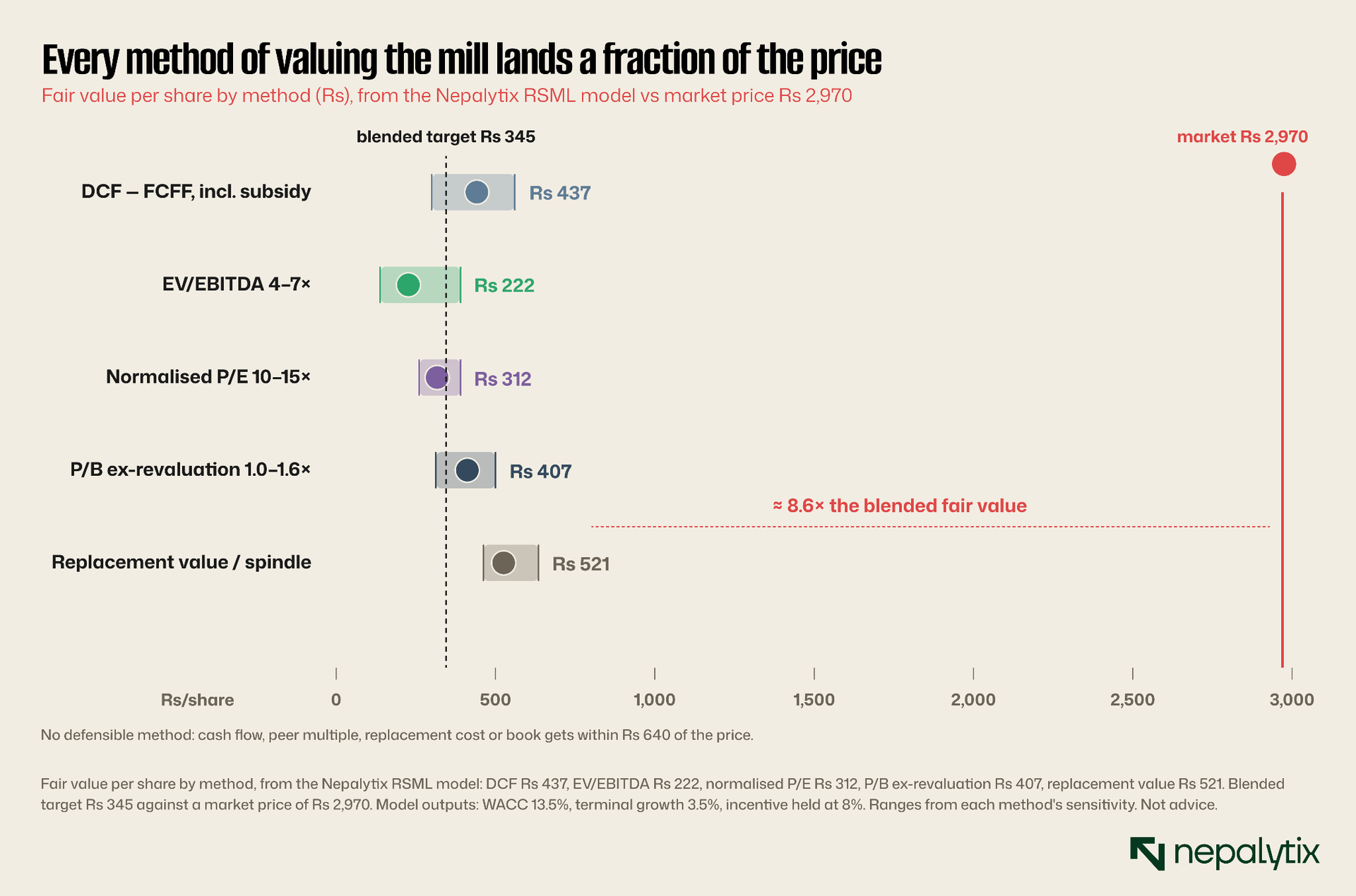
The methods cluster between Rs 220 and Rs 520. The market price is Rs 2,970 roughly nine times the blended Rs 345 target and still five times the most generous method on the board.
Note what the replacement value tells you. The mill's plant would cost more to rebuild (Rs 521 a share) than its cash flows are worth (the DCF's Rs 437). That gap of assets worth more than the earnings they throw off is the signature of a subsidised commodity producer: real steel and spindles on the ground, generating returns that only clear the cost of capital because the state tops them up. It is a reason the shares are not worthless. It is not a reason to pay Rs 2,970 for them.
For context, Nepal's established manufacturing blue chips trade nothing like this. Unilever Nepal on EPS of Rs 659 sits around 70×. Himalayan Distillery trades at 8.7× book; Shivam Cement around 3.4× book; Bottlers Nepal Terai under 4× book. RSML at ~6× book and 107× earnings is priced above companies with longer records, fatter unsubsidised margins and far deeper floats. The premium is not for quality. It is for scarcity and momentum and both can reverse.
The expansion bet
The strategic logic of the IPO is an expansion into cotton yarn, the planned Unit C aimed at the higher-value garment segment that currently relies on imported cotton yarn. The proceeds are earmarked for machinery, land and buildings and additional spinning capacity, and the capex is already visible: RSML spent Rs 638m on property, plant and capital work-in-progress in FY82 up from Rs 241m. Diversifying across cotton, polyester, viscose and acrylic is a genuine strength, because it lets the mill shift its product mix toward whichever fibre market is paying best and cotton yarn opens a premium end of the market.
But expansion is not free and it lands on a balance sheet that is already stretched. New capacity means more capex, more debt or more equity and initially more depreciation and interest before the incremental volumes earn their keep. The company is funding growth while its core operations do not cover their existing interest bill without the subsidy. That is a fine plan if cotton-yarn demand and margins arrive on schedule; it is a fragile one if they arrive late, because there is little cash cushion (Rs 17.6m) to absorb a delay. The expansion is the strongest part of the bull case and financed this way, also a source of execution risk. It is a reason to watch the stock closely; it is not, at 107× earnings, a reason to pay up in advance of the evidence.
The verdict
We want to be fair to the mill because the mill deserves it. RSML is a legitimate export champion in a market starved of them run by operators who have kept a factory running cleanly for three decades and are expanding into higher-value cotton yarn. On a five-to-ten-year view, at the right price, it is exactly the kind of real-economy business a NEPSE portfolio should want to own. If the export incentive regime is stable, if the rupee stays soft and if the NEA claim resolves without a large cash outflow, the industrial story compounds quietly.
But the stock is not the mill. At Rs 2,970 you are paying 107× earnings that are on the company's own audited numbers, entirely a function of a government subsidy the state has not fully paid; carrying an unprovisioned tariff claim larger than a year's profit; on a 10% float that can gap in either direction on a whisper. The bull case requires heroic growth to justify today's price; the bear case requires only that the subsidy tightens, the rupee firms, or the NEA ruling goes the wrong way. That asymmetry is unattractive.
A good company is not a good investment at any price. RSML is a good company at a price that assumes it is something it has not yet proven to be.
We initiate at SELL / Underperform with a target price of Rs 345 the blend of our DCF, EV/EBITDA, normalised-earnings and book-value work, with a range of Rs 222–521 across methods and an asset-based ceiling no higher than Rs 521. Against a market price of Rs 2,970, that is roughly 88% of downside to fair value. We would revisit the rating well before the price reached Rs 345: genuine evidence that margins hold without the inventory tailwind, collection of the outstanding NRB incentive receivables, a clean resolution of the NEA claim, and a Unit C ramp that lifts core (ex-subsidy) returns above the cost of capital would each move the target up. None of that is visible yet. Investors holding from the IPO at Rs 820.80 are sitting on a large paper gain and on our numbers, a price far above what the mill supports a position to trim, not add to. Investors thinking of buying at Rs 2,970 are paying nine times what the business is worth for a story the accounts do not yet tell.
Disclaimer
This report has been prepared by Nepalytix for informational and educational purposes only and does not constitute investment advice, an offer, or a solicitation to buy or sell any securities.
The information contained in this report is based on sources believed to be reliable; however, Nepalytix does not guarantee its accuracy, completeness, or timeliness. Opinions, estimates, and projections expressed herein are those of the authors as of the date of publication and are subject to change without notice.
Investing in securities involves risks, including the possible loss of principal. Past performance is not indicative of future results. Readers are advised to conduct their own independent research and consult with a qualified financial advisor before making any investment decisions.
Nepalytix and its contributors may hold positions in the securities discussed in this report at the time of publication or thereafter.
Neither Nepalytix nor any of its affiliates accept any liability for any loss arising from the use of this report or its contents.