Rights Shares in Nepal: A Complete Guide for Investors
Learn how rights shares work in Nepal, from issue ratios and book closure dates to theoretical ex-rights prices. Understand your options, calculate potential dilution and make sense of what happens when you subscribe or do nothing.
A rights offer looks like a gift: new shares at Rs 100 when the market price is five times that. It is not a gift. It is a bill and anyone who does not pay it loses money. Here is how to read the notice, do the arithmetic and know what usually happens to the price after.
Every few weeks a company on NEPSE publishes a notice that runs to a few lines: a ratio, a price, a book closure date, an opening and a closing date. Hydropower companies have issued most of them recently, often one new share for every share held, at Rs 100. Shareholders read the notice the way they read a bonus announcement as something extra. The commonest question on investor forums the week before book closure is whether to buy the share to "get the rights".
That question has the economics backwards and this piece is about why. We assembled the full register of rights offers on ShareSansar, 323 issues since 2011 and matched them to daily prices from merolagani's charting feed. For 180 of them we have clean price records around the book closure date enough to see what actually happens to the share price before, on and after the date. The arithmetic is simple. What the market does with it is more interesting, and has changed in the last two years.
Why rights issues come in waves
Companies issue rights when they need equity and in Nepal the need has mostly been set by regulators. The register shows two clear waves.
The first, and much the larger, ran from 2015 to 2018. The 2072/73 monetary policy of July 2015 required commercial banks to raise paid-up capital to Rs 8 billion, national development banks to Rs 2.5 billion and national finance companies to Rs 800 million, by the end of FY2073/74. The Insurance Board then told life insurers to quadruple paid-up capital to Rs 2 billion and non-life insurers to Rs 1 billion by mid-July 2018. Banks, development banks, finance companies and insurers that did not merge raised the money from their own shareholders by rights and bonus issues and the number of rights offers went from 26 in 2015 to 50 in 2016 and 69 in 2017. Between 2015 and 2018, 185 offers opened well over half of the register.
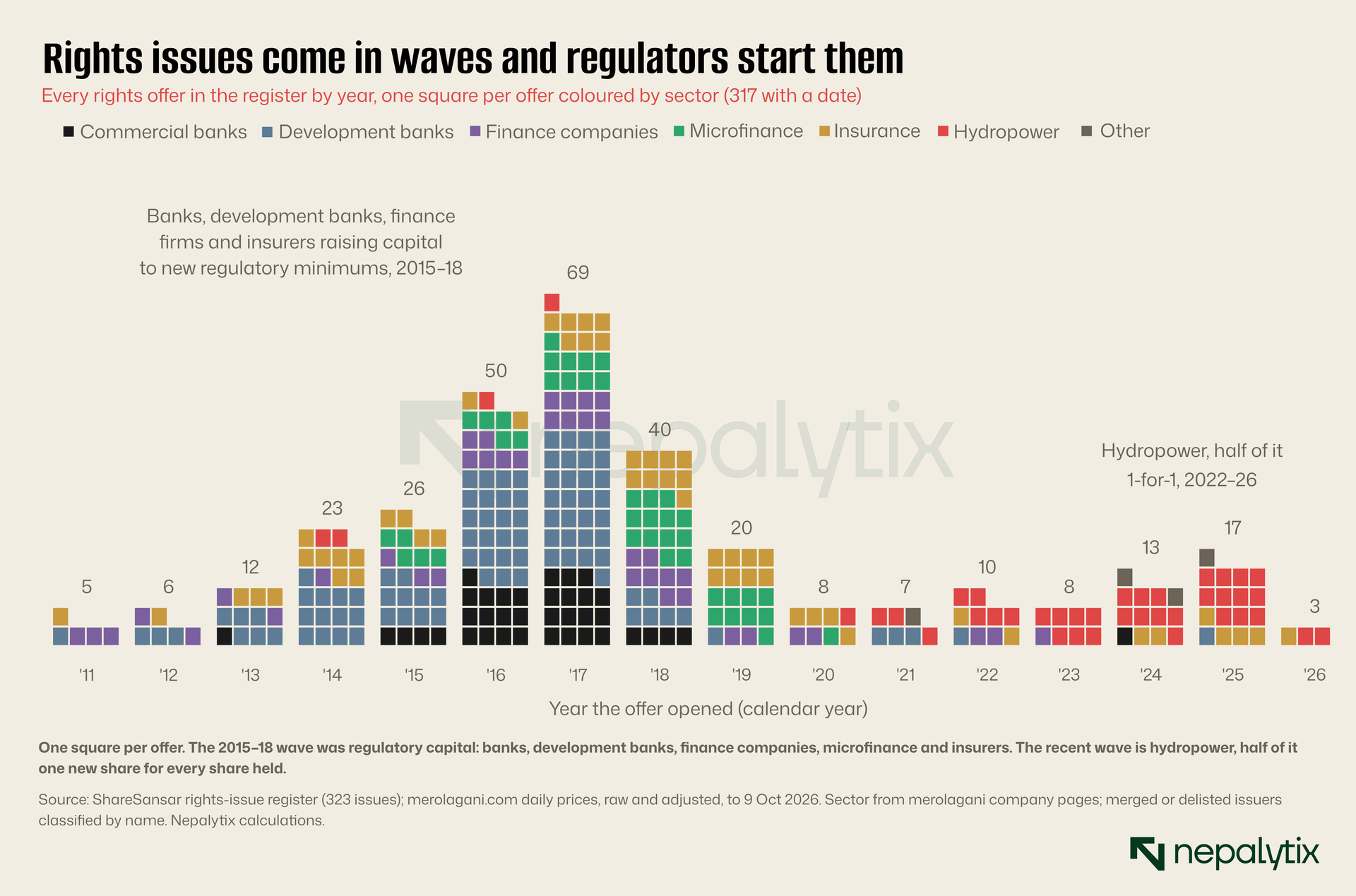
The second wave is smaller and different in kind. Since 2022, 33 of 51 rights offers have come from hydropower companies and half of those have been one-for-one. These are not regulatory top-ups. They are companies raising money for new projects or to repair balance sheets after cost overruns from shareholders who bought in at IPO. They are also the offers where the dilution arithmetic bites hardest because a one-for-one issue has the highest ceiling of any common ratio. Why that is so takes one worked example.
What the notice says
A rights notice carries five pieces of information and each one matters.
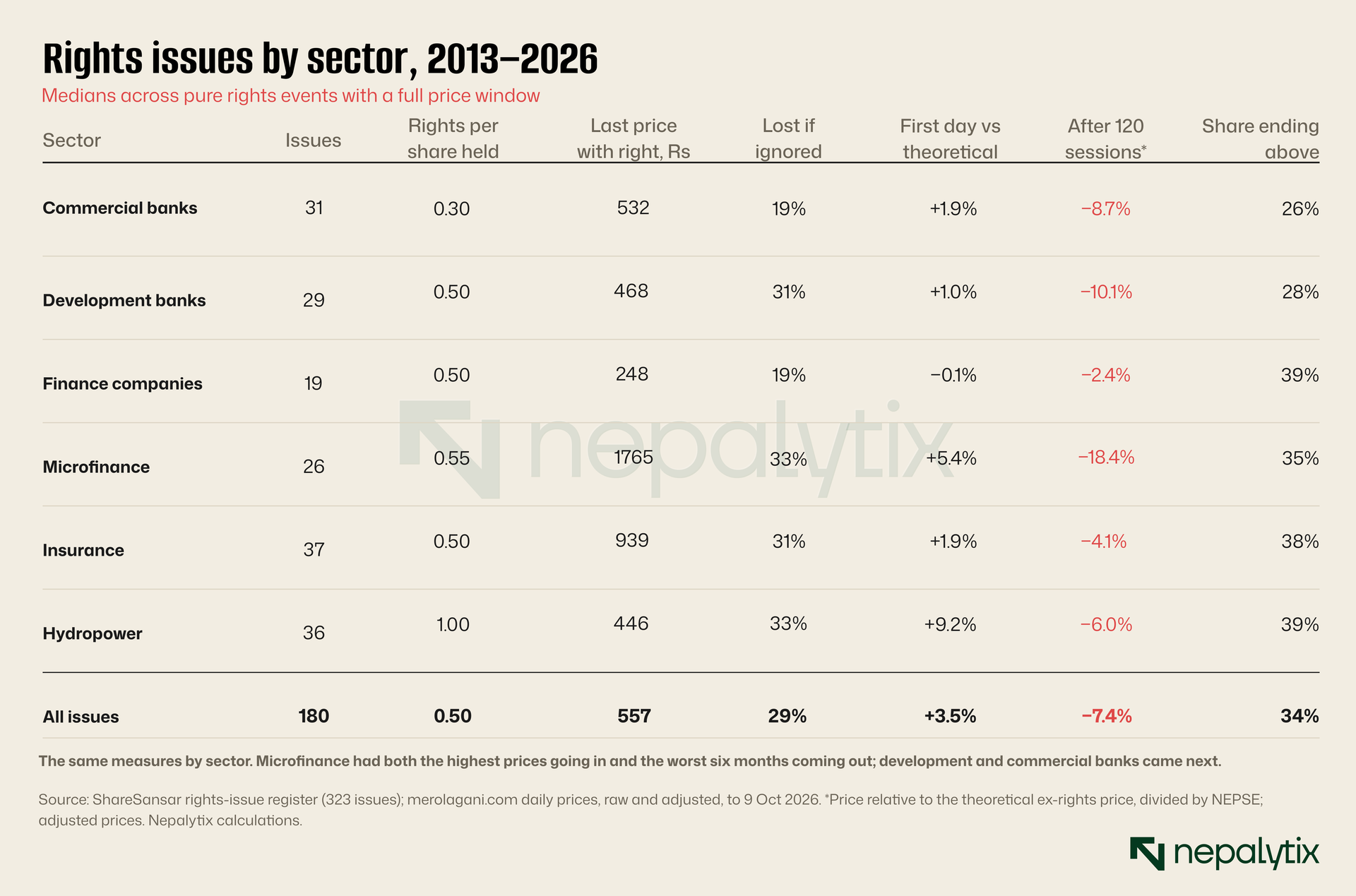
The ratio. Written as "1:1", "1:0.5", "10:4" or "100:10". The first number is shares held, the second is new shares offered. So 1:0.5 means one new share for every two you own; 10:4 means four for every ten. The median issue in our sample offers 0.5 new shares per share held. Hydropower companies have mostly offered 1:1, double the median; commercial banks have offered the least 0.3.
The price. Almost always Rs 100, the par value. In the register, 320 of 323 offers are priced at exactly Rs 100. That is the source of the confusion. A share trading at Rs 522 being offered at Rs 100 looks like an 81% discount and the median offer in our sample is priced 82% below the last market price. But you are not being sold someone else's share at a discount. You are being sold a new share in your own company and the discount comes out of the value of the shares you already hold.
The book closure date. The date on which the company freezes its register to see who is entitled. In practice, the market treats this as the ex-date: in 178 of the 180 clean cases, the big price adjustment happens on the book closure date itself. Anyone who holds the share at the close of the last session before it gets the right; anyone who buys from that date on does not.
The subscription window. Typically the offer opens a few weeks after book closure, a median of 18 days in the register and stays open for about five weeks, a median of 34 days. This is when you pay. If you do not apply and pay within the window, the right lapses.
Listing. The new shares you paid for are not tradable until they are listed and that takes a while. Across the 109 clean issues with a listing date, the new shares listed a median of 80 trading sessions after book closure, roughly four and a half months. For Himalayan Power Partner which we use as the worked example below, book closure was on 24 March 2026, the offer was open from 30 April to 20 May and the new shares listed on 10 July.
Rights, bonus and further public offers are different animals
Nepali investors meet three kinds of new share and they are easy to confuse because all three increase the number of shares in issue.
A bonus share costs nothing and raises nothing. The company moves money from its reserves into share capital and hands out new shares in proportion. Every holder's slice of the company is unchanged and the share price adjusts down so that the total value of the holding is unchanged too. Doing nothing costs nothing because there is nothing to do.
A further public offer raises new money from outside investors, usually at a price close to the market. Himalayan Bank's further public offer in 2025 was priced at Rs 157. Existing holders are diluted in percentage terms but because the new money comes in near the market price, the value of each existing share barely moves.
A rights share raises new money from existing holders, at a price far below the market. That combination is what creates the trap. Because the price is below market, the value of each existing share falls when the new shares are created. Because the offer goes only to existing holders, the only way to be compensated for that fall is to take up the offer yourself. A rights issue is fair to the shareholders who pay. It is unfair only to those who do not and the fairness depends entirely on your doing something.
The arithmetic, once
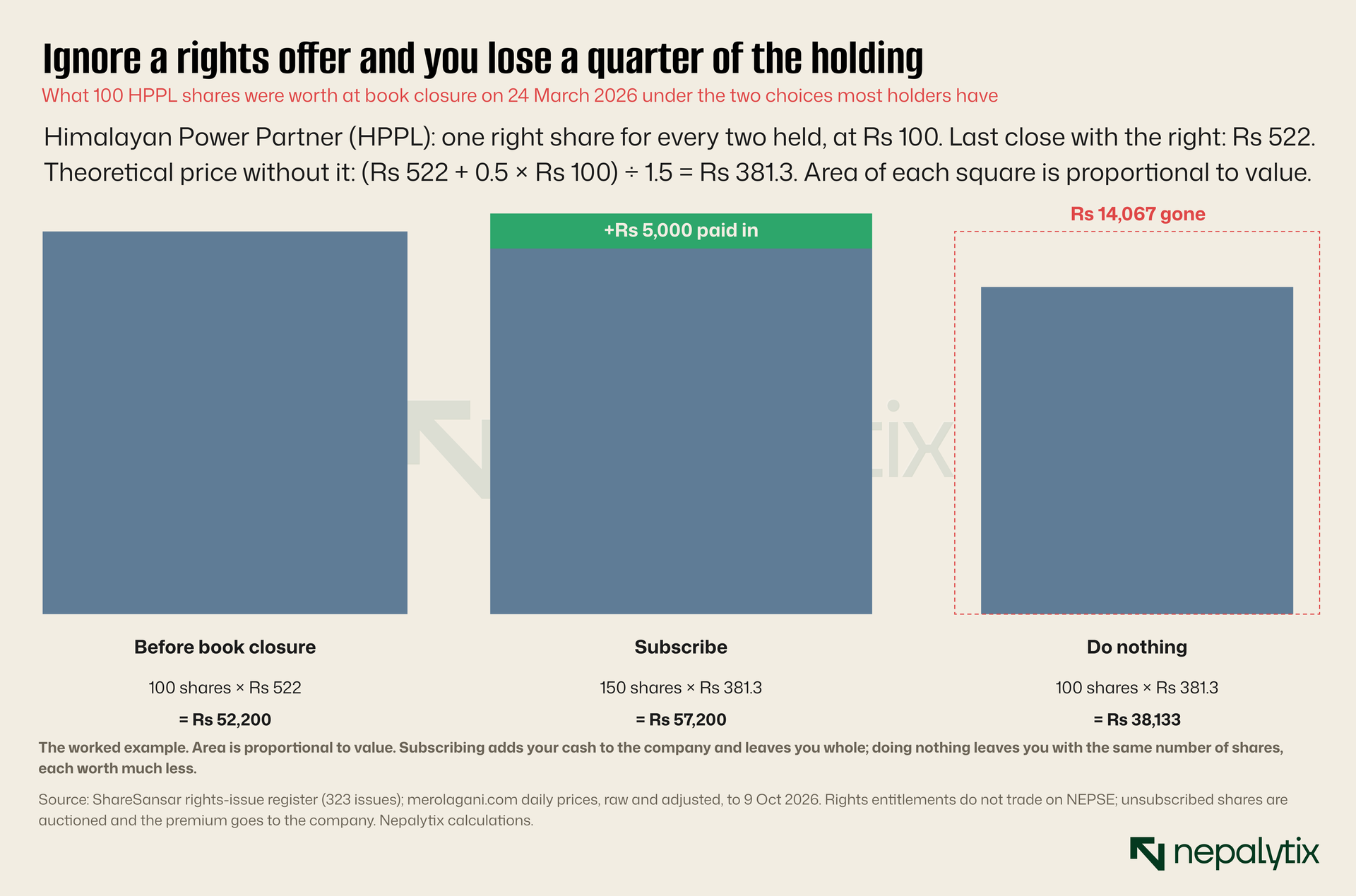
Take Himalayan Power Partner (HPPL). In March it offered one new share for every two held, at Rs 100. Its last close before book closure was Rs 522. Suppose you owned 100 shares, worth Rs 52,200.
After the issue, every holder who subscribes owns 1.5 shares for every share they held before and has paid Rs 50 more per original share. The company is worth what it was worth before plus the cash it raised. So the value of one share after the issue, the theoretical ex-rights price is a weighted average: (Rs 522 + 0.5 × Rs 100) ÷ 1.5, which is Rs 381.33.
Now the three things you can do.
Subscribe. You pay Rs 5,000 for 50 new shares and hold 150 shares at Rs 381.33, worth Rs 57,200. That is your Rs 52,200 plus the Rs 5,000 you paid in. You are exactly where you were, with more money in the company.
Do nothing. You keep 100 shares, now each worth Rs 381.33. Your holding is worth Rs 38,133. You have lost Rs 14,067, 27% of what you owned the day before and nobody has compensated you for it.
Sell before book closure. You sell your 100 shares at Rs 522 the day before and walk away with Rs 52,200. You have avoided the loss but you are out of the company.
There is a middle way that most textbooks call "tail-swallowing" and most Nepali investors have never heard of: sell just enough shares before book closure to pay for the rights on the rest. For HPPL, selling 9 of your 100 shares at Rs 522 raises Rs 4,698 and the rights on the remaining 91 shares, 45 new shares cost Rs 4,500. You end with 136 shares at the theoretical price of Rs 381.33 worth about Rs 51,860 plus Rs 198 in cash: almost exactly your starting Rs 52,200 less rounding and brokerage without putting in any new money. It is the closest thing the Nepali market offers to selling the right itself.
In most markets there is a fourth choice: sell the right itself. Where rights trade, a holder who does not want to pay can sell the entitlement to someone who does and the price of the right compensates for the dilution. In Nepal, rights do not trade on NEPSE. NEPSE discussed allowing renunciation as long ago as 2014 and some companies have permitted private renunciation before the issue closes but there is no market for it and for most retail holders the option does not exist in practice.
What happens to the rights you do not take up? The company auctions the unsubscribed shares, usually at a floor of Rs 100 with bids well above it. The premium over Rs 100 goes to the company not to you. A ShareSansar survey of auctions in FY2073/74 put Agricultural Development Bank's auction premium at about Rs 51 crore and Citizens Bank's at about Rs 38 crore credited to the share premium account in reserves. That reserve belongs to all shareholders including those who did subscribe. In effect, the holder who does nothing transfers part of the value of their holding to the company and to the shareholders who did pay.
The auctions themselves are sealed-bid. The floor is Rs 100; the cut-off is set where the bids fill the unsubscribed shares. When Life Insurance Corporation Nepal auctioned 492,577 unsubscribed rights shares in February 2025 bids ran from Rs 100 to Rs 1,100 and the cut-off was Rs 1,022. Every rupee above Rs 100 on those shares went into the company's reserves, not to the holders whose rights lapsed.
How much doing nothing costs
The loss to a holder who neither pays nor sells depends on two numbers only: how many rights per share (r) and how far the market price (P) sits above the Rs 100 offer price. The formula is r × (P − 100) ÷ ((1 + r) × P). Two features of it are worth holding on to.
First, there is a ceiling. However high the price, the loss can never exceed r ÷ (1 + r): 20% for a one-for-four, 33% for a one-for-two, 50% for a one-for-one. Second, the loss climbs steeply at first and then flattens. A one-for-one issue costs a non-subscriber 25% when the share trades at twice par, 40% at five times par and 45% at ten times.
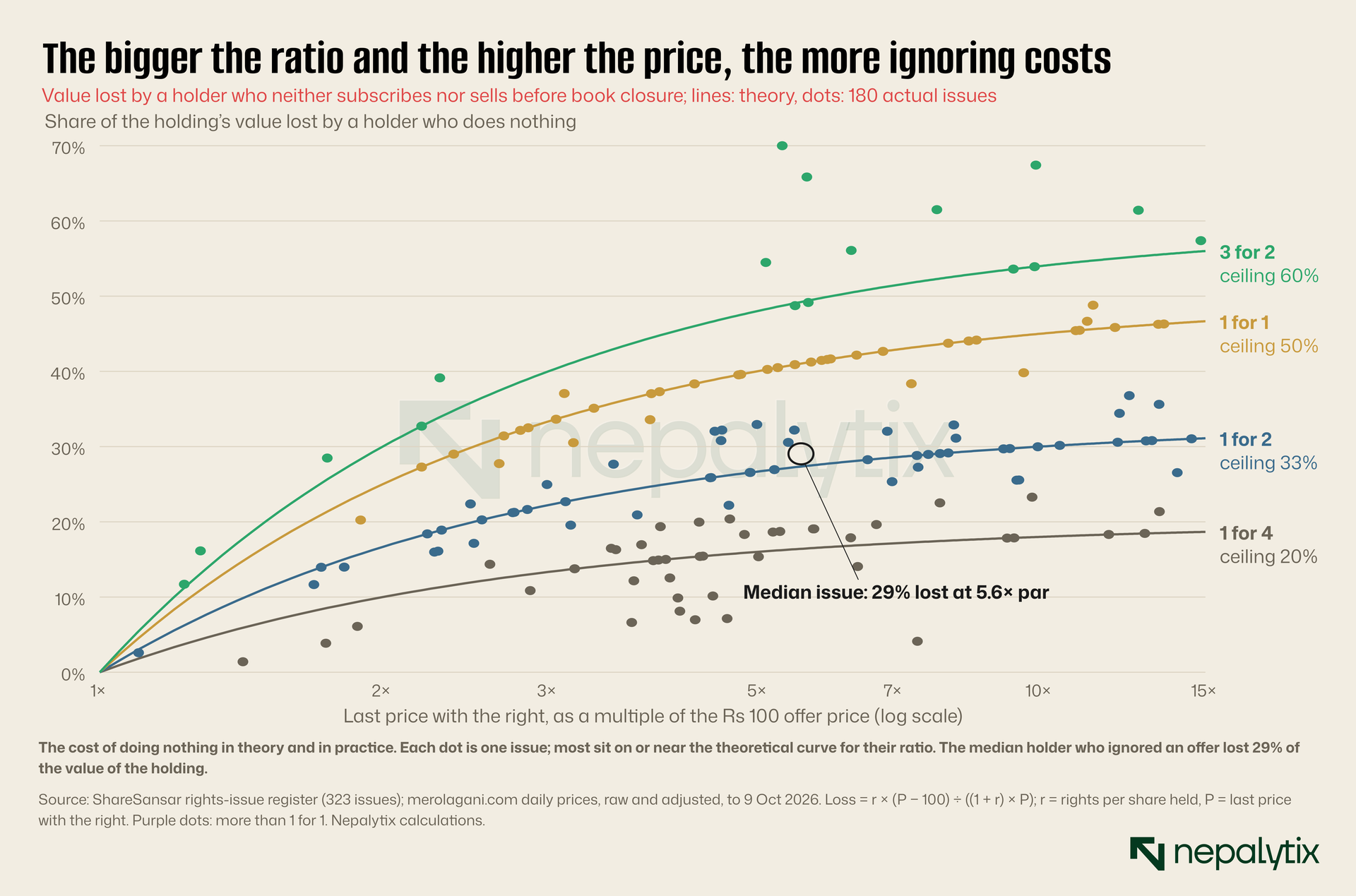
Across the 180 issues, the median issue would have cost a non-subscriber 29% of the value of their holding. The median issue was priced at 5.6 times par. The heaviest losses fell in 2017–2019 when microfinance and insurance shares traded at many multiples of par and some companies offered more than one new share per share held; the median microfinance issue in our sample came at a last price of Rs 1,765. Thirteen issues in the sample would have cost a non-subscriber more than half the holding, ten of them in those three years.
The practical rule is short. If you hold a share going into book closure, you have decided to pay. Either subscribe or sell before the date. The one choice that is never neutral is doing nothing.
Should you buy before book closure to get the right?
This is the question the forums ask most, and the arithmetic above already answers half of it. Buying a share the week before book closure "to get the right" means buying a share at the cum-rights price and committing to pay Rs 100 for each new share. The morning after, your share is worth the theoretical ex-rights price. You have bought the company at a price set by the market plus some more of it at a price set by the same arithmetic. There is no free value in the right; it is your own money coming back to you as a cheaper share.
The other half is empirical: does the price tend to rise into book closure so that the buyer at least catches a run-up? Measured relative to NEPSE, the median issue gained 0.3% over the 20 sessions before book closure and 51% of issues rose which is a coin toss. The last week is worse. Over the final five sessions with the right attached, the median issue fell 1.9% relative to NEPSE and only 26% rose. Whoever was buying to "get the rights" in that last week was on the record more often buying from sellers who knew the arithmetic.
What subscribing costs in time
Subscribing leaves you whole in value, but not in liquidity. The money you pay during the subscription window is locked up until the new shares list. Across the register, the new shares listed a median of 81 days after the subscription window closed and 137 days after book closure. A holder who pays on the first day of the window has cash tied up for three months or more in shares that cannot be sold, pledged at full value or used to meet a margin call.
That matters most for investors who borrow against their shares. A one-for-one issue on a large holding is a large cash call due within about five weeks of the window opening with the new shares unavailable as collateral until they list. Investors who cannot meet the call and do not sell before book closure end up in the "do nothing" column by default.
What the market does on the day
In theory, the price should fall on the ex-date from the last price with the right to the theoretical ex-rights price and then trade freely. Nepal's daily price limit makes the first day more mechanical than that. The pattern in the data implies that the exchange resets the reference price to the theoretical ex-rights price on the ex-date so the day's price limit applies around that figure.
Across the 180 issues, the first close without the right was a median 3.5% above the theoretical price and 74% closed above it. But the distribution has changed. In 43 cases, the first ex-rights close sat within half a point of exactly 10% above the theoretical price: the share went straight to the limit. Before 2024, 23 of 151 issues did that. Since 2024, 20 of 29 have.
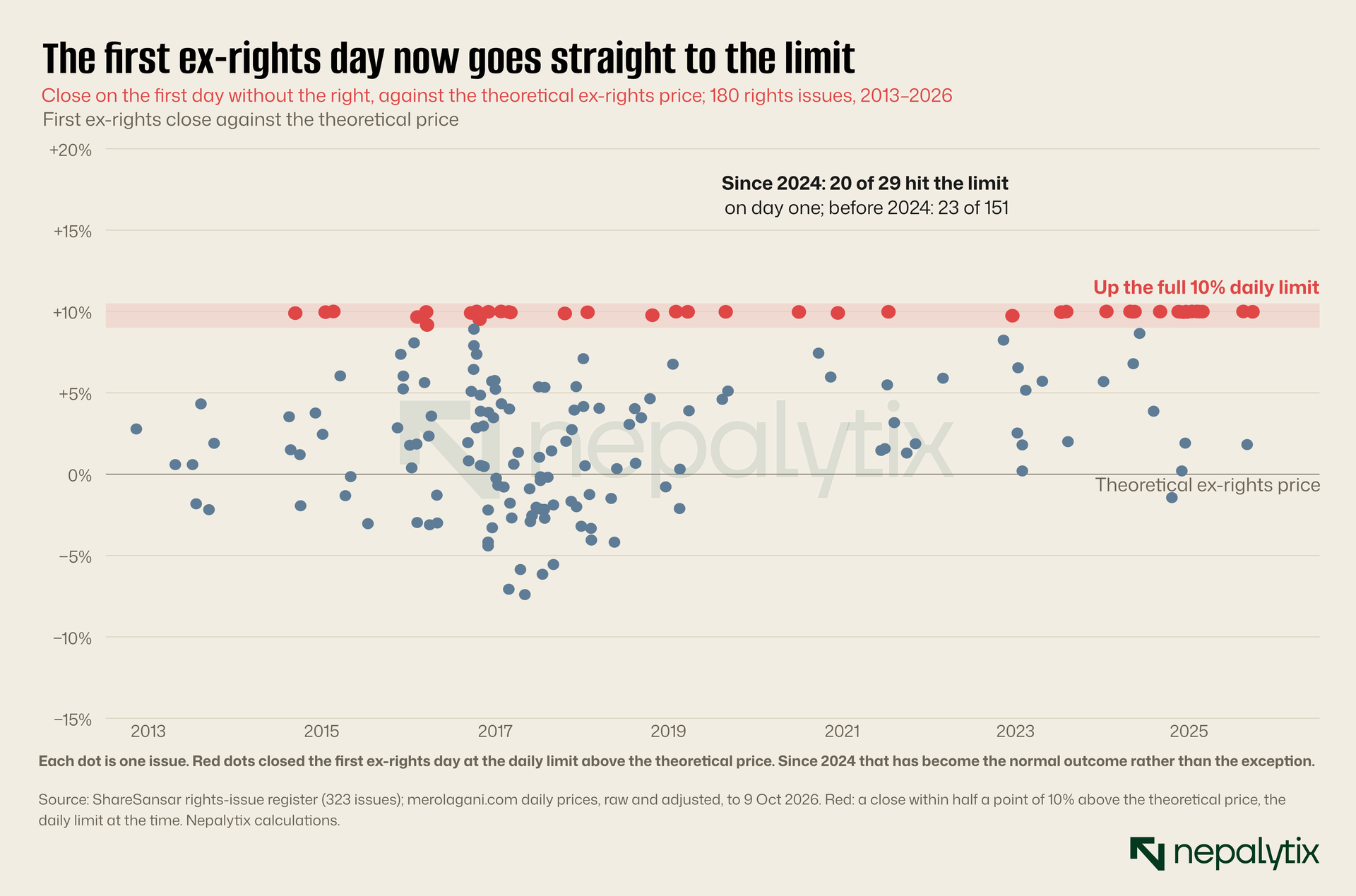
HPPL is a typical recent case. Its theoretical price was Rs 381.33; its first ex-rights close was Rs 419.40, exactly 10% higher. The temptation is to read that as the market saying the rights issue was good news. The more likely reading is that a reset reference price below where buyers were already anchored attracts a burst of demand that the limit then caps. Either way, the useful question for a holder is not what happens on day one but what happens over the following months.
What the market does after
To answer that, we tracked each issue's adjusted price for 120 sessions after the ex-date, about six months, and divided it by NEPSE so that the market's own moves do not show up as the stock's. A value of 1.00 means the share is at its theoretical ex-rights price, relative to the market.
The result is consistent and not encouraging. The median issue starts 3% above the theoretical price on day one is back to it by session 20, is 3% below by session 60 and 7.4% below by session 120. Only a third of issues end the six months above their theoretical price relative to NEPSE. Measured against the issuer's own sector index instead of NEPSE, the median is 5.5% below and 29% end above. The middle half of outcomes at session 120 runs from 16% below to 7% above so this is a tendency not a law: plenty of issues do well. But the tendency is on the wrong side.
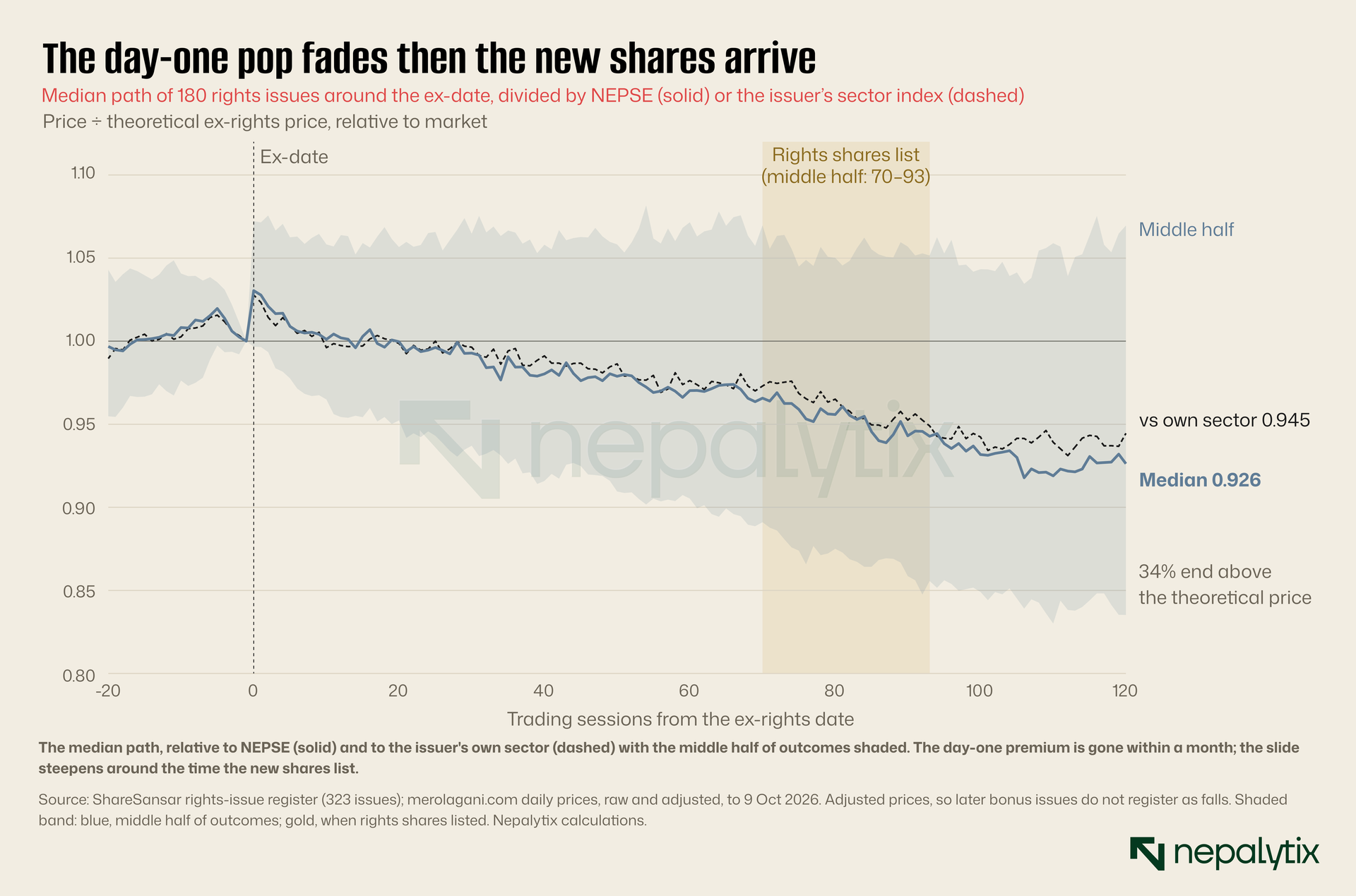
The recent cohort is the clearest illustration. The 29 issues since January 2024, two-thirds of them hydropower opened a median 9.1% above their theoretical price, and 28 of the 29 opened above it. Twenty sessions later the median was still 3.7% above and 72% were above. By session 60 the median was 2.1% below and only 38% were above by session 120, 6.0% below with 31% above. The new regime has not changed where issues end up. It has moved the gain to the first week where only someone who already owned the share before book closure or bought on the first ex-rights morning could collect it.
The day-one limit-up does not change this. Issues that went to the limit on the first day were still 6% below their theoretical price by session 120; the others were 8% below. Nor did the pattern belong only to the 2015–18 wave. Issues in 2013–18 ended the six months a median 8.7% below; issues since 2019, 4.2% below.
There is a weak tendency for deeper discounts and bigger ratios to do worse: the rank correlation between the discount and the six-month outcome is −0.16 and between the ratio and the outcome −0.15. Both are small. The discount and ratio tell you how much you lose by doing nothing. They tell you much less about where the price will go.
When the new shares arrive
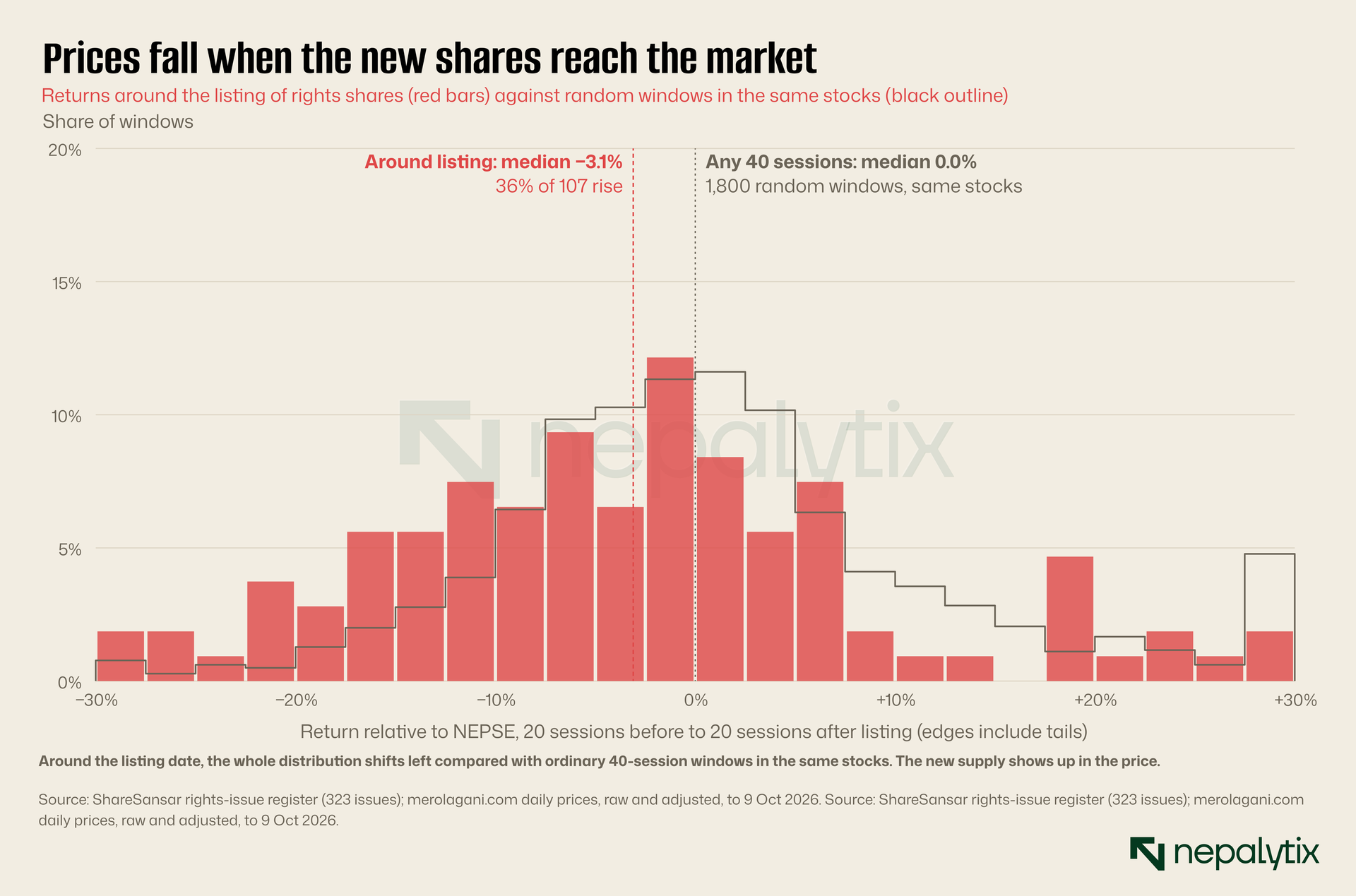
The slide steepens at a predictable moment: when the new shares list. Until then, the shares paid for in the subscription window cannot be sold. When they list, a median 80 sessions after the ex-date, every subscriber who wanted only to avoid the dilution and every auction buyer who bid to make a quick margin, can sell at once.
We measured the return relative to NEPSE from 20 sessions before to 20 sessions after the listing date for 107 issues and compared it with 1,800 randomly chosen 40-session windows in the same stocks. Around listing, the median return was −3.1% and only 36% of windows rose. In the random windows, the median was 0.0% and exactly half rose. Of 2,000 random samples of 107 placebo windows, 0.1% had a median as low as the listing windows.
For HPPL, the new shares listed on 10 July 2026. Sixty sessions after the ex-date, in June, the share was at Rs 367 below its theoretical price of Rs 381.33. On 9 October it closed at Rs 397.90.
Three misreadings to avoid
"The share price crashed after book closure." HPPL's price went from Rs 522 to a reference of Rs 381.33 overnight, and price screens showed a fall of 27%. Nothing happened to the company. The same company was simply divided among 1.5 times as many shares and Rs 50 of new cash was added per original share. Any price chart that is not adjusted for the rights issue will show a cliff on the book closure date; merolagani's adjusted series removes it and comparisons across the date should always use adjusted prices.
"My portfolio shows a loss even though I subscribed." Between book closure and listing, a subscriber's demat account shows the old shares at the lower ex-rights price and the new shares, already paid for, do not appear until they list about four months later. Most portfolio apps show this as a loss equal to the dilution. It is not a loss; it is a timing gap in how the holding is displayed. It becomes real only for the holder who did not pay.
"A one-for-one at Rs 100 doubles my shares, so it must be good." It doubles the shares and roughly halves the value of each one, minus the effect of the cash you pay in. Whether that is good depends on what the company does with the money which is the one thing the notice rarely tells you in any useful detail. A hydropower company raising equity to finish a project that will earn its tariff is a different proposition from one raising equity to repay overdue loans on a project that has run late. The ratio and the price are the same; the reason is not.
A checklist for the next notice
Four questions, in order, settle almost every rights decision.
Compute the theoretical ex-rights price. (Last price + ratio × Rs 100) ÷ (1 + ratio). That is what your shares are worth the morning after book closure before the market has its say.
Compute what doing nothing costs. Ratio × (price − 100) ÷ ((1 + ratio) × price). If you cannot or will not pay, this is what you lose and the premium from the auction of your unsubscribed shares goes to the company.
Decide whether you want more of the company at the theoretical price not at Rs 100. Subscribing is buying more shares at the theoretical price with part of your own holding's value. If you would not buy more at that price in the open market, sell before book closure instead.
Mark the listing date. The new shares arrive about four months after book closure and on the record so far the price has tended to soften around them. If you are subscribing to sell, that is the queue you are joining.
Two things to be careful of. First, none of this says rights issues are bad for companies. A company that raises equity to build a profitable plant or meet a capital requirement may be better for it; our measures are relative to the market over six months, not a verdict on the business. Second, the averages hide wide dispersion. A third of issues ended six months above their theoretical price relative to NEPSE and a quarter ended more than 16% below. A rights issue is a decision about one company and the arithmetic above is the starting point, not the conclusion.
There is also a gap in what is published. Companies announce the ratio, the price and the dates and they announce the auction of unsubscribed shares. Nobody publishes a consolidated record of how much of each issue shareholders actually took up or what the auction premium came to. Both are known to the issue manager the day the window closes. They are the most direct measure of whether shareholders thought the offer was worth paying for and investors have to piece them together from scattered auction notices.
Disclaimer
This report has been prepared by Nepalytix for informational and educational purposes only and does not constitute investment advice, an offer, or a solicitation to buy or sell any securities.
The information contained in this report is based on sources believed to be reliable; however, Nepalytix does not guarantee its accuracy, completeness, or timeliness. Opinions, estimates, and projections expressed herein are those of the authors as of the date of publication and are subject to change without notice.
Investing in securities involves risks, including the possible loss of principal. Past performance is not indicative of future results. Readers are advised to conduct their own independent research and consult with a qualified financial advisor before making any investment decisions.
Nepalytix and its contributors may hold positions in the securities discussed in this report at the time of publication or thereafter.
Neither Nepalytix nor any of its affiliates accept any liability for any loss arising from the use of this report or its contents.