Sagar Distillery (SAGAR): Is the Rs 1,700 Share Price Ahead of the Evidence?
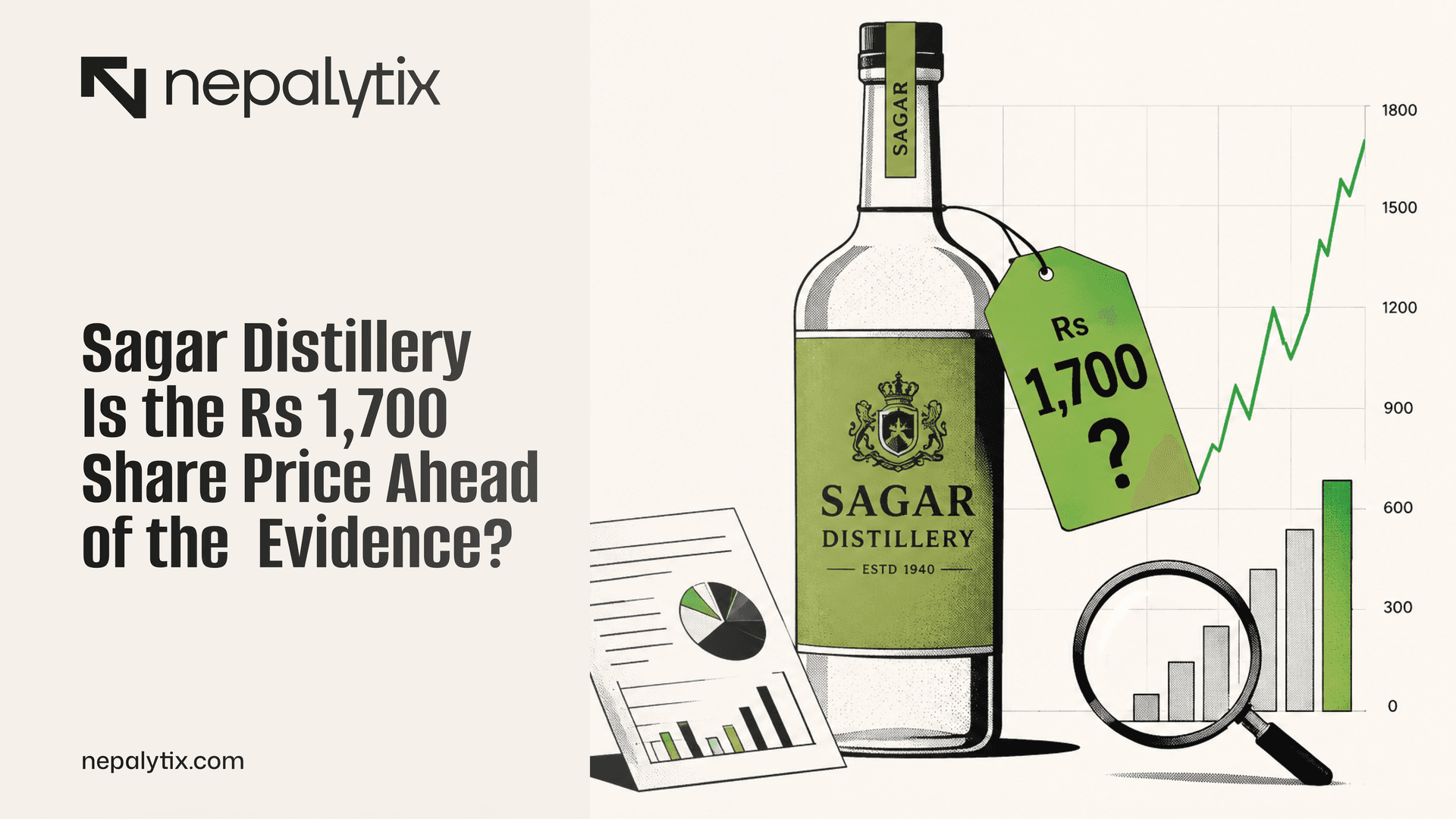
Sagar Distillery trades at Rs 1,700, 48.4% above profitable incumbent Himalayan Distillery, despite reporting a Rs 57.2 million loss. Here’s what the valuation, growth, float and financials actually show.
The case, in four propositions
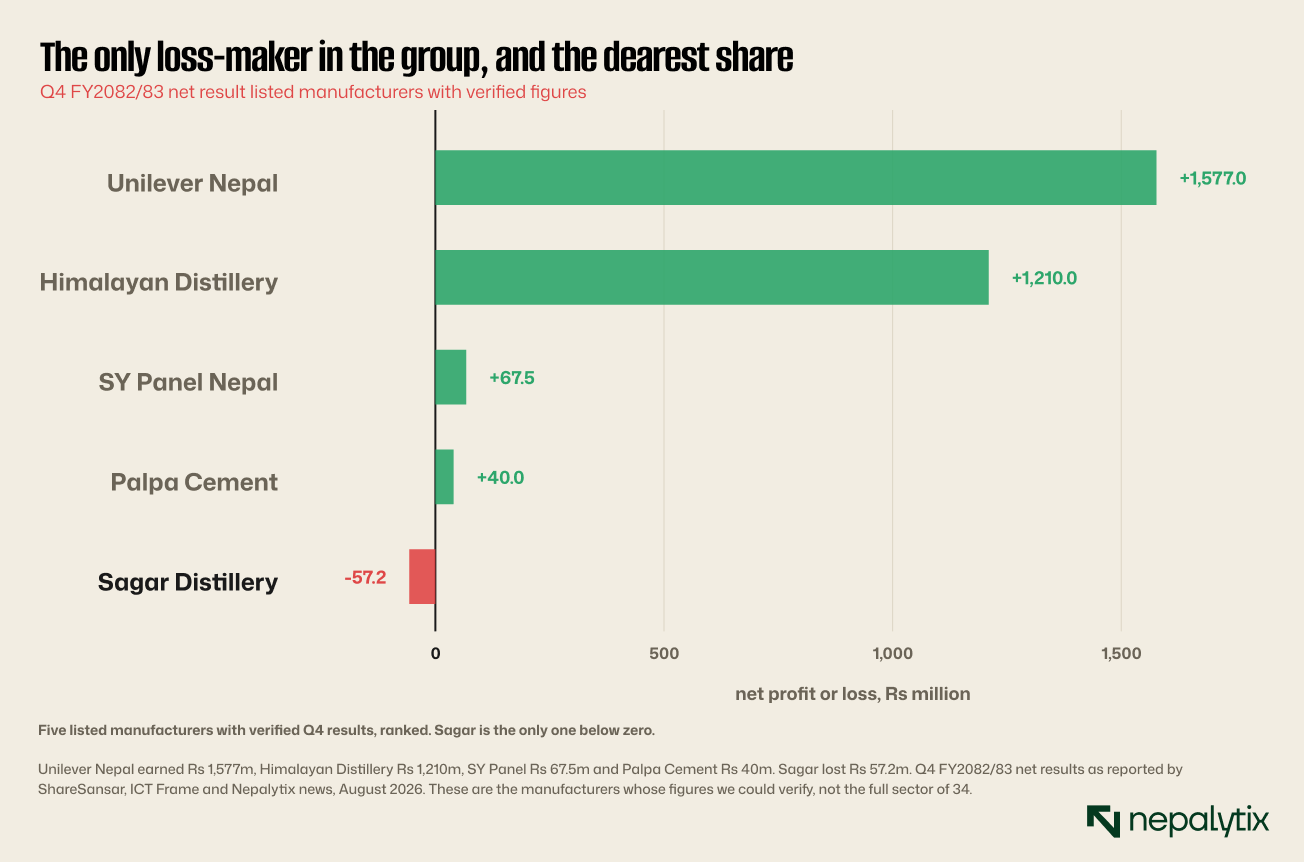
The share costs 48% more than the profitable incumbent. Sagar trades at Rs 1,700 against Himalayan Distillery's Rs 1,145. HDL earned Rs 1.21 arba last year; Sagar lost Rs 57.2 million.
Revenue growth is real and it is not reaching the bottom line. Q4 net sales rose 147.72% and operating income 145.48%. The cumulative loss still widened from Rs 15.32m at Q1 to Rs 57.2m.
The float is a fifth of the company. 1.45 million of 7.26 million shares are public. Price discovery in that quantity of stock is not the same activity as price discovery in HDL's 15.5 million.
The incumbent's record is the warning, not the reassurance. HDL grew profit fourfold over nine years while its EPS fell 58.5% and its net worth per share fell 36.7%. Growth in this sector has not reliably reached shareholders.
Why we are covering this name
Nepal's listed manufacturing sector receives almost no independent research. Thirty-four companies hold Rs 380.46 arab of market value and the analytical attention they attract is a fraction of what twenty commercial banks receive.
Sagar is the newest distillery listing and, on the numbers below, one of the more difficult to explain. It carries a market capitalisation larger than most of its sector, a share price above the sector's most established manufacturer and a loss.
That combination is worth examining regardless of the conclusion. This note does not reach a fair value for reasons set out in full at the end but it establishes what the price implies and what would have to be true for it to hold.
What the company is
Sagar Distillery produces, blends and bottles spirits at a plant in Devchuli, Nawalparasi with a reported capacity of around five million litres a year. Its portfolio spans whisky, vodka and gin under brands including Nepse Bulls, Royal Blue, Grey Wolf, Berries & Blues, Governor Whisky and Lalipop.
It was established in 2014, converted to a public limited company in 2023 and listed on NEPSE on 6 November 2025, a nine-year gap between incorporation and listing which is short by the standards of Nepali manufacturers. It is the sector's newest distillery listing and one of its smallest by share count.
Two figures frame everything that follows. The company carries a market capitalisation of Rs 12.34 arab placing it among the larger names in a sector of thirty-four listed manufacturers. Its most recent full-year result is a net loss of Rs 57.2 million and that loss has widened in each reported period of the year.
Why a new listing is hard to value
Three quarters of results is not a track record. It is a sample and a small one taken during the least representative period in a company's listed life.
A newly listed company carries costs that will not recur: issue expenses, listing fees, the professional costs of converting to a public limited company. It also carries operational conditions that have not yet stabilised, because most Nepali IPOs raise capital for expansion and the expansion is usually mid-flight at the time of listing.
Set against that, the market must price the share from day one. Sagar listed in November 2025 under the previous rule which set the opening band at up to three times net worth per share rather than three times face value.
What we can say is that the price has travelled a long way from any band the exchange would have set. At Rs 1,700 against a Rs 100 face value, the share trades at seventeen times par.
The comparison that matters
Any note on a newly listed company faces the same problem: three quarters of disclosure will support almost no analysis. The remedy is a benchmark with a long record in the same business, and Nepal has an unusually good one.
Himalayan Distillery listed in March 2003. It is the country's dominant listed spirits manufacturer, it has published nine years of comparable results and it makes the same product in the same regulatory and excise environment.
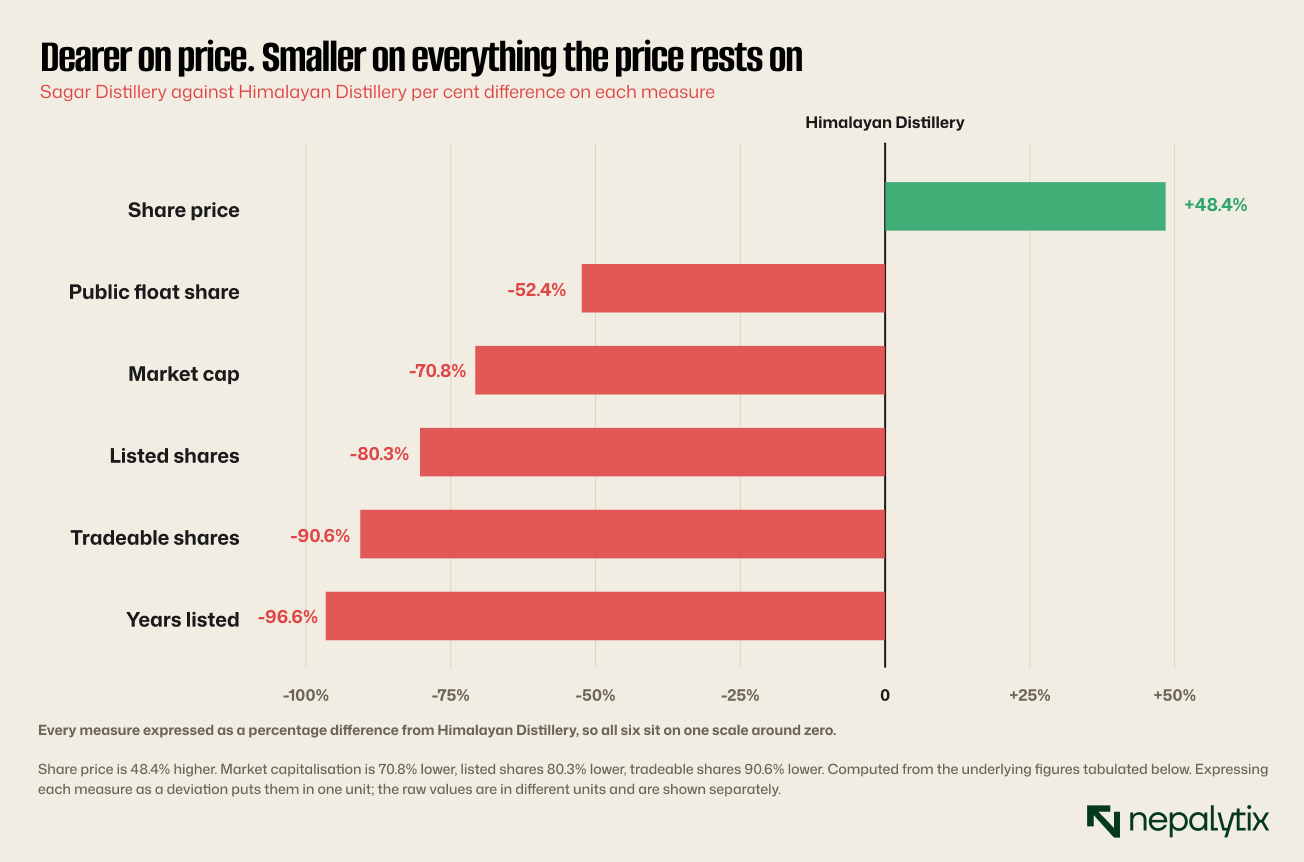
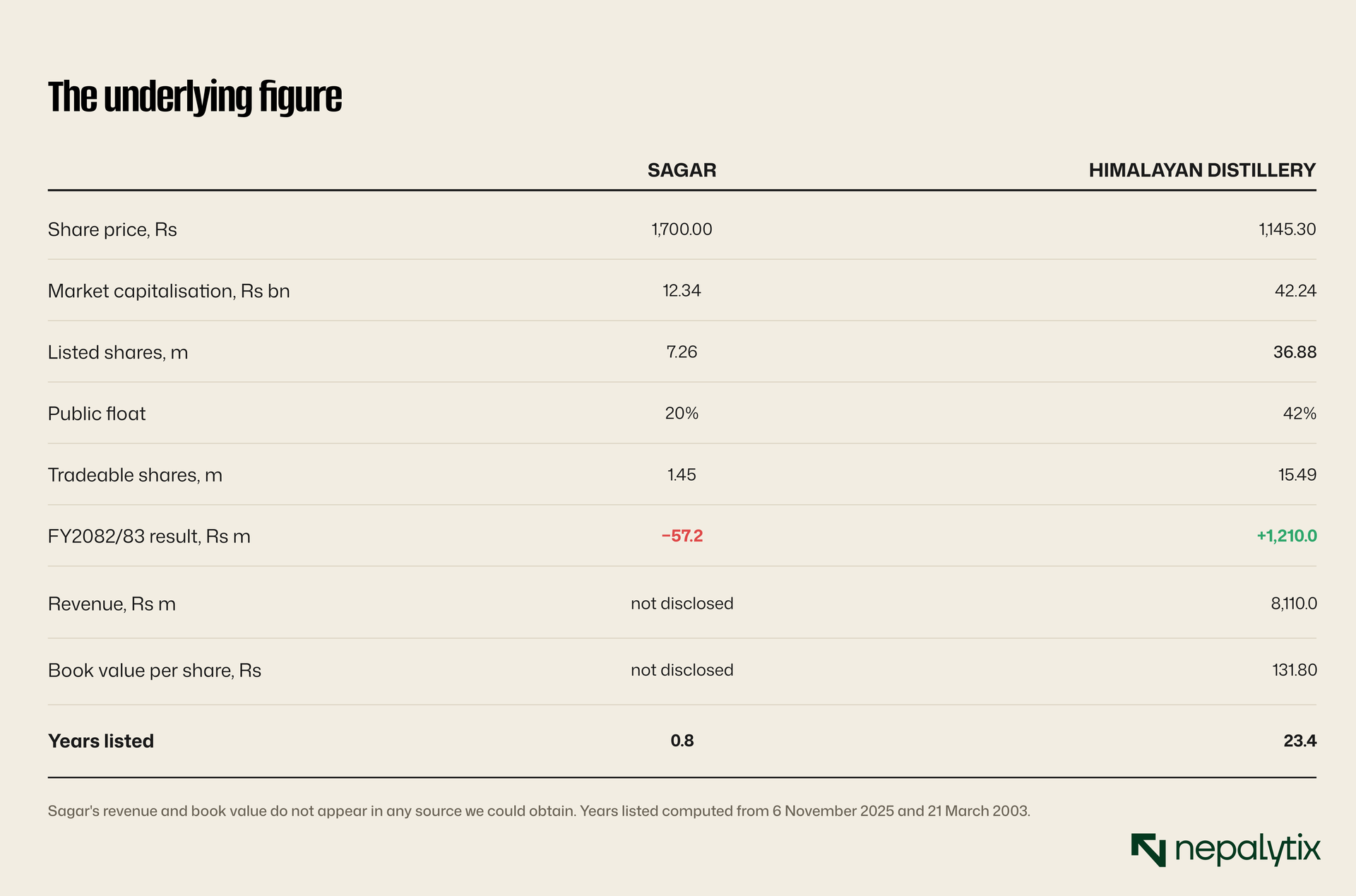
Sagar is priced as though it has already become what Himalayan Distillery took twenty-three years to become.
What the benchmark is and is not
Two qualifications on using HDL this way because the comparison does a lot of work in this note.
HDL is substantially larger and considerably older. It has scale advantages in procurement, distribution and excise administration that a five-million-litre plant cannot match and its brands have decades of recognition. A direct read-across on margins or multiples would be unfair to Sagar.
Its record is also not continuous in our data. We have four revenue observations and two full sets of per-share figures nine years apart. The years between are not in front of us and a company's path between two endpoints matters, a steady climb and a collapse followed by a recovery produce the same endpoints and mean different things.
What the comparison legitimately supports is narrower: the direction of per-share outcomes over a long period in this specific industry and the absolute level of revenue an established leader generates. Both are relevant to pricing a newcomer. Neither is a forecast for Sagar.
What Himalayan Distillery's record actually shows
Here the note turns because the benchmark is not the reassurance a buyer might expect. It is the warning.
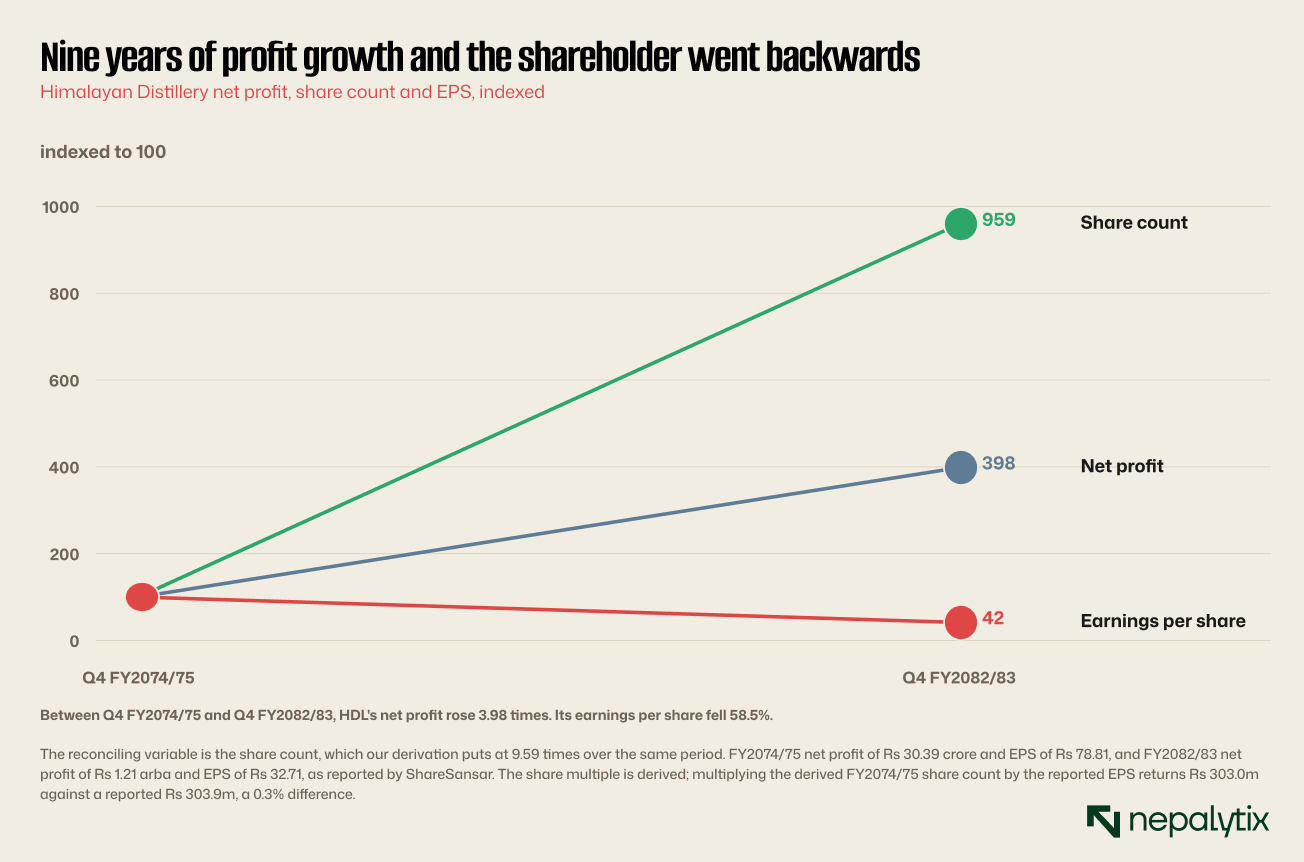
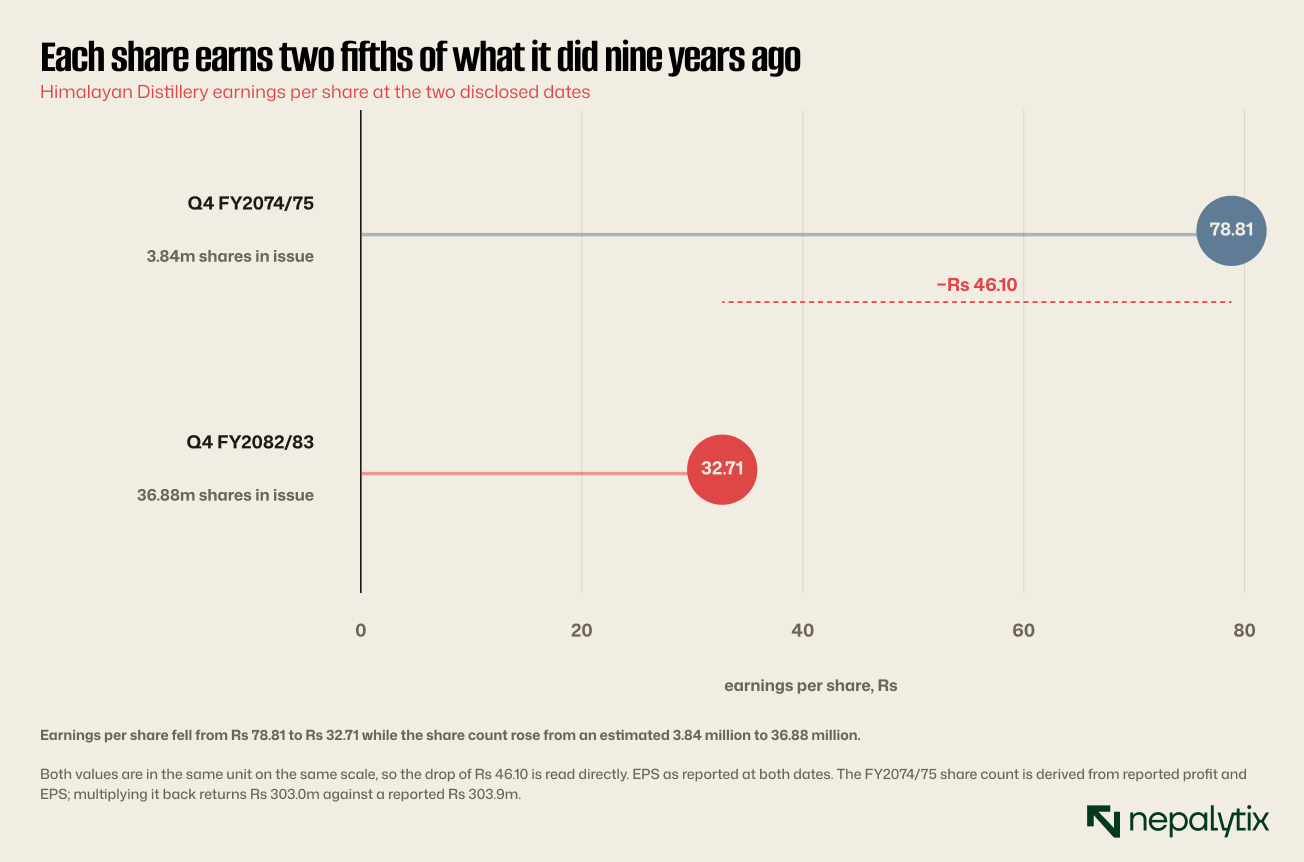
Nine years of compounding profit growth, and a shareholder who held throughout saw their earnings per share cut by more than half. The company grew. The claim on it shrank faster.
The mechanism is not concealed and it is not unusual. It is what happens when a company capitalises reserves into new shares year after year while its earnings grow more slowly than its share count.
The balance sheet told the same story
Net worth per share is the cleanest measure of what a share is backed by and HDL's fell alongside its EPS.
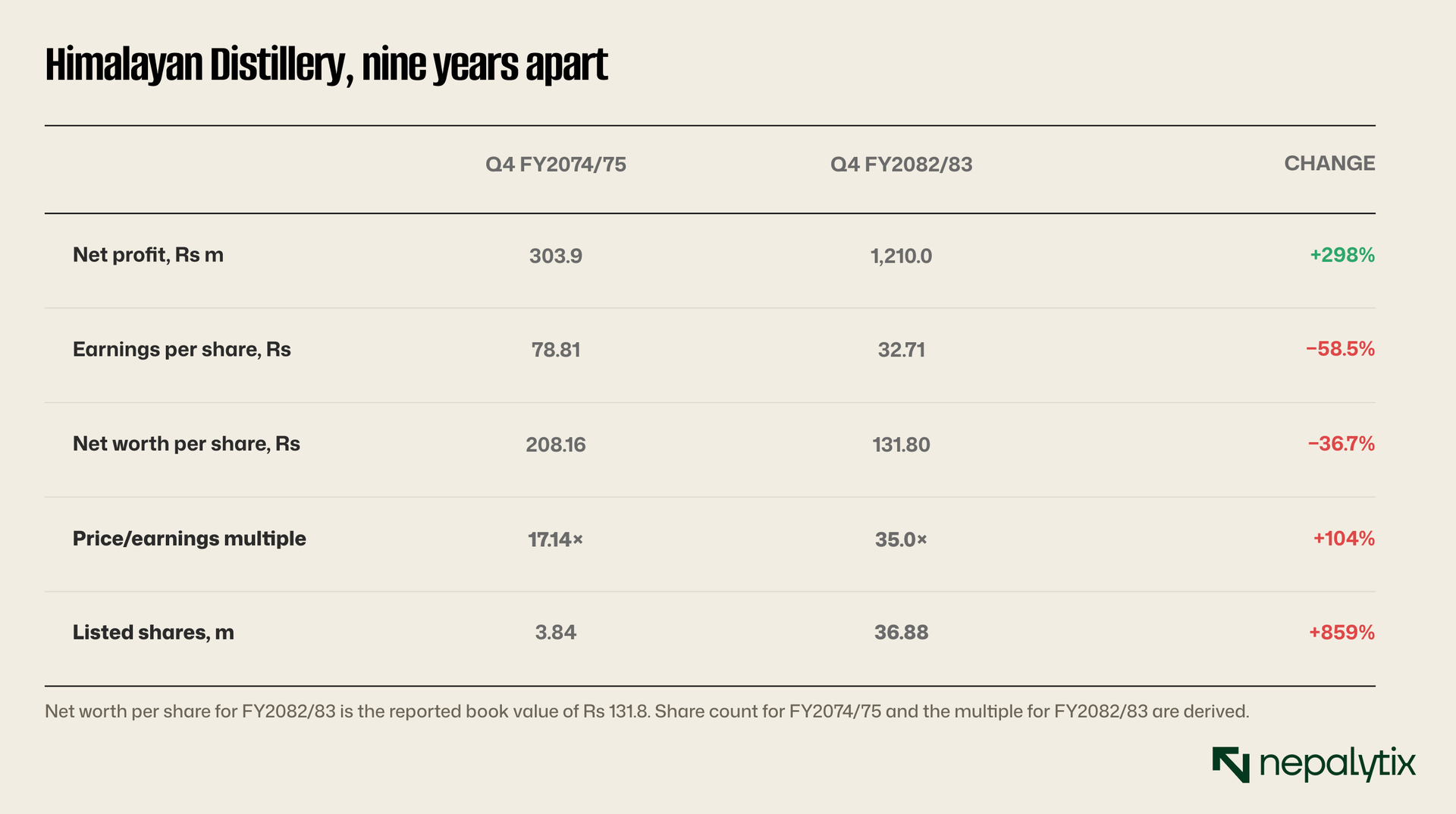
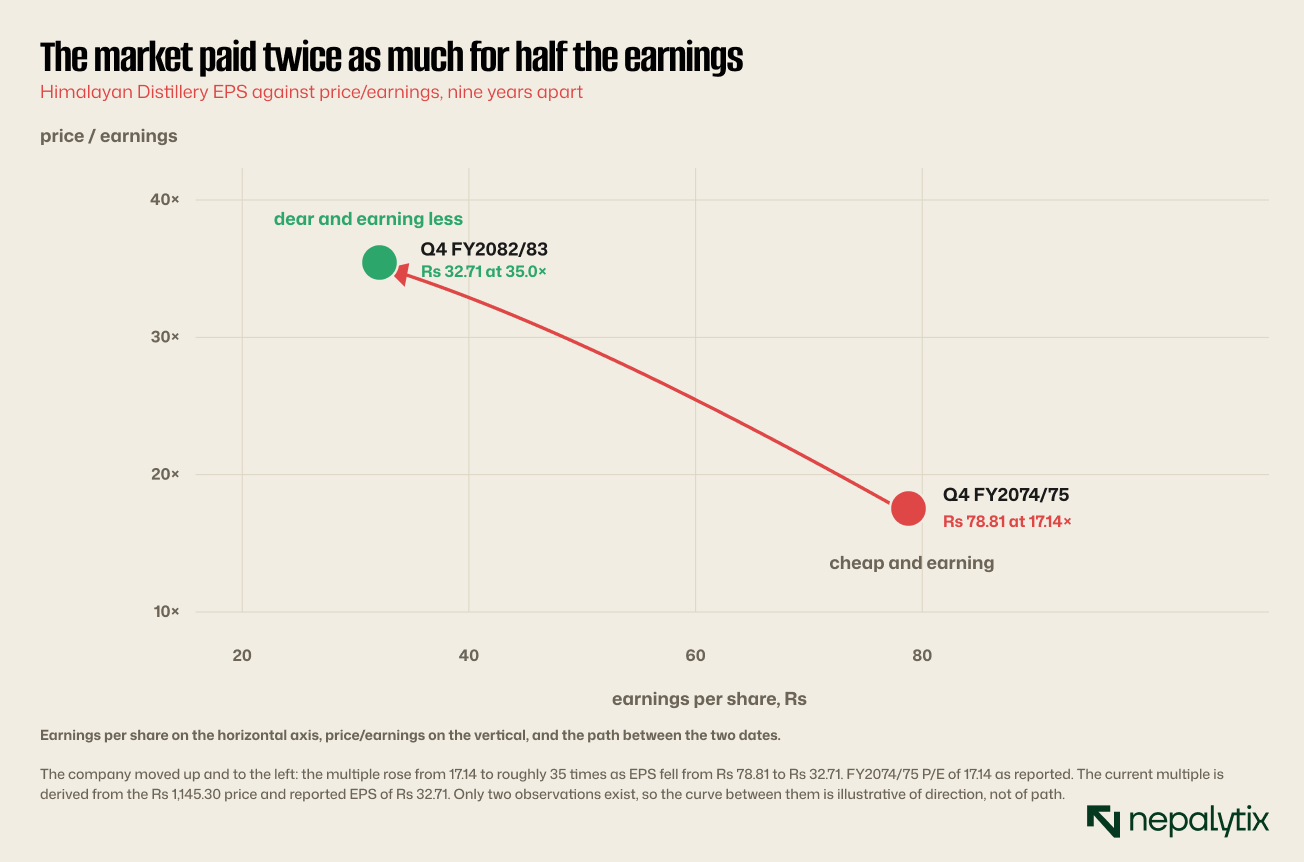
The buyer of Nepali spirits equity has been paying a rising price for a falling per-share claim for most of a decade.
Where the dilution came from
HDL's share count did not grow because the company kept raising cash. It grew because it kept capitalising reserves.
Its paid-up capital rose 20% in a single year, from Rs 3.07 arba to Rs 3.68 arba and 6,146,803 bonus units were listed following its twenty-fifth annual general meeting alongside a 25% dividend for FY2081/82.
A company issuing a 20% bonus needs 20% profit growth simply to hold earnings per share flat. HDL's Q4 profit growth of 28.14% against EPS growth of 6.78% is that identity operating in a single year and its nine-year record is the same identity operating repeatedly.
None of this is improper and none of it is hidden. Bonus issues are declared at AGMs approved by shareholders and reported. The point is that a prospective buyer of Sagar, looking to the sector leader as evidence that Nepali spirits equity rewards patience will find that it has mostly rewarded the company rather than the shareholder.
What Sagar's own numbers show
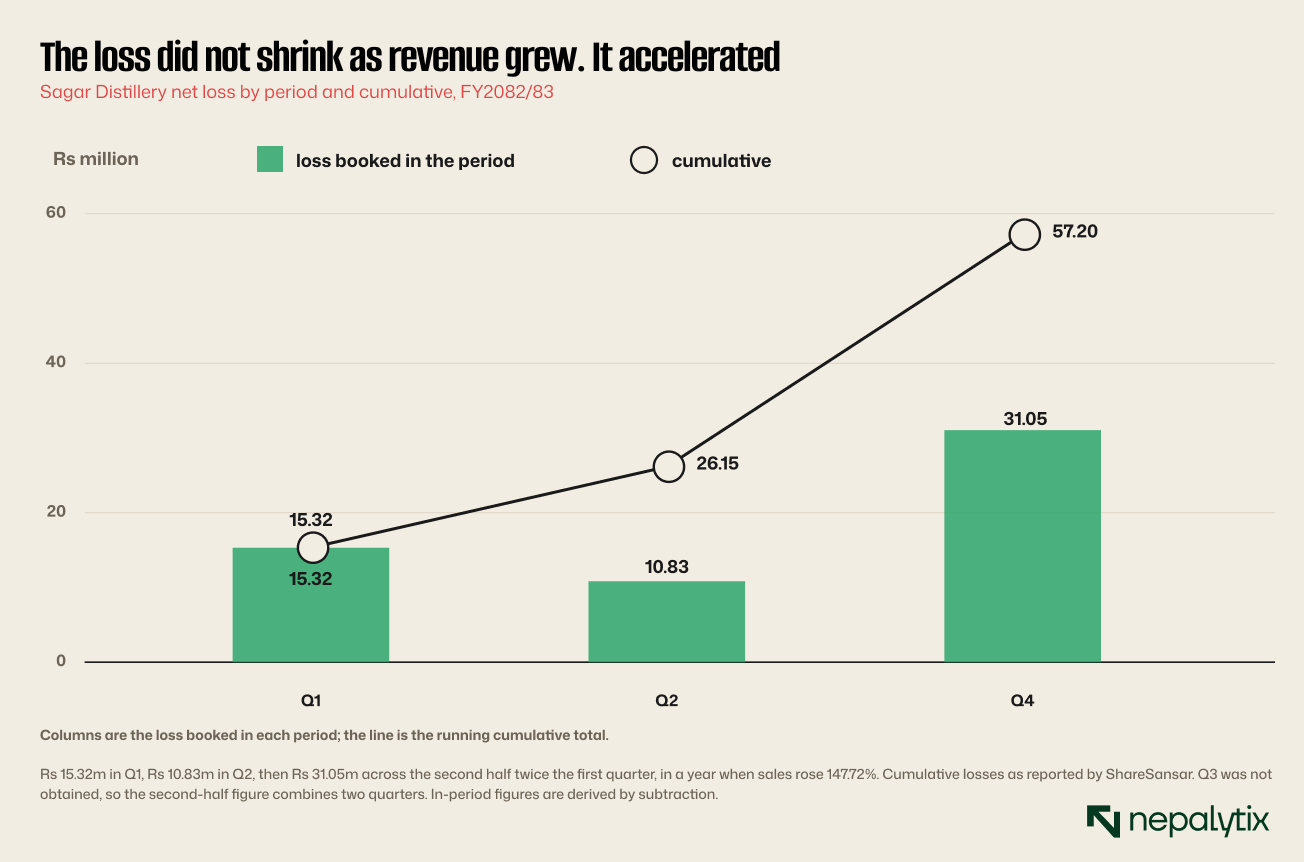
The revenue side is genuinely strong. Fourth-quarter net sales rose 147.72% and operating income 145.48%. Historic figures show revenue of Rs 66 million in FY2022 and Rs 94 million in FY2023, so the business is expanding from a small base at pace.
What the reporting attributes the loss to is selling and financial costs. We could not obtain the filing itself so we cannot say which dominates, and that distinction is the single most important open question about this company.
Why it matters which cost is consuming the growth
If the loss is selling and distribution it is a growth investment. A distillery entering a market held by an entrenched incumbent must buy shelf space, build a distributor network and advertise. Those costs front-load and, if the brands take, they normalise as revenue scales.
If the loss is financial cost, it is a balance sheet problem. Interest does not normalise with scale; it normalises when the debt is repaid and a company already losing money repays debt slowly.
The company's disclosure names both. Until the filing is read, an investor is buying one of two quite different situations at the same price.
Reading a growth rate without a base
A 147.72% increase in net sales is the most-quoted figure about this company and on its own it conveys almost nothing.
Consider two possibilities consistent with it. If Sagar's FY2081/82 revenue was Rs 400 million, the increase implies roughly Rs 990 million this year, a substantial regional distiller. If it was Rs 150 million, the increase implies Rs 372 million which is a small operation.
Both are consistent with the reported growth rate and they imply market capitalisation to revenue ratios of roughly 12 times and 33 times respectively. Neither figure is available in the sources we could obtain.
The last disclosed absolute revenue is Rs 94 million for FY2023. Compounding that at the reported growth rates would suggest something in the low hundreds of millions but that is extrapolation rather than measurement and we do not rely on it.
This is the practical difficulty with the company as an investment: the most important number for valuing it is not published in any accessible form and the numbers that are published are ratios computed against it.
The float
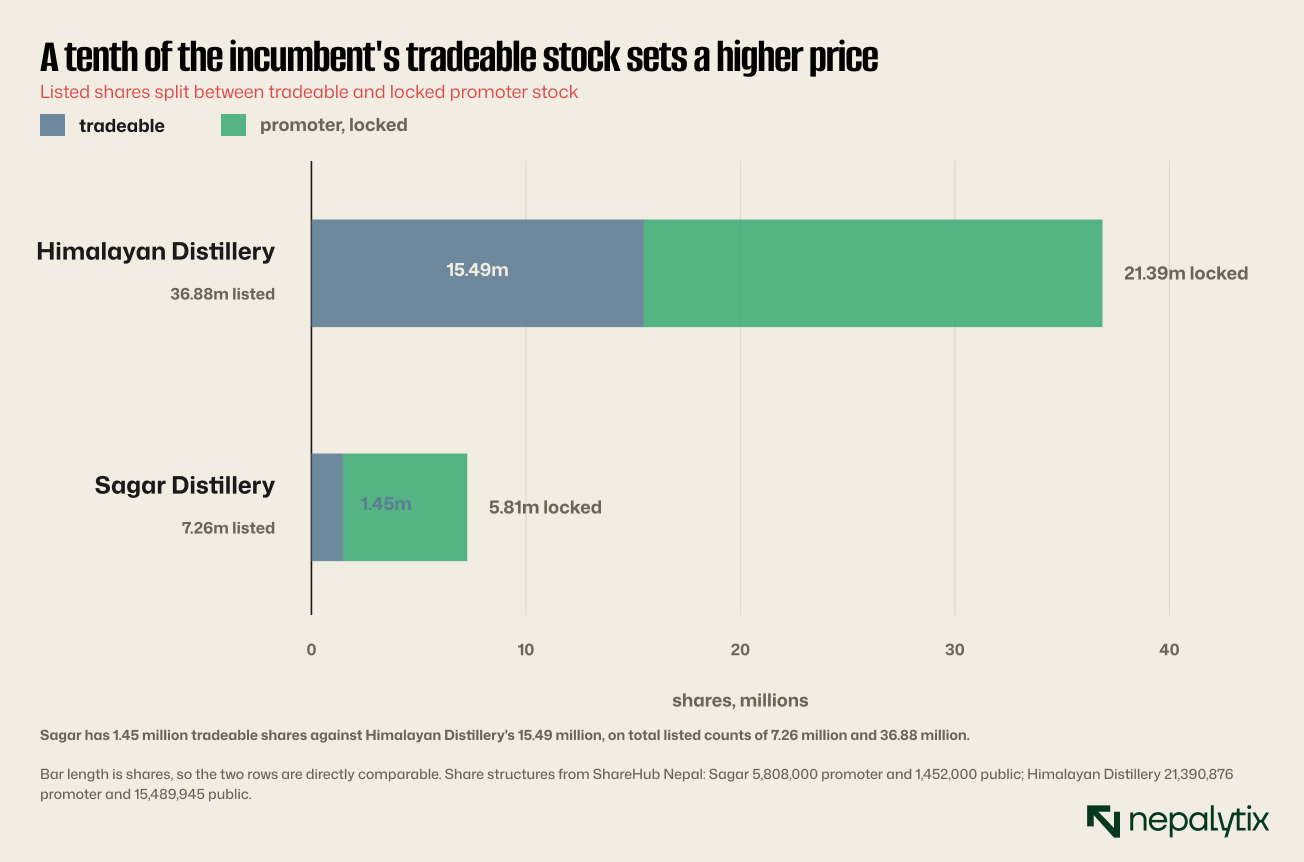
A 20% float is close to the statutory minimum and it has a specific consequence for how the Rs 1,700 price should be read.
Promoter shares carry lock-in periods and do not enter the ordinary market on expiry. Sagar listed in November 2025. Under the general three-year rule for non-bank promoters, its promoter stock is locked until roughly late 2028.
So the price is being set by trading in 1.45 million shares under 2% of the free float of a mid-sized commercial bank. That is not evidence of a market view. It is a quotation from a very small book.
Why the loss trajectory matters more than the level
A Rs 57.2 million loss is small in absolute terms. Against a Rs 12.34 arab market capitalisation it is 0.46%, and a company of this size could absorb it for years.
The trajectory is the concern. The loss did not shrink as revenue grew; it widened by 3.7 times across the year while sales rose 147.72%.
That combination has a specific meaning. It says the incremental sale is not yet contributing positively after the costs required to make it or that fixed costs are rising at least as fast as the gross contribution.
Either can be temporary. A distributor network built ahead of volume or a plant commissioned ahead of demand, both produce this pattern and both resolve as revenue catches up. But the pattern must break at some point, and there is no disclosed information indicating when.
The single most useful figure the company could publish is gross margin. Revenue growth with an expanding gross margin is a business finding its feet. Revenue growth with a flat or falling gross margin is a business buying sales.
The margin question
Spirits manufacturing in Nepal operates under a heavy excise regime and that shapes the entire profit and loss account in ways an investor coming from another sector will not expect.
Excise duty and value added tax are levied on production and sale, and for most Nepali distillers the tax line is comparable in size to the cost of goods. Reported revenue figures therefore need to be read carefully: gross sales including duty and net sales after duty can differ by a wide margin and the two are not always distinguished in summary reporting.
Himalayan Distillery's Rs 8.11 arba of revenue against a net profit of Rs 1.21 arba implies a net margin of roughly 15% which is high for manufacturing and reflects both brand pricing power and scale across a fixed excise administration cost.
That 15% is the ceiling a new entrant should be measured against, not a floor. Sagar is currently below zero.
What the float does to the price
The relationship between float size and price level in Nepal is well documented and it runs in one direction.
A small float means a small number of shares must absorb all buying interest. Where demand exceeds that supply, the price rises until it clears and the clearing price reflects the scarcity of stock as much as any view of the business.
ShareSansar made precisely this argument about Shivam Cement in 2019: its issue was 12% of capital, project-affected local shares were still locked, and the effective float was around 10%, which the portal identified as the primary reason for a 90.67% price rise in sixteen trading days.
Sagar's float of 20% is better than that case but still thin, and its absolute size: 1.45 million shares is what matters more than the percentage. Himalayan Distillery's 15.49 million shares can absorb an order that would move Sagar's price several per cent.
This is not a criticism of the company. It is a statement about what the Rs 1,700 price is evidence of, which is less than it appears.
A price set by a thin book is still a real price, it is what a buyer would pay today. It is simply weaker evidence about value than the same price in a liquid stock, and it should be weighted accordingly.
What the price requires
Rather than assert that Rs 1,700 is too high, it is more useful to state what it demands.
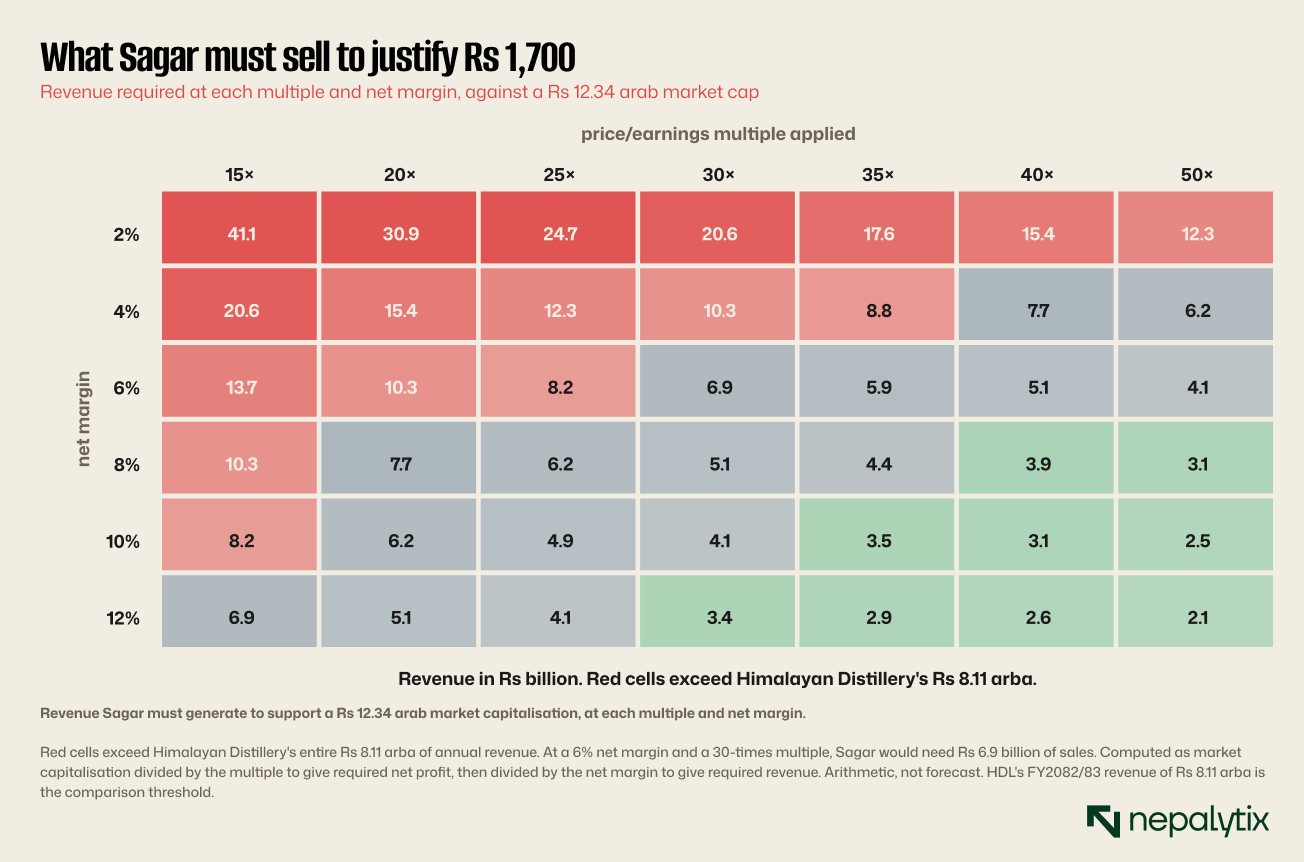
Read the grid at the assumptions that flatter the company most. A 40-times multiple and a 12% net margin, both generous for Nepali manufacturing still require revenue of Rs 2.6 billion.
Against a company that reported Rs 94 million of revenue in FY2023.
To put the same point in the other direction: at Himalayan Distillery's realised net margin of roughly 15% and its current multiple of approximately 35 times, Sagar would need net profit of about Rs 353 million and revenue of about Rs 2.35 billion to support today's price. HDL required more than two decades to reach Rs 8.11 arba of revenue and it did so as the market leader.
Reading the revenue chart carefully also matters. Four observations across nine years is a sparse series, and the line between the first two points crosses five years we have not observed. The 27% decline and the recovery are both real; the shape of the path between FY2074/75 and FY2079/80 is not something we can claim to know.
That is the scale of the journey the current price already assumes has been completed.
Even allowing for two years of the growth rates now being reported, the gap between the revenue the company generates and the revenue its market capitalisation implies is measured in multiples, not percentages.
The lock-in that has not arrived yet
One forward event deserves flagging because it is scheduled and it is large.
Sagar's 5,808,000 promoter shares are locked. Under the general three-year rule from allotment for non-bank promoters, that lock expires around late 2028.
As Sunday's Paisa set out, expiry does not put those shares into the ordinary float. Promoter stock unlocks into the promoter market and requires an AGM resolution, SEBON approval, NEPSE approval and a CDSC application before it becomes ordinary.
What expiry does change is that promoters gain the ability to sell to other promoters and to pledge the stock as collateral. For a company whose founders hold 80% of a business valued at Rs 12.34 arab, that is a meaningful shift in their position even if the float is untouched.
An investor buying today should understand that the current price is set by a float that will remain 20% for at least two more years, and that the eventual widening of it, if the company ever pursues conversion introduces supply against a price established in very thin trading.
The comparison a buyer should run
One arithmetic exercise puts the premium in its starkest form.
Sagar's market capitalisation of Rs 12.34 arab against a plant rated at five million litres a year values each litre of annual capacity at roughly Rs 2,468.
That is a crude measure and it ignores brand, distribution and product mix, all of which matter more than capacity. But it is the only revenue-adjacent operating metric the company has disclosed and Rs 2,468 per litre of nameplate capacity is a demanding number for a plant that is not yet generating a profit at whatever utilisation it is currently running.
We could not obtain Himalayan Distillery's capacity, so no comparison is possible. That absence is itself worth noting: the two most basic operating measures for a manufacturer, capacity and utilisation are not systematically disclosed in this sector.
Sector context
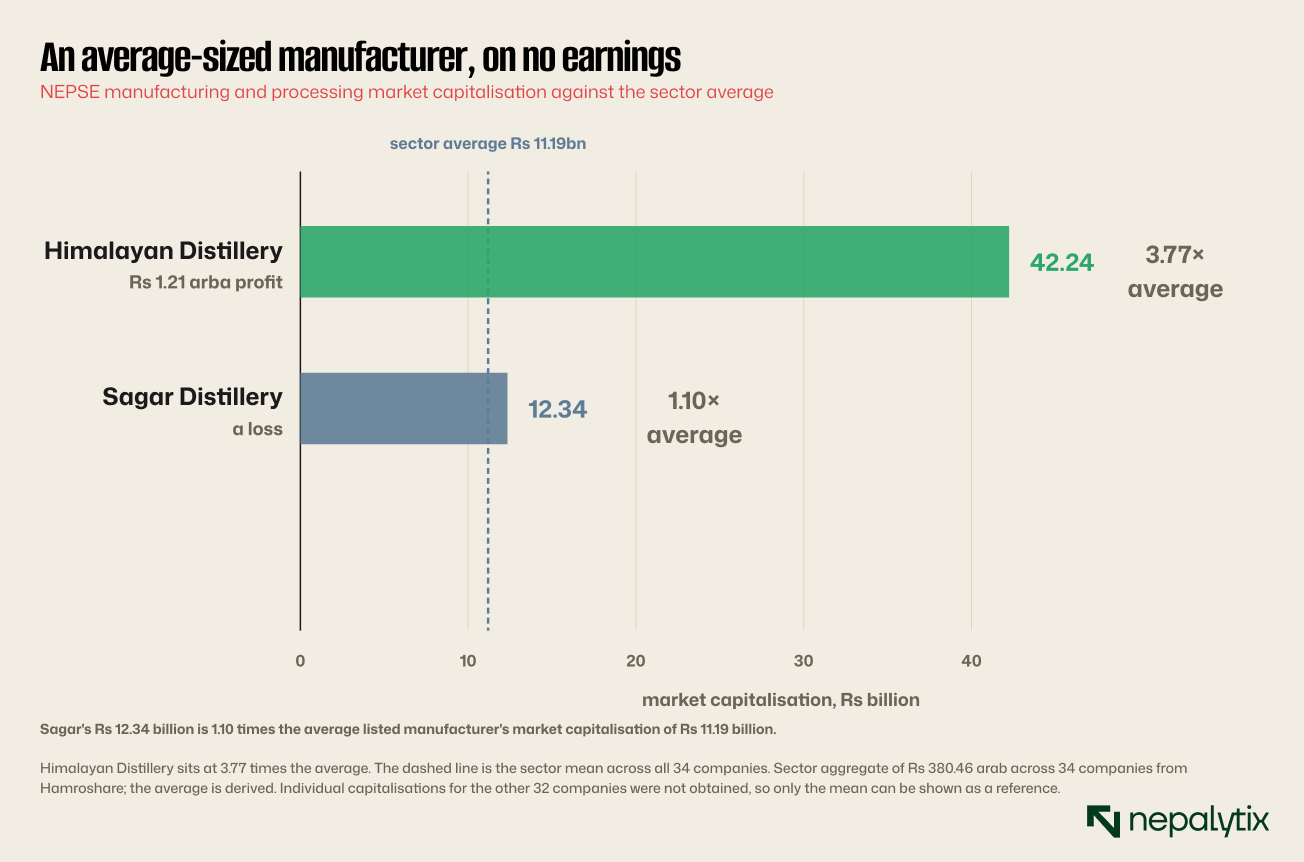
The sector also carries a demand-side history worth knowing before underwriting a growth story in it.
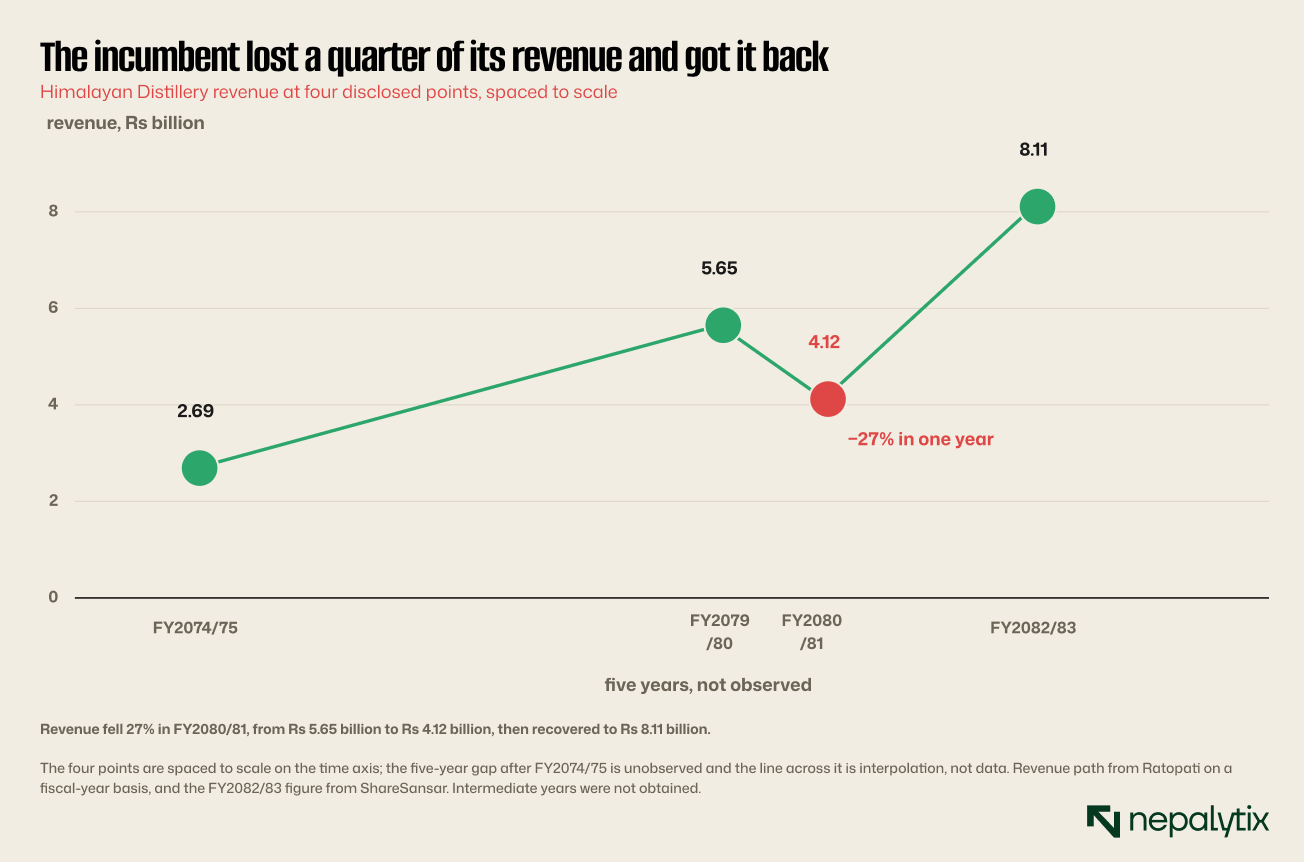
The comparison across the sector's largest names is instructive. Unilever Nepal's revenue fell about 3% and Bottlers Nepal Terai's about 6% over the same period. HDL's 27% decline was the sharpest among the large manufacturers, and it demonstrates that spirits demand in Nepal is cyclical rather than defensive.
A company with an established brand portfolio and a national distribution network lost a quarter of its revenue in a single year. A new entrant carries that same exposure without the balance sheet to absorb it.
Three things this note does not claim
Bounding the argument, because a note that declines to state a fair value can easily be read as a negative recommendation.
We are not saying the business is failing. Revenue growth of 147.72% is the opposite of failure, and a company in its first year as a listed entity carrying losses during expansion is behaving normally.
We are not saying the price is wrong. We are saying we cannot determine whether it is right, because the absolute revenue, the book value and the cost structure are not available, and the price is being set in a float too thin to serve as an independent check.
We are not extrapolating Himalayan Distillery's per-share history onto Sagar. HDL's dilution came from repeated bonus issues by a mature company capitalising reserves. Sagar has no comparable history and may never follow that path. The record is offered as sector context, not as a forecast.
What a buyer is actually underwriting
Strip out the sector history and the comparison and the position reduces to a single proposition.
A buyer at Rs 1,700 is paying Rs 12.34 arab for a company that lost Rs 57.2 million last year, on the expectation that a growth rate of roughly 148% will continue long enough to produce earnings that justify the price.
The revenue grid earlier in this note quantifies what that requires. At assumptions favourable to the company, it needs revenue several multiples above anything it has disclosed.
That is not an impossible proposition. Nepal's spirits market is large, informal supply is being displaced by formal brands and a well-run new entrant with distribution can take share. Himalayan Distillery itself grew sales from Rs 1.35 arba to Rs 2.69 arba in a single year at one point in its history.
But it is a venture-stage proposition being priced in a public market at a premium to the established leader, held by a float too small for that pricing to represent much of a consensus, and disclosed thinly enough that the key inputs cannot be checked.
The counter-case
The strongest argument for the share, put fairly.
The growth is real and it is accelerating. Revenue of Rs 66 million in FY2022, Rs 94 million in FY2023 and reported growth of 147.72% in the latest year is not a company standing still. Losses during a landgrab phase are normal and expected.
The sector has room. A large share of Nepali spirits consumption remains informal or home-produced. A formal manufacturer with brands and distribution is addressing a market considerably larger than the listed sector's revenue implies.
Scarcity has value in this market. Nepal's listed manufacturing sector is thin and dominated by companies with tiny floats and long histories. A new, growing, small-float manufacturer will command a premium simply because there are so few of them.
We accept all three. What we would say against them is that each is an argument for owning the business and none is an argument for owning it at a 48% premium to a profitable incumbent three times its size.
The disclosure gap, stated plainly
It is worth listing what a reader of Nepali market reporting can and cannot learn about this company because the gap is wider than for most listed names.
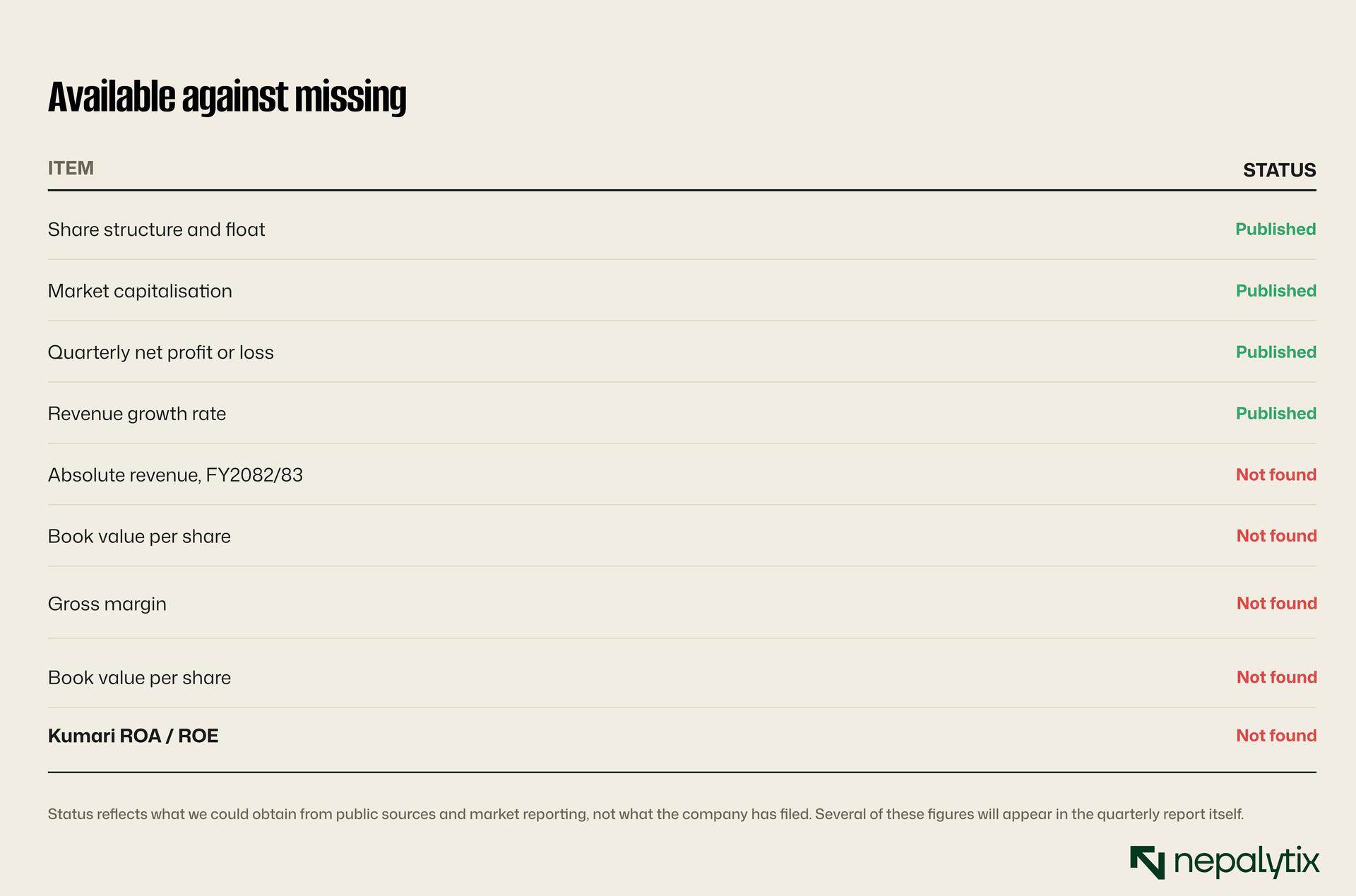
Four of the nine items are available and five are not and the five missing ones are precisely those needed to value the share. That is the practical case for reading the filing before acting on anything in this note including its conclusions.
What would change this view
Four things, in order of how much they would move the assessment.
The Q4 filing, read directly. The split between selling costs and financial costs determines whether this is a growth investment or a leverage problem. We have not obtained the filing and this note should be revised when we do.
Absolute revenue. A 147.72% increase on an undisclosed base is not a number an investor can use. The level, set against the Rs 6.9 billion the grid implies, is the whole valuation question.
Book value per share. Not published in any source we could obtain. HDL's Rs 131.80 gives a comparison point; without Sagar's, price-to-book cannot be computed and the Rs 1,700 has no balance-sheet anchor at all.
Capacity utilisation. The plant is rated at five million litres a year. What fraction is running determines whether the revenue growth has room to continue or requires fresh capital expenditure.
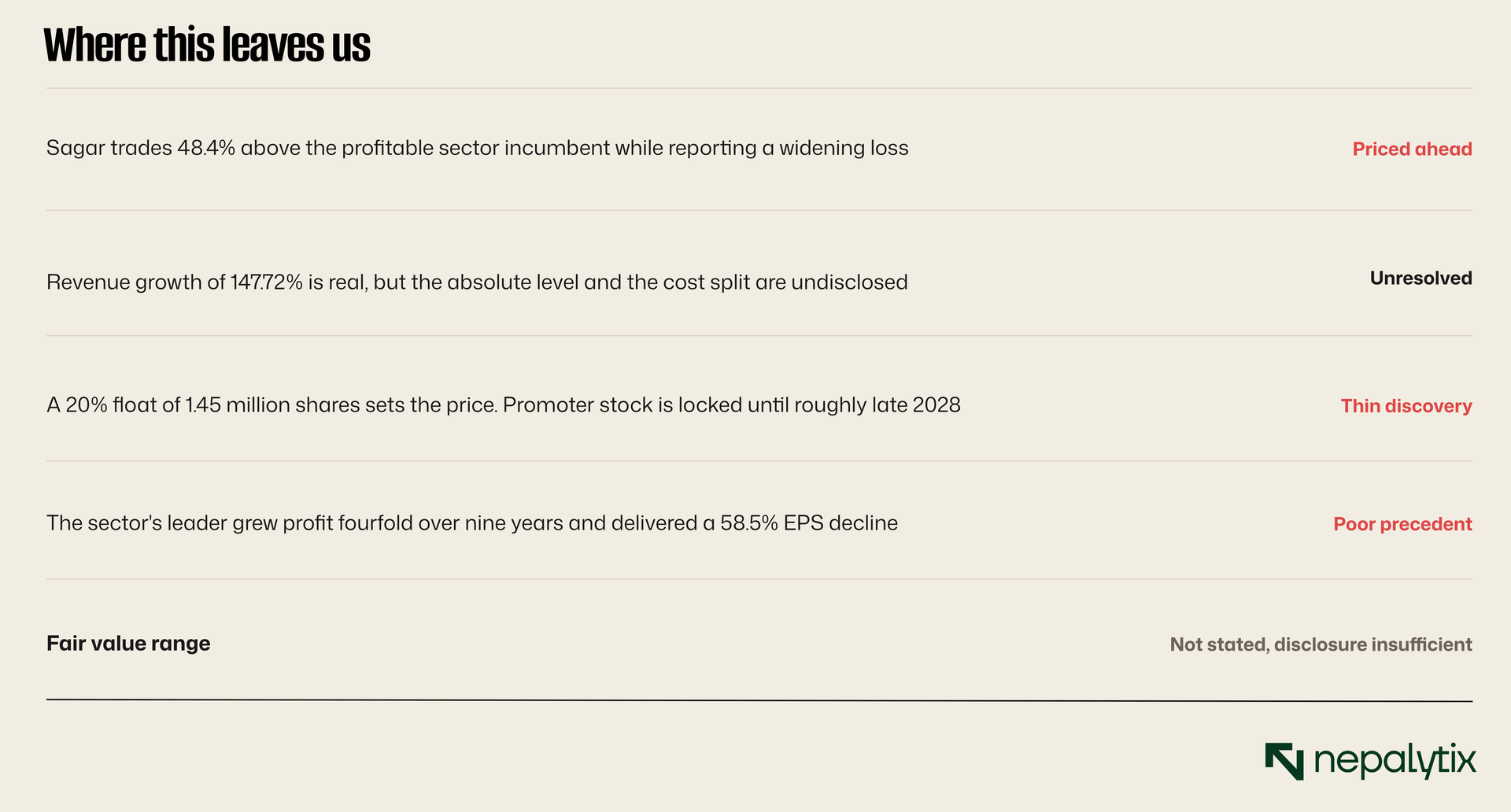
We are not putting a number on this share and the reason is in the caveat at the top of this note rather than in any judgement about the business. Three quarters of results, no published book value, no absolute revenue figure and no access to the filing is not a basis for a valuation. Publishing one would be arithmetic dressed as analysis.
What can be said is narrower and, we think, more useful. The market is pricing Sagar Distillery above a company that has been making and selling spirits in Nepal for twenty-three years, earns Rs 1.21 arba a year and has three times its market capitalisation. That is a demanding position for any newly listed company, and it is being sustained by trading in under one and a half million shares. The price and the evidence supporting it are not proportionate to one another and the gap between them is where the risk sits. An investor comfortable with that gap is making a venture judgement, not a valuation one and should know which they are making.
The incumbent's nine-year record is the piece of evidence a prospective buyer should sit with longest. Himalayan Distillery did nearly everything right, quadrupled profits, recovered from a 27% revenue collapse, built a dominant brand position and its shareholders still watched earnings per share fall by more than half.
Growth in this sector has been real. It has not reliably belonged to shareholders.
We will revisit this note when the Q4 filing is obtainable and specifically when absolute revenue, gross margin and the selling-versus-financial cost split can be read directly. Those three figures would move this from a note about what a price implies to a note about what a business is worth which is the note we would rather have written.
Disclaimer
This report has been prepared by Nepalytix for informational and educational purposes only and does not constitute investment advice, an offer, or a solicitation to buy or sell any securities.
The information contained in this report is based on sources believed to be reliable; however, Nepalytix does not guarantee its accuracy, completeness, or timeliness. Opinions, estimates, and projections expressed herein are those of the authors as of the date of publication and are subject to change without notice.
Investing in securities involves risks, including the possible loss of principal. Past performance is not indicative of future results. Readers are advised to conduct their own independent research and consult with a qualified financial advisor before making any investment decisions.
Nepalytix and its contributors may hold positions in the securities discussed in this report at the time of publication or thereafter.
Neither Nepalytix nor any of its affiliates accept any liability for any loss arising from the use of this report or its contents.