Sarbottam's Record Profit Isn't Saving Its Share Price
Sarbottam Cement's record profits mask two looming risks-an impending surge in tradable shares.
Sarbottam has posted the strongest results in its listed life and the share has drifted to new lows. The consensus reads this as an inefficiency good company, falling price, therefore a buy. It isn't. The market is discounting a supply cliff and a cement cycle rolling over and on both counts it is correct. The mispricing is in the bull case not the stock.
The Take
The "strong results, dead stock" puzzle is not a mistake to exploit, it is the market pricing two things the earnings-first case ignores: 89% of the shares unlock within eight months into a float of a few million, and the record profit is a peak-cycle print in a sector running ~22Mt of capacity against ~8Mt of demand. At 33× peak earnings, days from a supply flood, the stock is not cheap. The market isn't wrong. It's early.
Start with the puzzle, because it is real and it is genuinely strange. Through the first nine months of FY2082/83, Sarbottam Cement earned Rs 905.8m a record built on an H1 profit of Rs 538m that alone exceeded half the entire prior audited year. On any ordinary reading of a stock market, a profit print like that lifts the shares. Sarbottam's did the opposite: the price ground down through the strong results and as of 16 July, sits at Rs 772 below its own 52-week range and a long way under the highs.
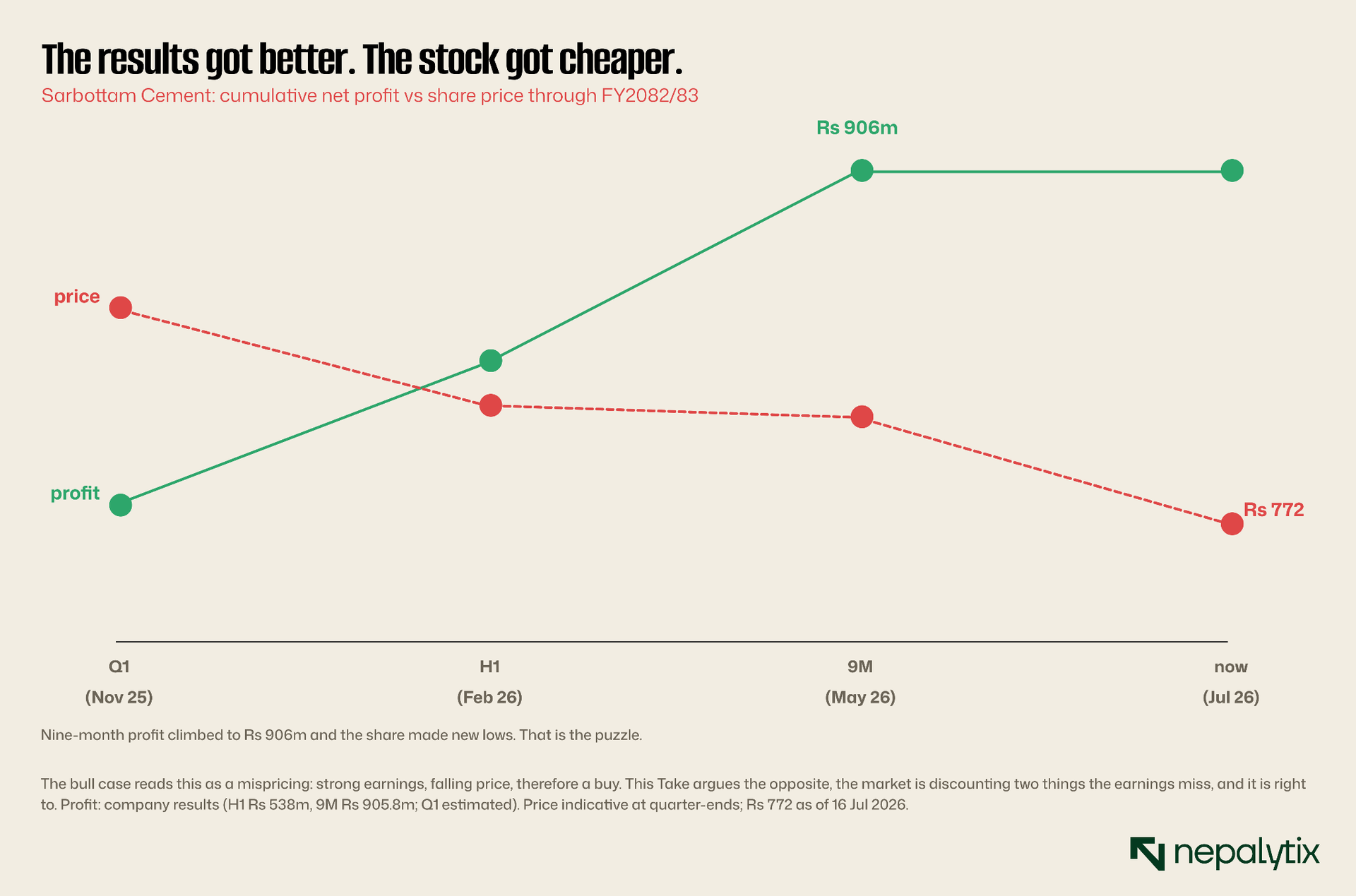
The bull case writes itself from here and to argue against it honestly you have to state it at its strongest. Sarbottam is a real, modern integrated plant with captive limestone run by an established group. It carries almost no long-term debt Rs 60.5m against Rs 10.24bn of equity. Its earnings are not only growing but accelerating. And on a trailing multiple it looks cheaper than it has in two years. Put those together and the conclusion seems obvious: the market has simply failed to notice, and a patient buyer is being handed a quality compounder at a discount. That is the case a dozen NEPSE commentators have made and every fact in it is true.
It is also we think wrong because it answers the wrong question. The bull case asks what the company earned. The market is asking what happens next to the supply of stock and to the price of cement. On both, the answers are unfavourable, visible, and dated to the calendar.
Reason one: the supply cliff
Begin with the share register, because it is the single most important fact about this stock and the one the earnings-first case never mentions. Of Sarbottam's 52.24m shares only about 10.9% of a few million shares actually trades. The remaining 89% is locked: roughly 87% promoter stock under a SEBON three-year lock that lifts around 11 March 2027 and the qualified-institutional tranche that unlocks earlier around September 2026.
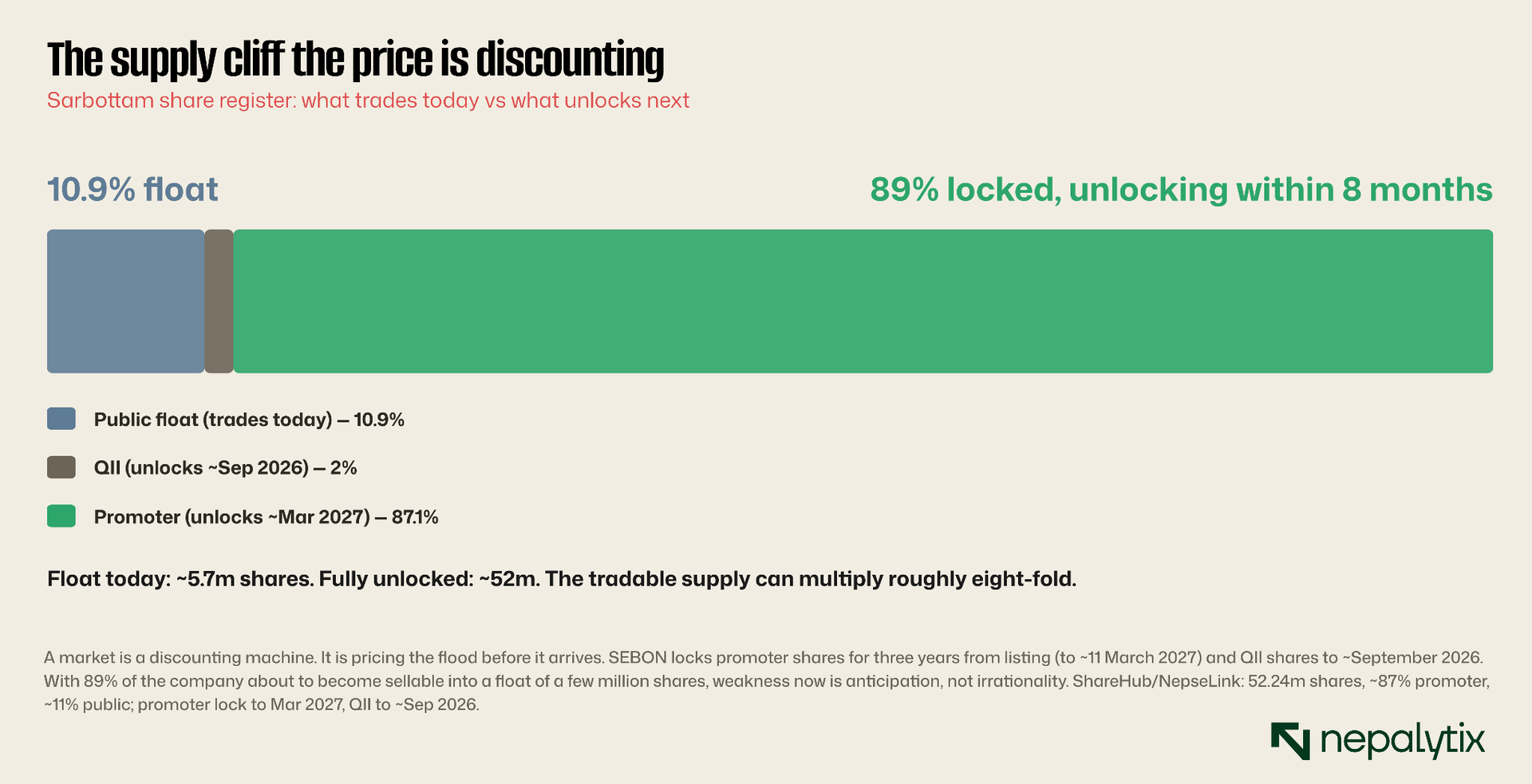
A market is a discounting machine. It does not wait for supply to arrive before repricing for it; it reprices in anticipation. With 89% of the company set to become sellable within eight months, into a float presently measured in single-digit millions of shares, the tradable supply of Sarbottam can multiply roughly eight-fold. You do not need any of those locked holders to actually sell to move the price, you only need the market to understand that they can and to demand a discount for the risk that they will. That discount is not irrationality. It is the correct response to a known, dated overhang.
If this mechanism were only theory, it would be worth less. It isn't, the cement sector is running a live experiment across three comparable names, and the results are unambiguous. Shivam, which has already cleared its lock-in, trades on an upward path. Ghorahi, which is unlocking now and happens to be loss-making, is down about 16% on the year. Sarbottam sits between the two on the calendar and is being priced toward Ghorahi's trajectory rather than Shivam's, despite far better operating numbers than either.
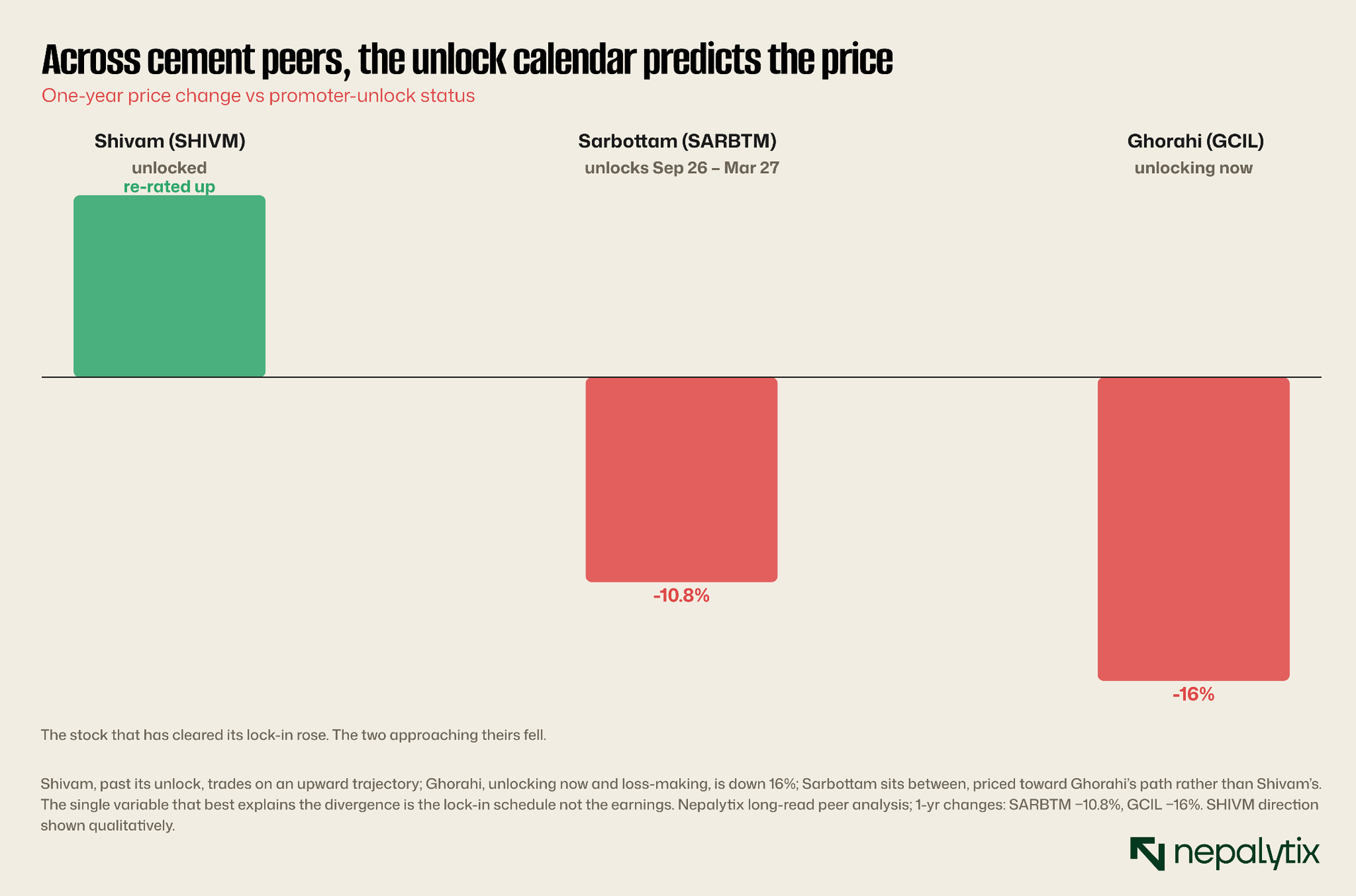
The variable that most parsimoniously explains why three cement stocks with different fundamentals are behaving the way they are is not earnings, or book value or leverage. It is close to unlocking. Shivam has cleared; Ghorahi is at the cliff edge; Sarbottam is walking toward it. The market has read the calendar. The analysts anchored on trailing EPS have not.
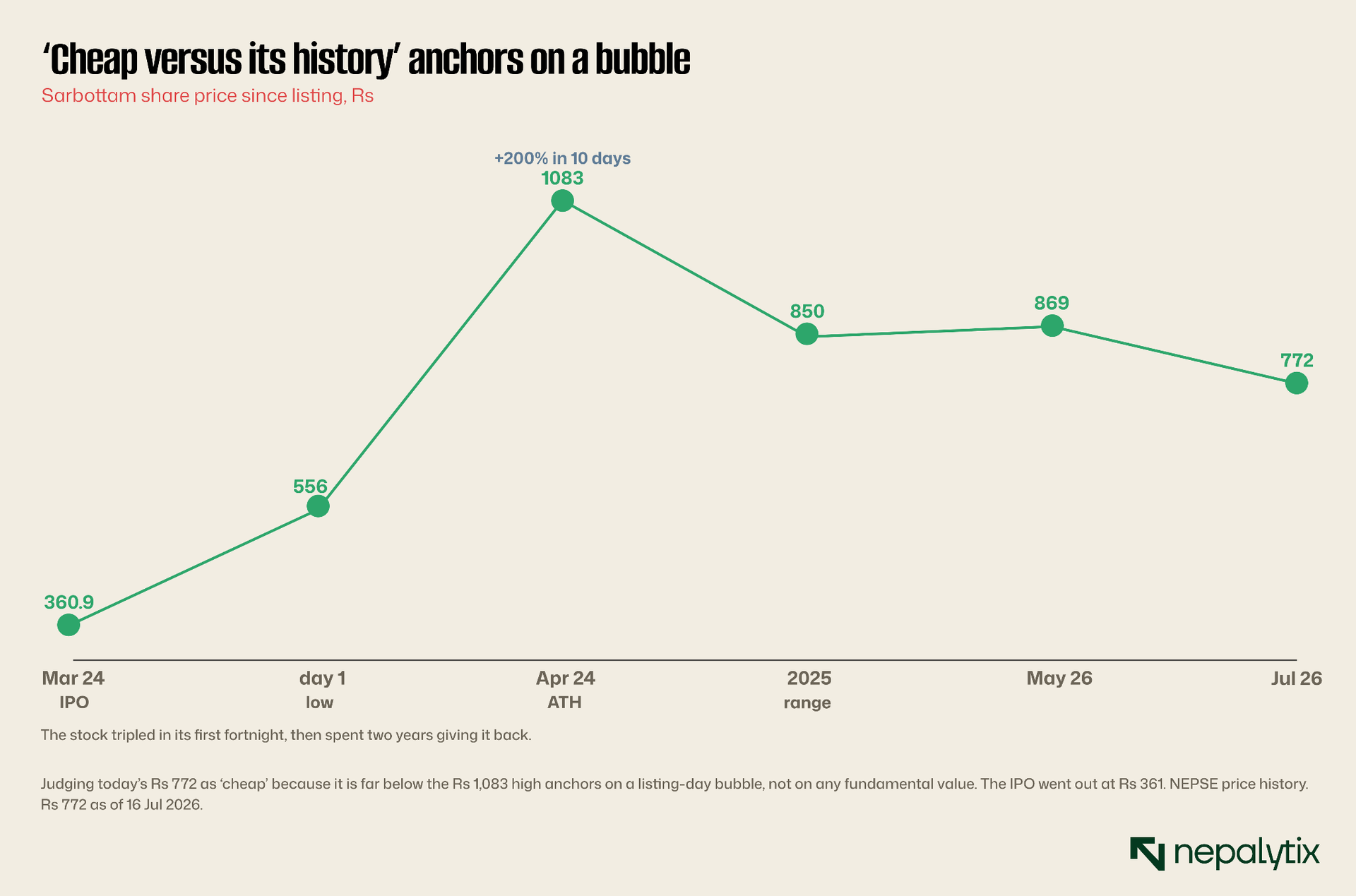
Which disposes of the "cheap versus its own history" argument too. Sarbottam tripled to Rs 1,083 within ten trading days of listing a 200% gain for public allottees over an IPO price of Rs 361 and has spent two years giving that back. Measuring today's Rs 772 against that Rs 1,083 high and calling the difference "value" is anchoring on a bubble. The listing spike was a function of a tiny float meeting IPO euphoria not of fundamentals. Using it as the benchmark for cheapness is precisely the error the float mechanics should warn you away from.
Reason two: peak earnings in a drowning sector
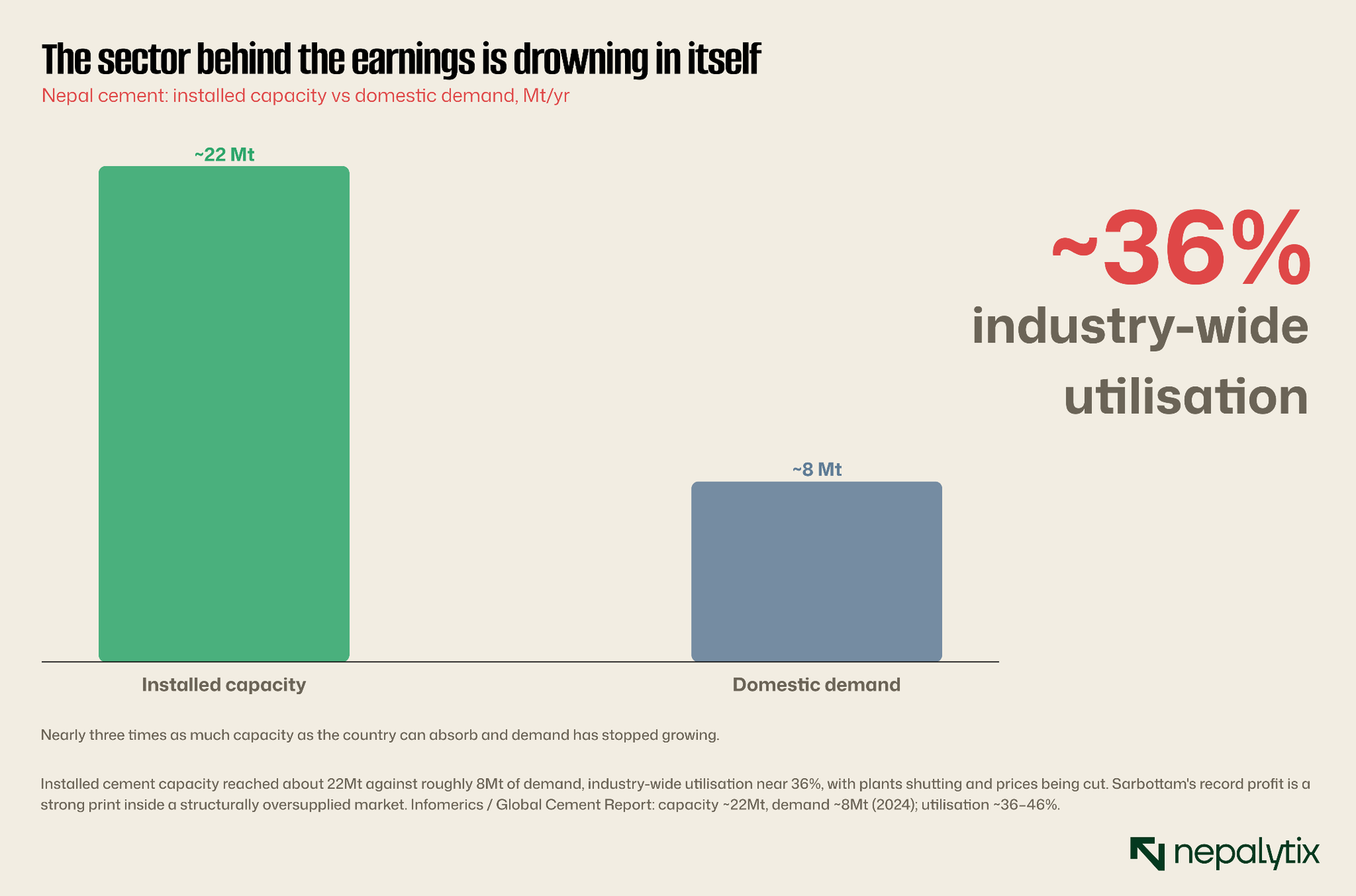
Now the earnings themselves because even the record profit is not the unambiguous positive it appears. Nepal's cement industry built roughly 22Mt of installed capacity against domestic demand of about 8Mt. Industry-wide utilisation runs near 36%. Plants are shutting thirteen in Koshi temporarily idled, Hetauda and Udayapur lurching in and out of production while the survivors fight for share with aggressive pricing and dealer incentives on imported coal and clinker whose cost keeps rising. This is not an industry with pricing power. It is a structurally oversupplied commodity sector two years past its reconstruction-era peak.
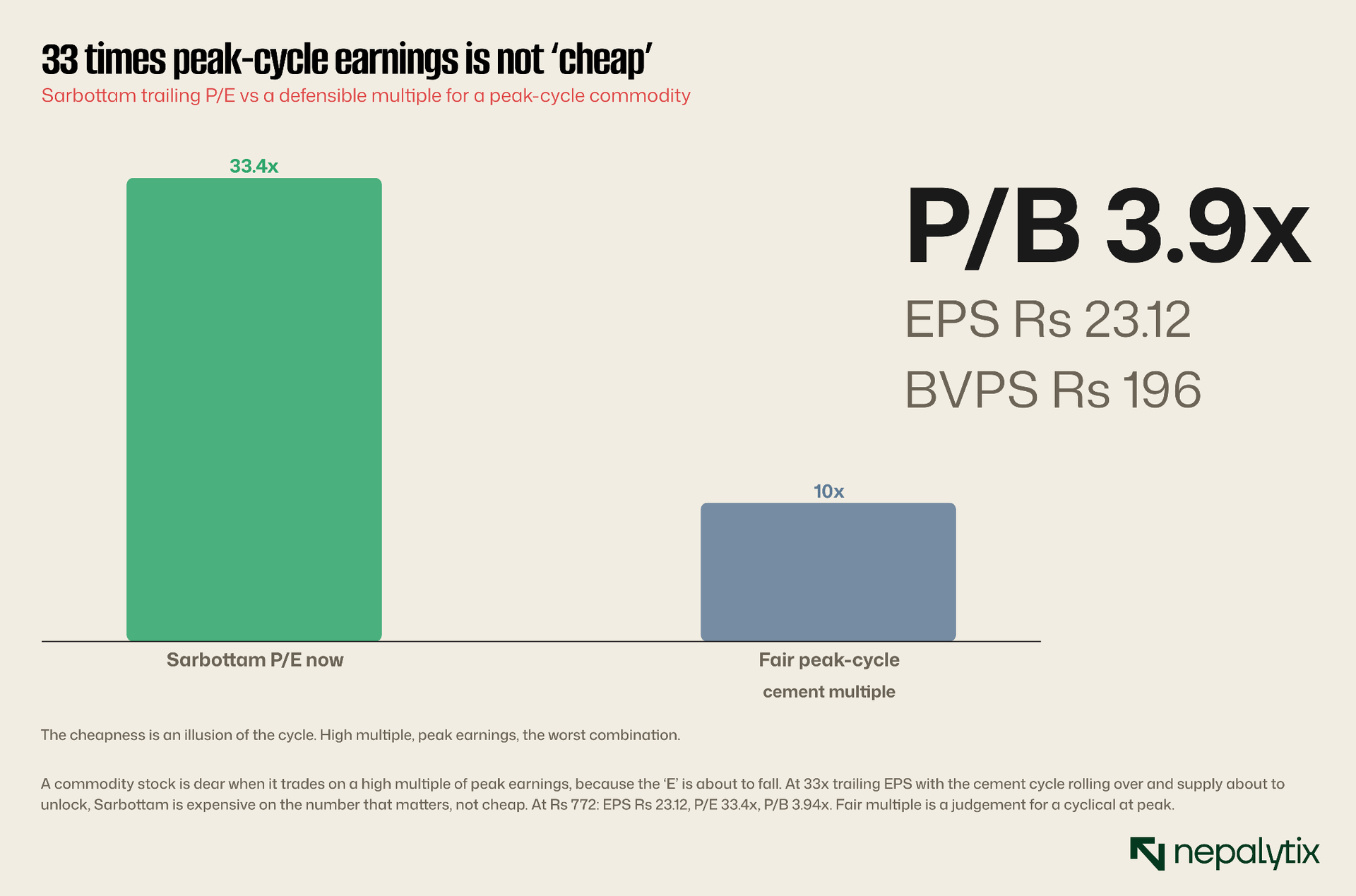
In that context, a record profit is not a plateau to extrapolate, it is a peak to fade. And this is where the valuation argument inverts on the bulls. A commodity producer is cheap when it trades on a high multiple of trough earnings, because the "E" is about to recover. It is expensive when it trades on a low multiple of peak earnings, because the "E" is about to fall. Sarbottam manages the worst of both: a high multiple 33 times trailing EPS of what looks like peak earnings. Strip away the anchoring on the listing bubble and the stock is not cheap on any measure that respects the cycle. It is expensive on the one that matters.
Where the bulls are half-right
Give the other side its due on the one point it earns. The balance sheet really is unusually clean on long-term debt: Rs 60.5m against Rs 10.24bn of equity is effectively no term leverage, and in a capital-intensive, cyclical business that is a genuine and rare strength. It is the reason Sarbottam will survive the shakeout that closes weaker plants and it is why this is a Take about price, not about solvency.
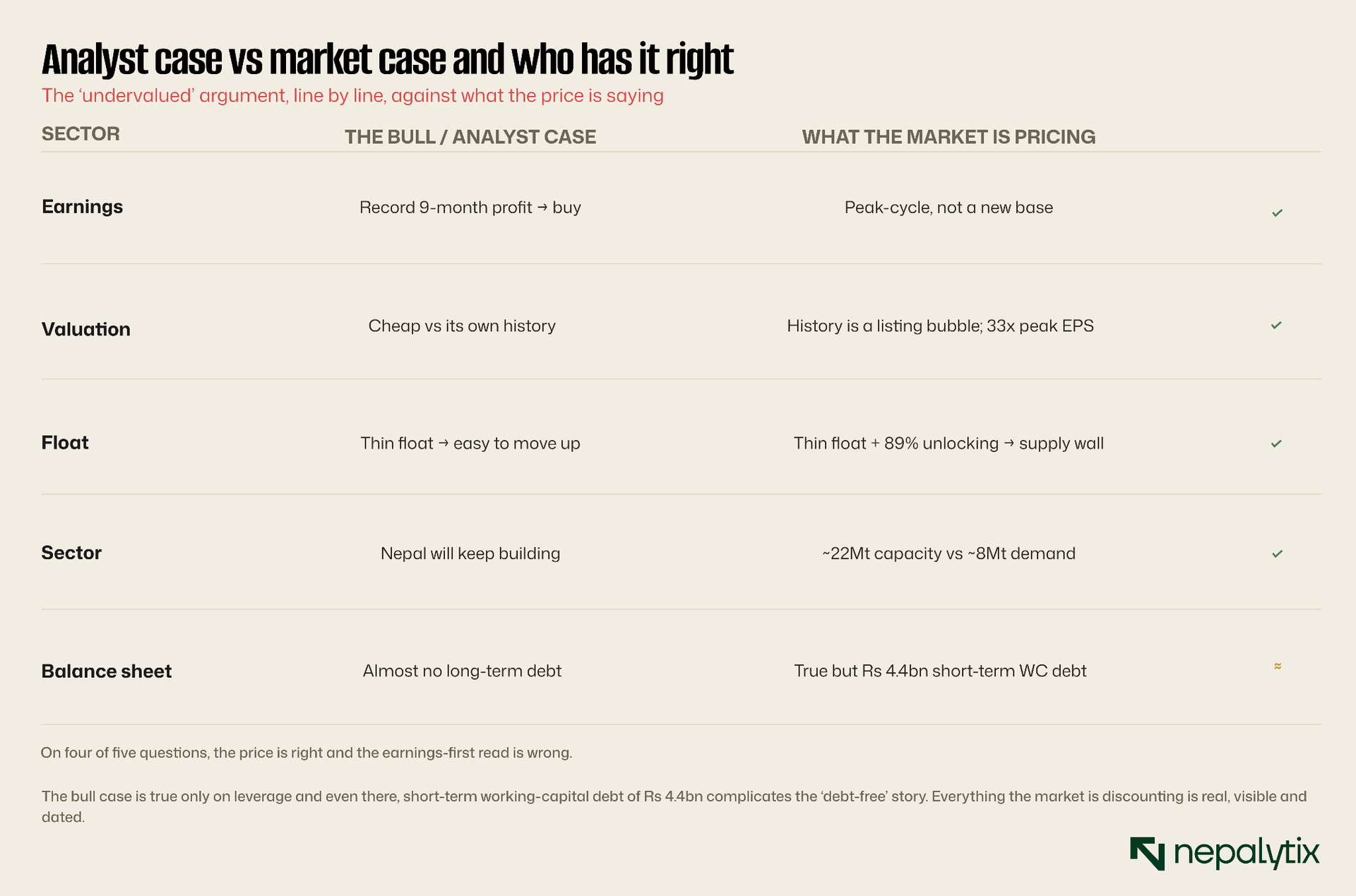
But the "debt-free" framing is cleaner than the accounts. Short-term borrowings stood at Rs 4.42bn at the end of the third quarter, up from Rs 3.76bn a year earlier working-capital debt funding inventory and receivables in a business selling into a price war. That is not a solvency worry at this equity base, but it is a reminder that the pristine-balance-sheet story requires a footnote, and that cash generation in an overcapacity sector is harder than a headline profit suggests. The strength is real. It is also the only leg of the bull case still standing.
The verdict
Lay the two cases side by side and the scorecard is lopsided. On earnings, the bulls see a record and the market sees a peak. On valuation, the bulls see cheapness and the market sees a bubble-anchored illusion at 33× peak profit. On float, the bulls see a thin free-float that could squeeze up and the market sees 89% of the company about to come sellable. On the sector, the bulls see a building nation and the market sees three-times-demand capacity. On four of five questions, the price is right and the earnings-first read is wrong. The bulls win only on leverage and even there with an asterisk.
None of this makes Sarbottam a bad company. It is one of the better-run cement assets in the country, and the low term-debt means it will still be standing when the cycle turns and weaker rivals are gone. That is exactly the point worth ending on: a good company is not the same as a good price. The market has not failed to notice Sarbottam's earnings. It has looked past them to the supply calendar and the cement cycle, and priced accordingly. That is not inefficient. That is the market doing its job.
What would change this Take? Three things, and they are datable. A promoter unlocked in March 2027 that passed without meaningful selling evidence the overhang was smaller than feared. A cement demand recovery that lifts utilisation off the floor and restores pricing power evidence the earnings are a base not a peak. Or a price low enough to compensate for both risks which Rs 772 on 33× peak earnings plainly is not. Until one of those arrives, the investors calling Sarbottam undervalued are fighting the one participant that has read the calendar correctly: the market itself.
Disclaimer
This report has been prepared by Nepalytix for informational and educational purposes only and does not constitute investment advice, an offer, or a solicitation to buy or sell any securities.
The information contained in this report is based on sources believed to be reliable; however, Nepalytix does not guarantee its accuracy, completeness, or timeliness. Opinions, estimates, and projections expressed herein are those of the authors as of the date of publication and are subject to change without notice.
Investing in securities involves risks, including the possible loss of principal. Past performance is not indicative of future results. Readers are advised to conduct their own independent research and consult with a qualified financial advisor before making any investment decisions.
Nepalytix and its contributors may hold positions in the securities discussed in this report at the time of publication or thereafter.
Neither Nepalytix nor any of its affiliates accept any liability for any loss arising from the use of this report or its contents.