SEBON’s Short Selling Plan Faces Nepal’s Liquidity Problem
SEBON’s proposed covered short selling could improve price discovery in Nepal but thin trading volumes, circuit limits and the lack of a lending pool could limit where the reform actually works.

SEBON has proposed covered short selling, securities lending and margin lending. A covered short must be borrowed, sold and bought back. On 7 September only nineteen of 236 securities traded more than 400 times and the circuit limit means a seller cannot buy back at all.
On 31 July the Securities Board of Nepal published a concept paper proposing three things this market has never had: margin lending under its own supervision, securities lending and borrowing and covered short selling. It follows a budget commitment to introduce intraday trading, short selling and derivatives in phases.
The case for it is straightforward and largely correct. A market where the only available action is to buy or to abstain produces prices that reflect the enthusiasm of holders rather than the balance of opinion. Nepal has spent three decades with that market. Every finding this publication has produced this month is a symptom of it.
The difficulty is not the principle. It is that a covered short requires a share to be borrowed, sold, bought back and on 7 September only nineteen of the 236 securities that carried a transaction count traded often enough for the last step to be reliable.
Why this proposal is right in principle
Before the objections, the case for proceeding deserves its own space because it is stronger than the objections and this publication has spent a month accumulating evidence for it without naming it.
Two weeks ago the post-listing screen found that every company listed on NEPSE within 180 sessions trades above its issue price, and that not one of 98 older hydropower companies trades below theirs. A market with no losing IPO in either sample is a market where the primary price carries no information.
Last Thursday, 111 hydropower companies turned out to be clustered in the lower half of their own annual range simultaneously, moving on common factors with almost no company-specific dispersion.
Last Wednesday, banks were found to be lending up to 80% against collateral valued at a last traded price that, for a fifth of the market comes from twenty-five trades or fewer.
Each of those is a symptom of the same condition. Prices in Nepal are formed by people who want to own the asset because those are the only people who can act. Nobody who thinks a share is expensive can do anything except decline to buy it and declining to buy leaves no trace in the price.
SEBON's diagnosis is correct. The question this piece asks is narrower: whether the instruments proposed can operate in the market as it currently trades.
What a covered short actually requires
Start with the mechanics, because the word "short" is doing a lot of work and the proposal is narrower than the debate around it.
Naked short selling means selling a share you have not borrowed and do not own. It is banned almost everywhere and SEBON is not proposing it. Covered short selling means locating a lender, borrowing the stock, selling it in the market and later buying it back to return it. The borrowing leg is why the paper proposes securities lending and borrowing alongside: one cannot exist without the other.
So a functioning covered short needs four things in sequence. Someone willing to lend the stock. A price at which to sell it. A price at which to buy it back. And enough volume at that second price to close the position before the borrowing agreement expires.
Nepal has a problem at each of the four and they compound.
The borrowing agreement is the piece most easily overlooked. A stock loan has a term and a recall provision: the lender can demand the stock back and when they do the short seller must buy it in the market whatever the price. In a liquid market that is an inconvenience. In a security trading eleven times a day it is a forced purchase into a book with no sellers.
Recall risk is why institutional lenders in developed markets charge more for hard-to-borrow names and why borrowers avoid concentrated positions in them. Nepal would inherit the same dynamic with far fewer lenders and far thinner books.
The market it would operate in
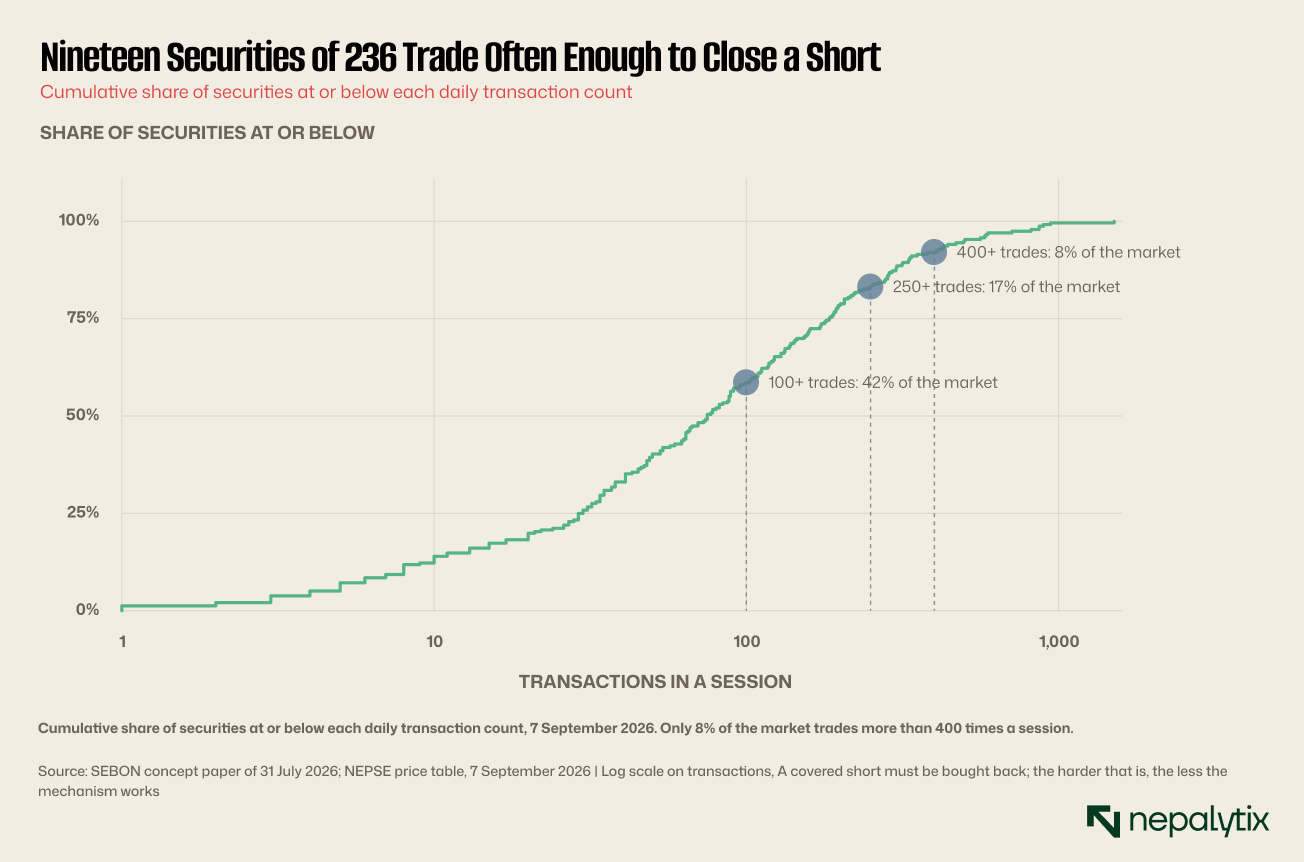
On 7 September, 236 securities carried a transaction count. The median traded 75 times. Fifty traded twenty-five times or fewer. Thirty-three traded ten times or fewer. Three traded once.
At the other end, nineteen securities traded more than 400 times and forty traded more than 250. Those forty are where a covered short could operate without the closing trade moving the price against the seller.
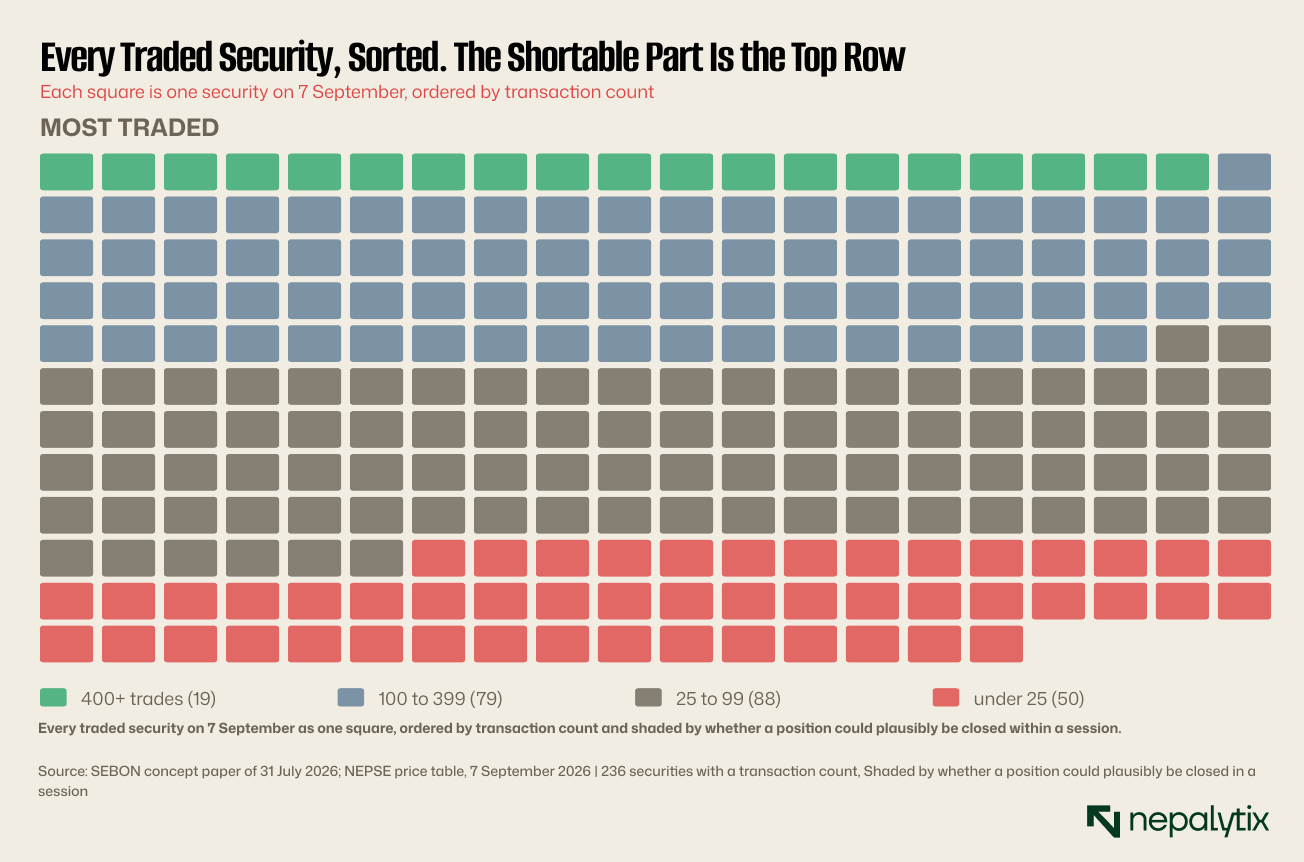
Draw the whole market as a grid and the shortable part is the top two rows. Below that sits the sector this publication has spent a month documenting: 111 hydropower companies, closed-end funds that do not print a price in a given week, promoter lines that change hands twice.
The objection to this is that liquidity is endogenous. Introduce short selling and volume rises because every short creates a future buyer. That is true and it is the strongest argument for proceeding. But it is circular in the securities that need it most: a covered short in a stock trading eleven times a day cannot be initiated at a size that would generate meaningful volume so the mechanism that would create liquidity cannot start for want of liquidity.
There is a further asymmetry inside those numbers that matters for who would participate. The forty securities liquid enough to short are the largest and best-followed on the exchange: the commercial banks, the largest hydropower names, the handful of manufacturers with real turnover. They are also the securities with the most analyst attention and the narrowest information gaps.
An investor with a genuinely differentiated negative view is more likely to have formed it about a company nobody covers. The reform hands the tool to the people who need it least.
That is not a reason to withhold it. A liquid market with short selling is better than a liquid market without. It is a reason to be precise about what the reform will achieve because the case being made publicly is about price discovery across the market and the delivery is confined to its most efficient corner.
The grid in Figure 2 also makes visible something the aggregate hides. The four colour bands are not evenly sized. Ninety-eight securities trade a hundred times or more but only nineteen trade four hundred times or more, and the drop between those two is steep. There is no broad middle.
That shape matters for an eligibility list. A threshold set at a hundred transactions admits forty per cent of the market and includes securities that trade a hundred and five times. A threshold set at four hundred admits eight per cent and excludes almost everything. There is no natural break to anchor on which means wherever the line is drawn it will be arbitrary and contested.
The circuit limit makes it worse
Nepal caps individual share moves at 15% a day. That cap was raised from 10% on 20 April 2026 and last week this publication set out what it does to a bank lending against pledged shares: during a limit-down sequence the collateral cannot be sold so the loan rides the fall.
The same mechanism catches a short and it catches it harder.
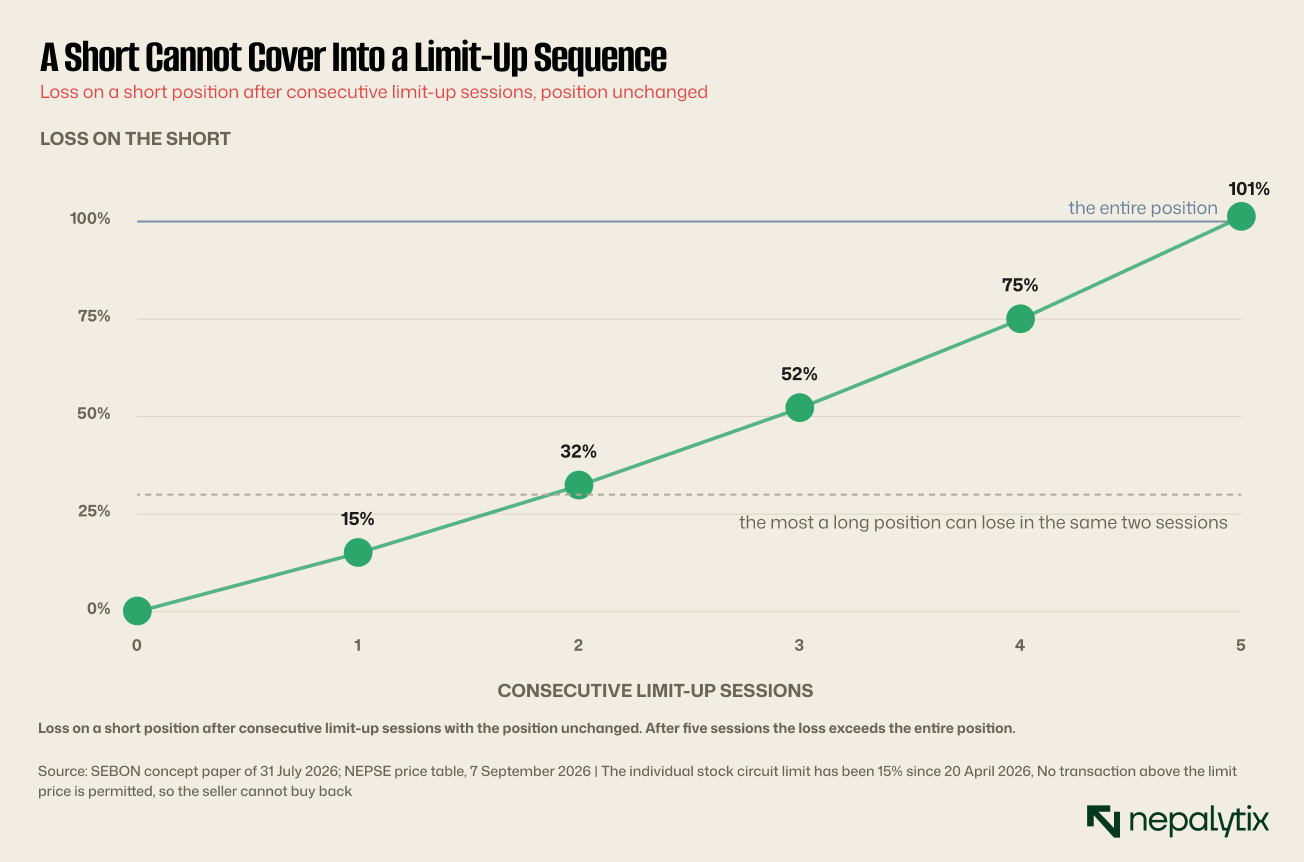
A short seller loses when the price rises. If the share goes limit-up, no transaction above the limit price is permitted so the seller cannot buy back. The book fills with buyers and empties of sellers because anyone holding expects a higher limit tomorrow.
One limit-up session costs the short 15%. Two cost 32%. Three cost 52%. Five cost 101% which is more than the position was worth when it was opened. And through every one of those sessions the seller is trying to buy and cannot.
Compare that with the lender's position last week. A bank at 80% loan-to-value was underwater after two limit-down sessions and could not sell. A short is underwater by a third after two limit-up sessions and cannot buy. The circuit limit was designed to protect the market from violent moves. What it actually does is prevent anyone from acting during one.
It is worth putting the two traps side by side because they are the same trap seen from opposite sides of a trade and both were documented on the same exchange within a fortnight.
A bank lends 80% against shares. The shares go limit-down. The bank cannot sell and after two sessions the loan exceeds the collateral.
An investor shorts the same shares. The shares go limit-up. The investor cannot buy and after two sessions the loss is a third of the position and still growing.
In both cases the participant is correct about direction and unable to act. The circuit limit does not reduce the loss; it removes the exit and lets the loss accumulate while everybody watches.
The loss has no floor
This is the part of short selling that people who have not done it consistently underestimate.
A long position can lose everything and no more. Buy Rs 100,000 of a share, the company fails, you lose Rs 100,000. The loss is bounded by what you paid.
A short position has no such bound. If the share triples, the seller owes two whole positions. If it goes up ten times, nine.
Now apply Nepali data. Last Thursday this publication found that the median listed hydropower company ranged 1.68 times between its low and high within twelve months and that eleven ranged more than three times. Suryakunda Hydro Electric ranged 7.3 times, from Rs 284 to Rs 2,069.
A short seller in Suryakunda at the low would have owed six times the position at the high during a period when the security could not reliably be bought back, in a market where the borrowing agreement has a term.
That is not an argument that short selling is too dangerous for Nepal. It is an argument that the dangers scale with volatility and with illiquidity and Nepal has more of both than the markets whose frameworks SEBON will be copying.
The volatility numbers deserve a second look because they bear directly on how a borrowing agreement would have to be priced.
Across 111 listed hydropower companies the median fifty-two week range was 1.68 times. Twenty two companies ranged more than two and a half times. Eleven began the year at exactly Rs 300, the capped opening quote for a new listing and ran to between Rs 587 and Rs 1,592.
A lender pricing a stock loan has to charge for the risk that the borrower cannot return the stock. In a market where a fifth of the eligible universe can triple inside a year that fee would be substantial and a substantial fee makes most short positions uneconomic before they start.
This is the quiet reason short selling is thin even in markets that permit it: the cost of borrowing hard-to-borrow stock usually exceeds the expected gain. Nepal would begin with almost everything in the hard-to-borrow category.
It is worth being concrete about what the eligible forty look like because the list is not a mystery. They are the commercial banks with the largest floats, Global IME and Nabil and Himalayan and Prabhu and Kumari; the handful of hydropower names with genuine turnover, Chilime and Rasuwagadhi and Madhya Bhotekoshi and API; the recently listed manufacturers with active books, Reliance Spinning Mills and Everest Colour and Palpa Cement and a small group of microfinance and development banks.
Every one of those already has analyst attention, a published quarterly and a price formed by hundreds of transactions a day. They are the securities where the market already works.
Where it would be most useful is where it cannot go
Here is the objection that should worry the drafters most and it is not about risk.
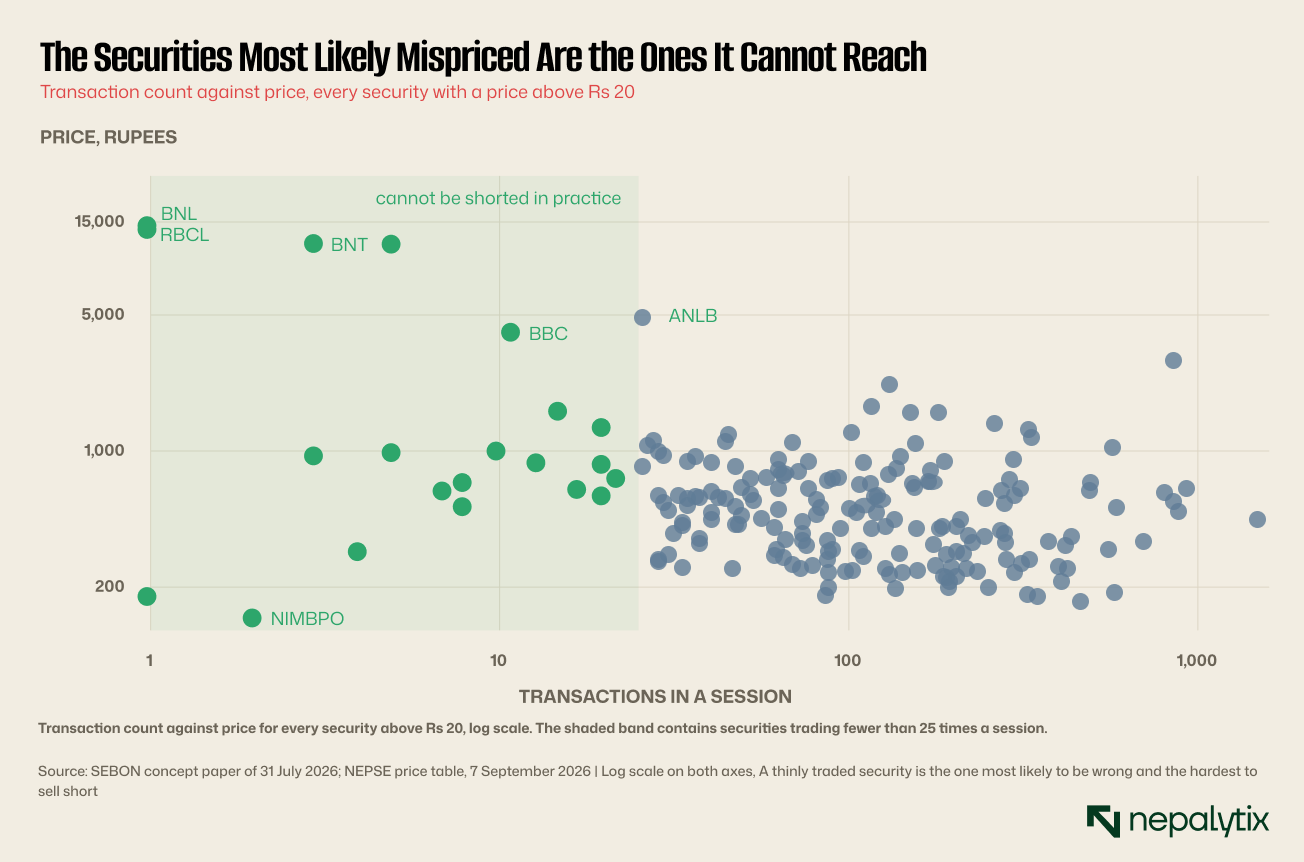
Short selling improves price discovery by letting sceptics express a view. The securities that most need a sceptic are the ones nobody analyses, nobody covers and nobody can value: the thinly traded, the expensive, the ones whose last price came from a single transaction.
Rastriya Beema traded once on 7 September, ten units at Rs 13,755.60. Bottlers Nepal traded once. Bishal Bazar eleven times. These are the securities where a price is most likely to be wrong because so little information goes into it.
They are also the securities where a covered short is impossible. Nobody will lend a stock that cannot be replaced. Nobody can buy back a position in a market with eleven trades. The mechanism reaches exactly the forty securities that are already well priced and cannot reach the 196 that are not.
So the price discovery benefit which is the main argument for the reform, is concentrated where it is least needed.
One more feature of the illiquid corner is worth noting because it cuts against an assumption the reform relies on.
The usual argument is that a short seller improves the market by forcing information into the price. That works when the seller has done research nobody else has. In Nepal the constraint on research is not the absence of a short mechanism; it is that no research operation can cover 302 listed companies and the companies that go uncovered are small and thinly traded.
So the binding constraint on price discovery in the illiquid corner is analytical capacity not the ability to express a negative view. Adding a short mechanism does not create analysts.
The figure also answers a question the debate usually skips: how big could a short position actually be?
In a security trading two hundred times a session, a position that would take twenty trades to close is a tenth of a day's activity. That is manageable. The same position in a security trading twenty times is an entire session and closing it means being the only buyer while everyone watches.
So even within the eligible forty, position size would be constrained by turnover rather than by capital. An institution wanting a meaningful short would find the constraint binding almost immediately which limits how much price discovery the mechanism can deliver even where it works.
Who lends
The borrowing leg has a problem nobody has addressed publicly.
Securities lending requires lenders: holders with long horizons, no intention of selling and an interest in earning a fee on inventory. In developed markets that is pension funds, insurers and index trackers.
Nepal has candidates. The Employees Provident Fund, Citizen Investment Trust and the insurance companies hold large balance sheets. But the shares most available to lend in Nepal are promoter shares, and promoter shares carry statutory lock-in, trade on a separate line and changed hands two to five times a session in the sample this publication examined last week.
What remains is the public float of the forty liquid securities held largely by retail investors through a depository that has no lending infrastructure. Building that is the "market infrastructure strengthening" and "IT modernization" the concept paper lists and it is not a small item.
The paper is right to propose lending and shorting together. The sequencing matters more than the pairing: without a lending pool there is nothing to short with and the lending pool depends on institutions that have never done it in a depository that has never supported it.
There is a structural feature of Nepali ownership that makes the lending problem harder than the deposit balances suggest.
Hydropower companies issue shares in tranches: a portion to residents of the project-affected district, a portion to Nepalis employed abroad, a portion to the general public, with promoters holding the rest under lock-in. Last Thursday's Long Read set out what that does to concentration. It also shapes who could lend.
District residents hold small parcels in one company and rarely trade. That is in principle ideal lending inventory: long-horizon holders with no intention of selling. In practice it is tens of thousands of individual accounts holding a few hundred shares each, with no aggregator, no standard agreement and no reason to trust a lending arrangement they have never encountered.
Aggregating that inventory is a retail distribution problem, not a regulatory one and nothing in a concept paper solves it.
There is one class of lender the discussion overlooks and it may be the most practical starting point. Closed-end mutual funds hold portfolios of listed equity with defined maturities and no reason to trade the underlying before then. Nepal has more than fifty of them and this publication established last week that they declared cash dividends across the board for FY2081/82.
A fund holding a five-year book of blue chips is exactly the inventory a lending programme needs: professionally managed, aggregated, legally straightforward, and earning nothing while it sits. The fee would accrue to unit holders which is a direct benefit to the retail investors who own the funds.
Whether fund mandates permit lending is a question for the drafters. It is a smaller question than aggregating tens of thousands of district shareholders and it would produce a usable pool faster.
What the flood showed
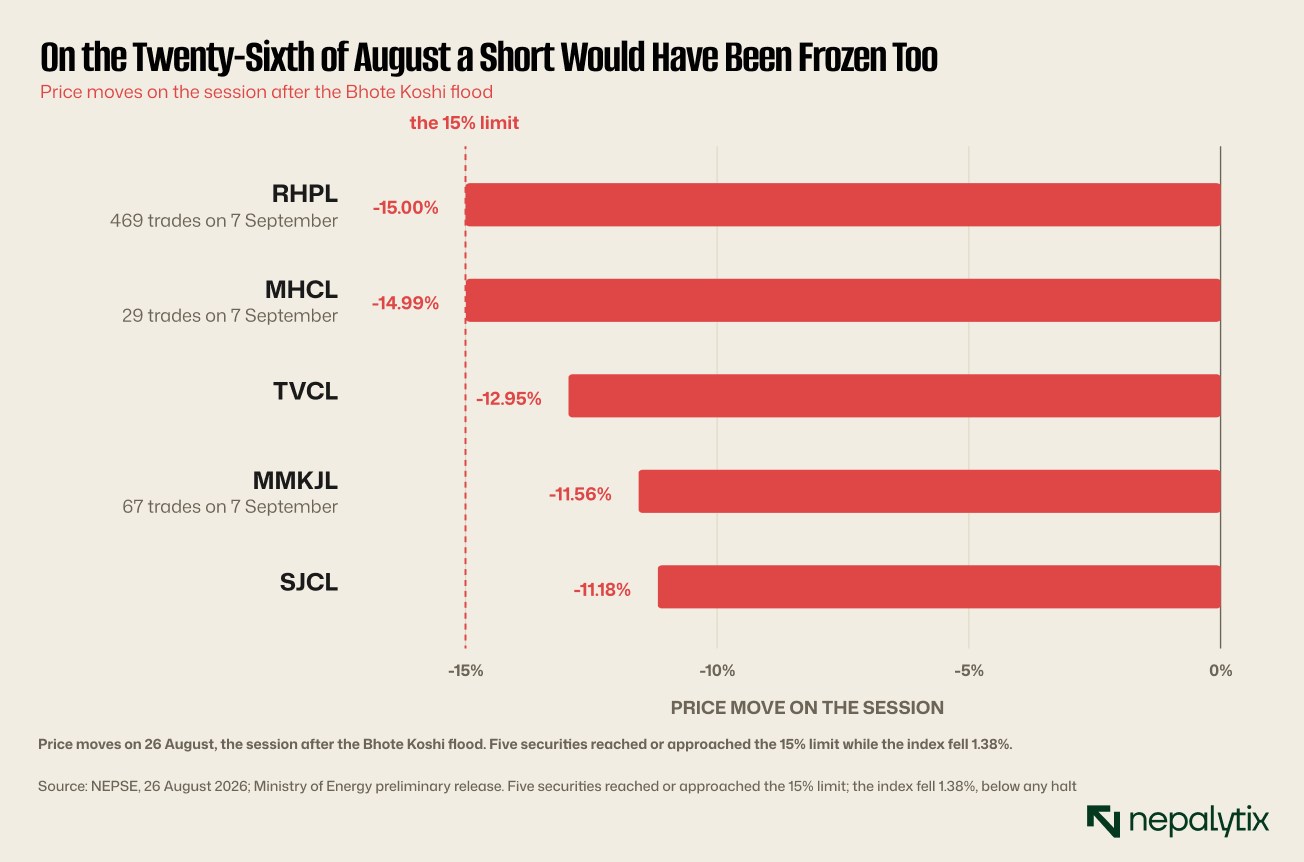
On 26 August a flash flood destroyed part of Nepal's hydropower capacity. Rasuwagadhi fell 15.00%, Molung 14.99%, Trishuli 12.95%, Madhya Mewa Khola 11.56%, Sanjen 11.18%.
This was the day short selling would have paid. An investor who believed those valuations were too high relative to physical risk was right and under the current rules had no way to act on it beyond not owning them.
But look at what would have happened to a short that was already open. The securities were limit-down which means the seller was sitting on a profit that could not be realised because closing a short requires buying and there were no sellers at the limit price. The position was frozen exactly as the lender's collateral was frozen.
And the index fell 1.38%, comfortably below the 5% level that triggers a market-wide halt. So the exchange traded normally all day while five securities were untradeable.
The flood is the best available case for the reform and the clearest demonstration of why the surrounding machinery has to change first.
The flood also exposes a timing problem the concept paper will have to resolve. Borrowing agreements have terms. A seller whose agreement expires during a limit sequence must return stock they cannot buy which means either a forced buy-in at whatever price eventually prints or a default on the loan.
Every market with securities lending has a buy-in procedure for exactly this. Nepal would need one, and it would need to work in a security where the market may not print a price for several sessions. That is not a detail to be left to the operational annexes.
The counterfactual is worth stating as well. What would a sceptic have done on 25 August, the day before the flood, if short selling had existed?
Almost certainly nothing. The flood was not forecastable from published information. Nobody held a differentiated view that Rasuwagadhi's plant was about to be destroyed.
Which means the 26 August session is a poor advertisement for price discovery even though it looks like a strong one. Short selling helps where a sceptic has information the market has not absorbed. It does not help with a flash flood and presenting the flood as the case for the reform confuses a price move with an insight.
What the case against gets right
The argument against short selling in Nepal is usually made badly, in terms of speculators attacking honest companies. That version is not worth engaging. The serious version is worth stating properly because it is largely correct.
A market this thin can be moved by a small number of participants. Twenty-five trades is a session's activity in a fifth of the market, and a determined seller with borrowed stock could push such a security through its circuit limit repeatedly. The resulting price would then become the reference for collateral valuation, index calculation and every other holder's mark.
The counter usually offered is that the buyer on the other side profits so the price recovers. In a deep market that holds. In a security with eleven trades a day there may be no buyer at all and a price that falls on thin volume does not bounce back because nothing forces it to.
Retail concentration compounds it. Nepali equity ownership is overwhelmingly retail and the counterparty to an institutional short would be individuals who cannot hedge, cannot borrow and cannot exit during a limit sequence.
And the enforcement question is real. Detecting manipulative shorting requires surveillance that can reconstruct order books, identify coordinated activity and act quickly. The concept paper lists regulatory restructuring and human resource development among its requirements which is an acknowledgement that the capacity does not currently exist.
There is a version of the reform that would work immediately and nobody is discussing it because it is unglamorous.
Securities lending and borrowing on its own, without short selling, has value. It lets institutions earn a fee on inventory they were never going to sell, it builds the depository infrastructure, it establishes legal precedent for title transfer and recall and it creates a lending pool. It also settles failed deliveries which in a T+2 market with thin books is a real operational benefit.
Introduce that first, let it run for a year or two and the eligibility question answers itself: the securities that attract lending are the securities that could support a short. The market would reveal its own list rather than a committee guessing at one.
The concept paper proposes all three instruments together which is defensible because they interlock. But they do not have to arrive together and the one that carries least risk is the one that has to exist first anyway.
There is an argument that the eligibility list should be deliberately generous at the start to build volume and it deserves an answer rather than a dismissal.
The reasoning is that a narrow list produces a market too small to attract participants, the mechanism never gains traction and the reform is judged a failure for want of scale. Better to admit more securities, accept some volatility and let the market sort itself out.
The difficulty is who bears the sorting. In a market where a fifth of securities trade twenty-five times a session and ownership is overwhelmingly retail, the learning would be paid for by individuals holding shares in companies they were sold at par and have never traded. A generous list transfers the cost of the experiment onto the least equipped participants.
A narrow list that expands on published criteria achieves the same growth more slowly and puts the cost on the institutions that chose to participate.
What follows from all of that
None of it argues for abandoning the proposal. It argues for sequencing it against the market rather than against a calendar.
The obvious instrument is an eligibility list, which is what every market in the region uses for exactly this purpose. Securities become shortable when they meet published thresholds on transaction count, turnover and free float and they fall off when they stop meeting them. On 7 September that list would have contained roughly forty names. It would grow as the market deepens which is the outcome everyone wants and the only honest way to get there.
The circuit limit has to be addressed in the same breath, because a limit that prevents covering makes a short unmanageable regardless of how liquid the security is. Either the limit widens for securities on the eligible list or the framework has to say what a seller does when the stock is limit-up and the borrowing agreement is expiring.
The lending pool has to exist before the shorting rules matter. That means a depository facility, a legal framework for title transfer and recall and at least one institution willing to lend at scale. None of those is a policy decision; they are construction projects.
And the margin lending component deserves a separate word. NRB already regulates lending against shares by banks and this publication argued last week that the framework has a valuation problem and no maintenance rule. SEBON now proposes its own margin lending regulation. Two regulators writing separate rules for the same activity against the same collateral is not obviously an improvement and the concept paper's promise to clarify institutional roles is the part of it most worth reading closely when the drafts appear.
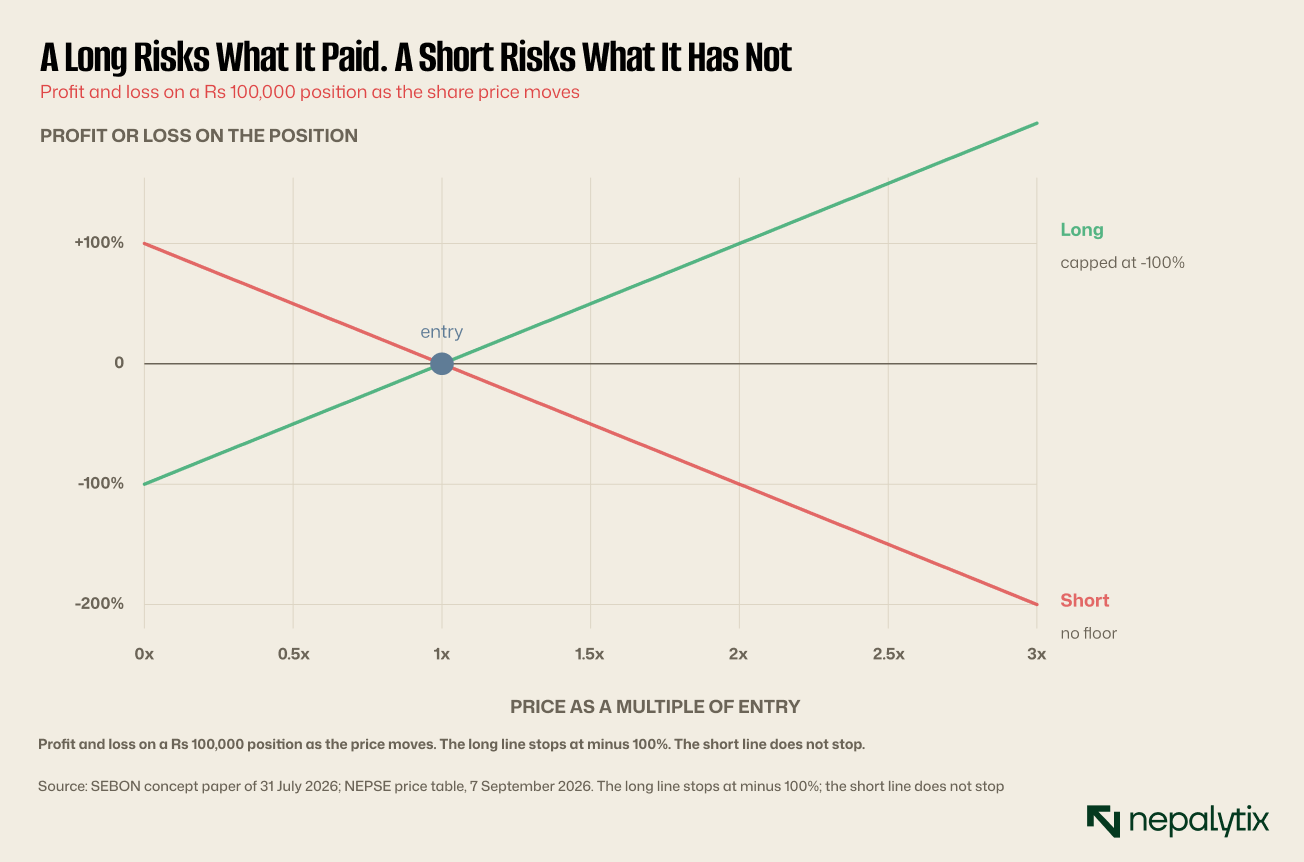
The asymmetry has a governance consequence as well as a financial one. A long position that goes wrong produces a loss the holder absorbs and the market never hears about. A short position that goes wrong produces a forced buyer who must transact regardless of price and in a thin book that buyer moves the price for everyone.
So the failure mode of a short is public in a way the failure mode of a long is not. That is true everywhere and it is more consequential in a market where a single participant can be a meaningful share of a session's volume.
The precedent that should worry everyone
Nepal has just run an experiment in introducing a market mechanism ahead of the market's readiness and the results are two months old.
On 15 July Nepal Rastra Bank raised the ceiling on lending against shares from 70% to 80% available to companies passing a seven-point strength test covering capital, listing history, profitability, dividends, rating, compliance and annual meetings. Not one of the seven criteria measures how often the security trades.
Six weeks later a flood put five hydropower shares limit-down and the collateral behind those loans could not be valued or sold.
The failure was not the loan-to-value ratio. It was that a framework written around company quality was applied to a market where the binding constraint is liquidity. That is precisely the error available to SEBON now and the concept paper's own list of requirements suggests the board knows it.
The difference is that margin lending was adjusted by a number in a directive. Short selling requires new regulations, new infrastructure and new supervisory capacity which means the decisions being taken now will be difficult to unwind.
One more consequence of proceeding without an eligibility list deserves stating because it runs through the rest of the market rather than through the short seller.
A price made by a forced short cover in a thin security becomes everyone's price. It is the reference for collateral valuation under the margin lending rules, for the sector sub-index, for every other holder's portfolio statement and for the next company thinking about an issue.
In a liquid security that reference recovers within a session. In a security trading eleven times a day, a price set under duress can stand for weeks because nothing forces a correction. The cost of the mechanism failing is therefore not borne by the participants who chose to use it.
The thing underneath
It is worth naming what this reform is actually for because the debate keeps getting conducted in terms of whether speculation is good.
A price is information. In a market where the only expressible view is optimism, the price tells you what optimists think and nothing about what anyone else does. That is why this publication found no listed company in either sample trading below its IPO price, why 111 hydropower companies sit clustered in the lower half of their own range moving together and why a bank valuing collateral has to use a number that a handful of people set that afternoon.
Those are not separate problems. They are one problem seen from three angles and short selling is one of the mechanisms that would address it.
But a mechanism that works in forty securities out of 302 listed companies is not a fix for a market-wide information problem. It is an improvement in the part of the market that already works best.
SEBON has done the right thing by publishing a concept paper and asking. The answer the data gives is that the instruments are correct and the market is not yet the market they assume. What determines whether this succeeds is not the drafting of the covered short selling regulation. It is whether the eligibility criteria are honest about how few securities qualify and whether anyone is willing to say so in a consultation where saying so is unwelcome.
A final word on the politics of the consultation because it determines what the drafts look like.
Consultations of this kind attract responses from the people the reform would enrich. Brokers gain commission from every short and every cover. Merchant bankers gain mandates from the infrastructure build. Institutional investors gain a lending fee on inventory they already own. All three have reason to argue for broad eligibility and rapid implementation.
The constituency for narrow eligibility is retail holders of thinly traded securities who do not know the consultation is happening could not assess it if they did and have no representative body that reads concept papers.
That is the ordinary condition of financial regulation everywhere and it is not a scandal. But it means the pressure on SEBON will run in one direction and the arguments that would produce a narrower, safer framework have nobody with an incentive to make them.
What to watch as the drafts appear
Whether an eligibility list exists. If the covered short selling regulation applies to all listed securities equally, the drafters have not engaged with the distribution in Figure 1. If it defines thresholds, the thresholds themselves are the whole policy.
What happens during a circuit sequence. Any regulation that does not address a seller unable to cover into a limit-up market is incomplete in the one scenario that matters.
Whether the lending pool is specified before the shorting rules. Sequencing is the substance here and a framework that publishes the shorting regulation first would be building the roof before the walls.
How SEBON and Nepal Rastra Bank divide margin lending. Two regulators writing separate rules for the same activity against the same collateral, with no consolidated view of total borrowing against a given security is the condition last week's piece described and this proposal could entrench.
Whether free float gets published. An eligibility list needs it, a lending pool needs it and nobody currently publishes it. It is the smallest of the required changes and the one that would improve the most other things.
Disclaimer
This report has been prepared by Nepalytix for informational and educational purposes only and does not constitute investment advice, an offer, or a solicitation to buy or sell any securities.
The information contained in this report is based on sources believed to be reliable; however, Nepalytix does not guarantee its accuracy, completeness, or timeliness. Opinions, estimates, and projections expressed herein are those of the authors as of the date of publication and are subject to change without notice.
Investing in securities involves risks, including the possible loss of principal. Past performance is not indicative of future results. Readers are advised to conduct their own independent research and consult with a qualified financial advisor before making any investment decisions.
Nepalytix and its contributors may hold positions in the securities discussed in this report at the time of publication or thereafter.
Neither Nepalytix nor any of its affiliates accept any liability for any loss arising from the use of this report or its contents.