Shikhar Insurance: Record Sales, Collapsing Earnings, Expensive Stock
Shikhar Insurance posted a record Rs 6.11 billion in premium collections, but beneath the headline lies Nepal's largest-ever insurance loss event.
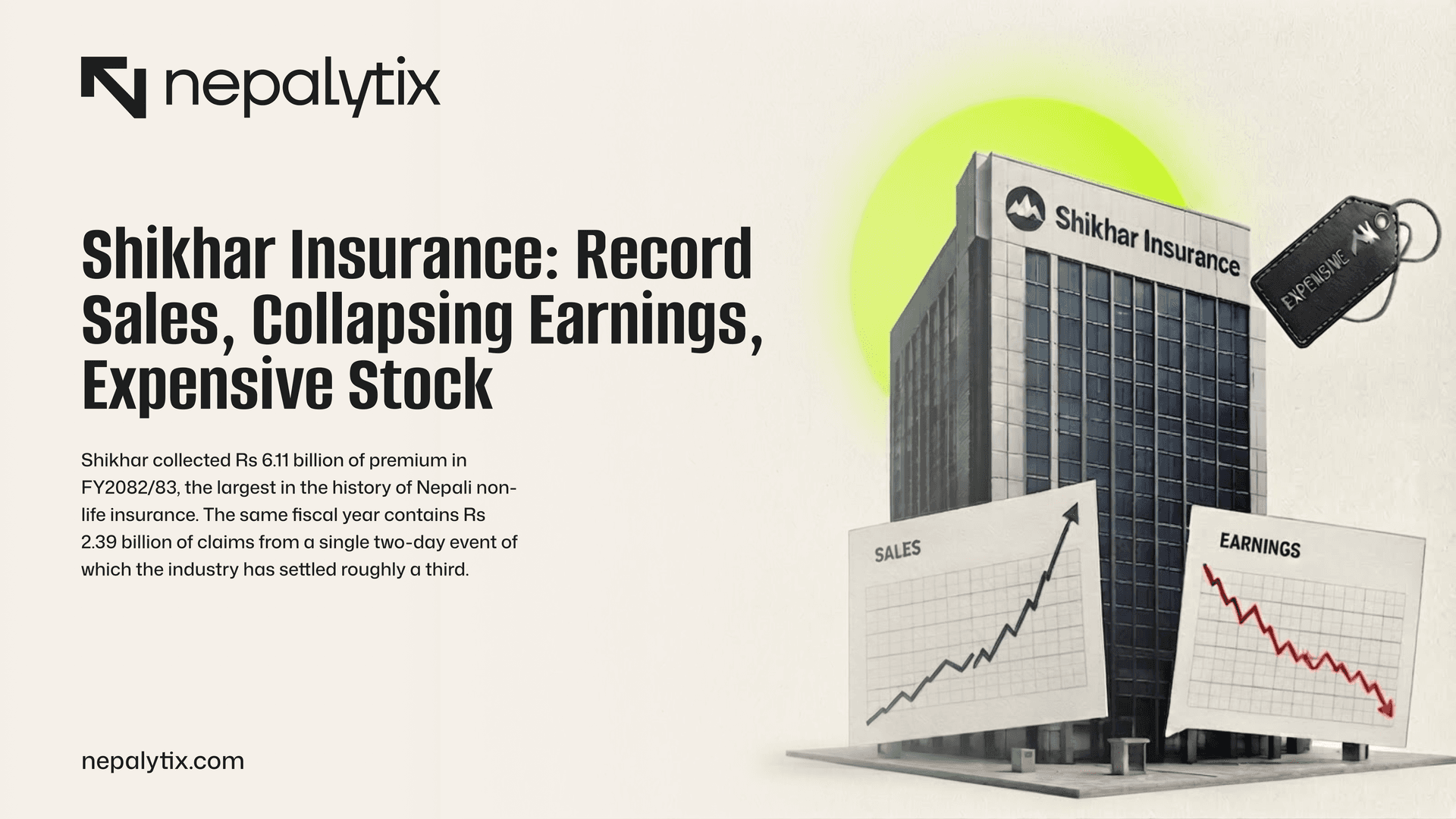
Shikhar collected Rs 6.11 billion of premium in FY2082/83, the largest in the history of Nepali non-life insurance. The same fiscal year contains Rs 2.39 billion of claims from a single two-day event of which the industry has settled roughly a third. Earnings per share have fallen 80%. The market has marked the shares down 28% and still pays 204 times what the company currently earns. We initiate with a fair value range of Rs 170–280 against a price of Rs 619.90.
The trade
In the second week of July 2026, Shikhar Insurance issued a press release. It had collected Rs 6.11 billion of premium in fiscal year 2082/83, a record for the Nepali non-life sector. The release noted 131 branch offices across all 77 districts and the company's contribution to insurance penetration and financial inclusion. Every claim in it is true.
Here is what the release does not mention. The fiscal year it describes opened three weeks before 8 September 2025, when two days of protest produced the largest single-event insurance loss in Nepal's history. Shikhar filed 366 claims worth Rs 2.39 billion against that event, the third largest exposure of any insurer in the country and equal to 39.1% of the record premium the company is celebrating.
Nine months later, the industry had settled Rs 7.62 billion of the Rs 23.53 billion claimed. Roughly a third. The remainder is still moving through survey, documentation and reinsurance recovery.
Meanwhile Shikhar's earnings have gone down. Earnings per share for FY2081/82 were Rs 15.49. The annualised figure at the third quarter of FY2082/83 is Rs 3.03 a decline of 80.4%. The share price over the same period barely moved, from Rs 630 in November to Rs 619.90 in May. The trailing multiple therefore travelled from 40.7 times to 204.6 times without a single buyer or seller changing their mind about what the company was worth.
A premium record tells you what a company sold. It tells you nothing about what it will cost to have sold it.
That is the argument of this note. Underwriting is a business where revenue arrives first and the cost of that revenue arrives later, sometimes years later. A record premium year is only good news once you know the claims attached to it. In Shikhar's case the largest claim event in the sector's history sits inside the same twelve months as the record and it has not finished settling.
What Shikhar actually is
Shikhar Insurance Company Limited was promoted by a group of Nepali industrial and business houses with interests in aviation, banking, manufacturing, trading, travel and media. It writes general insurance property, motor, engineering, marine, transport and the miscellaneous lines that make up a Nepali non-life book.
Paid-up capital is Rs 3.10 billion across 31,004,465 shares of Rs 100, following a bonus issue from the previous Rs 2.92 billion. Promoters hold 51% and the public 49% which is a genuine float by Nepali standards roughly Rs 9.7 billion of the Rs 19.8 billion market capitalisation is actually tradeable.
The distribution is the asset. 131 branch offices across all 77 districts is a network no other non-life insurer in Nepal matches and it is the reason the company can collect Rs 6.11 billion of premium at all. Building that footprint took two decades and it cannot be replicated quickly. When we say the franchise is real, this is what we mean.
It is also the reason the book looks the way it does which turns out to matter enormously for how the September event lands.
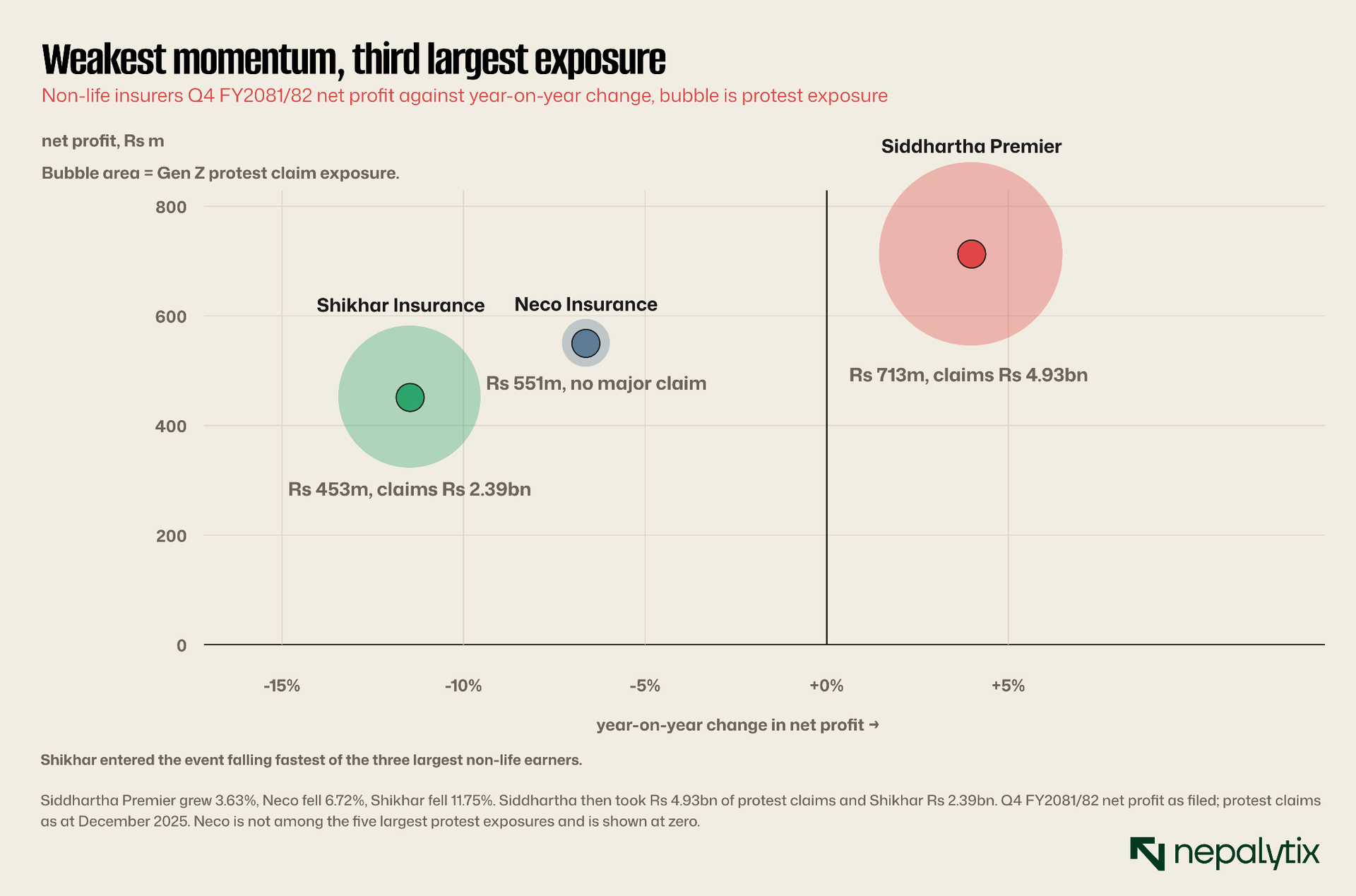
The market has already done something. A 28% decline over twelve months is not a market ignoring the problem. The question this note asks is whether a 28% decline is the right size of response to a liability the industry has quantified at Rs 23.53 billion and settled a third of.
One structural point about the sector is worth establishing before the numbers, because it governs how everything else reads. General insurance is a business of writing promises and discovering later what they cost. A motor policy sold in Shrawan generates a premium immediately; the accident it covers may happen in Chaitra and be paid the following year. Every set of accounts an insurer publishes is therefore part fact and part estimate and the estimate is the reserve for claims incurred but not yet settled.
This has a consequence that catches Nepali retail investors repeatedly. Premium growth is verifiable and immediate. Claims cost is judgemental and delayed. An insurer can grow premium aggressively, book strong profits for two or three years, and then discover the business it wrote was underpriced. The first three years look like a growth story and the fourth looks like a scandal and nothing changed except that the estimates were replaced by facts.
The record and what it was earning before September
Before the event, Shikhar's economics were already softening, and that is the necessary starting point because it establishes what "normal" looks like.
FY2081/82 net profit was Rs 452.72 million, down 11.75% on the prior year. Return on equity was 8.04% not a disaster but well below what a business with this distribution advantage ought to generate. Gross margin fell from 59.95% in Q4 FY2080/81 to 57.26% in Q4 FY2081/82 having peaked at 64.16% in the second quarter.
The underwriting detail is more interesting than the profit line. Policy renewals grew 11.94% while new policies contracted slightly, a book being maintained rather than expanded. Claims paid fell 13.66%. And outstanding claims rose 7.72%.
Read those last two together. Cash going out of the door on claims fell; claims recognised but not yet paid rose. That is a claimed tail lengthening and it was lengthening in the year before the September event. It is a small signal and easy to dismiss in isolation. It is much harder to dismiss once you know what arrived next.
Shikhar entered the largest loss event in the sector's history with the weakest earnings momentum of the three biggest non-life insurers. That is not a coincidence of timing so much as a coincidence of position: the company with the widest distribution writes the most policies and the company that writes the most policies has the most exposure when something hits everybody at once.
The float deserves a sentence too because it separates Shikhar from most of what we cover. Rs 9.7 billion of tradeable market value in a market where the average listed company's genuine free float runs to a few hundred million rupees means this is a stock an institution can actually take a position in. Price discovery here is meaningfully better than in the Nepali market generally which cuts both ways: it makes the 28% decline more informative than it would be in an illiquid name and it makes our disagreement with the market harder to dismiss as a pricing artefact.
Two days in September
On 8 and 9 September 2025 Bhadra 23 and 24, 2082 protest and arson caused extensive damage to businesses, hotels, vehicles and public property across Kathmandu and beyond. The Hilton Kathmandu alone sustained damage estimated at over Rs 800 million. More than thirty hospitality properties were partially or wholly damaged.
The insurance consequences are still being counted. As of June 2026 the Nepal Insurance Authority recorded 3,664 claims totalling Rs 23.53 billion against which insurers had paid Rs 7.62 billion.
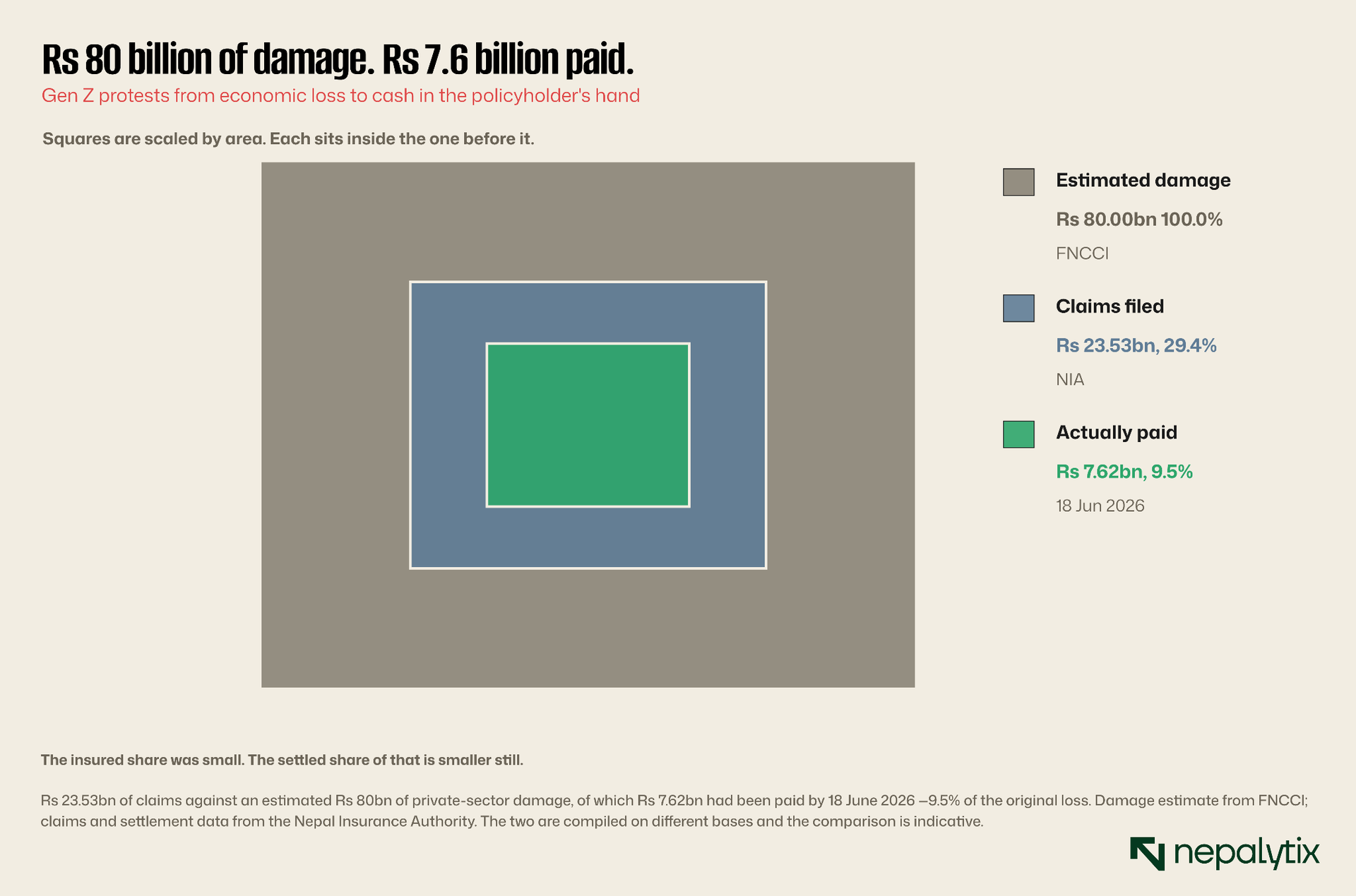
Two things fall out of this chart, and the second is the one that matters for equity.
First, the protection gap. The Federation of Nepalese Chambers of Commerce and Industry estimated private-sector damage at Rs 80 billion. Insurance claims amount to Rs 23.53 billion 29.4% of the loss. Seventy per cent of the economic damage was uninsured either because businesses carried no cover or because they were underinsured relative to replacement cost.
For the insurance sector as a whole that is a growth argument: a demonstration event that should drive penetration for years. It is the single strongest medium-term positive in this note, and we return to it in the bull case.
Second and more immediately, the settlement pace.
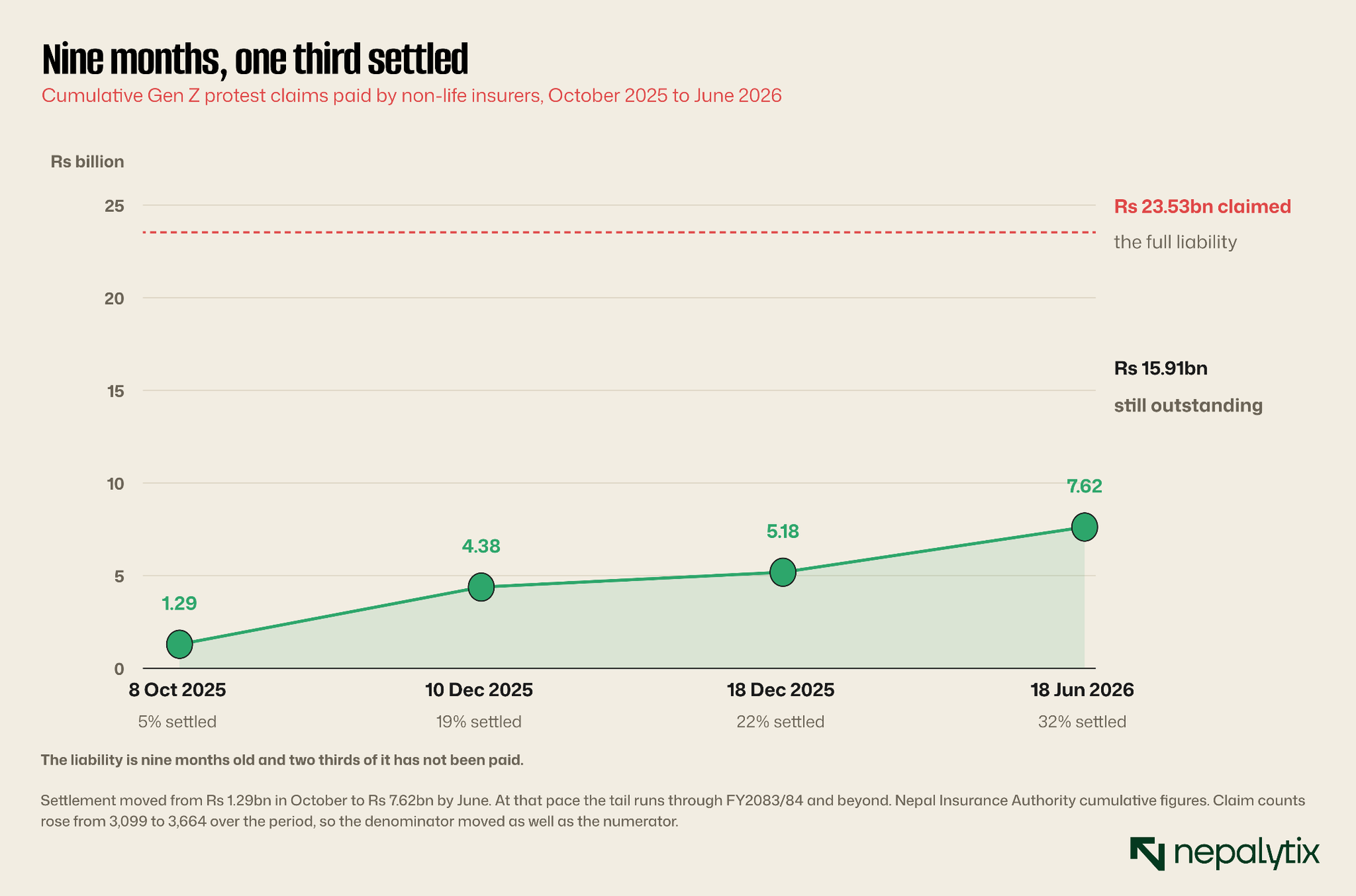
Rs 1.29 billion had been paid by early October. Rs 4.38 billion by mid-December. Rs 7.62 billion by mid-June 32.4% of the total, nine months after the event.
The regulator describes this pace as satisfactory and points out that Nepal's settlement timelines are comparable to countries at similar levels of development. Business representatives disagree. Both can be right: straightforward claims settled early and the complex ones are stuck on documentation and survey requirements. The Nepal Chamber of Commerce president has said as much publicly.
There is also a specific complication. Investigations into share transactions and company directors at Himalayan Reinsurance made insurers more cautious over the past one to two months, slowing settlements further. The authority has been summoning insurers and reinsurers and directing them to expedite payment.
For an equity analyst the pace matters for one reason. Every rupee still unsettled is a rupee whose ultimate cost is unknown. Reserves may prove adequate; they may not. The company's earnings for FY2082/83 and FY2083/84 depend on which.
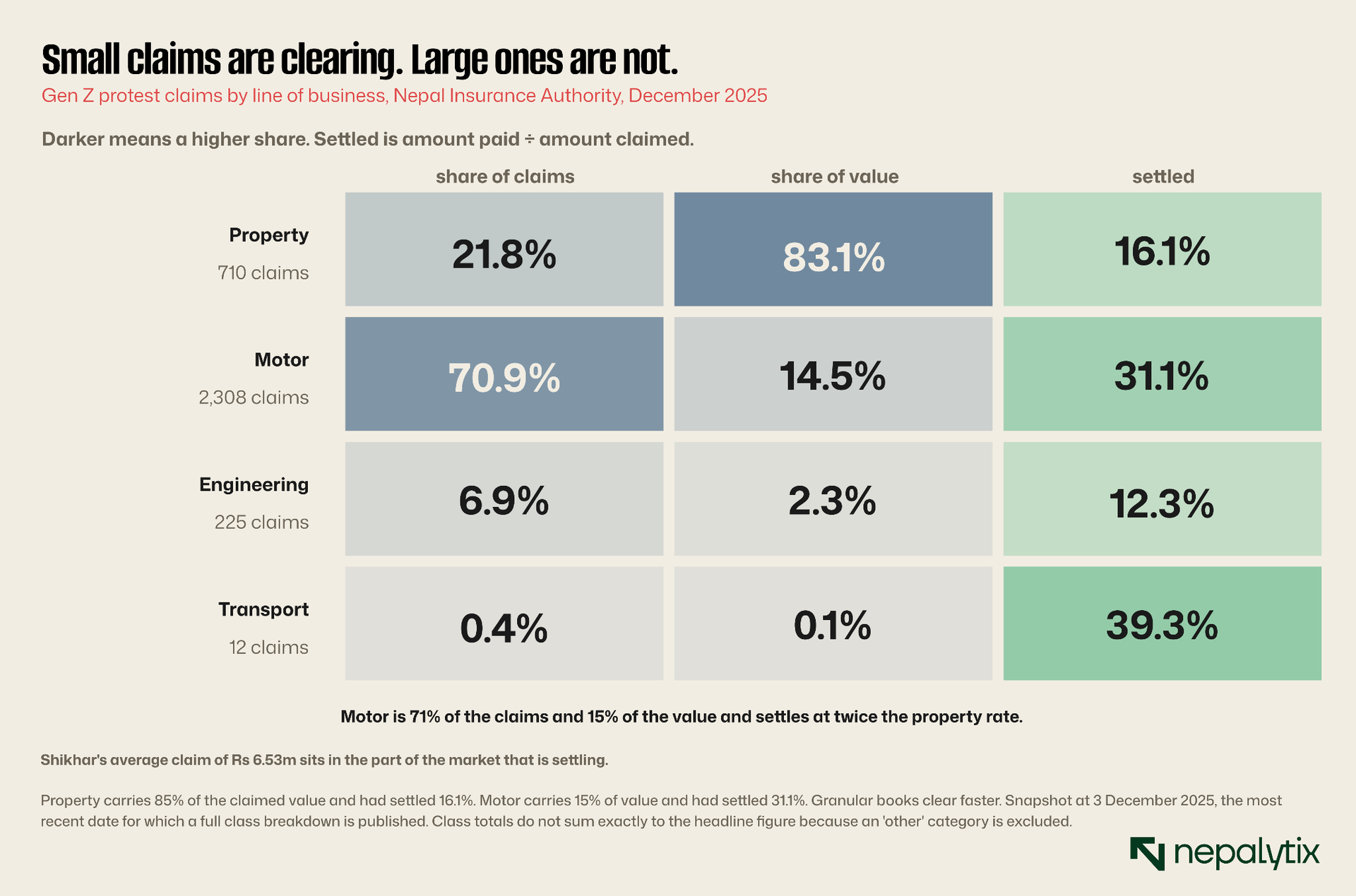
There is one more feature of the settlement data worth extracting. Property insurance accounts for the largest share of both claims and payouts, 721 claims worth Rs 19.13 billion, of which Rs 5.32 billion has been paid. Motor is second with payouts of Rs 2.05 billion across a far larger number of claims. That split tells you where the delay lives: property claims are individually large, require detailed survey, and often involve business interruption cover that has to be modelled rather than counted. Motor claims are small evidenced by a repair bill, and settle quickly.
Applied to Shikhar whose average claim is Rs 6.53 million, the book is likely to sit closer to the motor end of that distribution than the property end. That is a positive for settlement speed and a reason to think its specific tail is shorter than the industry aggregate implies.
The shape of Shikhar's book
Shikhar's Rs 2.39 billion of protest claims is the third largest exposure in the industry. But the aggregate hides the more useful fact which is the composition.
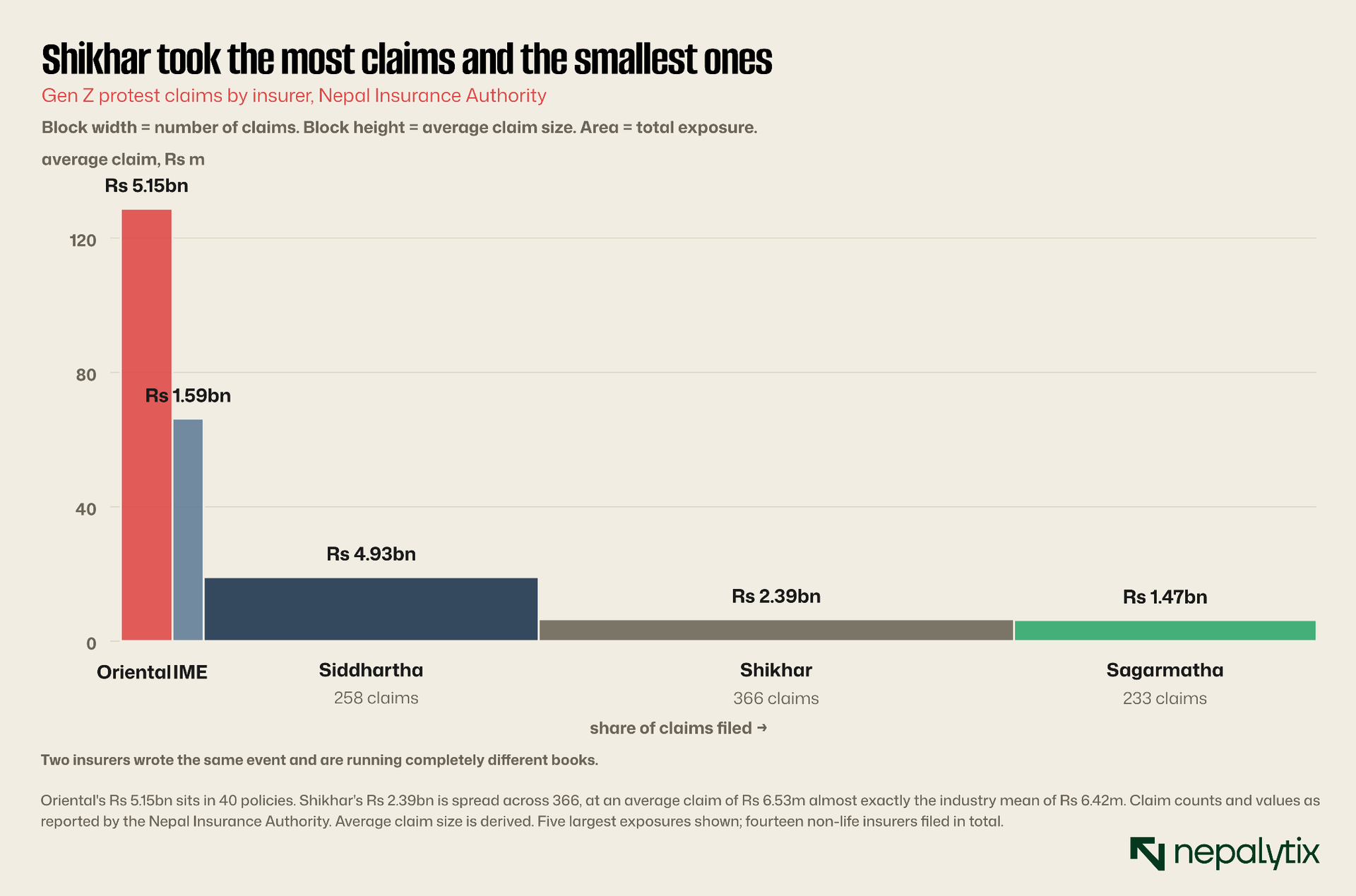
Oriental Insurance's Rs 5.15 billion arrived in forty policies. Shikhar's Rs 2.39 billion arrived in 366. The average Oriental claim is Rs 128.75 million; the average Shikhar claim is Rs 6.53 million almost exactly the industry mean of Rs 6.42 million.
This is the distribution network showing up in the loss data. A company with 131 branches across 77 districts writes broad, granular, mostly small-ticket business. When a nationwide event hits, it gets hundreds of modest claims rather than a handful of enormous ones.
Which is better? Genuinely both, in different ways, and the honest answer is that it depends on the failure mode you are worried about.
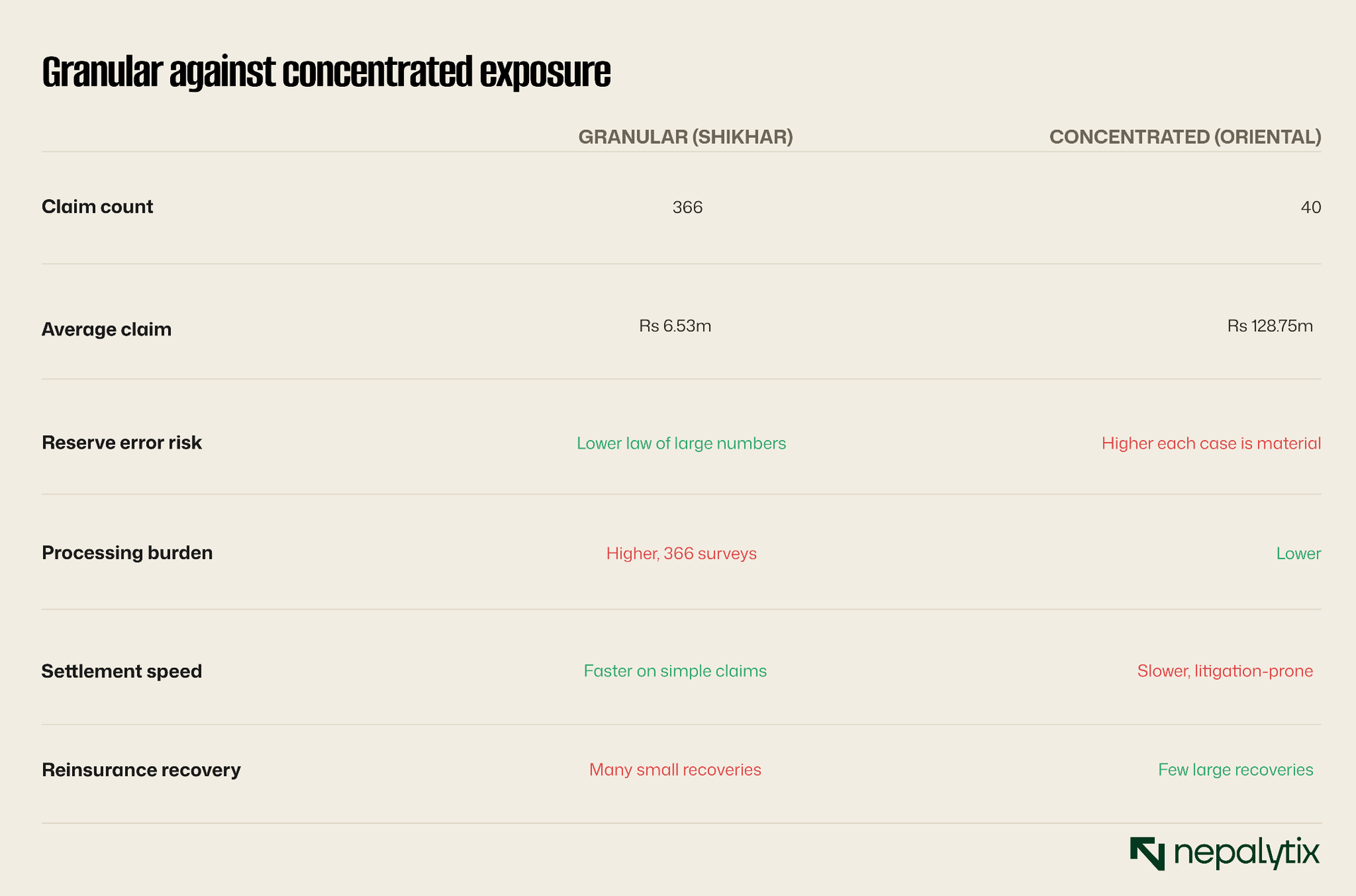
On balance we prefer the granular book for reserve reliability and dislike it for administrative drag. Shikhar's aggregate exposure is less likely to contain a nasty surprise than Oriental's because no single claim can move it much. But 366 surveys, 366 documentation files and 366 reinsurance recoveries is a genuine operational load for a company that also has a business to run.
There is a related point about how the two books will behave from here. Oriental's forty claims include a small number of very large properties, the sort of loss where the dispute is over valuation, business interruption cover and policy interpretation and where settlement can take years and end in arbitration. Shikhar's 366 are mostly small commercial and motor claims where the facts are simpler and the sums are not worth litigating.
If we are right that granular books settle faster, Shikhar's tail should shorten before the industry does. That is a genuine argument for the stock, and it is the strongest one in this chapter. It also cuts against our own thesis which is why we would want to see the settled proportion of Shikhar's specific claims, a disclosure the company has not made and which we would ask for first.
The reinsurance question
None of the above matters as much as this does.
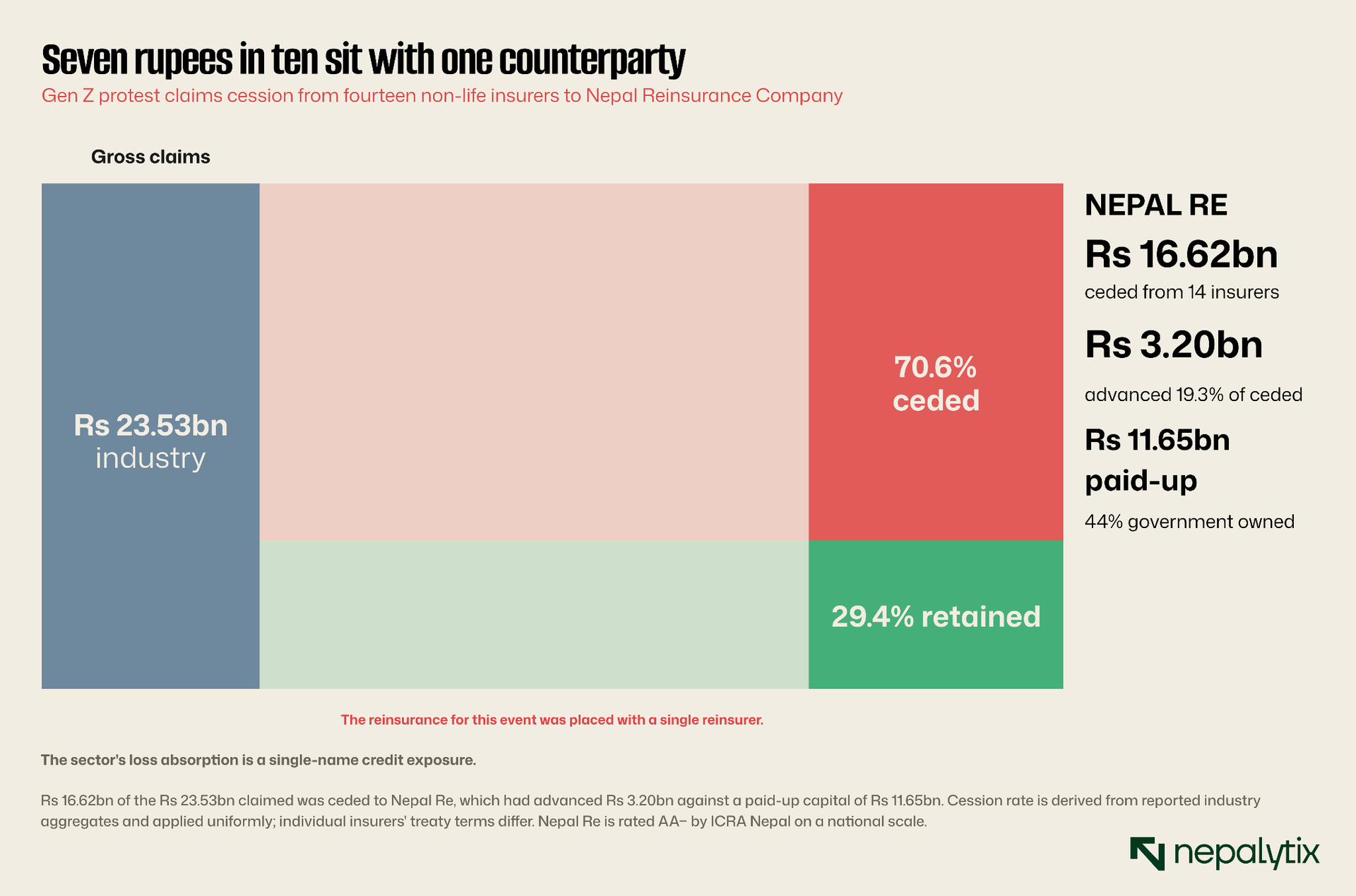
Of the Rs 23.53 billion of protest claims, Rs 16.62 billion 70.6% was ceded to Nepal Reinsurance Company across 2,862 reinsurance claims from fourteen insurers. Nepal Re had advanced Rs 3.20 billion against that or 19.3%.
The industry's post-mortem identified this explicitly as a bottleneck: the reinsurance arrangement for the event was placed with a single reinsurer. That is a structural feature of the Nepali market rather than a failing of any individual insurer Nepal Re exists precisely because the pool it succeeded was created in 2003 to cover riot, sabotage, terrorism and malicious damage risk during the insurgency. This is, in a real sense, the event it was built for.
Nepal Re carries Rs 11.65 billion of paid-up capital, is 44% owned by the Government of Nepal and is rated AA− by ICRA Nepal on a national scale. It is not a weak counterparty. But Rs 16.62 billion of ceded claims against Rs 11.65 billion of paid-up capital is a meaningful relationship and the sector's ability to absorb this loss is at the margin, a single-name credit exposure.
Shikhar's recovery on seven of every ten rupees depends on one counterparty, and so does everybody else's.
Applying the industry cession rate to Shikhar gives an estimated net retention of Rs 702 million on its Rs 2.39 billion of gross claims. We stress that this is an estimate. Shikhar's actual treaty terms are not public and its retention could be materially higher or lower. But Rs 702 million against annual net profit of Rs 452.72 million is 1.55 times a full year of earnings, retained from one two-day event.
What it did to the earnings
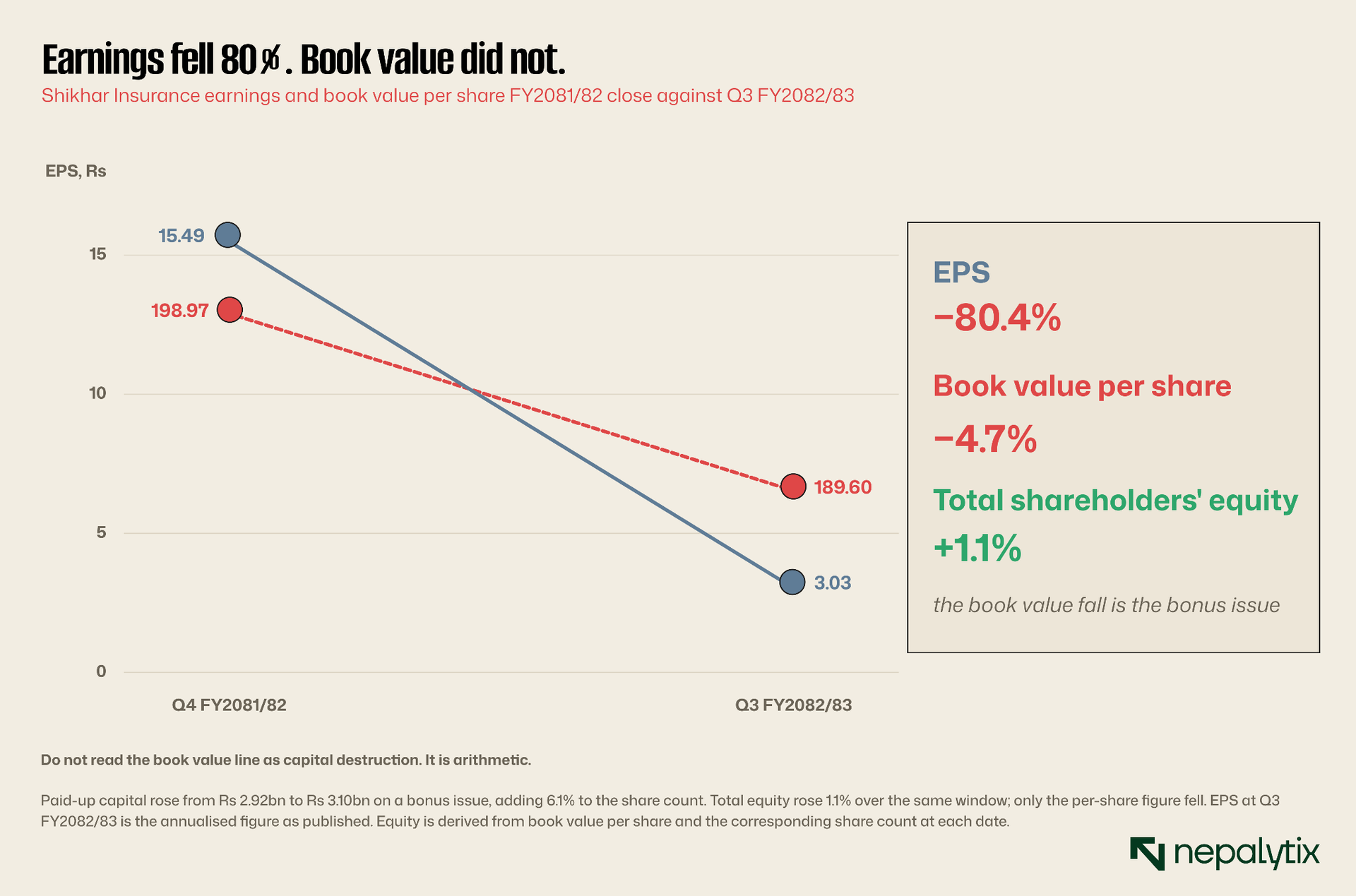
Earnings per share fell from Rs 15.49 to Rs 3.03 annualised down 80.4%. On 31 million shares that is annualised net profit of roughly Rs 94 million against Rs 452.72 million the prior year.
This is consistent with a retained claims cost of the order we estimated in chapter six landing across the year. We cannot decompose it precisely from public disclosure and we would not pretend otherwise: the Q3 report gives a bottom line not a claims-development triangle. But an 80% earnings decline in the year containing a Rs 2.39 billion gross claim event is not a mystery requiring explanation.
It is worth pausing on why an 80% decline is plausible arithmetic rather than an anomaly requiring a special explanation. Shikhar's normal annual profit is roughly Rs 450 million. Our estimated net retention on the protest claims is roughly Rs 700 million. If even half of that retained cost was recognised within the nine months to Q3 FY2082/83, it consumes three quarters of a normal year's earnings on its own before any allowance for the ordinary claims experience of a business that also had a fiscal year to trade through.
Seen that way the surprise is not that earnings fell 80%. It is that they remained positive at all which tells you the underlying book was profitable enough to absorb a shock of this size and still print a number above zero. That is a genuinely creditable outcome and we would not want the headline decline to obscure it.
What it did not do to the balance sheet
Book value per share fell from Rs 198.97 to Rs 189.60 over the same window, a decline of 4.7%. It would be easy and wrong to read that as capital erosion.
Paid-up capital rose from Rs 2.92 billion to Rs 3.10 billion on a bonus issue, adding 6.1% to the share count. Total shareholders equity across the two dates went from approximately Rs 5,816 million to Rs 5,878 million: up 1.1%. The per-share figure fell because there are more shares not because there is less capital.
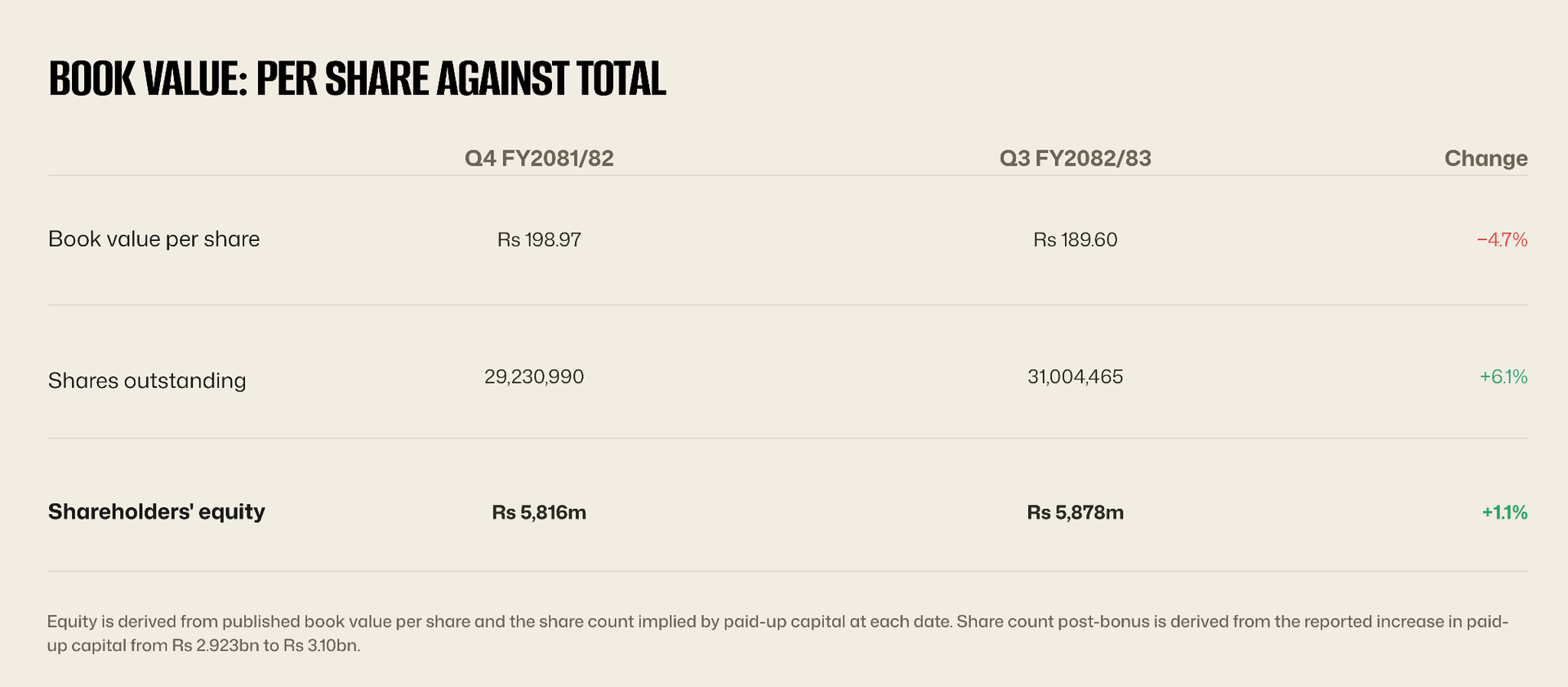
This matters for two reasons. It means the company has absorbed the retained claims cost out of the year's earnings rather than out of its capital base which is what a well-reserved insurer should do. And it means the price-to-book multiple of 3.27 times is being paid against a capital base that is intact.
We flag it prominently because the lazy version of this note writes "earnings collapsed and book value fell" and treats both as evidence of the same thing. They are not. One is the event. The other is arithmetic.
A word on what the Q3 disclosure does and does not permit. Nepali quarterly reports for insurers are not detailed enough to separate the protest claims from ordinary underwriting. There is no claims-development triangle, no split between current-year and prior-year loss development, no disclosure of case reserves against incurred-but-not-reported provisions. What we have is a bottom line, a book value and a premium figure.
That is a real limitation and it caps how precise any analysis of this company can currently be. It is also, in itself, an argument for a valuation discount. A business whose principal liability cannot be inspected from outside should trade at a lower multiple than one whose can and the appropriate response to opacity is not to assume the best.
The tail that has not run off
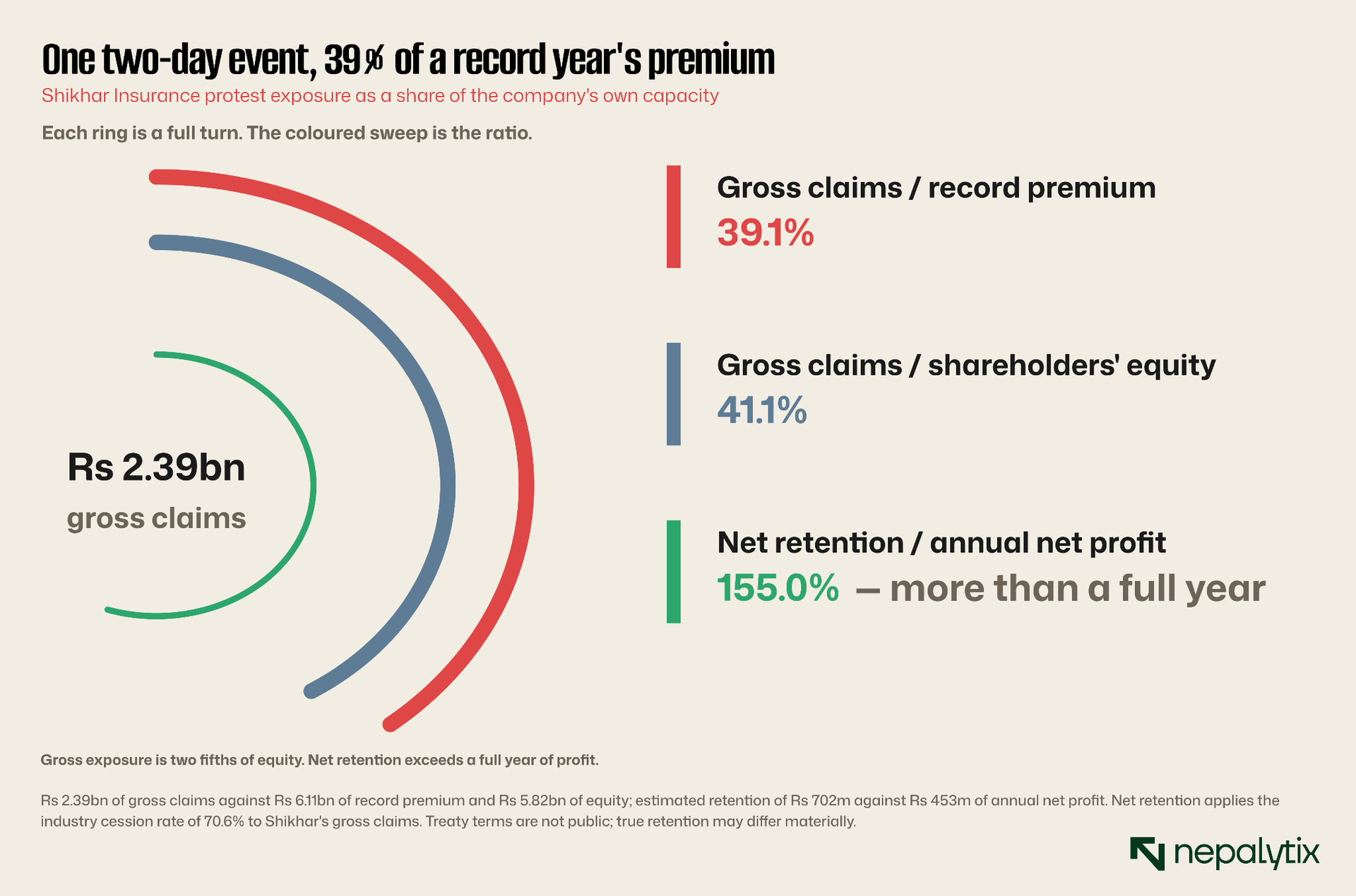
Set the numbers side by side. Record premium Rs 6.11 billion. Shareholders' equity Rs 5.82 billion. Gross protest claims Rs 2.39 billion. Estimated net retention Rs 702 million. Annual net profit Rs 452.72 million.
Gross exposure is 5.28 times a year of earnings and 41.1% of equity. Net retention, on our estimate, is 1.55 times a year of earnings. Those are the numbers that should frame any view on this stock and they are not in the press release about the record.
The reason this remains an open question rather than a closed one is the settlement data in Figure 4. If two thirds of the industry's protest liability is unsettled, then a material part of Shikhar's Rs 2.39 billion is still carried as a reserve estimate rather than a paid amount. Reserve estimates get revised. The direction of revision on a large, complex, first-of-its-kind loss event is more often up than down.
We are not forecasting a reserve strengthening. We are pointing out that nobody including the company can currently rule one out and that this uncertainty is not reflected in a 28% share price decline.
Finally, the operational cost of the event should not be ignored simply because it does not appear as a separate line. Processing 366 claims, commissioning surveys, collecting documentation, filing reinsurance recoveries, handling disputes consumes management attention and staff time that would otherwise go to writing new business. The industry mobilised 2,706 surveyors for this event. Shikhar's share of that effort is not costless and it lands in a year when the company also needs to renew a Rs 6.11 billion premium book.
Valuation
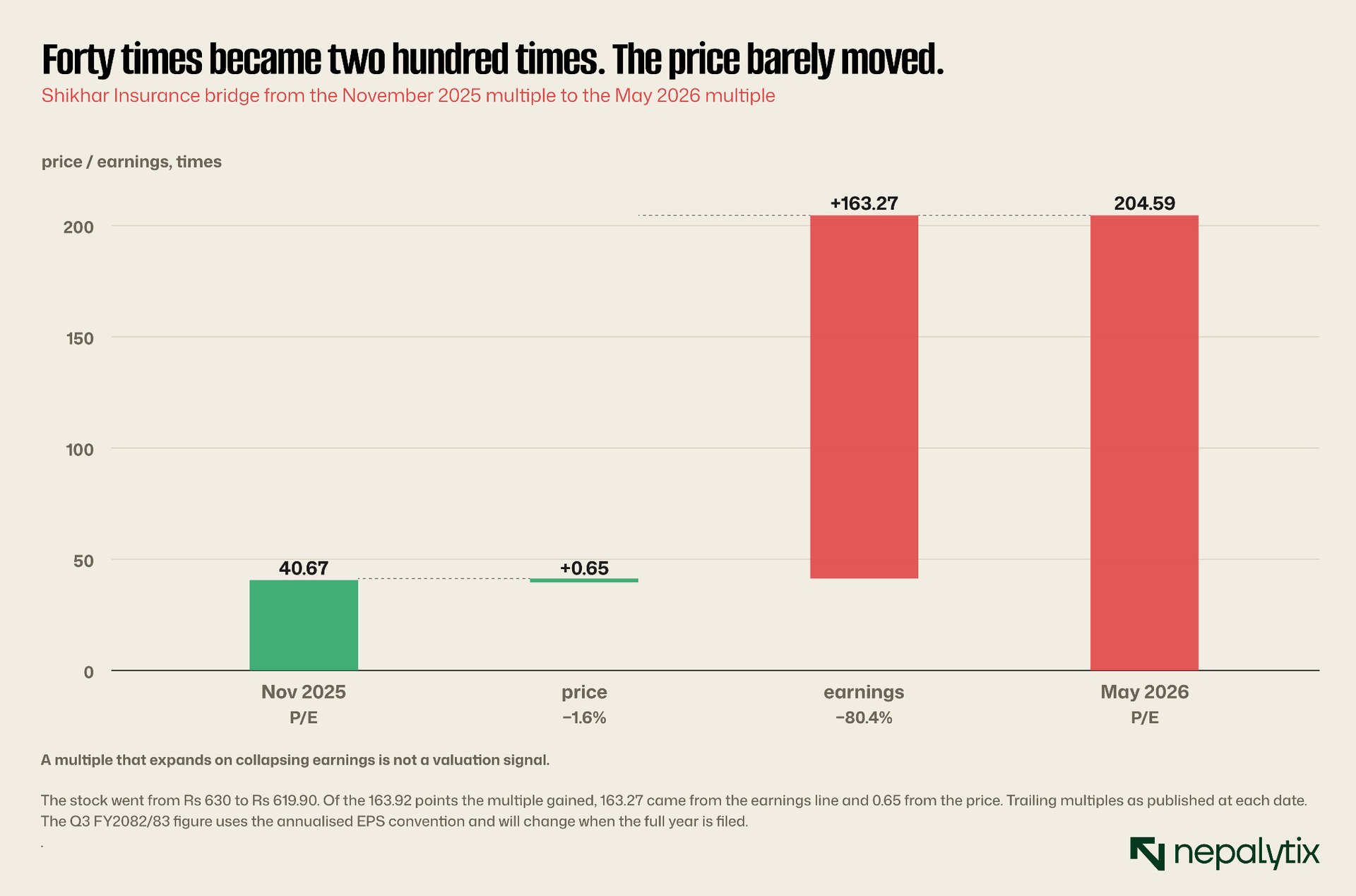
A multiple that expands while the price falls is not telling you the market has re-rated the stock upward. It is telling you earnings fell faster than price. Two hundred times is not a valuation, it is an artefact.
The useful question is what Shikhar earns once the event has passed through, and then what that stream is worth.
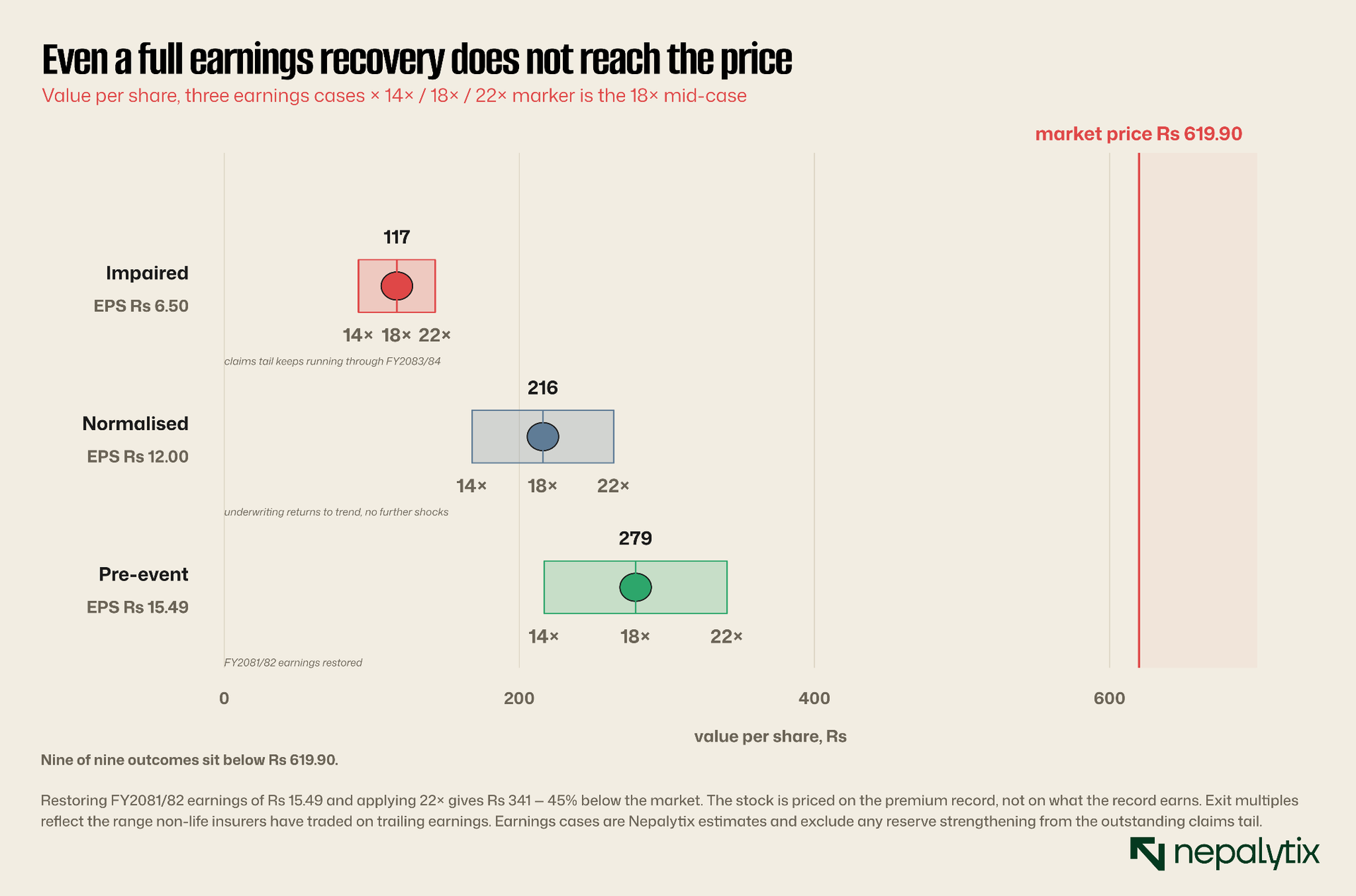
Three cases. Impaired at Rs 6.50 assumes the claims tail continues to run through FY2083/84 and underwriting margins stay compressed. Normalised at Rs 12.00 assumes the event clears and underwriting returns to a level consistent with an 8% return on equity. Pre-event at Rs 15.49 restores FY2081/82 earnings entirely.
Exit multiples of 14 to 22 times reflect the range at which Nepali non-life insurers have traded on trailing earnings.
Every one of the nine outcomes sits below the market price. The mid-case on normalised earnings is Rs 216 — 65% below Rs 619.90. Even restoring pre-event earnings entirely and applying 22 times gives Rs 341, which is 45% below the market.
We set fair value at Rs 170–280, spanning the impaired case at a mid multiple through the normalised case at a full one. That range implies substantial downside and we would rather state it plainly than dress it in hedges.
One honest caveat on method. Non-life insurers in developed markets are more often valued on book value than earnings, because reported earnings are a function of reserving judgement. On price-to-book Shikhar looks less extreme 3.27 times against a capital base that grew. But 3.27 times book for a business generating an 8.04% return on equity is still expensive: at that return, book value compounds at 8% and the multiple demands considerably more.
We should also address the obvious counter which is that we are extrapolating from an industry cession rate rather than company disclosure and that this makes the retention estimate soft. That is correct. It is the largest single source of error in this note and we have flagged it in the method statement.
But consider the direction of the sensitivity. If Shikhar retained less than 70.6% of its gross claims say 20% rather than 29.4% net retention falls from Rs 702m to roughly Rs 478m and the earnings hit is around one year of profit rather than one and a half. That improves the picture but does not change the conclusion, because the valuation gap is 55% to 81% depending on the case. The retention estimate would have to be wrong by a very large multiple to close it.
The other direction is worse. Catastrophe treaties carry event limits. If the September event exhausted Shikhar's treaty layer, retention on the excess is 100% and the net cost is higher than we model, not lower. We have no evidence that happened and are not asserting it. We note only that the error is asymmetric and the market does not appear to be pricing either tail.
The bull case, stated properly
The protection gap is the business opportunity. Seventy per cent of September's economic damage was uninsured. That is the single most powerful demonstration event Nepali general insurance has ever had and the company with 131 branches in 77 districts is the best-positioned entity in the country to convert it. Penetration-driven growth over five years could be substantial and Shikhar owns the distribution.
The event is non-recurring and the market knows it. Two days of civil unrest is not an annual occurrence. A buyer at Rs 619.90 is paying for a normalised earnings stream and treating FY2082/83 as a write-off year which is a defensible way to look at a general insurer. On that reading the 204× multiple is meaningless and the relevant number is price to book.
Capital is intact. Equity rose 1.1% through the event window. The company absorbed the loss out of earnings, not capital, which is what adequate reserving looks like from outside.
Reinsurance is real and is paying. Nepal Re has advanced Rs 3.20 billion and is government-backed with an AA− national-scale rating. Seventy per cent cession means the gross number substantially overstates what Shikhar actually bears.
Repricing follows losses. After an event of this magnitude, property and RSTMD rates in Nepal should harden materially. Shikhar writes the most policies of anyone; it captures the most of any rate increase. The FY2083/84 and FY2084/85 premium book may earn considerably better margins than the one that just closed.
Two further observations on the multiple before we leave it. First, comparing Shikhar's 3.27 times book against the Nepali non-life sector is less useful than it looks because several peers carry protest exposure of their own Siddhartha Premier's Rs 4.93 billion is nearly twice Shikhar's. A sector-relative valuation compares one impaired insurer against another and tells you very little about either.
Second, the combined reserve and surplus of all non-life insurers stood at Rs 25.16 billion at the FY2081/82 close, with an industry average of Rs 2.10 billion. Against that, a Rs 23.53 billion claim event is close to the entire accumulated surplus of the sector. Most of it is reinsured and the sector is not at risk. But it establishes the scale: this is not a large loss for Nepali general insurance, it is the largest and the industry is absorbing something of the same order as everything it has retained since inception.
What would break our view
A full-year FY2082/83 result showing the claims fully absorbed. If the audited accounts show the protest claims reserved to completion with no material tail and earnings recovering toward Rs 12 in FY2083/84, our impaired case falls away and fair value moves to the upper end of the range or above it.
Disclosure of Shikhar's actual retention. Our Rs 702 million estimate applies an industry-average cession rate. If the company's treaty retained materially less and a company writing granular small-ticket business often cedes more of a catastrophe layer, the earnings impact is smaller than we model and the recovery faster.
Evidence of hard-market pricing. If FY2083/84 premium growth comes with margin expansion rather than volume, the repricing argument in chapter eleven becomes the dominant story and this note is too pessimistic.
Acceleration in settlement. The regulator is actively pushing insurers and reinsurers to expedite. If the settled proportion moves from a third toward two thirds over the next two quarters, the uncertainty discount we are applying narrows sharply.
A change in the reinsurance structure. The single-reinsurer concentration identified in the sector post-mortem is a known problem with an obvious fix. If the industry moves to a broader panel for FY2083/84 and beyond, the systemic element of this risk falls and the sector deserves a higher multiple than it currently carries. Watch the treaty renewal commentary.
Verdict
Shikhar Insurance is a good company that has had a bad year for a reason that is not its fault and it is priced as though neither of those facts were true.
The franchise is genuine. The distribution is unmatched in Nepali non-life. The capital base came through the event intact which is the single best piece of evidence that the company reserves properly. The protection gap that September exposed is a multi-year growth argument and Shikhar is the best-placed operator to capture it.
But the share price implies a recovery to earnings the company has not generated since before the event, at a multiple the sector rarely sustains with a claims tail that is two thirds unsettled and a reinsurance recovery concentrated in one counterparty. Every one of nine valuation outcomes we can construct sits below Rs 619.90 and the most generous of them is 45% below.
The record premium of Rs 6.11 billion is real. It is also on our reading, the least informative number the company published this year.
Disclaimer
This report has been prepared by Nepalytix for informational and educational purposes only and does not constitute investment advice, an offer, or a solicitation to buy or sell any securities.
The information contained in this report is based on sources believed to be reliable; however, Nepalytix does not guarantee its accuracy, completeness, or timeliness. Opinions, estimates, and projections expressed herein are those of the authors as of the date of publication and are subject to change without notice.
Investing in securities involves risks, including the possible loss of principal. Past performance is not indicative of future results. Readers are advised to conduct their own independent research and consult with a qualified financial advisor before making any investment decisions.
Nepalytix and its contributors may hold positions in the securities discussed in this report at the time of publication or thereafter.
Neither Nepalytix nor any of its affiliates accept any liability for any loss arising from the use of this report or its contents.