The 1% Tax on Shares That Cannot Trade
A proposed 1% transfer fee would hit Nepal’s already illiquid promoter shares which trade at an average 33% discount to identical ordinary shares.
A draft Company Act would charge 1% on off-market share transfers above Rs 25 lakh. That is a levy aimed at promoter stock, which already trades 43% below the identical ordinary share because the state will not let it be sold.
THE ARGUMENT
A draft Company Act would charge one per cent on the transfer of shares worth Rs 25 lakh or more, payable by whoever acquires them. An MP has said it will not touch ordinary trading on NEPSE, only off-market transfers done directly on the company's register.
Take that clarification at face value and the fee becomes a levy aimed almost entirely at promoter stock, the class that already trades roughly 43% below the identical ordinary share, for no reason other than that it cannot be sold freely. It is defensible to tax transfers that escape the exchange. It is harder to defend taxing the one route that would turn locked stock into float.
Start with what actually exists. In late Ashadh the Ministry of Industry, Commerce and Supplies published a draft of the Company Act, 2083. Section 89 proposes that where shares worth Rs 25 lakh or more change hands, the person acquiring them pays a one per cent fee at the point the transfer is recorded.
Read that sentence carefully, because almost every problem in what follows comes from it. It does not say "off-market". It does not say "private transfer". It says shares worth Rs 25 lakh or more, transferred or bought and sold. On its face that is a description of most meaningful transactions in Nepali equities, including a great many that happen on the exchange every trading day.
The market read that as an extra one per cent on every trade and reacted accordingly. Within a day, Rastriya Swatantra Party MP Hari Dhakal was on social media saying the fee would not apply to secondary market trading through TMS and NEPSE where the applicable charge remains capital gains tax at 7.5 or 10 per cent, and that it would catch only off-market transfers registered directly with the company.
Two things about that are worth stating plainly. The first is that Dhakal did not draft the bill and does not administer it. A member of parliament's reading of a ministry draft is a useful signal about political intent and nothing more. The second is that the draft's own language sits awkwardly with the reading: it provides that where a transaction runs through the securities exchange system, the securities professional collects the fee and deposits it into the federal consolidated fund. If the fee never touches exchange transactions, that sentence has no work to do.
The investor Ambikaprasad Poudel made the point sharply in public, asking what subsections (1) and (2) of section 89 were actually meant to cover. He is right that the language carries the risk of encompassing every kind of transfer, and right that the question cannot be settled by anyone's assurance.
There is a wider lesson in this that has nothing to do with share transfers. Nepal legislates capital markets across at least four instruments, the Companies Act, the Securities Act, the Finance Act and Nepal Rastra Bank directives administered by three different bodies with no standing mechanism to reconcile them. A share transfer fee is a capital markets measure. It appeared in a company law draft, from the industry ministry, six weeks after the finance ministry had separately raised the tax on the same transactions. Nobody appears to have checked.
The ministry has since signalled that it will amend the provision, describing the draft as preliminary recommendations open to substantial modification and acknowledging that many submissions during the feedback window opposed it. So this piece is not an analysis of what the fee will do. It is an analysis of what such a fee would do, and it should be read that way. The reason it is worth writing anyway is that the idea has now been put on paper by a ministry, and ideas put on paper by ministries return.
It is worth pausing on that because it complicates the story the market told about itself. The reaction on social media was furious. The reaction in prices was a fifth of a typical daily range and it reversed. A market that genuinely believed a one per cent transaction tax was about to land on every trade would not have moved 0.62%. Either investors discounted the proposal immediately or the outrage was louder than the conviction behind it.
The recovery matters as much as the fall. If the market had priced a permanent one per cent transaction tax, the index would not have made back three per cent inside two months while the provision remained formally on the page. What the price action describes is a market that read the draft, listened to the ministry's retreat and concluded the thing was never going to happen. That is probably the correct read. It is also a reason to examine the proposal on the merits now, while nobody is panicking rather than the next time a version of it surfaces.
That does not make the proposal harmless. It means the case against it has to be made on its incidence rather than on the market's alarm.
What a transfer fee is and what it is not
A one per cent charge on the transfer of a security is a stamp duty in everything but name. Stamp duties on share transfers are old instruments with a long record, and the record is mixed rather than damning. They are cheap to administer, hard to avoid where a register exists, and they raise steady revenue. They also reduce turnover, and reduced turnover widens spreads and impairs price discovery. The size of that trade-off depends almost entirely on how liquid the market was to begin with.
That is the crux for Nepal. A transaction charge in a deep market is a friction. A transaction charge on a security that already trades at a 43 per cent discount for being untradeable is something else: it is a charge levied on the very illiquidity it deepens. The instrument is not wrong in principle. It is being pointed at the part of the market least able to absorb it.
It is also worth separating three things that the public debate ran together. A tax on gains is a charge on profit. A tax on transactions is a charge on activity. A fee for a service recording a transfer is a charge for administration. The draft calls this a fee, the market called it a tax and its structure is that of a transaction tax. If it were truly a recording fee it would be a flat sum reflecting the cost of the clerical work not a percentage of value and no one would have noticed it.
There is a further reason the exchange/off-market distinction is doing more work than it can bear. The two are not separate markets with separate participants. They are two doors into the same register and which door a transaction uses is often determined by the class of share rather than by the intent of the parties. An ordinary shareholder wanting to sell uses the exchange because that is where ordinary shares trade. A promoter wanting to sell uses the off-market route because the exchange will not accept the transfer. Neither is choosing a route to avoid anything. The route chose them.
A fee that distinguishes between the two therefore does not distinguish between the honest and the evasive. It distinguishes between the liquid and the illiquid, and then charges the illiquid.
Who actually holds the shares this would tax
Nepali listed companies issue two classes of the same security. Promoter shares and ordinary shares carry identical voting rights, identical claims on earnings and identical dividends. The only difference is that promoter shares cannot be sold freely: they are locked in for three years from IPO allotment under section 38 of the Securities Registration and Issue Regulation 2073, flagged inside the CDSC depository and after the lock-in they can generally move only to another qualifying holder.
The reason two classes exist at all is worth recovering because it explains why the discount is so stubborn. Nepal's regulatory architecture treats promoters as a category with continuing obligations rather than as founders who eventually become ordinary shareholders. A bank's promoters are expected to stand behind the institution; the law therefore restricts their exit and requires them to retain a majority. That is a defensible prudential position. It's side effect is a permanent class of shares whose holders cannot leave and a market that values those shares at what a restricted buyer will pay rather than at what the underlying business is worth.
In most markets the founder category is relevant only at the beginning. In Nepal it is structural and open-ended and it produces the odd result that the same rupee of earnings is worth Rs 340 in one column of the price sheet and Rs 193 in another.
The market prices that restriction and it prices it heavily.
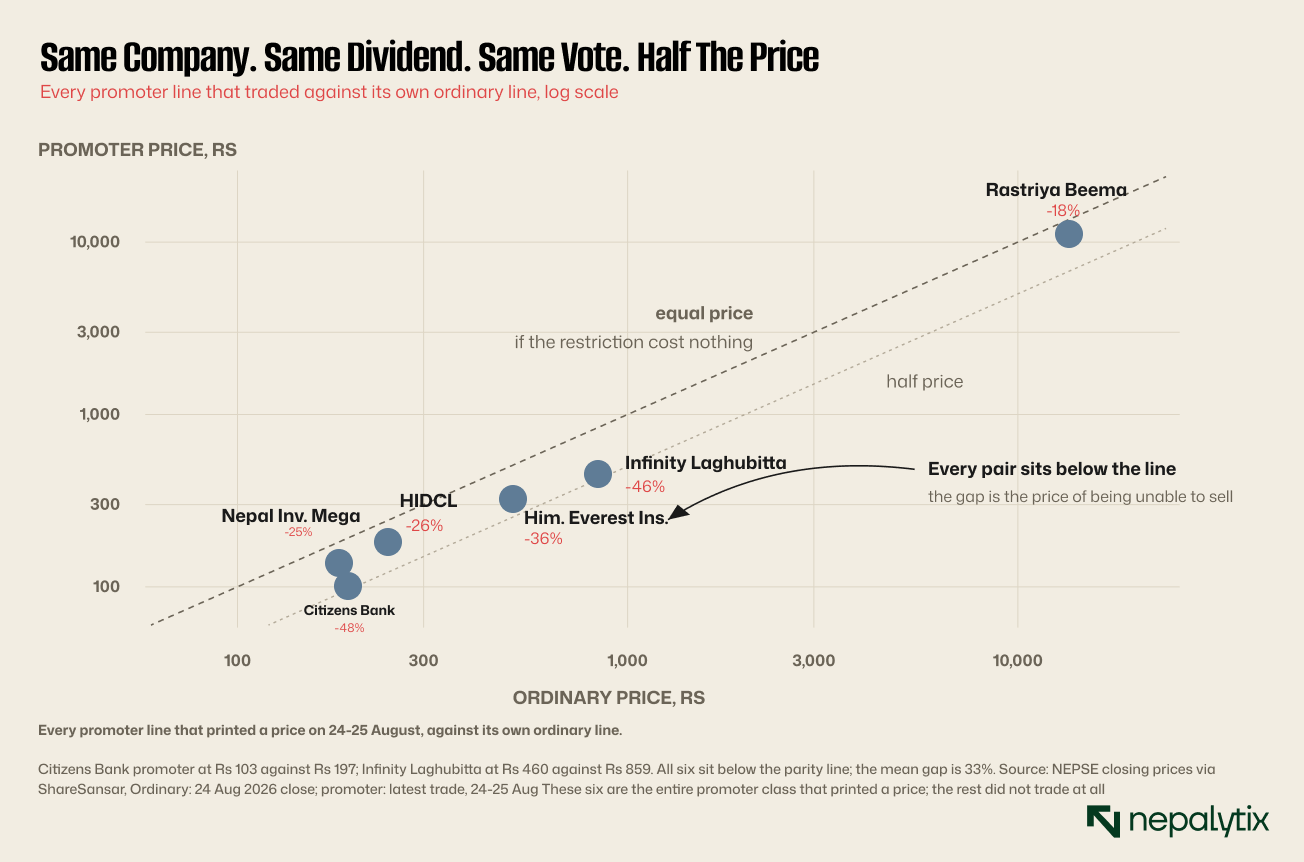
Thirty-three per cent on average and forty-eight at the widest. Not for a different company, a different dividend or a different vote, but for the same claim on the same earnings, held in a form that cannot be sold to whoever wants it.
Six pairs is not a sample. It is the population: on 24 and 25 August those were the only promoter lines in the whole market that printed a price at all. Everything else in the promoter class sat untraded which is the same finding by another route.
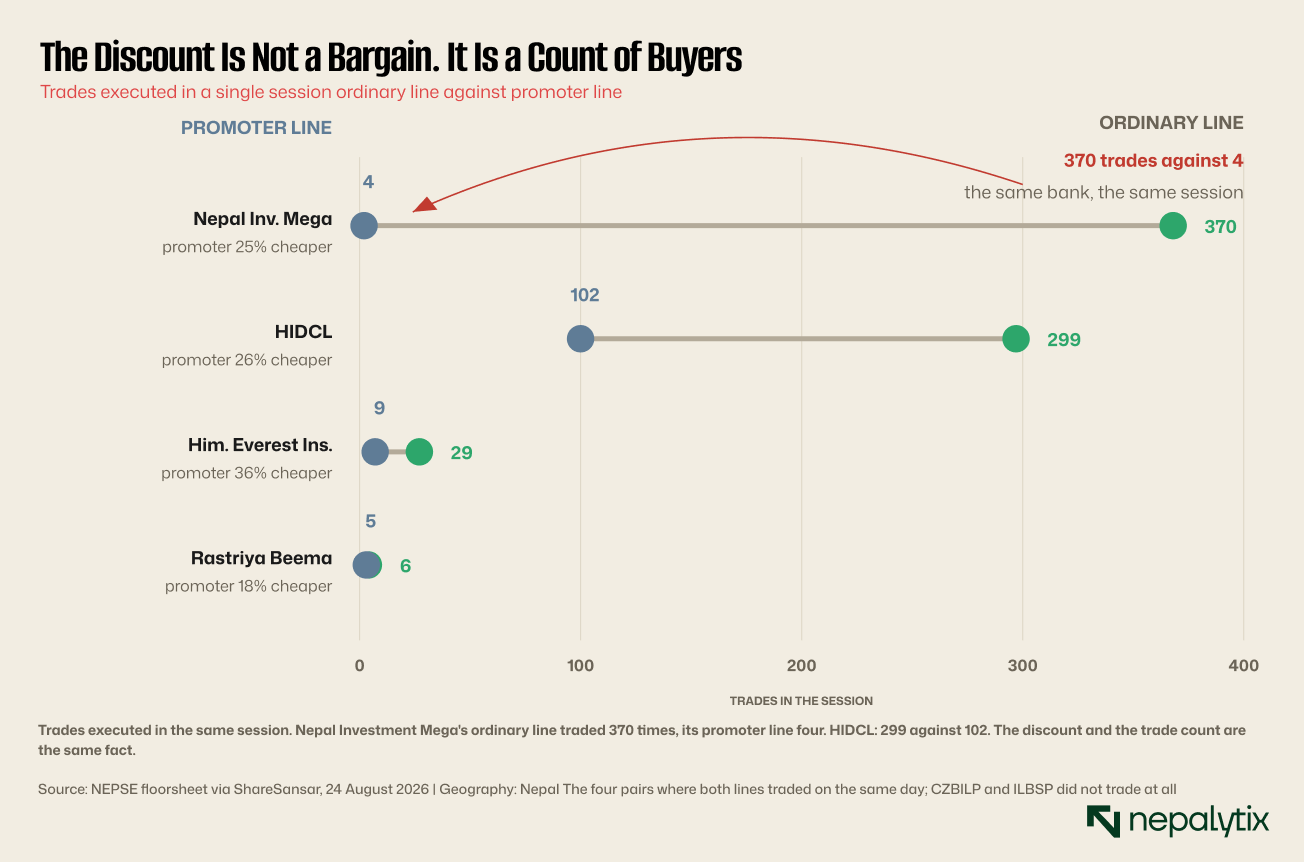
The discount and the illiquidity are one fact seen from two sides, and the floorsheet shows it directly. On 24 August, Nepal Investment Mega's ordinary line traded 370 times. Its promoter line traded four. Same bank, same session, same dividend and the promoter stock changed hands at a 25% discount. Rastriya Beema's promoter line traded five times; Himalayan Everest's, nine.
A quoted price that almost nobody can hit is not really a price. It is an estimate the exchange is obliged to print, arrived at by a handful of participants who are permitted to transact with each other.
Notice what the discount is not. It is not a governance discount, the two classes vote identically. It is not a dividend discount, they receive the same distribution on the same book closure. It is not a seniority discount, they rank equally on a winding up. Strip out every difference in rights and there is exactly one variable left, which is the ability to sell. The market has therefore given us an unusually clean price for liquidity in Nepali equities: somewhere between 30 and 50 per cent of the value of the underlying claim.
That is an extraordinarily high price for liquidity, and it is a measure of how tight the restriction is rather than of how skittish the market is. It also means any policy that touches the transferability of promoter shares is working on a large number, not a marginal one.
This is the class of share the fee is aimed at, on the clarified reading. Not the liquid two-thirds where price discovery happens and where the government already collects capital gains tax at settlement but the illiquid remainder that the market has already marked down by two-fifths for being illiquid.
Adding one per cent to that is not, by itself, a large number. The objection is not magnitude. It is direction.
One more comparison makes the size of it concrete. On a Rs 25 lakh transfer of promoter stock, the fee is Rs 25,000. The same block, if the shares were ordinary rather than promoter, would be worth about Rs 44 lakh at the ratio the market currently applies. The holder is already forgoing something in the order of Rs 19 lakh for holding the restricted class. The fee adds Rs 25,000 to that about 1.3 per cent of what the restriction is already costing them. Nobody is going to change a decision over 1.3 per cent of a loss they have already taken.
Which is precisely why the magnitude argument is the wrong one, in both directions. The fee is too small to be the outrage the market briefly made of it and too small to be worth the damage it does at the conversion gate. It is a measure whose costs and benefits are both minor, attached to a market structure whose costs are enormous. The 43 per cent is the story. The one per cent is a symptom of not looking at it.
The fee lands on the exit, not on the holding
A promoter share becomes ordinary becomes float only by moving. It moves either when a promoter sells to another qualifying holder or when the company converts the class through an AGM resolution, SEBON and NEPSE approvals and a CDSC application. Both are transfers. Both are precisely what section 89 taxes.
And both are already slow.
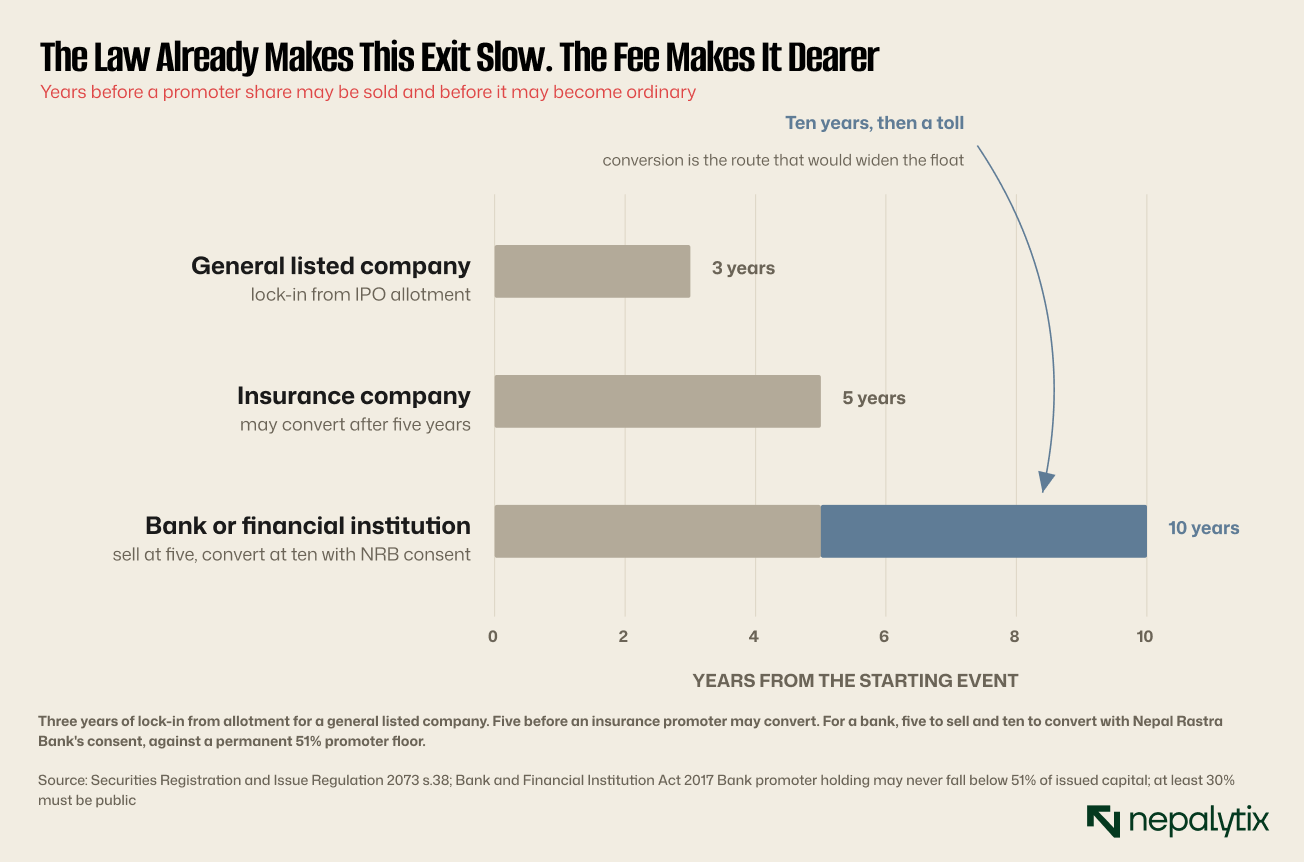
The Bank and Financial Institution Act 2017 requires at least 30 per cent of issued capital to go to the public, permits promoters to sell after five years, and allows conversion to ordinary only after ten years and only with the central bank's consent with a hard floor of 51 per cent promoter ownership that can never be crossed. Insurance companies may convert after five years.
Read that alongside the fee. The state has built a decade-long corridor through which locked stock may eventually become tradeable, imposed a permanent majority floor at the end of it, and is now proposing a toll at the exit. If the policy objective is a deeper market with a wider float and every official statement of capital market policy says that it is then charging for conversion works against the objective.
The counter-argument deserves to be put fairly and it is a real one. Off-market transfer is genuinely where avoidance lives. Transactions that never touch the exchange are harder to value, harder to verify and easier to structure at a price that suits the parties rather than the revenue authority. A fee levied on the recorded transfer is administratively simple and hard to avoid precisely because the register is where the transaction must land. If you wanted to tighten the loosest joint in Nepali share ownership, this is roughly where you would put the wrench.
The problem is that the wrench does not distinguish between the transfers that are a problem and the transfers that are the remedy.
There is one more structural point before the incidence. Because promoter holding in a bank may never fall below 51 per cent, the promoter class is not merely slow to convert, a majority of it can never convert at all. The float that could theoretically be released is capped by statute at 49 per cent of a bank's issued capital, and banks and insurers make up a large share of NEPSE's capitalisation. Any measure that raises the cost of moving promoter stock is therefore operating inside a pool that is already permanently restricted at one end.
None of which is an argument that promoter shares should trade at parity. A restricted security should be worth less than an unrestricted one and 43 per cent may even be a fair price for a restriction as tight as Nepal's. The question a policymaker should be asking is not whether the discount is justified but whether the restriction producing it is and if it is not, whether the state should be adding to its cost rather than dismantling it.
The incidence, transfer by transfer
Work through who actually writes the cheque. The draft puts the fee on the acquirer at the point of recording.
A promoter selling to another promoter. The buyer pays one per cent of a price already struck at a 43 per cent discount to the ordinary line. Since the pool of eligible buyers is small and the seller is often under some pressure to exit, the fee is likely to be pushed back into the price. In substance the seller bears it, on an asset the market has already penalised.
An estate transferring on death. A transmission to heirs is a recorded transfer. Whether the draft intends to catch it is not stated, and that silence matters: Rs 25 lakh of promoter stock is an ordinary size of holding for a founding family and a bereaved heir being billed one per cent to have shares moved into their own name is not what anyone means by taxing avoidance.
A gift within a family. The same problem in a different form. There is no consideration, so there is no gain, so capital gains tax has nothing to bite on but a one per cent fee on the value of the transfer bites regardless.
A corporate restructuring or merger. Nepal's banking and insurance sectors have spent a decade consolidating under regulatory encouragement. Every merger moves blocks of promoter shares by recorded transfer and blocks are large. One per cent of a merger's share consideration is not a rounding error.
Pledge enforcement. When a lender takes possession of pledged shares on default, the transfer is recorded. The acquirer is the bank and the value is by definition distressed. Taxing the enforcement of collateral raises the cost of lending against shares which is a small but real credit channel in Nepal.
Conversion to ordinary. The route that creates float. Taxed like the rest.
A foreign or institutional acquirer taking a strategic stake. Nepal has spent years courting exactly this and structuring the rules to permit it. A strategic investor buying into a listed bank acquires promoter shares by recorded transfer, in size and would pay one per cent on the way in on top of whatever price the seller extracts. It is a small deterrent on a large decision, but it is a deterrent pointing the wrong way.
The company itself, in a merger it was encouraged to do. Where two banks combine, promoter blocks in the disappearing entity are transferred and recorded. If the fee catches merger consideration, the state is charging for a consolidation it has spent a decade promoting through its own directives.
What that list shows is a levy that is indifferent to purpose. It cannot tell an evasive private sale from a widow inheriting her husband's holding because the only thing it looks at is the value on the register.
Set against that, the honest case for the fee gets stronger the more narrowly it is drawn. If it were confined to arm's-length private sales between unrelated parties above a meaningful size, the transactions where mispricing to suppress capital gains tax is a real risk it would be a reasonable anti-avoidance measure with a modest deadweight cost. The version on the page is not that. It is a levy on the fact of a transfer and the fact of a transfer tells you nothing about whether anyone is avoiding anything.
One asymmetry runs through every line of that list. In each case the party writing the cheque is acquiring shares they are then obliged to hold under the same restrictions that made those shares cheap in the first place. The buyer of promoter stock does not buy a discount; they buy the illiquidity that created it, and now they pay one per cent for the privilege. The discount is not a bargain waiting to be captured, it is a warning, correctly priced and the fee is charged on top of the warning rather than on top of any gain.
The threshold makes it worse, not better
The Rs 25 lakh floor looks like a concession to small holders and to a degree it is. But of the way it is drafted, the fee appears to fall on the whole consideration once the threshold is crossed, not on the excess above it. That produces a notch.
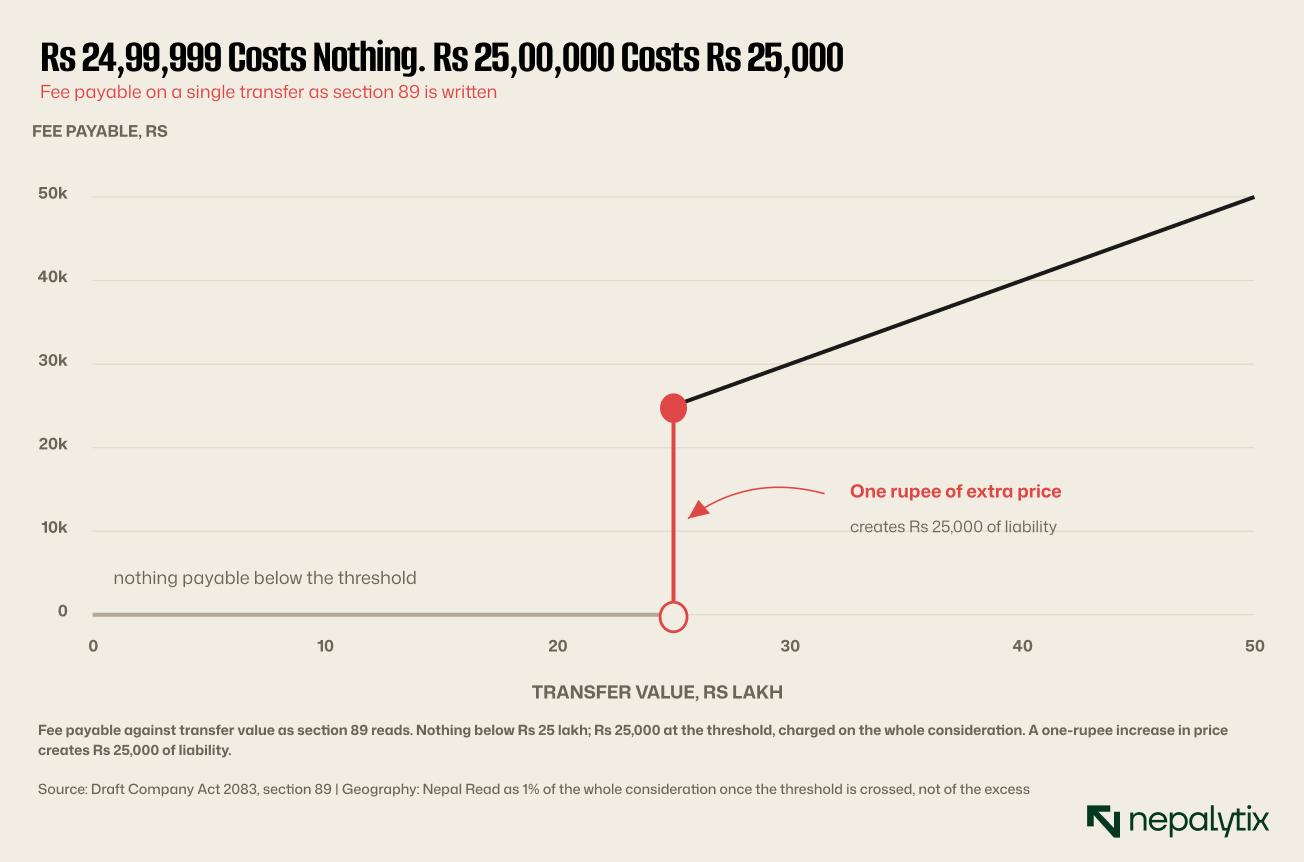
A transfer at Rs 24,99,999 costs nothing. A transfer at Rs 25,00,000 costs Rs 25,000. One rupee of extra consideration creates twenty-five thousand rupees of liability.
Before that, though, it is worth establishing who the threshold catches at all because the answer settles a good part of the argument the market had in Ashadh.
Notches of this kind have a well-understood consequence: transactions bunch just beneath them. Parties who would otherwise transfer a block at Rs 26 lakh will transfer it at Rs 24.9 lakh and settle the difference some other way or split one transfer into two. Neither outcome raises revenue and both degrade the accuracy of the register which is the thing the fee was meant to police.
There is a second-order effect worth naming. A notch does not merely distort the price at which transfers are recorded; it distorts which transfers get recorded at all. If splitting a Rs 40 lakh block into two Rs 19.5 lakh transfers a fortnight apart saves Rs 40,000, some parties will do it and the register will show two transactions where there was one economic event. The register is the state's own record of who owns Nepali companies. Introducing an incentive to fragment it is a strange thing for a Companies Act to do.
Notches also interact badly with an illiquid market. In a liquid market the parties can observe a fair price and the notch simply shifts a little value between them. In a market where the promoter line has not traded for weeks, the "price" is whatever the parties write down and a Rs 25,000 cliff gives them a shared reason to write down a smaller number. The fee's design thus works against the accuracy of exactly the data the fee is levied on.
A graduated rate, or a fee on the excess above the threshold, removes the notch entirely and costs the exchequer almost nothing. That this was not done in a first draft is not scandalous. That it be fixed before any redraft is the minimum.
A conversion that is really a housekeeping exercise. When a company converts promoter shares to ordinary after the statutory period, nothing changes economically: the same holder owns the same claim on the same business. What changes is a flag in the CDSC depository. Charging one per cent of value to reclassify a security that has not moved between owners is difficult to justify on any theory of the fee whether one thinks of it as anti-avoidance as a transaction tax, or as payment for administrative work.
The threshold answers the question the market was shouting about
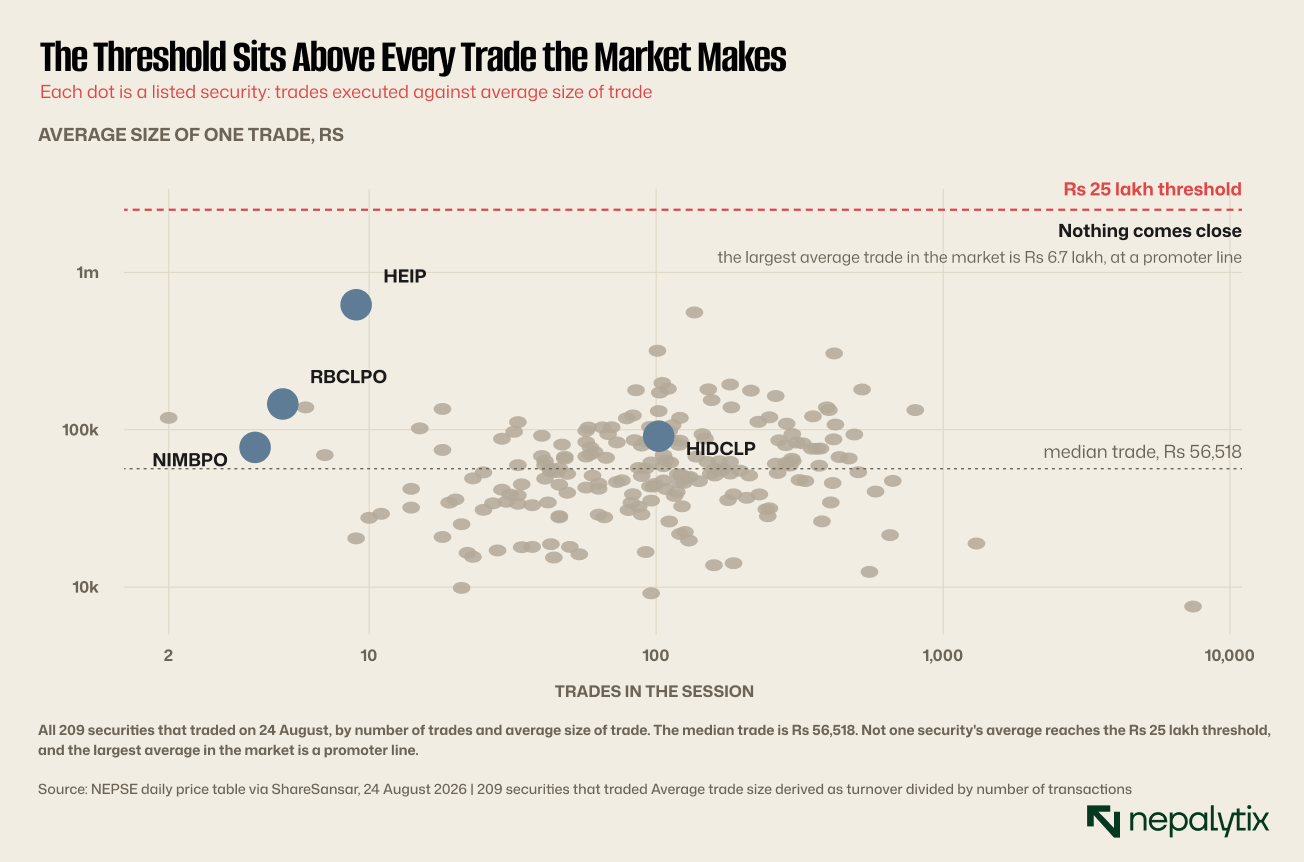
On 24 August, 209 securities traded on NEPSE. The median trade was Rs 56,518. The largest average trade of any security in the market was Rs 6.7 lakh about a quarter of the threshold. Not one security came close.
That is the empirical answer to whether a Rs 25 lakh floor could bite on ordinary secondary market trading, and the answer is essentially no. Retail order flow does not transact in Rs 25 lakh clips. Dhakal's reassurance, whatever its legal standing describes the market accurately.
But look at which securities sit highest in that distribution. The largest average trade in the entire market belongs to a promoter line, Himalayan Everest's, at Rs 6.7 lakh across nine trades all session. Rastriya Beema's promoter line ranks fourteenth of 209. All four promoter lines that traded sit in the top third by trade size while sitting at the very bottom by trade count.
That is the shape of block trading: few transactions, large ones. A threshold set at Rs 25 lakh is calibrated whether by design or by accident, to miss the exchange entirely and to land on transfers that move in blocks. Promoter transfers move in blocks.
It does not arrive alone
The fee would land on a market that has just absorbed a separate increase from a different ministry.
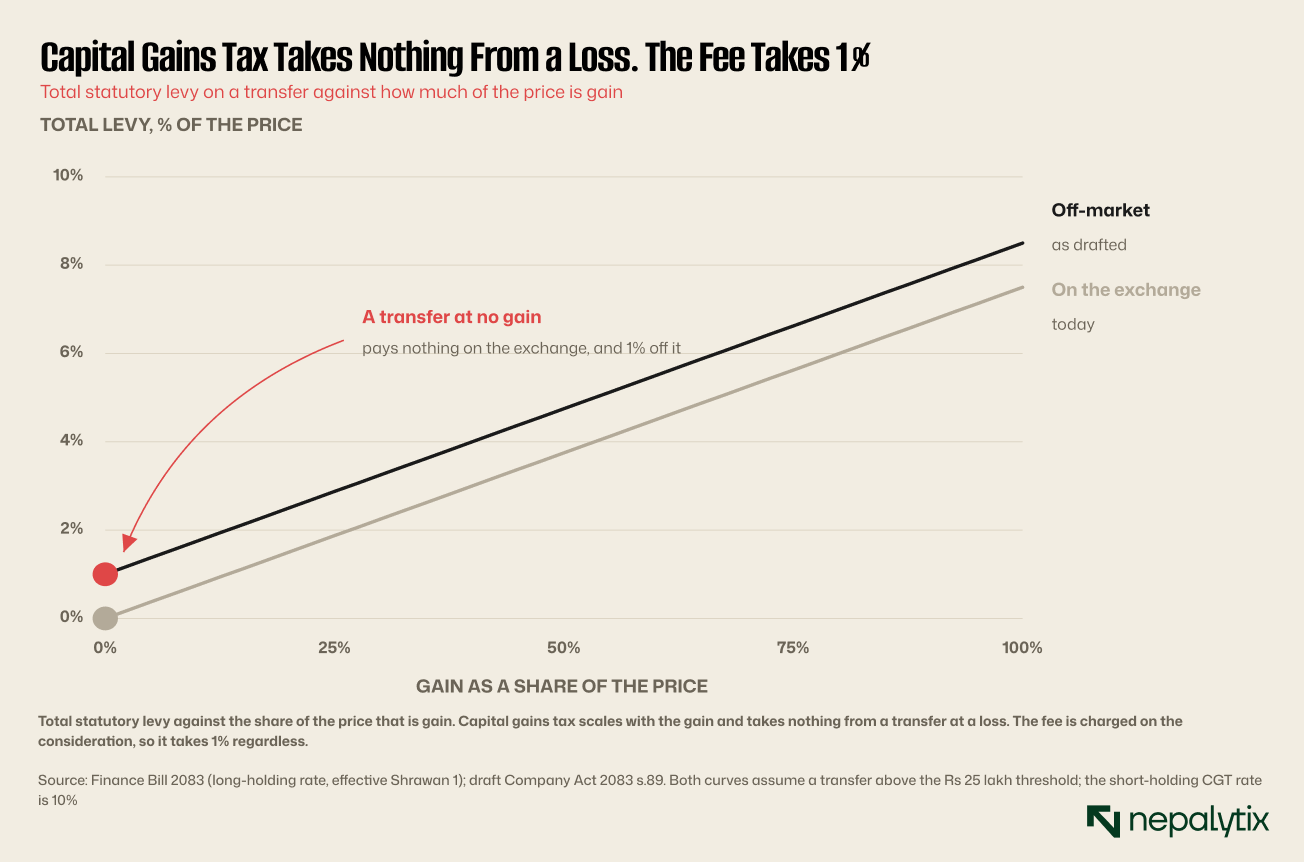
Finance Minister Swarnim Wagle's budget of 29 Jestha raised capital gains tax on listed shares from 5 to 7.5 per cent for holdings over a year and from 7.5 to 10 per cent for holdings under a year, effective Shrawan 1. Six weeks later a second ministry proposed a further one per cent on the transfer itself.
Taken together, the statutory levy on a long-held share moved off-market goes from 5 per cent to 8.5 per cent inside a single fiscal quarter. Neither ministry appears to have weighed its measure against the other's which is the more serious governance point in this whole episode. A capital market policy assembled from uncoordinated levies by separate departments is not a policy.
It also matters that the two levies have different bases. Capital gains tax is charged on the gain so it takes nothing from a transfer at a loss and scales with the profit realised. The proposed fee is charged on the consideration, so it takes the same amount from a promoter selling at a loss as from one selling at a gain. A transaction tax on gross value is a fundamentally different instrument from a tax on net gain, and stacking them means a loss-making transfer now attracts a charge where previously it attracted none.
For promoter stock, that is not a hypothetical. A holder who bought at a converted price and sells into a market that discounts the class by a third may well be realising a loss. Under the current regime they pay nothing. Under the draft they pay one per cent of the proceeds.
Priyaraj Regmi, formerly of the Nepal Stock Brokers Association put the objection in plainer terms: raise the cost of transacting and people transact less; if they do not transact, prices are not discovered; if prices do not rise, the government collects less capital gains tax than it would have. The mechanism is real even if the rhetorical framing is doing some work.
What is actually parked out there
The scale of the affected stock is not hypothetical. When CDSC moved in early 2026 to give listed companies separate ISINs for promoter and public shares to stop locked stock being sold under a single identifier independent power producers estimated the change would touch around 870 million shares worth roughly Rs 87 billion across 58 energy companies.
That is one sector. It is about 1.9 per cent of NEPSE's Rs 4.62 trillion market capitalisation, and it is the sector where the lock-in dispute is most active, SEBON has taken action against two hydropower companies for pre-lock-in sales and the ISIN question remains unresolved.
Rs 870 million is the toll on releasing that one pool. Not a catastrophic sum against Rs 87 billion, which is precisely why the magnitude argument fails. The argument that works is that the toll is charged at the gate the state says it wants people to walk through.
A fourth possibility deserves airing, because it is the one that would make the fee coherent. If the intention were not revenue at all but disclosure forcing off-market transfers into the light by attaching a cost to opacity then a fee would be a blunt way of achieving something a reporting requirement achieves better and for nothing. Requiring that off-market transfers above a threshold be publicly disclosed, with the price, would give the authorities everything a fee gives them by way of information and none of the deadweight cost. Nothing in the draft or the commentary suggests this was the intention but it is the version of the policy that would survive scrutiny.
The revenue nobody has estimated
A tax proposal usually arrives with a number attached. This one did not, and it could not have, because Nepal does not publish the aggregate value of off-market share transfers. NEPSE reports turnover for exchange trading. CDSC records off-market transfers but the totals are not in the public domain. Neither the ministry's draft nor any of the commentary around it put a figure on what the fee would raise.
That absence is more than an inconvenience. Without it, nobody can weigh the yield against the deadweight cost and the debate collapses into assertion, the ministry asserting that avoidance exists, the market asserting that the fee would kill liquidity, neither able to size either claim. The one number that is public is the direction of travel: NEPSE's market capitalisation stood at Rs 4.62 trillion in July 2026, up from Rs 4.47 trillion a month earlier but still below the Rs 4.88 trillion peak of July 2025. This is a market recovering rather than booming, which is a poor moment to test how much friction it will bear.
If a redraft appears, the first question to ask of it is what it is forecast to raise. If the answer is a small number, the provision is not worth its complications. If it is a large number, that is itself evidence that a great deal of value moves off-market, and the more proportionate response is to ask why which brings the conversation back to the lock-in rules rather than to the transfer.
What a better version would look like
None of this amounts to a case for leaving off-market transfer untaxed. The avoidance problem is real and the register is the right place to catch it. Four changes would keep the purpose and remove most of the damage.
Charge on the excess, not the whole. The notch is a drafting error, not a policy choice and it is free to fix.
Exempt transfers without consideration. Inheritance, transmission on death and intra-family gift involve no gain and no avoidance opportunity worth the name. A fee that catches them is taxing bereavement.
Exempt or rebate conversion to ordinary. If widening the float is the objective, do not charge for the only transaction that widens it. A rebate on conversion would actively pull locked stock into the market which is the outcome every capital market strategy document in the country claims to want.
Say explicitly what it does not cover. The confusion of late Ashadh was not caused by the fee. It was caused by a draft that could be read two ways and an MP supplying the reassuring reading. Legislation that requires a politician's Facebook post to be intelligible is badly drafted legislation whatever its merits.
Coordinate the base with capital gains tax. If the concern is that off-market transfers are priced to suppress the gain, the cleaner instrument is a deemed minimum value for capital gains purposes on unlisted or off-market transfers, not a separate gross-value fee. That targets the mischief precisely and leaves loss-making and no-consideration transfers alone.
None of these four requires abandoning the revenue objective. Together they would cost a fraction of the fee's yield and remove nearly all of its collateral damage. The fact that the first draft contained none of them suggests the provision was written as a revenue line rather than as a piece of market regulation which is the deeper problem with legislating capital markets through a company law bill.
Publish the aggregate off-market transfer data. Whatever happens to the fee, CDSC holds the numbers and there is no confidentiality reason not to release them in aggregate. If off-market transfer is a policy problem, the country should be able to see how big it is. If it turns out to be small, several arguments on both sides of this debate collapse which would be a useful outcome.
What this episode says about how Nepal makes market policy
Step back from the fee itself. In the space of six weeks, two ministries proposed measures affecting the cost of the same transaction, neither referencing the other. A draft went out for public consultation containing language capable of two opposite readings on its most consequential clause. The clarification that calmed the market came from a backbench MP on social media rather than from the drafting ministry. And the ministry's eventual response was not a defence or a redraft but a signal that the clause would be removed.
Every step of that is understandable in isolation. Together they describe a policy process in which the capital market is regulated by whoever happens to be drafting something, and in which the market's only defence is to make enough noise. That works, in the narrow sense that it worked here. It is a poor substitute for a process that would have caught the notch, the double-counting with capital gains tax and the ambiguity about exchange transactions before publication rather than after.
The Securities Board exists. It has a mandate over exactly this. Whether it was consulted on a provision that would change the cost of every share transfer in the country is not recorded in anything published, and it should be.
Give the Securities Board the pen. A measure that changes the cost of every share transfer in the country belongs in securities legislation, drafted by the securities regulator, consulted on with the exchange and the depository. That it appeared in a company law draft from the industry ministry is the procedural root of every substantive problem catalogued above, the notch, the double-count with capital gains tax, the ambiguity about exchange transactions, and the silence on transfers without consideration. None of those are hard questions for someone who regulates securities for a living. All of them are easy to miss for someone drafting a companies bill.
The thing worth remembering
It is worth being clear about what this piece is not arguing. It is not arguing that promoter shares should be freed immediately, or that prudential lock-ins are pointless. A bank whose founders can exit on day one is a worse bank, and Nepal has enough history with undercapitalised financial institutions to justify caution. Nor is it arguing that the state should never charge for a transfer. The argument is narrower and, I think, harder to dispute: if you have decided to restrict an asset's transferability so severely that the market marks it down by two-fifths, you should not also charge a toll at the one gate where the restriction lifts.
Nepal has built a market in which the same security trades at two prices depending on who is allowed to own it and in which the cheaper class is cheaper only because the state restricts its sale. The 43 per cent discount is not a market failure. It is a policy outcome, priced accurately.
A government that wanted to close that gap would make conversion easier, faster and cheaper, and the discount would narrow on its own as the shares became sellable. A one per cent fee on transfer does the opposite in a small way: it makes the locked class marginally more expensive to unlock and it does so at the moment when unlocking it is the whole point.
The provision will probably be dropped. The ministry has all but said so and the consultation record supports it. What should not be dropped is the question the draft accidentally raised which is why two-fifths of the value of a Nepali share should depend on whether its holder is permitted to sell it.
Disclaimer
This report has been prepared by Nepalytix for informational and educational purposes only and does not constitute investment advice, an offer, or a solicitation to buy or sell any securities.
The information contained in this report is based on sources believed to be reliable; however, Nepalytix does not guarantee its accuracy, completeness, or timeliness. Opinions, estimates, and projections expressed herein are those of the authors as of the date of publication and are subject to change without notice.
Investing in securities involves risks, including the possible loss of principal. Past performance is not indicative of future results. Readers are advised to conduct their own independent research and consult with a qualified financial advisor before making any investment decisions.
Nepalytix and its contributors may hold positions in the securities discussed in this report at the time of publication or thereafter.
Neither Nepalytix nor any of its affiliates accept any liability for any loss arising from the use of this report or its contents.