The Hidden Cost of Trading on NEPSE
NEPSE trades come with more costs than the price you see on screen. Here’s how broker commission, SEBON fees, DP charges and capital gains tax affect your actual returns.

Four charges sit between the price on your screen and the money in your bank. A Rs 5,000 round trip costs 1.75%. A Rs 1 crore round trip costs 0.59%. On a small trade the largest single cost is not your broker.
You buy a hundred shares at Rs 500. The screen says Rs 50,000. You sell them a year later at Rs 550 and the screen says Rs 55,000. You made Rs 5,000.
You did not. You made Rs 4,216.
The difference is four charges. None of them is large. Three of them you pay twice. Together they are the gap between the number on your trading screen and the number in your bank account and almost nobody looks at them until the money lands short.
Why the screen price is not the price
Start with what the number on your trading screen actually is. It is the last price at which two other people agreed to trade. It is not a quote to you, it is not inclusive of anything and it is not what leaves your account.
When you place a buy order through TMS, the amount blocked is the consideration plus an estimate of the charges. When the trade settles two days later, the exact figure is drawn. That is why the number on your contract note rarely matches the round figure you had in mind.
The gap is not a broker adding something. It is a schedule that applies identically to everyone, published by the regulator and almost never itemised in a form a retail investor reads.
The four charges
Every NEPSE trade carries the same stack.
Broker commission. A percentage of the trade, paid on both the buy and the sell. The rate falls as the trade gets bigger from 0.36% down to 0.24%. There is a minimum of Rs 10.
The SEBON fee. A flat 0.015% of the amount, again on both sides. It funds the regulator. On a Rs 1 lakh trade it is Rs 15 each way.
The DP charge. Rs 25, paid to your depository participant, per company, per transfer day. It is a flat fee. It does not care whether you traded Rs 5,000 or Rs 5 crore.
Capital gains tax. 7.5% if you held over 365 days, 10% if you did not, for individuals. It applies only to your gain and your broker deducts it before paying you.
The first three are the cost of transacting. The fourth is the cost of being right. Keep them separate in your head because they behave completely differently.
Where each charge goes and who sets it
Before the arithmetic, a word on who is charging you and why. It changes what you can do about each one.
The broker commission is set by SEBON, not by your broker. Every licensed broker in Nepal charges the same schedule for the same trade. This is unusual by international standards where brokers compete on price and discount brokers have driven commissions toward zero. In Nepal the rate is a regulated tariff.
The SEBON transaction fee funds the regulator directly. It is 0.015% on equity, 0.010% on mutual fund units and other securities and 0.005% on government bonds. The lower rates on bonds are deliberate to avoid taxing a market the state wants to develop.
The depository charge goes to your depository participant which is the institution holding your shares in dematerialised form. Usually a bank or a broker with a DP licence. It is compensation for the record-keeping that happens when ownership actually changes.
Capital gains tax goes to the revenue authority and your broker collects it on their behalf. It is a final withholding which means once it is deducted you have no further liability on that gain and nothing to declare.
Of the four, only the last is something you control, and you control it through how long you hold rather than through anything you negotiate.
What a round trip actually costs
Take the first three charges, on a complete buy and sell of the same amount and express them as a share of the trade.
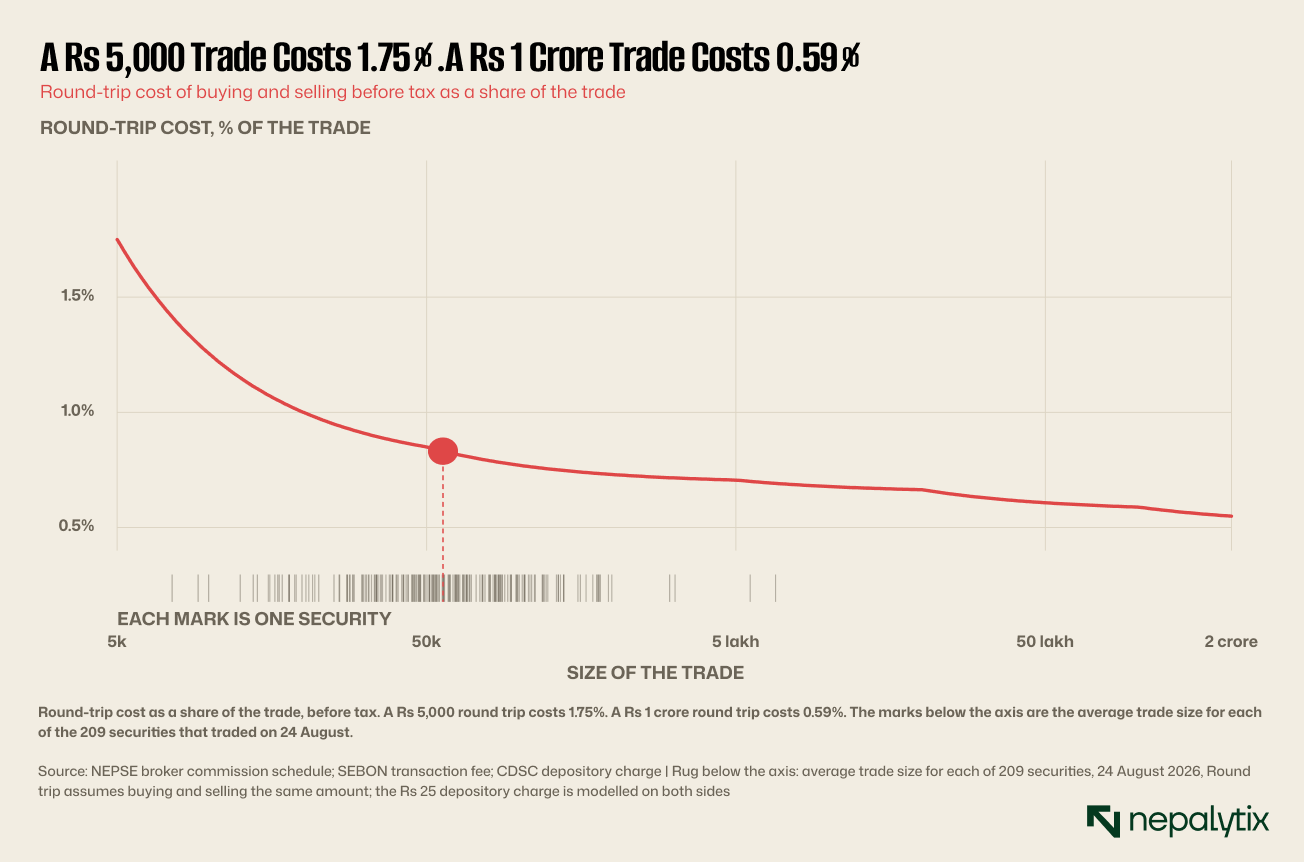
A Rs 5,000 round trip costs Rs 88 which is 1.75%. A Rs 1 lakh round trip costs Rs 770 or 0.77%. A Rs 1 crore round trip costs Rs 58,880 or 0.59%.
The curve falls steeply and then flattens. Below about Rs 50,000 the cost of trading is meaningfully higher and it climbs fast as the trade gets smaller.
The marks under the axis are where the market actually sits. On 24 August the median security had an average trade of Rs 56,518 which lands at 0.83% a round trip. Most Nepali trading happens on the steep part of that curve.
Notice how flat the right-hand side is. Between Rs 5 lakh and Rs 2 crore the round-trip cost moves from 0.71% to about 0.59%. A forty-fold increase in trade size saves you twelve basis points.
The whole action is on the left. Between Rs 5,000 and Rs 50,000 the cost halves from 1.75% to 0.85%. Between Rs 50,000 and Rs 5 lakh it falls only a further fourteen basis points.
If you want to reduce your trading costs meaningfully, the move from very small trades to merely small ones does almost all the work. Going from small to large does very little.
Why small trades cost so much
It is not the broker. Break the same cost into its three parts.
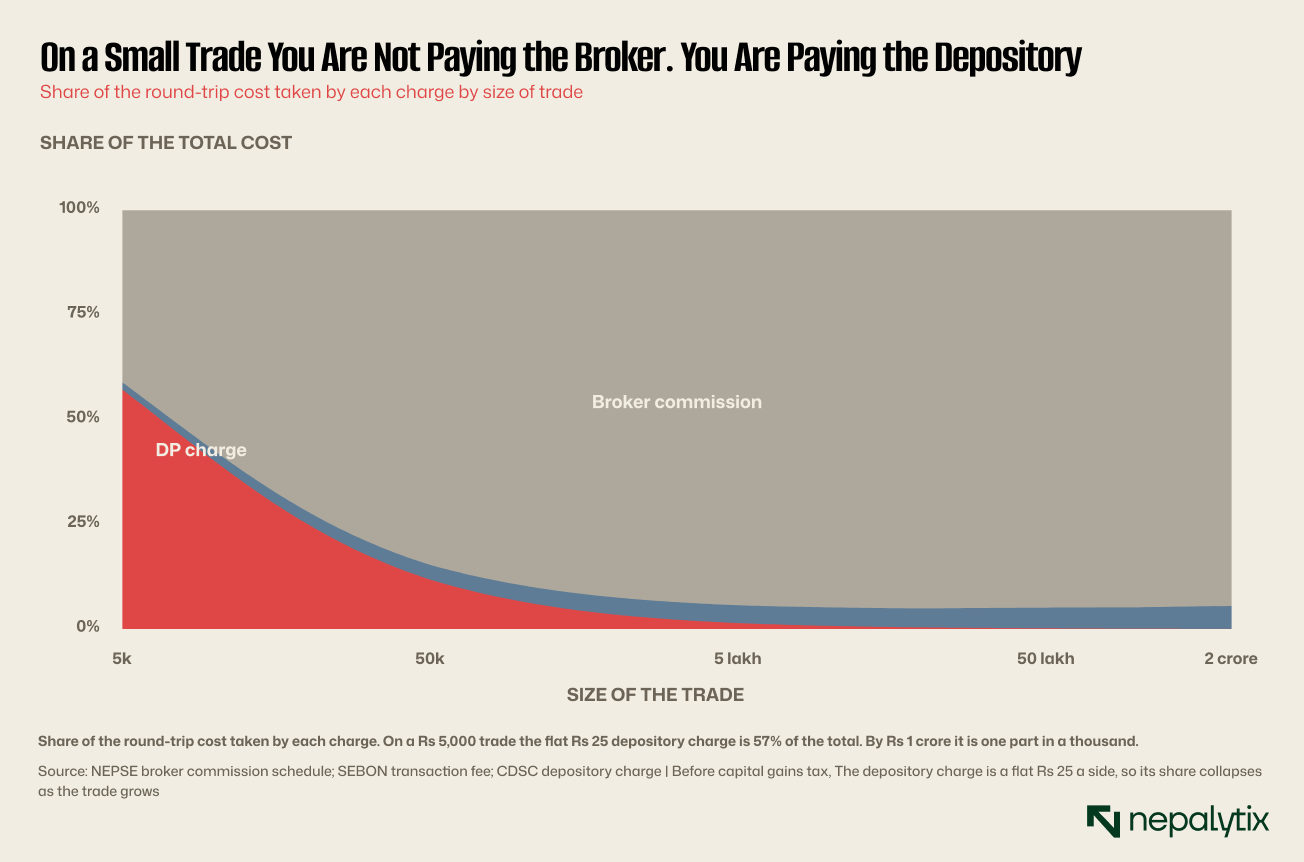
On a Rs 5,000 round trip you pay Rs 36 in commission, Rs 1.50 to SEBON and Rs 50 to the depository. The depository charge is more than half your total cost.
This is what a flat fee does. Rs 25 a side is nothing on a large trade and punishing on a small one. It is the single biggest reason small trades are expensive in Nepal and it has nothing to do with your broker's rate.
There is a practical consequence. The Rs 25 is charged per company, per transfer day. If you sell five different shares on the same day you pay it five times. If you sell the same share in three lots on one day you pay it once. Consolidating your trading into fewer companies and fewer days saves real money at small sizes.
There is a second consequence that catches people out on the buy side. The Rs 25 is charged per company, so buying five companies costs Rs 125 in depository charges regardless of how much you spend. An investor putting Rs 25,000 to work across five names pays Rs 125 on the buy alone against Rs 25 for the same money in one name.
Diversification is generally good advice. In a market with a flat per-company charge, it has a price at small portfolio sizes and the price is worth knowing before you spread Rs 25,000 across five stocks.
The settlement clock and why it matters to the cost
NEPSE runs on a T+2 cycle. Trade on Sunday and the shares reach your demat account on Tuesday. Sell on Sunday and the money reaches your bank on Tuesday.
Two practical consequences bear on cost.
You cannot sell what has not settled. Shares bought on Sunday cannot be sold until they land, which means a genuine two-day minimum holding period whether you wanted one or not. Anyone thinking about very short-term trading in Nepal is working with a floor of several days and every one of those round trips pays the full stack again.
The depository charge attaches to the transfer day rather than the trade day. That is what "per scrip per transfer day" means. Trades that settle together are charged together.
The break-even
Turn the cost around and ask how far a share has to move before you are level.
It is the same number. Buy Rs 5,000 of something and it has to rise 1.76% before you can sell without a loss. At Rs 1 lakh the figure is 0.77%. At Rs 1 crore, 0.59%.
Below break-even there is no tax because there is no gain. That is why the break-even and the cost are almost identical. Tax only starts once you are already ahead.
Worth sitting with: on a Rs 5,000 position, a 1.5% rise is still a loss.
How the tax is actually computed
Capital gains tax is not 7.5% of the difference between your buy price and your sell price. It is 7.5% of your net gain and net means after costs.
Your cost base is what you paid for the shares plus the commission, SEBON fee and depository charge on the buy. Your proceeds are what you sold for minus the same three charges on the sell. Tax applies to the difference between those two numbers.
That is a small mercy and worth knowing, because it means the buy-side charges are not taxed. On the Rs 50,000 example in the opening, the headline gain is Rs 5,000 but the taxable gain is Rs 4,558, and the tax is Rs 341.83 rather than Rs 375.
Two further points. Tax applies only where there is a gain, so a loss-making sale carries the transaction charges and nothing else. And the calculation is done trade by trade rather than across your portfolio, so a loss on one holding does not reduce the tax on a gain in another. In markets with loss offset it would. In Nepal it does not.
What holding period does
The capital gains rate changes at 365 days. Over a year an individual pays 7.5%. At or under a year, 10%.
The difference is 2.5 percentage points of your gain. On a Rs 10,000 gain that is Rs 250. On a Rs 1 lakh gain, Rs 2,500. On a Rs 10 lakh gain, Rs 25,000.
Two things follow. First, if you are close to the anniversary of your purchase and thinking of selling, the date is worth checking. Selling on day 360 and day 370 differ by a quarter of your tax bill. Second, the rates changed on Shrawan 1, 2083. They were 5% and 7.5% before. If you have a mental model of Nepali capital gains tax formed a year ago, it is out of date and so are most of the calculators online.
One caveat on the day count. The holding period runs from the date of acquisition which for IPO shares is the allotment date rather than the listing date. Those can be months apart.
What the charges take out of a gain
Costs are close to fixed. Gains are not. So the share of your profit that disappears depends enormously on how big the profit is.
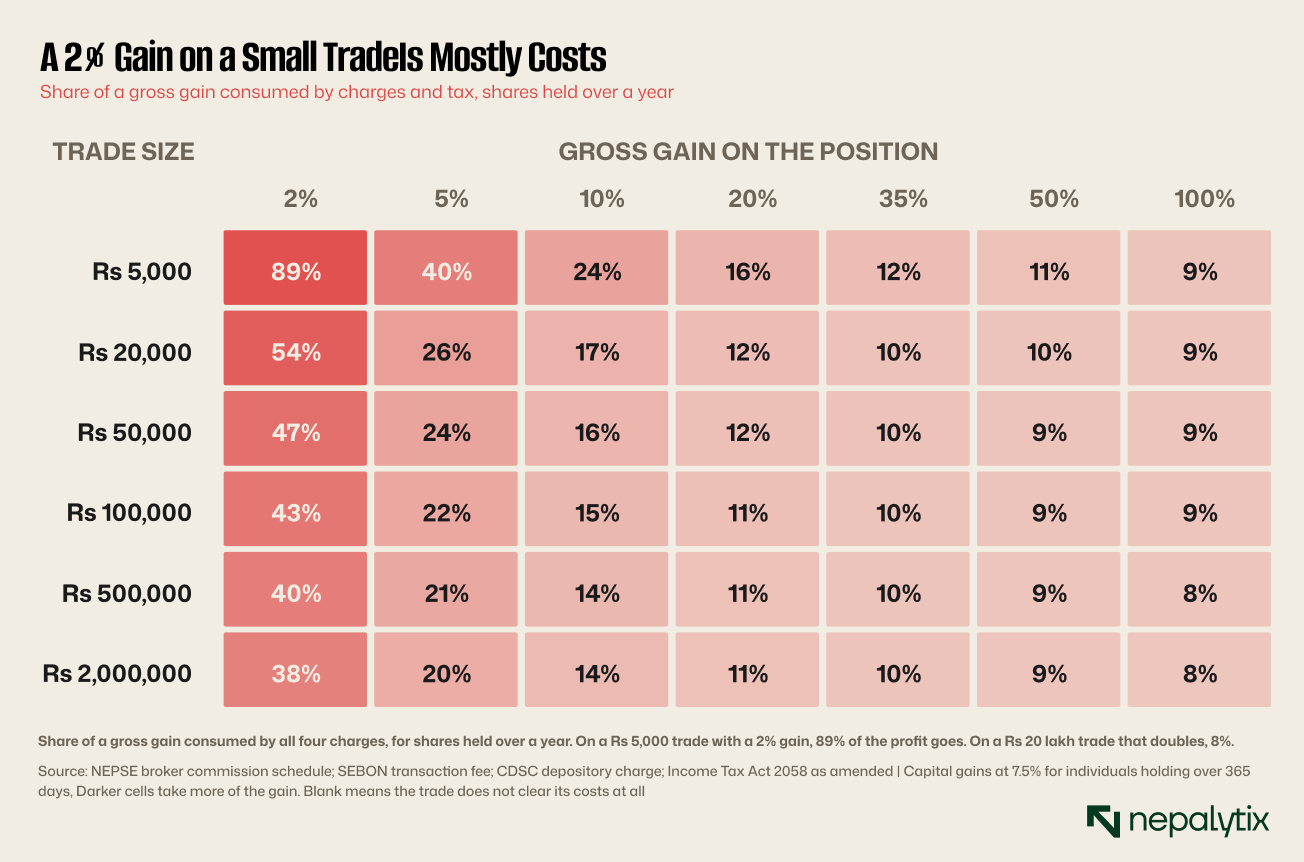
Read across a row and the number falls fast. Read down a column and it falls slowly. The size of your gain matters far more than the size of your trade.
A Rs 1 lakh position that rises 2% produces a Rs 2,000 gross gain of which Rs 869 goes in costs and tax. You keep Rs 1,131. The same position doubling produces Rs 1 lakh of gain, of which Rs 8,531 goes. You keep 91.5%.
This is the arithmetic behind a piece of advice you have heard without the numbers attached. Frequent small trades are expensive not because the rates are high but because each round trip pays the fixed part again and small gains have nothing to absorb it with.
Where the commission actually goes
You see one line called commission. It is split three ways. Roughly 79.4% goes to the broker, 20% to NEPSE and 0.6% to SEBON as a regulatory fee.
So on a Rs 1 lakh purchase, of the Rs 345 commission, about Rs 274 is your broker's Rs 69 is the exchange's and Rs 2 is the regulator's. Add the separate SEBON transaction fee of Rs 15 and the regulator gets about Rs 17 in total.
This matters for one reason. Commission rates in Nepal are set by SEBON, not negotiated with your broker. Shopping around on price will not help you. Brokers compete on platform, execution and service, and not on the number.
Bonds and fund units cost less
Everything so far describes equity. Two other things trade on NEPSE and both are cheaper.
Government bonds carry a SEBON fee of 0.005%, a third of the equity rate. Corporate debentures carry 0.010%. Closed-end mutual fund units and other securities also carry 0.010%. The commission schedules for bonds and fund units are separate from the equity one and lower.
The depository charge does not change. It is Rs 25 per scrip per transfer day whatever you are trading which means the small-trade problem in Figure 2 is if anything worse for fund units, since they trade at around Rs 10 a unit and a small position is a small rupee amount.
This connects to something last week's Signal covered. Nepali closed-end funds trade at a median discount of 4.3% to their net asset value. If you are buying a discount intending to collect it at maturity, the round-trip cost comes out of that discount first. On a Rs 20,000 position the charges are roughly 1.0% which is a quarter of a typical discount before you have waited a day.
What the fee schedules do not agree on
Three things in this piece are genuinely contested in the public sources, and you should know which.
Whether the DP charge applies on both sides. Some brokers state Rs 25 on the sell side only. Others state it on both. This piece models it on both, which is the more common statement and the more conservative assumption. If your broker charges it only on the sell, halve the depository component in Figure 2 and the small-trade cost drops by about a quarter.
The capital gains rate. For individuals it is 7.5% over 365 days and 10% at or under, since Shrawan 1, 2083. A large number of published calculators still show 5% and 7.5%, which were the rates before the Finance Bill 2083. If a calculator shows you 5%, it is out of date and it is understating your tax by half.
The commission split. Reported as either 79.4% or 79.6% to the broker. The difference is immaterial to you and the split is not something you can influence.
The slab which most calculators get wrong
The commission schedule has five bands. Up to Rs 50,000 the rate is 0.36%. From there to Rs 5 lakh it is 0.33%. To Rs 20 lakh, 0.31%. To Rs 1 crore, 0.27%. Above that, 0.24%.
Here is the part that trips people up. Each rate applies only to the portion of your trade inside that band. It works like income tax. A Rs 2 lakh trade is not charged 0.33% on Rs 2 lakh. It is charged 0.36% on the first Rs 50,000 and 0.33% on the remaining Rs 1.5 lakh.
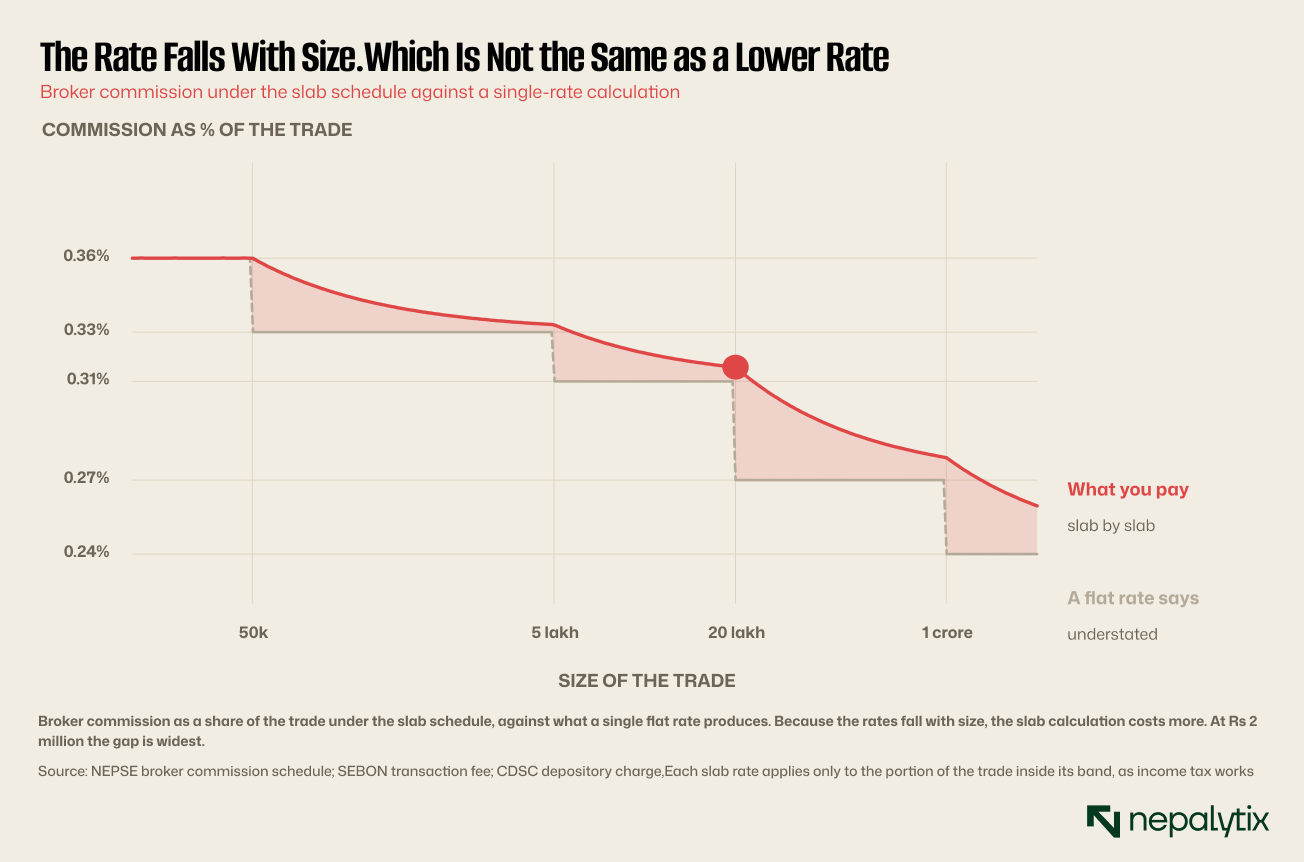
Because the rates fall as the trade grows, the slab calculation always costs more than applying the headline rate to the whole amount. Not less. The early money is charged at the higher rate.
Several online calculators apply a single rate to the full trade. On a Rs 2 million trade that understates the commission by 17%. If your broker's statement looks higher than the calculator told you, this is usually why and the broker is right.
There is a trap hidden in the slab structure that is worth naming. Because the rate is lowest on the last rupee and highest on the first, splitting one large trade into several small ones costs you more, not less. Two trades of Rs 1 lakh cost more in commission than one trade of Rs 2 lakh, and they also cost you the depository charge twice if they fall on different days.
The opposite belief is common presumably because people reason from the flat-rate version of the schedule where the rate depends on the trade size band. It does not work that way.
What to check on your own contract note
Your broker issues a contract note for every trade. Most people never open it. Four things on it are worth a look.
The commission figure against the slab. Compute it yourself for one trade using the bands. If your number and the broker's differ, one of you has applied a flat rate.
The number of depository charges. One per company per transfer day. If you sold three companies on one day you should see three, not one and not six.
The capital gains rate applied. 7.5% or 10% depending on your holding period. If you see 5%, the broker is using the old rate and the difference will find you later.
The holding period the broker used. It runs from acquisition which for IPO shares is allotment rather than listing. Brokers occasionally use the wrong date and it is worth 2.5 percentage points of your gain.
Two habits the schedule rewards
Everything above collapses into two behaviours, and both are worth stating as habits rather than as rules.
Trade in fewer, larger blocks. The fixed depository charge and the slab structure both reward size, and the settlement cycle means frequent trading is harder than it looks anyway. An investor putting Rs 1 lakh to work in one name pays Rs 385 on the buy. The same investor spreading it across four names in four sessions pays Rs 445 and pays it again on the way out.
Let the clock run past 365 days where you can. The rate drop from 10% to 7.5% is the largest single saving available to a Nepali investor and it requires no skill, no timing and no research. It requires patience and a calendar.
Neither habit is a strategy. Both are the removal of a leak.
The eight things worth knowing
One. Four charges: commission, SEBON fee, DP charge, capital gains tax. The first three apply on both the buy and the sell.
Two. A round trip costs between about 0.59% and 1.75% before tax depending almost entirely on size.
Three. On small trades the flat Rs 25 depository charge, not the broker is the largest single cost.
Four. The break-even move equals the round-trip cost, because tax only applies above it.
Five. The DP charge is per company per day. Fewer companies and fewer days means fewer Rs 25s.
Six. Commission is slab-wise. Calculators that apply one rate to the whole trade understate it, by up to 17%.
Seven. Holding past 365 days cuts the capital gains rate from 10% to 7.5%. On a Rs 1 lakh gain that is Rs 2,500.
Eight. The rates are set by the regulator, so your broker is not where the saving is. The saving is in trading less often and in larger blocks.
A worked contract note
Put the whole thing together on one trade line by line so you can check it against your own.
You buy 200 shares at Rs 500. Consideration Rs 1,00,000. Commission is 0.36% on the first Rs 50,000 and 0.33% on the next Rs 50,000, which is Rs 180 plus Rs 165, so Rs 345. The SEBON fee is 0.015%, or Rs 15. The depository charge is Rs 25. Your total outlay is Rs 1,00,385, and your effective cost per share is Rs 501.93.
Fourteen months later you sell at Rs 560. Consideration Rs 1,12,000. Commission is Rs 180 plus 0.33% of Rs 62,000, which is Rs 204.60, so Rs 384.60. SEBON fee Rs 16.80. Depository charge Rs 25. Gross proceeds after charges are Rs 1,11,573.60.
Your net gain is Rs 1,11,573.60 minus Rs 1,00,385, which is Rs 11,188.60. Tax at 7.5% is Rs 839.15. You receive Rs 1,10,734.45.
The headline said you made Rs 12,000. You made Rs 10,349.45. The charges took Rs 811.40 and the tax took Rs 839.15, which together is 13.8% of the headline gain on a position that rose 12%.
Now change one thing. Sell at eleven months instead of fourteen. The tax rate becomes 10%, the tax becomes Rs 1,118.86, and you receive Rs 279.71 less for the same trade.
What none of this covers
Three costs sit outside the four charges and are worth naming because they are real.
The spread. The gap between the best bid and the best offer. In a liquid security it is a paisa or two. In a Nepali security that trades a handful of times a session it can be several per cent and it is a cost you pay on entry and exit without it appearing on any statement. For thinly traded names the spread is frequently larger than every charge in this piece combined.
The opportunity cost of settlement. Money is blocked from the moment you place an order and shares are locked until they settle. Two days each way, on every trade.
Being wrong. Which dwarfs everything above and is the reason to spend more time on what you buy than on what it costs to buy it.
That last point deserves the emphasis. A round trip costing 0.77% is a rounding error against a position that falls 30%. The charges matter most for the investor trading often on small moves, and that investor's larger problem is usually the trading, not the charges.
The point
None of this is a reason not to invest. A 0.77% round trip on a Rs 1 lakh position is not expensive by international standards and Nepal's costs are lower than many frontier markets.
It is a reason to know what you are paying and when it bites. It bites hardest on small trades and on small gains which are exactly the trades a new investor makes most. Someone buying Rs 5,000 of a share and selling it a fortnight later on a 2% move keeps about Rs 11 of a Rs 100 gain and wonders where the rest went.
Now you know where.
Disclaimer
This report has been prepared by Nepalytix for informational and educational purposes only and does not constitute investment advice, an offer, or a solicitation to buy or sell any securities.
The information contained in this report is based on sources believed to be reliable; however, Nepalytix does not guarantee its accuracy, completeness, or timeliness. Opinions, estimates, and projections expressed herein are those of the authors as of the date of publication and are subject to change without notice.
Investing in securities involves risks, including the possible loss of principal. Past performance is not indicative of future results. Readers are advised to conduct their own independent research and consult with a qualified financial advisor before making any investment decisions.
Nepalytix and its contributors may hold positions in the securities discussed in this report at the time of publication or thereafter.
Neither Nepalytix nor any of its affiliates accept any liability for any loss arising from the use of this report or its contents.