The Tariff Gap Behind Nepal’s Export Boom
Nepal’s exports doubled to Rs 315 billion in two years but much of the surge appears tied to refined edible oil and a tariff advantage in India. Now that advantage is narrowing.
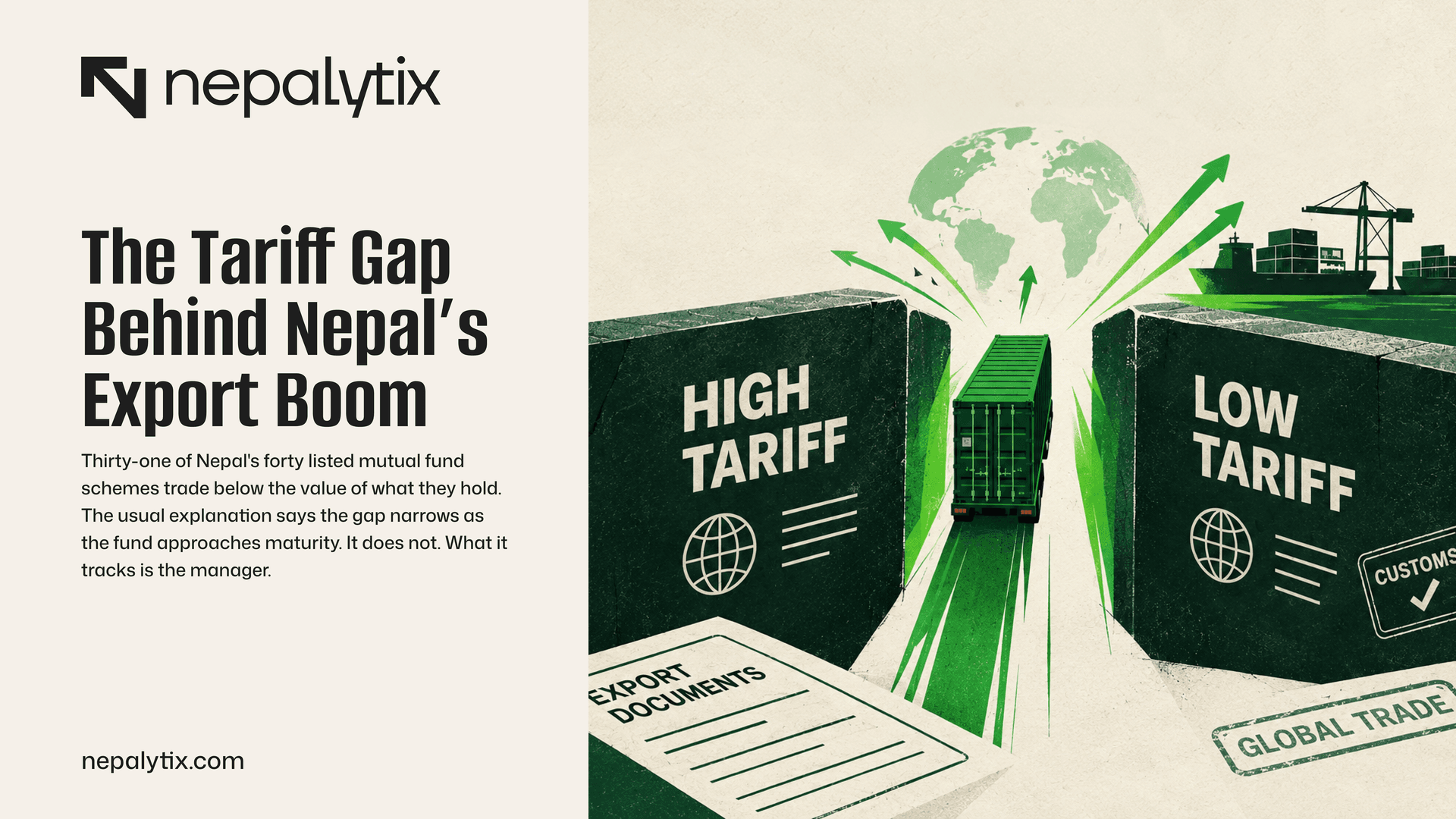
India reduced edible oil import duties on 24 September. Nepal's exports had doubled in two years on the tariff gap those duties created lifting export cover to a level unseen since 2011/12.
THE SIGNAL
India's Finance Ministry issued Notification No. 31/2026-Customs on 23 September. From 24 September the basic customs duty on crude sunflower oil is nil down from 10%. Crude palm and crude soybean oil fall from 10% to 5%. Refined palm and refined soybean oil fall from 32.5% to 27.5%.
Nepal is not mentioned in the notification. It is the country most exposed to it.
Nepal's merchandise exports have doubled in two years, from Rs 152 billion in 2023/24 to Rs 315 billion in 2025/26. Export cover has reached 15.0% of imports, a level last seen in 2011/12. Almost all of that came from refining imported crude edible oil and selling it into India duty-free.
The duty India just cut is the thing that made the trade profitable.
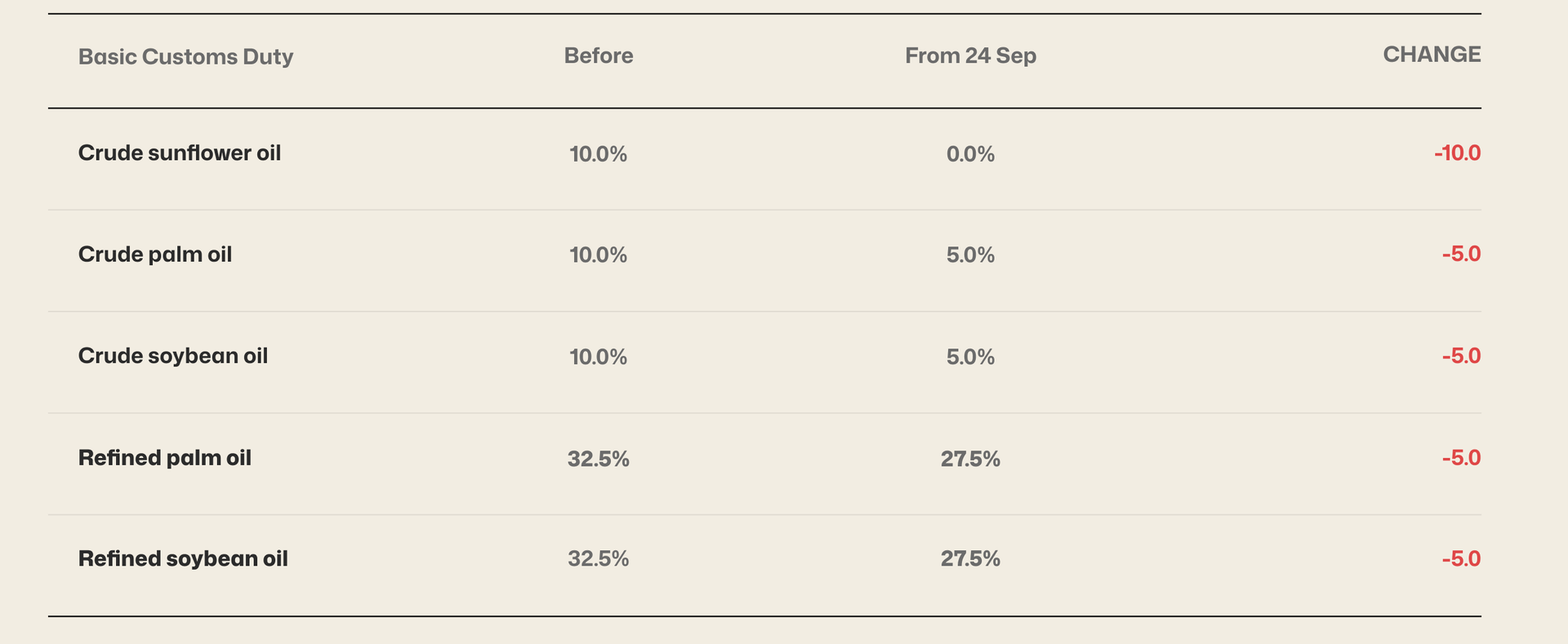
The crude-to-refined differential is retained at 19.25% which is the margin India preserves for its own refiners.
India imports more than 58% of the edible oil it consumes and retail cooking oil prices have risen 14 to 20% over the year. Navratri, Dussehra and Diwali are weeks away. The stated purpose is to bring landed costs down before the festival season.
Read the table in one direction and it is a consumer measure. Read it in the other and it is industrial policy. Crude duties fall further than refined duties in percentage-point terms on sunflower and the gap between crude and refined is held at 19.25% which means an Indian refiner importing crude and processing it at home keeps its protection intact.
That structure is deliberate and it has been consistent through several rounds. India lowers the cost of the input its refiners buy and leaves a wall around the output they sell. What changes between rounds is only the height of both.
Why Nepal is in this trade
Nepal grows very little oilseed and refines a great deal of oil. The reason is a tariff gap.
Nepali refined edible oil enters India at zero duty under the India-Nepal Trade Treaty and the South Asia Free Trade Area. A refiner outside SAARC selling soybean oil into India pays 45%.
So the trade is: buy crude palm or soybean oil from Indonesia, Malaysia, Thailand or Argentina, land it in Nepal, refine it and sell it across the southern border at a price an Indonesian refiner cannot match because the Indonesian refiner pays the duty and the Nepali one does not.
The margin is not manufacturing. It is the tariff differential.
India has been aware of the route for some time. Indian oil producers have argued publicly that the trade exploits loopholes in SAFTA and the bilateral treaty and India has maintained quotas since 2002 on four Nepali export categories, vegetable ghee among them, for closely related reasons.
Vegetable ghee is the precedent worth holding in mind. It was a Nepali export built on the same kind of preferential access, it grew quickly and it was capped. Refined edible oil is a larger version of the same trade.
Nepal's side of the arrangement is not illegitimate. The zero-duty access is written into two agreements India signed, the goods are physically refined in Nepal and the processing meets whatever origin requirements apply. Nothing about it is a violation.
What it is, is fragile. The question Indian producers raise is not whether Nepal is breaking a rule but whether the rule should say what it says and that is a question one party can answer unilaterally.
The scale of what this built
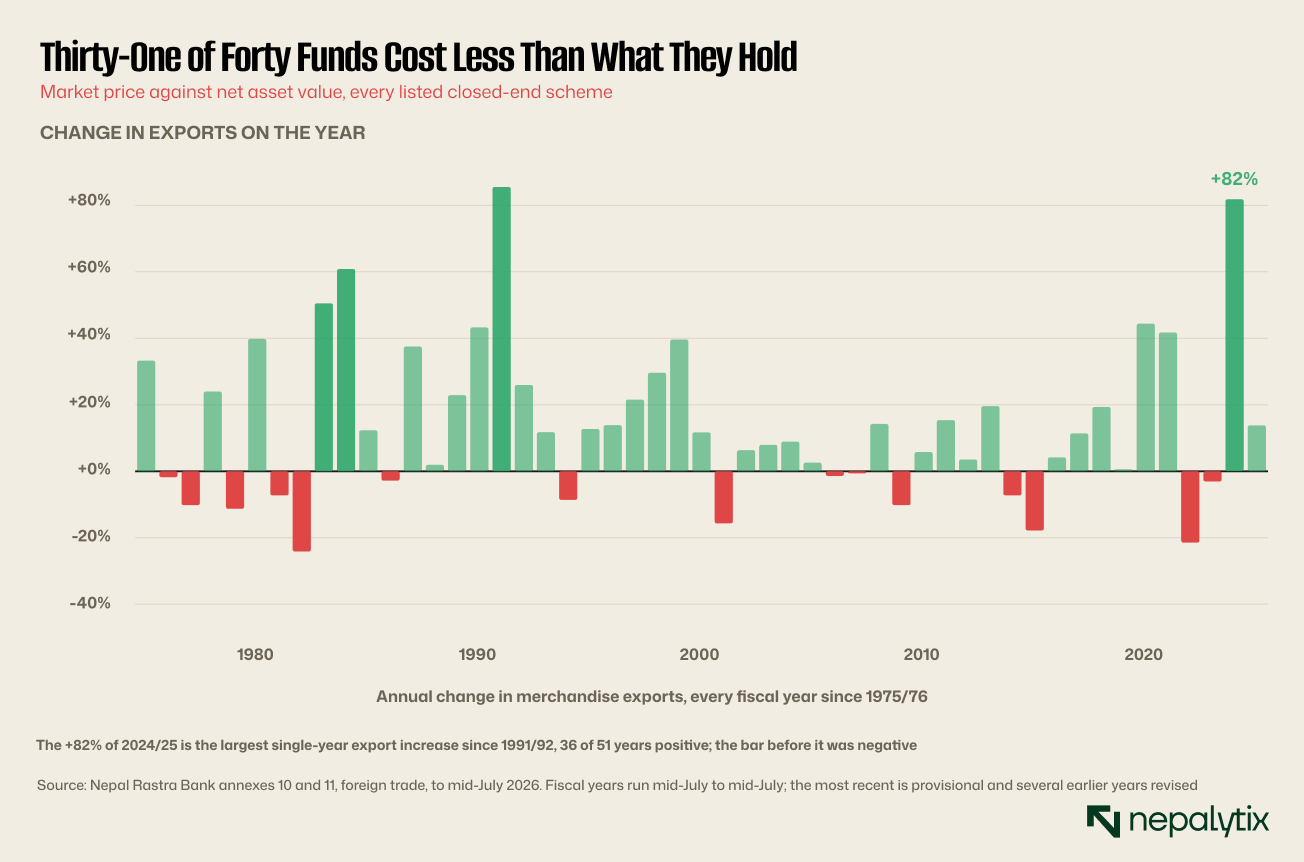
Exports rose +82% in 2024/25. That is the largest single-year increase in Nepali exports since 1991/92 and the only other year above 80% in half a century.
The year before it was negative. The two years before that were flat. Nothing in Nepal's productive capacity changed between them.
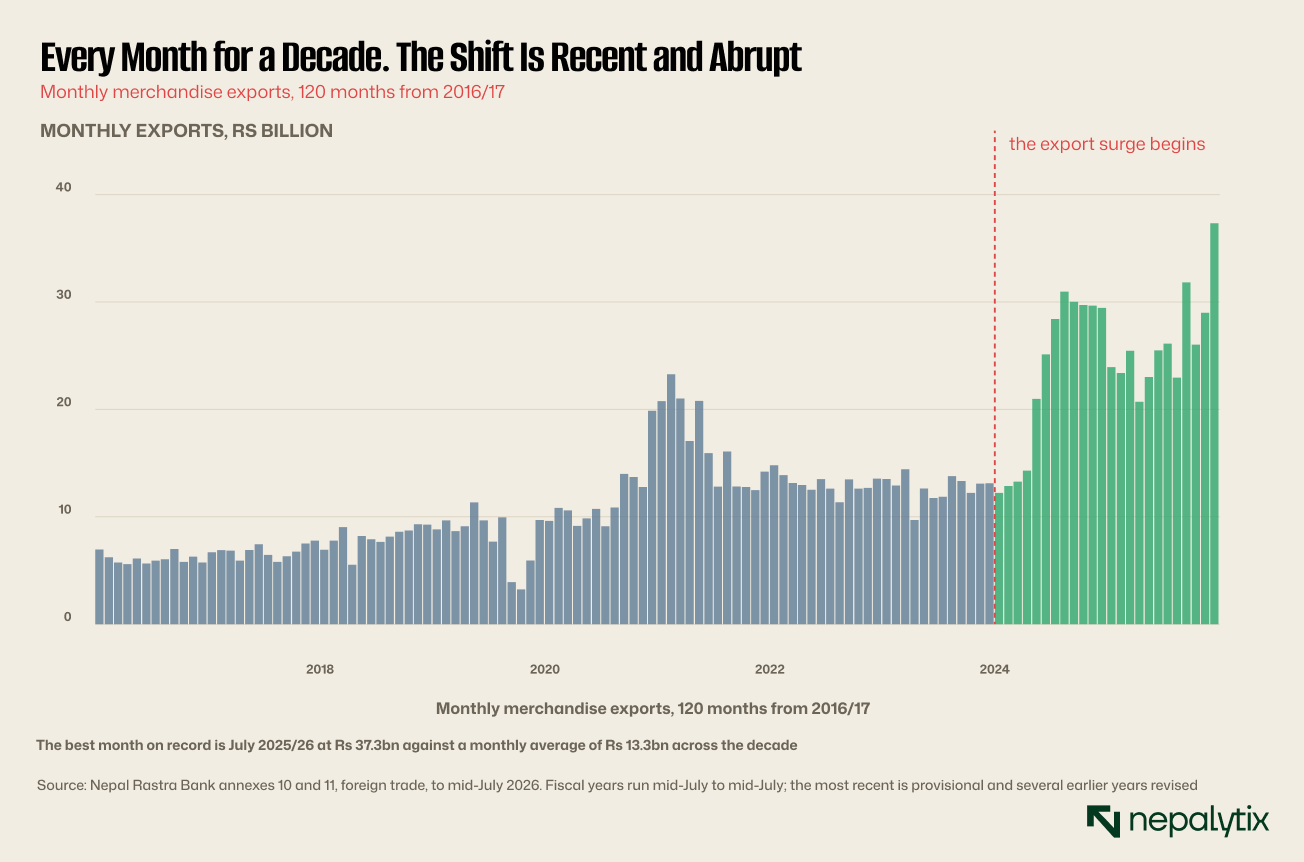
The monthly series puts the break in view. Exports ran between Rs 6 billion and Rs 15 billion a month for eight years. From mid-2024 they step up and stay up, peaking at Rs 37.3 billion.
Put the two years together and exports have risen +107% from Rs 152 billion to Rs 315 billion. In a country whose export performance has been the subject of policy papers for thirty years that happened without a policy.
It is also worth noting what the figures do not show. Exports fell 21.4% in 2022/23 and a further 3.0% in 2023/24. The surge did not build on momentum; it started from a declining base.
What it did to the trade account
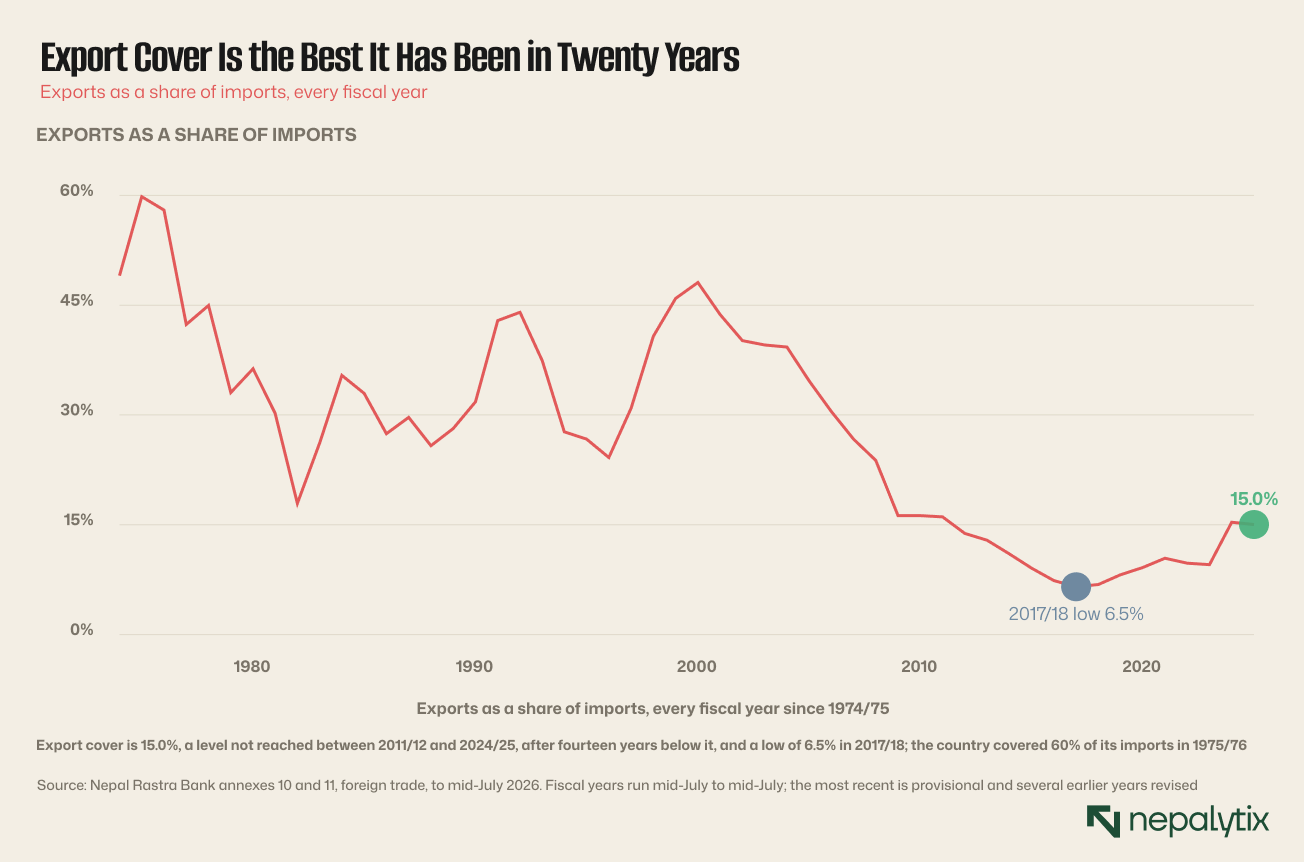
Export cover which is exports divided by imports is the cleanest single measure of how much of its import bill a country pays for with what it sells.
Nepal covered 59.8% of its imports in 1975/76. That fell for four decades to a low of 6.5% in 2017/18. It has now recovered to 15.0%, a level the country did not reach once between 2011/12 and 2024/25.
It is worth being clear about what that recovery is. It is not Nepal selling more of what Nepal makes. It is Nepal moving oil through a tariff gap.
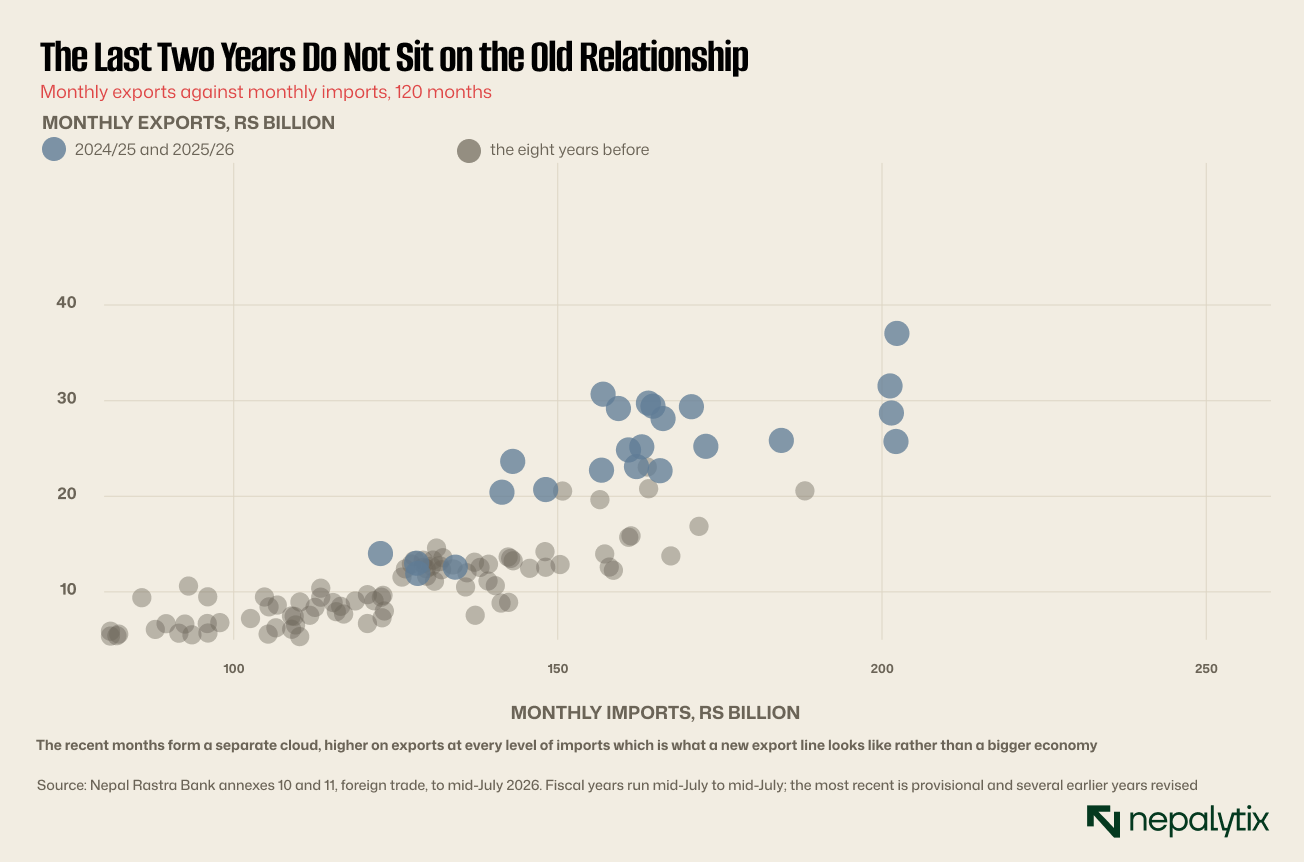
Plot each month's exports against the same month's imports and the last two years form a separate cloud. At any given level of imports, recent months export more.
That is the signature of a new export line rather than a larger economy. If Nepal were simply growing, the points would extend along the old relationship. They sit above it.
One caution on the cover ratio. It improves either when exports rise or when imports fall and here imports rose too from Rs 1,593 billion to Rs 2,096 billion across the same three years. So the ratio improved despite a rising denominator which makes the export side of it stronger than the headline suggests.
The other caution runs the opposite way. If the exports in question are refined crude that was imported a month earlier then part of the numerator and part of the denominator are the same oil counted twice and the ratio flatters a trade that is mostly pass-through.
One further feature of the monthly series is worth flagging. The step up is not gradual. There is no ramp across 2023 and into 2024; the level changes and holds. That is the signature of a policy or price threshold being crossed rather than of capacity being built which takes quarters.
Whatever triggered it, refiners were able to respond at scale almost immediately which suggests the capacity already existed and was being underused.
What the cut takes away
Two things happen at once and both cut the same way.
The preference narrows. A non-SAARC refiner selling refined palm or soybean oil into India now pays 27.5% rather than 32.5%. Nepal still pays nothing, so Nepal still has an advantage. It is five percentage points smaller.
Indian refiners get cheaper input. The duty on crude palm and soybean oil halves from 10% to 5%. An Indian refiner buying crude and refining it domestically now does so more cheaply, which is the competitor Nepali refined oil actually displaces.
The second matters more than the first. Nepal's trade works because Indian refiners find it expensive to import crude. Make crude cheaper for them and the Nepali route loses part of its purpose.
There is a third effect that operates on Nepal rather than on the margin and it is the one Nepali policy should be most concerned about.
A trade that exists because of a tariff differential is a trade another government can end by changing its tariffs. Nepal built no capability it would retain if the preference disappeared: the crude is imported, the equipment is imported, the buyer is a single neighbouring market and the advantage is a line in an Indian customs notification.
That is a different kind of export than a garment industry or a cement plant, both of which survive a tariff change with their assets intact.
There is a precedent
India did this before on 30 May 2025 cutting crude duties from 20% to 10% and leaving refined duties alone. The effective rate on crude including cess and surcharge, fell from 27.5% to 16.5%.
Reporting at the time described the move as a blow to Nepal's edible oil re-exports and noted that the revised tariffs had tilted the competitive edge back toward Indian refiners.
The Nepali export figures show what followed. Exports rose +82% in the fiscal year containing that cut then +14% in the year after.
So the previous intervention did not stop the trade. It is a fair question whether this one will either and the honest answer is that the 2025 cut left refined duties untouched while this one does not.
A further difference is worth recording. The 2025 cut applied to crude only so it compressed Indian refiners input costs without touching the wall protecting their output. Nepal's zero-duty access to the refined market was untouched.
This one moves both. Refined duties fall five points which directly narrows Nepal's preference, and crude duties halve again which further cheapens the Indian alternative. On the mechanism, this is the more serious of the two interventions even though the headline percentage-point changes are smaller.
What is not in the export figure
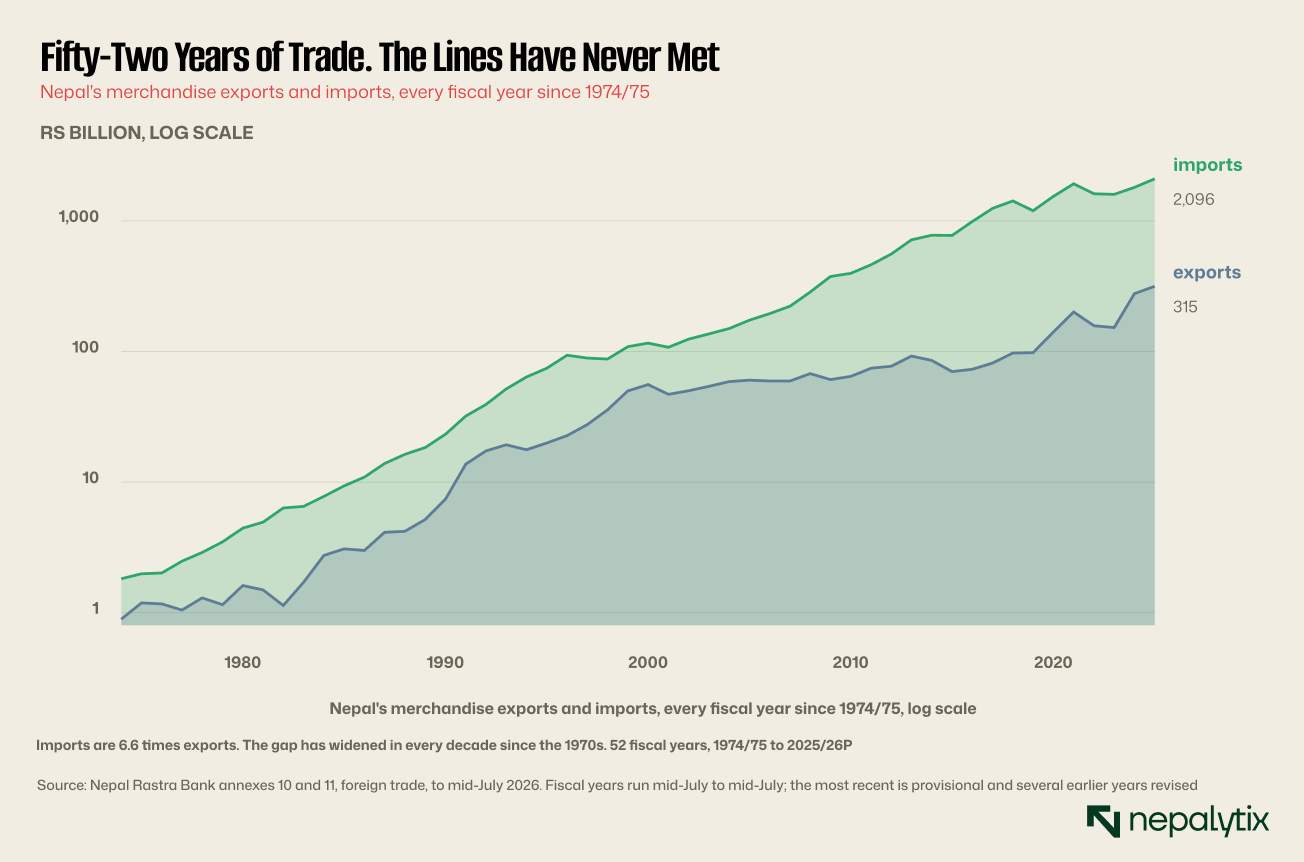
The export number looks better than the trade account does. Imports are still 6.6 times exports and the merchandise deficit for 2025/26 is Rs 1,781 billion, the widest on record.
That is because the crude has to be imported first. In the palm oil year reported in detail, Nepal imported 32,318 tonnes of crude palm oil worth Rs 4.60 billion and exported 6,685 tonnes of refined palm oil worth Rs 1.16 billion.
Both sides of the trade appear in the accounts. The export figure counts the refined oil going out. The import figure counts the crude coming in and the crude is the larger number.
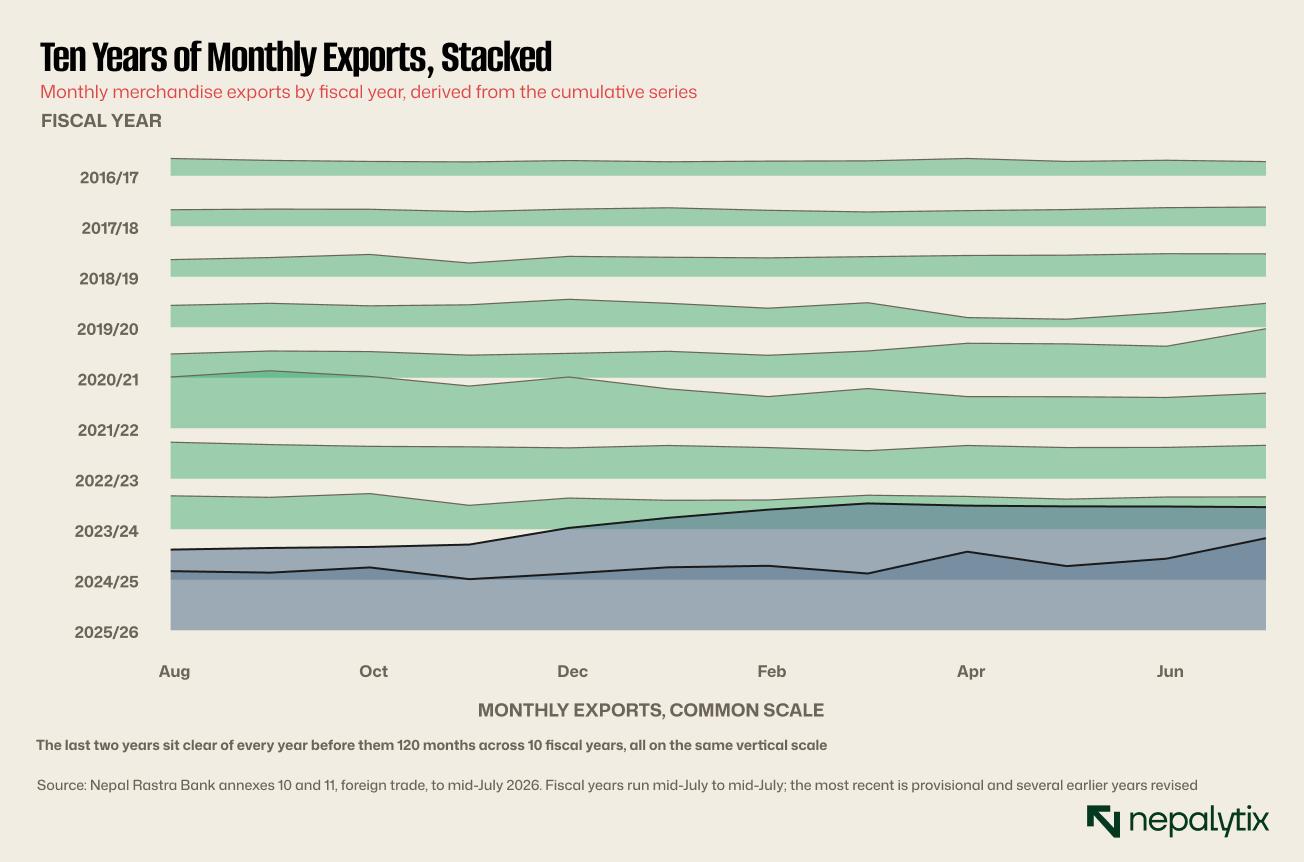
Stack the last ten fiscal years and the two most recent sit clear of every year before them at almost every month. Whatever is driving it did not exist in 2022.
The deficit figure is worth stating plainly because the export story can obscure it. At Rs 1,781 billion for 2025/26, the merchandise trade deficit is the largest Nepal has recorded. Exports at a twenty-year high and the deficit at an all-time high are both true at once.
The reconciliation is remittances which this publication examined on 24 September and which reached Rs 2,363 billion in the year to mid-July. The trade gap is financed by labour abroad not by trade.
The counter-case deserves stating because the dispatch so far has been one-directional.
Five percentage points is not a large change against a 27.5% wall. A Nepali refiner still pays nothing where a competitor pays 27.5%, and that remains a substantial advantage. If the trade's economics have any margin at all, they survive a five-point narrowing.
The 2025 episode supports that reading directly. Exports rose +82% in the year containing a ten-point cut to crude duties, which is a larger change than this one on the input side.
The case for concern rests on the refined duty moving for the first time, and on what it signals about direction rather than on the size of this single step.
What cannot be established here
The commodity breakdown of Nepal's exports could not be obtained at monthly frequency. The attribution of the export surge to edible oil rests on reporting and on the timing, not on a commodity series this piece assembled. A reader should treat the link as well-evidenced rather than demonstrated.
The tonnage and value figures for palm oil are from a single reported year and are not a current-year figure.
Which listed Nepali companies are exposed and how much of their revenue depends on this trade is not established. Nepal's refiners are largely unlisted and no listed company examined in this publication has disclosed material exposure to the edible oil re-export trade.
And the effect of the cut will not appear in Nepali data for months. The first fiscal month affected ends mid-October and Nepal Rastra Bank publishes with a lag.
Two things could not be checked and should be. Whether any Nepali refining capacity was built specifically for this trade and on what financing determines who carries the loss if it ends. And whether Nepali banks have lent against that capacity determines whether the exposure reaches the listed sector at all.
The commercial banking research published here on 28 September found the sector holding Rs 8,276.93 billion of deposits against Rs 5,857.06 billion of credit with lending growing 6.5% against deposits at 13.9%. A capital-intensive export industry expanding fast is exactly the kind of borrower that surplus would have found.
The week ahead
Nepal Rastra Bank absorbed a further Rs 20 billion on 24 September through a 32-day instrument settling on 26 October. The index closed at 2,629.81 on turnover of Rs 5.447 billion.
Watch three things. Whether Nepali refiners publicly seek relief which is how this became a policy question the last time. Whether India's quota list which has covered vegetable ghee, acrylic yarn, copper products and zinc oxide since 2002 is extended to refined edible oil which would end the trade rather than narrow it. And the mid-October trade figures which will carry the first week of the new rates.
What would settle it
One dataset would turn the central claim of this dispatch from inference into fact: Nepal's exports broken down by commodity, monthly.
The Department of Customs compiles it. Nepal Rastra Bank publishes aggregates. Nobody publishes a monthly commodity series in a form that can be read alongside the trade account, which is why a surge that doubled the country's exports can be attributed to one product category only by inference and timing.
That is a considerable gap for a country whose export performance is a standing policy concern. The figure that would show whether Nepal's export recovery is broad or rests on a single tariff-dependent product exists and it is not published in usable form.
A reader holding Nepali equities should note what this dispatch does not find. No listed company examined here has disclosed material exposure to the edible oil trade and the refiners appear to be privately held. The exposure is to the national accounts rather than to any security on the exchange.
That is a distinction worth keeping. A shock that removes a tenth of Nepal's export earnings affects the currency, the trade account and eventually the policy response and none of those shows up as a company whose shares can be sold.
11The position
Nepal's exports doubled in two years on a preference written into Indian customs law rather than on anything Nepal built. Export cover reached a level not seen since 2011/12. The merchandise deficit reached a record in the same period because the crude that becomes the export is itself an import.
On 24 September India narrowed the preference by five points on refined oil and halved the input duty for the domestic refiners Nepal competes against. India did this once before in May 2025 and the trade grew through it but that intervention left refined duties alone and this one does not.
What happens next will appear in Nepali trade data from mid-October and it will appear as a change in an aggregate export figure that nobody publishes a commodity breakdown for.
Disclaimer
This report has been prepared by Nepalytix for informational and educational purposes only and does not constitute investment advice, an offer, or a solicitation to buy or sell any securities.
The information contained in this report is based on sources believed to be reliable; however, Nepalytix does not guarantee its accuracy, completeness, or timeliness. Opinions, estimates, and projections expressed herein are those of the authors as of the date of publication and are subject to change without notice.
Investing in securities involves risks, including the possible loss of principal. Past performance is not indicative of future results. Readers are advised to conduct their own independent research and consult with a qualified financial advisor before making any investment decisions.
Nepalytix and its contributors may hold positions in the securities discussed in this report at the time of publication or thereafter.
Neither Nepalytix nor any of its affiliates accept any liability for any loss arising from the use of this report or its contents.