What NRB's Monetary Policy Means for NEPSE Investors in FY2083/84
NRB's FY2083/84 monetary policy offers no fresh market stimulus, but its new quality-based margin lending rules could reshape NEPSE by favoring blue-chip stocks over speculative small-caps.
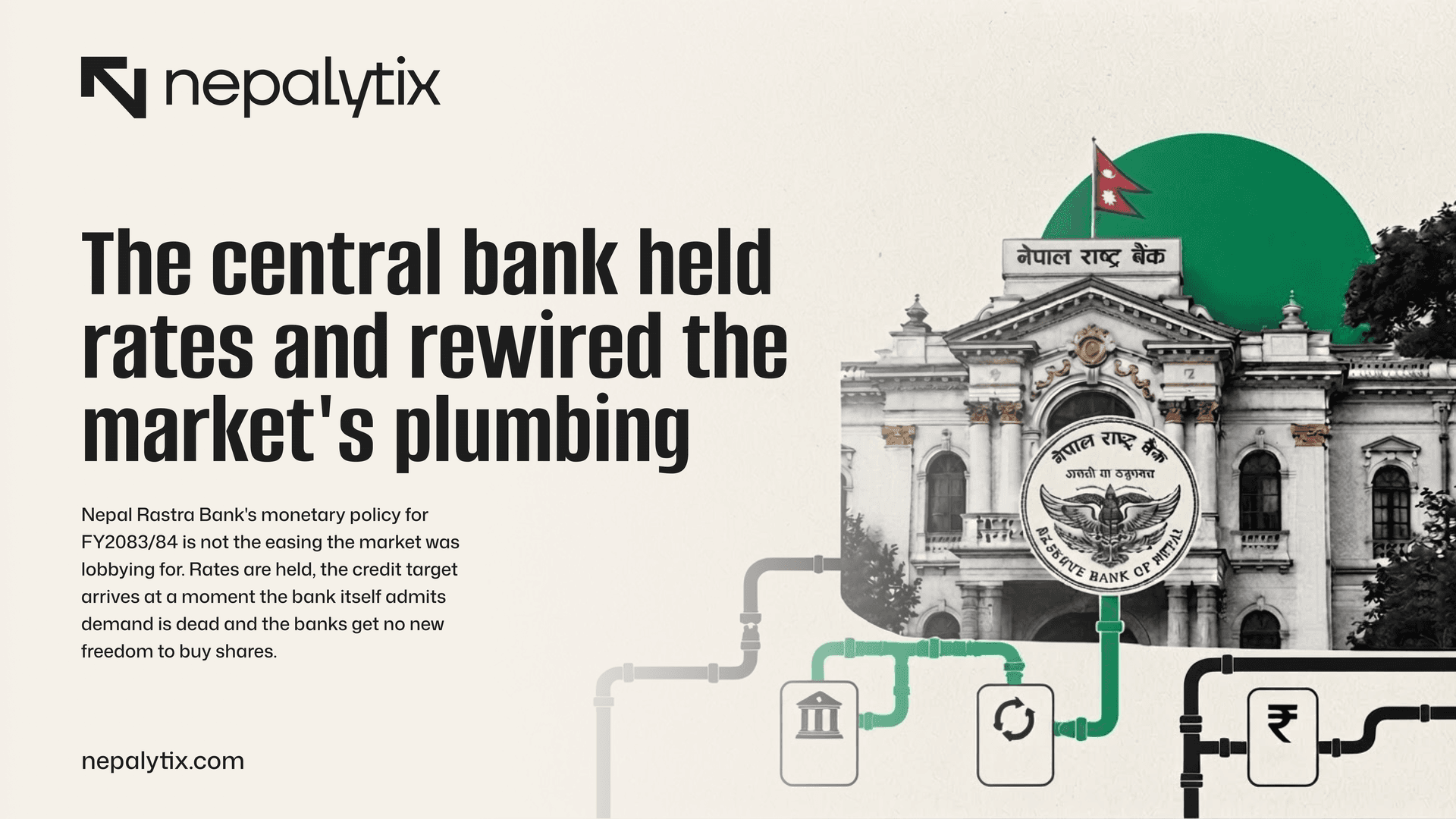
Nepal Rastra Bank's monetary policy for FY2083/84 is not the easing the market was lobbying for. Rates are held, the credit target arrives at a moment the bank itself admits demand is dead and the banks get no new freedom to buy shares. But one structural change tiering margin loans by the quality of the company you pledge quietly redraws who in this market gets to borrow.
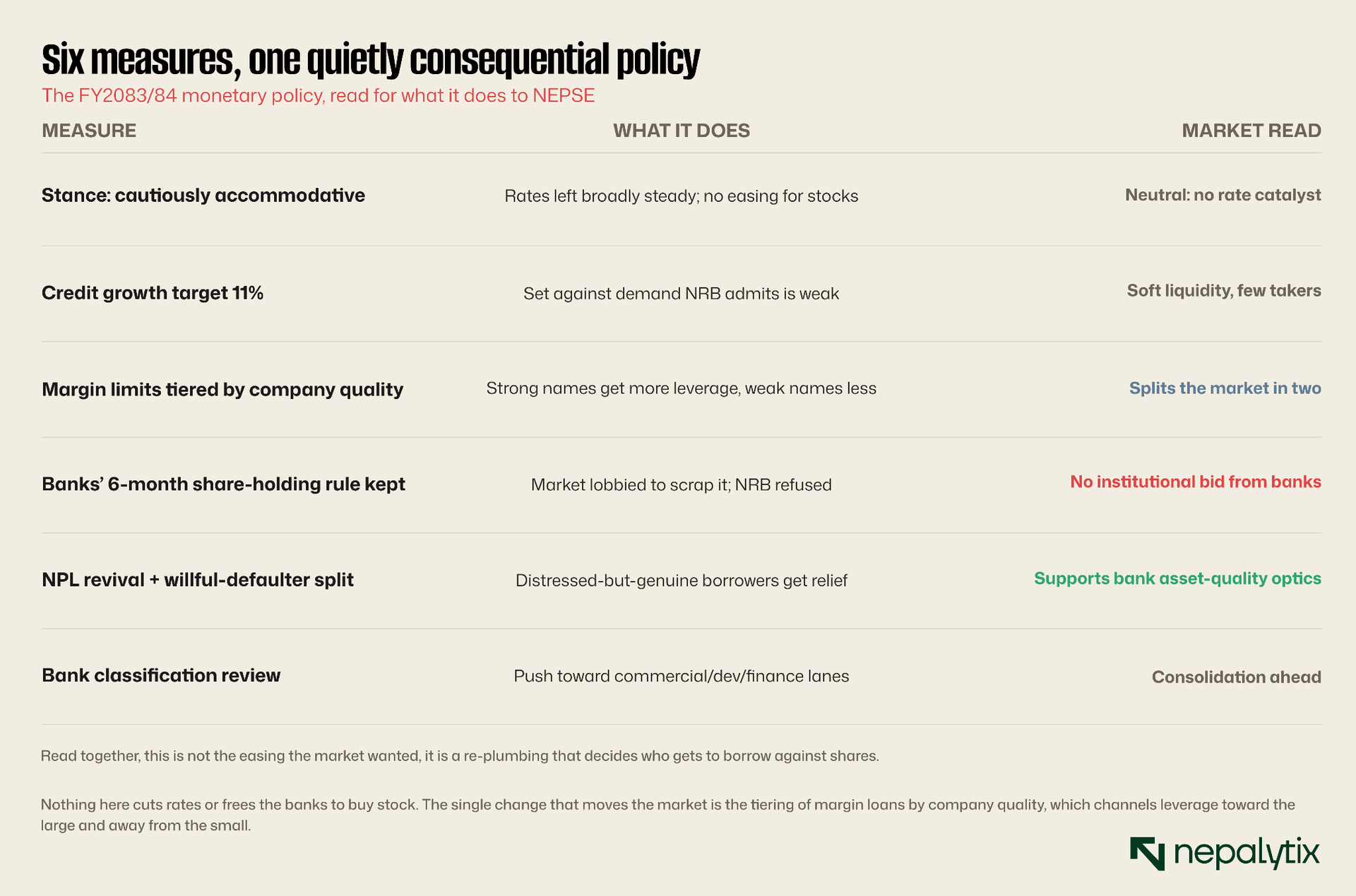
No rate cut, no credit boom, no institutional bid the broad market gets no catalyst it didn't already have. The one measure that moves prices is the tiering of share-pledge loans by company quality which pulls leverage toward blue-chips and away from the small-caps and mid-size investors who have actually been driving margin growth. Net: neutral-to-soft for the index, structurally bifurcating for stocks. Position up the quality curve; be wary of anything held up by borrowed money.
Read the document itself and the first thing you notice is its length: four pages. Governor Poudel has hived the detailed economics off into a separate Macroeconomic Report and Monetary Policy Implementation Review leaving the policy proper stripped to its decisions. The brevity is the message. This is a central bank signalling stability, no shocks, no frequent rule changes, a framework banks can plan around rather than one reaching for the levers. For a market that spent the run-up hoping for a jolt, the calm is the news .
The stance: the easing is already behind us
Everything about the rate settings says continuity. The corridor is left untouched; the standing liquidity facility at the top, the policy repo in the middle, the deposit rate at the floor and the cash reserve and statutory liquidity ratios are unchanged. That matters because the real easing happened over the past year, not this week. The bank rate came down from 6.5% to 5.75% and the policy rate from 5.0% to 4.25% across the FY2082/83 policy and its first-quarter review. Anyone waiting for this policy to cut again is waiting for a move that has already been made and then paused.
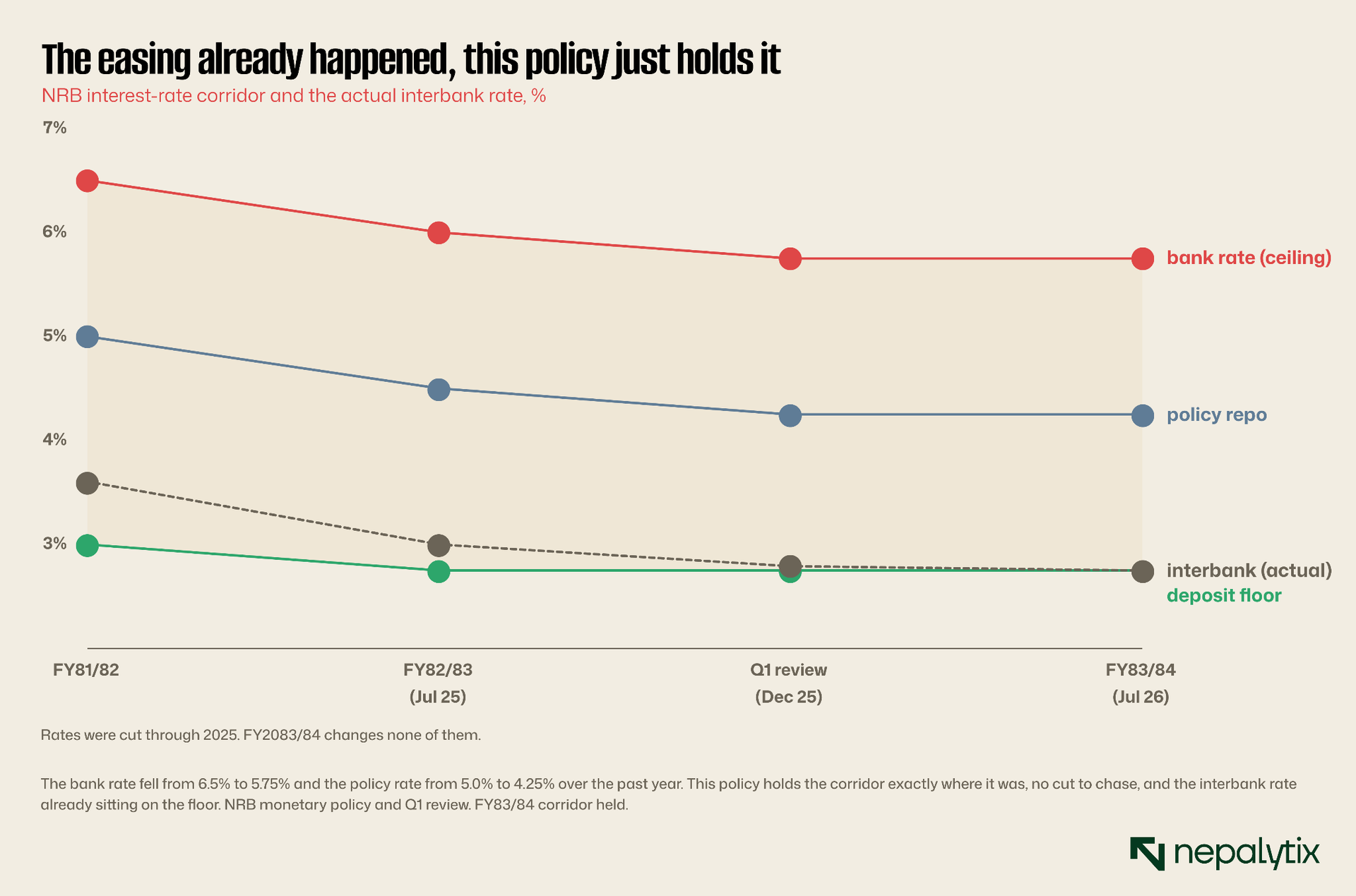
The stance is best described as cautiously accommodative. Inflation is targeted below 5.5%, private-sector credit is meant to grow around 11% and the whole edifice is meant to support the government's 7% growth ambition. But the interbank rate, the actual overnight rate banks charge each other and NRB's operating target is already sitting on the corridor floor. When the price of money is that low and lending still won't grow, cutting further does almost nothing. The signal for the market is blunt: there is no rate catalyst here and there isn't one coming soon.
The credit paradox: cheap money no one wants
The 11% credit-growth target is best read as a caveat wearing the costume of a plan. Last year NRB projected 12% and got roughly 6% lending at half of target. The shortfall was not a policy failure; it was demand. Businesses are not borrowing and the central bank openly says so, pointing to weak demand and for some banks, capital-adequacy limits rather than any shortage of loanable funds.
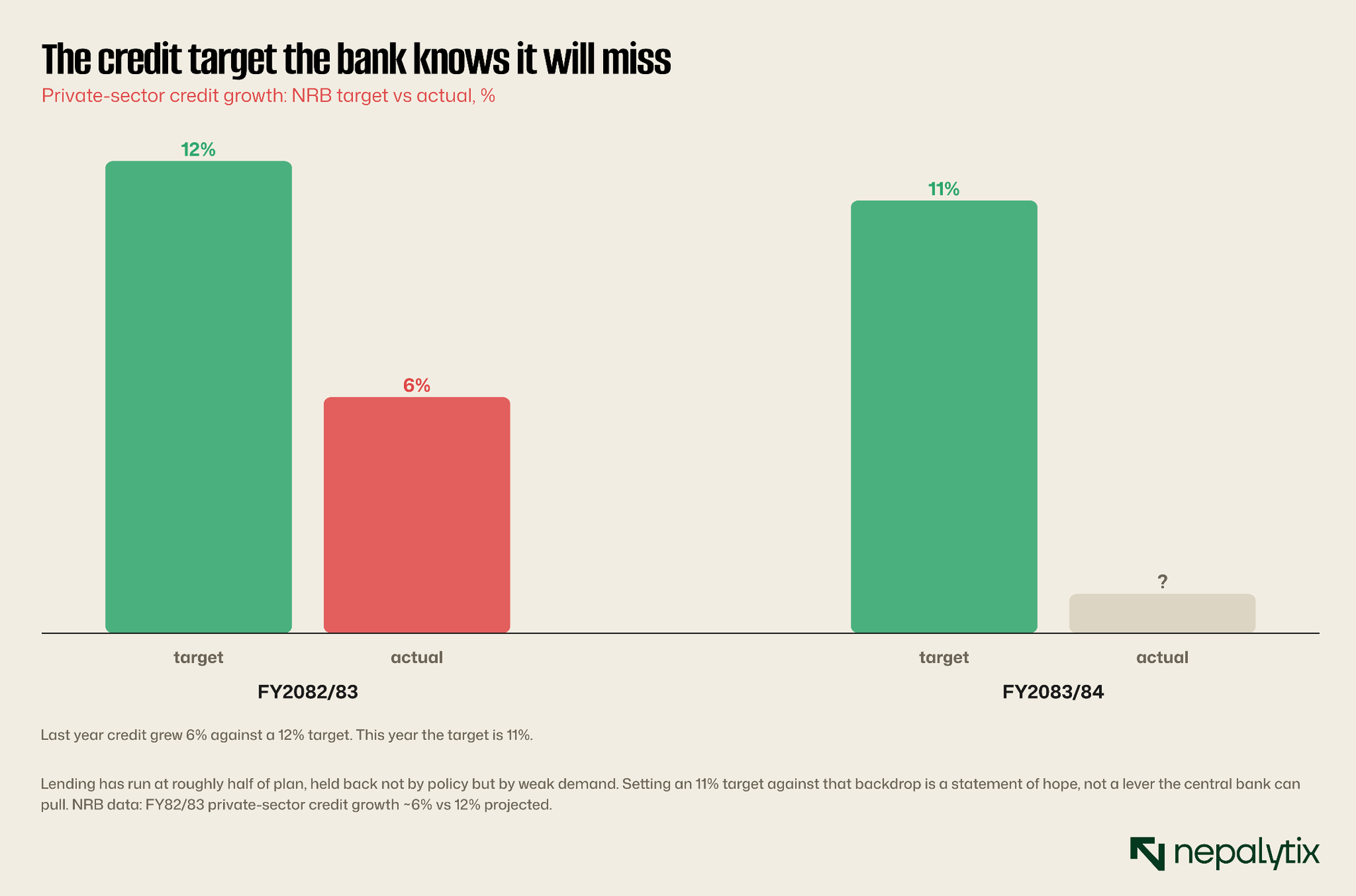
The evidence sits in the plumbing. The banking system is carrying more than Rs 1.4 trillion of excess liquidity, liquid funds have climbed into the hundreds of billions and short-term rates have collapsed toward the floor, the interbank rate around 2.75%, the 91-day Treasury bill near 2.63%, deposit rates falling as banks stop competing for money they cannot lend. This is a liquidity trap in miniature: money is abundant and cheap and it still will not move because the constraint is on the demand side where a rate cut has no purchase.
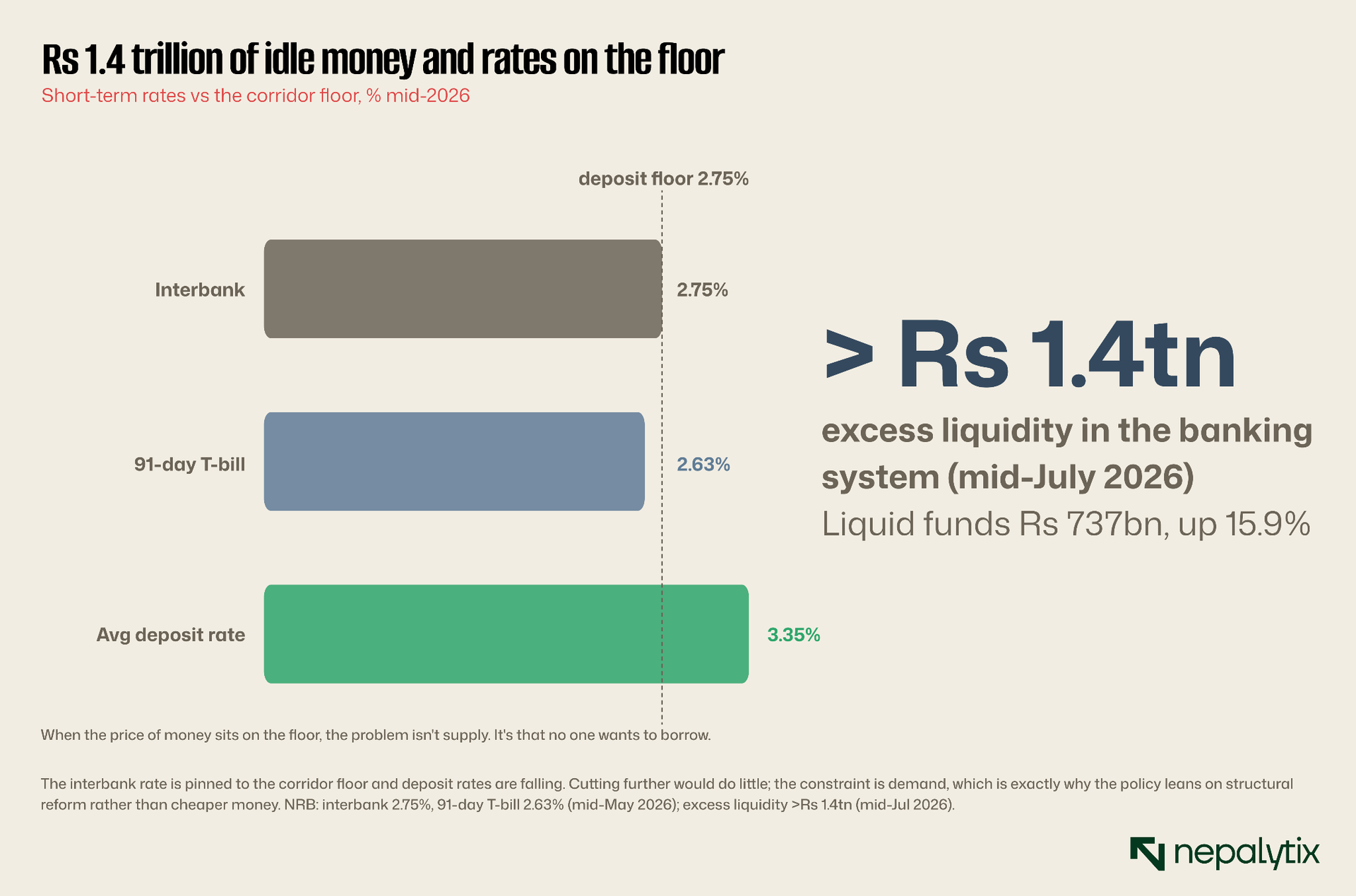
For the market, this cuts two ways. The idle liquidity is a soft floor under asset prices money with nowhere productive to go has historically found its way into NEPSE. But it is not a catalyst. Without credit growth reaching the real economy, there is no earnings tailwind coming for the listed companies that liquidity might chase and the policy offers nothing to force the money out of the banks and into loans. Cheap money that won't work supports valuations at the margin and drives nothing fundamental.
The one change that moves the market
Now the line that matters. Today, share-pledge lending, the margin loans that fuel a large share of NEPSE's activity runs on a broadly uniform rule: a rupee of pledged shares supports roughly the same loan whatever the company behind it. The new policy proposes to end linking borrowing limits to the financial strength and quality of the underlying company. Strong, well-rated names will unlock higher limits; weaker ones, lower.
To see why this bites, look at who has actually been borrowing to buy shares. NRB's own data show the margin-loan boom of the past year was driven by small and mid-size investors: loans in the Rs 5–10m band grew 12.8% in the first half of FY2082/83, the Rs 2.5–5m band 10.3% and smaller loans 7.9%. These are ordinary investors re-entering the market on borrowed money and they are exactly the participants holding the smaller portfolios and weaker stocks that a quality-tiered rule downgrades.
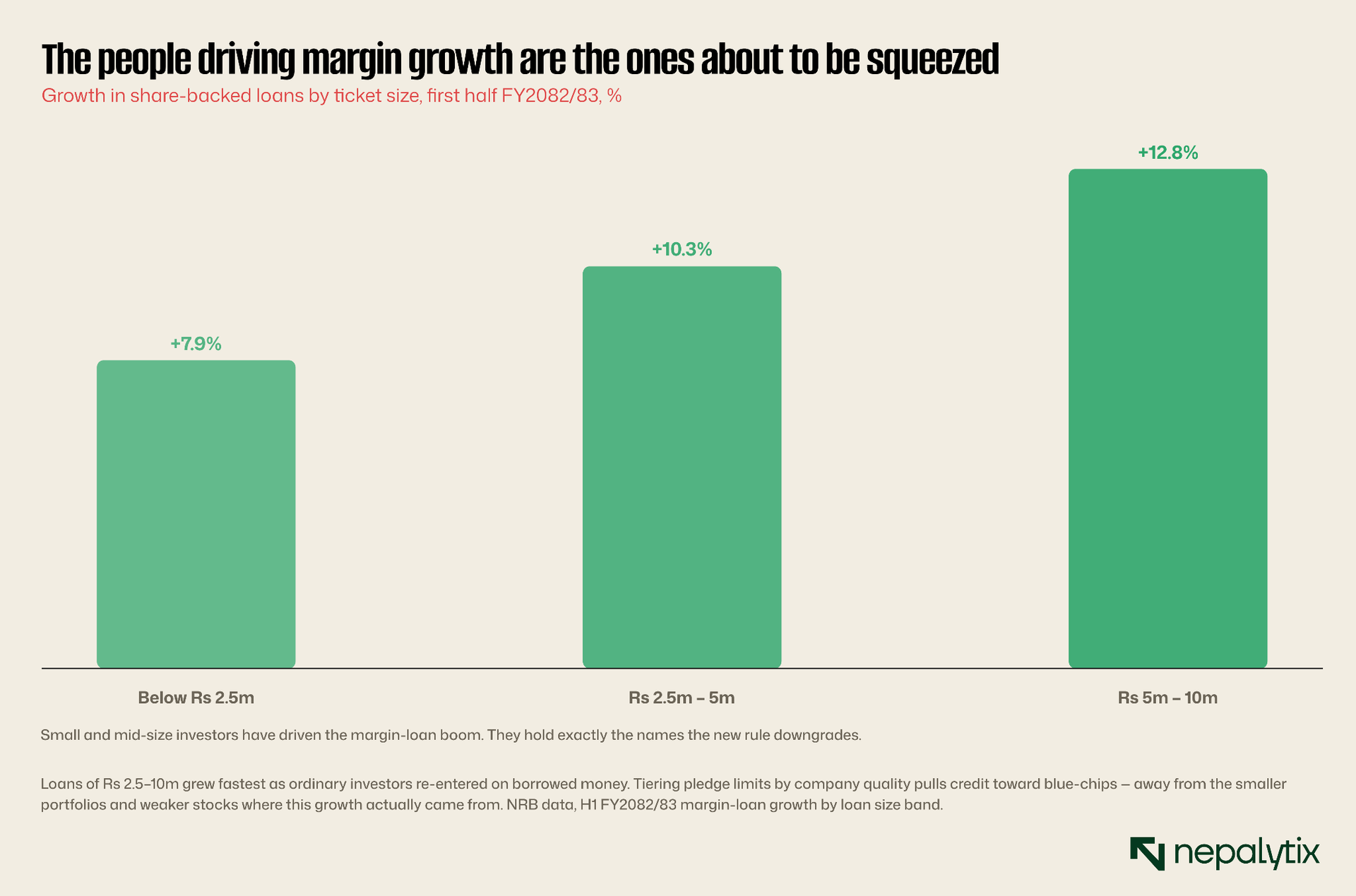
Put the rule and the borrowers together and the mechanism is clear. Leverage is the accelerant of Nepal's market and this change decides where it is allowed to pool. Pledging blue-chips will raise more credit; pledging weaker small-caps, less. Over time that pulls borrowed money up the quality curve toward the large, liquid names the regulator considers safe and drains the speculative bid from the bottom of the board where thin floats and momentum have produced the sharpest moves and not coincidentally, where the recent margin growth came from. The rule is prudential in intent. Its effect is to concentrate an already narrow market by design.
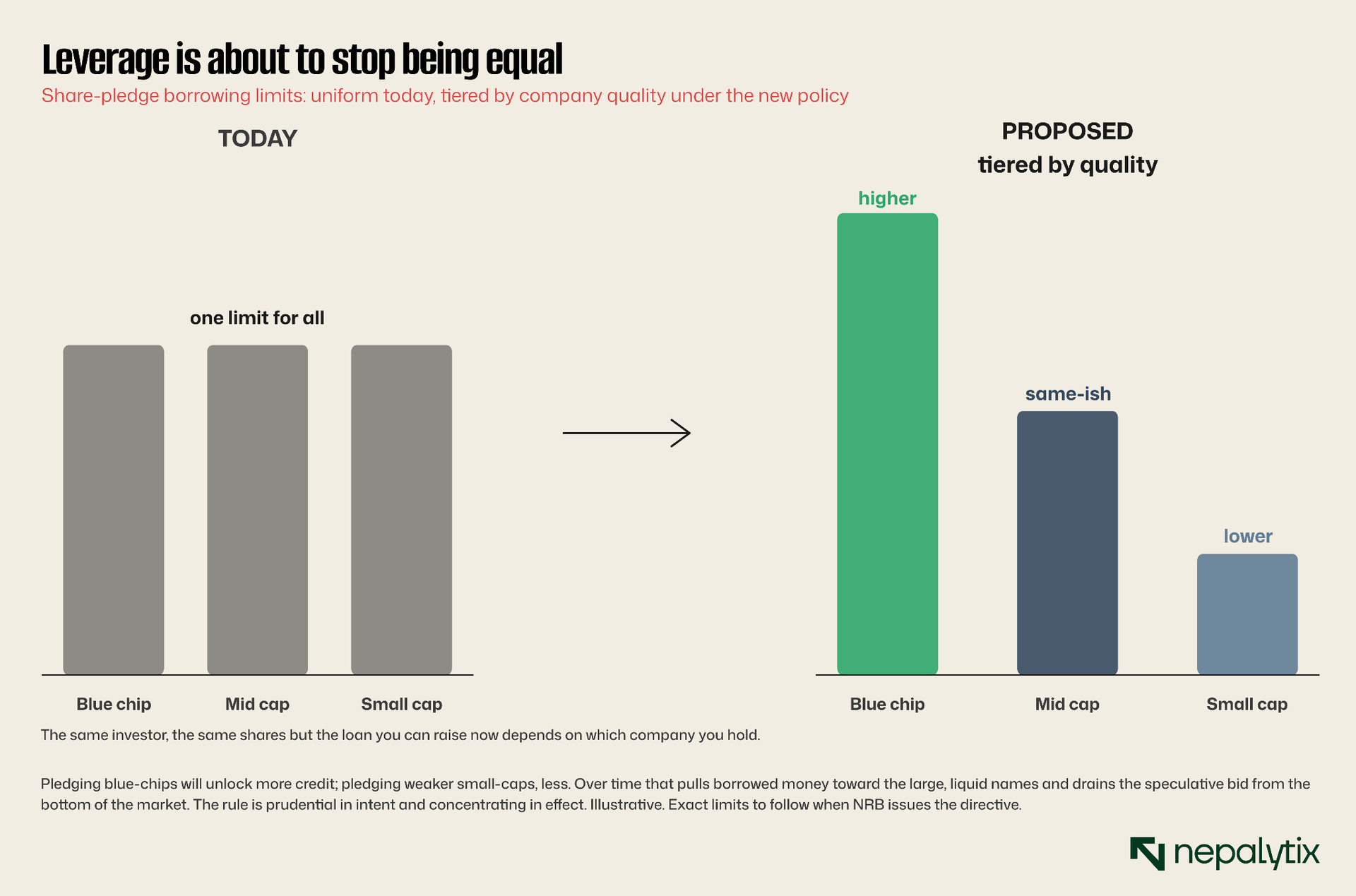
This is a signal to position around not merely to note. It argues for quality over speculation and puts a slow structural headwind under the least liquid, lowest-quality end of the market. The central bank has decided that not all collateral is equal and the market will reprice accordingly.
What did not change, and why it matters
The market's other hope was that banks would be freed to participate directly, specifically that the rule forcing a bank to hold shares it buys for at least six months before selling would be relaxed. It was not. The six-month lock stays and banks remain structurally discouraged from being active buyers of equities. The institutional bid that underpins many markets simply is not coming from Nepal's largest pools of capital. For anyone waiting for smart institutional money to validate the market, the policy is a quiet no; the float stays retail-driven, and retail-driven markets stay volatile.
Set the two together leverage tiered toward quality, banks kept on the sidelines and the message is consistent. The central bank is comfortable with a market that is smaller, more concentrated and less leveraged at its speculative fringe. Prudent regulation. Also, for a portfolio living in small-cap momentum names, a headwind worth respecting.
The plumbing that will show up in bank earnings
Beneath the market-facing lines sits a set of banking reforms that will not move prices this week but will shape financial-sector earnings for years: distinguishing genuinely distressed borrowers from willful defaulters, mechanisms to revive stressed credit in troubled industries removing the unlimited personal liability on guarantee-backed loans easing the blacklisting that follows a bounced cheque and a review that pushes commercial banks, development banks and finance companies into their own lanes.
The relevant read for an equity investor is on earnings quality, because the backdrop is deteriorating. The commercial-bank non-performing loan ratio has tripled from 1.81% in 2016 to 5.41% in 2026, with microfinance in double digits. Against that, tools to revive stressed credit and treat distressed borrowers gently are, in practice, tools that can slow the recognition of bad loans which flatters reported profit through lower provisioning.
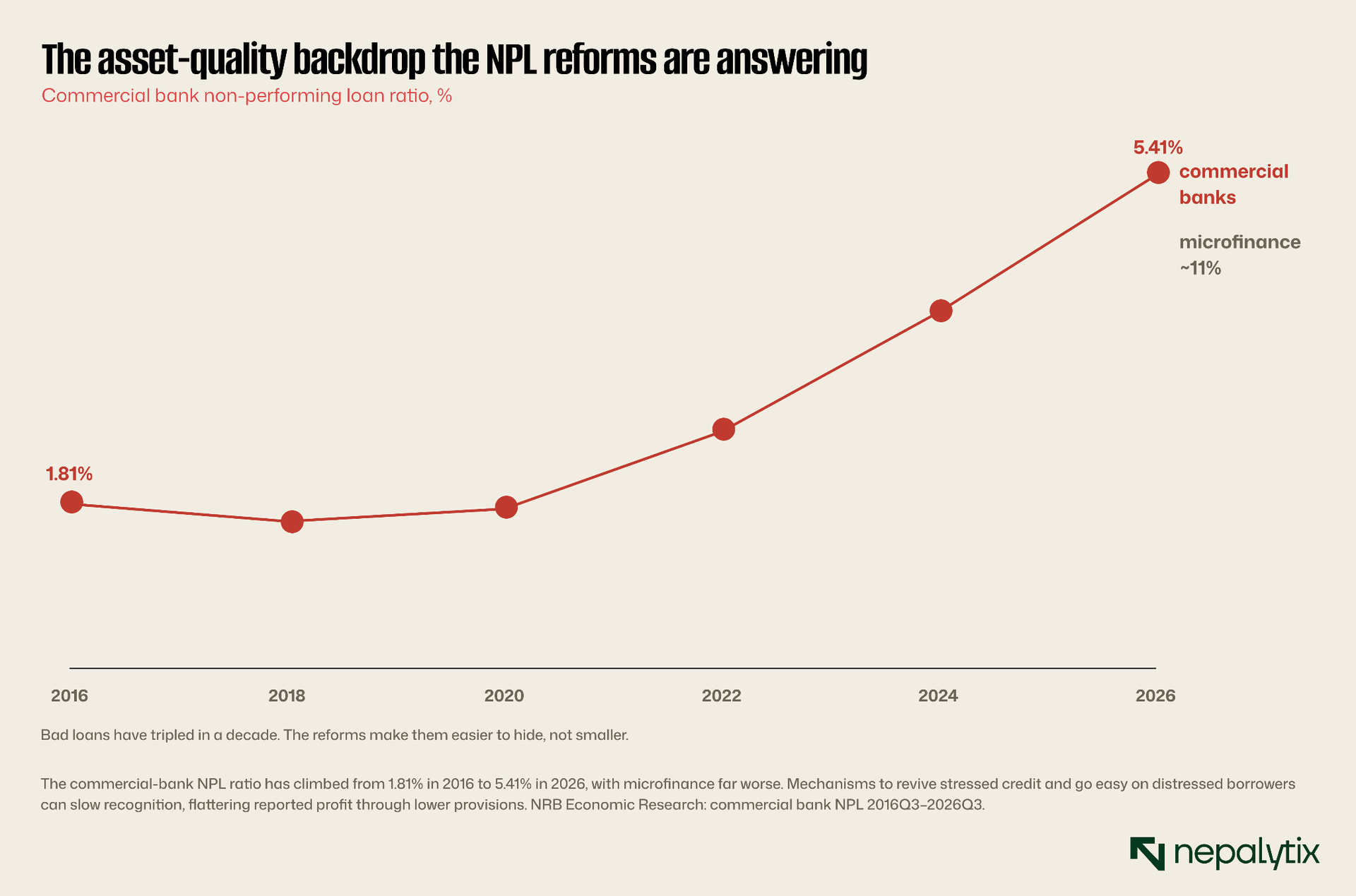
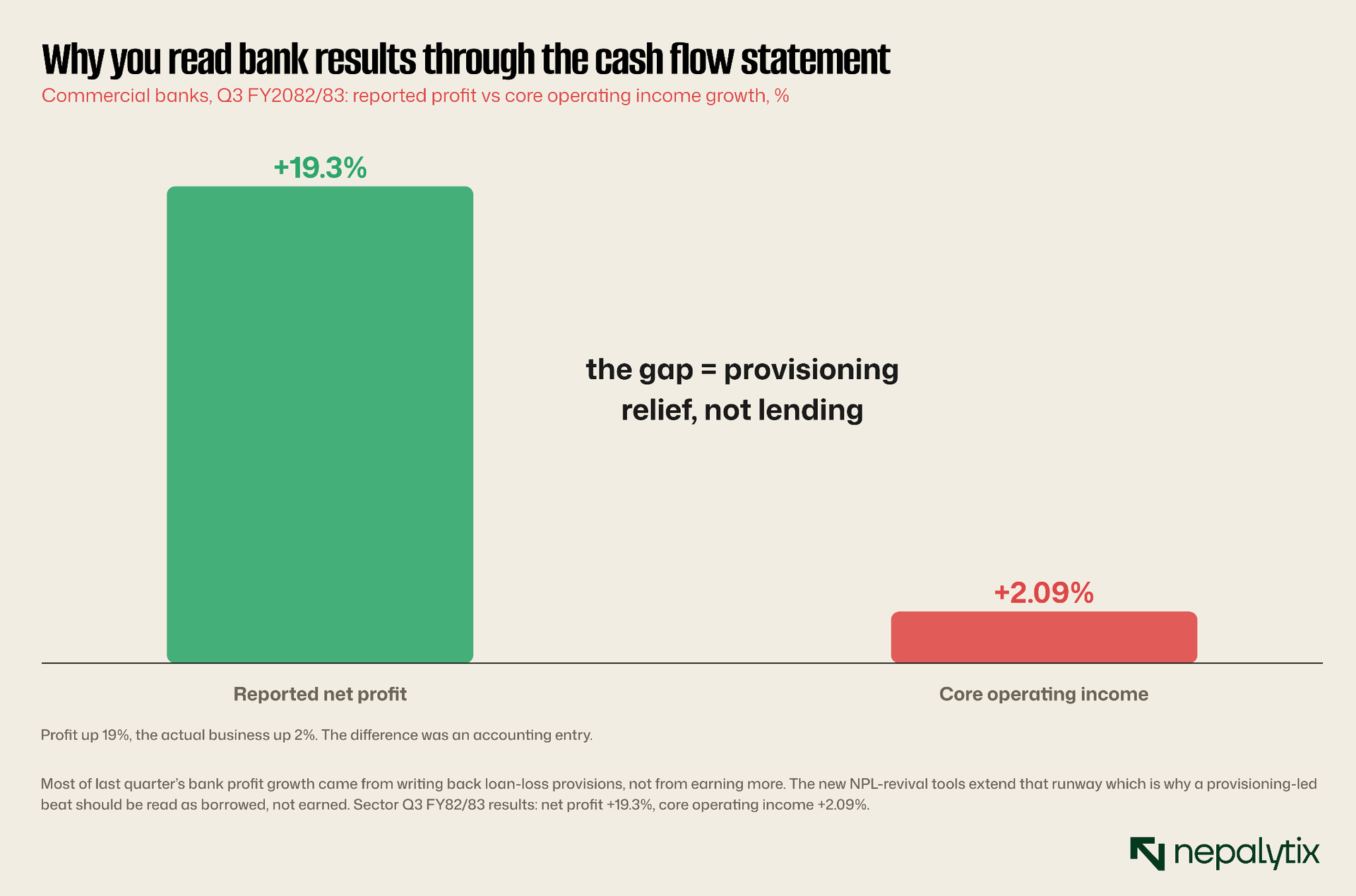
You do not have to imagine the effect; you saw it last quarter, when commercial banks reported profit up 19.3% while core operating income grew just 2.09%. The gap was provisioning relief, not lending. The new revival mechanisms extend that runway, which is precisely why a provisioning-led beat should be read as borrowed rather than earned and why as Sunday's guide argued, bank results are best read through the cash flow statement rather than the profit headline. The classification review meanwhile is the opening move in a longer consolidation: development banks and finance companies pushed into narrower lanes become candidates for the merger wave already thinning their ranks.
Net it out and the FY2083/84 policy is neutral-to-soft for the index and structurally bifurcating for individual stocks. There is no rate cut to chase and no credit boom to ride so the broad market loses a catalyst it never really had, cushioned only by idle liquidity with nowhere better to go. But the tiering of margin credit hands the large, high-quality names a durable advantage in access to leverage, while the small, weak and illiquid end faces a slow withdrawal of the borrowed money that animated it. Quality is being subsidised; speculation is being taxed. That is the shape of the year the central bank has drawn.
Two things will tell you how hard the signal bites. The first is the directive itself: the policy states the principle, but the loan-to-value bands that turn "company quality" into an actual borrowing limit have not been published and the severity lives entirely in those numbers. The second is the first-quarter review in late Kartik where NRB has recently done its real rate-setting. Until then the trade the policy implies is unglamorous and clear: up the quality curve and wary of anything whose price has been propped up on borrowed money.
Disclaimer
This report has been prepared by Nepalytix for informational and educational purposes only and does not constitute investment advice, an offer, or a solicitation to buy or sell any securities.
The information contained in this report is based on sources believed to be reliable; however, Nepalytix does not guarantee its accuracy, completeness, or timeliness. Opinions, estimates, and projections expressed herein are those of the authors as of the date of publication and are subject to change without notice.
Investing in securities involves risks, including the possible loss of principal. Past performance is not indicative of future results. Readers are advised to conduct their own independent research and consult with a qualified financial advisor before making any investment decisions.
Nepalytix and its contributors may hold positions in the securities discussed in this report at the time of publication or thereafter.
Neither Nepalytix nor any of its affiliates accept any liability for any loss arising from the use of this report or its contents.