What the NEPSE Index Actually Measures
NEPSE can rise even as most investors lose money. Here’s how the index works, what it misses and what the new benchmark could change.
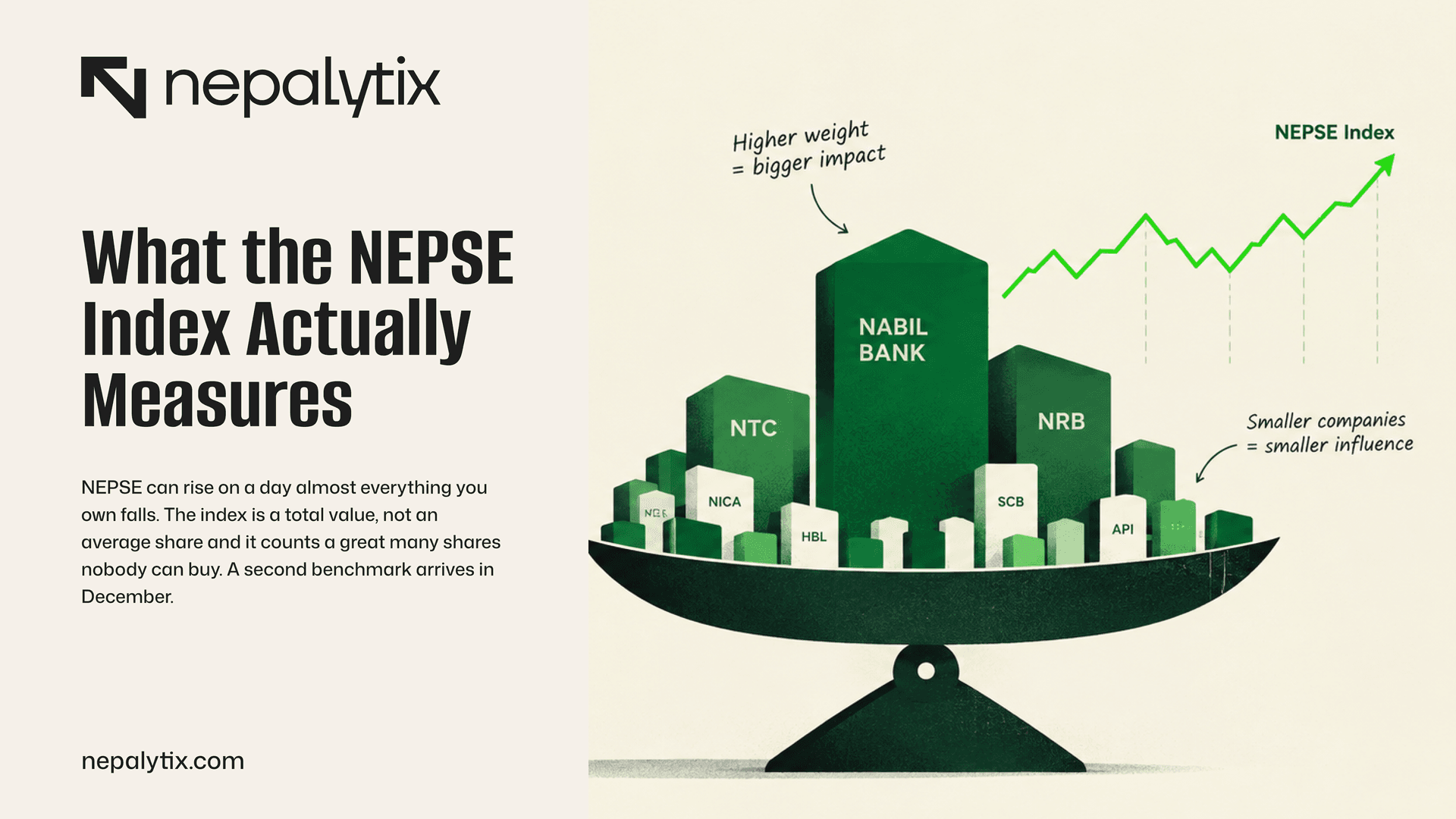
NEPSE can rise on a day almost everything you own falls. The index is a total value, not an average share and it counts a great many shares nobody can buy. A second benchmark arrives in December.
You check the market and NEPSE is up 22 points. You check your portfolio and everything you own is down.
Both are true and the reason is that the index is not measuring what you think it is measuring. It is not an average of share prices. It is not the market. It is one specific calculation over one specific set of shares and in Nepal that set includes a great many shares nobody can buy.
A second benchmark index arrives by mid-December. Before it does, it is worth understanding the one we have.
What an index actually is
The NEPSE index is a ratio, multiplied by a hundred.
Take the market capitalisation of every listed company today. Add them up. Divide by what that same total was on a base date. Multiply by 100.
The base date is 12 February 1994 and the base value is 100. So an index of 2,647 means the total market value of listed Nepali companies is 26.47 times what it was in 1994.
That is the whole calculation. There is no averaging of prices, no weighting decision, no committee. A company's influence on the index is its market capitalisation which is its share price multiplied by every share it has issued.
One consequence follows immediately and it explains the opening paragraph. A company worth Rs 100 billion has a hundred times the influence of a company worth Rs 1 billion. If the large one rises and the small one falls, the index rises. Most companies can fall on a day the index goes up.
Before the arithmetic, one thing the index is not because the misunderstanding is common and expensive.
You cannot buy the index. There is no index fund in Nepal, no exchange traded fund tracking NEPSE and no instrument that delivers the index return. The closed-end mutual funds hold portfolios chosen by a manager, not the index.
That matters because in most markets the index is both a measure and a product. An investor who does not want to pick shares buys the index and receives the market return at low cost. In Nepal the index is only a measure. Anybody who wants market exposure has to assemble it themselves, share by share, paying the round-trip costs this publication set out a fortnight ago on every one.
So when the index rises 22 points, nobody earned 22 points. Some people earned more and some less and nobody held the thing being measured.
What a weight is worth
It is worth putting numbers on that because the effect is larger than most people assume.
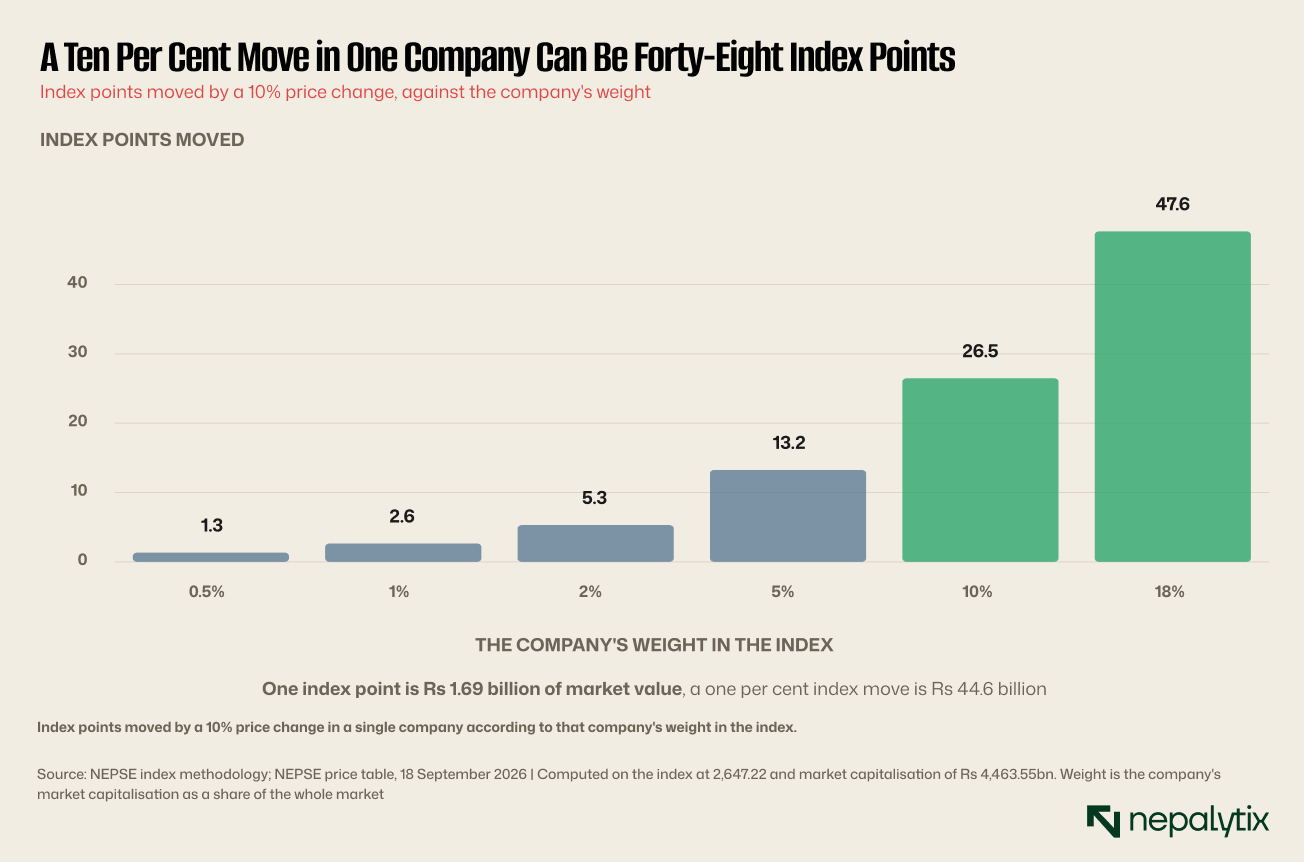
NEPSE stands at 2,647.22 and the market it measures is worth Rs 4,463.55 billion. Divide one into the other and a single index point is Rs 1.69 billion of market value. A one per cent move in the index is Rs 44.6 billion.
Now take a company with a 10% weight. If its shares rise 10%, the index rises 1%, which is 26.5 points. A company at 18%, which Nepal Telecom has historically been, moves the index 47.6 points on the same 10% move.
At the other end, a company with a 0.5% weight moves the index 1.3 points. There are dozens of Nepali companies at that weight or below. They can do anything at all and the number will not notice.
There is a second consequence of the base-date arithmetic that surprises people.
Because the base figure is adjusted every time a company lists, the index does not jump when a new company arrives. If it did not adjust, listing a Rs 60 billion company would add Rs 60 billion of market value overnight and the index would leap without a single share changing price.
So NEPSE recalculates the base so the index reads the same immediately before and immediately after. That is the correct treatment. It does mean the base figure today bears no relation to the Rs 200,000 notional value of 1994 and that comparing the index across decades compares two different baskets of companies.
An index at 2,647 is not telling you a 1994 portfolio is worth 26.47 times what it was. It is telling you a series of linked calculations, each one correct, have chained to that number.
Four indices, not one
NEPSE publishes four indices and they answer two different questions.
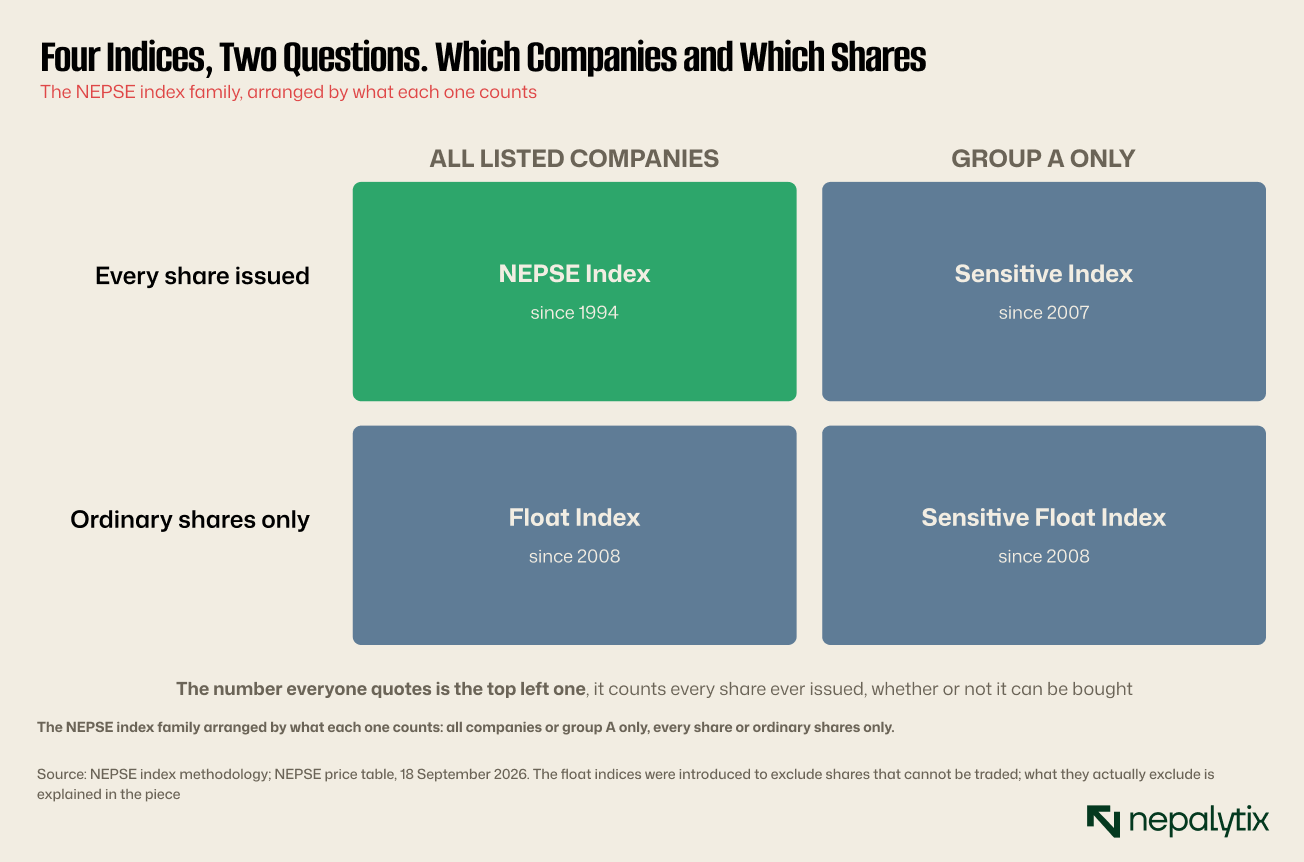
The first question is which companies to include. The NEPSE index takes all of them. The sensitive index, introduced in 2007 takes only group A companies, which are the larger and better-established issuers.
The second question is which shares of those companies to count. The headline indices count every share ever issued. The float indices, introduced in September 2008, count only ordinary shares.
That second distinction is the one worth understanding and it is where the Nepali index has a problem it has never solved.
Group A membership is worth a sentence because people treat it as a quality rating and it is partly a compliance one. A company qualifies on criteria including paid-up capital, profitability, shareholder numbers and whether it has held its annual general meetings and filed on time.
So a company can drop out of group A for being late with a filing rather than for deteriorating as a business and the sensitive index will drop it accordingly. It is a useful index and it is not a list of the best companies in Nepal.
The shares that cannot be bought
A Nepali listed company issues shares in more than one form. Promoters hold promoter shares, which trade on a separate line, carry lock-in restrictions and change hands rarely. The government holds shares in state-linked companies. Employees hold allotted shares. Project-affected local residents hold shares issued under a separate tranche.
The NEPSE index counts all of them. When it tells you the market is worth Rs 4,463.55 billion, a meaningful share of that value sits in certificates that will not be sold this year and in many cases cannot legally be sold.
The float index was created to fix exactly this. It was supposed to count only the shares actually available to buy.
It does not and NEPSE says so. The exchange has never published a mechanism for determining free float so the float index uses the ordinary shares of all listed companies as a proxy. That excludes the separately listed promoter line, which is a real improvement. It does not exclude ordinary shares held by promoters by the government, by employees under lock-in or by district residents who have never traded.
So Nepal has a float index that measures something considerably broader than float and a headline index that measures something broader still. Neither answers the question a float index exists to answer.
What the market actually trades
Set the index against the market as it behaves on an ordinary day and the gap becomes visible.
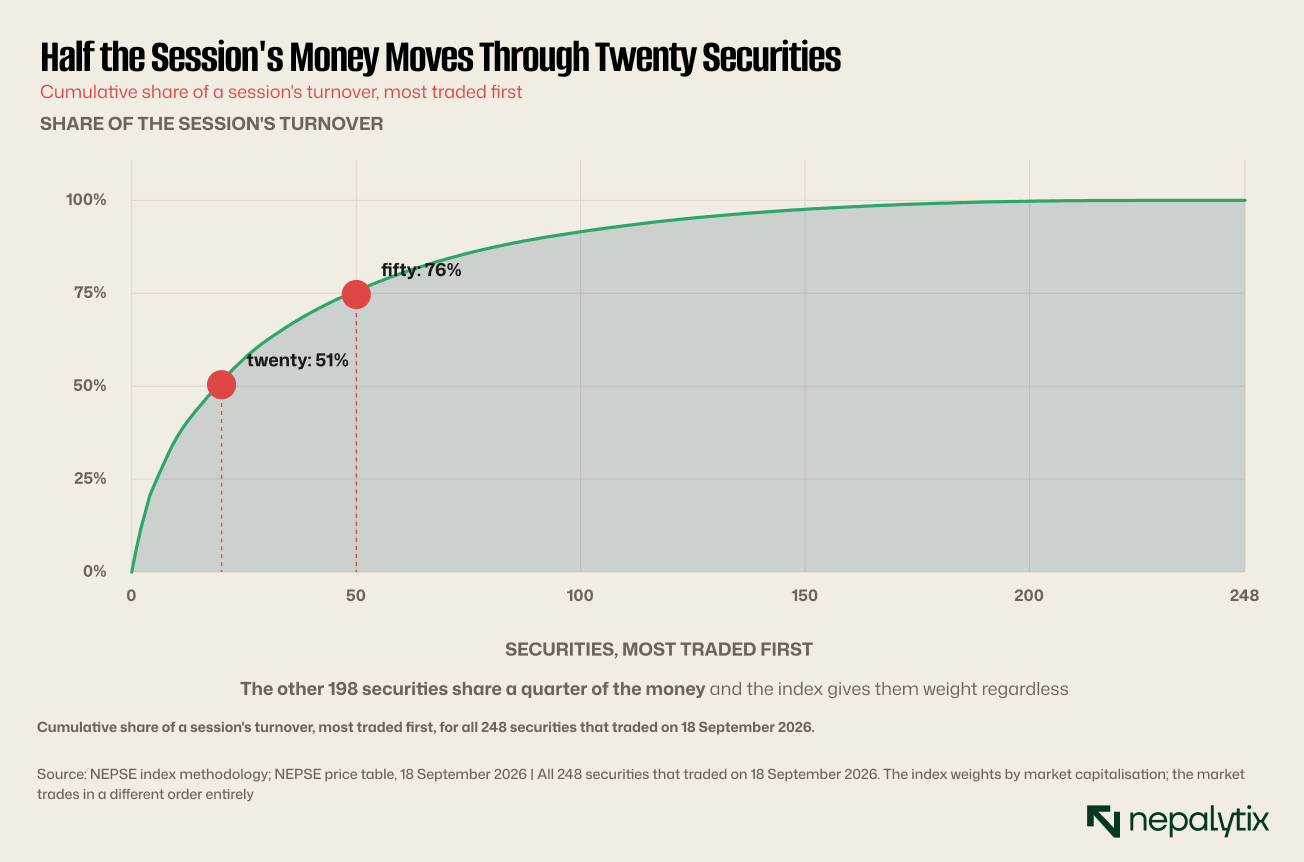
On 18 September, 248 securities traded. The twenty busiest accounted for 51% of the money that changed hands. The fifty busiest accounted for 76%. The remaining 198 securities shared a quarter of the session between them.
The index does not know this. It weights every company by market capitalisation regardless of whether anybody traded it. A company that did not trade at all still carries its full weight priced at whatever its last transaction happened to be, however long ago.
That is not a Nepali eccentricity; every capitalisation-weighted index works this way. What is unusual here is how far apart the two orderings sit because so much of the Nepali market trades so thinly.
It is worth being concrete about how much of the Nepali market this affects, even though the exact figure cannot be computed from published data.
Take hydropower, the largest cohort on the exchange. This publication found last Thursday that 111 companies are listed and that their shares are issued across several tranches: promoters, project-affected district residents, Nepalis employed abroad and the general public. Promoters typically hold a majority.
The headline index counts every one of those shares at the ordinary share price. The float index excludes the separately listed promoter line but not the ordinary shares sitting in district shareholders accounts that have never moved.
Nobody publishes how large that block is. Which is the whole problem: the figure that would let you correct the index is the figure that does not exist.
The sub-indices
NEPSE publishes a sub-index for each sector, computed the same way over that sector's companies.
These are more useful than the headline for most purposes because they separate things that move for different reasons. The banking sub-index responds to credit growth and interest rates. The hydropower sub-index responds to tariffs, hydrology and as August demonstrated, the weather.
They carry the same weighting problem in miniature. A hydropower sub-index covering 112 companies is dominated by the largest handful, and this publication found last Thursday that the ten largest hold 37% of the sector's value while the smaller half holds 18%. A reader watching the sub-index is watching about twenty companies and ignoring ninety.
A worked comparison makes the sub-index point concrete.
Suppose the banking sub-index rises 2% on a day when the hydropower sub-index falls 2%. Banking and the other financial sectors have historically been the larger share of market capitalisation so the headline index rises.
An investor holding only hydropower shares reads that the market rose and their portfolio fell, and concludes they are doing badly. They are doing exactly as well as their sector. The headline index told them nothing about the thing they own.
This is not a subtle effect in Nepal. Hydropower is 37% of the listed companies and 17.5% of the value so the two numbers can diverge substantially and often.
What is coming in December
The government's capital market reform plan, published on 15 September includes a new benchmark index by mid-December. The existing index remains and stays all-equity.
The proposal most discussed is a NEPSE 30: thirty companies, selected as the highest-weighted eight from each of seven sectors, computed on free-float market capitalisation with a base date of Poush 30, 2079.
Two things about that are worth watching.
The first is the free-float promise. A thirty-company index computed on genuine free float would be the first Nepali index that measures what it claims to. It requires NEPSE to publish a free-float figure for each company which is the mechanism the float index has lacked since 2008. If the new index ships without one, it inherits the same proxy.
The second is the sector cap. Eight companies per sector across seven sectors means banking cannot dominate by count even though it dominates by value. That is a deliberate choice and it makes the index less representative of the market's value and more representative of its breadth. Whether that is an improvement depends on what you want the number for.
There is a third thing to watch that nobody has raised publicly and it follows from everything above.
A free-float index needs the float figure to be maintained, not merely published once. Promoters sell down, lock-ins expire, companies issue rights and bonuses. If NEPSE publishes free float at launch and does not update it, the new index drifts away from accuracy in exactly the way the current float index did, only more slowly.
The instrument that would keep it honest is a requirement that companies report changes in promoter holding which would also serve several other purposes documented in this publication: an eligibility list for short selling, a collateral framework for margin lending and a liquidity measure for anyone trying to size a position.
One disclosure would improve four things at once. It has been outstanding since 2008.
The things that do not move the index
Three corporate actions look dramatic and do nothing to the number.
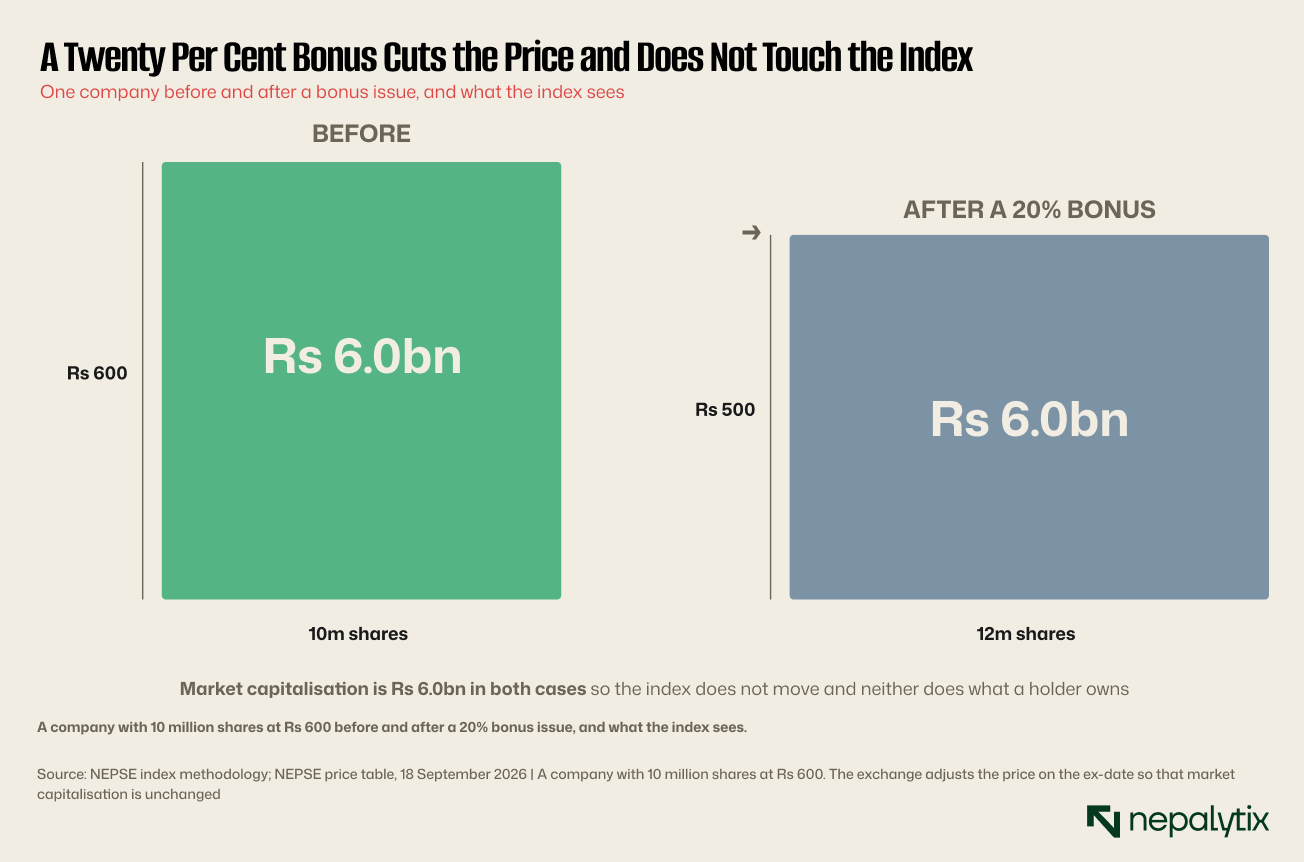
A bonus issue. Sunday's piece a week ago set this out from the shareholder's side. From the index's side it is even simpler. A company with 10 million shares at Rs 600 is worth Rs 6 billion. Issue a 20% bonus and it has 12 million shares at Rs 500 which is Rs 6 billion. The exchange adjusts the price on the ex-date precisely so this holds. Market capitalisation is unchanged and the index does not move.
A share split. Same arithmetic, same result.
A cash dividend. The price adjusts down by the dividend on the ex-date, so the index falls slightly. But the money went to shareholders so nobody lost anything. Over a dividend season with many companies going ex-dividend, the index drifts down for reasons that have nothing to do with the market's opinion of anything.
One action does move it, and it is the one people notice least. When a new company lists, its entire market capitalisation joins the index. NEPSE adjusts the base figure to prevent a jump on day one but from the second day that company's price movements count. Nepal listed a large number of companies over the last two years and each arrived carrying a capped opening price this publication has written about before.
There is a fourth action worth knowing about because it catches people out at exactly the wrong moment: a rights issue.
A rights issue does change market capitalisation, because the company receives money. If a company with 10 million shares at Rs 600 issues 5 million rights shares at Rs 100, it takes in Rs 500 million and now has 15 million shares. The adjusted price is Rs 433.33 and 15 million times Rs 433.33 is Rs 6.5 billion which is the original Rs 6 billion plus the Rs 500 million raised.
So the index is unchanged by the adjustment itself but the company's weight has grown because it is genuinely worth more: it has the cash. A shareholder who declined the rights as last week's piece explained, has been diluted and is worse off while the index records an increase.
That is the clearest case of the index and the shareholder telling different stories about the same event.
How to use the number
Do not read it as an average share. It is a total value. A rising index is consistent with most shares falling and in a market this concentrated that happens often.
Check the breadth alongside it. The advance-decline count tells you how many companies rose. An index up on a day with more decliners than advancers is a large company having a good day.
Use the sector sub-index for anything you own. The headline is dominated by companies you probably do not hold. If your portfolio is hydropower, the hydropower sub-index is your benchmark.
Do not compare your return to the index without adjusting. The index reflects price only. It does not include dividends so an investor receiving cash dividends beats the index by that amount and never sees it in the comparison.
Remember what is not in it that you might expect. Debentures, government bonds and mutual fund units are handled separately from the ordinary-share indices and promoter lines trade on their own.
One more use worth knowing because it is the only one that requires no interpretation.
The index is a decent measure of whether Nepali listed equity as a whole is worth more or less than it was. Over long periods that is exactly what it says and it says it accurately because the base adjustments preserve continuity and the capitalisation is measured the same way throughout.
Where it misleads is over short periods and for individual holders which unfortunately is when and by whom it is mostly read.
Reading a day properly
Put the pieces together on an ordinary session and a routine appears.
The index closed at 2,647.22 on 18 September, up 22.85 points on the day with four banks among the five most traded companies. Turnover was Rs 6.745 billion.
Read in order, those facts say: the market's total value rose about 0.87% roughly Rs 39 billion; the money moved mainly through large banks and the twenty busiest securities took about half of it.
What they do not say is how many companies rose, whether your sector participated or whether the companies that moved the number are companies anybody can buy in size. For that you need the advance-decline count, the sub-index, and the turnover table, all of which NEPSE publishes and almost nobody reads alongside the headline.
The headline is the least informative number on the page. It is simply the one printed largest.
The point
An index is a summary, and every summary throws information away. The NEPSE index throws away which companies moved, how many shares could actually change hands and whether anybody traded at all.
It keeps one thing which is the total value of every listed share at its last quoted price. That is genuinely useful and it is not the same as the market.
When the new benchmark arrives in December, the first question worth asking is what it counts. That single answer determines everything else about it.
Disclaimer
This report has been prepared by Nepalytix for informational and educational purposes only and does not constitute investment advice, an offer, or a solicitation to buy or sell any securities.
The information contained in this report is based on sources believed to be reliable; however, Nepalytix does not guarantee its accuracy, completeness, or timeliness. Opinions, estimates, and projections expressed herein are those of the authors as of the date of publication and are subject to change without notice.
Investing in securities involves risks, including the possible loss of principal. Past performance is not indicative of future results. Readers are advised to conduct their own independent research and consult with a qualified financial advisor before making any investment decisions.
Nepalytix and its contributors may hold positions in the securities discussed in this report at the time of publication or thereafter.
Neither Nepalytix nor any of its affiliates accept any liability for any loss arising from the use of this report or its contents.