Why IPO Issue Size Now Matters More Than the Company in Nepal
More than two million Nepalis now apply for almost every IPO. With the crowd staying large, the size of an issue increasingly determines who gets shares and how much an application is worth.

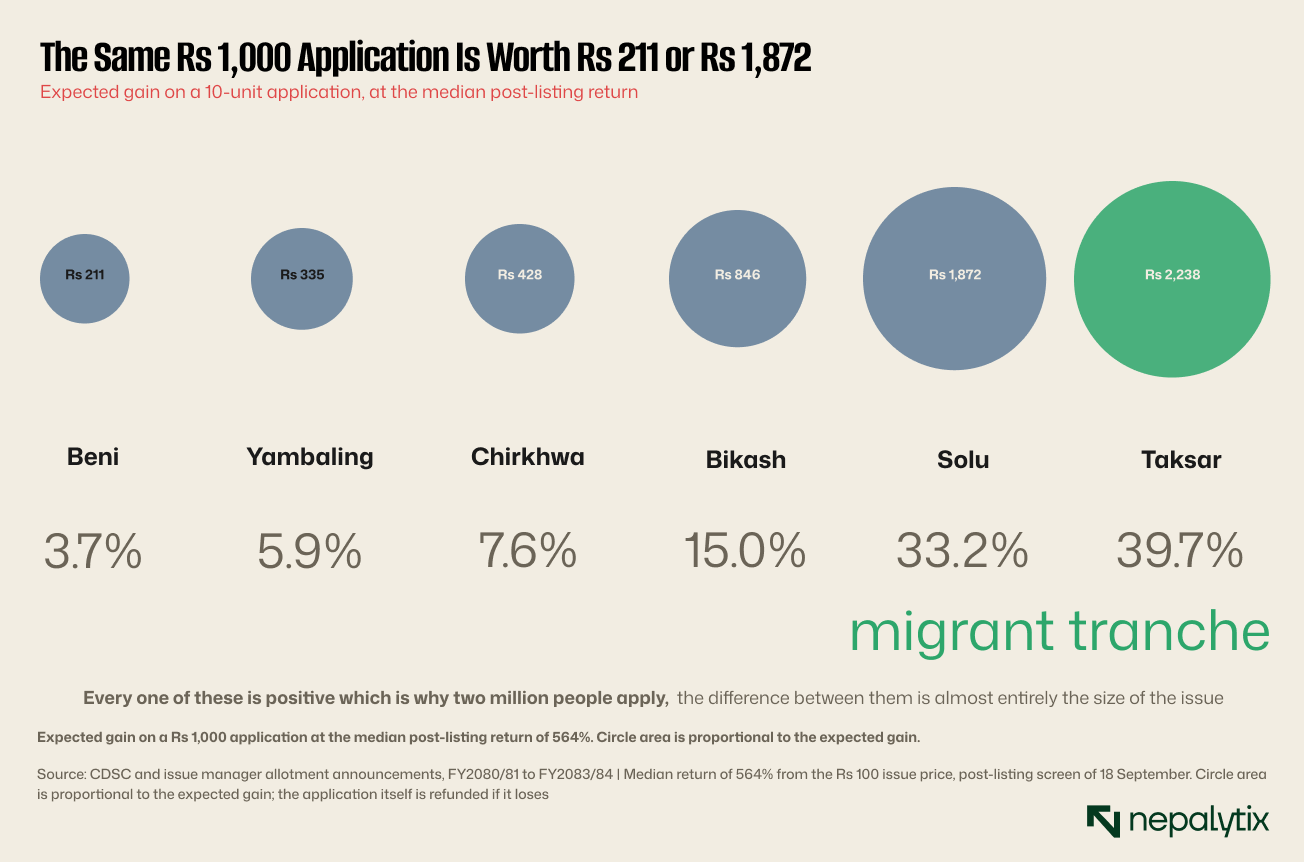
Beni Hydropower's lottery closed with 2.31 million valid applicants for 86,320 allotments. The same crowd of two to three million now meets every issue so the size of the issue alone decides the odds. A Rs 1,000 application is worth Rs 211 at Beni and Rs 1,872 at Solu.
THE SIGNAL
NMB Capital drew the lottery for Beni Hydropower's public issue on Sunday. 2,305,233 valid applicants competed for 86,320 allotments of ten shares each. One in 27 won.
The closing-day count of 25.76 times was an interim figure. The final count puts the issue at 30.35 times with more than 2.3 million people applying.
That crowd is not special to Beni. Five general public issues over three years drew between 1.13 million and 2.94 million applicants and the four most recent all landed between 1.96 million and 2.94 million. A standing pool of two to three million Nepalis now meets every issue, and the size of the issue alone decides how many of them win.
Beni, counted properly
Beni Hydropower's issue ran from Bhadra 22 to 25 through NMB Capital. The company offered 8,63,200 units to the general public after reservations: 1,04,000 to Nepalis working abroad, 20,800 to employees and 52,000 to mutual funds.
On the closing day CDSC reported 19,78,086 applicants for 2,22,42,970 units and the issue was widely reported as oversubscribed 25.76 times. That number was taken before the final applications cleared.
The allotment announcement gives the settled figures. 2,351,560 applicants applied for 26,200,910 units. After rejections for technical discrepancies, 2,305,233 were valid. Allotment went by lottery at ten units each to 86,320 applicants.
The issue was oversubscribed 30.35 times and a valid applicant had a 3.74% chance.
The allotment was drawn at NMB Capital's premises. Refunds to the 2,218,913 valid applicants who did not win go back through C-ASBA to the bank accounts the money was blocked in. Winners can check through the CDSC result portal, NMB Capital's site or MeroShare.
A separate report that "8,63,200 applicants" were allotted confused units with people. The issue offered 8,63,200 units to the general public; at ten units each that is 86,320 winners. The distinction matters for anyone computing their chance and several outlets carried the wrong figure.
The same crowd every time
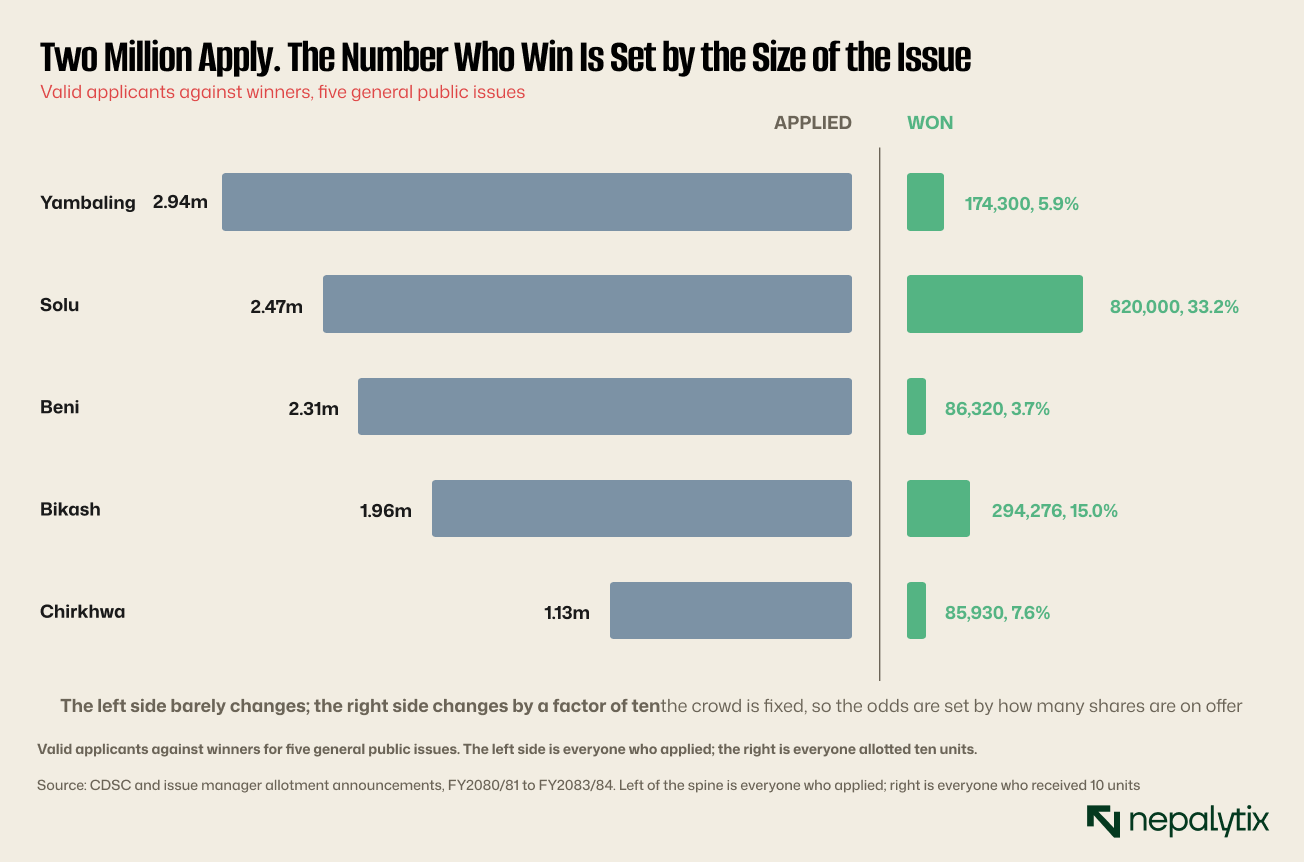
Set Beni against the issues before it and the pattern is immediate. Yambaling drew 2,938,082 valid applicants in Baishakh. Solu drew 2,471,007 in Magh. Bikash drew 1,961,737 in Ashadh 2082. Beni drew 2,305,233.
The applicant counts sit within a band. The winner counts do not. Solu produced 820,000 winners, Beni 86,320. Nearly ten times as many.
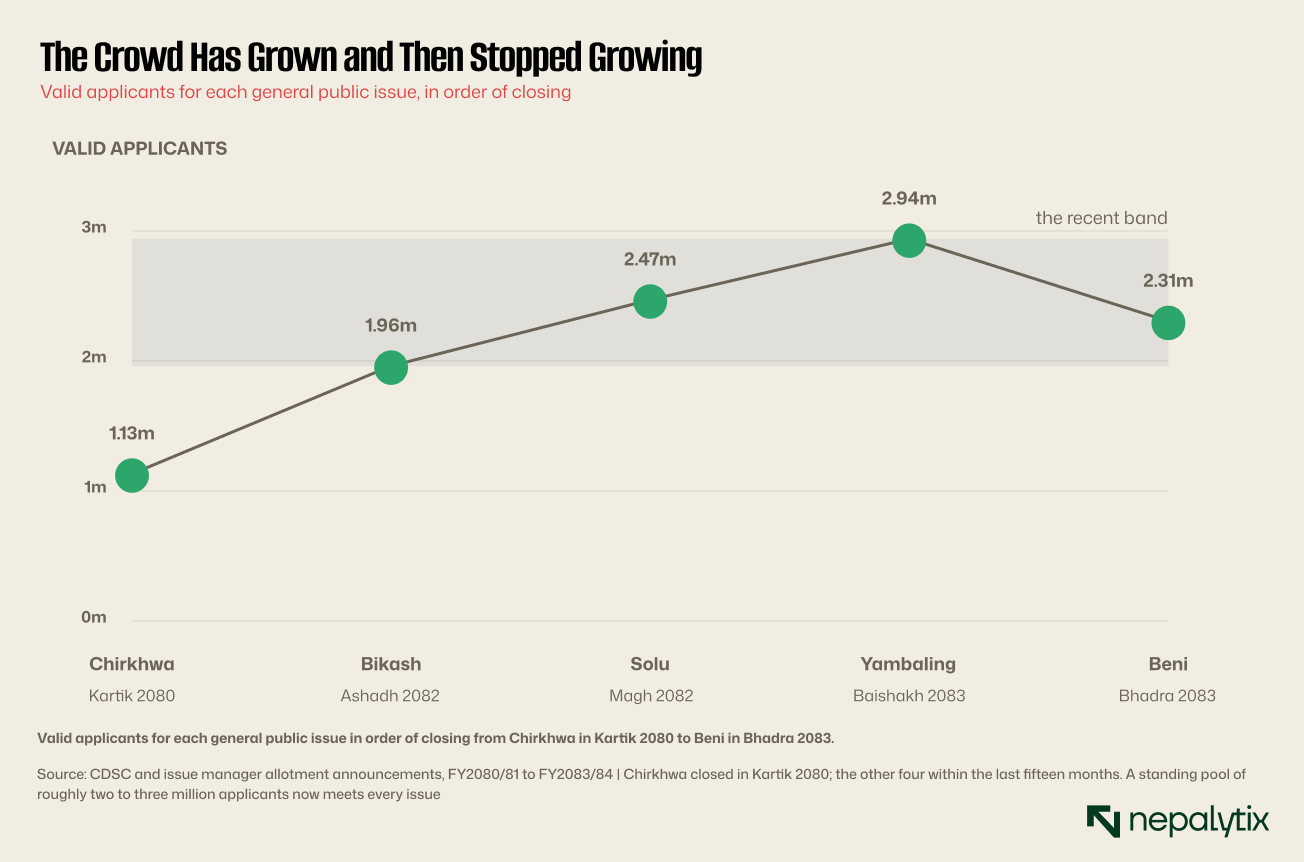
Chirkhwa Hydro, which closed in Kartik 2080, drew 1.13 million. By Ashadh 2082 the count had nearly doubled. Since then it has held between roughly two and three million.
That is the investor base the primary market now draws on. It is larger than the number of people who trade on NEPSE in any given month by a wide margin and it applies to almost everything.
The sizes of these issues vary for reasons unconnected to demand. Solu is an 82 megawatt project on a Rs 10 arba issued capital and 20% of that went to the public. Beni is a considerably smaller undertaking. Appolo is a 6 megawatt plant in Okhaldhunga. Each company issues what its capital structure and the regulator's public-float rules require.
The applicant pool does not scale with any of that. Two million people apply to an 82 megawatt project and to a 6 megawatt one alike because the application costs nothing if it loses and the screen published here found that recent listings have not lost.
So the market is sending one uniform signal, strong demand for anything issued at par, and the issuers are responding with offers of wildly different size. The lottery is where the two meet.
One detail from Solu shows how the tranches stack. Its issued capital was Rs 10 arba. Ten per cent had already gone to project-affected residents of Solukhumbu before the public issue opened. Of the 2 crore units in the public issue, 10 lakh went to Nepalis working abroad, 3 lakh to employees and 5 lakh to mutual funds leaving 82 lakh for the general lottery.
Every one of those carve-outs is decided before the crowd arrives and every one of them shrinks the pool the two million are drawing from.
What decides the odds
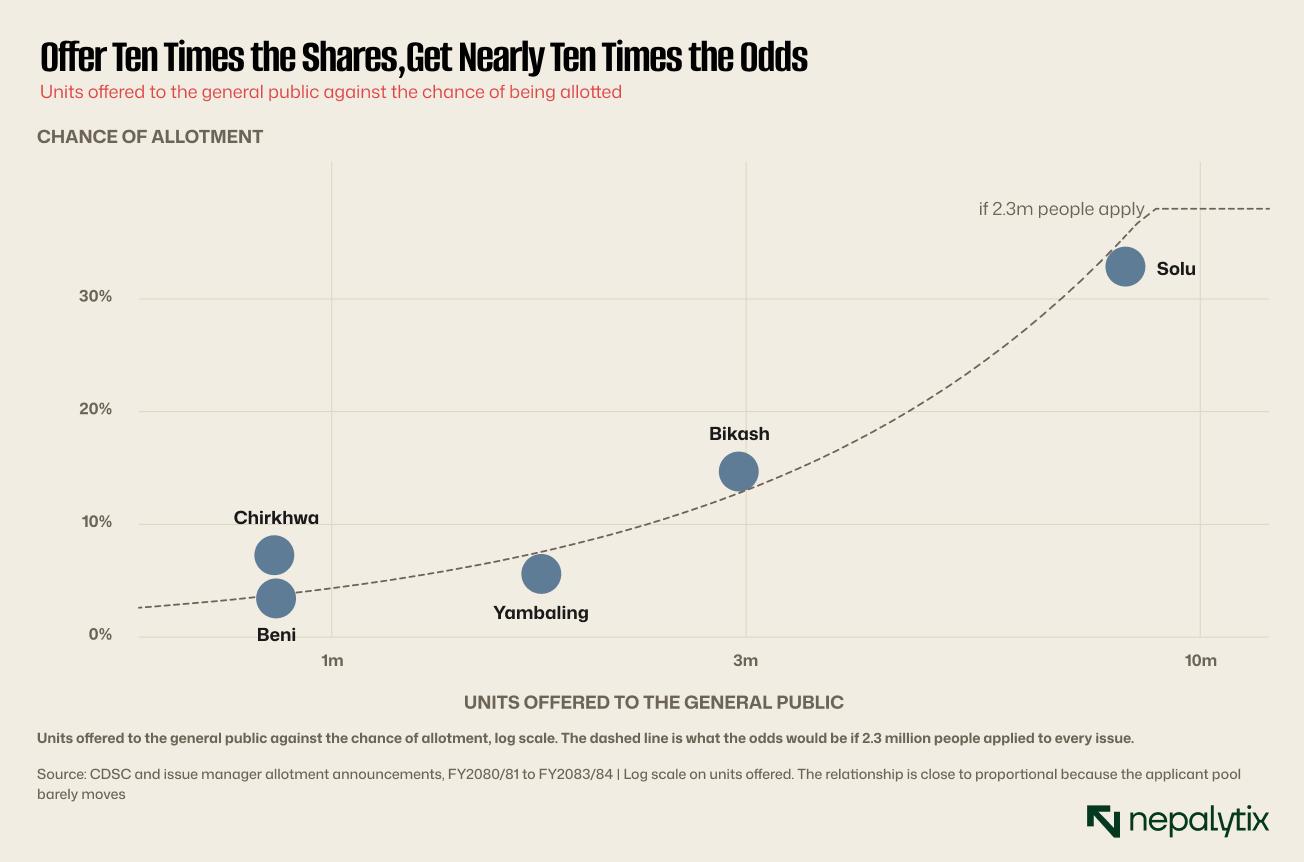
If the crowd is fixed, the odds follow the number of shares on offer. The data bears that out closely.
Solu offered 8,200,000 units. Beni offered 863,200. Solu offered 9.5 times the units to 1.07 times the applicants and its odds were 33.18% against Beni's 3.74%.
Bikash sat between them: 2,942,760 units, 15.00%. Yambaling offered 1,743,000 units and came out at 5.93%.
The ordering is exactly the ordering of issue size. Nothing about the companies, their ratings or their sector moved it. ICRA upgraded Beni to BB+ shortly before the issue; Solu carried an Infomerics BB. The rating did not matter to the lottery.
The one issue that sits apart is Chirkhwa and the reason is timing rather than size. It closed in Kartik 2080 with 11,31,936 valid applicants, well below the recent band. Its 7.59% odds came from a smaller crowd not a larger issue: it offered only 859,300 units similar to Beni.
Put Chirkhwa and Beni side by side and they isolate the effect of the crowd. Nearly identical unit offers. Chirkhwa's crowd was half the size and its odds were twice as good. The investor base doubling between 2080 and 2082 halved the chance of winning a small issue.
The share of the country this represents is worth stating once. Nepal's population is a little over thirty million. Two to three million valid applicants per issue means somewhere between one adult in eight and one in five depending on how the population is counted applies to a typical IPO. Several of them will hold more than one demat account through family members, which inflates the count but even allowing for that the reach is extraordinary.
No other financial product in Nepal draws participation on that scale. The lottery is in practice, the country's mass-market investment channel and it runs on the expectation that every ticket is a free option on a guaranteed gain.
The published multiple holds up
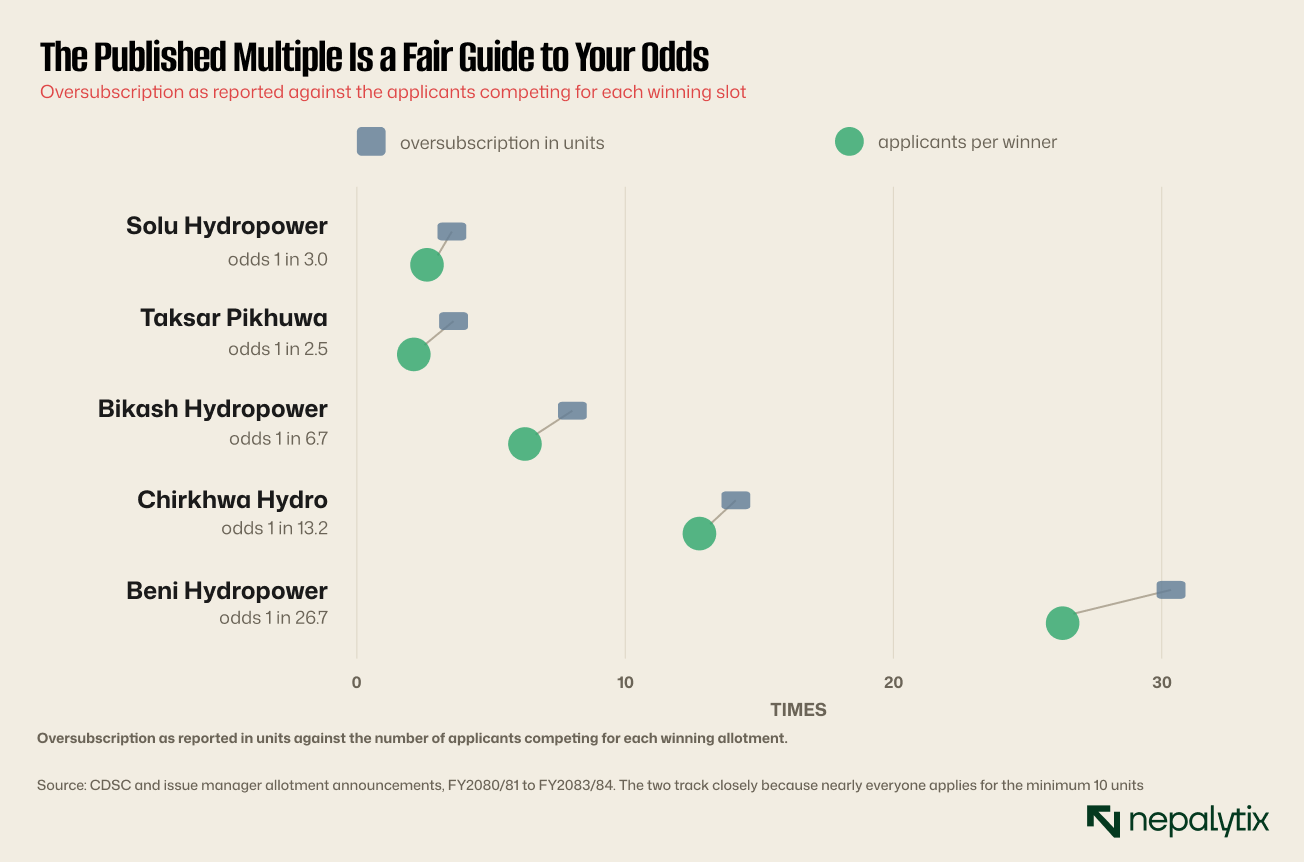
A reasonable worry is that the oversubscription multiple everyone quotes is the wrong number because it is measured in units while allotment is by person.
On this evidence it is a fair guide. Beni was 30.35 times oversubscribed in units and had 26.7 applicants per winner. Bikash, 8.04 times and 6.7. Solu, 3.54 times and 3.0.
The two track because nearly every applicant asks for the minimum ten units. When almost everyone applies for the same amount, units and people move together. An applicant who reads the closing-day multiple can divide it into one and get a close estimate of their chance.
The caveat is timing. Beni's closing-day multiple was 25.76 and the final was 30.35. The published figure on the last day understates the final competition by about a sixth.
Timing matters in a second way that the aggregate hides. The closing-day multiple is published by CDSC on the last day and it moves through the window. Beni was reported at 15.80 times on its third day, 25.76 times on its closing day and settled at 30.35 times.
An applicant deciding on the second day of an issue is looking at a number that will roughly double before the lottery. The final count is the one that decides the odds and it is the one nobody sees until afterwards.
What an application is worth
The post-listing screen published here on 18 September found a median return of 564% from the Rs 100 issue price across every company listed within 180 sessions. It could not say what an application was worth, because it had no allotment probability. These figures supply one.
A ten-unit application costs Rs 1,000. If it wins at the median return it is worth Rs 5,640 of gain. Multiply by the odds.
At Beni's 3.74%, the expected gain is Rs 211. At Yambaling's 5.93%, Rs 335. At Solu's 33.18%, Rs 1,872.
Every one is positive, and an unsuccessful application is refunded in full. That is why two million people apply for everything. The only cost is the money blocked for the days between application and refund.
The spread between them is almost entirely the issue size. A reader choosing where to apply, where the choice exists, should look at how many units are on offer before anything else.
A note on what the expected value assumes, since it is the figure a reader will act on. It takes the median return from a cohort of recent listings, all of which rose in a period when the index fell. It assumes the allottee sells at the prevailing price. And it ignores the round-trip costs of eventually selling ten units which on a position that small are proportionally large: this publication put them at roughly 1.75% on a Rs 5,000 trade.
None of those changes the sign. They change the size, modestly and they change it the same way for every issue so the ranking between Beni and Solu holds.
The quota that wins
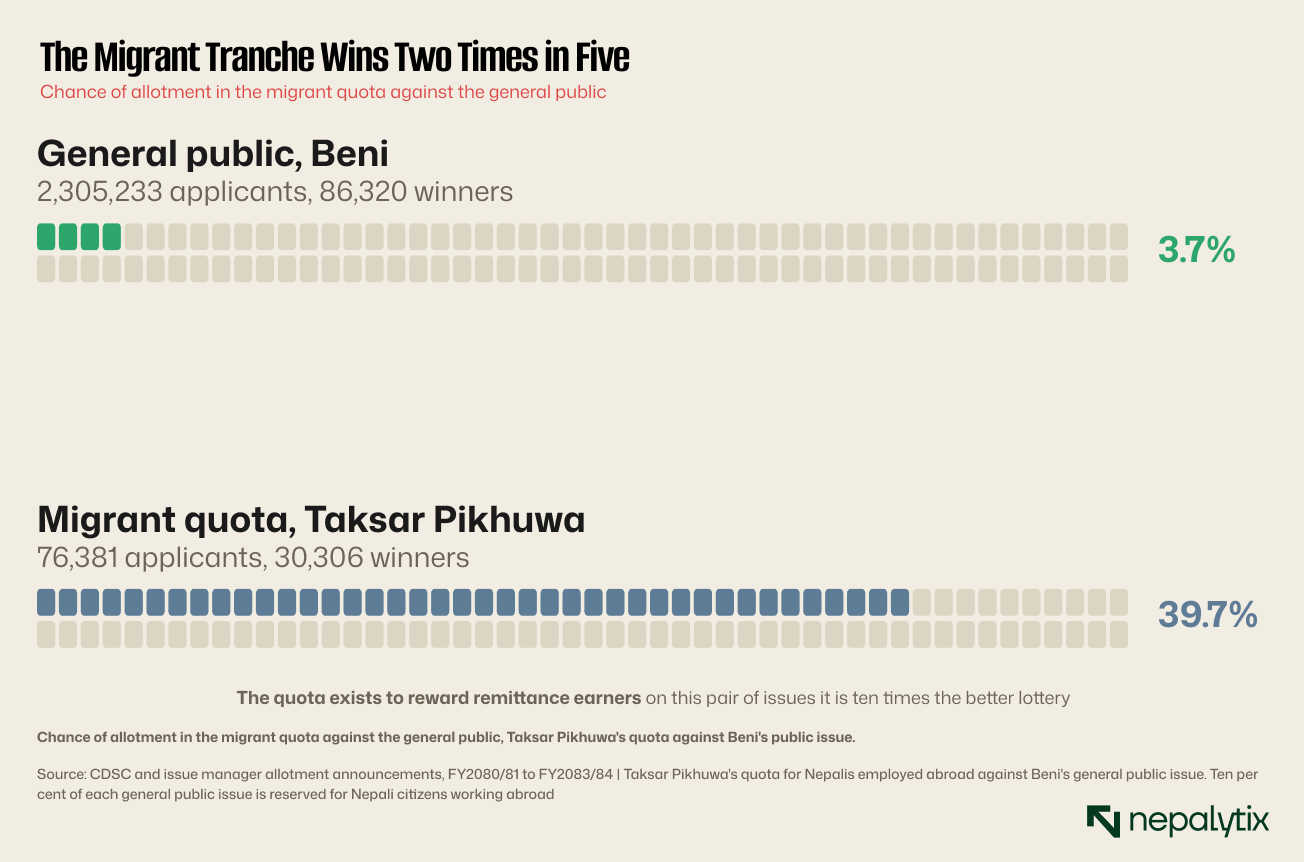
Ten per cent of each general public issue is reserved for Nepali citizens working abroad. The competition for that tranche is a different order of magnitude.
Taksar Pikhuwa's migrant quota of 3,03,067 units drew 76,381 valid applicants. 30,306 won ten units each. The odds were 39.68%.
Against Beni's general public tranche at 3.74% that is roughly ten times the chance. Two applicants in five win the migrant lottery. One in twenty-seven wins the public one.
The quota exists to give remittance earners a stake in the market. On this pair of issues it does that and considerably more: it is the best lottery on the exchange for anyone who qualifies.
The migrant quota also moved in a direction nobody has remarked on. Chirkhwa's reservation of 10% to Nepalis abroad sat alongside a general public lottery of 7.59% odds. Beni's sat alongside 3.74%. As the general lottery has worsened, the relative value of the quota has risen.
That matters for the remittance economy this publication examined on Thursday. The quota is one of the few direct channels linking Nepali earnings abroad to Nepali equity and on current odds it is worth using. Whether the 2.3 million general applicants include many who could have applied through the quota instead is not in the data.
Rejections are the last piece of the arithmetic and they are larger than most applicants assume. Bikash rejected 94,465 applications. Yambaling rejected 44,416. Beni rejected 46,327, the difference between 2,351,560 received and 2,305,233 valid.
The causes reported are demat account errors, duplicate applications and bank verification failures. An applicant rejected on a technicality is not in the lottery at all which for a first-time applicant is a worse outcome than losing it.
The pipeline
SEBON added Saurya Krishi and two investment companies to its approval pipeline in the past fortnight. CARE reaffirmed a BBB (Is) rating for Bajeko Sekuwa ahead of its issue. The board has 108 issues in its queue.
SEBON also published a draft directive on general eligibility for public issuance. Its content bears on which companies reach the queue and if it changes minimum issue sizes, on the odds this piece describes.
Every one of those 108 issues will meet the same two to three million applicants. The ones that offer the most shares will produce the most winners and the ones that offer the fewest will produce lotteries like Beni's.
The draft directive is the item to read closely. Nepali public issues are priced at the Rs 100 par value which the post-listing screen found produces no losers in either sample it examined. If the draft moves any category of issue toward book-building or a premium, the arithmetic above changes at the root: the median return falls, the expected value falls with it and the two million applicants may not all return.
A market that applies to everything because everything has paid is a market that depends on the pricing convention staying where it is. The directive is the first document in some time that could move it.
SEBON has also been asked how long it will take to clear 108 issues. At the recent pace of approvals the queue represents well over a year of issuance and each approval adds another lottery drawn against the same crowd.
What the numbers leave out
Six issues is a working sample and not a census. Allotment announcements are published issue by issue, and applicant and winner counts together were located for five general public issues and one migrant quota. Two further issues, Appolo and Super Khudi published winners without an applicant count and are excluded from every probability here.
The expected values rest on the median return from the post-listing screen which measured recent listings over a period when the whole cohort rose. A different market would produce a different median and the expected values would move with it. The ranking between issues would not, because it depends only on the odds.
And the figures describe the lottery, not the investment. An allottee who wins ten units still has to decide when to sell which the post-listing screen found is a decision with real money attached: the premium roughly halves as a listing ages.
The numbers also answer a question the post-listing screen left open. That piece found a market with no losing IPO and asked implicitly why the price was never corrected. The answer is visible here. The correction would come from applicants deciding an issue was not worth applying for and on these odds and returns no applicant has any reason to decide that. Every ticket is worth more than it costs.
A pricing mechanism that never disappoints produces a crowd that never thins and a crowd that never thins leaves the issue size as the only thing that varies. That is the state of the Nepali primary market in one sentence.
None of this is an argument against applying. On every issue in the sample the expected gain is positive and the downside is a few days of blocked money. It is an argument about where the value in the Nepali primary market actually sits which is with whoever sets the issue size and not with anybody's judgement about the company.
The week ahead
Beni lists next. Its opening band will run from Rs 100 to Rs 300 under the exchange's first-trade rules and the post-listing screen found every recent listing in its sample finished well above the top of that band. The 86,320 winners will find out within weeks what their ten units are worth.
Bajeko Sekuwa carries a CARE BBB rating into its issue which is higher than the BB-range ratings on most recent hydropower issues. It is a restaurant business rather than an infrastructure one which makes it a useful test of whether the crowd applies to anything or discriminates by sector.
And the Kartik quarterly statements will begin arriving from listed companies including the hydropower issuers whose shares these lotteries allocated. The first filings from the class of 2026 will show whether the businesses behind the allotments are earning what their prices imply.
Disclaimer
This report has been prepared by Nepalytix for informational and educational purposes only and does not constitute investment advice, an offer, or a solicitation to buy or sell any securities.
The information contained in this report is based on sources believed to be reliable; however, Nepalytix does not guarantee its accuracy, completeness, or timeliness. Opinions, estimates, and projections expressed herein are those of the authors as of the date of publication and are subject to change without notice.
Investing in securities involves risks, including the possible loss of principal. Past performance is not indicative of future results. Readers are advised to conduct their own independent research and consult with a qualified financial advisor before making any investment decisions.
Nepalytix and its contributors may hold positions in the securities discussed in this report at the time of publication or thereafter.
Neither Nepalytix nor any of its affiliates accept any liability for any loss arising from the use of this report or its contents.