Why Nepal’s Hydropower Stocks Move Together
Nepal has over 110 listed hydropower companies yet their shares often move together despite owning different plants raising a bigger question about how the sector is structured.
Hydropower is thirty-seven per cent of the companies listed on NEPSE and seventeen per cent of its value. The median one ranges 1.68 times in a year in a business with a fixed tariff and a single customer. Eleven share the same fifty-two week low.
Three hundred and two companies are listed on the Nepal Stock Exchange. One hundred and twelve of them generate electricity from water. That is thirty-seven per cent of the exchange and no other market in the region looks remotely like it.
Those 112 companies are worth Rs 771 billion between them which is seventeen per cent of NEPSE's value. So more than a third of the companies account for less than a fifth of the money. The median one is worth Rs 4.57 billion. Thirty-four are worth under Rs 3 billion. And thirty-four more are queued at the regulator waiting to join them.
This piece is about what happens when a country lists a hundred and twelve versions of the same business on one exchange, and about the price behaviour that follows from it. The short version is that these shares move together, move violently and move for reasons that have very little to do with rivers.
Some scale first because the numbers are easy to misread in either direction.
Nepal's installed capacity reached 4,120 megawatts by mid-July 2026 of which 3,905 is hydroelectric. Two decades ago the figure was under 600. The build-out has been genuine and rapid and the listed sector is how a large part of it was paid for.
Against the country's economically feasible potential usually estimated around 83,000 megawatts, what has been built is a small fraction. So the sector is simultaneously a real achievement and an early one which is part of why it attracts the capital it does. An investor buying a Nepali hydropower share is buying into a build-out that is demonstrably working and demonstrably unfinished.
What follows is not an argument that the sector is overvalued or that the plants are bad assets. Most of them generate electricity and get paid for it. It is an argument about the structure through which they are owned and about what that structure does to the prices of the securities that represent them.
The wall at three hundred rupees
Start with something odd in the data that turns out to explain a great deal.
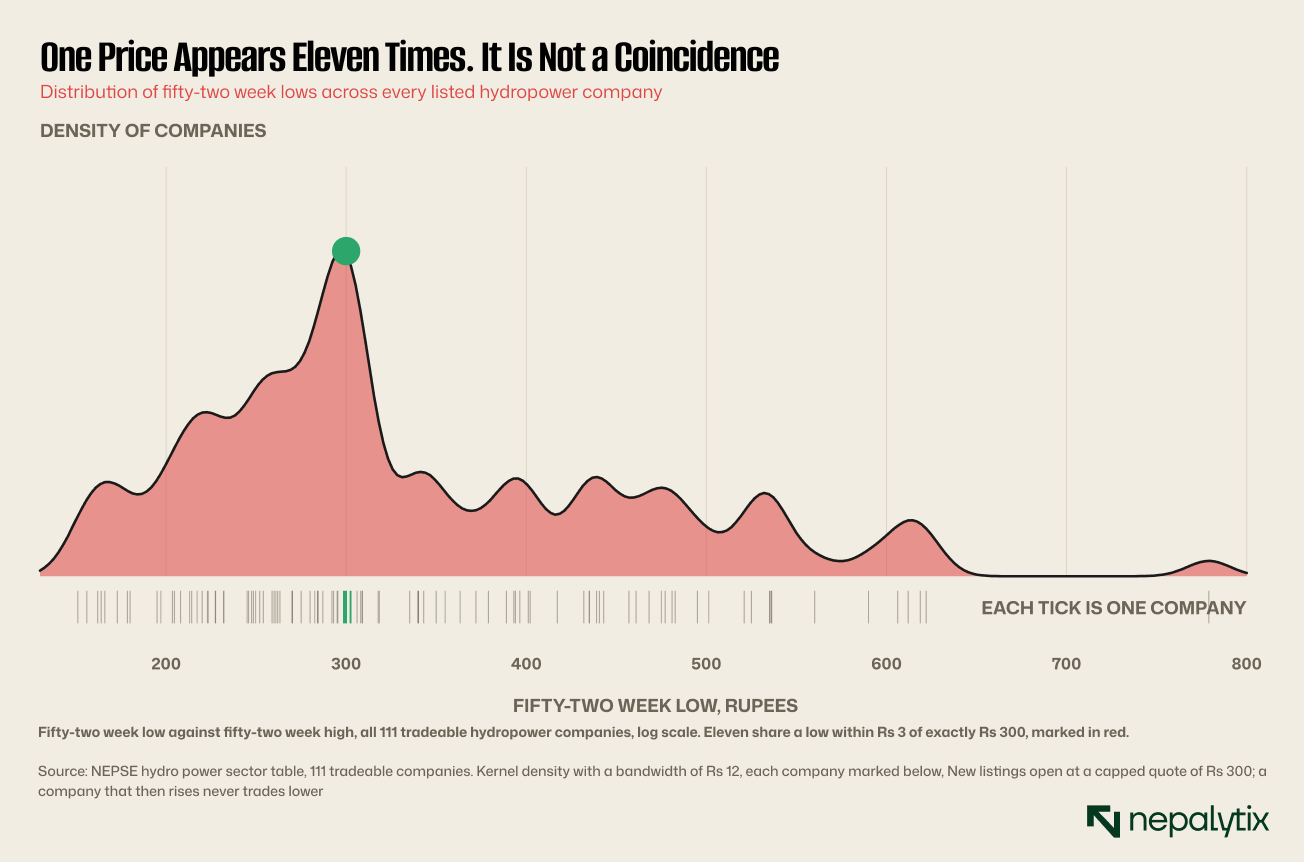
Eleven companies have a fifty-two week low of Rs 300 or within three rupees of it. Solu Hydropower, Super Khudi, Ridge Line Energy, Mount Everest Power, Kalinchock, Yambaling, Taksar Pikhuwa, Sanigad, Snow Rivers, Appolo and Bungal. Their lows are identical and their highs are not: they run from Rs 587 to Rs 1,592.
That vertical column of red dots is not a coincidence about water. It is a listing mechanic. When a new company lists on NEPSE, the opening quote is capped and for a recent issue the cap sits at Rs 300. So a company that lists and then rises never trades below its first day and its fifty-two week low is the cap rather than a price anyone discovered.
The consequence is that for these eleven the entire annual range is a record of what happened after an administratively fixed starting point. Ridge Line Energy opened at the cap reached Rs 1,592 and now sits at Rs 755. Super Khudi opened at the cap, reached Rs 1,360 and sits at Rs 732. Kalinchock: cap, Rs 1,325, now Rs 749.
Read that as a group and a pattern appears that has nothing to do with any individual company's hydrology, tariff or plant factor. List at a capped price, run three to five times, give half of it back. Eleven companies, one shape.
It is worth being careful about what the cap is and is not. NEPSE does not fix the price of a new listing indefinitely. It constrains the opening quote on the first day, after which normal circuit limits apply and the share finds its level. For a company that lists and falls, the cap is irrelevant within days. For a company that lists and rises, the cap becomes the lowest price that security will ever have traded at and it stays in the fifty-two week table for a year.
That asymmetry is why the eleven cluster. They are the ones that went up. Any company from the same cohort that went down has a low set by the market rather than by the rule and it sits somewhere else on the chart.
So Exhibit 1 is a survivorship pattern as much as a mechanical one and it should be read that way. What it shows is not that eleven companies are identical. It is that for eleven companies the entire recorded range of the year has an administrative number at one end of it and any statistic computed from that range inherits the number. A fifty-two week range, a position in that range, a volatility estimate drawn from the high and the low: all of them are partly measuring NEPSE's listing rule rather than the security.
This matters beyond presentation. The margin lending rule this publication examined yesterday values collateral partly on a 180-day average. For a company that listed six months ago at a capped price and tripled, that average is a number produced by the listing mechanic. A bank lending against it is lending against an artefact.
How far these things travel
The eleven are extreme but they are not aberrant. The whole sector moves like this.
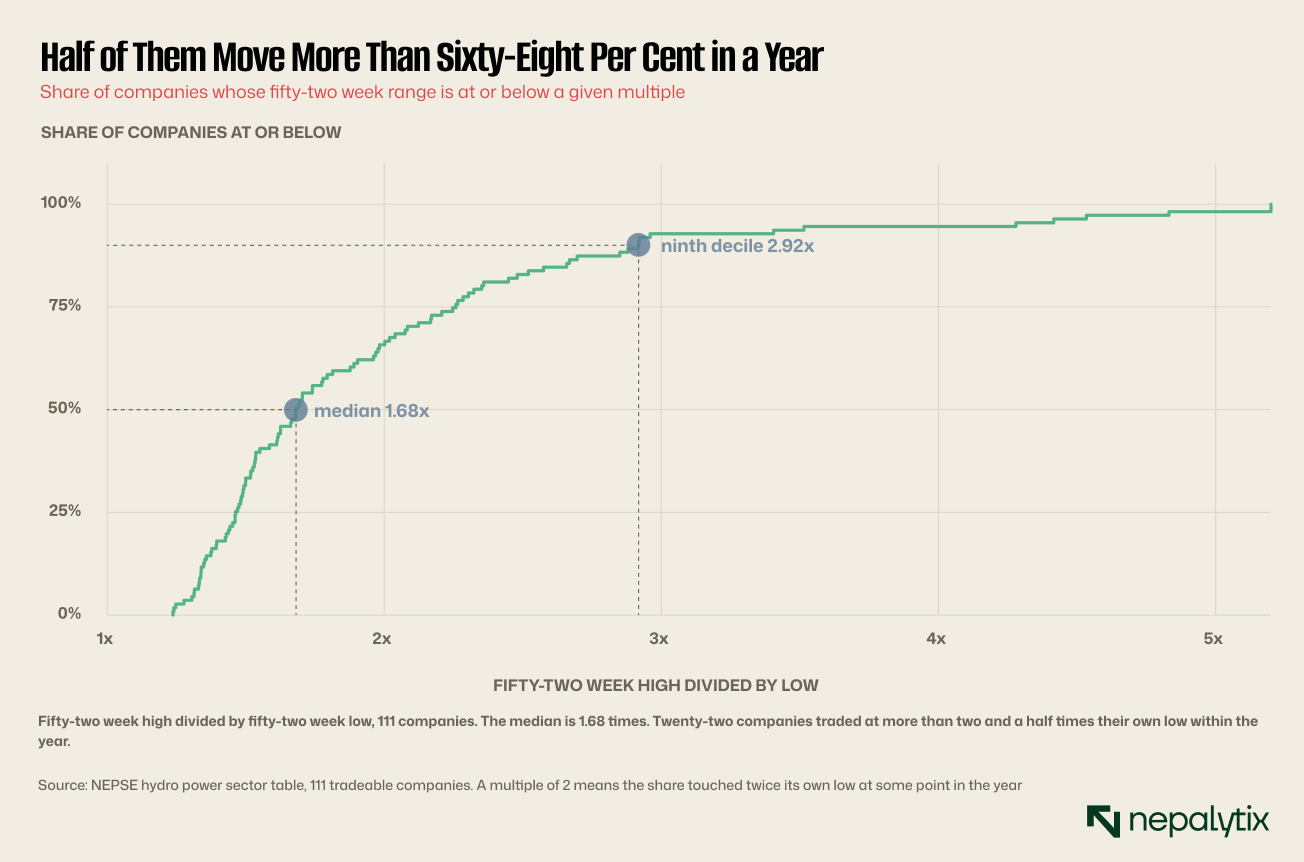
The median hydropower share on NEPSE traded at 1.68 times its own low at some point in the last twelve months. Twenty-two companies traded at more than two and a half times theirs. Suryakunda Hydro Electric ranged from Rs 284 to Rs 2,069, which is 7.3 times.
For context, a share doubling and halving inside a year is not what a regulated utility with a fixed-tariff power purchase agreement is supposed to do. The underlying business is about as predictable as a business gets: you build a plant, you sign a contract with the Nepal Electricity Authority at a set rate, the river delivers roughly what it delivered last year and you collect. There is no product cycle, no competitor taking share, no pricing decision.
Yet the equity behaves like a technology startup. Whatever is being priced in that range, it is not the operating performance of a run-of-river plant.
Look at where the mass sits. Sixty-one of the 111 companies fall in the 1.25 to 2 times band which is the ordinary condition of a Nepali hydropower share: it trades somewhere between its low and roughly double that over the course of a year. Only nine sit under 1.25 times which would be the range you might expect from a contracted utility.
The nine calmest are instructive. Upper Tamakoshi at 1.46 times, Sahas Urja at 1.34, Sanima Mai at 1.24, Green Ventures at 1.31. These are among the largest companies in the sector, with completed plants, long operating records and in Upper Tamakoshi's case, the biggest project in the country at 456 megawatts. They behave more like utilities because more is known about them.
The wildest are the opposite: recently listed, small and with short trading histories. Suryakunda ranged 7.3 times. Ridge Line 5.3. Bhujung 4.8. Super Khudi 4.5. Kalinchock 4.4. Every one of those listed within the last eighteen months.
Which suggests the volatility is not a property of hydropower. It is a property of a security that has not yet been priced, in a market where the process of finding a price involves very few transactions. The plant is the same plant on the day it lists as on the day it settles. What changes is how many people have formed a view about it.
There is a comparison that puts the range distribution in perspective. Nepal's non-life insurers, examined here last week, saw sector profit fall 39% in a catastrophe year. That is a genuine shock to a real business. The median hydropower share moved 68% between its own low and high in a year when nothing comparable happened to most of the underlying plants.
Put differently: the price movement in a typical Nepali hydropower share over twelve months exceeds the earnings impact of the worst claims year an insurance sector has had in living memory. That is not a statement about which sector is riskier. It is a statement about how much of the hydropower price movement can plausibly be attributed to the business at all.
A hundred and twelve of roughly the same thing
Part of the answer is that these companies are far more alike than a list of 112 names suggests.
The typical listed Nepali hydropower company owns one plant on one river, sells its entire output to a single buyer under a power purchase agreement at a fixed tariff and has no other business. Its revenue is a function of how much water came down and how many hours the plant ran. Its costs are dominated by debt service on the construction loan. Its growth options consist of building another plant which requires another licence and another river.
That is a description of an infrastructure asset rather than a company. It also means that almost every variable that moves one of them moves all of them: the tariff regime, the authority's willingness to pay, the monsoon, the cost of debt, the regulatory treatment of dedicated feeder charges.
So an exchange with 112 of them does not have 112 independent bets. It has a handful of common factors and a very long list of tickers.
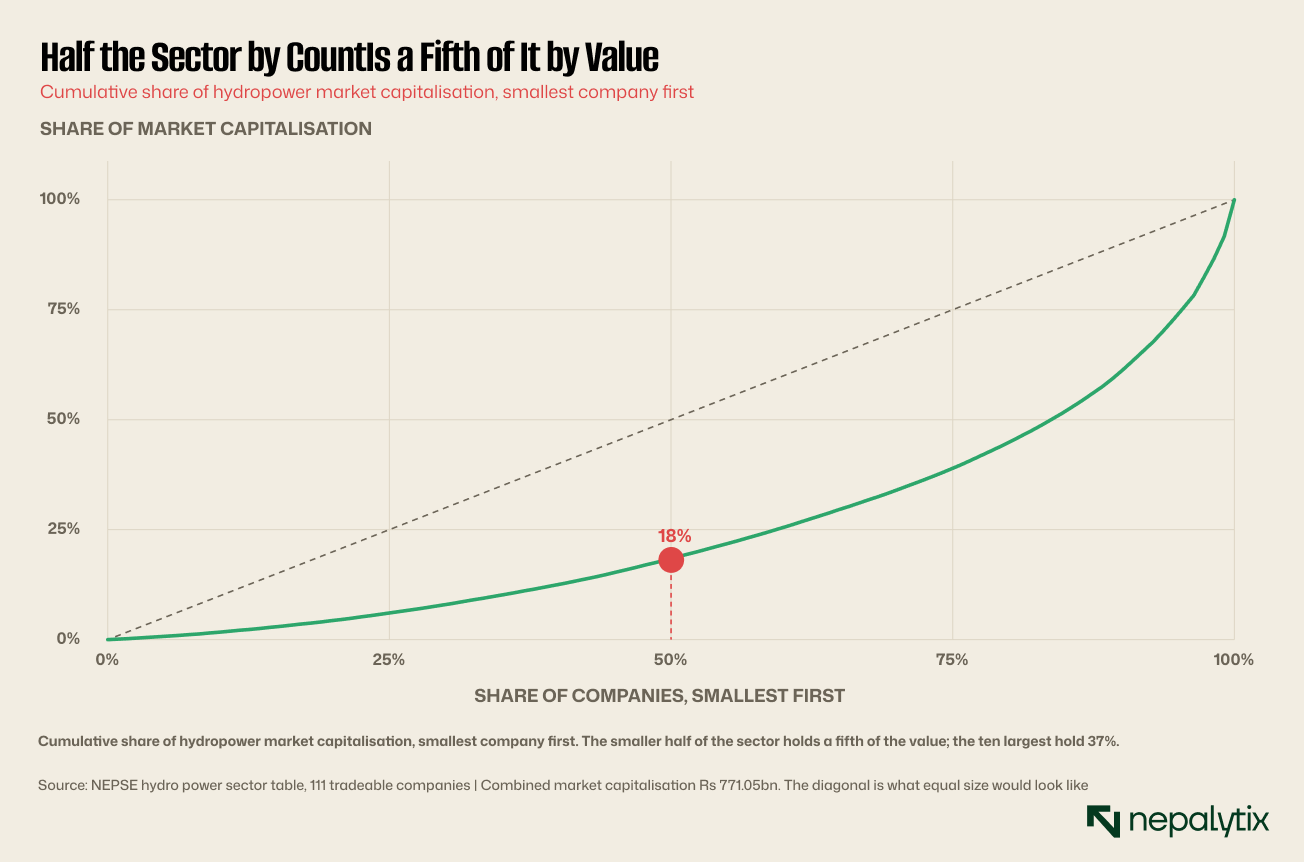
Size compounds the problem. The smaller half of the sector, fifty-five companies, holds a fifth of the value. The ten largest hold thirty-seven per cent. Solu Hydropower alone is 8.3%.
Below the top twenty, market capitalisations fall through Rs 5 billion and keep going. Dibyashwori Hydropower is worth Rs 710 million. Mailung Khola is worth Rs 1.03 billion. These are listed public companies with quarterly filings, annual meetings, boards, auditors and all the apparatus of a public market, attached to a single small plant.
Consider what this uniformity means for an investor trying to distinguish between them.
The variables that actually differentiate one Nepali hydropower company from another are: the installed capacity of its plant, the hydrology of its river, the tariff in its power purchase agreement, the remaining life of that agreement, its debt load and its exposure to the specific hazards of its valley.
Of those six, exactly one is reliably published: the debt load, which appears in the balance sheet. Installed capacity is disclosed at listing and rarely thereafter in a consolidated form. Hydrology is not published at all. Tariff terms are commercially confidential. Remaining PPA life is buried in prospectuses. And hazard exposure, as the August flood demonstrated, is not disclosed by anyone until the hazard arrives.
So an investor comparing two hydropower shares has access to price, market capitalisation, earnings, dividends and debt. They have almost nothing about the asset. The distinguishing information is precisely the information that is not published which means the shares trade on the information that is: recent price action, sector sentiment and whatever is in the news.
That is a reasonable explanation for why 112 companies with different rivers and different plants move together. It is not that investors are lazy. It is that the differentiating data does not exist in usable form.
The concentration figures also explain something about how the sector appears in market commentary. Because the ten largest hold 37% of the value, any sector index is dominated by them. Because the smaller half holds 18% most of the companies barely register in the aggregate no matter what they do.
So a reader following the hydropower sub-index is watching perhaps twenty companies with the other ninety supplying noise. And an investor holding a basket of small hydropower shares is holding something whose behaviour the index does not describe.
This is a general problem with capitalisation-weighted measures in a long-tailed sector and it is more acute here than almost anywhere because the tail is so long. Ninety companies below Rs 6 billion is not a tail. It is most of the sector by count and a minority of it by every other measure.
Size explains nothing
The natural assumption is that the small ones are the volatile ones. It is worth testing rather than assuming.
It does not hold, and the test is worth stating rather than charting because the answer is a null. The correlation between market capitalisation and the size of the annual range across all 111 companies is minus 0.04 which is no relationship at all. The twelve largest do average a narrower range, 1.50 times against 2.06 for those under Rs 2 billion. But the Rs 5 to 15 billion group averages 2.31 times wider than either so the pattern does not even run monotonically.
Solu Hydropower is the largest company in the sector at Rs 64 billion and its shares ranged 2.9 times. Upper Tamakoshi, the second largest and the owner of the country's biggest plant at 456 megawatts, ranged 1.5 times.
If size does not explain the volatility and the underlying businesses are contracted utilities, the explanation has to sit somewhere else. It sits in who owns these shares and why.
There is a second reading of the null result worth taking seriously because it points at something structural rather than statistical.
In most markets, size correlates with liquidity and liquidity dampens volatility. A large company has more shares outstanding, more holders, more analysts and more turnover so a given quantity of buying or selling moves the price less. That mechanism is why the relationship usually exists.
In Nepal it is weakened at both ends. A large hydropower company is large in market capitalisation but its free float may not be because promoters hold a majority and the local tranche is held by district residents who rarely trade. So the tradeable quantity does not scale with the headline size the way it does elsewhere. Solu Hydropower is worth Rs 64 billion and its shares still ranged 2.9 times.
And at the small end, the companies are so small that the difference between Rs 1 billion and Rs 3 billion of market capitalisation is immaterial to how the security behaves. Both are thin. Both move on a handful of orders.
So the usual mechanism connecting size to stability barely operates. What remains is idiosyncratic: how recently the company listed, whether anything has happened to it and who happens to be trading it that week.
Test the point against the two ends of the size range and it holds up.
Solu Hydropower is the largest company in the sector, worth Rs 64 billion, more than eight per cent of the whole. It listed recently enough that its fifty-two week low is the Rs 300 cap. It reached Rs 875 and now trades at Rs 640. So the biggest company in Nepali hydropower has an annual range shaped by a listing rule and has given back a quarter of its peak.
Dibyashwori Hydropower is the smallest with a published market capitalisation at Rs 710 million. Its range was Rs 254 to Rs 345, which is 1.36 times, one of the calmest in the sector. It trades at Rs 269.
The largest company is more volatile than the smallest. Whatever is driving the ranges in Exhibit 2, it is not capitalisation and the most likely candidate is how long the security has been trading and how much is known about it.
Where the sector is now
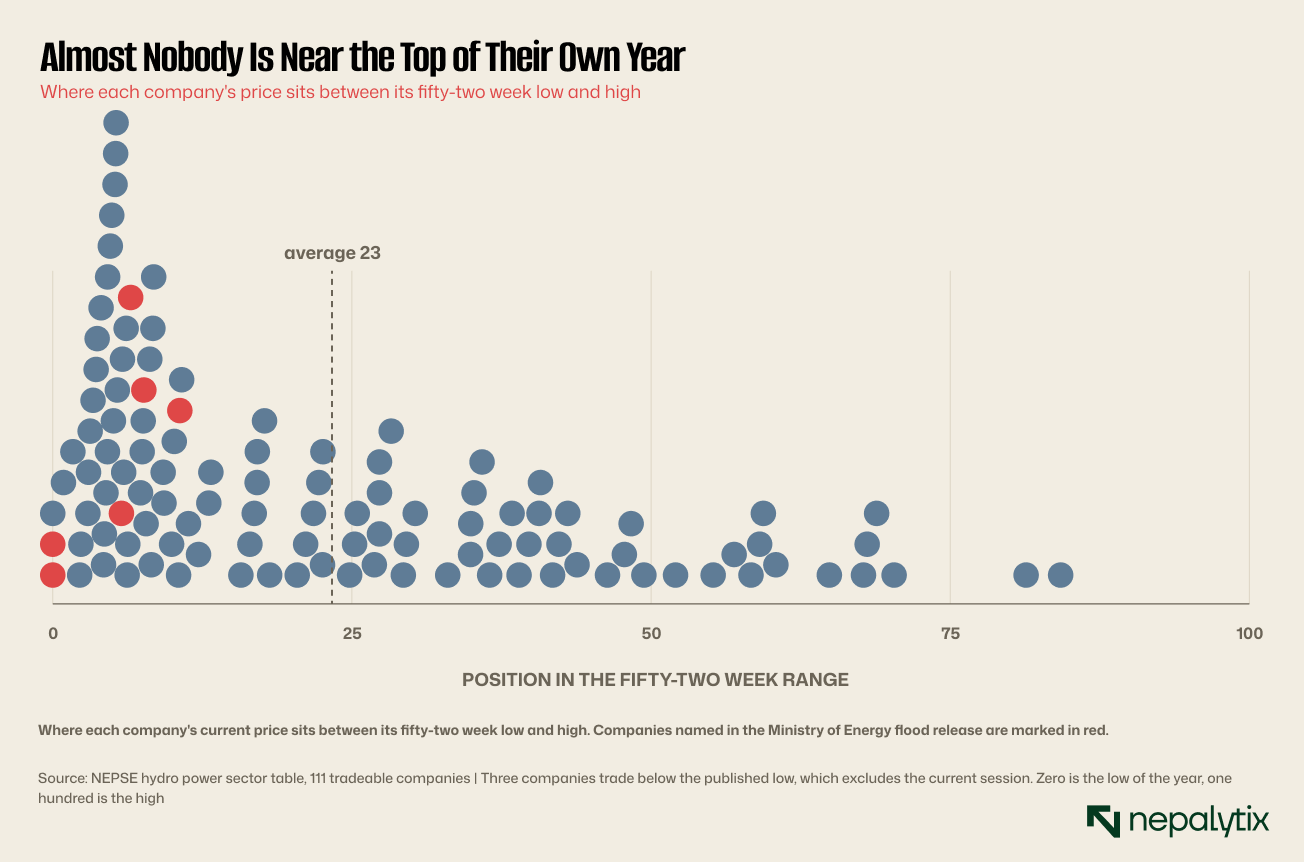
Take every company and ask where today's price sits between its own low and its own high. If the sector were behaving independently, those positions would scatter across the range.
They do not. The bulk of the sector clusters in the lower half of its own year and the average company sits well below the midpoint. Almost nobody is near their high.
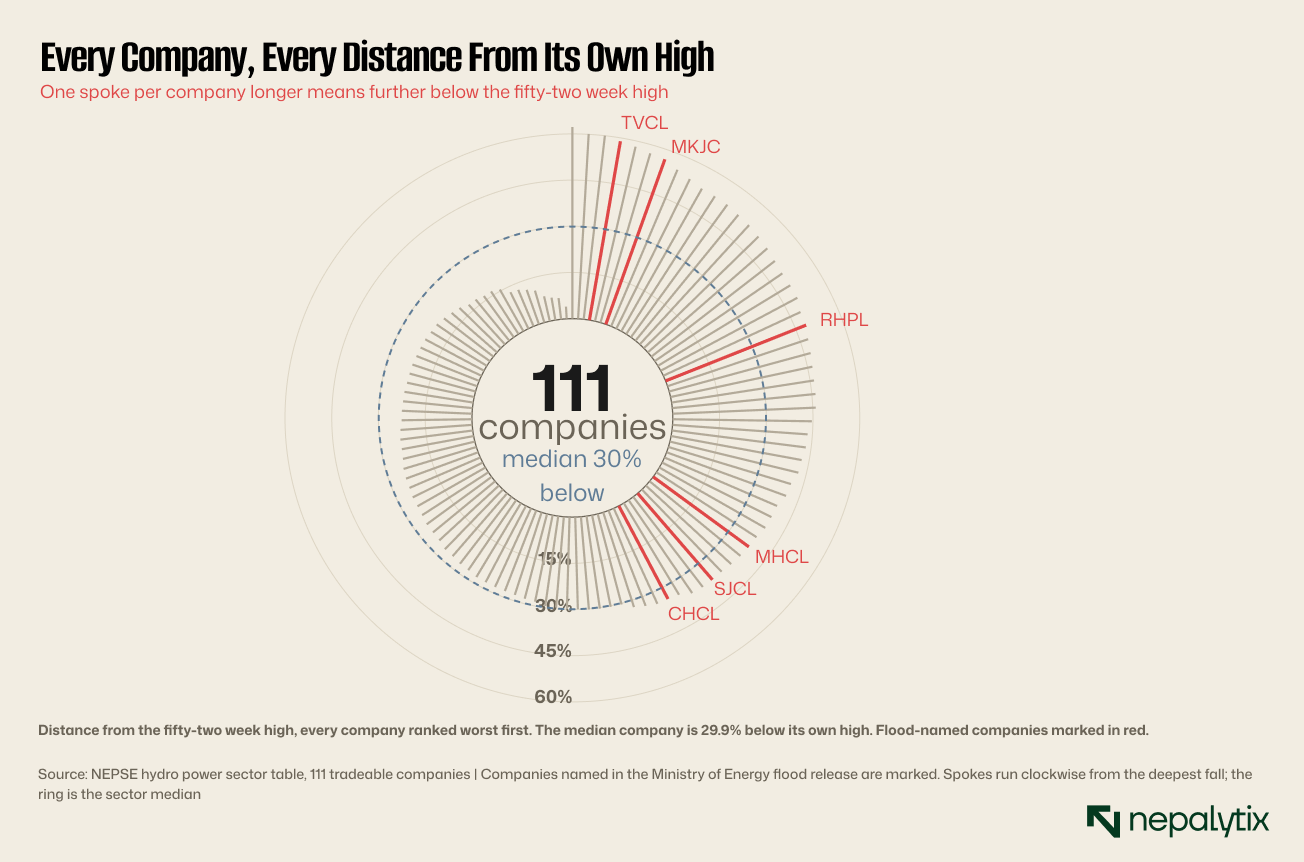
The median company is 29.9% below its fifty-two week high. Three Star Hydropower is 62% below. Suryakunda 60%. Bhugol Energy 60%. Trishuli Jal Vidhyut 59%.
Note where the flood names sit on that curve. Rasuwagadhi is deep in the left tail which is what you would expect for a company whose plant was damaged. But Chilime, Molung, Mailung and Sanjen sit among the general population rather than apart from it. The sector was already well below its highs before the water came down on 26 August.
This matters for how the flood should be read. It was a genuine event with genuine damage and it repriced specific companies. It was not the cause of the sector's condition. That was already in place.
The clustering has a practical implication that is easy to miss. If most of the sector sits in the lower half of its own range simultaneously, then the sector has a common factor doing most of the work and the position of any individual company tells you very little about that company.
An investor looking at a hydropower share 40% below its high might reasonably conclude the market has become pessimistic about that business. Exhibit 6 says otherwise: being 30% below the high is the median condition. The company is not being singled out. It is being carried.
That cuts both ways for anyone trying to find value here. The good news is that a share which has fallen with the sector has not necessarily deteriorated. The bad news is that a share which has held up has not necessarily done anything right and distinguishing between the two requires exactly the asset-level information that is not published.
Look at the shape of the cluster rather than just its centre. The dots bunch heavily between about 10 and 40 on the range position, thin out above 50, and almost disappear above 75. Very few companies are anywhere near their annual high.
In a sector of genuinely independent businesses that distribution would be close to uniform because each company would be somewhere in its own cycle. Some would be having a good year, some a bad one and the positions would spread. A distribution this skewed means the companies are sharing a single condition.
What that condition is, the data cannot say. It could be the sector's derating, the broader market's fall from 2,794.79 to 2,597.80 over the fiscal year, the supply pressure from the IPO queue, tightening margin credit or investor rotation out of the sector. Most likely it is several of those at once, which is exactly why individual companies cannot separate themselves from it.
One last note on the flood names before leaving them. Molung Hydropower and Mailung Khola are both small companies worth Rs 2.21 billion and Rs 1.03 billion. Both were named in the ministry release. Both trade well below their highs.
For a company of that size, a damaged plant is not a setback within a portfolio. It is the company. Mailung Khola owns one asset on one river and that river flooded. There is no second plant to carry the repair period, no diversified revenue to service the debt while the turbines are down and no balance sheet deep enough to absorb a rebuild without new capital.
That is the concentration risk this structure creates, stated at the level where it actually bites. The sector as a whole lost a few per cent of capacity. Individual small companies on that river may have lost most of what they own.
Why Nepal ended up here
None of this was designed. It is the accumulated result of three separate policies that each made sense on its own.
The first is licensing. Nepal issued generation licences project by project, to whoever could assemble the capital and the permits for a single scheme. That produced hundreds of single-project companies rather than a handful of developers with portfolios.
The second is the capital requirement. A hydropower project needs equity and Nepali promoters raised it by selling shares to the public. Public issuance came with listing. So the corporate structure that financed the build-out is the same structure now trading on the exchange.
The third is the local shareholder rule. Projects must offer shares to residents of the affected districts which means each company arrives with a shareholder register spread across a hill district and a public listing to make those shares tradeable.
Every one of those is defensible. Licensing per project spread opportunity rather than concentrating it. Public equity funded plants that debt alone could not. Local shareholding gave affected communities a stake. Together they produced 112 listed companies where a different set of rules would have produced perhaps a dozen.
Installed capacity has reached 4,120 megawatts of which 3,905 is hydro. The build-out worked. The question is whether the ownership structure that financed it is the right one to carry it now.
The local shareholder rule deserves particular attention because it is the least discussed and arguably the most consequential of the three.
A hydropower developer must offer shares to residents of the project-affected districts, at par before the general public. The intent is clear and defensible: a community that gives up land and bears the disruption of construction should share in the returns.
What it produces is a shareholder register concentrated in one hill district, holding shares in one company, in an asset located where they live. That is the opposite of diversification for those households. Their employment, their land value and their financial savings are all exposed to the same river.
The August flood made that concrete. Residents of Rasuwa who hold Rasuwagadhi shares watched their district damaged and their savings fall 49% from the year's high in the same fortnight. The policy that gave them a stake also concentrated their risk in precisely the way a financial adviser would warn against.
None of which argues the rule is wrong. It argues that the rule has a cost that was never priced and that the cost falls on the people the rule was written to help.
There is a fourth policy that shaped this and it operates in the other direction: the Nepal Electricity Authority as sole buyer.
Nepali hydropower companies sell to one customer. The power purchase agreement fixes the tariff often with a seasonal split between wet and dry months and runs for a defined term. That arrangement made the build-out financeable because a bank lending against a project could see contracted revenue rather than merchant price risk.
But it also means every listed hydropower company has the same counterparty. The authority's financial condition, its willingness to pay on time, its treatment of dedicated feeder charges and its position on tariff renewals are common exposures across all 112. When the authority disputes an invoice or changes a policy, it moves the whole sector.
Combine that with the same regulator, the same monsoon and the same tariff framework and the list of genuinely company-specific variables shrinks to two: which river, and how much debt. That is a thin basis on which to run a hundred and twelve separate listings.
It is worth noting that Nepal chose the opposite of the model most countries use.
In most markets a hydropower build-out is financed by a small number of utilities or independent power producers that own portfolios and raise capital against the whole. India has a handful of large generators. Norway, whose hydropower endowment is comparable in character, runs most of it through Statkraft and a set of municipal utilities.
Nepal financed its build-out by taking each project public. That was not an ideological choice. It reflected a shortage of large domestic balance sheets, a banking system with single-borrower limits that constrained project lending and a policy preference for spreading ownership. Given those constraints, selling equity project by project was the available route.
The result is that Nepal has more listed hydropower companies than most countries have listed companies of any kind in the sector. That is a genuinely unusual capital markets outcome and it was arrived at without anyone deciding it.
What the structure costs
Four costs follow from it and they are worth naming precisely.
Nothing trades properly. A sector where the median company is worth Rs 4.57 billion and free float is a fraction of that produces securities that change hands a handful of times a session. This publication has documented what that does elsewhere: prices set by very few transactions, collateral that cannot be valued and circuit limits that bind on any real news.
Analysis does not scale. No research operation in Nepal can cover 112 single-asset companies. So most of them are never analysed at all and the ones that are get covered by the same small number of people. Prices move on sector sentiment because there is no company-specific information competing with it.
Diversification is an illusion. An investor holding ten hydropower shares believes they hold a diversified portfolio. They hold ten claims on the same tariff regime, the same buyer, the same monsoon and the same regulator. Exhibit 4 is what that looks like when the common factors move: everyone in the lower half of their range at once.
The listing mechanic dominates the price. Exhibit 1 is the sharpest evidence. Eleven companies with the same starting price, three to five times the range and now sitting at roughly half their peaks. That is a pattern produced by how the shares were introduced not by what the companies did.
There is a fifth cost that only appears when something goes wrong and August supplied the demonstration.
When a flood damages fourteen projects, the market must reprice fourteen separate listed securities, each with its own shareholder base, its own board and its own disclosure obligation. Fourteen companies must each independently assess damage, each decide what to disclose and when and each answer to a separate register.
Under a portfolio structure, one company would assess damage across its affected plants, disclose once and let the market price a diversified asset base against a partial loss. The information problem would be a fraction of the size and the diversification would absorb part of the shock rather than concentrating it.
Instead, three weeks after the event, no listed company has published a repair timeline and the market is pricing on ministry press releases that disagree with each other by nearly a factor of two. That is not a failure of any individual company. It is what happens when the disclosure burden is fragmented across a hundred and twelve registrants.
Two further consequences of the structure are worth setting out because they bear on the rest of the market rather than only on this sector.
The first concerns the IPO queue. Thirty-four hydropower companies sit in the SEBON application list and this publication established a fortnight ago that hydropower is the largest cohort in that queue by count while manufacturing is larger by value. Each of those thirty-four is another single-asset company seeking another listing. The pipeline does not consolidate the sector; it extends it.
The second concerns collateral. Yesterday's Take examined margin lending, where banks advance up to eighty per cent against listed shares valued at the lower of the 180-day average and the market price. A sector whose median company ranges 1.68 times a year whose recent listings range three to five times, and whose prices are set by very few transactions is a difficult thing to lend against. Hydropower is 112 of the 302 securities a Nepali bank might be holding as security.
Neither of those is a hydropower problem in origin. Both are consequences of having built a third of the exchange out of single-project companies.
Thirty-seven per cent of the companies, seventeen per cent of the value
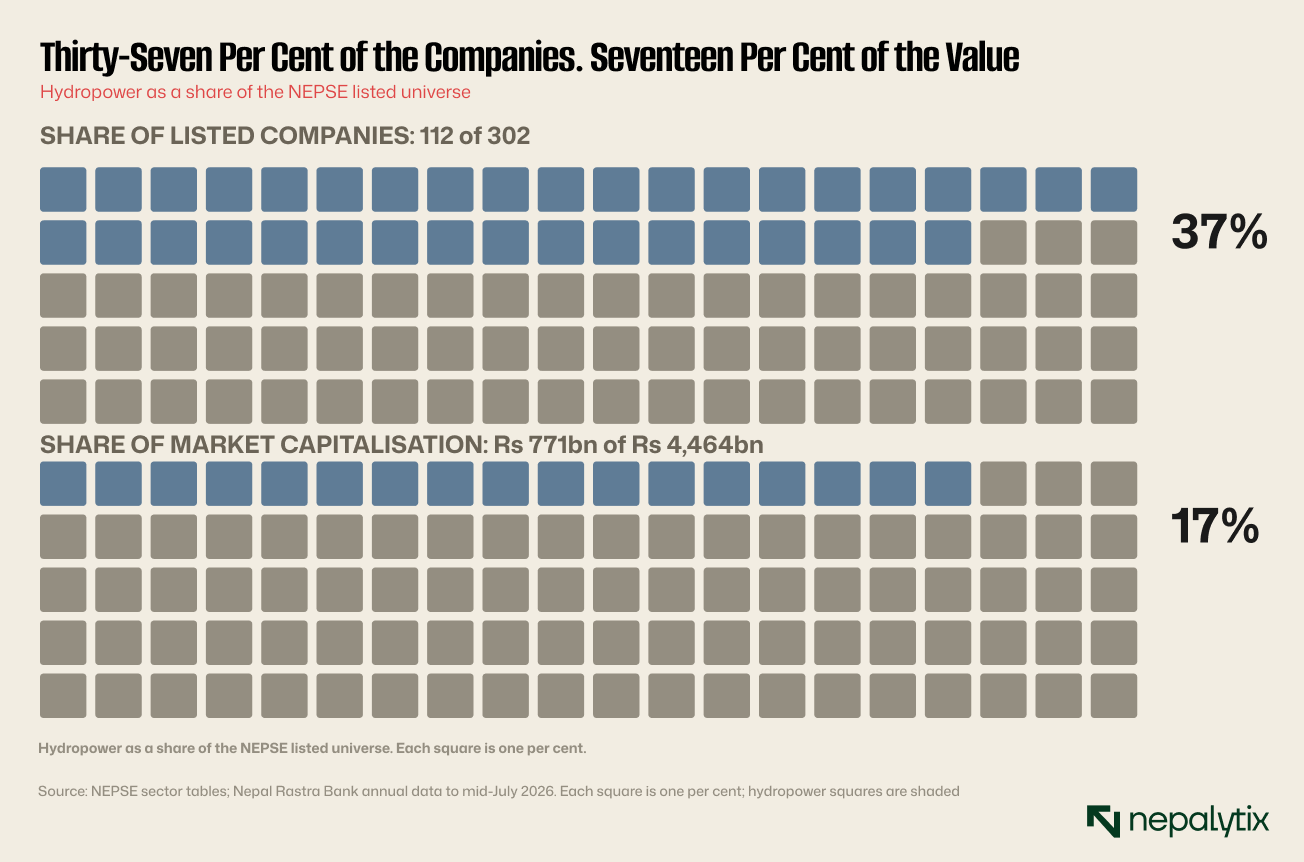
Set the two proportions side by side and the structural oddity is visible. Hydropower is more than a third of the companies on the exchange and less than a fifth of its value.
The gap is the cost of listing small. Every one of those 112 companies consumes the same regulatory and market infrastructure as a commercial bank: a prospectus, a listing, quarterly statements, an annual general meeting, a slot on the trading screen, coverage in every market summary. The exchange carries the administrative weight of a third of its universe for a fifth of its capitalisation.
And the queue is not shrinking. Thirty-four more hydropower companies sit in the SEBON application list seeking Rs 17.50 billion. If all of them list, the sector approaches 150 companies and the additional capital raised is about 2.3% of the sector's existing market value.
The administrative burden runs in both directions and the company side is heavier than the exchange side.
A listed company in Nepal must publish quarterly unaudited statements, hold an annual general meeting with a quorum, maintain a share registrar, appoint independent directors, file with SEBON and the exchange and answer to a shareholder base that for a hydropower company frequently numbers in the tens of thousands because of the local and public tranches.
For a commercial bank with Rs 20 billion of paid-up capital, that apparatus is a rounding error against the benefits of a listing. For Dibyashwori Hydropower worth Rs 710 million, it is a material fixed cost carried by a single small plant. The company was listed because that is how the equity was raised not because a listing was the right long-term home for the asset.
There is also a scarcity that nobody accounts for. Nepal has a limited number of qualified independent directors, auditors experienced in the sector and company secretaries. Spreading them across 112 hydropower companies rather than a dozen means each gets a thinner share of the available governance capacity.
The waffle in Exhibit 5 makes a comparison worth stating plainly. Banking and insurance together are 133 listed companies and 51.8% of NEPSE's market capitalisation. Hydropower is 112 companies and 17.5%.
So the two blocks are similar in company count and utterly different in weight. A commercial bank listing represents Rs 15 to 30 billion of market value; a hydropower listing represents Rs 4.57 billion at the median. The exchange processes them identically.
That asymmetry shows up in every market statistic Nepal produces. When a summary says a certain number of companies advanced or declined, hydropower supplies a third of the count and a fifth of the value so breadth measures are dominated by a sector that moves as a bloc. The 32 advancing and 75 declining in the latest hydropower session is a meaningful share of any day's market breadth.
One more angle on the flood, because it tests a claim the sector makes about itself.
Hydropower is routinely described in Nepal as a stable, contracted, utility-like investment. The power purchase agreement fixes the tariff, the river is reliable, the buyer is the state. On that description these should be among the calmest securities on the exchange.
August showed the other side of it. A single meteorological event on a single river damaged fourteen projects at once, because the projects cluster where the gradient is. The concentration that makes construction economic also concentrates the hazard and no amount of contracting protects a plant from the water that runs it.
So the utility framing is half right. The revenue is contracted and predictable. The asset is physical and sits in a valley. An investor is buying a bond-like income stream attached to a structure in the path of a river and the equity carries all of the second part.
What could change it
The structural fix is consolidation and it is worth being honest that Nepal has just tried this in another sector with ambiguous results. Last week's Long Read examined the forced merger of twenty non-life insurers into fourteen and found the merged companies performed no better than the ones that stayed independent in the year that tested them.
Hydropower is a different case in one important respect. Insurance mergers combine underwriting books, which is genuinely difficult. Combining hydropower companies combines assets: two plants, two power purchase agreements, one balance sheet, one listing. The operational integration is close to trivial because there is very little operation to integrate.
The benefits would be real. A company with eight plants across four river basins has genuine hydrological diversification, which is the only diversification that matters in this business. Its shares would trade in a size worth analysing. Its debt would price better. And the exchange would carry forty listings instead of a hundred and fifty.
The obstacles are equally real. Promoters of single-project companies control them and a merger dilutes that control. Local shareholders were sold shares in a specific plant in their district, not in a portfolio. And any merger requires a swap ratio which requires valuing companies whose shares range 1.68 times in a year.
Short of consolidation, three smaller changes would help. Publishing plant-level generation data by company would give the market something company-specific to price. Requiring disclosure of hydrological risk including the glacial lake exposure documented after the August flood would let investors distinguish a plant on a stable river from one below a dangerous lake. And reconsidering the opening-price cap would stop the exchange manufacturing the pattern in Exhibit 1.
It is worth asking what a consolidated sector would actually look like because the arithmetic is available.
Rs 771 billion of market capitalisation across forty companies would put the average at Rs 19 billion which is roughly where Sanima Mai sits today. Those companies would be large enough to attract research coverage, liquid enough for institutions to hold, and diversified enough that a single flood would not be an existential event for any of them.
Twenty companies would average Rs 38 billion, close to Upper Tamakoshi. That is a size at which a Nepali company can raise debt internationally, hedge currency exposure and fund a development pipeline from retained earnings rather than from a new public issue for every project.
Set against that, the current structure produces a median company of Rs 4.57 billion which can do none of those things. Each new project requires a new company, a new IPO, a new listing and a new set of local shareholders which is why thirty-four more are queued.
The counter-argument is that consolidation concentrates control, and Nepal deliberately spread hydropower ownership to avoid exactly that. A sector of twenty companies is a sector where twenty groups of promoters control the country's electricity generation. Given how Nepal's banking sector concentrated after its own merger wave, that concern is not theoretical.
Whether consolidation happens is not really a question about hydropower. It is a question about who benefits from the current arrangement.
Promoters of single-project companies hold control of a listed vehicle which carries status, access to capital and the ability to raise more equity for the next project. A merger converts that into a minority stake in something larger. The incentive runs against combining.
Merchant bankers earn fees from issues and thirty-four more IPOs in the queue is thirty-four more mandates. The incentive runs against combining.
Local shareholders were sold a stake in a plant in their district and may reasonably object to holding a stake in a portfolio spread across the country. The incentive runs against combining.
Investors would benefit from larger, more liquid, better-analysed companies and the exchange would benefit from carrying fewer registrants for the same value. Neither has any mechanism to bring it about.
Which is why absent a capital requirement of the kind the Insurance Authority imposed, the sector will continue to look like this. And the insurance precedent suggests that even a forced consolidation would need a clearer objective than making the register tidier.
A final observation about the queue because it determines whether this gets better or worse.
Thirty-four hydropower companies are waiting to list, seeking Rs 17.50 billion between them. That averages Rs 515 million per company, which would place almost all of them in the bottom quartile of the existing sector on day one.
So the pipeline is not bringing scale. It is bringing more of what is already there: small single-asset companies with a capped opening price, a local shareholder tranche and a fifty-two week low that will be set by the listing rule rather than by the market.
If all thirty-four list, the sector reaches roughly 146 companies and the median market capitalisation falls. The exchange carries more registrants for a sector that already accounts for a third of its companies and a fifth of its value.
The thing to hold on to
Nepal built almost four thousand megawatts of hydropower and financed a large part of it by selling shares to the public. That is a genuine achievement and the listed sector is the record of it.
What the exchange now carries is a hundred and twelve companies that own one asset each, sell to one customer at a fixed price and trade on a common set of factors none of them controls. Their prices range by a median 1.68 times a year in a business with no product cycle. Eleven of them share a fifty-two week low set by an administrative cap. The median sits thirty per cent below its own high and the sector was already there before a flood took fourteen projects off one river.
Thirty-four more are waiting to join.
One last thing about what the numbers in this piece do and do not say.
Every figure here comes from prices. Not one comes from a plant. This publication could not establish installed capacity by listed company, generation by plant, hydrological records, tariff terms or hazard exposure because none of it is published in a form that can be assembled across the sector.
So an entire analysis of Nepal's largest listed cohort has been conducted on market data alone. That is a limitation of the piece and it is also the finding. If the differentiating information were available, this would be a different article about which rivers and which agreements are worth owning. It is not available which is why it is an article about a hundred and twelve securities that move together.
The market is in the same position. It is pricing 112 companies on the only information anyone has and the only information anyone has is the price.
What the flood did to the companies on that river
Rasuwagadhi is the clearest case. Its high for the year was Rs 325 and it now trades at Rs 167 which is 49% below. On 26 August it fell 15.00% hitting its circuit limit and it has kept falling since.
Trishuli Jal Vidhyut is 59% below its high at Rs 283. Molung Hydropower is 38% below at Rs 275. Sanjen is 37% below at Rs 230. Chilime, the sector's blue chip and 51% owned by the Nepal Electricity Authority is 34% below at Rs 346.
What none of these numbers tell you is how much damage each company actually took. The ministry named fourteen projects. Three official estimates of lost capacity circulated within a day of each other and ranged from 405 to 748 megawatts. No listed company has published a repair timeline. No insurer has disclosed exposure.
So the market has repriced these securities by between a third and a half on information that does not exist yet. That is not irrational. It is what a market does when it must hold an unquantified risk. But it means those prices are placeholders rather than valuations.
One further observation about the flood names. Chilime is the sector's blue chip by any measure: the longest dividend record, 51% ownership by the Nepal Electricity Authority and the third largest market capitalisation in the sector at Rs 32.82 billion. It has been paying dividends nearly every year since FY2060/61.
It is 34% below its fifty-two week high, which places it close to the sector median. So the best-regarded company in Nepali hydropower, majority owned by the state utility that buys its output has behaved in the last year almost exactly like the average of a hundred and eleven others.
Either the market is failing to distinguish Chilime from the rest or there is nothing much to distinguish. Both readings support the same conclusion about what these securities actually are.
One detail in the flood data is worth recording because it will matter to how this is eventually assessed. The six listed companies named in the ministry release are spread across the drawdown curve rather than bunched at the bottom of it. Only Rasuwagadhi sits clearly in the left tail.
Two readings are available. Either the market has correctly distinguished the company whose plant was worst hit from the ones that were named but lightly affected which would be a point in its favour. Or it has not distinguished them at all, and the other five simply fell with the sector for reasons unconnected to the flood.
Nothing published lets anyone choose between those. The ministry named projects; it did not grade the damage. Until the affected companies file, the market's apparent discrimination is indistinguishable from coincidence and anyone claiming the prices reflect the damage is asserting something the data does not support.
Set that against the sector's own reporting cycle and the gap is stark. These companies file quarterly and the quarterly statement carries revenue, profit and balance sheet. What it does not carry is how many megawatt-hours the plant produced, how the river ran against its long-term average or what condition the assets are in.
So a hydropower investor receives financial statements for an asset whose entire performance depends on physical variables that never appear in them.
What to watch
Four things would tell you whether any of this is changing.
Whether a merger happens. No two listed Nepali hydropower companies have combined. If one pair does and the swap ratio is settled without a fight, it establishes that the obstacles are practical rather than absolute. Everything else follows from the first transaction.
The Kartik quarterlies from the flood-affected companies. Rasuwagadhi, Chilime, Sanjen, Trishuli, Molung and Mailung will each have to say something about damage and repair timelines. Whether they disclose consistently and how far apart their estimates are is a direct test of whether fragmented disclosure works.
Whether generation data is published by company. The Nepal Electricity Authority knows how much each plant delivered. Publishing it by listed company would give the market its first genuinely company-specific variable and would change how these shares are analysed more than any other single disclosure.
The next cohort of listings. Watch whether new hydropower listings continue to show a fifty-two week low at the opening cap. If they do, the pattern in Exhibit 1 is permanent rather than a feature of one unusual year.
Disclaimer
This report has been prepared by Nepalytix for informational and educational purposes only and does not constitute investment advice, an offer, or a solicitation to buy or sell any securities.
The information contained in this report is based on sources believed to be reliable; however, Nepalytix does not guarantee its accuracy, completeness, or timeliness. Opinions, estimates, and projections expressed herein are those of the authors as of the date of publication and are subject to change without notice.
Investing in securities involves risks, including the possible loss of principal. Past performance is not indicative of future results. Readers are advised to conduct their own independent research and consult with a qualified financial advisor before making any investment decisions.
Nepalytix and its contributors may hold positions in the securities discussed in this report at the time of publication or thereafter.
Neither Nepalytix nor any of its affiliates accept any liability for any loss arising from the use of this report or its contents.