Chilime’s Eleven-Year Earnings Story Is Fading
Chilime remains almost debt-free with substantial liquidity but stable electricity revenue and rising expenses have weakened its per-share earnings.
Chilime Hydropower Company Limited (CHCL) has maintained a strong balance sheet and stable electricity sales over the past eleven years, but its financial performance shows a clear divergence between growing assets and weakening per-share earnings. From Q4 FY 2072/73 to Q4 FY 2082/83, the company expanded its asset base, accumulated investments and remained almost debt-free, while net profit, EPS and net worth per share declined.
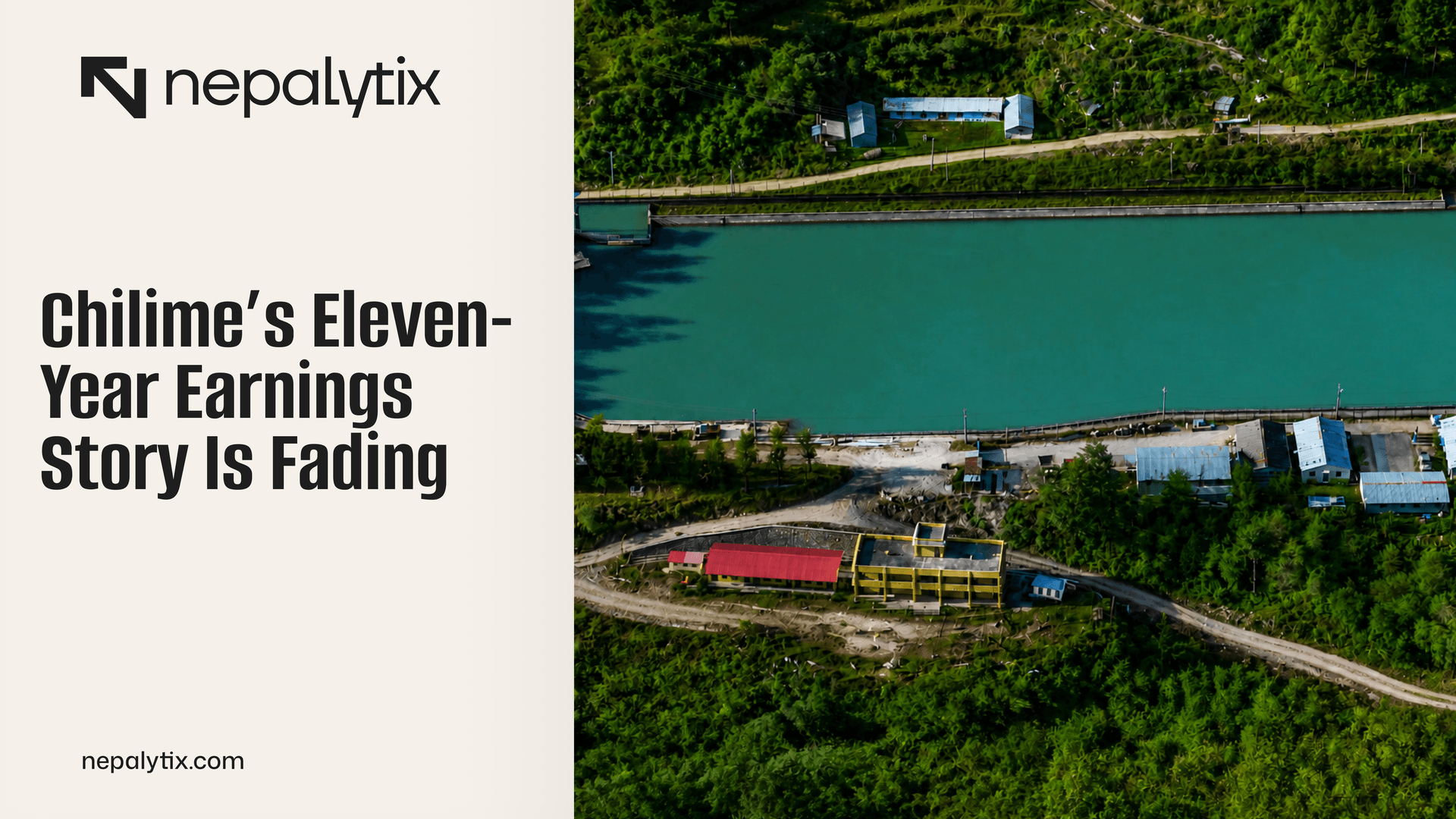
Chilime was incorporated in 1995 to develop hydropower resources in Nepal. Nepal Electricity Authority (NEA) remains its majority shareholder with a 51% stake, while the remaining 49% is held by the public, including local residents. The company operates a 22.1 MW hydropower plant in Rasuwa, commissioned in 2003, with annual generation of around 150 GWh. Electricity is sold to NEA under a long-term power purchase agreement.
The company's balance sheet has expanded considerably over the review period. Net property, plant and equipment increased from Rs. 7.43 billion to Rs. 12.06 billion, representing growth of approximately 62.35%. The increase reflects the company's expanding capital base and investments in the hydropower sector.
Investments have also become a major component of CHCL's assets. The company had not reported significant investments in the base year, but its investment portfolio subsequently rose sharply to Rs. 5.74 billion and later increased to around Rs. 6.59 billion. This growing investment base has become increasingly important to the company's overall financial position and earnings.
Liquidity is another notable strength. Current assets have increased to a level where they are approximately 26 times current liabilities, leaving the company with substantial short-term liquidity. While this provides a strong financial cushion, it also raises the question of how efficiently the company can deploy its excess capital to generate additional returns.
CHCL has maintained a very conservative capital structure. Loans and long-term liabilities have remained below approximately Rs. 40 crore, making debt a negligible portion of its overall funding. In contrast, paid-up capital increased steadily from Rs. 3.13 billion in Q4 FY 2072/73, partly reflecting the company's history of distributing dividends through bonus shares.
The other side of this dividend-heavy structure is visible in reserves. CHCL's reserve and surplus stood at Rs. 4.98 billion in Q4 FY 2074/75, but declined to just Rs. 2.26 billion by Q4 FY 2082/83. The decline reflects the company's continued use of accumulated reserves to distribute dividends. The company has distributed bonus shares equivalent to approximately 9.15 times over its history.
Revenue growth, however, has been modest. Operating income increased from Rs. 1.24 billion to Rs. 1.33 billion over the eleven-year period, representing only around 7.33% growth. Electricity sales have been particularly stable, rising marginally from Rs. 1.16 billion to Rs. 1.17 billion. With the company's existing PPA and generation capacity limiting electricity revenue growth, income from other sources has become increasingly important.
Income from other sources increased from Rs. 77.24 million to Rs. 163.78 million, more than doubling over the period. The rise indicates that investment income and other non-electricity sources are playing a larger role in CHCL's earnings.
At the same time, operating expenses have continued to rise. Excluding the initial period, operating expenses increased from Rs. 186.04 million to Rs. 339.30 million. Non-operating expenses have risen even more sharply, increasing from Rs. 12.43 million to Rs. 272.05 million. The increase is largely associated with higher depreciation as the company's hydropower assets age.
The result has been a gradual decline in profitability. CHCL earned Rs. 929.98 million in net profit in Q4 FY 2072/73 and reached its highest profit of Rs. 966.31 million in Q4 FY 2073/74. By Q4 FY 2082/83, however, net profit had fallen to Rs. 720.05 million.
The deterioration becomes more visible when measured on a per-share basis. EPS declined from Rs. 29.67 to Rs. 7.59 over the review period. The decline reflects the company's practice of capitalizing reserves through bonus shares and distributing cash dividends, while electricity earnings have remained largely stagnant.
Net worth per share followed a similar path. It peaked at Rs. 234.36 in Q4 FY 2073/74 before falling steadily to Rs. 123.90 in Q4 FY 2082/83. The decline reflects the distribution of accumulated reserves and the expansion of the share base without a corresponding increase in earnings.
Despite the decline in earnings, CHCL remains financially conservative. Its negligible debt, substantial liquidity and sizeable investment portfolio provide a strong balance sheet. ROE, which declined from 12.36% to 5.73% by Q4 FY 2081/82, rebounded to 12.88% in the latest period. ROA also improved marginally from 5.93% to 6.13%.
CHCL's eleven-year performance therefore presents a mixed picture. The company has a strong balance sheet, almost no debt and substantial liquidity, but its core electricity business has shown little revenue growth while per-share earnings have steadily weakened. With the existing plant operating under a long-term PPA, future growth will increasingly depend on how effectively CHCL deploys its investments and capital rather than simply relying on the existing hydropower asset.