Finance Committee Passes Nepal Rastra Bank Bill Amid Dispute Over Governor’s Term
The Finance Committee has passed amendments to the Nepal Rastra Bank Act, including a proposal to reduce the governor’s term from five years to three, with lawmakers divided over the change.
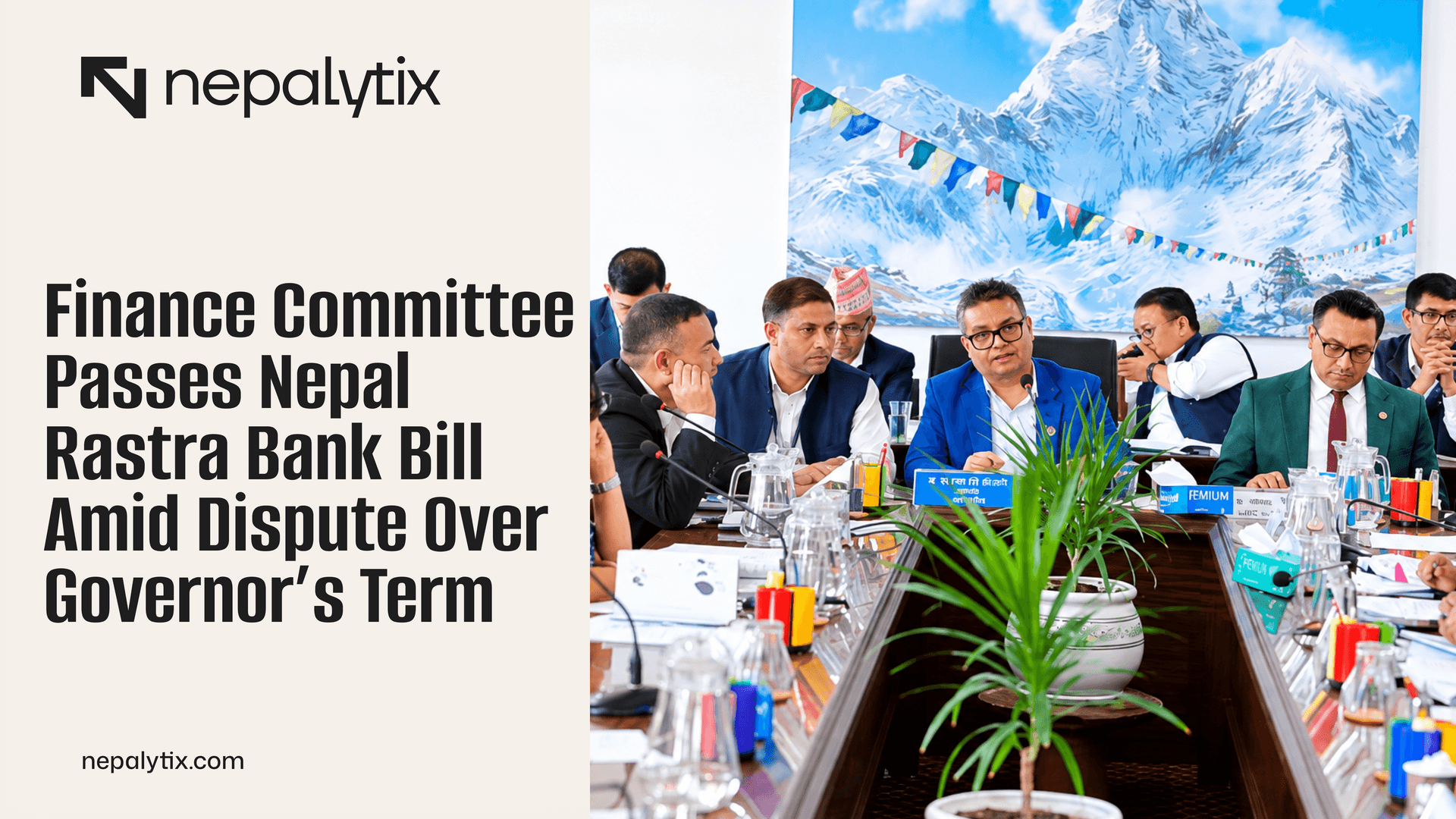
The Finance Committee of the House of Representatives has passed its report on the bill to amend the Nepal Rastra Bank Act, 2058, despite disagreement among some lawmakers over a proposal to reduce the governor’s term from five years to three years.
The committee’s 30th meeting on September 16, 2026 (Bhadra 31, 2083) approved the report, which will now be presented to the House of Representatives.
Committee Chair Krishnahari Budhathoki described the decision as unanimous despite individual disagreements among members over some amendments. However, lawmakers including Pushparaj Kandel and Parashuram Tamang have submitted written dissent over the proposed change to the governor’s tenure.
Under the proposed amendment, the terms of the governor, deputy governors and independent directors would be reduced from five years to three years, with the possibility of an additional two-year appointment based on performance evaluation. The Finance Committee had approved this structure earlier in the legislative process.
Kandel said he remained opposed to reducing the term, arguing that a three-year initial tenure followed by a possible two-year extension could make stable leadership more difficult.
Key Changes in the Bill
The amended bill contains several changes to the existing Nepal Rastra Bank framework.
These include:
Reducing the term of the governor and other specified board officials from five years to three years, with a possible two-year extension.
Allowing the government to issue directives to Nepal Rastra Bank on monetary, banking and financial matters.
Requiring Nepal Rastra Bank to introduce its monetary policy on July 1, the first day of the fiscal year.
Allowing serving or recently retired CEOs of banks and financial institutions to become governor after a two-year cooling-off period.
Preventing individuals holding more than 0.5% of shares in banks or financial institutions from becoming governor, deputy governor or director.
The amended report will now move to the House of Representatives for further consideration.
Concerns Over Central Bank Independence
Former finance ministers and former Nepal Rastra Bank governors have raised concerns about the proposed three-year term and the government’s authority to issue directives.
Former finance minister and former NRB governor Yuba Raj Khatiwada has argued that leaving the remaining two years of a governor’s tenure to government discretion could create uncertainty around the governor’s continuation and potentially affect long-term policy decisions.
Former governors have similarly raised concerns that the combination of a shorter initial tenure and government discretion over extension could affect the central bank’s institutional autonomy and policy continuity. These are views expressed by the former officials and are not a final assessment of the bill’s effects.
The government has maintained that coordination between the government and Nepal Rastra Bank is necessary, while the debate now centers on how the proposed provisions would operate in practice.
What Happens Next?
The Finance Committee’s approval does not by itself make the amendments law. The revised report will be presented to the House of Representatives, where the bill must proceed through the parliamentary process before the changes can take effect.
The debate over the bill therefore remains focused on the balance between accountability, government oversight and Nepal Rastra Bank’s institutional independence.