Government Unveils 21-Point Plan to Strengthen Nepal’s Capital Market
The government has introduced a 21-point action plan covering IPO reforms, NEPSE restructuring, new securities products, institutional investment, bond-market development and tax reforms to strengthen Nepal’s capital market.
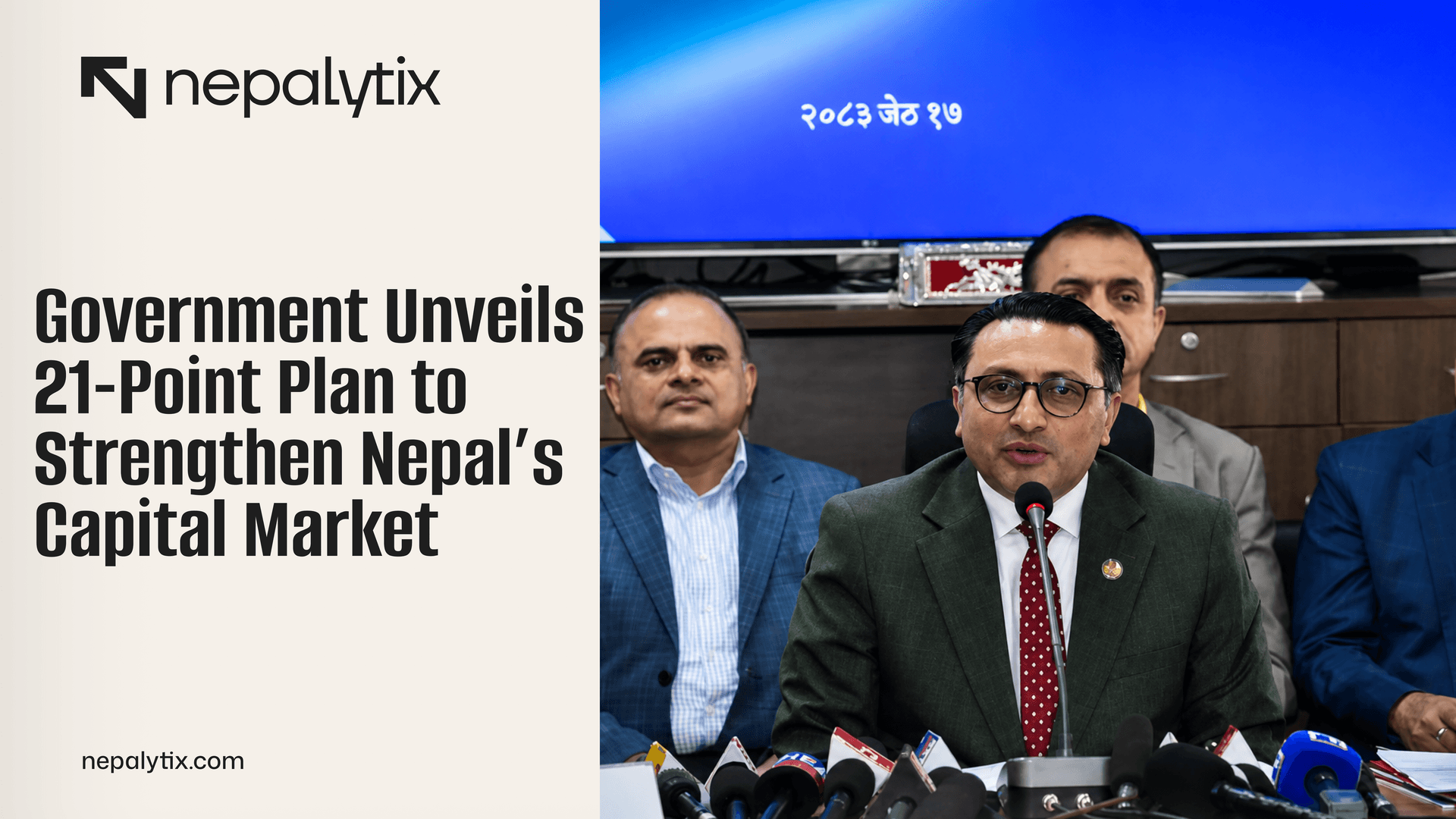
The Government of Nepal has introduced a 21-point action plan aimed at strengthening and revitalizing the capital market following the disruption caused by the Bhotekoshi floods, which damaged physical infrastructure including hydropower projects.
The plan, released by the Ministry of Finance, covers reforms ranging from easier IPO processes and sector-specific issuance criteria to securities-market infrastructure, NEPSE restructuring, brokerage reform and investment-related tax changes.
IPO and mutual fund reforms
The Nepal Securities Board has been directed to issue guidelines on general eligibility requirements for IPOs. Sector-specific criteria will also be developed for industries including hydropower, manufacturing and processing, hotels and tourism, agriculture and pharmaceuticals.
The framework will cover market-based pricing, price discovery and securities allocation, with implementation targeted by mid-2083.
The government also plans to make collective investment funds more professional, diversified, transparent, risk-aware and technology-oriented. A policy framework for developing instruments linked to bond and money markets is expected by Mangsir 2083.
Brokerage and securities-market reforms
A policy for the institutional reform and strengthening of securities brokerage businesses will be introduced, with the objective of transforming brokers into modern, professional and technology-enabled providers of broader securities-related financial services.
The government also plans to draft separate bills covering securities regulation and market infrastructure. These reforms are expected to create a legal framework for products and activities including margin lending, intraday trading, securities lending and borrowing, and short selling.
NEPSE will also undergo institutional and structural restructuring based on the report submitted by the government-appointed task force in December 2082.
A new basic stock-market index is planned by Mangsir 2083 while retaining the existing NEPSE index as an all-equity index. The proposed index will consider factors including tradable shares, market capitalization, company financial condition, liquidity, corporate governance and information flow.
NRN participation and bond-market development
The government plans to amend the Foreign Investment and Technology Transfer Act and the Foreign Exchange (Regulation) Act to enable non-resident Nepalis to participate in Nepal’s secondary securities market. The proposal is targeted for submission to the Cabinet by mid-Asoj 2083.
The plan also focuses on shifting more market-based financing away from an overreliance on bank-based financing through the development of an institutional bond market.
Existing bond-market regulations are expected to be implemented with necessary amendments by mid-Asoj 2083. The government will also introduce policies encouraging specialized bonds such as green, disaster, social, project-specific and environmental bonds.
Transaction fees will be reviewed, while policy and market infrastructure will be developed to support an active secondary market for treasury bills and development bonds.
New securities products
Regulatory and policy arrangements will be developed for share consolidation and subdivision as well as companies purchasing their own shares from distributable accumulated profits.
Rules covering bonds, margin lending and intraday trading are targeted for approval by the Ministry of Finance by mid-Asoj 2083.
The margin-lending system is expected to become operational through securities brokers licensed by the Securities Board by mid-Mangsir 2083, allowing investors to borrow and invest through the formal securities-market framework.
The action plan also proposes expanding the Securities Act to address securities-related offenses and enable private companies to issue bonds.
Greater institutional participation
The government intends to facilitate institutional investors' participation in both primary and secondary securities markets.
A policy and regulatory framework for institutional investment is expected by Mangsir 2083. Legal and structural reforms will also be introduced to encourage institutions such as the Employees Provident Fund, Citizens Investment Trust, Social Security Fund, insurance companies and mutual funds to diversify portfolios that are currently heavily concentrated in bank deposits.
The institutional capacity and structural framework of CDS and Clearing Limited will also be reviewed to support the operation of new securities-related financial services.
Review of banks’ securities investment framework
The Securities Board and Nepal Rastra Bank will jointly review existing arrangements covering investment limits, risk weights, collateral adequacy and other related measures.
The review will consider capital mobilization, direct and indirect risks, interconnectedness, systemic risk, liquidity, returns and depositor protection.
Capital gains tax reform
The government also plans to make the tax system more investment-friendly, particularly to encourage long-term participation in the stock market.
Under the proposed framework, capital gains on listed securities held for more than 365 days by resident individuals would be taxed at 3.75%, while securities held for 365 days or less would face a 5% rate.
The proposed system would calculate capital gains after adjusting profits and losses through the transaction and clearing system, with capital gains tax becoming the final tax only when there is a net profit.
The plan also calls for Nepal Rastra Bank to establish an investment policy with a minimum investment-period requirement of 45 days.