Home Ministry’s Debt Recovery Directive Raises Concerns for Banks
A new Home Ministry directive targeting harassment during loan recovery has sparked debate over how banks can enforce repayment while avoiding unlawful pressure on borrowers.
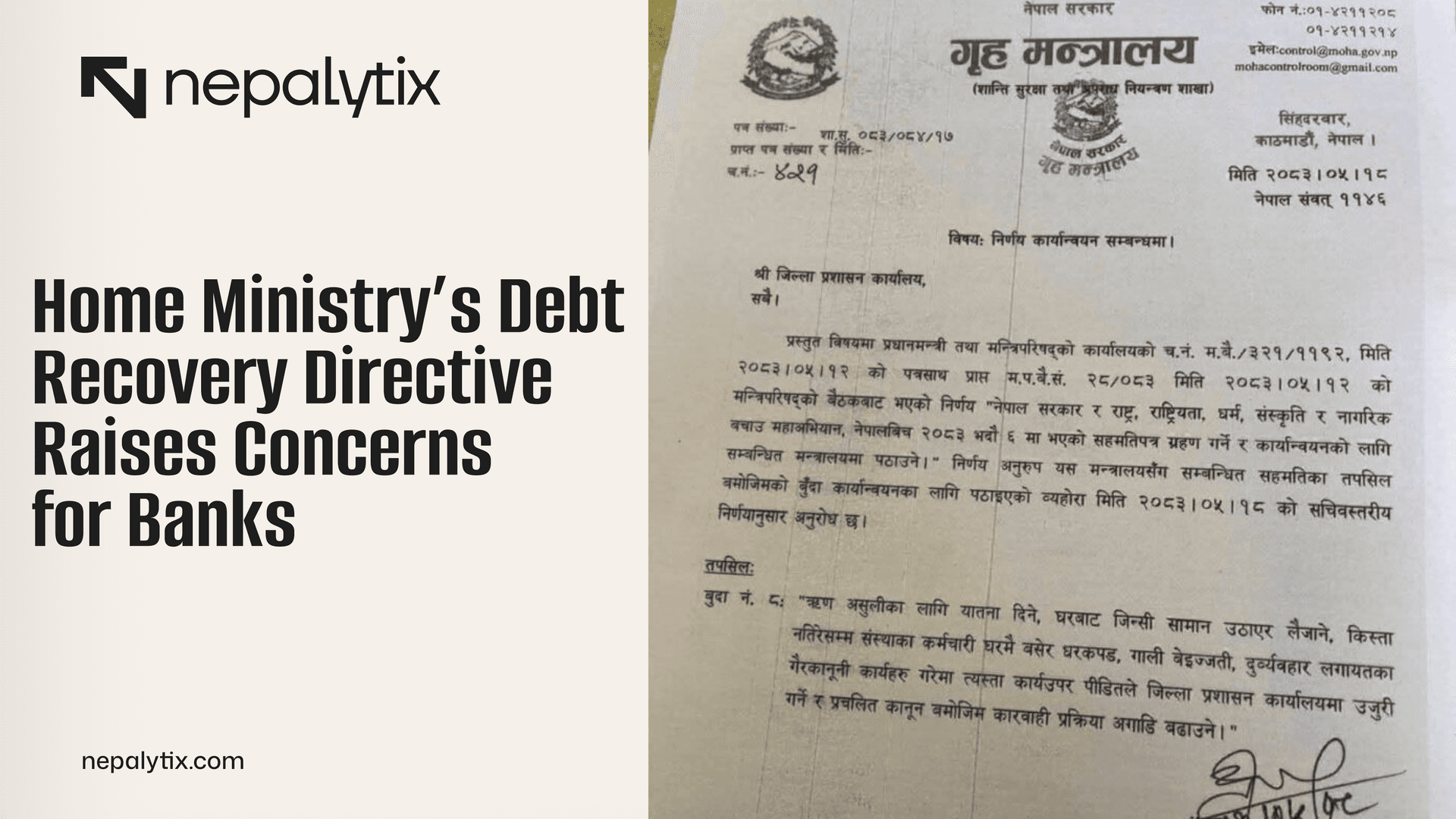
A recent directive from the Ministry of Home Affairs to take action against employees of banks and financial institutions (BFIs) involved in threatening, intimidating, or illegally harassing borrowers during debt recovery has triggered fresh debate in Nepal’s banking sector.
The directive is aimed at curbing excessive pressure on borrowers, a move that has been welcomed in principle. However, bankers have raised concerns that it could make legitimate loan recovery more complicated, particularly as non-performing loans remain a concern amid prolonged economic weakness and financial stress among businesses.
What does the directive say?
The Home Ministry issued the circular following a secretary-level decision to implement Point No. 8 of an agreement reached with the Rashtra, Rashtriyata, Dharma, Sanskriti ra Nagarik Bachau Mahaabhiyan.
Under the directive, legal action may be taken against BFI employees who engage in unlawful recovery practices, including mental or physical pressure, taking household belongings, staying at a borrower’s residence until installments are paid, or abusive and harassing behavior.
Borrowers facing such treatment can file complaints at the District Administration Office, after which the authorities can take action based on the complaint.
Banks worry about recovery becoming harder
Bankers acknowledge that unlawful pressure should not be used to recover loans. However, they are concerned that the new directive could create additional difficulties for legitimate recovery efforts.
The concern comes as banks face a challenging credit environment, including rising bad loans, weak private-sector credit demand and financial pressure on businesses.
Bankers fear that borrowers could potentially interpret or report even routine recovery efforts as harassment. This could make bank employees more cautious and potentially slow down the recovery process.
Banks have legal mechanisms says former banker Bhuvan Dahal
Former banker Bhuvan Dahal said banks and financial institutions should not threaten borrowers, seize household belongings or subject them to unnecessary mental pressure.
According to Dahal, banks already have established legal mechanisms for recovering loans and should follow those procedures rather than resorting to forceful measures.
He also noted that reports of such practices have occasionally emerged in the microfinance and cooperative sectors. However, borrowers should not be able to misuse the new provisions against institutions that follow established banking procedures.
Former NRB Governor Chiranjibi Nepal calls for balance
Former Nepal Rastra Bank Governor Dr. Chiranjibi Nepal said borrowers should be treated respectfully, but banks must retain their legal authority to recover outstanding loans.
He noted that when borrowers default, banks have the legal right to auction collateral pledged against loans.
According to Dr. Nepal, creating a comfortable environment for borrowers and preventing unnecessary harassment is positive. However, restricting legitimate recovery efforts at a time when non-performing loans are increasing could create additional difficulties for banks.
NRB preparing updated recovery guidelines
Following the Home Ministry’s directive, Nepal Rastra Bank (NRB) is preparing to amend its loan recovery guidelines for banks and financial institutions.
NRB Deputy Spokesperson Sudha Shrestha said strict provisions against aggressive recovery practices already exist for microfinance institutions. The central bank now plans to update guidelines for commercial banks and other financial institutions to clearly define what constitutes acceptable conduct during debt recovery.
The emerging debate is therefore less about whether borrowers should be protected from unlawful harassment and more about where the line should be drawn between legitimate loan recovery and unacceptable pressure.