Wagle Calls for Law Alignment on Bank Directors
Finance Minister Swarnim Wagle has called for legal changes to align BAFIA and the NRB Act over rules governing the eligibility of bank directors.
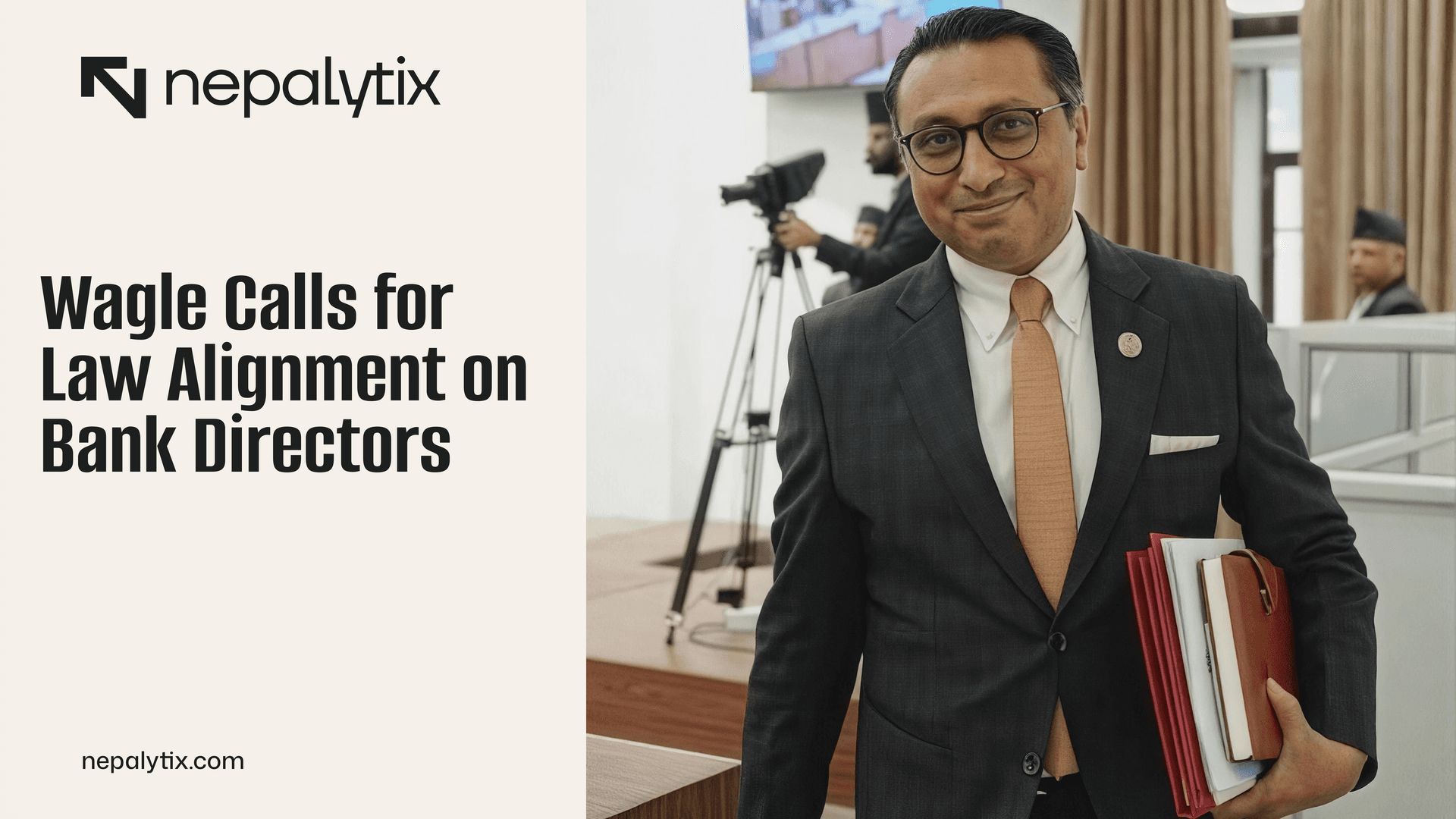
Finance Minister Dr. Swarnim Wagle has called for greater consistency between Nepal's banking laws to resolve legal conflicts over the eligibility of individuals to serve as directors of banks and financial institutions.
Wagle said provisions governing the disqualification of bank directors should be clearly incorporated into the Bank and Financial Institutions Act (BAFIA) rather than being addressed only through the Nepal Rastra Bank (NRB) Act.
The issue has emerged from differences between the two legal frameworks governing the banking sector. The Finance Ministry has therefore proposed an amendment to Section 18 of BAFIA through the Some Nepal Laws Amendment Bill.
Under the existing provisions, individuals who have been penalised by financial regulators can be barred from serving as bank directors for five years. However, lawmakers have raised concerns that the provision could be applied too broadly.
In particular, they noted that even relatively minor regulatory reprimands could potentially result in an individual being disqualified from serving as a director for five years. This has raised concerns about whether the existing framework appropriately distinguishes between serious regulatory violations and minor disciplinary actions.
Wagle argued that such provisions need to be placed within the appropriate banking law and aligned with the NRB Act to avoid contradictions and uncertainty in their implementation.
The Finance Ministry has already started work on the proposed legal changes. Ministry officials said efforts are underway to harmonise the provisions of BAFIA and the NRB Act, with the aim of creating a clearer and more consistent regulatory framework for bank directors.
The proposed amendment could also provide greater clarity to banks, financial institutions and their directors regarding the circumstances under which a person becomes ineligible to hold a board position.
The issue is particularly relevant because directors of banks and financial institutions are subject to regulatory requirements and oversight from Nepal Rastra Bank. Any inconsistency between laws can create uncertainty over how regulatory penalties affect an individual's eligibility to remain on a bank's board.
The government is therefore seeking to address the issue through the proposed amendment rather than leaving the matter to interpretation between separate legal provisions.
If approved, the amendment could help establish a more consistent system for determining director eligibility, while ensuring that serious regulatory violations are treated appropriately without automatically imposing the same consequences for minor reprimands.