Banks Should Tell us What The Flood Did To Their Loans
Ten weeks after the Bhote Koshi floods, hydropower losses are mounting while banks remain silent. Investors deserve to know the damage now, not in May.

Ten weeks after the Bhote Koshi flood, the listed hydropower companies it hit have lost a quarter of their market value. The banks that lent to them have gained. Their first-quarter results due this month will not show a single rupee of the damage and under the relief rules now in force, the next results probably will not either. Shareholders and depositors should not have to wait until May to find out.
The proposition
Every bank and financial institution should publish with its first-quarter results this month, what it has lent to borrowers in the flood-affected basins: how much, to which projects, how much of it has been deferred or restructured under the relief rules and what it has set aside against it. Nepal Rastra Bank should require it and should publish the system total. The banks already hold every one of these numbers. Under the relief rules, little of this is likely to appear in the ordinary figures before May.
1. What we know and how we know it
On the morning of 26 August, a flood came down the Bhote Koshi into the Trishuli. By the authorities count on 9 October it had killed 1,457 people and 4,720 were still missing. It wrecked the Rasuwagadhi–Gyirong border crossing, took out bridges and roads and hit a chain of hydropower projects along one of the most densely developed river corridors in the country. The government’s rapid damage and needs assessment put total damage and losses at Rs 408bn and the cost of reconstruction at Rs 723.31bn. Hydropower and transmission was the largest single item: Rs 151bn of damage and losses and Rs 390.62bn to rebuild. Thirteen hydropower projects and five solar plants with 759 MW of capacity between them were affected. Eight of the hydropower projects are privately owned. The World Bank, in its October update, counted twelve projects and their transmission links affected, putting about 430.7 MW, 10.6% of the country’s installed hydro and solar capacity out of reach including about 60 MW built to sell power to India.
Most of what the public knows about the banks share of this comes from a single source: a preliminary assessment by the Nepal Bankers Association, reported on 1 September, six days after the flood. It found eight hydropower projects with bank lending in Rasuwa, Nuwakot and Dhading and four of the larger ones damaged. It put the bank loans at those four at about Rs 6.5bn.
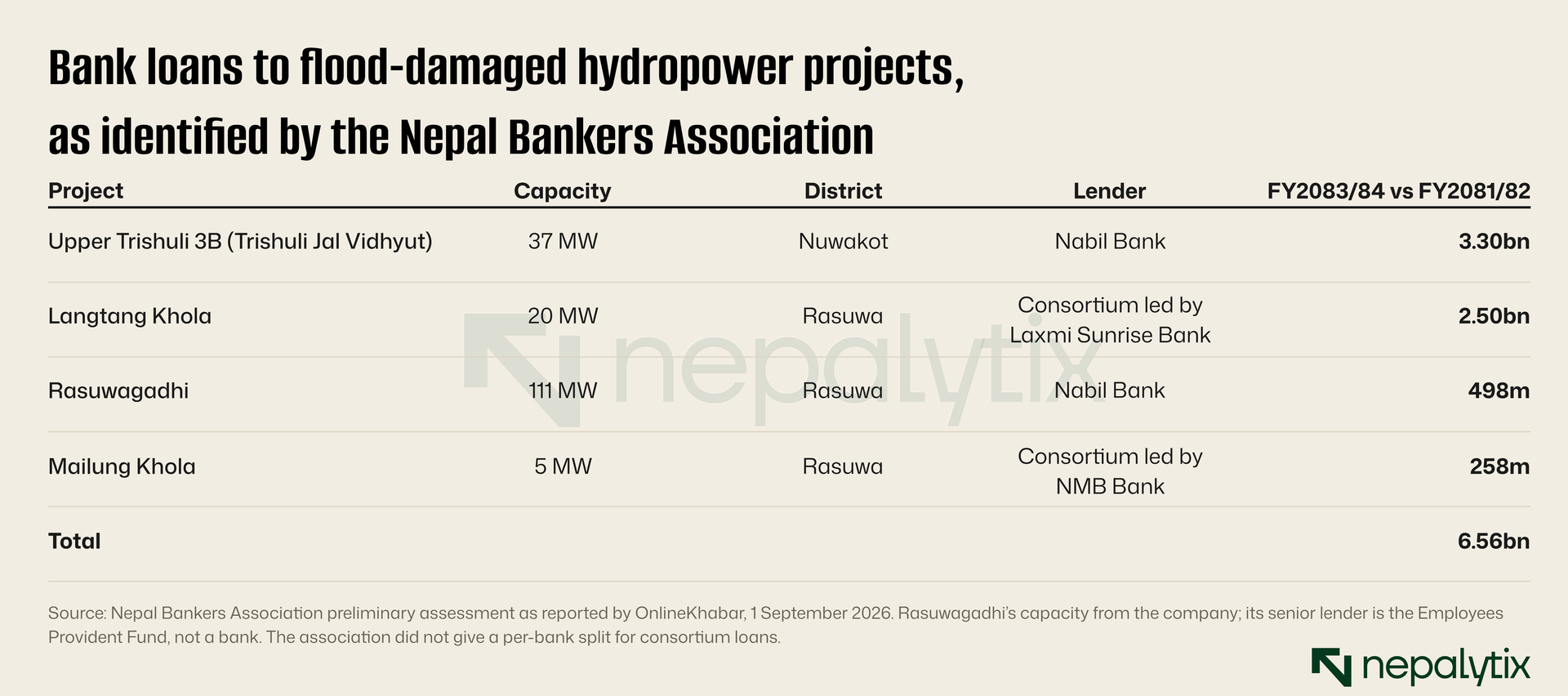
Undamaged projects with bank financing in the same area include three under construction and financed by Nepal Investment Mega Bank and a micro-hydro financed by Prabhu Bank. Another early estimate, reported by Insurance Khabar on the same day, put loans at risk in Rasuwa at Rs 2.48bn. The figures differ because they count different things, at different moments in the confusion of the first week. Neither has been updated in public since.
That is the whole of the public record. There is no figure from Nepal Rastra Bank. There is no figure from any bank in its own name. There is no figure for the loans that banks have made to the businesses, traders and households of the affected districts, beyond the Rs 724m of damage to 17 bank branches that the banks reported in September Rs 650m of it at a single Agricultural Development Bank branch and there is no figure for how many of the hydropower loans have since been deferred or restructured under the relief rules the government announced on 4 September.
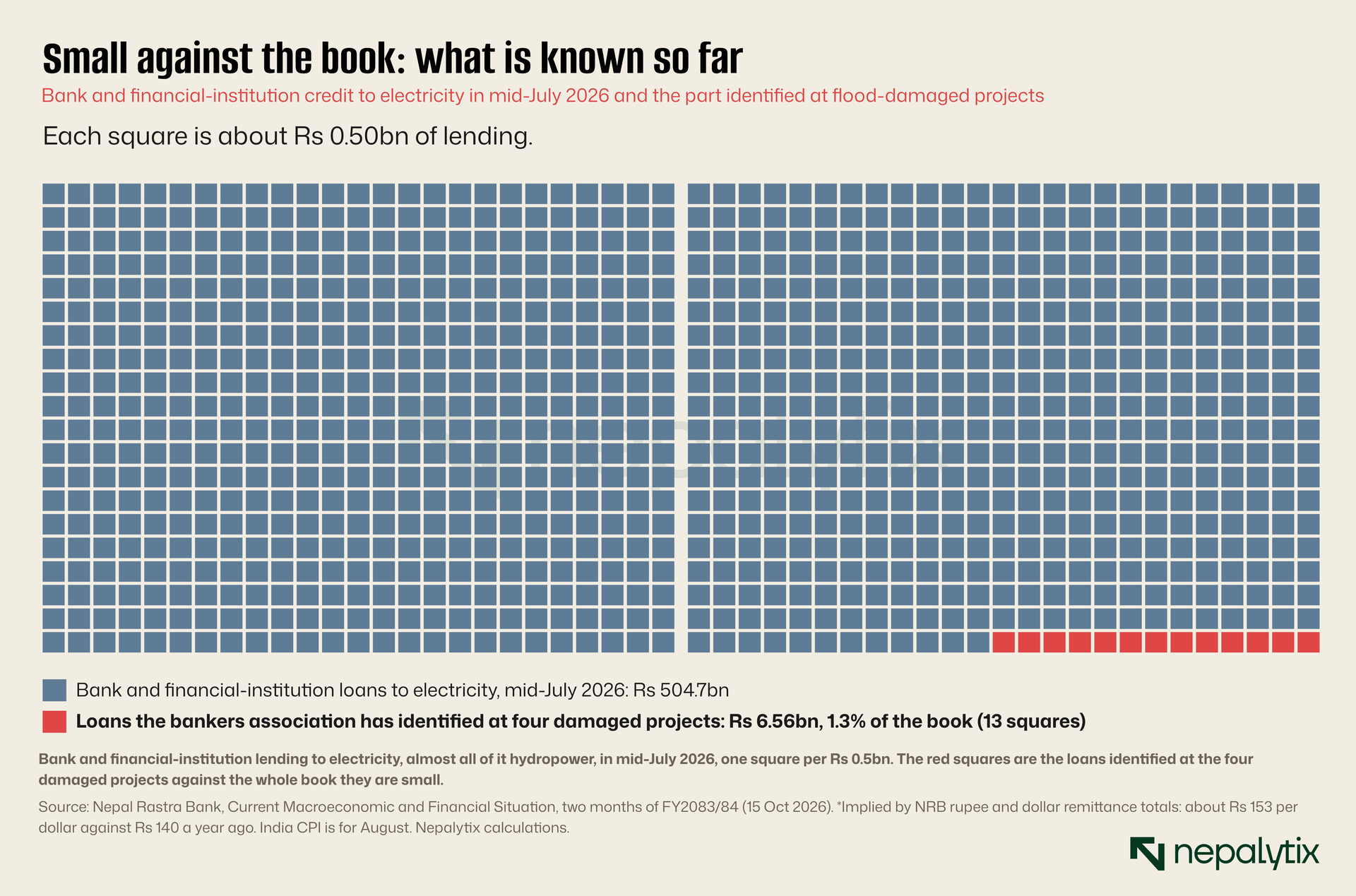
Set against the whole system, the identified loans are small. In mid-July 2026, banks and financial institutions had Rs 504.68bn lent to electricity, according to NRB’s sectoral credit table.The Rs 6.56bn at the four damaged projects is 1.3% of that. Against total lending of Rs 5,954.62bn, it is about a tenth of one per cent. If that were the whole story, there would be no need for this piece. It is not the whole story for four reasons. The loans are concentrated in a few banks. The relief rules guarantee they will not show up in the ordinary numbers for months. The rules that decide how much a bank must set aside against them range from 1% to 100%. And the Rs 6.56bn is a preliminary count of four projects in one corridor from a regulator’s directed-lending push that has put Rs 505bn into exactly this kind of asset.
2. Small for the system, not for every bank
System totals are the wrong unit. A depositor or a shareholder does not own the system. They own or lend to a particular bank and the identified exposure sits with three of them.
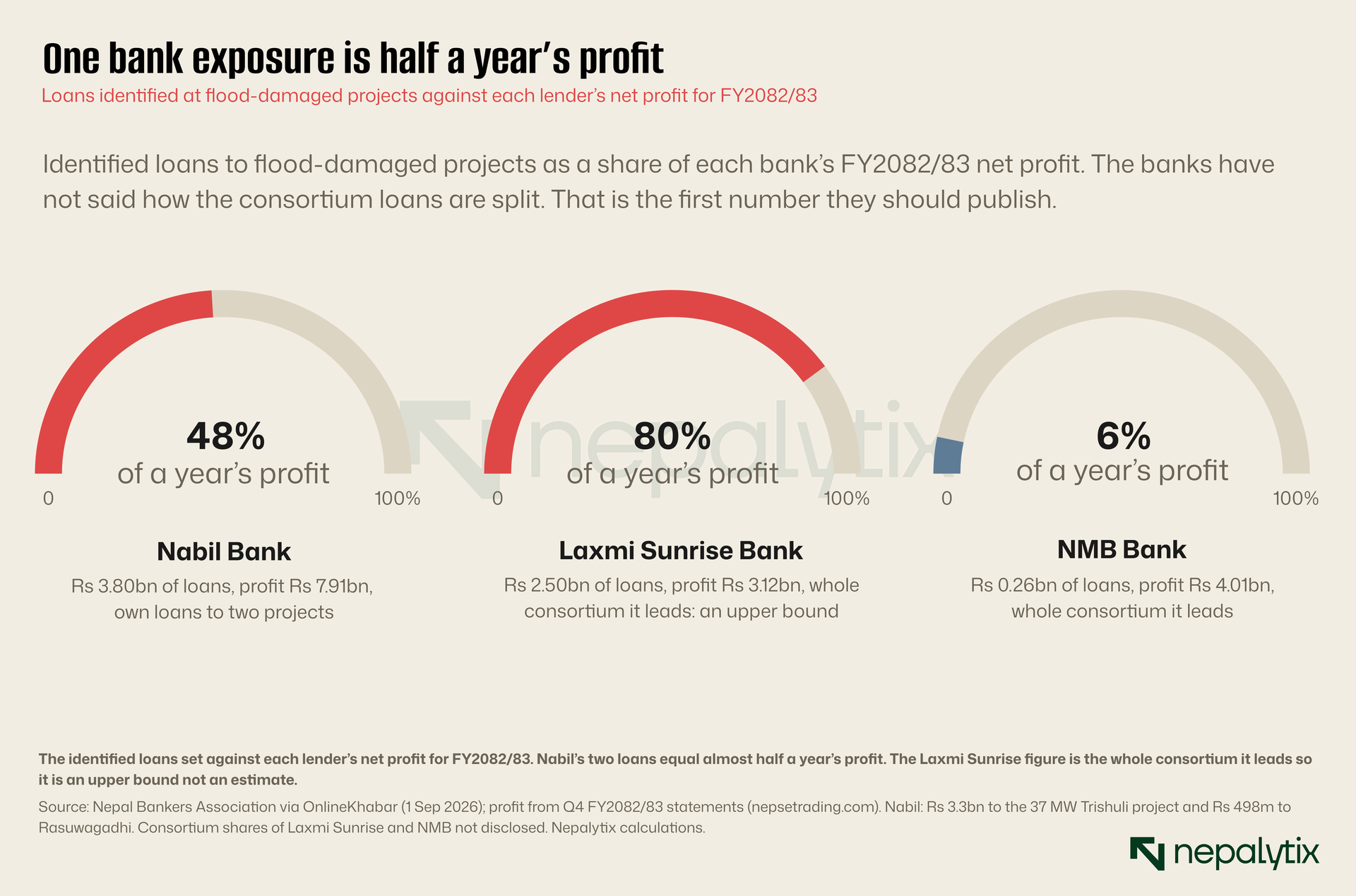
Nabil Bank lent Rs 3.30bn to the 37 MW Upper Trishuli 3B project and Rs 498m to Rasuwagadhi: Rs 3.80bn in all. Nabil earned Rs 7.91bn in FY2082/83. Its identified exposure is 48% of a year’s profit. That is not a solvency question: Nabil holds Rs 593bn of deposits and its equity is many times the exposure. But it is a profit question and profit is what Nabil’s shareholders are paid out of.
Laxmi Sunrise Bank leads the consortium that lent Rs 2.50bn to the 20 MW Langtang Khola project. If Laxmi Sunrise held all of it, the exposure would equal 80% of its FY2082/83 profit of Rs 3.12bn. It almost certainly does not hold all of it; consortium loans are shared among several banks. But how much it holds, and who holds the rest has not been published. NMB Bank leads the consortium that lent Rs 258m to the 5 MW Mailung Khola project, 6% of NMB’s profit even if it held the entire loan.
Consortium lending makes the question harder not easier. Large hydropower loans in Nepal are usually syndicated: a lead bank arranges the loan, holds a share and manages the security and several other banks and financial institutions take the rest. Each member books only its own share so a single damaged project can sit in small pieces on the balance sheets of five or six lenders, none of which is named in public. The lead bank’s name appears in news reports because it speaks for the group. The members names appear nowhere. A shareholder in a bank that is a silent member of the Langtang consortium has no way of knowing it.
Those three figures are the floor of what investors should know, not the ceiling. They cover four projects. They do not cover the loans that other banks hold as consortium members, the working-capital lines to contractors on the damaged projects, the loans to traders whose goods were stuck at a destroyed border crossing or the loans to businesses, hotels and households in five districts. The relief package explicitly covers goods damaged after passing through the Rasuwa customs point which tells you the government expects losses well beyond hydropower. For most banks the exposure outside hydropower is probably small. For a few it may not be. Nobody outside the banks can tell.
3. The market has priced the borrowers, not the lenders
The stock market has had ten weeks to form a view. It has formed a sharp one about the borrowers and no view at all about the lenders.
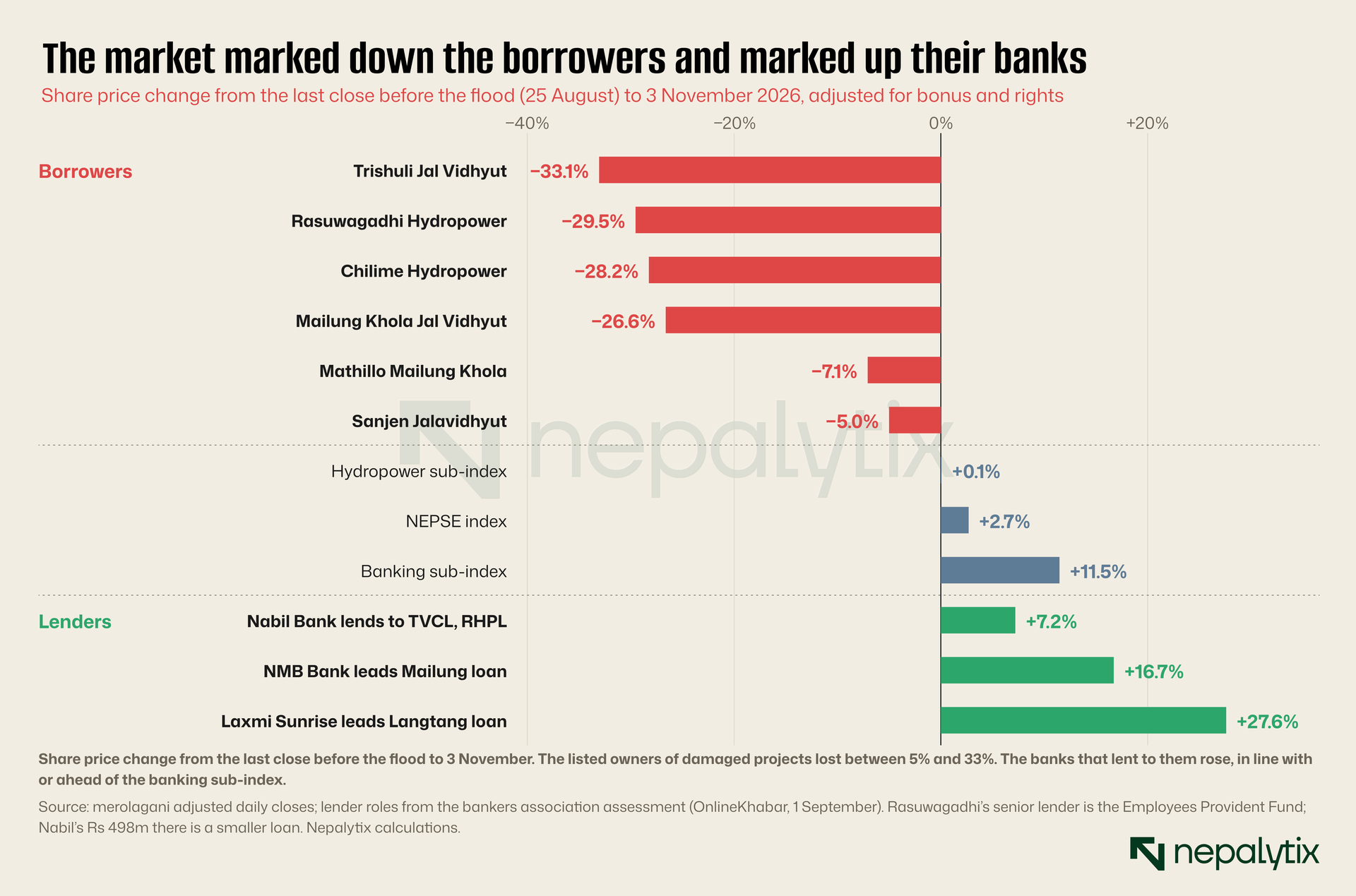
From the last close before the flood, 25 August to 3 November, Trishuli Jal Vidhyut, the owner of Upper Trishuli 3B, fell 33.1%. Rasuwagadhi Hydropower fell 29.5%, Chilime 28.2% and Mailung Khola 26.6%. Over the same period the banking sub-index rose 11.5% and NEPSE 2.7%. Nabil rose 7.2%, NMB 16.7% and Laxmi Sunrise 27.6%. The hydropower sub-index which contains dozens of plants far from the corridor is almost exactly where it was.
There are good reasons for some of this. Banks have recovered across the board this autumn as deposit rates have fallen and margins held. Their loans to the corridor are secured, and in a restructuring lenders usually rank ahead of shareholders. Much of the borrowers fall reflects lost revenue and equity that a rebuild will dilute not losses to their lenders. A bank can be repaid in full by a company whose shares are worth half what they were.
The scale of the repricing is still worth stating. At 3 November prices, the six listed companies in the corridor were worth about Rs 21.5bn less than on 25 August: Chilime about Rs 12.7bn less, Rasuwagadhi Rs 4.9bn, Trishuli Jal Vidhyut Rs 2.6bn and the other three about Rs 1.2bn between them. Those are equity losses, borne by shareholders who could see the companies debts and damage and act on them. The banks shareholders have been asked to bear nothing yet because there is nothing for them to see.
But the gap between the two groups is also a measure of what the market can see. Hydropower companies publish their debt and our own research on the six listed companies in the corridor set out who owed what: Rasuwagadhi carries Rs 17.82bn of borrowings against Rs 4.59bn of equity, Sanjen Rs 9.42bn against Rs 3.06bn. An investor can price that. An investor in Nabil or Laxmi Sunrise cannot price the other side of the same loans, because the banks have not said what they hold. The market has not concluded that the lenders are safe. It has had nothing to conclude from.
4. Why the first-quarter results cannot show it
The banks’ first-quarter results for FY2083/84 cover the three months to mid-October and will be published by mid-November. They will report non-performing loans, provisions and profit as usual. They will be by construction almost silent on the flood.
The reason is the calendar. In Nepal, a loan is usually classified as non-performing when a payment is more than three months overdue. The flood happened on 26 August. Even a payment that fell due the next day and was simply never made, could not have been three months overdue by mid-October. And most payments were never allowed to fall due at all. The relief package the Cabinet approved on 4 September lets every flood-affected borrower restructure or reschedule a loan once, with principal and interest extended and caps their interest for a year at the lower of the base rate plus 0.5 percentage points or the base rate plus their existing premium. On 14 October NRB went further and told banks to let borrowers in the Bhote Koshi and Budhi Gandaki basins pay the principal and interest that had fallen due by the end of October.
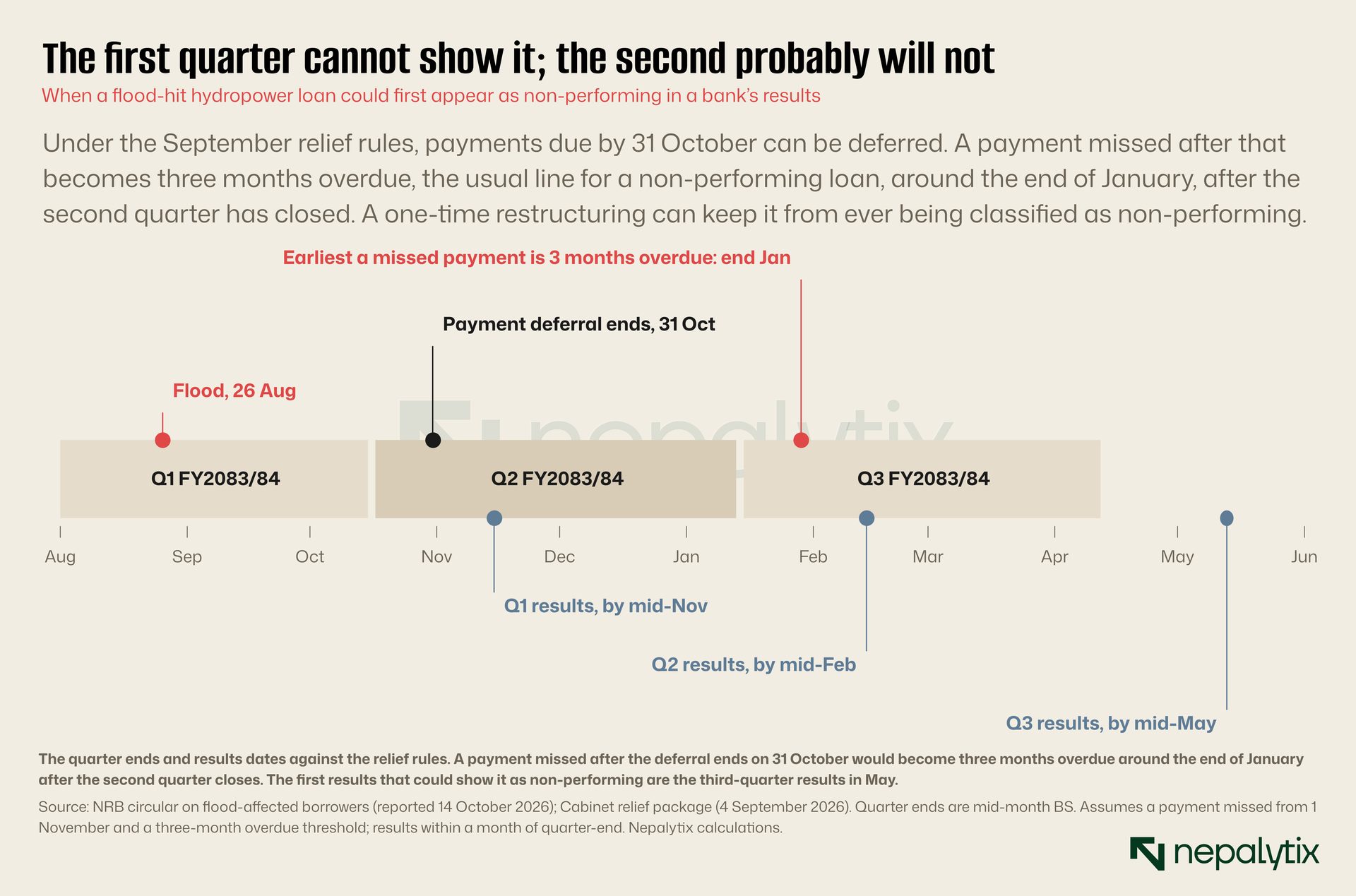
Follow the calendar forward. Suppose a damaged project cannot pay an installment due after the deferral ends on 31 October. Three months later, around the end of January, the loan would cross the usual line into non-performing. The second quarter ends in mid-January, before that. So the first set of results that could show such a loan as non-performing is the third quarter’s which ends in mid-April and will be published in May 2027, nine months after the flood.
That is the earliest case. The likelier case is that the loan never appears as non-performing at all because it has been restructured. Restructuring is exactly what the relief rules are for and it is the right response to a disaster: a bank that forces a damaged project into default gets a ruined asset and a long court case. But a restructured loan is still a loan to a damaged project. Its repayment depends on a rebuild that has not been funded, on insurance claims that have not been settled and on a border crossing that has not reopened. It is precisely the kind of exposure that ordinary non-performing loan figures were not designed to show.
There is a recent precedent for doing this differently. When the pandemic forced banks across South Asia to defer and restructure loans in 2020 and 2021, India’s central bank did not leave the restructured books to be discovered later. It required banks to disclose, in a prescribed format in their quarterly results, how many loans and how much money had been restructured under the relief framework, and how much had since slipped into default. The relief and the disclosure arrived together. Investors could see both the forbearance and its cost as it accumulated and banks that had used the relief heavily could not present themselves as untouched.
None of this is a criticism of the relief. It is a description of what the relief does to the numbers. The rules give borrowers time. In doing so they also give the banks reported figures time and the people who rely on those figures, depositors, shareholders and bondholders are left with nothing to look at.
5. How big the hit could be depends on a rule
When a bank recognises that a loan is impaired, it sets aside a provision, a charge against profit. How large a provision depends on how the loan is classified and here the rules have moved in the borrowers’ favour.
After the eastern floods of June 2023 which damaged thirteen operating and seventeen under-construction hydropower projects, NRB asked banks to capitalise interest and reschedule loans but required a provision of 12.5% on a restructured loan. Developers complained that this made banks reluctant to restructure and an existing directive that barred banks from paying dividends out of capitalised interest income until projects began production gave lenders a further reason to press borrowers rather than wait. In December 2025 NRB amended its directives: a rescheduled or restructured loan to a national-priority project, a category that includes hydropower now needs only a 1% provision, provided the project is operating or close to operating and its capacity is assured. The same amendment barred banks from booking as income any interest capitalised after the original grace period.
That second rule matters as much as the first. When a lender restructures a loan to a damaged project, it typically adds unpaid interest to the principal rather than collecting it. Under the old practice, some of that capitalised interest could flow through the income statement so a restructuring could raise a bank’s reported interest income even as the borrower paid nothing. The December 2025 rule stops that for interest capitalised after the grace period. It is a good rule. It also means that from this quarter, the flood should show up as interest income that a bank stops earning if it shows up anywhere. Investors comparing the net interest income of the three lenders with that of their peers will be looking for a hole they cannot measure because they do not know what the loans would have paid.
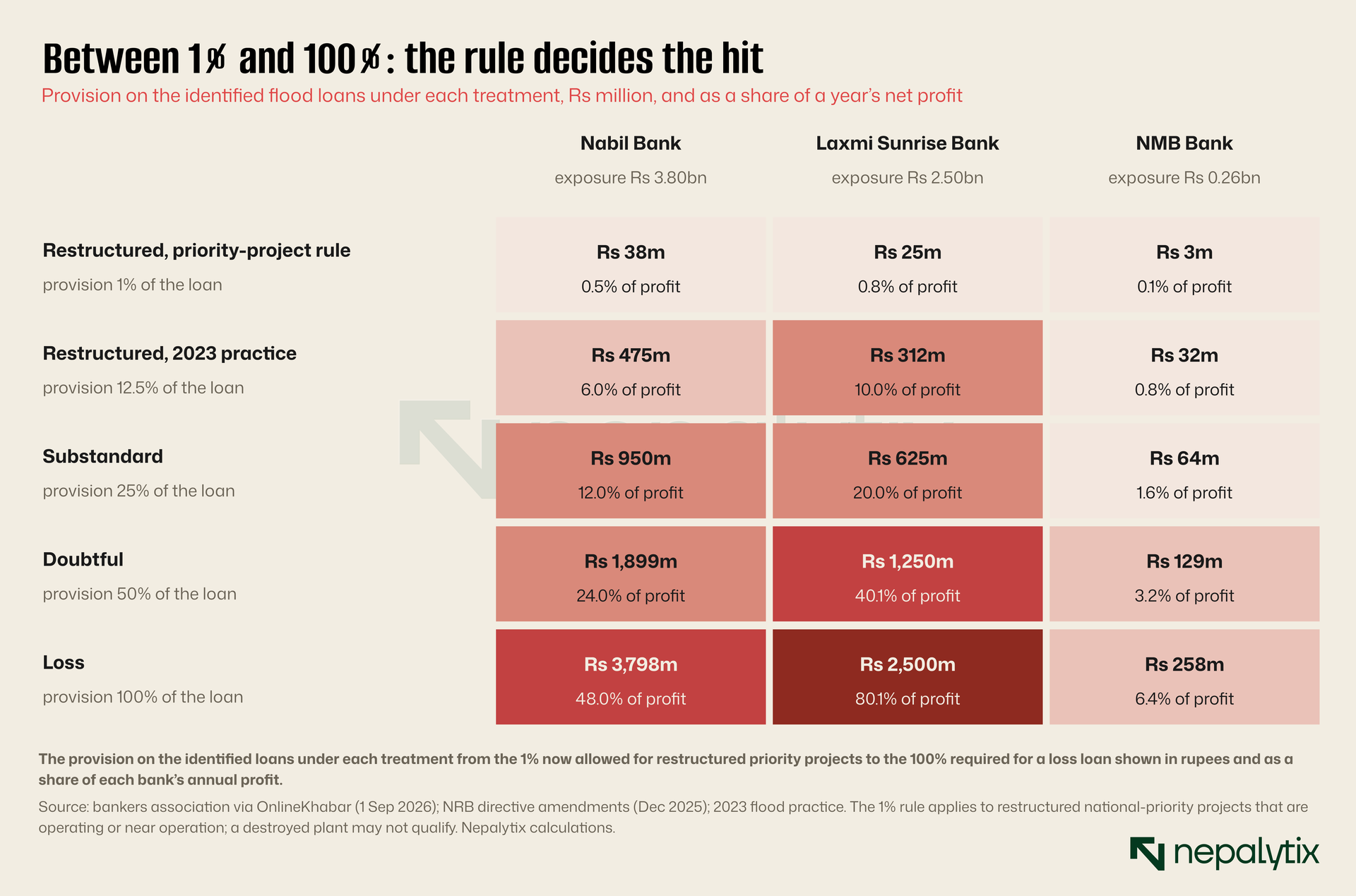
The difference is large. Applied to Nabil’s Rs 3.80bn, a 1% provision is Rs 38m, half a per cent of a year’s profit. The 12.5% used after the 2023 floods would be Rs 475m, 6% of profit. If the loans were classified as substandard, the provision would be 25%; as doubtful, 50%; as a loss, 100%, the full Rs 3.80bn or 48% of a year’s profit. For the Laxmi Sunrise consortium the same range runs from Rs 25m to Rs 2.50bn.
Which treatment applies is not obvious. The 1% rule is meant for projects that are operating or about to operate. A plant whose intake, powerhouse or tunnel was destroyed is neither. Whether a given loan qualifies is a judgment for the bank and its supervisor, and reasonable people could differ. That is exactly why investors need to see the judgment. A bank that classifies its flood loans as restructured priority loans and sets aside 1% will report one profit. A bank that classifies the same loans as substandard will report another, several hundred million rupees lower. Both may be within the rules. Only disclosure lets an outsider tell which one they are looking at.
6. What 2023 taught
The country has been here before and the last time is instructive. After the floods of June 2023 in eastern Nepal, the response followed a familiar sequence: a refinancing facility from the central bank, instructions to reschedule and capitalise interest, appeals from developers for cheaper loans and longer licences. Two details from that episode matter now. Neither showed up in any bank’s published accounts at the time; both were reported only because developers complained to the central bank and the press.
The first is that, according to developers own submissions to the central bank, insurance payments on some damaged projects were used to pay interest to banks rather than to rebuild. That is rational for a lender with a claim on the cash and bad for a project that needs the money to restart. It also means that a bank’s exposure can look healthier for a year or two because interest is being paid while the asset behind it is still broken. The second is that NRB’s deputy governor told promoters to put up their own capital for reconstruction rather than rely on banks. For heavily indebted borrowers, that capital may not exist. Rasuwagadhi’s equity, at Rs 4.59bn against Rs 17.82bn of borrowings is a quarter of what it owes.
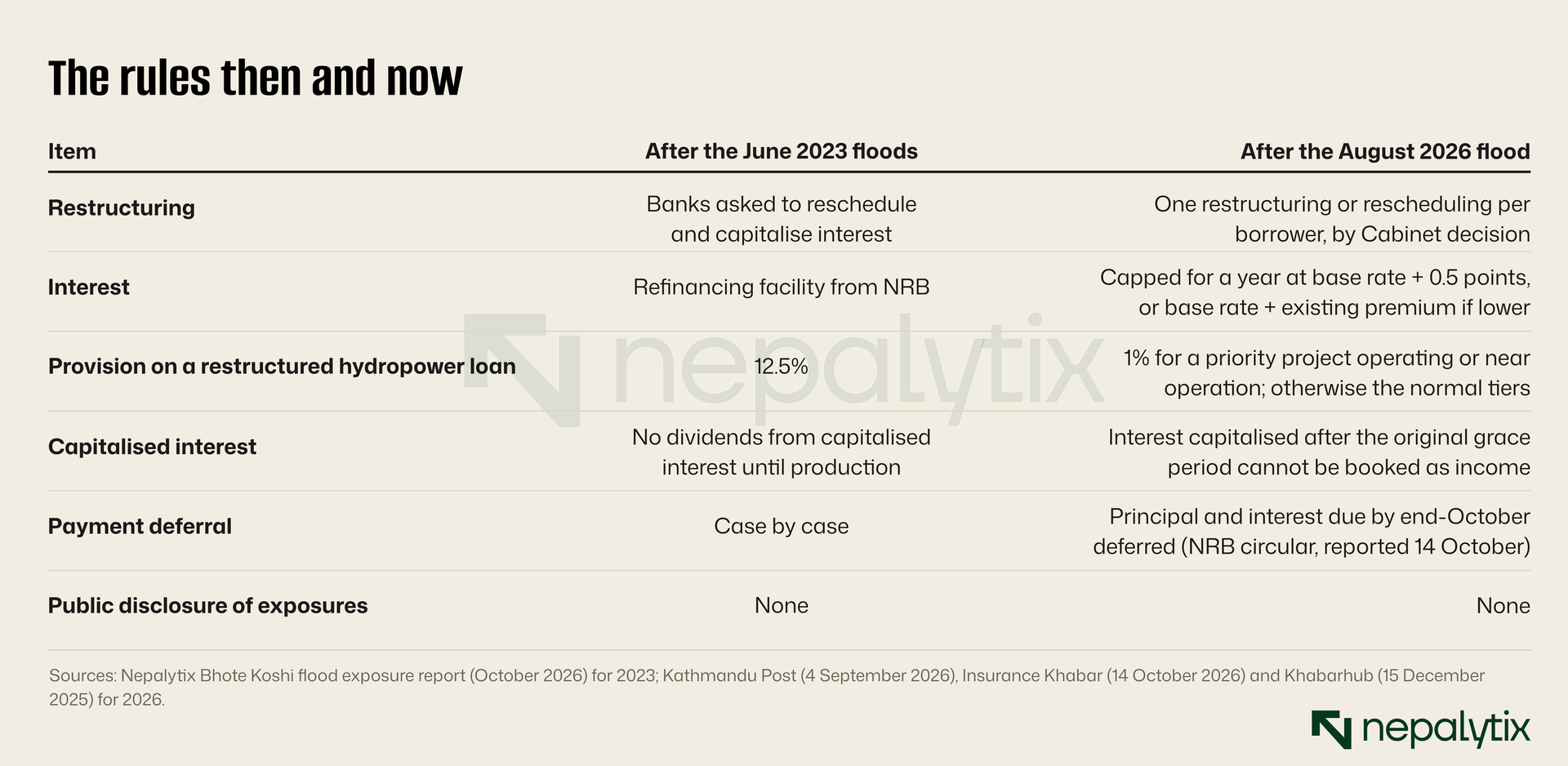
The rules have become more generous to borrowers in almost every row. The last row has not changed at all.
7. What the borrowers owe and to whom
The other side of these loans is public, at least for the companies listed on NEPSE. Six listed hydropower companies own plants in the damaged corridor and their fourth-quarter statements for FY2082/83, made up to 16 July, six weeks before the flood, show what they owed going in.
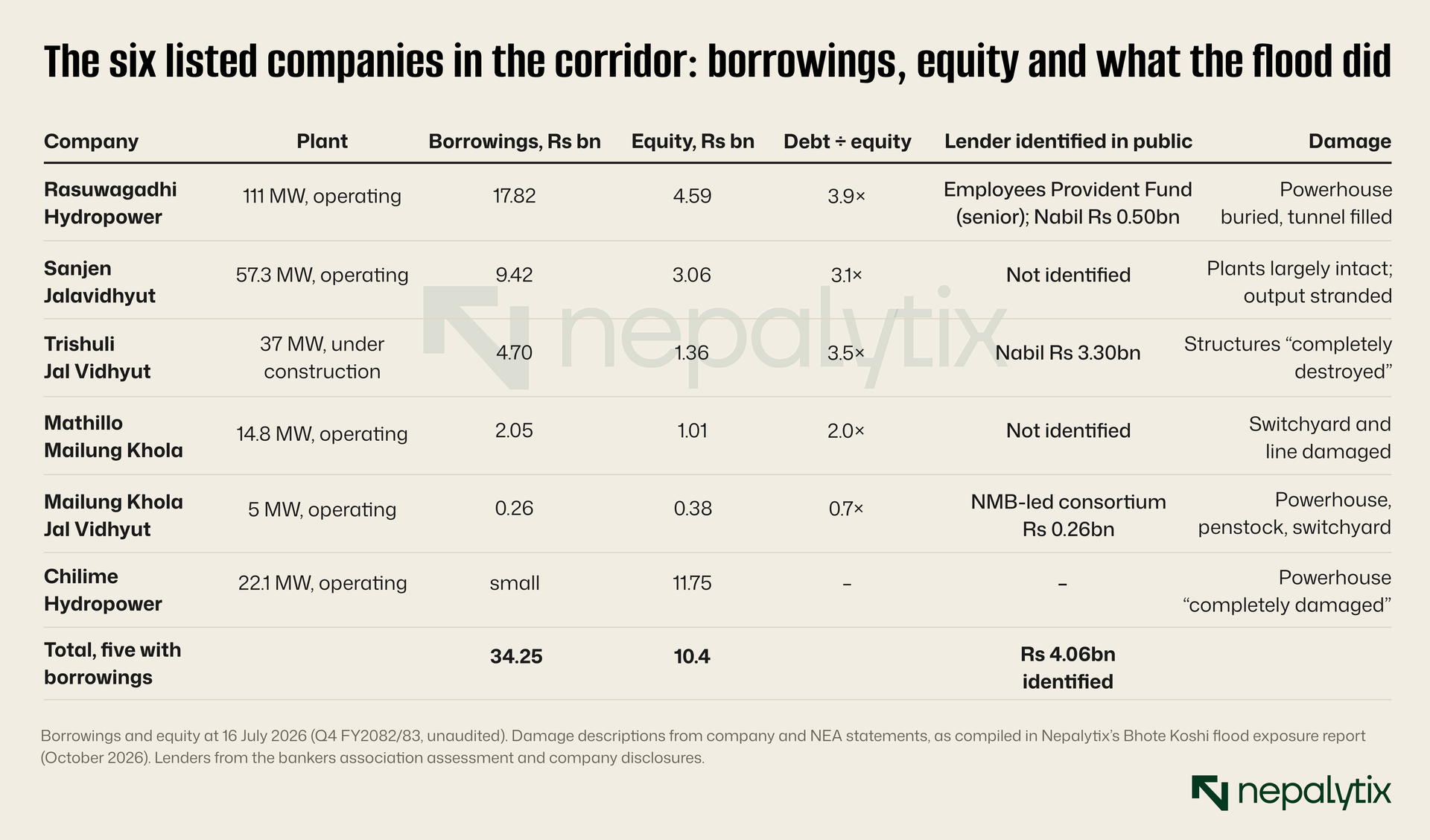
The five companies with borrowings owed Rs 34.25bn between them against Rs 10.40bn of equity. The public record identifies who is owed Rs 4.06bn of it. The bankers association figures match the companies own numbers where they overlap: Mailung Khola’s Rs 258m of borrowings is exactly the loan the NMB-led consortium holds and Nabil’s Rs 3.30bn is most of Trishuli Jal Vidhyut’s Rs 4.70bn. For the remaining Rs 30bn, the lenders are not named in anything a shareholder can read. Some of it is owed to the Employees Provident Fund, the state retirement fund that is Rasuwagadhi’s senior lender. Some of it is almost certainly owed to banks that do not appear in the association’s list. Sanjen alone owes Rs 9.42bn and its plants are physically intact but cannot deliver power because the hub substation at Trishuli 3B was destroyed. That is a borrower whose ability to pay depends on a piece of infrastructure it does not own.
Look at the balance sheets in that table and the provisioning question becomes sharper. Rasuwagadhi already carried an accumulated deficit of Rs 2.26bn and lost Rs 1.45bn in FY2082/83, before the flood. Trishuli Jal Vidhyut had no revenue, a current ratio of 0.50 and a project that its own statement describes as completely destroyed. These are not projects that are “operating or near operation”, the condition for the 1% provision on a restructured priority loan. Whether their lenders treat them as if they were is the single most useful thing the banks could tell us.
8. Who else carries it
Banks are not the only lenders in the corridor and the losses will not stop with them.
The Employees Provident Fund is the largest single creditor among the listed six as Rasuwagadhi’s senior lender. Its money is the retirement savings of government and private-sector employees. It does not publish quarterly results that a member could use to see its exposure and its exposure to Rasuwagadhi alone is probably larger than all four bank loans in Table 1 combined. A disclosure rule for banks should be matched by one for the provident fund and the Citizen Investment Trust which together lend heavily to hydropower and report less than any bank.
Insurers carry the next share. The relief package told insurers to pay policyholders an advance of up to 50% of their claims on the basis of preliminary surveys, and told reinsurers to advance up to 50% to insurers in turn. In September ICRA Nepal downgraded Nepal Reinsurance from A to A−.Hydropower policies in Nepal usually assign the insurance to the lender as security. That is sound practice but it has a consequence the 2023 floods exposed: when the claim is paid, the money goes first to the bank and can be used to service the loan rather than to rebuild the plant. Item six of the disclosure proposed below, insurance assigned to the bank, claimed and received, exists to make that visible.
Depositors carry the last share and the one least discussed. A bank that restructures a loan to a destroyed plant and provisions it at 1% reports more profit, pays a larger dividend and holds less capital against a loan it may never recover in full. None of that is visible in a deposit account. Depositors in Nepal are covered by deposit insurance only up to a limit and above that they rely on the bank’s capital. They are entitled to know what it is being asked to absorb.
Bondholders sit in the same position. About Rs 170bn of debentures, almost all of them issued by banks are listed on NEPSE held by retail investors and by the same insurers and provident funds already exposed to the corridor. A debenture holder is an unsecured creditor of the bank, paid after depositors in a failure. Our debenture guide of 25 October explained how to read one. It could not explain how to read a bank’s exposure to a flood because the bank has not published it.
9. A book that was pushed into the river valleys
The flood loans are not an accident of individual bank choices. They are the visible part of a lending book the regulator has spent years building.
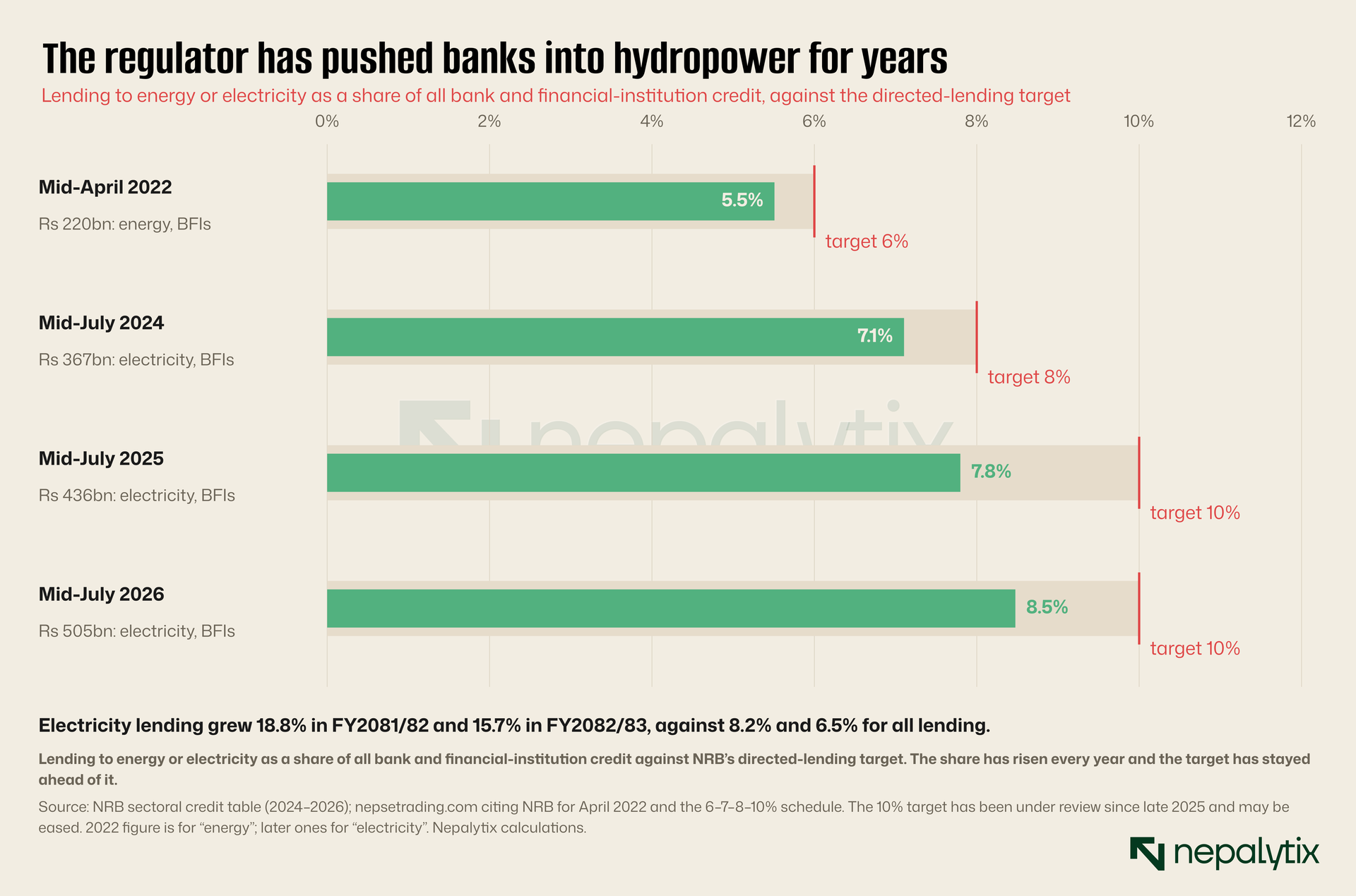
NRB’s directed-lending rules have asked commercial banks to put a rising share of their loans into energy: 6% by mid-July 2022, 7% by 2023, 8% by 2024 and 10% by 2025, according to the schedule reported at the time. In mid-April 2022 the share was 5.51%, Rs 220bn. By mid-July 2026 lending to electricity by all banks and financial institutions had reached Rs 504.68bn, 8.5% of all credit. It grew 18.8% in FY2081/82 and 15.7% in FY2082/83, against 8.2% and 6.5% for lending as a whole. NRB’s later roadmap kept hydropower at 10% within a 45% target for priority sectors by FY2084/85 and a review begun in late 2025 is expected to soften the targets rather than remove them.
There are good reasons for the push. Hydropower is Nepal’s comparative advantage, its largest source of new exports and one of the few sectors that can absorb long-term credit productively. But directed lending changes who carries the risk. When a regulator tells banks to lend to a sector, it takes on some responsibility for knowing where that lending sits. Nepal’s hydropower is not spread evenly across the country. It is concentrated in a few steep, glacier-fed valleys, the Bhote Koshi, the Trishuli, the Tamakoshi, the Marsyangdi and the Kali Gandaki among them and those valleys share the same hazards: glacial lake outbursts, landslide dams, monsoon cloudbursts. A lending book that is 8.5% hydropower is in practice a book with a large exposure to a handful of river basins.
Nobody publishes that exposure. Banks report loans by broad sector once a year in their annual reports. NRB publishes a sectoral credit table for the system as a whole. Neither tells you how much of a given bank’s hydropower lending sits in a single basin, or how much of the system sits within a day’s flood of a given glacier. After 2023 and 2026, that is the question a depositor in a bank with a large hydropower book would most like answered.
10. What the disclosure should contain
The proposal is narrow on purpose. It does not ask banks to estimate losses they cannot yet know or to publish anything about individual small borrowers. It asks for six numbers, all of which every bank already has published once with the first-quarter results and updated each quarter until the relief period ends.
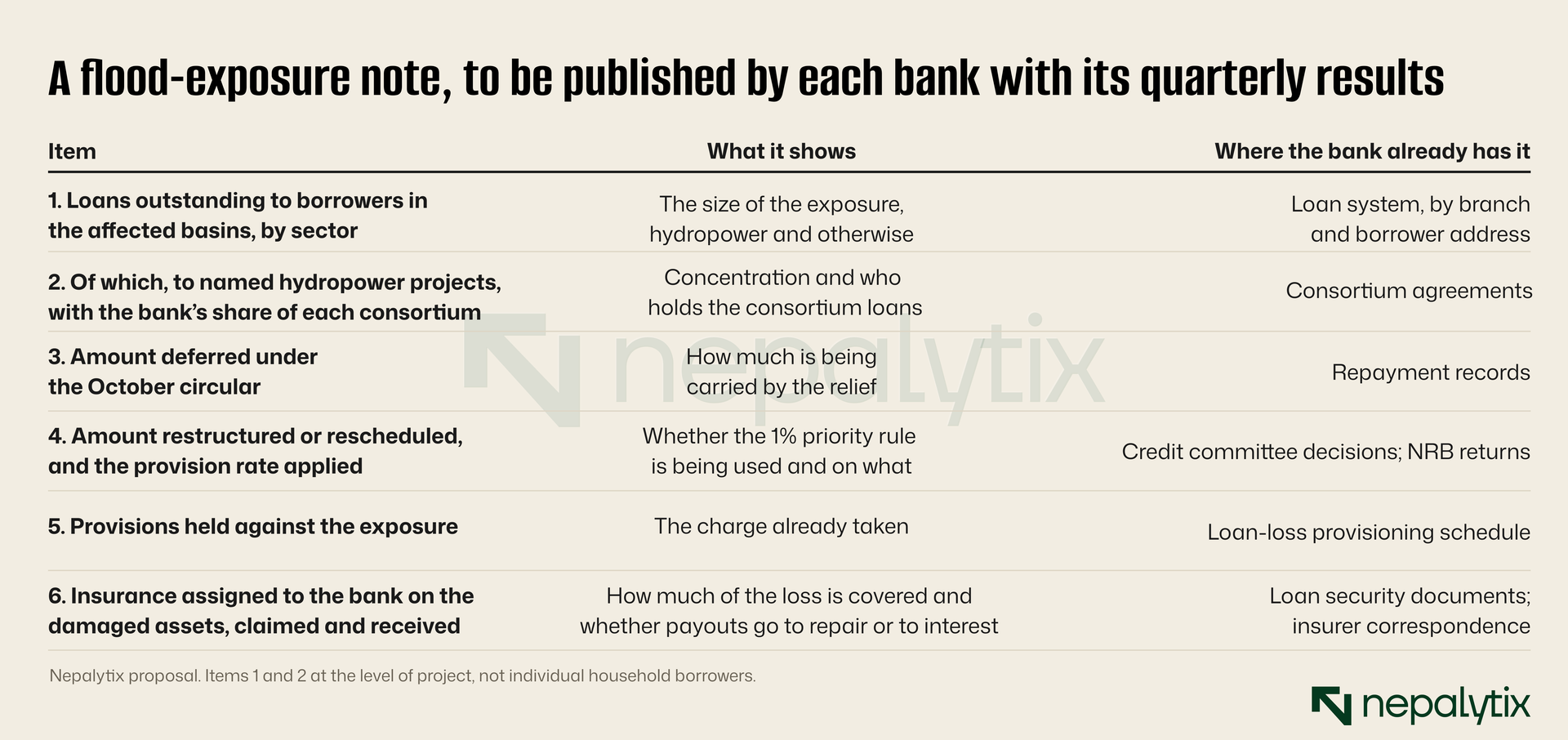
NRB should require the note and should publish the system total each quarter: lending in the affected basins, the amount deferred, the amount restructured and the provisions held. The central bank already collects returns from every licensed institution in far more detail than this. The cost to the banks is a page in a quarterly report. The cost of not doing it is a year in which the reported health of the banking system and its actual exposure to the worst disaster in a decade are allowed to drift apart.
There is a longer-term version of the same idea and it should follow. Banks should report their hydropower lending by river basin once a year, alongside the sector table they already publish and NRB should publish the system’s basin map. The 2023 and 2026 floods hit different rivers. The next one will hit another. A depositor should be able to see how much of a bank’s book sits in valleys that share a single hazard.
The best case against
The amounts are too small to matter. At 1.3% of the electricity book and a tenth of a per cent of all lending, the identified loans are not a systemic risk. Asking for special disclosure dramatises a manageable problem. The system total is small; the bank-level figures are not and investors own banks, not the system. Nabil’s identified exposure is half a year’s profit. And the Rs 6.56bn is a preliminary count of four projects, not the full exposure.
Disclosure could hurt the borrowers. Naming projects and amounts could make it harder for damaged companies to raise new money, or invite pressure from creditors. The borrowers are listed companies that already publish their debt or private projects whose lenders are already known to the market. The proposal asks banks to publish their side of loans whose existence is not secret.
It is commercially confidential. Loan terms are private. The proposal asks for amounts, shares and provisions, not terms. Banks disclose large exposures to regulators already; this asks for a summary of the same thing to be made public for one event.
Supervision, not publicity, is the right tool. NRB sees all of this already, and can act on it. Supervision protects the system. It does not tell a shareholder or a depositor what their own bank holds, and it did not stop the 2023 rules from being loosened in 2025. Publication disciplines the supervisor as well as the banks.
Banks will be punished by the market for honesty. The first bank to publish will be marked down which is why NRB should require it of all of them at once. The market is already pricing the borrowers; it would rather price the lenders on numbers than on rumours.
Why now
The window is short. First-quarter results will be published by mid-November. They are the last set of figures that will be read as a clean picture of the banks before the flood’s effects work through. If the flood exposure is attached to them, the market starts the year with the facts. If it is not, investors will spend the next two quarters reading non-performing loan ratios that cannot by construction, show the problem and provisions that may have been set at 1% on loans to plants that no longer exist.
There is also a practical reason to do it now rather than later. The longer the relief runs, the harder it becomes to separate the flood from everything else. By the third quarter, a bank’s non-performing loans will reflect the flood, the slow economy, the end of the deferral and whatever restructurings it has agreed, all at once. Today the flood exposure is a short list of named projects and a defined set of borrowers. It can be counted. In six months it will have been folded into a hundred other numbers.
And there is a reason for the regulator to want it. NRB has spent five years asking banks to lend more to hydropower and has just made restructured hydropower loans cheaper to carry. Both choices have arguments for them. Both also make the central bank a party to the outcome. A regulator that publishes what its rules have produced, rather than leaving it to be discovered in a bad year, is in a stronger position to defend them.
What should investors watch in the meantime? Three things in this month’s results. First, whether any bank volunteers the numbers: a bank that does is telling you it is comfortable with them. Second, the watchlist and restructured-loan figures in the notes, which may move before the non-performing loan ratio does. Third, the size of the first-quarter provision charge at Nabil, Laxmi Sunrise and NMB against the same quarter last year. A charge that has not moved at all, ten weeks after the worst flood in a decade hit their borrowers, is itself a piece of information.
Nothing here requires a judgment about whether the relief rules are right. They probably are. A disaster of this size calls for patience with borrowers and banks that force damaged projects into default would make the losses worse. But relief and disclosure are not alternatives. The relief buys the borrowers time. Disclosure lets everyone else see what that time is being used for.
The proposition, again
With their first-quarter results this month, banks should publish what they have lent in the flood-affected basins, to which projects, how much has been deferred or restructured what provision rate they applied and what insurance stands behind it. NRB should require it of every bank at once and publish the system total. The numbers exist. The relief rules mean they will not surface any other way before May.
Disclaimer
This report has been prepared by Nepalytix for informational and educational purposes only and does not constitute investment advice, an offer, or a solicitation to buy or sell any securities.
The information contained in this report is based on sources believed to be reliable; however, Nepalytix does not guarantee its accuracy, completeness, or timeliness. Opinions, estimates, and projections expressed herein are those of the authors as of the date of publication and are subject to change without notice.
Investing in securities involves risks, including the possible loss of principal. Past performance is not indicative of future results. Readers are advised to conduct their own independent research and consult with a qualified financial advisor before making any investment decisions.
Nepalytix and its contributors may hold positions in the securities discussed in this report at the time of publication or thereafter.
Neither Nepalytix nor any of its affiliates accept any liability for any loss arising from the use of this report or its contents.