Nepal Airlines Rs 56 Billion debt problem was built into its financing
Nepal Airlines owes up to Rs 56 billion, much of it to the retirement funds of Nepali workers. The problem is not only how the airline is run, but how it was financed.
Nepal Airlines owes somewhere between Rs 46 billion and Rs 56 billion depending which official document you read. Almost all of it is retirement savings. And it was structured as debt which is the decision that turned a struggling airline into an insolvent one.
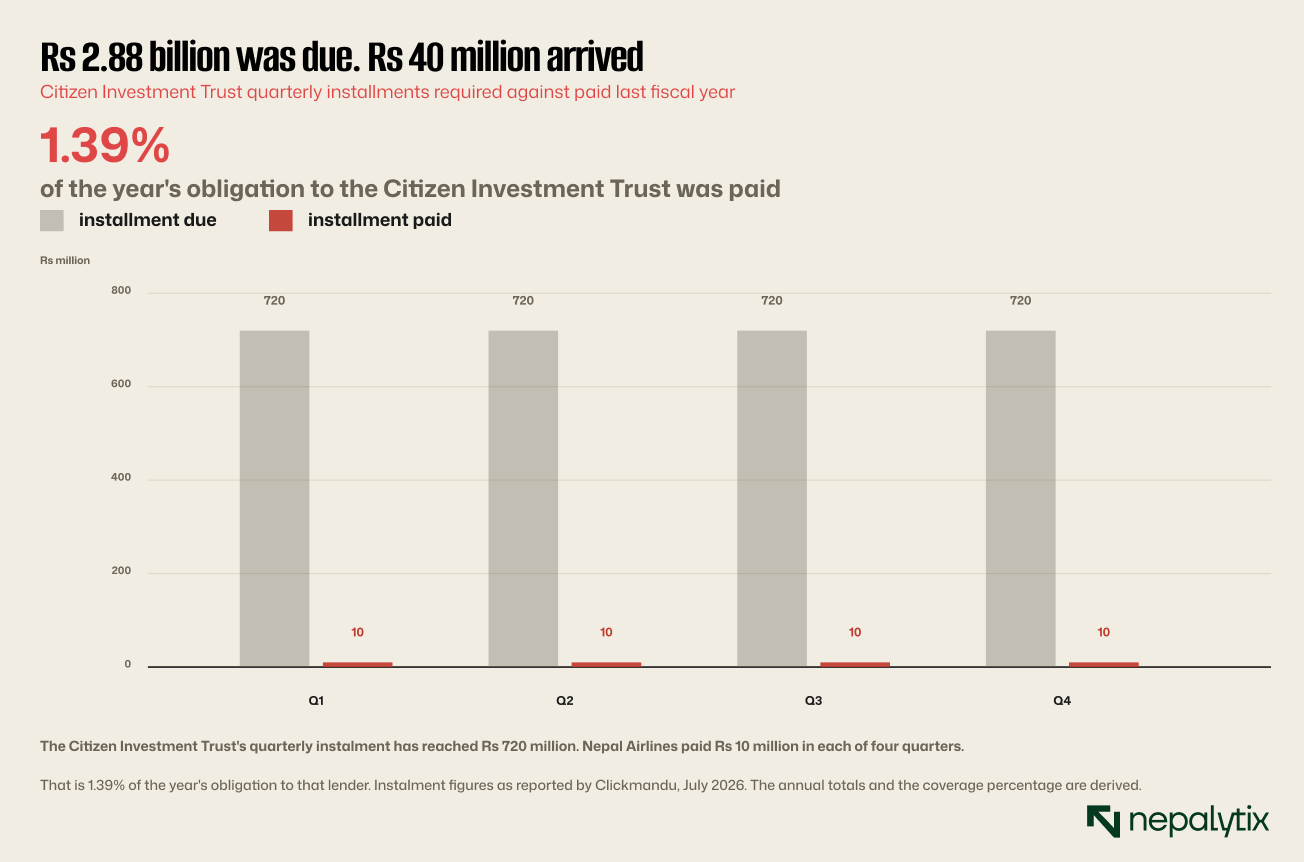
Last year the Citizen Investment Trust was due Rs 2.88 billion from Nepal Airlines. It received Rs 40 million.
Nepal has no shortage of loss-making public bodies and a piece about any of them can be written from a template: political appointments, overstaffing, procurement scandals, losses. Nepal Airlines has supplied material for all of it across sixty-eight years.
This piece is about something narrower and we think, more consequential. The airline's insolvency is not principally the product of how it has been run. It is the product of how it was financed and the financing decision was made by institutions holding other people's retirement money.
That distinction matters because the remedies differ completely. If the problem is management, you change the management and the government is doing that with sixteen applicants for the chief executive's post. If the problem is the capital structure, changing the management achieves nothing because no operator can service Rs 56 billion on a Rs 23 billion revenue base.
The evidence in this piece points firmly at the second.
How much does Nepal Airlines actually owe?
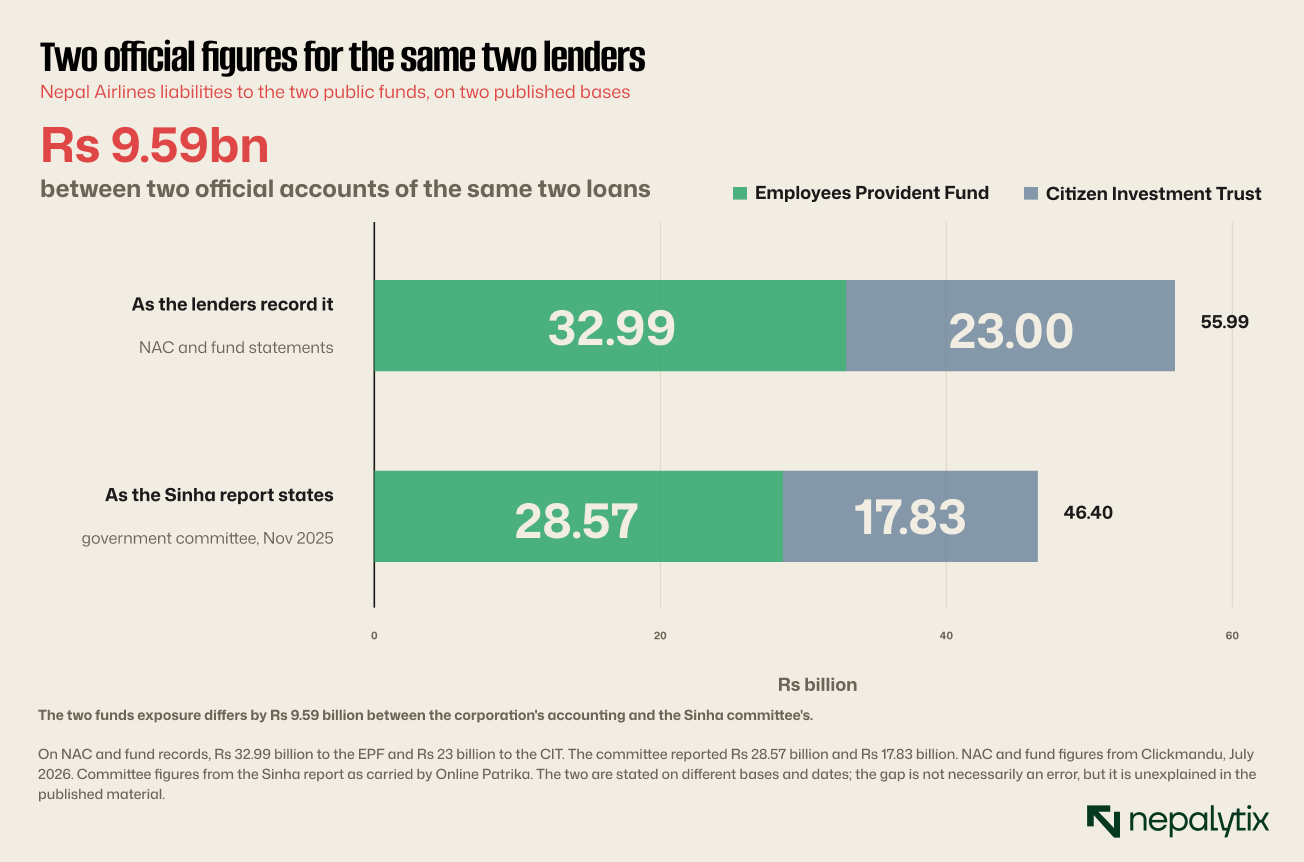
This should be the easiest question in the piece. It is not. Five documents published between November 2025 and August 2026 give five different answers and the corporation itself has said its records do not match those of the institutions that lent the money.
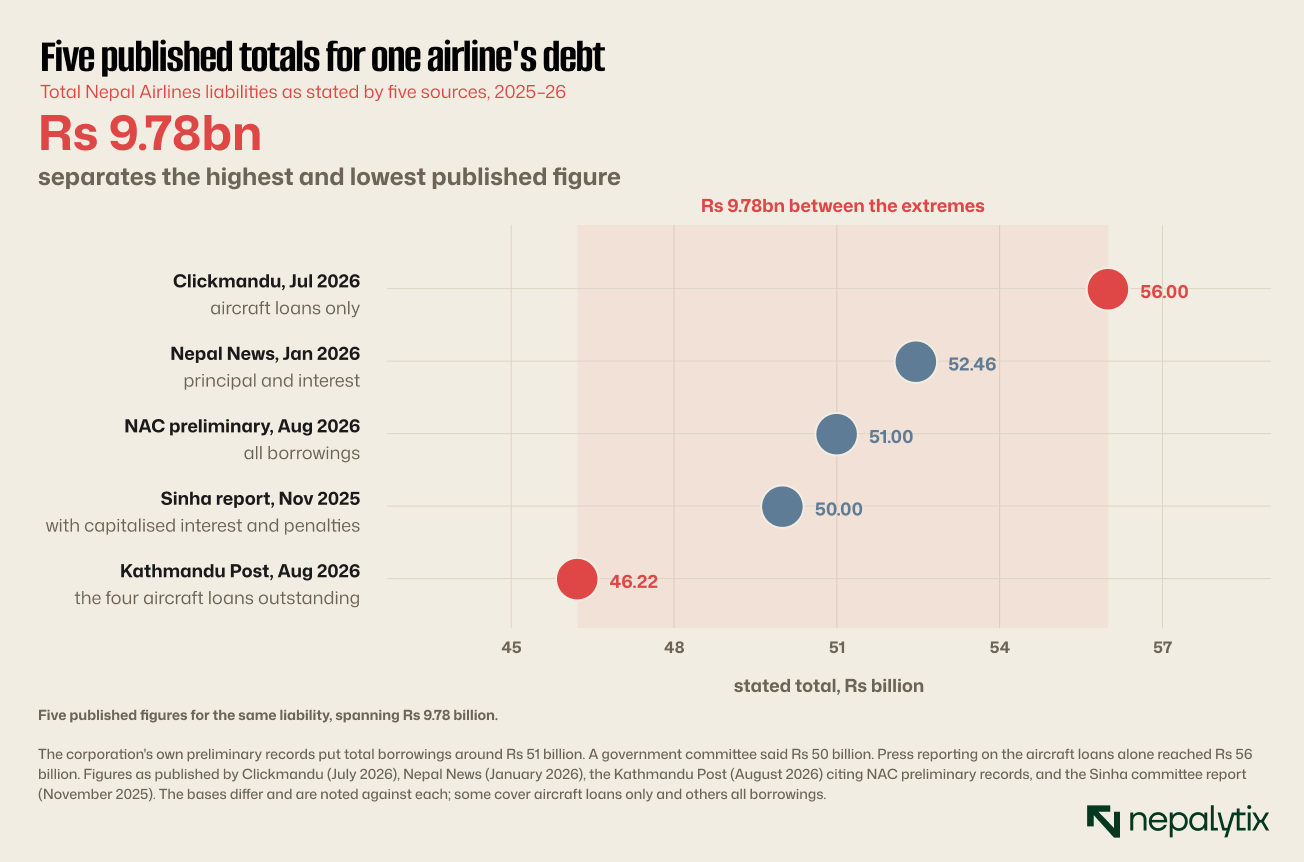
Part of the range is definitional. Rs 46.22 billion is the outstanding balance on the four aircraft loans specifically. Rs 51 billion adds other borrowings. Rs 56 billion appears to include interest accrued on a different reckoning.
But not all of it is definitional and the corporation has said so. Its own executive director has acknowledged discrepancies between the debt figures NAC maintains and those recorded by the institutions that lent the money.
An airline and its two principal creditors do not agree on the size of the loan. Not approximately and not on a technicality: the parties are separated by billions of rupees on liabilities held on behalf of the public. That is where any restructuring conversation has to begin, and it is not where the public discussion is.
Why the range is not just a rounding argument
It would be easy to dismiss this as journalists quoting different scopes, and some of it is exactly that. But three things suggest otherwise.
The corporation's own executive director raised, in talks with both funds, the lack of clarity on the total amount payable and the inconsistency in the underlying facts. That is not a definitional quibble. It is the borrower telling the lenders their records do not match.
The Sinha committee, which had access the press does not, published figures for EPF and CIT exposure materially below those the funds themselves report. Either the committee used an earlier date, a different treatment of penalties, or a different view of what is properly owed.
And the talks now under way are described as covering the establishment of a uniform record by adjusting the reality of the outstanding amount. If a uniform record needs establishing, there is not one.
For a liability of this size, held by public retirement funds, the absence of an agreed number is the first fact a reader should know and the last one being reported.
How did Rs 34 billion become Rs 56 billion?
Nepal Airlines borrowed twice for aircraft. In 2013 it took Rs 10.49 billion for two narrow-body Airbus. In 2017 it took Rs 24 billion Rs 12 billion each from the Employees Provident Fund and the Citizen Investment Trust for two wide-body A330s.
That is Rs 34.49 billion of drawdown against four aircraft.
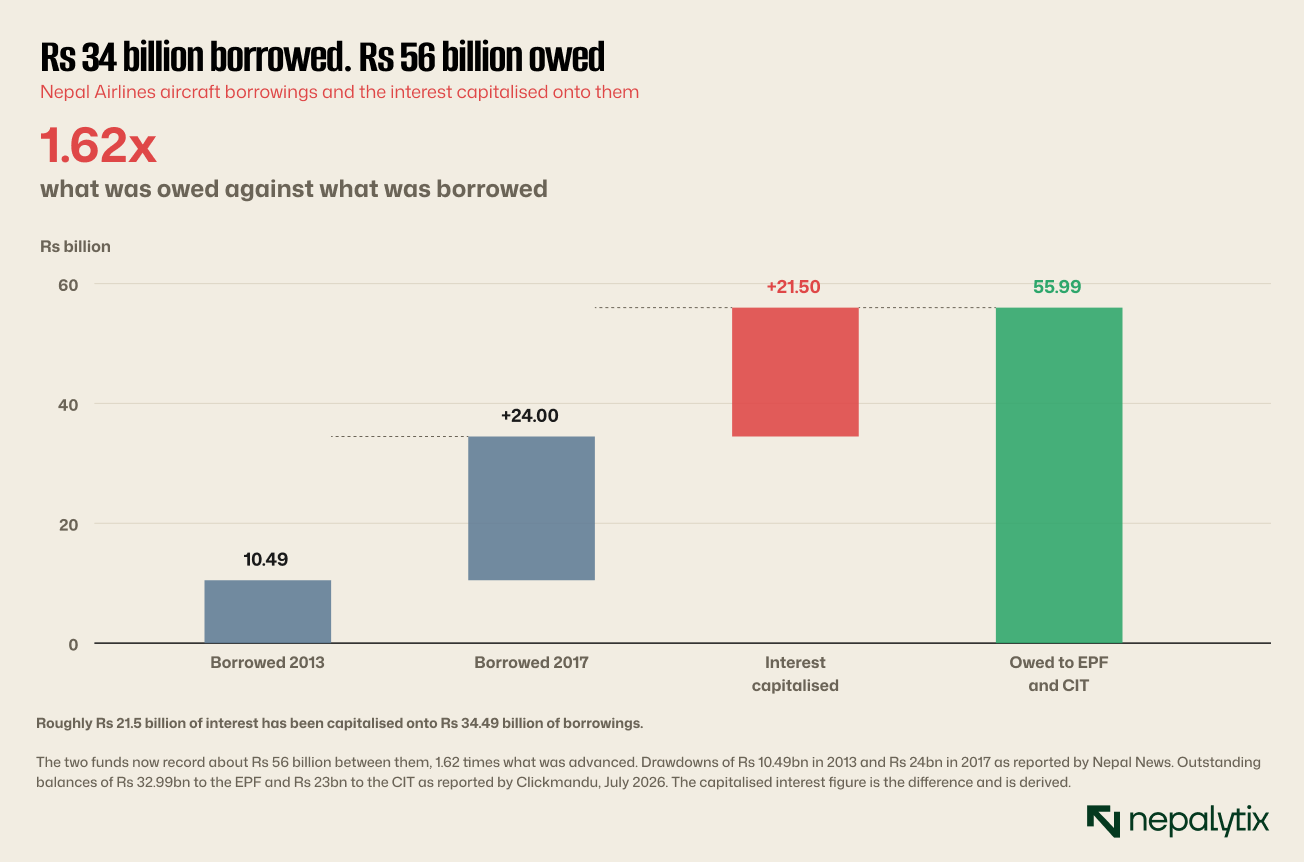
The mechanism is straightforward and it is the reason the number keeps moving. When NAC fails to pay interest on schedule, the unpaid interest is added to the principal. The following period's interest is then calculated on the larger balance.
The EPF's spokesman has described exactly this: the debt exceeded the original loan because the corporation failed to pay interest and instalments on time, and the unpaid interest was capitalised.
Nine years of that on the wide-body loan has taken Rs 24 billion to over Rs 46 billion. The aircraft themselves have not changed in value by anything like that amount.
What the 2017 decision actually committed to
The June 2017 agreement is worth examining on its own terms, because it is the transaction that created most of the present liability.
Rs 12 billion from the EPF and Rs 12 billion from the CIT, for two wide-body Airbus A330s. Wide-body aircraft are the largest capital commitment a small carrier can make and they only pay for themselves on long-haul routes flown at high frequency and high load.
The commitment being taken on was not Rs 24 billion. It was Rs 24 billion plus interest across the loan's life, payable in fixed instalments from the first year against revenue from routes that did not yet exist at frequencies the fleet could not yet fly.
Nine years later, the CIT's quarterly obligation alone stands at Rs 720 million. Annualised, that is Rs 2.88 billion from one lender against total corporation revenue of about Rs 23.40 billion and an operating deficit.
The airline is expected to hand a single creditor more than a tenth of its gross revenue while losing money at the operating line. It has not done so and the arithmetic explains why more clearly than any account of mismanagement.
Is it being repaid at all?
Partly and nowhere near the schedule.
Against the four aircraft loans as a whole, NAC records Rs 16.54 billion repaid to date. That is real money and it should be acknowledged. The Prime Minister has cited Rs 1.06 billion of instalments repaid in a recent period alongside revenue of Rs 6.27 billion in four months and 86% occupancy.
None of it is close to the contractual schedule. Repayments at 1.39% of what one lender is owed do not reduce a balance; they slow the rate at which it grows.
The arithmetic of capitalised interest
It is worth walking through what capitalisation does because it explains why the balance moves in the wrong direction even in years when the airline pays something.
Suppose a Rs 12 billion loan carries interest that accrues to roughly Rs 1.2 billion in a year, and the borrower pays Rs 40 million. The Rs 1.16 billion of unpaid interest is added to the principal. The following year interest accrues on Rs 13.16 billion.
Repeat that across nine years and the balance does not merely fail to fall. It compounds. A Rs 12 billion advance from each of two institutions in June 2017 is now reported at over Rs 23 billion on a single aircraft.
This is not a penalty regime or a punishment. It is ordinary loan mechanics operating on a borrower that cannot meet the schedule, which is precisely the situation equity is designed for and debt is not.
What do the solvency ratios say?
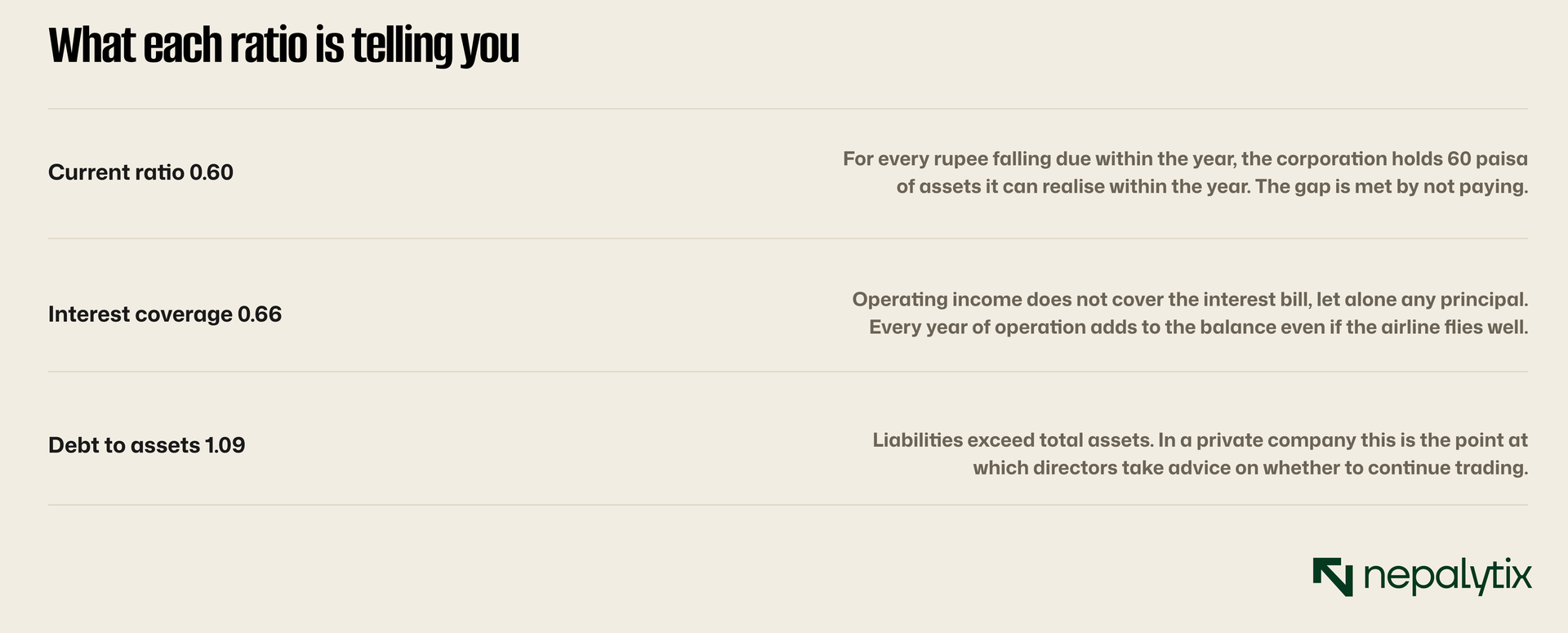
The Office of the Auditor General has published three, and they are unambiguous.
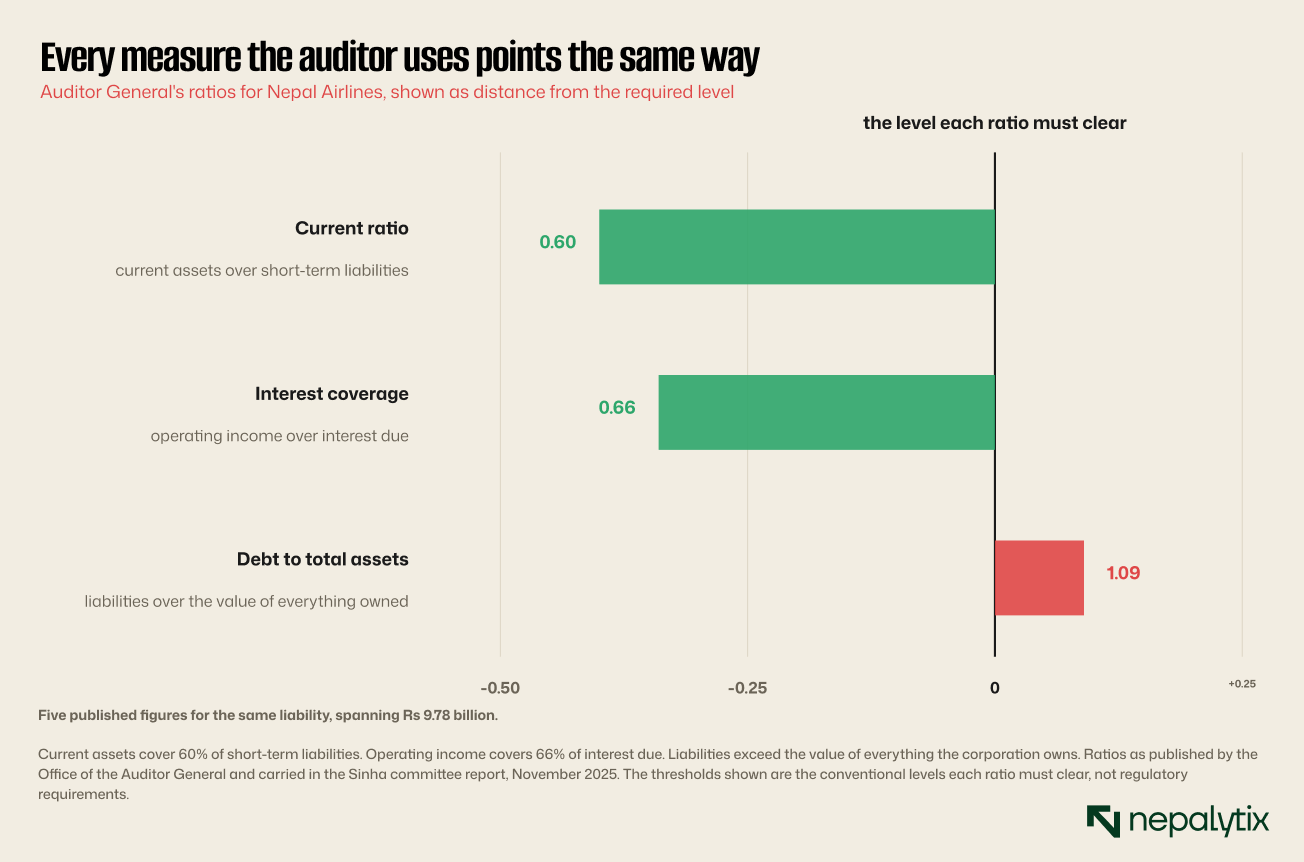
A debt-to-assets ratio above 1.00 has a specific meaning. If Nepal Airlines sold every aircraft, every building and every receivable at book value, the proceeds would not clear its liabilities.
The Sinha committee, chaired by former Supreme Court Justice Anil Kumar Sinha, put it without hedging: the corporation is heading towards bankruptcy.
What the guarantee does and does not do
The 2013 and 2017 borrowings were made under government guarantee. That fact is often cited as though it settles the question of risk. It does not settle it; it relocates it.
A guarantee means that if Nepal Airlines cannot pay, the government is obliged to. So the EPF and CIT are not exposed to the airline's insolvency in the way an unsecured commercial creditor would be.
But a guarantee is only as good as the guarantor's willingness to honour it and honouring it means a transfer from the national budget to two funds, to cover a loss created by an enterprise the same government owns. That is a fiscal event, and it has not been budgeted for or publicly quantified.
The alternative, the one now under discussion is conversion to equity under which the funds accept shares rather than calling the guarantee. That protects the budget and moves the loss onto the funds balance sheets which is to say onto the retirement savings the funds hold.
Somebody absorbs roughly Rs 20 billion of value that does not exist. The published discussion has not yet named who and the three candidates are the national budget, the funds members, or the airline's creditors accepting a longer schedule at a lower rate. Each is a political choice dressed as an accounting one.
Whose money is it?
This is the part that makes it a public question rather than a corporate one.
The Employees Provident Fund holds the retirement contributions of Nepali workers. The Citizen Investment Trust manages long-term public savings. Between them they are the custodians of the retirement money of millions of people.
Those two institutions are Nepal Airlines principal creditors.
The Long Read of 30 July established that essentially every formally employed Nepali worker is an investor through these funds without having chosen to be. This is the other side of that.
Their money is in an airline whose auditor reports liabilities exceeding assets, and it is there as a loan that is not being serviced rather than as equity.
How the funds ended up here
The question worth asking is why two retirement institutions lent Rs 34 billion to a loss-making state airline in the first place.
The answer is that it looked like a safe asset. A government guarantee, a state-owned borrower, a defined interest rate and a repayment schedule. For a fund that must generate a return on members' contributions without taking equity risk, a guaranteed loan to a state enterprise is close to a sovereign instrument.
That reasoning is sound in isolation and it is how such funds are supposed to think. The failure is at the other end. Nobody appears to have asked whether Nepal Airlines could generate the cash flows to service Rs 34 billion of amortising debt, on top of an operating cost base it was already struggling to cover.
An airline is a poor candidate for heavy amortising debt at the best of times. Revenue is cyclical, fuel costs are volatile, and fleet expenditure is lumpy. Airlines worldwide are financed through leases, equity and asset-backed structures precisely because fixed repayment schedules sit badly against variable earnings.
Nepal Airlines was given the financing structure of a utility and the earnings profile of an airline. Utilities carry heavy fixed debt because their revenue is regulated and predictable. Neither condition applies here.
Why does the debt-versus-equity distinction matter so much?
Here is the argument this piece exists to make.
The Sinha report identifies a structural flaw that has been almost entirely absent from public discussion. Institutions like the EPF and CIT ordinarily deploy long-term capital as equity. Banks then extend medium and long-term loans from their capital reserves.
Nepal Airlines received direct credit from capital funds that should have arrived as equity. The report is careful: this may not be illegal but it represents poor financial judgement.
Consider what would be different had the same Rs 34.49 billion gone in as equity.
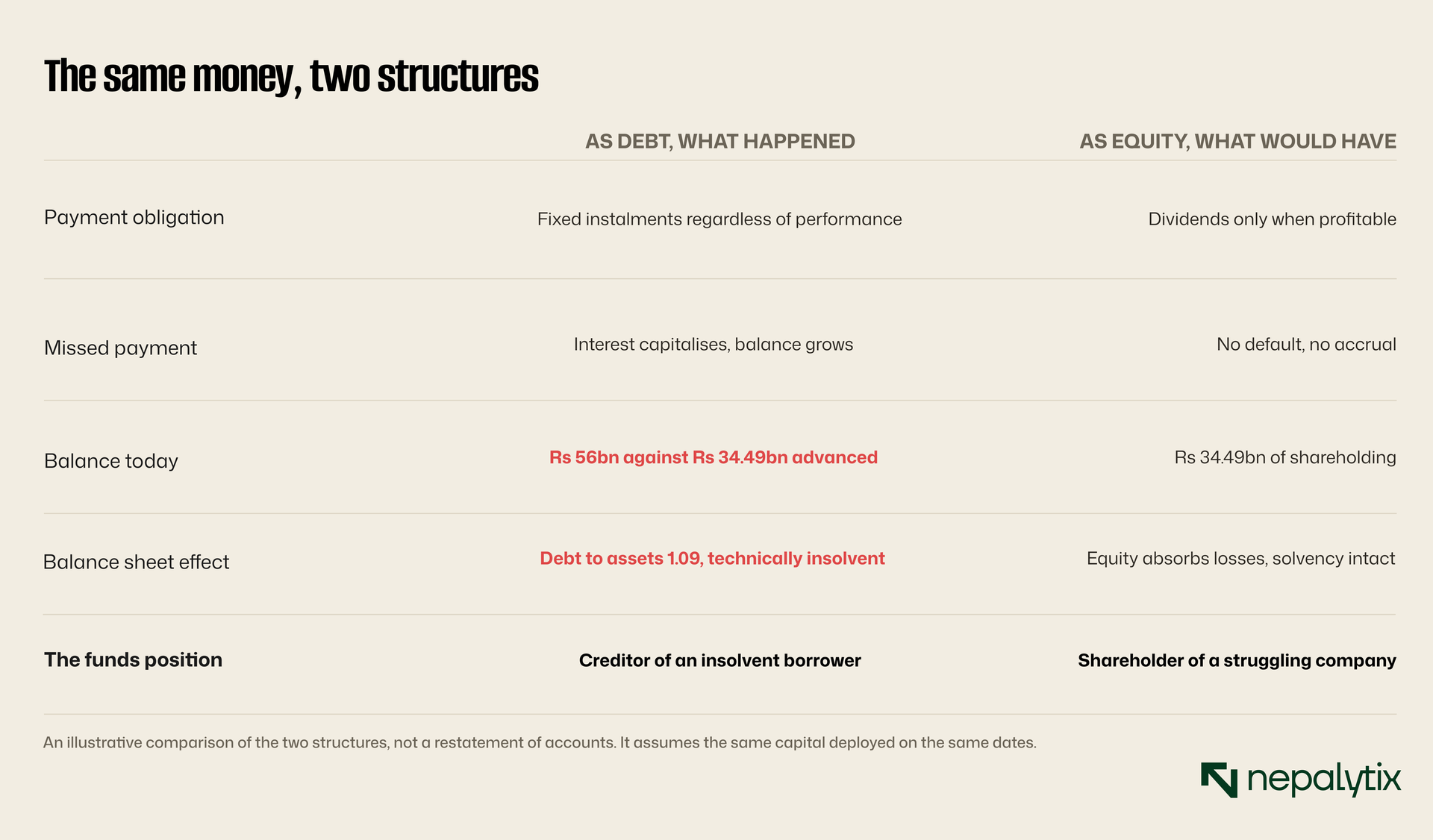
The distinction is not academic. A shareholder in a loss-making airline owns a stake worth less than they paid. A creditor of an insolvent airline is owed a sum that grows every year it is not paid, secured against assets worth less than the debt.
The funds took the second position while performing the economic function of the first. They supplied the airline's capital and accepted none of the flexibility that equity provides.
The case against conversion, put fairly
Converting the loans to equity is the remedy this piece supports, and the objections to it are serious enough to state properly.
It rewards non-payment. A borrower that services its obligations gets no relief; one that does not gets its debt written into shares. That is a poor incentive to set for every other state enterprise borrowing from the same funds.
It converts a guaranteed claim into an unguaranteed one. The funds currently hold debt backed by a government guarantee. Equity in Nepal Airlines carries no such backing. On a strict reading, conversion makes the funds' position worse, not better, and their members bear it.
It does not fix the operating deficit. An airline losing Rs 1 billion a year with no debt is still an airline losing Rs 1 billion a year. Conversion buys time; it does not buy a business model.
It may be repeated. Reform proposals have promised transformation before, and earlier restructuring attempts are among the borrowings on the balance sheet today. A conversion that is not accompanied by governance change is a transfer, not a reform.
We accept all four. What they argue for is conditions attached to conversion, not the preservation of a claim the auditor has already indicated cannot be recovered in full.
The precedent this sets for other state enterprises
Nepal Airlines is the largest case but it is not the only one and the structure that produced it is still available.
The arrangement was: a state enterprise needs capital, the budget cannot supply it and two public funds hold large pools of long-term savings. A government guarantee bridges the credit assessment. The funds book a safe-looking asset and the enterprise books a liability it may not be able to service.
Nothing in that sequence has changed. If another state enterprise requires capital tomorrow, the same route is open and the same guarantee is available.
The Sinha report's recommendation to reorganise government capital, investments and institutional loans reaches at this and it is the part of the reform agenda least likely to be implemented because it constrains a financing channel that is convenient for everyone involved except the funds members.
What has the passage of time done?
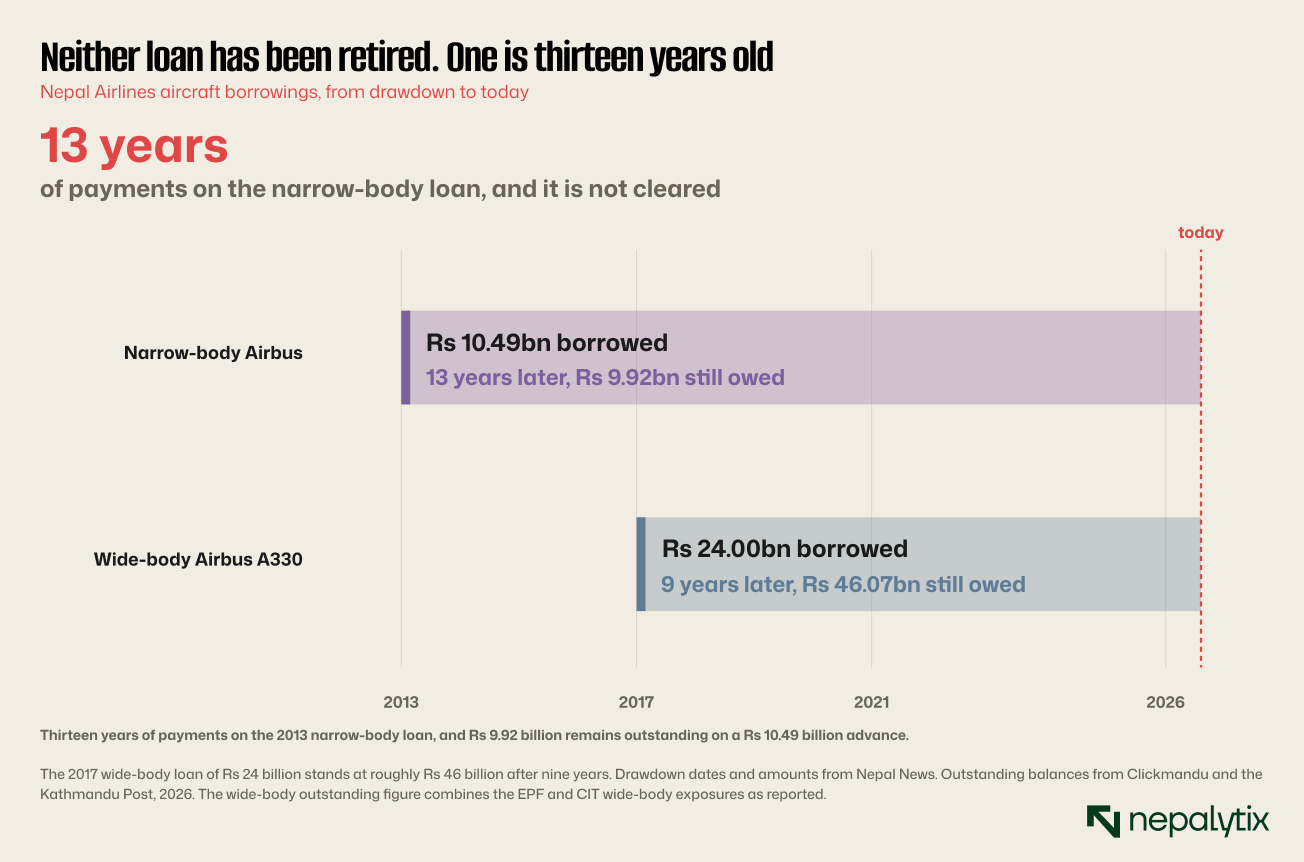
The narrow-body figure is the one to sit with. Rs 10.49 billion borrowed in 2013. Rs 9.92 billion outstanding in 2026. Two aircraft bought, thirteen years flown, and the debt that bought them is very nearly whole.
Thirteen years of instalments have reduced the balance by roughly five per cent of what was advanced. On any ordinary amortisation schedule a thirteen-year-old loan would be substantially retired by now.
The comparison nobody makes
One observation raised in commentary on the corporation deserves more attention than it gets: every private airline serving Nepal is profitable, on the same fuel prices and the same airport fees.
That comparison is often deployed as evidence of state incompetence, and management failures are real. But it also isolates the variable. The private carriers operate the same routes, from the same congested airport, into the same demand and they make money.
What they do not carry is Rs 56 billion of amortising debt against a Rs 23 billion revenue base.
Strip the interest bill from Nepal Airlines and the airline that remains is roughly breaking even at 86% occupancy not a strong business, but a viable one. Add the debt back and no amount of operating discipline reaches solvency, because interest coverage is 0.66.
The lesson is not that state ownership fails. It is that the same airline, financed differently would be an ordinary competitor rather than a bankruptcy case.
Thirteen years, five per cent
The narrow-body number deserves one more paragraph because it is the clearest single fact in this piece.
Rs 10.49 billion was borrowed in 2013. Rs 9.92 billion was outstanding at the end of the last fiscal year. Thirteen years of instalments have reduced the balance by roughly Rs 570 million, which is about five per cent of the original advance.
Those aircraft have been flying for thirteen years. They have depreciated substantially and will need replacing within the useful life of most narrow-body fleets. The loan that bought them is essentially intact.
That is the position the corporation is in on its older and smaller borrowing.
Does the operating business work?
Better than the debt figures suggest, and that is genuinely important.
NAC estimates revenue of about Rs 23.40 billion last fiscal year against expenses of roughly Rs 24.40 billion, a deficit near Rs 1 billion. On a Rs 23 billion revenue base that is a margin problem, not a catastrophe.
Occupancy at 86% is a respectable load factor for any carrier. Revenue of Rs 6.27 billion in four months annualises well above the prior year.
The airline flies full aircraft and roughly covers its operating costs. What it cannot do is service Rs 56 billion of debt on top. That sentence contains the entire diagnosis, and every remedy under discussion should be tested against whether it addresses the second half of it or only the first.
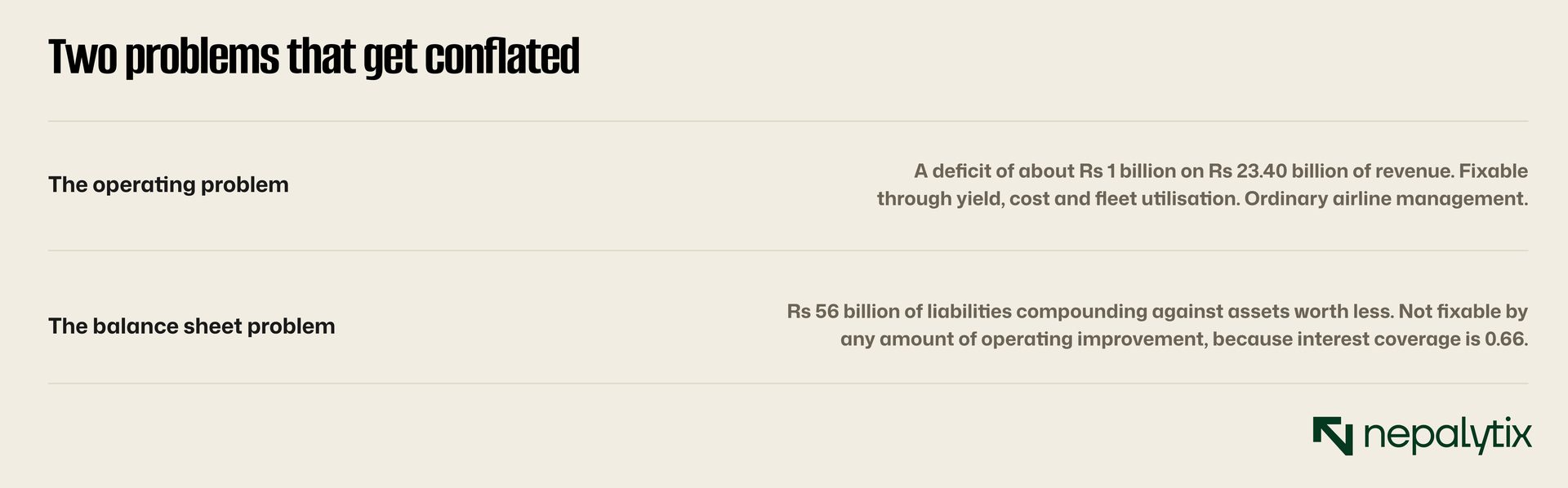
Every announcement about occupancy, route additions or quarterly revenue addresses the first. None of them touches the second, and the second is what the auditor is describing when it reports a debt-to-assets ratio of 1.09.
What the funds' members are actually exposed to
It is worth being concrete about who bears this, because "public savings" is an abstraction and the exposure is not.
The Employees Provident Fund holds the retirement contributions of formally employed Nepali workers, deducted from salary and matched by employers. The Citizen Investment Trust manages long-term savings on a similar basis. Neither member chose to finance an airline.
On the funds' own records, roughly Rs 56 billion of their assets sit in Nepal Airlines paper. The Long Read of 30 July established that the EPF alone manages a pool large enough to make it one of the largest institutional holders in the Nepali market.
What a member sees is a credited rate of return. What sits behind part of that return is a loan to a borrower whose auditor reports liabilities exceeding assets, servicing that loan at 1.39%.
If the debt converts to equity, the funds' accounts will carry shares rather than a receivable, and the shares will be worth less. That difference is a reduction in the assets backing members' balances, and it is the reason this is a story about retirement savings rather than about aviation.
What would a real restructuring have to do?
Three things, and the first two are the ones nobody wants to say out loud.
Agree the number. Before anything else, NAC and the two funds must reconcile to a single figure. The corporation has begun talks on exactly this, and reporting describes discussions covering a uniform record of the outstanding amount, options for interest waiver, and rescheduling. That reconciliation should be published. A restructuring negotiated over a liability the parties measure differently is not a restructuring.
Convert debt to equity. The Sinha report recommends reorganising government capital, investments and institutional loans, and reform proposals have suggested converting large portions of the loans into equity. This is the correct remedy and it should be described honestly: it converts a claim that is growing into a shareholding that will be worth less than the loan's face value.
That is a loss for the EPF and CIT. It is a loss they have already suffered — the debt-to-assets ratio of 1.09 says the money is not recoverable in full — and conversion recognises it rather than creating it. But it is public money and the recognition should be explicit rather than folded into a balance sheet exercise.
Change what the funds may do. The structural flaw was allowing retirement funds to lend to a state enterprise under government guarantee, at scale, without the discipline either a bank or a shareholder would apply. If that is not addressed, the same thing will happen to the next state enterprise that needs capital.
What has to be published before anything else
Before a restructuring, a conversion or a partnership can be assessed by anyone outside the room, four documents need to exist in public.
A reconciled statement of liabilities. One figure, agreed between NAC, the EPF and the CIT, with the basis stated. The talks now under way are aimed at exactly this, and their output should be published rather than summarised.
Audited accounts on a current basis. Commentary refers to audited accounts for FY2022/23. For an enterprise in this condition, three-year-old audited figures are not an adequate basis for a transaction.
The Sinha report in full. Its findings have reached the public through press summaries. A committee chaired by a former Supreme Court justice, reporting on the solvency of a state enterprise holding public retirement money, should be read directly.
A quantified cost of the guarantee. If the government's guarantee is called, the budget pays. If it is not called and the debt converts, the funds pay. Either way there is a number, and it belongs in a public document before the decision rather than after it.
None of these is a technical demand. Each is a precondition for any citizen, member of either fund, or prospective partner being able to judge what is being proposed.
What a partner would actually be buying
Set aside the balance sheet for a moment and ask what is genuinely attractive here, because a serious restructuring case has to name the assets.
Slots at Tribhuvan International. As Kathmandu's traffic grows against a constrained single runway, priority access becomes more valuable rather than less, and it cannot be replicated by a new entrant.
Domestic routes with no competition. Several remote and trekking-region routes have infrastructure and aircraft requirements that keep private carriers out. Those routes feed premium tourism traffic.
Underused network capacity. Commentary on the corporation notes that many routes operate at frequencies well below market potential, which is a yield opportunity requiring aircraft rather than new market development.
An 86% load factor. Whatever else is wrong, the airline is filling its aircraft.
Those are real. They are also exactly why the debt matters: an operator would be buying a business with genuine franchise value and a liability that exceeds the value of everything it owns. The assets are worth having. The structure they sit inside is not.
What about the PPP?
Public-private partnership is being discussed as the route out, and it may well be part of the answer. A private operator could bring fleet discipline, yield management and route economics that a state carrier under political direction has not achieved in sixty-eight years.
But a PPP is a transaction and a transaction requires a price. A price requires a balance sheet. And the balance sheet currently shows liabilities that the corporation and its creditors measure differently, exceeding assets by nine per cent, on an interest bill the airline cannot cover.
No private party is buying into that structure. They would be buying an obligation, not an asset.
So the sequence matters and it is the reverse of the public conversation. The debt has to be reconciled and restructured first. Only then is there something a partner could price.
Three things this piece does not argue
We are not arguing that Nepal Airlines should be wound up. It carries a national route network, holds slots at a congested airport and serves domestic routes no private carrier will fly. Those are real assets and they are not reflected in a debt-to-assets ratio.
We are not arguing that the EPF and CIT acted improperly. The Sinha report is careful on this point and so are we: extending credit where equity was appropriate may reflect poor financial judgement and it does not appear to have been unlawful. Both institutions lent against a government guarantee to a state borrower which on its face is a conservative allocation.
We are not arguing that privatisation is the answer. A private operator would face the same fuel prices, the same airport and the same demand as the private carriers that already compete profitably on those routes. What it would not accept is the balance sheet which is the point.
Where this leaves it
Nepal Airlines is not primarily a management failure, though it has had those. It is a financing structure failure and it was set in 2013 and 2017 when public retirement savings were routed into an airline as loans rather than as capital.
That decision converted every subsequent bad year into a permanently larger liability. An airline with equity investors and a difficult decade has disappointed shareholders. An airline with creditors and a difficult decade has a balance in default that compounds.
Sixteen people applied for the chief executive's job at an institution its own government's committee describes as heading towards bankruptcy. Whoever takes it will inherit an operating business that roughly works and a capital structure that cannot. No chief executive has authority over the second which is why the appointment matters less than the reconciliation now under way with the two funds.
The airline's problem is not that it is state-owned. It is that it was funded with debt by institutions that should have supplied equity and nobody has yet been willing to say what that has cost the people whose savings were used.
Disclaimer
This report has been prepared by Nepalytix for informational and educational purposes only and does not constitute investment advice, an offer, or a solicitation to buy or sell any securities.
The information contained in this report is based on sources believed to be reliable; however, Nepalytix does not guarantee its accuracy, completeness, or timeliness. Opinions, estimates, and projections expressed herein are those of the authors as of the date of publication and are subject to change without notice.
Investing in securities involves risks, including the possible loss of principal. Past performance is not indicative of future results. Readers are advised to conduct their own independent research and consult with a qualified financial advisor before making any investment decisions.
Nepalytix and its contributors may hold positions in the securities discussed in this report at the time of publication or thereafter.
Neither Nepalytix nor any of its affiliates accept any liability for any loss arising from the use of this report or its contents.