NEPSE Should Not Close for Nine Days Every Dashain
Nepal’s prolonged Dashain market closure disrupts trading, liquidity and investor access. Historical data points to a better calendar, make-up sessions and opening auctions.
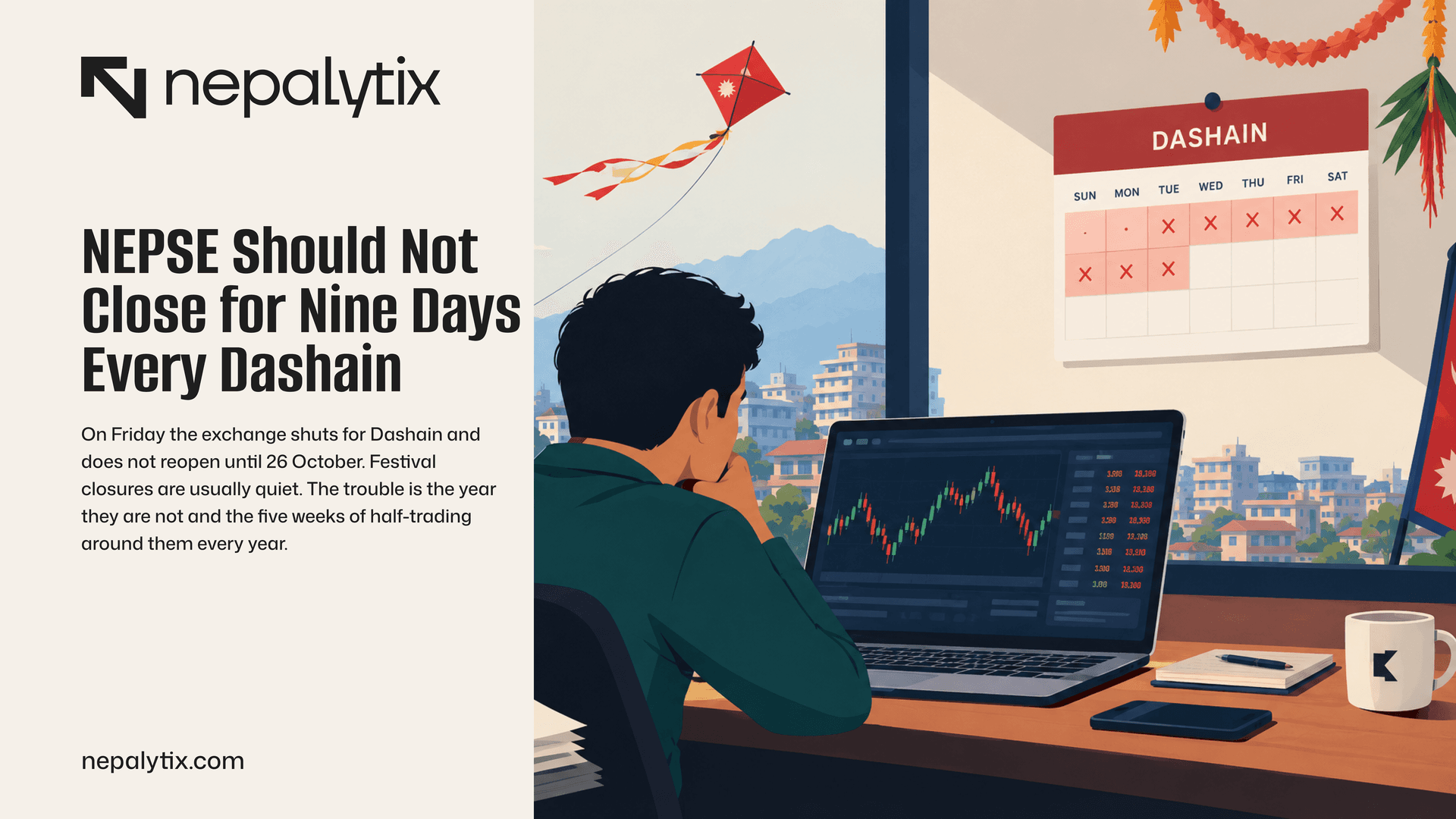
On Friday the exchange shuts for Dashain and does not reopen until 26 October. Festival closures are usually quiet. The trouble is the year they are not and the five weeks of half-trading around them every year.
The proposition
Nepal's stock market should stop treating Dashain as a nine-day shutdown. It should trade on every day the payment system can settle, hold a short festival session on the days it cannot, add make-up sessions when it must close and reopen after any long closure through an auction rather than a sequence of circuit breakers. The closure protects almost no one on a quiet year and on the years that are not quiet it leaves investors unable to act exactly when acting matters most.
Friday 16 October is the last trading session before Dashain. The Nepal Stock Exchange closes after it and reopens on Monday 26 October, nine days later.Friday is also the last day of the first quarter of FY2083/84 so the quarter will close, its numbers will start to circulate and investors will be unable to trade on any of it for more than a week. Less than two weeks after the market reopens, Tihar will close it again: Laxmi Puja falls on 8 November.
None of this is new. Nepali investors have treated the October shutdown as a fact of nature for as long as there has been a market and in most years the cost of it is invisible. The index reopens, moves a little and life goes on. That is precisely why it is worth arguing about now, in a week when the market is near its 52-week low, the microfinance sector is about to be audited and the last two closures that spanned real news each ended in a reopening that lasted only a few minutes.
This piece makes the case in four steps. First, how often and how long the market actually closes. Second, what the closure costs in ordinary years which turns out to be less about prices and more about liquidity. Third, what it costs in bad years which is about who is left holding a position they cannot touch. Fourth, what other markets with their own great festivals do instead. Then it gives the best case for keeping things as they are and answers it.
Closing is a habit, not a necessity
Using the daily NEPSE index since 2008, we identified every gap of five calendar days or more between one trading session and the next. There are 64. Eighteen span Vijaya Dashami and 16 span Laxmi Puja: the market has closed for Dashain and for Tihar in essentially every year on record. Five more span national or local elections, one the promulgation of the constitution in 2015, one the earthquake of 2015, one the Covid lockdown of 2020 and one the Gen Z protests of September 2025. The other 21 are shorter holiday clusters: Holi, Chhath, New Year and the like.
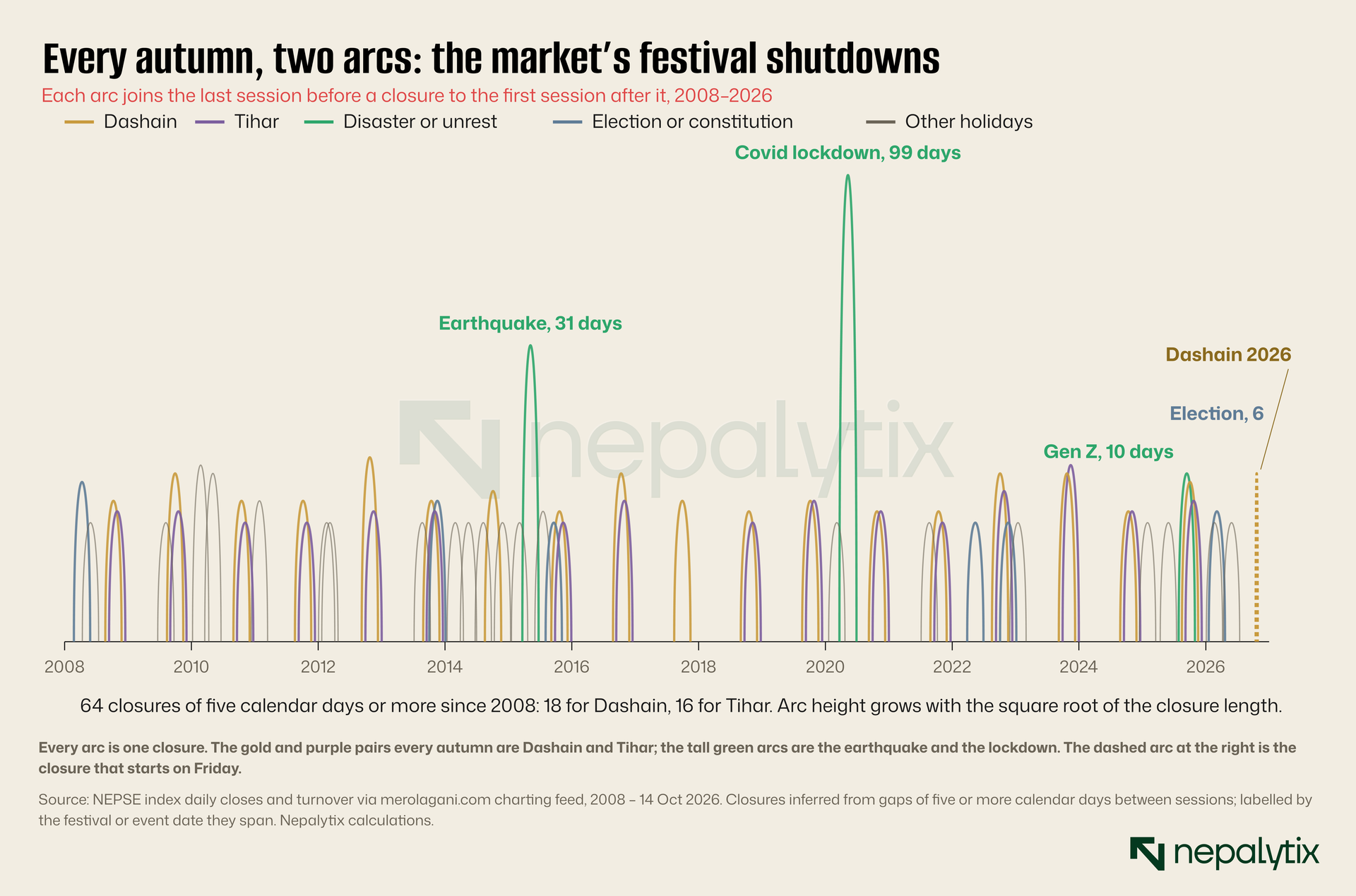
The median Dashain closure is seven calendar days from last session to reopening. This year's gap from Friday 16 to Monday 26 October, is ten matching the longest Dashain gaps of the last decade in 2016, 2022 and 2023 and exceeded only by the twelve-day closure of 2012. In an ordinary year without lockdowns the market holds about 235 sessions. Dashain and Tihar together take roughly ten week days out of that, concentrated in five autumn weeks.
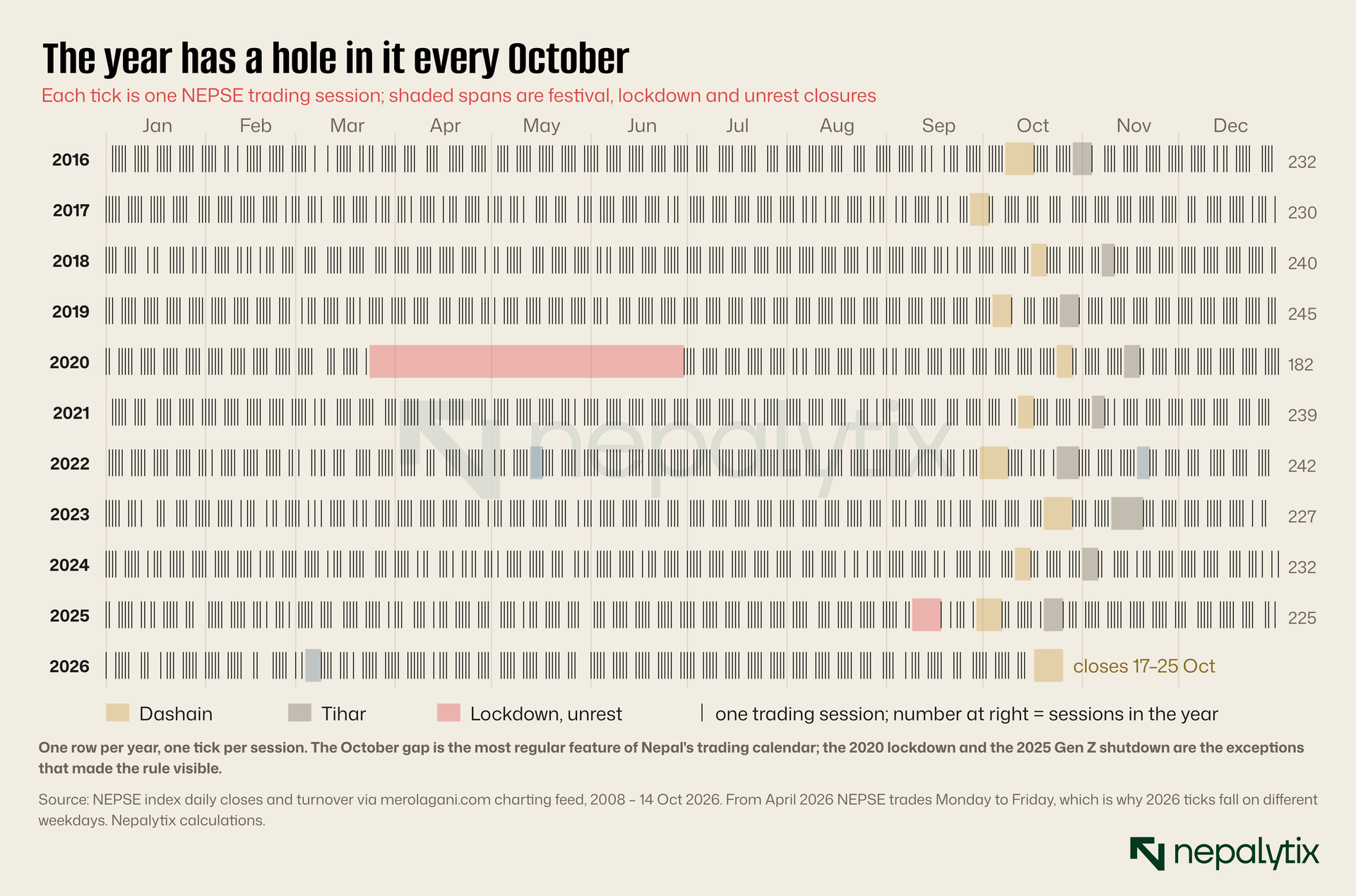
Two things about this calendar are worth noticing. The first is that it has already changed once this year without anyone suggesting the sky would fall. When the government moved the weekly holiday to Saturday and Sunday in April, NEPSE's board moved the trading week to Monday to Friday within days. The calendar follows the government's office calendar and the government's office calendar is a choice. The second is that the length of the Dashain closure has never been set by any market consideration. It is whatever the public holidays, the bank holidays and the weekends add up to in a given year.
In a normal year, the cost is liquidity, not price
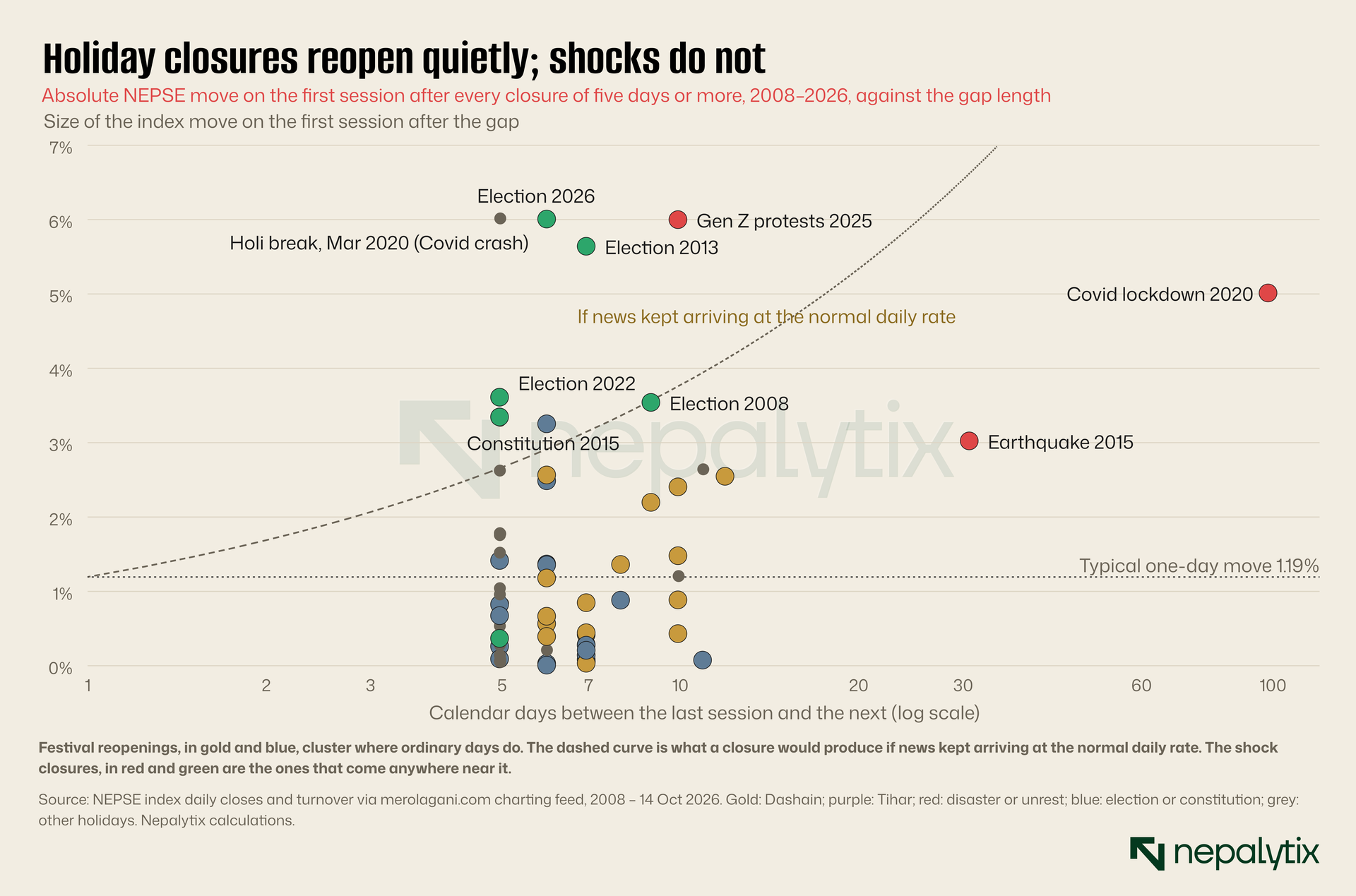
The obvious objection to closing a market is that news keeps arriving while it is shut and prices have to jump to catch up when it reopens. If news arrived at the normal daily rate, the first session after a ten-day gap should move the index about three times as much as a normal session. Festival reopenings do not look like that.
Across all overnight sessions since 2008, the typical NEPSE move is 1.19% (measured as the root mean square of daily changes), and the median absolute move is 0.56%. The median first session after Dashain moved the index 0.76%; after Tihar, 0.47%. The largest Dashain reopening move in 18 years was 2.57%, in October 2020, comfortably inside the range of ordinary days. On the price evidence alone, the Dashain closure looks harmless. That concession matters and it should be made plainly: an argument against the closure that rests on festival reopenings being violent would be wrong.
But price is not the only thing a market supplies. It also supplies the ability to sell and that is what the closure quietly removes for far longer than nine days. We measured NEPSE turnover around the eleven Dashain closures since 2015 against the same market two to three months earlier. In the ten sessions before the closure, turnover runs at between 40% and 70% of normal; on the last session before it, about 50%; on the first session after about 30%. It is still at 42% of normal five sessions after reopening and 58% fifteen sessions after. In 22 of the 31 sessions around the closure, turnover is below 60% of its earlier level.
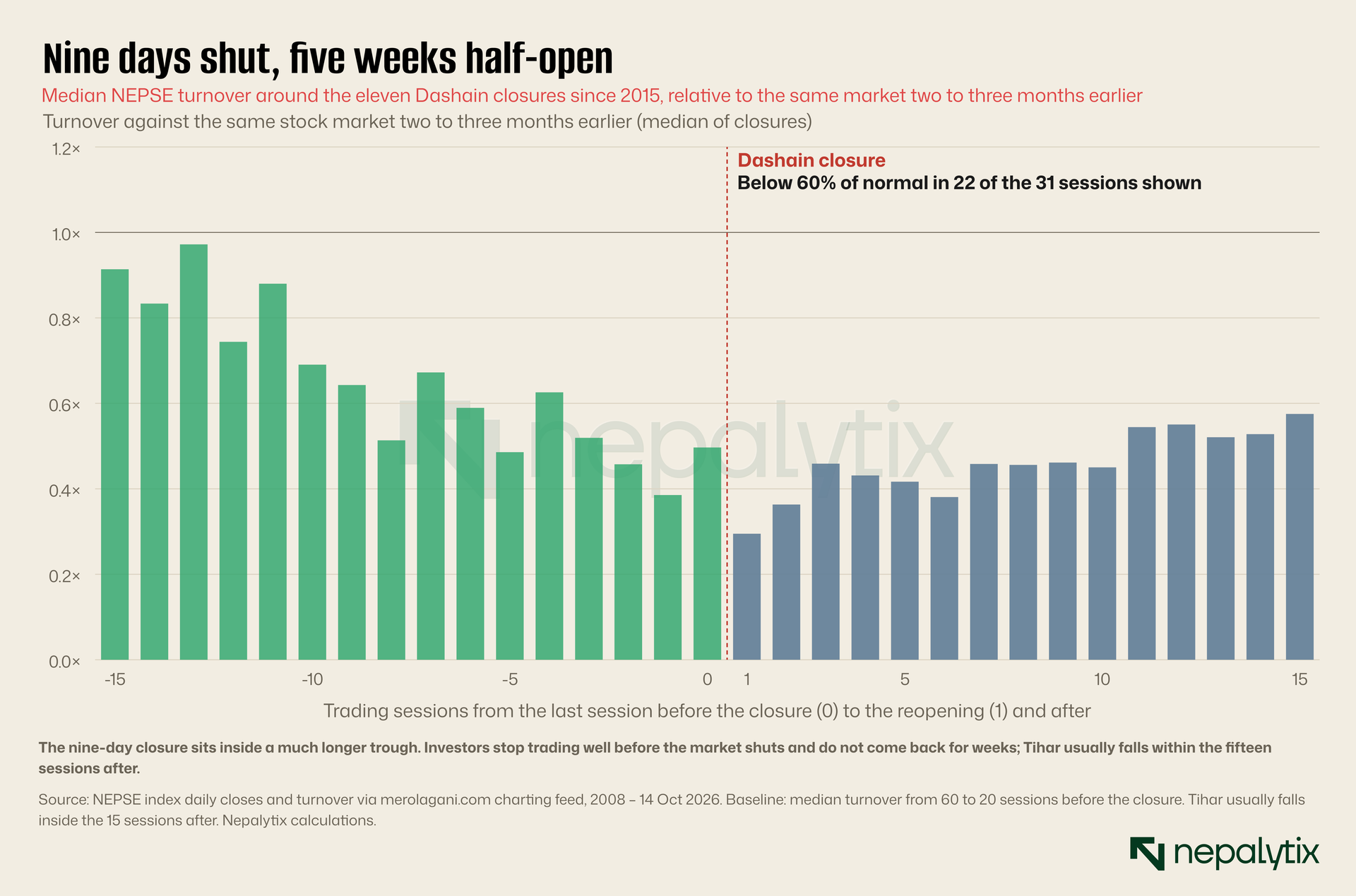
Some of that is simply the festival: people are travelling and trading is the last thing on their minds. But some of it is the closure itself. A market that is about to shut for nine days is a market in which nobody wants to open a position they cannot manage and a market that has just reopened is one in which everyone is waiting to see what the others do. The practical effect is that the Nepali investor who needs cash for Dashain which is to say a large share of them, has to sell into a market that has already thinned out.
The price data add a twist. Over the last five sessions before the closure, the very sessions in which turnover halves, the NEPSE index rose in 17 of the 18 years since 2008 by a median of 2.1%. Only 2015, with the constitution crisis and the Indian border blockade under way, broke the pattern. A market that drifts up on half its normal volume is not one in which buyers are rushing in; it is one in which sellers have stepped away. Whoever needs to sell in that week sells into a market with fewer counterparties than usual and whoever wants to buy is paying a premium to own shares through a period in which they cannot be sold.
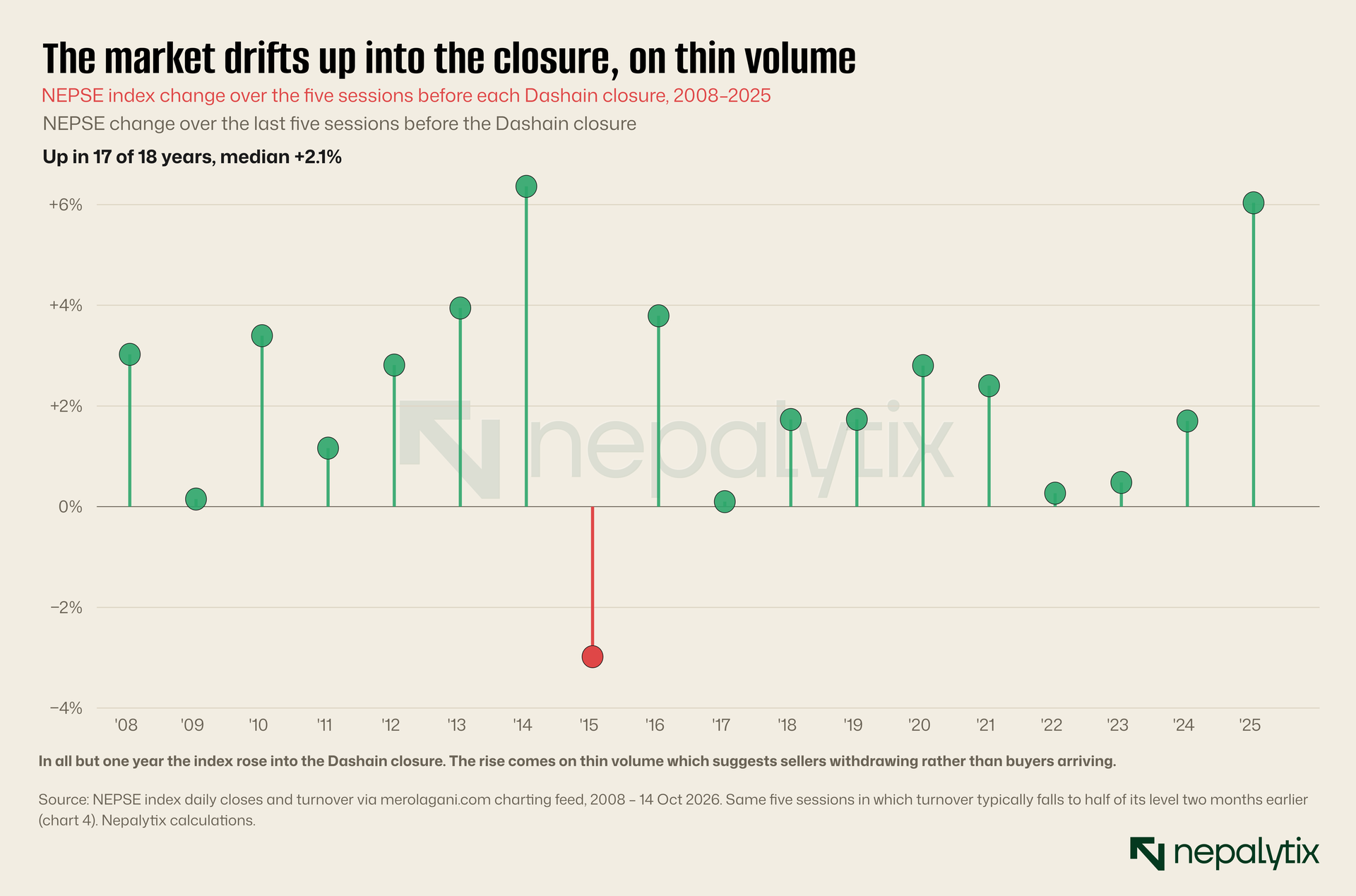
Our Sunday piece on Dashain and NEPSE which looked at a longer window before the festival found the broader run-up weak in most years. The two findings fit together: the weeks before Dashain are soft and the last few sessions firm up as the market empties. Neither looks like a market working well.
That is a real cost but it is a modest and diffuse one. If it were the whole story, the case for change would be about convenience. It is not the whole story.
The autumn, not the week
Dashain is only half of the autumn problem. Tihar follows two to three weeks later and closes the market again for a median of six calendar days. In 2023 the two together shut NEPSE for 21 of the 32 days between 19 October and 20 November: ten days for Dashain, eleven for Tihar. This year Laxmi Puja falls on Sunday 8 November, less than two weeks after the Dashain reopening so the market will reopen on 26 October into the trough shown in chart 4 and close again before turnover has recovered.
Taken together, the autumn festivals turn five or six weeks of the year into a period in which the market is either shut, about to shut or recovering from having shut. For a market whose fiscal year ends in mid-July and whose first-quarter results land in mid-November that is an awkward place for the hole to be. The first quarter closes on the last trading day before Dashain this year; the reports start to arrive in the weeks after Tihar. Investors will spend the gap between the quarter's end and its reports trading in a half-open market.
In a bad year, the closure decides who is trapped
The closures that do produce big reopening moves are the ones that span an event: the 2015 earthquake, the constitution, elections, the Covid lockdown, the Gen Z protests. Across those nine, the median first-session move was 3.61%, roughly six times the median ordinary day. Since 2008, only seven ordinary overnight sessions have moved the index 5.8% or more. Two of the nine event reopenings did and two more moved it by more than 5%.
Dashain is not an event closure and the argument is not that something terrible happens every October. It is that nothing guarantees it will not. The festival closure is scheduled; the news that arrives during it is not. The earthquake struck on a Saturday in April. The Gen Z protests began on a Monday in September three weeks before Dashain. The Bhote Koshi flood came on a Wednesday morning in August with the market open and as our premium report showed, investors were able to begin pricing the damage that same session. Had the surge come on the first Saturday of Dashain, every holder of Rasuwagadhi, Chilime and Upper Trishuli 3B would have spent nine days reading about their companies with no way to sell, hedge or borrow against the shares.
The difference is not academic. With the market open, Rasuwagadhi fell by the 15% daily limit on the day of the surge and by 31% over three sessions and the market spent the following weeks sorting the damaged companies from the undamaged ones. Investors could see each step and act on it. Had the same news broken inside a closure, all of that adjustment would have been compressed into the first sessions after it, behind a 15% stock limit and a 6% index breaker with the holders of the damaged companies unable to sell at any price for as long as the limit-down queue lasted.
We know what happens when the market reopens after news, because it has happened twice in the last thirteen months. On 18 September 2025, after ten days shut for the Gen Z protests, NEPSE fell 4% in the first three minutes, triggering a 20-minute halt; fell to 5% within a minute of resuming, triggering a 40-minute halt and hit the 6% limit within two minutes of the second resumption, closing the market for the day. Turnover for the session was Rs 729 million. On the next trading day the index rose 4.44% on turnover of Rs 9.18 billion, more than twelve times as much.
On 9 March 2026, after six days shut for the general election, the same sequence ran the other way. The index rose 4% within 70 seconds then 5% within 20 seconds of resuming, then 6% within 25 seconds of the second resumption and the market closed for the day having traded for under two minutes. Turnover was Rs 556 million. The next session turned over Rs 21.5 billion, nearly forty times as much and the index fell 1.1%.
The pattern is older than the last year. When the market reopened after the Covid lockdown on 29 June 2020, the index fell 5.0%. On the next three sessions it rose 6.1%, rose 6.0% and fell 6.0%, hitting the index limit on each. It took four sessions, three of them cut short by the circuit breaker, for the market to settle on a price after 99 days shut.
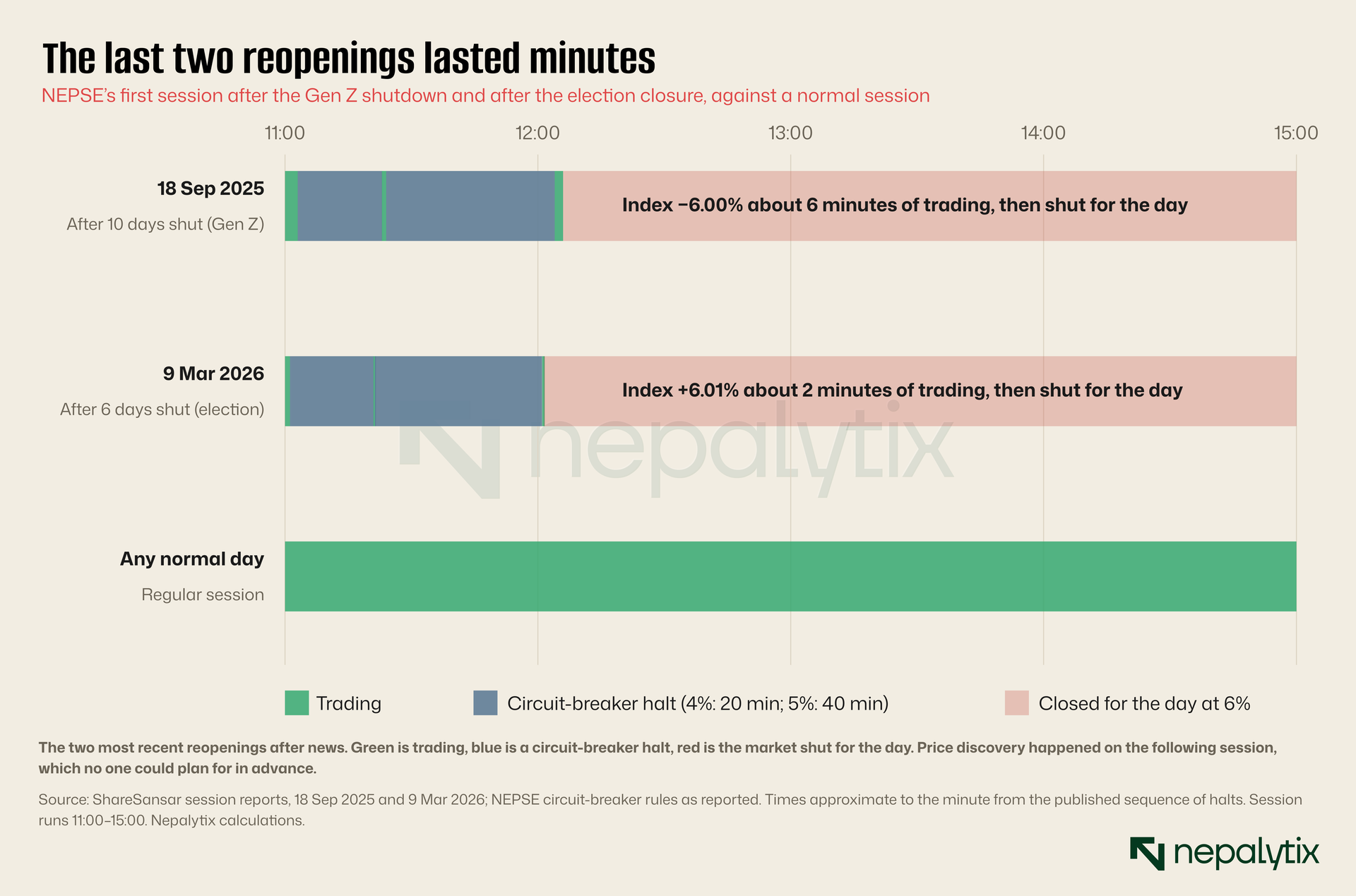
In both cases, the reopening session did not discover a price. It confirmed a direction, shut the market and handed the actual price discovery to the session after. For the investor who wanted to sell on 18 September 2025, the first realistic chance came on 21 September, thirteen days after the market had closed. For anyone on the wrong side of a margin loan, those thirteen days were spent accruing interest on a position that could be neither cut nor topped up through the market. Nepal has no listed equity futures or options; there is no other instrument on which to hedge a NEPSE position. When NEPSE closes, all of Nepal's listed equity risk is frozen in place.
The official response to the September 2025 reopening was telling. Within a day the Ministry of Finance had formed a task force to review market irregularities and the Securities Board directed NEPSE to compute the index from final transaction prices rather than a closing-window average. Both were reasonable. Neither addressed the design choice that produced the session in the first place: a market that had been closed for ten days reopened into continuous trading with intraday circuit breakers and the breakers did exactly what breakers do, which is stop trading.
What sits in the freezer
It is worth being concrete about what a closure freezes. At the end of the last fiscal year, Nepal's banks, development banks and finance companies held Rs 166.5 billion of margin-nature loans, loans secured on listed shares, according to the central bank's monthly statistics. That is up 18% in a year and more than double the Rs 76.5 billion of mid-July 2023. Every one of those loans is secured on collateral that cannot be sold while the market is shut. If the market falls when it reopens, lenders call for margin from borrowers who have had no opportunity to reduce their positions; if it hits a circuit breaker and closes for the day as it did twice in the last year, they wait another session to find out what the collateral is worth.
The flows are large too. Over the last 60 sessions, NEPSE turned over an average of Rs 4.5 billion a day. This year's closure runs from Saturday 17 to Sunday 25 October, so it takes out five weekday sessions, from Monday 19 to Friday 23 October: roughly Rs 22 billion of trading that will not happen, and that cannot be done early by anyone who did not plan for it. The figure is not lost forever, most of it is merely postponed, but postponement is exactly the problem for anyone who needed the cash or the exit in those five days.
Nepal's own history of long closures shows that the freezer is not hypothetical. The 2015 earthquake shut the market from 23 April to 24 May, 31 days; it reopened 3.0% lower. The Covid lockdown shut it from 22 March to 29 June 2020, 99 days; it reopened 5.0% lower and holders had spent more than three months unable to sell, rebalance or meet margin calls through the market. Those were emergencies and no one argues the market should have traded through an earthquake. The point is narrower: when a closure does coincide with news, the cost is large and falls on whoever happened to be holding and Dashain is the one closure of the year that is chosen rather than imposed.
Other markets with great festivals do not do this
The obvious reply is that Nepal is not unusual: many markets close for their great festivals. That is true and the comparison is instructive because the markets that close for a week or more have each built something to soften it.
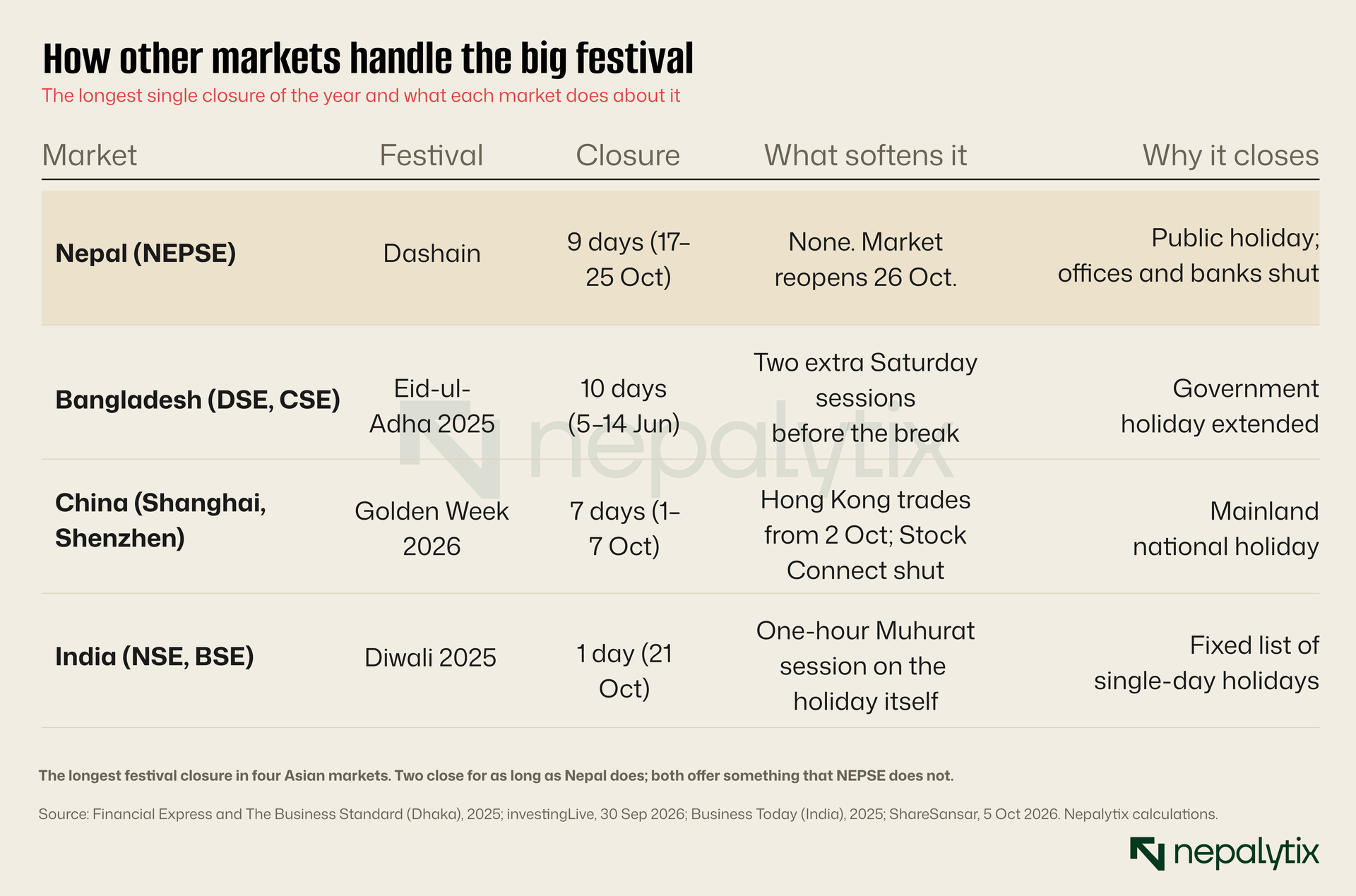
Bangladesh is the closest parallel. Its exchanges closed for ten days for Eid-ul-Adha in June 2025, as long as this year's Dashain closure. But when the government extended the holiday, the Dhaka Stock Exchange opened on two Saturdays beforehand, normally weekly holidays, to make up the sessions. China's mainland exchanges close for a full week at the National Day holiday, from 1 to 7 October this year but Hong Kong closes only on 1 October and Hong Kong-listed Chinese shares and index futures keep pricing Chinese risk through the week. India, whose Diwali is the nearest thing to Dashain in scale, closes its exchanges for one day and runs a one-hour "Muhurat" session on the festival day itself, a tradition that predates electronic trading.
Each of the three carries a different lesson. Bangladesh shows that a market which must close for a long festival can buy back the sessions it loses, at the cost of a couple of weekend days for exchange staff. China shows the value of a second venue: when Shanghai and Shenzhen are shut, Hong Kong is open and anyone holding Chinese risk can at least trade a proxy for it. Nepal has no such proxy which makes a long closure more costly here, not less. India shows that the cultural weight of a festival and the operation of a market are not in conflict; the Muhurat session is itself a festival ritual, opened with ceremony and it has run for decades without anyone suggesting it diminishes Diwali.
Nepal does none of these things. It closes for as long as Bangladesh, has no Hong Kong to price its risk elsewhere and holds no Muhurat session. The closure is total and its length is set by the holiday calendar rather than by any judgement about the market.
The best case for closing
Settlement needs banks. NEPSE settles trades two days after the trade date through bank accounts and the central depository. If the banks are closed, trades cannot settle, and a market that cannot settle should not trade. This is the strongest argument and it is a real constraint.
Nobody would trade. Turnover is already a third to a half of normal around Dashain. A session on Navami would be thinner still, and thin markets are easy to push around. Opening a market that few people use invites manipulation of exactly the small-cap stocks that are already easiest to move.
People need the holiday. Brokers, exchange staff, depository staff and bank staff are people with families and Dashain is the one time of year they go home. A market that runs through the festival runs on their time.
The circuit breakers worked. On both recent reopenings, the breakers did what they were designed to do: they stopped a panic in one direction from becoming a rout. The following day's recovery after the Gen Z shutdown is evidence that the pause helped, not that it hurt.
Festival reopenings are calm. By our own measure, the median Dashain reopening moves the index less than one percent. If the problem is event risk, the answer is to manage events, not to abolish a holiday that has not caused any.
Why the closure survives
If the costs are real, why has no one changed it? Partly because the costs are invisible in the years when nothing happens, and nothing happens in most years. Partly because the people who bear them, retail investors with margin loans and holders who need festival cash are not the people who set the calendar. NEPSE is majority-owned by the government and its calendar follows the government's office calendar; its board moved the trading week within days when the government moved the weekend in April. The Securities Board approves the arrangements. Brokers, the depository and the clearing banks all close because the public holiday closes them. At no point in that chain does anyone ask what the market would choose if it were designing its own calendar.
The irony is that Nepal's market rules have changed quickly in the last two years. The daily price limit for individual stocks went from 10% to 15% in April 2026. The trading week moved to Monday to Friday the same month. The index calculation changed in September 2025. Each change was made quickly, by the same institutions that maintain the festival calendar, once someone decided it mattered. The festival closure has simply never been put on that list.
And partly because the closure is popular. For brokers and exchange staff, Dashain is the one long holiday of the year. For many investors, a market that cannot be watched is a market that cannot cause anxiety during the festival. That preference deserves respect and the proposals below are designed around it: none of them requires anyone to trade who does not want to, and none of them asks brokers to keep branches open. What they do is give the people who want or need to act during the closure a way to do it.
The answer to the best case
Each of those points is right about something and none of them justifies a nine-day blackout.
Take settlement first. It is a binding constraint on the days when the payment system is shut and on those days a normal session cannot be held. This year, most and perhaps all of the five weekdays inside the closure from Navami to Dwadashi are public holidays on which the banks will not settle. So the narrowest version of the reform, trading on every day the banks can settle, would gain little or nothing in 2026. That is a fair point and it is why the other proposals matter more than this one.
But settlement is a constraint on when trades settle, not on when they are struck. A trade executed on a holiday can be scheduled to settle on the first working day after it, which is how India settles Muhurat trades struck on Diwali. Nothing in the logic of a two-day settlement cycle requires that the trade date be a banking day; it requires only that the settlement date be one. The constraint is real but it rules out normal sessions, not every session.
The thin-market argument cuts both ways. Around Dashain the market is already thin for five weeks and the thinness is partly a product of the closure: investors withdraw before it because they cannot manage a position through it and return slowly after it because the first sessions are disorderly. A market with no nine-day hole in the middle would give them less reason to withdraw. And the manipulation risk in thin sessions is a matter for surveillance which operates on any day the market is open, not a reason for the market to be shut.
The staff argument is the one with the most human weight and it deserves a human answer. No one is proposing that every broker work through Dashain. A short session, on the days the banks are open, can be run with skeleton staff by an exchange whose trading has been fully online for years; India runs its Muhurat session on the festival itself and Bangladesh's make-up sessions came before the break, not during it. If the choice is between ten days off and eight days off plus two short sessions, that is a negotiation, not an impossibility.
The circuit-breaker argument proves less than it seems. The breakers did stop the move; they also stopped the market. The September 2025 reopening traded for about six minutes and the March 2026 reopening for about two. The genuine price for each was found on the following session, on turnover twelve and forty times larger. A circuit breaker is designed to slow a market that is moving on the day's news. It is a poor tool for a market that has accumulated ten days of news because it guarantees that the first session will be a formality. An opening call auction in which orders accumulate and a single price is struck is the tool designed for that job and it is how most exchanges open after a long break.
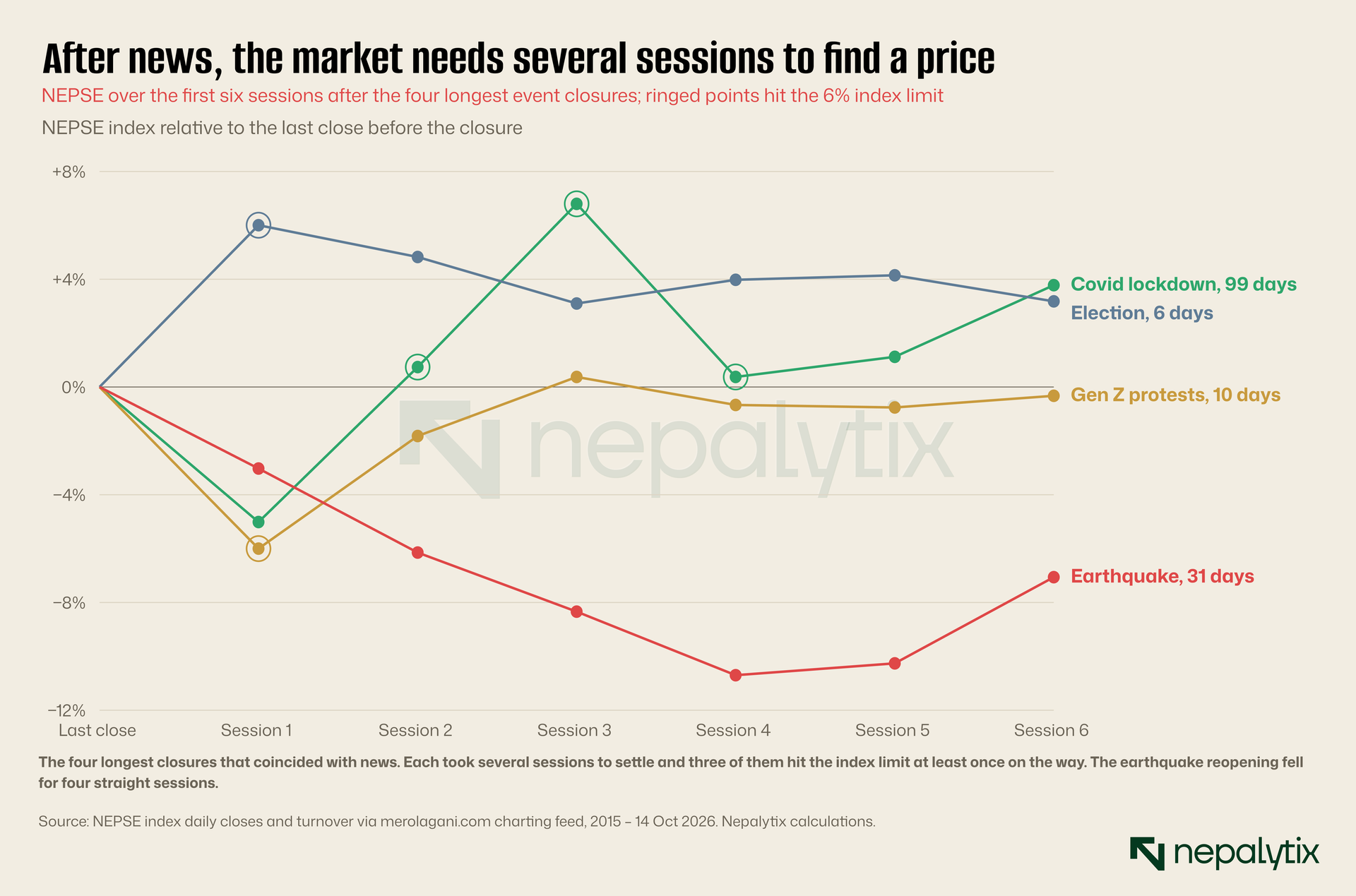
The chart shows the problem from the other side. After the earthquake, the market fell for four sessions in a row before it found a floor nearly 11% below its last pre-closure close; it would have been sensible for investors to be able to begin that adjustment well before the 31st day. After the lockdown, it swung between −5% and +7% in three sessions. After the Gen Z shutdown and the election, the first session's move was largely retraced or extended in the following days. In none of these cases did the first session after the reopening produce a price that held.
An opening auction would not have prevented any of those moves; the news was real and the prices had to adjust. What it would do is let the adjustment happen at a single price struck from all the orders that had accumulated, rather than in three bursts of a few seconds each separated by an hour of halts and followed by a closed market. The design is simple: a call period of thirty minutes in which orders are entered but not matched, an indicative price published continuously so that investors can see where the market is heading, a single uncrossing at the end and only then continuous trading with the usual stock limits and index breakers. The index breakers exist to stop panics within a trading day; they were not designed for the first minutes after ten days of news and they should not apply to them.
And the calm reopenings argument is the one we made ourselves so it is the one that most needs answering. The answer is that a holiday closure is a scheduled bet that nothing will happen, renewed every year. It has paid off at Dashain every year since 2008. It did not pay off during the Gen Z protests or the 2015 constitution crisis, both of which fell within weeks of Dashain and its cost when it fails is borne entirely by people who did nothing wrong except hold shares through a holiday. A market's design should not depend on the news being polite enough to wait.
What the evidence does not say
An argument for change should be clear about its limits, and this one has three.
First, everything here is measured on the NEPSE index. The index is dominated by large banks and insurers and it smooths what happens to individual stocks. A small hydropower company with a project in a flood zone or a microfinance company with a pending audit, can carry far more closure risk than the index shows. Our stock-level checks found only a modest rise in the share of stocks closing at their daily limit on reopening days but that is partly because the index breakers shut the market before individual stocks had time to reach their limits.
Second, the sample of event closures is small. Nine reopenings after news is enough to show that they are large and disorderly, not enough to say how large the next one will be. The case rests on the asymmetry: a scheduled closure has small, frequent costs and rare, large ones and the rare ones fall on people who had no say.
Third, we cannot observe the counterfactual. No one knows how much would trade in a one-hour session on Navami or whether two make-up sessions before Dashain would be busy or empty. The Friday experience suggests investors use sessions when they exist; it does not prove they would use a festival session. The honest claim is not that the proposals would transform the market but that they would cost very little to try and would give the people caught by news somewhere to go.
If you hold shares this week
None of the changes argued for here will happen before Friday so the practical question for anyone holding shares is how to manage nine days without a market.
If you have a margin loan, assume that you will not be able to reduce it between Friday and the end of the first session after the reopening and possibly the second. Check the margin your lender requires and the price at which your collateral would breach it and decide before Friday whether you want to be inside that range for ten days. If you need cash during the festival, the last sessions before the closure are thinner than they look; selling earlier in the week has historically meant selling into a fuller market. If you are buying, remember that the index has risen into the closure in 17 of the last 18 years on half its normal volume: the price you pay on Friday includes a premium for the privilege of holding through the holiday.
And if something does happen during the closure, expect the first session after it to be a formality. On the evidence of the last two event reopenings, it is likely to hit the index limit within minutes in whichever direction the news points and the price at which you can actually trade will be set the session after. Plan for two sessions, not one.
What should change
Four changes, in rising order of ambition, none of which requires new legislation.
Publish the closure as a market decision, not a holiday list. NEPSE and the Securities Board should say, each year which days the market will close and why, distinguishing days when settlement is impossible from days that are merely public holidays. The closure this year runs from 17 to 25 October; investors deserve to know which of those days are closed because the payment system cannot settle and which are closed because everyone is on leave.
Make up the sessions. Where the market must close for more than a week, it should add sessions before or after, as Dhaka did in May 2025. Two extra sessions before Dashain would cost the exchange little and would let investors who need festival cash sell into a market that has not yet emptied.
There is evidence from this year that investors use sessions when they are offered. Until April, Friday was not a trading day. Since the market moved to a Monday-to-Friday week, Friday sessions have turned over a median of Rs 4.39 billion against a range of Rs 4.06 billion to Rs 4.65 billion for the other four days. The new day did not cannibalise the others or sit empty; it simply became another day of normal trading. A make-up session before Dashain would not be a Friday and it would face festival thinness but the experience of the last six months is that Nepali investors trade when they can.
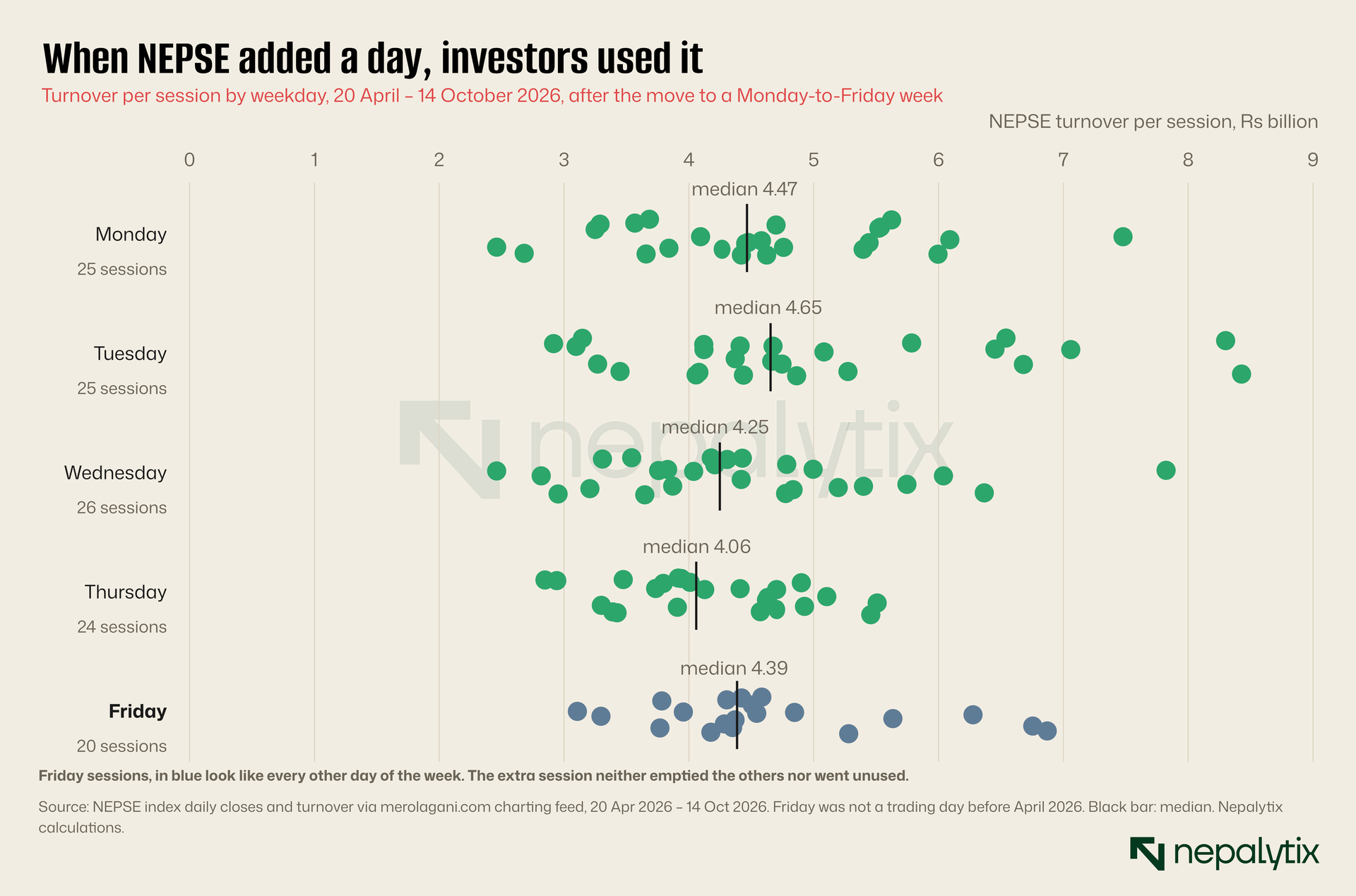
Hold a short festival session. On one or two days within the closure, the market should open for an hour, with settlement scheduled for the first working day after the festival. India has done this on Diwali for decades. It would give anyone caught by news a chance to act and it would make the closure a pause rather than a blackout.
What would such a session look like in practice? One hour, mid-morning, on one of the middle days of the festival, perhaps Ashtami or the day after Dashami. Normal price limits. Orders from online accounts only, so that no branch need open. Trades settling on the first working day after the festival, through the same two-day cycle counted in working days. Brokers free to take part or not. The exchange's own systems run online already; the people who would need to be at work are a small team at NEPSE, the depository and the clearing bank, for a few hours.
Reopen by auction. After any closure of five days or more, the first session should begin with an opening call auction, long enough to collect orders from investors who have been unable to trade, with the index circuit breakers applying only after it. The last two reopenings show what happens otherwise: two minutes of trading, a closed market and the real price set the next day.
Each change has an owner. The trading calendar and the session design are NEPSE's with the Securities Board's approval. Settlement on the first working day after the festival needs the depository and clearing arrangements to treat a holiday trade date as valid which is a rule change at CDS and Clearing, not a new system. Settlement through the banks needs the central bank's payment system to recognise those settlement dates which it already does for ordinary working days. Nothing here requires a new law, a new technology or a new institution. It requires someone in that chain to decide that the market's calendar is a market question.
None of these changes would make Dashain less of a festival. They would make the stock market less of a hostage to it.
Disclaimer
This report has been prepared by Nepalytix for informational and educational purposes only and does not constitute investment advice, an offer, or a solicitation to buy or sell any securities.
The information contained in this report is based on sources believed to be reliable; however, Nepalytix does not guarantee its accuracy, completeness, or timeliness. Opinions, estimates, and projections expressed herein are those of the authors as of the date of publication and are subject to change without notice.
Investing in securities involves risks, including the possible loss of principal. Past performance is not indicative of future results. Readers are advised to conduct their own independent research and consult with a qualified financial advisor before making any investment decisions.
Nepalytix and its contributors may hold positions in the securities discussed in this report at the time of publication or thereafter.
Neither Nepalytix nor any of its affiliates accept any liability for any loss arising from the use of this report or its contents.