Nepal Has 104 IPOs Waiting. The Rs 100 Price Is the Real Problem
Nepal’s IPO pipeline has swollen to Rs 69 billion across 104 companies but the bigger story is the pricing system that makes every Rs 100 allotment look like a lottery win.

A hundred and four companies want Rs 69 billion from the market at a price set by statute rather than valuation. The queue grew by a third in ten months while the regulator had no chairman. Two IPOs listed in the last two.
The arithmetic of a Nepali IPO is not complicated, and that is precisely what makes it strange. A company sells shares to the public at Rs 100. Not Rs 100 as a starting point for a book-building process not Rs 100 as a floor Rs 100, the face value printed in the Companies Act, the same number for a hydropower developer with a completed 40 megawatt plant and a wine industry with three years of accounts. Applications run into the hundreds of thousands. The allotment is a lottery. And the shares, when they list, trade at whatever the secondary market thinks they are worth.
How much is that? On 24 August, the median security on NEPSE closed at Rs 366. Not one traded below Rs 100.
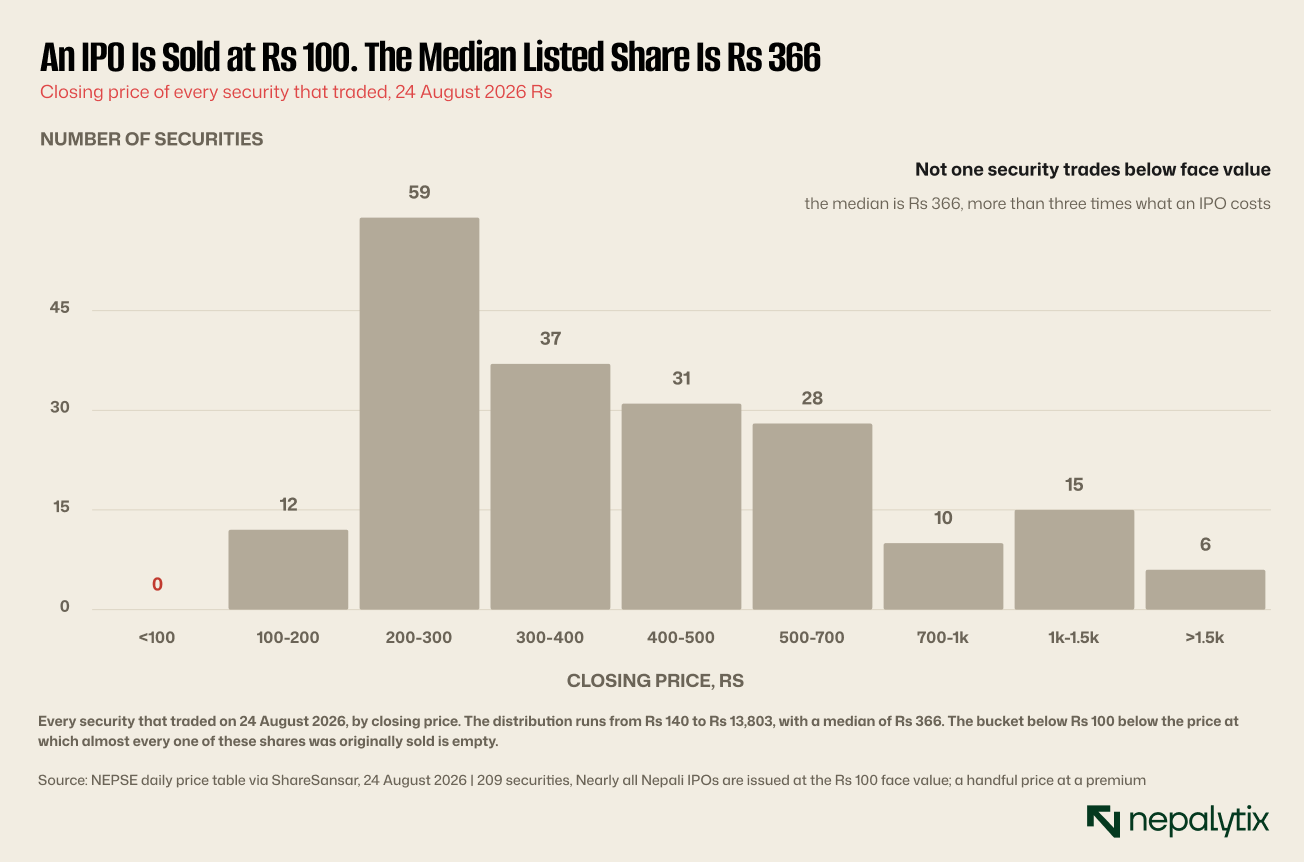
That is the whole of the case for treating an allotment as a windfall and it is a strong one. A market where nothing trades below face value is a market where buying at face value is structurally advantaged and no amount of commentary about IPO risk changes the observation. The lottery is a lottery for a reason: the prize is real.
But this piece is not mainly about the allotment. It is about the queue behind it which has grown by a third in ten months while the machinery that is supposed to process it stopped working, and which now represents a quantity of paper the market has not priced.
Before going further it is worth being precise about what the histogram above does and does not say because it is the most quoted kind of statistic and the most easily abused. It is a snapshot of prices on one day for securities that are currently listed and trading. It is not a return series. It does not follow any company from its issue to its present. What it establishes is a single fact with no time dimension: in this market on this day, the price at which shares are sold to the public sat below every price at which shares actually change hands.
That fact alone justifies the queue. A hundred and four boards have looked at the same arithmetic and concluded that selling shares at face value is a price worth paying for access to public capital, a listing and the liquidity that comes with it. They are not wrong to think so which is exactly why the queue keeps growing.
What is actually waiting
The number that circulates in Nepali market commentary is Rs 52.15 billion across 75 companies and 354.52 million shares. It comes from a SEBON regulation department report and it was accurate in November 2025.
It is now Rs 69.31 billion across 104 companies and roughly 473 million shares.
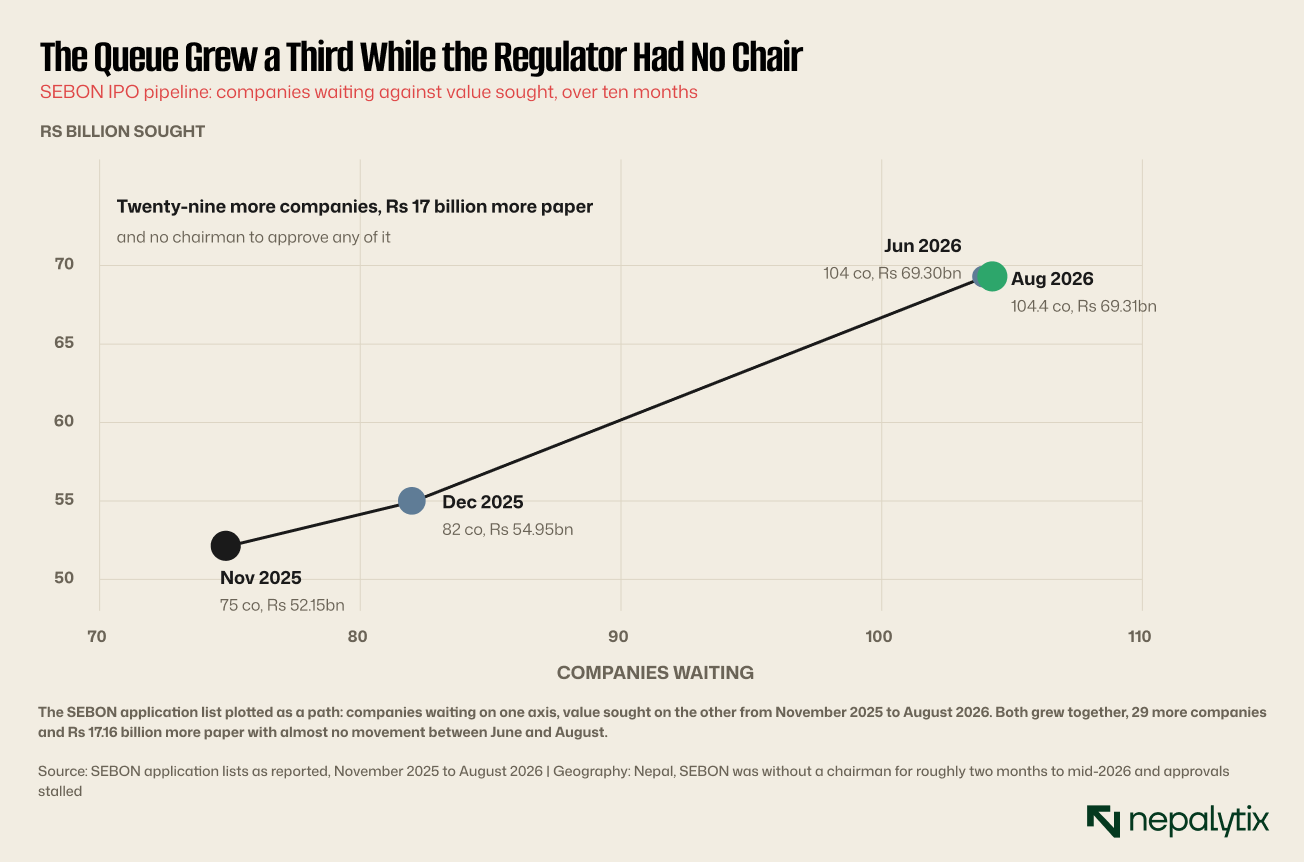
Twenty-nine more companies joined the queue and Rs 17 billion of additional paper was proposed. Nothing left it in any volume. The flat segment at the top right of that path is the part that matters: between June and August the pipeline barely moved because SEBON spent roughly two months without a chairman and the approval process in the phrase used by nearly every outlet that covered it came to a grinding halt.
A queue that grows while its exit is closed is not a pipeline. It is a backlog.
The process a company goes through to get into that list is worth setting out because the length of it explains why the backlog compounds rather than clearing. A company must first appoint a licensed issue and sales manager, a merchant bank. It then applies to SEBON with the memorandum and articles, three years of audited financial statements, project details, share structure, a risk statement and the proposed issue terms. A hydropower applicant must additionally supply the project's technical condition, generation capacity, commercial operation date and power purchase agreement.
Only after all of that does the application join the list this piece has been describing. SEBON then reviews, frequently asks for additional documents, and in a number of recent cases has required revised ratios and updated statements which restarts parts of the clock. When approval finally comes, the company issues, allots and applies to NEPSE for listing which is a further process with its own timetable.
Each of those stages is defensible in isolation. Cumulatively they mean that a company joining the list today is unlikely to trade for a year or more, and that any interruption at the regulator, a vacant chair, a change of leadership, a new directive requiring resubmission propagates through every application simultaneously.
What an empty chair costs
The flat segment between June and August in Figure 2 is worth dwelling on because it is the clearest available measure of what regulatory vacancy costs a capital market.
Between the June and August lists, the pipeline moved from Rs 69.30 billion to Rs 69.31 billion. Ten million rupees. In a period when applications were still arriving, the June reporting noted six newly added companies seeking Rs 2.78 billion between them, the aggregate barely moved which means approvals and new applications roughly cancelled and the net throughput of the system was close to zero.
For the companies in that queue, the cost is not abstract. An IPO application is accompanied by three years of audited accounts and audited accounts age. A company that applied on the strength of its FY2080/81 statements and is still waiting has by now a fresh fiscal year of results that SEBON may reasonably ask to see. Several applicants have already been required to submit updated documents and revised ratios. Delay generates its own paperwork which generates more delay.
For the market, the cost is that the supply arrives lumpily. A regulator processing steadily releases paper at a pace investors can absorb and anticipate. A regulator that stops and then restarts releases it in bursts and bursts are what move prices. The backlog is not just larger than it should be; it is more dangerous in the shape it will eventually be released.
There is a governance point underneath that. The chairmanship of SEBON is a political appointment and the market's primary issuance machinery therefore runs at the speed of a political process with which it has nothing to do. No amount of improvement in SEBON's internal procedures fixes an unfilled post.
The composition has changed and nobody says so
Nepal's capital market talks about itself as a banking and hydropower market. For the secondary market that is still broadly true. For the primary market it is no longer true at all.
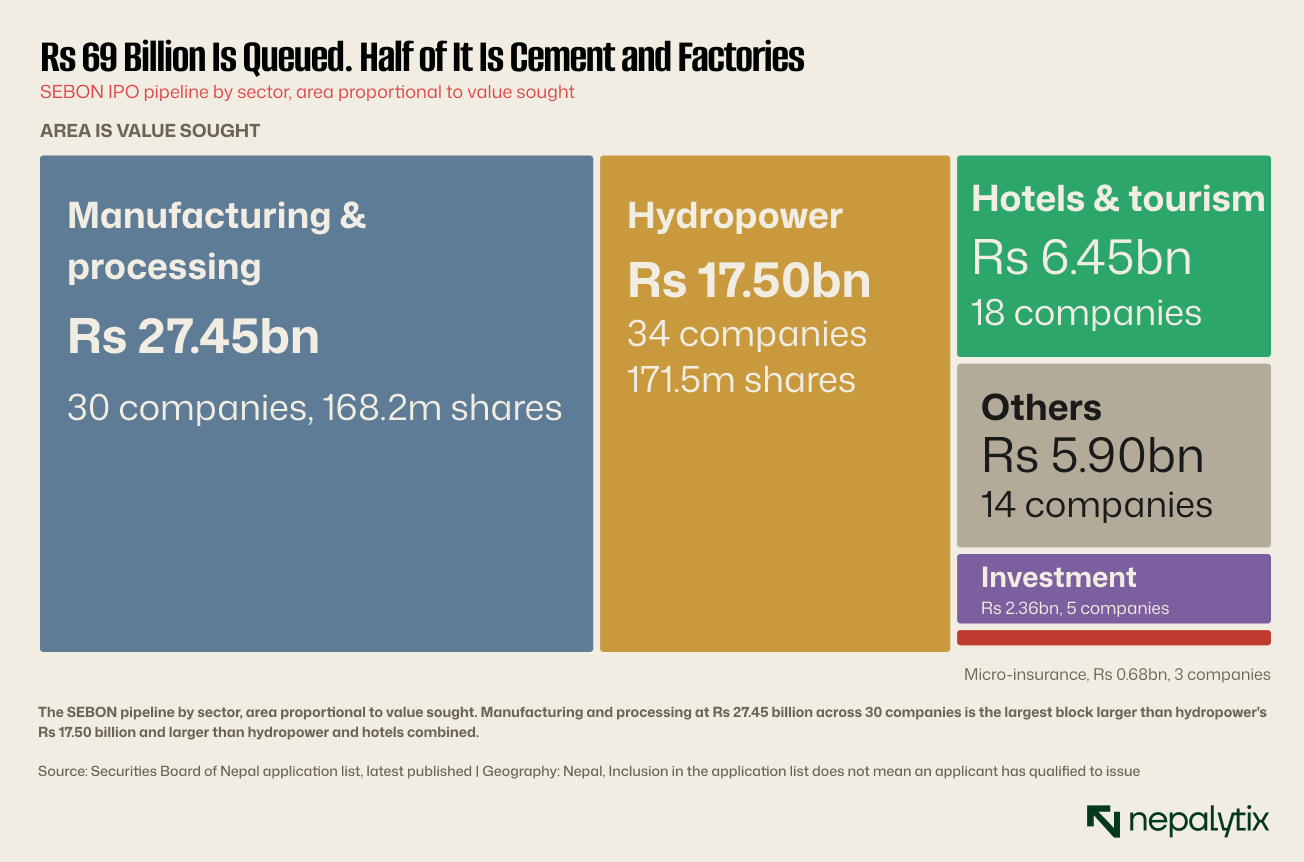
Manufacturing and processing is the largest single block in the queue by value: Rs 27.45 billion across 30 companies, against hydropower's Rs 17.50 billion across 34. Cement, distilling, colour and chemicals, wine, plywood. Six of those manufacturers have applied to issue at a premium rather than at face value, which is itself a signal, a company that believes it can price above Rs 100 is a company that expects to be valued on earnings rather than on the lottery.
The count tells a different story from the money which is why both are worth drawing.
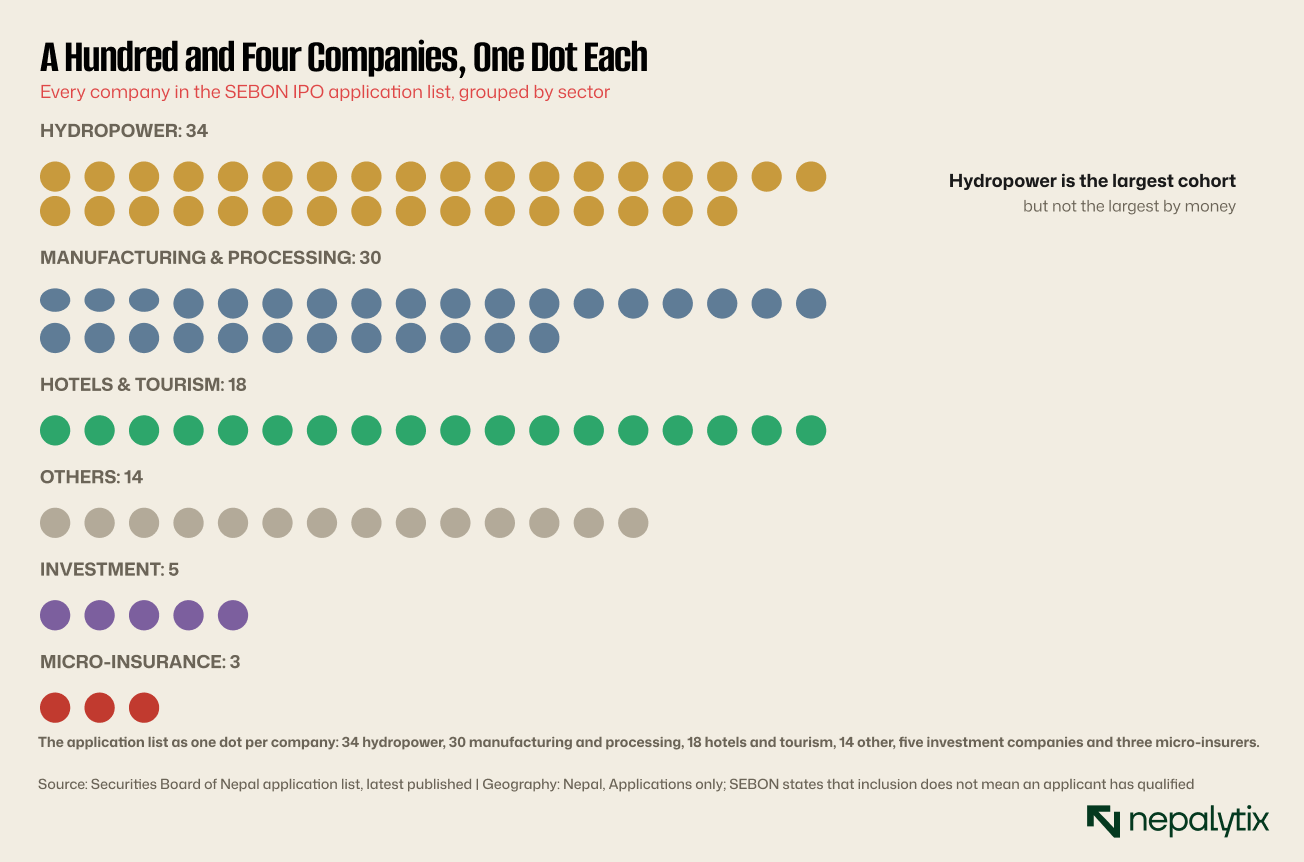
By headcount hydropower still leads. By capital sought it does not. The difference is average issue size: hydropower companies are mostly small run-of-river developers raising a few hundred million rupees each while the manufacturers in the queue include names seeking Rs 2 billion and more. Siuri Nyadi Power is the exception on the hydro side, seeking Rs 3.03 billion for a 40.27 megawatt project in Lamjung. Dish Media Network, in the "others" bucket, seeks Rs 1.97 billion. Shree Airlines has priced at Rs 200 a unit for Rs 1.26 billion.
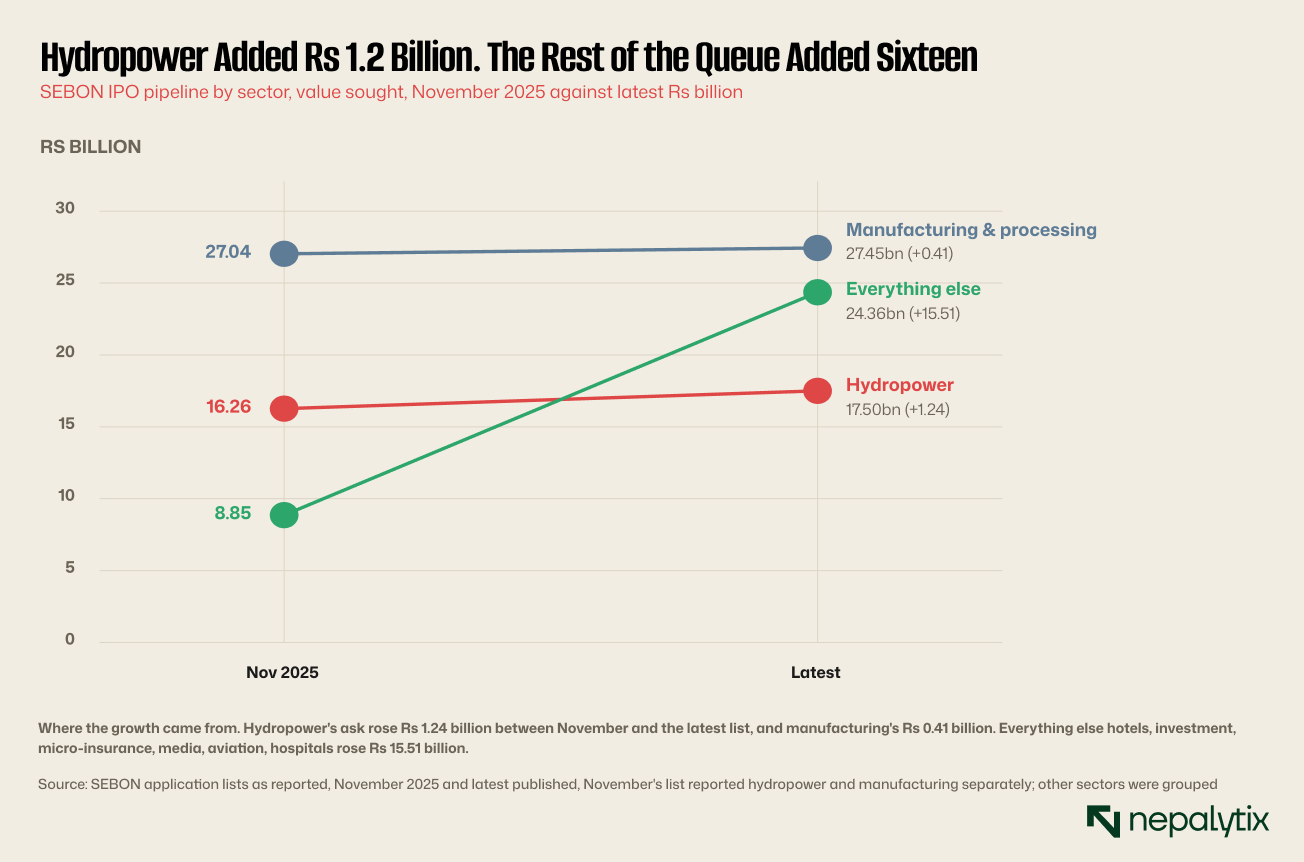
This is the finding that the headline number conceals. The queue did not grow because hydropower developers piled in. Hydropower added Rs 1.24 billion and manufacturing added Rs 0.41 billion. Everything else added Rs 15.51 billion. Hotels and tourism alone now account for 18 companies and Rs 6.45 billion, including two cable car operators and an airline.
Nepal's IPO market is diversifying away from the two sectors that have defined it and it is doing so at exactly the moment the regulator stopped issuing approvals.
It is worth naming some of the companies because abstractions of Rs 69 billion do not convey what the queue is actually made of. From hydropower: Siuri Nyadi Power seeking 30.26 million shares for Rs 3.03 billion against a 40.27 megawatt run-of-river project in Lamjung; Raghuganga Hydropower at 15 million shares; Mewa Developers at 11 million; Super Hewa Power at 1.925 million. From the "others" category, Dish Media Network at 19.71 million shares worth Rs 1.97 billion, the largest applicant in that bucket by volume. From hotels and tourism, Shree Airlines at 6.3 million shares priced at Rs 200 for Rs 1.26 billion alongside two cable car operators.
That list is a reasonable cross-section of the Nepali economy outside banking, hydropower, media, aviation, tourism infrastructure, manufacturing which is a genuinely encouraging thing about the pipeline and rarely said. A capital market that finances only banks and power plants is a narrow one. The queue whatever its problems represents a broadening.
One further observation on composition. The manufacturing and processing cohort of 30 companies is the block most likely to change what NEPSE looks like because manufacturers have properties that hydropower developers do not. They have operating histories measured in decades rather than in years since commercial operation date. They have revenue that varies with demand rather than with hydrology and a fixed power purchase agreement. They can grow by building a second line rather than by finding a second river.
They also carry risks Nepali investors have less practice pricing. This publication's initiation on Shivam Cements two days ago described a listed manufacturer whose revenue has not moved in four years and whose profit swings on coal and electricity prices. That is the shape of a manufacturing business, and a market accustomed to hydropower where the output is contracted and the variable is rainfall will need to learn to read it.
Thirty manufacturers seeking Rs 27.45 billion is on that basis, the most consequential line in the whole pipeline. It is also the line most likely to test whether the face-value convention survives since these are the companies with net worth well above Rs 100 and the strongest case for pricing at a premium.
The gate
Between an application and a listing there are several stages and the attrition between them is severe.
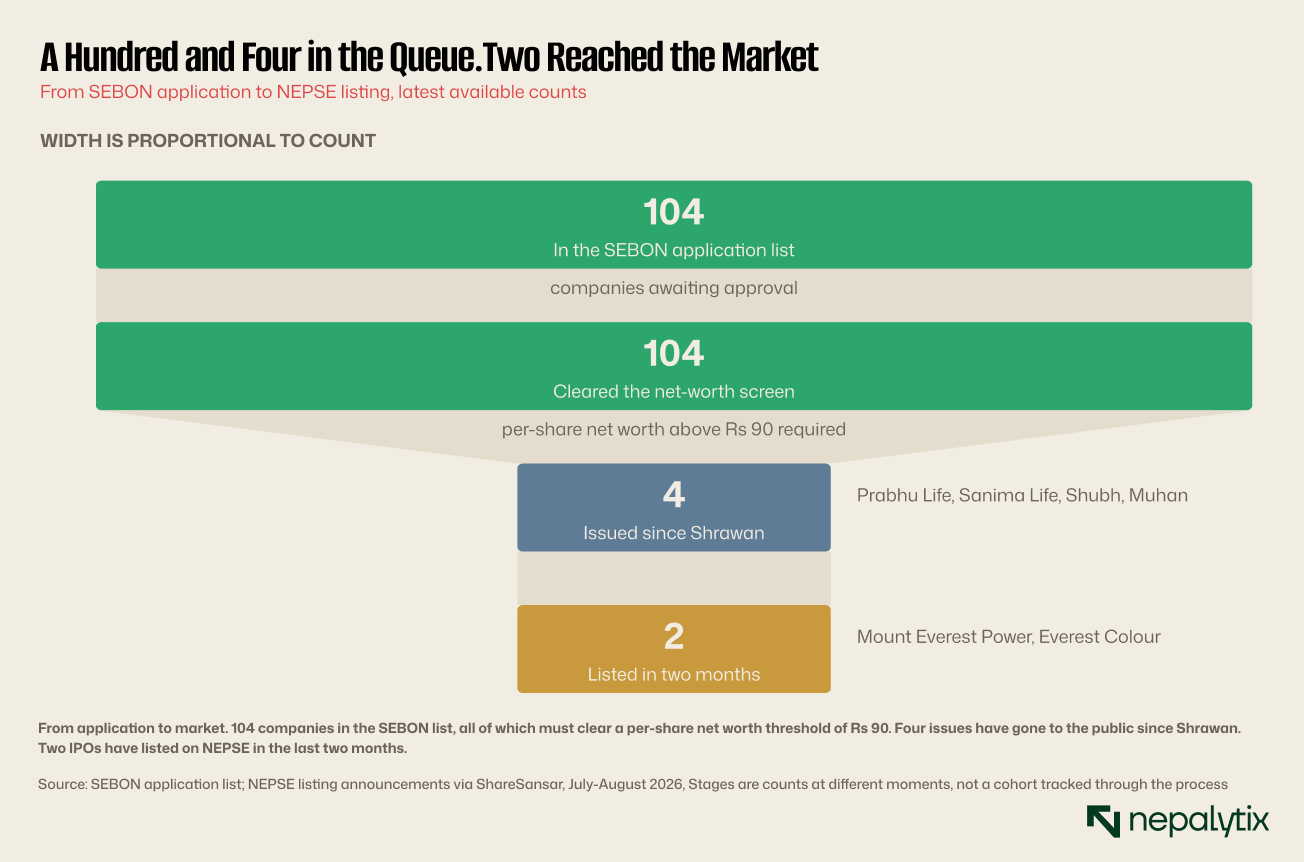
One hundred and four companies are in the list. Four issues have come to the public since Shrawan: Prabhu Life, Sanima Life, Shubh International Hospitality and Muhan Hydropower. Two IPOs have listed on NEPSE in the two months to late August: Mount Everest Power Development on 11 August and Everest Colour on 16 July.
Those stages are not a cohort. The 104 in the list today are not the companies that listed in July and August; the ones that listed applied a year or more ago. But the ratio still says something about throughput. At two listings a month, a queue of 104 clears in something over four years, assuming nothing else joins it and something else always joins it.
There is a filter that is doing real work and it deserves more attention than it gets. Following a directive from Parliament's Public Accounts Committee, SEBON permits only companies with a per-share net worth above Rs 90 to remain in the pipeline. That is a meaningful screen: it excludes companies that have accumulated losses large enough to erode face value which is precisely the category most likely to leave retail allottees holding a share worth less than they paid.
It is also, note, the mechanism most responsible for the empty bucket in Figure 1. A market where no listed security trades below face value is partly a market that has been good at keeping the worst issuers out.
There is a second filter that is less discussed and arguably more consequential: the local and project-affected tranche. Nepali IPO regulations reserve a portion of most issues for residents of the district or districts affected by the project and for employees. These are allotted separately at the same price and critically they are ordinary shares carrying their own lock-in of one to three years from allotment rather than the promoter lock-in.
For a hydropower company in a remote district, the local tranche can be a meaningful share of the issue and it lands with holders who did not choose the investment on financial grounds and who in many cases will sell as soon as the lock-in permits. That is a supply event specific to each listing, arriving one and three years after allotment and it is not visible in any published calendar.
The application, from the other side
Consider the decision from an applicant's chair because the incentives it creates explain most of the market's behaviour.
An IPO in Nepal is applied for through C-ASBA: the money is blocked in the applicant's own bank account rather than paid away, and released if the application is unsuccessful. The minimum application is ten units Rs 1,000. There is no meaningful cost to applying beyond the temporary block on funds and no analysis is required since the price is fixed and the question of whether the company is worth more than Rs 100 has already been answered by the Rs 90 net-worth screen and by the distribution in Figure 1.
The rational response to those conditions is to apply for everything, always, with the minimum lot. And that is what happens: applications routinely run into the hundreds of thousands and have exceeded a million for larger issues against issue sizes of a few million units. When applications exceed units available, allotment is by lottery at the minimum lot which means the expected value of applying is positive and the variance is enormous.
Two effects follow. The first is that the allotment becomes a de facto public distribution scheme, thousands of small holders each receiving ten shares. The second is that the resulting shareholder register is enormous and fragmented, which imposes real administrative cost on the issuer and produces a shareholder base with no institutional anchor.
The second effect is under-appreciated. A company that lists in Nepal acquires tens of thousands of shareholders holding ten shares each and typically, no institution holding a position large enough to care about governance. The promoter block remains locked and controlling. Nobody in the float has the incentive or the stake to hold management to account. That is a direct consequence of how the shares were distributed and it is one of the reasons the disclosure standards this publication complains about weekly do not improve.
Why the price is Rs 100
Step back and ask why an IPO in Nepal is sold at face value in the first place, because the answer is not obvious and it is the root of everything above.
Face value in Nepali company law is Rs 100 a share. Historically, and still for the large majority of issues, the public offering is made at that value regardless of what the business is worth. A company with Rs 400 of net worth per share and a decade of profits sells its shares to the public at Rs 100, the same as a company with Rs 95 of net worth and no operating history.
Two consequences follow and they pull in opposite directions.
The first is that the issuer leaves money on the table, in quantity. A company raising Rs 1 billion at face value whose shares then trade at three times face, has transferred something close to Rs 2 billion of value from its existing shareholders to whoever won the allotment. That is not a market failure being exploited by clever investors; it is a pricing convention that guarantees the transfer.
The second is that the transfer is broadly distributed. An IPO allotment lottery with hundreds of thousands of applicants and a ten-unit minimum spreads that Rs 2 billion across a very large number of small holders. Whatever else it is, it is one of the few mechanisms in Nepal that reliably moves capital gains toward ordinary savers rather than away from them.
Whether that is good policy is a genuine question and this publication does not think it has a clean answer. What is not in question is that the convention creates the queue. If issuing at face value transfers value to the public, every company with a net worth above Rs 100 has an incentive to consider an IPO and a hundred and four of them have.
The comparison worth drawing is with how this works elsewhere. In most markets an IPO price is discovered through book-building, through an institutional order book through a range narrowed as demand becomes visible. The price at which the public buys is meant to approximate what the shares are worth and the "IPO pop" that follows is treated as evidence of mispricing rather than as the design.
Nepal has book-building on the statute book and uses it rarely. The overwhelming majority of issues are at face value which means the pop is not a bug in the pricing process; it is the pricing process. An applicant is not betting on the company. They are collecting a statutorily-guaranteed spread between Rs 100 and whatever the market decides and the only uncertainty is whether they win the ballot.
This has a corrosive second-order effect on how Nepali retail investors think about equity. If the reliable way to make money in shares is to win a lottery for underpriced paper then analysis of the underlying business is not merely difficult but pointless. Nothing in the allotment process rewards it. A market that trains its participants not to value companies will struggle to price them in the secondary market either, and much of what this publication writes about promoter discounts, thin trading, prices that sit unmoved for months is downstream of that.
The Rs 90 screen deserves one more paragraph, because its logic is subtle and it has an unintended consequence.
Requiring per-share net worth above Rs 90 before an IPO is permitted at Rs 100 means the public is never asked to pay materially more than the accounting value of what they receive. It is a floor on quality expressed as a floor on book value and it is why Figure 1 has an empty first bucket: the companies most likely to trade below face value were prevented from issuing at face value in the first place.
The unintended consequence is that it also caps the upside of the screen's own logic. A company with net worth of Rs 92 clears the bar and sells at Rs 100, the public pays a small premium to book for a business with thin equity. A company with net worth of Rs 400 also sells at Rs 100 and the public receives four rupees of book for every rupee paid. The screen protects against the first case and does nothing about the enormous transfer in the second which is where nearly all of the pipeline's value sits.
A screen that set the issue price as a function of net worth rather than setting a threshold and then fixing the price regardless,would address both. That is close to what book-building is supposed to do, and it returns to the same conclusion: the problem is not the screen, it is the fixed price behind it.
What the premium issuers are telling you
The six manufacturers seeking permission to issue at a premium are the most interesting companies in the list because they are opting out of the arrangement described above.
A premium issue prices closer to what the business is worth. It raises more capital for the same dilution, it leaves less on the table, and it removes most of the lottery character from the allotment if the issue price is near fair value, winning the ballot is worth much less. Shree Airlines at Rs 200 and the unnamed applicant that has priced at Rs 330 are testing whether Nepali retail demand survives contact with a price that is not a gift.
There is recent evidence on that question and it is not encouraging for the premium route. The Long Read of 13 August examined what happened when a book-built issue priced at Rs 820.80 met NEPSE's rule capping the opening quote of such a listing at Rs 300. The exchange's own mechanics punished the issuer for pricing honestly. Until that is resolved, an issuer choosing a premium is choosing a route with a known hazard at the end of it.
Which is a shame, because the premium route is the one that would fix the queue. If issues priced nearer fair value, applications would fall, allotment would stop being a lottery and the pipeline would clear on the strength of the businesses rather than on the regulator's processing speed.
There is a defence of face-value issuance that deserves a fair hearing. Nepal's retail investor base is large, financially unsophisticated in aggregate, and has limited access to independent research. A book-built price requires someone to form a view on value; a face-value price requires nothing but an application. Setting the price by statute removes the possibility that a well-connected issue manager talks the price up beyond what the business supports and leaves retail holding it.
In other words, face-value issuance is a consumer protection measure disguised as a pricing convention. Seen that way, the transfer of value from issuer to allottee is not a flaw. It is the compensation the public receives for participating in a market where they cannot independently verify what anything is worth.
That defence works better the less developed the market is. The question for Nepal now, with 263 listed companies and a market capitalisation over Rs 4.6 trillion is whether it still applies or whether it has become a subsidy that mostly rewards speed of application and size of bank balance.
There is a version of the premium question that will be settled, one way or another, within the next year. Six manufacturers have applied to issue above face value. If SEBON approves them and they list without being mangled by the opening-price rule, the convention starts to break and Nepal begins to have a priced primary market. If they are approved and then punished at listing or if they quietly refile at face value, the convention hardens for another decade.
That is a specific, dated, observable test and it is the single thing most worth watching in Nepali capital markets over the coming year. It will not be reported as such. It will appear as a handful of individual approval notices spread over months.
The supply question
Rs 69.31 billion is the number in the queue. It is worth being careful about what it means for the secondary market, because the loose version of this argument gets it wrong.
NEPSE's market capitalisation was Rs 4.62 trillion in July 2026. The entire pipeline, if every application were approved and every issue fully subscribed tomorrow would be about 1.5 per cent of that. As a share of market value it is not a wall of supply.
But market capitalisation is the wrong denominator, because most of it cannot trade. The Take of 12 August established that promoter shares carry identical rights to ordinary shares and trade at a discount of a third or more precisely because they cannot be sold freely. The correct comparison is against the float and against daily turnover, and on that basis Rs 69 billion is a large number.
It is also not going to arrive at once. SEBON says explicitly that inclusion in the application list does not mean an applicant has qualified to issue. At the current rate of approval, the pipeline is a multi-year overhang rather than an event.
The honest characterisation is this: the queue is not a shock, it is a weight. It sits over the market as a persistent supply of new paper that will be released at a pace set by a regulator's administrative capacity rather than by market conditions. That is a bad way to run a primary market but it is not a crash risk.
One more calculation on the supply side, because the "wall of paper" framing gets used loosely in both directions. Rs 69.31 billion spread over four years is roughly Rs 17 billion a year of new issuance. Against a market that turns over billions in a single session that is absorbable. Against the free float, the portion of market capitalisation that can actually be bought and sold, which the promoter structure keeps far below the headline, it is a materially larger number, and one nobody can size precisely because the float is not published.
That is the honest position: the pipeline is probably absorbable, nobody can prove it and the reason nobody can prove it is that the single statistic required Nepal's actual free float is not something the exchange publishes.
Who the money is actually for
An IPO raises capital for the issuer. It is worth asking what the issuers in this queue intend to do with Rs 69 billion because the answer determines whether the pipeline is a transfer of savings into productive investment or into somebody's exit.
Nepali IPOs are overwhelmingly primary issues new shares, with the proceeds going to the company rather than to selling shareholders. That is a materially better arrangement than the alternative, and it is the strongest thing that can be said for the current structure. When Siuri Nyadi raises Rs 3.03 billion that money goes toward a 40.27 megawatt project. When a cement manufacturer raises capital, it funds a kiln or a grinding line.
Set against that, the face-value convention means the company raises far less than the same dilution would fetch at a market-related price. A manufacturer whose shares will trade at Rs 350 and which issues 10 million shares at Rs 100 raises Rs 1 billion and hands the public Rs 2.5 billion of value. Had it issued 4 million shares at Rs 250, it would have raised the same Rs 1 billion for less than half the dilution.
The convention therefore does two things at once: it moves value to the public, and it forces issuers to give away more of the company than they need to for the capital they get. Nepali promoters accept it because a listing is worth having and because the alternative route is blocked. But it means the queue is not simply companies wanting capital. It is companies willing to pay an unusually high price for it.
What an allottee should actually expect
Return to the individual, because the pipeline only matters to most readers through the allotment.
The distribution in Figure 1 is the base rate and it is favourable. Nothing on the exchange trades below face value; the median is three and a half times face. An allotment at Rs 100 in that market is on the arithmetic, a good expected outcome.
Three qualifications belong alongside it and they are the reason this piece stops short of the conclusion that IPO applications are free money.
Survivorship. Figure 1 shows what is listed and trading today. Companies that failed, delisted or were suspended do not appear in it. The distribution of outcomes for everything ever issued is worse than the distribution of outcomes for everything still trading and by an amount nobody has measured.
The number is not a return. A median price of Rs 366 tells you what the market values a typical listed share at. It does not tell you what a share issued in 2024 returned to its allottee, because those are different companies with different issue dates. Building that screen requires issue prices and listing dates matched to current prices for every recent listing and it is the piece this Long Read was originally commissioned to be. The data exists in SEBON approvals, in NEPSE listing notices, in company prospectuses but not in any single published place and it could not be assembled to a standard worth publishing in the time available. It is worth doing properly and this publication intends to.
The lock-in. An allotment is not the end of the supply story for that company. The Paisa of 16 August set out that promoter stock unlocks into the promoter market rather than the float, so promoter expiry is less consequential than it looks. But employee and project-affected local tranches are ordinary shares, and those clocks, one year and three years from allotment under section 38 of the Securities Registration and Issue Regulation 2073 run out into the tradeable float. For companies that listed in 2024 and 2025, those dates are arriving now.
A note on the four issues that have come to the public since Shrawan, because they are what the pipeline looks like when it moves. Prabhu Life and Sanima Life are insurers; Shubh International Hospitality sits in the hotels and tourism cohort that has grown fastest; Muhan Hydropower is a small developer of the kind that makes up the bulk of the hydro queue by count. Four issues from a list of a hundred and four in a fiscal quarter.
Watch what happens to those four over the coming year rather than what happened on their allotment days. Their listing prices, their first-year trading ranges and the behaviour of their local and employee tranches when those lock-ins expire will tell a reader more about whether the Nepali IPO is a prize than any amount of analysis of the queue behind them.
One last qualification on Figure 1 that cuts against the argument of this piece and it should be stated as plainly as the rest. A price distribution of currently listed securities is not a distribution of investor outcomes because it says nothing about when anyone bought. Someone who received an allotment at Rs 100 in a company now trading at Rs 250 has done well. Someone who bought the same company at Rs 400 in the secondary market during a rally and holds it at Rs 250 has not. Figure 1 contains both and cannot distinguish them.
What Figure 1 does establish is narrower and still worth having: the price at which shares are issued to the public sits below the entire range of prices at which shares trade. That is a statement about the issuance convention, not about anybody's returns.
The clocks nobody has drawn
Every listing sets running a set of timers that release shares into the market at fixed dates, and no published calendar assembles them.
Under section 38 of the Securities Registration and Issue Regulation 2073, promoter shares carry a three-year lock-in from allotment, with hydropower companies counting from listing and banks from the commencement of operations. The piece written on 16 August established why that matters less than it appears: promoter stock unlocking does not become float, it becomes tradeable promoter stock which moves in a separate and far thinner market.
The tranches that do become float are the employee allocation and the project-affected local allocation. Both are ordinary shares. Both carry their own shorter lock-ins running one and three years from allotment. For a hydropower company in a hill district, the local tranche may be held by several thousand residents who took the shares because the project affected their land, not because they formed a view on the equity.
When those clocks run out the shares arrive in the float in a block from holders with a high propensity to sell. For the cohort of companies that listed through 2024 and 2025 which includes most of what the market currently thinks of as recent IPOs those dates are landing now and through the next eighteen months.
This is a chart this piece would have liked to draw and could not, for the same reason as the screen: allotment dates by tranche are disclosed at the time of each allotment and never collected. A calendar of expected float releases over the next two years is straightforwardly computable from data that already exists in CDSC's systems and would be among the more useful things anyone could publish about this market.
What would fix this
Four things, in descending order of how much difference they would make.
Appoint and keep a SEBON chairman. The single largest contributor to the backlog in the last ten months was an empty chair. A regulator that cannot approve is a regulator that converts a pipeline into a queue, and every month of delay adds applicants without removing any.
Fix the opening-price rule for premium issues. As long as the exchange caps the opening quote of a book-built listing at a level unrelated to its issue price, no rational issuer will price at fair value. That single rule is doing more to entrench face-value issuance than any convention.
Publish the post-listing record. NEPSE and SEBON between them hold every issue price and every listing date. Publishing a standing table of issue price against current price for all recent listings would cost nothing and would tell every applicant what the base rate actually is. Its absence is why the screen in this piece could not be built.
Keep the net-worth screen and say what it excludes. The Rs 90 filter is sound policy. What is not published is how many applicants it has removed which would tell the market how much of the empty bucket in Figure 1 is quality control and how much is luck.
What this piece could not do
This Long Read was commissioned to be a screen. The plan was to take every company listed in the last two to three years set its issue price against its price today and against the index over the same window and answer the question directly: is an IPO allotment in Nepal worth what people think it is?
It is not built here, and the reason is worth recording because it is itself a finding.
Building that screen requires three things matched together for at least fifteen companies: issue price, listing date and current price. Current prices are trivially available. Issue prices are available in individual SEBON approval notices and company prospectuses. Listing dates are announced individually as they happen. What does not exist anywhere in the public domain is a consolidated table linking them.
Assembling one means reading listing announcements individually back through a feed dominated by bonus and rights listings in the two months to late August there were two IPO listings against a dozen or more bonus and rights listings matching each to its approval notice, and reconciling any subsequent bonus or rights issue that changed the share base. It is a day's work for a person with access to the primary sources and it is worth doing properly rather than approximately.
The absence of that table is not a minor gap. It means no Nepali investor deciding whether to apply for an IPO can see the historical base rate of the decision they are making. They can see that the median listed share trades at Rs 366. They cannot see what happened to the people who bought the last thirty issues at Rs 100. Both regulators hold every number required to publish it.
Publish the free float. Every argument about whether Rs 69 billion of new paper is absorbable turns on the size of the tradeable market and nobody outside the exchange can compute it. NEPSE holds the promoter and public splits for every listed company. A published float-adjusted market capitalisation would settle a question that is currently argued entirely on assertion.
The thing to hold on to
A hundred and four companies want Rs 69 billion from a market whose entire daily turnover runs in the low billions. They want it at a price set by statute rather than by valuation, in a queue processed at two listings a month into a float that is a fraction of the market capitalisation the pipeline is usually measured against.
Every part of that sentence is a policy choice rather than a market outcome. The face value convention is a choice. The approval bottleneck is a choice or at least a consequence of one. The promoter lock-in that keeps the float small is a choice. The opening-price rule that punishes honest pricing is a choice.
The allotment lottery that Nepali investors queue for is the visible end of all of it, the one part of the machinery that touches an ordinary saver directly and the part that looks most like luck. It is not luck. It is the predictable output of a set of rules that guarantee shares are sold below what they are worth and then ration access to them.
One closing observation about the shape of the whole thing. Nepal has built a primary market with a fixed price, a rationed allotment, a quality screen at the entrance and a regulator-controlled release valve. Every one of those is a mechanism for managing a market in which participants cannot be relied upon to value companies for themselves. Taken together they have produced a market in which participants have never needed to learn.
The queue of a hundred and four is the bill for that arrangement arriving. It is too long to clear at the current rate growing faster than it is processed and composed increasingly of businesses factories, hotels, an airline, a media network that cannot be assessed by the heuristics that work for a hydropower developer with a signed power purchase agreement. At some point the market will have to price these companies rather than ballot for them.
Disclaimer
This report has been prepared by Nepalytix for informational and educational purposes only and does not constitute investment advice, an offer, or a solicitation to buy or sell any securities.
The information contained in this report is based on sources believed to be reliable; however, Nepalytix does not guarantee its accuracy, completeness, or timeliness. Opinions, estimates, and projections expressed herein are those of the authors as of the date of publication and are subject to change without notice.
Investing in securities involves risks, including the possible loss of principal. Past performance is not indicative of future results. Readers are advised to conduct their own independent research and consult with a qualified financial advisor before making any investment decisions.
Nepalytix and its contributors may hold positions in the securities discussed in this report at the time of publication or thereafter.
Neither Nepalytix nor any of its affiliates accept any liability for any loss arising from the use of this report or its contents.