The Rs 100 IPO Problem
SEBON’s proposed Rs 100 net-worth test could exclude 40% of listed hydropower companies today. But if book value does not determine what Nepal’s IPOs are worth, the rule may screen issuers without fixing the pricing problem.

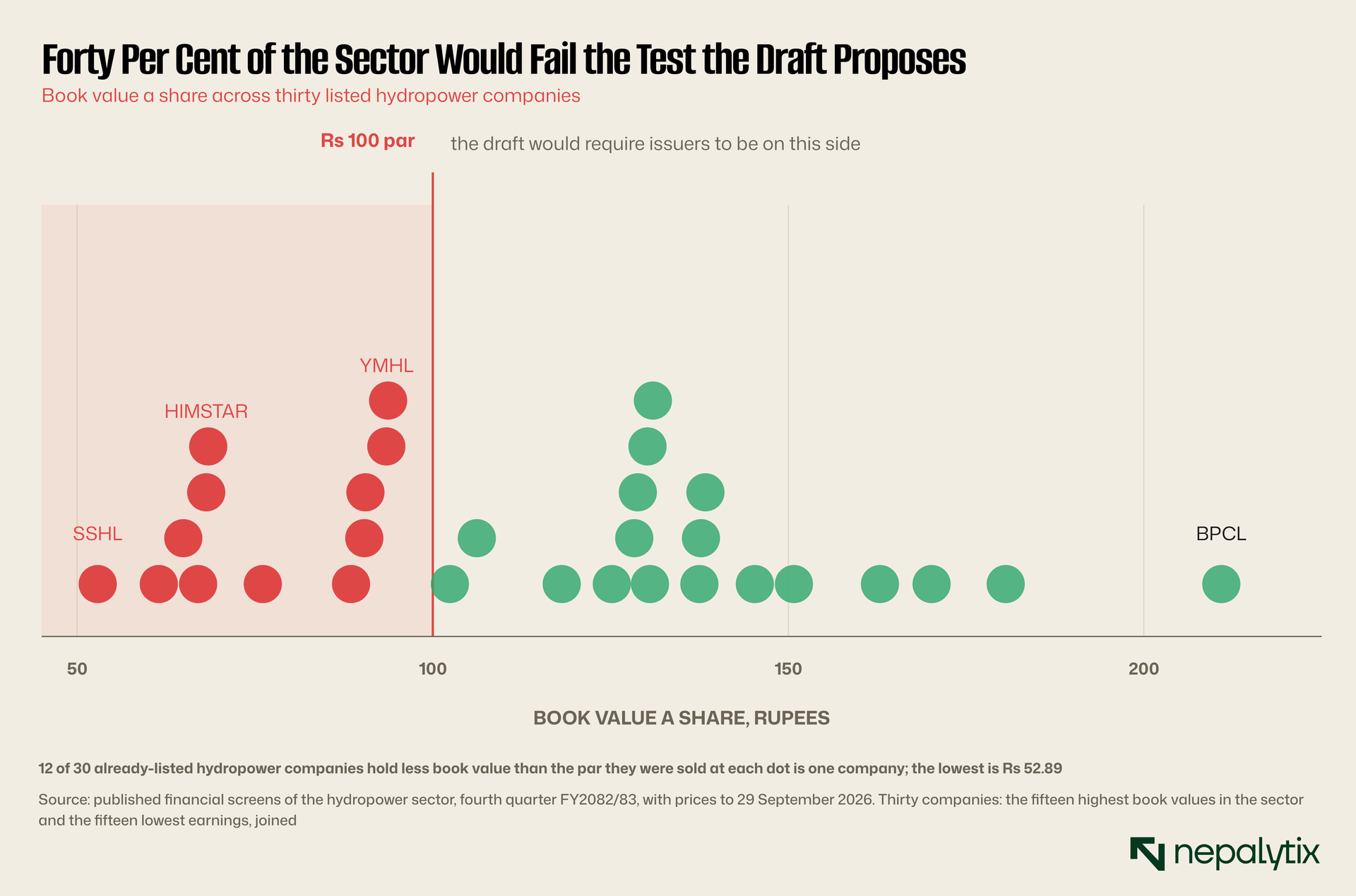
SEBON's draft would require a hydropower company to hold net worth of at least Rs 100 a share before it may sell shares at Rs 100. Forty per cent of the sector already listed would fail that test today. The market pays more for the ones that fail it than for the ones that pass.
On 22 September the Securities Board of Nepal published a draft of its General Qualifications for Public Issuance Guidelines, 2026. For hydropower and infrastructure issuers it would introduce eight requirements of which one is a financial threshold and seven concern whether the project is real. The seven are sensible and overdue. The one is the subject of this piece because it is the only provision that touches what an issue costs and because the evidence says it will not do what it is meant to do. The context matters because Nepal has been here before. The screen published here on 18 September examined the entire recent listing cohort and found no company trading below the price it was sold at with a median gain of 564%. That is not a market where subscribers are being harmed by overpricing. It is a market where they are being enriched by underpricing and the two problems require opposite remedies.
A net worth floor protects against the first. Nepal has the second.
What the draft asks for
The technical requirements first, since they are the part that deserves support.
An issuer would need an independent technical inspection before issuance and a due diligence certificate from an independent engineer. It would need a project oversight committee operating under board governance. It could not use issue proceeds for administrative expenses and would have to hold capital mobilisation in a separate account. It would be disqualified by operational disruptions, by an adverse auditor note on going concern or by promoter blacklisting.
Every one of those addresses a documented failure mode. A hydropower issue in Nepal is usually a single-asset project with construction risk, and an engineer's certificate is the correct instrument for establishing that the asset exists and works. Segregated accounts and a use-of-funds restriction address where the money goes after it is raised.
The eighth requirement is different in kind. It says the issuer's per-share net worth must be at or above par value, which for every Nepali company means Rs 100. It is worth saying why this draft exists at all, because the timing is not accidental. The government's capital market reform plan of 15 September set a sequence of deliverables running to January 2027. SEBON has since published two documents against it: this draft on 22 September and a conceptual framework for intraday trading on 24 September. The regulator is clearing a list. That matters for how the draft should be read. It is not a considered response to a diagnosed problem in primary issuance. It is one item of several, produced quickly, in a package whose headline items are intraday trading and margin lending.
Which is a reason to scrutinise the substance rather than the intent. Nobody involved is trying to do the wrong thing; they are trying to do several things at once to a deadline.
Who the draft protects is worth establishing before asking whether it protects them.
Two to three million Nepalis apply to every public issue. The Signal of 28 September put Beni Hydropower's final count at 2,305,233 valid applicants for 86,320 allotments, odds of 3.74%, and found the pool has sat between roughly two and three million across every issue measured.
Those are the subscribers. They apply for ten units at Rs 1,000, they have no ability to analyse a prospectus, and on the evidence they do not need to: the screen found no recent listing below its issue price.
So the population the draft exists to protect has not lost money in the period examined, and the protection being added addresses a harm that has not occurred. That is not an argument against prudence. It is a reason to be precise about what the rule does.
What a net worth test can and cannot do
The intention is clear enough. If a company is selling shares at Rs 100, it should have at least Rs 100 of accumulated equity behind each one. Otherwise the buyer is paying more than the company is worth on its own books at the moment of sale.
That is a floor on one thing: whether the issue price exceeds book value at issuance. It is not a floor on whether the issue price bears any relation to what the company is worth, and in Nepal those are very different questions.
The reason is the par convention. Nepali public issues are priced at Rs 100 because the law sets face value at Rs 100, not because anybody has valued the company at Rs 100 a share. The screen published here on 18 September found that every company listed within 180 sessions trades above its issue price at a median of 564% and that across 111 hydropower issuers not one trades below the price it was sold at.
A company worth Rs 800 a share and a company worth Rs 110 a share both issue at Rs 100. The draft would stop the second only if its book value happened to be below Rs 100. It does nothing about the first where the gap between price and value is largest and where the transfer to whoever wins the ballot is greatest.
The distinction can be put in one line. The draft asks whether the company has Rs 100 behind each share. The question a subscriber needs answered is whether the company is worth more than Rs 100 a share and those two are the same only by coincidence.
A company with book value of Rs 150 and no prospects is worth less than a company with book value of Rs 90 and a working plant. Book value records what has been put in and retained. It says nothing about what the assets produce.
For hydropower this gap is wide by construction. A project's value is the discounted stream of power sales over a licence term of decades and its book value is construction cost less depreciation. The two are not designed to agree.
A comparison makes the convention visible. In a market with book building, an issuer and its bankers canvass institutional demand, set a price range, take bids and price the issue where the book clears. The subscriber pays something an informed buyer was willing to pay.
In Nepal the price is Rs 100 because the Companies Act says face value is Rs 100. No demand is canvassed, no range is set and the only variable the issuer controls is how many shares to sell.
Everything downstream follows from that. The oversubscription this publication measured on 28 September where two to three million applicants compete for every issue, is the market expressing demand the only way the structure allows: by queueing rather than by bidding.
Whether the threshold binds
To find out whether a net worth floor at par would screen anything, the place to look is the companies that already cleared issuance and listed.
Across thirty hydropower companies with published fourth-quarter figures, 12 hold book value below Rs 100. That is 40% of the cross-section and the lowest is Shiva Shree at Rs 52.89.
These are not applicants. They are listed securities that an investor can buy today. Every one of them sold shares at Rs 100 to the public at some point and now holds less than that in accumulated equity per share.
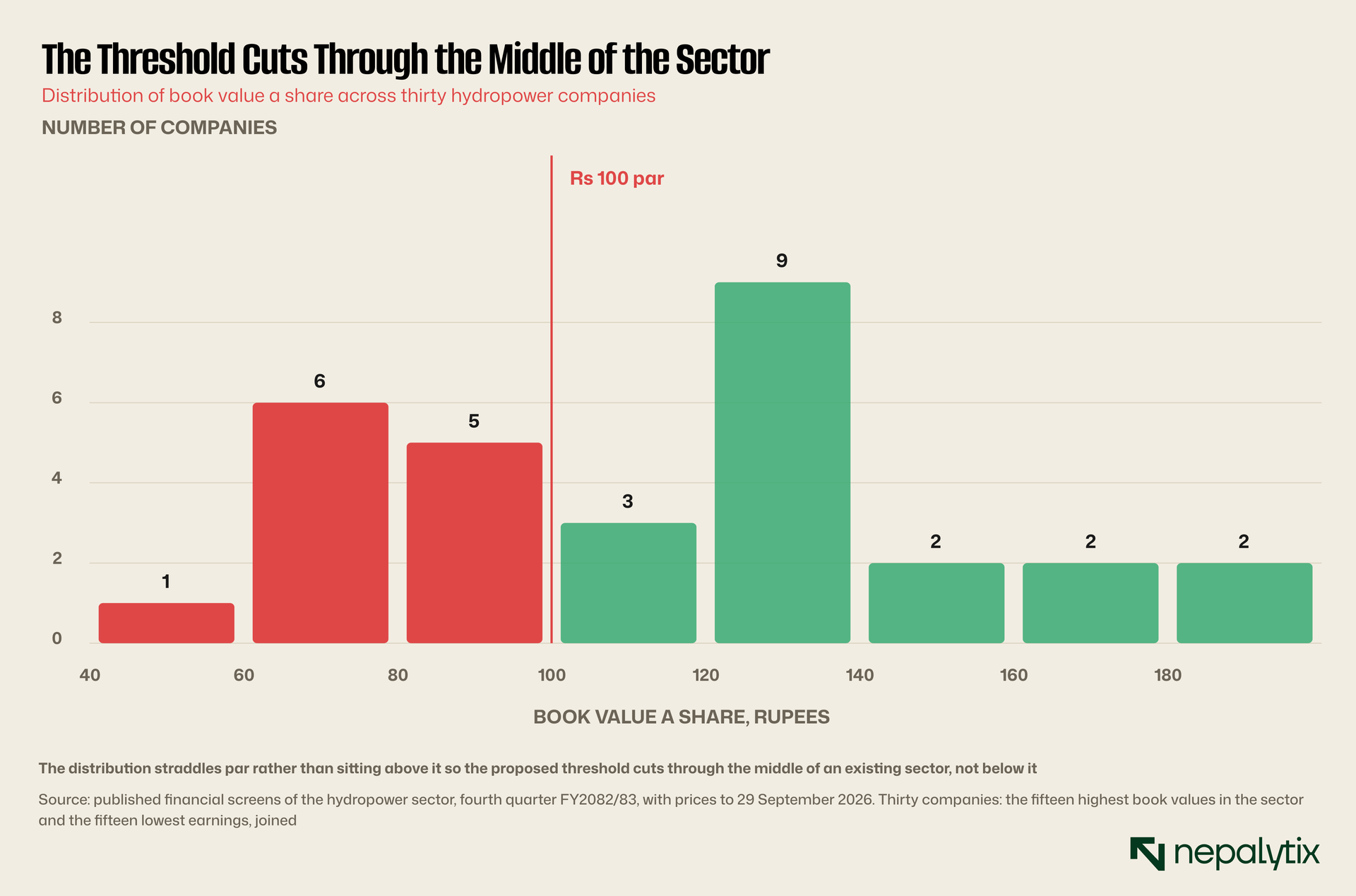
The distribution straddles par. It does not sit above it with a thin tail below which is what a threshold at the bottom of a healthy range would look like. The Rs 100 line runs through the middle of an existing sector.
So the threshold would bind and it would bind on a great many companies. That is an argument for it, not against it and it is the strongest thing that can be said in the draft's favour.
One caveat on the sample before it carries any weight. These thirty are the fifteen highest book values in the sector and the fifteen lowest earnings, joined from two published screens. They are the two tails, not a random draw and the middle of the distribution is under-represented.
That cuts both ways. Selecting the lowest earners will over-represent companies below par, so 40% overstates the sector rate. Selecting the highest book values will over-represent companies well above par which pushes the other way.
What the sample does establish and a biased sample can establish this is existence and magnitude. Twelve listed hydropower companies hold less book value than the par they sold at and the lowest holds barely half of it. Whatever the sector rate is, the threshold would exclude a substantial population of companies resembling those already listed.
There is a reading of the below-par population that is worse than the one above and it should be put on record because it bears on whether the threshold is even measuring what it claims.
Book value falls below par for two quite different reasons. A company can lose money which erodes accumulated equity. Or a company can distribute more than it earns which does the same thing and is a choice rather than a misfortune.
Twelve of the thirty are below par and fifteen of the thirty lose money with twelve in both groups. So the below-par population here is the loss-making population almost exactly, and the distribution question does not arise in this sample.
That is convenient for interpretation and it will not hold in a sector where dividends are larger. In banking or microfinance a below-par book could mean either and a threshold that cannot distinguish a lossmaker from a generous payer is a blunt instrument in those sectors.
What the market actually prices
Here is where the case for the threshold runs into evidence.
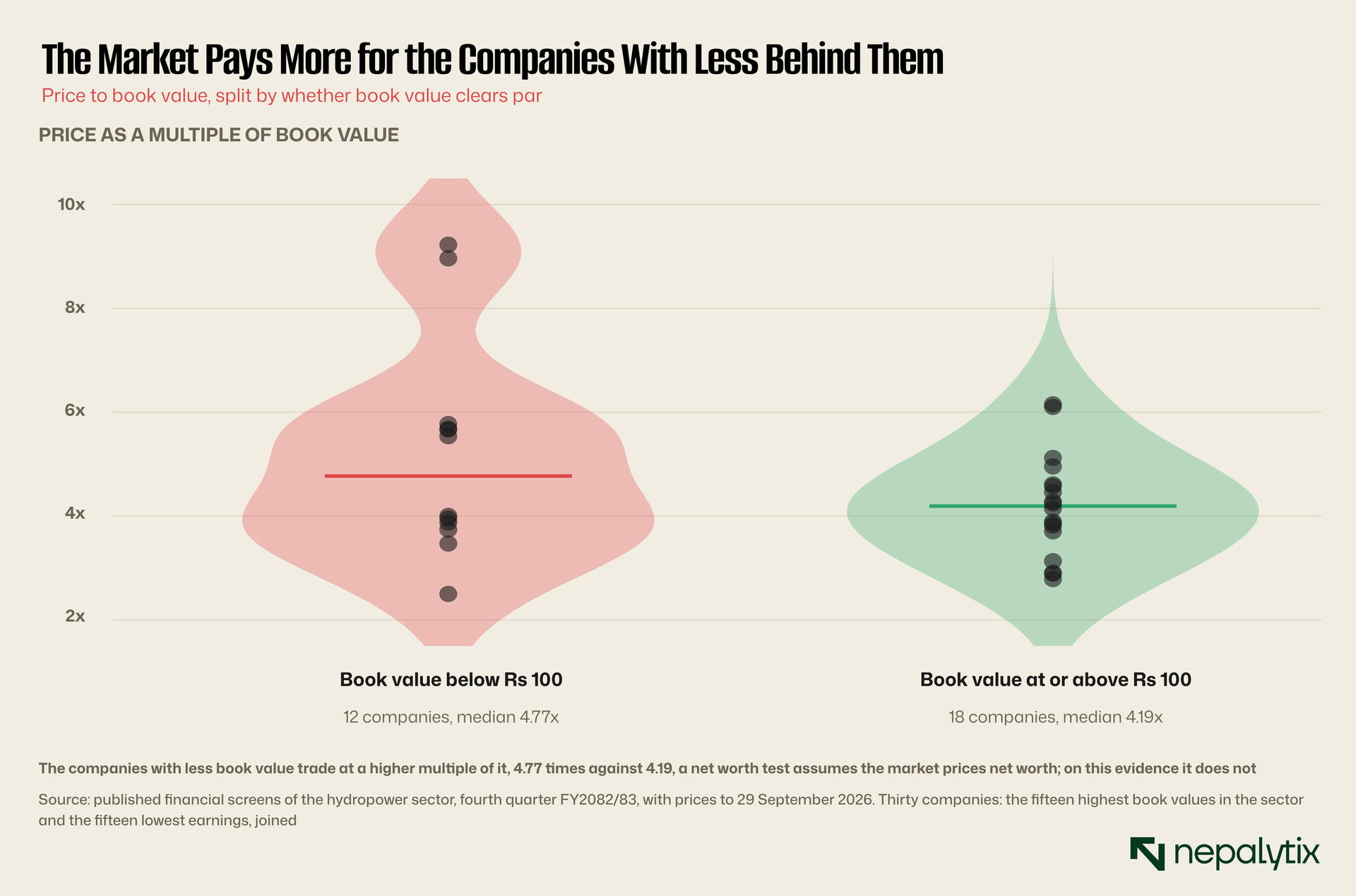
The twelve companies with book value below par trade at a median of 4.77 times that book. The eighteen at or above par trade at 4.19 times.
The companies with less behind them command a higher multiple of what is behind them.
Him Star Urja holds Rs 68.14 of book and trades at Rs 628.50 which is 9.22 times book on earnings of minus Rs 29.72 a share. Suryakunda holds Rs 90.38 and trades at Rs 810.00, 8.96 times book on minus Rs 4.81.
Those are not marginal cases at the edge of a distribution. They are the two highest multiples in the sector and both belong to companies that would fail the draft's test.
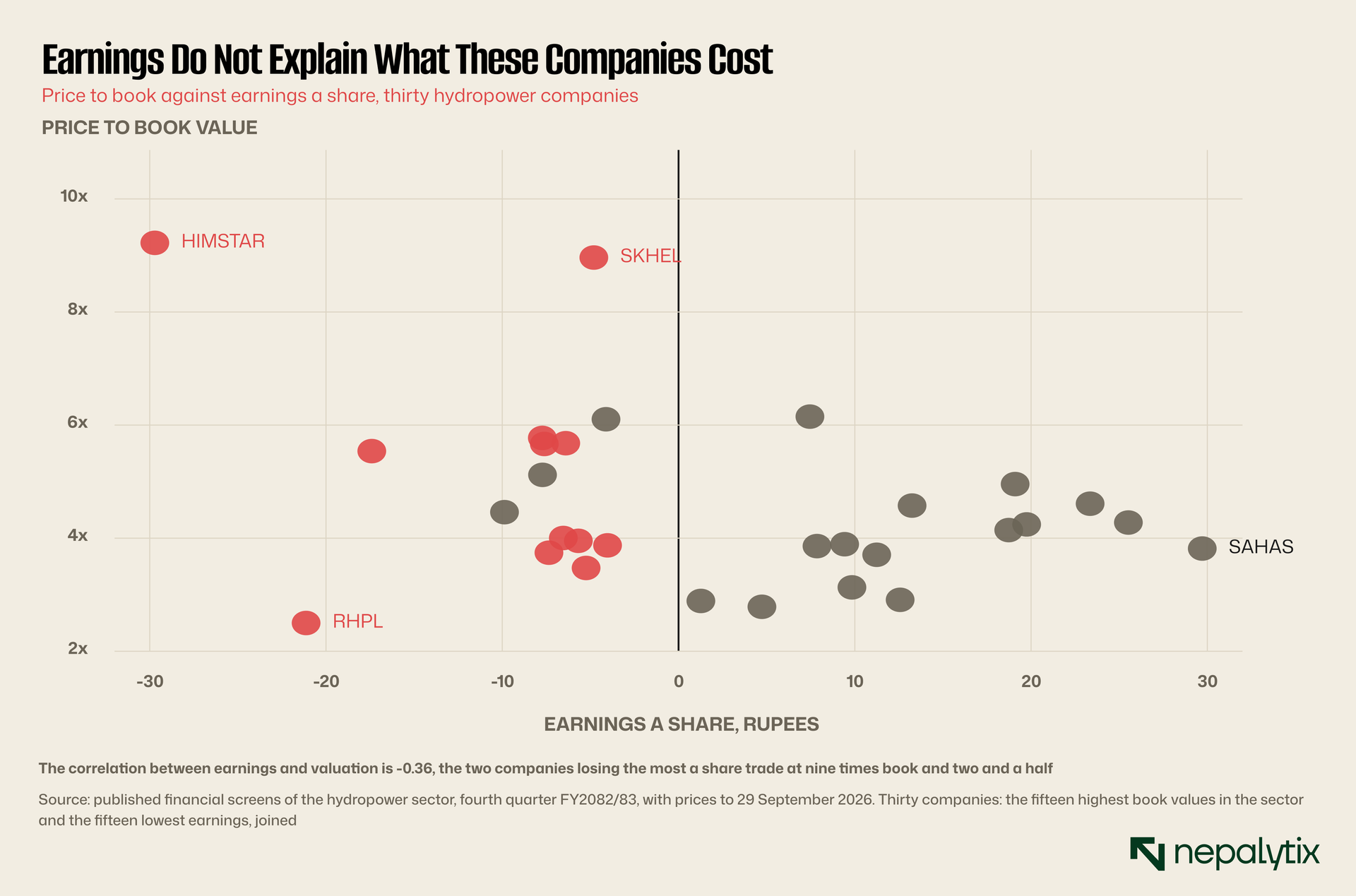
Earnings do not explain it either. The correlation between earnings a share and price to book across the thirty is minus 0.36 which is weak and points the wrong way.
Fifteen of the thirty lose money. Twelve of those fifteen are the twelve below par which is what one would expect: a company that loses money erodes its book value. What is not expected is that the market prices the erosion as an upgrade.
A net worth test assumes investors care about net worth. On this evidence they do not price it and a threshold that screens for something the market ignores will change who may issue without changing what issues cost.
Three explanations for the inverted multiple are available and the data does not separate them.
Float. The companies with the highest multiples also have the smallest public floats and a price set by a million tradeable shares is not a valuation. Him Star has 1,119,000 public shares and 2,611,000 held by promoters.
Newness. A recently listed company has a short price history, a promotional narrative and no accumulated disappointment. The screen of 18 September found the post-listing premium decays with age so young companies sit at the top of the multiple range for reasons unconnected to what they own.
Construction stage. A company still building its plant has spent capital, earned nothing and written off development costs which drives book value down and earnings negative simultaneously. On that reading a below-par book is a signal of stage rather than of failure and the market is pricing a plant that will exist.
The third explanation is the most generous and it is also the most damaging to the draft. If a below-par book value marks a company mid-construction then a net worth threshold at par systematically excludes exactly the projects that most need public capital and admits the ones that already have operating cash.
A rule that lets established generators issue and blocks projects under construction is a rule that funds the past.
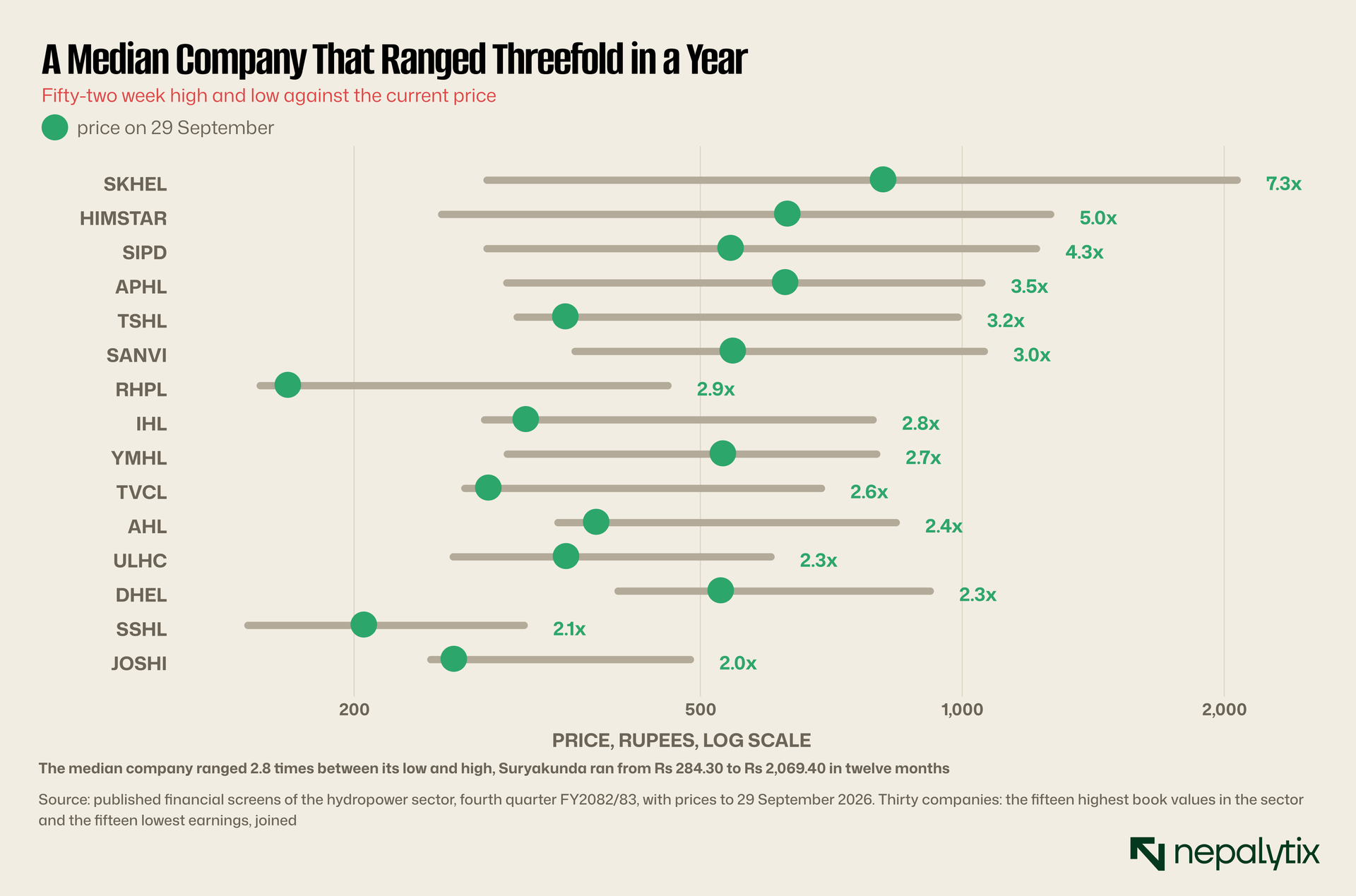
The range chart also shows something about the current price that is easy to miss. The dot on each bar is where the share sits today relative to its own twelve-month range, and for most of these companies it sits in the lower half.
Suryakunda is at Rs 810 against a high of Rs 2,069.40. Shikhar Power at Rs 541 against Rs 1,216.80. Him Star at Rs 628.50 against Rs 1,264.
So the multiples quoted above, high as they are, are computed on prices already well below where these securities traded within the year. At their highs the same companies were at fifteen and twenty times book.
The moment the test is applied
There is a second problem and it is the more serious of the two because it is structural rather than empirical.
The draft tests net worth at issuance. Net worth at issuance is the moment a company has just received a large cash injection from the public and has not yet spent it or lost it.
Take Yambaling Hydropower. Its issue closed in Baishakh 2083. This publication reported the allotment on 28 September: 2,938,082 valid applicants competed for 174,300 allotments, odds of 5.93%.
Yambaling now holds book value of Rs 93.47 a share, below par. Its earnings are minus Rs 7.62. It trades at Rs 529.80 which is 5.67 times its book.
An allottee paid Rs 100 for something that holds Rs 93.47 of book and is marked at Rs 529.80.
Yambaling cleared whatever requirements applied when it issued. Under the draft it would presumably have cleared the net worth test too since the test is applied before the deterioration happens. The rule catches a company at the one moment it is most likely to pass.
The general form of the problem is worth naming because it recurs across this publication's subjects.
A threshold applied at a single moment can be met at that moment. A bank meets capital adequacy on the reporting date. A company meets a net worth test at issuance. What happens between reporting dates is not tested and is where the risk lives.
The remedy in banking is continuous supervision and quarterly disclosure. The equivalent here would be a requirement that issuers publish net worth quarterly after listing with a consequence for falling below par and the draft contains nothing of the kind.
Without it the threshold is a gate rather than a standard: something a company passes through once and then need not maintain.
It is worth testing the inverted multiple against the alternative that it is a statistical artefact rather than a finding.
The below-par group has twelve members and the above-par group eighteen. With samples that small, a difference between medians of 4.77 and 4.19 is not large relative to the spread within each group: the below-par multiples run from 2.50 to 9.22 and the others from 2.79 to 6.15.
So the honest statement is not that below-par companies command a premium. It is that they do not trade at a discount which is what a market pricing net worth would produce and is the thing the threshold's rationale assumes.
That weaker claim is enough. A rule justified by protecting subscribers from companies with thin book value needs the market to penalise thin book value. It does not.
The case for the draft, put properly
The strongest version of the other side
Nepal's IPO problem is not only pricing and a regulator that fixes what it can fix is not a regulator avoiding the hard question.
A hundred and eight issues sit in SEBON's pipeline. A meaningful number are single-asset hydropower projects with construction risk, no operating history and promoters the public cannot assess. For those, an independent engineer's certificate, a project oversight committee and a segregated account are not second-best measures. They are the things that determine whether the asset exists.
The net worth threshold is defensible on its own narrow terms. A company with book value of Rs 52.89 selling shares at Rs 100 is selling above its own book and preventing that is a coherent objective even if it is not the largest problem.
And the pricing question may simply not be SEBON's to solve. Face value is set in company law rather than securities regulation. A regulator cannot introduce book building by guideline and criticising it for not doing so is criticising it for lacking a power it does not have.
On that reading the draft is what a regulator does when the instrument that would fix the problem belongs to somebody else.
That last point carries real weight and this piece does not dismiss it. The reply is narrow: if the pricing power sits elsewhere, the draft should say so and the consultation should name the statutory change that would be required.
It does not. A reader of the draft would conclude that per-share net worth at par is a meaningful protection for a subscriber and the evidence above says it is not.
A further consequence of testing at issuance is that it gives the promoter control of the timing.
Net worth at par is a threshold a company can be engineered across. Revalue an asset, capitalise a cost that might have been expensed, convert a promoter loan to equity or simply wait for a quarter in which the number clears. None of that is improper and all of it is available.
A test that can be timed is a test that will be timed and the regulator would be examining a figure the applicant chose the date of.
The same caution applies to the correlation. Minus 0.36 across thirty companies drawn from two tails is suggestive rather than conclusive and a random sample of the full 111-company sector might return something different.
What it rules out is a strong positive relationship. If earnings drove valuation in this sector, thirty companies spanning minus Rs 29.72 to plus Rs 29.72 of earnings a share would show it, and they do not.
What the sector looks like to an investor
The median company in that group ranged 2.8 times between its low and its high in twelve months. Suryakunda ran from Rs 284.30 to Rs 2,069.40, a factor of 7.3.
A security that can trade at Rs 284 and Rs 2,069 within a year is not being priced on book value, earnings or anything the draft measures. It is being priced on demand.
Part of the reason is who holds the shares. In nine of the thirty, promoters hold between 70% and 86%.
Vision Lumbini Urja has a public float of 2,400,187 shares against a market capitalisation of Rs 7.34 billion. Suryakunda has 1,379,350 public shares against Rs 5.59 billion. Him Star has 1,119,000 against Rs 2.34 billion.
A price set by a float that small is not a valuation. It is whatever the marginal buyer paid and the draft contains nothing about float.
The Yambaling case deserves one more pass because it is the cleanest evidence available and it should be stated carefully rather than rhetorically.
Nothing here suggests Yambaling misrepresented anything. A hydropower company that issued, listed and now carries negative earnings and a book value slightly below par is behaving the way a company mid-construction behaves. The project may well come good.
The point is narrower. Whatever the draft's net worth test would have measured at Yambaling's issuance, the figure eighteen months later is Rs 93.47. Subscribers who won the ballot at Rs 100 now hold a security marked at Rs 529.80 which is 5.67 times a book value that is below what they paid.
They have done extremely well and the protection the draft offers had nothing to do with it. Both halves of that sentence matter.
The fifty-two week ranges make a related point about what the draft is regulating.
Twelve of the fifteen companies with a published range moved by more than double between low and high. Three moved by more than four times. Shikhar Power ran from Rs 284.30 to Rs 1,216.80.
These are the same companies whose net worth the draft would test to two decimal places at the moment of issuance. A regulator applying a precise threshold to a company whose market price moves fourfold within a year is measuring the wrong quantity to the wrong precision.
Float deserves a section of its own because it is the variable the draft ignores entirely and the one that most determines what a subscriber's shares will be worth.
Every provision in the draft concerns the issuer: its net worth, its engineer, its board, its accounts. None concerns the security that results and the security that results is defined largely by how much of it exists to trade.
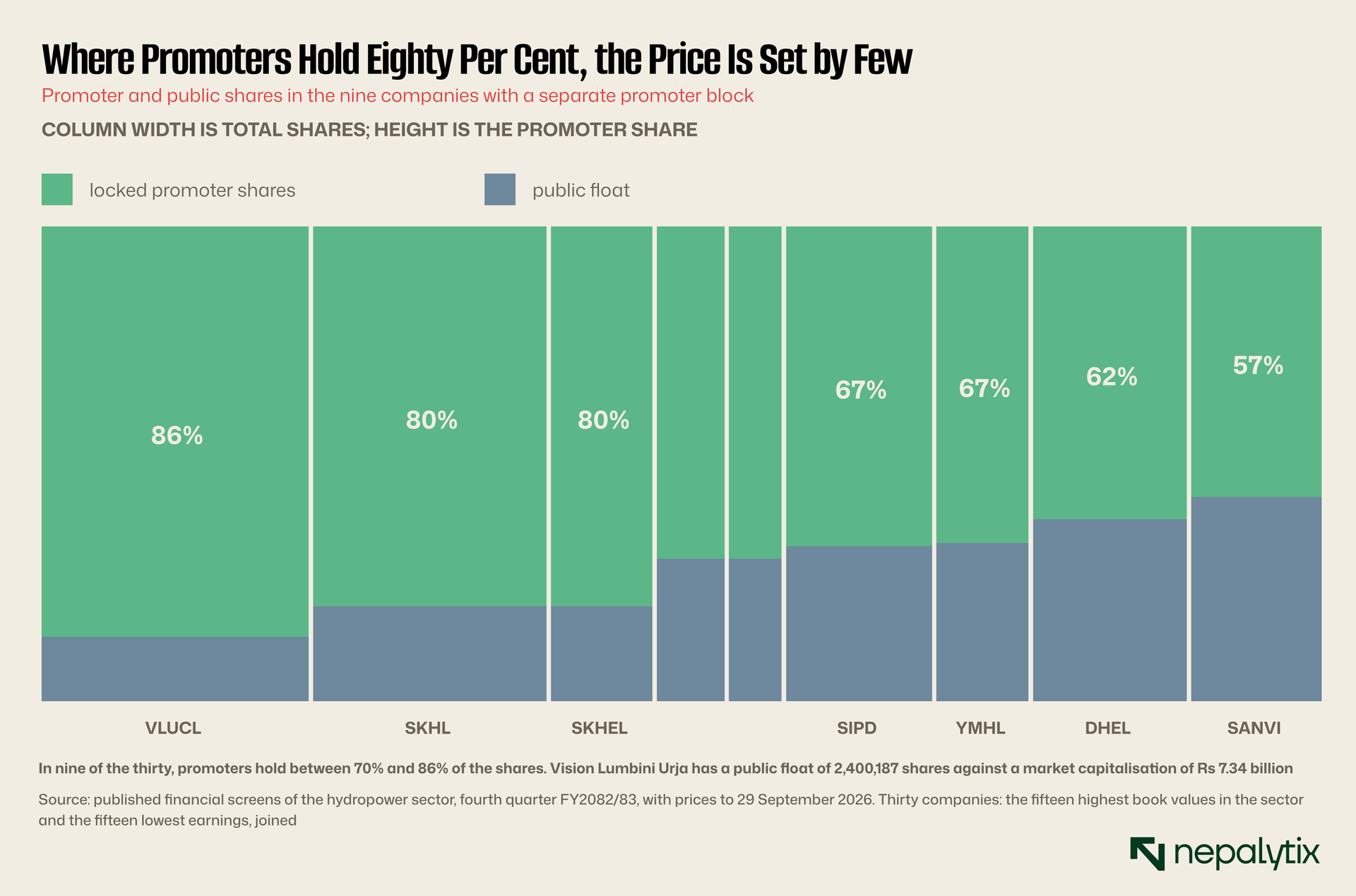
Vision Lumbini Urja is the extreme case in this sample. Promoters hold 15,300,000 shares and the public 2,400,187 so 86% of the company is locked. The market capitalisation is Rs 7.34 billion and the tradeable portion is Rs 921 million.
The Exit Register published here on 25 September measured what small floats do to a security's saleability. A company whose price is set by 2.4 million shares is a company whose price can be moved by a small amount of money, in either direction and whose holders may not be able to leave when they want to.
A subscriber who wins a ballot in such a company receives shares in a business that may be sound and a security that is structurally illiquid. The draft addresses the first and is silent on the second.
What would actually change the price
If the objective is that subscribers pay something related to value, three instruments would do it and the draft uses none.
Book building. Let the price be discovered by institutional demand rather than set by the Companies Act. This requires legislation and it is the only measure that addresses the problem directly.
A larger issue size. Monday's Signal of 28 September established that allotment odds are determined almost entirely by how many shares are offered because the applicant pool is constant at two to three million. Requiring a larger public float would reduce both the oversubscription and the scarcity that supports the post-listing premium.
A published free float. The exchange does not publish it for any company, as Sunday's piece set out. Without it, nobody can see that a Rs 7 billion company has 2.4 million shares available.
The first requires parliament. The second and third do not.
One thing the draft could add at no cost would materially improve it.
Require the issuer to publish, in the prospectus, the per-share net worth at each of the last eight quarters rather than at a single date. A company whose book value has fallen every quarter for two years and happens to clear par in the quarter it applies is telling a subscriber something the point estimate conceals.
The figures exist. Every applicant files quarterly statements. Publishing eight of them instead of one converts a gate into a trajectory, and a trajectory is what a subscriber would actually use.
It also closes the timing problem in the previous section since a company cannot engineer eight consecutive quarters as easily as one.
There is a version of this draft that would reach the pricing problem without legislation and it is worth setting out because it uses powers SEBON already has.
Require the prospectus to state a valuation. Not a price which is fixed at Rs 100, but an independent estimate of what a share is worth, prepared on a stated basis by a party with liability for it.
The gap between that figure and Rs 100 is the transfer. Publishing it would not change who receives the transfer, since the ballot decides that but it would make the size of it visible for the first time and it would put a number on the thing this publication has been measuring indirectly for a month.
The independent engineer's certificate the draft already requires establishes that the asset exists. An independent valuation would establish what it is worth. The second is a small step from the first and it is the one that reaches the actual problem.
The float point has a regulatory answer the draft could have reached for.
Nepal already requires a minimum public issue proportion. What it does not require is that the proportion stay public or that the exchange publish what proportion is tradeable or that a prospectus disclose the lock-in schedule under which promoter shares become sellable.
A subscriber in Vision Lumbini Urja holds 14% of a company alongside promoters holding 86% whose shares will at some point become eligible to trade. When that happens the float multiplies and the price discovered on 2.4 million shares meets a much larger supply.
The date on which that occurs is the single most consequential fact about the security and it is not published anywhere a subscriber would look.
The narrow conclusion
The draft's technical requirements should be adopted. They address real failures, they are within the regulator's power and nothing in this piece argues against them.
The net worth threshold should be adopted too, on the grounds that selling above book is worse than selling at book, and that a floor is better than no floor.
What should not happen is that the threshold is described in the consultation or in the coverage, as a protection against overpaying. It is not one. Forty per cent of the sector would fail it today, the failures trade at higher multiples than the passes and the one company this piece traced from ballot to balance sheet passed the test at issuance and sits below par now.
The consultation is where this should be argued and the draft is a draft.
Two amendments would cost nothing and address most of what is set out above. Publish eight quarters of net worth rather than one. Require an independent valuation alongside the independent engineer's certificate.
Neither requires legislation, neither conflicts with anything in the draft and both use machinery the draft already builds. A regulator that added them would have produced a document that reaches the problem rather than one that reaches what was available.
One further point about sequencing, since the reform package is explicitly sequenced.
SEBON published this draft on 22 September and its intraday trading framework on 24 September. The second will raise turnover in securities that already have it. Neither touches the primary market's pricing.
If the sequence continues as published, Nepal will have intraday trading, margin lending and a new benchmark index before it has an issue priced by anything other than the Companies Act. The secondary market will be modernised around a primary market that still sells everything at Rs 100.
That is not a criticism of any individual document. It is an observation about what a deliverable list produces when the hardest item is not on it.
What this piece does not claim
It does not claim the draft is harmful. Every provision in it makes an issue safer than no provision, and the technical requirements are a clear improvement.
It does not claim SEBON is avoiding the pricing question. The instrument that would address it sits in company law and a regulator cannot legislate.
It does not claim the below-par companies are bad investments. Several are mid-construction and the market may be right about them; the screen of 18 September found no recent listing has lost money for a subscriber.
What it claims is one thing. A subscriber reading that issuers must now hold net worth of at least Rs 100 a share would reasonably conclude they are protected from paying more than a company is worth. On the evidence assembled here they are not because the price they pay is fixed by statute rather than by value and because the market they will sell into prices book value inversely if at all.
A rule that screens for book value in a market that does not price book value will change the list of who may issue.
It will not change what an issue costs which is the thing the last eighteen months of evidence says is wrong.
A last observation on where this leaves the reader of a prospectus.
Under the draft, a Nepali subscriber applying for a hydropower issue would know that an independent engineer has certified the project, that a board committee oversees it that proceeds are segregated and that per-share net worth was at least Rs 100 on some date.
They would not know what the company is worth, what proportion of it will be tradeable, what its net worth has done over the preceding two years, or what the shares are likely to be worth when the premium decays.
The first list is a genuine improvement on the present position. The second list is what they would need, and every item on it could be supplied by disclosure rather than by legislation.
What to watch
The consultation response. Whether the industry objects to the net worth threshold will indicate whether it binds on the current pipeline. Silence would suggest applicants can clear it.
Whether book building appears anywhere. The full text was not obtained. If it contains a book building provision, most of this piece is wrong and gladly so.
The 108 issues in the queue. If approvals slow materially after the guidelines take effect, the threshold is binding. If they do not, it is not.
The next cohort's book values. Companies issuing under the new rules will clear par at issuance by definition. Whether they are still above par two years later is the test of whether a point-in-time threshold does anything, and it is answerable from published quarterly statements.
Disclaimer
This report has been prepared by Nepalytix for informational and educational purposes only and does not constitute investment advice, an offer, or a solicitation to buy or sell any securities.
The information contained in this report is based on sources believed to be reliable; however, Nepalytix does not guarantee its accuracy, completeness, or timeliness. Opinions, estimates, and projections expressed herein are those of the authors as of the date of publication and are subject to change without notice.
Investing in securities involves risks, including the possible loss of principal. Past performance is not indicative of future results. Readers are advised to conduct their own independent research and consult with a qualified financial advisor before making any investment decisions.
Nepalytix and its contributors may hold positions in the securities discussed in this report at the time of publication or thereafter.
Neither Nepalytix nor any of its affiliates accept any liability for any loss arising from the use of this report or its contents.