NEPSE Rose 1.1% Last Quarter: FY 2083/84 Q1 Review
NEPSE gained 1.1% in the first quarter of FY 2083/84 but 213 of 339 listed stocks fell. Banks carried the index while smaller companies struggled and turnover dropped 48% year-on-year. Here’s what the numbers reveal about Nepal’s stock market.
The index rose 1.1% between Shrawan 1 and the Dashain closure, the smallest first-quarter move in 26 years. Underneath, the 51 largest companies rose and most of the rest fell, banks supplied all of the gain and turnover ran at half last year's pace. Here is the quarter in numbers and what is waiting when the market reopens on 26 October.
The signal
The flat index is a bank story laid over a falling market. Market-value-weighted, commercial banks added 2.6 percentage points to the quarter and every other sector together took away 1.2. The largest fifth of listed companies rose by a median 3.6%; the smallest fifth fell by a median 8.0% and only 8 of its 52 members rose. Turnover averaged Rs 4.56 billion a day, half what it was a year ago. When NEPSE reopens after Dashain, the first-quarter results season and the next promoter unlocks arrive into a thin market that has already been selling its small and mid-sized stocks
01. A round trip
Fiscal year 2083/84 began on Shrawan 1, 17 July. NEPSE had closed the old year at 2,597.8 on 16 July, after a weak final fortnight. It had stood at 2,652.9 on 1 July and slipped to 2,570.2 by 13 July. The new year opened with the quarter's biggest daily gain, 3.1% on 17 July, and the index kept rising for a week. It reached its highest close of the quarter, 2,734.6, on 24 July, 5.3% above the start.
That was the top. NEPSE then fell for six weeks in a row to its lowest close of the quarter, 2,513.4, on 31 August. That day was also its biggest daily fall of the quarter, 1.7%. From there it recovered most of the way in September and drifted in October. It finished Thursday 15 October at 2,625.9, up 1.1% on the quarter. In 60 sessions it rose on 30 and fell on 30.
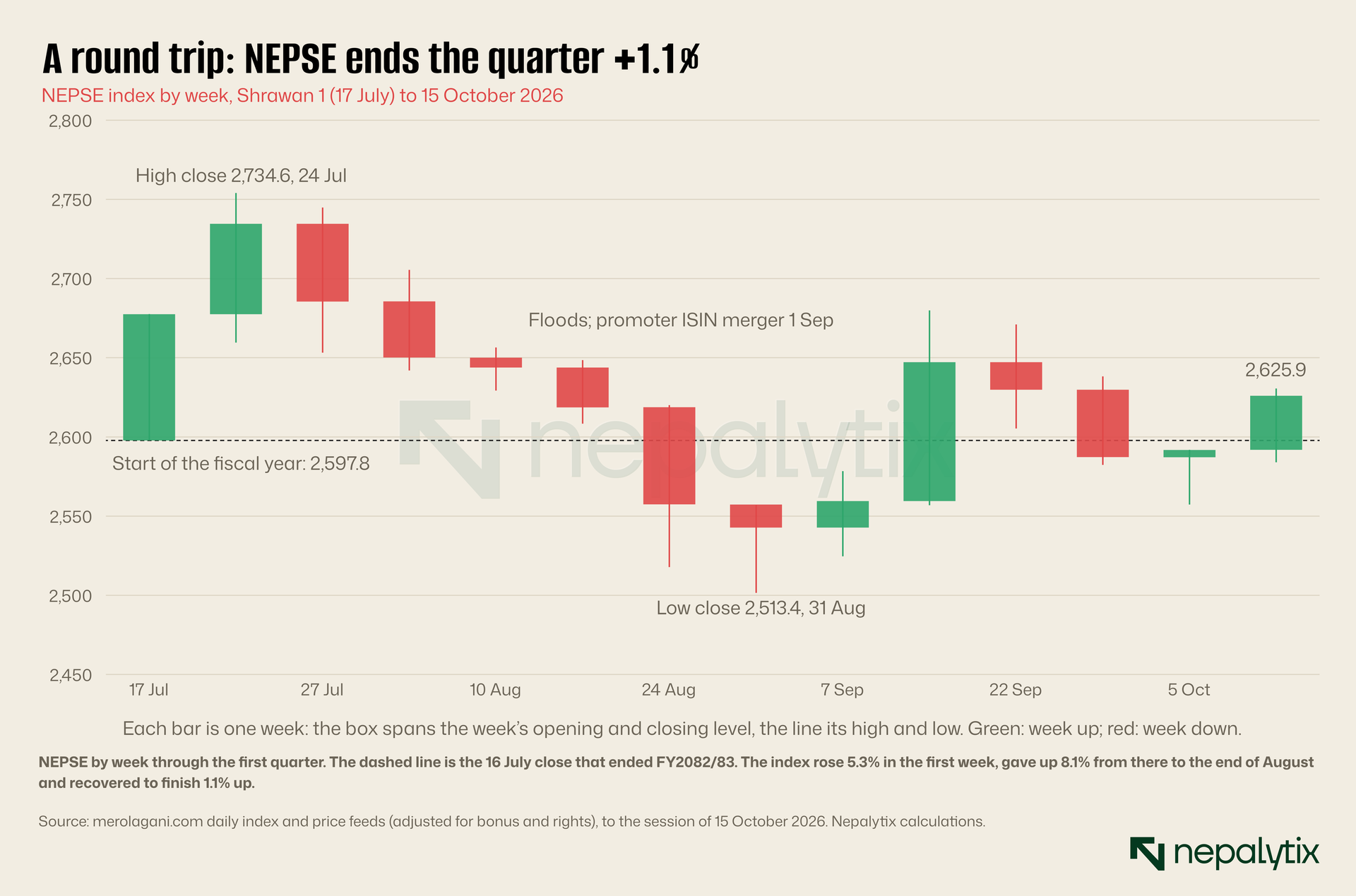
By month, the quarter reads +3.4% for the second half of July, −6.4% for August, +3.4% for September and +1.0% for the first half of October. August was the only month with a large move, and it was down.
The recovery came in two steps. In the week of 7 September NEPSE rose 0.7%, and in the week of 14 September it rose 3.4%, to 2,647.2, the quarter's best week. The Cabinet approved the new capital gains rates on 16 September, in the middle of that week; whether the two are connected is hard to say from prices alone. The next two weeks gave back 2.3%, and October's first half added 1.5% back. The quarter's shape is a peak in the first week, a trough at the end of the second month and a long sideways finish.
02. What happened in August
Two events landed at the end of August and both hit particular stocks hard. The Bhote Koshi and Rasuwa floods damaged several hydropower projects in the last week of the month; our premium report on that flood rated the exposure of each listed company. Over the quarter, Rasuwagadhi Hydropower fell 34.8%, Chilime 29.3%, and Trishuli Jal Vidhyut 40.3%. Then, from 1 September, SEBON's decision to merge the separate promoter and ordinary ISINs of non-financial companies whose lock-in had ended came into effect. Emerging Nepal whose promoters gave notice to sell more than half their stake fell 41.0% over the quarter. Kalinchowk Darshan, the other big seller in our Thursday Long Read fell 25.7%.
Neither event explains the whole of August's fall. Every one of the eleven sector sub-indices fell that month, from −5.1% for development banks to −14.0% for non-life insurance. The flood and the ISIN merger were specific; the selling was general.
03. The index rose; the typical share fell
NEPSE is weighted by market value. A 1% move in Nabil or Nepal Telecom moves the index far more than a 1% move in a small hydropower company. In a quarter where large and small stocks go different ways, the index can tell you very little about what most shareholders experienced. This was such a quarter.
Of the 339 listed equities with a price at both ends of the quarter, 125 rose and 213 fell. The median change was −3.7%. Only 109 beat NEPSE's 1.1%. We sorted the 258 companies for which we have a market value into five equal groups by size.
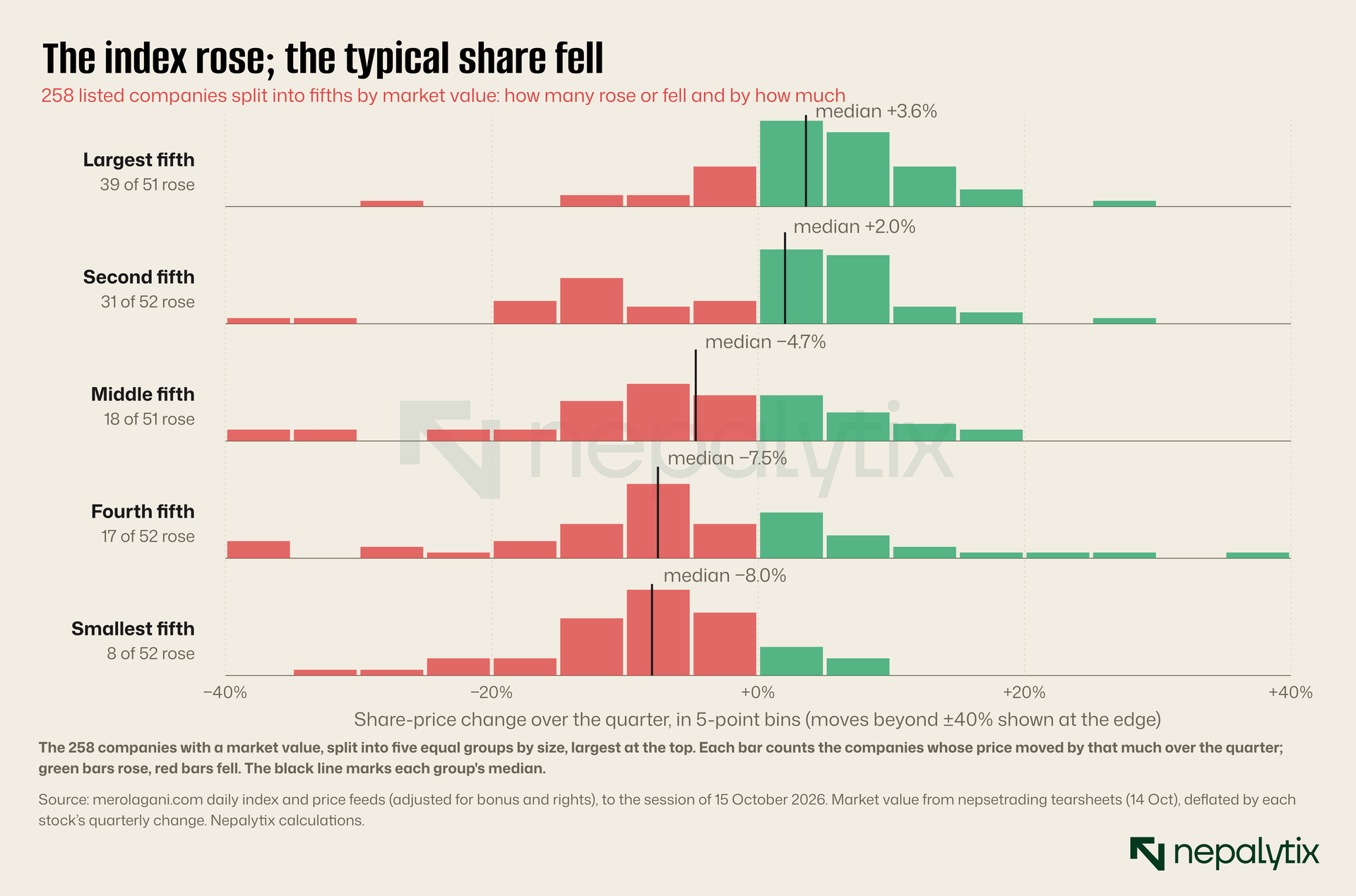
The result is a staircase. The largest fifth of companies rose by a median 3.6% and 39 of its 51 members rose. The second fifth rose by a median 2.0%. Then the sign flips. The middle fifth fell by a median 4.7%, the fourth by 7.5% and the smallest by 8.0%. In the smallest fifth, only 8 of 52 companies rose.
For a retail investor with a portfolio of small hydropower and microfinance stocks, the first quarter was a loss of something like 7% or 8%, whatever the index says.
The sector medians make the same point from another angle. The median commercial bank rose 9.8% and the median manufacturer 5.6%. The median investment company rose 2.2% and the median life insurer 0.5%. Every other sector's median company fell: hydropower by 0.7%, development banks by 0.9%, hotels by 4.7%, microfinance lenders by 7.2%, finance companies by 8.3%, non-life insurers by 11.2% and the companies in "others" by 12.6%. Microfinance is the clearest case. As our Signal of 12 October showed its fourth-quarter profits rose 43% while its bad loans rose 64% and the market spent the quarter marking its shares down.
Big single-day gains were rare and concentrated. Across all listed equities there were 44 sessions in which a stock closed 14.5% or more above its previous close. Twenty-eight of them belonged to the three companies that listed during the quarter, which are discussed below. Outside those three, only twelve stocks had a day like that at all. Falls of that size were rarer still: 17 sessions across 12 stocks. They included Sindhu Bikas Bank on three consecutive sessions in early September, Emerging Nepal twice in the first week after the ISIN merger and the flood-hit Rasuwagadhi Hydropower and MKJC in the last week of August.
04. Banks carried it
The large companies that rose were overwhelmingly banks. The banking sub-index gained 9.6% over the quarter by far the best of the eleven. Weighting each listed company by its market value at the start of the quarter, the whole market rose 1.3%, close to NEPSE's 1.1%. Commercial banks, about 27% of that market value, contributed 2.6 points of it. Every other sector together contributed −1.2 points.
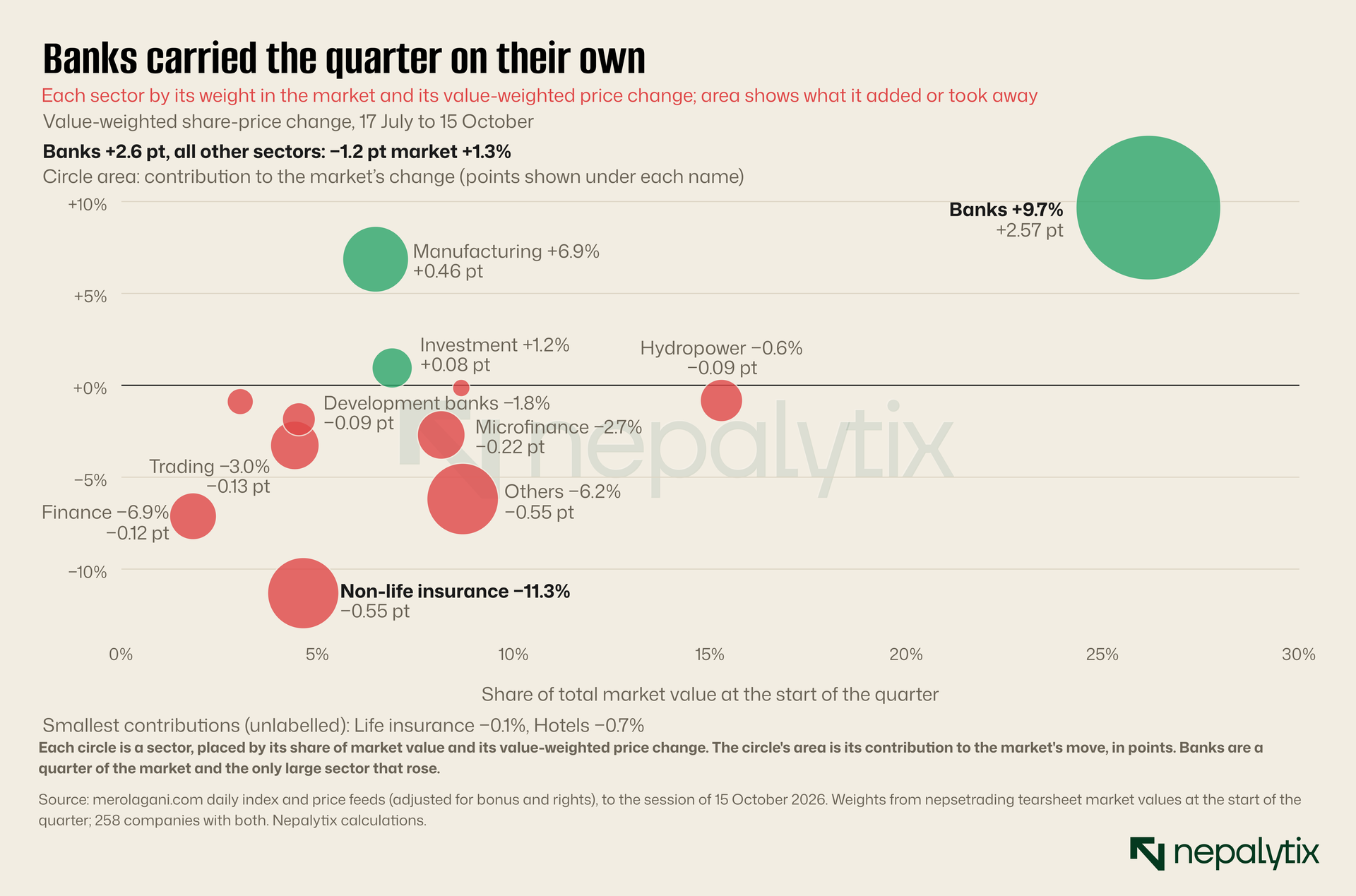
Manufacturing, at 6.7% of market value was the only other sector with a meaningful gain, 6.9%. Investment companies rose 1.2%. Everything else fell. Hydropower, the second-largest sector was flat at −0.6% value-weighted but its median company fell 0.7% and its range was enormous: Ghalemdi Hydro rose 41.4% and Trishuli Jal Vidhyut fell 40.3%. Microfinance fell 2.7%, finance companies 6.9% and non-life insurers 11.3%, the worst of any sector.
Within banking, the gains were broad. Nabil rose 7.2%, Laxmi Sunrise 26.3% and Siddhartha 18.6%; the median commercial bank rose 9.8%. NIC Asia down 0.7%, was the only one of the 19 to fall. Six of the ten best performers outside hydropower were banks.
05. Everything fell into August; banks made their gain after it
Split the quarter at the end of August and the pattern becomes clear. From 17 July to 31 August, every one of the eleven sector sub-indices fell and NEPSE lost 3.2%. Banks fell least, by 0.8%; non-life insurance fell most by 14.5%. From 1 September to 15 October, NEPSE gained 4.5% and nine of the eleven sectors rose. Banks rose 10.5%, life insurance 7.9% and non-life insurance 3.7%. Only hotels and finance companies fell in both halves.
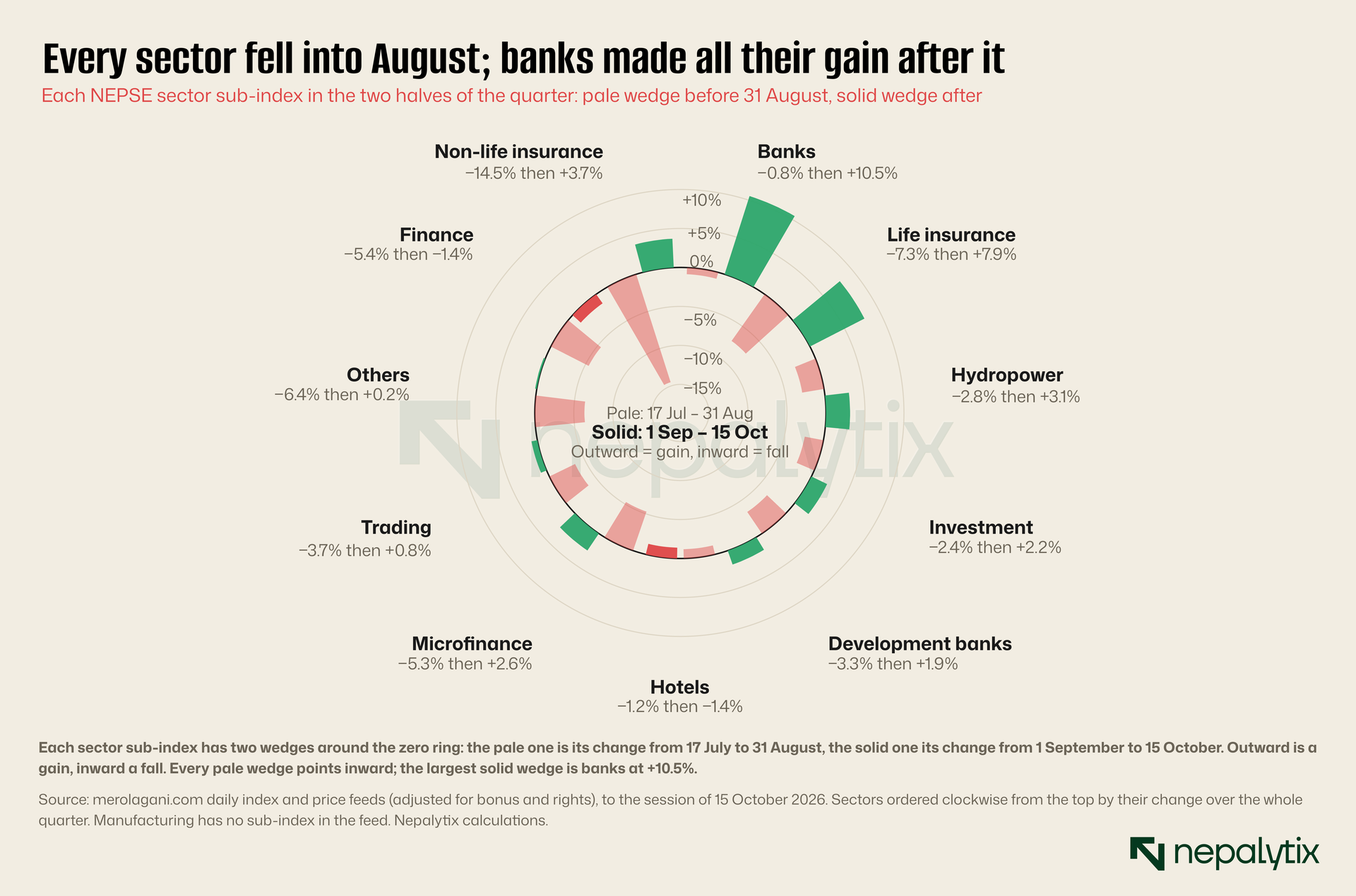
So all of the banks 9.6% gain for the quarter came after August and it came on top of having fallen less than anyone else on the way down. Month by month, leadership still rotated: hydropower led the second half of July with 5.1%, development banks were the least bad sector in August at −5.1%, life insurance led September with 5.8% and banks led the first half of October with 4.6%. Banks never ranked lower than third in any month. Non-life insurance was the opposite: last in July and in August when it fell 14.0%, and never able to recover it. A market whose leader changes every month without enough money coming in to sustain any of them is a market without a theme.
06. Half the turnover
The money is the clearest change from a year ago. NEPSE turnover averaged Rs 4.56 billion a session in the first quarter, over 60 sessions, Rs 273.5 billion in all. In the same quarter of FY2082/83 it averaged Rs 8.81 billion a session. In the quarter just ended, the fourth of FY2082/83, it averaged Rs 4.77 billion. So the first quarter was slightly quieter than the one before and 48% quieter than a year earlier.
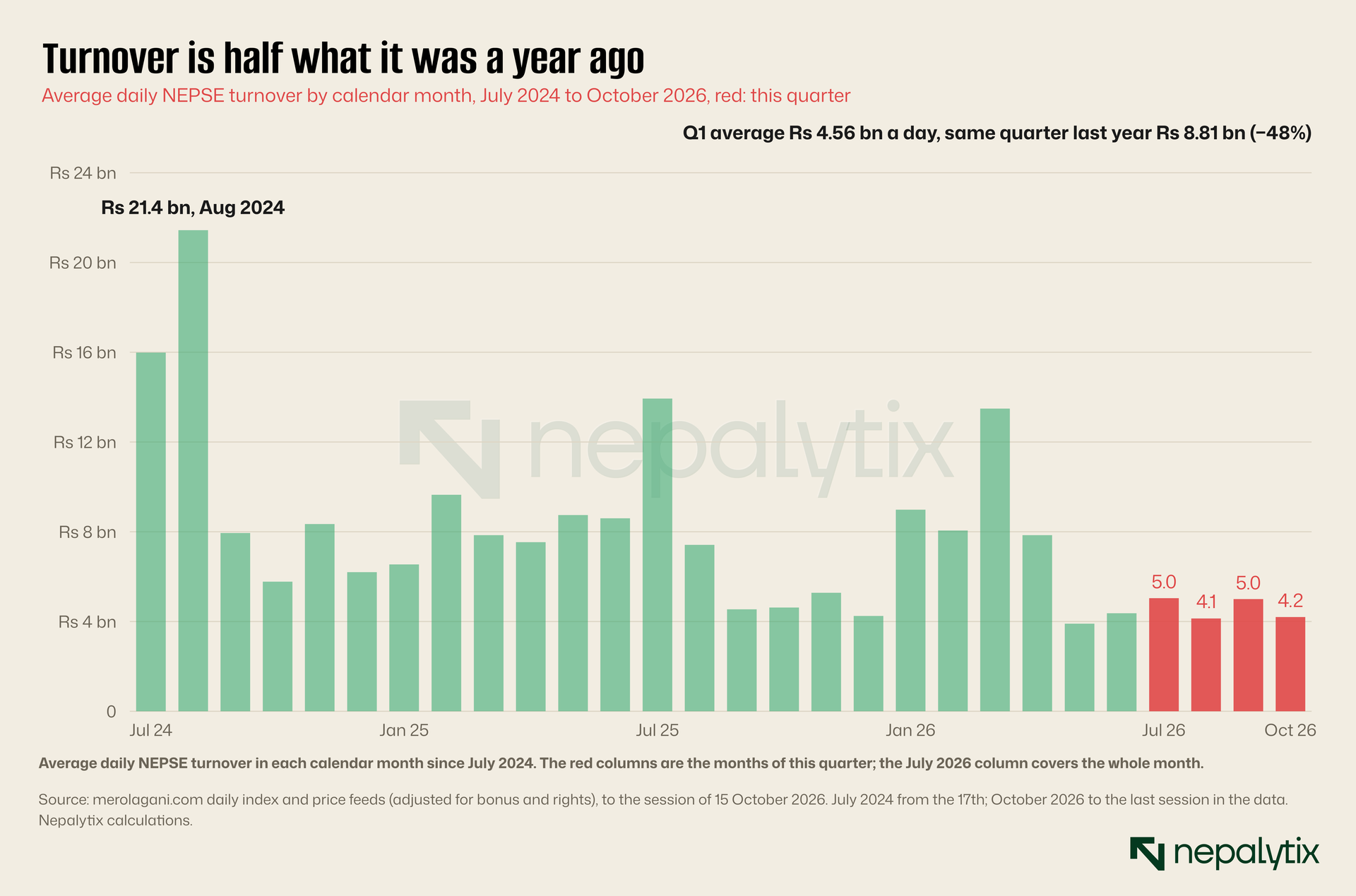
No month of the quarter averaged more than Rs 5.0 billion a day. In August 2024, during the last strong rally, the average was Rs 21.4 billion. August 2026, at Rs 4.14 billion a day was the second-quietest month in the chart after May 2026 and the first half of October the third.
Two details sharpen the picture. First, debentures which dominated trading in early July, almost disappeared. As Sunday's read showed, debenture trading peaks as the fiscal year closes and holders position for their annual coupons. Listed debentures traded about Rs 18.7 billion in the first half of July before the quarter began and only Rs 2.2 billion during the whole quarter under 1% of turnover. Second, equity turnover was concentrated. The ten most-traded stocks took 24.6% of equity turnover. The two most traded were Reliance Spinning Mills, at Rs 11.1 billion and Solu Hydropower at Rs 8.6 billion. These are the two largest promoter stakes still in lock-in on the schedule in our Thursday Long Read and both unlock in January 2029. Reliance Spinning fell 11.0% over the quarter and Solu rose 22.6%.
07. Three new listings, all far above their issue price
Three companies listed through IPOs during the quarter. Everest Colour started trading on 17 July, the first day of the fiscal year and Sarvottam Paints and Mount Everest Power Development in mid-August. All three closed their first day at more than three times the Rs 100 issue price and all three kept going.
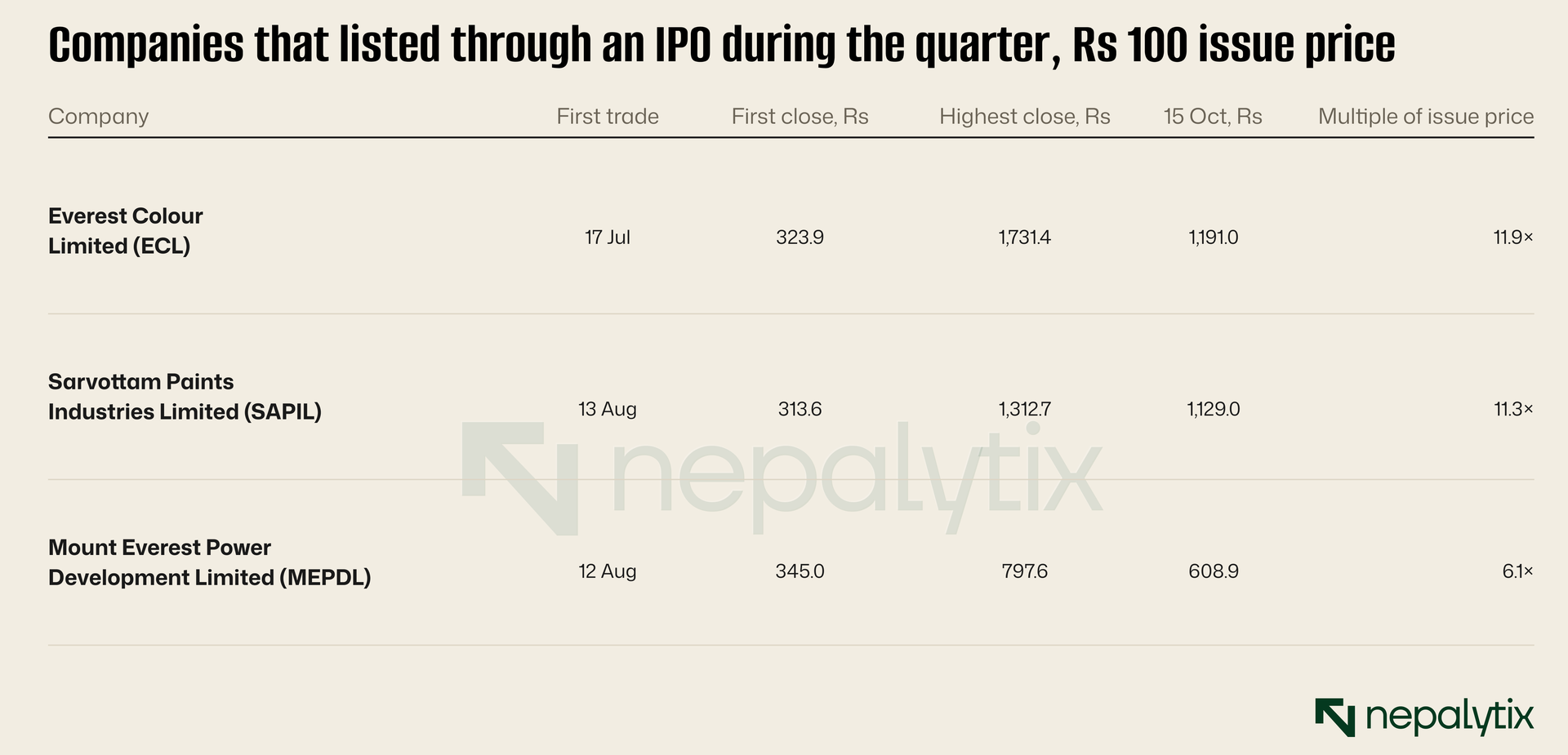
Everest Colour and Sarvottam Paints are small manufacturers with small floats. Both ended the quarter above Rs 1,100, eleven to twelve times the issue price, though Everest Colour had touched Rs 1,731 on the way. Our Long Read on IPO allottees found that, in every period we tested, allottees who held past listing day did better than those who sold on it. So far these three fit that pattern.
08. The biggest movers
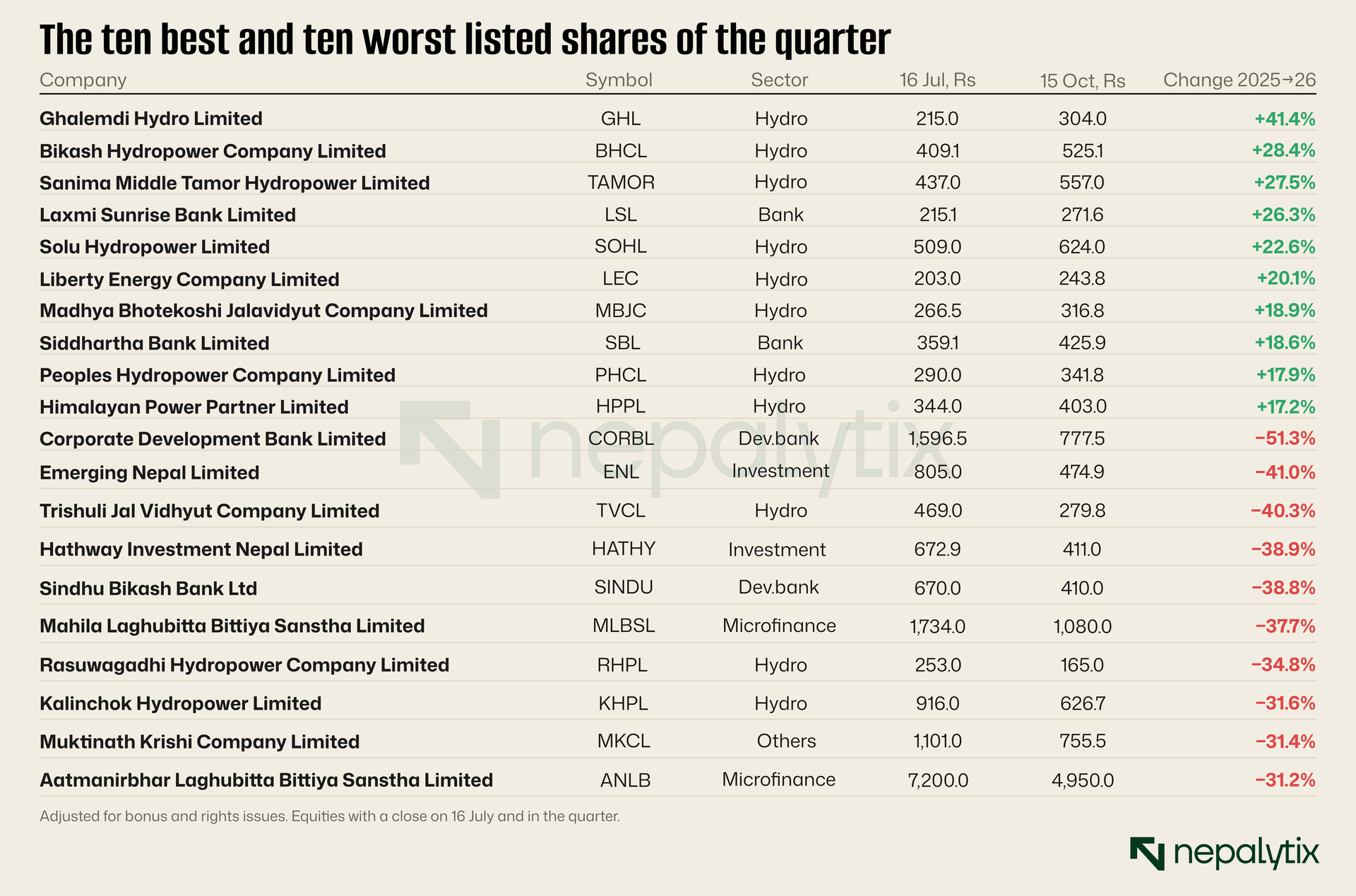
The ten best and ten worst performers of the quarter are below. The winners are mostly hydropower companies and banks. The losers include the flood-hit hydros, Emerging Nepal after its promoter shares came loose and several development banks and microfinance lenders with no single public event to explain the fall.
One name on the losing side deserves a note. Himalayan Reinsurance fell 14.3% over the quarter. Its 76.1 million promoter shares, 70% of the company, come out of lock-in on 26 December. The event study in Thursday's Long Read found that the median stock falls most in the 60 sessions before an unlock and Himalayan Reinsurance is now inside that window.
On the winning side, hydropower dominates the list despite the sector's flat average. Ghalemdi Hydro rose 41.4%, Bikash Hydropower 28.4% and Sanima Middle Tamor 27.5%; Solu Hydropower, the most actively traded hydro of the quarter rose 22.6%. These are not obviously connected to any single piece of news. In a market with low turnover, a few active buyers can move a mid-sized hydropower stock a long way and the same is true in reverse.
09. The quietest first quarter in 26 years
We measured NEPSE's first quarter from the last close before 17 July to the last close on or before 16 October for every fiscal year since FY2058/59. In the 25 earlier years, the smallest move in either direction was a 1.2% fall in FY2074/75. No year was as flat as this one. The first quarter has ranged from a 26% gain in FY2064/65 to a 20% fall in FY2058/59.
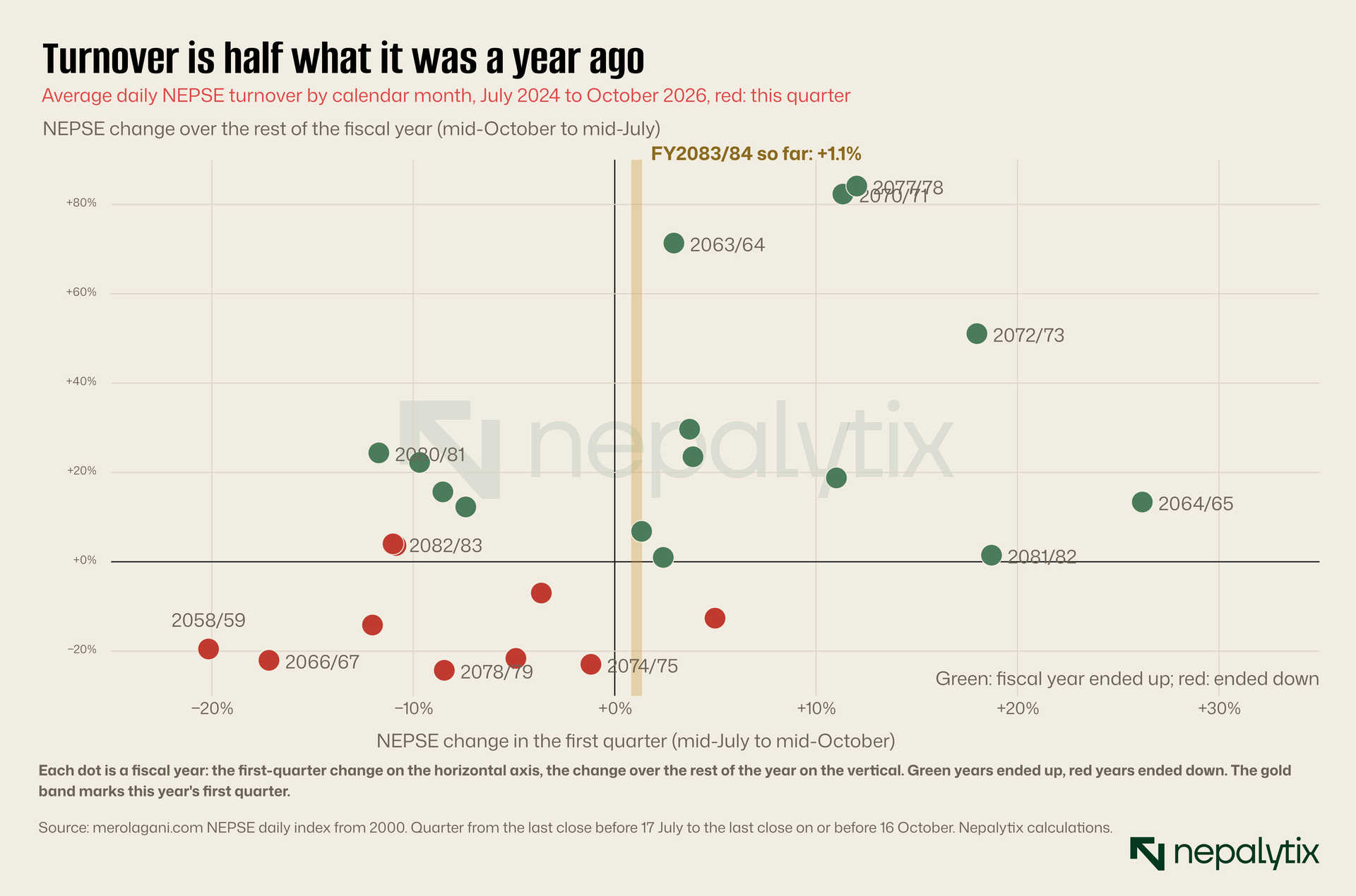
Does the first quarter predict the year? Somewhat. Across 25 years, the correlation between the first-quarter change and the change over the rest of the year is 0.50 and in 20 of 25 years the full year ended in the same direction as the first quarter. But that relationship is driven by the big quarters: strong first quarters such as FY2077/78 and FY2070/71 were followed by huge rallies and steep falls by weak years. Around zero, the chart shows almost anything. Years that began within a few points of flat went on to rise 72% or to fall 22%. A 1.1% first quarter tells us nothing about where FY2083/84 will end.
What it does tell us is how little conviction there was in either direction. The first quarter is when the new monetary policy takes effect and the first signs of the year's credit and deposit flows appear. In FY2081/82 that reaction was an 18.7% gain; in FY2082/83 it was an 11.0% fall. This year the policy raised margin limits, deposit rates kept falling and the index barely moved. The money that would normally follow cheaper credit into shares has not arrived at least not yet.
10. What is waiting on 26 October
NEPSE is closed from 17 to 25 October for Dashain. A number of things that would normally have moved prices during those nine days will instead be priced in the first sessions after the reopening.
Friday's session. This dispatch uses data to Thursday 15 October. The last session before the closure on Friday 16 October, completes the quarter; we will update the figures once it is in.
First-quarter results. The quarter ended on Ashwin 30. Banks and other listed companies publish their first-quarter statements within about a month, so most will appear between late October and mid-November. After a quarter carried by bank shares, the bank numbers matter most. Sunday's debenture Paisa noted that deposit rates fell to 3.2% by July, which helps bank margins, while lending is weak.
Promoter unlocks. Mathillo Mailun Khola Jalvidhyut's promoter shares come out of lock-in on 20 October, during the closure, so the first session at which they can trade is 26 October. Chirkhwa Hydro, Vision Lumbini Urja, Muktinath Krishi and Nepal Warehousing follow in November and early December, and Himalayan Reinsurance on 26 December.
The RBBL debenture. Rastriya Banijya Bank's 6% debenture, open since 15 October, closes on 27 October, the second day after the reopening.
Margin and tax. The FY2083/84 monetary policy, announced on 7 July, raised the limit on share-backed margin loans to a single borrower from Rs 150 million to Rs 250 million. The Cabinet approved new capital gains rates of 3.5% and 5% on 16 September. Neither has yet shown up in turnover: the quarter's average was half the level of a year earlier.
A market that rose 1.1% on half last year's turnover, with nearly two-thirds of its stocks falling, does not go into a nine-day closure with momentum. It goes in with its large banks up, its small companies down, and very little money moving between them.
Disclaimer
This report has been prepared by Nepalytix for informational and educational purposes only and does not constitute investment advice, an offer, or a solicitation to buy or sell any securities.
The information contained in this report is based on sources believed to be reliable; however, Nepalytix does not guarantee its accuracy, completeness, or timeliness. Opinions, estimates, and projections expressed herein are those of the authors as of the date of publication and are subject to change without notice.
Investing in securities involves risks, including the possible loss of principal. Past performance is not indicative of future results. Readers are advised to conduct their own independent research and consult with a qualified financial advisor before making any investment decisions.
Nepalytix and its contributors may hold positions in the securities discussed in this report at the time of publication or thereafter.
Neither Nepalytix nor any of its affiliates accept any liability for any loss arising from the use of this report or its contents.